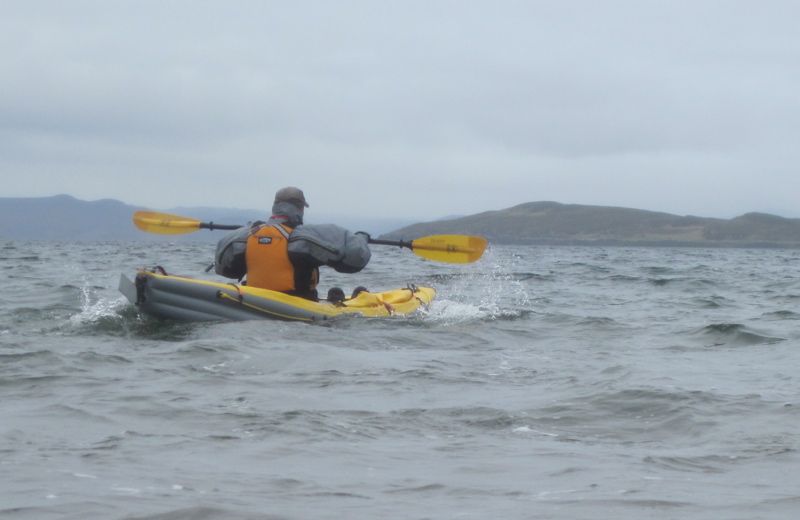
Sunday morning Jon and I went to try out his new boat, another Intex Sea Hawk, but the one-man version this time which goes on amazon for under 20 quid. For that money a pump is extra, but we managed to fill it up, though maybe not as firm as it could have been. Once inflated it dawned on me rather belatedly that the Sea Kork is indeed a row boat; and it’s not just the rollocks and the rocket launchers – sorry, rod holders – that give it away. It’s the fact that the rounded bow has, like a new Alpacka, a lot more volume – and so buoyancy than its flat stern. This is a boat that you’re supposed to row facing backwards – like a rowing boat. If you sit at the less buoyant back end facing the bow the trim goes to pot, much like it could be on an old-shape Alpacka with heavy person in it. Jon is only 80kg so could get away with it, but with me – in all my gear right on the Kork’s 100kg limit – I felt better kayak-paddling it backwards. Better trim (levelness) means less yawing.
We decided to go over to Achnahaird Beach where, as luck would have it, the surf was kicking off the scale with some rollers up to knee height and kept up by a light offshore breeze. I am joking of course, but a few weeks ago the Achnahaird surf was looking pretty damn good (above) at up to a yard high, so even if today was a nothing special, it can be fun here.
I can’t help laughing whenever I see an Intex in action, but it’s as much in amazement that you get so much boat for 20 quid. Out on the water, the first order of the day was to attack the Sea Hawk with the pointy bow of my yellow Phoenician warship (left). Poor Jon had only been 60 seconds in his brand new boat before I was trying to tip him over, like a log-rolling contest.
Kayak paddling from a standing start the Yak left the Sea Kork far behind – no great surprise there. Jon then took his TNP apart and tried rowing which ought to be more efficient and so faster. But all he did was a backward zig-zag; maybe that takes some practice – or a rowing boat.
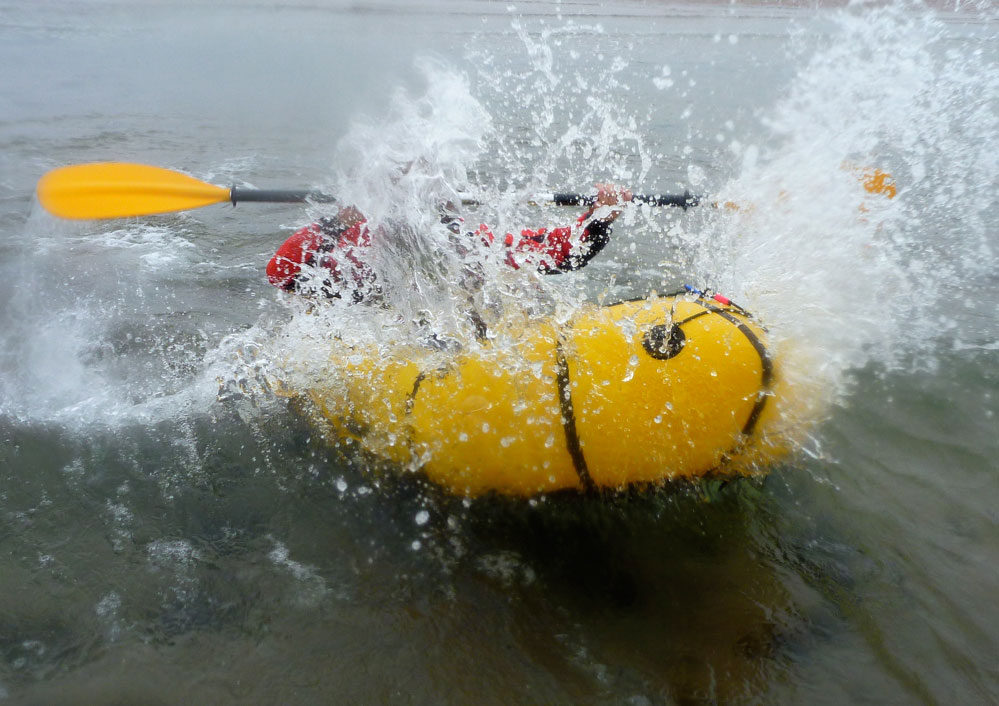
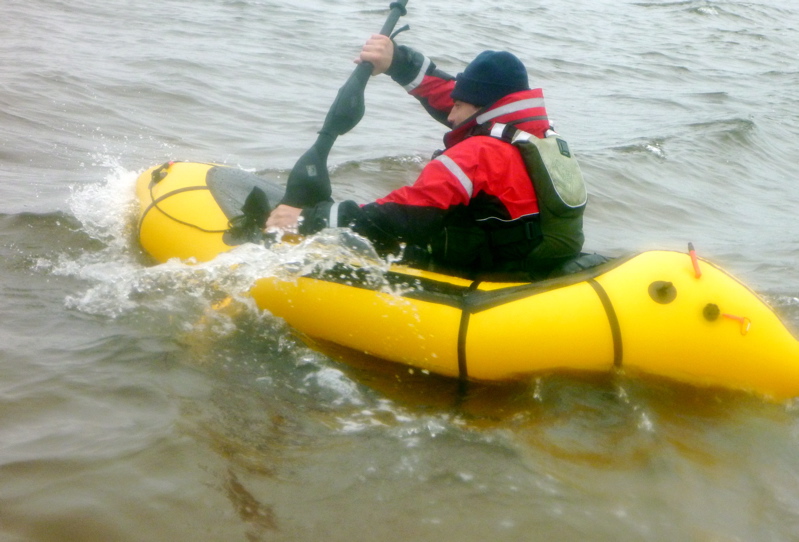
By now we were nearing the surf zone where we spent the next hour having a laugh. Neither of us had ever tried this so the semi-surf was just right; we couldn’t tip our boats over whatever we tried, but if we caught a good one on time we could get a good ride and then head back out to try and ‘wheelie’ off the next one coming at us (left and below).
We swapped boats and confirmed the obvious; the $1000 Alpacka blows a hole in your wallet, but it also blows the Intex inflatable squid off the water. They weigh about the same, but it’s down to the Yak’s shape, lesser width and a snug fit to give you control, as well as no rollocks or fish launchers to bash your hands on as you paddle along. By the time I got in the Sea Squak the inflatable floor was already limp so I was sitting about six inches lower than my feet, not an ideal paddling stance in a boat that’s a metre-wide. On the way back I tried kneeling, but that soon got uncomfortable. Even then, sunk down and paddling ‘backwards’, stern to front, the Sea Stork still tipped along at 2.5mph without much yawing. So as a packraft the Intex does the job and has got to be one of the best value neo-packrafts around.
I’m told one of the shots on this page was published in the 2012 Alpacka Calendar.
Rounding it all up over the years and my packboating footwear has narrowed down to: Teva Omniums for light duty day paddles and Lowa Desert Elite boots for heavier tramping with loads.
Otherwise, this is what counts
No membrane
No mesh uppers, butatough,quick-drying fabric that can take the knocks and is salt water tolerant. Durability is more useful than the lightness and wet grip.
Good draining – particularly at the heel rather than the instep, as that’s how you drain a shoe when sitting down in a boat with your legs sticking out over the sides.
A thick, chunky sole, ideally from a boot not a trail shoe. One that offers solid support over rocky terrain and good grip in mud or wet grass. Custom insoles for comfort tuning can always be added later by the owner.
Proper laces. Forget velcro and cinch-cord locks – that’s for cag cuffs and stuff sacks. Laces may not be high-tech, but they’re field repairable and still the best way to get a shoe or boot to fit a varyingly sized human foot securely.
A wide fitting (for me).
Some provision to stop stones getting in and possibly wearing holes in a latex drysuit sock (though wearing socks over drysuit socks is probably a better solution).
And great build quality.
Until that distant day comes I’ll stick with my Teva Omniums (now on my second pair), even though they’re rather more for day-use than overnighting. Update here.
With an IK you hop in, paddle away and hop out. You’re not normally tramping for days carrying your gear. Even Neoprene booties will do, or just an old pair of trainers. Packrafting footwear (that is, trekking the moors and paddling the lochs, usually with a camping payload) requires an amphibious boot which will drain and dry quickly while giving you support on the trail.
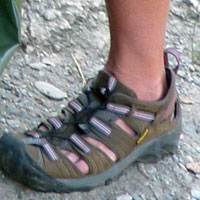
Of course you can just use any old boot and let it get wet. But anything with a membrane (GoreTex) can take quite a while to dry. On my first ever overnight packraft trip I used Keen Arroyos (left) and paid the price. I made the mistake of putting water duties (drainage/easy drying) above ground support for trudging cross-country with an 18kg load. With the thin soles and feeble, slip-prone lacing Still used by Keen), I didn’t feel at all secure in the rough, and when I got to a long, road-walking stage the feet soon got sore. On any kind of rocky terrain or path they’d have been worse. Having said that, when my current Teva Omniums wear out, I may give the Keen Newport H2 a go. They’d drain a lot faster from the heel.
Keen Newport H2
I then adapted a pair of less flimsy Karrimor Meridian trail shoes (left)I got for 30 quid, by pushing draining holes through with a red-hot poker. Shame, as they have an eVent membrane, of which I hear good things. They weren’t a great full-on hiking shoe and under my 95kgs the sole got mushy and the tread offered little grip in steep or wet Scottish conditions, partly why I find a packstaff so useful. But they were better for loaded, rough-country walking than the Arroyos. And it has to be said they’re survived a regular sea-water soaking, rinsing, airing and drying pretty well for a pair of cheapies. Nothing came apart but it can’t be far off.
Brasher Lithiums (left) fitted me OK, had an usually stiff sole which also happen to make good MTB boots and they passed a test on the Fitzroy in Australia, although much of the time we were wading or even sinking in quicksands which were easier to get out of barefoot.
After a couple of nights I poked through drain holes (below) on the instep and above the heel so they drain as the feet point up in a boat. Back home on regular day walks the Brashers turned on me, rubbing blisters at the heel and then squishing the small toe as they were too narrow.
Another idea could be some Crocs. Remember the Croc Craze a few years ago? Their Swiftwater Mesh Deck Sandal (below) is an acquired look, like regular Crocs (left), but goes for under 40 quid on ebay and weighless than the Tevas. For something which gets squeezed out of a tube every few seconds in an Asian factory, with that mesh upper I’m no convinced they’ll last very long.
The forecast was good and with time running out, such days cannot be ignored. ‘Let’s go and do Suilven‘ I said to the Mrs. ‘Better still, let’s take the bikes and the packraft, park the car at Inverkirkaig, cycle to the trail head, climb up the north side, down the south side, and paddle Fionn Loch into the River Kirkaig for the footpath back to the car to get the bikes.’
‘What was the last bit again?‘
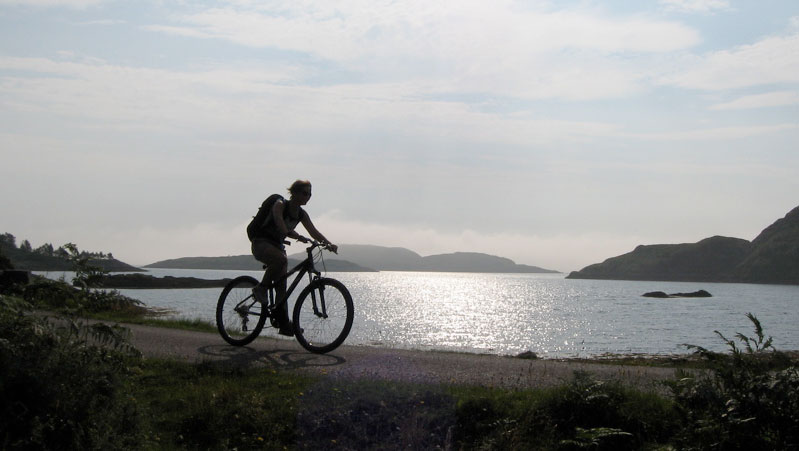
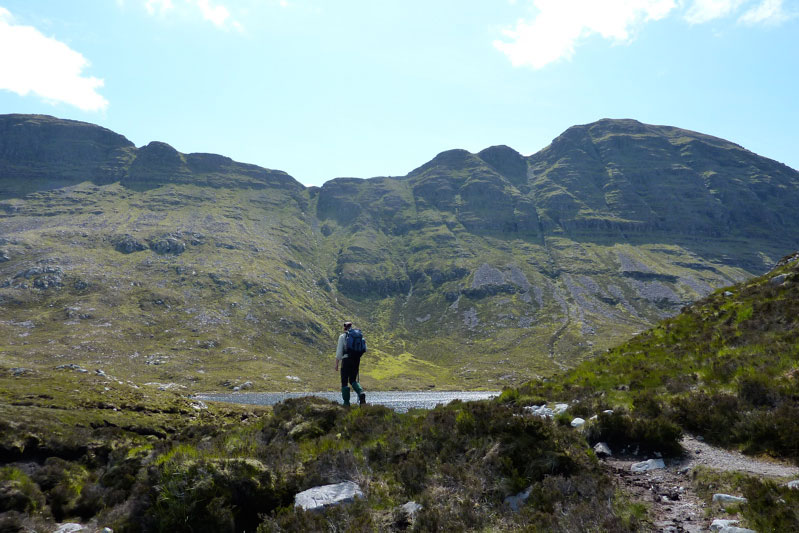
It’s a hilly 6-mile ride from Inverkirkaigalong the WMR and up to Glencanisp Lodge where the road ends. From that angle Suilven rises like a sperm whale’s head over the gorse and lochans. Maybe it was the sunshine, but Glen Canisp that day looked like something out of a Scottish Tourist Board advert, and was made all the more appreciable by the easy quadbike track we followed east. One time that would be great walk to follow the 14 miles all the way through to Cam Loch and the A835 near Ledmore.
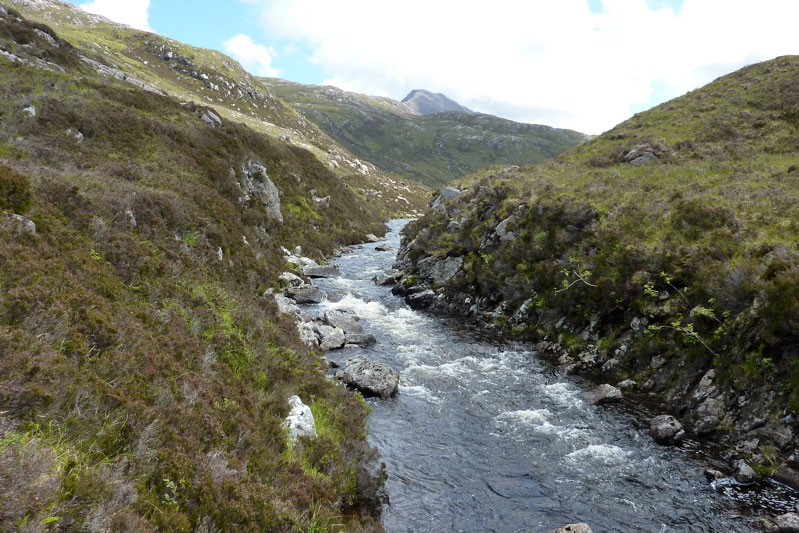
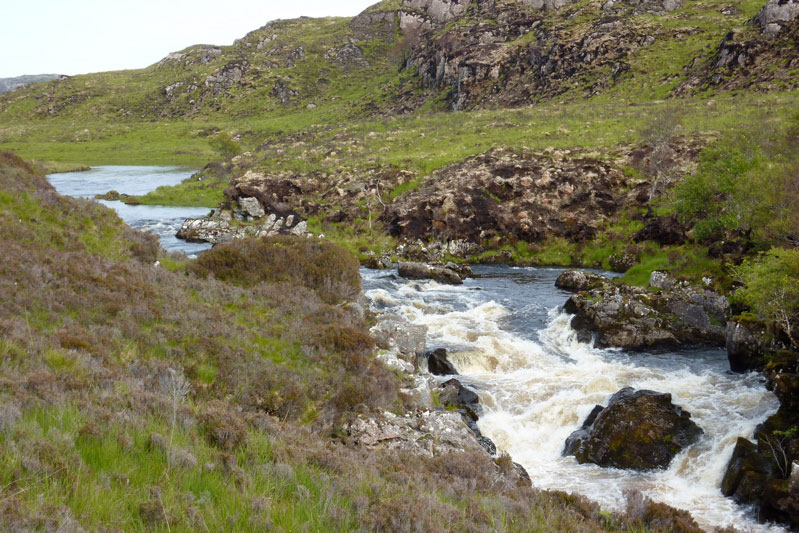
Of course, as ever these days, I was eyeing up the pack-potential of the Abhainn na Clach Airigh river too; actually string of easy lochans and gorges (left), linked with flat or frothy river stages. That too would be a great run, more probably from the Ledmore end, and with a handy bothy at Suileag. Or cook up any combination you like; with boots and a paddle the possibilities here or anywhere in northwest Scotland are infinite.
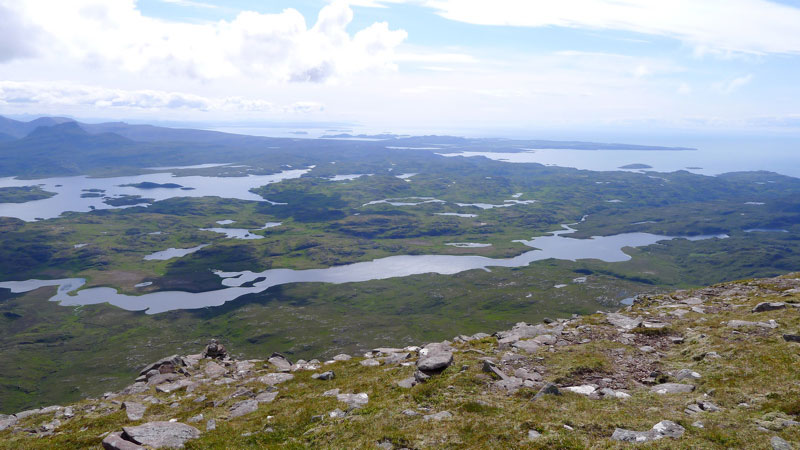
There comes a point directly north of Suilven’s twin-peak saddle (right) where you have to leave the easy track and head south into the bogs and up. You can’t see a path up the side of Suilven, but it pretty much follows the creek running down from the saddle; an hour and a half’s slog from the quad track that’s as steep as any track can be, without using your arms. And yet, as long as you keep chipping away (left), it’s always quicker and easier than it looks. And it’s quite a thrill to approach the saddle and have the Loch Sionascaig vista erupt before you (below right) as you catch your breath.
G/f decided to rest here while I took on the last 130 metres up to the summit, about 20 minutes away. For some reason a ‘magnificently pointless’ dry stone wall straddles the summit ridge near here. A quick look on the web came up with no convincing reason to its origin, though it does extend downwards enough on each side to stop agile stock either leaving or getting to the summit. And on the actual top there’s certainly enough room to graze a few sheep as well as curiously closely cropped grass. We’d not seen a sheep all day so unless deer make the climb you do wonder what grazed the grass up here? More Suilven summit mysteries.
From anywhere up here we could see the way back; the put-in near last week’s camp and the 2-odd miles along Fionn Loch to the entrance of the River Kirkaig (left). These waters define the border between the counties of Ross & Cromarty and Sutherland. While I was planting the flag, G had been scanning the scene below with binoculars and had spotted the waterfalls on the River Kirkaig we very much did not want to get sucked into.
We set off back down the looser south side slope, don’t want to go on but it was another validation of the knee-sparing Packstaffing Way. Without it it’s hard to see how anyone would not stumble or slip a couple of times. Passing the spot I reached last week, strange barking sounds emerged from the heather. A grouse in distress? Turns out G with better eyesight had seen a couple of dashing deer right in front of me.
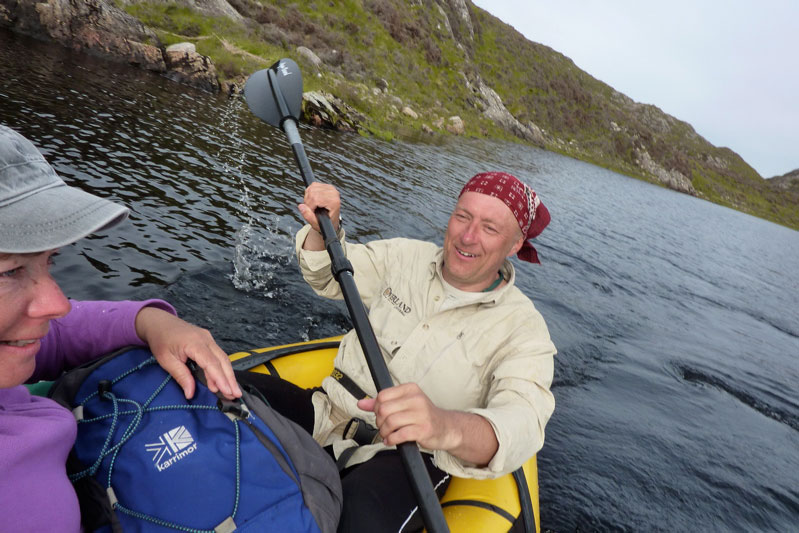
Down by Fionn Loch I wasn’t convinced two-up in the Yak was going to work or be safe. But we tried fitting in on the bank and in fact it was roomy enough with my legs out over the sides. So we put in and pushed off west across the loch (left) for the river, initially following the shore. Then as it became clear the 3-kilo boat-in-a-bag managed its 160kg (350lb) load fine, I set the engine for full ahead against what I perceived [incorrectly] was a slight current as well as a breeze. Amazingly (or perhaps not) I’ve never seen my packraft track so well with the near-perfect trim.
About 40 minutes later the entry point to the river loomed, with a mild rushing sound caused by the race of water flowing off the loch. We were a little edgy, knowing a deadly waterfall lay not far ahead. We let ourselves get swept in and as soon as I entered the river the boat handled differently, like a kayak in a backwind. It was the current of course wafting us onward. I went as far as I dared and stopped paddling for a moment – a louder rumbling of white water became evident. Two up, sluggish and with no BAs, we didn’t risk it and headed for the bankside footpath.
Rolling up and looking back, it seemed hard to believe we come up and over ‘Pillar Mountain’ as the Vikings had named the prominent maritime landmark of Suilven. By taking to the water we’d saved a bit of time over the path and rested the legs for the last hour’s trek back to the car and a short drive back to Glen Canisp Lodge to collect the bikes. All up, a great day out; 7 miles cycling, 2 paddling and a dozen on foot. And the Yak had proved itself as able handle the two of us for similar flat water transits.
Packrafting the River Kirkaig The minor waterfall (left) we took out before might be rideable by the likes of Roman Dial and his intrepid chums, but the thundering 100-foot Falls of Kirkaig (see map, above left) would only appeal to gonzo hairboaters high on Red Bull and Go Pros. From there though, the river far below the track seemed packable to the brave, certainly at a point where the path drops down right alongside and the river where it broadens out, just under a mile or so from the road bridge. All grade II or less; even I could manage much of it. Beyond the bridge, it’s just half a mile to the sea at Loch Kirkaig, which would be satisfying to pull off, but even at the relatively high levels (now dropping), it gets pretty shallow in places and would not be a clean run. But don’t take my word for it. I read the river is listed in the SCA whitewater guide.
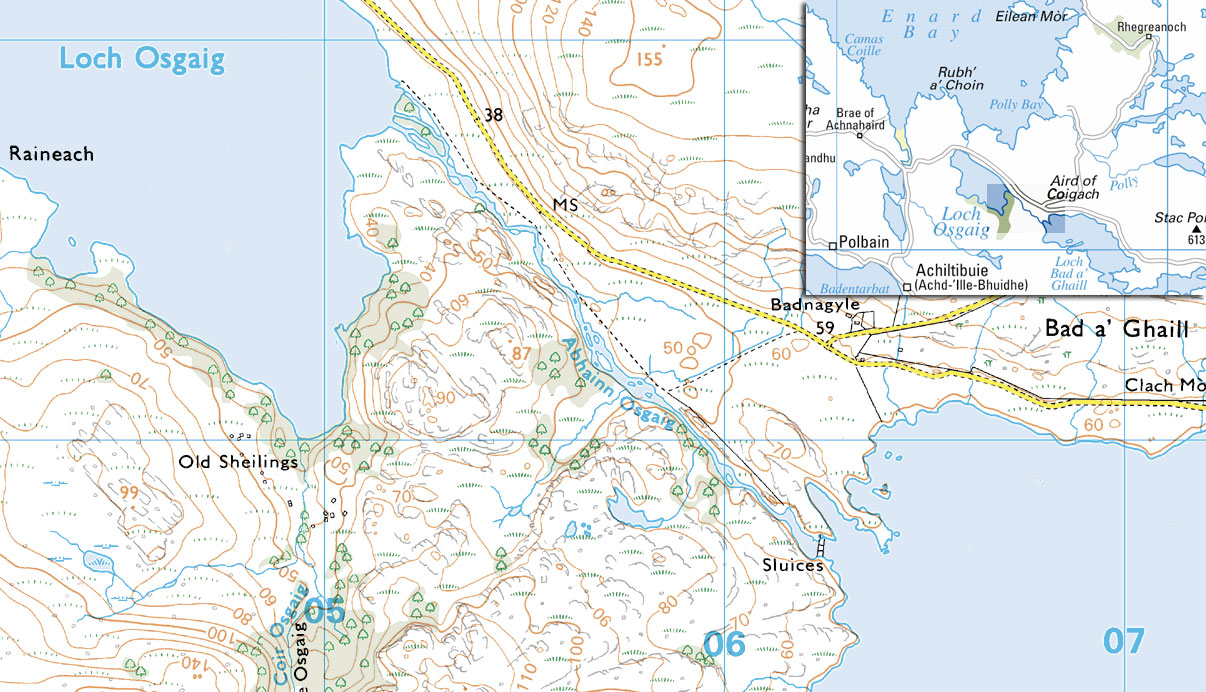
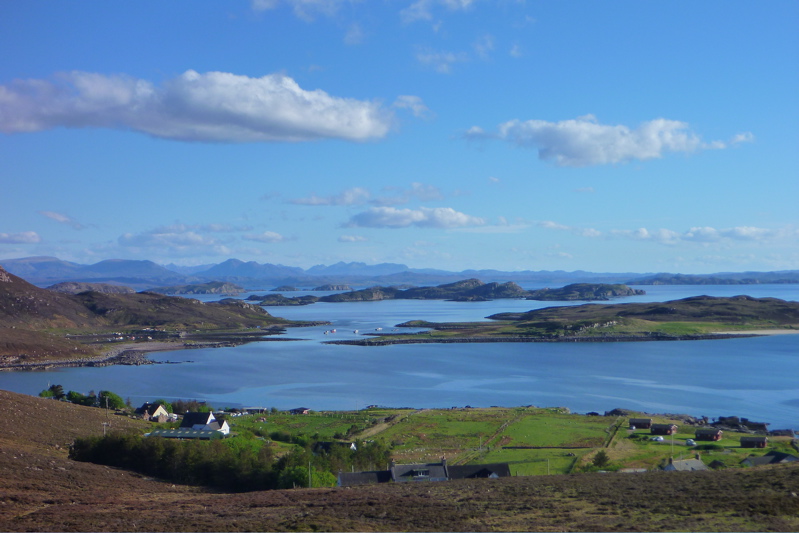
While dodging stray sheep and oncoming traffic along the ‘Wee Mad Road‘** that leads off the peninsula to the outside world, I often throw a pack-hopeful glance over to a creek called the Abhainn Osgaig. It runs for a kilometre or two down from Loch Bad a Ghaill to Loch Osgaig, which in turn drains into the sea at Enard Bay. Most of the time what you can see from the road looks a bit boney, but the other day, following a week of gales and squalls, it was full enough to catch the eye. Driving back from a recce for another packrafting plan, I squelched over the bogs for a closer look, as most of it appeared hidden in a gorge. Sure enough, from some nasty-sounding sluices at the west end of Loch Bad, the river drops briefly into a narrow gorge you can’t even walk along. Viewed from the bottom end it was running hard enough to put me off. If I was thrown in I suppose I might surprise myself with some quick moves and get through without dumping, but I don’t fancy any white water that looks like it needs head protection. It’s a bit frustrating to be such a ninny; a creekboater wouldn’t shake a cag at this one, but I can just see myself flailing around like a squid in a blender, bouncing out of control from rock to rock.
Below the gorge (2nd and 3rd pics, left) it spreads right out so even I could acquit myself; if anything it looks like I’d need to step out in the shallows once in a while. Back in the car and driving on slowly, I spotted at least one more waterfall I’d not want to drop in on uninvited, but there’s plenty of room to walk round that one so it would be fun to bike out there one time, tramp upstream from Osgaig loch for a good sticky beak, and put back in for the 10-15-minute ride back down. Although I’m always on the look-out, there aren’t many packworthy rivers close by, so while the Osgaig runs deep enough to float my boat – and at a time when it’s too windy to do any other boating of substance – that is this week’s mission in the Yak. Right now it’s pelting down again and the sea is heaving. I’ve just heard the Shipping Forecast out in the Atlantic (Rockall, Malin, etc) is F11, just below a hurricane so the prospects for rain and high water are good.
A few days later I got fed up waiting for a break in the weather – it’s the worst May for 37 years they say, and most of the time too windy for solo sea kayaking in my Incept. So we schleped up to the Osgaig between downpours, and I took a bit of a run at the lower half just below the uninviting waterfall.
I miss the fun sensation of scooting down a river in a packraft, but I wasn’t really getting any this day. Even in what passes for spate round here, the Osgaig is just too shallow and I winced as the poor Yak scraped over the boulders while being relieved I got Alpacka to spec it with a butt patch. Bouncing off, or hanging up on rocks lined me up all wrong at times, but in an Alpacka one firm pull lines you back up. Fact is, there was no rhythm or flow and I felt like someone with a flash new toy desperate to find somewhere to play with it. It wasn’t even worth running the remainder of the river down to the loch.
Day-boating like this is not really my thing anyway. I’m more into pack-rafting and have a great one- or two-nighter lined up round the back when the cabin fever hits the red zone. Of course no one comes to Scotland for a sun tan,, but at least I have the Ardeche Gorge to look forward to in late July. No two ways about it, that will be a great run. See this: same river a year later.
Normally on a decent weekend up here (as pictured left) there’ll be half a dozen vans with their distinctive kayak racks parked down at the beach. This weekend they’d all clearly read the forecast, but keen to get some hours in for an upcoming plan, kayaking chum Jon took a chance on the long drive up. The good thing with the lie of the land hereabouts is there’s usually somewhere sheltered to go wherever the wind’s coming from. Except perhaps during a northwesterly as predicted for Saturday and which bowls straight up the skirts of the prevailing lochs and valleys.
With it all laid out on my doorstep, Saturday afternoon we put in at sheltered Old Dornie harbour (left) and tried to head out round the adjacent isles, but I lost my nerve at the sight of the oncoming swell and increasing wind. Eager though we were, we reverted to Plan A, turned round as if on a tight rope and settled for a couple of hours solo re-entry practice, something I’d yet to try in my Incept K40.
Being a hardsheller, Jon works on his roll from time to time, but hasn’t quite got it nailed yet. He’s got a good alternative though, re-entry and roll, they call it – getting himself into the semi-submerged kayak on its side and then once in and braced, doing the hip flick and paddle float lift to get himself upright, at which point he pumps out the hatch compartment.
Me, I tried lunging onto the deck from the water, as I would on my former Sunny or my packraft. But the K40 bobs quite high when empty, so I was surprised I managed it, perhaps aided by the added buoyancy of my dry suit.
The problem is, once slumped belly down over the hatch (above), what next? You fall back in, that’s what next, because trying to turn onto your back tips you off long before you get your legs securely down the hatch. Perhaps with a bit more practice and finesse it could be done, but this was pretty calm water so realistically, just as on a hardshell sea kayak, it’s usually too tricky to pull off unaided. I then tried with my new paddle float as an outrigger. Would you believe it, re-entry was much easier and also pulls less water in as the boat remains more upright. Hook a leg over the floating paddle shaft and scuttle aboard. From this position I found it was fairly easy to flip round and drop bum first into the hatch and then stuff the legs in.
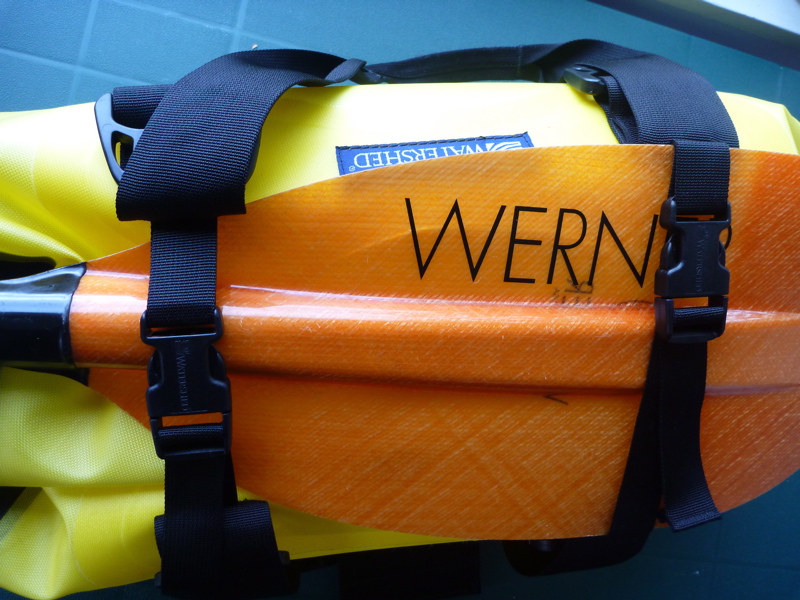
On that day I was carrying my two Watershed dry bags full of camping gear to see how it handled, so they helped reduce the boat’s possible swamped water volume, but even then any deckless IK conveniently self-drains when flipped back over – no awkward, X-rescue hauling over another kayak’s glossy fibreglass deck to drain. Once in the K40, there were only a few inches of water to bilge out, certainly not enough to cause sloshing instability (the true reason why you need to drain a kayak fast following a deepwater re-entry – not because you’ll get your pants wet). One thing I noticed was a rope knife attached to my pfd got caught on the hatch coaming, and also all this grovelling around over my wet kayak’s deck pulled the bite valve off my new CamelBak/pfd set up which then drained away. That will be £4.99 please. Now I know to reposition one and tuck in the other to avoid any snags. Spraydeck newsflash! The massively oversize cheapo spray deck I bought and modified (left) still required a lot of scrunching. But having actually used it, my feeling is the K40 sits so high it’s not going to be needed unless it gets cold or I’m heading for river rapids. At other times it’s just more clobber to carry around, wash and dry. Maybe I’ll get to see the value of it as my experience in the Incept extends. On a much lower sea kayak like Jon’s P&H, a deck is pretty essential.
The other way to get back into an Incept from deep water would be to simply unzip the decks and haul yourself on. No paddle float needed, although it occurred to me yet another use of the Watershed bags, particularly the smaller yellow Chattooga, could be as a paddle float (left). Any dry bag will do, but you know the Watershed’s won’t so much as seep a drop like a roll-top will after a few minutes, and the Chattooga even has some clips which can be used to secure a paddle blade.
If not using any type of outrigger float, a bit more water will swill into the K40 as you pull over the side to get back in. Ideally you then want to crawl up through the unzipped hatch hole as you got aboard, ease around and take your seat. But now you have the fairly tricky manoeuvre of trying to zip up the decks, all while hanging onto your paddle and not tipping back in. As I found first time out, without the support of another boat or a float, reaching the fully opened zip pulls on the Tasman is quite an unstable stretch from the seat, even with the grab loops I’ve tied to them. Longer loops might get in the way so some sort of a hook stick is needed if no one is around to do it for you. Regarding the K40’s zippy deck, as long as I wear a dry suit I can see even less need for it at sea in the conditions I’m every likely to go out in. Only on a WW 2 or 3 river would it be handy (with the spray deck) to save the boat swamping and the need to find a bank to drain it. If you’re paddling undecked, getting in from deep water all so much simpler, just like an SoT, and if not there’s a good section on the informative Kayarchy website illustrating all sorts of deep-water rescues.
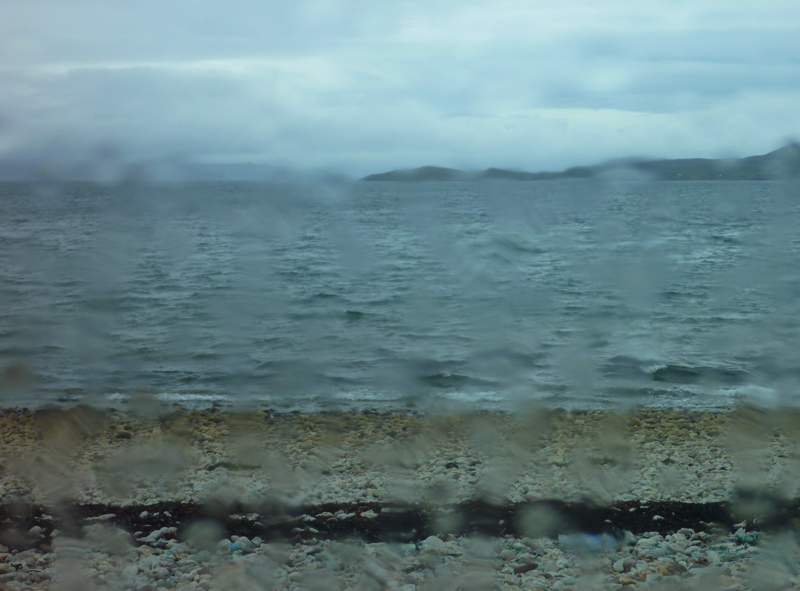
Next day we set off to try and actually paddle somewhere, but off the beach it still looked horrible (left and right); 15-20mph winds but now from the SW. We paddled towards the Isles anyway, but after 15 minutes I didn’t like what I’d guess you’d call a boat-stalling ‘short chop’ which would only get worse further out. While hacking away warily, it occurred to me that focussed as you are in such conditions, it takes some effort to think of others or even keep track of them, and should they flip while you’re barely coping yourself, it can all go horribly Pete Tong. After all, no one usually capsizes is calm, wind-free conditions. That’s why we wanted to get some practice time together out here. The plan had been to go as far as camp the previous night, but the miserable weather and a fully fitted house just a mile away nixed that idea.
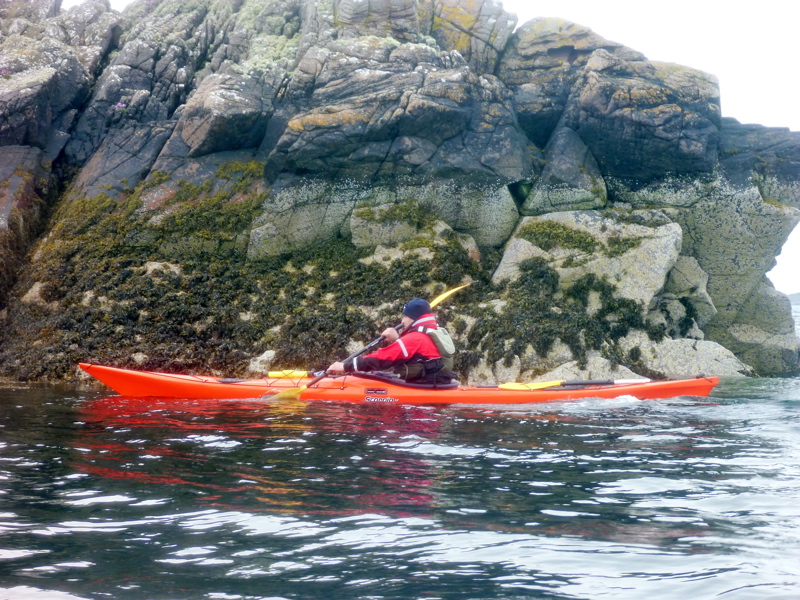
It wasn’t actually that gnarly, just not much fun and possibly about to get less so. As we did a U-ey I was encouraged to observe my Incept that morning felt less intimidating to turn than Jon’s slinky P&H. Again, no great surprise; his boat is floating stick insect with the turning circle of a stretched limo. The K40 is wide, has a rudder and – now that I’ve seen pics of me in it – the ends sit out of the water even with my weight and a 10-15 kilo load aboard. Is that a lot of ‘rocker’ or a little, I forget, but it turns easily with rudder + paddle strokes, and with the rudder up can spin on its axis with a lot fewer paddle strokes than Jon’s Scorpio. And with fewer edgy moments too. I was getting the feel for the Incept in rougher water.
So we sailed ourselves back to the beach, fighting to steer with the tailwind. Once there we settled for messing about closer to the shore, practising more turns out on the swell or paddling parallel to waves to gauge tippiness, secure in the fact that we were constantly getting blown inshore.
I was open deck that day, but noticed where the Sunny would have flexed and swamped over the rounded sides where I sat, the more rigid and higher-sided K40 stayed mostly dry. I was also conscious that even though they are also more clobber and something to catch your foot on, the thigh straps I’m waiting to glue in would surely help control in rough water. Either that or I see them as the only possible explanation for my lame kayaking skills! With the deck off we also tried paddling the Incept two-up – me sitting in the back facing backwards. That’s a total weight of at least 180kg in our gear, 20kg over what the Tasman is rated for. Jon reported the boat was tippier like this and had it been a serious requirement, I could have laid down to improve stability. One thing I noticed open deck is that there’s less back support from the low seat – a common problem with IKs using inflatable seats, and one reason I went for a Aire Cheetah seat on my Sunny. Clearly with the deck on the flexible coaming helps as a back rest and by the end of that day I felt the tops of my legs straining a bit in a bid to maintain upright. The problem is there is nothing solid to brace the feet against either, but I imagine this is another benefit of fitting thigh straps.
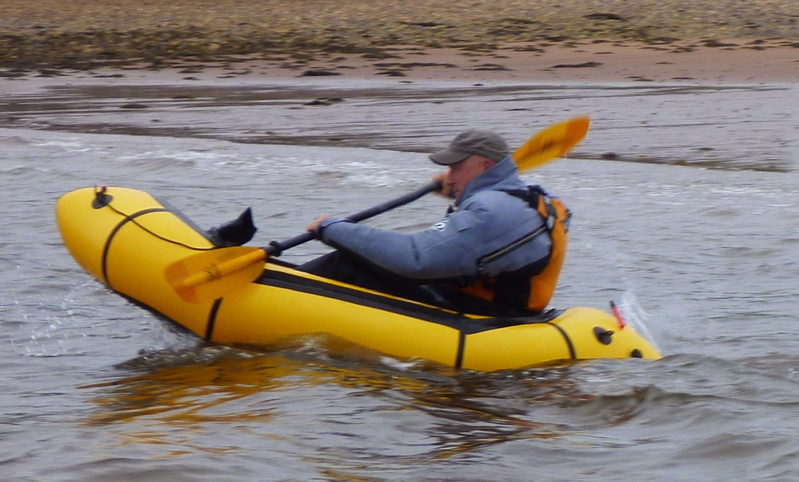
Having mastered many new skills, we had a quick scoot in the packraft (above); fun and very stable in the conditions, but also so slow you’d run out of puff before getting anywhere. The initial instinct in the chop was to try and jump it like a BMX bike; it sure would be fun to try surfing it on bigger waves one time.
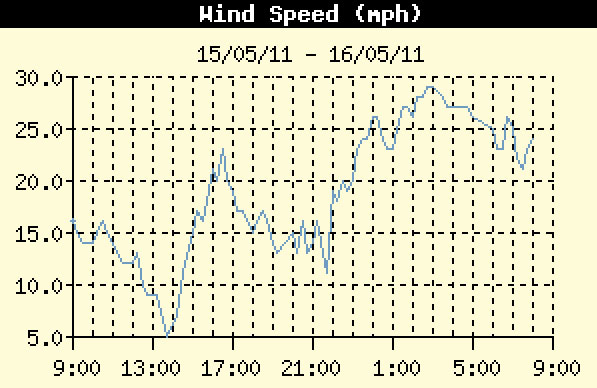
Suddenly a glassy calm befell the bay, just as a private weather station near Ullapool recorded accurately in the graph on the right. Great we thought, let’s make a dash to the Tanera Mor about a mile and a half away, so we can say we got off the mainland – an ‘open water’ crossing! In this way many foolhardy newbs sail off to their doom, I suspect, because little did we know it was just the wind clearing its throat and refilling its lungs before coming back from new direction and harder than ever. But not before we’d managed to cross over and nudge the island’s sandstone cliffs (left) with our bows.
The previous day and that morning I’d been put off in similar- or even easier conditions but now, after a few hours playing around we were more tuned into our boats and even headed back diagonally across the stiff back wind and swell to make it a bit more difficult. Me of course with the aid of my rudder; without it I’d be correcting all over the place and need to stern-rudder, as Jon occasionally did. With backwind ruddering, I noticed it’s not a simple matter of holding the rudder at a certain angle because the tracking continually goes off, presumably as a quartering wave rises and drops behind you. A constant pedalling of the rudder controls was required to keep on the track. Don’t know if that’s normal, but I’d hate to wear out my rudder lines prematurely. So not a totally wasted weekend. Now we know we can get back into our boats alone one way or another, and can actually handle F4 conditions within sight of the shore, even if next time we go out, initially we may not feel that way.
I’d parked the RV at the end of a 55-mile track south of the highway at Hole in the Rock, the top of a gully which drops 500 feet down to Lake Powell and which is bit of a scramble in places. If this was the Australia that I know, the chasm would be plastered with ‘Gorge Risk‘ signs. Looks like the Americans have got over all that, if it ever existed here. What you see – a steep, boulder-chocked gully where you want to take care – is what you get.
Getting down and back up from the lake wore me out for a day, but what was I complaining about? In 1880 Mormon pioneers spent six weeks here lowering two dozen wagons to get across what was then the Colorado river (read right) to get to a new settlement on the far side. Once on the water I only went for a bit of a splash-about in a flooded arm off the main body of the lake as it was a bit windy and I wasn’t sure what weather lay ahead. By the time I got back to the top it had clouded over and stayed that way till I left the GSENM a few days later. Changes on the conventional-looking pre-2011 rafts are summarised here: pointy ends, greater length, extended stern, 2-part backrest/seat and a deck that zips right off. I also have a feeling the floor’s made from a chunkier or stiffer fabric and so the extra butt-patch I had specified (left – done for free) may not be so necessary – but it sure feels worthwhile when scraping along a boney Scottish burn.
On the water first impression was not so good – oh dear the 4-inch shorter Yak was seemingly narrower at the front than my old Llama and I couldn’t put my feet side by side when pressed against the front (left image on the right) – this wearing size 11 Keen Arroyos (fairly wide). But deflating the backrest from full gave my legs more room and I actually found that both feet placed flat on the floor below the bulge of the side tubes worked fine (right image above right), just not so sure if this is so intuitive for brace control. I checked the front interior width of my Llama against the new Yak and it’s only an inch wider. In the picture left the new Yak and Llama fronts seem near identical in interior front width.
Getting back in the longer Llama, I now see the reason my feet didn’t jam was that I had a few inches gap between the front of my feet and the inner front of the boat where it tapered off. Sat against the back I could never reach the front to brace which is why I got the Yak. Also, the UDB on the new Yak may have constricted my feet a bit that day. Paddling a few days later without the UDB, I can’t say I noticed the foot jam. Got all that?
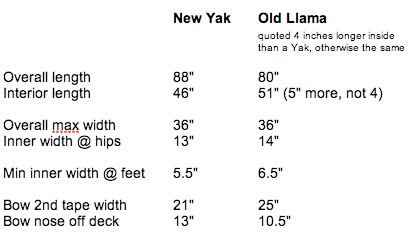
Other fascinating facts from my comparative measurements (above right) show the new Yak is only 8 inches longer then the Llama, so a new Llama ought only be 12″ longer, not 20 inches as estimated from the Alpacka website’s measurements at the time. The new Yellow Yak is nominally 4 inches shorter inside than an old Llama.
Other than that it feels much like the old Llama. Like they claim, turning/spinning doesn’t seem to be affected by the increase in length, but I’m sure the Yak’s bow yawed less from side to side as I paddled, due I suspect to the extended tail damping the paddle-induced pivoting effect, rather like a rudder or skeg. I did have my part-filled UDB strapped to the front where any weight tends to reduce yawing anyway. It was the first time I used the UDB on the water and have to admit the added guarantee of its girth and buoyancy was reassuring should a Colorado river barracuda make a bite at my Yak. Couldn’t really do any speeding in the conditions – it may be just half a mph faster, but that’s still some 20%.
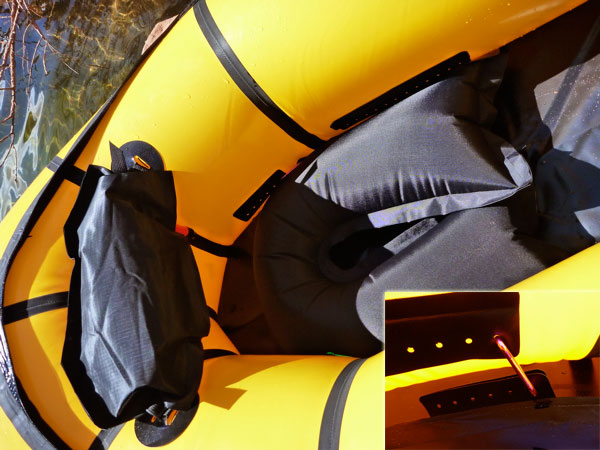
As anticipated, the new 2-part seat is a real improvement. No more having the backrest flop down as you’re trying to get in quick off a steep bank or into a fast flow with a need to line up or burn. Like on my Llama, I just clipped the seat base onto the hull tabs with a single snaplink each side (inset, left) rather than mess about with the string they supply. Makes taking it out and drying/cleaning the insides easier.
Later on, washed up on the wrong side of the Virgin River Gorge in northwest Arizona, I also found the part-deflated backrest a handy way of portaging the empty boat – a bit like a Sherpa’s headband (left). So, bottom line, not a huge difference in operation apart from less yawing which was never that bad anyway once you compensated for it. Can’t say I noticed any added buoyancy/better trim with the longer back, but it might be noticeable from the other PoV. The zip-off skirt is a nice idea; one less thing to unroll and dry after. The added snugness I dare say I’ll appreciate in rougher conditions and it sure is nice to have a yellow boat for a change! There was a discussion on BackpackingLight about the new shape and here Roman D gives his opinion for a harder core of white water utility. More pack-Yak adventures this summer.
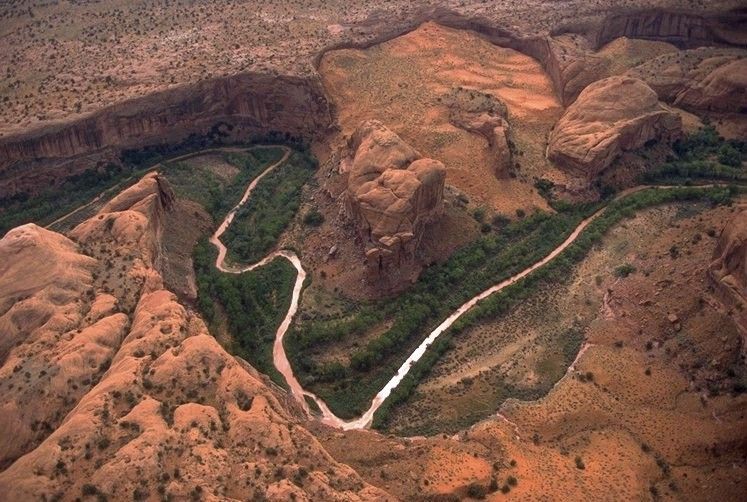
My latest flawed packrafting plan had been to try my new Yak down the Escalante River in the spectacular and relatively remote GSENM – a place I’d been wanting to visit for years. But after a long trek down to Lake Powell for a quick christening on the Yak) on top of what would probably turn out to be a day’s effort required to position my borrowed vehicle, the forecast for the next few days (top right) was not so promising: rain or possibly snow on top of high winds. I expected things may not work out exactly as planned and didn’t mind as I knew the GSENM and southern Utah in general had plenty of wilderness action off the water.
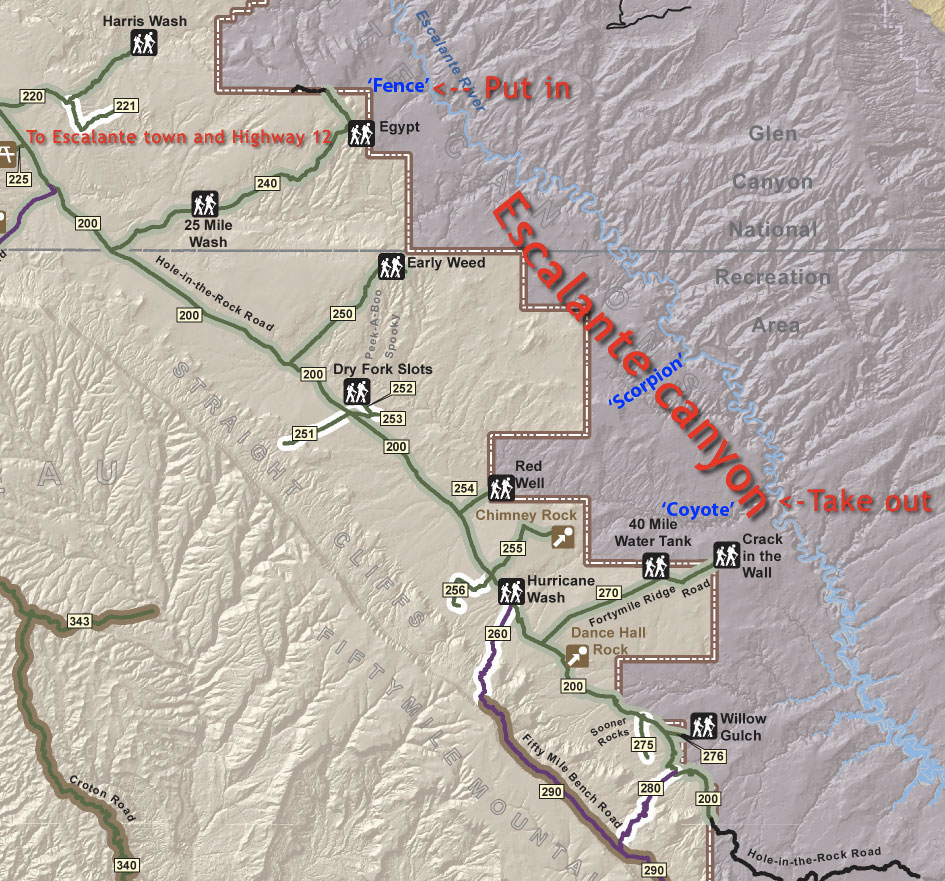
In the end, I’d have happily settled for a couple of day-runs on the Escalante but park HQ explained the river was all or nothing. I checked out an uninspiring local dam; any natural lakes in the area were high up and all still frozen I was told. Most put in at Egypt trailhead, aka Fence Canyon (see map) and take out 40 river miles later, either following Coyote Gulch upstream 13 miles to Red Well trailhead close to the main Hole In The Rock track, or up the dune to Crack in the Wall close to Fortymile Ridge trailhead which was 10 miles or so from the main HitRock track. Or you can head onto Lake Powell and arrange to get picked up by a boat out of Bullfrog Marina, but that’s expensive and unnecessary with packrafts.
However, it’s up to a 1000-foot drop from the trailheads on the bench down to the river and if the Escalante was that easy, many more boaters would be paddling it. I think that’s why it’s become a packrafting classic; they’re the only practical boats to run the Escalante river without getting bogged down with a pick-up off the Lake. So in the end and in the time I had, I settled for a foot recce of the Escalante’s access points, while hoping I wouldn’t get snowed-in in the park before my plane left.
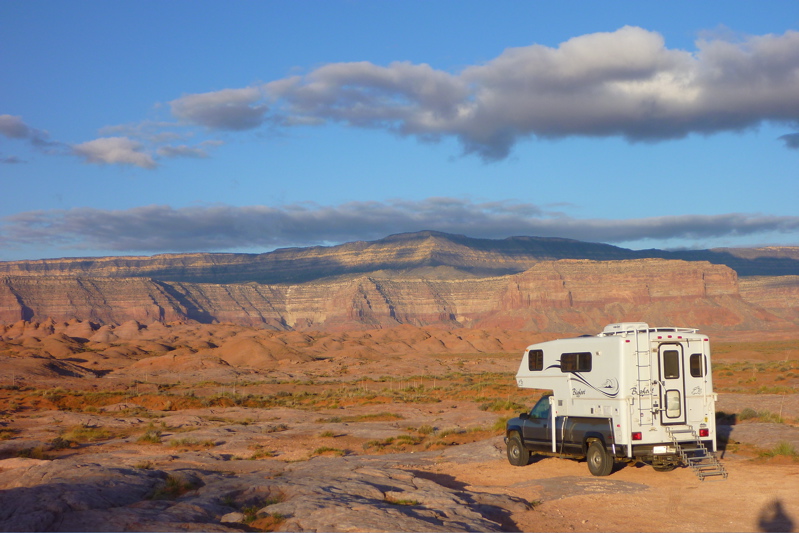
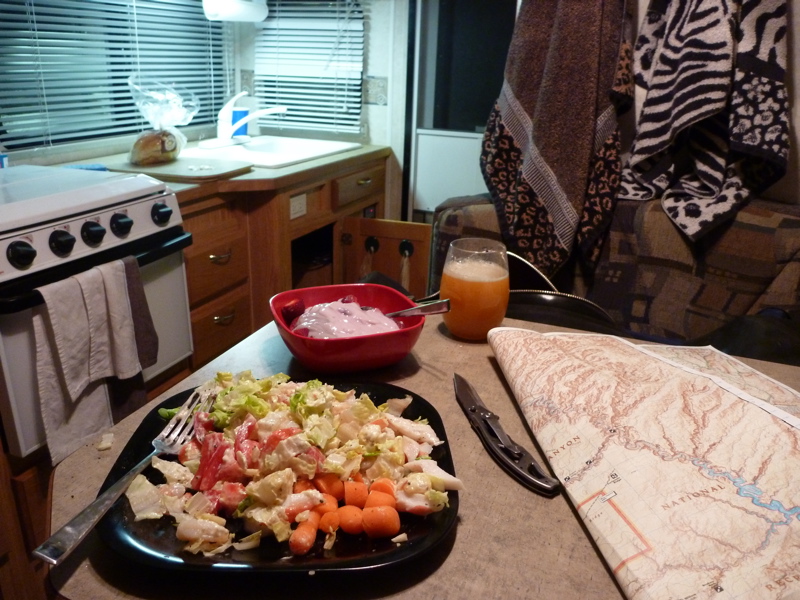
On the bright side, I got lent a GMC Sierra 4×4 truck camper by a guy at a travel show I’d attended in southern Arizona the previous weekend. With heating, a fridge a big bed and a week’s worth of food, staggering back to the van after a day on the trail sure beat windblown tent camping alongside a rental car. And as it was, the bottom-of-the-range rental car I cancelled at the last minute would have struggled to get to places like Egypt trailhead without leaving parts of its undercarriage in the dirt.
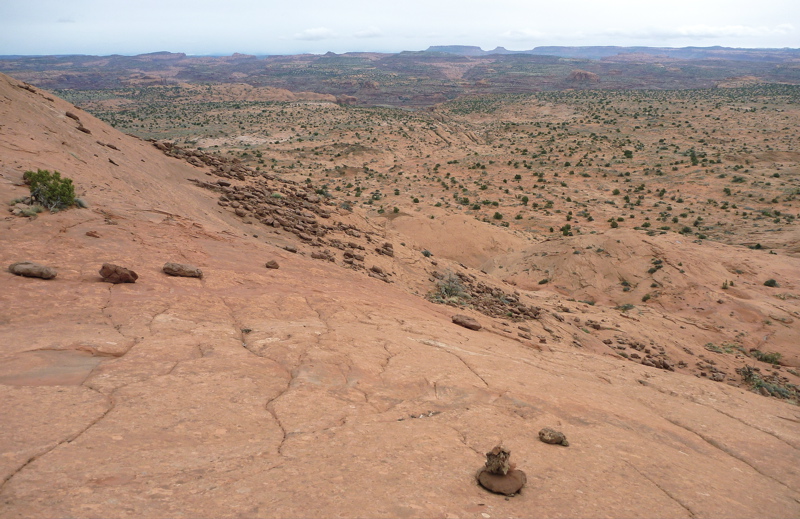
I got to Fortymile trailhead overlooking the take-out the same day I’d crawled down to Lake Powell and back from Hole in the Rock (HitR; N37° 15.385′ W110° 54.09′) so was a bit pooped. The last couple of miles’ drive to the trailhead were sandy but a few regular cars were parked there. Getting that heavy Sierra bogged down would have been a headache. From the trailhead car park (N37° 24.227′ W111° 00.533′; 4705 feet) it’s only a couple of miles following faint cairns to Crack in the Wall (N37° 25.152′ S110° 59.108′; 4413 feet) on the Escalante canyon’s rim where you get an impressive view to the northwest (above left and right) over the river below, with Stevens Arch behind and the shrubby dune slope dropping to the river’s edge.
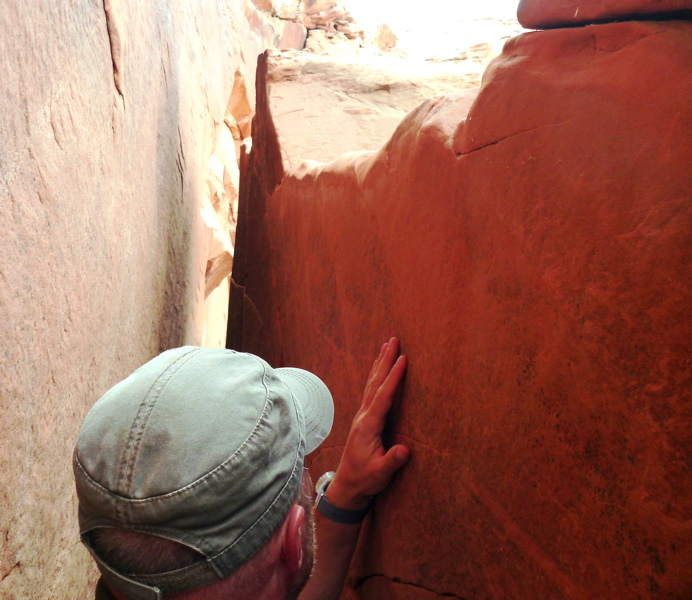
They’re not kidding when they suggest a length of rope to haul your packs over the outside of Crack in the Wall, a slab separated from the cliff by a foot or so and that’s the way down from the rim to the top of the dune slope. Once you drop into it it remains just wide enough to squeeze through if shuffling sideways. Alone coming up might involved more complicated roping. It was late in the day when I got here, howling and gloomy overhead so I didn’t trek down to the river’s edge far below. Instead, I drove away from the exposed trailhead and camped out of the wind down in Hurricane Wash on the main HitR track. Next day I drove the short distance on to Red Well trailhead (N37° 25.790′ S111°08.776′; 4508 feet), just a couple of miles off the main track.
From here – the most popular hike in the park they say – it’s 13 miles to the Escalante following the increasingly narrow Coyote Gulch, which is the same spot I was looking over the day before. The walk takes a full day or more, especially if coming back up with your gear. I set off towards the river and managed less than half that distance in 3 hours or so, walking through the broader, wooded part of the deepening canyon in and out of the river to about a mile before the point where Hurricane Wash joins Coyote from the south. Later they say it gets more interesting, narrower and much slower as you wade full time through the stream, around waterfalls and past arches. As a way of getting off the Escalante river, following Coyote upstream has the advantage in that there’s water to drink right around your feet to within a mile or so of the trailhead at Red Well. This itself is only a mile or two from the main track and so a manageable way of getting a lift out back to Egypt trailhead, if you left a car there.
After having clocked the two take-out routes off the river, I drove over to Egypt trailhead, a fun 4WD side track for which you’d need a high-clearance vehicle, and passing a surprisingly different desert environment of pinon trees on limestone? The trailhead is also more impressively located that Forty-mile, right on the rim (N37° 35.581′ W111°13.099′; 5646 feet) where the bench drops over 3.7 miles down via Fence Canyon to the river, 1100 feet below. It took me about 2 hours to get there with a bit of wandering after lost cairns. You have to be vigilant not to lose track of these although the way is fairly obvious: down.
It’s a fun walk and there’s a bit of room to camp down by the river (N37° 36.744′ W111°10.745′; 4550 feet), though I was surprised how narrow the river was here, just 15 feet wide and moving past at walking pace. A cliff blocked bank access to the south so it wasn’t possible to explore downriver without talking a swim or crawling over the cliff. According to the GPS from the put-in here to the take out is only 17 miles as the crow flies, but of course 40-odd miles along the tightly meandering canyon. One reads this is an access point to the lovely looking Neon Canyon slot on the far side of the river, a place that would have been fun to explore in warmer weather.
By the time I got back up to the car up on the rim, it had got much colder and as I left Escalante NM for the drive back west to Arizona, Bryce and Zion parks (left) were all under a few inches of snow, with more falling that night at Glendale.
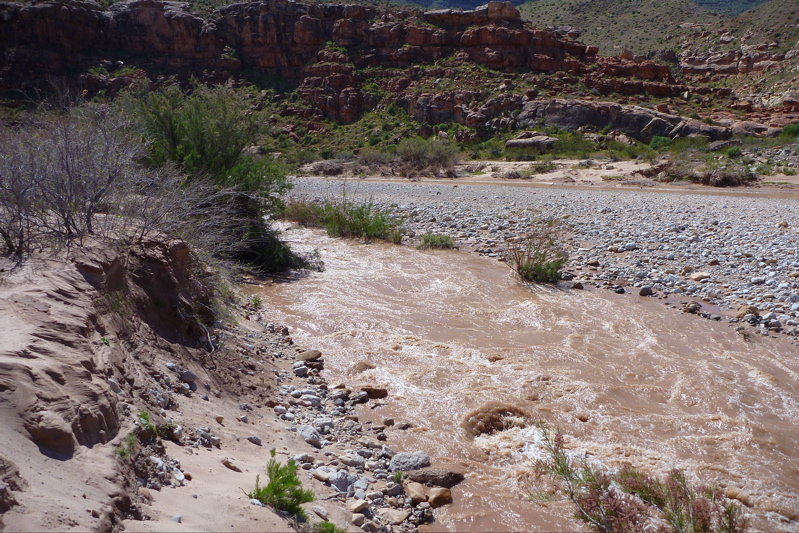
The next day I wanted a scoot down a short section of the Virgin river canyon in Arizona, where I’d stopped late one night a week earlier on the way up from Vegas. The recreational and camping area even had wifi and the Virgin below included a fast narrow chute of a couple hundred yards running at around 15 mph. Surely I could manage that in my slick new boat? I recce’d it all and thought so, but as I approached the chute in the Yak I lost my nerve and scurried for the stony bank a 100 yards or more to where it slowed a bit. Probably a good idea as even though there were no big rapids, at water level it looked rather more intimidating, and if I’d flipped the boat it would have been long gone before I got my bearings.
I put back in after the rush and scooted along a mile or so downstream before I took out in another probably unwarranted panic ahead of some unrecce’d rapids. Unfortunately, the only way out short of grabbing trees and bushes, was the other side of the river from the camp site but no worries, it’s a packraft so I hiked up the hill and upstream with the boat on my head, and did a quick ferry to the camp side where getting out was easier. I drove back north to St George and took the road east back into AZ, past the North Rim of the Grand Canyon to Lees Ferry on the Colorado river.
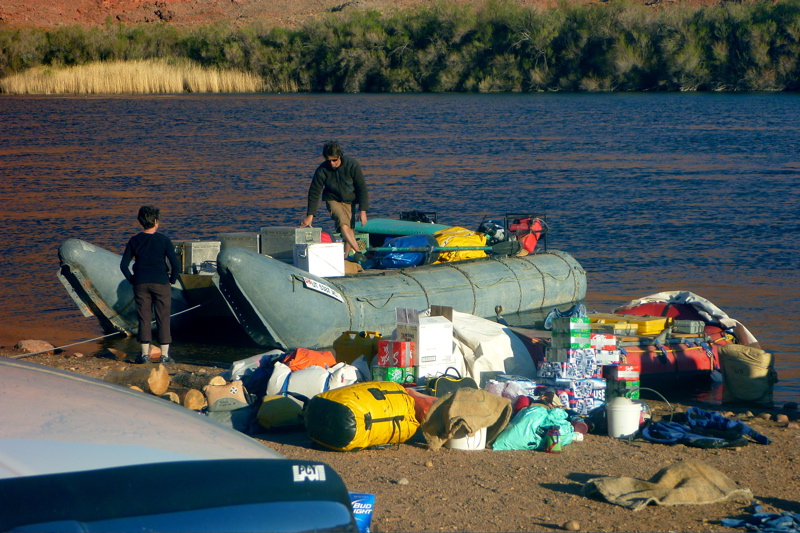
Never been to the North Rim but it was still closed for the winter, although the drive on past Vermillion Cliffs (below) was well-timed with the dropping sun. Down at Lees Ferry I chatted with some rafting guides loading up for the first tourist run of the season down the Grand Canyon the following morning; two weeks and 220 miles down to Diamond Creek. Their rigs included the biggest raft I’d ever seen, a huge 7 or 8 metre load-carrying pontoon with added side chambers and an outboard, while the clients took off in regular 4m rafts.
So there it is, Escalante packrafting recce for your reading pleasure. Knowing what I do now, I feel more confident about diving in for 3-4 days worth, leaving the car at Red Well, getting a lift somehow back to Egypt and then setting off downriver and coming out via Coyote back to Red. Although they said the bad weather had come in unseasonably late, these are high altitudes where anything can happen. I reckon up to a month later – mid-May – would have been a good time to try the Escalante, even if it means higher temps and lower levels requiring more portaging. Better to enjoy a slow ride with time for exploration of the side canyons in sunshine and warmth. In fact on getting back, the May issue of Canoe & Kayak magazine had a little feature on great rivers in the American West which included the Escalante. It recommended using packboats and mid-May as the best time. I was in the area in early April so took a chance.
Short version: the extended tail makes a Llama now 2.4 metres long where the old one was said to be 1.89 – 20 inches less – although my measurements make the new model only 12 inches longer. Interior length and width are said to be the same, but you’d think the new seat design might free up an inch or two and so now the next-size-down Yak may fit a 6-footer like me snugly (better control), while the added stern buoyancy will trim the boat better with my 95kg. And a pointier bow (a bit more length there too) never did a boat any harm.
Knowing that NRS, Feathercraft and a few others are on their case, Alpacka haven’t been sitting on their paddles. They’ve substantially redesigned their boats with pointier bows and extended sterns acting rather like a skeg to improve tracking, speed and trim without affecting turning. The current rafts certainly have turning ability to spare, and tracking I find fine – the bow just yaws a bit from left to right but the boat goes straight enough. Alpacka don’t offer skegs, though you can easily glue one on. My long stern Yaks never felt like they needed one on rivers and locks, but now I sail and sea paddle in longer packrafts, I couldn’t do either without a skeg.
However a bit more speed as a result of reduced yawing (zig-zagging) due to greater length, more centralised weight and added pointiness) would be nice for those long lochs. The extended back end acts like a bit of a skeg to counter the pivoting of the boat around the axis that is the paddler’s body. Interestingly, when I got my Llama I had an idea to fit a ‘trailing skeg’ like this to limit yawing; a plastic plate pinned between two arms coming off the back corners of the boat. I was told skegs make little difference but it could be easily done as an experiment, maybe on a Slackraft. Another advantage of the extended back is the added buoyancy keeps the boat level with the weight more centralised. A benefit of this ought to be that the boat will stay more level and the floor under my butt will no longer be the lowest part of the boat and so less prone to grounding. You can see here how the regular Llama sits with me in it. It may mean one won’t have to get around to glue on an extra layer of floor to save the floor scuffing in the same place.
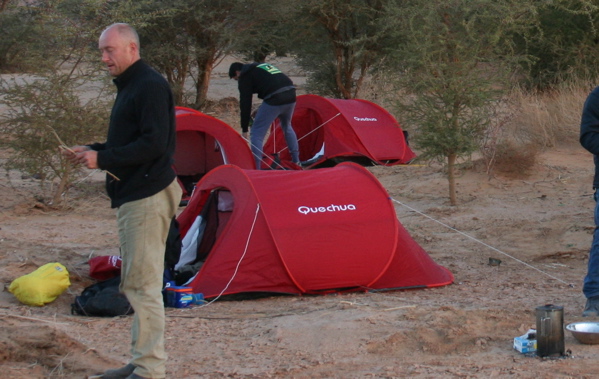
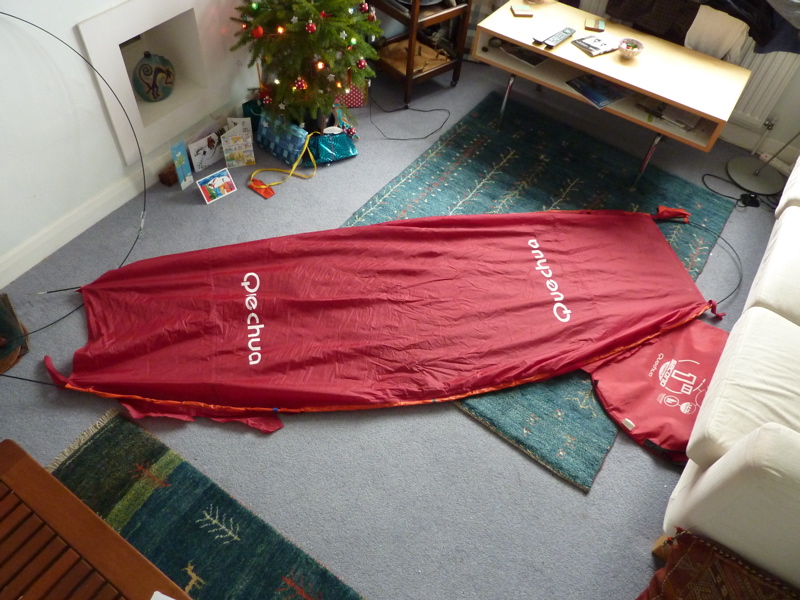
A few years ago I got a batch of discounted Decathon Quechua ‘2 seconds 1’ pop-up tents (right; £20) for a desert tour I was running, and have a couple leftover. Now everyone’s offering cheap pop-ups. People love the idea and though I don’t suppose this is a tent you’d want on the north face of Annapurna in a gale, when you arrive at a camp tired after a day of desert biking, you just want to click your fingers and, Abracadabra, you have a cozy shelter to call your own.
Whoever came up with the idea of flexible hoops sewn into a 3-D form to spring apart and make a tent or shelter was ingenious. I still marvel at it today. It seems a photographer John Ritson got to idea of adding fabric to a flat loop in 1985 and invented the collapsible Lastolite light reflector (right) after he saw a carpenter fold the blade of a bandsaw (See the bottom of this page). I imagine a Lastolite (a 38-incher costs £50) was the motivation behind the WindPaddle idea, but from a plain disc to a tent is quite a leap.
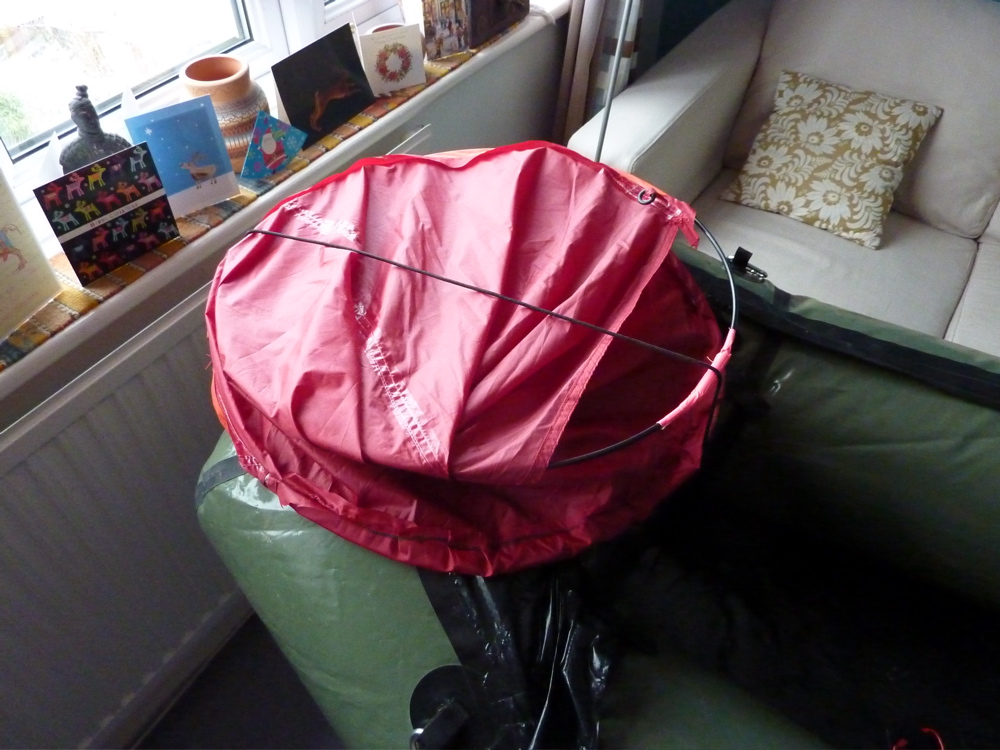
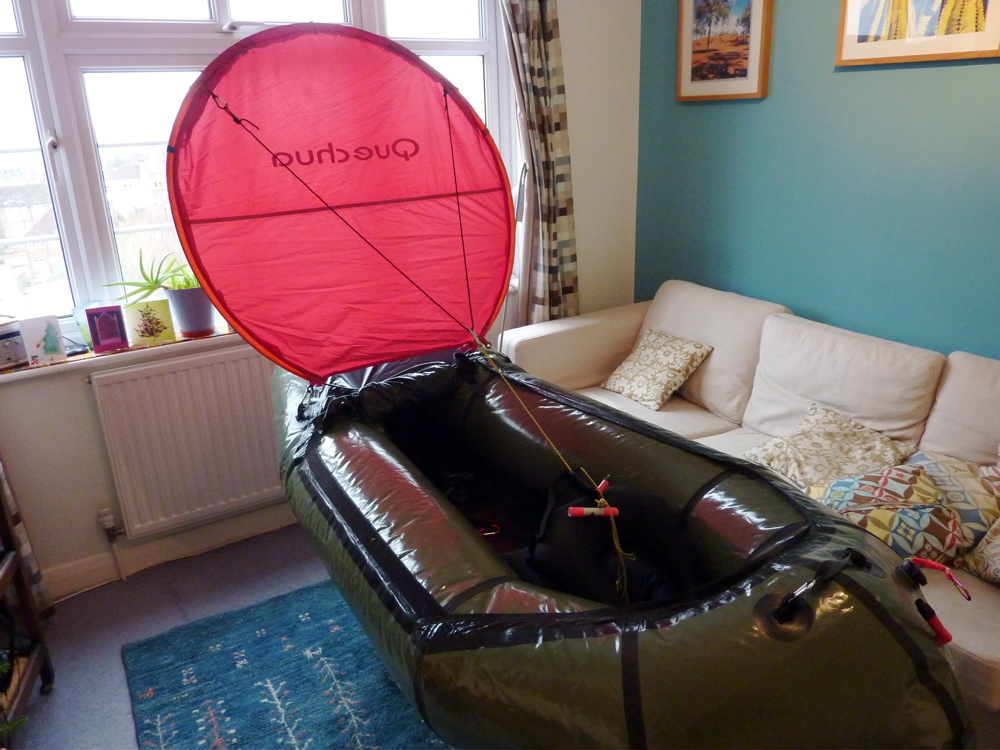
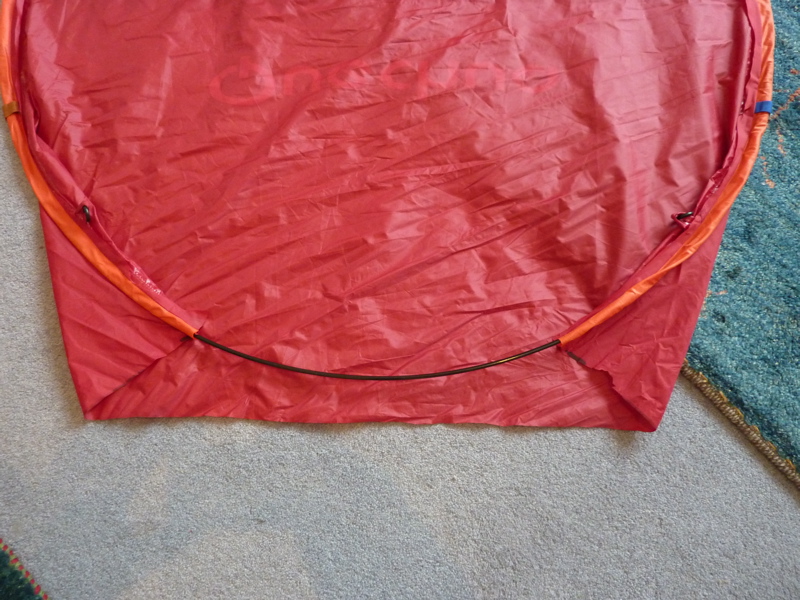
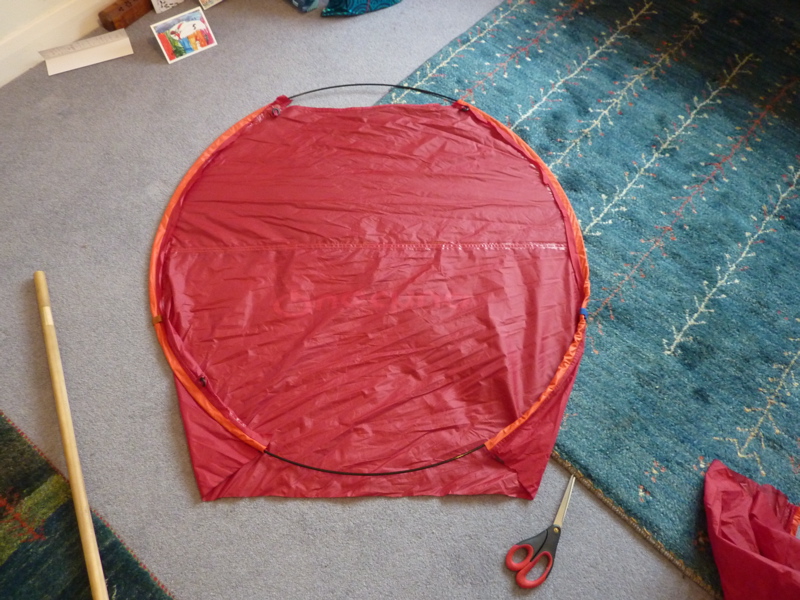
So I took a knife to one of my used Quechua tents. Bad though it felt shredding a perfectly functional shelter, in the spirit of the Inca shaman, it will be reincarnated as a sail – or more ill-conceived clutter to shove under the bed. Dismembering the Quechua gives two giant hoops of 4mm nylon-coated alloy and another of 6mm. Having been told that WindPaddles can deform easily under strong winds, I chose the thicker wire to use for the hoop (Gallery pic 2, below) in the hope of reducing this possibility. (Warning: when opened up these springy wires can fly about all over the place). Cutting the thick loop in half and rejoining it with the metal collar/tube (don’t lose this bit) gives a hoop of around 40 inches or 1 metre diametre making a sail area of 0.785 m2 (8.45 ft2) – similar to a WindPaddle, but with negligible dishing. I built up the sawn-off end with some cloth tape to stuff into the collar-tube, and then taped it all up (so it’s easily undoable). There’s enough fabric in the main body of the tent’s flysheet (Gallery pic 1) to make two 40″ disc sails if you cut from the middle, so 1 tent fly = 2 sails. I only worked this out after I cut. You want to use each curved end of the flysheet with as much orange hem-sleeve as possible (Gallery pic 4) – it saves on sewing later. You don’t want, as I thought, the flat middle section which of course won’t become a smooth disc once formed into a loop with the wire. Gallery pics 5 to 9 show how to gather up the slack, trim it, tack it down and get the Mrs to sew it up as if she hasn’t got enough work to be getting on with at this time of year. Gallery picture 10 is the sewn-up sail with a handy gap at the bottom for I don’t know what and which also happens to coincide with the position of two little hooped tabs at 5- and 7 o’clock which you can use mount it to an Alpacka’s rearmost bow loops using mini snaplinks (Gallery picture 11). By chance there are 2 more sewn-on plastic rings at 10- and 2 o’clock to mount a control string. The length of string I used happened to be just right to wrap around the folded over tent, though it’s all under tension and pretty unstable; you might want something like a bulldog clip to stop the sail deploying unexpectedly. I also think my control string may be on the short side, but it’s what was lying around. My disc tent doesn’t have anywhere near the dishing (depth) of a WindPaddle or an umbrella-like spinnaker sail I am told. I still haven’t worked out if this is significant (it is). One would imagine a deeper WP-like sail – a ‘bowl’ rather than a ‘saucer’ – would be more stable downwind but less good at tacking across it (probably correct) but what do I know? Last time I sailed a boat was over 35 years ago. I suspect a flip-out disc sail like this is probably a compromise when it comes to sailing effectively, but then so are pack boats. If round sails were such a good idea the Vikings would have them. It may even prove to be not fully useful and so just more junk to carry about which is why, after trying the umbrella, I chose to make one for next to nothing rather than spend £140 ($215) on a WindPaddle in the UK. It was easy to make, is light (250g or 9oz), and it can swapped between my Alpacka packraft and Sunny IK in the time it takes to unclip 2 snaplinks and attach them elsewhere. Other uses include something to sit on, a doormat for the tent, a windbreak, sunshade or umbrella. There is a slight problem: you can’t see where you’re going, especially on the shorter packraft with a metre-wide sail a metre on front of you, but on most water that ought not matter too much and if it does, I can cut in a window (like a WindPaddle) if that is the sail’s only flaw. As to how it sails, Monday after Christmas had a good southerly wind and the warmest day for weeks (ie: above freezing), but the reservoir I chose was a rink and looks like it’ll be that way for a while. It’s been the coldest December in the UK since records began so a test run make take a few weeks to complete. To see how it sailed first time out, click this.












































 Inflatable Kayaks & Packrafts