Category Archives: Drop-Stitch Kayaks

The future of IKs

Paddling with a Yakkair Full HP2 dropstitch IK

See also:
Full drop-stitch inflatable kayaks main page

Late 2021: Bic Sport rebranded Tahe and this boat is a Breeze HP2. Price unchanged

Tahe Breeze HP2
image.png

French paddleboat, board and ball-point dinghy manufacturer BIC Sport joined the full dropstitch (FDS) market a few of years back with three models of Yakkair Full HP: the 1, 2 and le trois. Made in Vietnam, the HP2 goes for around £1200 in the UK under the new for 2021 Tahe brand.

Yak owner Robbo uses an ultralight ripstop, rip-cord
paragliding backpack-bag for his Bic.

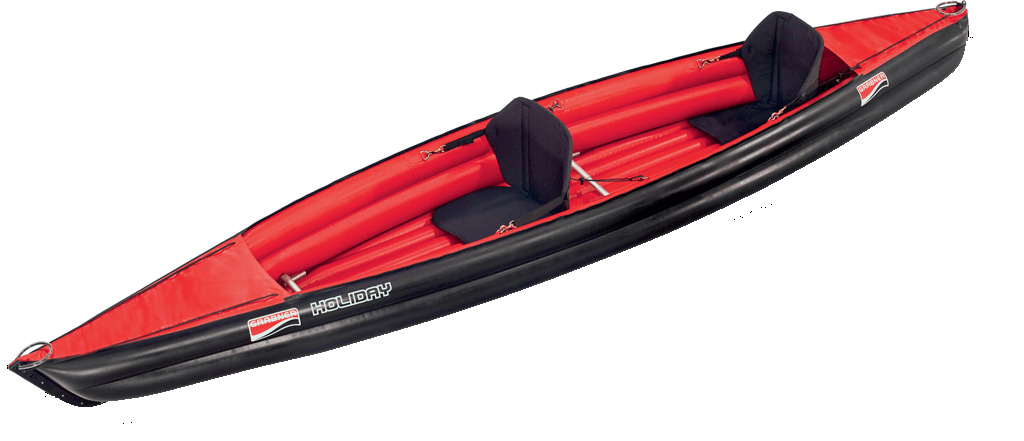
The ‘Full’ is an important addition to the name which gets emblazoned on the hull, because the previous Yakkair models (above right) were just called HP 1, 2 and maybe 3. They had a DS floor between regular round side tubes.
The old models didn’t really jump out off my IK radar; they looked too much like some Advanced Elements IKs. But looking at the inset diagram above, it looks like they tried to address the flat-floor with a keel tube tucked underneath the outer shell.

On the water under the weight of a paddler it supposedly deformed to produce a double concave profile – a bit like the Kxone/DS Kajak AirTrek floors – and which looks like it will work better than a totally flat floor. Even with a skeg at the back, this barge-like flat floor common to DS IKs does make me wonder how they’d handle or track.
Bic owner Robbo has a variety of slip-on skegs and for this run he selected a medium in orange.

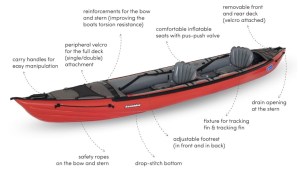
You get two clip-in SoT contoured-foam seats which have a well-braced backrest but, with bases an inch or two thick, won’t raise the butt above the ankles to give an efficient paddling posture, IMHO. Many IKs are like this out of the box, but raising or replacing the seat base is dead easy. I put my shoes under my Sunny seat: much better, but really you can’t beat an inflatable seat base like a packraft seat.

For solo use it looks possible to position the front seat back to the next D-rings, except there’s nowhere to clip the foot brace, which on the Yakkair are just a couple of padded straps. You could maybe use the front seat mounts. A good way to make a firmer and more effective foot brace is to slip a bit of 4-inch ø plastic drainpipe over the strap (right).

At each end you have two chunky carry handles as well as those fairly useless elasto-nets so common to many IKs. What would you put there that wouldn’t be more secure and more accessible lashed down by your feet or behind you? Not needed today, but the Yakkety Yak has a dinky slip-in spray visor up front to keep the splash out.

Talking of splash, I was keen to see the notorious side-floor join I wrote about. Sure enough, the Yakk’s floor is glued to the hull casing floor beneath and taped the side panels. But not all the way and so water and crud will run into the cavities at each end (below left) and then run down behind the tape along the sides. You could get rid of most of it by standing the boat on its end and opening the drain at the stern. And if you think there’s a lot of grit and other debris in there, hose from the top and let it run down the inside edges and out the drain. As for drying: that will take as long as it takes.

Sat inside, the boat is over half a metre wide because so much space is saved by the flat DS panels. But measured at 87cm wide (33.5″), the FHP 2 looks a bit on the wide side. Many FDS IKs look the same but have various widths: the HP2 seems about average. The much cheaper Decathlon Itiwit X500 is an unnerving 64cm, but even it seemed pretty wide when I looked at one in the shop. My Sunny was some 20cm less wide – and that’s with round tubes!

yakfhp2-4way

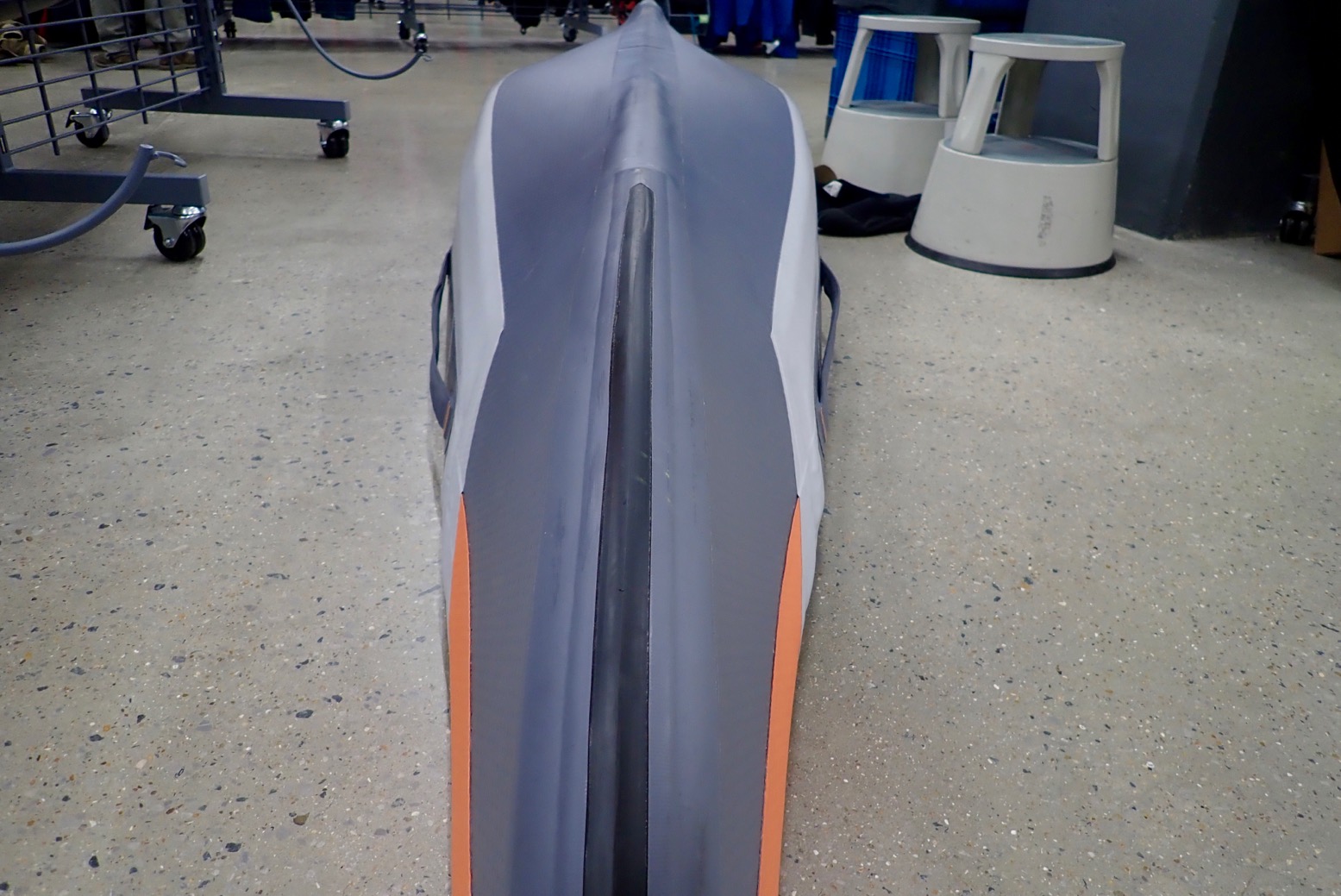
Flipped over, the bow looks a lot better formed than a typical full-tube IK, perhaps to compensate for the flatter floor. It’s actually a solid plastic moulding so should be immune to wear as the boat comes in to shore. But coming back down the Adur into the wind and against the flow, E & L had some trouble tracking straight. The two of them combined probably weighed less than me and with the featherlight L in front, the lifted bow was not cutting down through the water – the trim was out. Swapping seats with the heavier E up front would have fixed that, but it was thought the more powerful paddler should be at the back. Kayaking lore seems to agree, though two-up in my IKs (same-ish length) my generous mass is better distributed up front. To me it’s obvious: better to have the larger mass (my torso) towards the centre of the boat, not the stern.

Watching the Yakk navigate 20-km of flatwater for a few hours didn’t me inspire to even ask for a go, far less to own one. Used to being snuggly jammed into IKs & Ps, the canoe-like width and low seats put me off and set-up was without footrests would have made it too much like sitting on a log. L & E were first-timers in this boat afaik and initially found it tippy though soon got accustomed (they looked pretty relaxed).

The quality of assembly certainly corresponded with a four-figure IK and it sure looks less bloaty than a Decathlon Itiwit we met – the IK sales hit of 2020. I suspect this image is the attraction to many FDS buyers, but for me the water and grit-trapping cavities would add extra maintenance, even if it wouldn’t be that hard to fabricate and glue in a PVC cone to seal them off for good. Then you could simply rinse, drain, deflate, wipe off and dry the Yakkair like a regular tubeless IK. And the other drawbacks: seats; footrests; thigh straps are easily added. The you’d have a stiff and spacious tourer with great paddler ergos.

New Yakkair HP1 owner, Kevin A, adds:
Having just bought a Bic Yakkair Full HP1 to replace an ageing Walker Bay Airis which has become porous after about ten years of excellent service, I was very interested to read this review and I thought I would add some early impressions of my own boat.  So far, I have only had it on the water once because I have ordered a new combo paddle which can be a kayak paddle, a canoe paddle or a SUP paddle – I generally prefer using a single canoe paddle but the one which I have been using for years is a bit too short for the wider new boat.  You mention the width of the HP1 in your review and you say that you prefer a narrower boat but, for me, the extra width was part of the attraction.  I’m not sure yet about how it affects the stability and handling but, tbh, I just prefer the appearance of the wider boat even though, as you suggest, it does make a footrest essential so that you can brace yourself better – in my other boat, I was held fairly firmly at the thighs by the narrow interior.  The footrest which came with my boat seems to be a bit more substantial than the one you describe in your review.
Looking around at the various marketing pictures, I think some of the details of the package are a bit variable and maybe the footrest falls into that category.  But the biggest difference I have spotted is the style of the carry bag for the boat and I have to say that the carry bag which I have been supplied with is fantastic.  It is superbly well made and looks like a fairly upmarket piece of luggage – on the occasions when I take the boat on public transport I will no longer feel quite so conspicuous (the downside – there’s always a downside! – is that the bag itself adds weight to the whole package).  The real surprise about the carry bag is that it swallows up the entire rig – hull, paddle, pump and seat and there is still room for all the normal bits and pieces of personal kit.  The downside of that, of course, is that it is very big and only just about manageable by a single person – there is definitely no chance that it will ever be carried on my back using the excellent quality backpack straps which are part of the bag’s construction (I’m seriously tempted to cut the straps off).
The only area which I still have to work out is, as you say, how to deal with getting the water out of the joints between the three panels.  I’m not sure that the material itself will absorb much moisture and I’m hoping that removing the end plug and propping the boat up on end for a decent length of time (half an hour?) will allow the joints to drain pretty thoroughly – if necessary, I will have to re-inflate the boat at some point in order to ensure that it is completely dry.  By the way, I think that the so-called self-bailing drains are only really intended for use in seriously white water when the boat is in danger of filling up completely – in those conditions, it would be quite normal for the boat to have quite a lot of water sloshing around but the self-bailers would help to keep the level down (I only ever paddle on flat water so I have no idea how effective the self-bailers are in practice).
Happy paddling!

Advanced Elements AirVolution Dropstitch Kayak

See also:
Sandbanks Style Optimal (similar to AirVolution)
Full drop-stitch inflatable kayaks main page
Advanced Elements AirFusion

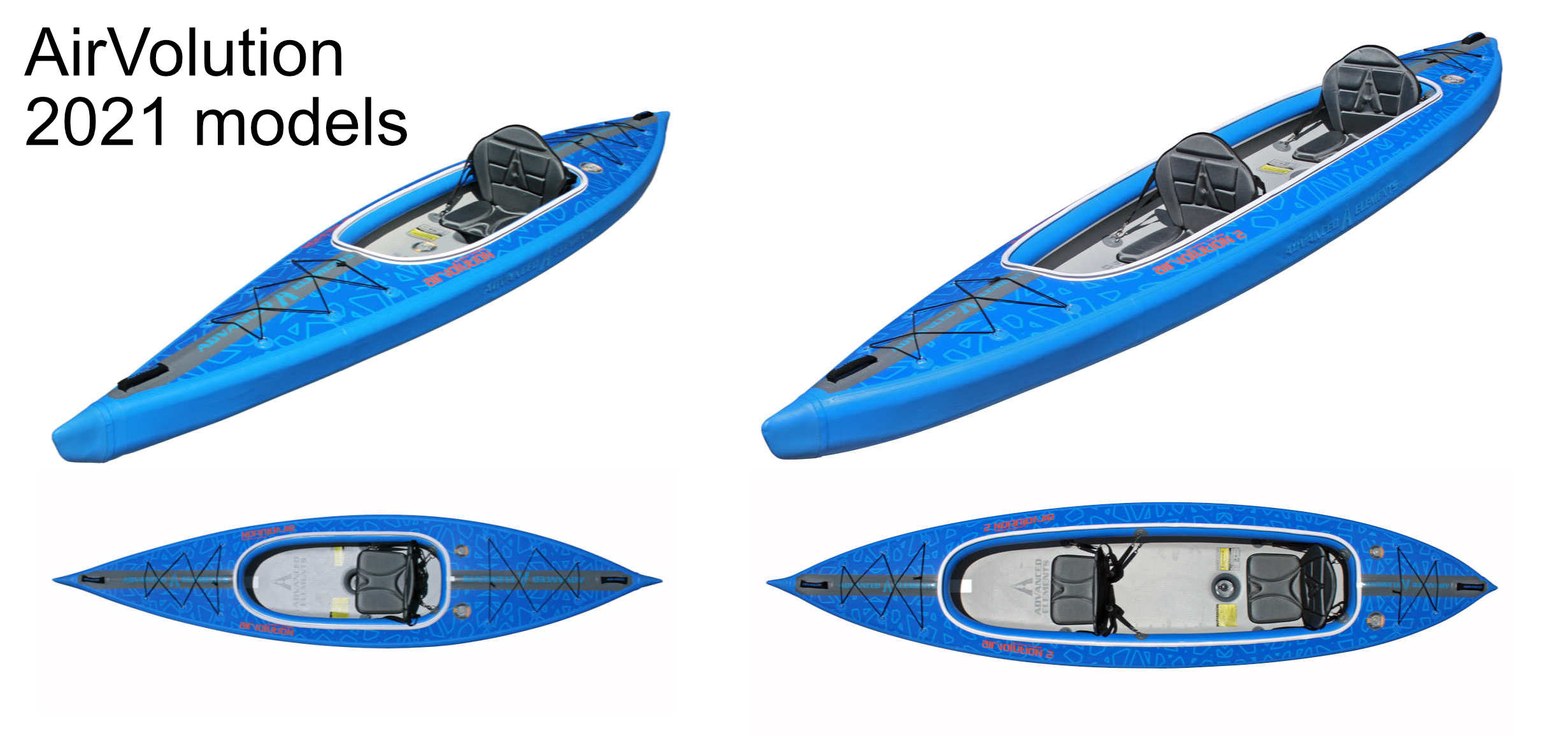
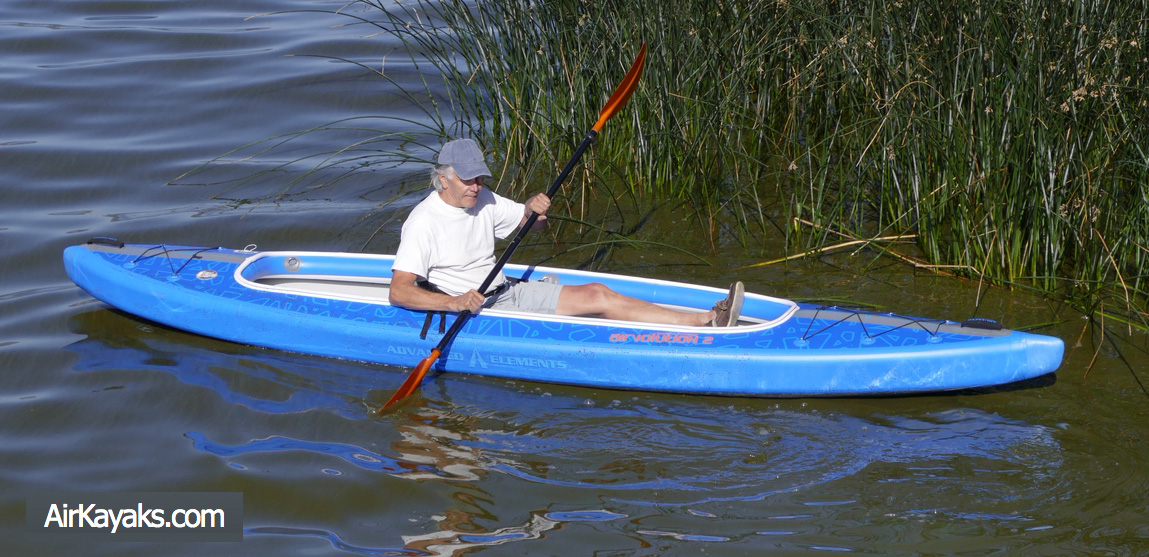
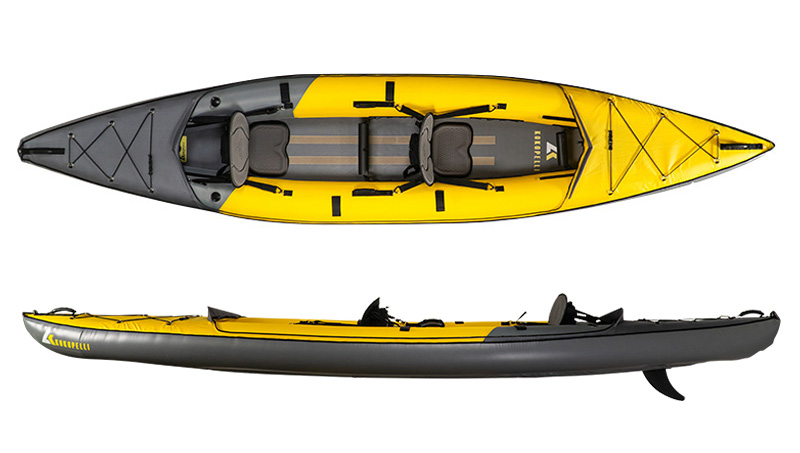
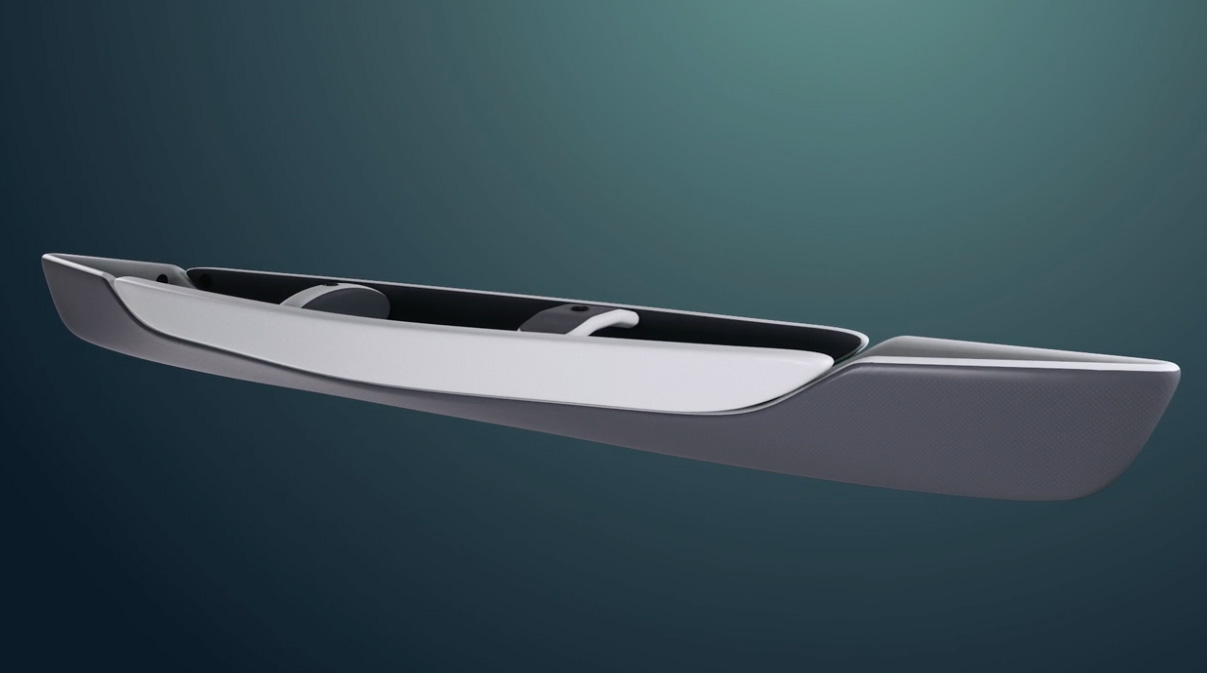
US IK and iSUp brand Advance Elements have come up with a sleek and innovative new angle on full dropstitch kayaks (FDS IK): The AirVolutions feature a high-pressure two chamber ‘clamshell’ design where the upper DS panel is a demi-deck. With minimal stowage below the decks at each end, it resembles a Sit-On-Top, except (though not currently offered) you could fit a spray skirt round that coaming (cockpit rim) to be sealed right off.

Airvolutions do not have a ton of storage space below deck [and] are designed to be Recreational/Day Touring kayaks

There are Solo and Double/Solo models with dimensions below. The more I study these Full DS IKs, the more I think what you gain in rigidity you pay for in weight and especially bulk over similar non-FDS IKs, some with just a DS floor. Maybe PVC tough enough to handle the intended use and pressures is simply a bulky fabric. In its wheeled duffle the folded up AirVolution2 is a massive 4 feet high and 18″ wide. As with many US-branded IKs, the Airvolutions are on the wide side, but it’s claimed they can be stand-up paddled if you have good balance. That’s me out, then!

LengthWidthWeightPayload
Solo13′ / 3.9m33″ / 84cm39lbs / 17.7kg300lbs / 136kg
Double14.5′ / 4.5m37″ / 94cm52lbs / 23.5kg550lbs / 249kg

Both models are rated at 10 psi / 0.7 bar (though they will work with less) and have another DS IK innovation: Pressure Relief Valves (PRVs) on both panels set to now purge at 14psi (2021 onwards). Why not 10psi so you can blithely inflate away till the PRVs hiss? Some pressure might be purged over a hot day from the top deck but not enough to matter.

A few iSUps have PRVS, but I’ve not seen them on FDS IKs before and many potential owners will be reassured, as it should aid the as-yet untested longevity of DS panels. PRVs limit potentially destructive over-pressurisation when inflatable boats are left in the sun.

Looks like AE listened: the 2021 models got 14psi PRVs, as well as an inflatable footrest (mentioned below), a better backrest, and other detailed tidying. And they chuck in a low pressure battery pump to get the bulk of the air in. You’ll still need a 2-stage barrel pump to get it up to 10-12psi.

AirKayaks™ IK in the US seem to be a favoured AE outlet right now and have detailed reviews of both boats with loads of photos and measurements, followed by a quick flatwater spin.
There you can read the double’s open hatch is over 7.5 feet (231cm) long) and, oddly, there are no footrests (until 2021 models). A stuffed bag would work, or it would be easy to glue on some D-rings to run a footrest strap and hard tube. On a raft-wide IK like the AirVo2, it may not be worth bothering with thigh straps. Both models run a huge 9-inch skeg which will ground easily in shallows and suggests tracking with the flat floor may need help. It’s easily be replaced with a cut-down spare.

The AirVolution2 looks like a great day kayak for two, but from the photo above, even tall solo users may be better off with the less huge AirVolution, unless you add a foot brace tube. With this design, either boat has less low-down storage space than a conventional fat sidetube IK like a Seawave. Storing gear under the deck bungies just adds windage and hampers steering and stability. For touring, what gear is less than 4-5 inches high could squeeze under the covered ends, and when used solo the double has about half a metre of room behind the seat and some in front.

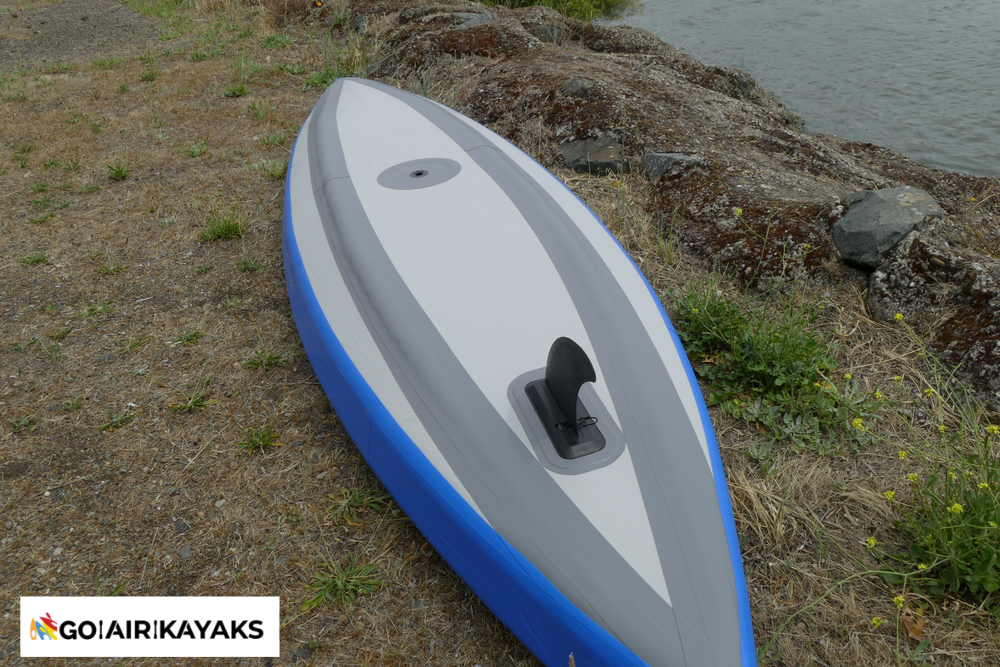
It’s hard to be sure, but inside it does look like the two panels have been ‘wallpapered over’ leaving no crevices to trap water and much more potentially damaging grit. This is a big improvement over hitherto conventional boxy three-panelFull DS IKs where water and crud gets in all sorts of hard-to-clean places. Being smooth inside, you’d think the AirVolutions could easily be drained by tipping upside down, then wiped down to dry. Maybe, but they’ve added a big plugged drain in the middle of the floor (left) to make that easier (it won’t work for self-bailing unless you’re very light). Judged against some of AE’s other ‘busy’ graphics, the blue boats don’t look too bad.

Up to now AE used far less elegant solutions to the problem of rigidity in long IKs. The AirVolutions: a pair of iSUp boards wrapped up and glued in the blue skin, are an interesting idea with some compromises, mostly in storage. These are day boats, not tourers, but there are many, many more day-paddlers out there.

It would be a struggle carrying a 23-kilo boat too far so for your money you get a wheelie duffle but with tiny, pavement-only wheels and clearance. There’s also a repair kit and a high-pressure, two-way switchable barrel pump which may need some brawn to reach the full 10+psi. Because high-pressure IK pumps need to be tall and slim, they’re low volume so take a while. AirKayaks reported it needed 100-150 strokes to inflate each chamber. That is a whole lot of pumping for a DS boat, but a battery pump now comes with the 2021s.
Prices in the US for 2021 are now $1200/$1500; in the UK the boat works out a bit more in £s; not such a good deal with obscure-branded 3-panel FDS IKs going for half that price. Or indeed a similar Sandbanks Optimal.


Preview: Kokopelli Moki 2 IK

See also: Kokopelli Moki 2 tested in Scotland

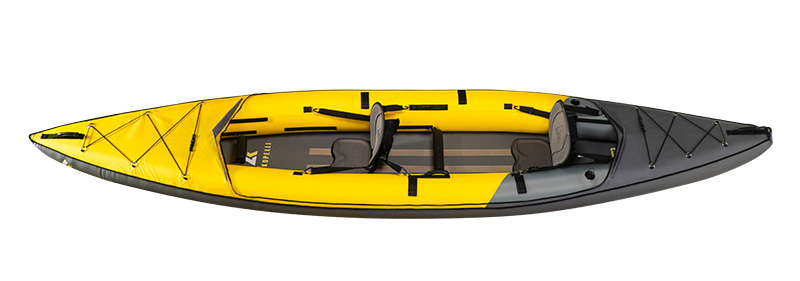
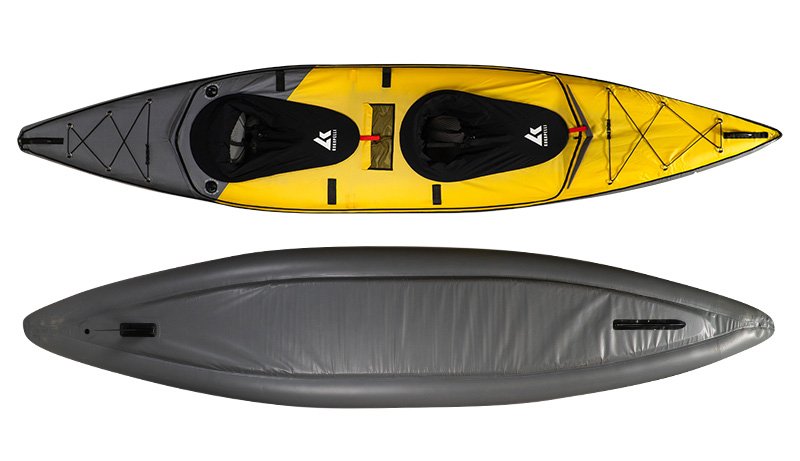
Kokopelli are a US packraft brand who started out in a Denver garage in 2012 but soon moved on to full Asian production. Known for their distinctive range of yellow TPU or PVC packrafts – long, short, bailing or decked, with the Moki I and Moki II they’ve moved into IKs.
Both Mokis are what they’re calling hybrids: dropstitch floors with conventional side tubes. Warranty is a generous 3 years. As always here at IK&P, it’s the the two-seater’s added versatility as solo tourer that’s of interest. The online stats for the Moki II are:

Weight: 24kg (53lbs) • Full kit in bag 27kg (59.5lbs) ; boat with seats 21.5kg (47.4lbs)
Length: 4.3m (14 feet)
Width: 91cm (36″) • With deck (39″); no deck (38″)
Sidetube ø: 21.8cm (8.6″) • 30.5cm (12″)
Payload: 272kg (600lbs)
Pressure: Sides 0.17bar (2.5psi) ; 0.27bar; DS floor (4 psi) • Set-up leaflet says: sides 3-4psi, floor 8-10psi
Construction: 840D Nylon side sleeves for PVC bladders; 1000D PVC DS floor
Price: U$ 999 (with tandem spraydeck); UK £950

Renting a Moki 2 a couple of months after this was written revealed several errors in the online specs. Only the length was spot on. The set up leaflet also refers to ‘… the packraft…’ a couple of times, as if it was hastily copied.
Verified figures are in red above.

Big, 21.8cm nylon sidetubes house PVC bladders which take an above-average 2.5 psi (0.17 bar) while even the dropstitch floor (DS-F) only runs an oddly low 4.5psi. That’s about the same as my uprated Seawave or a similar, regular-tubed Grabner. Can a DS-F IK be too stiff? Possibly. Turns out official online data is wrong.
As with many bladder boats and/or part or full DS IKs, weights tend to be higher and the Moki is more than most, but this may include all the extras, not least a huge roller duffle with backpack straps. The 24kg weight give may well add up to the boat with the deck and skirts.

According to Kokopelli, the Moki II is rated as ‘Lake’ but it’s also rated for ‘Fishing • Oceans • Travel’.

The well-featured EVA foam seats look a bit thin in the floor, but that’s easily altered and they can be positioned securely anywhere along twin velcro bands on the floor, with the backrests braced off the hull top in both directions. A lot of IKs have these bow and stern bungies which are handy to slip a paddle in while you fiddle with a camera, but you’d not want to use them for anything important or bulky. Not listed, but you can also use velcro tabs on the side tube tops to secure paddles. The specs claim there are a dozen D-rings but they are just the bungies being repeated. There are no D-rings in the boat.
The foam rubber tube footrest/s can be repositioned in daisy chain loops, presumably sewn to the DS-F casing and there a huge, clip-on skeg (tracking fin) plus what looks like a shallow front keel to help the flat floor track straight.

The zip-on tandem zip-on deck with coaming rods and skirts come with the boat too (hatch length: 86cm, 34″); an optional solo deck is available. Plus you get a compact, two-way barrel pump and a repair kit. Add a paddle and some water and you’re all set.

At the listed three feet or 91.4cm, both Mokis are pretty wide as so many US-branded IKs are (one reviewer verified a Moki I at 37″ wide). See true figures above. But something looks wrong with the stated dimensions (left). If the internal width between the tubes is 14″ and the side tubes are 8.6″ each, the total is 32.2″, nearly 5″ narrower and about the same as my old Seawave. That’s more than wide enough to be stable but nippy. I asked Kokopelli; someone replied but never got back and the website remains unchanged. From the proportions of the images above, the actual length looks somewhere between the two. Discrepancies explained by verified measurements, above.

We paddled a Moki II for a couple of days. Review here.

Kokopelli’s page

Preview: Gumotex Rush 1 and 2 IKs

Gumotex Rush (DSF)

See also:
More about Hybrid IKs
Interesting discussion
Another detailed online review

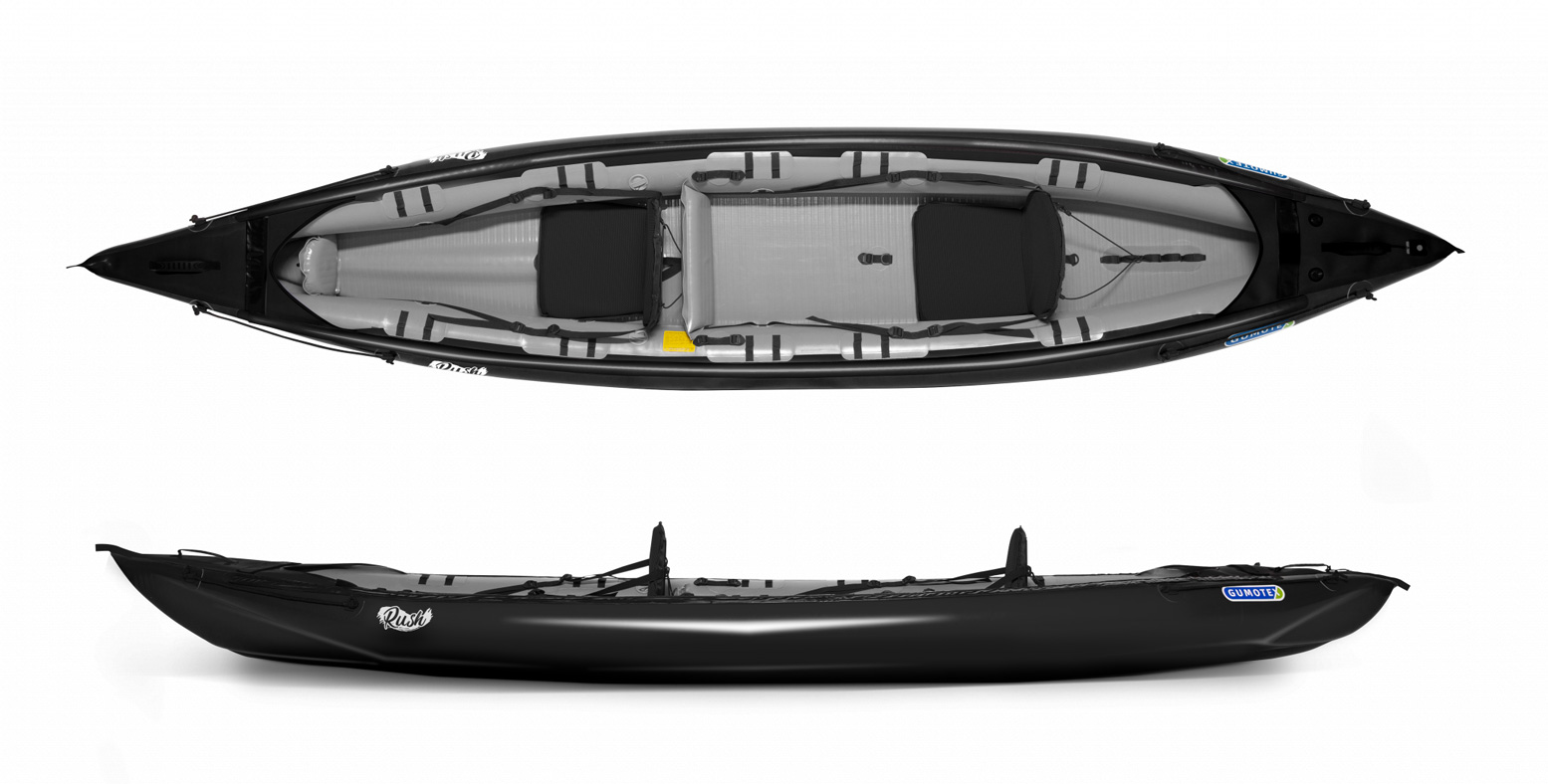
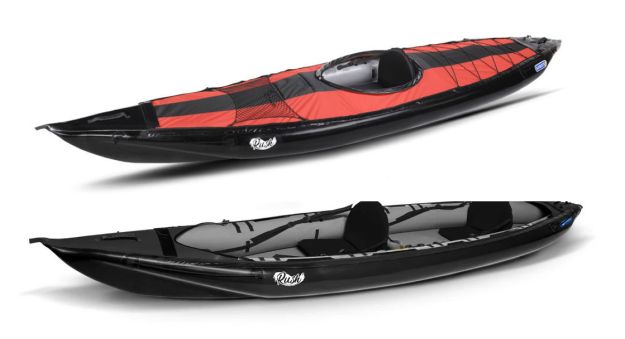
Gumotex are moving on up with hybrid dropstitch technology, originally showcased in 2019’s Thaya which is basically an old Solar 3 with a DS floor to make it more stiff. The new-for-2020 Rush 1 and 2 (left) is quite a sophisticated advance on a DSF or hybrid IK. A couple of years later the Seawave got the DSF treatment and became the Seashine at not less than £2500.

The Rush models came out in April 2020, just as the pandemic hit and lockdowns, shutdowns and slowdowns spread across the world. It’s also said there was some kind of quality control calamity at the Gumotex factory which led to many completed boats getting shredded. As a result, stock of Gumotex IKs dried up at a time when post-first-lockdown IK demand went ballistic RTW.
Other IKs gradually came back online, including other Gumotex models, but oddly, the all-new flagship Rush was put right to the back of the queue until 2023. I speculated this may have been a production issue and it seems I was right: I read in the PaddleVenture review comments:
“There is actually a modification to the Gumotex Rush [for 2021]. The drop stitch area on the bow and stern elements is said to have been improved. Apparently there were more complaints here than usual, so that at the end of last summer no more Rush models were produced and this part of the boat was revised”.
It’s not clear what the problems were, but it proves that making anything other than a flat, DS plank is tricky, but also that any boat which can get round this (like the Itiwit X500) will be superior. The Rushs were briefly back in stock in 2021 by which time all Gumotex IKs received a massive price hike which killed demand. By 2025 the R2 was listed in the UK at £2250 but offered for £1999.

‘Hybrid’ is a cool word for a kayak which isn’t a Full DS like a Sea Eagle Razorlite and many others. These IKs are assembled from three flat dropstitch panels making boxy hulls which, according to the graphics on this page of the French Gumotex importer, can be sub-optimal in choppy waters.
Me, I also think a totally flat, barge-like floor doesn’t help, but the Rushs get round this with raised side tubes which act more like stability pontoons, a bit like the Tributary Sawtooth.
In addition you’ll see on the left the suggestion that tall, flat sides are more affected by waves and wind, which does seem plausible. Of course, if you only every intend to paddle flatwater on calm days, this doesn’t really matter.

Derived from iSuP boards, DS has become a blessing to IK floor design which hitherto had to use I-beams of parallel tubes (above) which complicates assembly and is prone to ruinous rupture if over-pressured, unless fitted with a PRV or the IK is exceptionally well made.

A Gumotex hybrid IK (below) retains the regular round side tubes of a classic IK for better secondary stability (afaiu) but features a DS floor for much-needed rigidity as boats get longer. However, unique to Gumo, DS end-panels are also used on the bow as well as shorter and less obvious panels at the stern.


A word about this fabric paraphrased from here:
Nitrilon-Dropstich is composed of a core of 1100 dtx polyester fabric made up of two sheets joined by a mass of threads exactly 10 cm long. Unlike regular PVC-based iSuPs and DS kayaks, the durable elastomer plastic coating is not glued to the fabric, but ‘pressure-impregnated’ which eliminates delamination risks more common with bonded PVC coatings. An additional layer of polyester-reinforced Nitrilon is vulcanised to the floor bottoms making them double thickness.”

The Rushs differ from the Thaya (1st gen Gumo DSF) with the panels forming a more ‘hydroformed’ bow, another weak point with regular blunt-nosed tubed IKs. The Rush’s bow makes a water-slicing wedge sharp enough to cut ripe avocados.

The vital stats on the tandem Rush 2 are said to be 4.2m long x 82cm wide. Compare that to my Seawave at 4.5 x 78cm; the Seawave has an 11% better length/width factor (LWF) of 5.77 vs 5.12 over the Rush 2, but those are my Seawave measurements. The side tubes are said to be 19/20cm on the Rush compared to 22 on my Seawave. This and the length may contribute to the load rating dropping to 195kg vs 250 on the longer Seawave. That’s still plenty, unless you’re hauling a moose carcass out of the Yukon.
The official weight varies between 15.5 or 17kg, depending on where you look online. The higher figure is the same as my modified Seawave with a packraft seat mod.

Pressures are another obvious difference with the Seawave. The 6cm DS floor runs at 0.5bar (7.2psi), actually a modest level for DS, but an IK doesn’t need to be as stiff as a iSuP board. The slimmer side tubes run 0.25 bar or 3.75psi (same as the Seawave). Well, that’s according to the table from the online manual shown below. Many outlets still list 0.2 sides and so did the Gumotex website until I corrected them.

0.25 is a bit higher than normal IK pressure, but not quite as high as 0.3 in a Grabner, a Zelgear Spark or the 0.33 bar on my modified Seawave. When you combine that with the stiff DS floor, the 0.25 sides must make the Rush IKs Gumo’s stiffest IKs by far. The difference is, I added PRVs to my Seawave sides before running them at 50% higher pressure to automatically protect them. The Rushs don’t have any PRVs which explains the warning in the manual, above right. It’s odd but worth remembering that my super-stiff Grabner Amigo didn’t feature any PRVs either, not even in the floor. Quality of construction (gluing assembly) must have a lot to do with it.

When you add any colour you want as long as it’s black, you do wonder if no PRVs is a good idea, because in the sun black things get hotter, faster. Black may be great for Cockleshell saboteurs, not so good for visibility at sea and it kills photos stone dead.
It’s true the Innova-branded Swings in North America have long had black hulls and no one complained. But they only run 0.2 bar so need help in stiffening up in the hot sun. They also have fixed decks in red. Many Grabner IKs are now made with black exteriors too (right).
One assumes the Rush’s grey, lowish-psi floor will handle increased pressures from passive solar heating, especially as it’s in the water most of the time. But the black side tubes will get taught which becomes a nuisance to manage (or worry about), even if tubes/cylinders handle high pressures better than flat slabs.
In fact, as you’ll see from the comments below and elsewhere, Gumotex have found black is not notably worse than red or green in absorbing solar heating and dangerously over-pressurising. And if you’re that worried it would be just as easy to install PRVs in the Rush side tubes, as it was on my Seawave.

Because a DS floor is flat, one imagines it will hinder effective tracking, despite having a skeg at the back. The flat hull will plane over the water and wander off to the sides like a packraft – the so-called ‘[windscreen] wiper-effect’.

So, similar to Sea Eagle‘s patented NeedleKnife Keel™ (left), Gumo added a more discrete ‘keel hump‘ under the bow (left) to compensate for the lack of old-style parallel I-beam floor tubes which added a directional element. You can see from the overhead image above that this keel hump is mirrored on the floor inside the boat, either by design or need. This protuberance makes a high-wear point on the IK in the shallows so it’s just as well the floor is double thickness Nitrilon, as mentioned above. It’s the same on any boat. On my Seawave I pre-emptively added a protective strake – a strip of hypalon – to the central tubed rib, though to be honest it never got much wear as I try and be careful. Mine was hardly worn in five years of mostly sea paddling.

Still from youtu.be/87nA5QTXsBg by Austrian Steve

Rushs can be fitted with optional decks (green on the R1, above, red on the R2, below), using the same velcro system as the Seawave, with those horribly bulky alloy spars (right) supporting the decking (surely a flexible rod like tentpole material wouldn’t be hard to make). I read on other reviews that they’ve greatly improved the coaming (hatch rim) so that spray skirts attach more securely.
In the still on the right the footrest appears to be the usual rubbish black cushion adjusted by strap and seats can be moved to a variety of positions, too, but the other images show grey footrest tubes which are supposedly dropstitch – much better.
Seats are now solid foam, but the base looks too thin and low to me. A stiff foam backrest (with side bracing straps) is good, but an inflatable seat base is much more comfortable to sit on because you can vary the pressure and so the height. Foam eventually loses its cushioning but an inflatable seat doesn’t need to be made of hefty hull-grade hypalon, as on other Gumo IKs (more in the vid below). But anyway, a seat is easily changed to suit your prefs. More on IK seats here.

The Rush 2 has slimmer sidetubes than a Seawave and does seem quite low. It may benefit more from a deck.

Below, a review of a Rush 1 by Austrian Steve. Can’t understand a word but some observations: I like his convertible Eckla Rolly trolley/cart/camp chair; also love the lovely long canoe chute at 20:40. Have to say though, I winced a bit at some boat dragging here and there. Do the right thing, Steve; it only weighs 12kg! Note also this shortish boat seemed to track pretty well without a skeg – the frontal keel-hump may be effective in leading it by the nose, after all. But in the comments Steve admits the stiff, flat floor slaps down hard on wave trains coming out of rapids and I suppose would be the same at sea. It’s a drawback of flat, raft-like DS floors.
See this for an easily translatable written review also in German.

The rrp of a 2025 Rush1/Rush2 is now a £1599/2250 (with 10% discounts), plus decks going from £47v5 (solo; R2) and a rudder kit for £329, same as the Seawave unit.

As you can see, I have been comparing the Rush 2 with my Seawave and wondered if it might be time (or an excuse) to change. An unprecedented five years of ownership proves there’s nothing wrong with my Seawave [I sold my Seawave in May 2020 but bought another in October].

What are the benefits of a Rush 2? Black is not such an attractive or useful colour for a boat at sea. Neither is losing a foot in length or 50kg in payload over the Seawave. But less bulk? and 2-3 less kilos is appealing.
On a river the greater nippiness from less length will have benefits, but for that I have a packraft. As for greater rigidity, it looks pretty good in this clip but my adapted HP Seawave was very good compared to the lower-pressure Gumboats, and it seems the speed (see below) is no greater, but the gliding effort is reduced. A Seawave with a DS floor – the Seashine (left) – appeared in 2023, now costing about 50% more than a regular Seawave.

Good owner’s review (in French)

Trying out SUP paddle boarding

iSUP: a new way to get in trouble at sea (worth reading)

sup - 4

Finally I got to try this SUP-ing everyone’s so crazy about, on a recreational inlet in north Sydney. Ideally it should have been an iSUP to satisfy the strict submission criteria of IK&P, but among the user-owners and rental places on Sydney’s northern beaches, it seems carrying or stacking your oversized ironing board to the beach or lake is no great hardship.

sup - 2


I would guess mine was a beginner’s round-nosed planing board of around 10 feet by 30 inches wide. I read later this was a little under-buoyant for my weight, but I can’t say it felt like that, or looks so in the photos.
You read a lot about how SUPing is a good work-out for the core (stomach) muscles. Thirty minutes of flat-out SUPing a day for two or three years will turn a wobbling belly barrel into a granite-hard six-pack. But initially, I found it was my feet and thighs which felt over-worked from micro-managing my tippiness, though any balancing exercises must be a good way of working the core.
Conditions were a light breeze topping out at a 2-3 inch swell and, just as with kayaking, it felt a lot more satisfying padding into a slight breeze than having it behind you, right up to the point it becomes a headwind. I don’t have acrobatic levels of balance but I was determined not to fall in so edged off the shore very slowly. I only fell off when the skeg snagged a tree root in the shallows. It sounds like I got off a lot better than Gael did, learning to iSUP on his marlin-nosed racer in Sardinia.
Half an hour in I got over the initial wobbliness and, like all inveterate hoons, decided to see how fast will it go (mister). Who knows if I was doing it right, but I found a knee-dip just prior to putting in a good draw close to the board before standing back up straight and pulling back felt right. It would’ve been fun to try a couple hours of this. Note the bend in the long stick in some pictures.

sup - 4

I did experiment with canoe-style J-stroking, where you give the end of each stroke a little outward scoop to counteract the tendency of the board to turn off course. But I can’t say it worked which is why most SUPers you’ll see swap sides every three or four strokes to track straight.
It’s fun to stand like a fully-fledged, chest-beating biped, but seeing as you need near-flat water I can’t see a SUP board being an irresistible travel tool as a packraft or IK are. On more turbulent waters falling in would be more common, which means away from the Mediterranean conditions I was padding in, you’d need to dress for immersion. Who wants the if they can help it?
Still, I’d like to give it a good go unhampered by the ticking of the rental metre. On eBay new iSUPs go from 150 quid, with quality used ones from £350. As with a lot of recreational stuff, buying used you can put in the time at your convenience to get a good idea for SUPing, then sell it for less than the rental hours, if it’s not for you. I must say I would be more attracted to owning a longer and pointier iSUP board (below), as Gael A writes about here. And then probably regret it once I failed to stay on it.
So for the moment, I think I’m happy to carry on renting when the opportunity arises.

sup9

Preview: Itiwit Strenfit X500 Droptitch kayak

See also:
Full drop-stitch inflatable kayaks main page
Itiwit Packraft

nanook

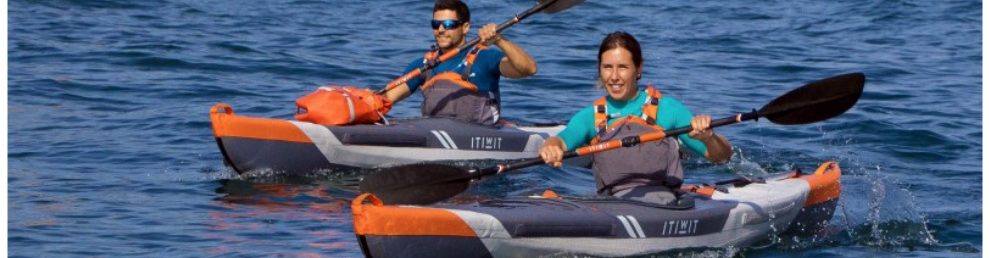
First Gumotex and now Europe-wide, French sports retail giant Decathlon have turned to dropstitch (DS) technology in a bid to improve rigidity and so, the performance of their inflatable kayaks.
The Strenfit X500 is again sold in UK Decathlons for 2025, currently reduced to £599. A drop stitch bargain.

decpump

Only Decathlon haven’t just added a DS floor to an existing model, but with the single-seater X500 Strenfit have designed an entire 10psi (0.7 bar) DS hull, complete with a deck and coamed hatch supported by two D/S beams. (Do you need a deck?) Above left, Serge and Nanook take their X-boats for a spin. UK price is very reasonable and delivered with a two-year guarantee, although the essential SUP two-way pump (right) is another 30 quid.

inuit
dechull

Itiwit‘ is a Decathlon water-sports brandword, contracted from ‘itinerary’ and ‘Inuit’, the latter being fur-clad denizens of the Arctic who invented sea kayaks all those centuries ago. I suppose it sounds better than ‘Inuary’.
Watch the slick vid below to get your head round the unusual design. It looks like the dark grey V-floor panel is one chamber, plus a lighter grey sidewall panel each side and then the two deck-supporting thwarts or beams. And being French-designed, it conforms with their national watersports regs which allow it to stray a full 300 metres or more from the sea shore.

decmanual
deco

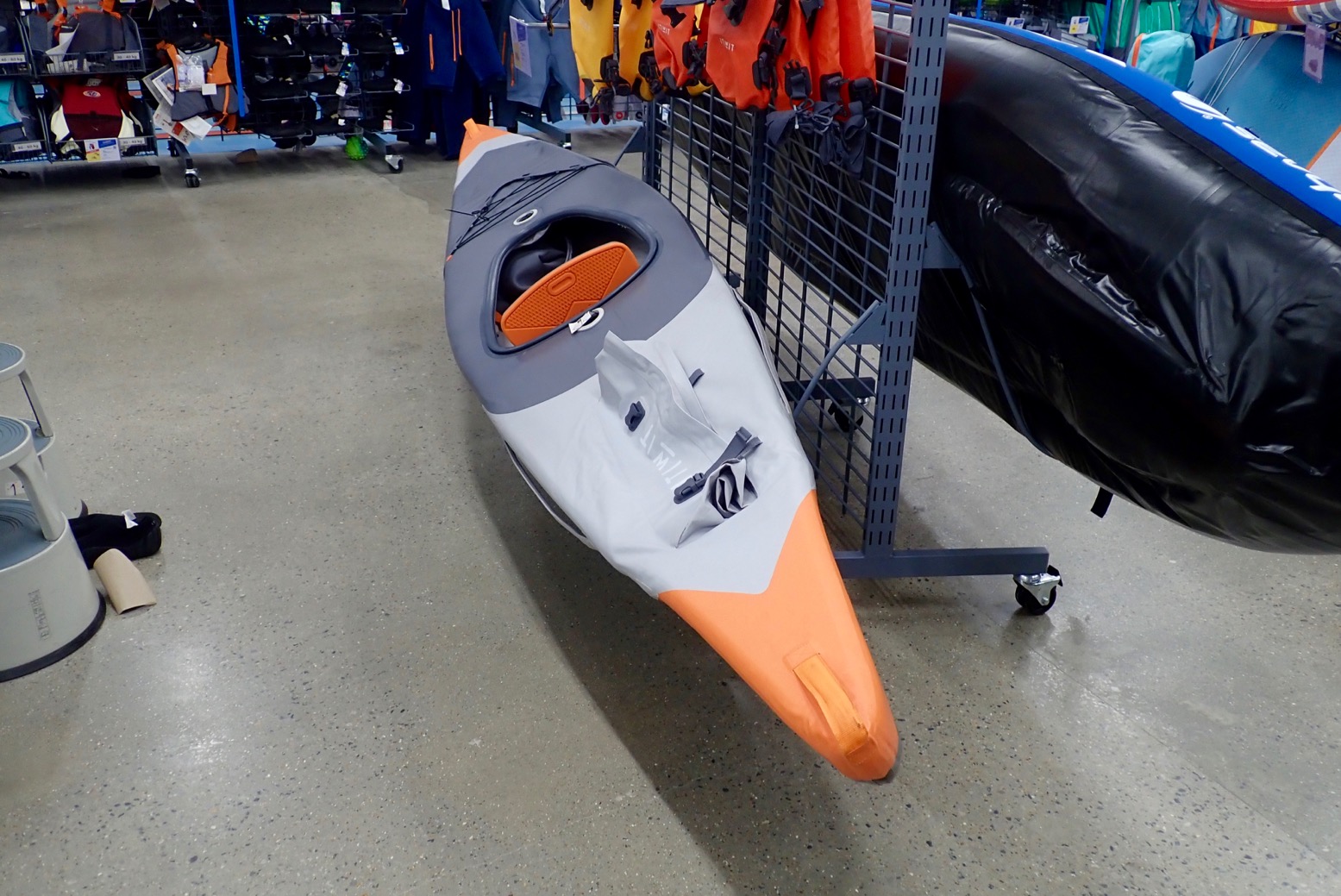
Vital stats are 3.8m long by just 64cm wide and 18kg, making it similar to an undecked but flat-floored Kxone Slider 375, and between a Gumotex Twist 2 and a decked Aurion or Swing II.
It’s made of PVC and, like most other FDS IKs, you can be sure it’s made in China. But there have been reports that the fabric cracks when folded and creased hard. Sounds like cheap PVC and is why we like old school rubber IKs.
Because DS hulls have less air volume than regular tubed IKs, they’re slimmer (thinner walled, giving more space in the boat) and are quicker to pump up (3 mins, claimed on the X500). But that lower volume explains a modest payload of just 125kg. No dims are given on the hatch size, but based on the length, I’d guess it’s 80cm long.

itwit-danube-x500

Below, watch Nanook film Serge as he effortlessly assembles, paddles and then disassembles his X500 in what may be real-time. The roll-top rear hatch is a clever idea; not seen that before, though it looks like water may pool there. And the proper wave-slicing V-hull dispenses with the need for a skeg to aid tracking, although the boat may benefit from a rudder or skeg in cross winds.
Like most IKs, the X500 sits fairly high in the water, unlike a proper hardshell sea kayak which is barely above it. With the narrow V-hull and poor knee bracing, many report it feels unstable until it’s moving. Lighter paddlers have found dropping the pressure a bit make the boat float lower and improves stability. But this also adds up to a fast boat, making it most sea-kayak-like IK since Feathercraft’s short-lived Aironaut. It’s not an exaggeration to say it’s a revolutionary DS IK, but with the mentioned flaws in durability.

itiwitX500

Below a review by a sea kayaking chap on what looks like the balmy Med. I agree with his suggestion: it would be good to see a longer version, but that will probably be a tandem which, with the fixed deck, won’t adapt to solo long-range touring. They produced that tandem version, but it’s since been dropped.
The X500 has strapadjustable footrests but he also mentions poor knee bracing – often an IK weak spot, even with decked boats. Nevertheless, he still manages to bang out a pretty smooth eskimo roll, and it would not be impossible to glue or somehow clip on some thigh bracing straps which would greatly improve the connection with and control of the boat.

One the way back from the Regents Canal the other day, I dropped into my local Decathlon to have a closer look at the X-boat. First impressions were it wasn’t half as narrow as I expected – at least at cockpit level. The hatch is nice and big and it sure looks more kayak-like than the rest of the Itiwit range of bloats. That sure isn’t a typical flat DS floor which might explain the tippiness some report.

The boat wasn’t at all saggy as you’d expect from an Intex watersofa sat in a showroom for months. But as mentioned, if your boat has a slim V-hull, you really need some knee-bracing to control any rolling. The deck felt quite slack but as always, the good thing is others will see how Decathlon took a big step forward in DS IKs, and try to improve.

Pumps for inflatable kayaks and packrafts

Updated Summer 2025

See also:
Inflation valves and PRVs
My PoV on electric pumps for IKs
Tested: Flextailgear rechargeable packraft pump
Packraft air pressure

Your inflatable packboat needs a pump to take form as well as to top-up once on the water. These functions may be best performed by two different pumps. The folding bellows footpump (left) is history and even low-pressure IKs now come with some sort of hard plastic barrel pump. Some pump on both up and down strokes to fill your boat faster, but as you reach higher pressures they automatically or manually switch to downstroke-only inflation to reduce the effort. They work best on flat, firm ground where you can stand on the stirrup plates and get stuck in. The excellent Bravo 4 RED Kite pump below (newer ones are blue) is still well under £20 and will pump up an IK in 5 minutes.

sw05

I got a Bravo 6 with my Seawave once but found it hard work – who knows why. The cheaper Bravo 4 does claim to be an ‘R.E.D’ (‘reduced effort device’) and I can confirm this isn’t some gimmicky acronym. The other port on the Bravo’s handle can be used to suck air from an IK so it rolls up good and flat; you can see creases forming in the hull as you suck it down.
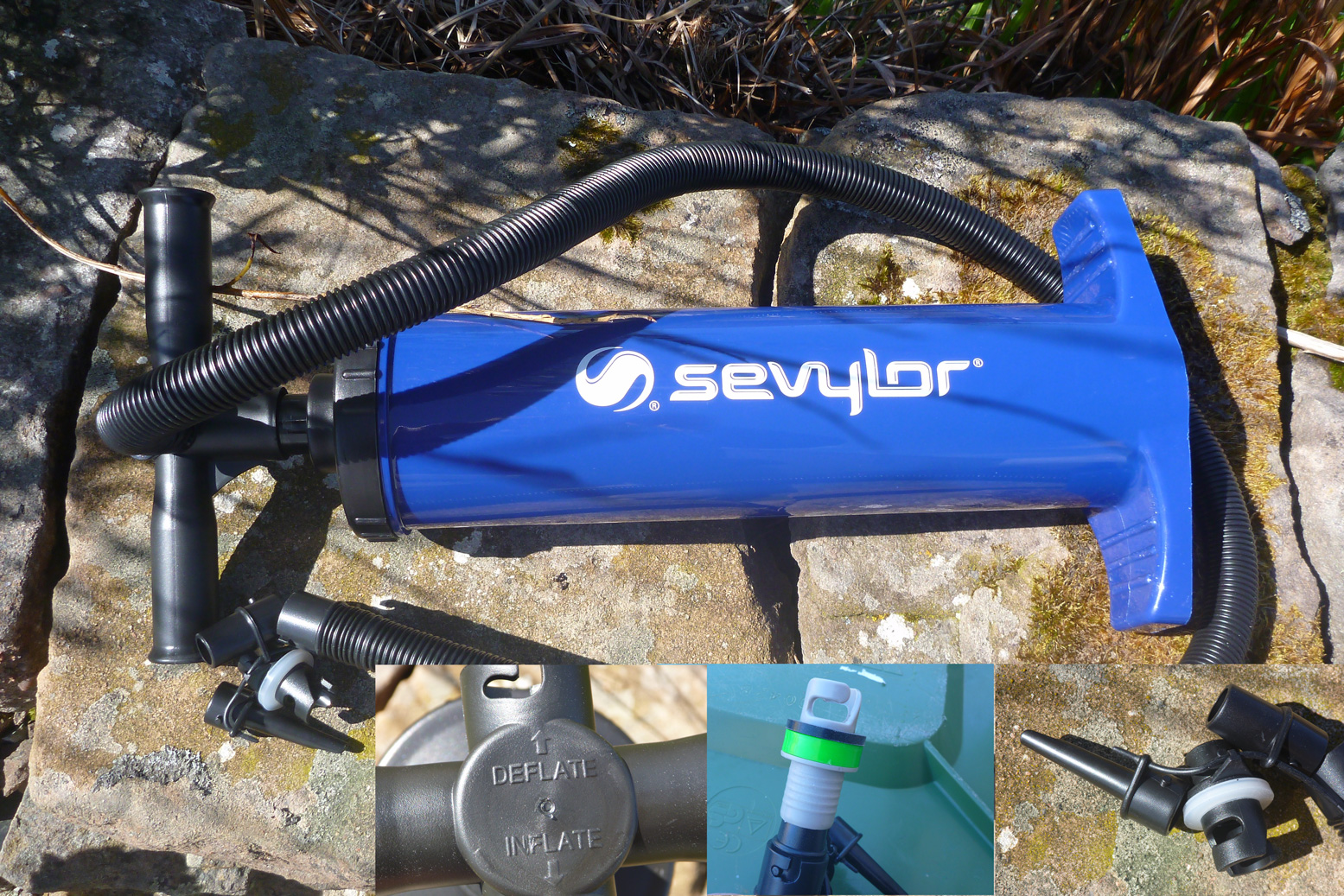
I left my Bravo 4 RED at home one time so bought a Sevylor RB2500G barrel pump (below left) for a tenner. Same size as the Bravo barrels, it did OK for the awkward topping-up of my Semperit’s lilo plugs and came with others adaptors plud sucked as well as pumped. But pumping up my Seawave from flat was exhausting towards the end: I actually got out of breath and had to rest! Morale of this fascinating anecdote: get a Bravo 4 RED and the right adaptor for your boat.
Not all barrels have a built-in pressure gauge which is obviously dead handy in getting the right pressure without needing to faff about with a separate manometer (see below). It’s worth an extra tenner to get a built-in gauge, especially with DS boats.

kpump200

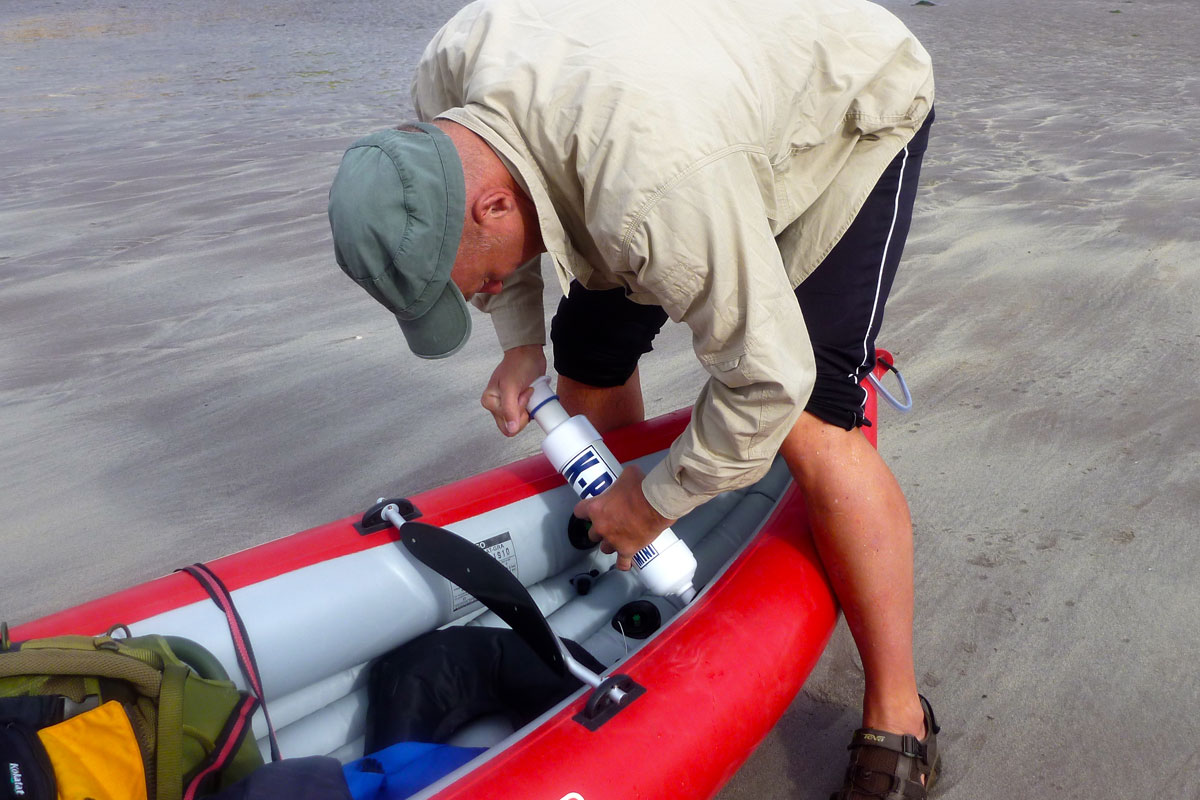
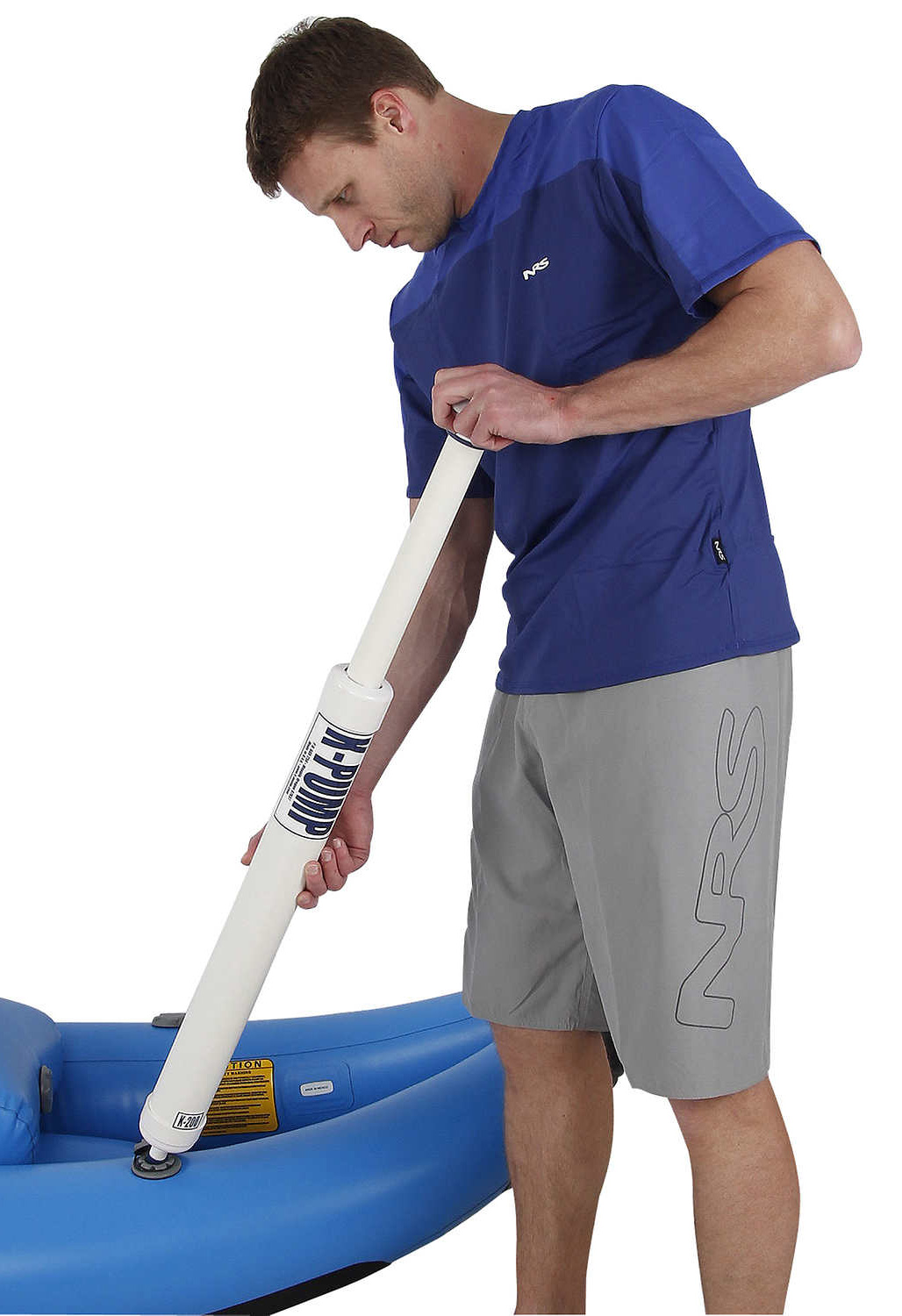
The K-Pump Mini (above right) is a handy top-up pump or compact 600-g travel pump. It took 15 minutes to fully inflate up my 14-foot Seawave; the push-fit nozzle works on any IK with one-way spring valves. You have to press and hold the nozzle against the valve. Using it a lot one time, I got the feeling it might break something or wear out the seal (which needs regreasing once in a while). I’ve also used the K-Pump to top up my Nomad S1 packraft which was too big and long to inflate firmly with just its airbag. Fuller review of the K-Pump Mini here. They’re hard to find in the UK, the very long, and slim US-made K-Pump 200 (right) may also be suited to higher-pressure dropstitch applications.

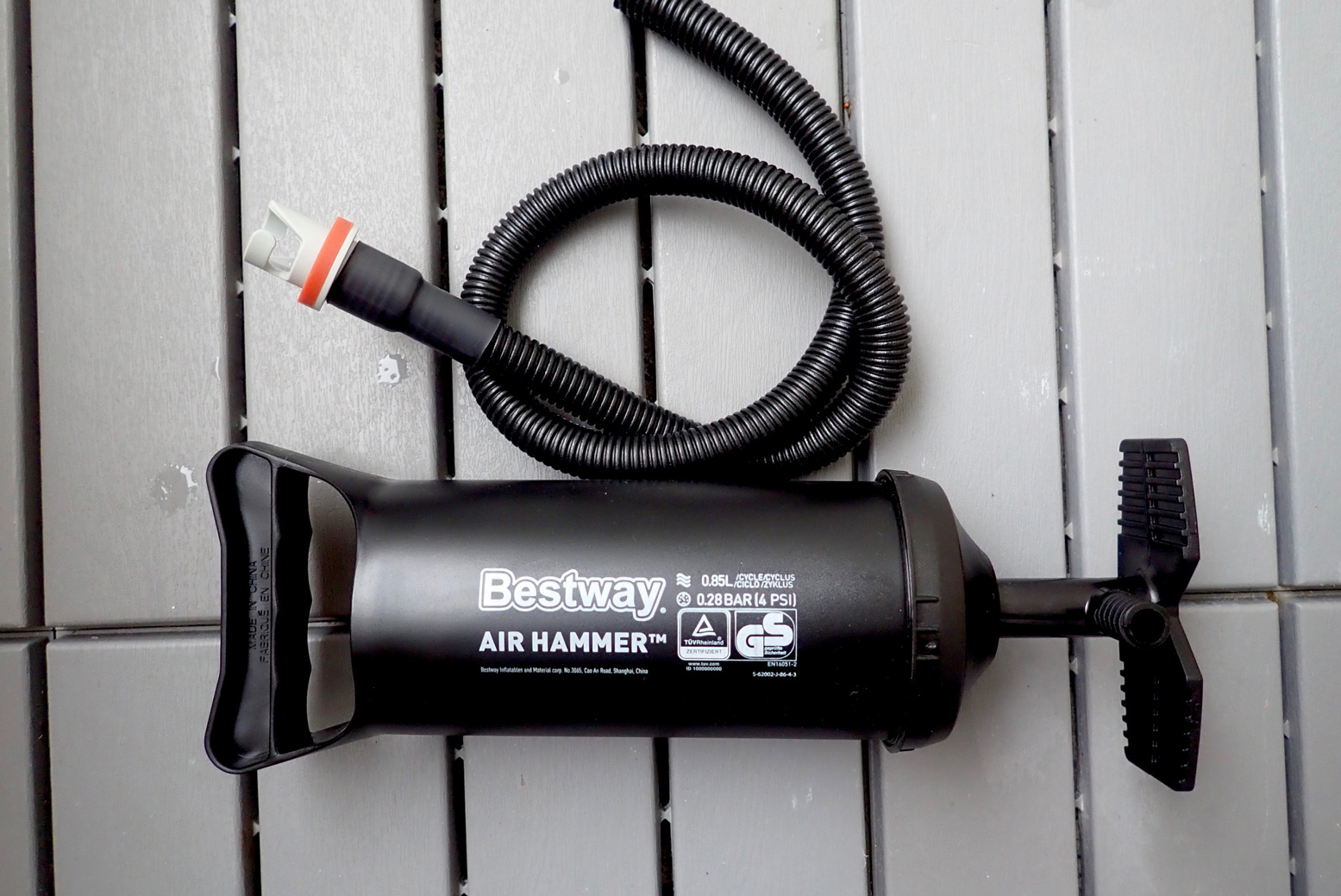
Left, the Bestway Air Hammer is an ‘upside-down’ barrel pump which comes in three sizes and costs from just £6 on eBay. If you don’t want to paddle with your full-size barrel pump, the smallest Air Hammer could work as a compact top-up pump like the K-Pump, but a tenth of the price. The one on the left came with a ROBfin and was rated at 4psi.

High-pressure pumps

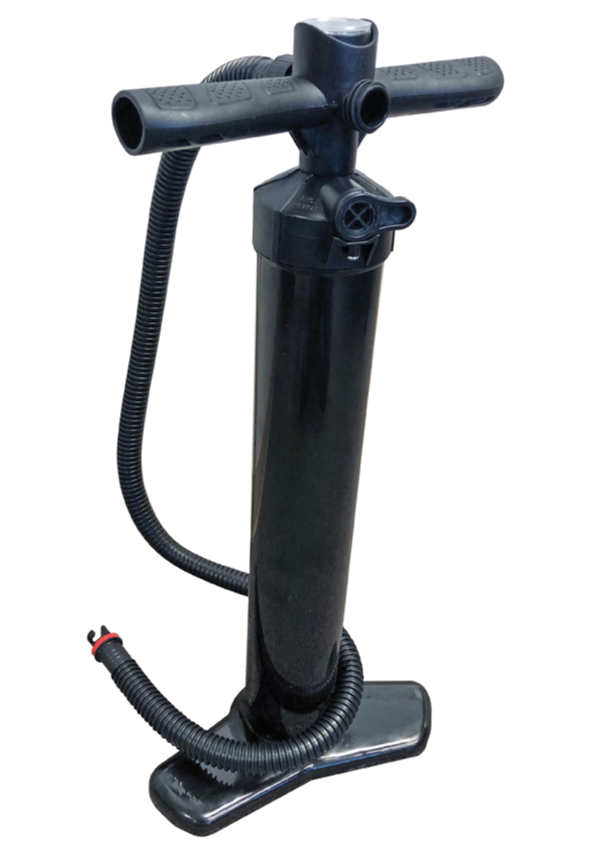
More and more IKs now feature super-rigid, high-pressure dropstitch hulls – either just floors or the entire hull which runs 2–5 times higher pressures than regular IKs. Your old Bravo footpump will blow its brains out trying to reach a typical 7-10psi.
Barrel pumps with long, slim bodies, as opposed to the shorter, stockier examples above, put out less volume (DS IKs have less volume anyway) but can more easily attain higher pressures. It’s something to do with the ø of the pump face x the stroke. You don’t necessarily need a super high-pressure iSup board pump.

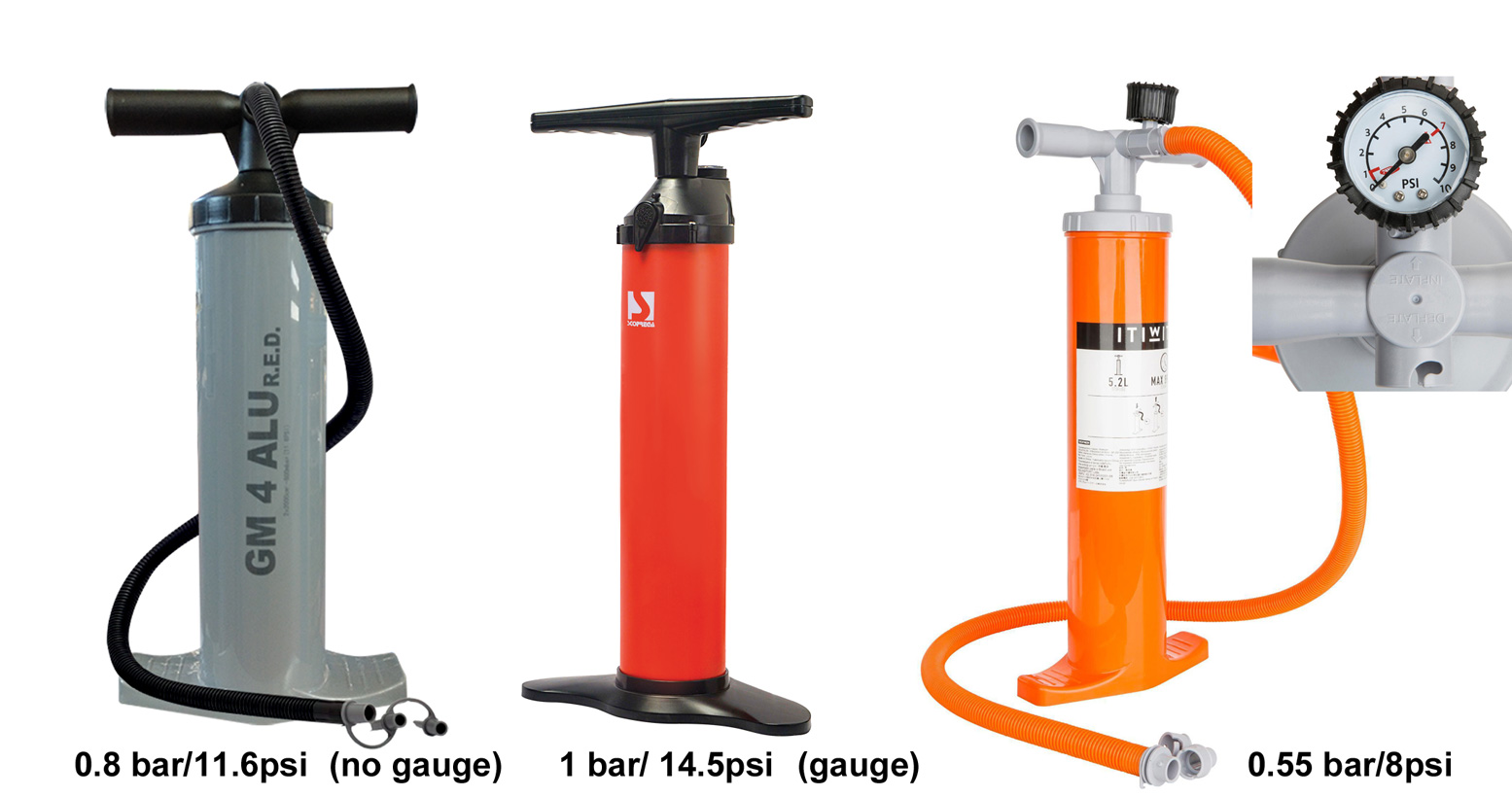
Left: Bravo Alu RED from £16 • Middle: Bravo 110 >£40 • Right Itiwit (Decathlon) £20

Some of these pumps may be double action. At a certain psi they become single action (downstroke only). I believe the Bravo Alu 4 RED (0.8 bar) works like that. Or they have a switch to do the same and help attain higher pressures. It works. Whatever pump you get for your DS IK, make sure it is rated to comfortably exceed your DS boat’s pressure rating.

What I call ‘raft’ valves

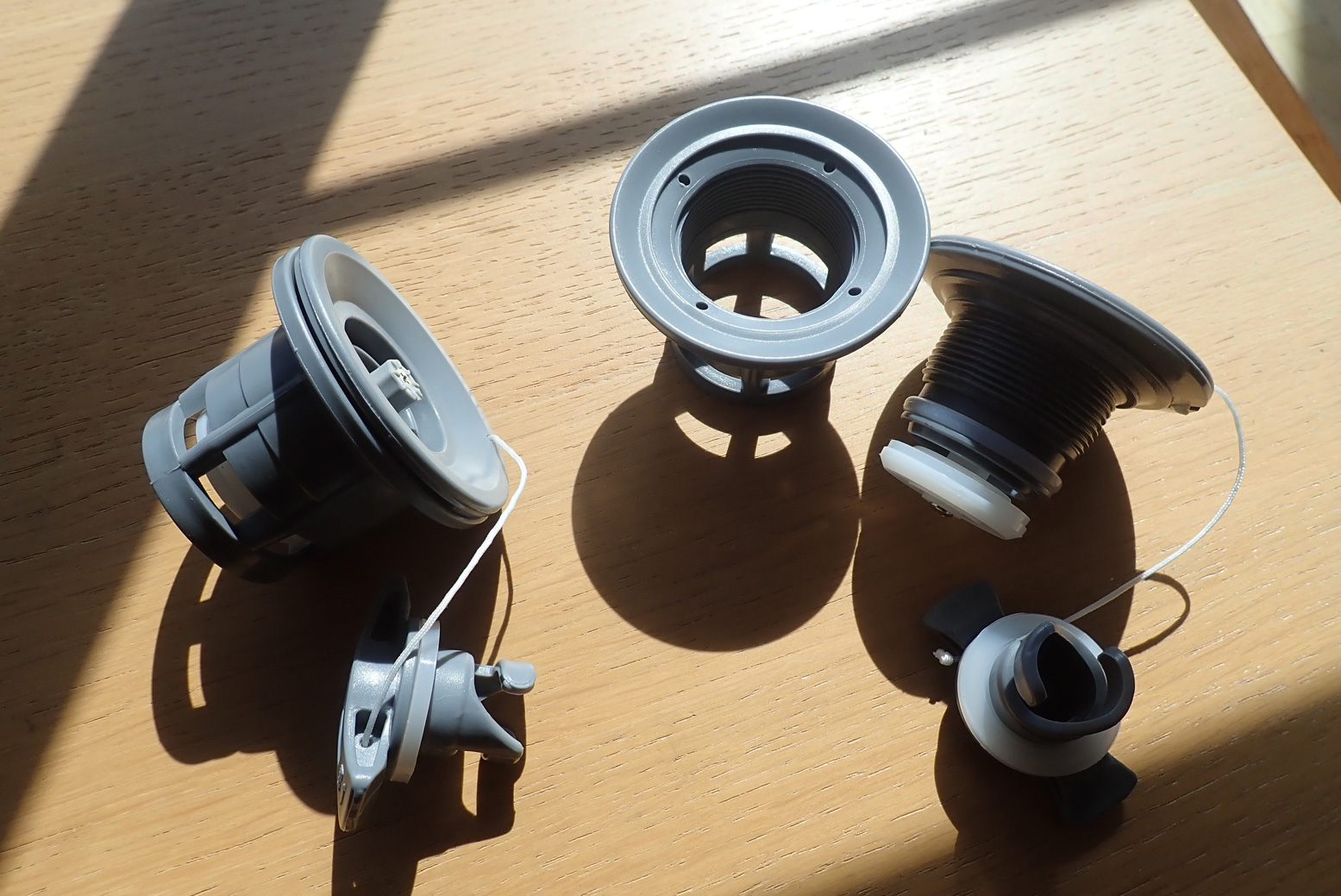
Bayonet nozzles for ‘raft’ valves.
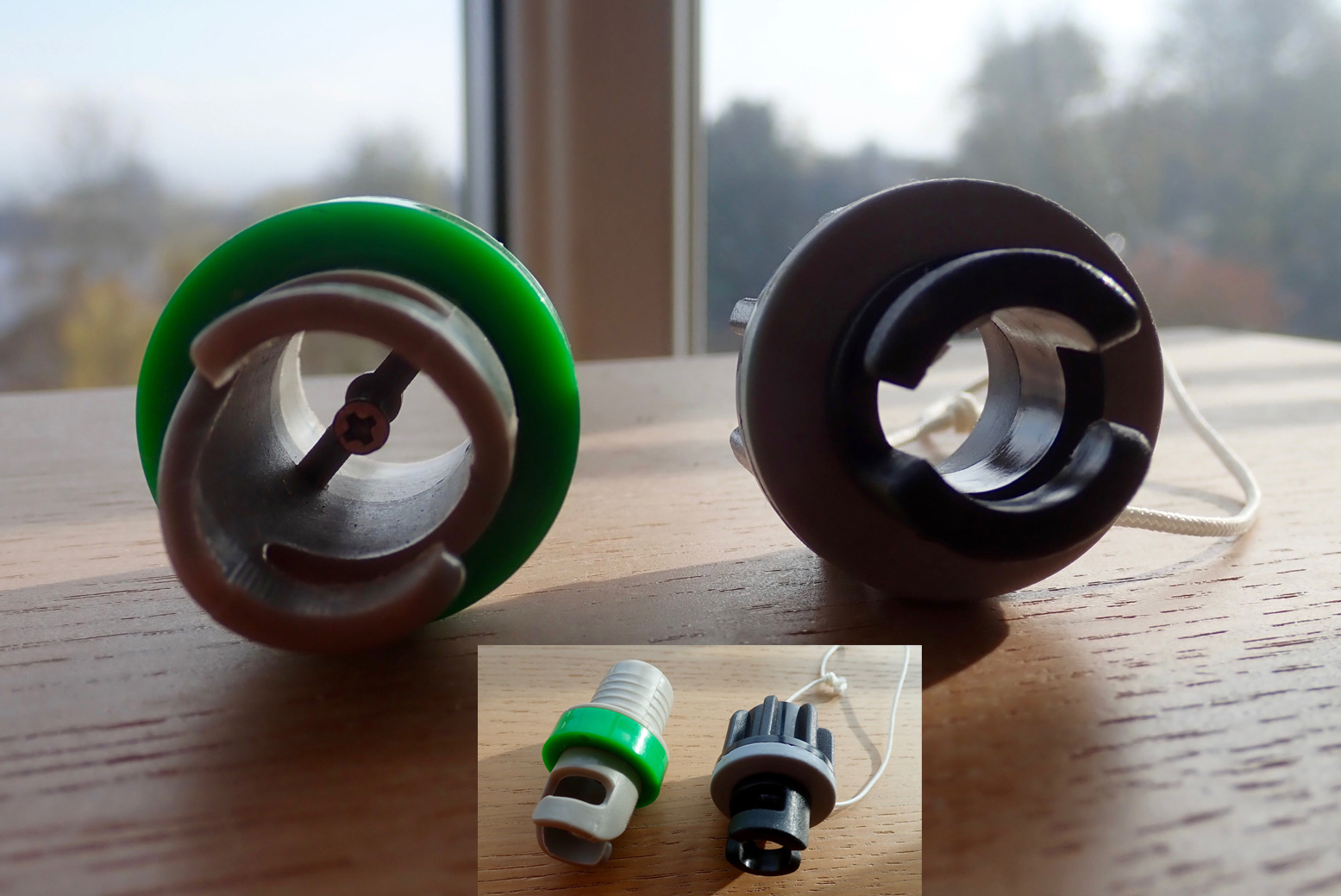
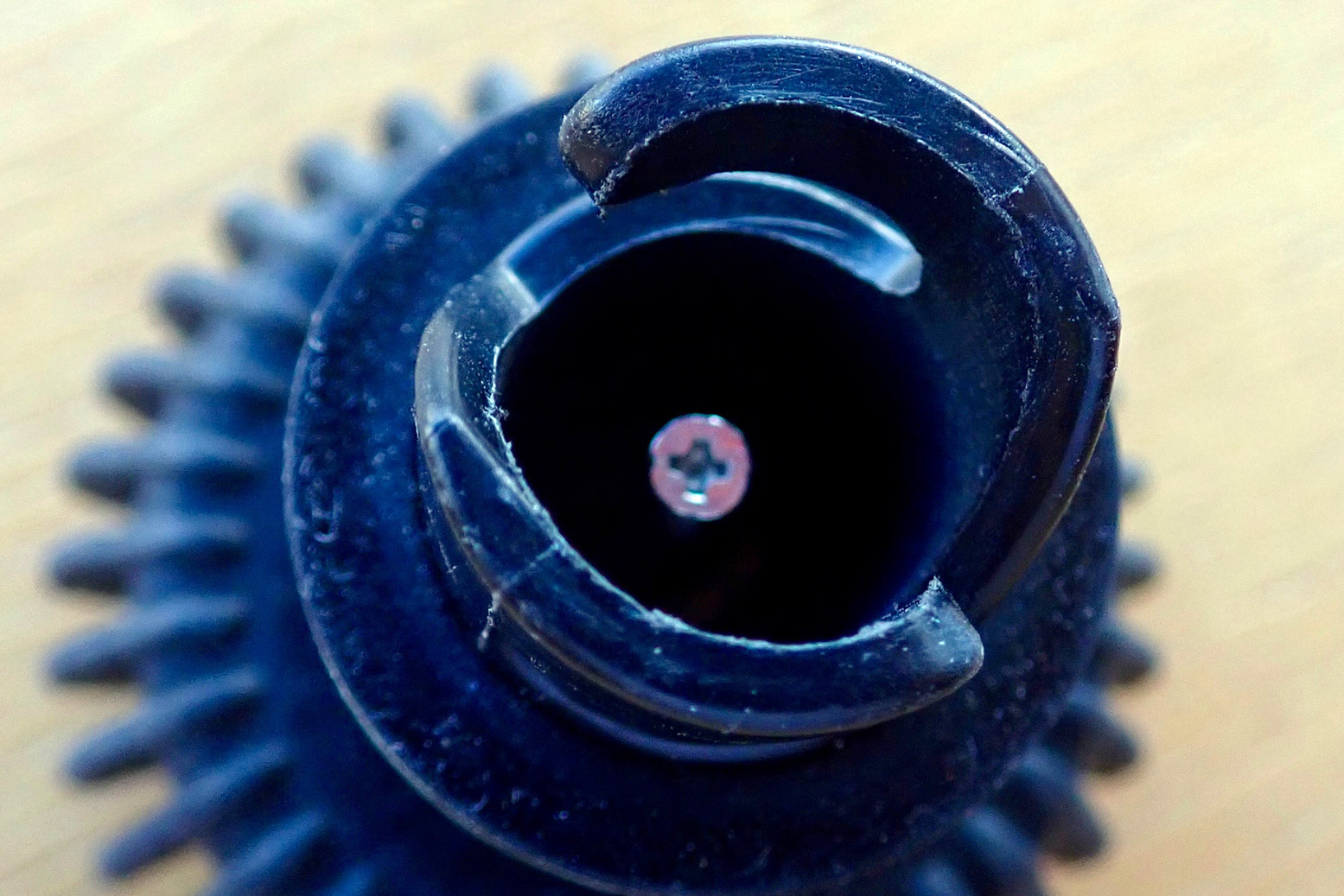
Who would have thought there’s something to be said about bayonet nozzles? Well there is. There are two types: plain (below right, Gumotex) and crossbar-peg or detent (left, Bravo). Both need soft spacer washers to fit snugly against your boat’s raft valve, but the small peg inside the green one will press open your valve stem as you connect it.

You will notice a similar peg on car tyre inflation hoses and also on a hand manometer (below). A manometer can’t get a pressure reading without this peg partially opening the valve as you push it on. A nozzle with a peg/detent means that:
a: you’re not pushing the valve spring open each time you pump (easier pumping) and
b: if your pump has a manometer you will get a constant/live reading as the pressure climbs which is the point of having a built-in manometer. The Bravo one goes from 3 quid; search: ‘Bravo Adjustable HP Valve adapter’.
The only drawback might be that you need to remove a pegged nozzle carefully with Push-Push (Gumotex) valves. Normally a little air escapes as you do this, but if the valve doesn’t spring back closed, air will rush out. Turn slowly then pull away briskly; you’ll get the knack.

Pressure gauge (manometer)
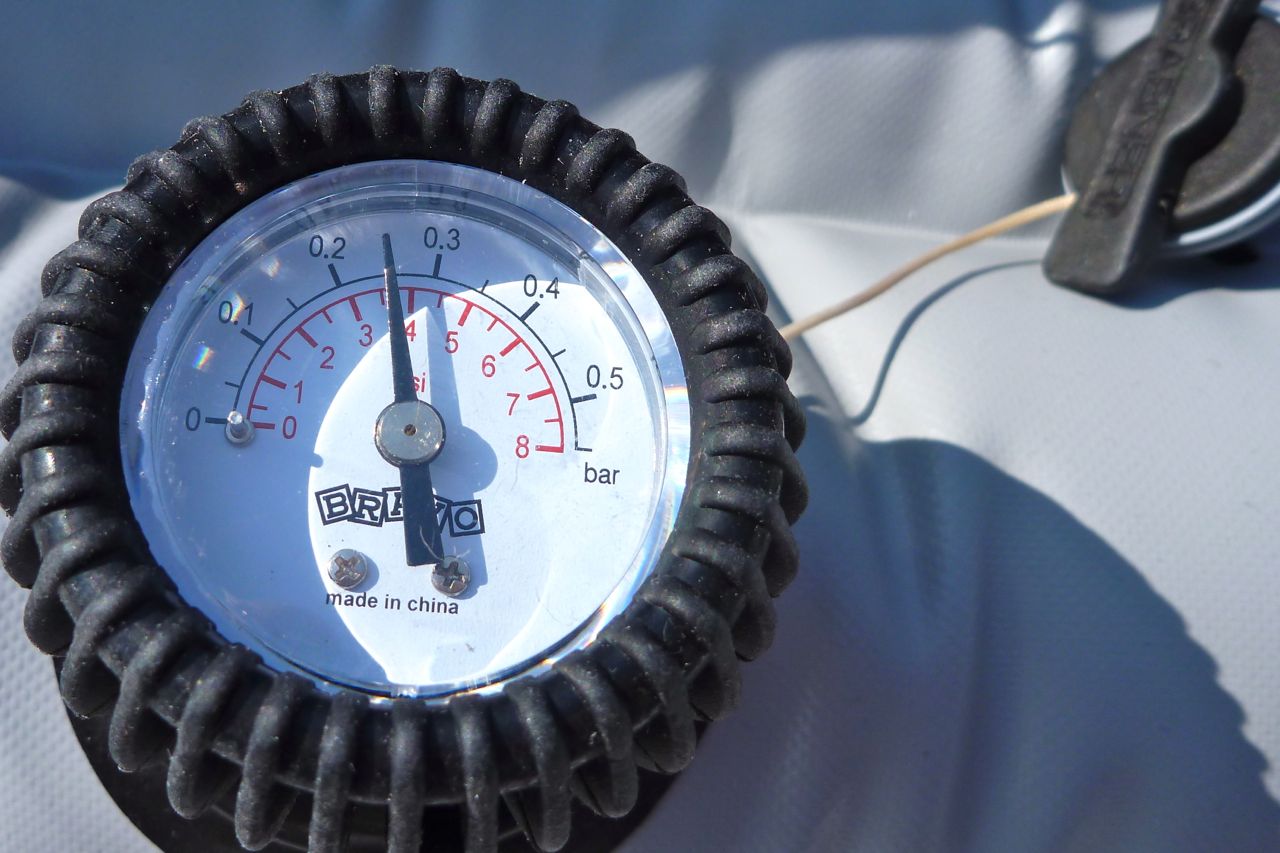
Until I got a Grabner which has no PRVs but ran a relatively high, 0.3 bar (4.3 psi), I never bothered with a pressure gauge (manometer, below) and just pumped up by feel. A lot of people do this. Since then, I ran a Gumotex Seawave and fitted PRVs to all chambers. That meant I still didn’t need a pressure gauge to get the right pressure; I simply kept pumping until each PRV hissed: the boat was then at operating pressure. My Seawave 2 was left stock (no side PRVs) so I have got into the habit of keeping a Bravo manometer with the K-Pump Mini and checking the sides at each paddle when I top up. I have checked this manometer against the floor and it measured 0.25bar which matches with the PRV rating, so I think it’s pretty accurate. Try and get a model with a range of no more than 1 bar (as below left) as that is the range you’re working in. At the moment, Sea Mark Nunn sell it in the UK.

With high-pressure DS IKs, you probably want a pressure gauge as the boat will perform best at the right pressure which may be higher than you’re used to.

Packraft Pumps

Packrafts used to be inflated with a featherlight airbag which came with the boat. A nozzle on the bag screwed into the boat’s valve and you scoop air into the bag (easier with a breeze) and ‘bear hug’ it to cram the air into the boat. It’s takes about ten scoops and two minutes to inflate a boat this way, then unscrew the bag nozzle and quickly screw on the valve without losing too much air.
Next, you used to top off by mouth on a separate twistlock valve: the firmer the boat the better it rides. In the video below (speeded up x 15) from walking up to a beach with my paddle in my pack, to loading up and paddling away took 8 minutes.

Things have moved on. Most packrafts now have a single one-way Boston valve which tackles initial inflation and topping up to a firm pressure.
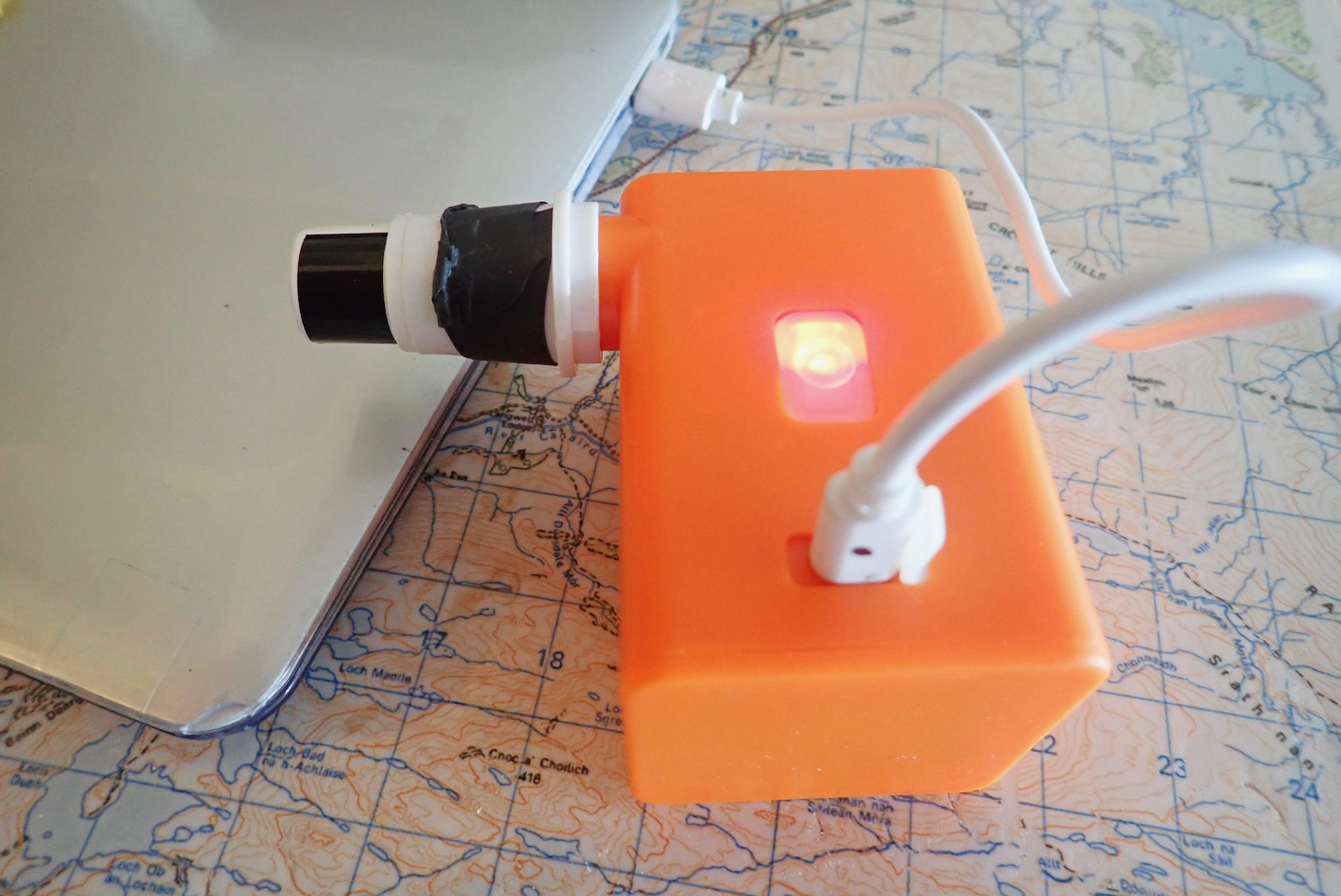
Inexpensive and tiny rechargeable electric pumps (left and below) now effortlessly do the initial job of the air bag, once you fit the right adaptor. Flextail minipump reviewed here.

Mini electric pump

And for those who don’t have lungs like Luciano Pavarotti, once aired up a light and compact mini handpump (left) will get the boat good and firm. Firm boats paddle better, and like IKs, a packraft that feels firmly inflated by hot ambient air on land will go soft once cooled in the water and will need more topping up.

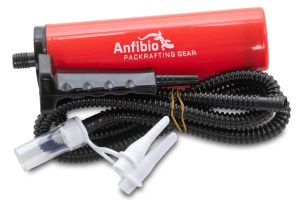
The Anfibio pump above is an adapted eBay balloon pump with an added hose so you can top-up on the water, if needed. It also differs from eBay cheapies in that the handle now unscrews from the pumping shaft to make it less prone to snapping in transit (as I found with the earlier version).
With a Flextail and an Anfibio pump you’re packing good to go, but I always keep the original air bag plus a short section of garden hose (for topping up; below) with my boat in case either pump fails.

Note: a good packraft should hold air for days at a time, but don’t leave it fully inflated and out of the water in the hot sun. The air inside heats up and expands, pressures rise and the seams will get strained and may rupture.

Preview: Gumotex Thaya IK

See also:
More about Hybrid IKs
Gumotex Rush

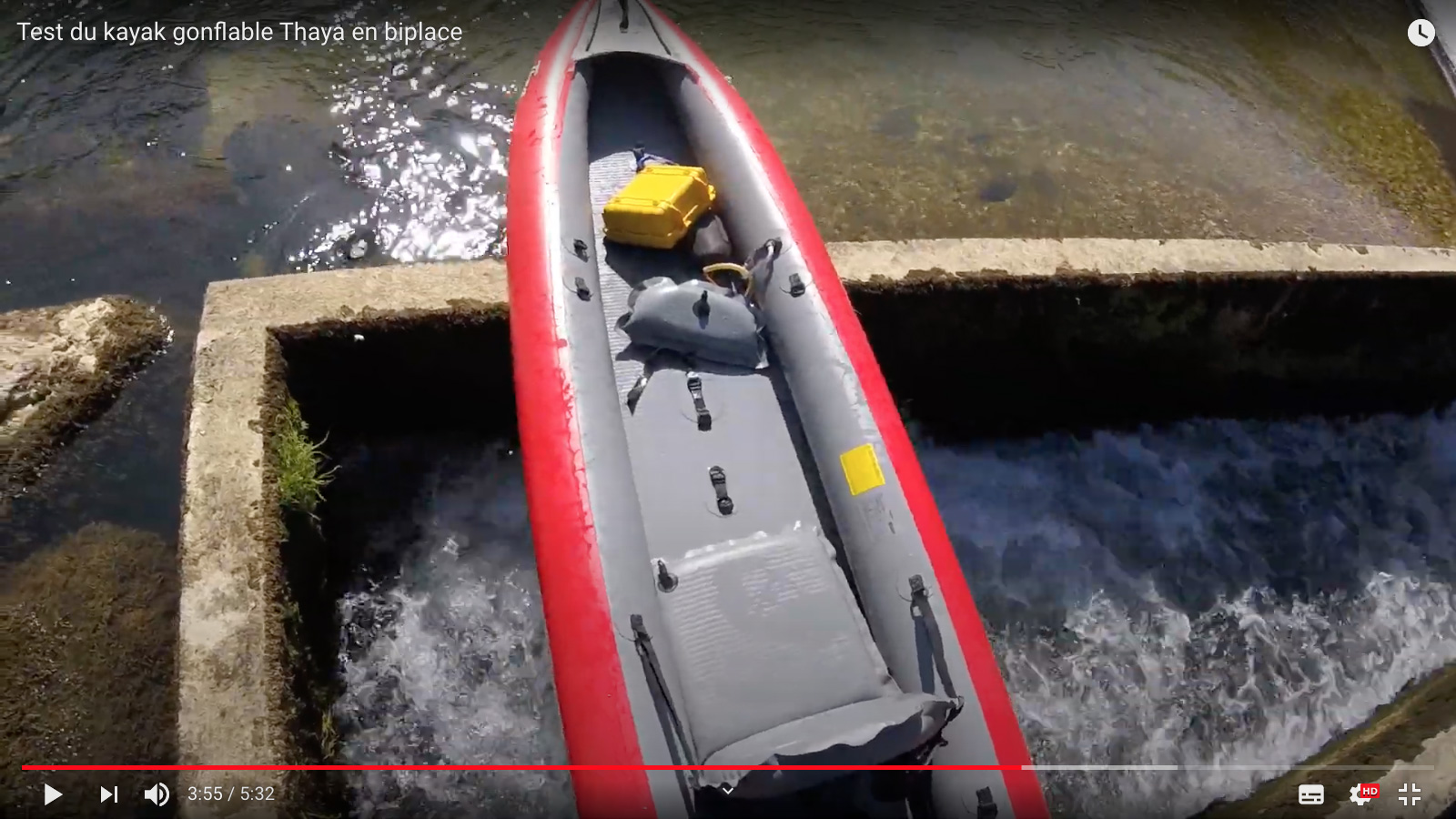
Since 2019 the Gumotex Thaya sits alongside the near-identical and 25% cheaper 4.1-m Solar on which it’s based, but with a drop-stitch (DS) floor to greatly improve rigidity. The Solar was not unlike my old Sunny, running just 3psi (0.2 bar) all round. That can get a bit saggy with a well-fed solo paddler. This was the first of Gumotex’s DS-floor boats, but a basic exercise in simply replacing a floor rather than trying anything more fancy like the Rushs of 2020.

decpump

Drop-stitch fabric now makes the complicated hand assembly of pressure-vulnerable I-beam floors (left) redundant. A DS floor is a flat panel with effectively 3-4 zillion ‘I-beams’ (see top of the page) all spreading the pressure load evenly to constrain the form into a plank shape, but at a much higher pressure than an I-beam floor can safely handle. In an IK, high pressure = a more rigid hull = better glide/less effort for barely any additional weight. The only drawback is that you need a more powerful high pressure barrel pump (above right). Your old Bravo foot bellows won’t do anymore.

DS is normally PVC and made in China, but Gumotex have found a way to manufacture threading and bonding a D/S floor with their durable, flexible and environmentally right-on Nitrilon rubber fabric. It can’t be that hard. The regular, normal-pressure 3psi sidetubes ought not need the higher pressures I ran on my adapted Seawave because the 7psi (0.5 bar) DS floor greatly aids rigidity (see action video below). Gumotex’s new tag line rubs it all in:
Made in EU [read: ‘not China’], made from rubber [read: ‘not PV … spit … C’].

thaya-family

The promo video below suggests something revolutionary, but combining DS with Nitrilon can’t be that much different from doing the same with PVC. It will certainly simplify or speed up assembly. One assumes drop-stitch floors supposedly don’t need a PRV necessary to protect I-beam floors from internal ruptures when they overheat in the hot sun. Some UK outlets where claiming the Thaya has a “Safety relief valve [PRV] in the bottom of the boat” but it’s probably just a copy and pasting error from the Solar. I can’t see one in any pictures and have yet to see a DS panel with a PRV until the AE AirVolution came out in 2020. The assumption is they don’t need it if it runs a modest 7psi, but some claim high-pressure DS floors won’t last as long as I-beams. Without a PRV, that may be true and much will depend on running the correct recommended pressure, the quality of manufacture/assembly and where possible, leaving the boat in the water on hot days so the large water-contact area keeps things cool.

One positive thing about old-style I-beam floors is the parallel I-tubes (left) probably don’t hurt tracking (even without a skeg). They also enable the desirable curved hull profile of a boat rather than the flat floor of a barge (for the moment DS panels can only be flat or maybe with a slight curve).

Payload ratings seem to have settled at 230kg and the movable seats are also made from DS panels. Initially I thought why? For the backrest and footrest that makes sense but who wants to sit on DS seat base on a DS floor? Of course you don’t have to pump DS up to the max to get its flat form constraining benefits and it looks like valves are regular twist-locks so you’d couldn’t get more than a couple of psi in there. Footrests are the usual inflatable pillow rubbish, but possibly also DS? I’d replace them with a section of sawn-down plastic drainpipe so you get a solid block to brace against. It makes efficient paddling much easier.

thaya-red-l

I’ve never tried one, but I do wonder how a flat-floored DS IK might handle in windier, choppier conditions where an IK isn’t exactly a hydrofoil at the best of times. A flat, raft-like floor will be stable, sure, but it will roll and pitch about more. Also, according to the specs (left) at 89cm the Thaya is a disappointing 6 or 9cm (3.5″) wider than the all-tube Solar 3 (Actual verified width seems to be 34″ or 86cm). Great for family-friendly stability; not so good for solo paddling speed and efficiency. My Seawave was 2cm narrower than a Solar 3 and with the usual care getting in, stability is not an issue. Out at sea my Seawave would swamp long before I’m tipped out. But then again, the near-rigid floor may cancel out the drawbacks of the greater width. At 18kg the Thaya is heavier than a Solar 3.

For most recreational, flatwater users the Thaya ought to be a nice family boat, but then so is a Solar 3. The Thaya costs 30% more than the Solar 3 whose days may be numbered, but it’s 2022 so maybe not.

Full Dropstitch Inflatable Kayak Buying Guide

Page moved here