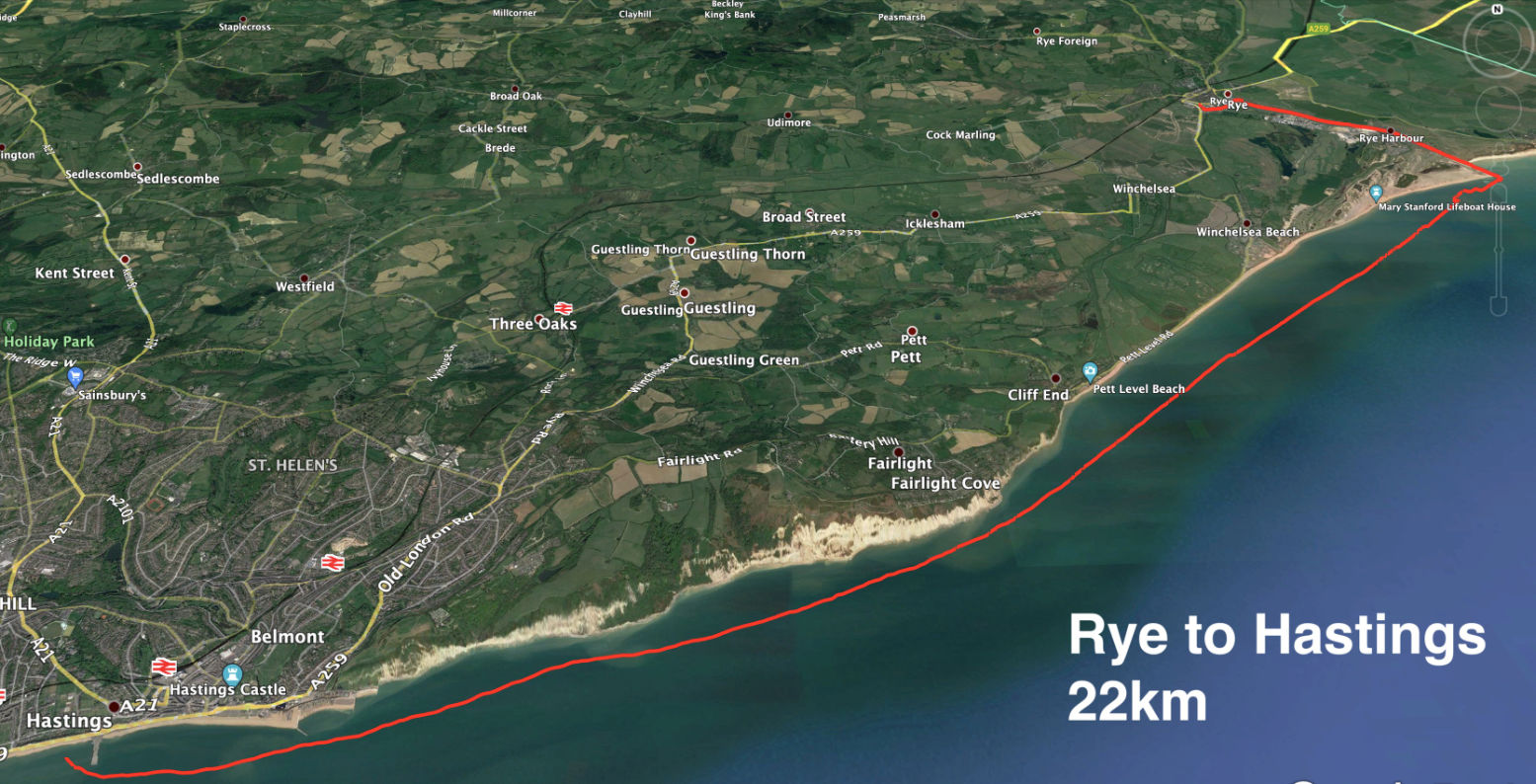
Once we were let out in the Covid summer of 2020, we did a very nice coastal walk from Hastings to Rye along the Sussex coast. Hot, but not so windy, it would have been just right for paddling. Today conditions were similar for a westbound transit from Rye back towards Hastings. High Water (and a spring tide too) was at a very reasonable noon in Rye, with a forecast of 8-14mph from the east and a bit of a kick at 3pm. I was hoping for the upper limit and a bit of splashy sport, so brought the WindPaddle I’d used on the packraft last month in Scotland in much stronger winds.
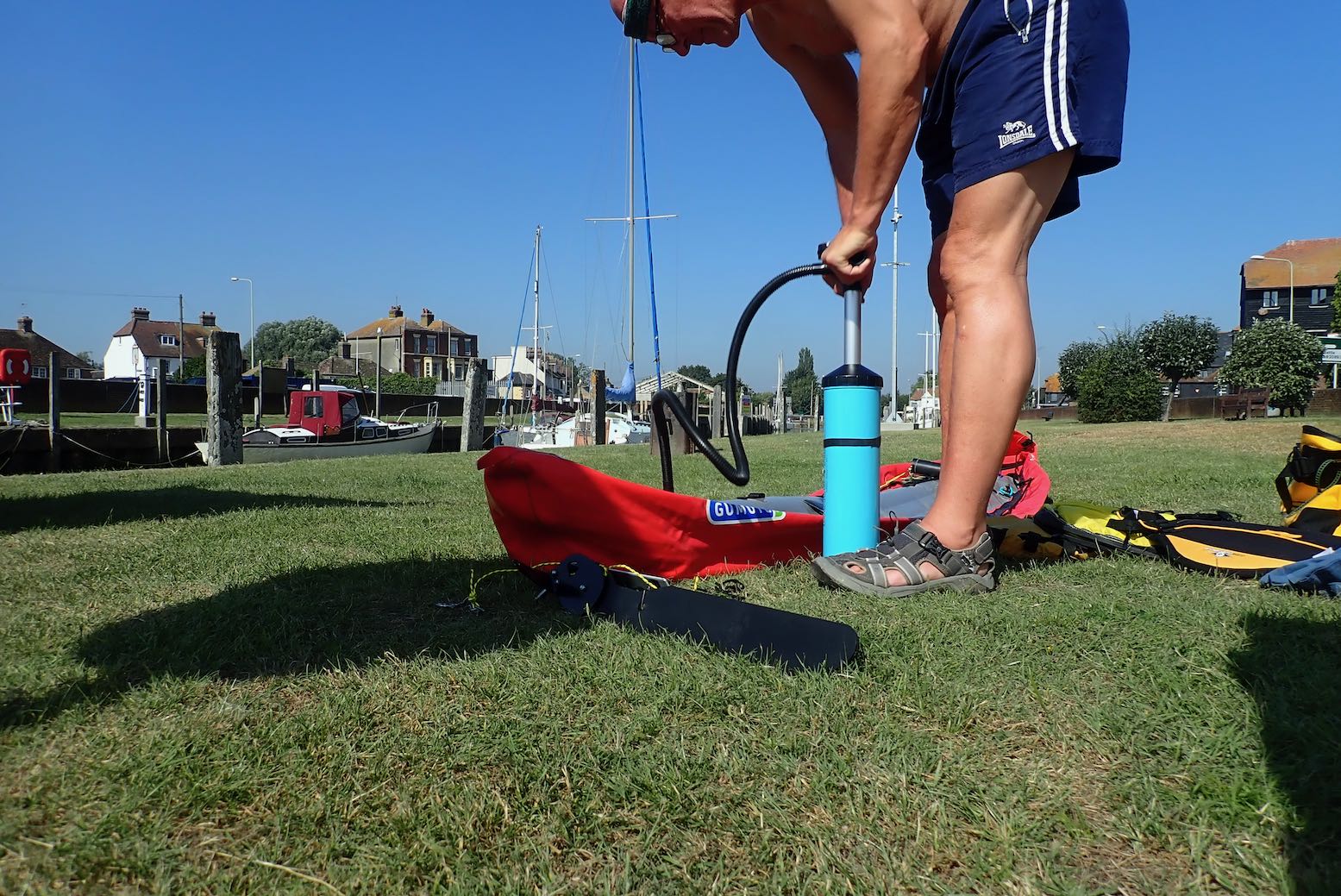
It’s only a 10-minute walk from Rye station to a boat ramp on the quay where the water was still inching up the concrete as I pumped up the Gumotex.
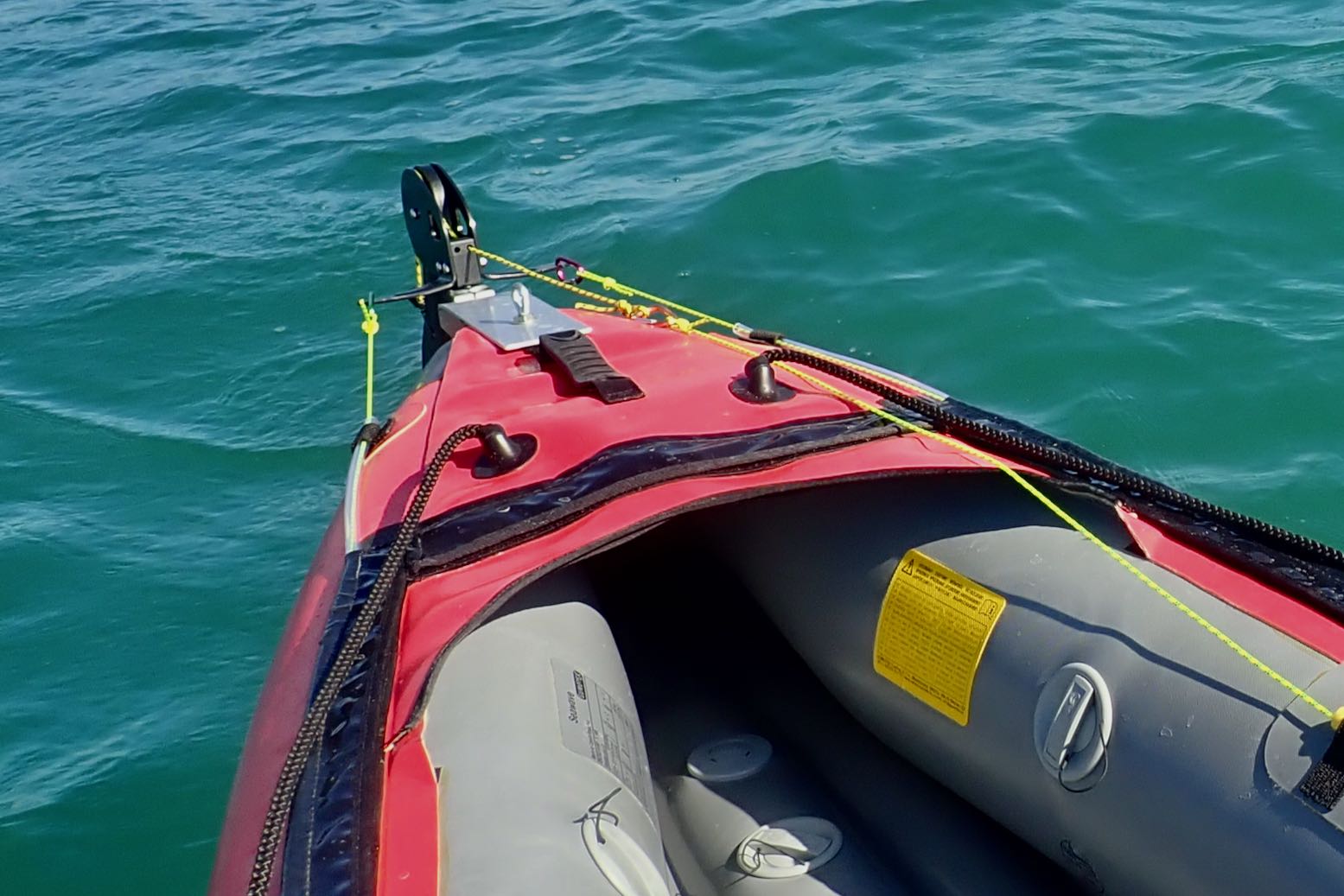
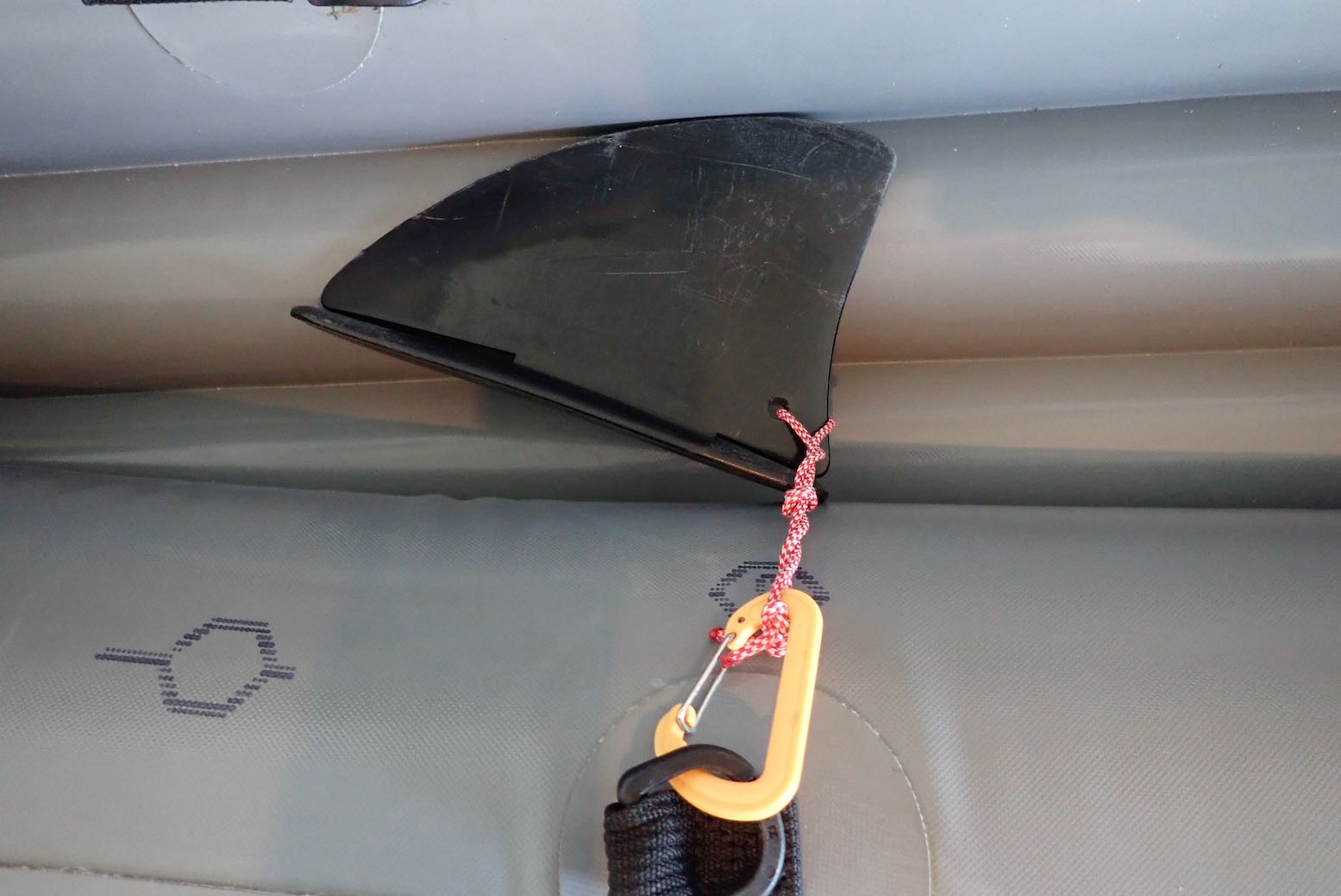
I was taking a gamble trying my untested new rudder set up. Because I expected it to play up, I fitted the stock skeg so I could lift a problematic rudder and carry on as normal without coming shore. To be without a rudder or skeg with a backwind at sea would not be ideal. Being the ever recirculating goldfish, I forgot to try out my sail stick mount idea.
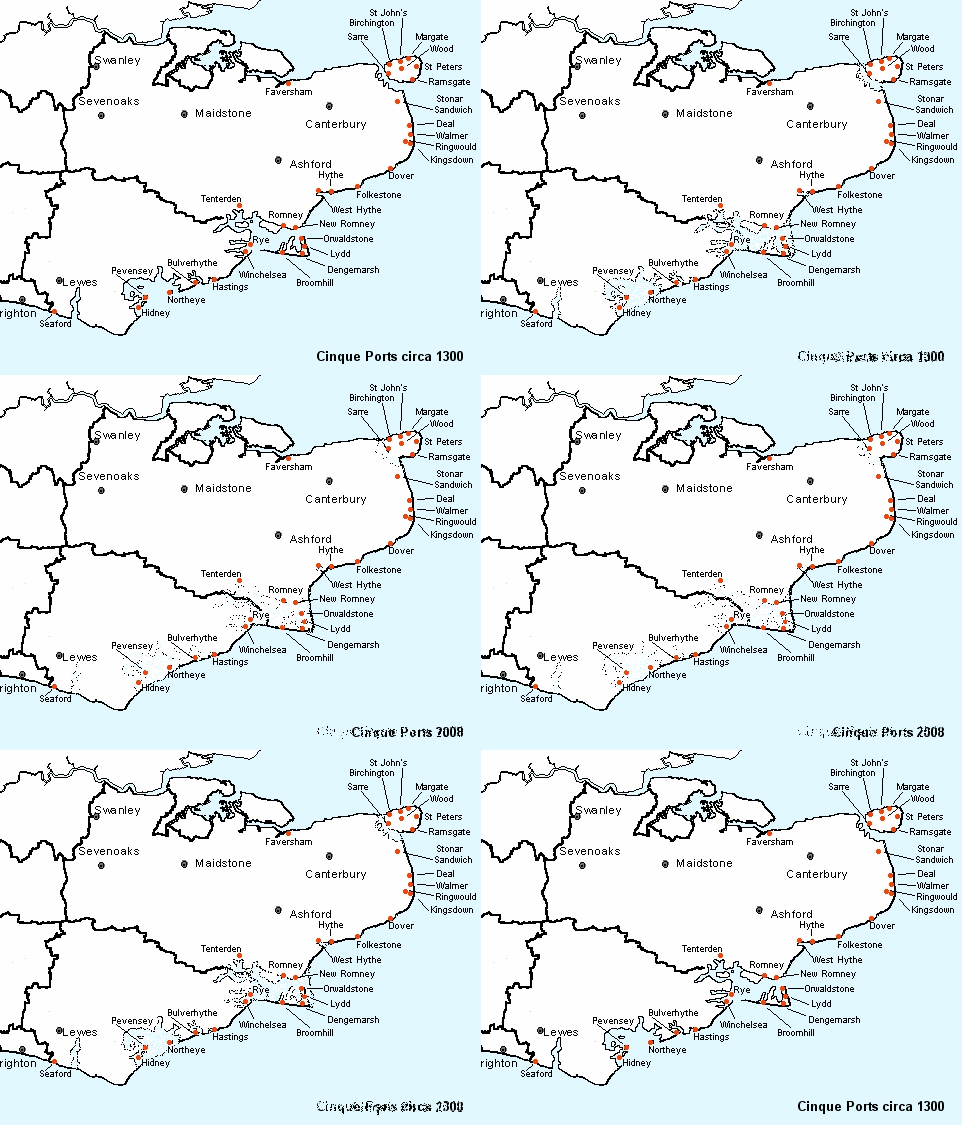
Rye hasn’t been on the coast since 1287 or so when, along with gradual land reclamation, the biggest of a series of 13th-century storms filled the adjacent marshy inlet with silt and shingle which finished off semi-abandoned Old Winchelsea and radically redrew the low-lying coastline where the Kent and Sussex borders meet. It was the same in Pevensey to the west. The gif on the left from this interesting regional website shows how the coastline of southeast England was transformed in the late medieval era. Where the Rother river once flowed directly east to enter the sea at New Romney, the filled-in bay saw it diverted south below the old hill town of Rye, now stranded two miles from the sea. The then important port of Winchelsea was rebuilt on its present site in 1288, but eventual silting saw both it and Rye’s maritime importance decline. What this area may lack in epic spaces common to the north and west of Britain, it gains in fascinating history. 1066 and all that.
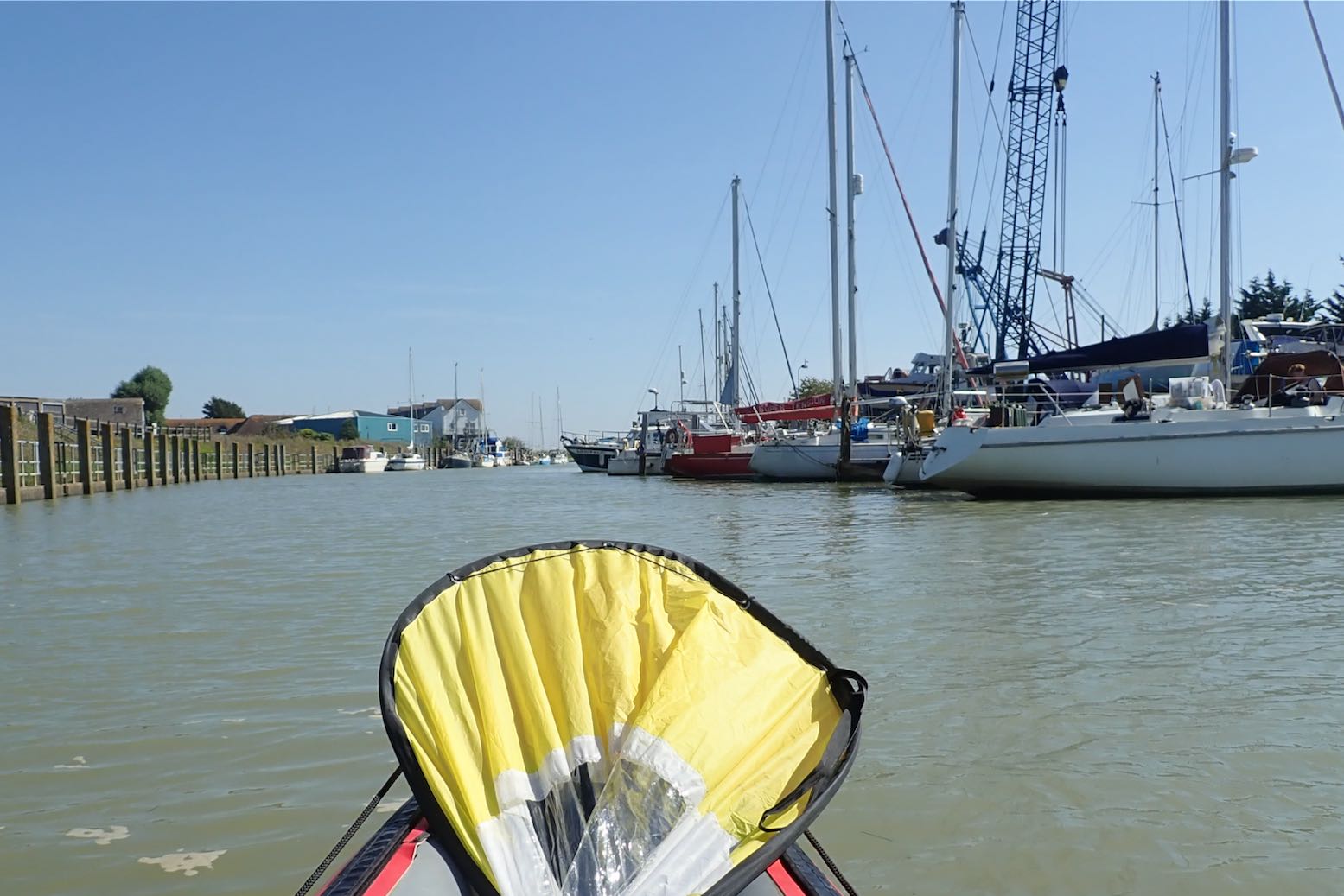
I set off along the River Brede which wraps around Rye’s south side like a moat, and soon joins the Rother. It’s about 5km to the open sea.
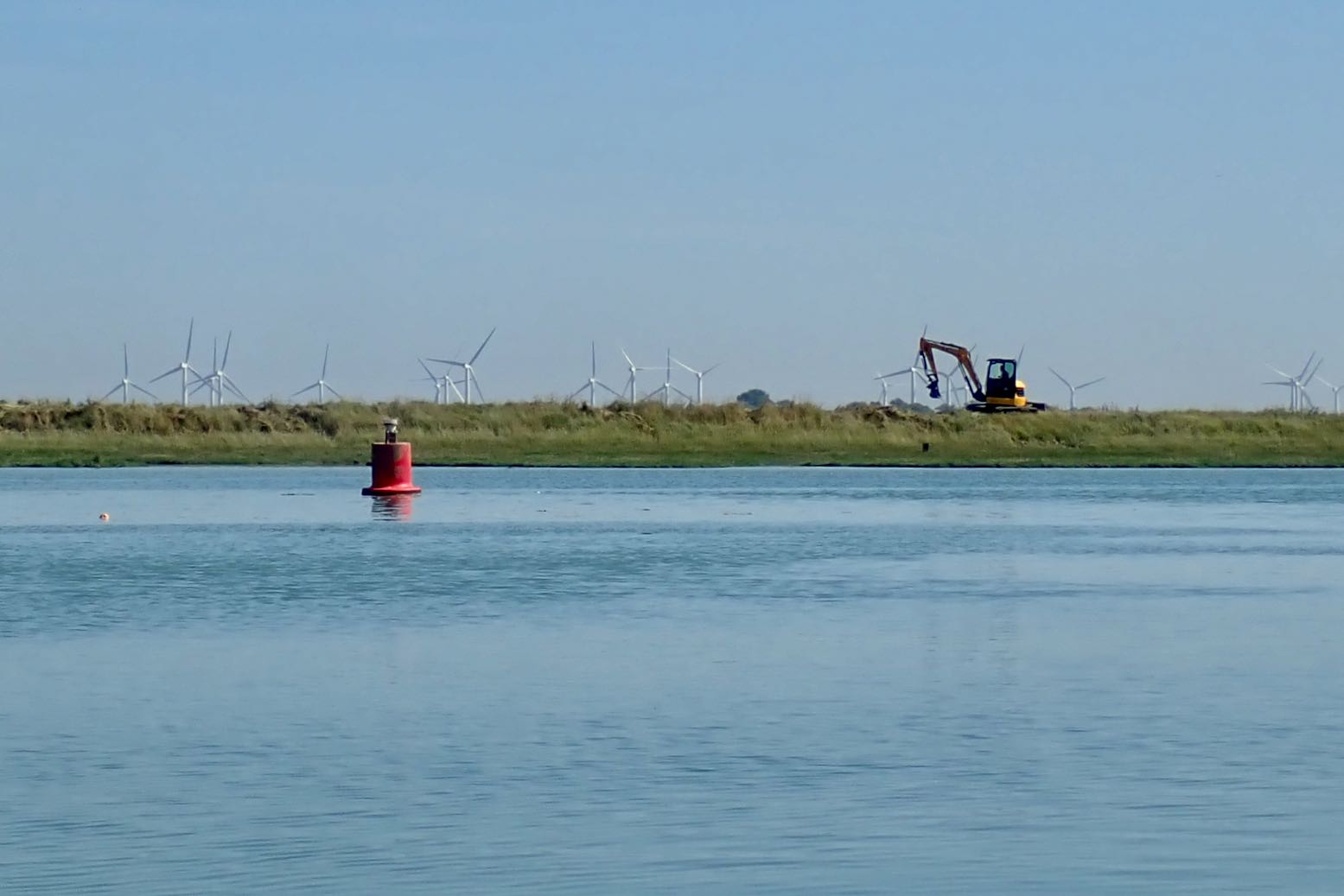
I’m into the wind but the grass banks are under water and the wind turbines are spinning merrily; all good signs.
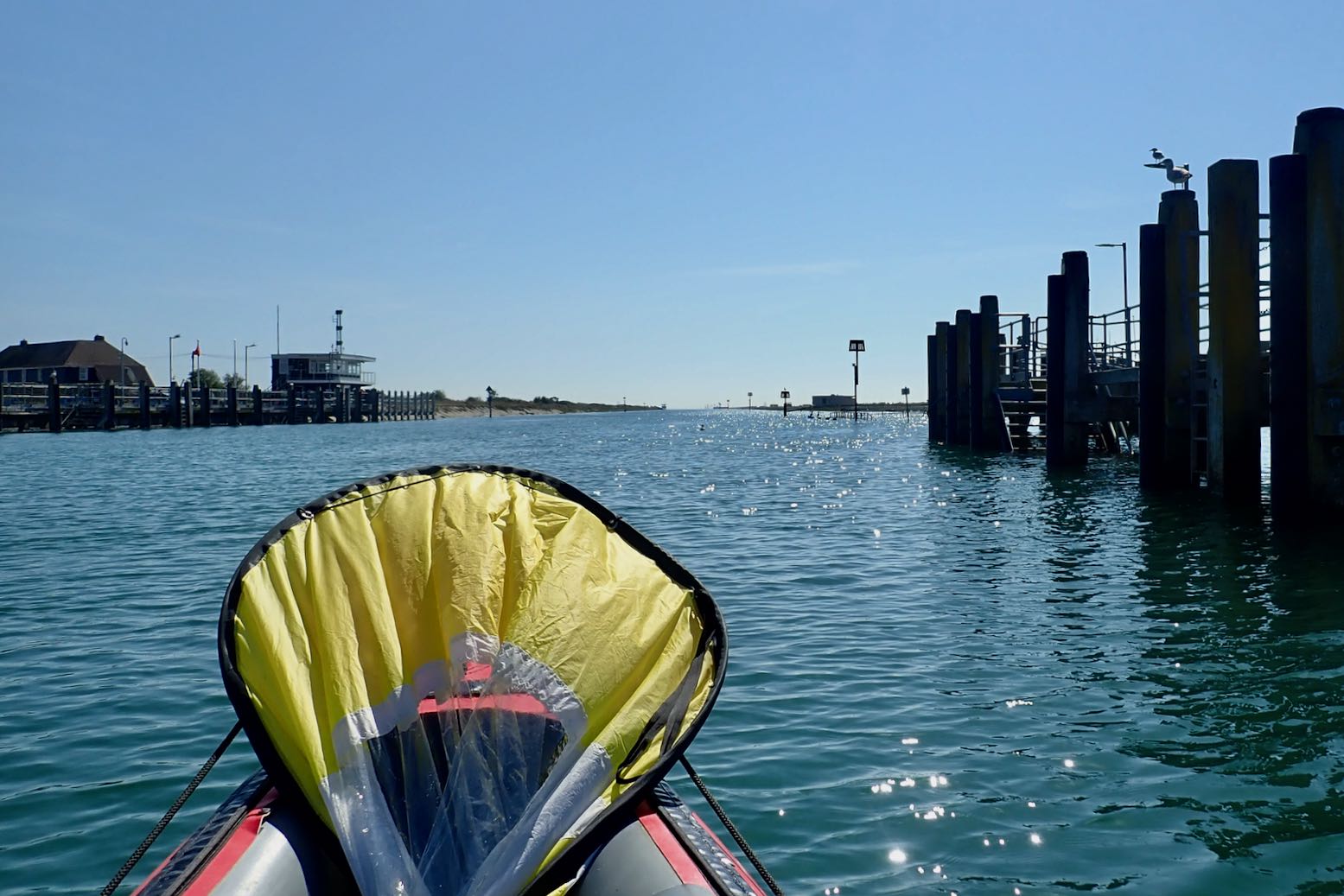
Rye Harbour. The tide is high and I’m moving on.
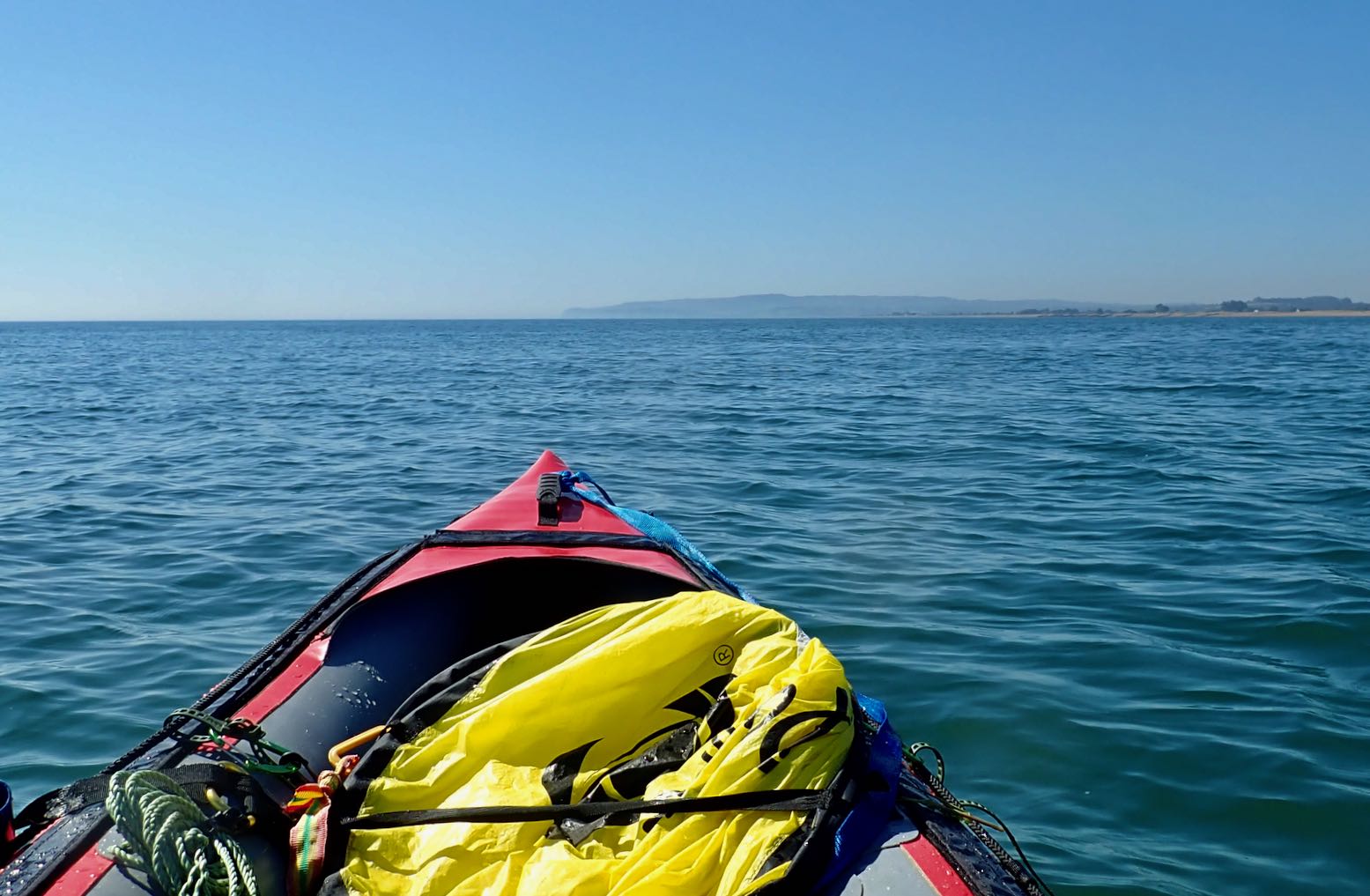
In 45 minutes I reach the old breakwater opposite Camber Sands where I recall bucket & spading as a child. The sea looks depressingly flat.
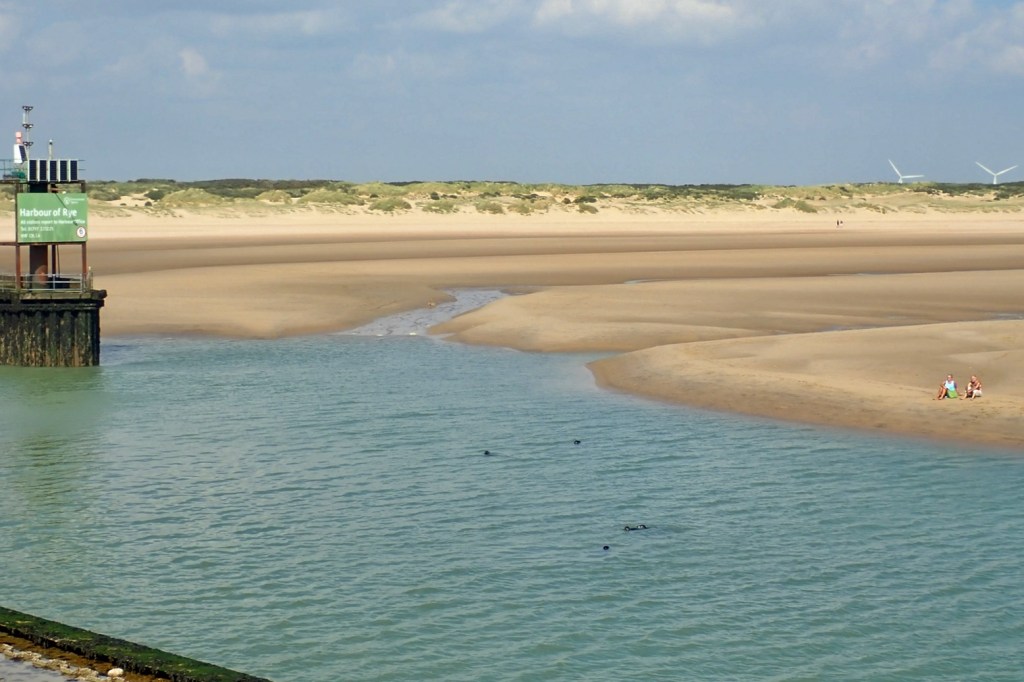
Seals at the river mouth (a few days later).
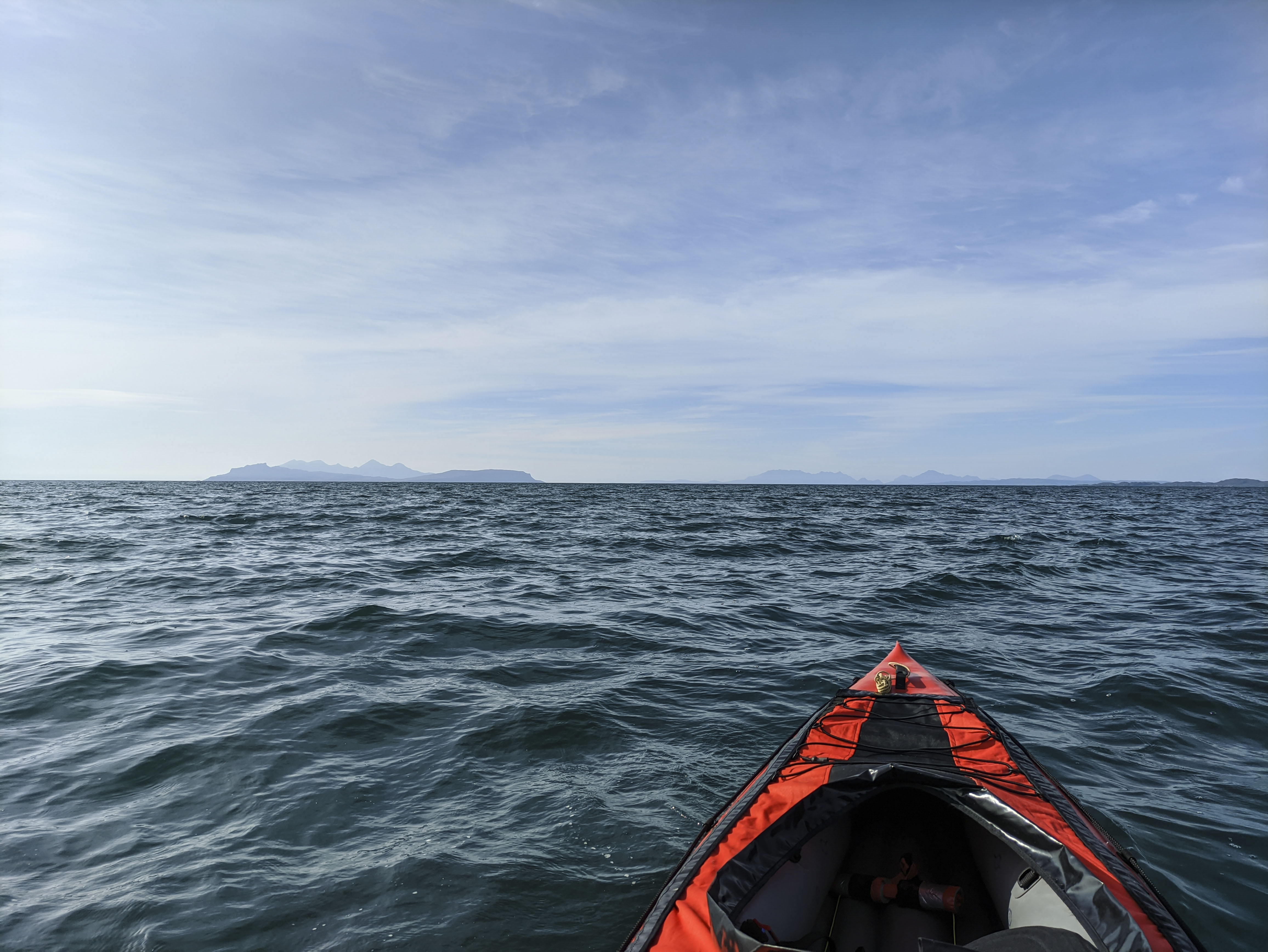
It’s nearly 10km to the distant cliffs, a two-hour haul. And with the breeze from behind, I’m soon streaming with sweat. I’m not sure my water will last.
Going with the Flow A few years ago while planning Newhaven to Brighton, I learned an odd thing about Sussex and Kent tides. For the last two hours of the incoming (eastbound) flood, the tide keeps rising but reverses westbound along the English coast as it backs up at the Straight of Dover and spills back down the sides. That makes HW is around the same time in Folkestone, and 140 miles to the west, past the Isle of Wight, but HW at all the places in between lags behind. Tidal steams are not that strong here – wind will have much more of a bearing on paddling – but this means you get only four hours eastboundflow with the flood tide and prevailing southwest winds. But if you time your run with a warm easterly off the continent and go westbound– as I did on this occasion – you get a much longer run with the tidal current; eight hours or more; maybe 45km all the way to Eastbourne. The question is: can you paddle that long.
A breeze picks up so I flick up the sail. I check my GPS and am doing 3-4kph, while I can paddle at around 5-6kph. Then the breeze drops away. I wasn’t really planning to paddle the full 30+ clicks to Cooden station, but I can always get off at Hastings, a few stops before.
At least the rudder seems to working as it should, though any quick response is dulled a little by the skeg. A rudder’s not really needed in these conditions, though it compensates for me being blown gradually onshore. I’m trying a rudder lift-line only, not a rudder lowering line as well. But once in the boat I find I can’t turn enough to even see the lifted rudder to flick it down with the paddle, so I’ll probably fit a drop-line later.
I creep along the expanse of Winchelsea Beach. It’s hot work in a backwind. Eventually I reach the start of the cliffs where the coast turns more east-west, putting the wind directly behind me. But paddling at effectively wind speed, there is no cooling effect. More familiar with paddling at the other end of Britain, I’m not used to 27°C.
Then, as predicted, around 3pm the breeze picks up and I can get the sail up.
Paddling half a mile from the shore, initially it was hard to know if I’m moving and at what speed. So waking up the GPS screen was a handy way of telling if the sailing speed was worthwhile. With the odd gust I reach nearly 7kph, but average less than 5kph, a bit slower than paddling, but I’m not dripping like a leaky tap or needing to drink. In fact I could nearly doze off.
Niblick (5b), Harrisons Rocks
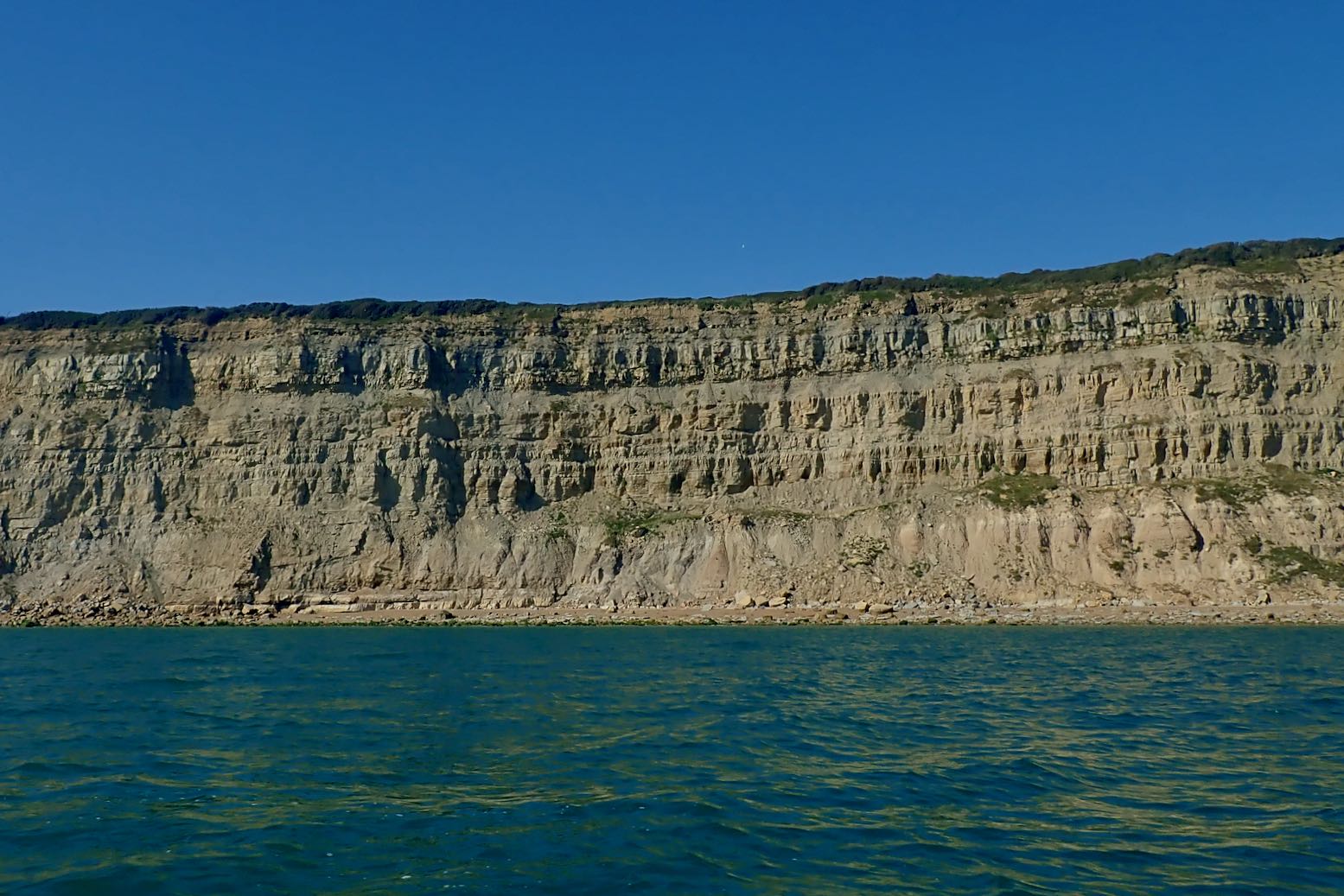
The cliffs inch by. This is the sea end of the Wealden sandstone formation, less high and steep than the better known chalky Seven Sisters to the west, or Dover’s white cliffs to the northeast. Both chalk cliffs are part of the same formation or bed, but when the land was squeezed and uplifted to the dome or hump was eroded away to expose the older sandstone below. This is what they call the Weald, and near Tunbridge Wells, East Grinstead and Frant, the weathered sandstone ridge produces small outcrops where I started rock climbing as a teenager (right).
There’s barely a sensation of movement; it’s not as bracing as I was hoping
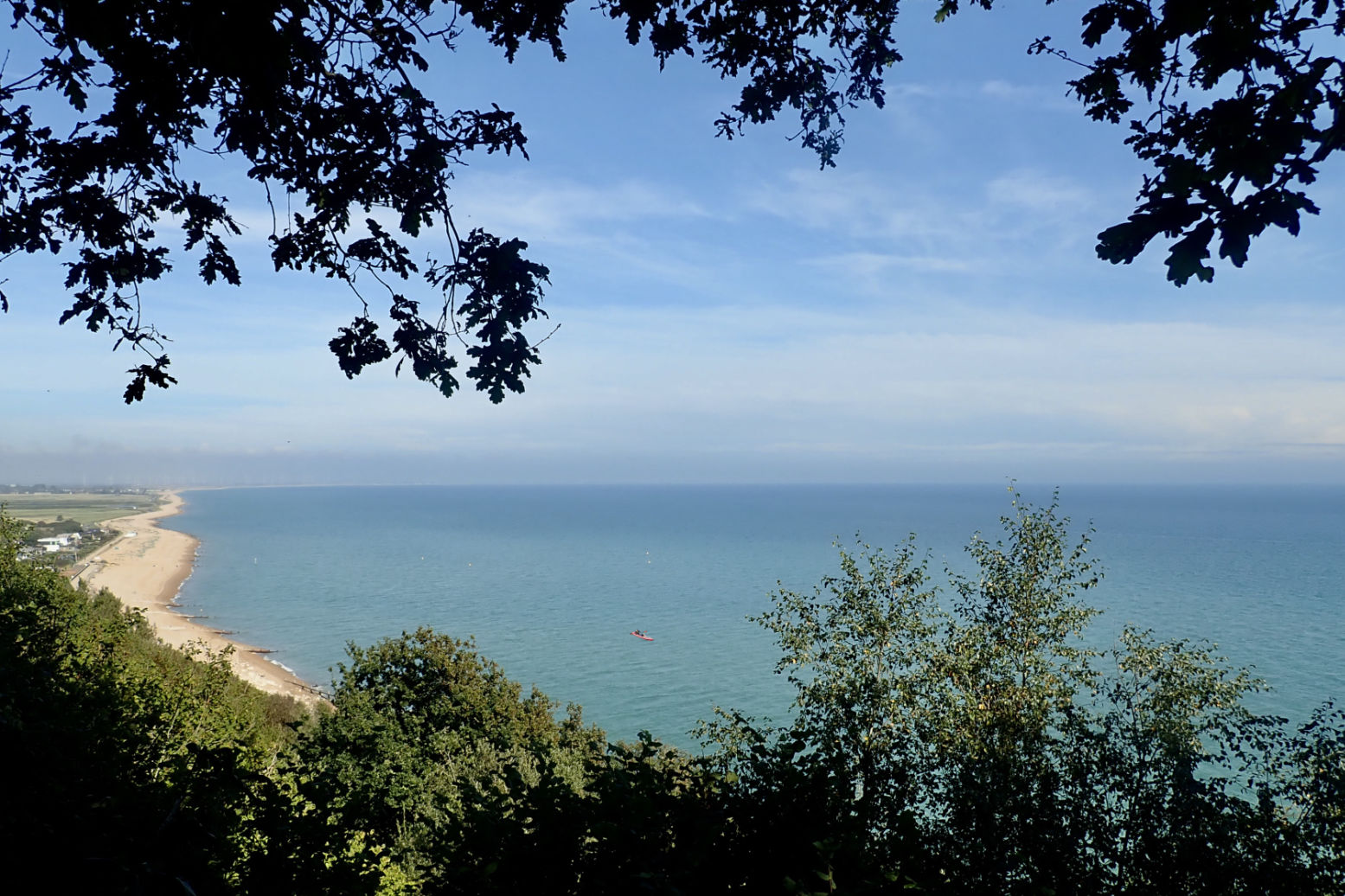
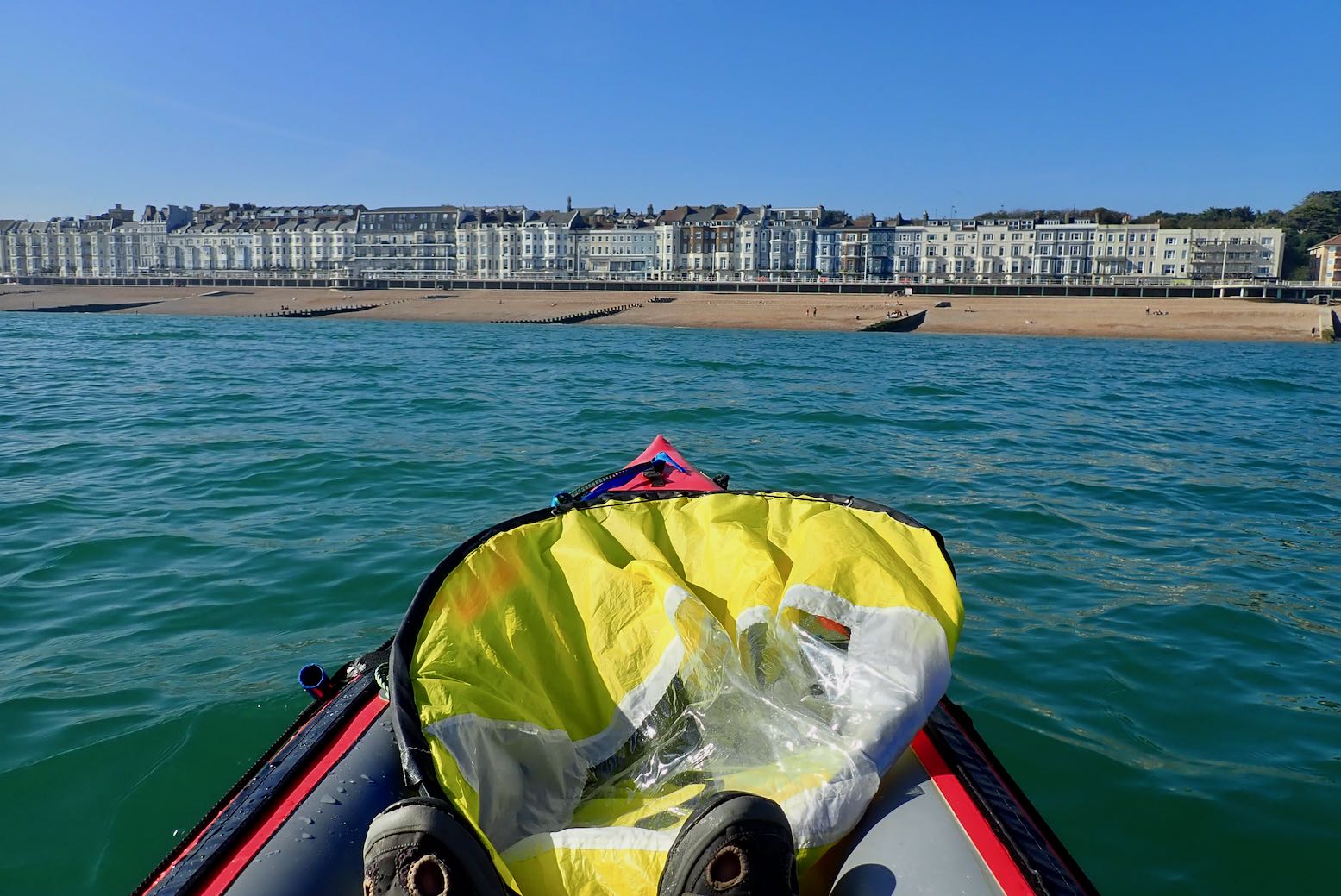
I pass the Stade, the east end of Hastings where the cliffs drop back down. A few souls are enjoying the last day of summer on the shingle beach.
I keep going to the pier and decide to have a leisurely take out there. It’s gone 4pm so another 10km to get the train 6.15 from Cooden would be a rush.
Landfall by Hastings pier. Compared to the fabulous Summer Isles, for me these southeast coast paddles lack drama and interest, but are easy to reach if tomorrow’s weather looks good. We walked Hastings to Rye again a day or two later; it took about the same time and was more enjoyable (though it was cooler). The rudder foot pivot worked fine, though needed a bit of re-tensioning at the pier. Next time I can confidently leave the skeg off, though I can see a rudder would only be needed when sailing or paddling in windier conditions. That is all I have to say for now.
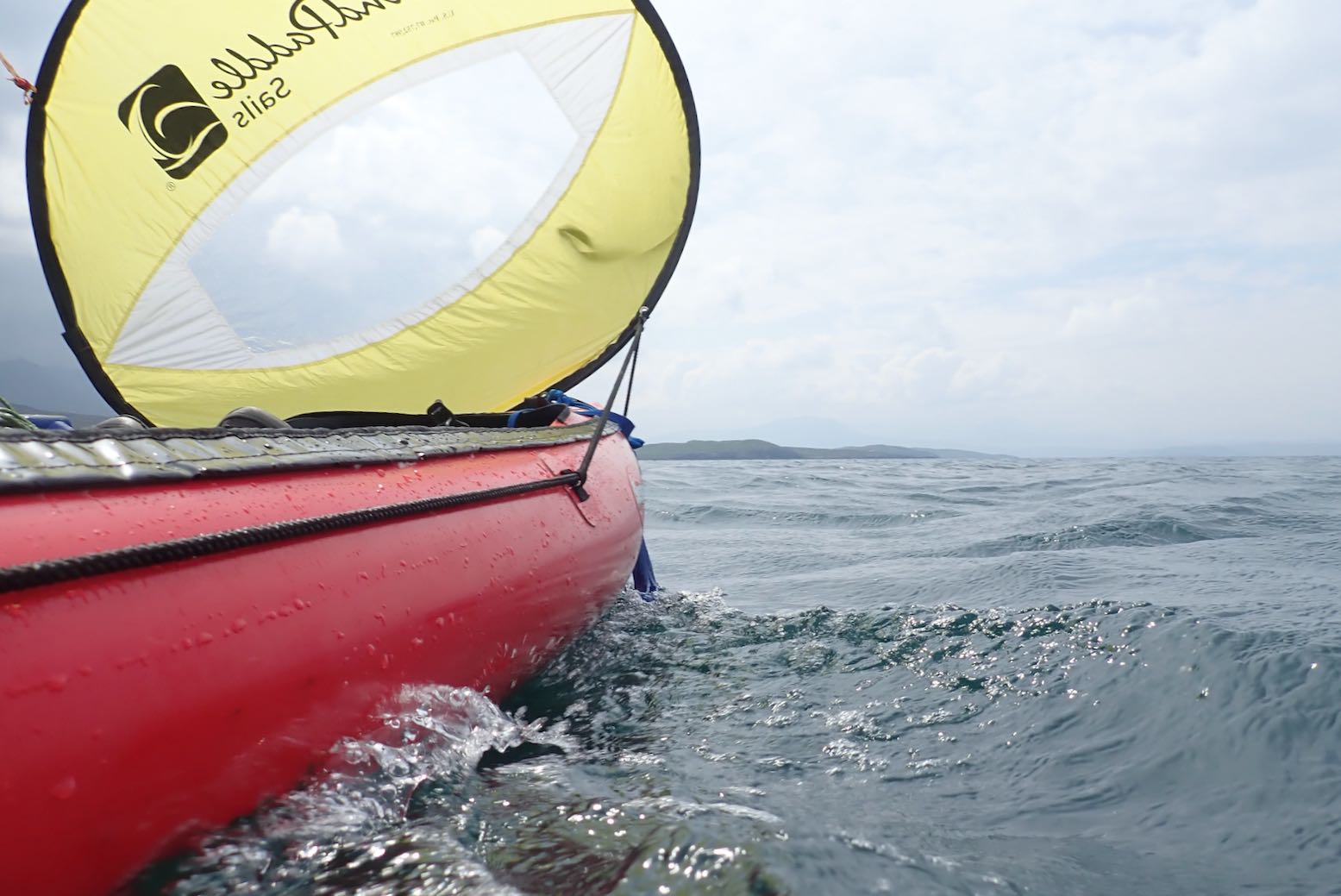
One problem I’ve had sailing my Seawave is the sail tends to sway ever more violently from side to side when the wind gets too strong. This is not just a problem with the WP disc sail I now use (left); it was the same with the Pacific Action V-Sail I used on my Incept K40 in northwest Australia a few years ago. Unable to transfer the wind energy into forward motion, it instead spills over the sides in a flapping frenzy.
It’s well know these downwind sails (especially smaller ones) have a limit of about 15-20 mph beyond which they flip out. But lazily hooking up the WP to my Seawave’s decklines introduces a lot of slack (left) which may exacerbated the swaying. It was only when trying the similar AirSail and later my WP on my packraft in Scotland (at one point with gusts as strong as Australia) that I realised lashing the sail mounts close to the hull eliminated the swaying. At least on a broader bowed packraft.
Out sailing the Seawave the other day, I belatedly succeeded in tensioning the decklines on the water with some ever versatile SoftTies (right). As you can see left, that worked OK but annoyingly it wasn’t as windy as I’d hoped, and not enough to get the WP in a flap.
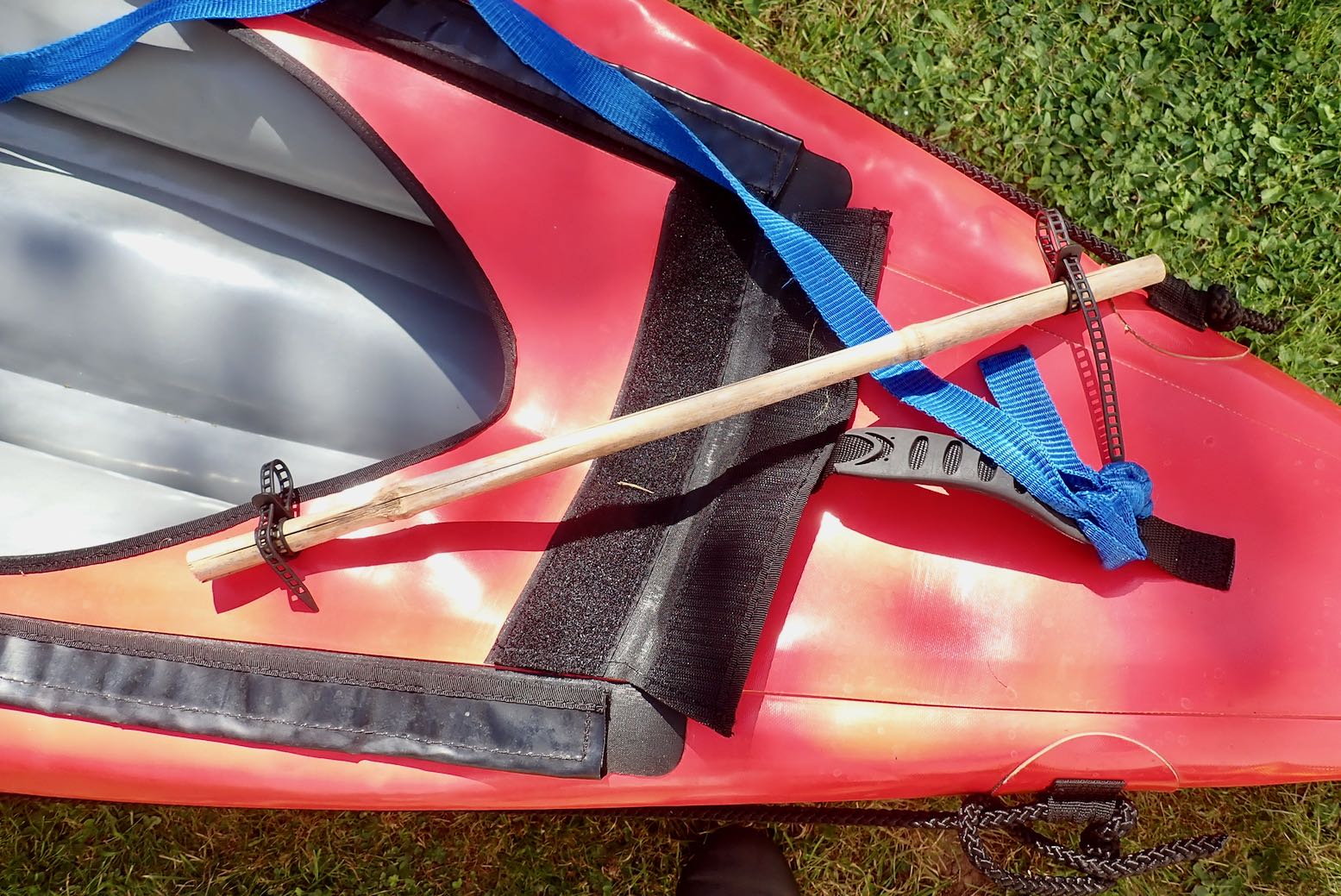
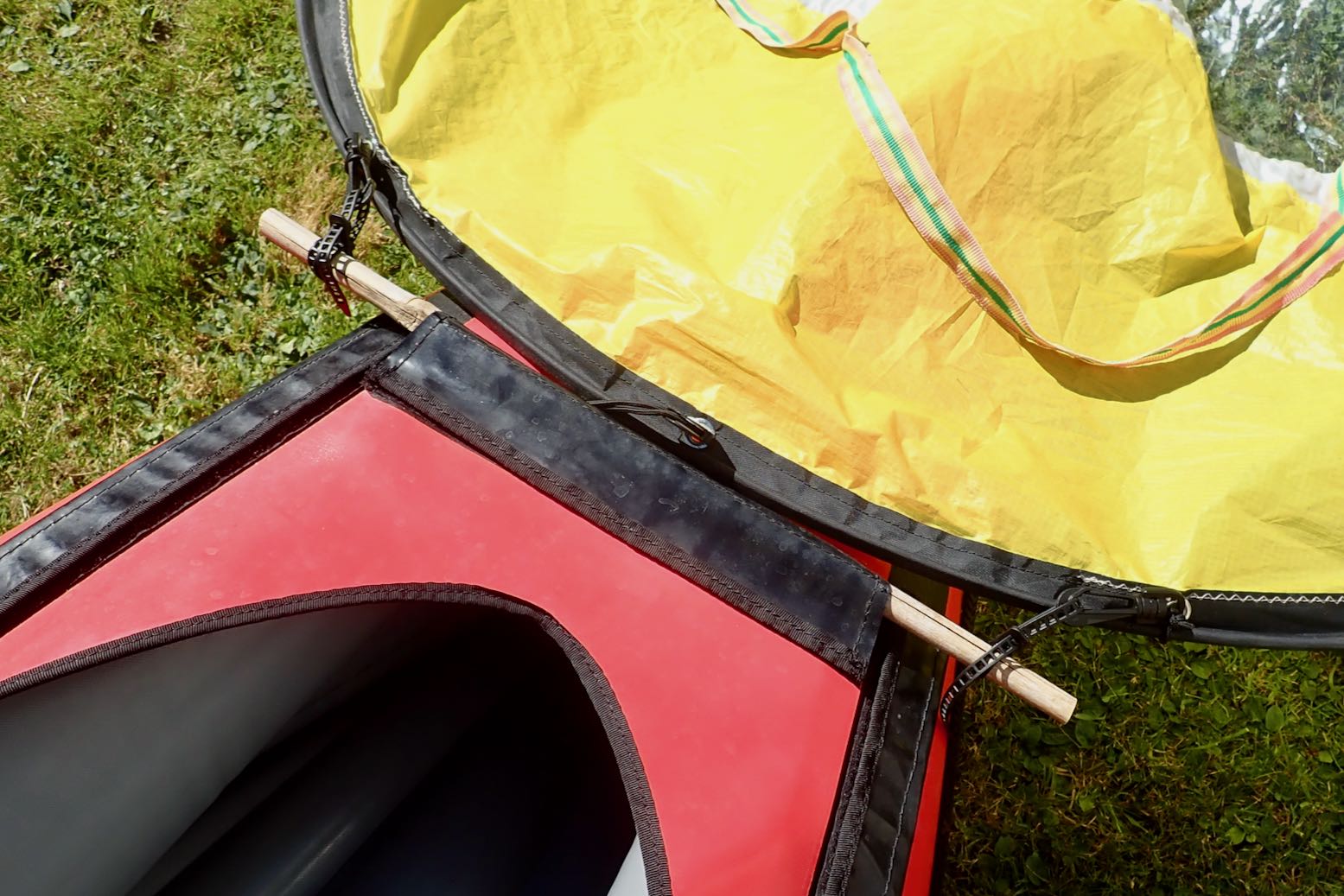
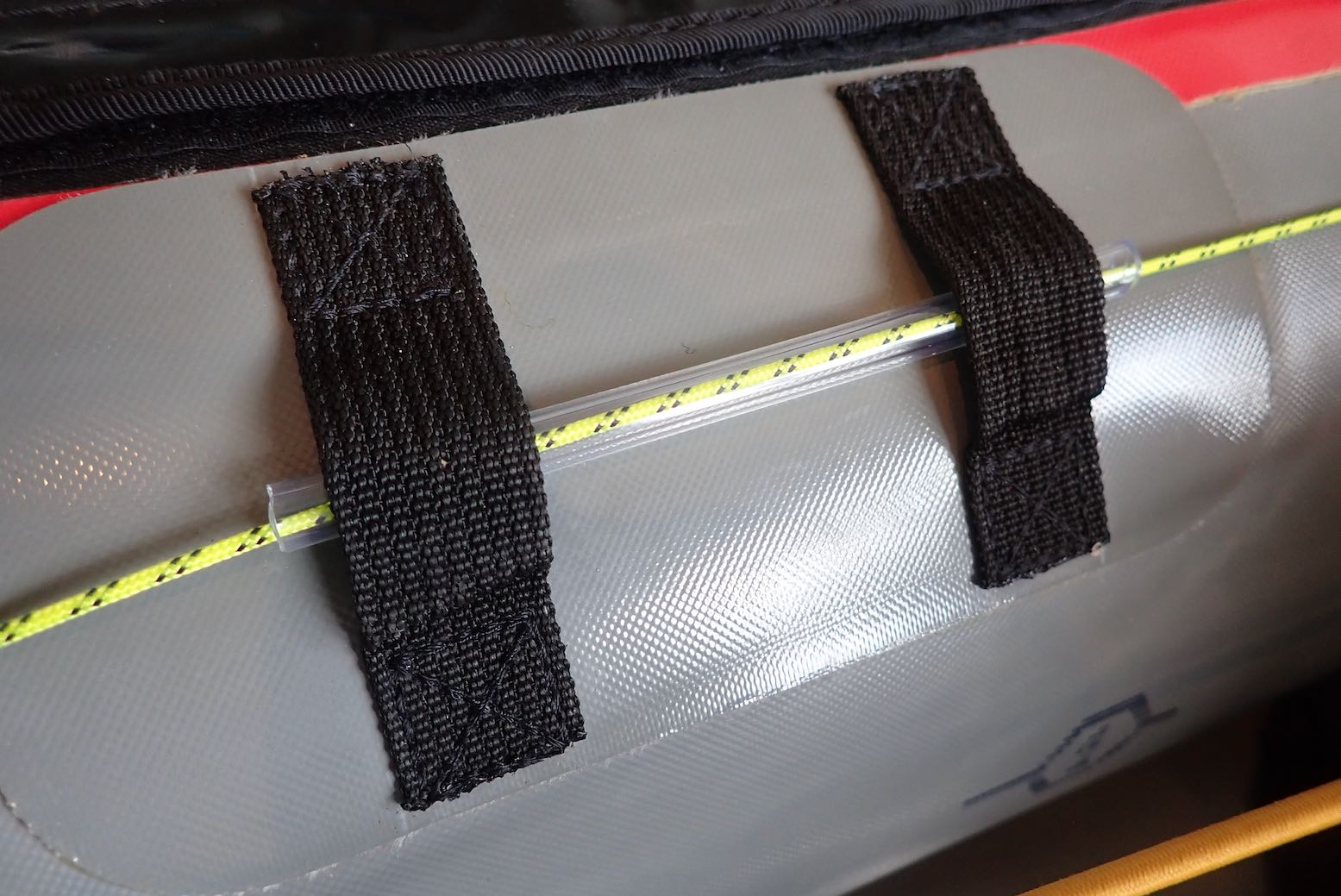
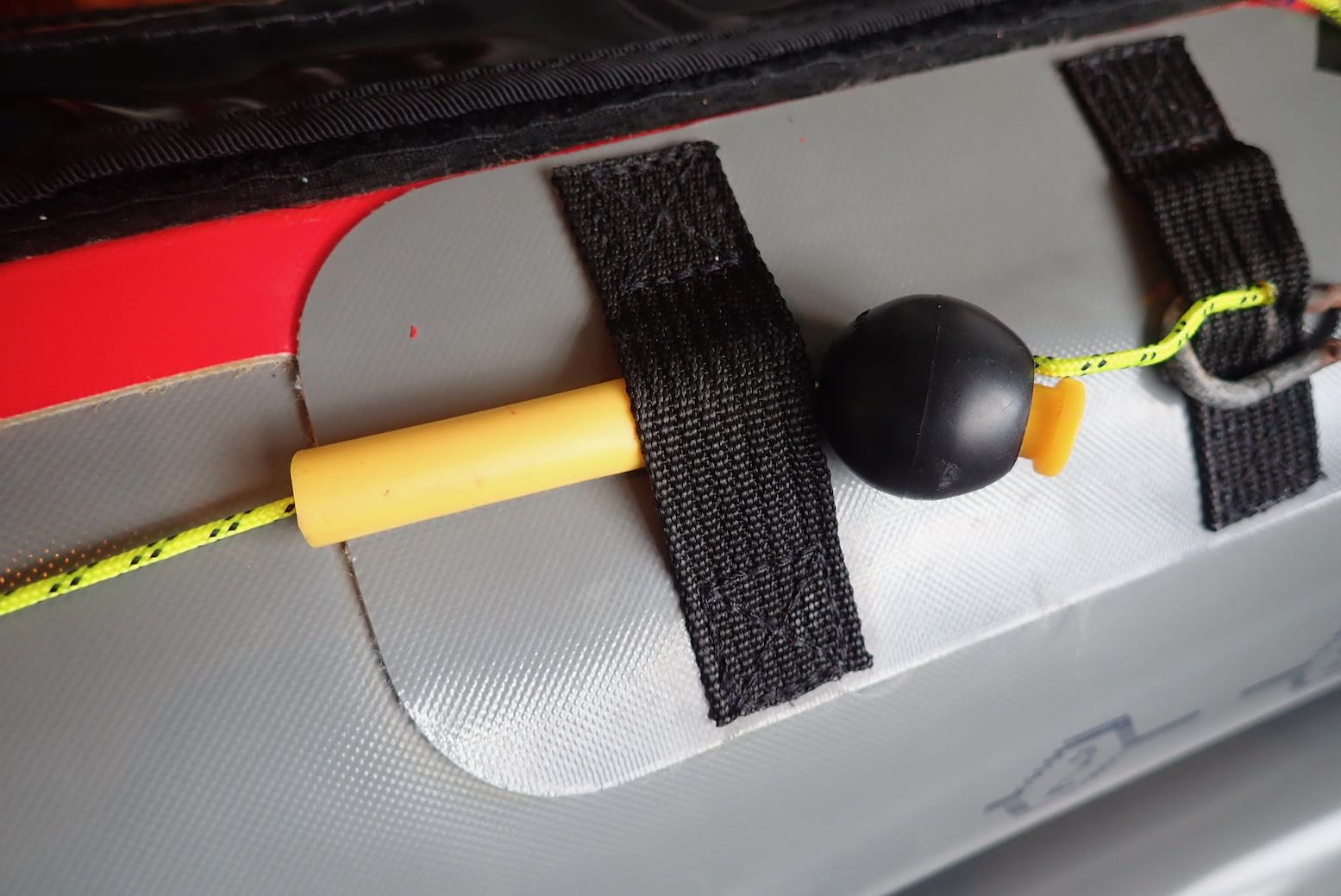
I’d forgotten to try my stick idea. Whether you use the deck cover on not, you can fix a transverse stick securely under the Seawave bow’s velcro flap and, with another couple of those nifty SoftTies, closely fix the WP to the stick. (I’ll be keeping an eye out for a nice bit of ally tube to replace the weathered old bamboo). Required work and added weight: negligible and it may work on other IKs, too. Something to try for next time.
Nicely shot vid with drone footage of an Ozzie father and son’s tough, 250-km paddle and portage through Alaska’s Brookes Ranges in a pair of Advance Elements Expedition Elites. After getting dropped off at Summit Lake on the Continental Divide (see map, right), they followed the Koyukuk River south, with a plan to climb the 7500′ Mt Doonerak, Alaska’s ‘Matterhorn’, not far from the river and 20 miles west of the Dalton Highway. With extra gear piled high on the decks, you do wonder if this made the 4-metre Elites unstable in what looked like relatively easy but shallow white water. That led to a couple of capsizes and the loss of the crucial sat phone. Other dramas ensue.
Rather like sails where I Made My Own, lost interest, then returned with a proper WindPaddle, after five years I’ve come back to the idea of fitting a rudder to Seawave 2. Mostly, this was inspired by a much simpler pivoting footrest tube idea from fellow Seawaver Jules, replacing cumbersome and bulky foot pedals. A rudder ought to make the Seawave more useable in a slightly greater range of conditions, including sailing which I tried again recently.
Gumotex’s £219 kitJules’ MYOEbay rudder mech: £25
Jules’ footrest pivot
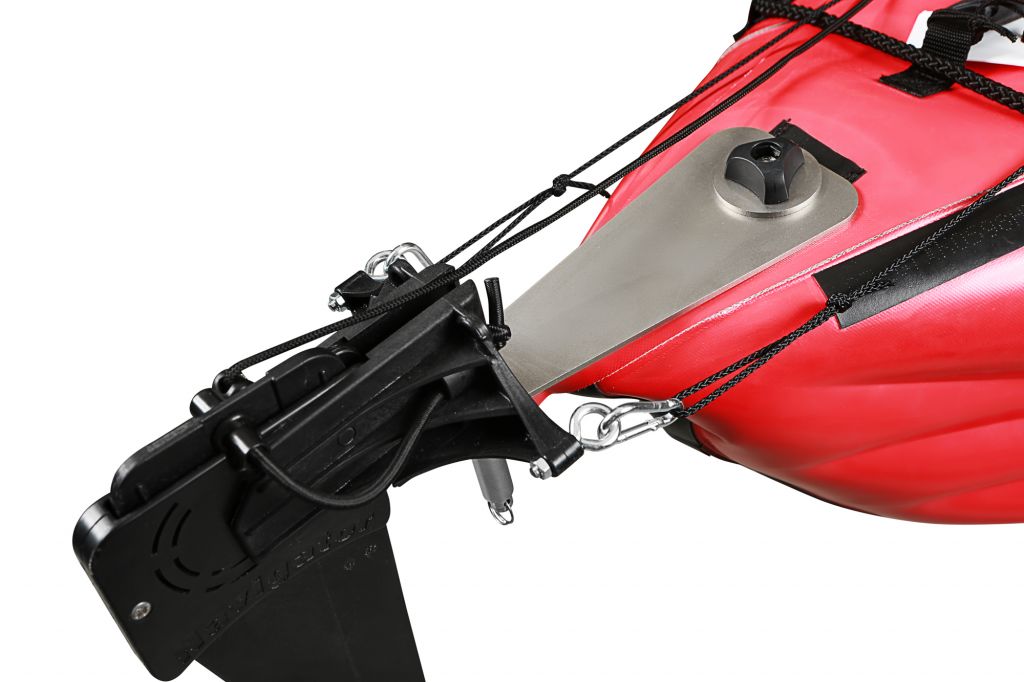
I could have bought the Gumotex rudder kit for just £219, but as always it’s more fun to piss about for hours and days on the pretext of saving money and conjuring up small improvements. IKs sit higher than hardshell kayaks, so I coughed up 25 quid for the longest rudder mechanism I could find on ebay: 510mm. It weighs 550g. The stern-mounted rudder plate started as a slab of was a chopping board, then became an aluminium plate additionally located with velcropads, as Jules and Gumotex use. I found secure clamping of the rudder mounting plate to be important to stop it turning on its axis. There is perhaps more torque on the mount than might be expected when a rudder blade tries to turn a 4.5-m boat. As you’ll see I ended up making a Mk 3.1 rudder mount in a mixture of soft and hard chopping board, as well as a Mk 3.2 in aluminium. There’s a 20g weight difference. Another bright idea idea Jules had was running the rudder lines out of the way under the deck velcroflap and inside thin tubing. That largely eliminates any exposed lines. I also liked his idea of controlling the rudder by pivoting a drainpipe footrest tube from the centre, eliminating the need for cumbersome foot pedals. Overall the whole mechanism: rudder, mount and clamp (220g), cords and tube (50g), adds up to less than a kilo and under £50 (some bits I had already). Eliminating foot pedals was the main saving in weight and bulk.
Mk3 Rudder for Seawave 2
Items needed:
Ebay rudder assembly from £20
Piece of HDPE chopping board, 3mm x 400mm x 60mm, aluminium bar, or similar
Stick-on velcro
Hand clamping knob and nut
6 metres of PVC (or PTFE) pipe with 5mm internal diameter
11 metres of 2mm Dyneema cord
4-inch ø x 30cm plastic drainpipefootrest (if not used already)
2 metres of 25mm strap
A few mini snaplinks, fish snaps or similar
You may also like:
Knob for rudder lift, cinch locks and clamcleats
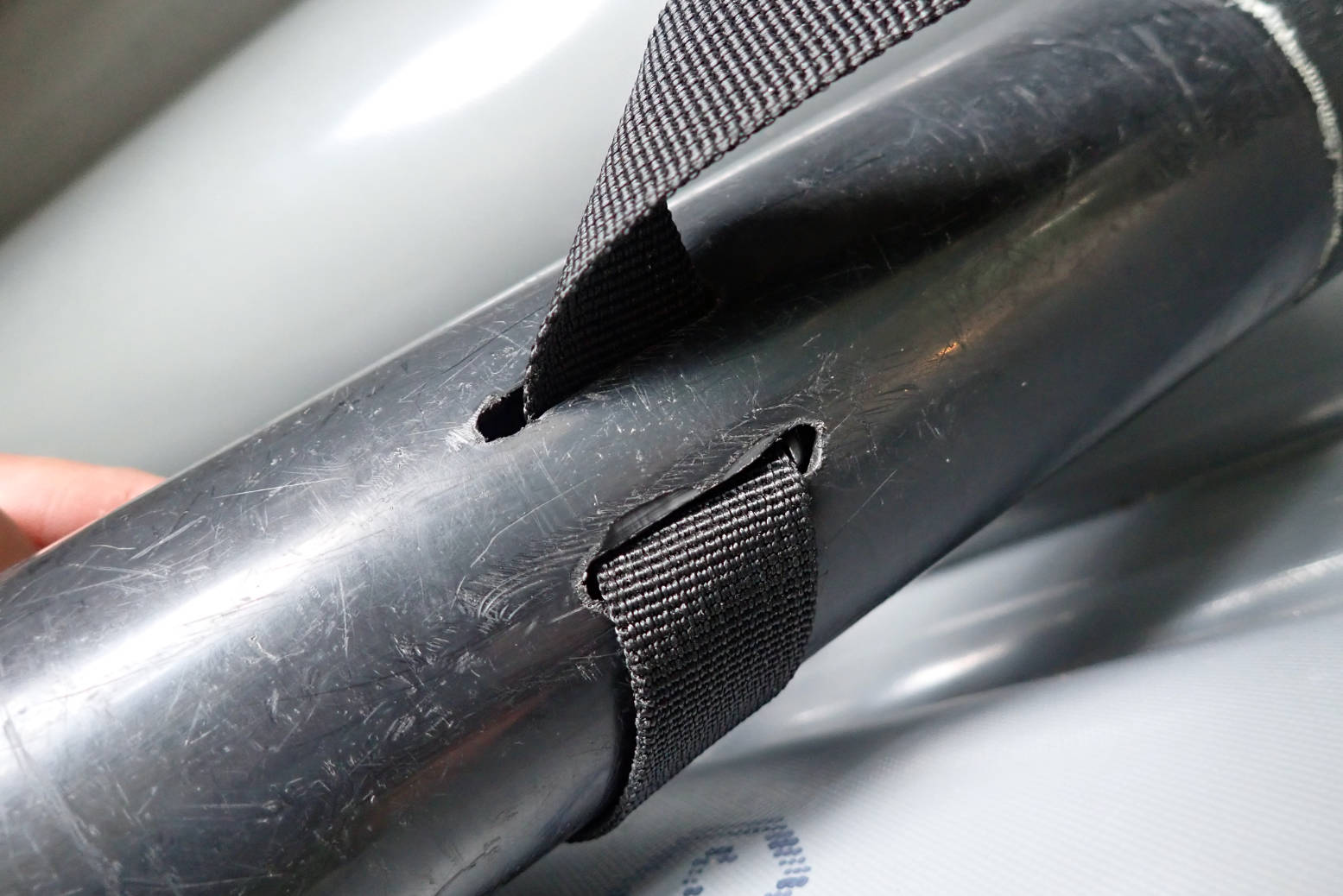
Make 2 central slots, then attach the strap
Footrest I already use a drainpipe as a fixed footrest. At 25cm wide, another 5cm would still fit between the Seawave’s sidetubes and may give a bit more finesse and leverage to rudder steering. If this proves the case with mine, it’s an easy swap. Drill and/or hot-knife in two adjacent slots in the middle and feed the strap through. You must fix the footrest to the strap so there’s no slippage. A big knot inside will do. Thread the strap’s loose ends through the stock footrest attachments buckles on the boat’s floor. You can now easily re-position the footrest tube forward or back for tandem or other sized paddlers. This is handy whether you use a rudder or not. While fine in the straight line along the hull top, putting a bend in the soft PVC tubing down the insides of the hull caused too much drag on the lines. So to avoid wear on the grey Hypalon, I just chopped the PVC tube back and stuck on some tape. (As you can see I need to add another strip for the tandem position). It’s probable the harder PTFE tubing Jules used causes less stiction, but having the rudder line exposed near the footrest-pivot make adjusting clamcleats and cinch locks easier.
Footrest-pedal in solo position. Tape avoids wear on hullTakes 1 minute to reposition for tandem paddling
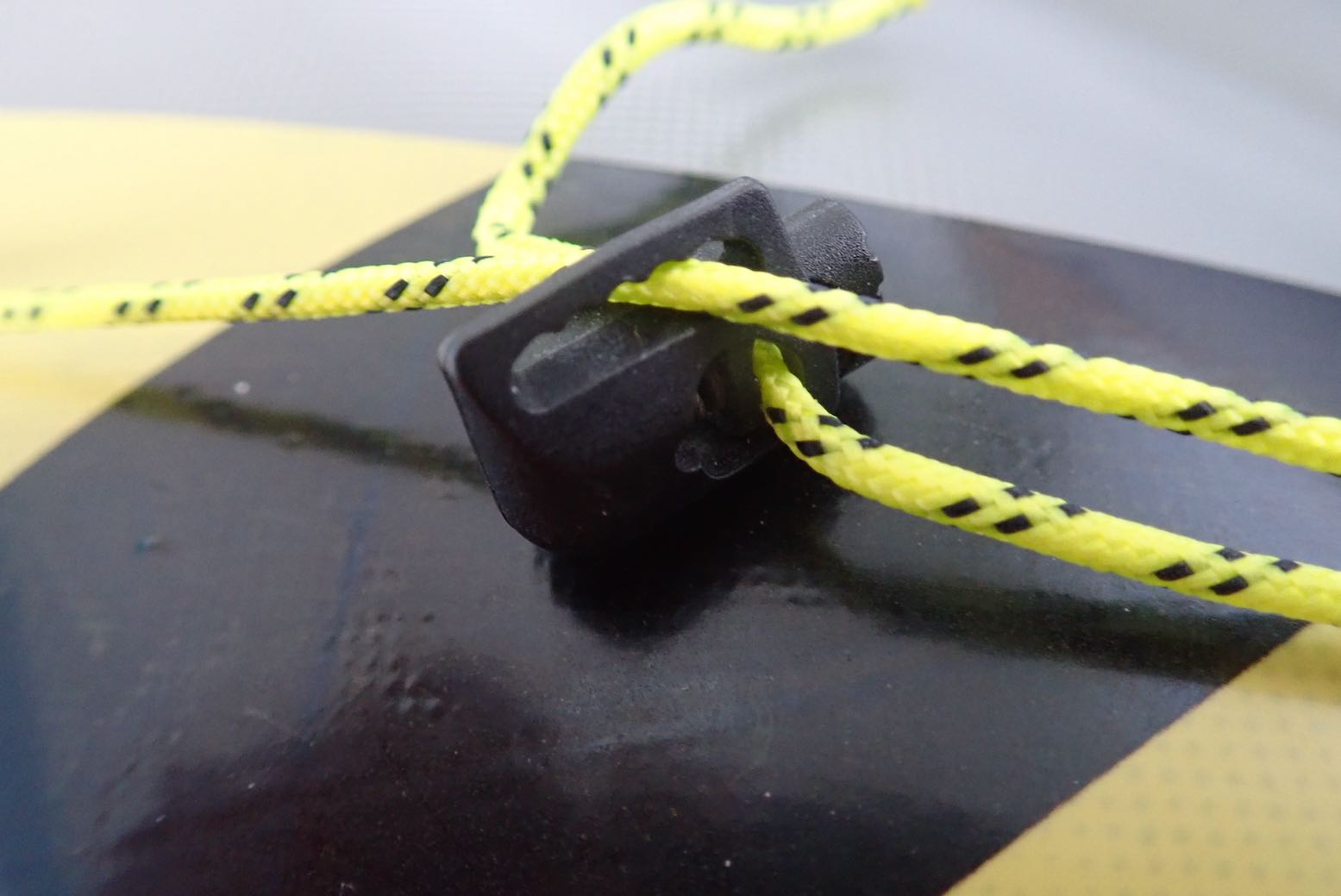
I stumbled on quite a fast and easy way to fine tune or readjust the footrest pedal tension: inline clam cleats (or cam cleats or rope locks) which I came across during my V-Sail experiments years ago. Feed the line through as shown below; centre both rudder and footrest, then cinch up and you should be good to go. Once you’ve established the right line length through the cleat for a certain fixed position, it can help to ‘memory mark‘ the cord (as I did in red). Though I bet once I get on the water and use the rudder a bit, they’ll go off alignment, so probably better to wait till then.
How to thread your clamcleat (rope lock)Inline clamcleat: fast adjustment & red memory markers
You need enough rudder line slack to slide the whole pedal-footrest forward about a foot when paddling two-up. Loose ends can be tidied away with cinch locks. Eleven metres of Dyneema cord is enough to do this job on a Seawave, including a single rudder lifting line. (To push and drop the rudder too you’ll need another 3m.)
Cinch lock tidies up loose endsAnd lifts rudder line a bit to reduce drag
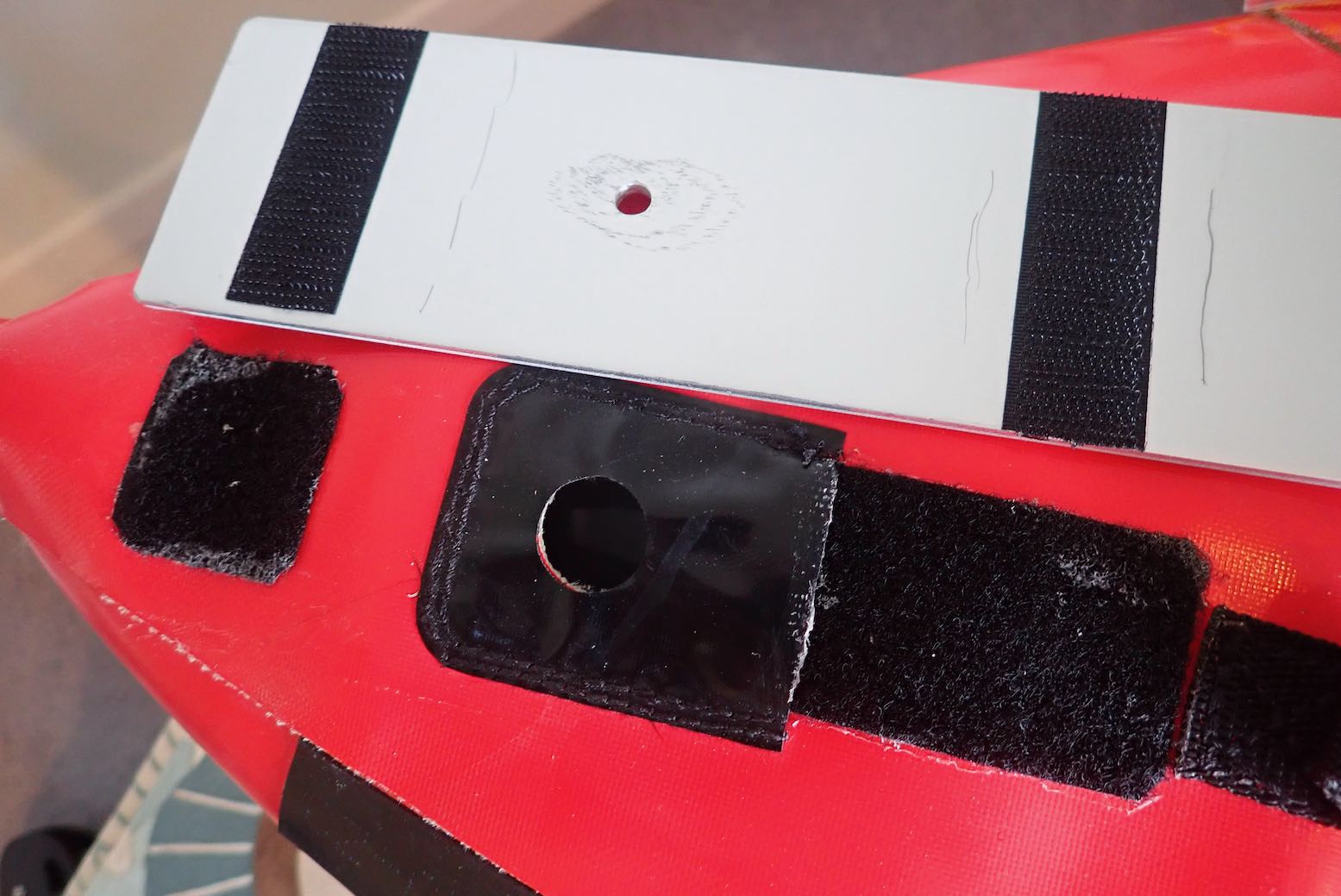
Rudder mountplate The 10mm red chopping board I bought was actually quite bendy (LDPE, not HDPE?) compared to other bits I realised I had all along. The less play in the rudder system the more responsive it will be; an IK’s stern mounting is mushy enough. This time round I copied Gumotex’s idea of using small velcro pads to stop the rudder twisting on it’s pivot-clamp axis. Initially lacking stick-on velcro, I glued plain velcro, using the PU glue from the Gumotex repair kit. For one-part glue, it seemed to fix the velcro pretty well but if not, some sticky-back came in the post.
Gumo glue seems surprisingly goodOn the ally plate I used stick-on
I knew from last time I made a rudder the under-plate shape helps eliminate pivoting of the mount, but you can draw out the truncated triangle by simply tracing the converging top seams at the stern, then make the under-plate from whatever you got. I used a bit of plywood: jam it in snugly, mark the point under the stock drain hole, remove and drill. I glued and taped a nut to the back of the ply and added a bit of string to help pull the under-plate out.
Triangular under-plate – importantJam it in, mark a hole and drill
I would have rather made the rudder top mount plate from ally but with little more than a hacksaw and a kitchen stool, lacked the tools to do a neat job. Then, while waiting for parts to arrive, I realised it was possible to buy ‘aluminium bar off cuts’ on ebay (right). Using the word ‘bar’ was the key. This place, or others like it, sell various sizes, including 3mm x 400 x 60mm for 7 quid.
Jules’ neat rudder mountNeeds a visit to a beautician’s but works the same
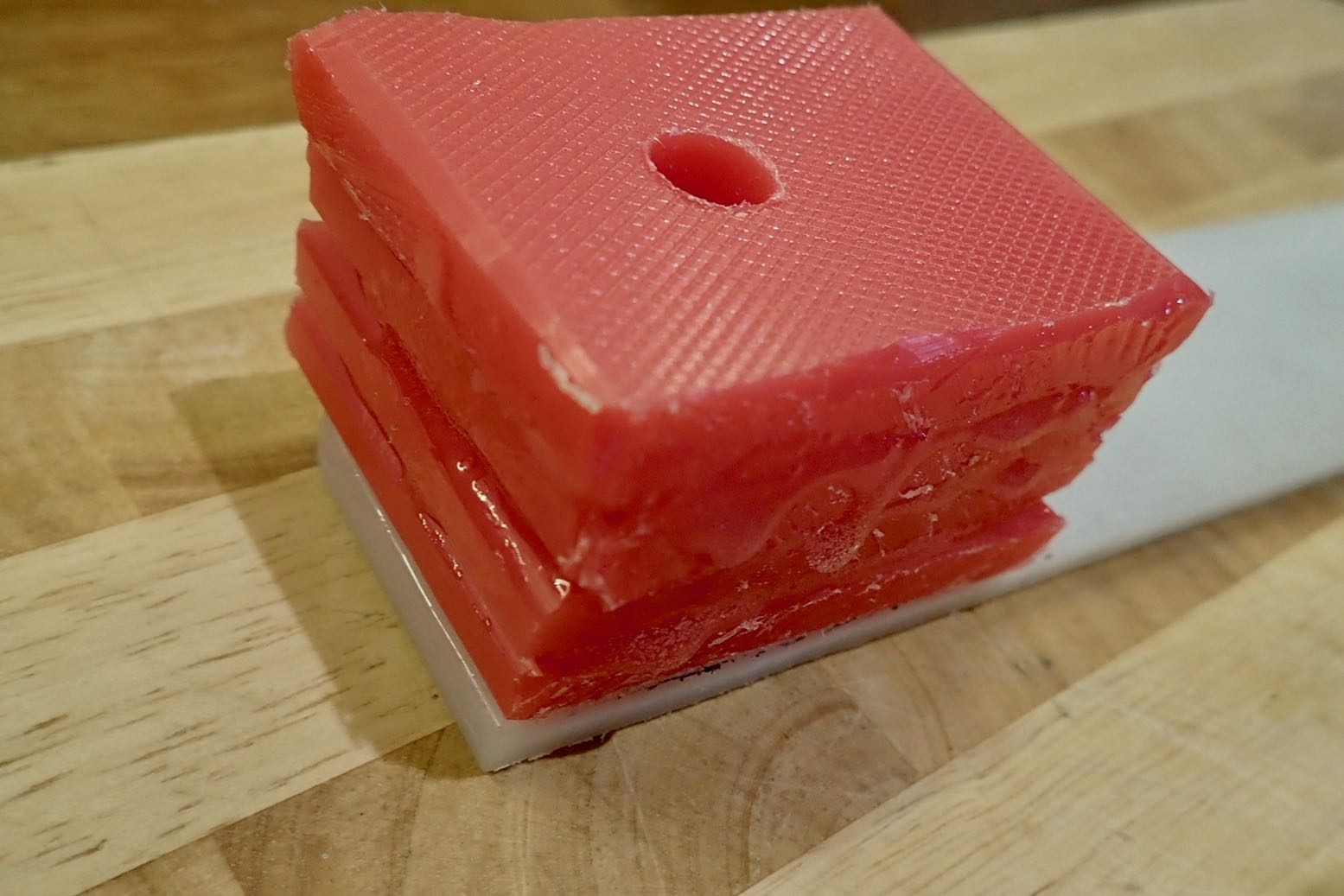
I’m pretty sure most kayak rudders come with a 48-mm pivot pin of 9mm ø. Or was it originally 3/8″s, which is 9.5mm? The pin slips into a 10mm gudgeon swivel sleeve/tube. Some hardshells have this tube moulded in the stern; on an IK it must be built into the rudder mount plate. Above left, you can see Jules (as well as Gumotex) integrate a gudgeon swivel tube into the end of the mount plate; a tricky thing to do accurately with a just a hand drill, though Jules’ thick plate makes it a bit easier. On my Mark 3.1 white HDPE mount, I glued layers of the old red LDPE into a block of plastic, then drilled a 10mm hole which works OK.
Bracket from China; hole ø 11mm10mm washer needed to reduce play
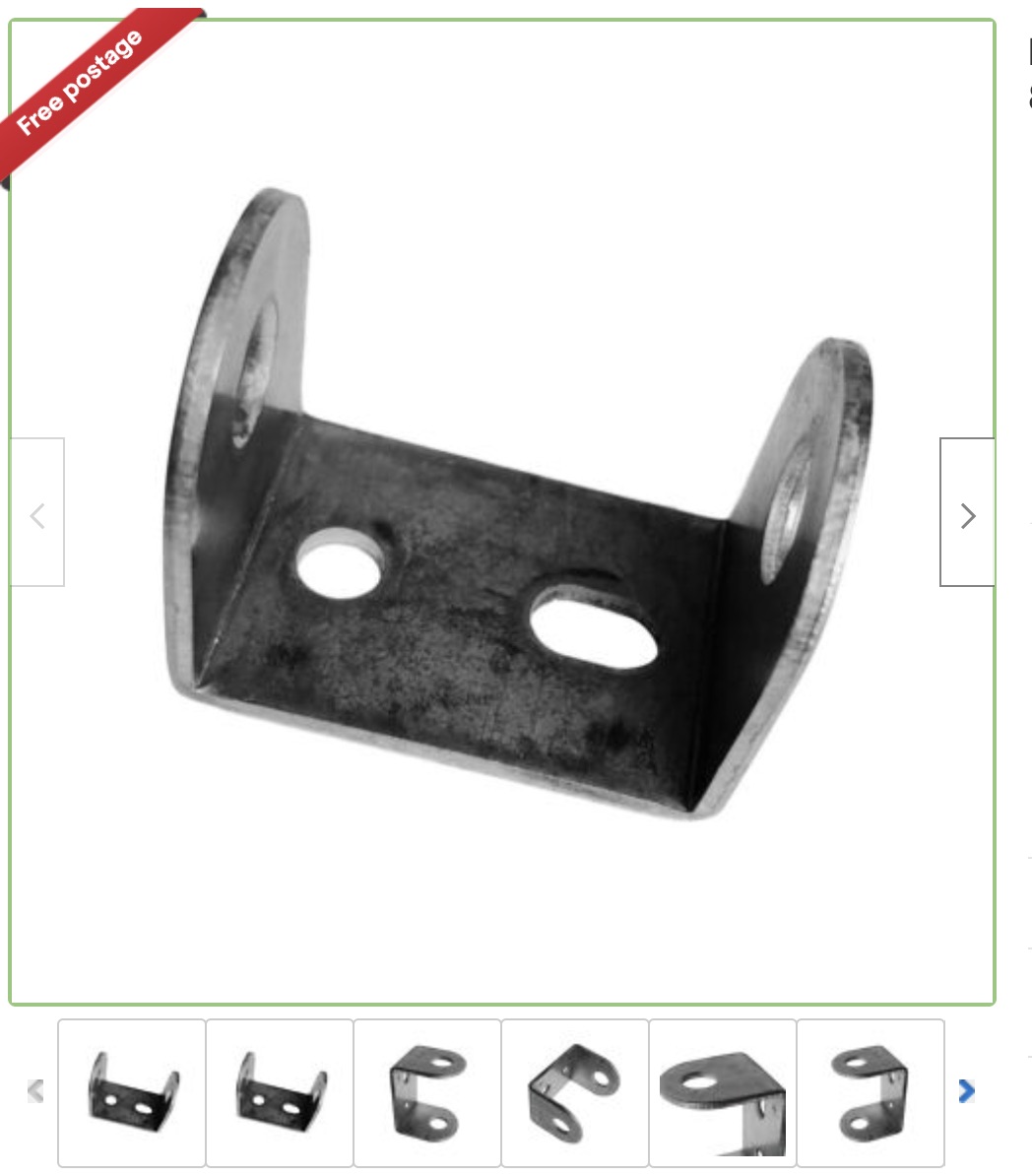
When it comes to an ally rudder mount, online you’ll find stainless steel kayak rudder pivot ‘C’ brackets for a fiver. They weigh 57g and are usually screwed to the vertical stern of a hardshell, replicating the gudgeon tube. Even though they’re only a fiver, it seems impossible to buy these from anywhere else but the Far East, and it would be more than a fiver’s work to fabricate that shape from hard stainless steel. I bought a pair anyway; they arrived in a fortnight, but hole diameters (not stated in the advert) were 11mm, meaning 2mm of play with my rudder pin which feels too much. Oh China, your poor manufacturing tolerances let me down! So I glued on some 10mm washers to eliminate the slack. I’d have been better off making something after all. It had occurred to me I could have bent my 400-mm piece of 3mm ally into a full ‘C’, either curved round a pole, or bent on an edge at two right angles, as up above left in cardboard. Tweak the alignment and precisely drill two 10mm holes and the rudder swivel mount and plate are all one piece. In fact, that 3mm alloy plate I bought was pretty stiff, so I settled on a simple L bend (and without a vice, even that wasn’t perfect), then glued and bolted on the Chinese ‘C’ bracket.
Not a perfect ‘L’ when bent in a metal gate frame
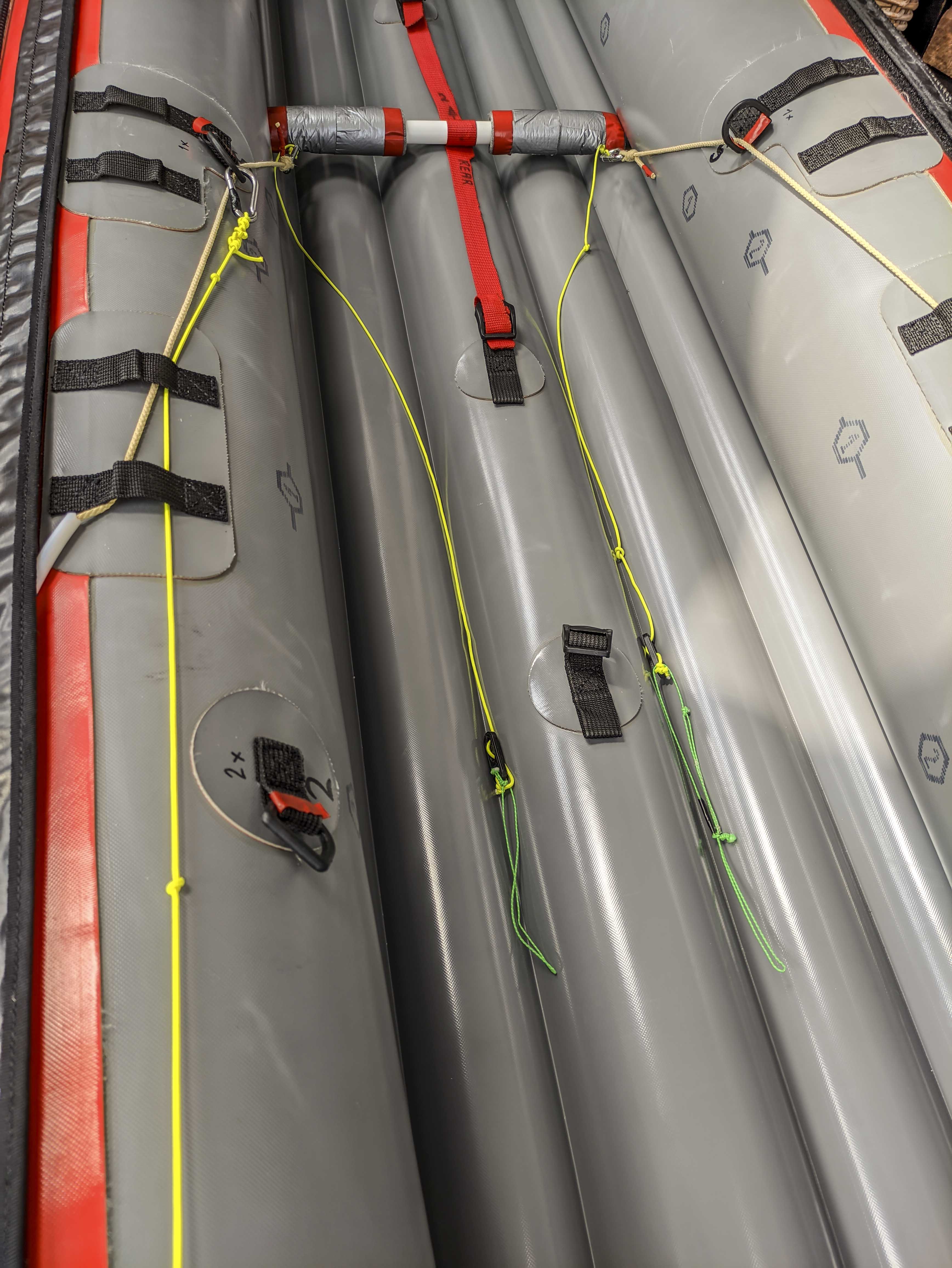
Rudder pulley Rudder blades have a hole in the back so the pulley can lift and lower the rudder near a shore. For the moment I’ve decided to keep things simple and only use a single lift line, not a doubled-up line (another 3m of cord needed; 14m total) to lower the rudder as well. I intend to use the paddle to reach back and flip the rudder into the water. If that is a poor idea, I can easily add a two-way rudder line. On packing up I realised this line needs to be in two sections if the rudder and plate are to be easily removable when rolling up the boat. The join can be at the back near the plate. As you can see I ran out of Dyneema and used an orange shoelace.
Separation needed to remove rudder but leave lineLoose lines hook up out of the way when rudder not used
I fitted the lift line along the sides, using the deck support rib tabs and running through spare bits of tubing to avoid wear and aid smooth running. I fitted a tension-adjustable knob at the hand end of the lift line on the left, though anything will do. Pull forward six inches to lift the rudder. Flip the rudder back down with the paddle blade.
Lift line runs through tubeTension adjustable lift knob
Does that flat, 4mm front edge of the rudder blade need chamfering to cut through the water, or am I other-thinking it? Who knows but watever you do, keep the skeg handy in case the rudder plays up.
Rudder blade could do with a sharp leading edgeKeep the skeg handy
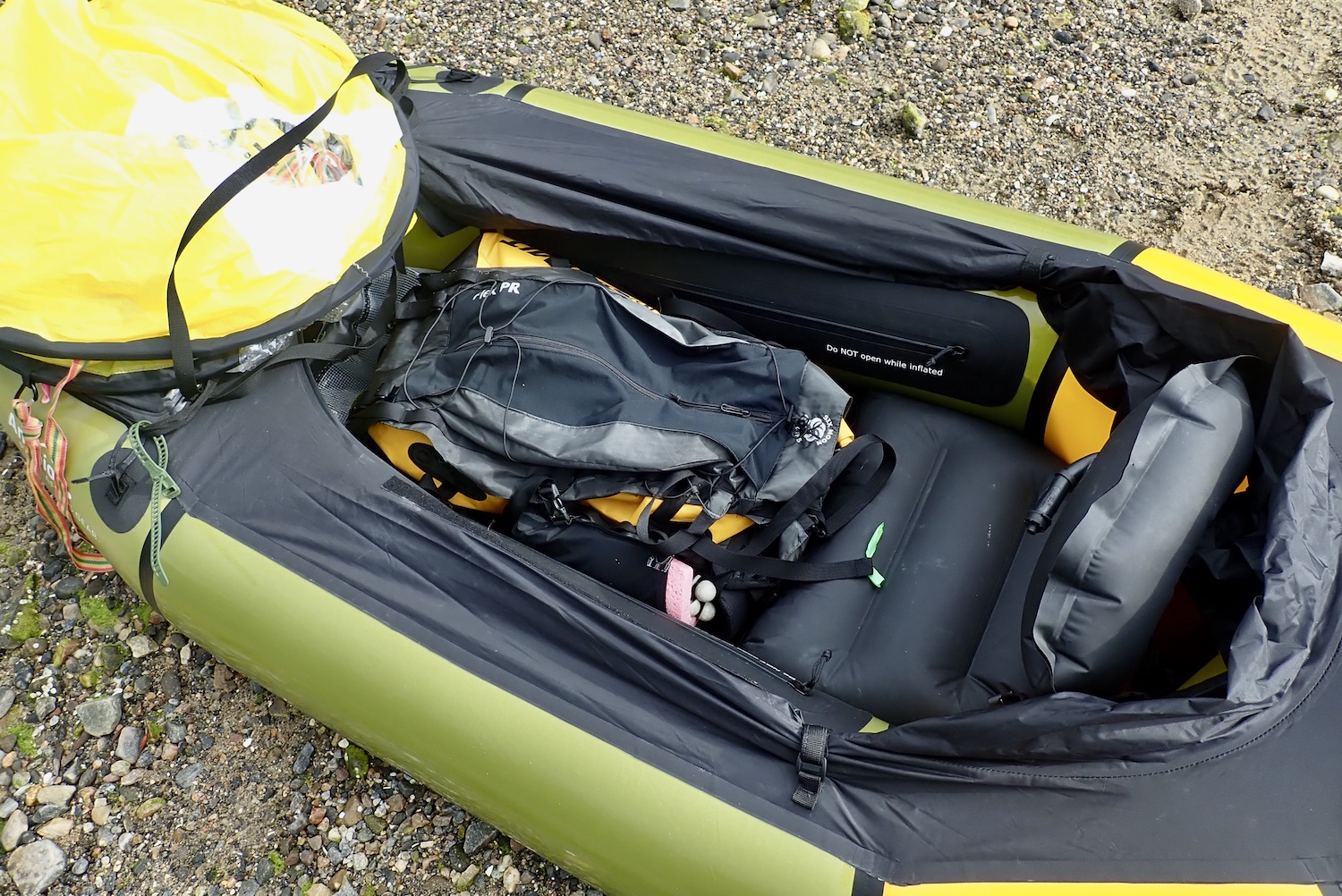
Weight (verified): 1525g in Large (shoulder straps 212g; hip belt 376g; back panel 937g). Used with Sea to Summit 60L dryback; 316g. Usable total 1840g.
Where used Four-day packrafting recce on Knoydart, covering about 50 miles, and another 3 days packrafting there (about 25 land miles).
The Flex PR was supplied free for testing and review by Six Moons and Anfibio
• Carries heavy loads like a proper rucksack • Includes no less than nine pockets • Four-strap adjustable hip belt • The price dropped by 25% around 2025
• Loads of black buckles with very long black straps on the black back panel (a 1-star review on the 6M website also mentioned this). • Fixed shoulder-strap mini-pockets too small and too high for me. • Wide outer panel means too much slack to cinch down the side straps fully • Refitting once back on land takes more time and buckling about than just shoving it all in a regular backpack.
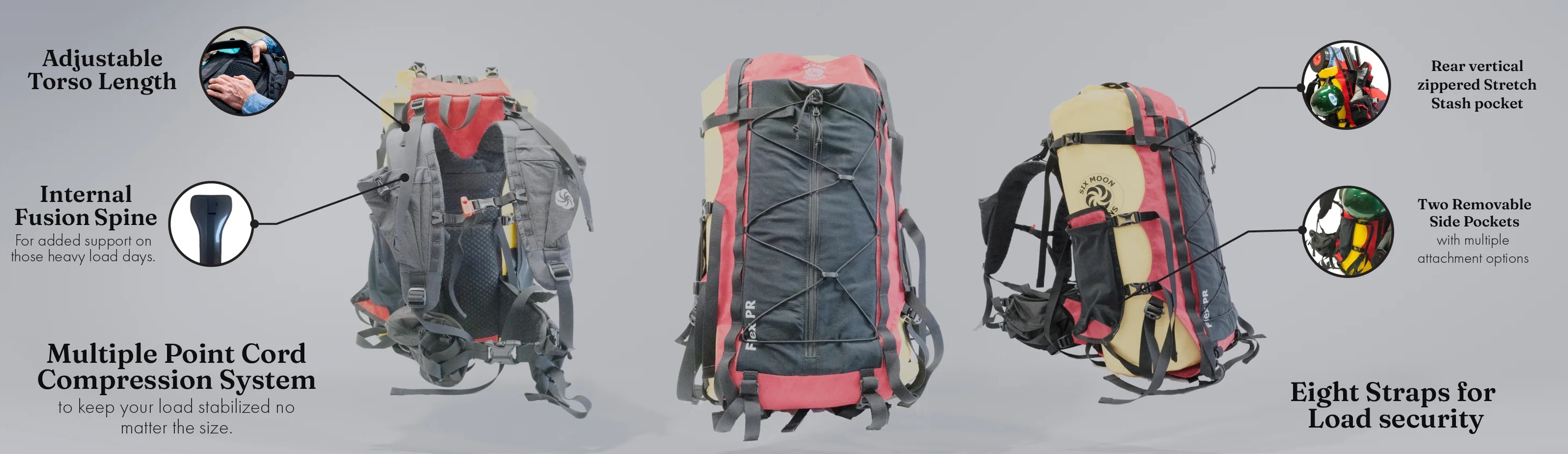
What They Say The [new for 2021] Flex PR is a multi-use pack specifically designed for pack rafters. The Flex PR is a 50L dry bag with a removable suspension system designed for carry heavy loads in comfort. Whether you are portaging on a canoe trip, hunting in the backcountry, or doing trail maintenance, the Flex PR will keep your gear dry, your accessories handy, and your back comfortable.
I’m on the TRAYNE!!
Review I’ve long been a fan of pack harnesses as I call them; aka: portage packs or multi-use packs. Once combined with a bombproof dry bag like my aged Watershed UDB, your packrafting load-carrying needs on land and water are solved for under 2kg. Lash all you needs to the harness and hit the hills.
It took me years of experimenting with ex-military and hunting-focussed metal-framed versions before I discovered backpacking-oriented ‘soft’ harnesses like my NRS Paragon. No longer made, the Paragon was a basic 100-dollar harness and a bit on the small side for me. The fully adjustable Six Moon Flex PR is up there with the best hiking load-carriers.
NRS Bags: just a roll-top dry bag with shoulder straps; not a long hauler
What’s wrong with a regular rucksack? Well, they’re not waterproof like a PVC dry bag can be, and if you have a proper dry bag likje NRS above, you’ve less need for a backpack which is just more bulk. Plus, once you account of 4-5kg of rafting clobber, it won’t all fit in a normal hiking rucksack and on the water you may end up with a soaking backpack, or one which is hard to cram into hull storage. I tried this on my very first multi-day packrafting adventure from Morar to Rannoch Moor way back in 2010 with my Alpacka Llama, carrying a huge roll-top vinyl dry bag (left; like the NRS bags). I was stronger then and it sort of worked, but once you get into it, a dry bag lashed to a pack harness works best. Wet things are separated or more accessible.
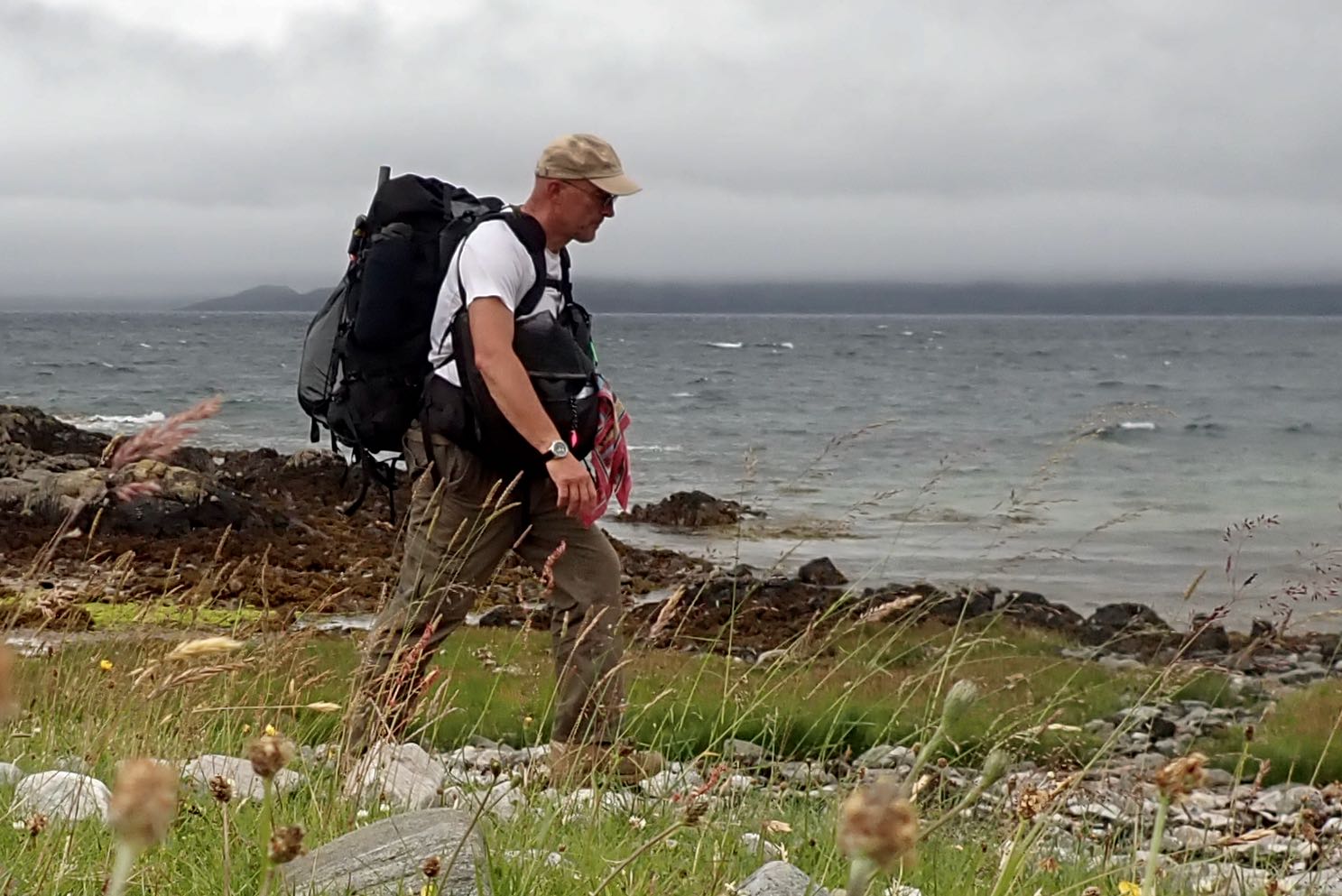
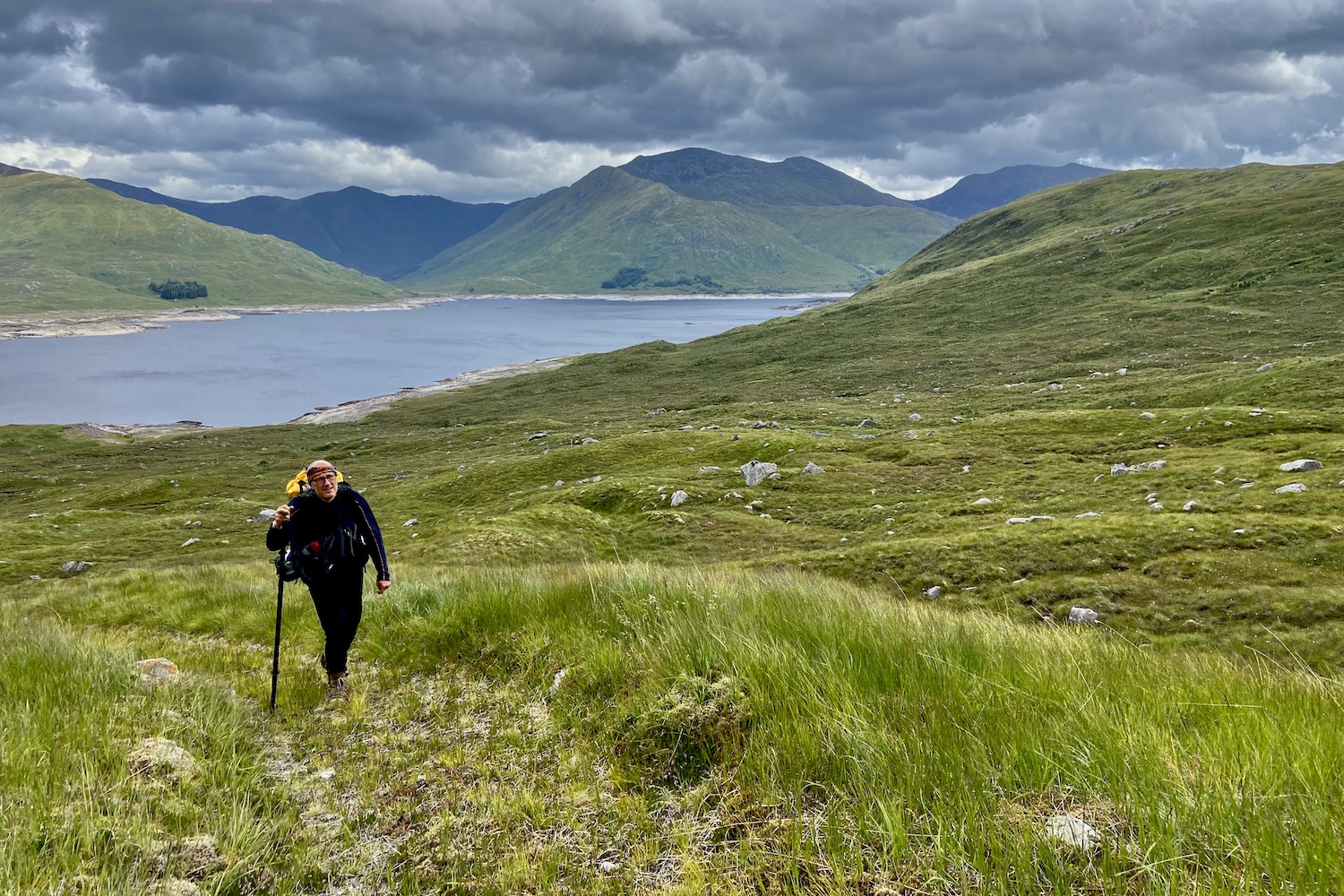
I jumped in the deep end with my Flex PR, carrying an initial load of 18kg on a four-day tour of the Knoydart peninsula with my Rebel 2K. My plan was rather over ambitious for a new area, so it turned out to be more walking than paddling. I came back to do it better a couple of weeks later so the Flex PR got a week’s heavy hauling, covering about 70 miles.
Back Packing, Back Packing, Oh isn’t it wild?Pull-out ribbed and curved alloy stiffening rod
Out of the box the Flex PR comes in three sections: the load-carrying back panel incorporating the fabric strap-down flap which wraps up and around your dry bag and then cinches down at the sides. The lumbar panel is supported by a removable, pre-bent ribbed alloy stiffening rod which you want to take care not to bend. The wide hip belt slips in through a sleeve at the base of the back panel and velcros in place. And the shoulder harness slips down into another velcro sleeve with various adjustment marks. At 6′ 1″ (1.85m) and after some experimenting, I settled on the longest setting, as below left.
The back pad and big sleeve and outer pocket (right)Inside of the harness which wraps round a drybag
I do wonder how securely velcro will hold the weight after a while, but it’s not like you’re undoing it several times a day, and most of the weight rests on the hip belt with velcro on both surfaces. The PR has loads and loads of straps: six on the hip belt; twelve plus a bungie on the back panel, and three on the shoulder harness. With your own dry bag it will take a while to configure the PR to your liking, but after that you can leave it be. You may also be tempted to snip off the excess on the straps, but initially it’s better to knot them up or try and tuck them out of the way until you know for sure which ones are really too long. Better too long than too short. (The foot-long shoulder-top tensioning straps are primary candidates for the snip.) After a day or two, in an effort to reduce strap overload I detached the removable stabiliser ‘Z’ straps. Six side straps and two over the top ought to do the job. These Z-straps had some interesting removable buckles (above right) I’ve not seen before.
Dangling straps keep the flies awayUDB was too slim and sausagey for the Flex PR
6MD 50L dry bag with purge valve
You’ll need a rugged and dependable dry bag to handle prolonged rain, persistent waves and rough handling, although with my Rebel 2K I’ve lately joined the ranks of packrafters stowing baggage inside the hull, not out on the bow, so on the water a submersible-grade dry bag becomes less critical. The Flex PR is designed to be used with 6MD’s 50-litre, 227g (8oz) roll-topdry bag (another $45; left) which includes four side loops which match up with the harness’s side straps. (I didn’t ask for, or use this bag.) What it’s made from or coated with is not stated on the link above, but one review listed ‘210D TPU-coated Nylon’, which sounds the same as a lightweight packraft hull. It includes a purge valve which will release any air after the bag is rolled up for packing and as you cinch down. Nice touch.
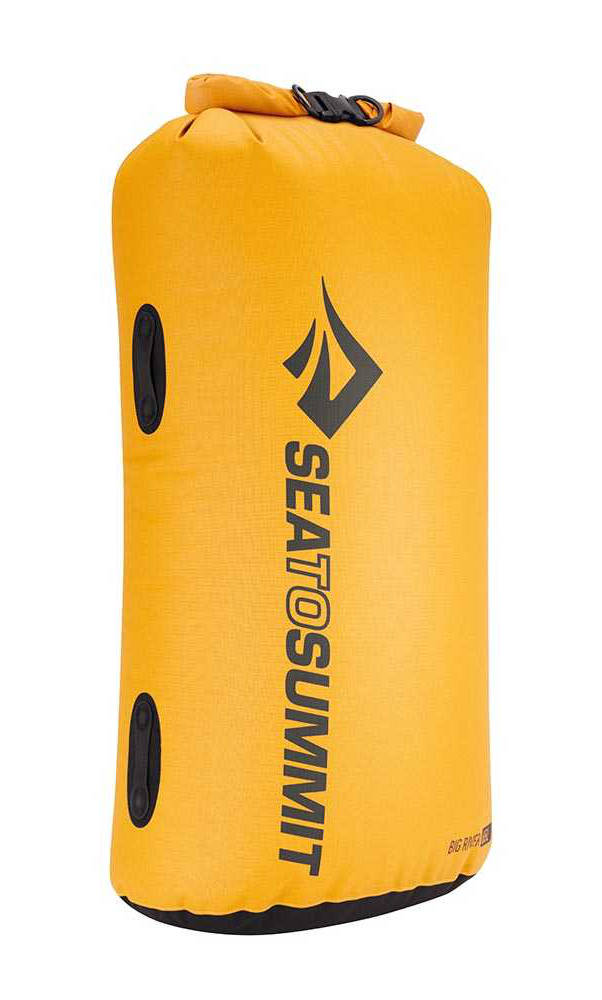
Sea to Summit Big River 65L
Although the Flex PR has generous external storage and additional lashing options, I do feel that 50-litres is aminimum for a few days out in the back country. Better a larger bag and add another couple of rolls of the closure. Something like the ovalised Australian Sea to SummitBig River65-litre TPU roll-top (left). This is TPU laminated on 420D nylon with a white lining and a textured, ripstop exterior. It weighs 315g (verified) and has hypalon side loops which more or less line up with the Flex’s side straps. It now costs £80. Compare it to S2S’s 75-litre Big River Dry Backpack for £150 of less, with a thin hip belt.
It took the first Knoydart recce trip to realise my large, sausage-like UDB duffle wasn’t suited to the Flex. And much as I prefer a top loading holdall-style bag, every morning I had to re-lash my black UDB into the harness, made harder by everything being black. When bothered by swarms of midges or rain, you don’t want to have to think about re-lashing the pack correctly each time, and there were times my long, thin load felt lopsided because the tall bag lacked girth.
Don’t mention the B-word
I’ve since tried to tidy up the set-up by tucking in unneeded loose ends and tying coloured ribbons to the important cinch straps, just like better tents have colour-coded markers for poles, but I couldn’t tighten the UDB down properly so it was often lopsided. So I bought myself the S2S Big River 65 dry bag, top-loading, like a rucksack. As mentioned, the Rebel 2K’s massive 140-litre in-hull storage capacity now makes a bombproof, over-the-bow dry bag like my trusty UDB redundant.
triple dry bag test
Back home, I dummy rigged three dry dry bags (above), but I can see it might still be a faff lashing on each time, just with added colour. However, one benefit of this multi-bag idea would be they pop straight into the 2K’s capacious TubeBags with no emptying and repacking. That would be handy on a trip where you’re switching between walking and rafting more than once a day.
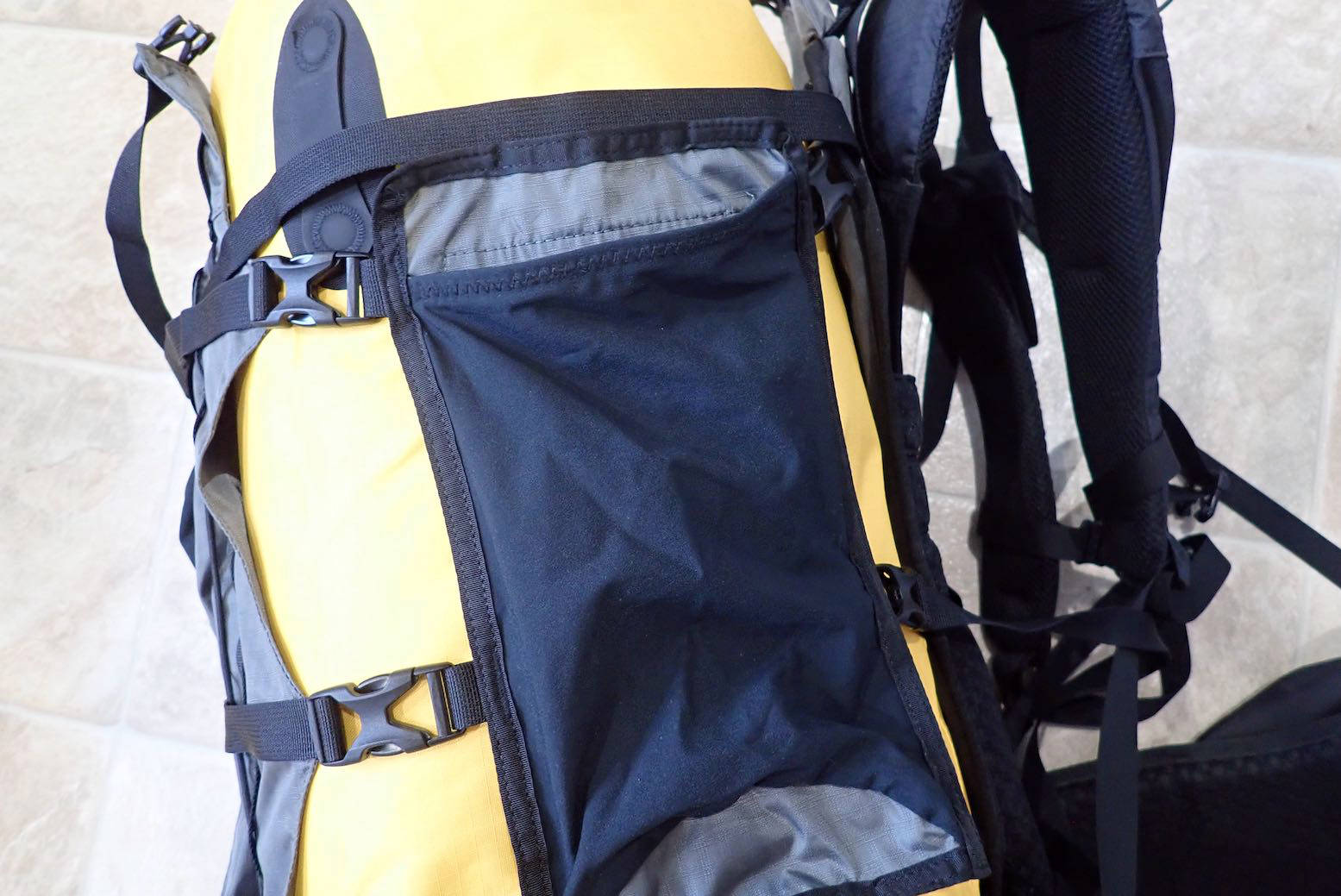
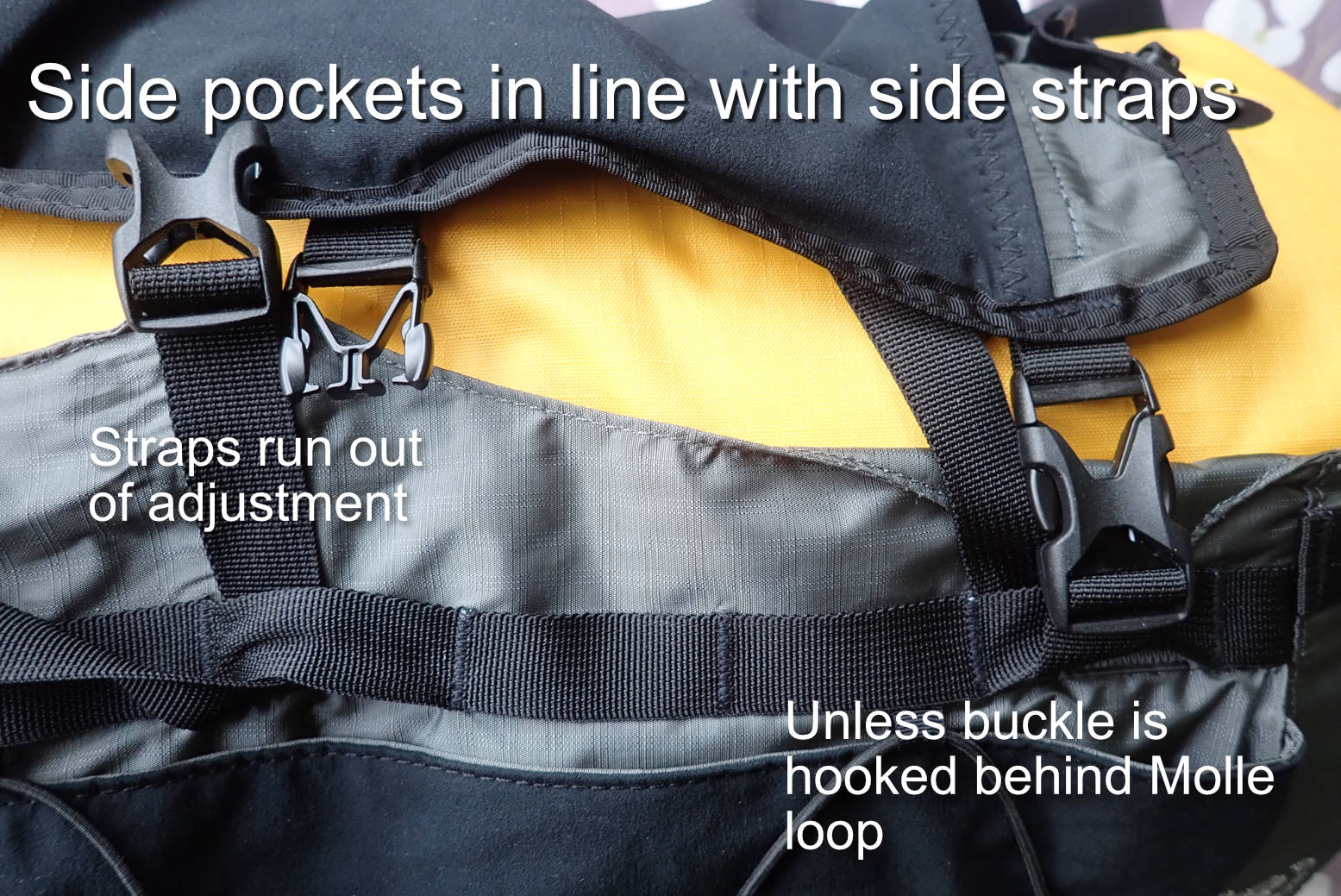
Pockets One of the best things about the PR are the numerous pockets which do their best to replicate a regular backpack, adding to convenience on the trail, something I missed on the Paragon. There’s a small hidden zipped pocket inside the back panel, two big fist-sized zip-ups on the hip belt and two detachable side pockets. With a stretchy outer fabric, these will easily each take a 1.5 litre water bottle or a rolled up cag. They can clip in line with the side cinch straps (below left), or can be Molle’d (daisy chained) from behind. Attaching them in line would make tensioning easier, but unless your load has a massive girth, the width of the pockets combined with the wide back panel makes it difficult to fully tension a normal sized pack properly before you run out of adjustment. Maybe my Sea to Summit bag was an odd shape, but it’s 30% bigger than the 6MD dry bag. Setting the rear panel buckles two inches further towards the centre would do the trick. One way round this might be to slip you paddles down the sides to add girth.
Side pockets clipped in line; too much slack for cinching
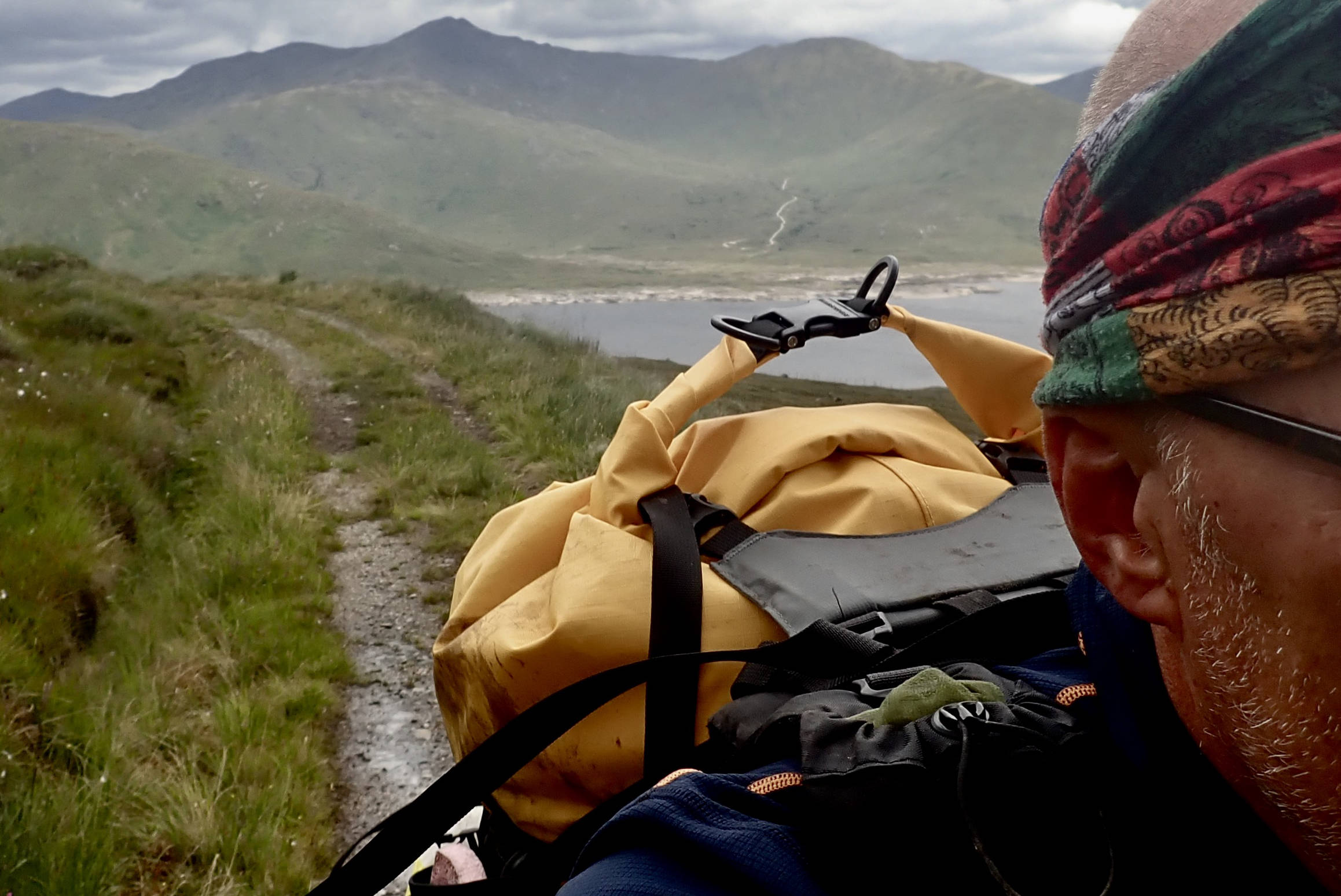
Next, you have stretchy cinch-up pockets sewn to the shoulder straps but, as others have noted, they’re too small to secure anything bigger than a Garmin InReach or maybe a midge net, and are set oddly high. On me they were level with the tops of my shoulders. Although they have to dodge the chest strap which can be Molle’d up or down in five positions. It would be better if the pockets were Molle-backed too. As it is, it’s easy to buy accessory shoulder-strap pockets for your bigger items. Not done get. The wide outer cover has a big open sleeve which swallows a four-part paddle, and in front is a long stretchy, gusseted zip pocket for more of whatever you’ve got. On top of that is a criss-cross elastic cord which I used to attach a WindPaddle.
Removable 2-litre side pocketsAdjustable lumbar support
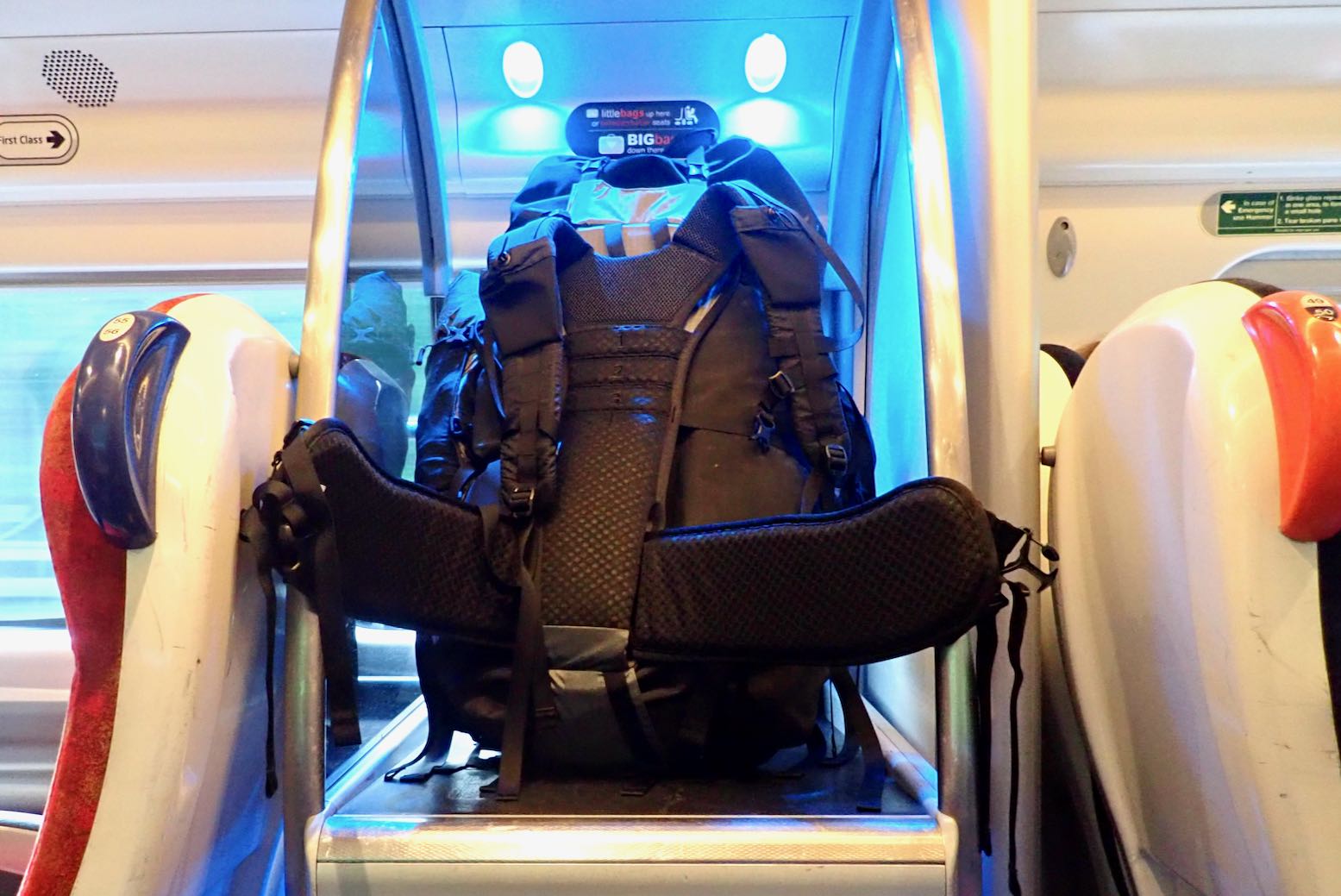
My walk was quite hard: 18 miles on day one, followed by a tough crossing from sea level up to 1500 feet and back down to sea level. While I got a few initial aches from old injuries initially carrying over 18kg, at no time did my shoulders get sore which proves the stiff harness panel was taking the weight at the hip belt (and from there down to the hard-pressed feet). And the hip belt is particularly good: the pockets aren’t waterproof but are a useful size (unlike the Paragon), and the twin straps each side mean you can cinch it in snugly, whatever your hip shape. I’d have preferred a bigger hip belt buckle and in fact found all the Flex’s clip buckles oddly hard to link; they didn’t readily clip together, possibly due to relatively soft, bendy plastic.
Packraft underneath is vulnerable to scuffs but lower CoG.
On the way back to the Inverie ferry I decided to take the packraft out of the UDB and strap it underneath (above), using the fitted straps for this purpose. Surprise, surprise, the lowered load carried much better. Hung outside and quite wide but out of sight. But the rolled-up boat is vulnerable to getting snagged on barbed wire fences, farm gate latches, or when being hauled about in transit.
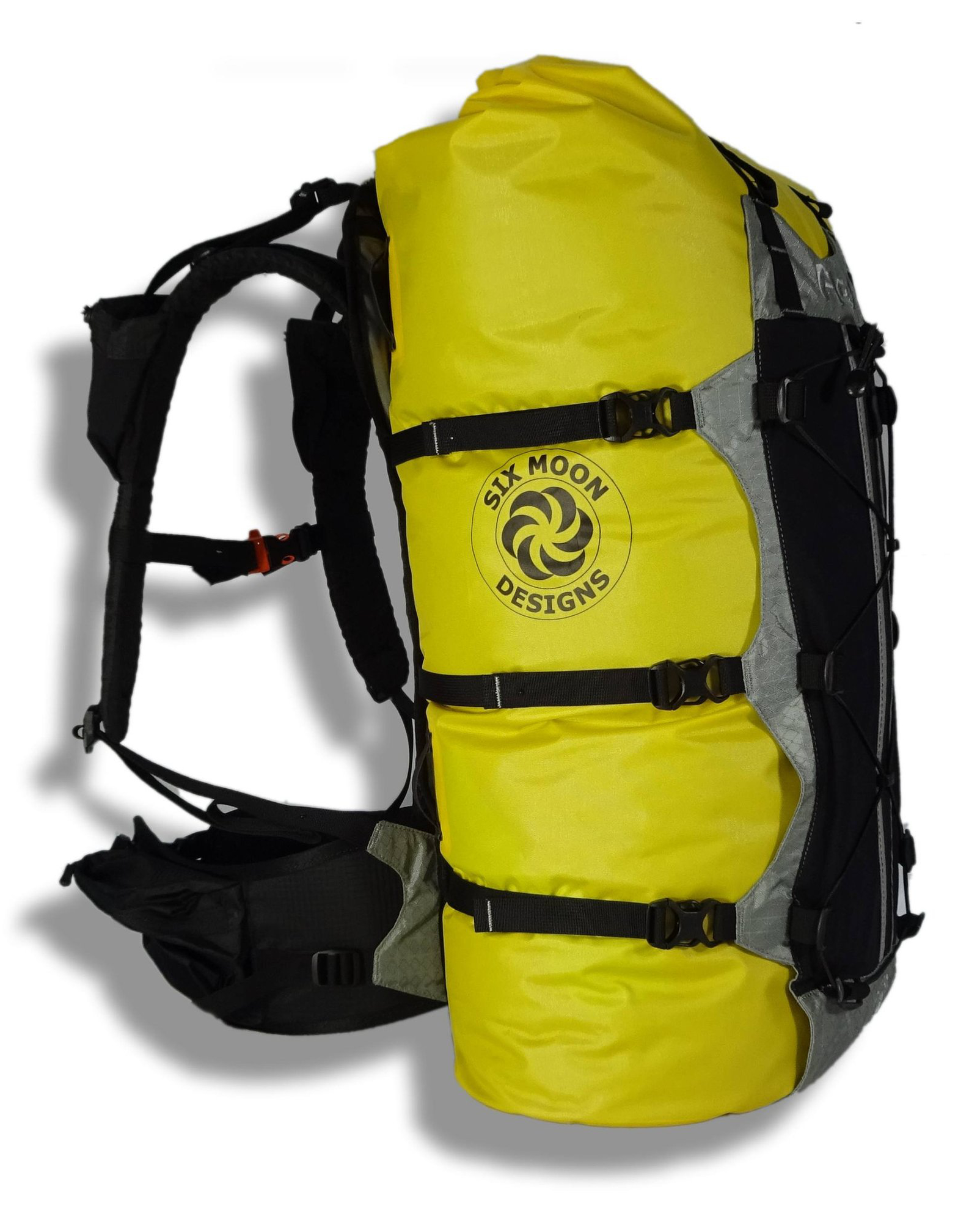
Knoydart Trip Two I returned to Knoydart with a chum and the 65-litre S2S Big River (below). Left attached in the harness’ side straps, this made the Flex work as intended like a regular rucksack; no need to re-lash or adjust too much every morning or when swapping from walking to paddling.
Sea to Summit 65-L Big River dry bag. That’s more like it
Roll top closure may seep through eventually; a cover could be easily tucked under the straps
Using the 65-litre bag, I did wonder if 50 might well be adequate, but this was with minimal and compact camping kit. Any warm- or spare clothing or a dry suit would soon need more volume in the dry bag. We had two half-days of lashing rain; my mate fitted a shower cap over his regular rucksack and I found the water had seeped only a little way through the rolled folds of the Big River., as it does with most roll tops. The bigger your bag the more tight rolls you can make on the closure, but actually in pouring rain it would be fairly easy to tuck a cover over the closed dry bag rolls to stop any rain getting there.
Boat dry bag as foot matFlex PR under the knees with handy pocket access
With everything within the pack loaded into six bags, it took just a minute to transfer them into the Rebel 2K’s hull and zip it up. I then used the chunky Gumotex dry bag which held the packraft as a footpad on the packrafts’s floor (to stop gritty boot heels prematurely chewing up the boat’s floor) and found I could easily shove the empty harness under my knees and zip up the deck. This made repacking the Flex at the shore relatively quick easy, though it always takes 20-30 minutes to get going.
The Flex PR now carries its load as well as can be expected and the S2S Big River added capacity for cold weather gear or a dry suit. I must say I didn’t really miss the lack of a purge valve; you burp the bag in the usual way then roll it down. Any spare air will be squashed out by the compression of the straps. The combination now offers reliable waterproofing on foot, while the pack would work OK on the bow, though in-hull storage (if it fits) and harness under the knees is more secure all round.
PS: On both trips I used my roomy 20-litre Anfibio DeckPack (below) as a handy day pack for which it worked very well. The stuff inside is behind a waterproof zip, is easily accessible on the move and up to a point, keeps the lashing rain from wetting out your cag.
Where used Loch Hourn, off Knoydart, Scotland (on my Anfibio 2K, and alongside an MRS Nomad S1).
Barry tries his Anfibio AirSail as a brolly
Rolls up compact (unlike framed versions) Big surface area Unexpectedly stable, controllable and steerable As long as you’re not using a deck, it can be temporarily pulled down and tucked under the knees when not wanted A 3.5-m long Nomad S1 can move at up to 5mph in strong gusts Uses the same valve and pump as the packraft Doubles as a tent footprint or mini-tarp or even a brolly
Window is too high (on a fat-bowed packraft) On a regular sized packraft, sailing might be slower than you think About 20% more expensive than Anfibio’s same-diameter PackSail Punctures or twisted bladder more likely than a broken batten?
The AirSail was supplied free by Anfibio for testing and review.
What They Say The first packraft sail of its kind! The light, inflatable AirSail gets your packraft going and lets you experience speed even on calm waters. The sail creates completely new possibilities to be on tour with the Packraft. Only 466g and minimal packing size.
Review On a multi-day packrafting trip or where you’re not returning the same way into the wind, sailing downwind is a smart means of conserving energy while enjoying a look around. At any other time, it’s just plain fun. Until now, the only options for packrafts were flexible, spring-out WindPaddle disc sails and their many inferior knock-offs. I’ve made my own and tried both, and currently own a WP Adventure 2 which has been OK on the Seawave IK and my old MRS Nomad, and even better on the Rebel 2K.
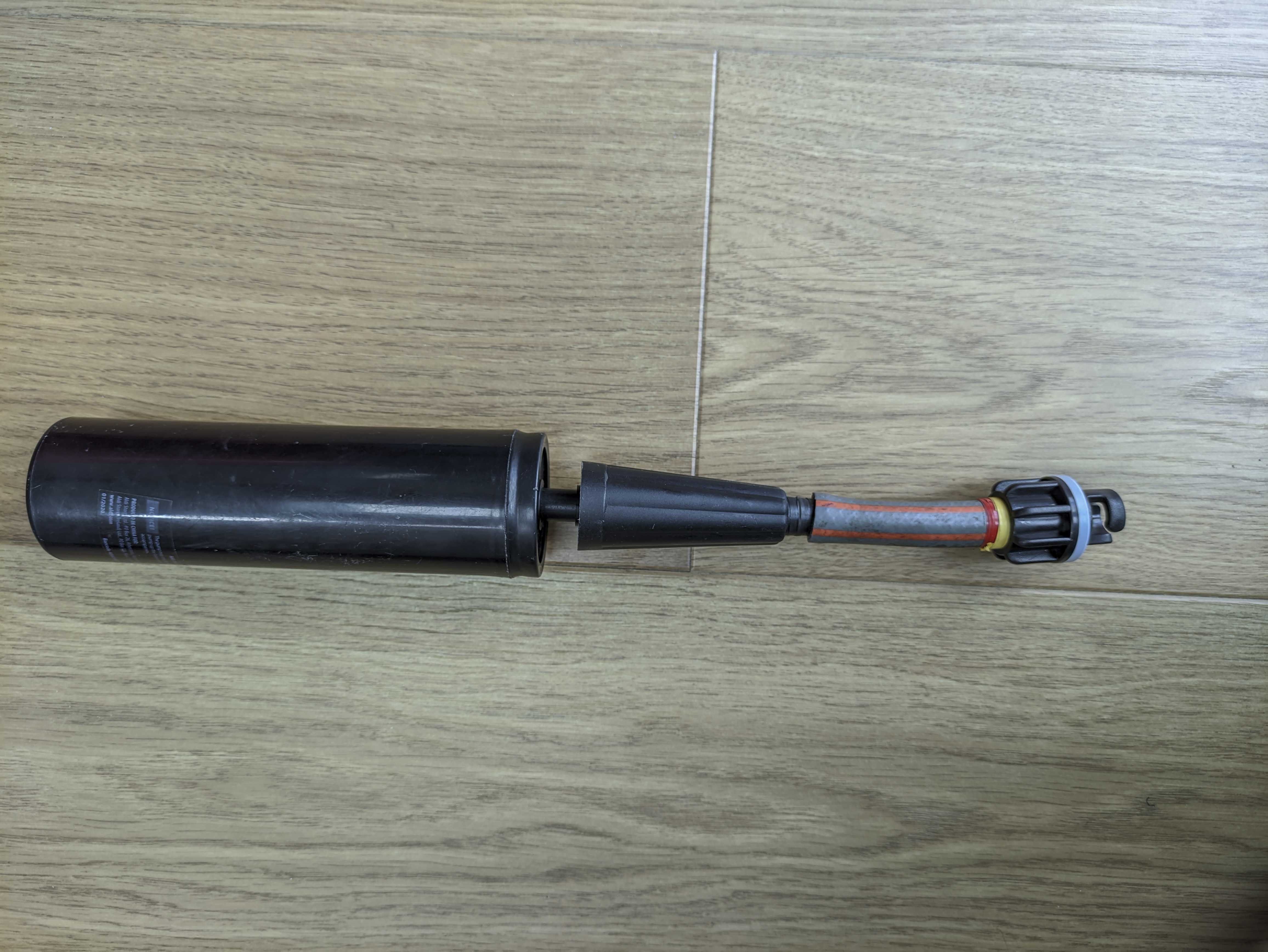
The Anfibio AirSail differs by using an inflatable bladder ring inside a fabric rim casing which you inflate via a Boston valve with the same 10-euro mini hand pump you use to top up the boat. The sail’s outer diameter is 137cm, so the sail is close to 130cm, as stated. Surprisingly, it seems to be possible to achieve as effective levels of stiffness to a flexible batten disc sail – a key to consistent performance – while an AirSail packs down to the size of a sleeping pad. My WindPaddle folds down to a flat, 40-cm disc which some might find more awkward to pack on the trail, though I can’t say I did.
Alone, out on the water in windy conditions it would be tricky to deploy the AirSail. Assuming a skeg is fitted and the sail’s already clipped to the bow via a couple of mini-karabiners, you need to reach forward to unstrap the sail (hard in my 2K with a deck zipped up), unfurl to unkink it, plug in your mini pump and give it two dozen jabs to fully inflate – all without being blown around or losing your paddle. Were I doing this, I’d add a short ‘haul-line’ to the base of the sail so I could pull it back into arm’s reach. I chose to do all this by the shore in the lee of a headland. I started with my electric Flex Pump but for some reason it didn’t do much, considering the small volume. It was the same next time, so in future I’d go straight to mini hand pump which needs around 25 pumps.
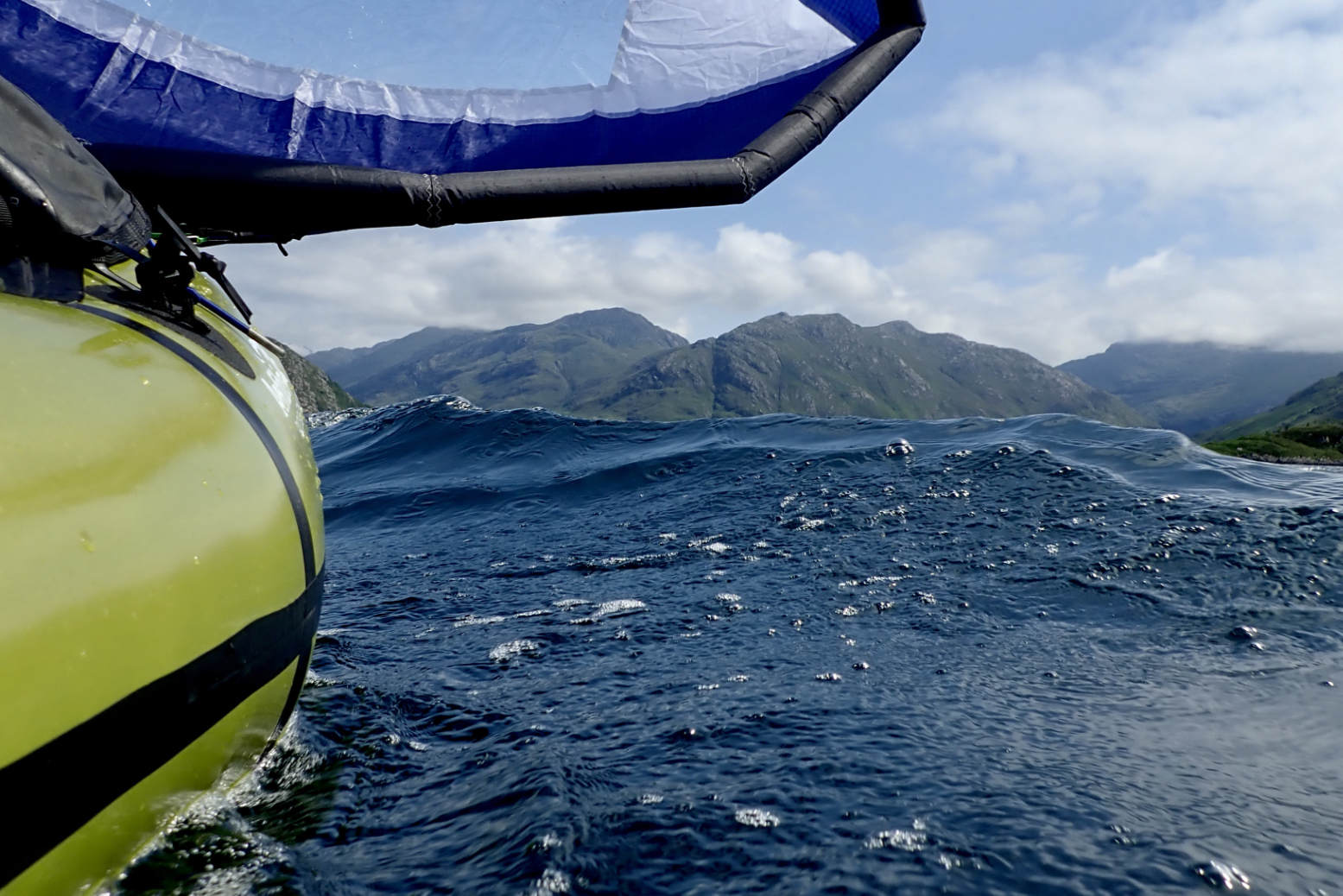
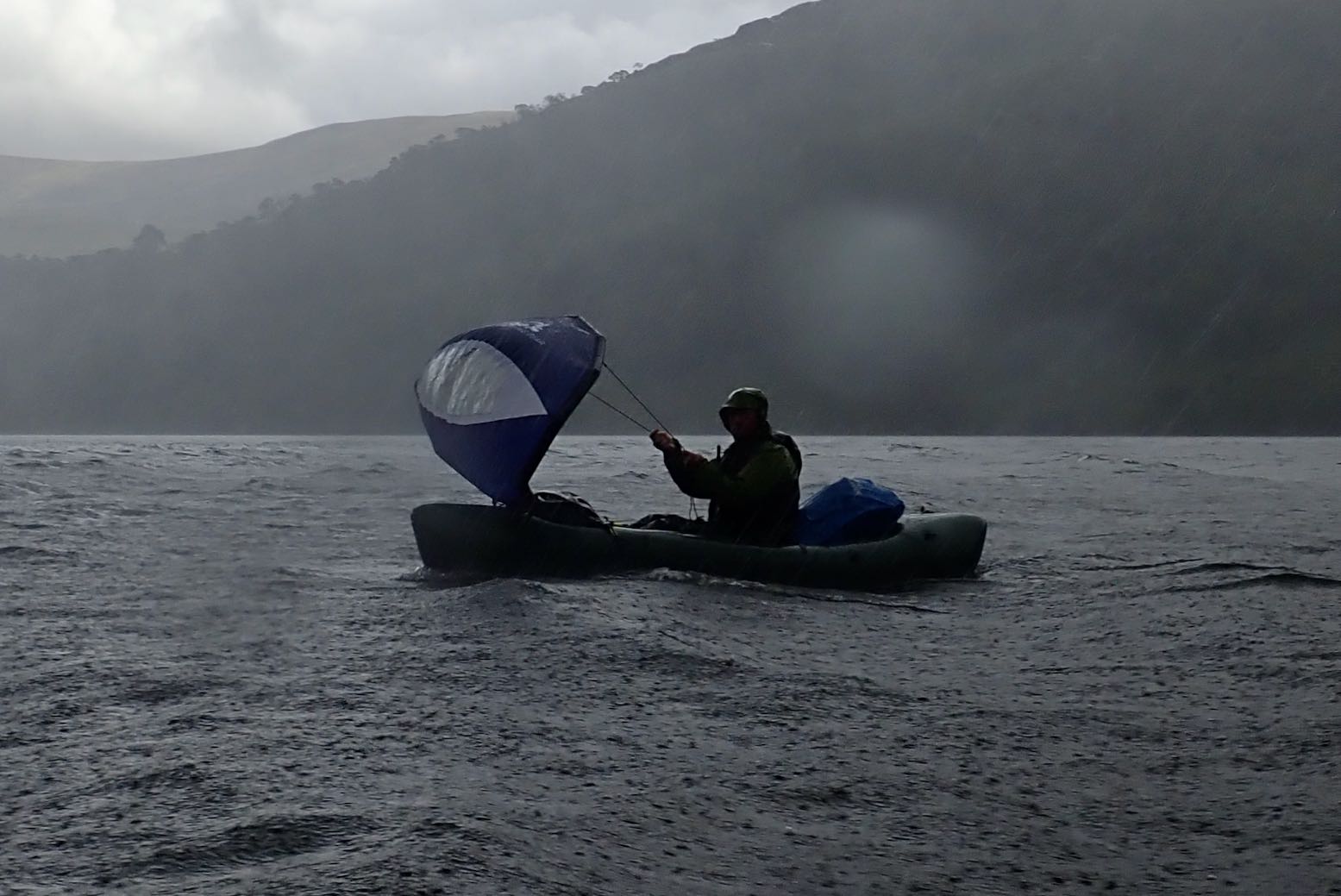
From my experiences with the WindPaddle on kayak and packraft, I was a bit nervous the even bigger AirSail might be a handful. I needn’t have worried. Funnelled down the steep-sided Loch Hourn, winds gusted to 15mph, but the Rebel 2K with the AirSail was easy to manage in a way the WindPaddle 2 never has been so far on other boats. And this was with an under-inflated air ring. There was no violent see-sawing from side to side, little need for constant correction and, considering I was out in the middle of a windy sea loch, I felt safe and in control. My paddle was leashed to the mooring line but also slipped securely under and out of the way underneath the DeckPack.
Use hand (safer in strong winds)Clip to pfd…..or use your head in calm winds
This plain sailing was partly because the 2K could not break into a gallop. I doubt I was going much faster than paddling, but it sure was effortless and relaxing. Had there been a signal I could have easily updated my profile on Insta or checked the forecast. The 4km which had taken me an increasingly slower 80 minutes, was covered downwind in an effortless 60 minutes I also think the low centre of gravity of the loaded 2K helped it sit on the water and – crucially – the lack of slack between the sail and boat fittings kept the under-inflated sail from swaying. I must try this taught rigging on the kayak next time; that could have been my problem all along.
With the line clipped to a karabiner on my pfd or behind my head, most of the time I was sailing hands free which made filming easy. The line was just the right length, too. Only tiny tweaks were needed to keep the boat on line, due to the back getting blown round. This was most probably down to the small skeg, but was all much less frantic than my recent sail with the WP on the Seawave. I suppose with free hands, the paddle could have been used as rudder to maintain a heading, but I didn’t think to try that as I was going vaguely in the right direction. Something to try next time. One problem with the AirSail: because the bow on a 2K is high compared to a kayak, the window is too high to see what’s ahead; it’s the lower third which needs a clear PVC pane. Most of the time it doesn’t matter; you can lower the sail or look around. In fact, it would be great if the whole thing was made of clear film, but weight, rolled volume or strength may not add up.
Holding on for dear life, and AirSail on Nomad S1 bursting at the seams in 25-mph gusts
With the line out of your hands it’s easy to try and add a bit of speed by paddling as well, but at best this might add a tiny bit of speed and will help keep you warm. You do notice that not paddling can chill you. Once you’ve had a good look around, after being used to having to paddle every hard-won metre, sailing slowly might even be said to be a little boring unless the winds are strong,. But on a long day on a multi-day tour, you’ll welcome the break when you get a chance, as we did on Knoydart.
As you can see, a couple of weeks later I travelled with a mate in an MRS Nomad S1 using the same Anfibio AirSail, with me WindPaddling in my 2K. The longer Nomad is a bit faster than my 2K, and with the AirSail was quite a lot faster, maybe 15%, especially in strong winds. That meant that the Nomad had to stop to wait for me to catch up, which also proved that the AirSail could be pulled back and tucked out of the way under the knees. The added space up front on the Nomad makes this easier than in a regular packraft, but requires not using a deck, unless some sort of cross-strap arrangement is set up to hold the sail down.
AirSail; another thing to inflatePaddle-sailing helps you keep warm
Longer MRS Nomad S1 sailed quicker than my 2K
Sailing in squalls of up to 25mph took quite a lot of concentration but never felt unsafe. The Nomad was reaching 5mph (8mph) but remained stable and controllable (as did my slower 2K with the WP sail). With both types of sail, this was sailing at its best: satisfying, safe but exciting too The problem with sailing is you don’t generate any heat. We were already wet from a long walk before we got on the water, and neither of our hiking cags were up to it. After an hour or so of hanging on in torrential squalls, and with another two hours to the end of the loch, my mate in the undecked Nomad had to go ashore to drain his boat by which time both of us were chilled. We’d both tried paddle-sailing to warm up (and me, to catch up), but were too far gone to make a difference in the conditions that day. If you plan to paddle and sail an undecked packraft in all conditions, get a dry suit and maybe a bilge pump.
Having used the AirSail and paddled alongside one, I still think I’d choose the cheaper, same weight/ø, batten-rimmed PackSail. For me the value in being able to stow or release a sail in a few seconds is not offset by the slight awkwardness of needing to stash a 40-cm disc. But it’s nice to have the choice.
A couple of fellow Seawave owners got in touch recently to share their ideas and modifications.
eBay rudder with DIY mount plate
Lighter, bendy deck bars
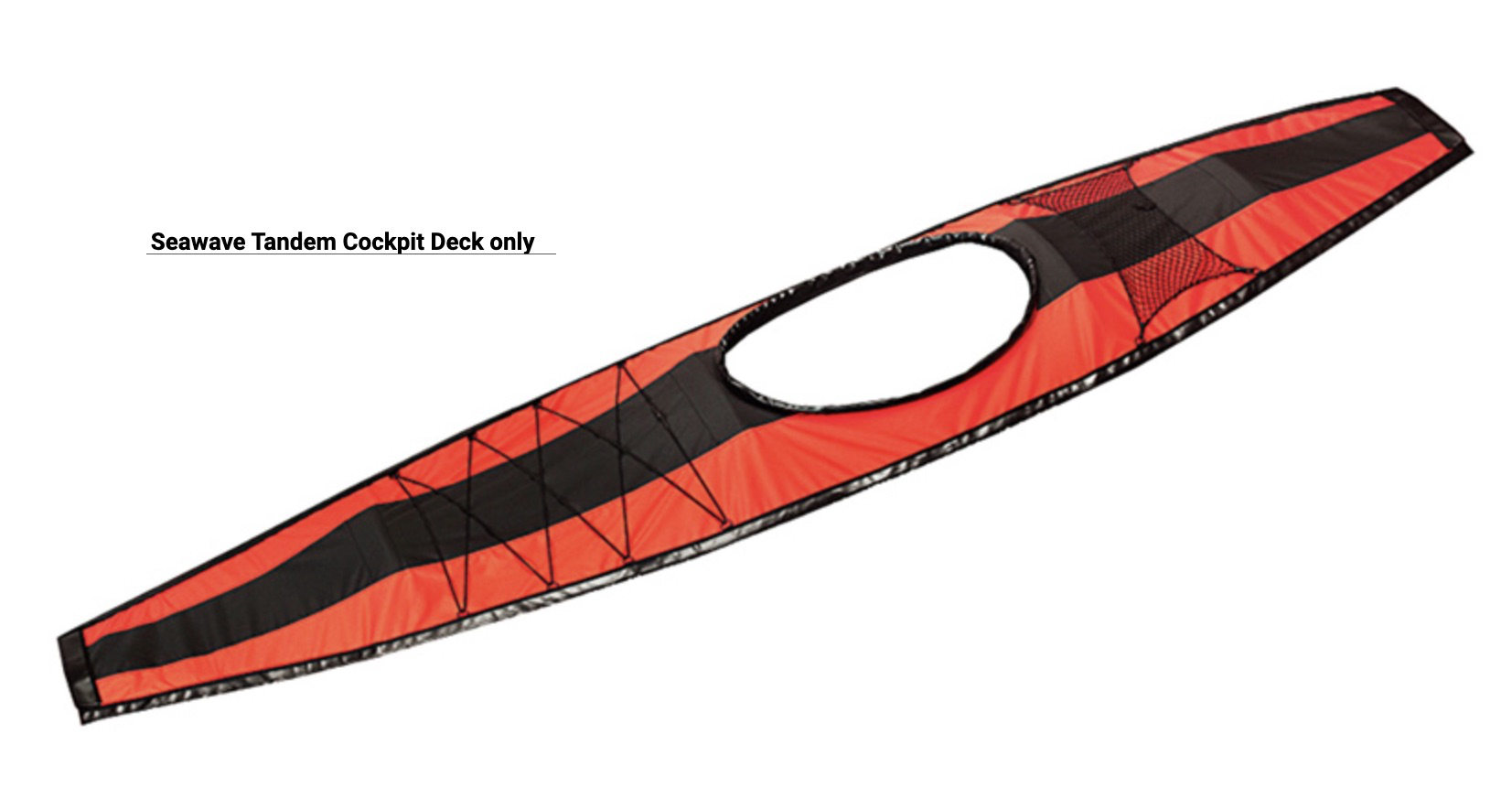
Jules showed me his very nicely milled MYO rudder similar to my Mk2 design of 2016 made from HDPE chopping board. I doubt the alloy one is any heavier. He also uses a deck, but replaced the four bulky welded alloy bars fit for a Zeppelin with a much lighter arrangement in heat-bent plastic pipe with alloy end slots. Were I to get a deck again (solo decks only go for around £145 – over half price of the full kit), I’d definitely make something similar, maybe with tent poles or even thick garden hose. It would pack much more compactly. Jules adds: … I’ve made a very efficient rudder for the Seawave using a tube that pivots on tape as a pedal bar or locks off to form footpegs, with cables running in PTFE tubes under the velcro for the deck. It means no exposed lines and works very smoothly.
I take that to mean a hard drainpipe tube (like I use) which pivots from the centre like handlebars with the rudder lines attached at each end. In an IK that’s a much neater way of doing it than any pedal system. Tucking the lines under the deck velcro in tube sleeves is also much better. It’s about time that deck velcro did something useful! The photos below may help clarify Jules’ system
Front footrest locked off
Rear footrest ruddered up
PTFE rudder line tubing
Rudder and lock off lines
The ‘packraft’ pump can also get the Seawave up to 4.5psi, eventually
At sea with waves
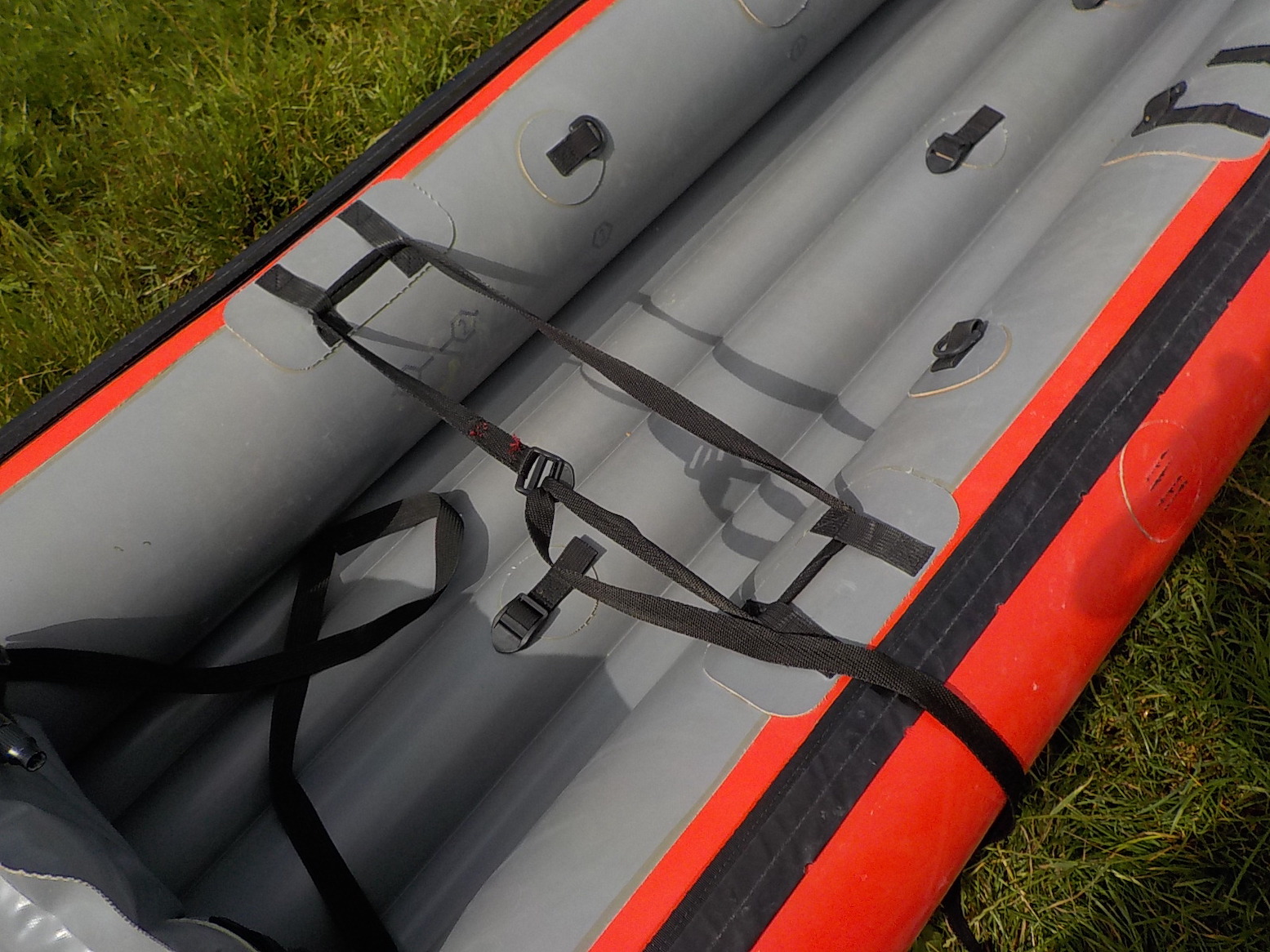
Meanwhile Gavin adds: On my most recent trip I experimented with looping a couple of straps across from one side to the other around some of the attachment points, one strap near the bow and one near the stern. I then tightened the straps so that it pulled the side tubes closer together. It makes the kayak narrower, gives a slightly more pronounced keel from the floor being squeezed together, and seems to stiffen the kayak along its length as well as across its width. Obviously it takes away some stability, but I can live with that as a trade-off for being more efficient.
I usually paddle single-blade and sit on a bench seat held under the velcro on the side tubes. The Seawave is faster than the Palava paddled like that, although it lacks the width and stability… I’ve got a rudder steered with a tiller held in place by friction under the fixings for the deck support bars, so I can do straight strokes instead of having to J-stroke to keep a straight course.
I like the tiller idea too, though of course it works best for canoeing. Anything to dodge the clutter of foot pedals and rigging, though Jules’ idea improves on that.
Thinking over the mods and ideas I applied to my original Seawave over the years, on Seawave 2 I believe the best or most essential ones are:
Replacing the stock footrest cushion with a solid drainpipe footrest tube. Proper support, lighter. Replacing the stock inflatable seat/s with with a stiffened foam backrest and light packraft seat base. Better support, lighter, less bulky. Adding a Gorilla tape strake under the bow; simpler than gluing on a strip of hypalon. My skeg-wheel trolley is great too.
Other old Seawave mods I tried am not in a hurry to reimplement. Rudder: too much faff for the fair-weather day paddling I do, but were I doing an overnighter at sea (with or without sailing) where you can’t always pick you winds, a rudder would be a very handy and I’d apply Jules’ ideas, starting with a 20-quid rudder mechanism off ebay.
PRVs in the sidetubes: worked great but as explained here, after a recent paddle in Seawave 2, where I paddle heat is not a big problem and the extra care required and time saved is minimal. I still run 0.32 bar or so, not 0.25 but better to make use of an accurate pressure gauge.
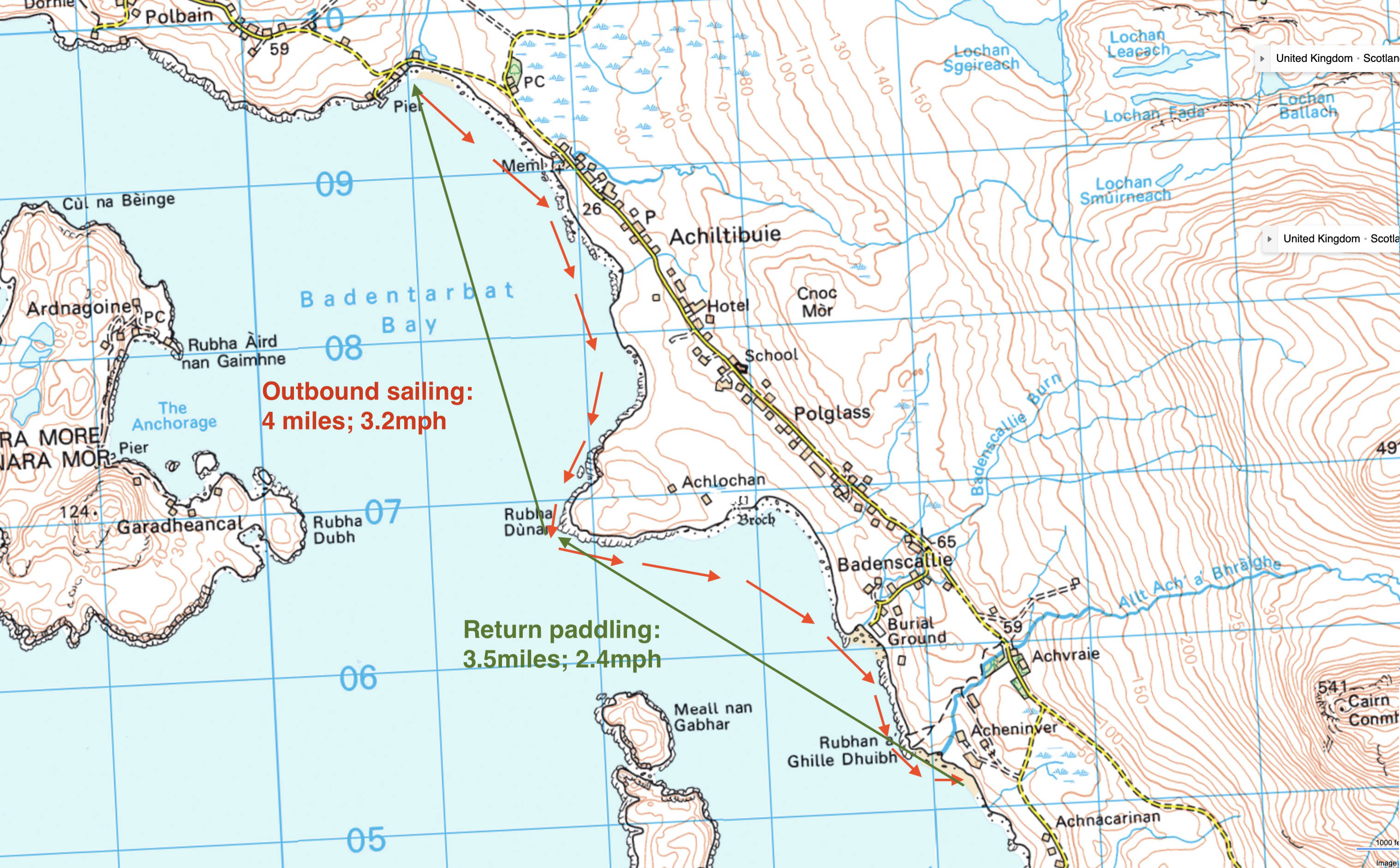
It’s Midsummer’s Day up here in the MidSummer Islands, but it’s barely over ten degrees and blowing from the northwest. Now my Seawave PRV saga has been resolved, there’s enough (but not too much) wind to sail the four miles over to Achininver for a visit. It’s the last day of paddleable weather before we pack up and head back south with the geese.
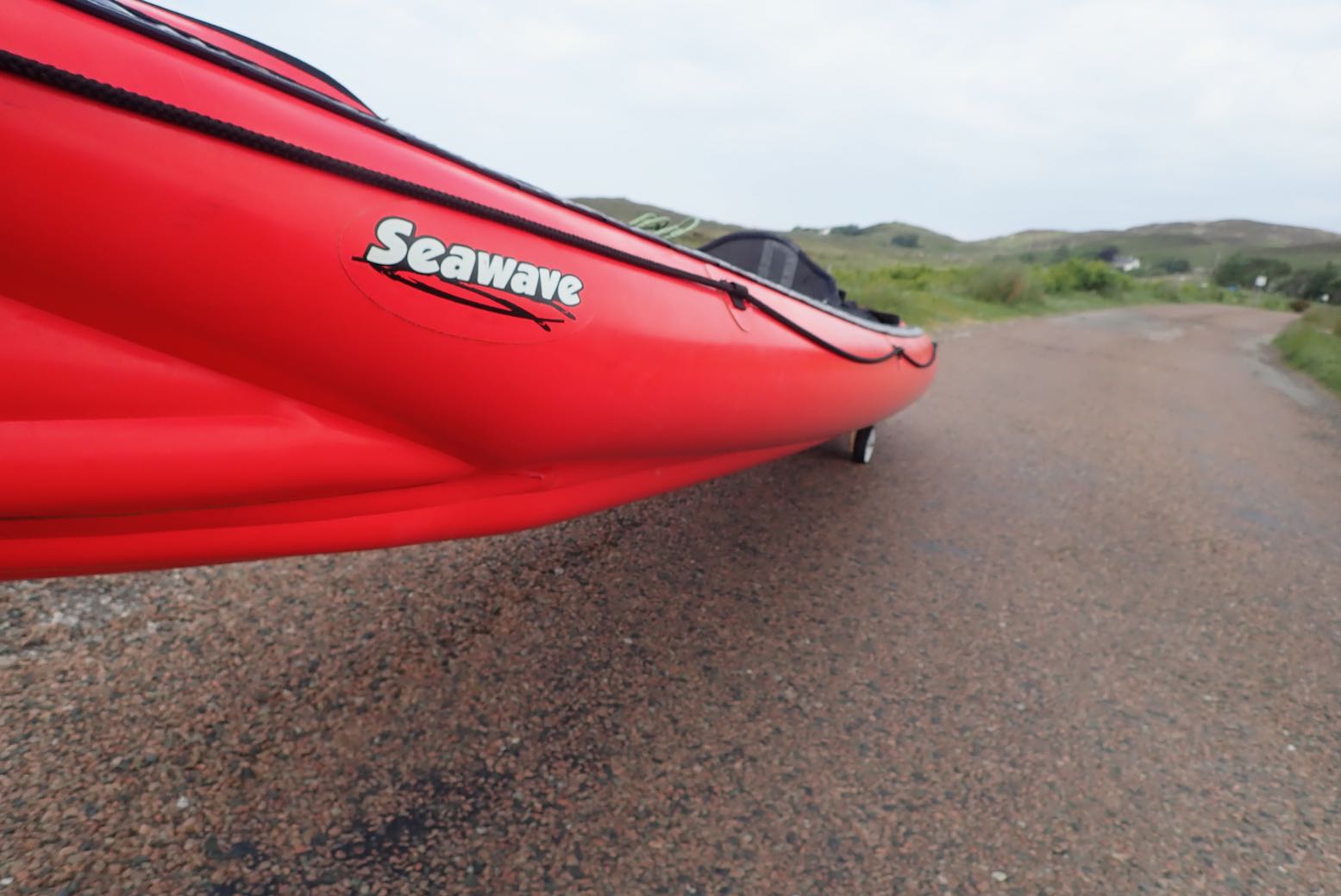
It’s also my first chance to try out my trolley with wrapped-round inner tube tyres. It’s less than a mile down to the beach and the racket of solid plastic wheels is gone. This trolley really is one of my better ideas for the Seawave. It ditches the need for a car for short hops, and elsewhere means you can paddle somewhere and wheel back if there’s a road or decent track.
As it’s chilly and will get splashy on the paddle back, I slip into my Anfibio dry suit. If the sailing goes awry and I fall in, I have an impression of being protected, even if its true insulation effects will be marginal. Best of all, I can dip myself into the brackish loch behind Badentarbet beach for a salt rinse and be dry by the time I wheel home.
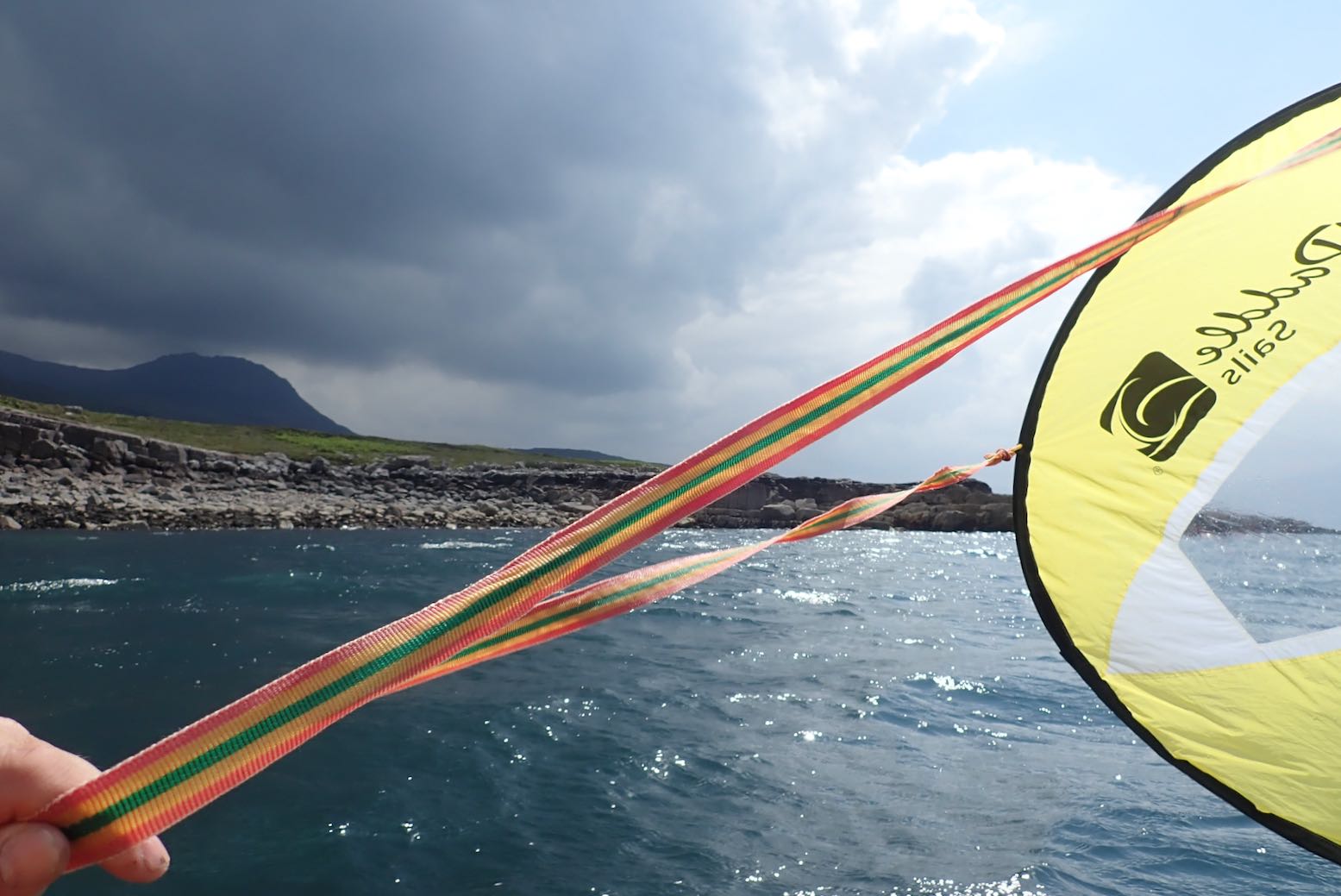
My WindPaddle is the 1.2m Adventure II model, big enough to haul the 4.5-m Seawave with me in it. I flip it out and off we go, trying to steer SW for Rubha Dunan point. Only it’s not really working so well. Apart from the usual sail swaying left-right on bigger gusts and flopping back on lulls, whitecaps are rolling in from the right, pushing me onto the Achlochan peninsula. Later I realise this drift is probably because the Seawave’s skeg (no bigger than my hand) is too small to stop the light Seawave drifting across the wind which across the bay may be turning WNW. This is why sail boats need keels and dagger boards. If I had a third hand or a passenger, the paddle could’ve been used as a rudder, but as it was my hands were full managing the sail and trying to take the odd photo. You don’t want to risk losing the paddle. Since then, I’ve made a rudder for the Seawave.
Quickly stashed and redeployed
You can always paddle
I’m pushed into the rocky shore where the refracted waves and added fetch make things a bit lively, but the ever-stable Seawave is reassuring. So with a quick cross-fold, the sail is stashed between my knees and I paddle on to Rubha Dunan. Once round the corner the sea is smoother but the wind remains so I cruise past the sandstone cliffs towards Badenscallie Beach, an alighting point for Horse Island. Once back out of the lee the waves build up and with the odd gust, the Seawave races on. When you’re not trying to control the sail, it is a marvel to sit back and look round as the water tinkles past the bow. One thing I did learn a few weeks later while sailing the packraft in similar conditions with a similar sail, was that the side-to-side swaying was largely eliminated because the sail was fixed closely to the bow with no play. On the Seawave, I just hook the sail to the grab line (below left) in the hope of gaining a bit more height for more drive. Next time I’ll pin it closer to the bow and see what happens. I’d expect better control.
Fixing the sail to the bow more closely may reduce swaying.
It took me an hour-fifteen to cover the four miles to Achininver Beach, at times lazily sailing slower than I could paddle. Interestingly, it took only an extra 15 minutes to hack back non-stop into the wind at 2.4mph, but by the time I got in I was just about pooped. It was a fun excursion, but to make it worthwhile you need more wind than you’d want to paddle back against. A better use of the sail would be going somewhere and not having to crawl back.
Time to head back up the hill, dry out the boat and roll it up for this season in the Summers.
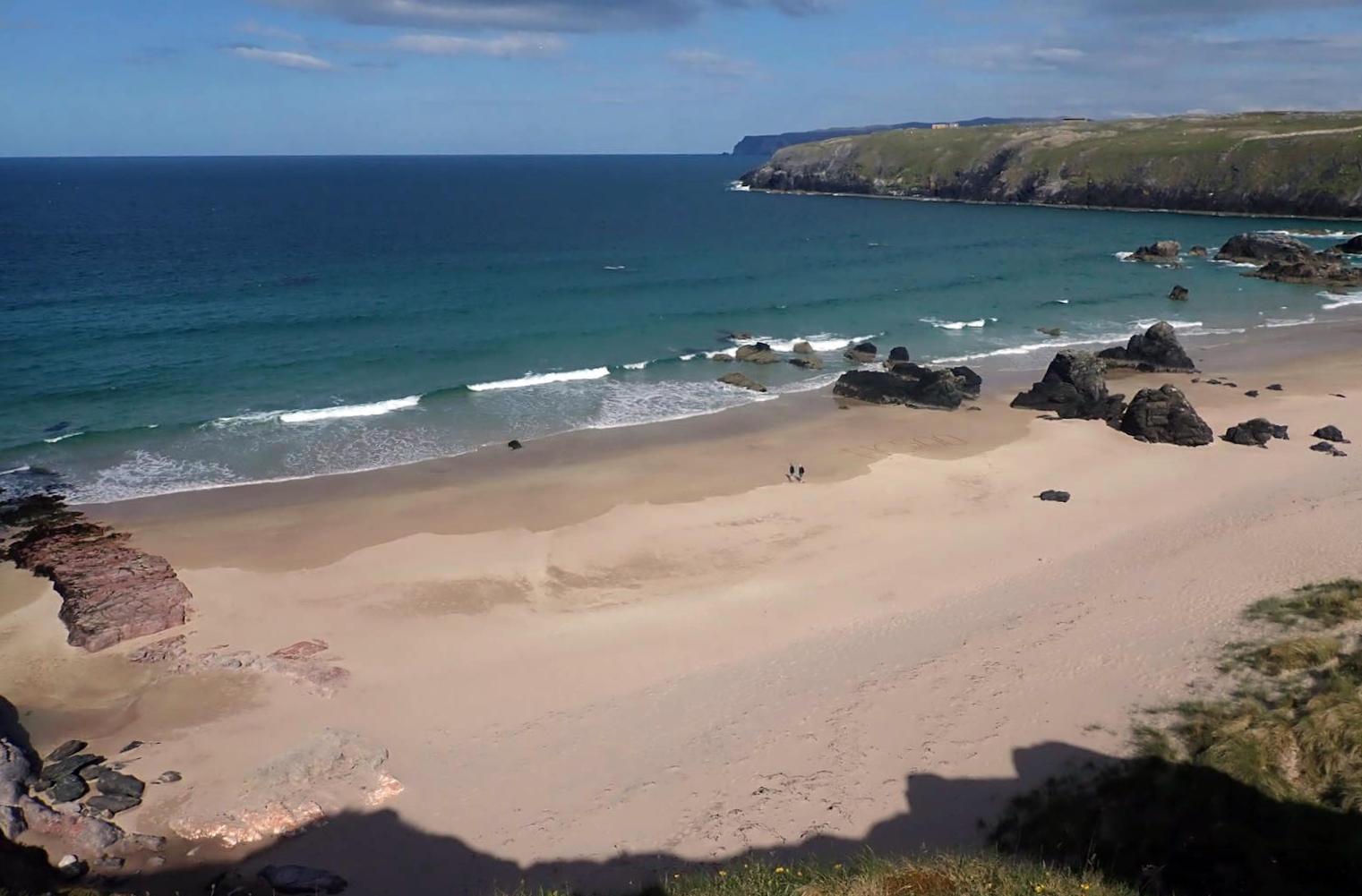
The other day we paddled the Seawave off Durness beach where the surf was bigger than I’m used to. Hitting a breaking wave as we paddled out didn’t help; the swamped boat needed tipping out at the next beach. It was a bit too offshore windy to roam, but it was still a thrill to be paddling on the very top of Britain, just 2175 miles from the North Pole (about the same distance south to the Canaries). After the paddle I took care to dry, wipe down and roll the boat up on a sand-free rock bench, but lacking a hose back at the house, I had to rinse one bucket at time – not ideal. When I pumped up, the floor soon went flat: sand was in the seal of the floor’s PRV (what’s a PRV). It’s a thing that happens but in nearly 20 years of Gumotexing it’s never happened to me. Today was my day.
Seawave PRV
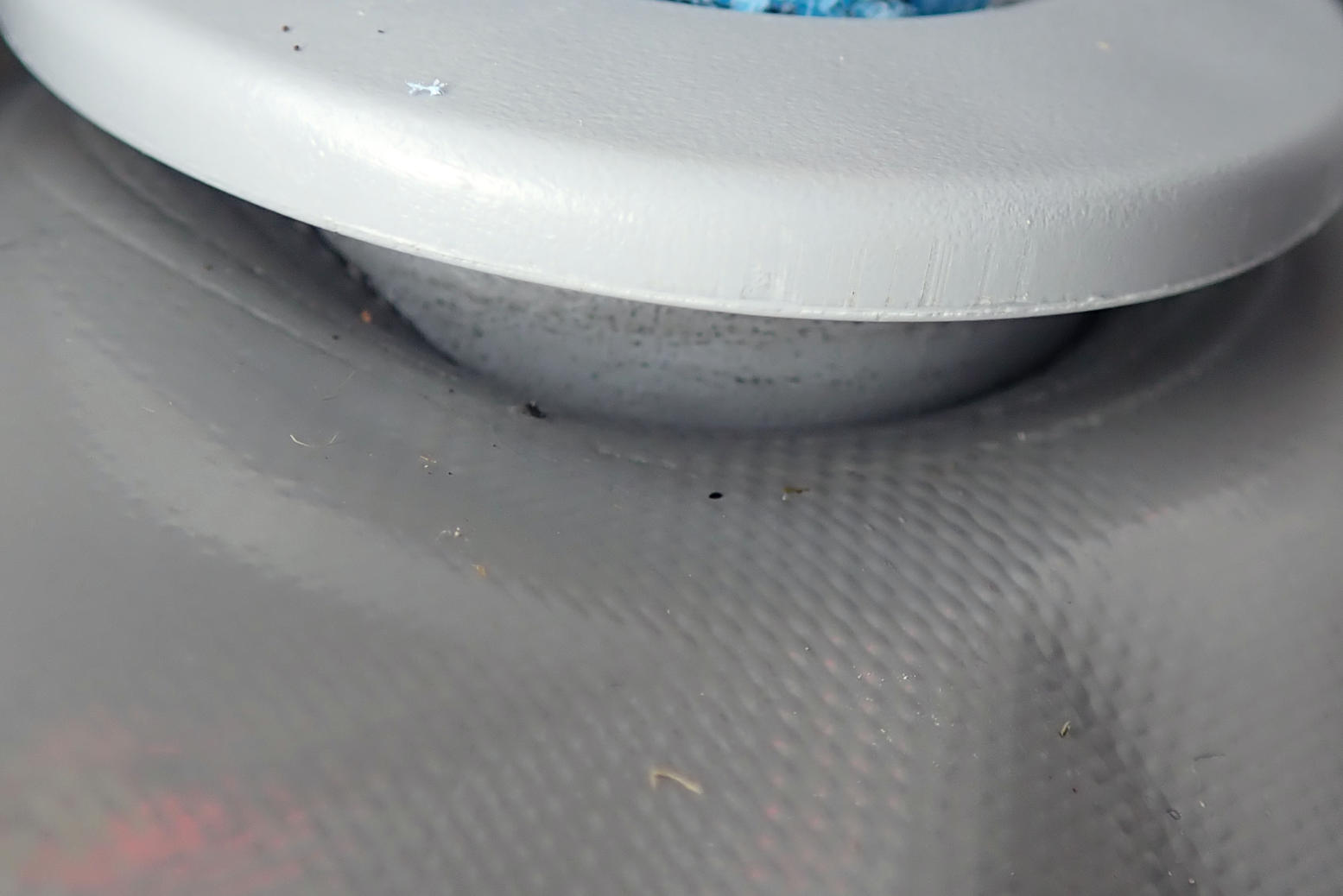
The design of the valve means that if the boat swamps in the surf, water laden with grit can enter via the six vents and pool in the valve body right above the seal. The next time it purges, sand grains can slip down onto the soft rubber seal surface and stay there, letting air leak out. Because the chances of this are high, with a leaking floor PRVs are the usual culprit, not the nearby inflation valve with its sealed valve cap, or less still, a puncture. But don’t rule either out (the cleaning procedure for an inflation valve will be the same).
Fixing a PRV Much of what follows is my take on Polishman Marcin S’s translated post linked above. It’s not how I actually did it, it’s how I would do it next time after quite a lot of trial, error and better ideas or procedures though up along the way.
Before disassembly, first try giving the PRV a darn good blow-through by pumping like billy-o and letting it purge. It will help to prise off the vent cap with a small flat screwdriver so grains blow away, not bounce back in. Pump up and see what happens. Chances are it won’t work.
Next I suggest putting the boat on a slope (to save water and weight) and flood the stern to establish the pace of the leak from the PRV. You will do it again at the end to see if there is any change. By dragging the boat around 180°, you can let the water slosh down to the bow while you remove the PRV at the stern at the high end.
Don’t try this; manometer leaking
Small bubbles rising from the PRV
Don’t plug in a manometer to try monitor the leak over a period of time; it cost me a few hours and a disassembly or two before the flooding idea proved my manometer was leaking from the base faster than the PRV. As we know, pressure gauges are plugged in briefly to get a reading, then as quickly removed. To test for a leak, water is best.
Six splines below the vent cap
Buy one now
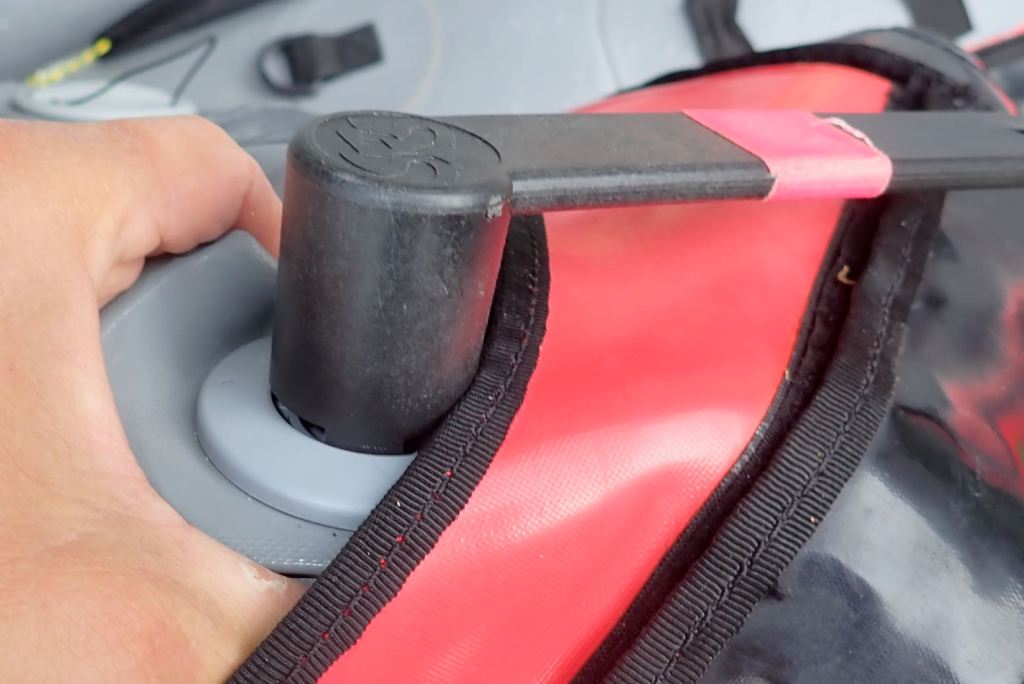
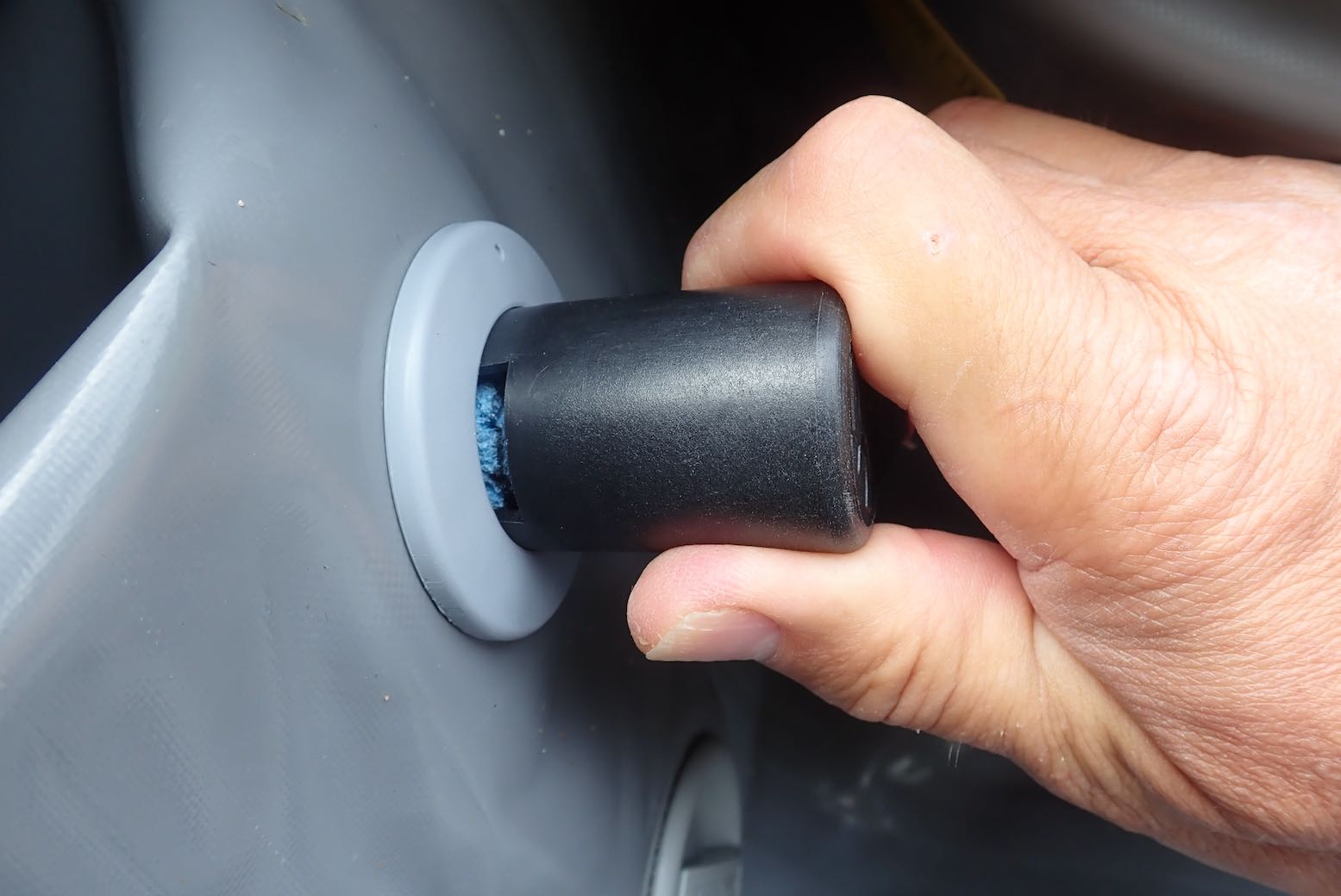
You now know for sure the PRV is leaking so will have to remove and clean it. Flicking off the vent cap exposes the valve body’s six splines. Fit your Gumotex valve tool(or eBay clones from £6) and unscrew the PRV. As Marcin says: the plastic one will do; you don’t need the expensive metal one Gumotex also sell. Expect the PRV to be very tight. Marcin pre-lubed his, I didn’t but it undid easily enough. My boat is less than a year old.
What a tool
Don’t let the backing nut fall away (or the o-ring)
It’s easier to start unscrewing the PRV with the boat fully inflated, but separate the two parts of the valve only once fully deflated so there’s less chance of the backing nut inside the hull rolling away out of reach. Same with the loose o-ring on the valve body base; don’t let it drop into the abyss.
PRV with black o-ring
Rinsing; worth a shot
With the PRV in hand, you can see how it works: a spring-loaded valve opens upward when pressure from within reaches a pre-set level – on a Seawave supposedly 0.25 bar or 3.5 psi (but it might close as low as 0.20). As pressure drops it seals shut. At this point you might try rinsing under a tap while pushing the valve open, but you’re going to have to disassemble it anyway to check the state of the seal.
Set the o-ring aside and unscrew the 6mm locknut on the valve stem. Press on the sprung valve from the other side to stop it spinning as you unscrew the nut. But before you do this, count the number of threads or take a photo (above), as the position of the nut regulates the purge pressure; the more you screw down the nut the higher the purge pressure. I notice Marcin’s nut on his Solar was much less screwed in than mine (lower purge pressure). (At one point I tried screwing in my nut an extra turn to improve sealing, but it didn’t seem to make much difference; still closing around 0.2. Maybe a few more turns are needed, but of course you don’t want to go too far and compromise the floor.
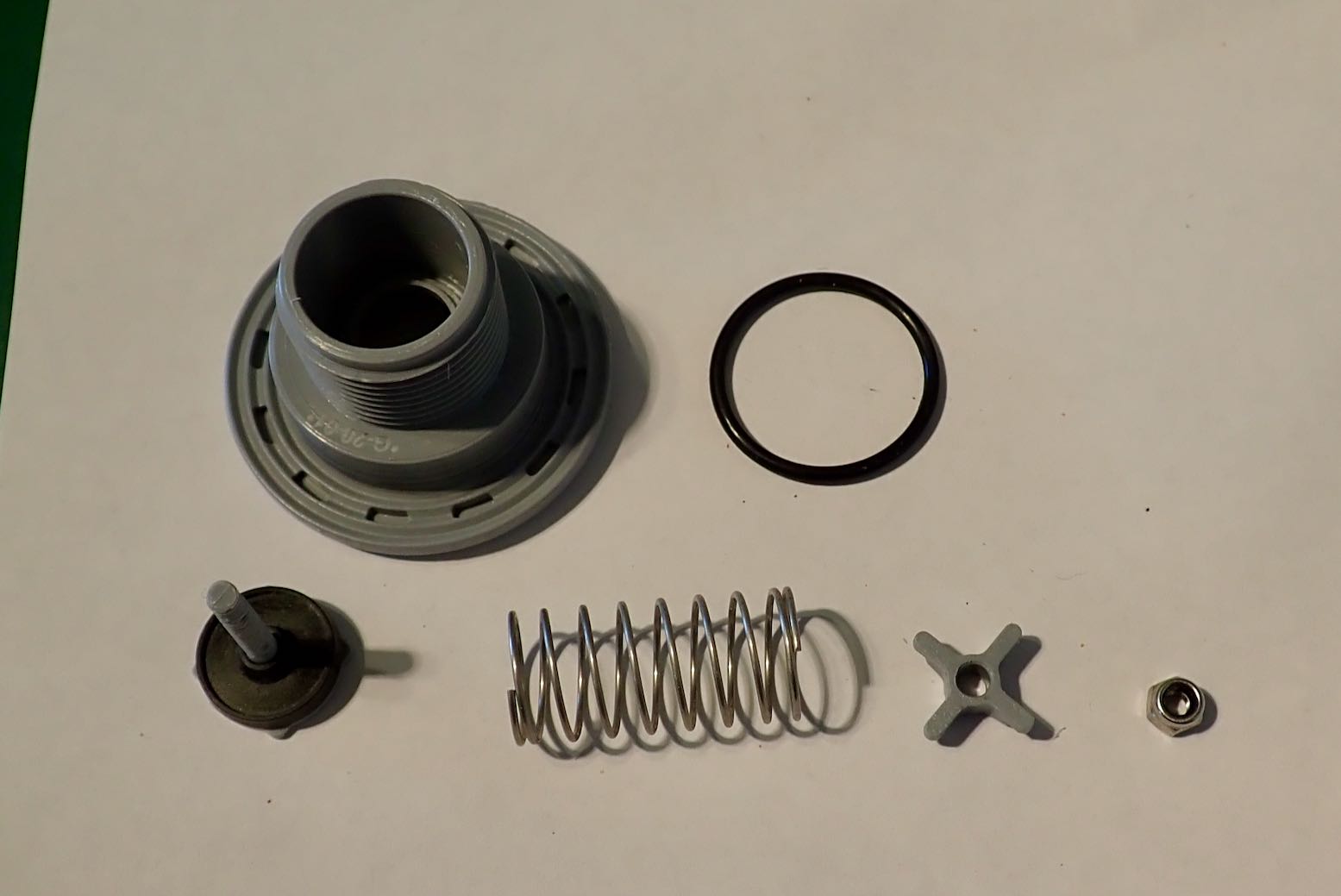
Left: pliers to undo the nut; magnifying glass and torch to closely inspect the rubber seal. Right: the disassembled PRV. From top left: valve body, o-ring, valve stem with rubber seal, spring, spring cross-washer, 6mm lock nut.
Ooo-er, quite a lot of fine Durness beach on there.
I chose to clean the rubber seal with an ear stick and toluene solvent. (I tried, but decided not to remove the rubber seal from the stem). After carefully wiping off the grains on, around and under the seal, I dipped the whole thing in the toluene bottle cap (not too long as toluene is strong stuff on plastic; it dissolved the orange marker dot). Don’t forget to inspect and wipe the inside of the plastic valve body too.
A lovely, clean PRV seal. Reassemble and carefully screw down the metal nut onto the soft plastic valve stem to where it was – or what you prefer.
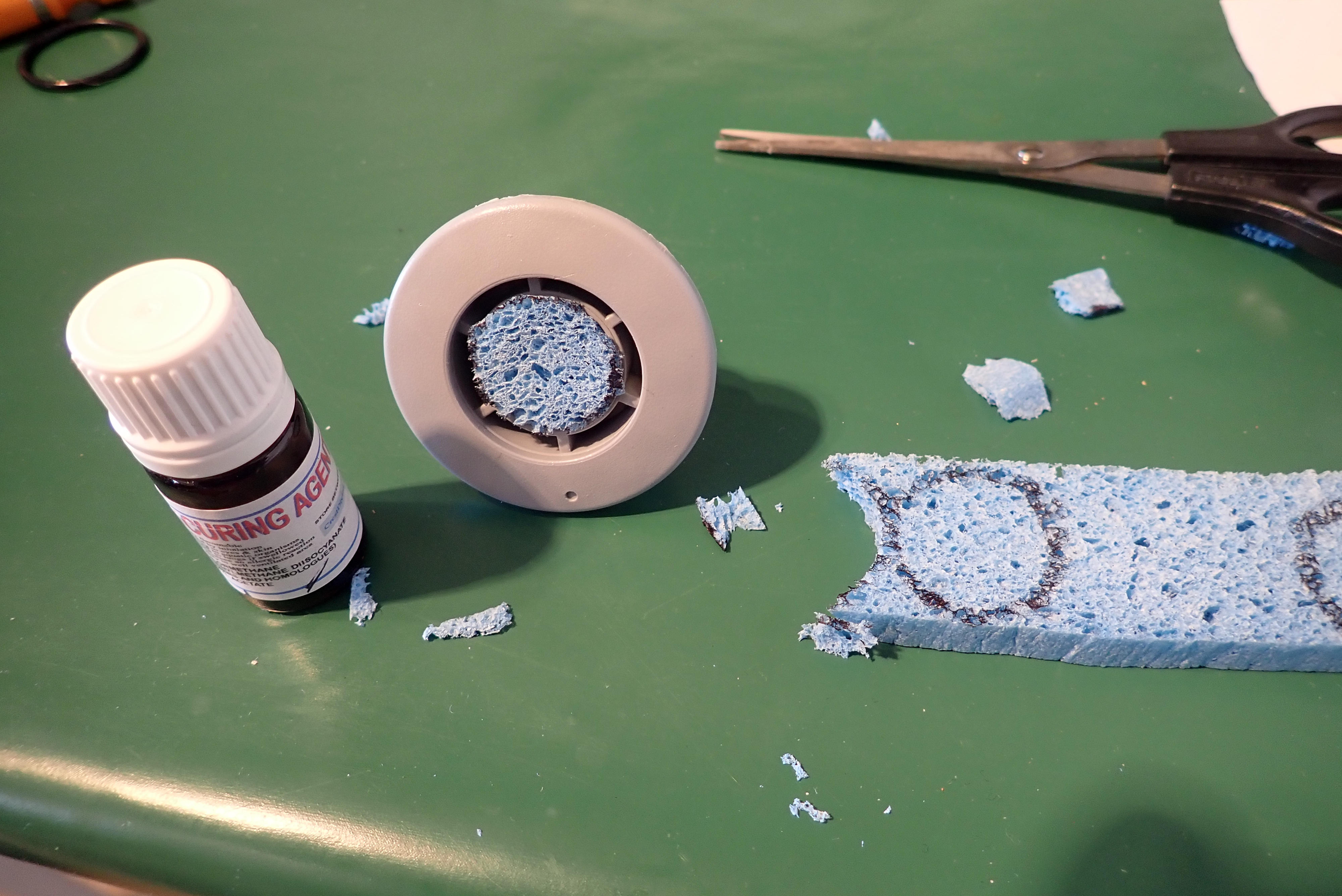
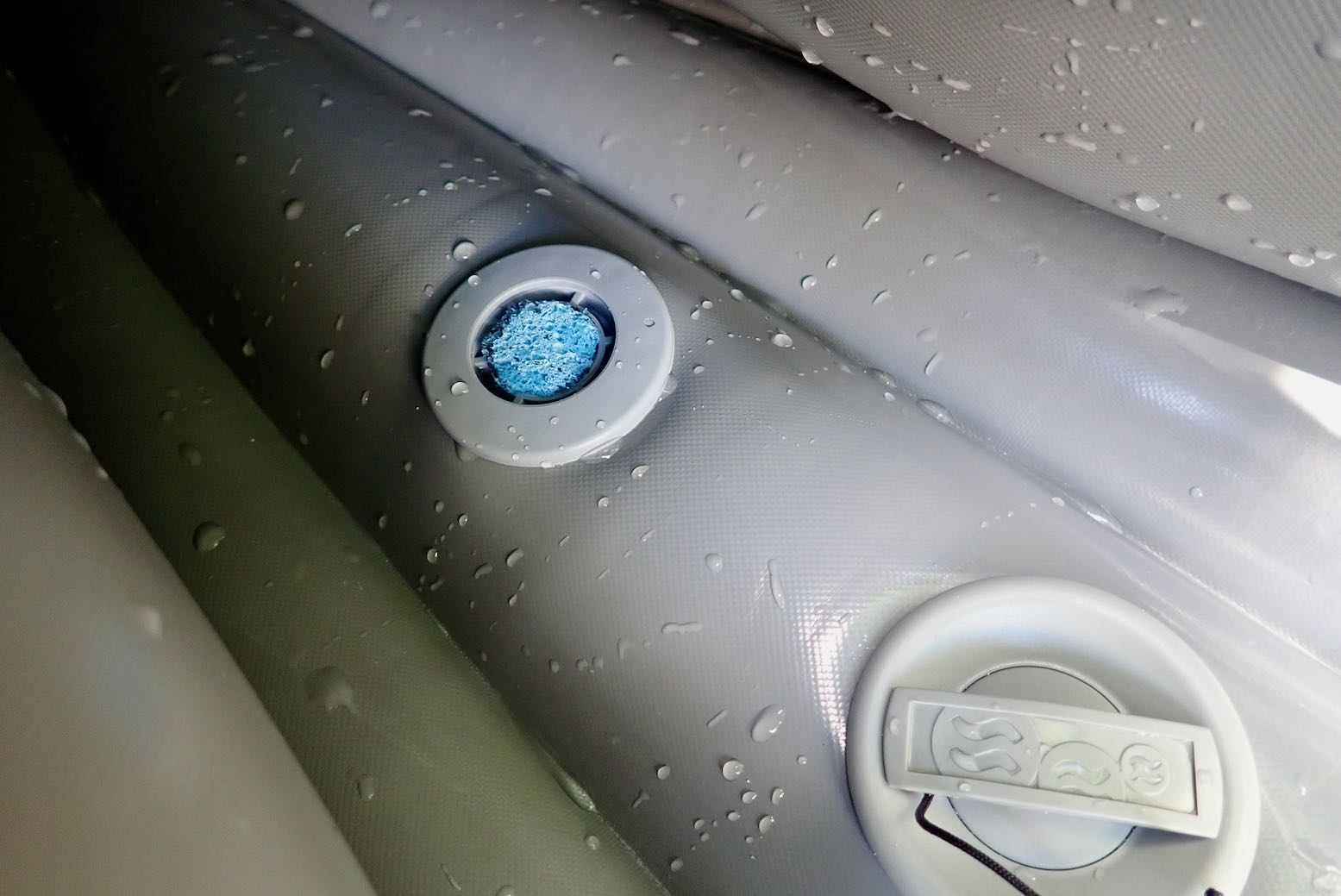
Grit-catching foam filter
Marcin suggests sticking some sponge under the vent cap to catch grains in future. Sounds like a good idea. These are easily removed/rinsed/dried or replaced by flipping off the vent cap.
Edge caught in thread
Tooling on
Clip on the cap
A quick Hail Mary to Saint Columba and you’re now ready to refit the valve. You shouldn’t need any lube other than a bit of water for things to reassemble smoothly, though I decided to lube the o-ring with some TiZip silicon grease. I found as you start screwing in by hand it feels like it’s cross threading. It isn’t: the edge of the fabric is getting caught in the thread. Back up and jiggle the valve body and loose fabric around to make sure the body has slotted and centred its flange into the fabric hole. Pump back up, tighten the PRV down some more, but probably don’t clip on the vent cap just yet as you may be going back to square one, as I did (partly because the fitted manometer was leading me astray).
Now flip the stern back downhill and let the water slosh back over the Seawave’s valves. I found the PRV purged for about a minute, then abruptly stopped with an odd underwater squawk … but carried on leaking slowly. Another removal and check and refit and there’s still a very slow leak – a 2mm bubble every 2-3 seconds, but with the floor now lying in the warm afternoon sunshine, that may be normal purging. I decide it’s as fixed as it can be. A few hours later, all was normal again and we are all much the wiser.
Moral of the story: if you think sand-laden seawater may have pooled in your PRV (most likely from crashing beach surf, not normal, deep-water paddle-splash), back on shore flip the vent cap off and rinse the PRV cavity with fresh water, ideally flipping the boat upside down, so any grains flush out.

























































 Inflatable Kayaks & Packrafts