Lashing points and loading One of the limitations of all old Sunnys is a lack of lashing points – something that an Aire Super Lynx or FC Java have plenty of. Early on, I tried to glue a few on with what I thought were the right materials and technique, but half have since peeled off. Now I’ve discovered Aquaseal or two-part glue I manage better.
Another IK limitation is that nearly half the actual width of the boat is taken up with air chambers, reducing the interior packing volume (if not necessarily payload) to less than a foot wide, especially with single side chamber boats like a Sunny (as opposed to twin-chamber bloats like Grabner H2s or Gumo Seakers). I have to say though, on the trips I’ve done – nearly a week along a tropical coast (above) with one resupply – the volume was adequate. It might not be the same story in a colder climate or when you need to carry more freshwater. The limits with the Sunny are weight as much as space; the freeboard is reduced and it swamps easily, which at sea can be a hassle if sharks are circling.
As is well known, the position of loads has an effect on what they call ‘trim’ – the level or balance of the boat. This also effects tracking (more critical without a skeg). In some pics you can see how my 95-kg weight sinks the boat in the middle. To counteract this I generally try to pack the heavy weights out at each end. Too heavy at the front is not so good for waves and rapids, but the Sunny swamps fast in these conditions anyway; it’s only on flat water that baggage positioning is noticeable.
I kept the cargo nets off my FC Java (left and above) and used those on the Spey river one time, a quick way of getting to your stuff which of course is one thing that IKs and SoTs do so much better than SinKs.
Trolley tech The Gumotex backpack/drybag is a pretty basic sack with thin shoulder straps prone to tearing, and no hip belt. You wouldn’t want to carry the 16-kilo Sunny and say, 10kg of camping gear and paddling gear more than a couple of clicks.
A £10/1kg folding trolley is a handy way of transporting an IK around rail stations or airports. It folds up neatly and fits on the bow (right). In fact, with a bit of adaptation, I wonder if it could make an upside down set of wheels for portaging? It’s nice and light but the wheels on this black trolley are too close together, or the load platform is too high so the load tips easily on rough pavements. And you get what you pay for: the tubing and construction are pretty flimsy. Protracted gumboat trolleying over rough surfaces and tracks will eventually mangle such a lightweight trolley (my second) so it needs to be treated carefully.
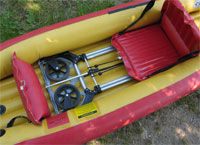
On the Haute Allier river in France I used a heavier-duty and wider trolley (4.2kg) that fitted well under the seat (left, with the old original Sunny seat). Where weight is not a limitation (on trains and buses), I’d use this one again, but with any trolley a wide wheel track is the way to go. It all depends how far you’re trolleying of course, and if it’s over rough ground.
Sometimes I wonder about an integrated backpack frame with wheels, or a wheeled bag with more handles. Part of the reason the OE gumbag is tearing is that when you trolley up to some stairs you can only yank it by the top clips or the backpack straps. It’s something to think about when your current gumbag rips to the point of no longer being a functional drybag. Even in good shape it’s not a serious dry bag, but what roll top is? There’s more on dry bags here.
Short version: the extended tail makes a Llama now 2.4 metres long where the old one was said to be 1.89 – 20 inches less – although my measurements make the new model only 12 inches longer. Interior length and width are said to be the same, but you’d think the new seat design might free up an inch or two and so now the next-size-down Yak may fit a 6-footer like me snugly (better control), while the added stern buoyancy will trim the boat better with my 95kg. And a pointier bow (a bit more length there too) never did a boat any harm.
Knowing that NRS, Feathercraft and a few others are on their case, Alpacka haven’t been sitting on their paddles. They’ve substantially redesigned their boats with pointier bows and extended sterns acting rather like a skeg to improve tracking, speed and trim without affecting turning. The current rafts certainly have turning ability to spare, and tracking I find fine – the bow just yaws a bit from left to right but the boat goes straight enough. Alpacka don’t offer skegs, though you can easily glue one on. My long stern Yaks never felt like they needed one on rivers and locks, but now I sail and sea paddle in longer packrafts, I couldn’t do either without a skeg.
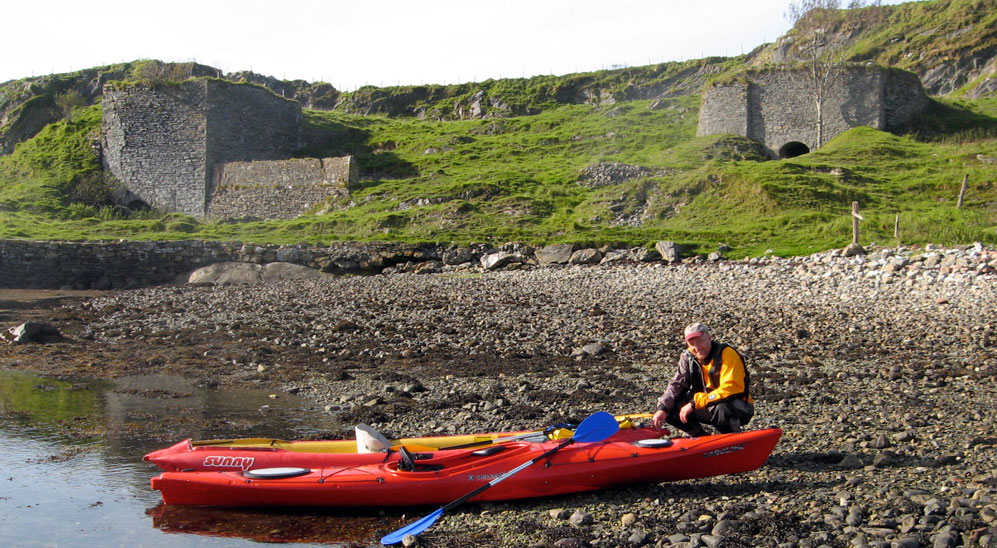
However a bit more speed as a result of reduced yawing (zig-zagging) due to greater length, more centralised weight and added pointiness) would be nice for those long lochs. The extended back end acts like a bit of a skeg to counter the pivoting of the boat around the axis that is the paddler’s body. Interestingly, when I got my Llama I had an idea to fit a ‘trailing skeg’ like this to limit yawing; a plastic plate pinned between two arms coming off the back corners of the boat. I was told skegs make little difference but it could be easily done as an experiment, maybe on a Slackraft. Another advantage of the extended back is the added buoyancy keeps the boat level with the weight more centralised. A benefit of this ought to be that the boat will stay more level and the floor under my butt will no longer be the lowest part of the boat and so less prone to grounding. You can see here how the regular Llama sits with me in it. It may mean one won’t have to get around to glue on an extra layer of floor to save the floor scuffing in the same place.
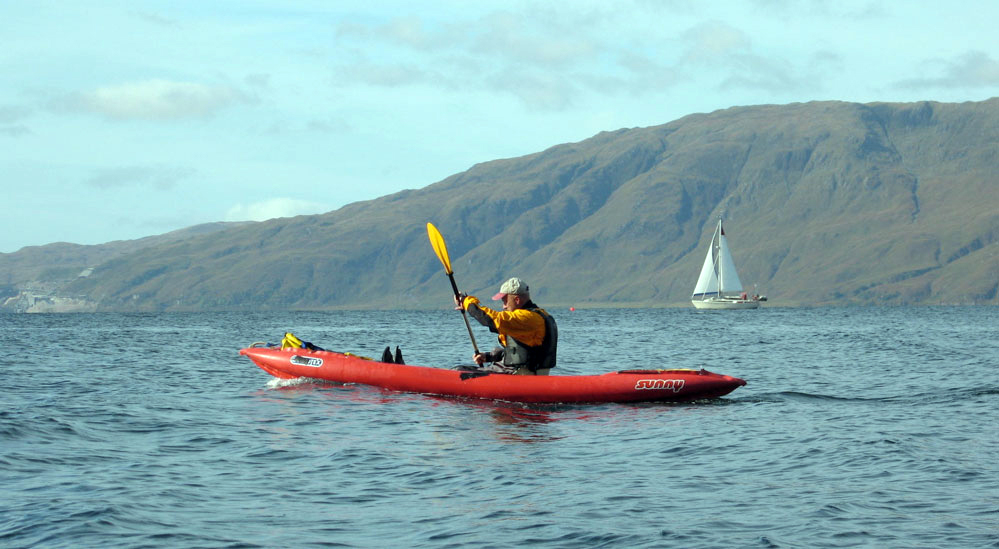
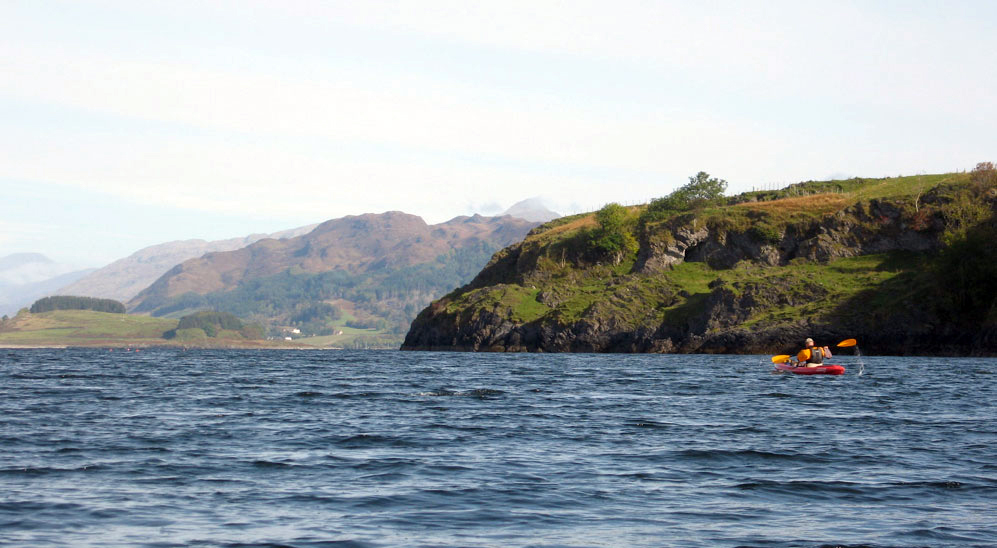
A short slide show of an afternoon’s paddling we did a couple of years ago after the Spey. Jon in the Carolina found this route description in this book, winding in and out of a few islands and so never far from a shore which was fine by us. It’s hardly ‘out there’ but for us it was quite a step up, calculating the tides, wind, currents, UV refraction index and negotiating the swell that might have exceeded two feet at times – plus dealing with some dodgy rip on the way back that was there just where the route description said it would be. After the castle, coming back in between Shuna island and the shore, the wind or tide or something was against me while Jon glided effortlessly forth in his hard plastic boat. That’s the good thing with an IK, you get a free work out! All in all, a lovely October’s day on the Scottish west coast.
Imagine it. It’s a good summer and you have four or five days to spare, but you’re based in the UK, wracking your brains to find a decent river nearby to satisfy that urge for a good short trip, a couple of nights camping, pubs and a little white-water thrill. Britain’s, or more accurately Wales and England’s paucity of suitable rivers that are actually navigations (permitted) and therefore free from legal hassles means your list of choices is short and the Wye is bound to be near the top. It’s said to be Britain’s finest canoeing river. It probably is, but the problem is nature gave us very few to choose from before bureaucrats and landowners stepped in. Your next problem is the state of the river and whether you’ve got the right boat. The Wye has a good variety of speeds and moods and very variable rainfall; at times it’s too dangerous and claims the occasional life, though those are often novices in rented canoes. Photos you’ll find on the web will often show dramatic class III scenes, probably taken at Symonds Yat, but these are show-off photos which aren’t typical of the conditions, even at Symonds Yat. And you’ll see whitewater paddlers wearing helmets in glass-smooth water, which makes you wonder what they know that you don’t. So choosing which boat to take is a tough one for the Wye, unless you’ve got one boat, and it’s a Gumotex Sunny. I was reluctant to take my new Feathercraft Kahuna as I thought I’d scrape the bottom too much and also feared heavy water at Symonds Yat might be too much to handle. So I borrowed the Sunny and in four days of paddling never bottomed out once, though the water levels were quite high. The rest of our group had similar concerns. John had added outriggers to his aluminium Grumman canoe, but I think that was due to worries by his front-paddler, my sister Sally. John’s mate Snoz was the strongest paddler and took a plastic Pelican canoe, the only boat he owns, and my mate Michael paddled his double Pouch folder as that was all he had to hand.
The river starts off nicely and slower boats won’t fall too far behind. Bends and shallows provide ripples and eddies for entertainment and the surrounding scenery deserves all the praise it gets, though I won’t get poetic on you. The ‘no landing’ signs commonly seen on the bank remind you that canoeists are not too popular on this river. Even pubs have ‘no landing’ signs but with some determination we managed to find a place to tie up and climb out to visit the Boat Inn, which has a miserable camping garden and no customers.
We later rescued some rental paddlers (right) whose boat was stuck in some trees on a fast corner while one of their number had somehow found himself on the other side of the river at a point where it was running too fast and deep to cross. The Wye not the wildest river, but you won’t often get a mobile signal and there aren’t many roads nearby so if you get stuck, you’ll have to get yourself out of trouble or hope someone paddles by.
Our first night was spent just above Monnington Falls. It’s a muddy scramble up a bank till you reach some steps, then an orchard campsite with a decent shower at the far end. Having a light boat is a big advantage here, though a plastic canoe could be safely tied up and left by the river. A nice spot and you can worry yourself all night about how bad the falls might be next morning. In the event, the water levels were so high that the falls were submerged and the only trick was to turn fast enough to avoid being tangled up in trees in fast water. More beautiful scenery, more ‘no landing’ signs.
Hereford for lunch, but is there a good spot to land and get a lunch by the river? No, not at all, the city pretty much turns its back on the river, but we were able to tie up under a bridge and walk to a huge Tesco and bring back something. The river carried us on at a fair clip to Lucksall Caravan Park for our next night. A tiny jetty, steep steps with tight turns and a roller so you can pull an empty boat straight up the high bank are all that’s on offer, and the owners regard that as a great facility, but they don’t kayak. Groups of rental boats with bossy leaders monopolise the landing for an hour or more in the morning. All we can do is brew-up and ignore them.
Lunch and a pint await you at Hoarwithy where there’s a primitive campsite and a field with a bull in it between us and the pub. At that point I found out that my sister had a fear of bulls but my greater need for a drink overpowered that. In the afternoon Snoz showed us he can paddle standing up for hours at a time, even through minor ripply stuff. The evening brought us to Ross-on-Wye and the White Lion, a riverside pub which welcomes paddlers with camping in front of it. The awkward take-out is rocks and mud and again I was glad to be in the Sunny. The last day for us was through Symonds Yat, the last possible concern for nervous nellies, then past Monmouth (the river runs around it and you won’t see much of the town) and our finish at Redbrook, where we had left our other car. After Ross, the river picks up a bit more and enters a high-sided valley. There’s a view of the river from the Offa’s Dyke long-distance footpath that is said to be one of the finest in England (though at this point the Wye is about to return to Wales), and I wouldn’t argue with that, though ‘in the top 20’ would be fairer to say. In summer the colours and leafy splendour are fabulous and it’s peaceful indeed, a blissful meander as you approach Symonds Yat.
There’s a good pub to stop at to get some Dutch courage if you need it, but the high levels made it pretty straightforward for us. Symonds Yat is a straight shot, just line up right and you’ll be through it quickly enough. After that Snoz pulled out a bottle of Wood’s rum and some Coke to celebrate and we drifted in the sun, occasionally scrambling round our boats to find leftover food to finish off for lunch. We finished at Redbrook though things looked very enticing downriver. The Wye becomes tidal after Tintern, with no take-outs (due to muddy banks) until Chepstow.
So is it a great river for paddlers, a must-do? I proclaim it’s a fantastic river, and if you haven’t the energy or time to get over to France, it’s one of the best you’ll find in Britain. The great shame is that so little has been made of it. European rivers have towns and villages facing the river rather than facing away from it; there, rivers are tourist attractions and every effort is made to allow tourists on the bank to enjoy river views and for paddlers to land, get out and spend a little money. By contrast the Wye is a shocker, for none of this sort of development has occurred. The proliferation of ‘no landing’ signs, frequent references in the guide book such as ‘prior permission for landing requested, call 01299….’, the shabby and half-hearted take-outs, where they exist at all, it’s is a disgrace to our country, especially on a river that’s often referred to as our finest for canoeing.
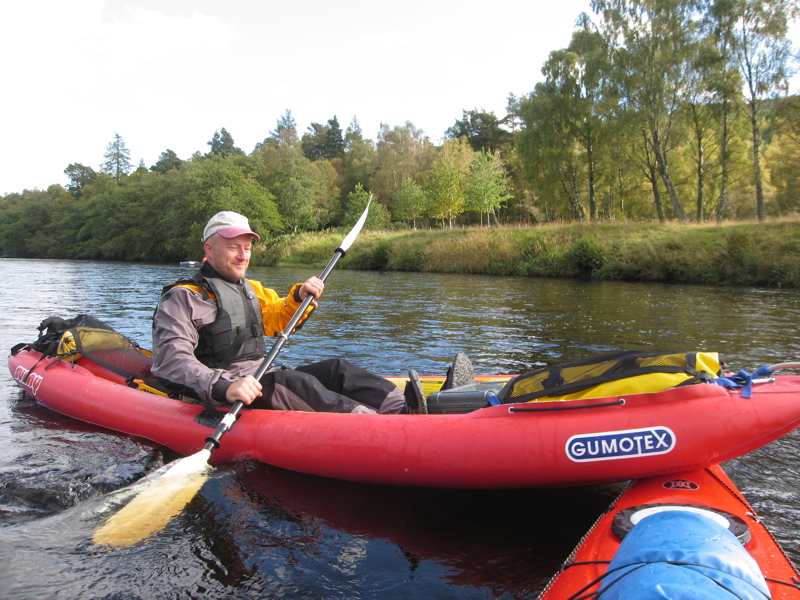
I’d take the Sunny again on this sort of river, it’s a very versatile boat, mid-range for speed so you won’t be too far ahead or behind, totally stable and easy to get in and out of, and very secure in rapids and shallow water. OK you might get a soaking but you’d have to try hard to tip this boat on a river like the Wye.
Resources ‘Wye Canoe?’ is the book to get for this river, if only for the maps. As the official guide it’s full of the kind of rules and regs you didn’t want to read, but it’s got all that you want for planning.
WYE (Hereford to Ross on Wye) – classic touring. WYE (Ross on Wye to Symonds Yat East) – a classic touring paddle. WYE (Symonds Yat East to Monmouth) – a classic trip, with the famous Symonds Yat rapids. WYE (Monmouth to Redbrook)
Here’s my gallery of a run down the Spey river we did one September in 2007; three days from Aviemore to the sea – about 85 kms or 53 miles, camping two nights. Me in my Sunny and a new dry suit, Steve in a Pouch tandem folding battleship, Dave in a Klepper folder and Jon in a red kayak made of rigid, hard plastic called a Carolina; quite robust and fast it was, but a bit heavy and not something he could transport easily on a bus. It remains to be seen if these ‘hard shells’ will catch on. The Spey is a famous Scottish canoe run; it’s also famed for salmon fishing and its malt whiskey distilleries. Although the river is said to be open all year to paddlers (see the online guide below for details), when an estate is charging an overseas tourist hundreds of pounds a day to fish off their banks, they don’t want you getting too close and upsetting the client’s concentration. As far as we knew we were there on the last weekend of the salmon season and only once got waved away from a bank of anglers.
That year the river was a bit shallow in places, though none of us quite needed to get out and walk. Even then my Sunny filled on a couple of occasions, despite some piffling rapids, so a dry suit was a good call. Jon was the only one to fall out which just goes to show what lethal boats these SinKs can be – that thing is less than 26 inches wide! It is of course very satisfying to follow a river down to the sea, watch it change and paddle right into to the waves (oddly the tides only reach in a few hundred metres at Spey Bay). Whatever boat you’re in it’s a great run with easy white water, and easy side access. Anything rated for a canoe is fine in an IK. ForDave unfortunately it all ended on the morning of Day 2 when his Klepper snagged on an embedded metal stake (an old fence post?) and ripped a foot-long hole in his hull. Kleput!
There’s a road close to the Spey all the way and he managed to get a lift back to his car and was there that night to drive us to the campsite in Aberlour, 2.5kms from the river. I do recall a very nice meal in the pub that night, in a bar with scores on malts lined up on the back shelf. Dave was also able to pick us up from Spey Bay where there’s a formica-era cafe. The nearest station is Elgin, about 13 miles away. You could packraft the Spey too; it would be fast enough and if you combine it with the Loch Morar stage I packrafted last summer down to Gairlochy, after a 40-mile transit up the A86 to Newtonmore (20 miles upstream from Aviemore) you’ve completed a ~150-mile Scottish coast-to-coast run; Atlantic to the North Sea. I know of a couple of packrafters who have done most of it, including these two guys in the freezing winter of 2009-10. Along with many other reports, there’s a detailed online guide here. Harveys make a waterproof map of the Speyside Way walk which of course follows the river closely.
Just like their bikes and many other things, in southern France those Frenchies dig their recreational paddling. Unlike the UK, they don’t care if it’s an inflatable, a canoe, kayak, packraft or two bin bags and a stick. And unlike England and Wales, (see green box below), no river permits or licenses are required; just adhere to sensible regs. Add the fresh food, good camping, inexpensive ‘creaky stair’ hotels, great weather, natural spectacle, easy access by rail or bus, plus beautiful medieval villages with weekly markets and you’ve got a great packboating holiday with as much easy white water action as you like.
The sorry state of paddling in England & Wales
Did I miss anything? Yes: the long-overdue second edition of Rivers Publishing’s guide (left) which originally opened up this area’s potential to me. Generally aimed at ‘family’ canoeing, Best Canoe Trips in the South of France has river descriptions so you don’t have to worry too much about what’s downriver. As a serious guidebook it could be better, so if you read French, Rivières Nature en France (right) has better maps and covers many more rivers.
Massif – loadsa rivers
Extending south from the city of Clermont Ferrand 200km to the former Roman colony of Nimes, the Massif Central is an undeveloped and relatively unpopulated upland region of extinct volcanoes and 1000-metre limestone pleateaux or causses. About the size of Belgium, the highest peak is the 1885m (6184ft) Puy de Sancy in the Parc des Volcans near Clermont. Now you know where all that Volvic mineral water comes down from.
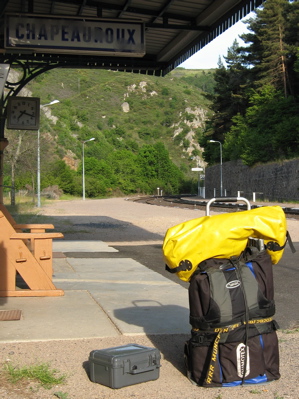
Early morning train from Brioude.
Getting there from the UK The key airports to access the region include Clermont, Montpellier, Nimes, Lyon and Rodez with Easyjet, Ryanair and FlyBe, among others. Nimes is probably the most useful, but Easyjet (Lyon, Montpellier) has daily rather than weekly Ryanair flights with better prices when booked late. There are also fast TGV trains to Nimes via Paris, taking just 6-7 hours from London (red lines, left) but elsewhere or beyond, things slow down considerably as you head for the Massif (blue area on map, left), so it’s unlikely you’ll get to a river on the same day as leaving the UK. A train is a much more agreeable than flying of course, but even in summer and once you pay for baggage, budget airlines work out much cheaper and as fast or faster, depending on where you start.
Dordogne (red) then Vezere with the Mrs. My first French paddles in 2005. We took out at Tremolac, the first big barrage and 40km from the airport at Bergerac.
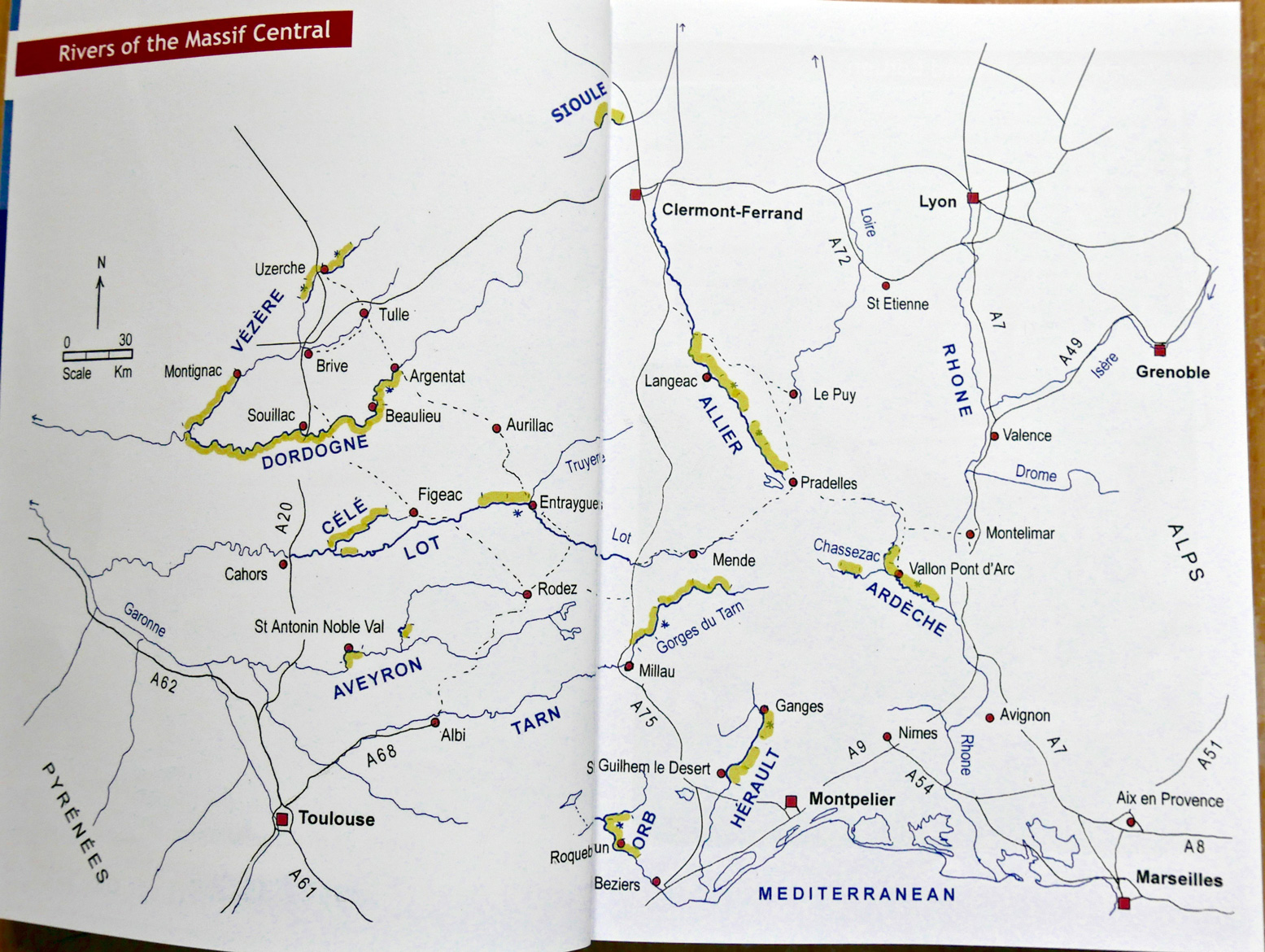
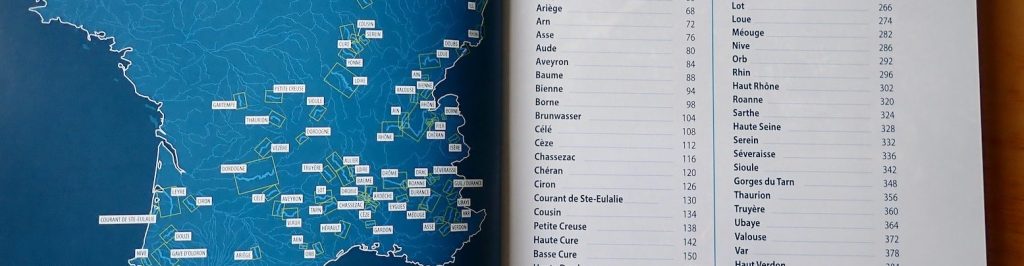
Rivers Take your pick from the easy Dordogne and Vezere, more challenging but easily accessed Allier, a Herault day trip, Tarn, Ceze, Chassezac which joins the Ardeche. Then there’s the Gardon and little-known but slightly greasy Lardon. Come August the biggest danger on the Ardeche is getting nutted by an out-of-control plastic rental kayak. In 2018 I did the Tarn again, from Florac all the way to Millau in a packraft, and a few weeks later the Allier too. Maps below from the Best Canoe Trips… and Rivières Nature guidebooks.
English guidebookFrench guidebook
They’re all fun in an IK provided the boat is not too long. With a long boat problems occur when the front noses into slower water or catches a rock, while the back is still in a fast current; the boat swings sideways, high sides and tips you out. In a slightly slower but much more stable and agile packraft I’d pick the frothier rivers like the Allier, the Tarn and Ardeche, because a packraft makes sub-Class 3 whitewater easy and safe. Packrafting the Tarn in 2018, I’m pretty sure I’d have struggled to control my 4.5-metre Seawave IK in some rapids.
But then again, packrafting the Allier a few weeks later, I was pleased I decided to walk round an 8-km gorge section of relatively sustained Class 3 rapids (left; a self-bailing Gumotex Scout) which would have swamped my Yak again and again. Here a decked or self-bailing packboat works better. And from what I’ve seen, two-up in a kayak or canoe makes things even more complicated unless both are experienced. If you do these rivers early in the season (June, July) there can be more flow, frothier rapids and certainly fewer crowds than early August. But summer storms can raise levels overnight.
Maps and river levels There’s a very good official website for live river levelshere with more about it here. For general mapsof France right down to 1:25k scale and beyond, have a search here, or download the IGN Rando app and download for offline use. As the Best Canoe Trips… guidebook says, IGN maps better than Google Maps, just as OS is in the UK. All that’s missing are markers identifying canoe chutes on the weirs.
Evening on the Allier
The rivers TheAllier is a good choice for packboating as you can get a train from Clermont via Brioude all the way to the village of Chapeauroux, where the easier section flows right back to Brioude. Note Alleyras to Monistrol is now open (see link) but beware the first 8km out of Monistrol to Prades through the gorge. Long version in the link above, but you’ll see it from the train coming upstream and may be alarmed, as I was in 2018, even though I’m pretty sure I kayaked it 12 years ago as a clueless newb.
The Ceze and Herault are car and shuttle-with-bike day trips. The classic Tarn Gorge starts from Florac (noon bus from Ales) and cuts 85km below the Causse Mejean to Millau with its famous viaduct just beyond. A great run with easy rapids, bar one or two not mentioned in the guidebook. Being out of the Massif, the Dordogne-Vezere (map above) are easier paddles, but iirc took me a bit of bus and train’ing after a Ryanair to Rodez and out from Bergerac. Perfect for your first IK adventure, but it could be slow and a bit dull in a packraft.
And if you don’t have a packboat or can’t be bothered to bring yours, no worries. Get down to a river and rent an SoT for as long as you like. It’s all set up for you. Click the river links for more galleries.
Eats, Chutes & Lodges On any big Massif river there’s a well-established riverside campsite and canoe/kayak/SoT rental scene, so that by August flotillas of holidaymakers pack out popular rivers like the Ardeche and Tarn. Plus, at any time you can pull over to wander through a village which will very often have a basic hotel from 40 euros, like the one left on the Allier.
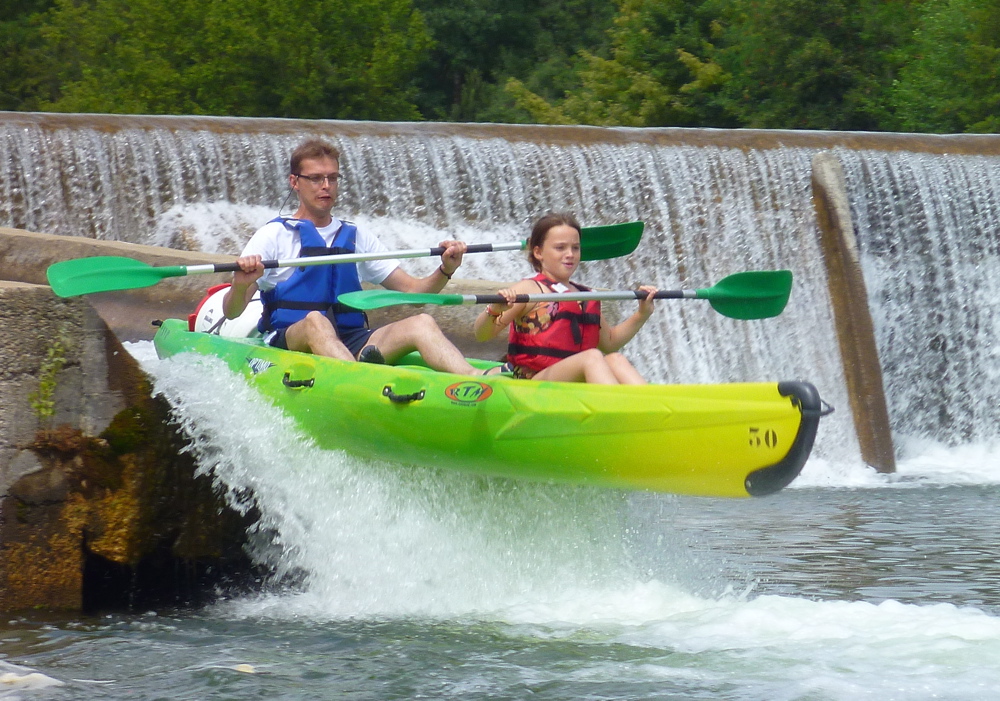
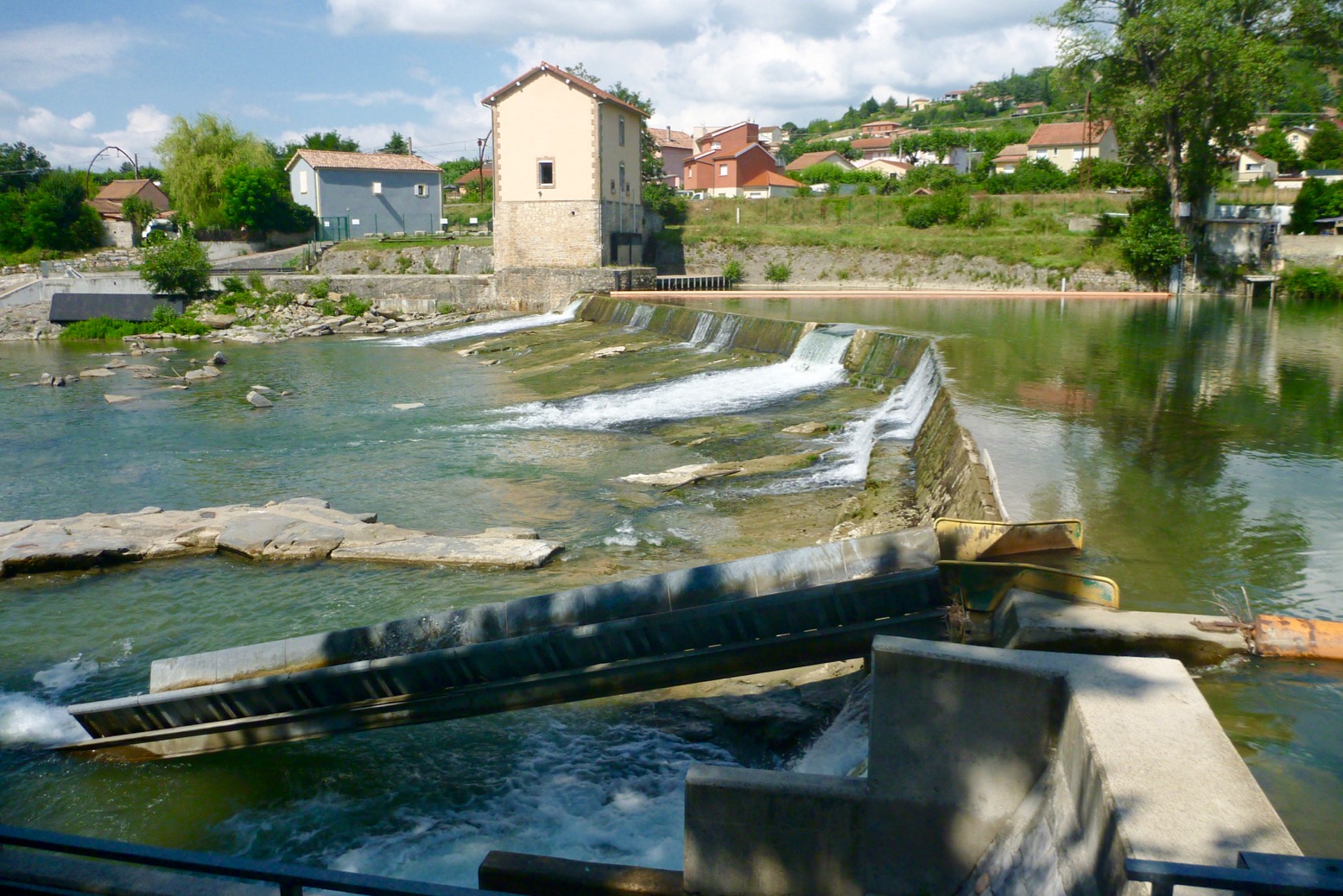
Some of these rivers cut through spectacular gorges and are strung out with easy rapids up to Class III, weirs to portage round or tip over and which often have a glissiere or canoe chute (left and below) which shoot you down the face of a weir without the need to get out and carry. Great fun and often easier than they look. There are no locks until you leave the Massif and enter the intensively farmed lowlands by which time the fun is over.
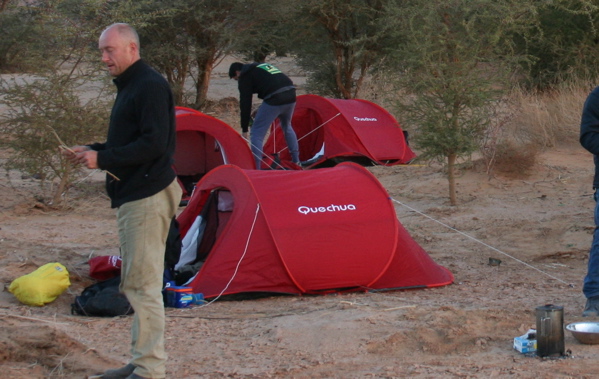
A few years ago I got a batch of discounted Decathon Quechua ‘2 seconds 1’ pop-up tents (right; £20) for a desert tour I was running, and have a couple leftover. Now everyone’s offering cheap pop-ups. People love the idea and though I don’t suppose this is a tent you’d want on the north face of Annapurna in a gale, when you arrive at a camp tired after a day of desert biking, you just want to click your fingers and, Abracadabra, you have a cozy shelter to call your own.
Whoever came up with the idea of flexible hoops sewn into a 3-D form to spring apart and make a tent or shelter was ingenious. I still marvel at it today. It seems a photographer John Ritson got to idea of adding fabric to a flat loop in 1985 and invented the collapsible Lastolite light reflector (right) after he saw a carpenter fold the blade of a bandsaw (See the bottom of this page). I imagine a Lastolite (a 38-incher costs £50) was the motivation behind the WindPaddle idea, but from a plain disc to a tent is quite a leap.
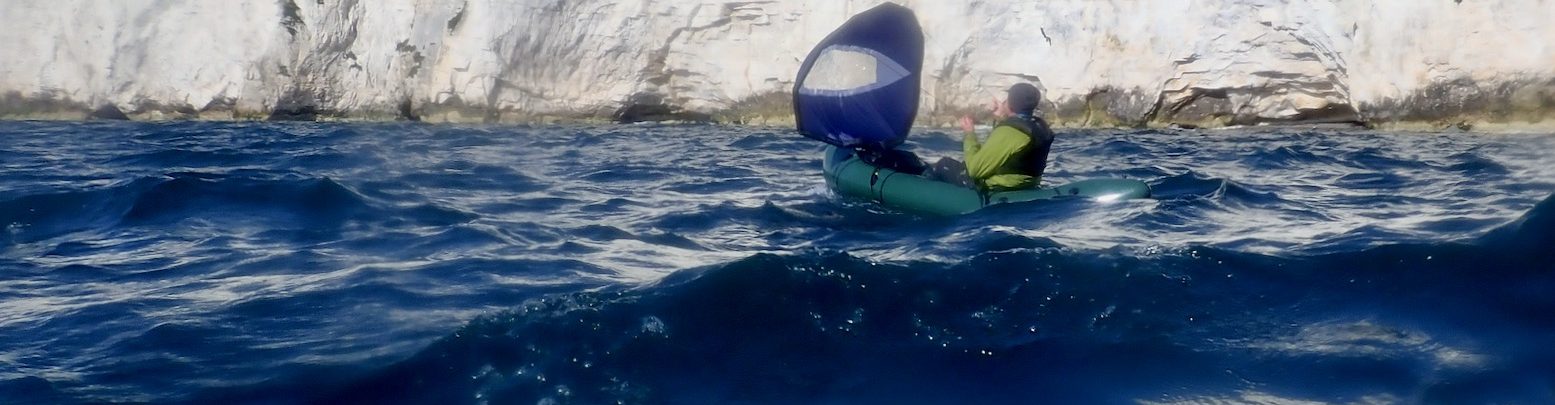
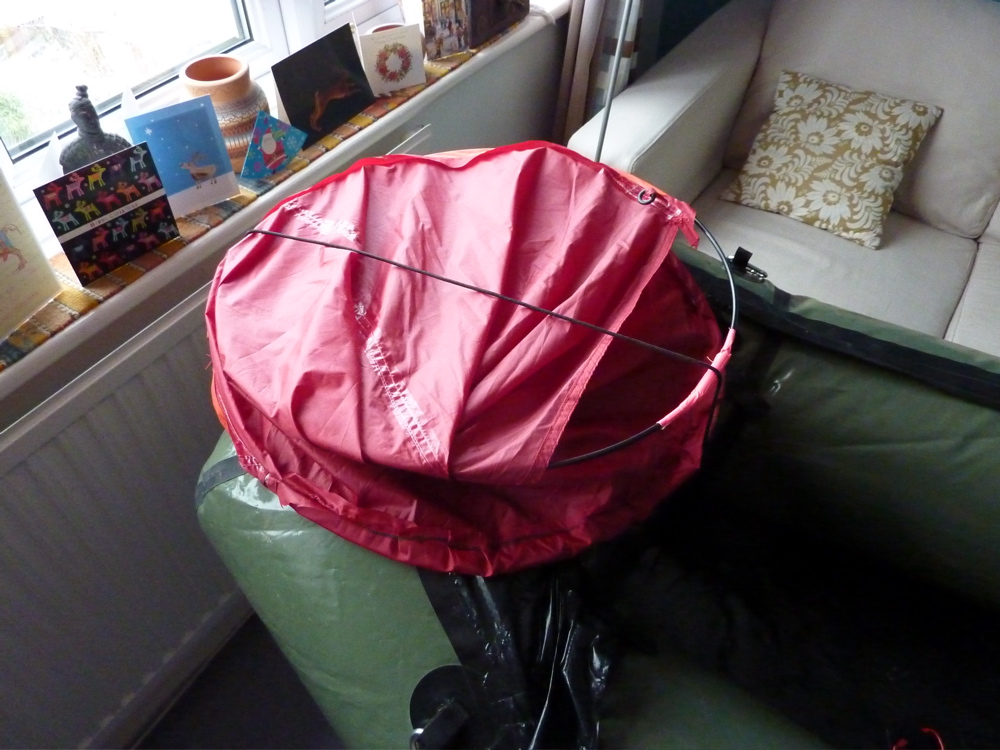
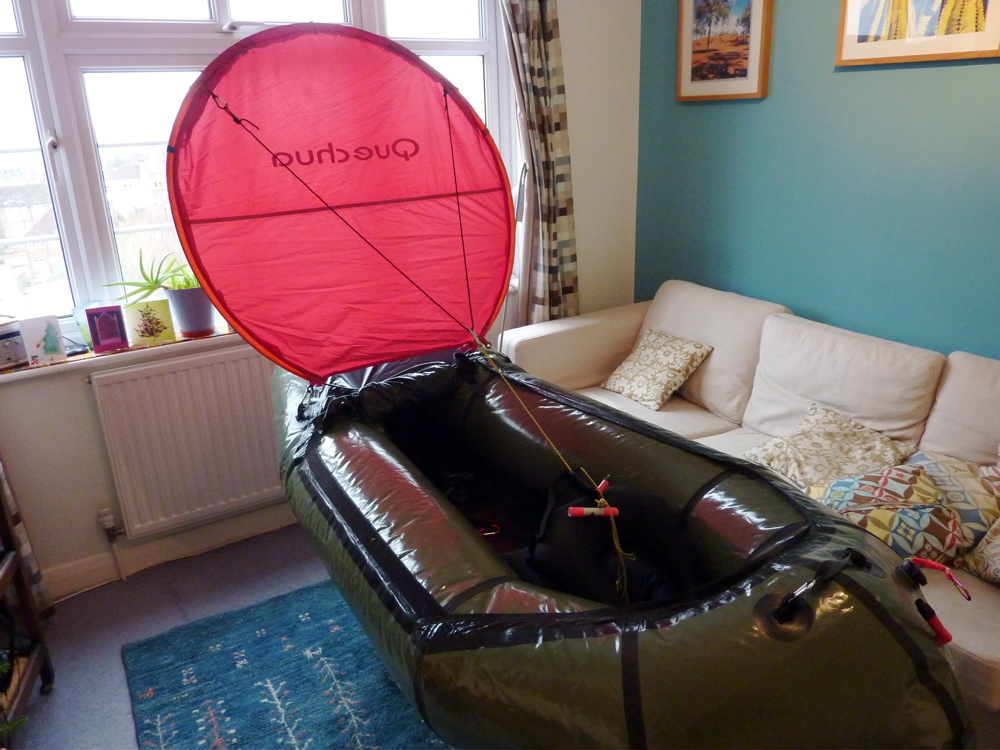
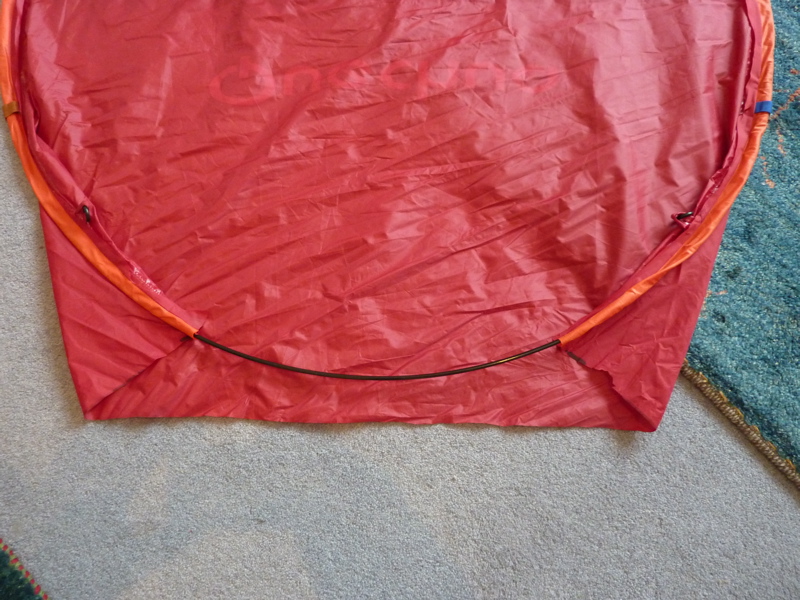
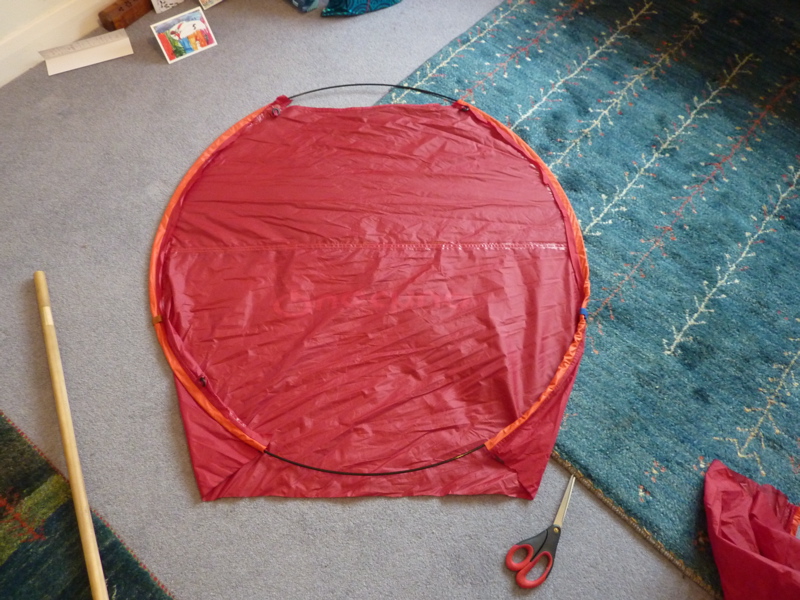
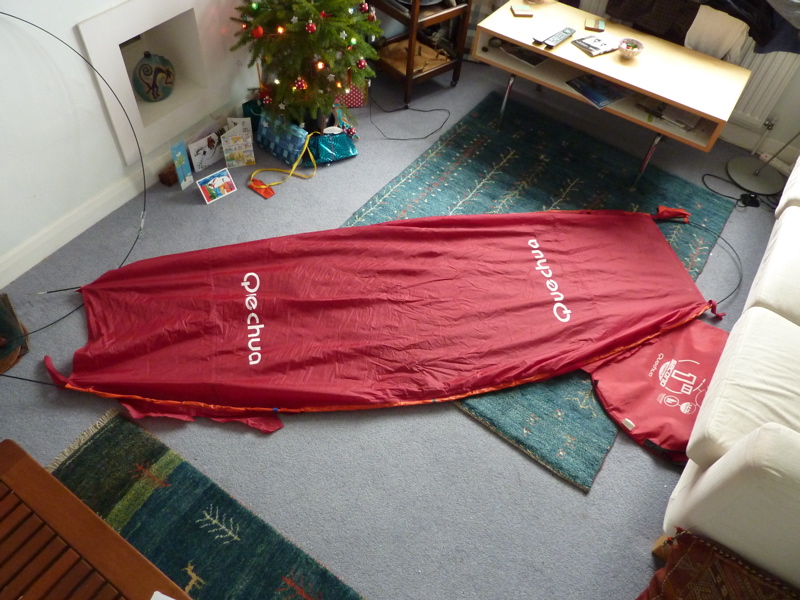
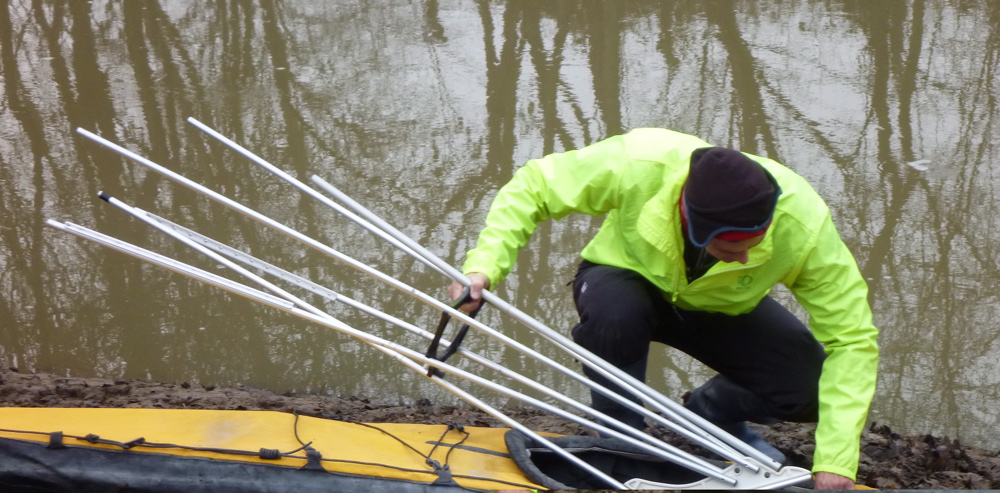
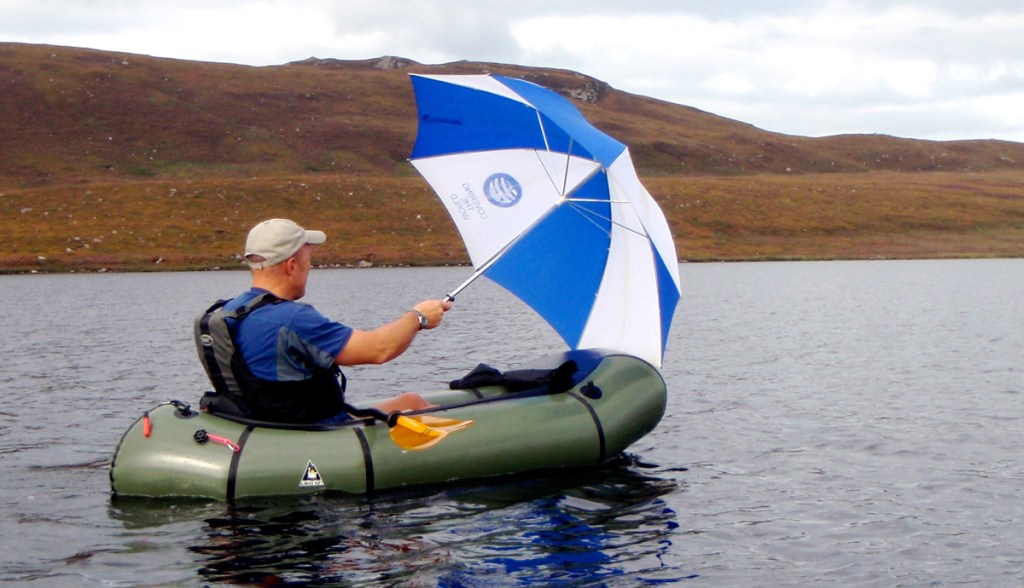
So I took a knife to one of my used Quechua tents. Bad though it felt shredding a perfectly functional shelter, in the spirit of the Inca shaman, it will be reincarnated as a sail – or more ill-conceived clutter to shove under the bed. Dismembering the Quechua gives two giant hoops of 4mm nylon-coated alloy and another of 6mm. Having been told that WindPaddles can deform easily under strong winds, I chose the thicker wire to use for the hoop (Gallery pic 2, below) in the hope of reducing this possibility. (Warning: when opened up these springy wires can fly about all over the place). Cutting the thick loop in half and rejoining it with the metal collar/tube (don’t lose this bit) gives a hoop of around 40 inches or 1 metre diametre making a sail area of 0.785 m2 (8.45 ft2) – similar to a WindPaddle, but with negligible dishing. I built up the sawn-off end with some cloth tape to stuff into the collar-tube, and then taped it all up (so it’s easily undoable). There’s enough fabric in the main body of the tent’s flysheet (Gallery pic 1) to make two 40″ disc sails if you cut from the middle, so 1 tent fly = 2 sails. I only worked this out after I cut. You want to use each curved end of the flysheet with as much orange hem-sleeve as possible (Gallery pic 4) – it saves on sewing later. You don’t want, as I thought, the flat middle section which of course won’t become a smooth disc once formed into a loop with the wire. Gallery pics 5 to 9 show how to gather up the slack, trim it, tack it down and get the Mrs to sew it up as if she hasn’t got enough work to be getting on with at this time of year. Gallery picture 10 is the sewn-up sail with a handy gap at the bottom for I don’t know what and which also happens to coincide with the position of two little hooped tabs at 5- and 7 o’clock which you can use mount it to an Alpacka’s rearmost bow loops using mini snaplinks (Gallery picture 11). By chance there are 2 more sewn-on plastic rings at 10- and 2 o’clock to mount a control string. The length of string I used happened to be just right to wrap around the folded over tent, though it’s all under tension and pretty unstable; you might want something like a bulldog clip to stop the sail deploying unexpectedly. I also think my control string may be on the short side, but it’s what was lying around. My disc tent doesn’t have anywhere near the dishing (depth) of a WindPaddle or an umbrella-like spinnaker sail I am told. I still haven’t worked out if this is significant (it is). One would imagine a deeper WP-like sail – a ‘bowl’ rather than a ‘saucer’ – would be more stable downwind but less good at tacking across it (probably correct) but what do I know? Last time I sailed a boat was over 35 years ago. I suspect a flip-out disc sail like this is probably a compromise when it comes to sailing effectively, but then so are pack boats. If round sails were such a good idea the Vikings would have them. It may even prove to be not fully useful and so just more junk to carry about which is why, after trying the umbrella, I chose to make one for next to nothing rather than spend £140 ($215) on a WindPaddle in the UK. It was easy to make, is light (250g or 9oz), and it can swapped between my Alpacka packraft and Sunny IK in the time it takes to unclip 2 snaplinks and attach them elsewhere. Other uses include something to sit on, a doormat for the tent, a windbreak, sunshade or umbrella. There is a slight problem: you can’t see where you’re going, especially on the shorter packraft with a metre-wide sail a metre on front of you, but on most water that ought not matter too much and if it does, I can cut in a window (like a WindPaddle) if that is the sail’s only flaw. As to how it sails, Monday after Christmas had a good southerly wind and the warmest day for weeks (ie: above freezing), but the reservoir I chose was a rink and looks like it’ll be that way for a while. It’s been the coldest December in the UK since records began so a test run make take a few weeks to complete. To see how it sailed first time out, click this.
The Medway is not a river I’d choose to run in mid-December. I’ve kind of given up on English rivers, with all the access hassles, angling aggro. The Southeast of England is more congested than most, with a lot of canalisation and locks. But the other day, a week before Christmas, Steve and I drove down to Tonbridge to give Kent’s historic river a try.
He’d invited me to take his Feathercraft Big Kahuna folding kayak for a spin. The Medway would be just as wet as the Thames, but a bit nearer and easier to train back to the car. Feathercraft‘s Big K was a folder I was thinking of getting at the time so it was a real fluke when I realised one of the few people I knew who was into paddling actually had one. Then, as we tooled up in the town car park I realised I’d forgotten the Sunny’s pump. what a plonker! It had been a while since I’d paddled my Gumo Longboat down south but luckily I’d also brought the Alpacka packraft which Steve was curious to try. A slick Feathercraft paddling alongside the dumpy Denali was not how we’d planned it, so having messed about looking for the right put-in (the map guide above was not so clear) we decided to just get as far as we got before dark and train back to Tonbridge.
Either they’d built the dock platforms extra high to discourage canoeists, or the water level at the Tonbridge’s Town Lock was a good 2 or 3 feet lower than normal. It made launching the Kahuna 4 feet below the dock too awkward. Even getting into the Alpacka would have been tricky, so we plodded on into the woods out of town and found a muddy bank from which to deploy our portable water craft. Watching Steve assemble the Kahuna proved it was a pretty quick job – maybe 25 minutes out the bag. I can’t say I was hanging about twiddling my thumbs by the time I’d pumped up my packraft, put on a drysuit and clamped the two halves of my paddle together with that satisfying ‘click’.
‘Merdeway’ Steve had called it, not having done it either and expecting the usual jetsam slalom through a neo-urban river’s boat-stabbing detritus. The Kent countryside is not like the wilds of Scotland and the Medway didn’t exactly look like the Everglades in springtime. He’d picked up the official river guide somewhere but it looked a bit basic to me. If we’d looked online right here or here we’d have found out why the river was low. In fact Steve had checked online and just saw ‘Green – All Clear’ at Allington, rather than a skull and crossbones. Having paddled the Medway several times since, I have the Environment Agency officers or whoever a bit slack with announcing river level anomalies which could affect paddlers The river hereabouts had actually been closed for boating a few days earlier because Eldridge Lock – the first out of Tonbridge – was about to get a make-over and was wide open, running a dodgy, 3-foot drop followed by a train of nasty-looking eddies (below). This is how paddlers come to grief. You’d think they might have put up a red flag or a boom or something! It’s just as well we’re not hard of hearing because whatever that ominous rushing noise was, we wanted a look first which meant clambering through more cloying mud up the exposed river banks and onto the lock. I’ve since been informed that there should have been signs at Town Lock and the bridge 500m upstream of Eldridge Lock saying “Danger – Works ahead – River closed” but I can’t say we saw them.
Never tried but they say man-made recirculating drops like this are deadly for kayaks.
Looking down on it (above), with a fast run up a long boat like the Kahuna would probably have speared itself over, but I’m pretty sure that with half the available speed, the Alpacka would’ve merely plopped over the edge like a wet mattress and promptly flipped backwards (or ‘bandersnatched’ as they call it in America). Soon after, I’d get sucked into some lethal hydraulic tumbler with all the plastic bottles and dead badgers. Urgh, gives me the creeps. I don’t like canal locks at the best of times.
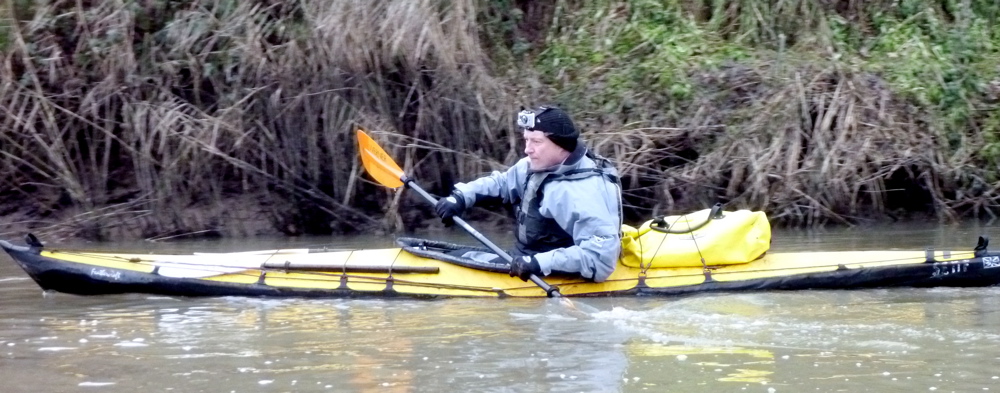
Just past here we swapped boats; I eased myself into the yellow Feathercraft and shoved backwards off some rocks. Without any anatomical adjustments, first impressions were not good. The seat back was too inflated, pushing my shins off the foot rests up onto the underdeck. Plus Steve’s Bending Branches paddle, hand carved from a narwhal’s tusk by a blind Inuit shaman, seemed all wrong in my hands. It took me 5 minutes before I even managed to turn the 14-foot boat round but once Steve deflated the backrest I felt more at home.
Man, it sure is nice to g li d e smoothly and quietly along a river after half an hour pack-splashing left to right like a ferret in a whirlpool. This surely is at the heart of kayaking’s appeal: smooth, quiet, weightless, waterbound progress. The £2200 Big Kahuna was a pleasure to paddle, once you’re in it’s all go, but getting in an out was the usual ballet on barbed wire for me, and there are a lot of locks on the Medway Canoe Trail. It can’t be all that bad though. Last summer Steve has spent weeks and weeks Kahooning down the Danube (above) with a posse of Germanic Rührschaufellen.
Back on the dreary Medway, there was a conspicuous lack of complaining emanating from my Glorified Green Inner Tube. Could Kahunaman be secretly enjoying the little packboat? We swapped back to our own paddles, much better for me. I was breaking in my new oversized and super-light Werner Corryvrecken, and could now really shift the Big K. Every stroke translated to a breeze across the face. It had been a long time since I felt that in a packboat!
I knew there was a canoe chute somewhere on this river, which added an un-Kentlike thrill. I never even knew the Brits were into these like they are in France where they’re called glissades and are a lot of fun on a hot summer’s day (let alone the portage aggro they save). Porters Lock was the chute – or ‘canoe pass’ as they call them here – but suddenly the idea of being hurled down it wrapped in a rubbery sarcophagus of alloy tubes filled me with horror. I really do have a problem with these SinKs! We got out and recce’d the raging sluice which drops all of a metre or maybe even two over 10 metres or so. That done we deduced confidently that at least one of us might survive the drop and crawl to the bank alive to paddle again.
We swapped back to our own boats and interestingly, Steve admitted afterwards he had a lot of bother regaining control of the long Kahoo and thought I’d sawn through one of the tubes as a jape. It transpired that just a short spell of nuance-free packrafting – requiring as it does all the poise and balance of sleeping cat in a sofa – had been sufficient for his cerebral cortex to delete eons of kayaking skills. Or so he thought, though actually increasing the pole tension on his FC at the swapover had altered the hull dynamics to tippier and less turnable. Eventually he lined it up and slid down the chute like a component on a production line. No big drama; nor for me in the raft.
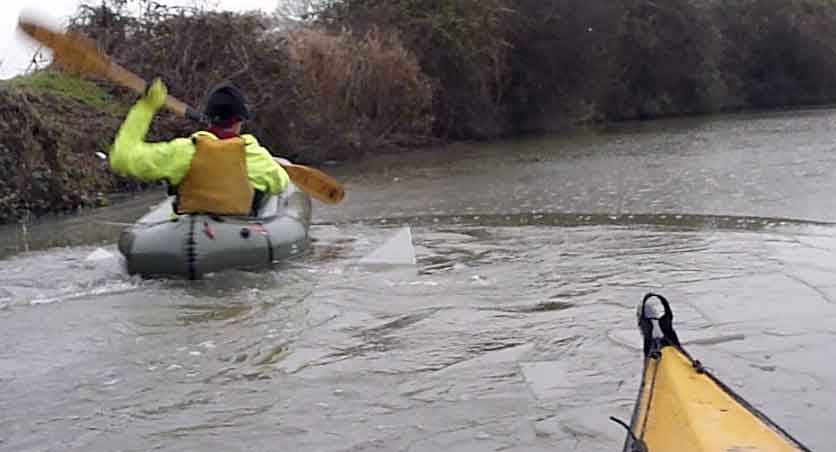
Clambering over the next lock, we came across a barge lady chopping up wood in advance of the next cold spell forecast in a few days time. Three more locks to Yalding she said, our planned take-out at Mile 8 by the famous thatched Anchor pub. As we dropped the boats in we realised this stagnant back channel was actually under an inch of mostly intact ice. No problem I thought reboarding the Kahuna, the pointy end will cut through it like an icebreaker making a nice sound effect and a path for the Alpacka to follow. No it won’t. Instead the bow will ride up onto the ice sheet and start tipping the boat sideways if the ice didn’t give way in time. Yikes! Even in a drysuit I was getting chilled and didn’t fancy tipping myself into the pea-green, near-freezing waters of the Merdeway. Meanwhile, propped in the handy packraft, Steve attacked the ice with his sturdy narwhal tusk as the boat bobbed and spun around.
He had more success in the raft because the kayak’s distant prow was too far ahead for me to reach up and hack at the ice – plus my super-light Corry didn’t have the clout to do any more than scratch and slither over it. The patch of iced-up river was only about 30 metres long and Steve bashed on through along the bank like a contestant from whatever they call It’s a Knockout these days, until we were free again and on our way to Yalding. Now you know, when the Ice Age returns, packraft better than long kayak.
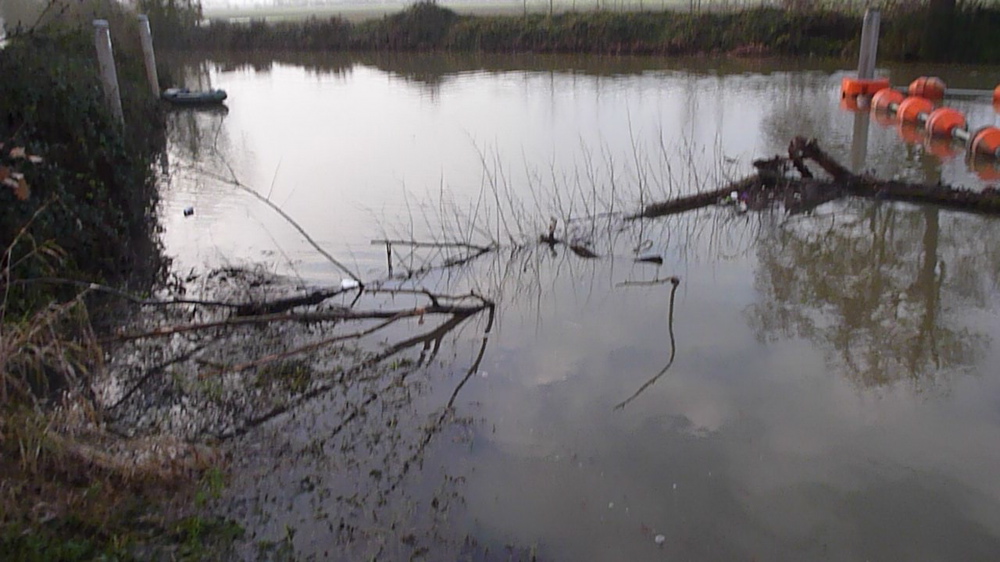
By the time we got to Sluice Weir (below, another time) I was back in the packboat. We could see the chute on the right but access was blocked by a big tree trunk (above). I nipped out to have a look from above and was a bit shocked: this chute was twice as steep and twice as long as Porters. Where were we, Alton Towers all of a sudden?
Juicy Sluicy
Rather tellingly the Medway Canoe Trail website features lots of shots of wholesome young couples with great posture shooting down Porters chute with toothsome smiles, but you won’t find a trace of the Juicy Sluicey Weir chute other than sexed-down refs that it’s a bit on the steep side for long boats [which may bury their nose and send you flying]. In a packraft: who knows how it would handle it, but on a warm summer’s evening it would be fun to find out. A couple of degrees above freezing in winter had less appeal and anyway, Steve was paddling commando with no skirt or dry suit and was already feeling the chill. Had the bank been accessible and not a scrum of brambles I’d have tried wading in and pulling the tree away, but a few minutes in that near-freezing water would have got nasty, let along the worry of slipping and getting sucked on a boatless ride down the chute. Maybe we’ll go back with a saw and a rope some time. [Again, I’m told a more explicit sign warning ‘Warning: steep chute’ is in the pipeline.]
From then on it got to be a a bit of trudge for me in the packboat towards Yalding. Steve was getting cold hanging around waiting for me and I was getting puffed out trying to keep up, and both our feet were numb from the cold. In the end he instructed me to hook up and towed me along by my packrafting ears. The GPS had proved what was fairly obvious, the Kahuna was easily twice as fast as the Alpacka and as you’ll see in the vid, a pointless head-to-head race had me thrashing at the water like a drowning addax, while Steve pulled ahead calmly, lighting a cheroot and texting in bids to his broker.
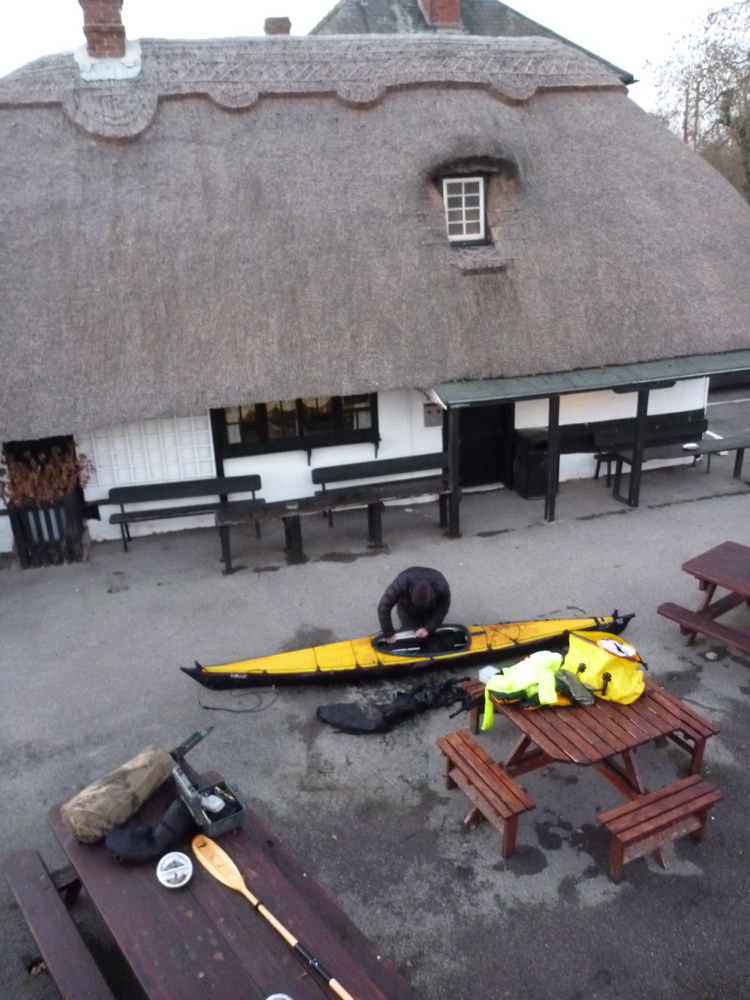
We arrived at Yalding and managed to haul ourselves up a wall onto the pub’s forecourt where they screw the ashtrays to the tables. We rolled up our boats and inside had a tea and a burger, waiting out the icy chill until the train back to Tonbridge was due. All of 8 miles we did in 4 hours or so. The classic run is from Tonbridge right through to Allington in Maidstone, 20 miles it says. And from there as far again to Rochester is on the estuarine tides and beyond the reach of river byelaws. But once the Eldridge lock is fixed up and with four other chutes on the way to Yalding, the Medway sounds like a fun run between the tame flatwater stages and portages. The river agency have certainly done a good job building in kayak-friendly infrastructure.
I’ve paddled the Medway several times in inflatablekayaks and packrafts – it’s fun. Search ‘Medway’
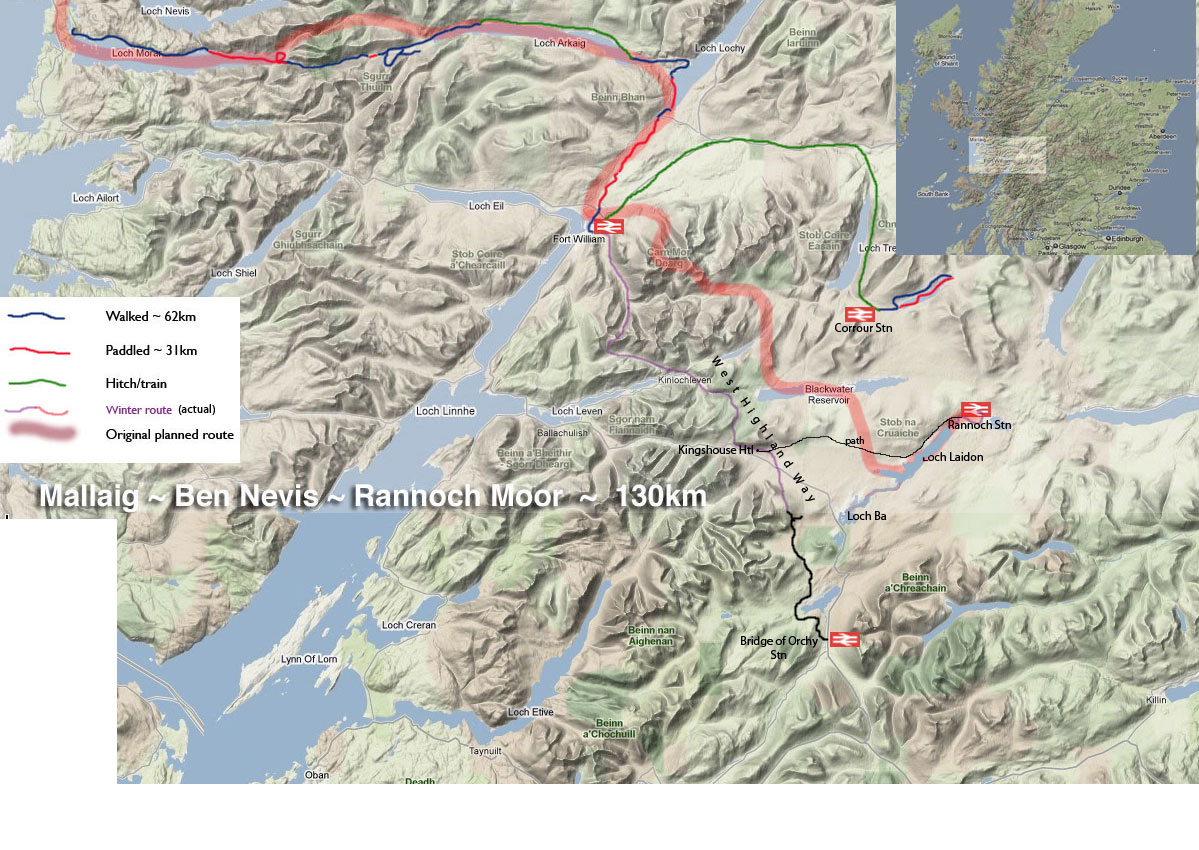
I should have been off to France in early November to packboat down the Allier River, but the current job drags on. So despite the very short days, it struck me I ought to finish off my summer’s packrafting plan. On that occasion, I ran out of time at Fort William while realising my idea of traipsing merrily across the bogs of Rannoch Moor from loch to river was – as usual – over-ambitious. Being my first packing trip, I also learned a bit about what gear works for this sort of travel. End of November I’ll walk southeast for two days down from Fort William to west Rannoch along the West Highland Way, like any normal person. Then I’ll put-in near the road bridge at Loch Ba and paddle northeast for two slow days onto Loch Laidon for Rannoch station to train back home. Another perfect mini adventure!
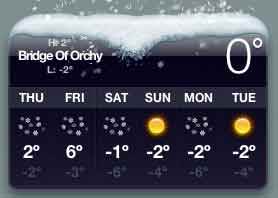
Looks like the forecast is freezing and snowy, so I’m a little concerned that a weekend of sub-zero temperatures may be enough to thinly freeze the lochs by Monday when I reach Loch Ba, making it too thin to walk on but too hard to paddle across. (a couple of weeks later we indeed experienced a paddling-through-ice scenario on a local river. Wind is forecast at 18mph headwind, but not till Tuesday which on top of -2 ought to chill things down. But that’s the final day’s paddle to the station so it can be endured or walked.
On the way I’ll be trying out some new gear:
Full-length Seal Skin socks for bog-wading immunity.
Self-draining trail shoes (normal hiking shoes with a hole melted through the sides). My Keen Arroyo drainers were not up to loaded walking.
Watershed UDB drybag/backpack and W’shed Chattooga day bag.
A waterproof Panasonic FT2 camera that can just hang off the neck come rain or splash. No more scrabbling with a Peli box while watching out for camera-killing drips and the rocks ahead.
December 5 ~ All Pack and no Paddle
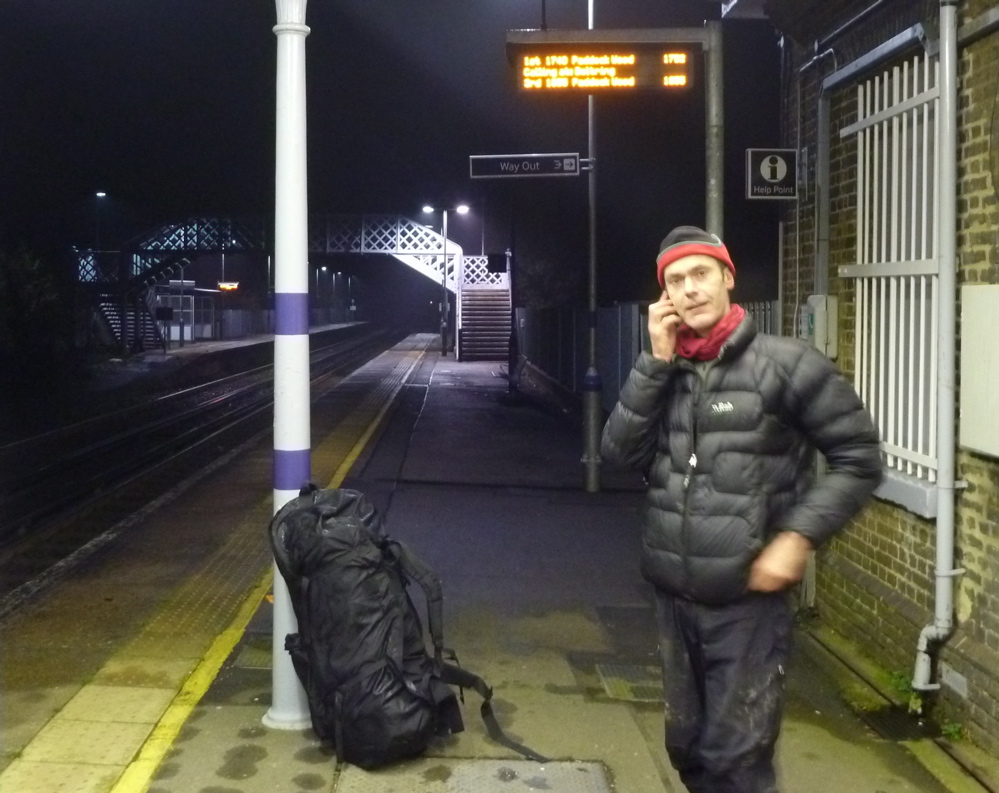
I ended up only packwalking for three days, reversing the West Highland Way (WHW) from Fort William to Bridge of Orchy. It was nice enough, especially the last day after a bit of snow to improve grip. The only other person I met was this guy who’d cycled the WHW from Glasgow (95 miles) in 2 and a bit days. Pretty good going as I soon found out it’s not all rideable or even easily walkable in icy conditions.
On the first day I misjudged what I needed to wear a couple of degrees below freezing and ended up overheated and worn out after a long climb out of Fort William. After 13 miles I descended to Kinlochleven, a former ally-smelting company town for which the Blackwater reservoir had been built a century ago. From above it looked like some sinister gulag hidden in a valley. With snow on the hills I thought the hostel here would have been packed out with climbers, but there were only 4 others in and close up Kinloch doesn’t look so bad. The smelting works have now been converted into an ice climbing centre, while I imagine plenty of excess hydropower still pours down the pipes to get fed off to Fort William.
Day 2 was a slog up along the pipeline towards the reservoir and then breaking off on the WHW path towards the walk’s 560-metre high point at the Giant’s Staircase before dropping to Glencoe. From the top the Blackwater reservoir looked grim but was clearly unfrozen which boded well for tomorrow when I hoped to paddle the nearby lochs to Rannoch station.
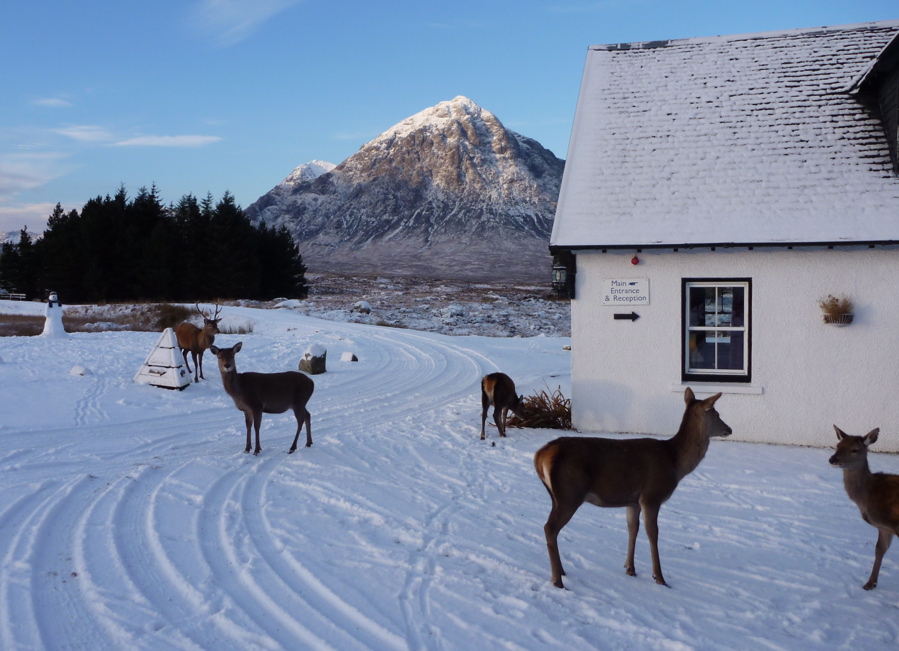
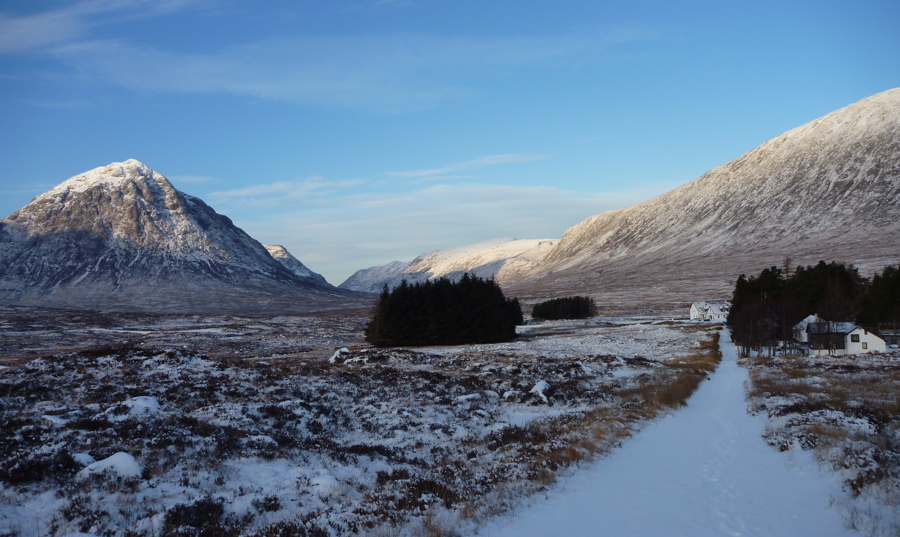
For the second time that day, I went flying on ice, ripping off my metal watch strap, tearing my trousers, and bashing my knee. The heavy pack amplified the impacts. Then later, walking on the flat towards the isolated Kingshouse Hotel at the head of Glencoe, I slipped again on and landed hard with the heel of my hand on a sharp rock which hurt a lot. With three similar falls on the previous day, after 9 miles I staggered into the hotel feeling pretty beaten up, but what a lovely cosy old place to spend the night! There was a fantastic view out of my room across to the pyramid peak of Buachaille Etive Mòr, while deer gathered below my window in the dusk.
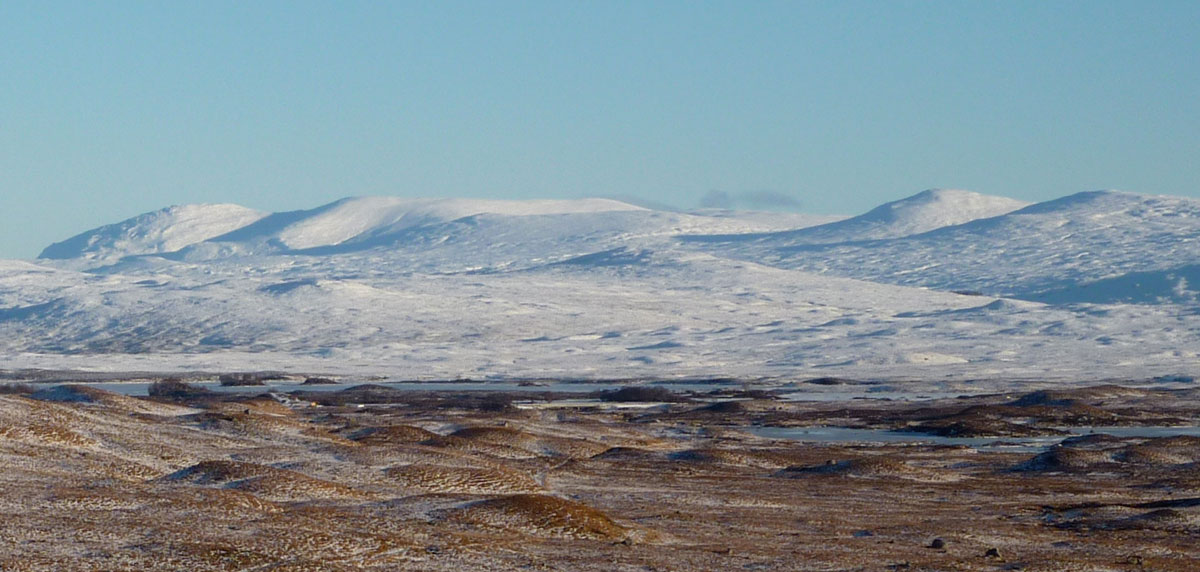
It snowed overnight and leaving Kingshouse Hotel, after a few miles I was expecting to get a view east over to Loch Ba from a high point cairn on the WHW, to establish whether it was worth schleping cross country to get to the water. The previous night had been forecast at -10°C and at the viewpoint all to the east was just a snowy tundra, with a small, snow-covered frozen loch south of Loch Ba for sure. Was Loch Ba frozen too? I couldn’t see from there nor from any other point further on the WHW, despite scooting without a pack up a hill for a better recce. Only back home when I zoomed in on the photos could I see a thin blue line of the bigger Loch Laidon which was clearly unfrozen. So I probably could have managed it after all.
It has to be said it was a lovely sunny day on the trail with only me, the stags, and some scurrying tracks, so with days short, I was happy to stick with what I knew and plod on to Bridge of Orchy station, rather than paddle to Rannoch station (the next one up) as planned.
So, a 40-mile walk in the snow with a heavy load. Nothing new there. What I should have done is taken the path from Kingshouse east to Rannoch, passing north of the lochs, but that would have missed out Loch Ba and the easy and shallow chute between the two lochs (though that may well have been frozen).
If nothing else it proved that you can set off for a walk with a camping load including a packraft as an option. If the walking is more pleasant or the packrafting not worthwhile, the modest extra weight is no drama. It would have been nice to go for a paddle but it’ll all be there next time and on the way to the station at Bridge of Orchy I was sizing up the Orchy River which drains from the moor to enter Loch Awe which I’d never heard of but whose north end is right on the Oban rail branch line. Sounds like a couple of nasty waterfalls need the be walked around on the Orchy soon after the bridge, but in tame water that’s too low for any hardshell it could be another little adventure with packboat and paddle. With roads, rails, and trails, the more you look at a map of Scotland, the more packable stuff is out there.
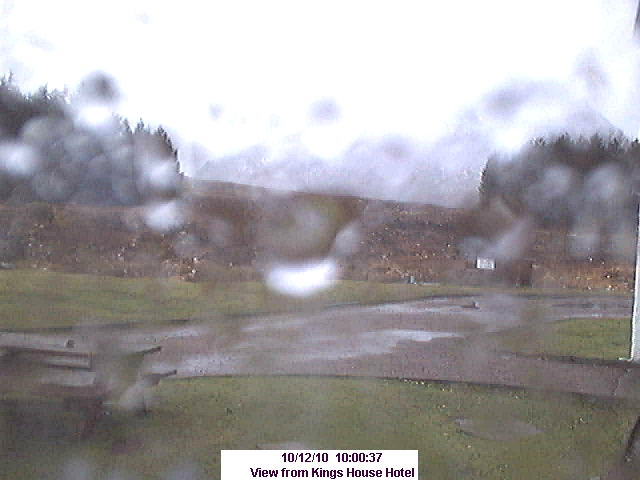
A week back home and the temperatures have jumped, even in Scotland, so the papers have to write about something else. Today, December 10th, the webcam at Kingshouse is the standard miserable Scottish highland vista. We’re going back in a month to walk back from Orchy to the hotel and from there to Rannoch station. Bring on some more Siberian winds.
I was back in the area a month or so later in mid-January 2011 – still snowy but less thick cover. This time I could clearly see the path off the WHW leading down to the road bridge being repaired, the rushing torrent of the river Ba leading to the loch, and even the isles on the loch, not totally icebound. Maybe my eyesight improved over Xmas.
Gear
Seal Skin socks – very good while they last. Warm but not sweaty considering they’re initially waterproof. The knee-length ones ought to make great waders.
Self-draining Karrimor trail shoes. No real wading to test them, but certainly better to walk in with a heavy load than the thin-soled Arroyos, even if proper tight lacing (which could be adapted onto the Arroyos) had a lot to do with it. I may adapt a decent pair of decent trail shoes from Meindl or whatever with a better sole, if some turn up half price. It would be nice to get some plain, non Gore-tex trail shoes for packboating but I don’t think they exist these days.
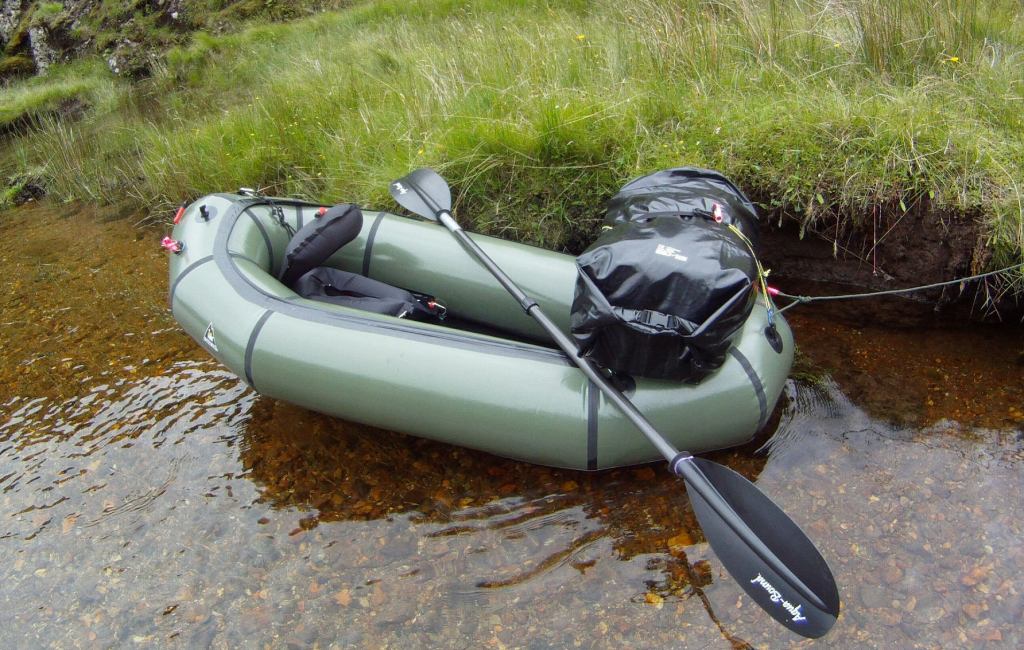
Watershed UDB drybag backpack was surprisingly good when you consider the 16kg load I carried just on shoulder straps with another smaller yellow Watershed over the front. Part of the tolerable comfort I feel was that the UBD’s relatively rough fabric grips across the back like weak velcro and so spreads the load. The packstaff paddle shaft saved a few tumbles and so means the 4-part Aquabound paddle is well suited when trail walking and paddling.
The Panasonic FT2 never got to be splash tested either but was otherwise easy to use (once you know Pana interface) and took some great shots and video. It does lack the full 25mm width of my normal Lumix TZ6 and I wonder if on full zoom the relatively tiny lens is on the limit. A great back up camera for watery places. I’m still using one in 2016.







































 Inflatable Kayaks & Packrafts