The MRS Nomad S1 I tested last summer in Scotland is my new packraft. Goodbye to my great little Alpacka Yak. Like the Yak before, it held its value and I sure got my money’s worth out of it over 4 years. The Nomad is an unusually long packraft with a central seat, making it more of a packyak which paddles much like a short IK (no yawing), has more space and weighs under 5kg with a roll-back skirt and thigh braces. So – easy to walk with for as long as you like.
I’d originally planned the classic North Island paddle: the canoe-able and therefore safely packraftable Whanganui River in the southwest. The best section is a 5- or 3-day-with-huts run for which you need to be self-sufficient as there are no towns, let alone roads or bridges until you take out at Pikiriki. I was set up for that, but it turned out getting to the remote Whakahoro put-in, then from Piki back to Auckland for my plane took more time than I’d allowed myself, once my flights got rescheduled. No worries, this in New Zealand: international nexus for outdoor activities. I’d had a bike test arranged at Tauranga on the North Island’s Bay of Plenty, so decided to stick around that region instead of watching days pass by from a bus window.
A brochure at the hostel proposed evening kayaking up a glow-worm gorge off Lake McLaren, 20kms south of town. Even in daylight that sounded fun, so I taxied over and planned to walk and paddle back. Lake McLaren is a country park (left) with forest trails spread around a small reservoir and an old power station by a waterfall. A good place to reacclimatise myself with the S1 as a quick spin in Sydney a week earlier showed up a crease mid-hull which suggested a slow puncture or just the usual ‘is-it-a-bit-soft?’ neurosis combined with too much fine dining.
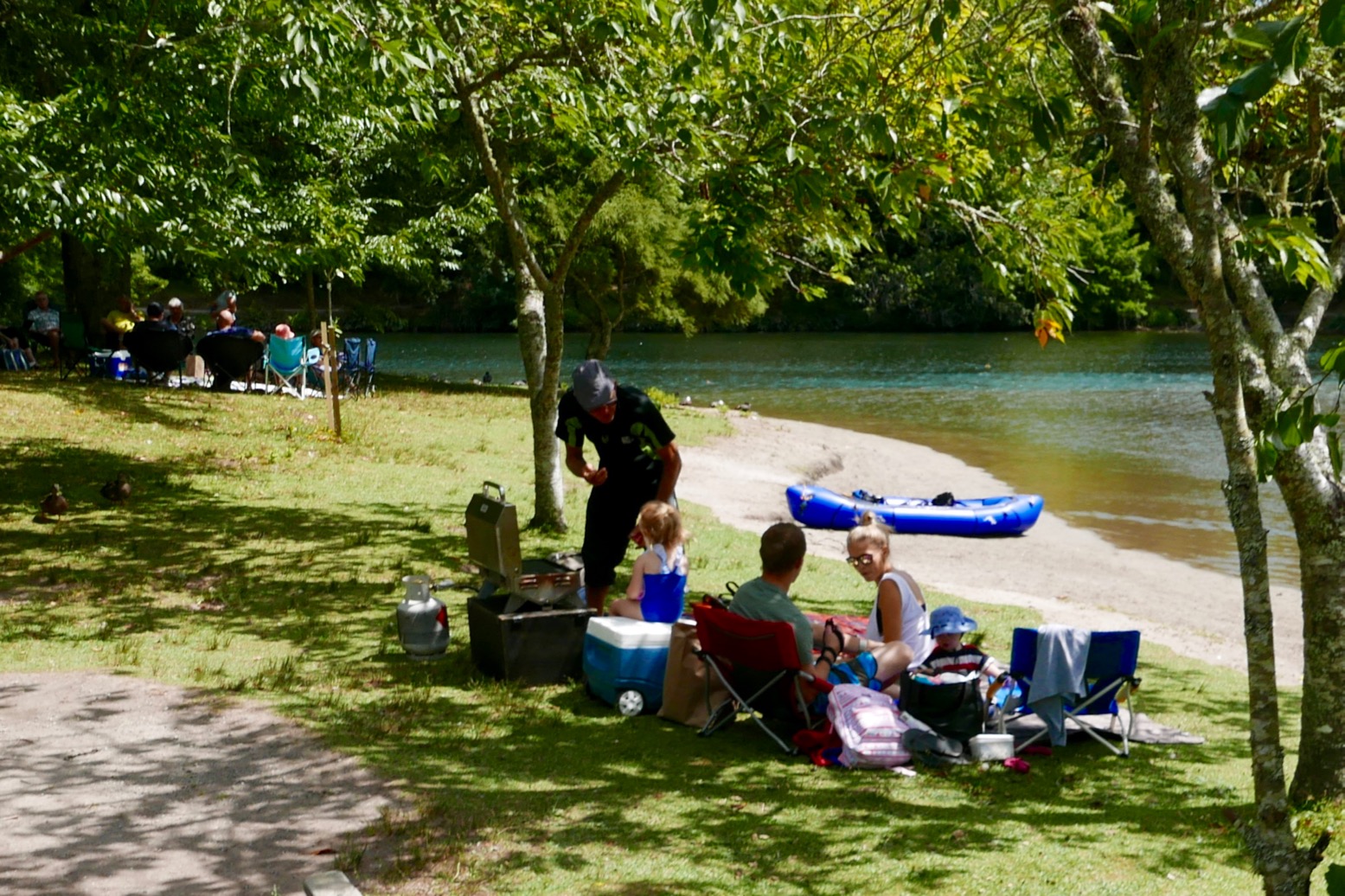
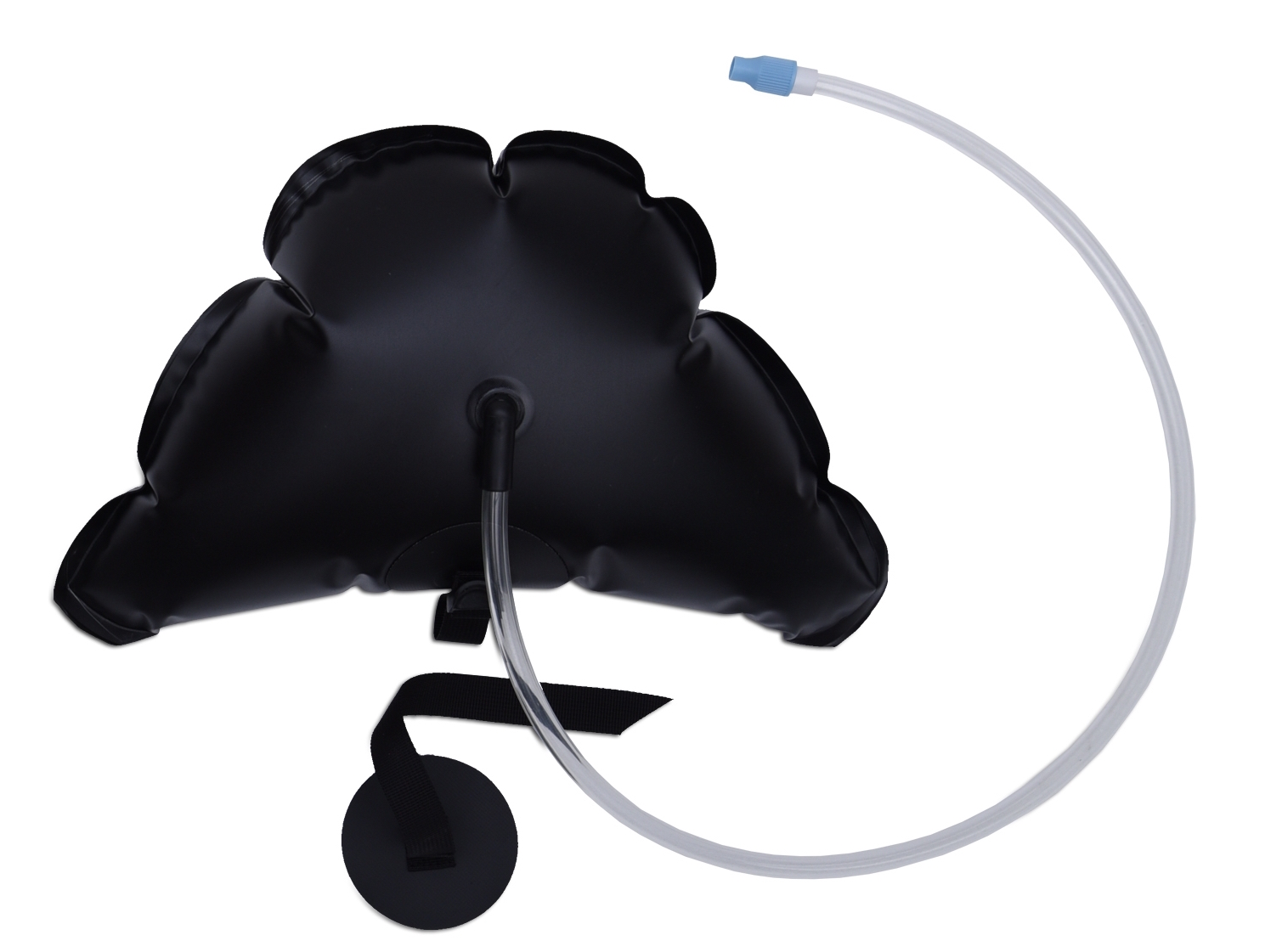
The boat was tempered and inflated to the max with my patented IAT (inflation assist tube; right). With the yellow hose you’re able to do a much better puff than just with your mouth on the Boston valve. I paddled my way round to the glowworm gorge inlet where families where feeding the ducks and enjoying Waitangi Day picnics. But the gorge stream was barely deep enough to float a duck and my quick foot-recce didn’t go far enough. If there was a paddleable pool up there, it was probably tiny. So I settled for cruising about the lake a bit and force-feeding more air where it wouldn’t go. I didn’t recall any hull creases when I tried the S1 last summer. And I’m sure the seat was suspended off the floor which spreads the load better, rather than pressing on the floor. Anyway, no leaks on this boat.
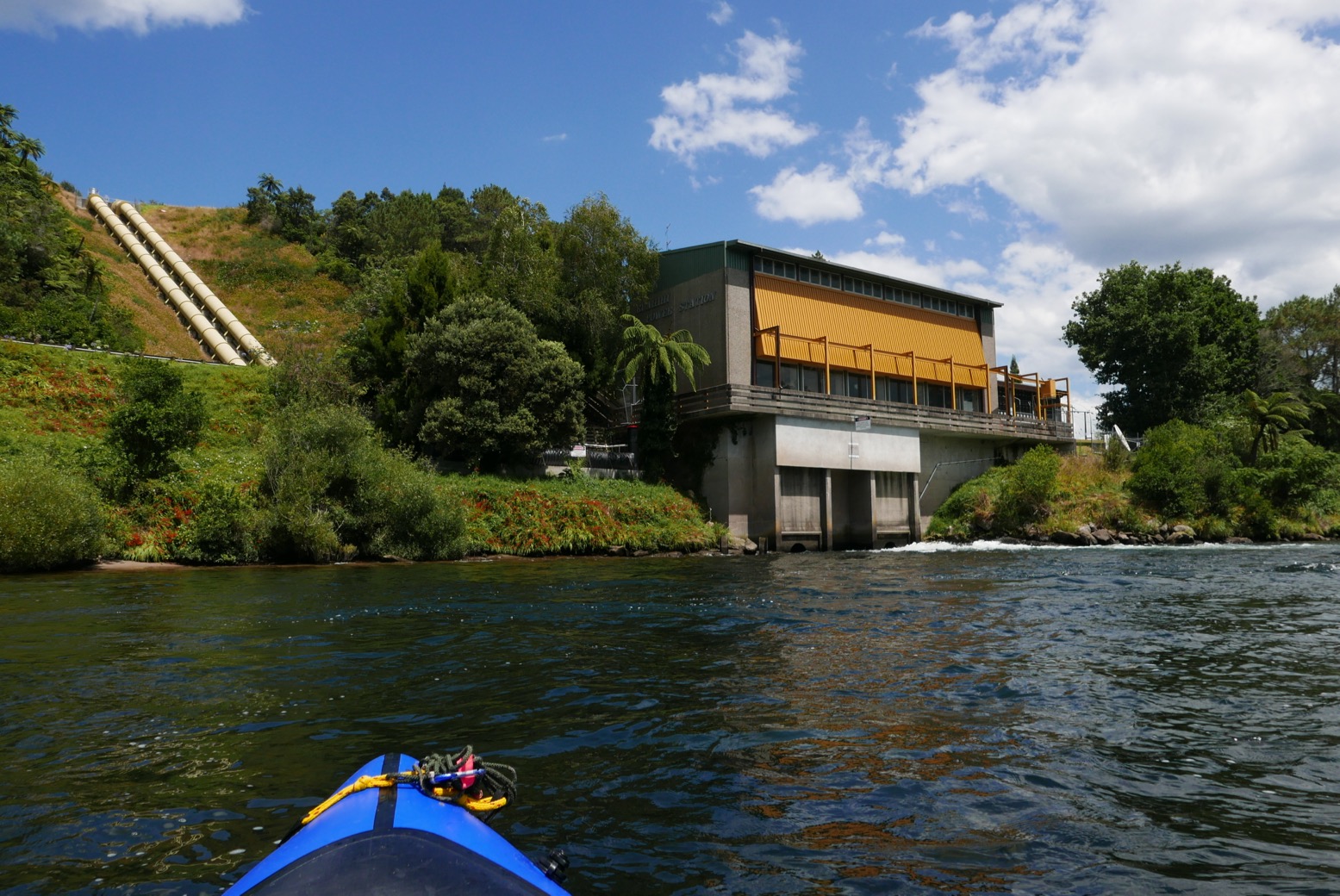
From the park it was a 6km walk back along the main road to rejoin the river at the newer Ruahihi power station. Between the park and Ruahihi I presume the lake’s output gets diverted through pipelines, baring occasional releases for the white water brigade. Having appraised the range of Newzealandish roadside detritus, just by the station I slithered down a steep bank thick with red flowers (left) and reinflated.
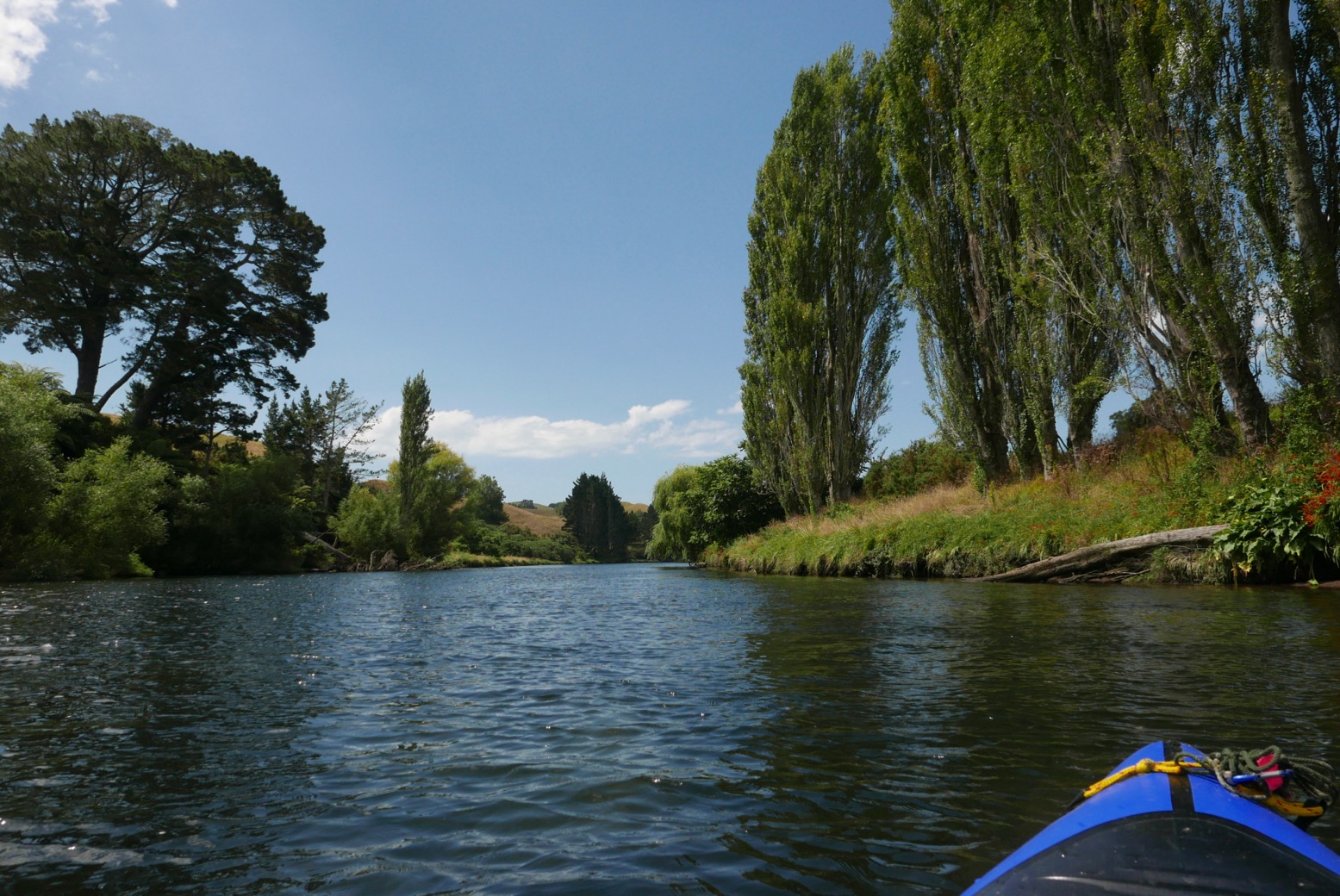
A nice current kicked out of the power station’s bores and I set off for the 12km run to a water park by a road bridge west of Tauranga. It would be nice to report the Wairoa was a magical paddle. Giant, palm-like fern trees certainly give NZ’s lush, English-looking countryside an other-worldly, Jurassic quality. It’s no coincidence that just down the road they’ve renamed a town Hobbiton (below) in honour of the movie filmed there.
The Wairoa might make a nice afternoon’s flatwater canoeing, but I do miss a bit of easy Massifianeau vivant. Youtube vids suggested the Whanganui has some rapids fit to tip beginners’ canoe, but here all I got was the cooling breeze which developed into an annoying headwind. I put my head down and dug away, on the way passing a clifftop tree (left) which surely must be one good deluge away from crashing down into the river.
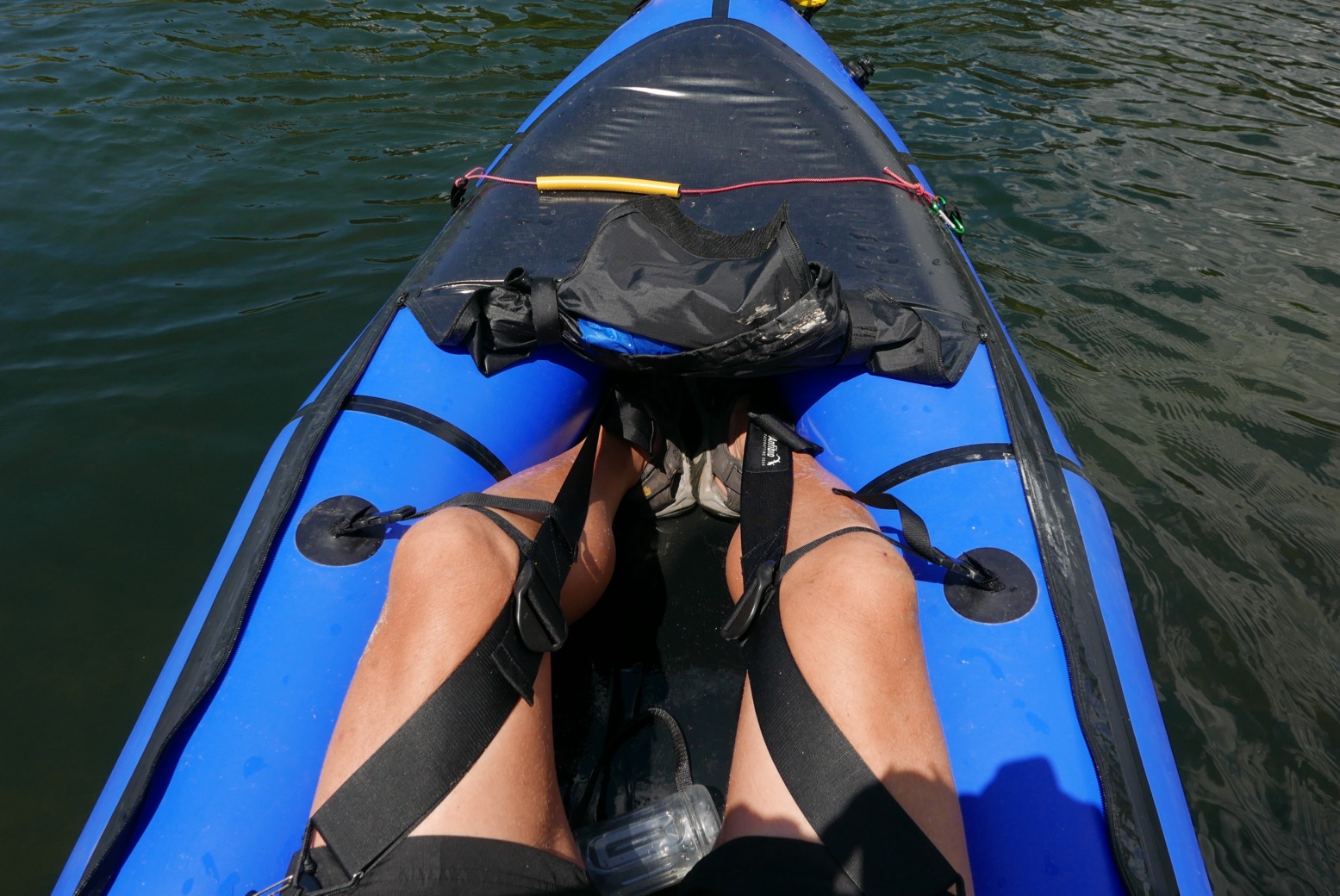
I may have skipped lunch and haven’t padded since the summer, but I was getting more tired than I should be. Something felt off with the seating and bracing set-up meaning I wasn’t relaxed. One problem with the mid-seated Nomad (or any packraft much longer than 130cm inside) is that you can’t jam yourself in, back-to-foot, leaning on the stern with the feet braced against the bow. The Packrafting Store included Anfibio knee braces which, after some adjustment, improved things a bit, but wasn’t as good as bow-braced feet. I see the Store are now selling an MRS footrest for €30 (right) which shortens the distance by six inches or so. I’ve since fitted one, improving bracing and comfort.
A jet ski shot by up river, kicking up some welcome wake. Then a paddle boarder passed by and a group getting merry on a motor pontoon. It had been over two hours now so I asked a bank-side dog lady how far to the water park ’Oh it’s a few kilometres’. Surely not. I pulled over and, clinging to a moored boat against the wind, fired up the GPS. That’s more like it – not so far at all.
Soon there were kids churning along on pedallo-powered water slides, SoTs, giant inflatable silliness and a water chute hurling screaming infants into the river. What better way to spend Waitangi Day. Beyond, traffic rumbled over the road bridge and before that, a steep tidal bank lead up to a nicely mowed lawn for a dry-off during a bit of a lie-down. One-fifty minutes for 12 clicks – not so bad considering it felt like dog water much of the way.
From here it was a 7-km hike through Tauranga’s affluent suburbs back to the hostel. On the way, a supermarket called me like a siren: ‘Food… Foooood, large amounts’. Once out, I’d didn’t even re-park my trundler (as trolleys are called here) before gorging myself on a pain-au-choc, peaches and yoghurts. The rest of the shopping for the evening meal nicely balanced my paddle for the long walk back.
Finally I got to try this SUP-ing everyone’s so crazy about, on a recreational inlet in north Sydney. Ideally it should have been an iSUP to satisfy the strict submission criteria of IK&P, but among the user-owners and rental places on Sydney’s northern beaches, it seems carrying or stacking your oversized ironing board to the beach or lake is no great hardship.
I would guess mine was a beginner’s round-nosed planing board of around 10 feet by 30 inches wide. I read later this was a little under-buoyant for my weight, but I can’t say it felt like that, or looks so in the photos. You read a lot about how SUPing is a good work-out for the core (stomach) muscles. Thirty minutes of flat-out SUPing a day for two or three years will turn a wobbling belly barrel into a granite-hard six-pack. But initially, I found it was my feet and thighs which felt over-worked from micro-managing my tippiness, though any balancing exercises must be a good way of working the core. Conditions were a light breeze topping out at a 2-3 inch swell and, just as with kayaking, it felt a lot more satisfying padding into a slight breeze than having it behind you, right up to the point it becomes a headwind. I don’t have acrobatic levels of balance but I was determined not to fall in so edged off the shore very slowly. I only fell off when the skeg snagged a tree root in the shallows. It sounds like I got off a lot better than Gael did, learning to iSUP on his marlin-nosed racer in Sardinia. Half an hour in I got over the initial wobbliness and, like all inveterate hoons, decided to see how fast will it go (mister). Who knows if I was doing it right, but I found a knee-dip just prior to putting in a good draw close to the board before standing back up straight and pulling back felt right. It would’ve been fun to try a couple hours of this. Note the bend in the long stick in some pictures.
I did experiment with canoe-style J-stroking, where you give the end of each stroke a little outward scoop to counteract the tendency of the board to turn off course. But I can’t say it worked which is why most SUPers you’ll see swap sides every three or four strokes to track straight. It’s fun to stand like a fully-fledged, chest-beating biped, but seeing as you need near-flat water I can’t see a SUP board being an irresistible travel tool as a packraft or IK are. On more turbulent waters falling in would be more common, which means away from the Mediterranean conditions I was padding in, you’d need to dress for immersion. Who wants the if they can help it? Still, I’d like to give it a good go unhampered by the ticking of the rental metre. On eBay new iSUPs go from 150 quid, with quality used ones from £350. As with a lot of recreational stuff, buying used you can put in the time at your convenience to get a good idea for SUPing, then sell it for less than the rental hours, if it’s not for you. I must say I would be more attracted to owning a longer and pointier iSUP board (below), as Gael A writes about here. And then probably regret it once I failed to stay on it. So for the moment, I think I’m happy to carry on renting when the opportunity arises.
First Gumotex and now Europe-wide, French sports retail giant Decathlon have turned to dropstitch (DS) technology in a bid to improve rigidity and so, the performance of their inflatable kayaks. The Strenfit X500 is again sold in UK Decathlons, currently reduced to £599. A drop stitch bargain.
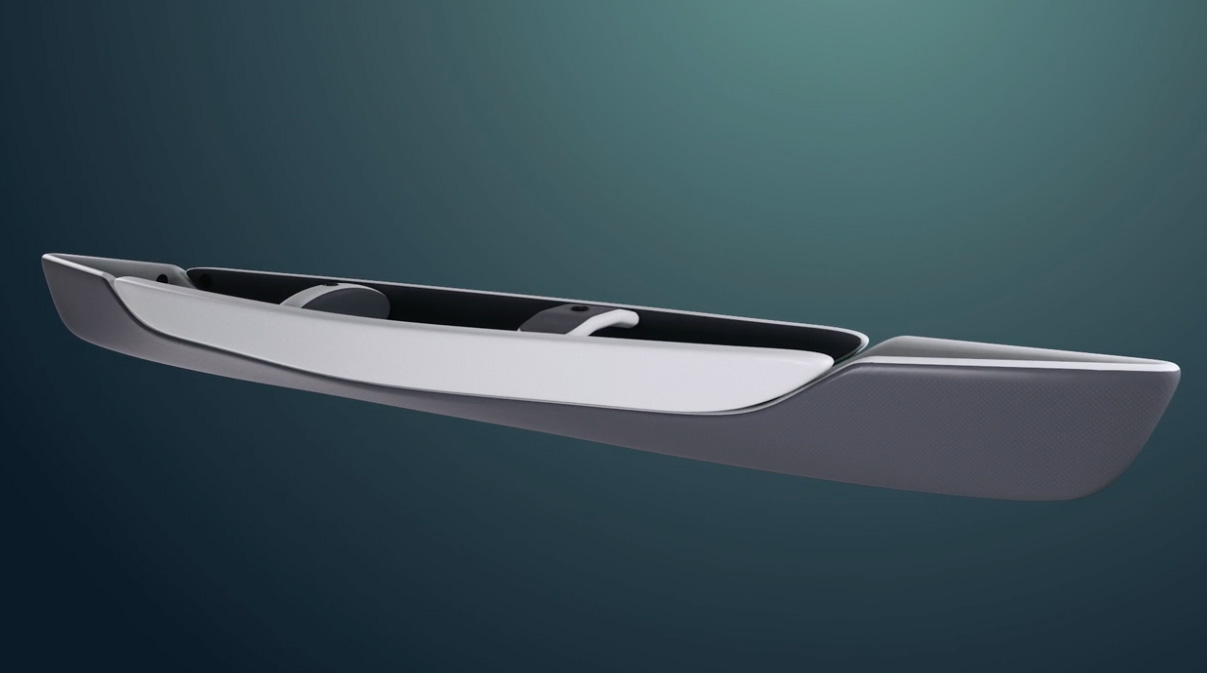
Only Decathlon haven’t just added a DS floor to an existing model, but with the single-seater X500 Strenfit have designed an entire 10psi (0.7 bar) DS hull, complete with a deck and coamed hatch supported by two D/S beams. (Do you need a deck?) Above left, Serge and Nanook take their X-boats for a spin. UK price is very reasonable and delivered with a two-year guarantee, although the essential SUP two-way pump (right) is another 30 quid.
‘Itiwit‘ is a Decathlon water-sports brandword, contracted from ‘itinerary’ and ‘Inuit’, the latter being fur-clad denizens of the Arctic who invented sea kayaks all those centuries ago. I suppose it sounds better than ‘Inuary’. Watch the slick vid below to get your head round the unusual design. It looks like the dark grey V-floor panel is one chamber, plus a lighter grey sidewall panel each side and then the two deck-supporting thwarts or beams. And being French-designed, it conforms with their national watersports regs which allow it to stray a full 300 metres or more from the sea shore.
Vital stats are 3.8m long by just 64cm wide and 18kg,making it similar to an undecked but flat-floored Kxone Slider 375, and between a Gumotex Twist 2 and a decked Aurion or Swing II. It’s made of PVC and, like most other FDS IKs, you can be sure it’s made in China. But there have been reports that the fabric cracks when folded and creased hard. Sounds like cheap PVC and is why we like old school rubber IKs. Because DS hulls have less air volume than regular tubed IKs, they’re slimmer (thinner walled, giving more space in the boat) and are quicker to pump up (3 mins, claimed on the X500). But that lower volume explains a modest payload of just 125kg. No dims are given on the hatch size, but based on the length, I’d guess it’s 80cm long.
Below, watch Nanook film Serge as he effortlessly assembles, paddles and then disassembles his X500 in what may be real-time. The roll-top rear hatch is a clever idea; not seen that before, though it looks like water may pool there. And the proper wave-slicing V-hull dispenses with the need for a skeg to aid tracking, although the boat may benefit from a rudder or skeg in cross winds. Like most IKs, the X500 sits fairly high in the water, unlike a proper hardshell sea kayak which is barely above it. With the narrow V-hull and poor knee bracing, many report it feels unstable until it’s moving. Lighter paddlers have found dropping the pressure a bit make the boat float lower and improves stability. But this also adds up to a fast boat, making it most sea-kayak-like IK since Feathercraft’s short-lived Aironaut. It’s not an exaggeration to say it’s a revolutionary DS IK, but with the mentioned flaws in durability.
Below a review by a sea kayaking chap on what looks like the balmy Med. I agree with his suggestion: it would be good to see a longer version, but that will probably be a tandem which, with the fixed deck, won’t adapt to solo long-range touring. They produced that tandem version, but it’s since been dropped. The X500 has strap–adjustable footrests but he also mentions poor knee bracing – often an IK weak spot, even with decked boats. Nevertheless, he still manages to bang out a pretty smooth eskimo roll, and it would not be impossible to glue or somehow clip on some thigh bracing straps which would greatly improve the connection with and control of the boat.
In 2020 they released a two-seater X500: 5.3 metres x 70cm but weighing a true 30 kg in the bag.
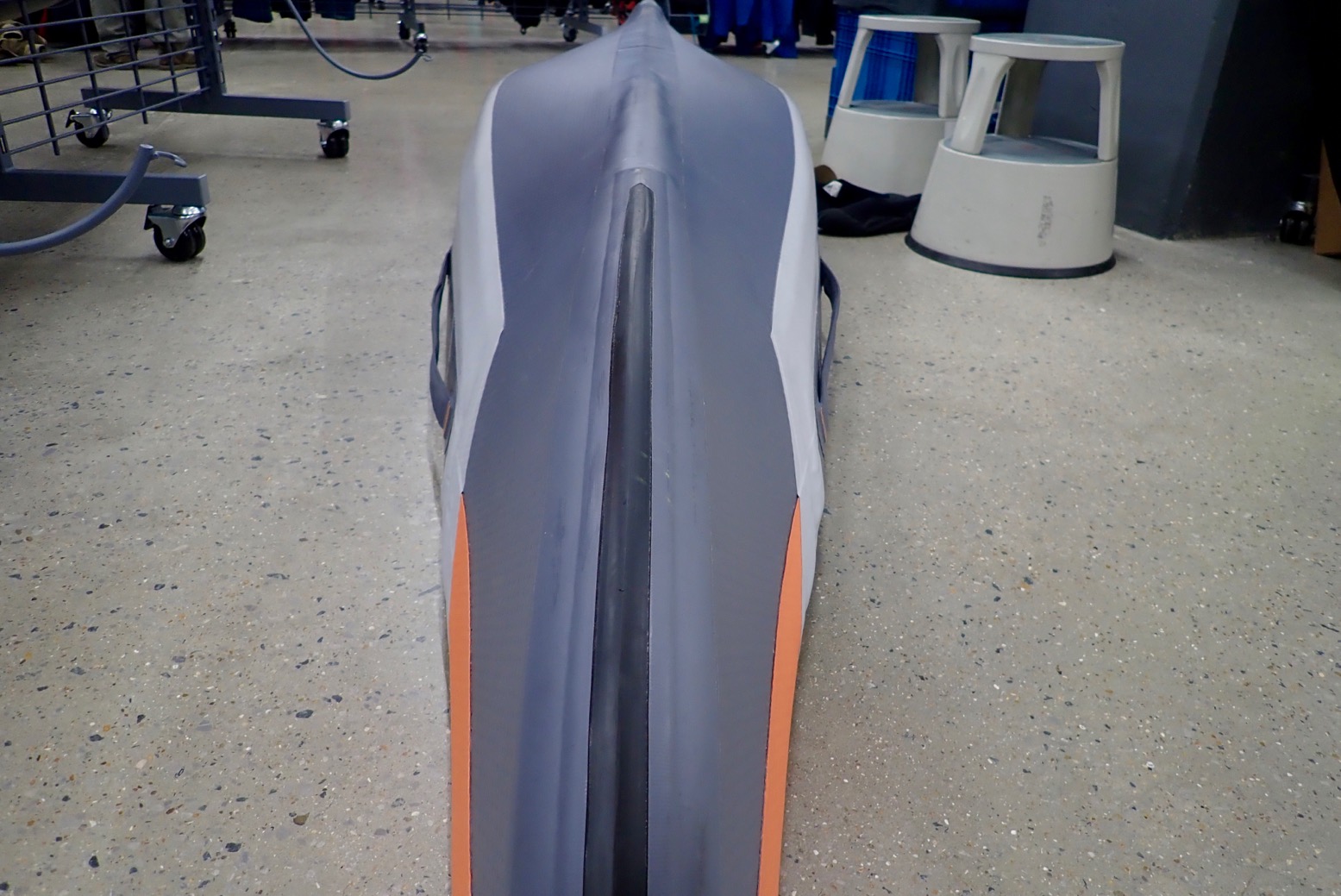
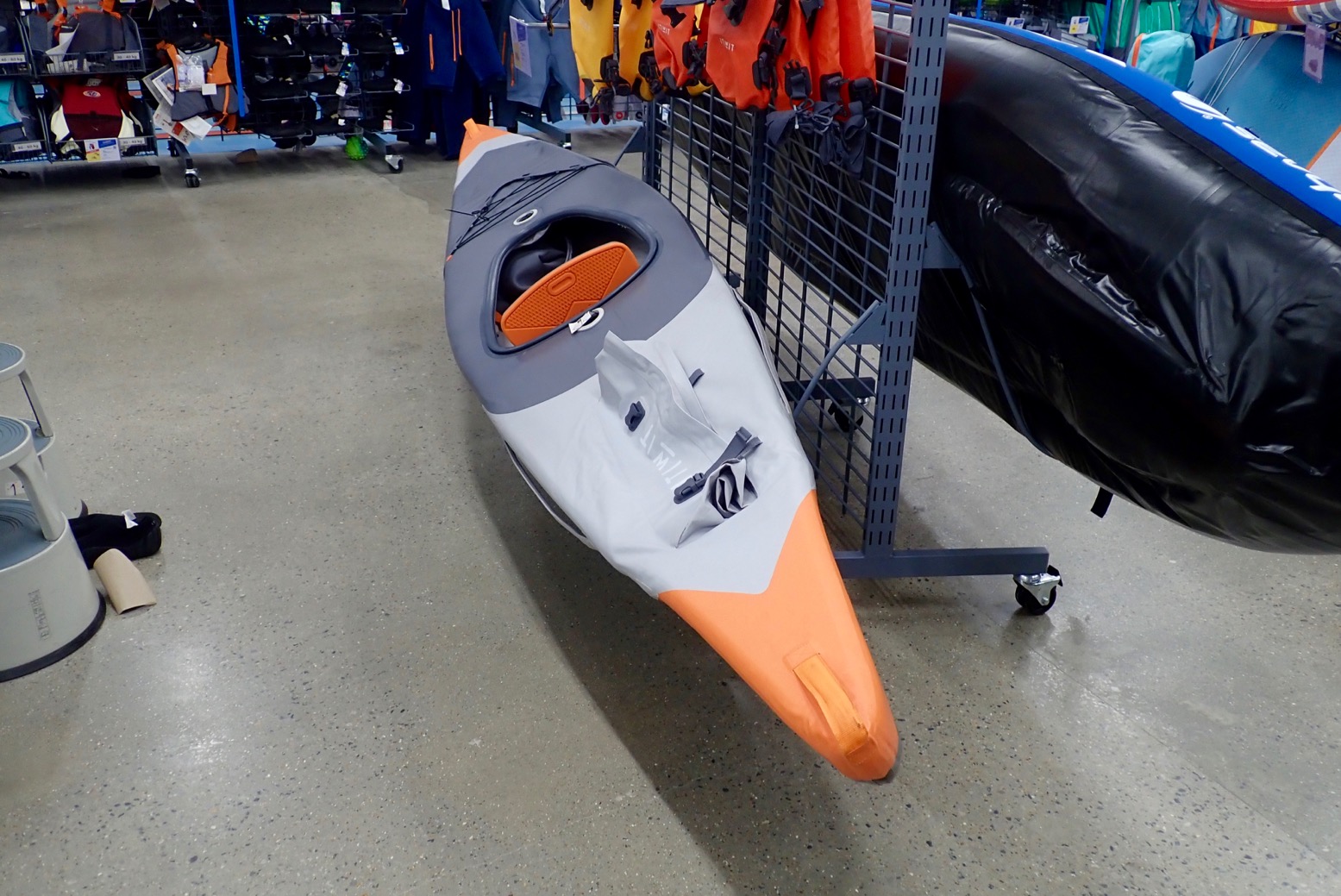
One the way back from the Regents Canal the other day, I dropped into my local Decathlon to have a closer look at the X-boat. First impressions were it wasn’t half as narrow as I expected – at least at cockpit level. The hatch is nice and big and it sure looks more kayak-like than the rest of the Itiwit range of bloats. That sure isn’t a typical flat DS floor which might explain the tippiness some report.
The yellow boat is an all-PVC X100 with a DS floor and 3psi sides. The others are all 1.5psi bloats
The boat wasn’t at all saggy as you’d expect from an Intex watersofa sat in a showroom for months. But as mentioned, if your boat has a slim V-hull, you really need some knee-bracing to control any rolling. The deck felt quite slack but as always, the good thing is others will see how Decathlon took a big step forward in DS IKs, and try to improve.
Your inflatable packboat needs a pump to take form as well as to top-up once on the water. These functions may be best performed by two different pumps. The folding bellowsfootpump (left) is history and even low-pressure IKs now come with some sort of hard plastic barrel pump. Some pump on both up and down strokes to fill your boat faster, but as you reach higher pressures they automatically or manually switch to downstroke-only inflation to reduce the effort. They work best on flat, firm ground where you can stand on the stirrup plates and get stuck in. The excellent Bravo 4 RED Kite pump below (newer ones are blue) is still well under £20 and will pump up an IK in 5 minutes.
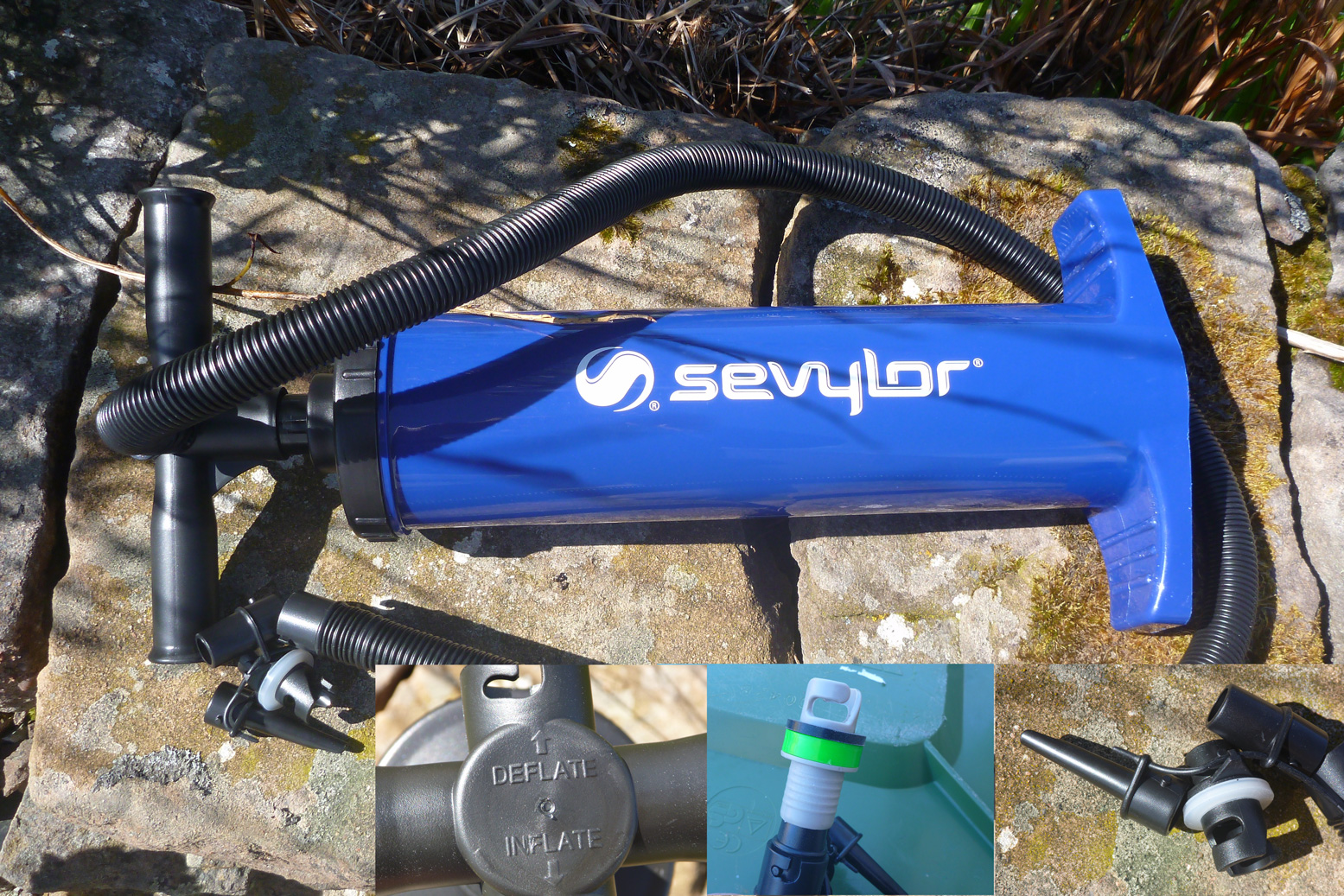
I got a Bravo 6 with my Seawave once but found it hard work – who knows why. The cheaper Bravo 4 does claim to be an ‘R.E.D’ (‘reduced effort device’) and I can confirm this isn’t some gimmicky acronym. The other port on the Bravo’s handle can be used to suck air from an IK so it rolls up good and flat; you can see creases forming in the hull as you suck it down. I left my Bravo 4 RED at home one time so bought a Sevylor RB2500G barrel pump (below left) for a tenner. Same size as the Bravo barrels, it did OK for the awkward topping-up of my Semperit’s lilo plugs and came with others adaptors plud sucked as well as pumped. But pumping up my Seawave from flat was exhausting towards the end: I actually got out of breath and had to rest! Morale of this fascinating anecdote: get a Bravo 4 RED and the right adaptor for your boat. Not all barrels have a built-in pressure gauge which is obviously dead handy in getting the right pressure without needing to faff about with a separate manometer (see below). It’s worth an extra tenner to get a built-in gauge, especially with DS boats.
Cheapo Sevy barrel – tiringHandy K-Pump Mini for topping up on the water
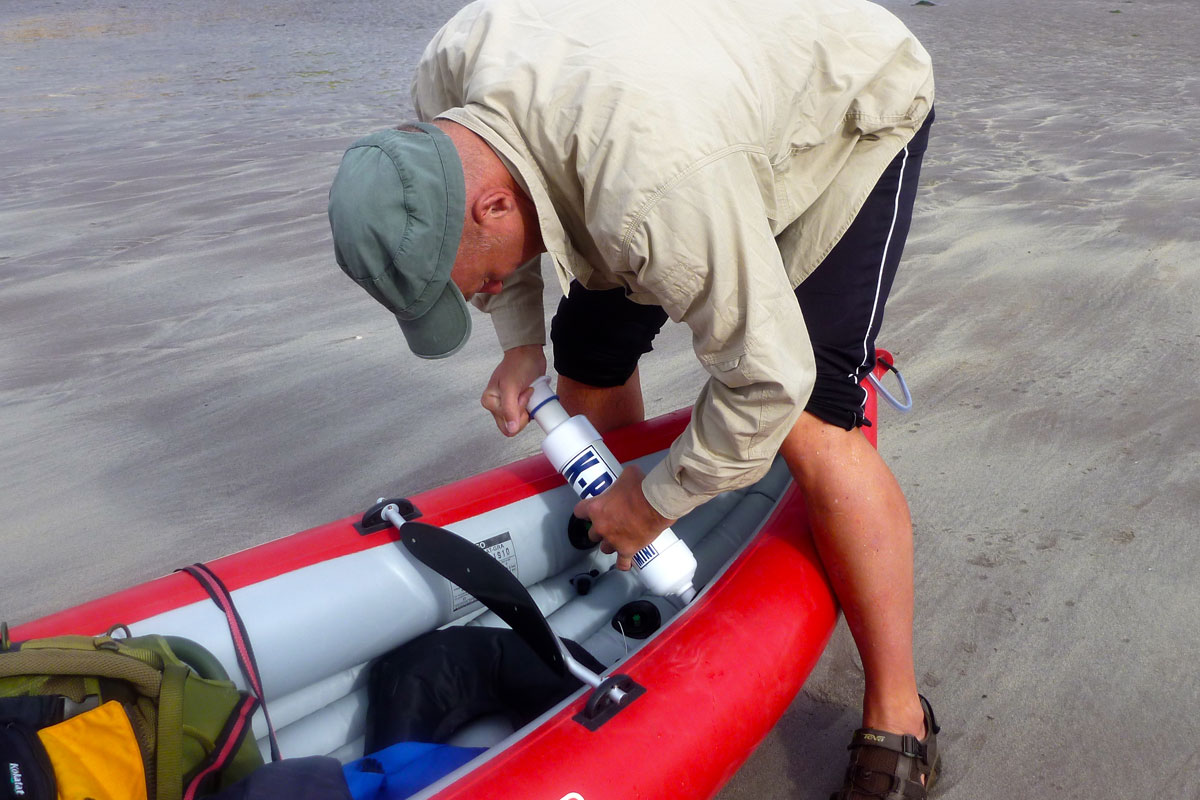
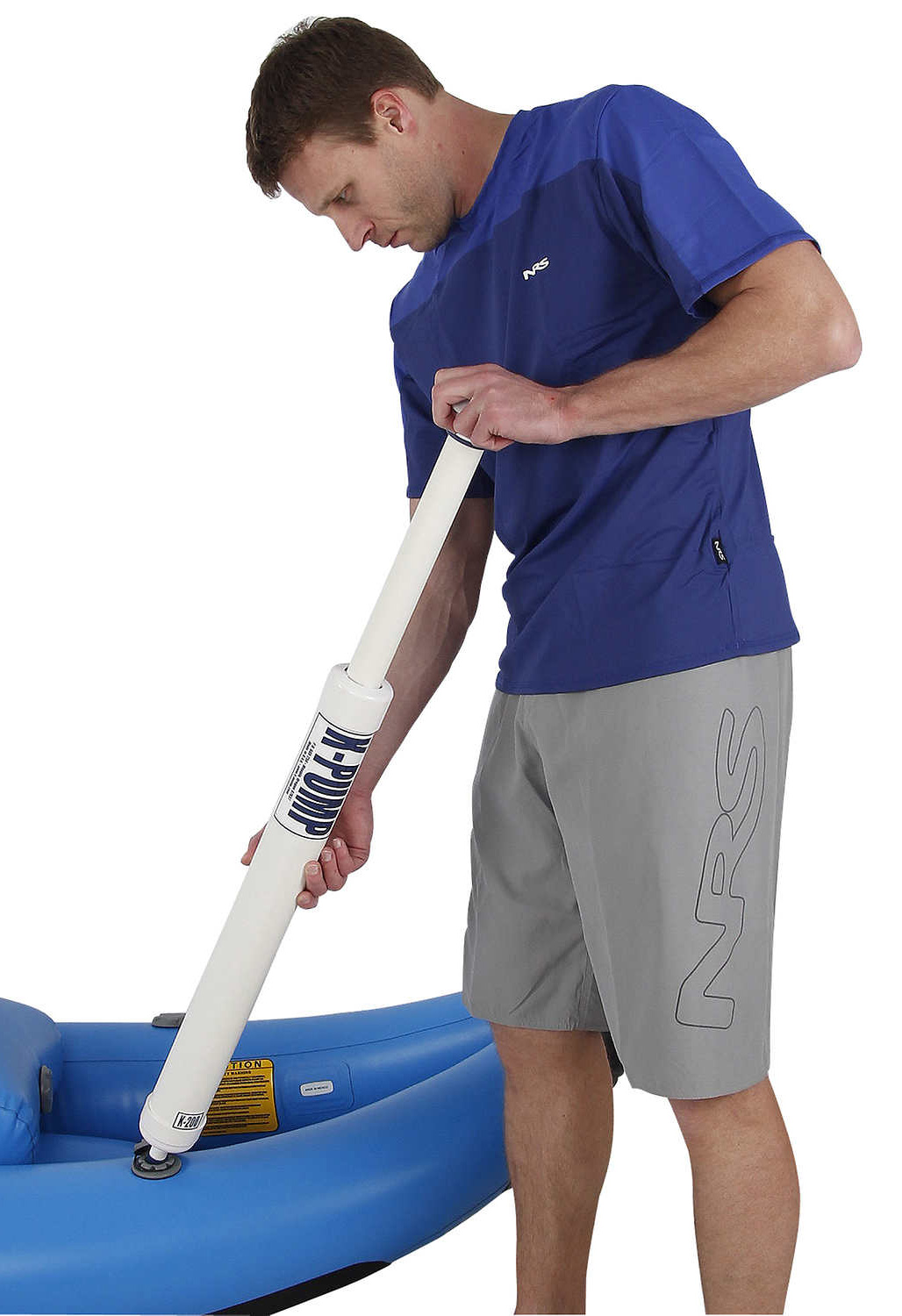
The K-Pump Mini (above right) is a handy top-up pump or compact 600-g travel pump. It took 15 minutes to fully inflate up my 14-foot Seawave; the push-fit nozzle works on any IK with one-way spring valves. You have to press and hold the nozzle against the valve. Using it a lot one time, I got the feeling it might break something or wear out the seal (which needs regreasing once in a while). I’ve also used the K-Pump to top up my Nomad S1 packraft which was too big and long to inflate firmly with just its airbag. Fuller review of the K-Pump Mini here. They’re hard to find in the UK, the very long, and slim US-made K-Pump 200 (right) may also be suited to higher-pressure dropstitch applications.
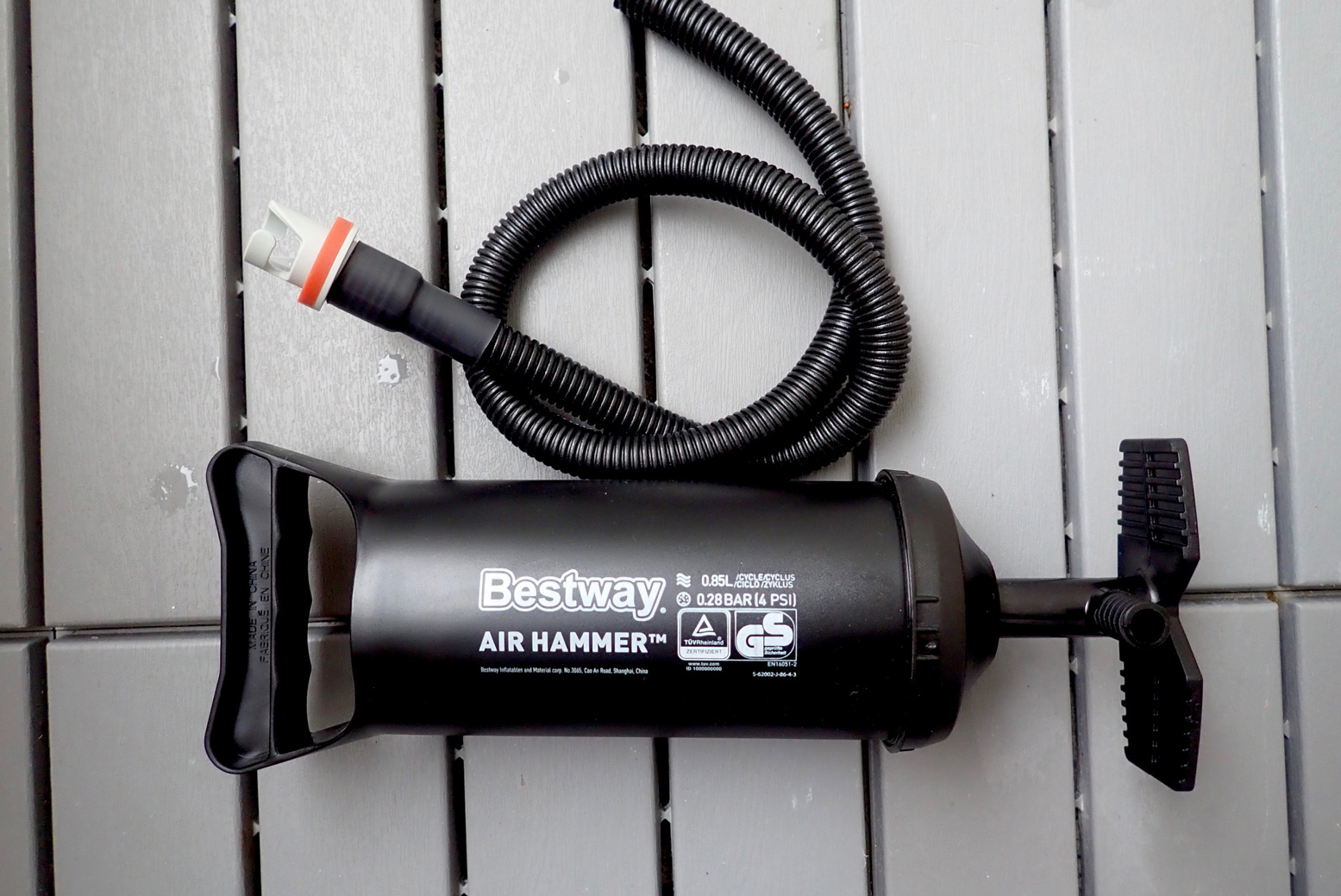
Left, the Bestway Air Hammer is an ‘upside-down’ barrel pump which comes in three sizes and costs from just £6 on eBay. If you don’t want to paddle with your full-size barrel pump, the smallest Air Hammer could work as a compact top-up pump like the K-Pump, but a tenth of the price. The one on the left came with a ROBfin and was rated at 4psi.
High-pressure pumps
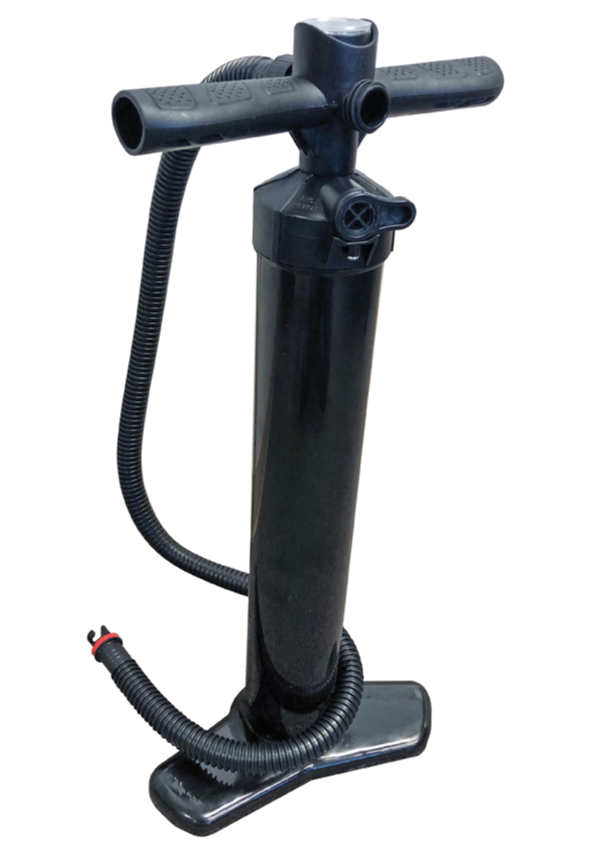
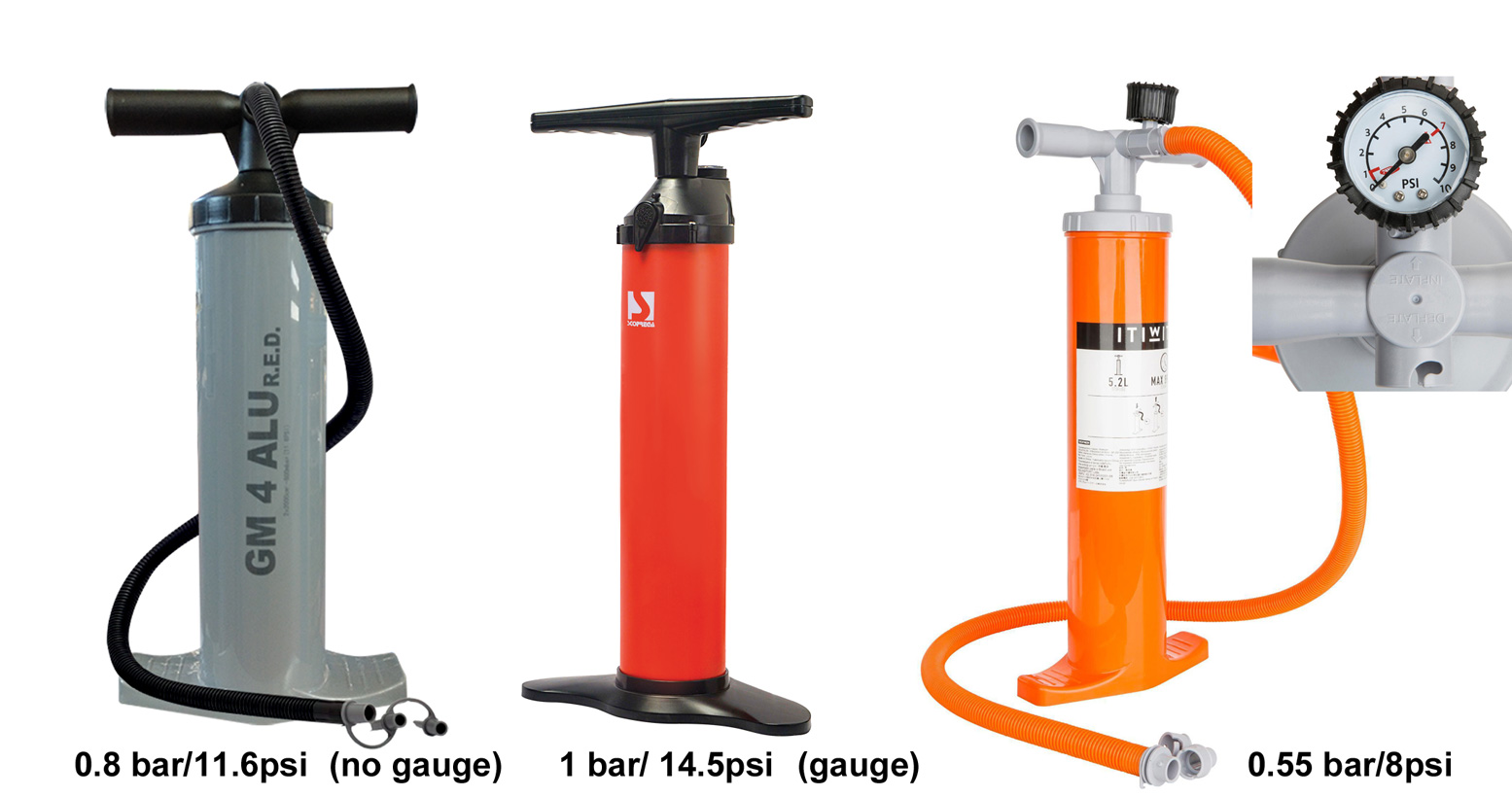
More and more IKs now feature super-rigid, high-pressure dropstitch hulls – either just floors or the entire hull which runs 2–5 times higher pressures than regular IKs. Your old Bravo footpump will blow its brains out trying to reach a typical 7-10psi. Barrel pumps with long, slimbodies, as opposed to the shorter, stockier examples above, put out less volume (DS IKs have less volume anyway) but can more easily attain higher pressures. It’s something to do with the ø of the pump face x the stroke. You don’t necessarily need a super high-pressure iSup board pump.
Left: Bravo Alu RED from £16 • Middle: Bravo 110 >£40 • Right Itiwit (Decathlon) £20
Some of these pumps may be double action. At a certain psi they become single action (downstroke only). I believe the Bravo Alu 4 RED (0.8 bar) works like that. Or they have a switch to do the same and help attain higher pressures. It works. Whatever pump you get for your DS IK, make sure it is rated to comfortably exceed your DS boat’s pressure rating.
Left: Kokopelli Nano pump ticks all the boxes: fold-out feet, screw-off handles, switch for one-way pumping as pressures increase, manometer in the handle. Right: twice the volume Bravo Alu 4 with auto one-way switching (so it says). The bayonet valve nozzle on the Nano keeps the valve open and so is for live (constant) manometer readings. With the push-fit (non-bayonet) adapter on the blue pump suited to Boston valves, a manometer only reads as you pump and push open the valve. Both are better than soggy footpumps.
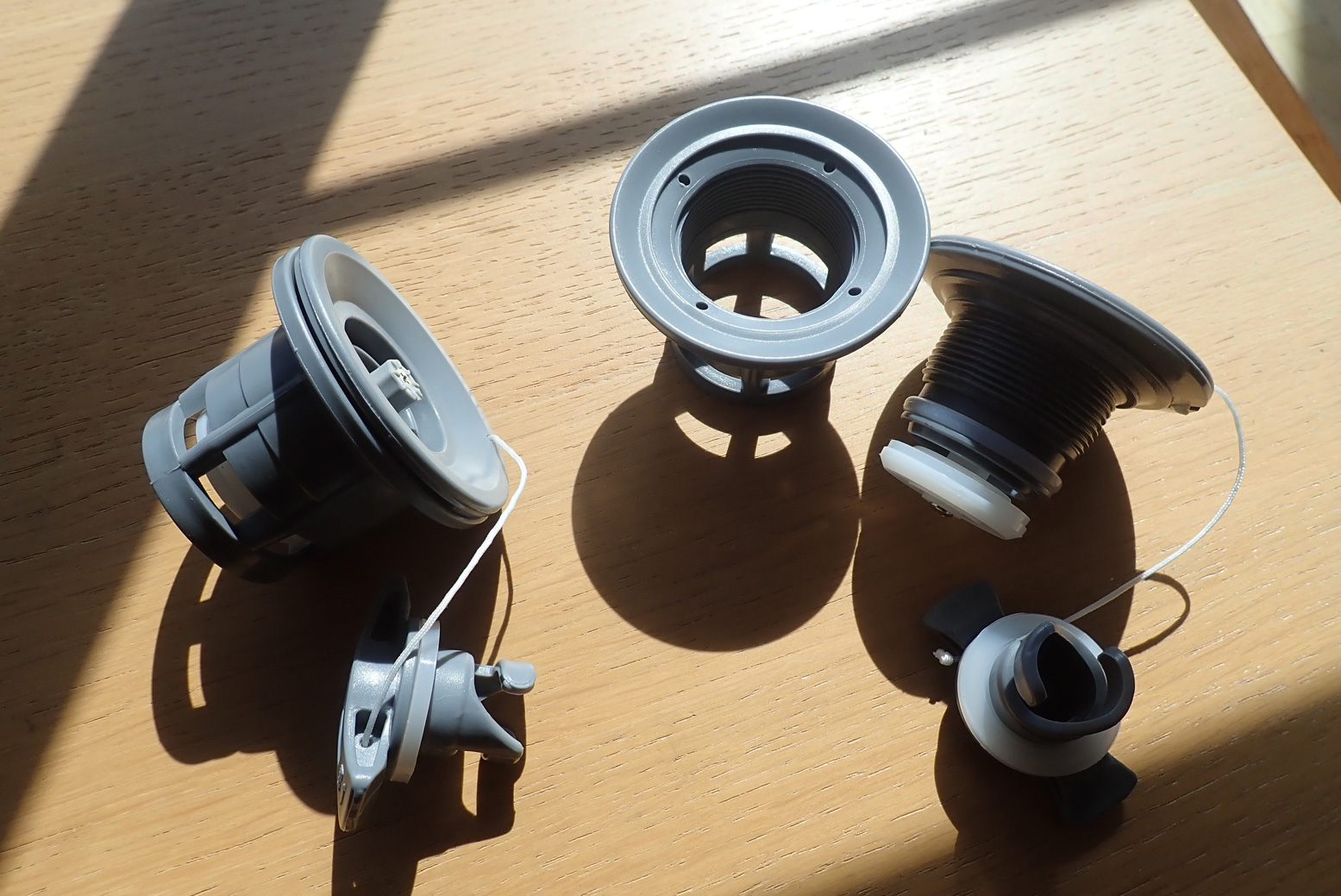
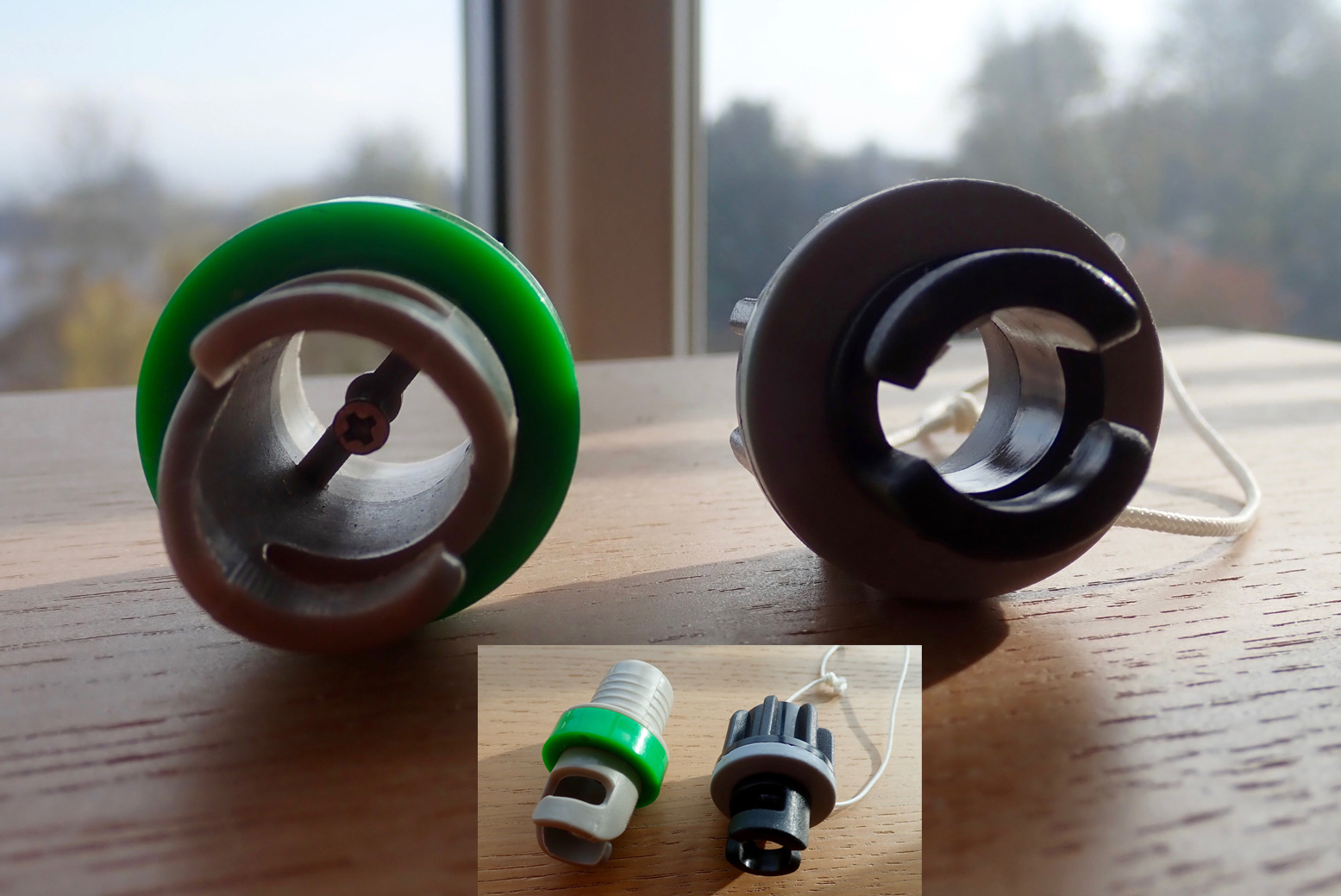
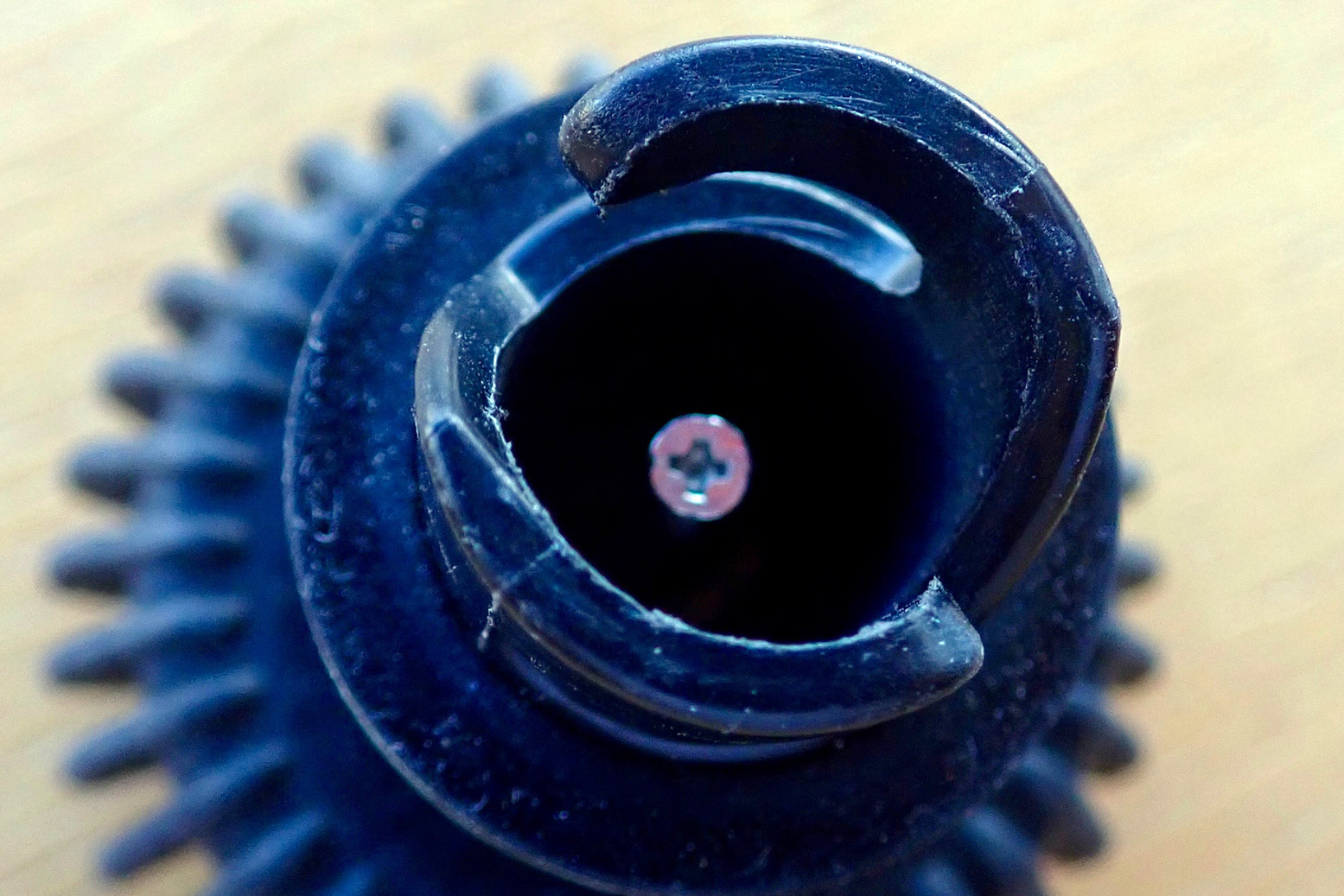
Bayonet nozzles for ‘raft’ valves. Who would have thought there’s something to be said about bayonet nozzles? Well there is. There are two types: plain (below right, Gumotex) and crossbar-peg or detent (left, Bravo). Both need soft spacer washers to fit snugly against your boat’s raft valve, but the small peg inside the green one will press open your valve stem as you connect it.
You will notice a similar peg on car tyre inflation hoses and also on a hand manometer (below). A manometer can’t get a pressure reading without this peg partially opening the valve as you push it on. A nozzle with a peg/detent means that: a: you’re not pushing the valve spring open each time you pump (easier pumping) and b: if your pump has a manometer you will get a constant/live reading as the pressure climbs which is the point of having a built-in manometer. The Bravo one goes from 3 quid; search: ‘Bravo Adjustable HP Valve adapter’. The only drawback might be that you need to remove a pegged nozzle carefully with Push-Push (Gumotex) valves. Normally a little air escapes as you do this, but if the valve doesn’t spring back closed, air will rush out. Turn slowly then pull away briskly; you’ll get the knack.
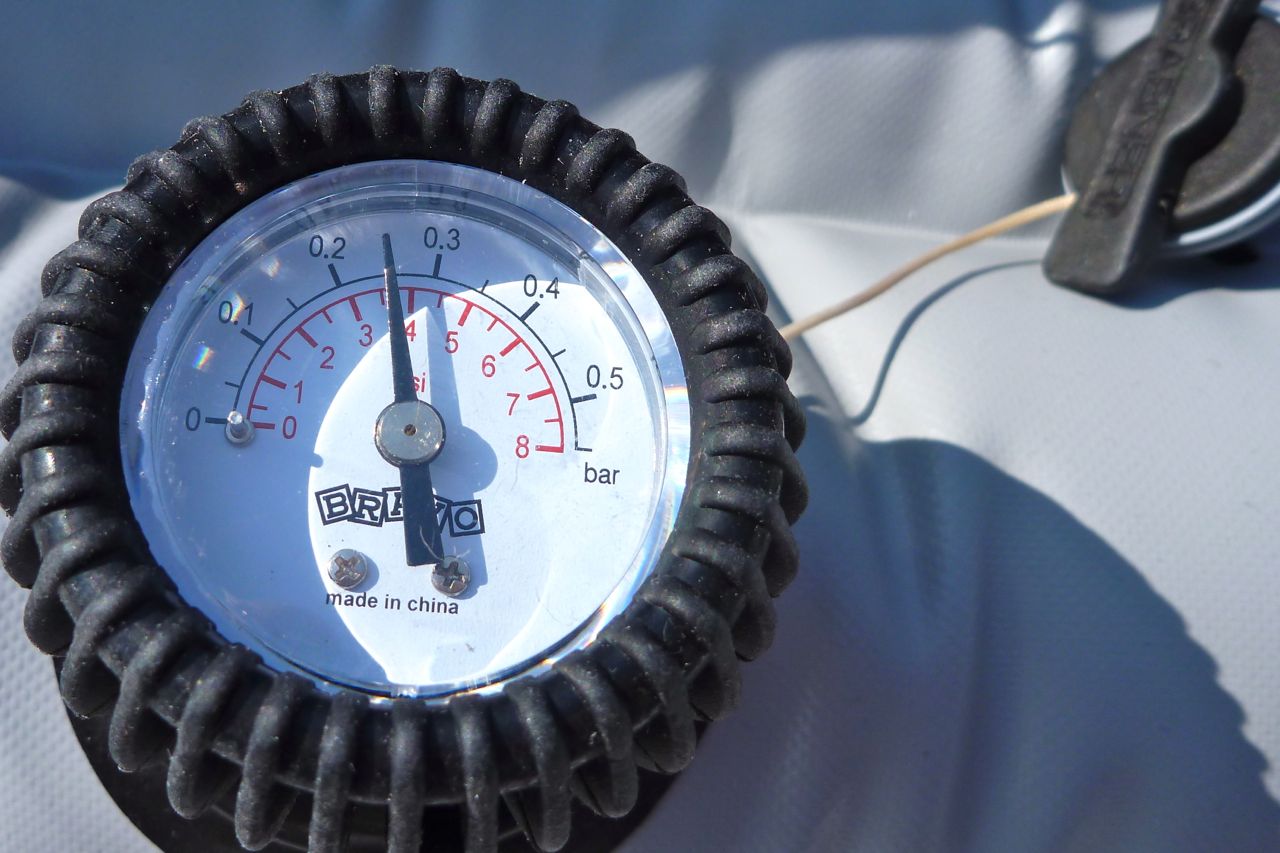
Pressure gauge (manometer) Until I got a Grabner which has no PRVs but ran a relatively high, 0.3 bar (4.3 psi), I never bothered with a pressure gauge (manometer, below) and just pumped up by feel. A lot of people do this. Since then, I ran a Gumotex Seawave and fitted PRVs to all chambers. That meant I still didn’t need a pressure gauge to get the right pressure; I simply kept pumping until each PRV hissed: the boat was then at operating pressure. My Seawave 2 was left stock (no side PRVs) so I have got into the habit of keeping a Bravo manometer with the K-Pump Mini and checking the sides at each paddle when I top up. I have checked this manometer against the floor and it measured 0.25bar which matches with the PRV rating, so I think it’s pretty accurate. Try and get a model with a range of no more than 1 bar (as below left) as that is the range you’re working in. At the moment, Sea Mark Nunn sell it in the UK.
Bravo manometer: from 13 quid and accurateAdjustable screw/peg to push open the valve
With high-pressure DS IKs, you probably want a pressure gauge as the boat will perform best at the right pressure which may be higher than you’re used to.
Packraft Pumps
Packrafts used to be inflated with a featherlight airbag which came with the boat. A nozzle on the bag screwed into the boat’s valve and you scoop air into the bag (easier with a breeze) and ‘bear hug’ it to cram the air into the boat. It’s takes about ten scoops and two minutes to inflate a boat this way, then unscrew the bag nozzle and quickly screw on the valve without losing too much air. Next, you used to top off by mouth on a separate twistlock valve: the firmer the boat the better it rides. In the video below (speeded up x 15) from walking up to a beach with my paddle in my pack, to loading up and paddling away took 8 minutes.
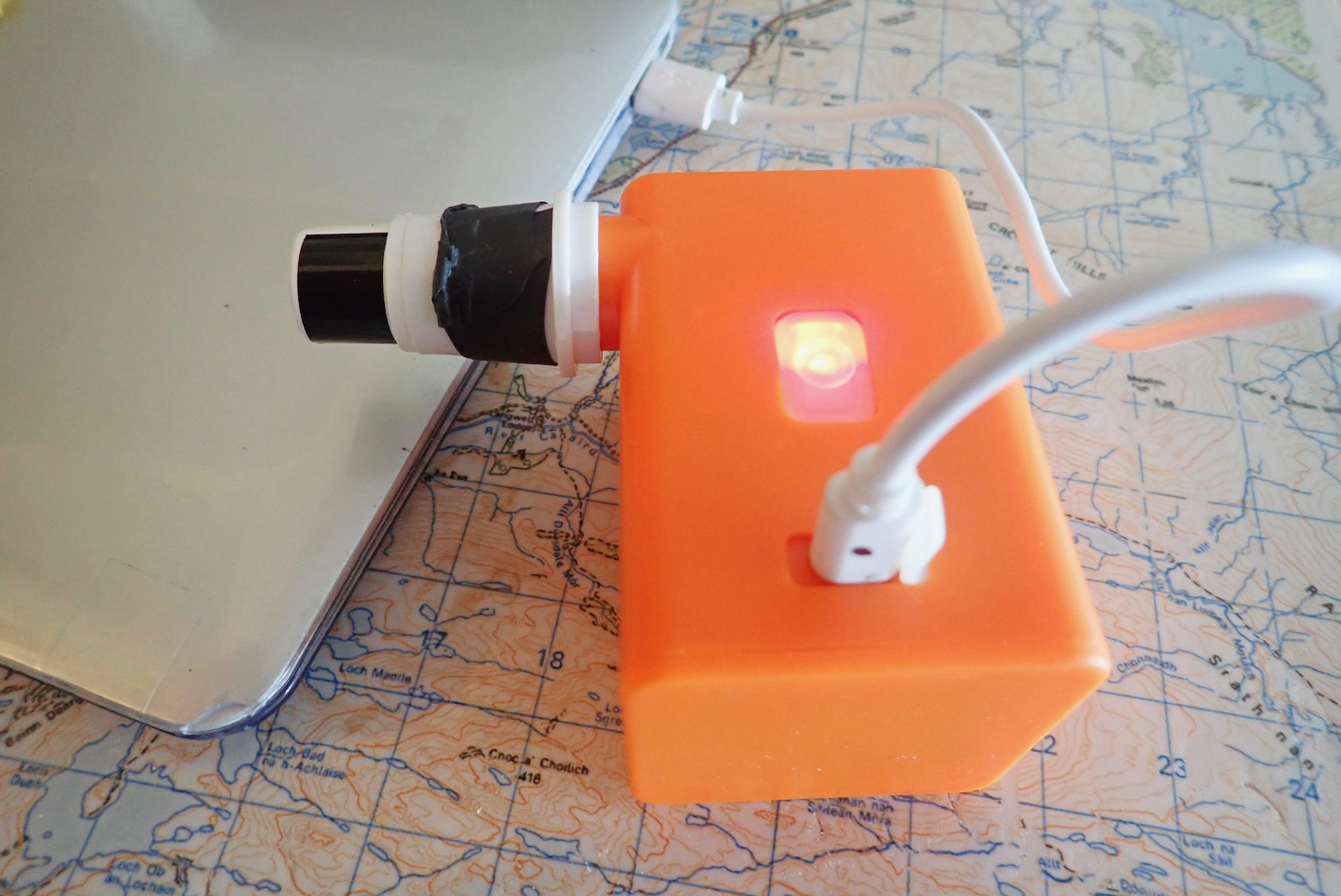
Things have moved on. Most packrafts now have a single one-way Boston valve which tackles initial inflation and topping up to a firm pressure. Inexpensive and tiny rechargeable electric pumps (left and below) now effortlessly do the initial job of the air bag, once you fit the right adaptor. Flextail minipump reviewed here.
Mini electric pump
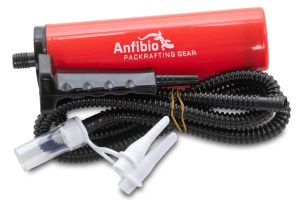
And for those who don’t have lungs like Luciano Pavarotti, once aired up a light and compact mini handpump (left) will get the boat good and firm. Firm boats paddle better, and like IKs, a packraft that feels firmly inflated by hot ambient air on land will go soft once cooled in the water and will need more topping up.
The Anfibio pump above is an adapted eBay balloon pump with an added hose so you can top-up on the water, if needed. It also differs from eBay cheapies in that the handle now unscrews from the pumping shaft to make it less prone to snapping in transit (as I found with the earlier version). With a Flextail and an Anfibio pump you’re packing good to go, but I always keep the original air bag plus a short section of garden hose (for topping up; below) with my boat in case either pump fails.
Note: a good packraft should hold air for days at a time, but don’t leave it fully inflated and out of the water in the hot sun. The air inside heats up and expands, pressures rise and the seams will get strained and may rupture.
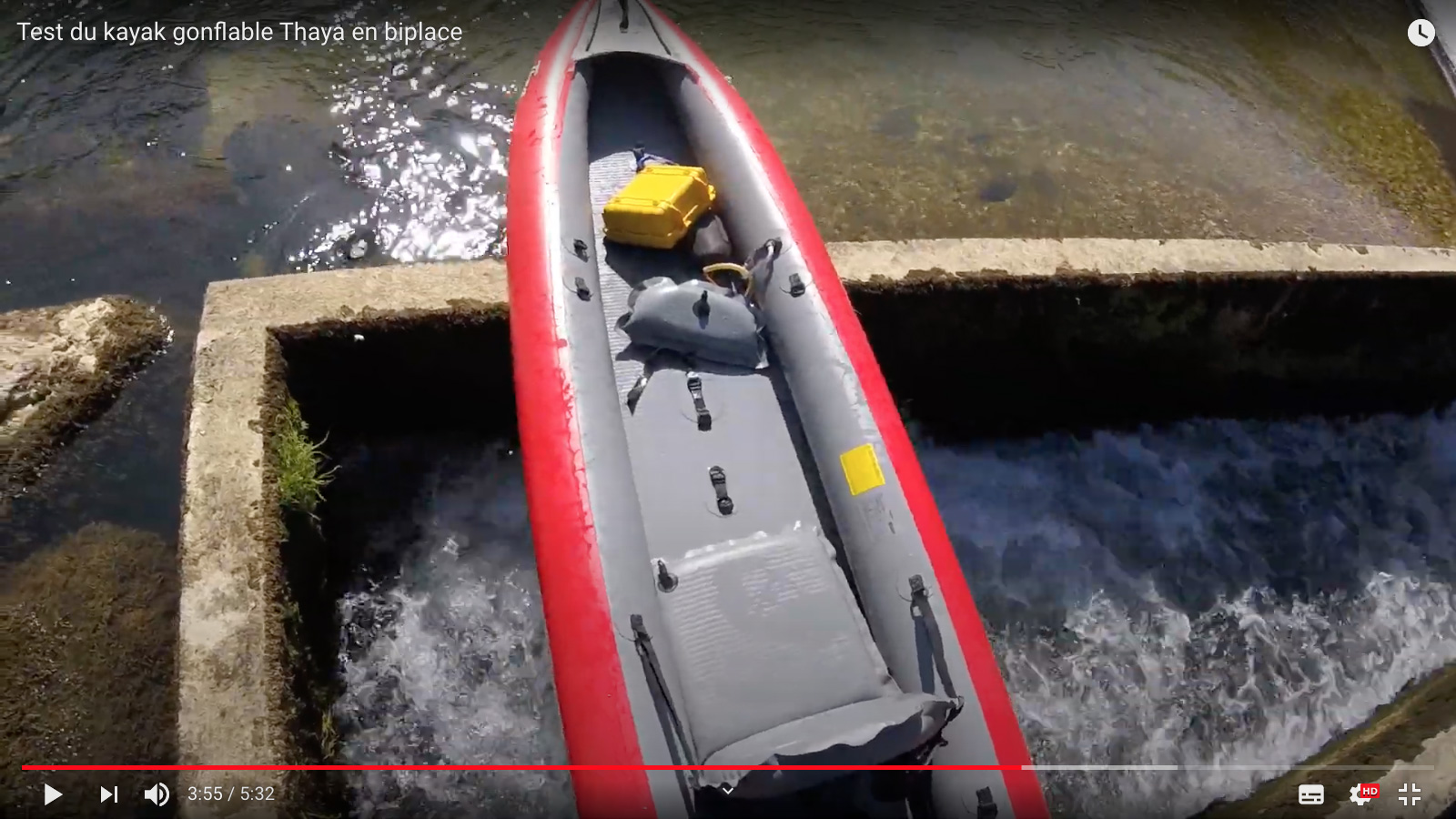
Since 2019 the Gumotex Thaya sits alongside the near-identical and 25% cheaper 4.1-m Solar on which it’s based, but with a drop-stitch (DS) floor to greatly improve rigidity. The Solar was not unlike my old Sunny, running just 3psi (0.2 bar) all round. That can get a bit saggy with a well-fed solo paddler. This was the first of Gumotex’s DS-floor boats, but a basic exercise in simply replacing a floor rather than trying anything more fancy like the Rushs of 2020.
Drop-stitch fabric now makes the complicated hand assembly of pressure-vulnerable I-beam floors (left) redundant. A DS floor is a flat panel with effectively 3-4 zillion ‘I-beams’ (see top of the page) all spreading the pressure load evenly to constrain the form into a plank shape, but at a much higher pressure than an I-beam floor can safely handle. In an IK, high pressure = a more rigid hull = better glide/less effort for barely any additional weight. The only drawback is that you need a more powerful high pressure barrel pump (above right). Your old Bravo foot bellows won’t do anymore.
DS is normally PVC and made in China, but Gumotex have found a way to manufacture threading and bonding a D/S floor with their durable, flexible and environmentally right-on Nitrilon rubber fabric. It can’t be that hard. The regular, normal-pressure 3psi sidetubes ought not need the higher pressures I ran on my adapted Seawave because the 7psi (0.5 bar) DS floor greatly aids rigidity (see action video below). Gumotex’s new tag line rubs it all in: ‘Made in EU[read: ‘not China’], made from rubber[read: ‘not PV … spit … C’].
The promo video below suggests something revolutionary, but combining DS with Nitrilon can’t be that much different from doing the same with PVC. It will certainly simplify or speed up assembly. One assumes drop-stitch floors supposedly don’t need a PRV necessary to protect I-beam floors from internal ruptures when they overheat in the hot sun. Some UK outlets where claiming the Thaya has a “Safety relief valve [PRV] in the bottom of the boat” but it’s probably just a copy and pasting error from the Solar. I can’t see one in any pictures and have yet to see a DS panel with a PRV until the AE AirVolution came out in 2020. The assumption is they don’t need it if it runs a modest 7psi, but some claim high-pressure DS floors won’t last as long as I-beams. Without a PRV, that may be true and much will depend on running the correct recommended pressure, the quality of manufacture/assembly and where possible, leaving the boat in the water on hot days so the large water-contact area keeps things cool.
One positive thing about old-style I-beam floors is the parallel I-tubes (left) probably don’t hurt tracking (even without a skeg). They also enable the desirable curved hull profile of a boat rather than the flat floor of a barge (for the moment DS panels can only be flat or maybe with a slight curve).
Payload ratings seem to have settled at 230kg and the movable seats are also made from DS panels. Initially I thought why? For the backrest and footrest that makes sense but who wants to sit on DS seat base on a DS floor? Of course you don’t have to pump DS up to the max to get its flat form constraining benefits and it looks like valves are regular twist-locks so you’d couldn’t get more than a couple of psi in there. Footrests are the usual inflatable pillow rubbish, but possibly also DS? I’d replace them with a section of sawn-down plastic drainpipe so you get a solid block to brace against. It makes efficient paddling much easier.
I’ve never tried one, but I do wonder how a flat-floored DS IK might handle in windier, choppier conditions where an IK isn’t exactly a hydrofoil at the best of times. A flat, raft-like floor will be stable, sure, but it will roll and pitch about more. Also, according to the specs (left) at 89cm the Thaya is a disappointing 6 or 9cm (3.5″) wider than the all-tube Solar 3 (Actual verified width seems to be 34″ or 86cm). Great for family-friendly stability; not so good for solo paddling speed and efficiency. My Seawave was 2cm narrower than a Solar 3 and with the usual care getting in, stability is not an issue. Out at sea my Seawave would swamp long before I’m tipped out. But then again, the near-rigid floor may cancel out the drawbacks of the greater width. At 18kg the Thaya is heavier than a Solar 3.
For most recreational, flatwater users the Thaya ought to be a nice family boat, but then so is a Solar 3. The Thaya costs 30% more than the Solar 3 whose days may be numbered, but it’s 2022 so maybe not.
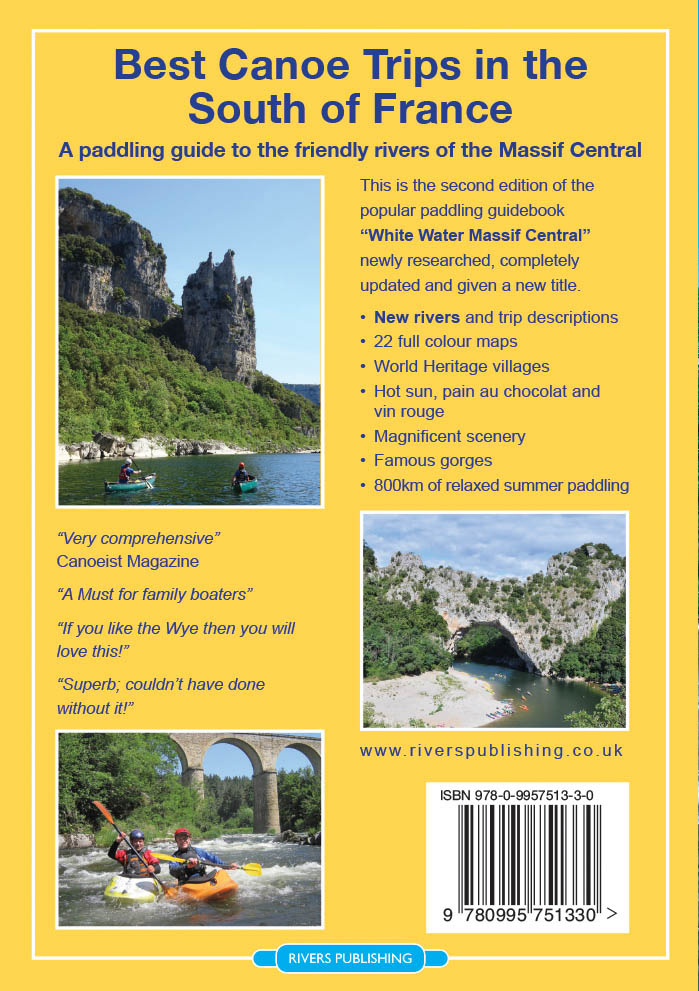
Back in print after 16 years, Rivers Publishing have updated their 2002 White Water Massif Central canoe guide, now less scarily titled: Best Canoe Trips in the South of France. Packboats aren’t mentioned, but what’s doable in a canoe is well suited to IKs and is easier still in packrafts.
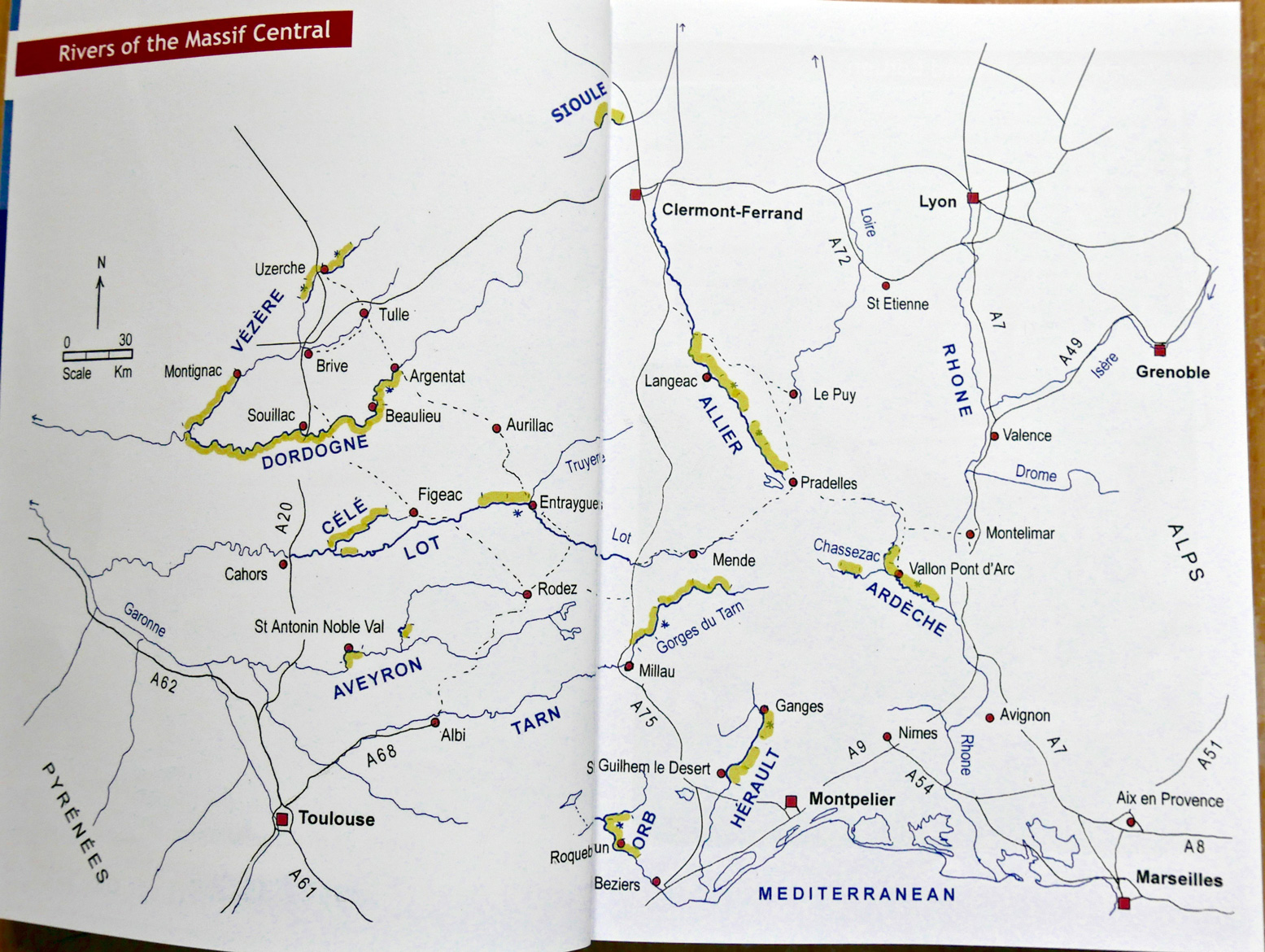
Compared to a Pesda Press paddling guide, Best Canoe Trips looks old school and a bit amateurish, but there’s nothing else like it in English covering France’s inspiring Massif region (right). It’s a good example of: ‘write it and they might come’. Even now, let alone back in 2002, trying to amass this sort of information online would take days of effort and translating, (though I belatedly can see how online translation apps can make a book like Rivieres Nature en France usable by readers with limited French. Whichever you choose, this is why there’s still a place for proper, well-researched paper guidebooks.
Visiting over the years with packboats using planes and trains and mates in vans, I’ve ticked off just about all the original book’s big rivers. Like a lot of activities in France, the whole scene is so much more fun, open and less rule-bound than the UK. You can’t help but smile as you bundle into a Tarn or Ardeche rapid alongside floating barrels and screaming teenagers clinging to upturned rentals.
What they say:
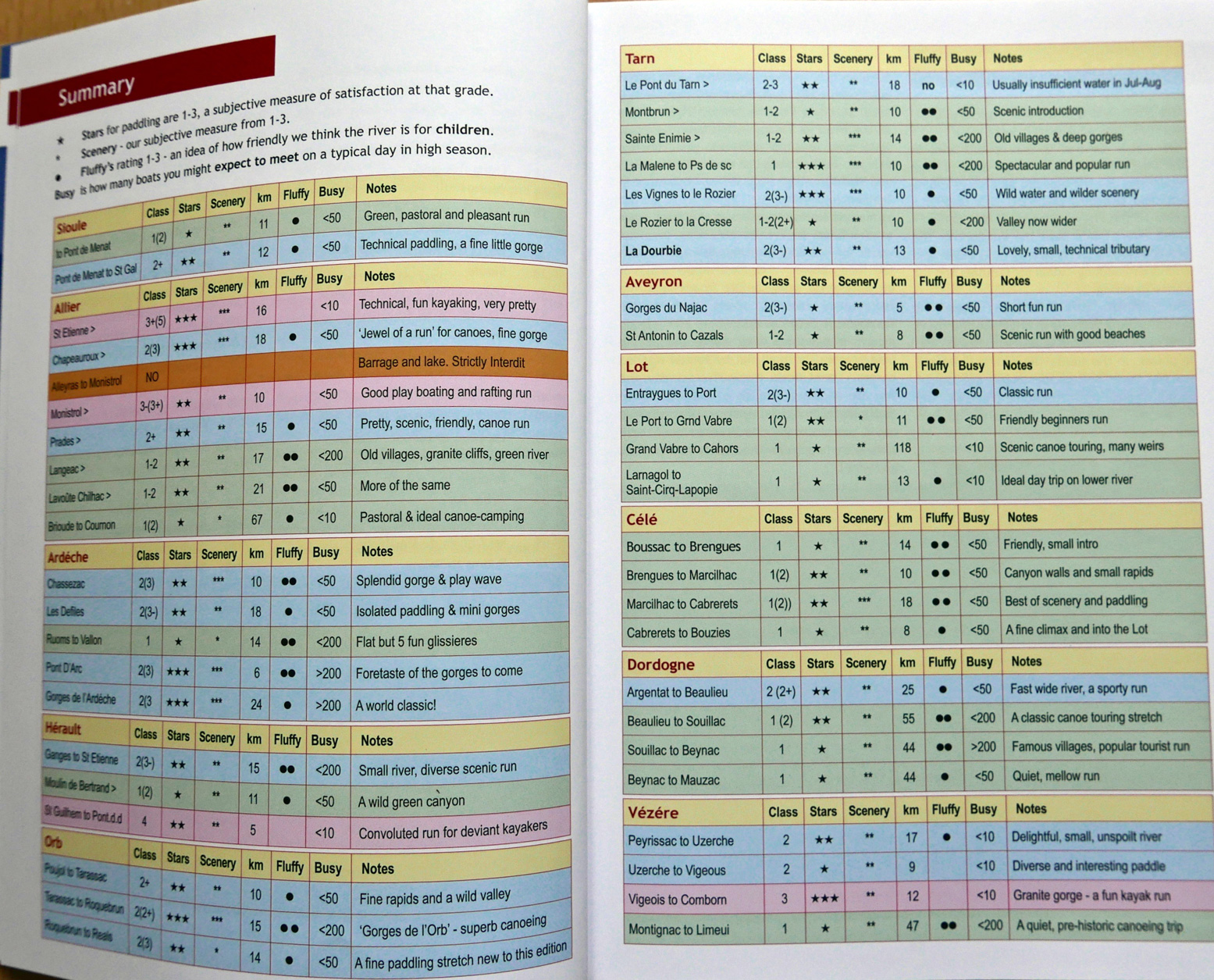
[Best Canoe Trips in the South of France] is written for the recreational canoeist, kayaker, or stand-up paddle boarder going on holiday to the South of France. Rivers include the famous Gorges du Tarn, Gorges de l’Ardèche, Dordogne and Lot, besides some lesser known jewels such as the Allier, Hérault, Orb, Vézere and Célé. The Massif Central is renowned for its canoeing and the rivers in this guidebook are some of the best in the world for canoe-camping. This guide book targets those rivers that have easy white water and assured water levels in the summer months of July and August, when most families have to take their holidays. New dams, reservoirs, and guaranteed water releases means that canoe tourism is now huge in the Massif Central and this guide covers over 800km of class 1-3 [rivers], with all the details needed for a fabulous and truly escapist, holiday. This new edition has details of two new rivers, 22 detailed colour maps, updated river descriptions, recommended campsites and lots of inspiring photographs.
What I think • Great selection of brilliant rivers • Loads and loads of good colour photos show how it is
• Some maps lacking in detail and consistency • Route descriptions could be more concise • Poor updating; errors on the two rivers I paddled recently • What’s with the fake cover?
Photoshop?
Review If you know the original edition (far left), first thing you’ll spot is the near-identical cover, but with scary, frothing rapids airbrushed out and a somewhat anachronistic SUP pasted on, a embarrassingly clumsy attempt to cash-in on the current SUP craze. Some of Rivers’ other publications feature very nice retro poster-style covers (right) which would have suited Best Canoe Trips perfectly. Can a non-faked image of canoeing in the Massif be so hard to track down? The book is full of them. But if you don’t know the previous edition you’ll probably not notice the front cover photoshoppery. Imagine what AI could manage today?!
Excellent at-a-glance summary of all the rivers
Inside, it’s now full colour and twin column, like a Pesda. Two small rivers have been added: the 23-km Sioule north of Clermont, and all of 13km of the Dourbie meeting the Tarn at Millau. It’s not much which proves they did a thorough job first time around, even if some descriptions were incomplete. Up front are Planning and Resources sections before getting stuck into the 11 (actually 12, with Chassezac) river descriptions. Each river still gets a rating table for magnificence, enjoyment, child-friendliness, as well as cleanliness, temperature, flow in cumecs, and busy-ness. Of these last four, the traffic is most useful for what to expect. Without lab tests, all the rivers I’ve done looked clean enough, and temperature was what it was on the day, depending on depth or season. And who but a river pro knows what ‘7 cumecs’ looks like? There must be some rationale to it, but to me identifying the locations of more easily understood river level gauges (where present) would be much more useful, as you can refer to this handy live river levelswebsite.
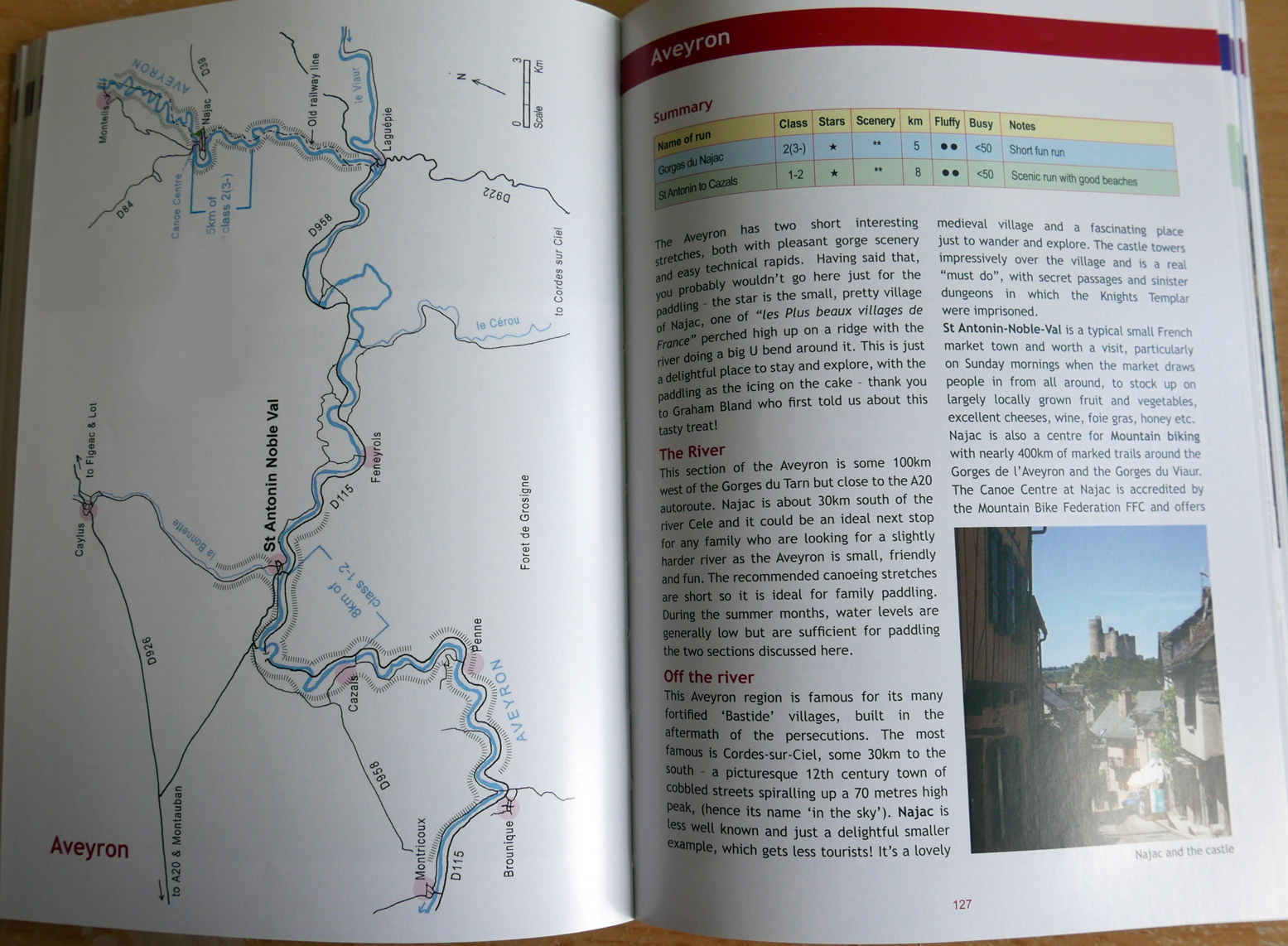
The river descriptions remain long-winded – 85km of Tarn goes on for 16 pages, albeit with loads of photo padding. It makes it hard to pin down the nitty-gritty. Headings include Camping, Off the River, Food & Drink, more Camping, then Maps & Guides. Then each suggested shuttle-able day-stage is described, some getting Summary and Description headings, some not. Boxes cover asides, others list tourist offices and campsite telephone numbers where surely websites (as in the old edition) are infinitely more useful. The ‘Off the River’ heading is a nice touch, suggesting the many other things to see and do locally, and you get a recommendation for the best IGN map/s for the river. You’ll need that because, despite a handy, ‘big picture’ river map scaled-down to fit a page, with the subsequent stage maps you’ll struggle to orientate yourself unless you keep track closely, and the important detail is rendered inconsistently from map to map. All but three of the 20-odd maps are the same as edition 1. At over 1:100,000 scale (some over twice that), the 50k or bigger walking standard would be much better, such as Chassezac on p64. Only the map for the new Sioule river shows how it should have been done: a coincidentally usable scale of 71k and each weir, rapid and so on marked with a small red dash so you know what’s coming or where you are. To a nervous newb this is important. The old maps retain tiny dashes marking such things, but in blue over a blue river with blue writing that’s hard to read.
Just follow the river you might think. But when you’re wondering just how far to that nasty-sounding weir (which turns out to be nothing), without offline GPS mapping or a phone signal, a well-drawn and detailed map with bridges and other landmarks, is so much more useful and intuitive than columns and columns of text where one drossage reads very much like another. For 20 quid I’d expect to have proper, usable maps. Full, town-to-town river descriptions would also make more sense than obscure put-in to obscure take-out. We managed fine continuing beyond the half-described Chassezac (listed under ‘Ardeche’ for some reason) all the way to the actual Ardeche confluence. Same with the Tarn: Florac to Millau is a great 3-4 days. Why not just provide a full and accurate description right through to the white water course in Millau (a fun finale!) and let the reader decide where to start and end? Whoever they sent to update the Allier phoned it in. Distances (another useful aid to orientation; easily measured online) were out. Over-emphasised descriptions of ‘blink-and-you-miss-them’ pre-industrial weirs are now irrelevant, while other chute-avoiding weirs have become fun Class 2s. There are even left/right portaging errors introduced since the previous edition. See the Allier page for more detail. The ‘fluffy-duck-mascot’ joke was done to death first time round. Unfortunately, the author still thinks it has some mileage in this edition. Oh well, chacun a son gout. The switch to colour has given the book a fresh new look, but as a worthwhile improvement, the inconsistent updating has led to a missed opportunity. It’s perhaps to be expected because, as the author hints and my impressions concur, fewer families holiday like this anymore. Holiday-makers just bundle into a rental for a day and get vanned back to the campsite. All that is a shame as without the first edition I’d have missed out on a whole lot of memorable paddling adventures in lovely southern France, one of the best paddling locales in western Europe.
FYI 2023: Not sure what or how but TiZip tell me the MasterSeal design has updated
As mentioned here, wafting down the Tarn Gorge one summer with a Watershed Chattooga drybag jammed under my knees gave me plenty of time to configure a ‘deckbag’ to better fit my needs.
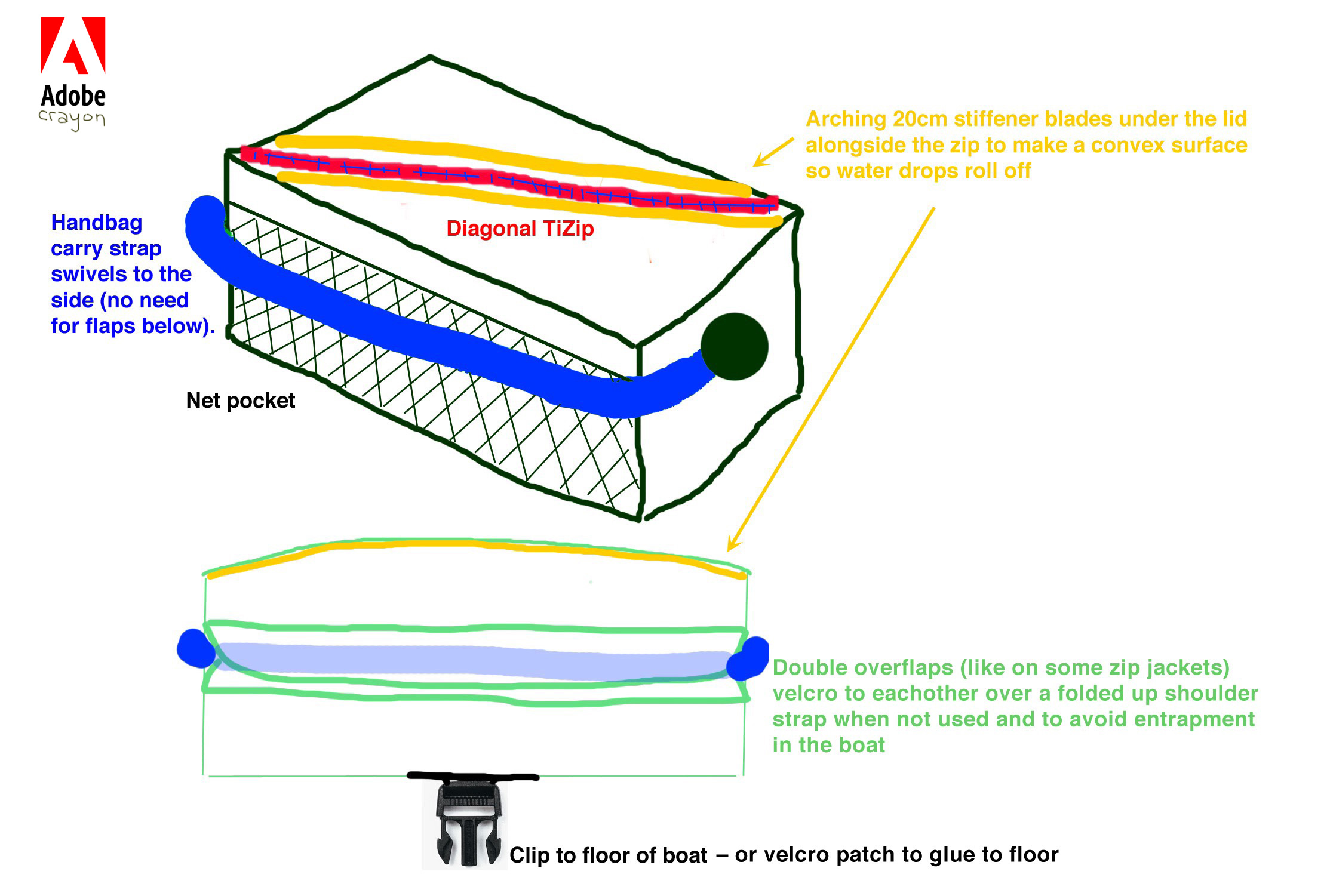
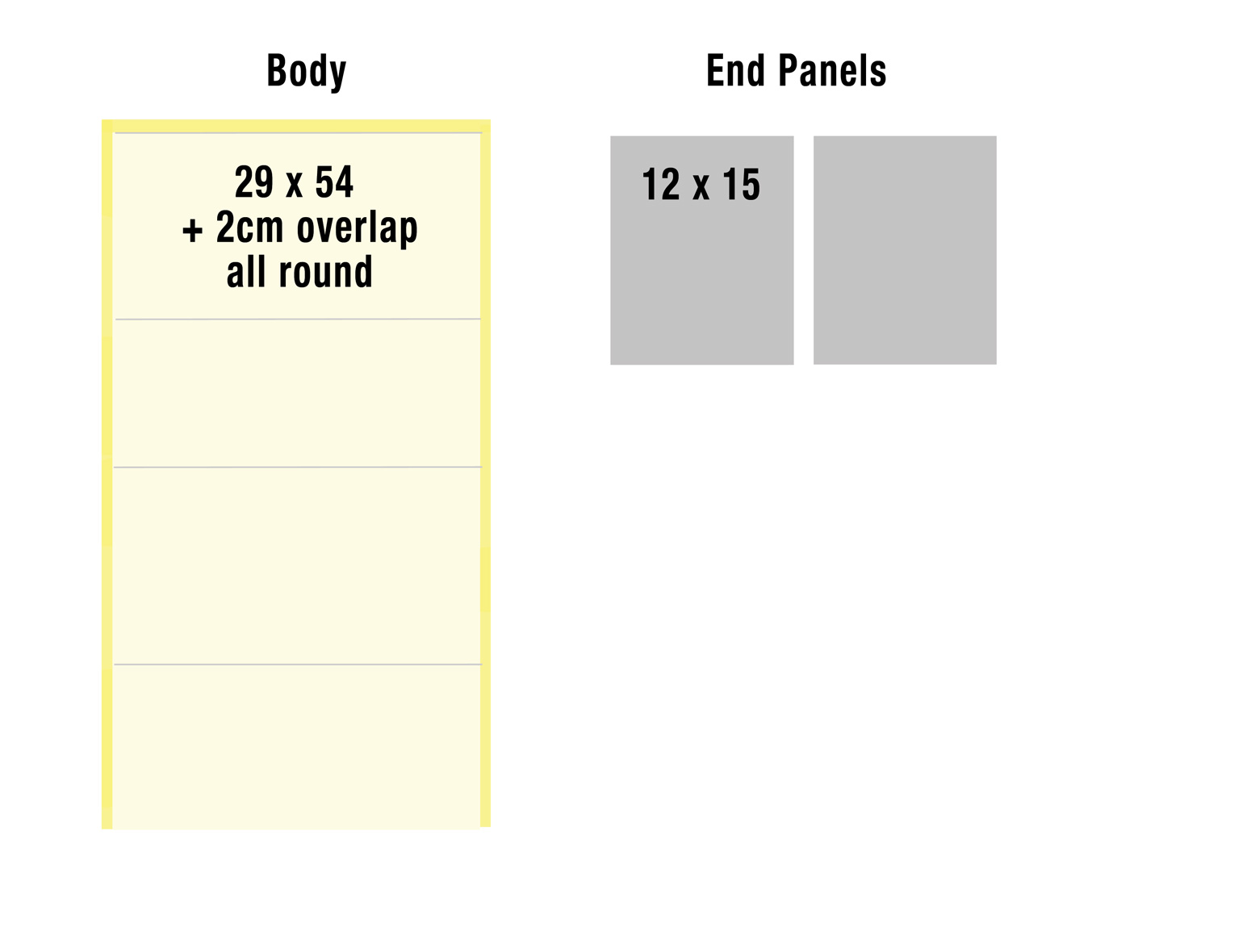
Peli cases are too heavy and cumbersome for these sorts of trips, while dependably dunk-proof – or even submersible bags like the Chattooga are too big and too fiddly to seal easily (since replaced with an Ortlieb Travel Zip). All I needed a 5-litre bag to sit on the floor below my knees for my must-stay-dries. Using state-of-the-art Adobe Crayon™ CAD software I came up with a design (above) and optimal dims of about 29cm x 15cm wide by 12cm deep giving about 5 litres volume. Part of the attraction of this project was learning to heat-weld TPU fabric with a small iron. It looks so much easier and less messy than glue. Or so I thought.
Before I got – quite literally – stuck in, I considered adapting some of the many heavy-duty SealLine PVC roll-top dry bags I have knocking about. All I needed to do was stick a zip in, then somehow cap one end with a round piece of something. I may well try that later but what I was actually aiming for was a stable box not a cylinder to sit securely on the floor of a boat.
Heat welding: important to understand PVC plastic can’t be heat sealed with an iron because it’s double coated. With double-coated anything (TPU, PVC, etc) the hot iron will easily melt the coating and make a right mess. Done this way you need to use a heat gun and a roller (left) which requires three hands. Or use single-sided PVC seam tape. Or of course, use glue.
The body of my Pakbag could be made from single-coated yellow 210D packraft hull fabric, with the near-square end panels in ‘both-sides-coated’ 420D black packraft floor material. At 650g/sqm (27oz/sq yard) this stuff is good and thick. The thin yellow is 275g/sqm.
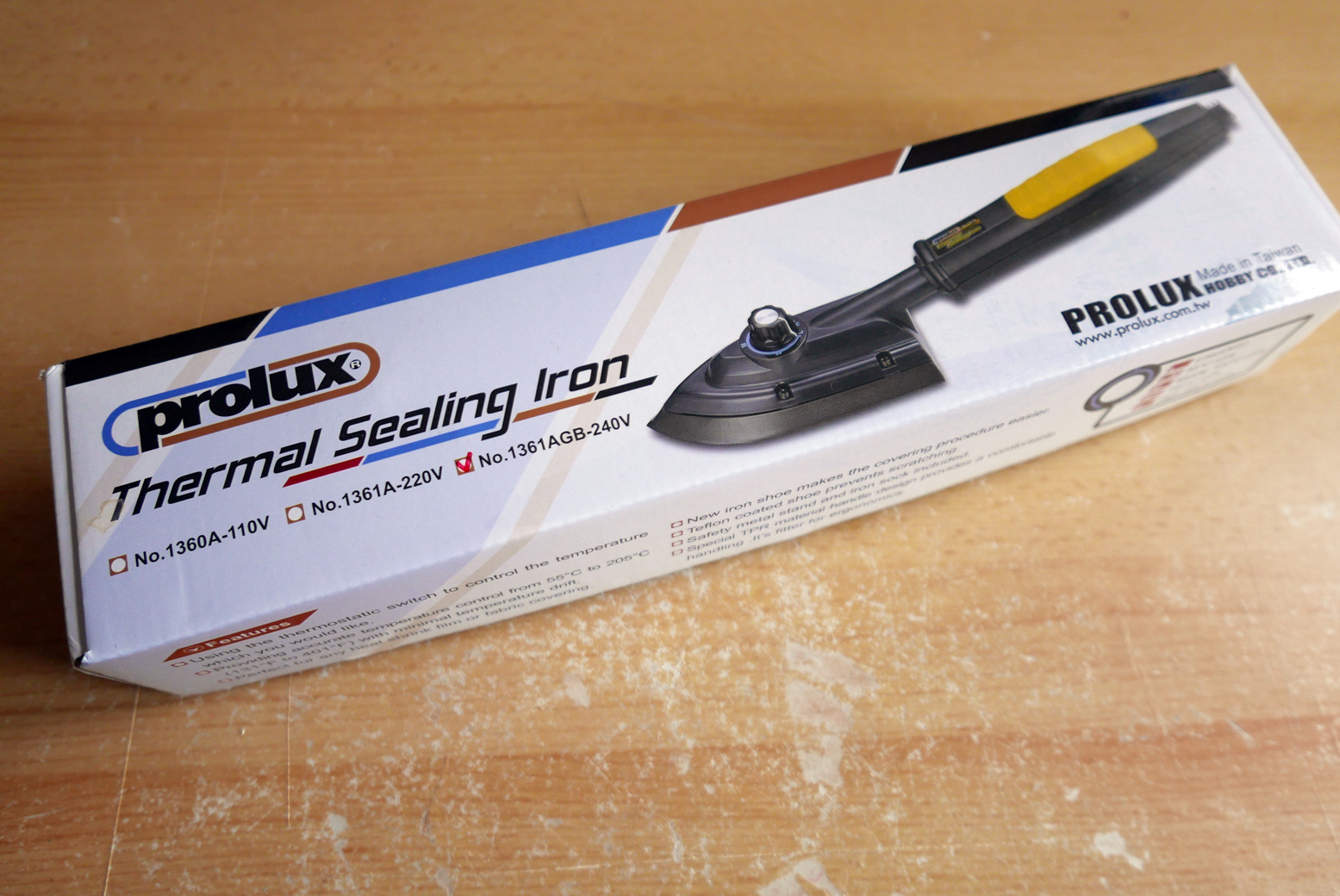
Half a metre minimum order of each cost €10 and €20 respectively from extremtextil in Germany; a very handy resource for the home fabrician. What you see left is what’s left over. Extrem were also one of the only places I found who’d sell a couple of 23-cm TiZip MasterSeal 10s for €23 each. Rolled delivery cost a bit more but avoided folds and was very fast. In the meantime I bought a used Prolux iron off ebay for 20 quid and already had some scissors, a table, a ruler and a knife.
I’m not so skilled at home handicrafts so expected to make a right mess of things first time round, and was prepared to make a second bag. The next best thing I could do was think carefully before diving in like Edward Scissorhands at a confetti convention. One smart decision I made was to use a wooden mould to form the bag around. I could have laboriously hand-sawn some kitchen-shelf leftovers down to size, but after more ebaying found a pair of hobbyist’s knick-knack balsa boxes which added up to 15 x 12 x 30 stacked. As mentioned, you can’t iron on the coated side of TPU fabric; the coating will melt all over your iron before it bonds to whatever’s underneath. You can only directly heat an uncoated surface while pressing down the coated side which melts to the corresponding panel – coated or uncoated.
You can learn a lot from the DIY Packraft website. Lord knows how these guys manage to make packrafts from a roll of raw TPU. There can be no doubt that my attempt would end up looking like Picasso in an abattoir, but a dinky, curve-free pakbag ought to be within my abilities.
They mention the need for an iron with an adequate and consistent spread of heat up to around 220°C. Rated at 205°C, my cheapo Prolux was not in this category. I understand model makers find them ideal for applying thin transfers. For TPU work you need an iron with more poke, costing at least three times as much. I practised joining 210D to 210D, but sealing was far from instantaneously miraculous. It took repeated ironing and pressing, as well as spot heating to get a full seal with virtually no air gaps or lifted edges. You could then peel it apart if you got an edge up, but you certainly couldn’t pull it apart. I thought maybe the coating may be too thin or once melted was gone for good, but it’s probably just my crap iron.
For the end panels you need to seal 210D on to the thick black 420D. The box mould really helped to make a neat-enough job. One interesting observation about joining fabrics by sewing or heat-welding is that millimetre-precise measurements aren’t critical as they are with wood or metal. I took more time than I needed cutting the exact forms and trying to get precisely perpendicular edges. A big metal set square may help, or you can find stuff round the house – in my case, some square glass bathroom scales. Another tip is arrange something sticky under your cutting edge ruler so it doesn’t slip as you slice hard to get a full, straight cut.
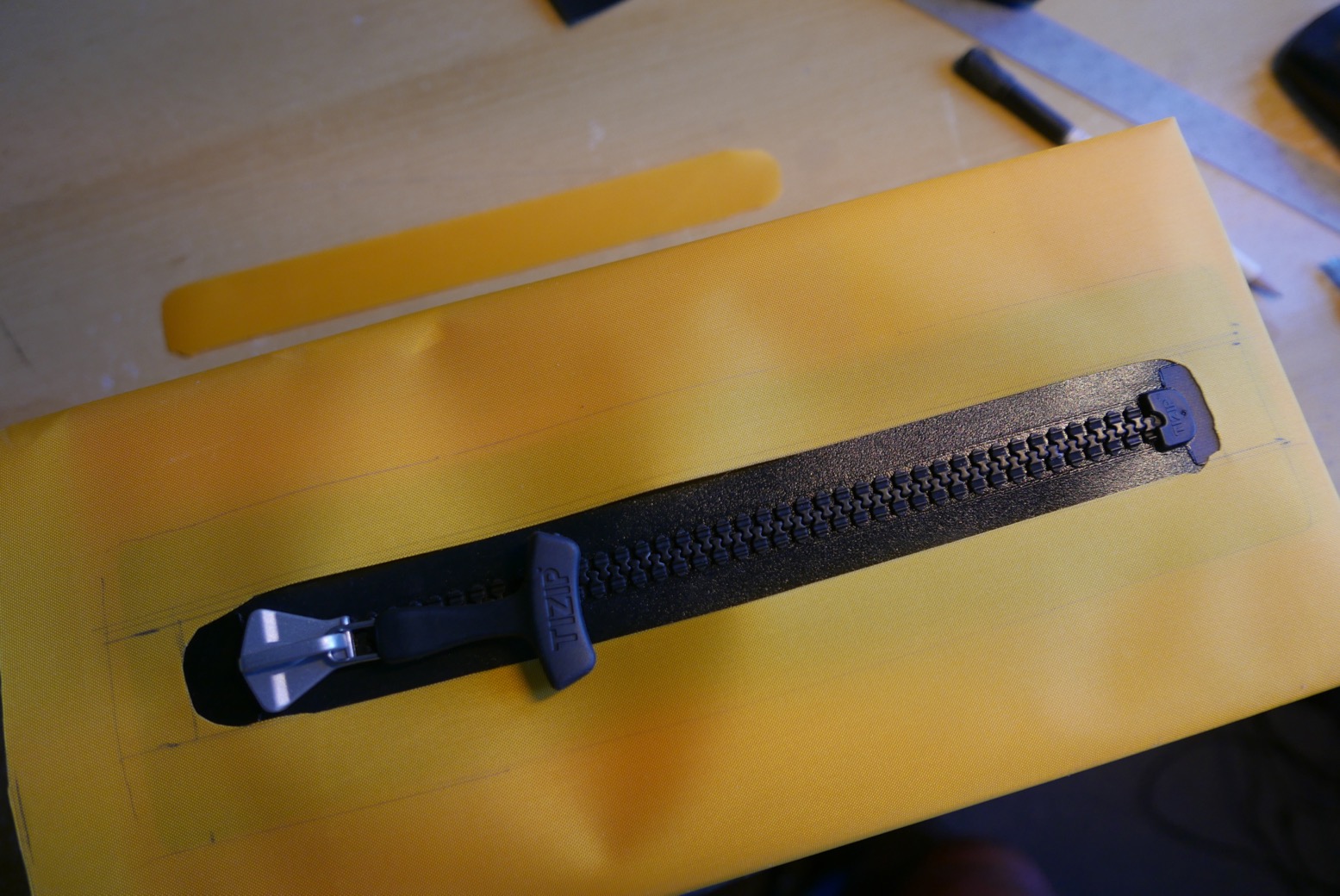
The length of the bag is partly governed by the available zip size. The 23cm MS10 Tizip which extrem sell is presumably used as a relief zip on men’s drysuits, but for a bag has a minimally useful aperture of just 19cm. The next size they sell is a massive 71cm. They must make TiZip sizes in between (for example for packraft cargo hulls), but good luck tracking them down online.
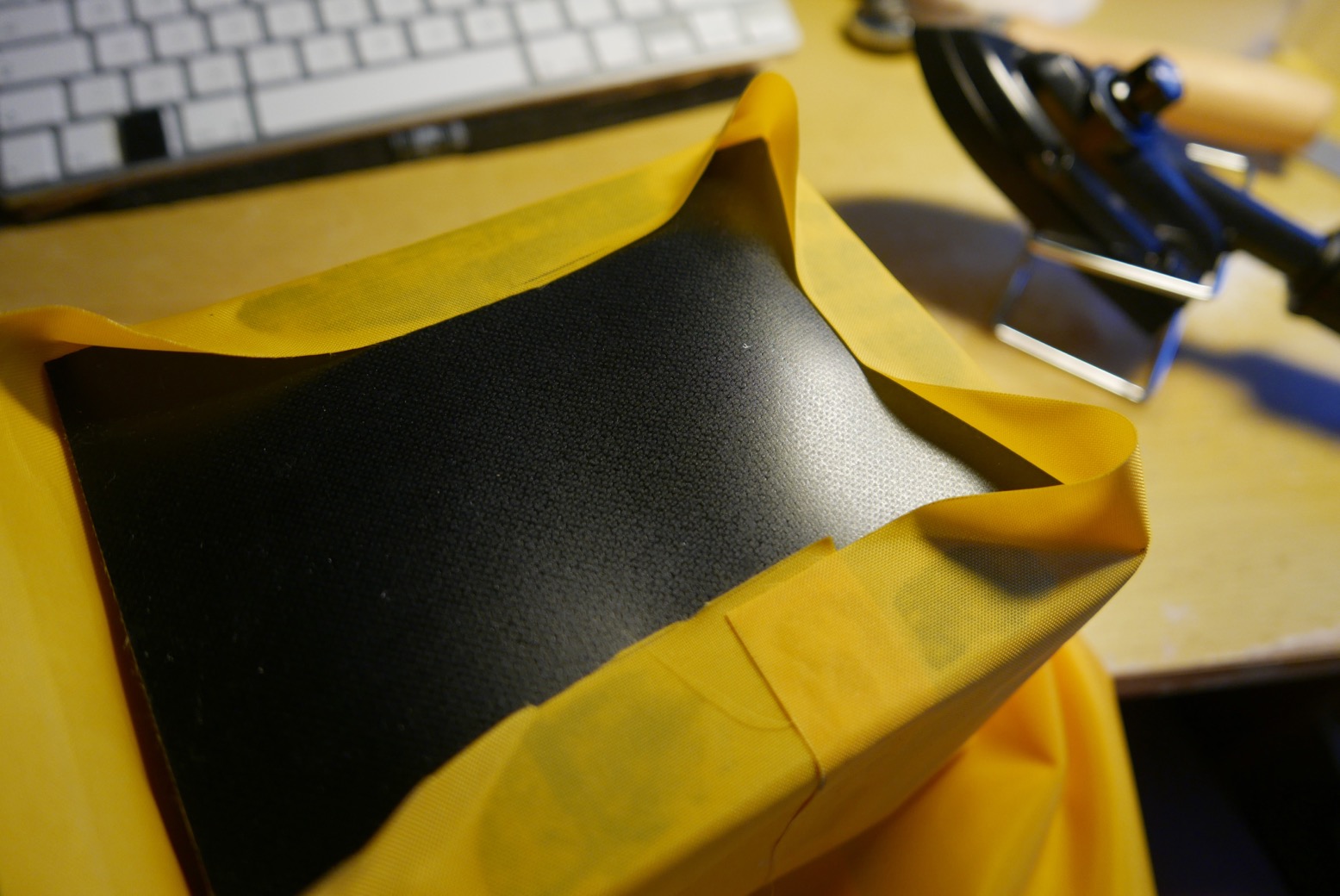
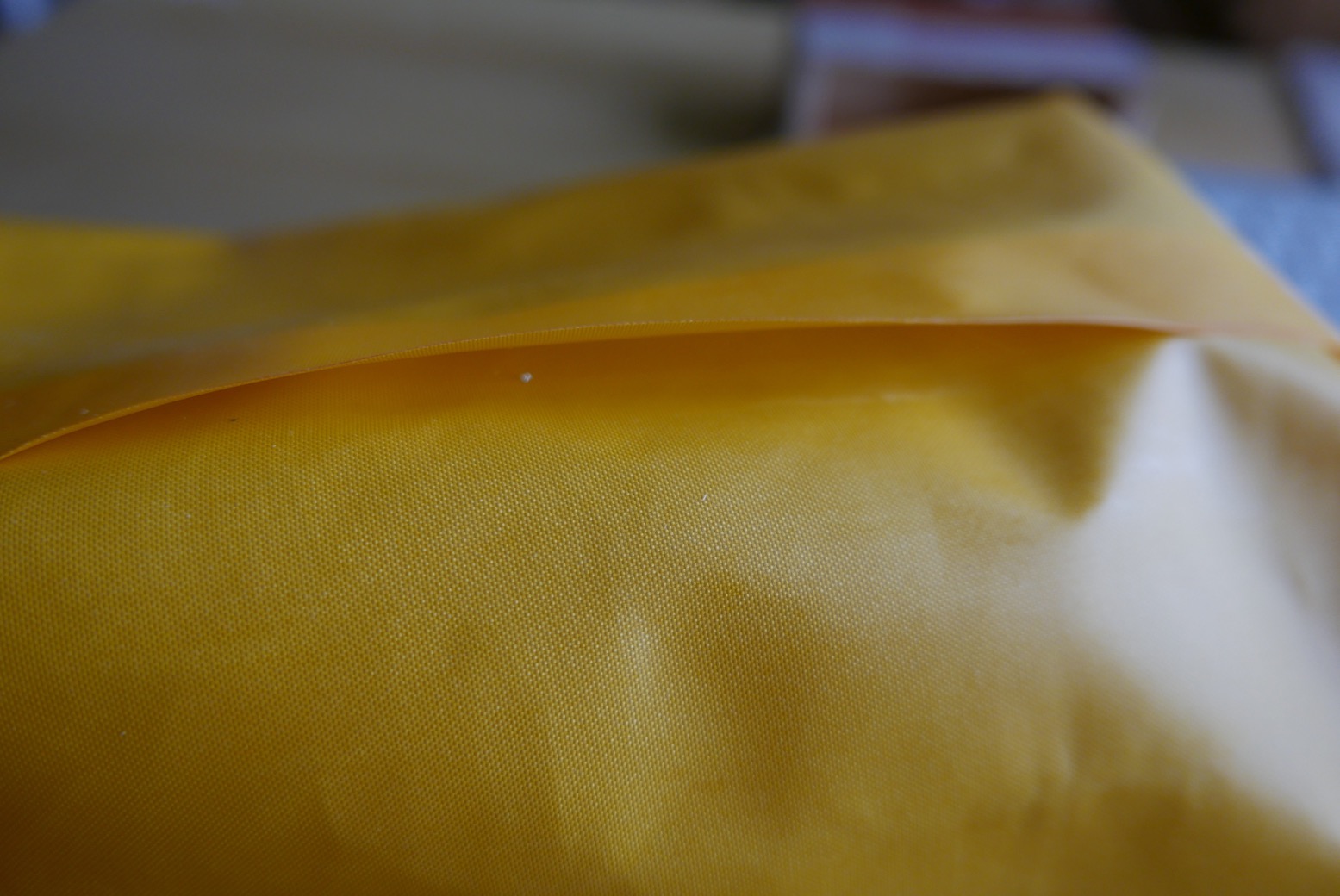
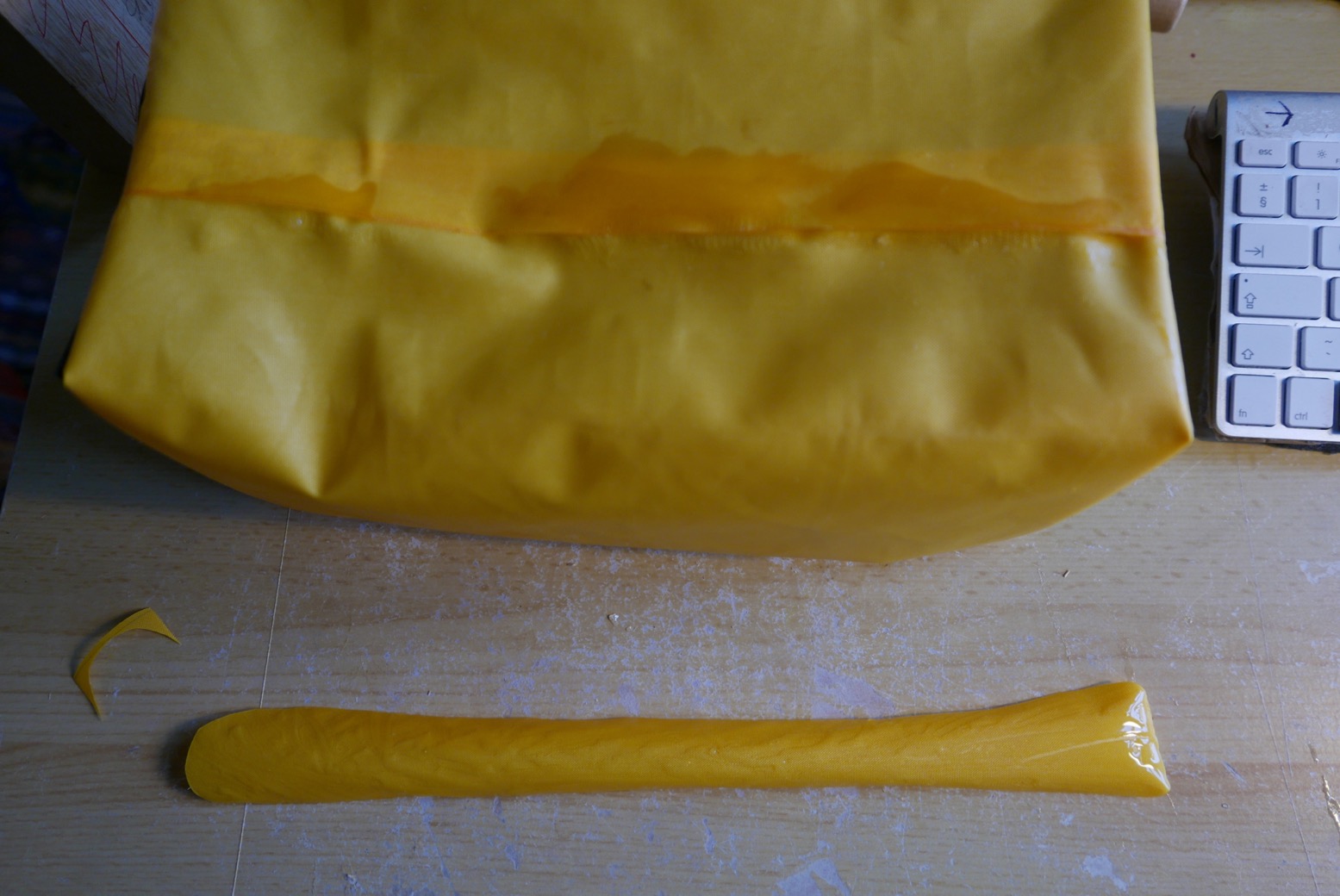
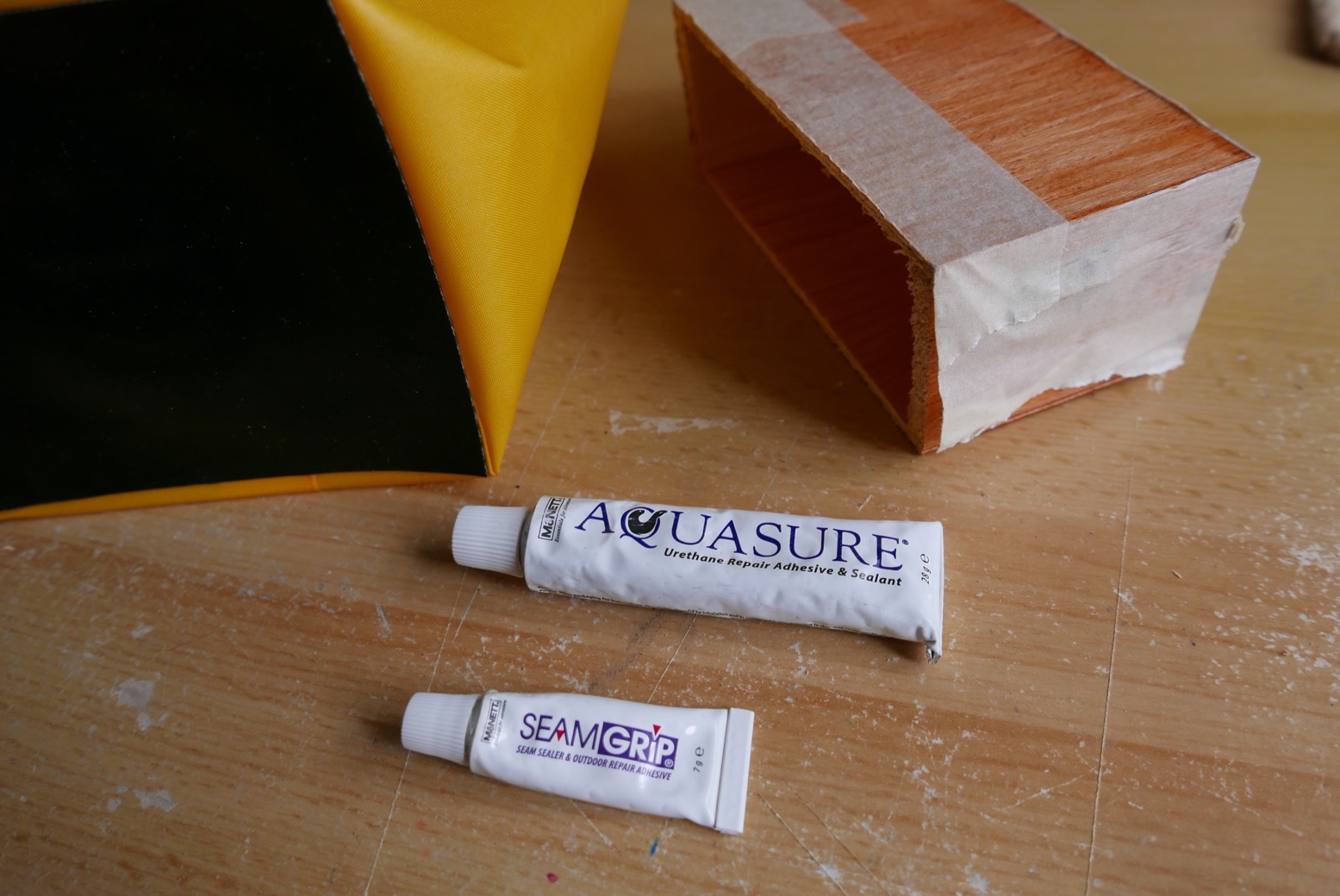
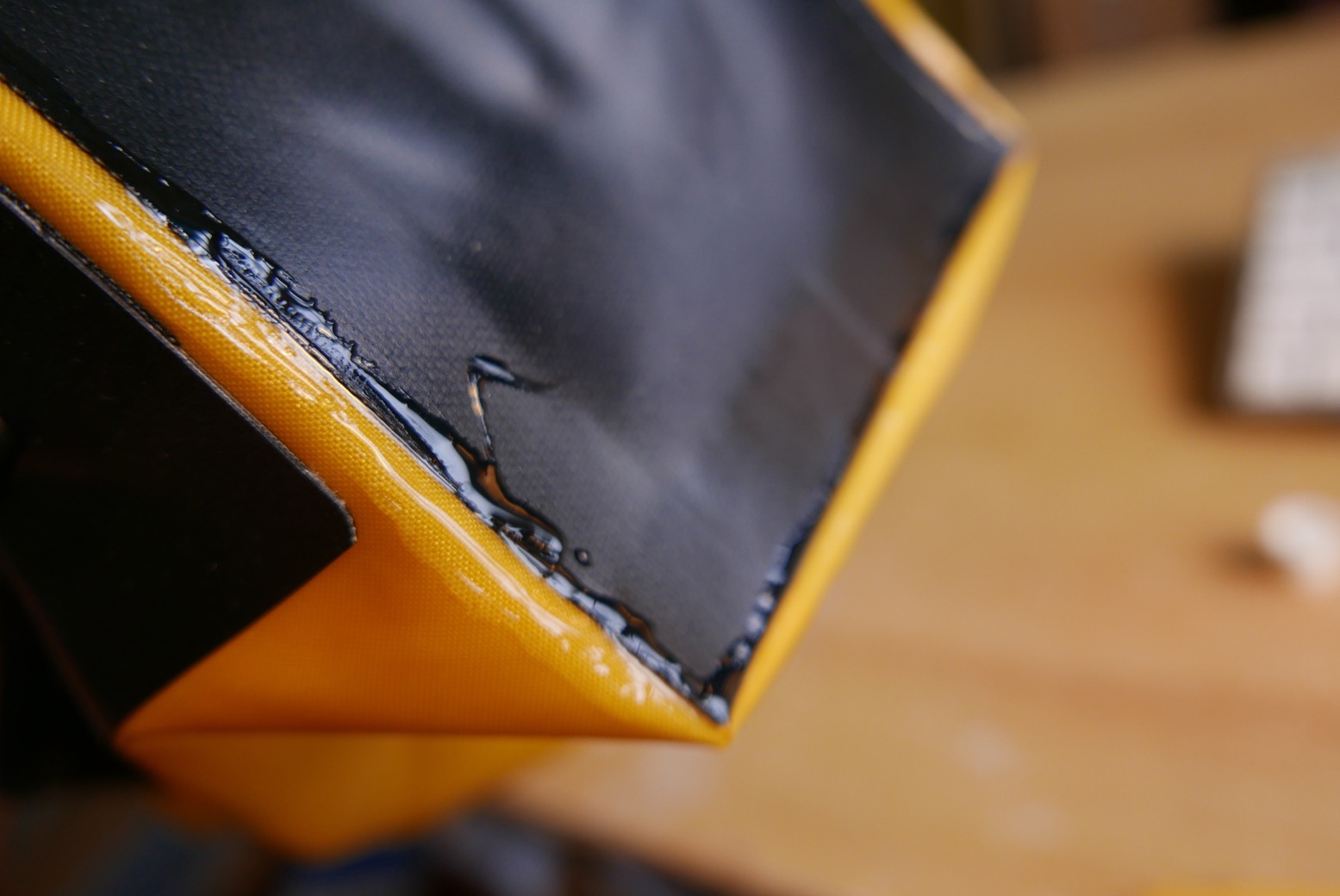
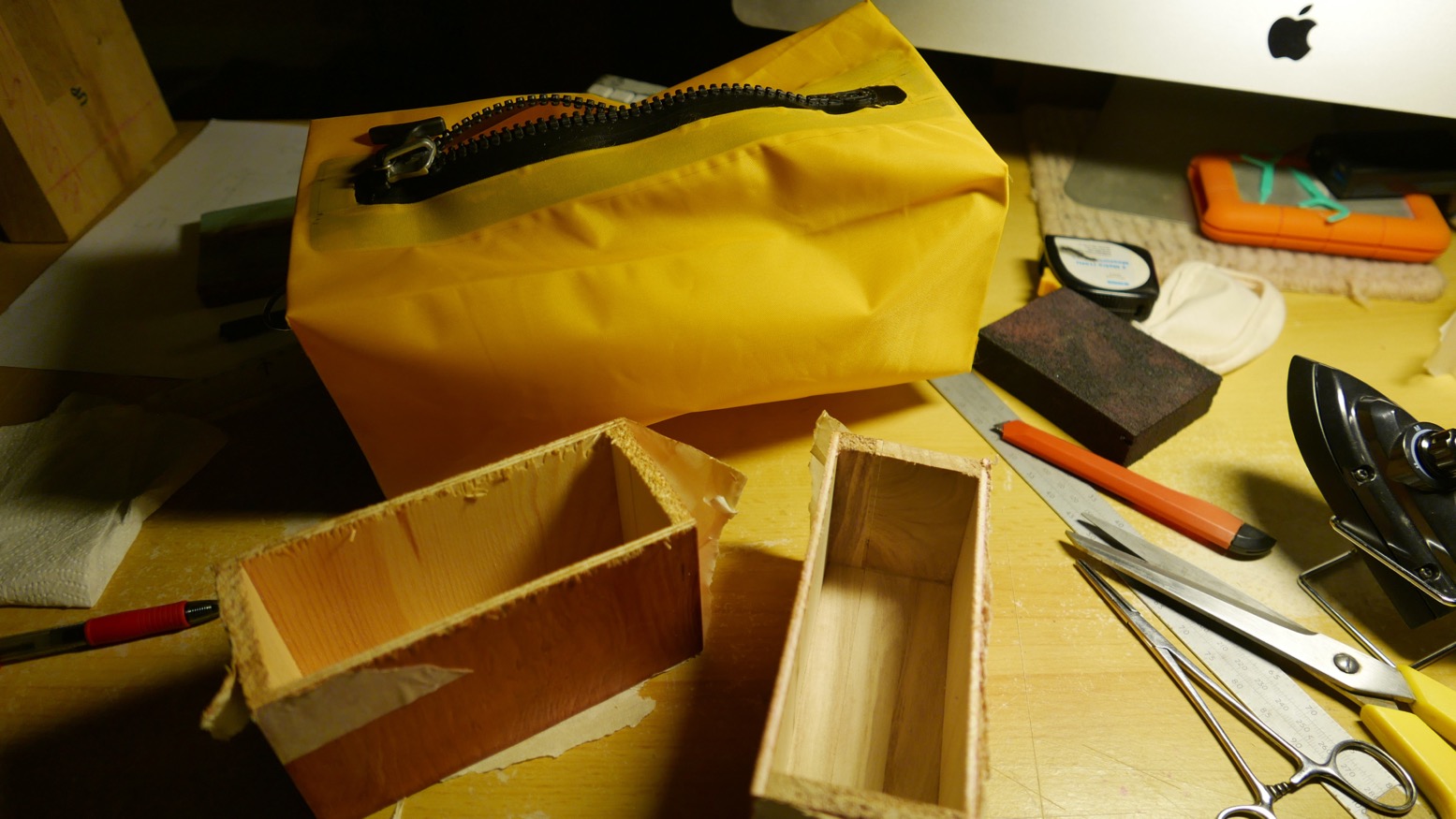
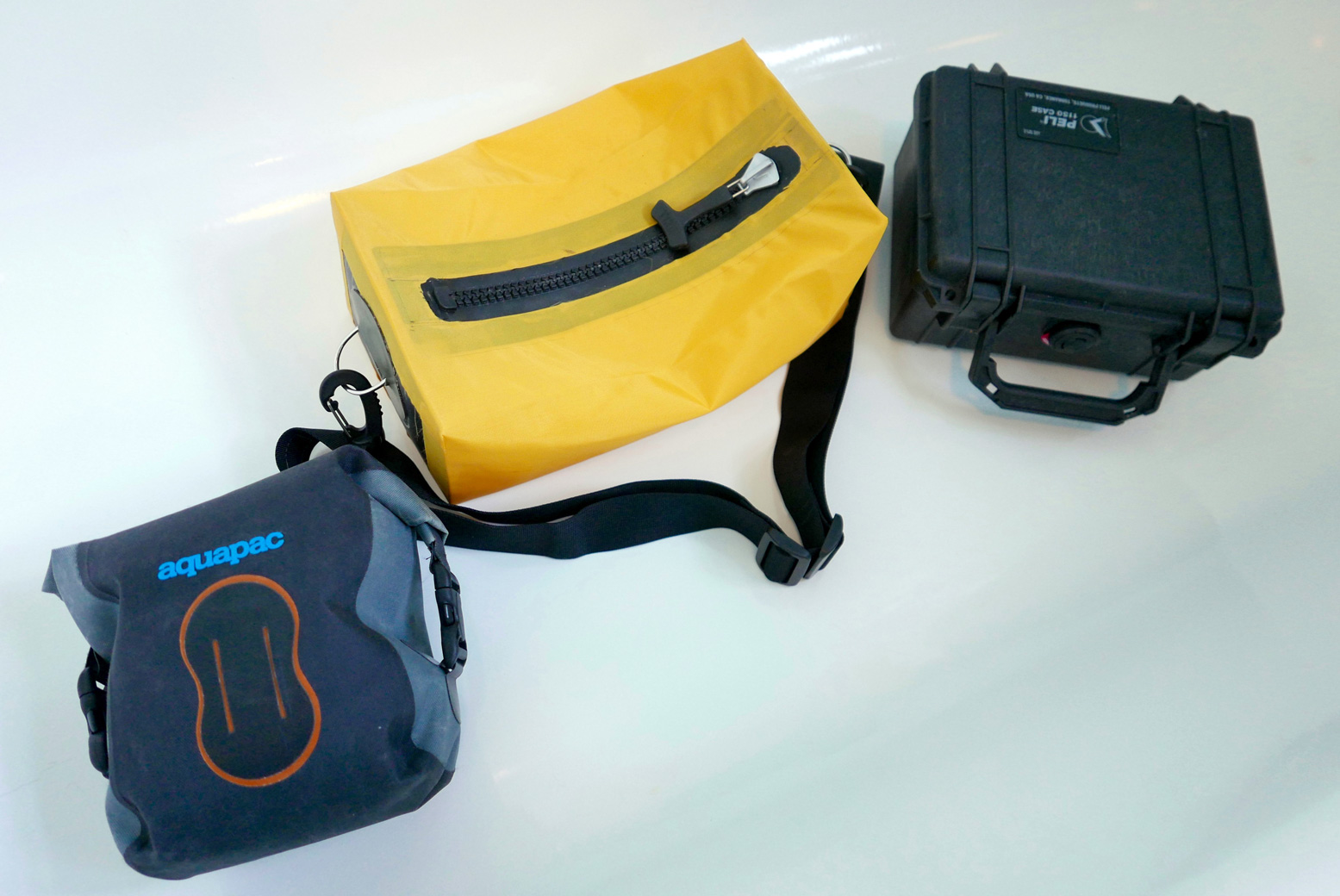
First job was wrapping the bag body panel round the box mould and sealing it. Cue endless to and fro with the iron to try and get a complete seal before I gave up and accepted I’d glue up the gaps later. Looking back, I should have made this join on the top of the bag, either side of the zip. Barely two inches of yellow to yellow sealing required here. Now I know.I dropped a black end panel on to the end of the box mould.and welded down the bits between the corners.Then I made an incision at each corner, pressed the flaps down over each other and welded on. Good to know the 210 welds much better to the thicker coated black stuff.Sealing wasn’t perfect but all along I expected to have to hand seal all joins, and certainly all corners with Seam Seal.Before sealing the other end, I cut a slot for the zip.Then ironed it down. Again, the thick coating on the broad zip sides made good adhesion easier to achieve.I stuck a home-made D-ring on the finished end. I actually needed this to pull the bag off the tightly fitting box mould before doing the other end. This requires sawing an end off the box so it can be removed through the zip hole after butting up against the unfinished bag end to support firm heat welding.Oh dear, look at the state of that floor seal inside the bag. I went over it again with the iron, then filled up the gaps with glue.Then I stuck the zip cut-out over it for good measure. Once inverted, I did the same on the outside for more good measure. It’s not pretty but it ought to seal.With the bag still inside out, I went round the yellow-to-black joins with Seam Seal. It’s like Aquasure/Aquaseal, but runnier and takes a long time to dry.Beautifully sealed seams. I should get a job at Alpacka.The bag turned right way out. I’m amazed that it looks less crap than I expected. No need for stiffeners; as hoped, the 420 end panels retain the boxy shape. The box mould (sawn off bits in the foreground) helped greatly in making a tidy form.Without the strap the bag weighs 158g or 5.5 oz.Completed Pakbag alongside the Aquapac and a Peli 1150.Pakbag, with a foam floor panel to keep above any moisture. A sachet of silica crystals may help humidity, as does TiZip silicon lube for the zip end. It passed the submersion sink test.
Several features are omitted from the Adobe Crayon blueprint at the top of the page:
• The overlap sleeve on the side to contain the shoulder strap to avoid entrapment. On rough water I’ll just unhook the shoulder strap and stash it
• Otherwise the full-length shoulder strap can adjust down to ‘handbag ‘length so there’s less is lying about
• No side net. Would still quite like this but not sure how to do it neatly
• TiZip is not diagonal – not important – but the arched stays idea underneath it may be. I noticed in France under the knees gets a lot of drips off the paddle (PSZ; right) which can get in when you open up. Convex top would be good but a shake of the bag may thrown off excess drips before unzipping
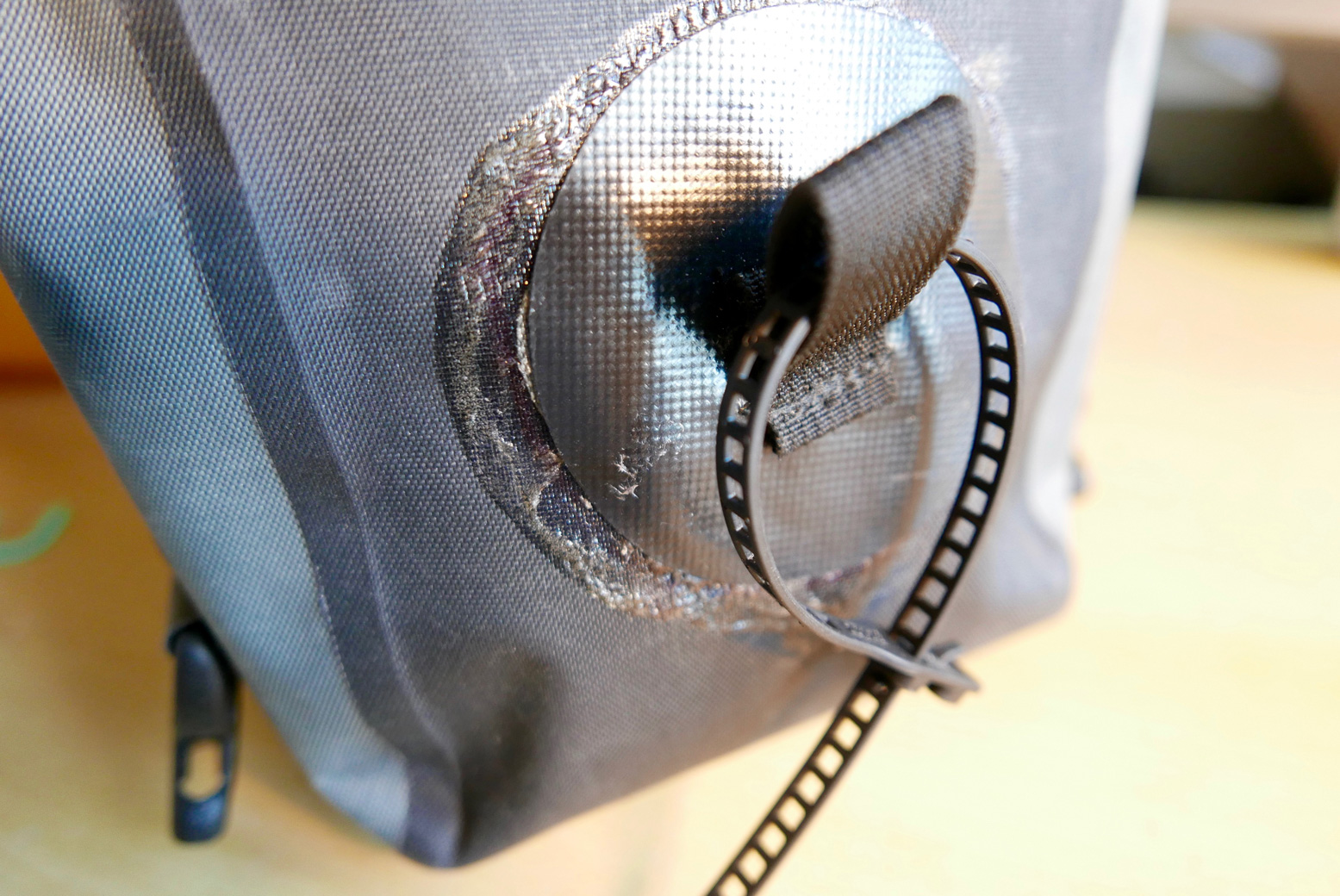
• Need to find a way to attach it to the packraft floor. Velcro might be low profile but with the repeated force of pulling apart, I’m not sure the shiny-backed stuff I have will glue to the bag or the floor well enough, even with proper two-part glue. So Ill just clip one of the strap rings a D-ring glued on, mid-floor
A few months later… using the Pakbag
After paddling the Wairoa River in New Zealand as a day trip, I can boldly claim my MYO Pakbag is fit for purpose. It’s just the right size for a water bootle, camera, GPS and wallet, even if the easy-to-use zip is a tad short for easy access. One thing I didn’t appreciate is that, slung over the shoulder while sat in the boat, the bag is still handy to access but keeps off a wet floor and is always attached to you. No need to think where it is.
Sadly my glue or gluing skills are not so fit for purpose. I need to reglue the strap end-rings and a couple of corners. This time I’ll probably use 2-part glue which I know will tear off the coating from the fabric core before it separates from what it’s glued to.
What I’d really like is for someone to make this properly. The difficulty – as possibly mentioned above – seems to be that anything with TiZips requires the consent and approval of TiZip Inc before they supply a zip. It’s a way of ensuring a proper application to their tight specs is done so that their reputation is not harmed. Which is why many TiZip products, like my Ortlieb Travel Zip bag are unusually expensive. You’d think there must be alternative or knock-off TiZips around; I’m pretty sure I searched and searched.
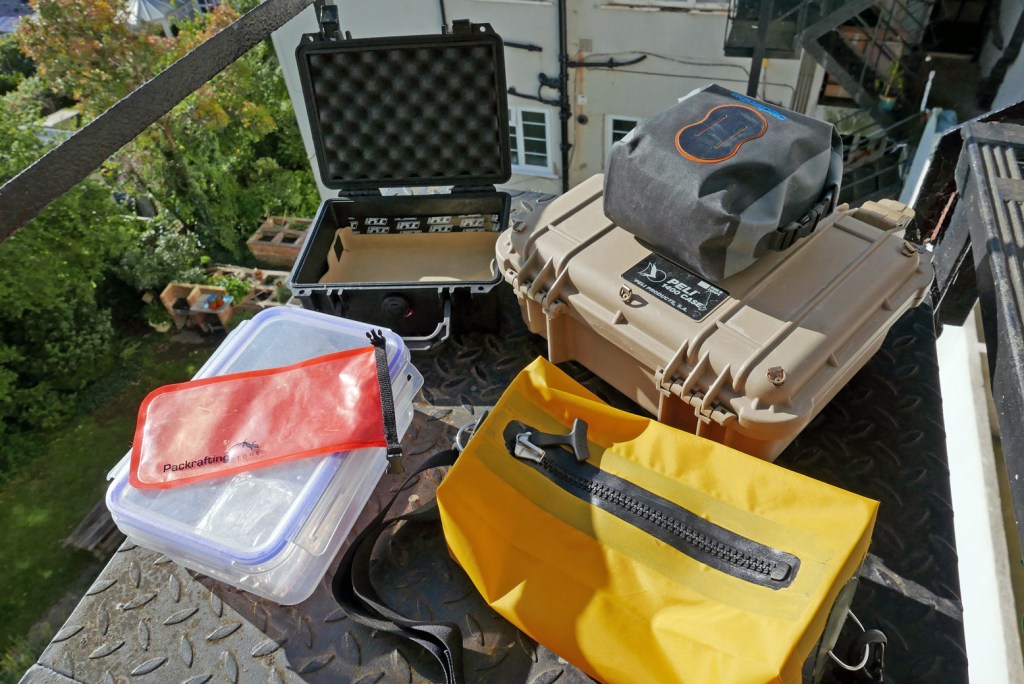
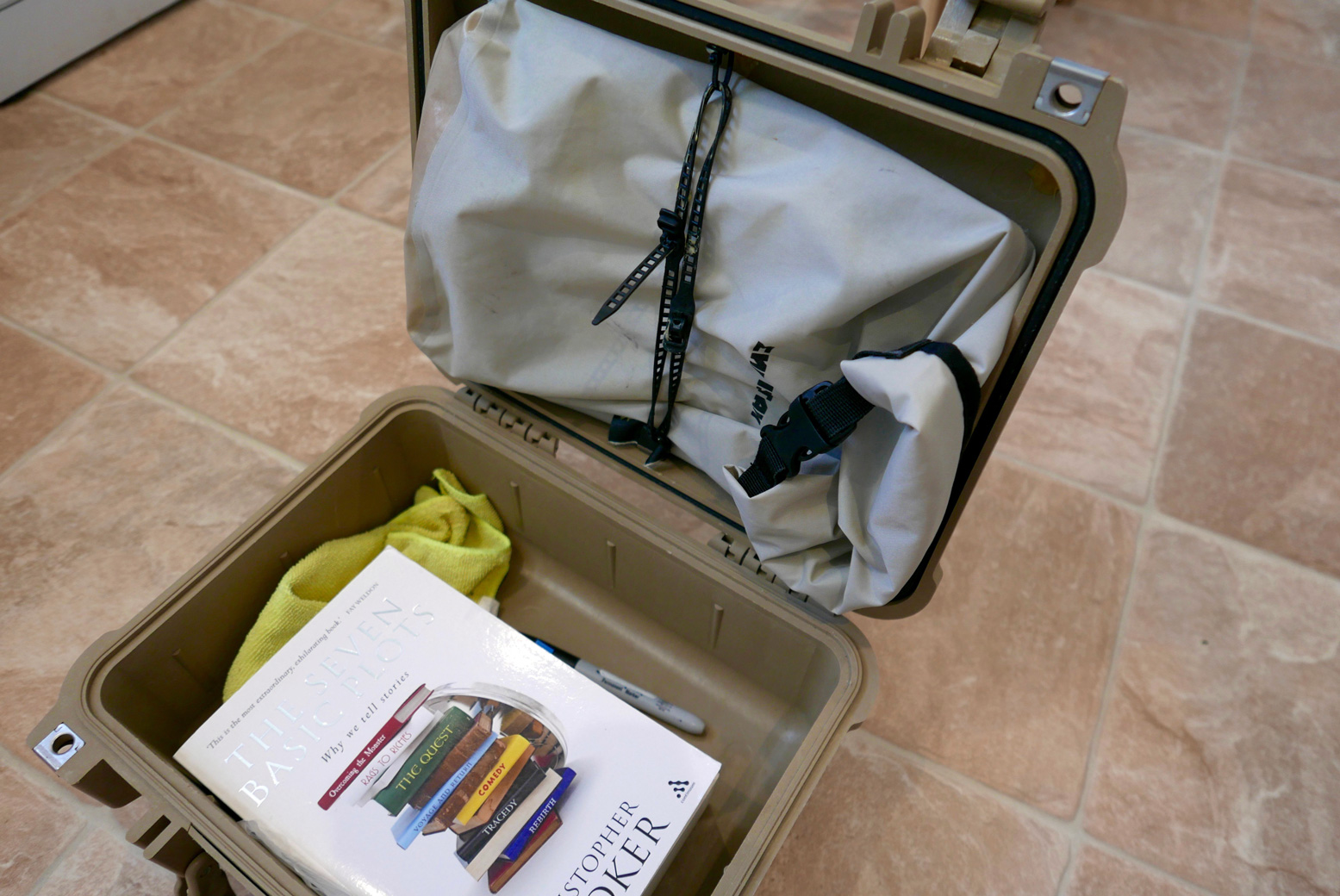
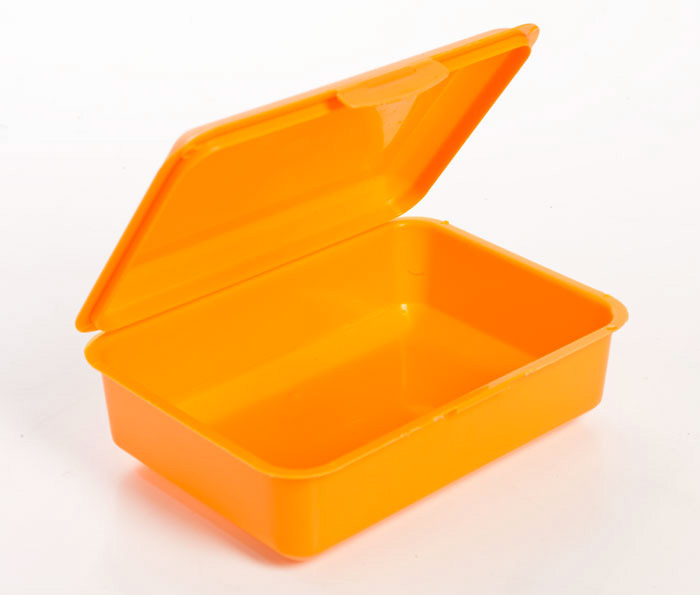
Clockwise from top left: Peli 1150, Peli 1400 with Aquapac camera bag on top, my yellow Pakbag; roll-top phone pouch; four-clip food container.
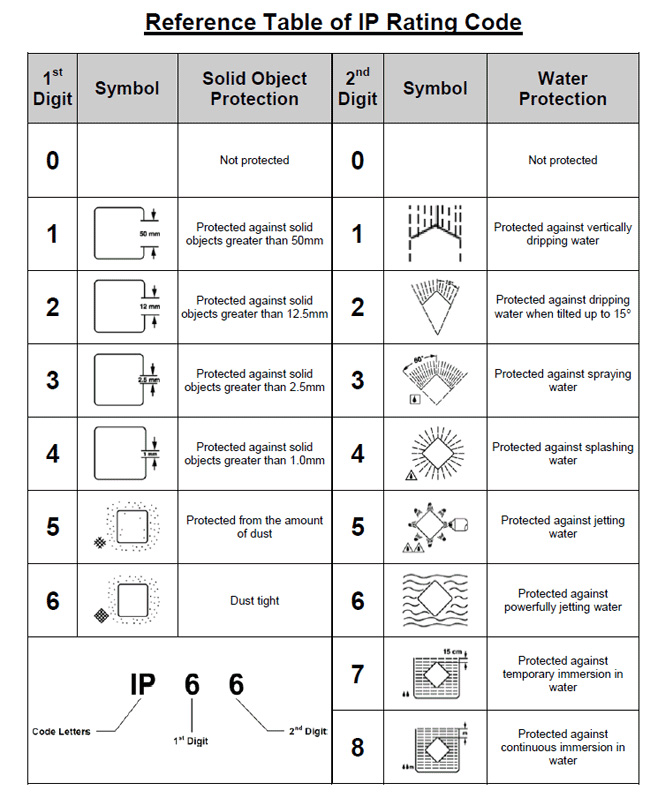
Whether on day trips or overnighters, how do you organise easy access to regularly used items and valuables, including stuff you want to carry when away from your packboat? I’m talking something capable of handling less than flat water, rated at least IP65 (right) to stash the wallet, phone, tablet, camera, travel docs, ammo and snacks. Stuff you want to keep dry in case of swamping or capsize, as well as being easy to get to on the water.
For walking or cycling, a daypack does the trick but that doesn’t really work in a paddle boat. The pockets and pouches in your pfd (right) have their uses, but they’re not waterproof. You want something that’s airtight when briefly submerged while easy to access on the water and portable off it. It’s actually quite a tall order.
Anfibio smartphone case. Submersible and keypad works through the plastic
Things like paper maps and nav aids (GPS, compass) I keep in a separate waterproof pouch like the SealLine (left) with a double ziploc seal, even if this is yet more clutter knocking about around your legs. Since I took that photo I’ve mounted a compass on the side of my Seawave IK – very handy as it’s always there at a glance. And I now use a IPX7-rated Garmin Montana with loads of mapping space, though I prefer to keep salty seawater off it where possible.
Waterproof waist bags A small, roll-top waterproof waistpack actually ticks many boxes as long as you don’t mind being attached to yet more clobber. There are quite a few out there between 2 and 6 litres, from OverBoard (2 sizes) to Aquapac and the bigger SealLine. The good thing is a waistpack sits up on your lap, out of the water and the paddle splash zone (PSZ), but well within reach.
The bad thing is they’re a faff to roll up and clip down quickly and reliably, and if you’re bobbing around in the water swimming after your boat you can be sure they’ll slowly leak. Read reviews and you’ll come across disgruntled accounts of ruined cameras or phones following a quick dip or even too much splashing. The problem, as usual, is the roll top; it needs to be tightly rolled down 2 or 3 times, then tightly clipped and even cinched down to the sides to make a good, dunk-proof seal. I believe a lot also depends on the nature of those sealing surfaces. As long as you avoid creases, smooth, shiny vinyl or PU pressing against the same will make a better seal than anything textured, like Cordura.
Hard cases For years the obvious solution seemed to be small ABS or polypropylene hard cases commonly used for camera gear. I started years ago with a 9-litre Otterbox in my Gumotex Sunny days (left). The Otter was lighter and cheaper than the well-known Peli cases, and with either, you know the box will be airtight, access quick enough and boxes make a handy solid footrest in an IK as well as a seat or raised surface on a beach.
After some years I changed to a Peli 1400, a bit less volume than the Otter, but a bit wider and flatter. Adding some retaining straps my Macbook Air fits neatly inside the lid (right), and below there’s room for everything I need in a day.
The only thing that spoils the Peli and similar boxes are the clamps which are hard to open or close effortlessly. Some sort of lever-arch mechanism would be better. Because of this I use the box less often than I would during a paddle. On top of that, a shoulder strap for hands-free carrying is awkward unless attachment rings are added. And at 2 kilos the 1400 is a bit hefty.
I really don’t need a PeliCase’s crush-proof ruggedness. All I want is submersion-proof airtightness up IP65 for which a lunchbox (right) or food storage box might do as well, as long as the durability and seal could be relied on.
Around the same time I got into packrafts I discovered Watershed dry bags. Most of them use an oversized rubbery zip-loc seal which is submersion-proof and therefore miles better than roll-tops. The yellow, 30-litre Chattooga (left) was also more chuckable than a hard case, made a good pillow, and for me had secondary uses for biking. It fits under the knees just about, but as many find, can be difficult to open and close. To operate smoothly and seal quickly the big seal needs lubing with 404 or silicon grease.
I finally got tired of my Chattooga’s tedious seal-closure and got a (now discontinued) Ortlieb Travel Zip (below left) for £100. It has has proved to be a perfect daybag, also at 30 litres. I’ve used this packrafting in New Zealand, motorbiking in Morocco and paddling in Sardinia. The TiZip sees to immersions and two outside mesh-zip pockets make easy access to things that can get wet. Inside are a couple of zip pockets and the carry straps come together with the clever and comfortable hard plastic handle. Add a comfy shoulder strap with a pad and you’re good to go. They seem to replaced it with a ‘40L‘ version (right) with backpack straps, but it seems to have the same dimensions as mine and so will be as good.
Camera Bags If you’re serious about paddling photos, get the best waterproof camera you can afford, like the Lumix FT7 – right – £400, or an Olympus TG5 Tough (left). You need a good one because the tiny lens must work within the housing so low-end ones are only OK while the light is good. Occasionally they’ll expose perfectly, but don’t bother the optical zoom beyond halfway unless it’s Elvis galloping on a unicorn. Any shots on this website from 2019 on, like this story, are shot with the Olympus. You can see the difference. Get one of these cameras and the whole section below on waterproof camera bags becomes irrelevant.
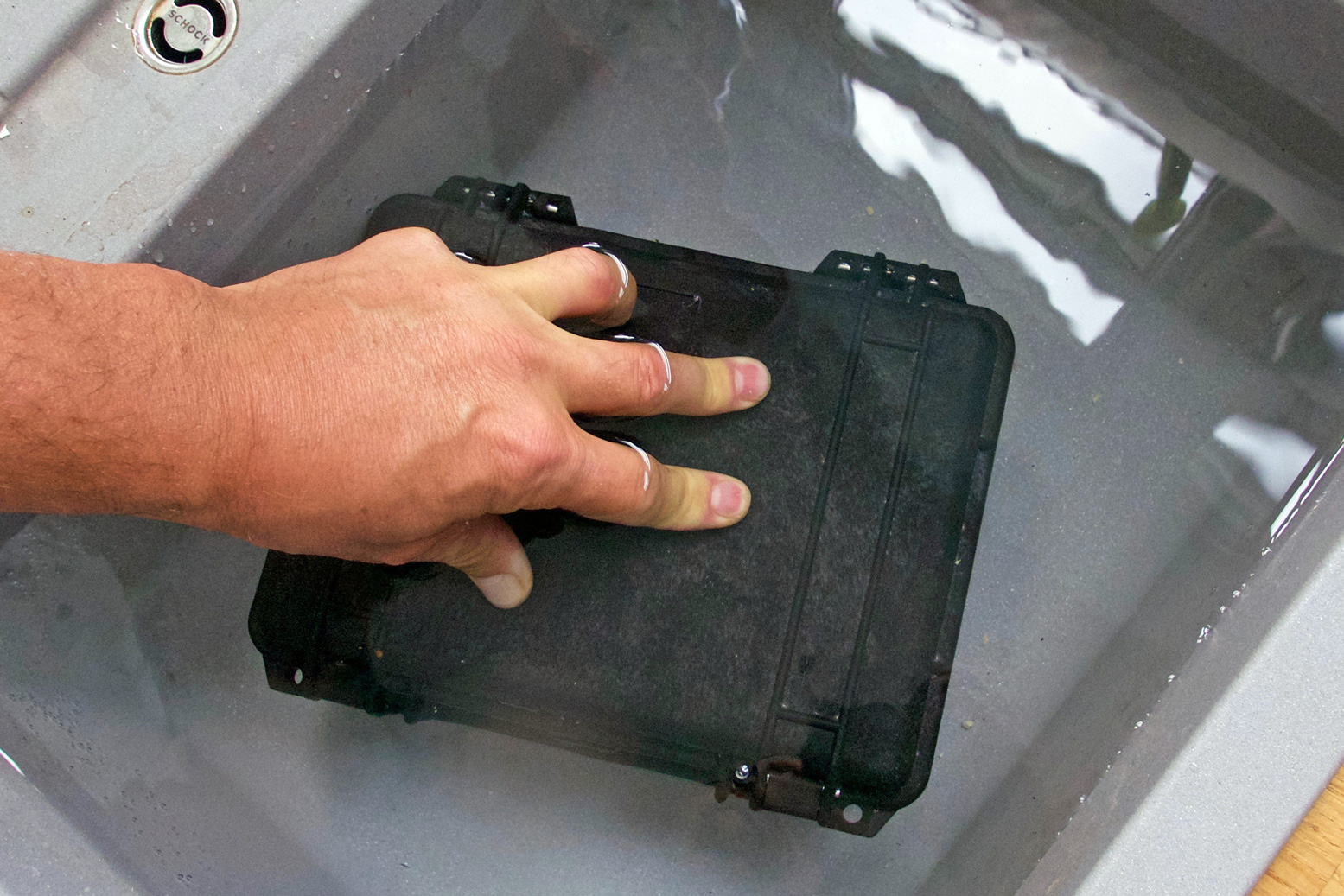
With a regular camera which I’ve also used, you need reliable water protection. I bought a used Aquapac camera bag (left). They’re just your usual roll down and clip jobbies, but inside the lid is a ziploc seal (right) which makes the bag much more dunk-proof than regular roll tops. Testing in a sink, bubbles only escape very slowly, but treading water with it attached to your waist might not end so well.
One flaw with these Aquapac camera bags are the flimsy belt loops. On mine I glued over one with a big tabbed patch (right). But really it’s too bulky to hang off a belt; I ziptie mine into one of the net pouches of my Anfibio Buoy Boy pdf, but only fold over and clip down when at sea. To properly close the seal is too much faffing and usually unnecessary – until it is.
Doing a sink submersion test (right) reminds you of the difference between hard cases and sealed bags. A rigid box is unaffected by the increased pressure of light submersion. If anything, the pressure forces the lid down on the seal even more. With a bag it’s the opposite: even a few inches underwater compresses the bag, forcing the air out through any weak point, usually the closure. This is why submarines are made of steel, not PVC fabric.
On the Tarn I found the Chattooga under my knees too big in general, and too big to exit the boat easily (or in a rush). But I sure didn’t miss lugging the hefty Peli 1400 around. I thought a lot about my needs and for the Allier came up with an interim solution: a smaller 1150-like hardcase (left) of about 2 litres volume for my essentials, including the LX. It worked OK, bar the usual easy opening issues. I knew from the Tarn what I really wanted was a smallwaterproof under-knee ‘deckbag’ with a waterproof zip closure. The zip eliminates the bulk as well as dunking unreliability of roll-tops, while the bag weighs much less than a box and carries effortlessly and comfortably on a shoulder strap. I had the dimensions and design all jotted down in my head and eventually made one because…
Waterproof TiZip bags A lot of Googling later I realised no one makes such a thing. There are plenty of TiZip daypacks like the Lowepro Dryzone range, or larger, watersports-oriented duffles from the likes of Ortlieb or Aire (Frodo; right) or SealLine, which resemble my own YKK-zipped Watershed UDB – one of my favourite bags. But none of the above are smaller than my 30-litre Chattooga.
The closest candidates I’ve found include the IP67-rated Ortlieb Trunk Bag (right and left). At 8 litres it’s a bit on the big side (add up the claimed dims and it’s more like 11 litres). And these days it only comes with a fitting mechanism to lock it to a bike rack. Very clever but this all helps raise the weight to over a kilo and price up to £98. The fabric is also not your usual pliant and mildly carcinogenic Ortlieb PVC, but resembles Heavalon (with its distinctive hexagon patterning) which Gumotex use as decking on some boats.
The Trunk-Bag could suit a lot of paddlers but as it’s made for bikes, you do wonder if it’s actually dunk-proof. Tellingly, the product description says underwater resistance: ‘lower edge of product, duration: 30 mins‘. As well all know, it’s common to be paddling a packraft with a little water swilling around the floor, so unless you slaver the base of your Trunk-Bag in Aquaseal, water will slowly seep through. Not good.
You’d imaginefly fishing waist bags, are ready for dunking. But they’re so large they often came with an added shoulder or neck harness to help take the weight. Plus it seems fly fishing gear may be to outdoor gear like smoked salmon is to fish fingers – prices are nuts. Patagonia make the Stormfront (left), a 10-litre waistpack with an added shoulder strap – yours for as little as £180! It’s just a dunking PVC handbag with a zip!
You’ll find any number of other fly fishing roll-top bags at twice the price of hiking or SUPing examples pictured above. Note that many find waterproof zips like the plastic TiZip or brass YKK stiff to operate, just as they are on a dry suit. Ideally, you need a good T-toggle and some sort of tab to pull against. And I do wonder if incorporating TiZips to the required standards explains the high prices for gear using them. The full range of TiZips is not readily sold to consumers, only to manufacturers for products which use them. Anyway, long story long, I decided it might be fun to make my own TiZip deck bag. Read about that here.
In 2005 the Dordogne and nearby Vezere were my first multi-day rivers in my Sunny IK, all helped by the discovery of the inspiring White Water Massif Central guidebook. The Dordogne was a good choice but to be honest, a bit easy. Ready for something un peu plussportif, I’d got it into my head from that book that the Ardeche was too hardcore, so I’d be better off on the less famous Allier between Chapeauroux and Brioude (big map, above).
Gumotex IC and IKs paddling pros on the Allier, 2025. And they al trained back from Brioude – respect!
In fact, as you can read here (admittedly at twice the normal summer flow; video too, as well as the video above), parts of Allier can get tricky (left; a plastic canoe folded against a rock). Even though a railway carves and tunnels right along the gorge, on the first two days from Chapeauroux there are places where the rapids come at you fast and with no easy way out of the gorge if you get in trouble. Over the years stranded paddlers have been rescued by helicopter.
Not fully comprehending all this, in June 2006 I set off from Chapeauroux in my Sunny, and at the very first bend was flapping about like a salmon with a seizure, trying to stay on track. It went on like that for a while, then eased up and actually got quite pleasant by the time I reached Alleyras for the night. This was more like it; a wild river rather than the broad Dordogne lined with droning pumps irrigating the adjacent farmland.
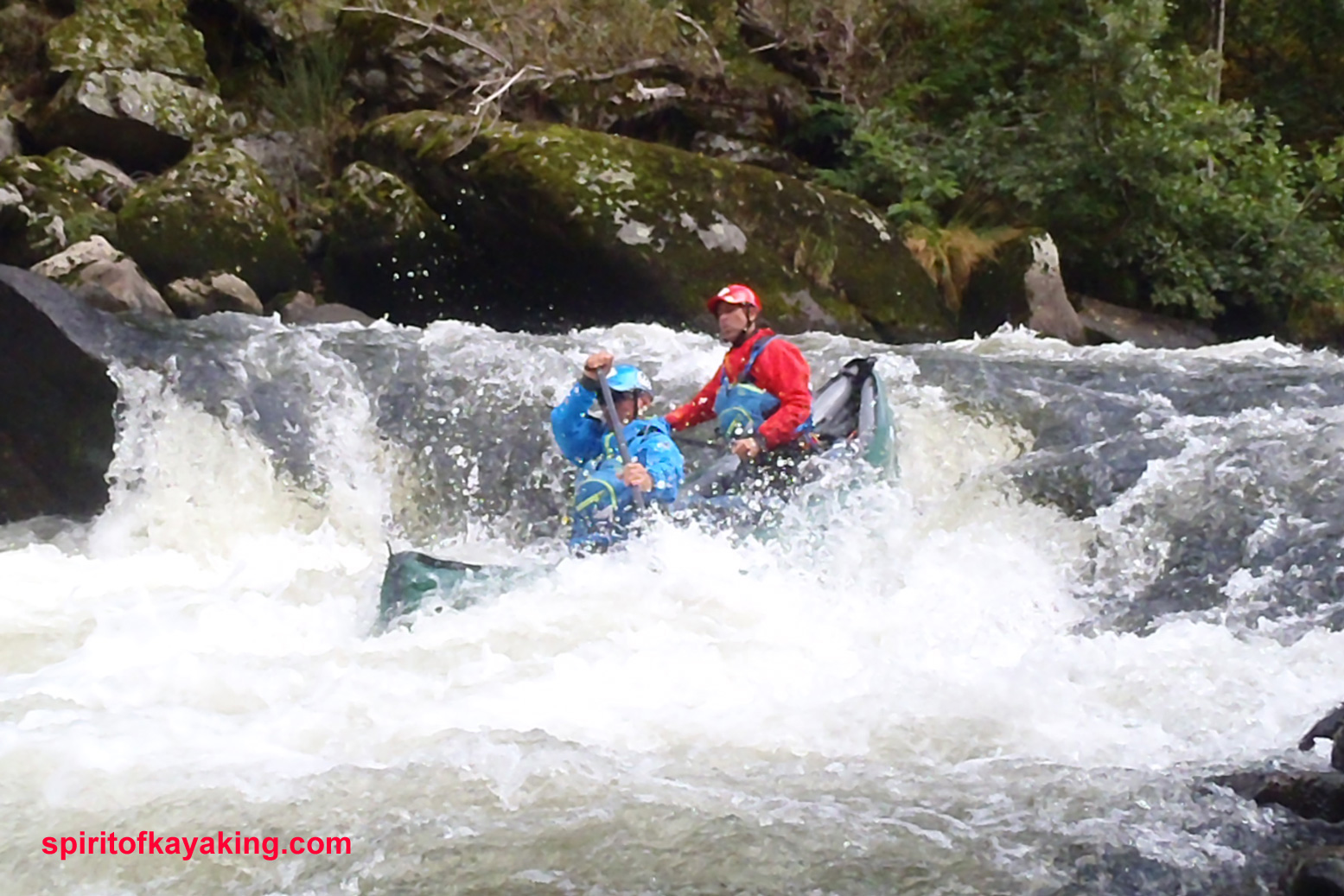
Next morning a taxi transported me past the then-closed section dodging the Poutes dam below Alleyras (more below) and dropped me at Monistrol. Here again I failed to fully appreciate the greater challenges immediately ahead, even if the guidebook was clear: great fun in a creekboat, but an open canoe will fill up on the longer rapids. And if I didn’t know it then, I sure do now: the white water abilities of open canoes and IKs are closely matched, while IKs might easier to control for beginners (like me).
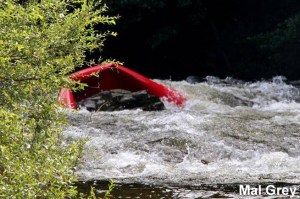
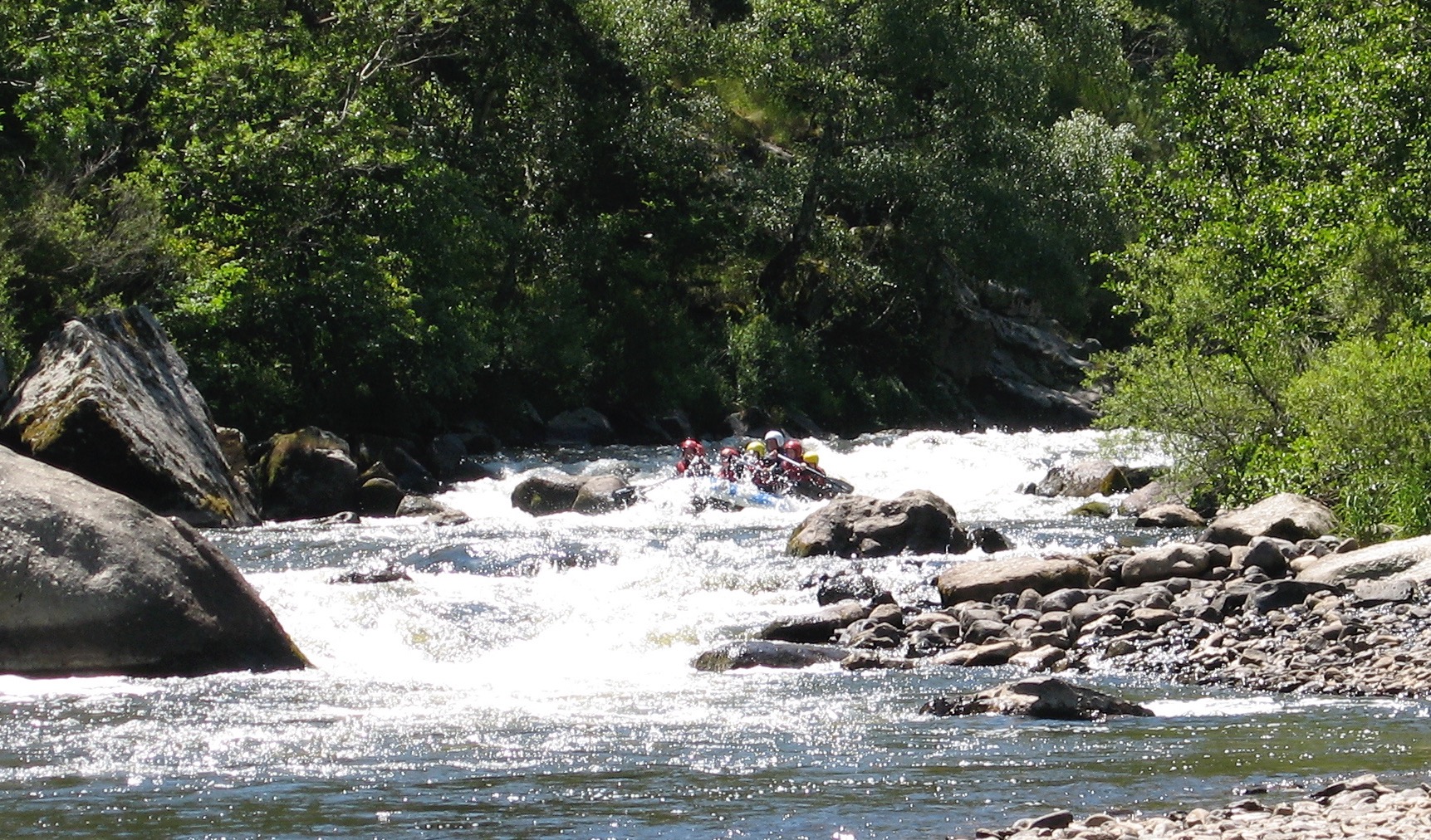
This Monistrol stage is run by commercial rafting trips (above), also a telling sign about the nature of this part of the river. I scraped through that day, exiting a few rapids with a boat full of water, and on one ending up swimming alongside it. Looking back, I’m pretty sure this was the exit of ‘La Barraque au Ponnet‘ (KM3.5; more below) with that raft above coming through soon after I stopped. It was all a bit of a shock.
Unless you’re confident, I’d suggest not following my example in doing this section alone. Consider a recce in the commercial raft if there’s one going that day, or ask if you can tag along for safety.Or find some paddle pals.
A few kilometres before Prades (KM12 from Monistrol) it all becomes less of a white-knuckle ride, and what followed all the way to the Brioude take-out were fun, Grade 2 rapids and a couple of thought-provoking chutes or easy portages. All manageable in open packboats. As you approach Brioude on the last day, the paddling eases right up so that you start harking back for a bit of eaux vivants.
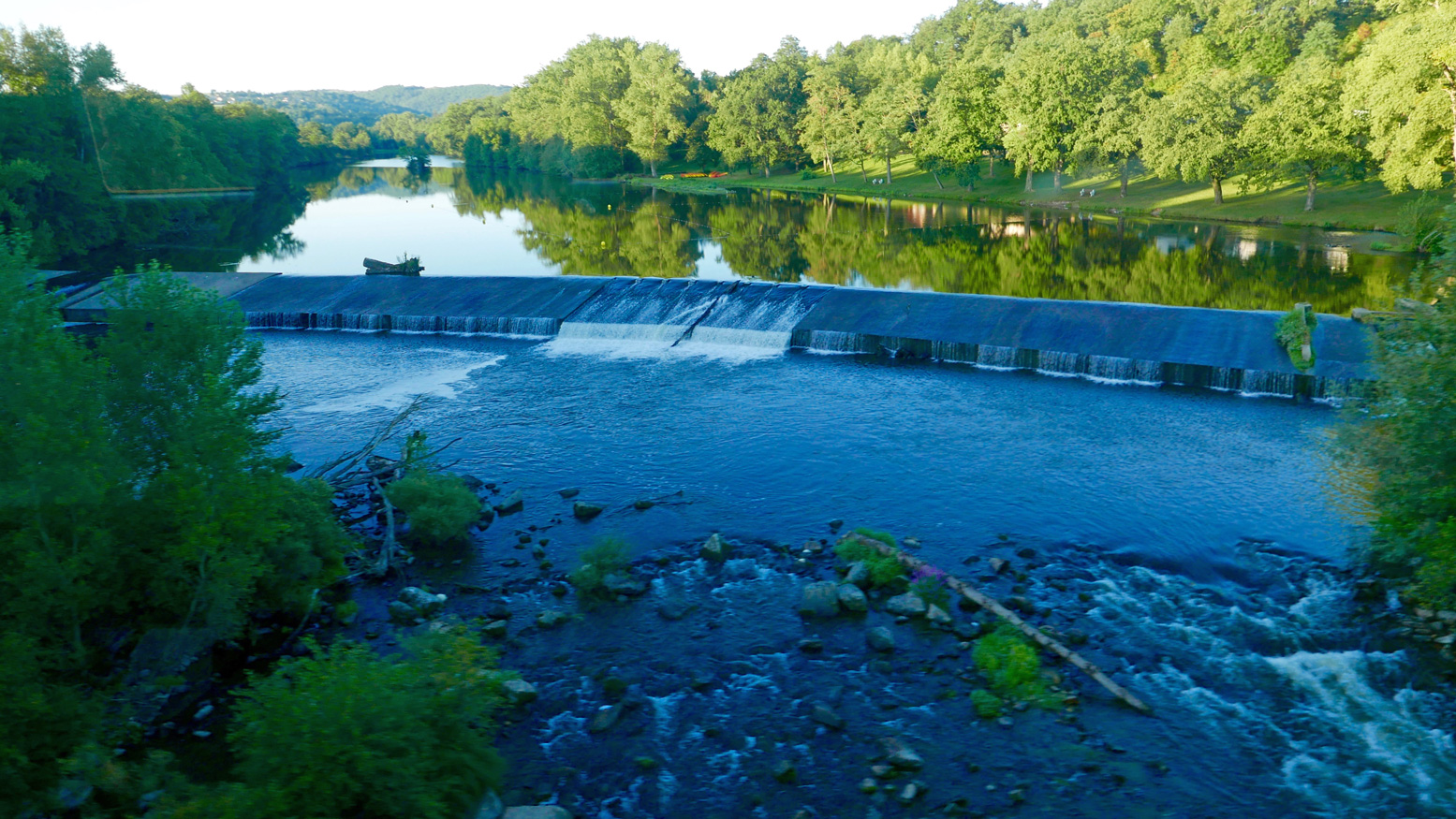
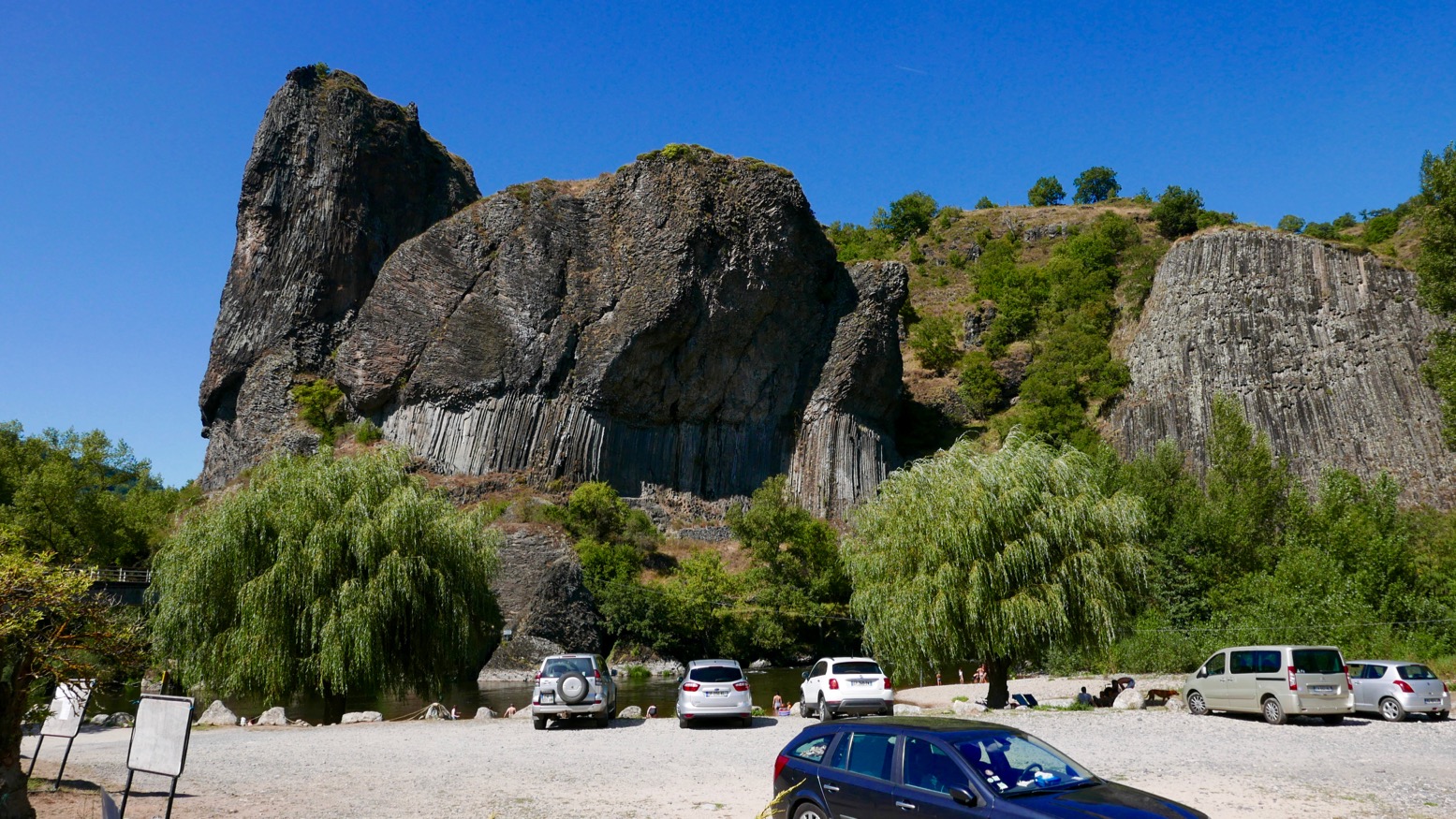
All along what they now call ‘one of Europe’s last wild rivers’ you’ll pass many striking outcrops of columnar basalt as well as pretty villages (like Chilhac, below) with adjacent campsites, boulangeries, quaint hotels – and not a chain store to be seen. Like the better known Ardeche and Tarn, the Allier is another Massif classic, still distinctively scenic but with non of the nose-to-tail traffic during busy holiday periods.
Getting there Although the daily trains aren’t frequent, with riverside stations at Brioude, Langeac, Monistrol, Alleyras and Chapeauroux, the Allier (left) is easy to get to with packboats. First, Easyjet yourself to Lyon, or Ryanair-it to Nimes or Clermont, two cities which are also linked by the scenic Ligne des Cévennes rail line (below). Brioude is an hour south of Clermont, and Chapeauroux is two hours over the hills from Nimes. Between them, Brioude and Chapeauroux span the scenic and paddleable 88-km section of the Allier.
One thing worth considering if you’re unsure about the half-day Grade 3+ Monistrol–Prades section, is coming up on the train from Brioude or Langeac. It passes right above the gorge where you get a good view of the Barraque au Ponnet and a few seconds later the ‘Roche qui Pleure’ drop a few hundred metres upstream (left; Gumotex Scout canoe). I’m sure glad I looked when I came back years later.
In 2018 I returned to the Allier, this time with a packraft. I flew to Lyon (cheaper and more frequent than last-minute Ryanair), caught the train via Clermont to Brioude (5hrs), and next day caught the first train to Monistrol (left). I planned to miss out the Chapearoux–Alleyras stage to save time and the taxi faff around the dam**. It left me three days to cover about 70 paddling kilometres back to Brioude.
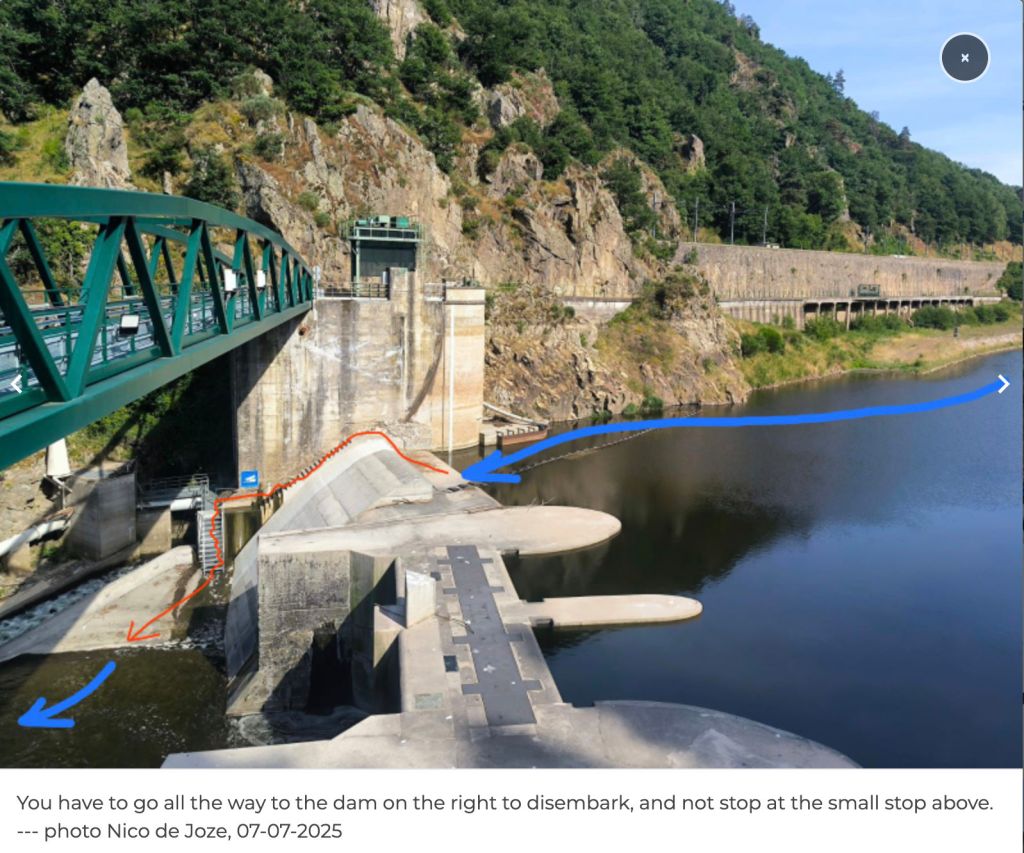
Poutes Dam **Since around 2021 (click ‘P5’) the long-closed section between Alleyras and Monistrol reopened to paddlers, with a portage around the new Poutes dam (below), 3.5km from Alleyras station (the train line crosses the river right in front of it). See the video link above. As part of the Allier resalmonification programme, the dam was lowered by 10 metres d and fitted with a ‘ladder’ to help the fish get upstream and propagate – plus give anglers something to do. Local environmentalists fought a long battle to get this done.
The train heading upstream passed right in front of the Brioude weir (left) where I’d be taking out in a couple of days. The line then rejoins the Allier at Langeac before heading for Monistrol. Soon it enters the wild gorge and looking down at the rapids below I thought… ‘Hang on a minute!’ which, a rapid or two later escalated to ‘WTjoF!?’.
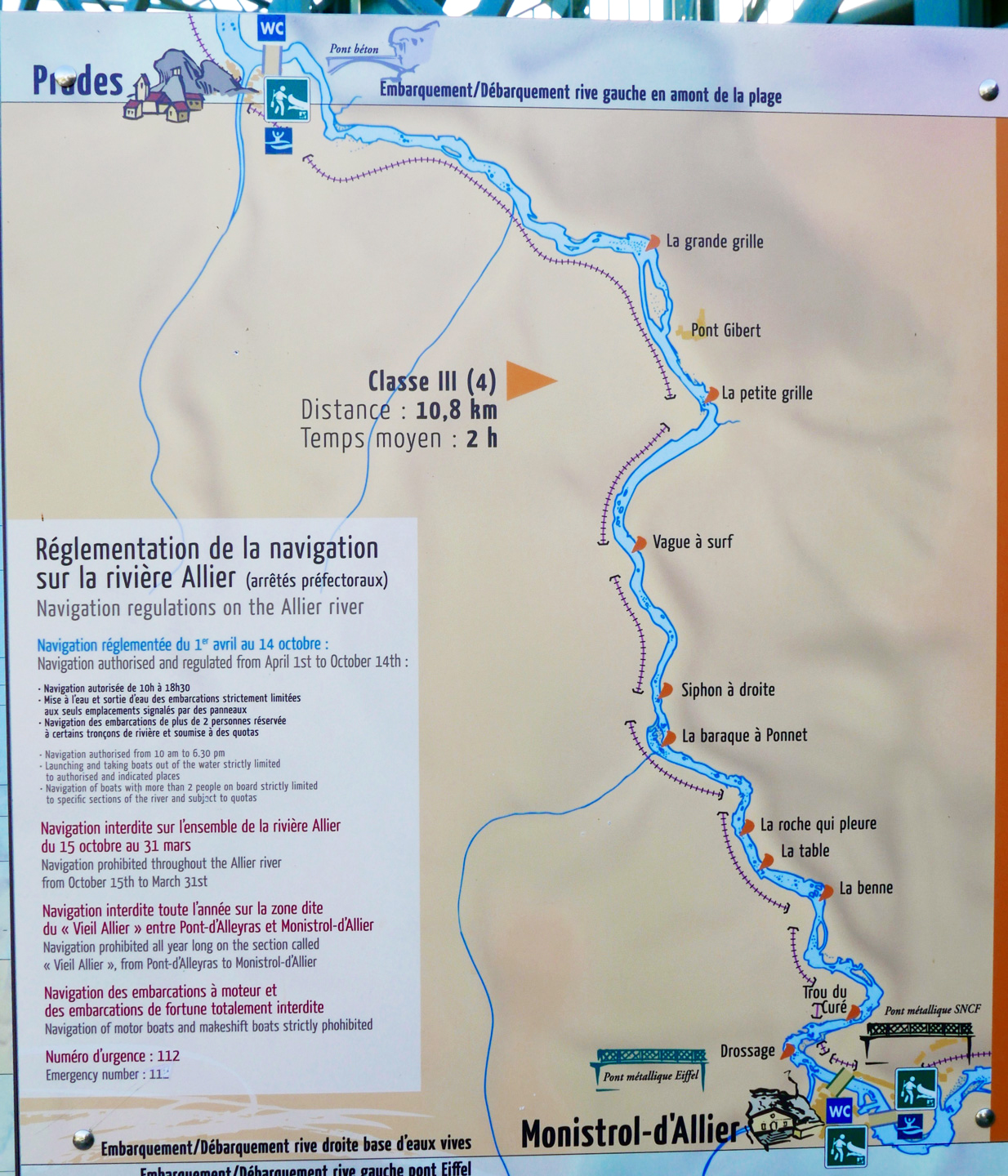
I recall being unnerved in 2006, but I’m sure they didn’t look this gnarly. I realised later that the first 100-m white plume was ‘Le Barraque au Ponnet’, easily recognisable on aerial maps. The other was ‘La Roche Qui Pleure’ – two of the plus fruitif chutes on this stage (map below left).
I got off at Monistrol, scoffed a petit dej at a deserted hotel and wandered around town wondering what to do. The river didn’t seem higher than normal; perhaps it was low back in June 2006 when I came through in the Gumboat? Either way, thanks to my train preview this stage seemed a bit too ripe for me; the Yak would be spilling over long before I was halfway through ‘Le Ponnet’.
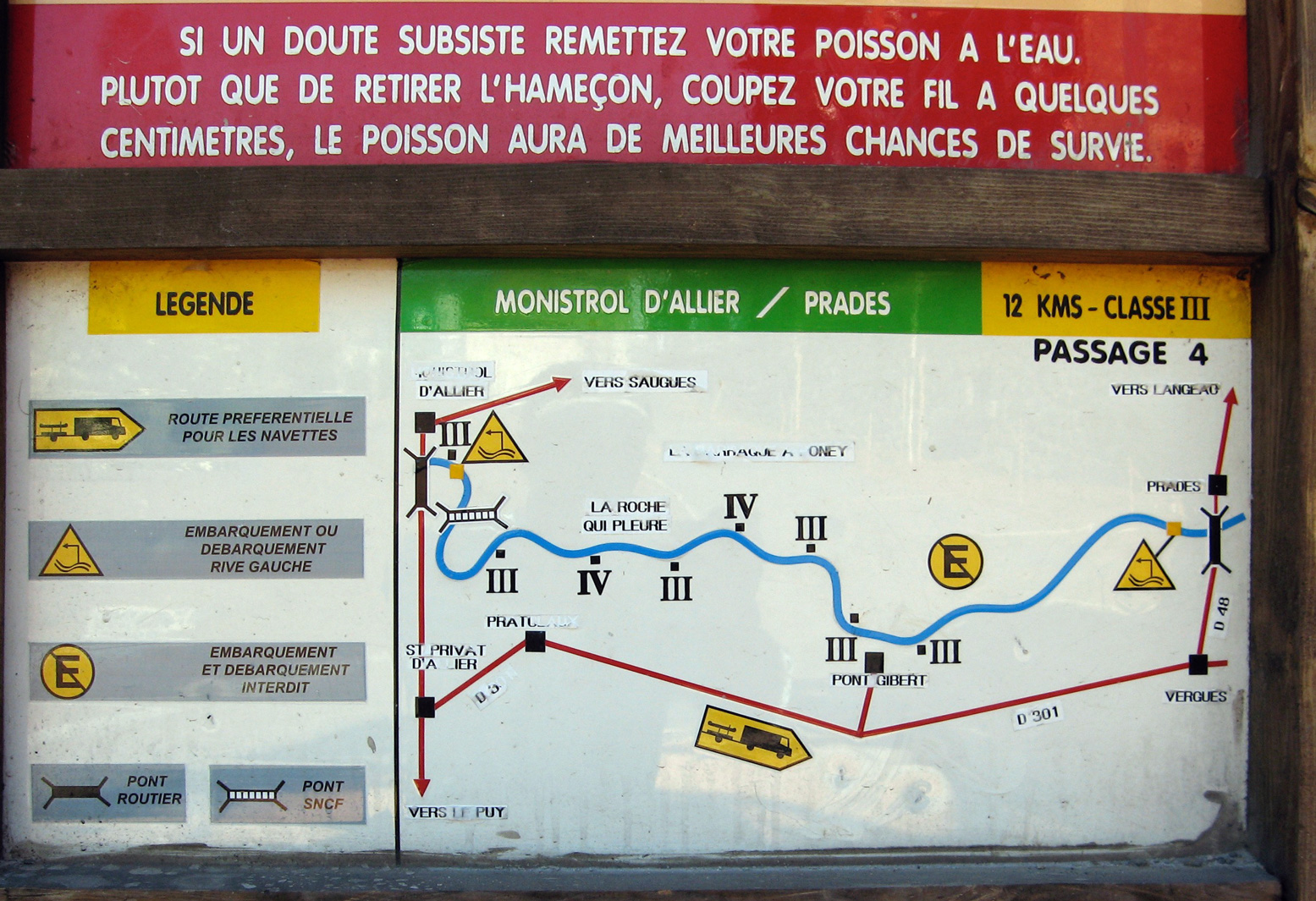
For a while I actually wondered if I was suffering from false memory syndrome from 2006 and might have cause to claim compensation if I could find the right lawyer. But I definitely recall the old Monistrol hydro plant (right) and my photo record shows I took the picture of the board below at 9.03 and arrived at Prades beach by 1pm, invigorated but not inordinately traumatised. River pictures were few back then in that pre-wet camera era.
Later, trying to work out what was different (other than my aged nerves), I wondered if I’d just glanced down on Le Ponnet during a particularly hearty pulse of dam-released water? Looking at the vigicrues website later, the flow graph for that day (at Prades) does show it was high as I passed by around 8am – before dropping six inches around midday. I knew from the Tarn earlier this summer that following a stormy night, a six-inch rise makes a difference – it speeds up the flow but can also smother stony rapids and make them easier. The pulsed releases every 8 hours are the lumpy pattern you can see along the bottom of the graph below for the days before and after I came through. As you can tell, I am bending over backwards trying to find ways to rationalise my new-found timidity! Above left: from the Eiffel bridge in town, you can see the first rapid (looking back upstream). Like the book says: if you don’t like how this or the next couple of runs look, turn back. Otherwise – strap in for the ride!
Annoyingly, my GPS with good maps was at the menders. I took a look off a passing trekker’s map (Monistrol is on the GR65 Santiago trail) but at 1:100k, I was none the wiser. I’d have needed a 1:25k map to find any viable paths along the gorge.
La Benne?
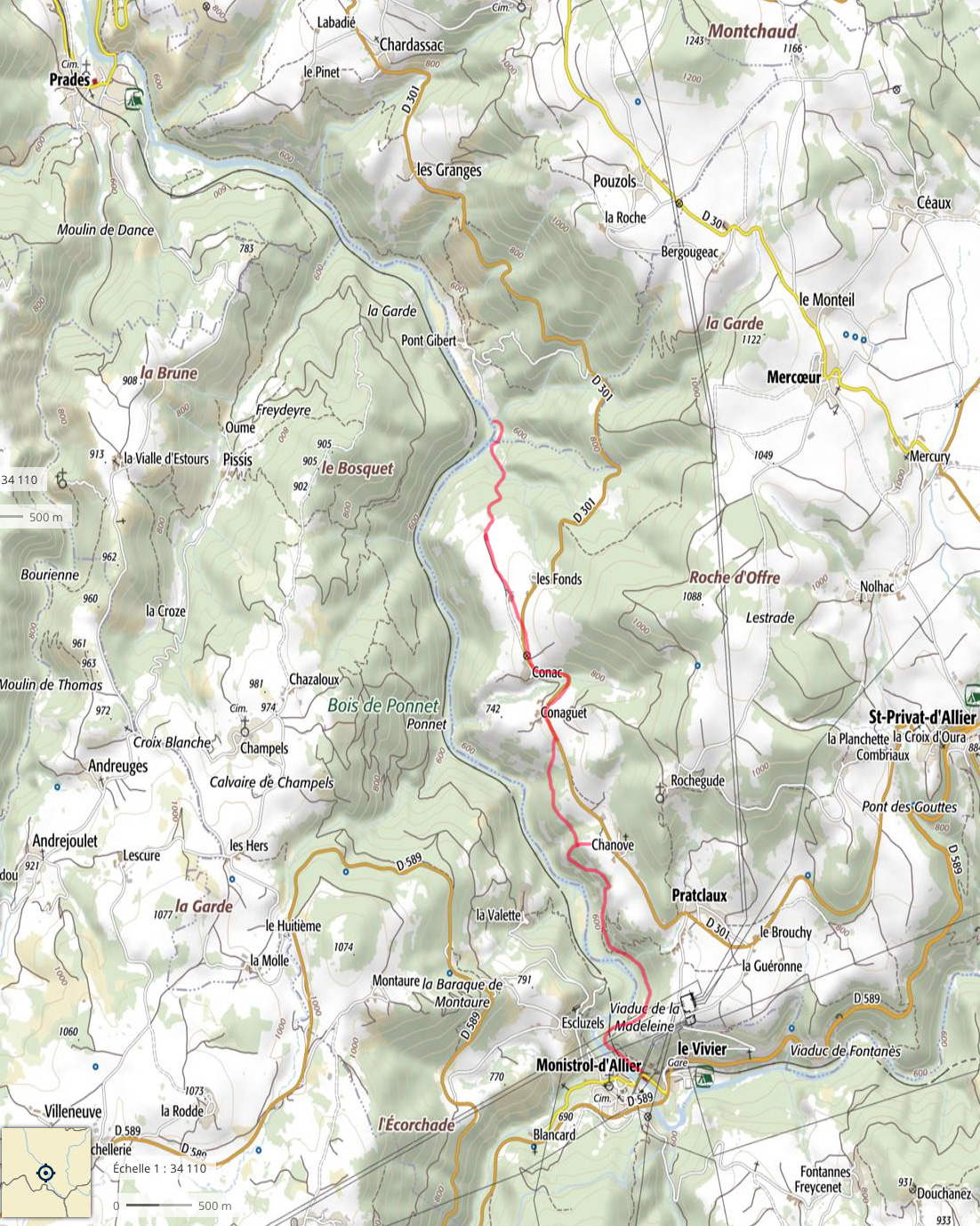
In the end I decided to follow a path by the bridge on the right side of the river, signed: ‘Viaduct, 1 hr’. It might continue along or above the gorge to a point where I could put in with the worst behind me. If it didn’t I could turn back and hitch or bus – or if desperate, clamber uphill to the D301 backroad to Prades. And that is what I did, but not without a huge amount of effort. Initially, the path followed the riverbank, passing a few Grade 3s (above, probably ‘La Benne’; KM1.8) which would have swamped my Yak like hot ‘creme anglais’ over a freshly baked rhubarb crumble.
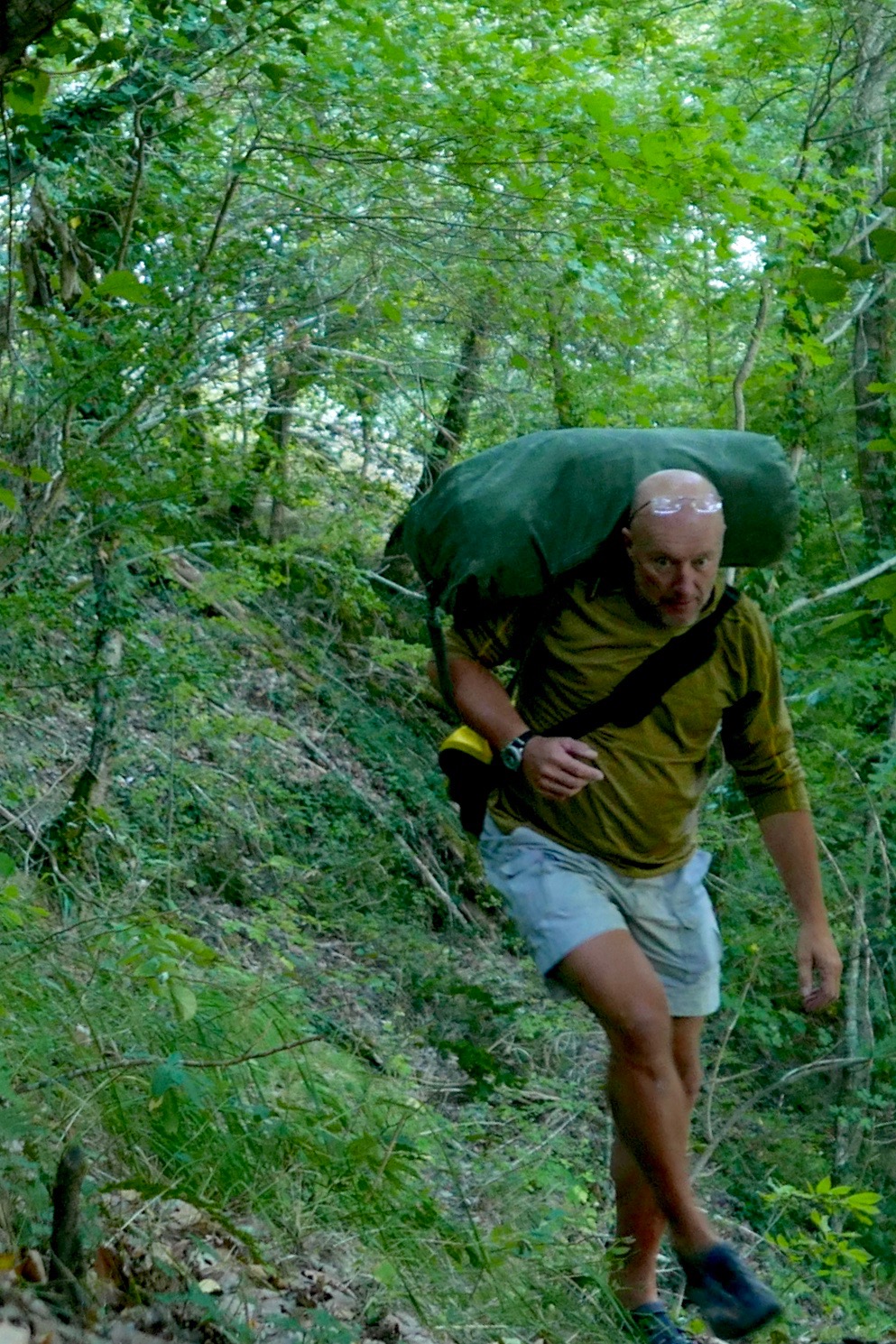
Some three hours later, high above the valley and heading for dehydration (33°C in Brioude that day), I gave up trying to follow a path. Fallen trees, brambles, scree slopes, an intermittent path and the 1:1 slope all took their toll. After an aborted attempt climbing a loose cliff, I managed to hack my way uphill and emerged a sweaty mess on the D310 backroad, looking like I’d just escaped from a teenage slasher movie. Scratched, bitten, stung and grazed to buggery, I’d covered 3km in three hours.
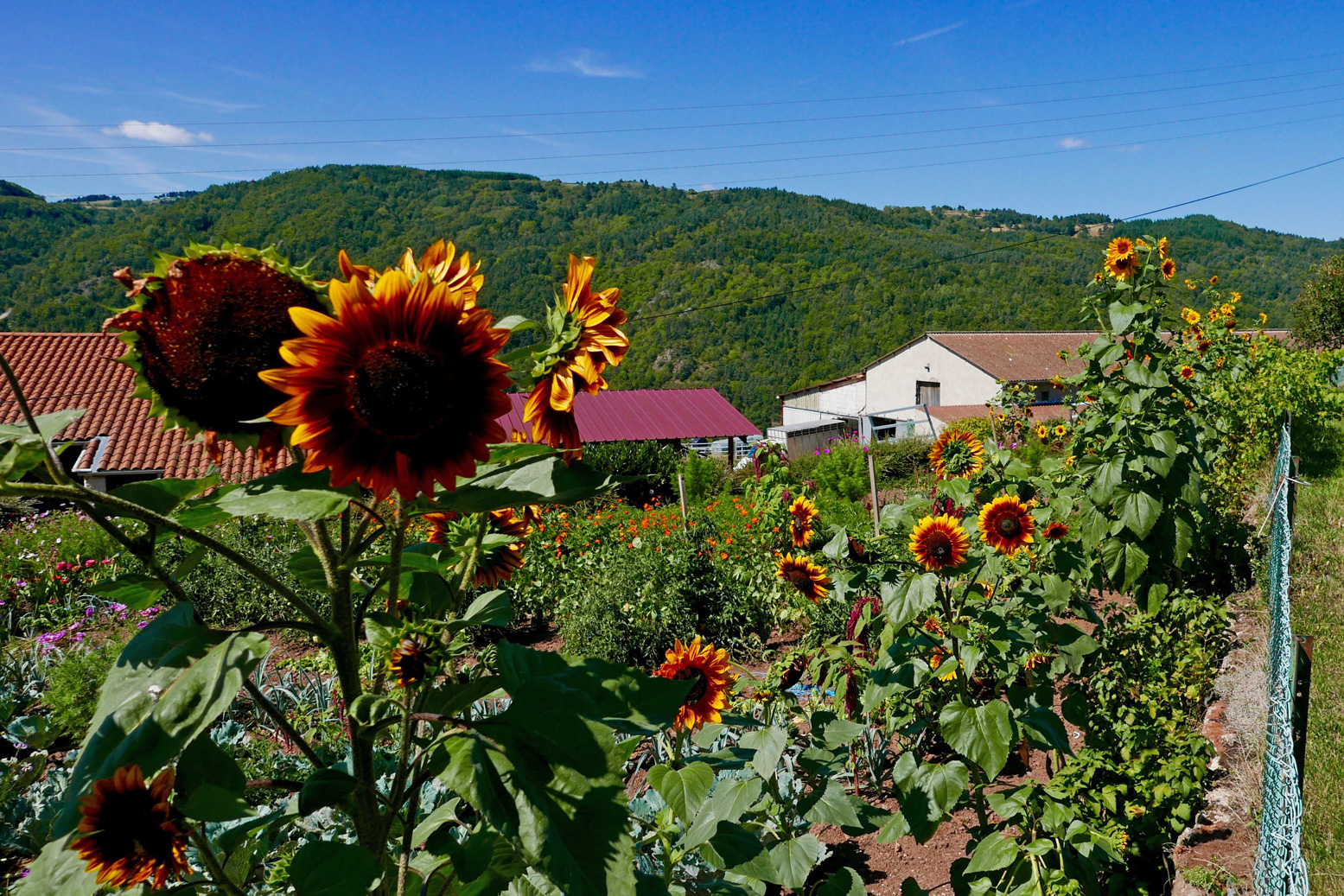
I washed in a cattle trough and passed through the sunflower hamlets of Conaquet and Conac, before splitting left down a side track and path leading back downhill, hopefully to rejoin the river below any enraged torrents.
This it did, just before Pont Gilbert and just below ‘La Petite Grille’, by chance nearly the last (and easy-looking) rapid, 8 river-kms from Monistrol. Although it didn’t feel like it at the time, this turned out to be pretty darn good route-finding without a map (left).
At one point earlier, while thrashing through the bush or teetering across scree slopes, I heard the telltale whoops of hyper-excited rafters far below. I realised that’s what I should have done: taken the fun option in a big-arsed raft as far as Pont Gilbert (if they’d take me, with baggage). I’d seen signs for a rafting centre near Monistrol station, but the town was so quiet I assumed they’d closed for the season. It would have been a great way to punch through the big rapids without a care in the world. Picture above: the ‘Le Ponnet’ viaduct down below with the long ‘Barraque’ rapid starting just around the corner and ‘Roche qui Pleure’ laughing menacingly from behind the trees on the left.
Dropping the kit bag and setting up by the riverside below ‘La Petite Grille’, it had indeed become hot enough to grill a salmon, but once on the water it sure felt good to flop down and float away like a stray log. Just like in the wilds of northwest Scotland, if you have the choice: float, don’t walk. Obviously part of me wondered if I could have managed the gnarly rapids upstream in the Yak. After all, I’d clearly scraped through years ago in the Sunny (still hard to believe). With someone alongside I’d have been braver but I’d followed my gut and felt happy with that.
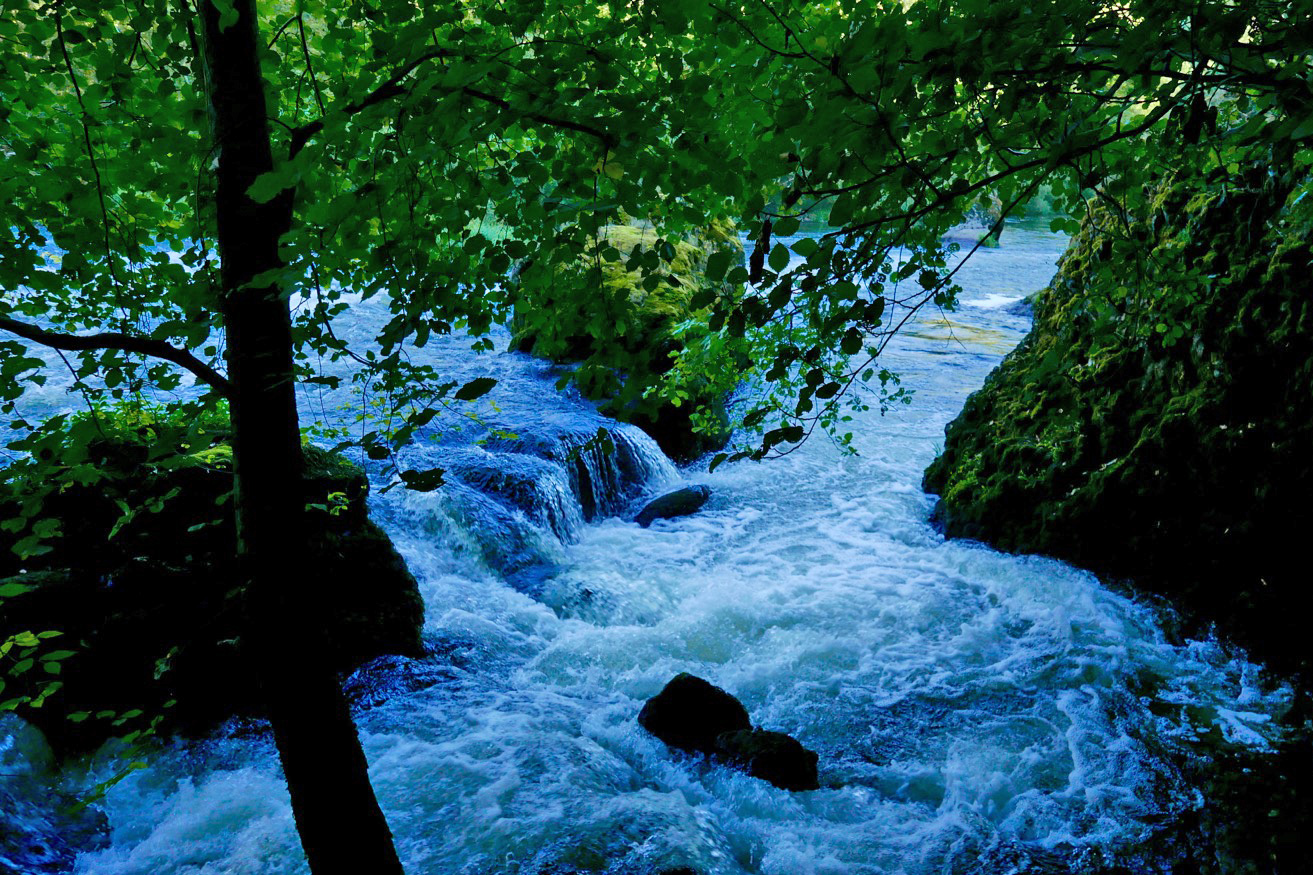
Watch Belgian packrafter Dzjow’s video below from 2014. He enjoyed the Monistrol stage so much he went back up on the train and did it again with GoPros rolling. Watching it, I’m glad I didn’t. From Monistrol starts at 1:57 and he shoots down ‘La ‘Roche qui Pleure’ (the image below) at 2:28, soon followed by ‘Barraque au Ponnet’ which starts at 2:34 (note the railway viaduct) and goes on for a while to the big rock (3:19) you’ll recognise on the left in the rafting pic, above. Dzjow was a hardcore adventuriste I’ve come across before. The following year he went on to do a self-admittedly tough and not so enjoyable trip in wild Patagonia. He hasn’t written about packrafting since.
After about 4km I pulled into Prades beach (below left). I needed salt and I needed drink. And while I was at it, what harm would a handmade mini quiche, some bacon crisps and a tartes aux framboises do? None at all, mon brave.
Now dizzyingly revived but still worn out by the morning’s commando course, I knew there was a bit of a drossage (great word) just around the corner, but it was all fun knowing a few others were playing around too, including SUPs. What is it with these SUPs? I’ve never seen them doing anything more than goof about in the shallows but rarely actually go anywhere, yet they’re clearly ten times more popular than IKs and Ps combined. What does that say about the state of post-industrial recreation in the developed world?
Unusually, I had a hotel booked at Reilhac, about 18km downriver, past Langeac. With just a couple of canoes on the water, the afternoon passed without drama, bar the odd wetting. But approaching Langeac, the din from the weir just before town was unusually intimidating. The canoe chute here (left) is well-known as being a bit of a drossage because it’s about 3 feet too short and so pumps a plume of water into a nasty backwave which not all boats can easily escape.
Spot the chute
And I do wish these Frenchies would mark the tops of their glissieres with two poles, indicating: ‘aimhere’. Above, show me the chute entry point while wearing a pair of sweat-smudged specs! Maybe the idea is by not having clear markers, paddlers slow down and look carefully. I did just that above and portaged round off a little beach on the right. I could not be arsed with hitting the churning pile to get catapulted over the bow like a 40-kilo sack of dried beetroots. I felt that no matter how far back I leaned, my short, light boat would plough ‘n’ flip, unlike a longer IK. Back in the water, I paddled on through early evening Langeac and an hour or so later was slumped on my Reilhac hotel bed.
The next day was just what I wanted; a short, easy run of just 13km, ending at the UNESCO-overlooked village of Lavoute Chilac where the charming Hotel des Pecheurs tottered on the slender gooseneck bluff above the Allier.
Three clicks downriver (6km from Langeac) was a double-drop weir-chute (below left). Easy enough providing you steer straight for the lower drop, but I walked it as I knew it would be a bailing job, and today was some 10 degrees cooler. Splish followed splosh followed splish down to Chillac (below, 11.5km from Langeac), another picture-perfect village sat atop a striking basalt plug with dreamy views over the Auvergnois countryside from the terrace by the church.
Half a click downstream from Chilac is an easy, short chute (left) on the far left. But once down it I realised the old weir passing below the mill on the right had pretty much been washed away, making the chute redundant and a fun ride down a long, shallow rapid. Clearly I was recovering my mojo if I was looking for some white water action again. Later, I read this weir has been flushed away for some years, but is another thing the new Canoe Trips,South of France guide had not updated.
Soon, the bluff of Lavoute Chilac rose into view. I pulled over left at the riverside park, let my gear dry, then walked into the village over the tall bridge (left). Les Pecheurs (white building on the right, below) was still on siesta, so I left the Yak by the steps and walked over to Le Prieure, the other creaky-stair hotel in the village, for a mouth-watering ‘Salade Auvergnate‘.
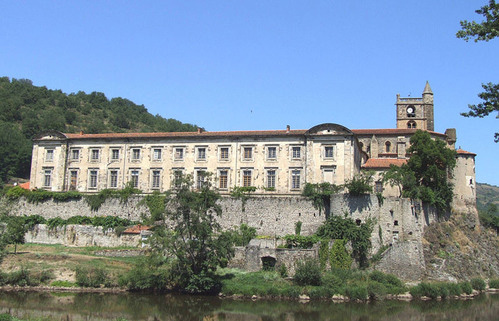
Wandering around the old church and the imposing, 18th-century facade of the abandoned priory (right, due for luxury flat conversion), I was staggered to see a July 1866 flood marker at the church’s back door. In the photo left my hotel room would have been submerged by a few metres. Perhaps the river’s acute 180-degree turn causes floodwaters to back up.
It’s the last day of my packrafting mini-break and by my estimates, I had about 22km of paddling, plus a 4km walk to Brioude station to catch the 4:10 to Lyon. I didn’t want to miss that so set off briskly, passing a canoeing couple (the only other boat I saw all day) until I could estimate my pace against a landmark. Before 11am I’d reached the bridge at Villeneuve meaning I’d covered 9.5 clicks in 80 minutes which gave me plenty of time. This Allier flows quicker than it looks.
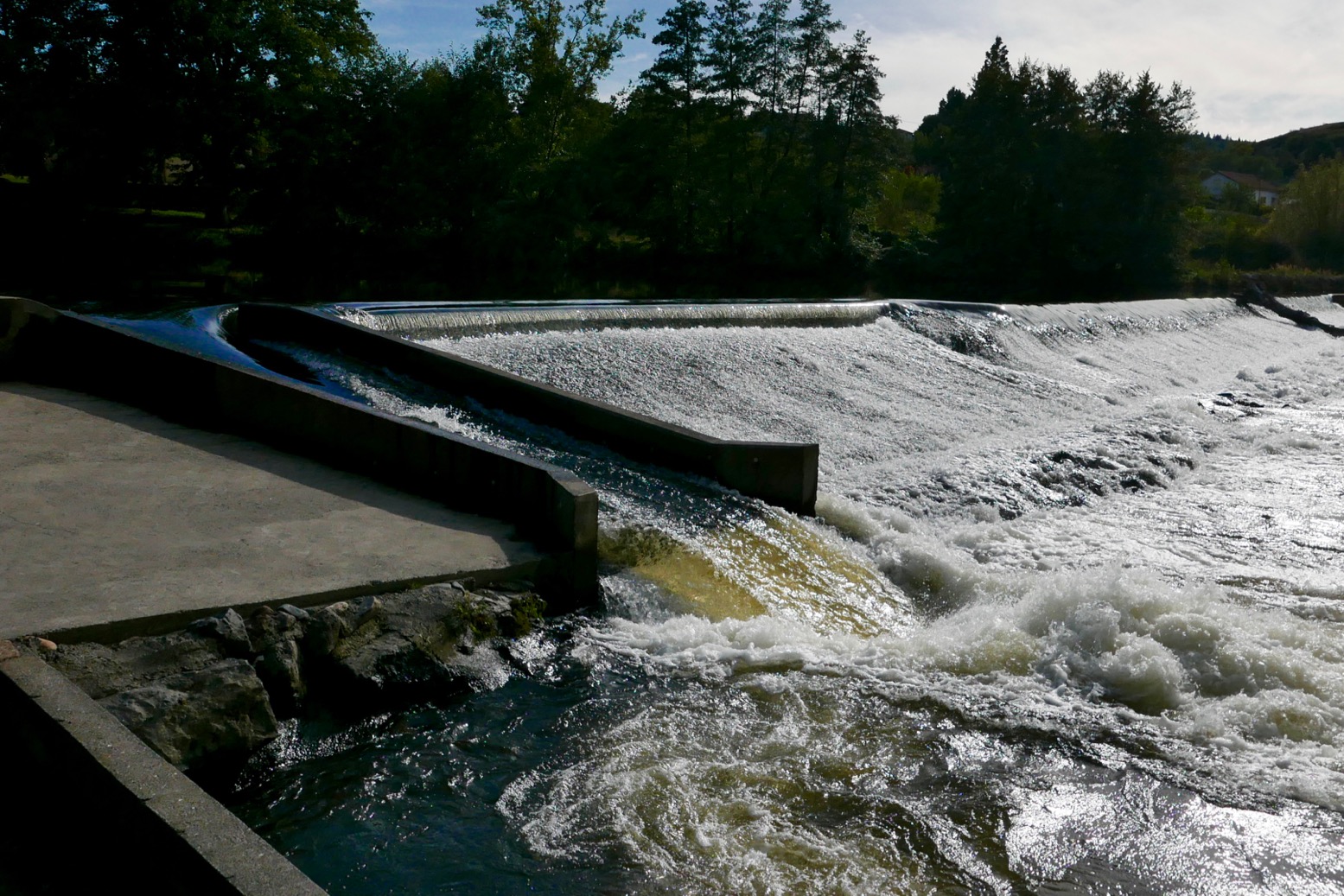
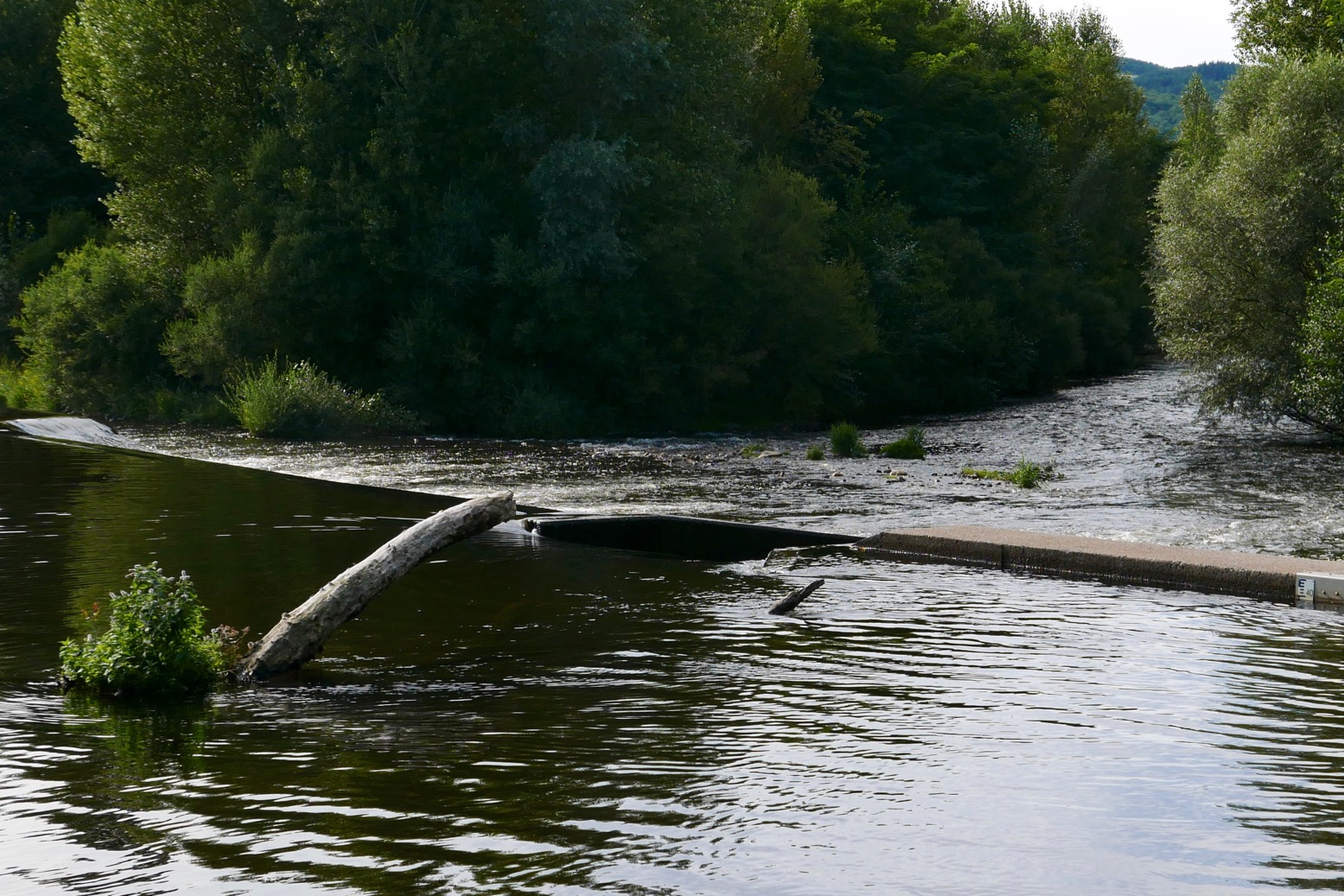
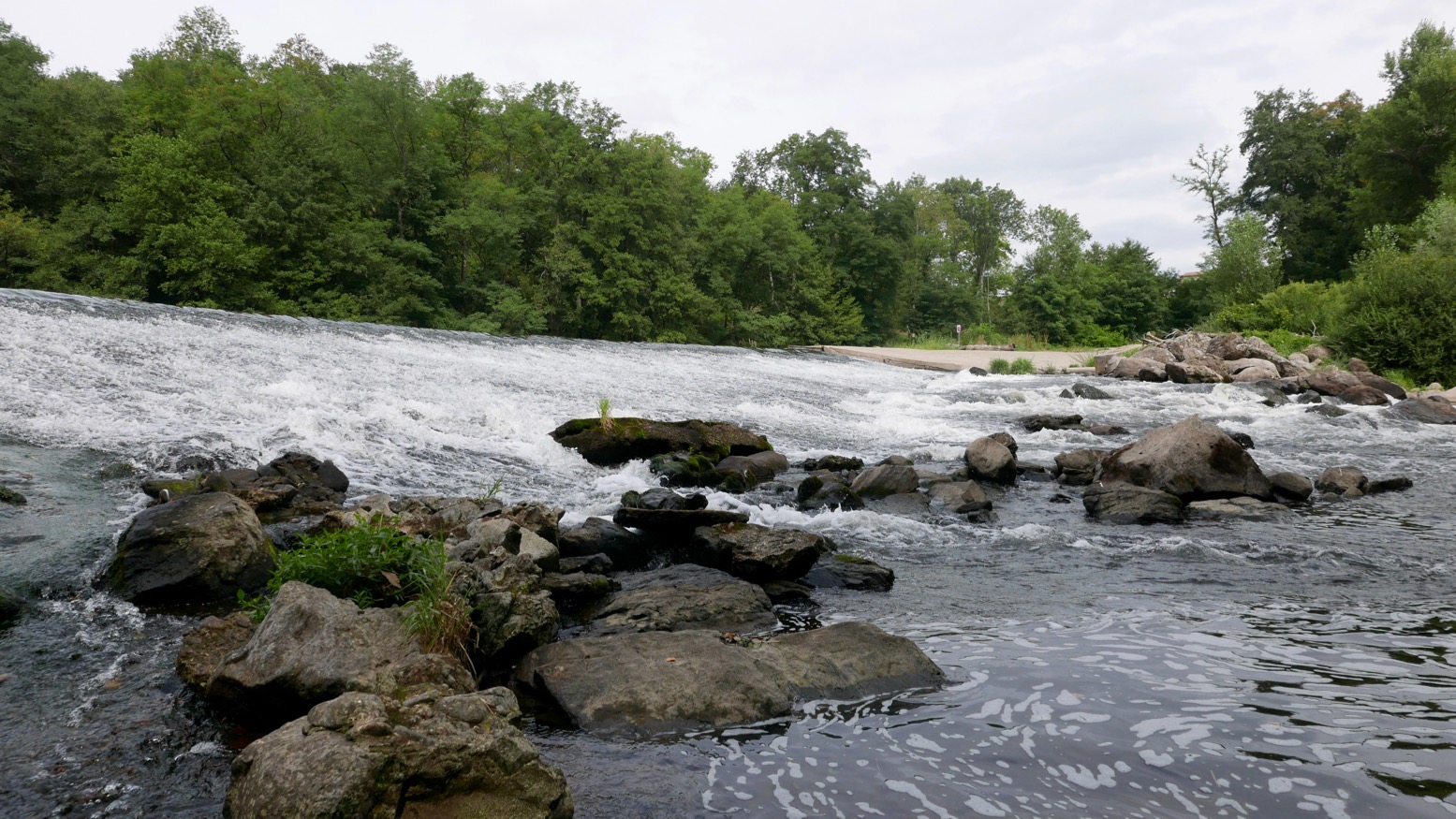
The book talks of another old weir to ‘shoot’ at Villeneuve campsite, but there’s nothing here except a ford with poles marking the car crossing. Many of the book’s ‘shoot an old weir’ descriptions are out of date. There’s rarely anything more than a line of rounded boulders and a drop of a few inches, making you wonder: ‘was that it?’ But at Ville Brioude, just before the tall bridge, the book suggests you can shoot a modern concrete weir (left). Good luck with that and those boulders lined along the base.
Finally I was back at the public beach below La Bargesse campsite (45.279097, 3.406962). Ahead was the big weir before the red brick rail bridge I’d crossed on the train a few days earlier (left). Here again the book now suggests ‘portage right’ and other convoluted options – perhaps a simple left/right mistake? Instead you simply take out at the grassy park, river left, walk over a little footbridge and put back in below the weir under the railway bridge and above a shallow rapid.
Once again, I’m amazed at the true amphibiousness of these packrafts, especially if not hauling camping gear on the trail. A long walk to dodge gnarly or closed stages is (potentially) easily done, even carrying an inappropriate kitbag. With plenty of time to catch my train, I dried off, got changed and walked over to Brioude for a coffee and cake in the town square below the basilica’s decorated tower. In the hills all around, the petrified volcanos and lush grassy valleys of the Auvergne countryside could easily sustain more exploring on foot, by pedal or with paddle.

 The MRS Nomad S1 I tested last summer in Scotland is my new packraft. Goodbye to my great little Alpacka Yak. Like the Yak before, it held its value and I sure got my money’s worth out of it over 4 years. The Nomad is an unusually long packraft with a central seat, making it more of a packyak which paddles much like a short IK (no yawing), has more space and weighs under 5kg with a roll-back skirt and thigh braces. So – easy to walk with for as long as you like.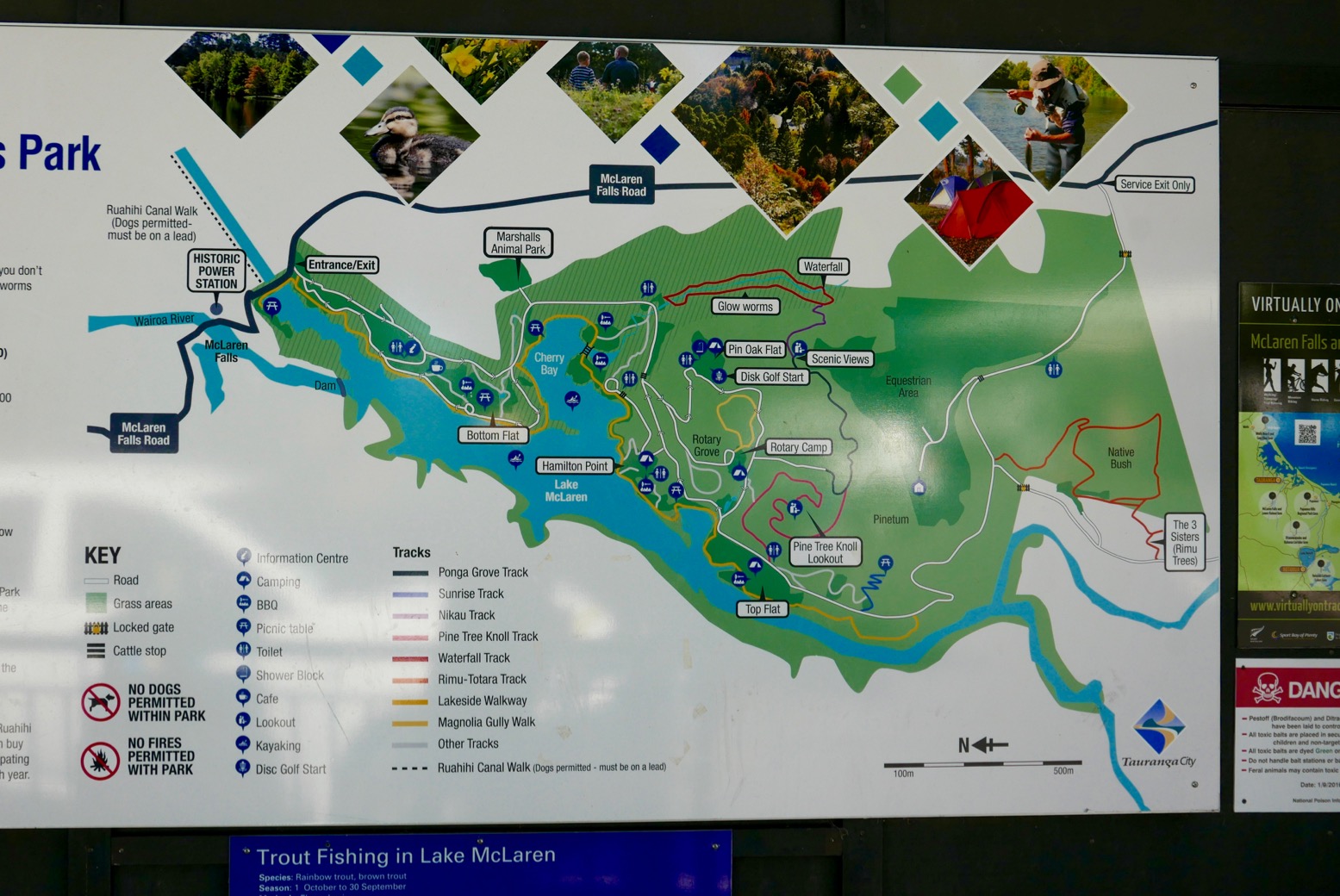





 Surely not. I pulled over and, clinging to a moored boat against the wind, fired up the GPS. That’s more like it – not so far at all.
























































 Inflatable Kayaks & Packrafts
