The heatwave which we hear has been tormenting the southerners finally crept onto the Coigach last weekend, like an overdue dog looking for its dinner. Warm, sunny and no wind. Hallelui-yay!
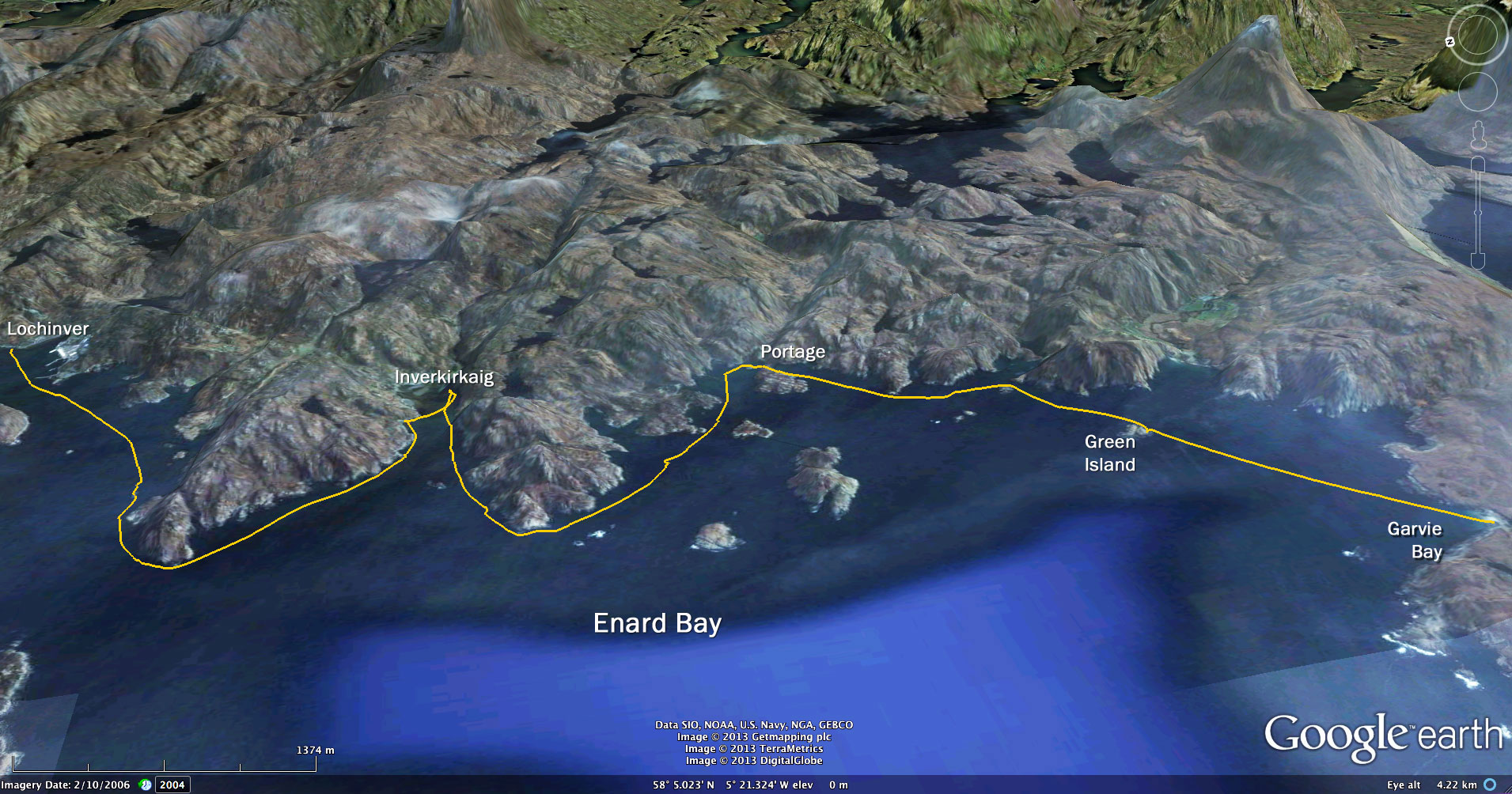
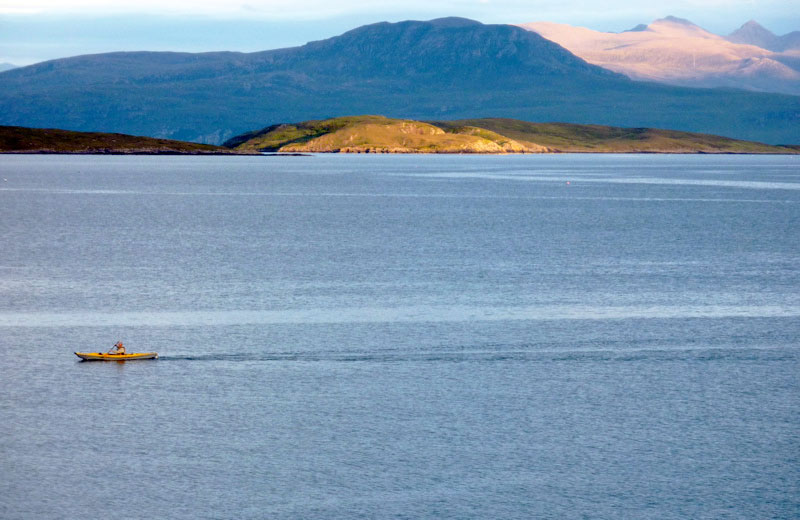
I planned to diligently hug the coast east round to Polly Bay were the Polly river drained Sionasgaig Loch, a fun stage which I packrafted last year. But once I actually got out on the water Green Island looked a doable 2km across mackerel-infested water rippled by an easterly breeze, so I took the direct line with wavelets slapping at my boat.
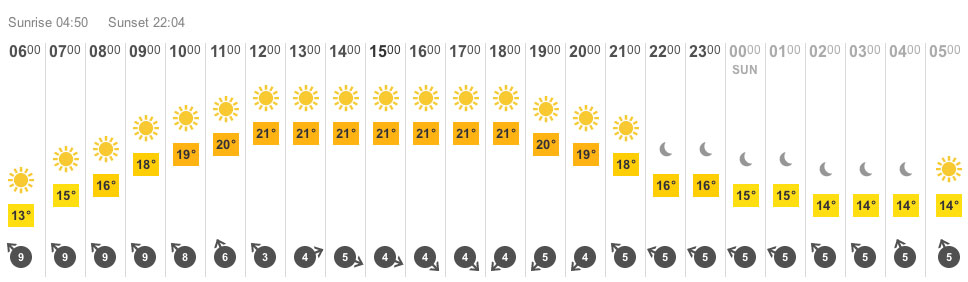
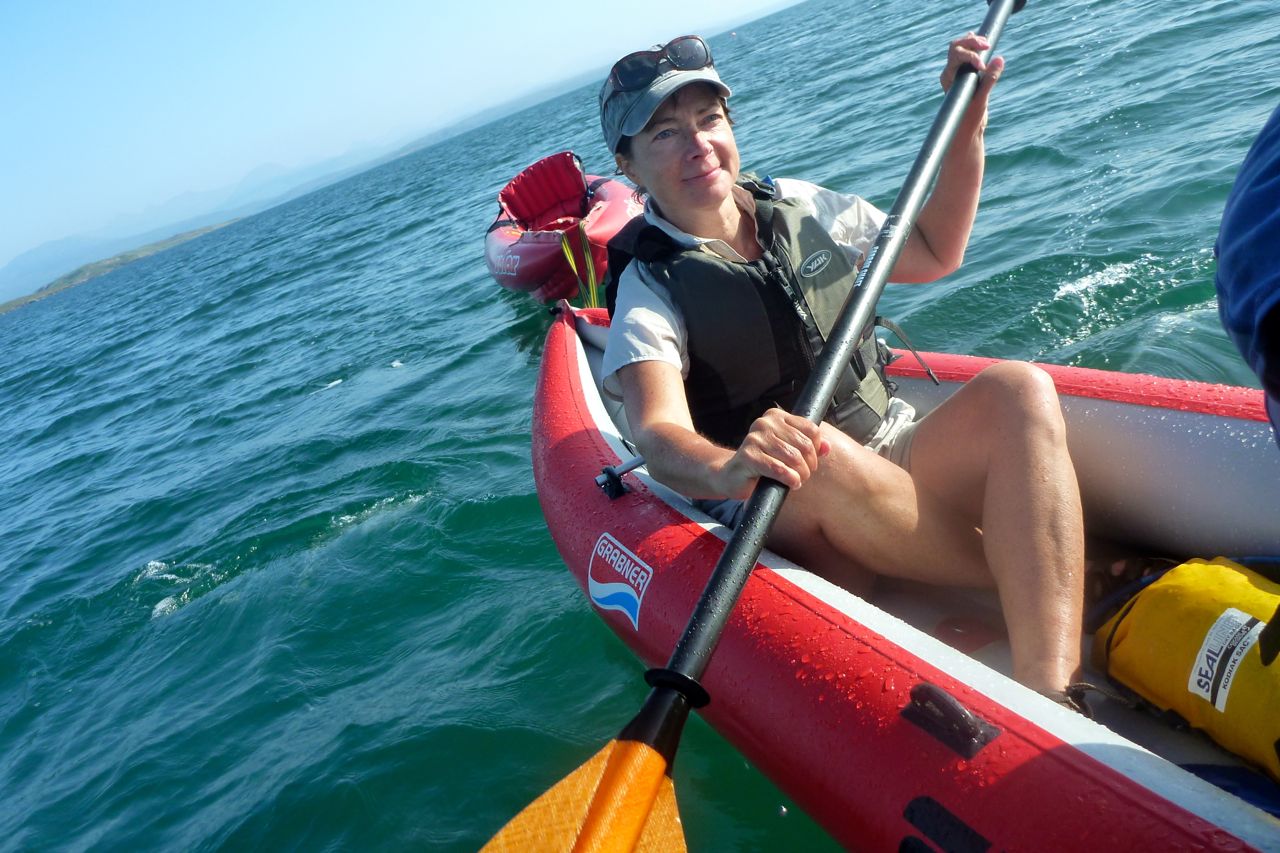
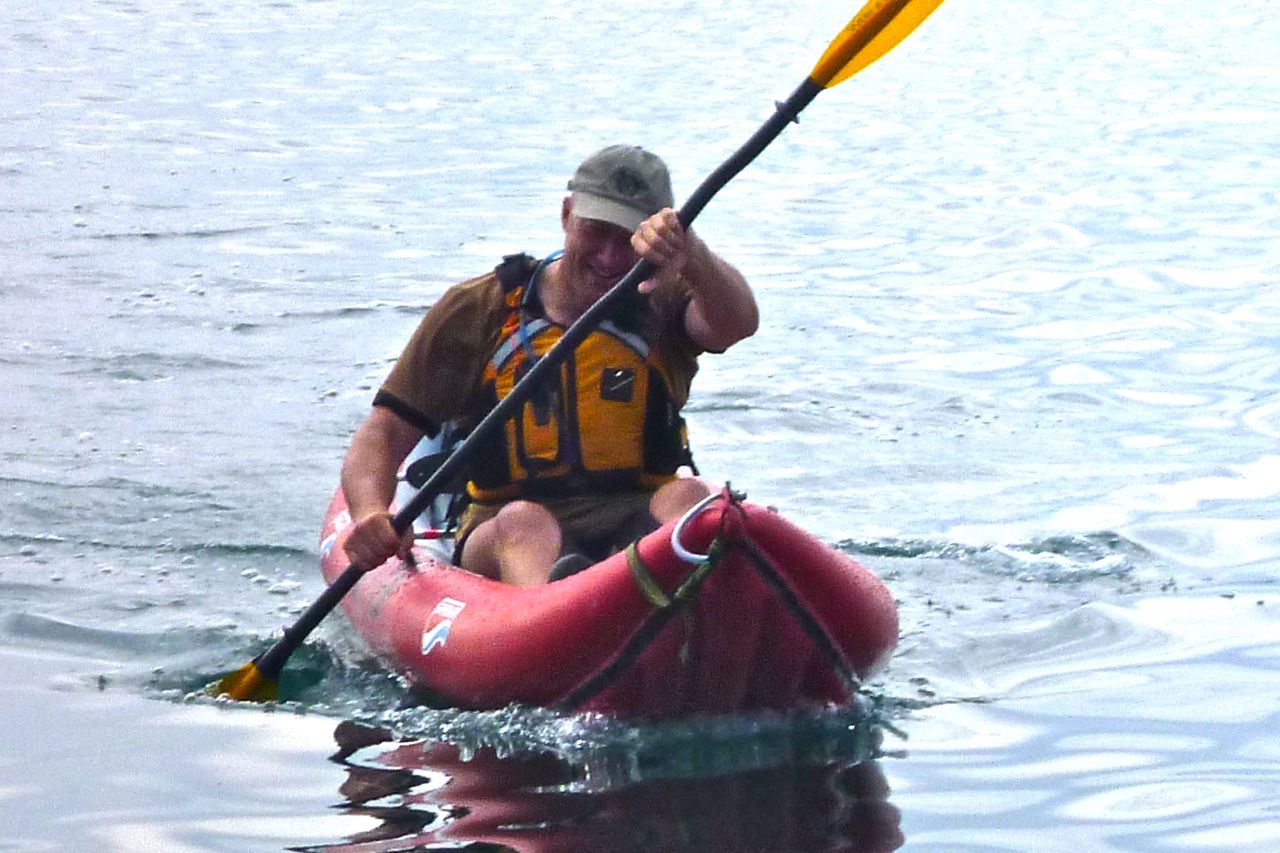
This was my first long solo run in the Amigo and initially, the usual neuroses bobbed to the surface: ‘must get a paddle leash’; ‘what if fish farm toxins have caused mackerel to mutate into piranhas’… and so on. In fact, the biggest problem was the heat. I’d put in already dripping from the walk to the beach and would stay like that for most of the day. They’d forecast a pleasant 21 but I’d guess it got well over 25.
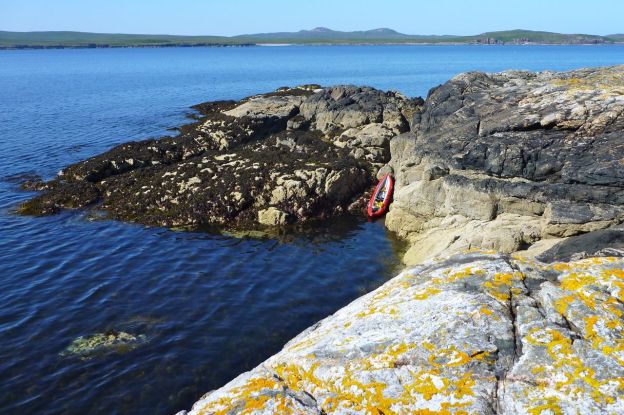
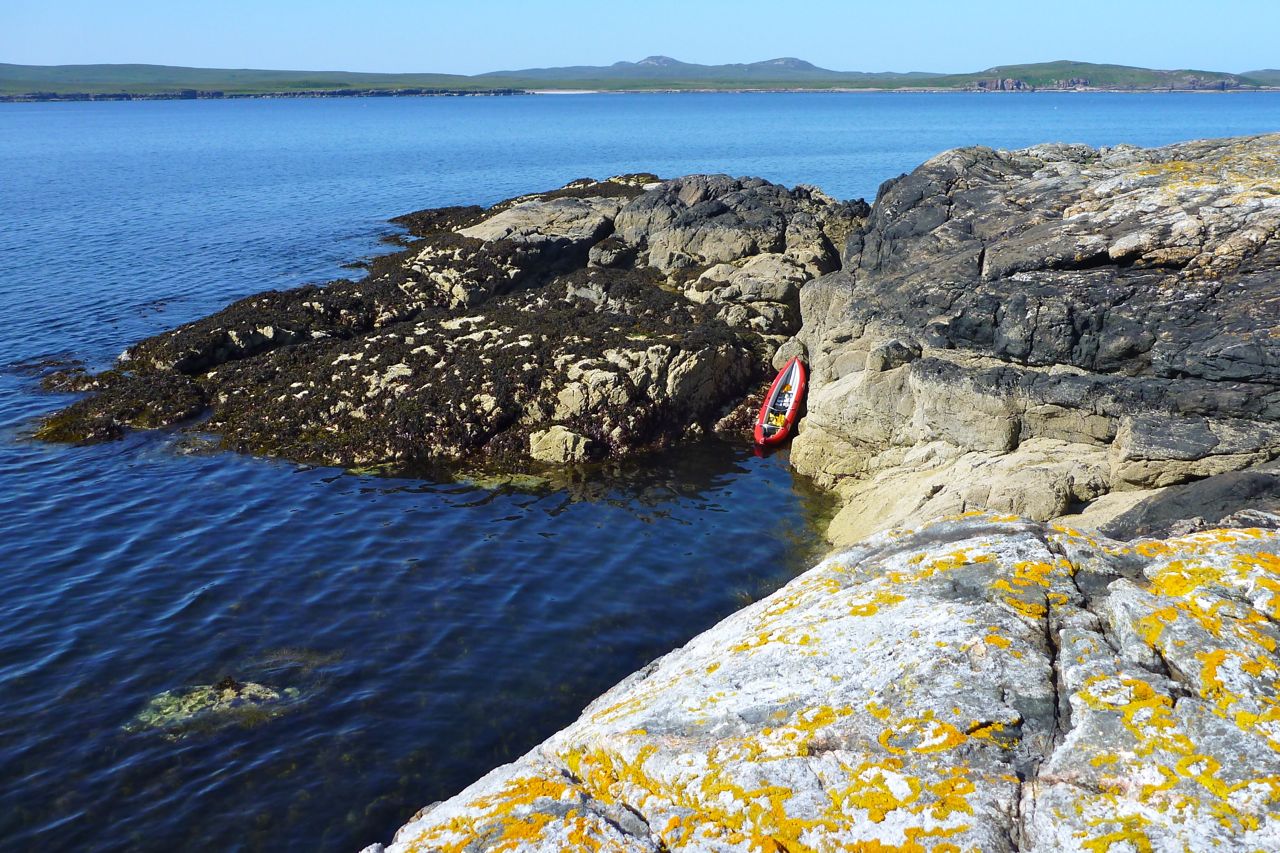
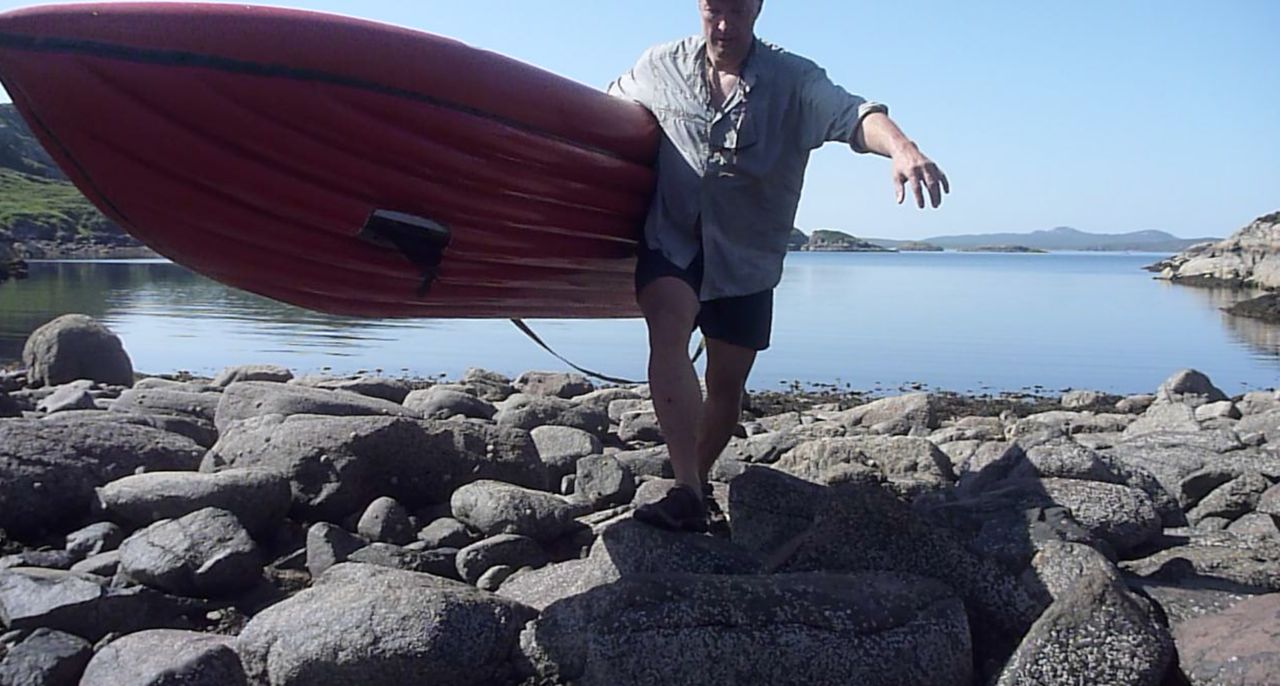
By the time I pulled alongside Green Island I’d calmed down enough to spare time for a quick look around. Finding a place to get out elegantly without slithering across a web of slimy boulder-covered seaweed was tricky, so I jammed the Amigo up a barnacle-covered slot and stumbled ashore.
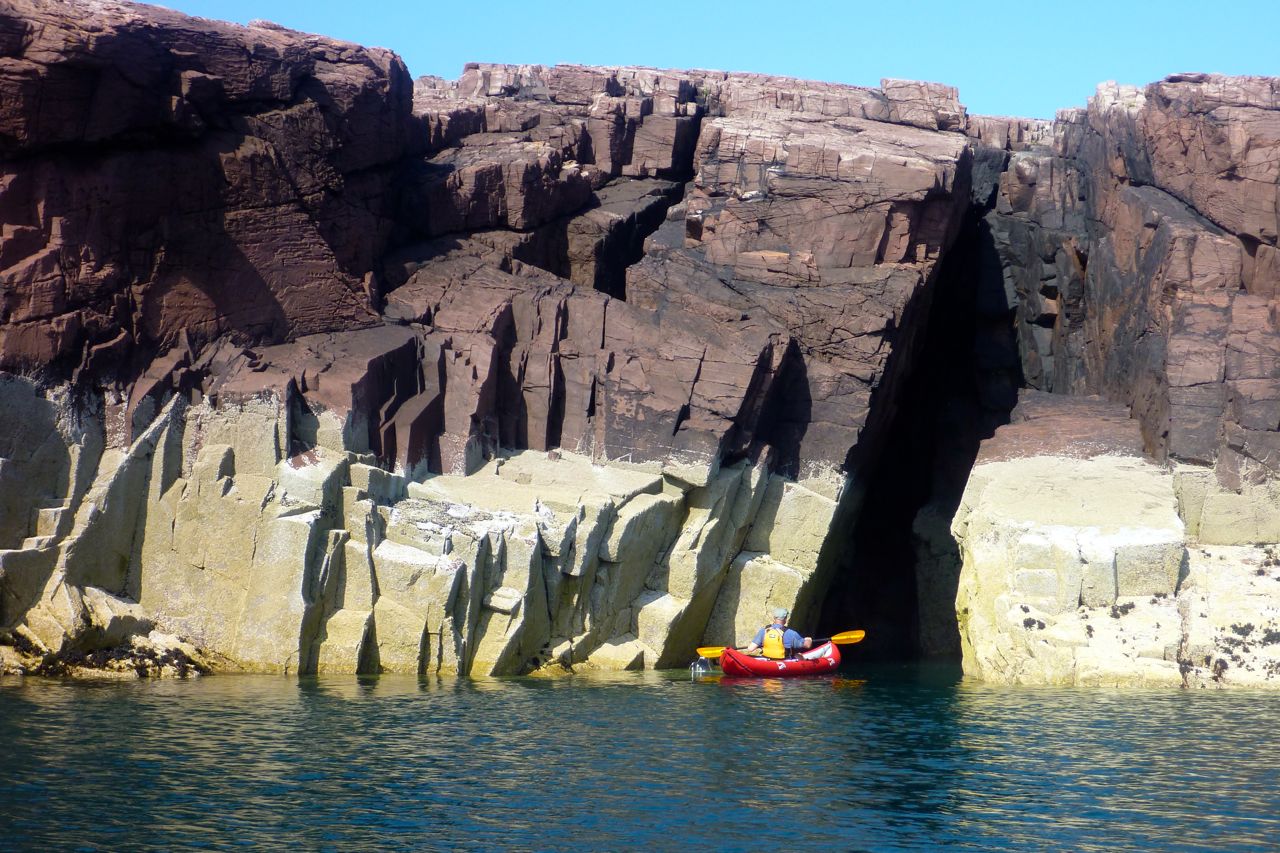
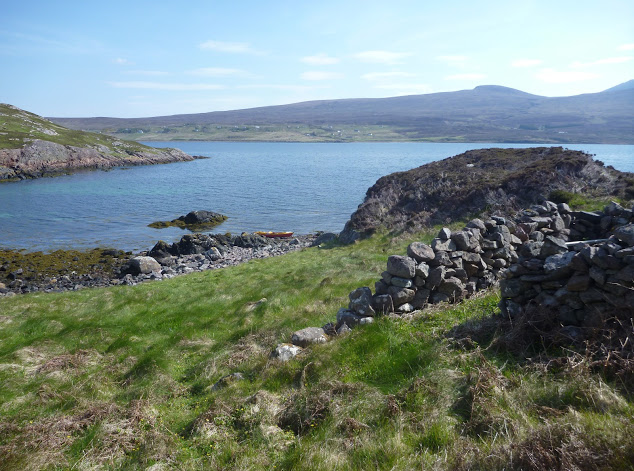
These tiny, uninhabited and unsheeped islands preserve a unique ecology, or at least a distinct botany that makes them look different to the mainland. I climbed over the sooty lichen rocks into the sweeping grass and wildflowers, causing an avian scramble, and a few minutes later planted a footprint on the 20-metre summit. I looked all around and as before, imagine Newfoundland was like this, a wild, windswept panorama under a pale northern sky with a surrounding coastline ground down by long-extinct ice caps. To the east was a sandy beach at Polly Bay – one for next time – with Suilven rising behind. In the other direction was Rubha Coigach which I was also eyeing up as a paddle during this calm spell. Heading back to the boat (‘what if it’s drifted off…?’) I came across a lone pink Croc flung into the grass during an especially violent winter storm.
I headed for the mainland, squeezing between an islet to what looked like a dormant fish farm above Rubha Phollaidgh (‘Dun’ on the map). We’d cycled to this point a couple of weeks ago, following the private road past Inverpolly Lodge which controls the freshwater loch fishing around here. Pushbiking seemed safely innocuous, but you’re never quite sure if some irate ghillie in a tartan strop will come after you. I’ve read of kayakers getting aggro for trying to put in at that bay.
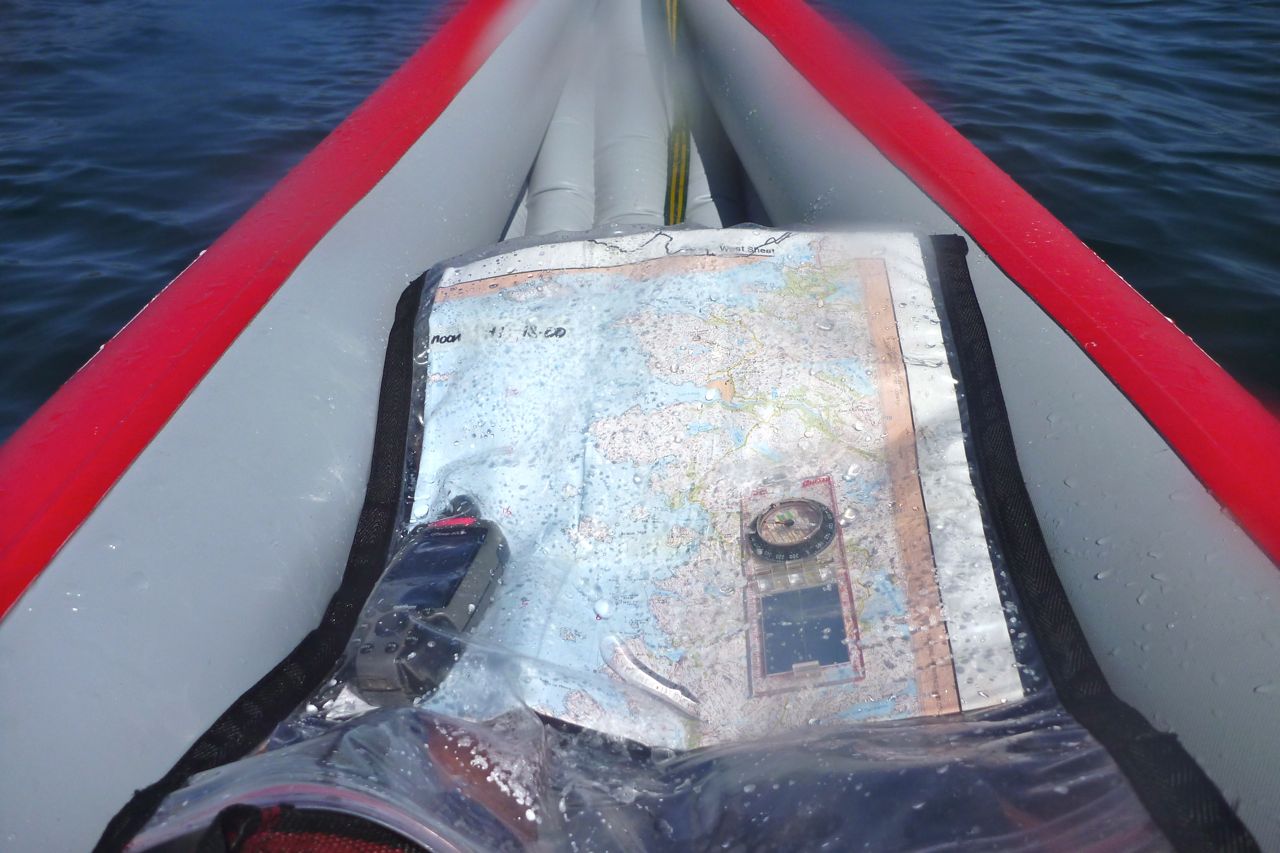
As I left the bay something felt wrong, had I caught some weed in the skeg, was the boat going flat or a current suddenly against me? There was no sensation of speed as I clawed at the water although I was moving. I checked the GPS – 4mph, good enough. It seems the 4mph breeze was now directly behind me and I was paddling in a bubble of perfectly still air – never noticed that before. I became uncomfortably hot and soon began pouring with sweat; the insulating pfd didn’t help. On a day like today adapting the pfd to hold a 2-litre bladder loaded with Nuun tablets was a good idea, but it reminded me how much more satisfying it always felt paddling into a wind, even if you weren’t going so fast.
The single-track WMR comes right down to the sea at a bay known as Loch an Eisg Brachaigh. When driving or cycling by I’d long wanted an excuse to splash a paddle around here; it looked like a magical sheltered place. From the south the map showed a short cut into the bay over an isthmus linking the tidal isle of Rubha Bhrocaire. Had I arrived at high water I might just have scraped over with a few inches to spare. As it was, my timing was right off, but a wee portage (right) is always good for the legs and the bladder.
I plopped around the bay’s islets, scaring a seal that may have been a glistening mermaid just moments earlier. I seemed to be making better time than expected, too. Closer to the shore I was in the lee of the breeze and gliding over a flat calm. But it sure was hot and my eyes were permanently stinging with sweat which I presumed a sea wash would do little to alleviate. North of here the rocky, cove-riddled shore lead round to another deep inlet; the hamlet of Inverkirkaig on the WMR. A short, steep river ends here, running off Fionn Loch below Suilven and another great packrafting excursion, although the river itself seems usually too boney to packraft for more than a short distance.
Less than two-and-a-half hours from Garvie, I paddled in at low water where I found it was too much of an ankle-twisting bother to get to the distant shore and a bench. All around was manky seaweed so I satisfied myself with a desalinating rinse in the estuary and headed back out for lunch on a sandy beach on the north side. Refuelled, I decided sod this pfd, I’m as likely to drown in my own sweat and the RNLI would be stretched to the limit on a day like today. So I stripped off and cooled right down. At the rate I was going I was looking good to meet the Mrs passing through Lochinver at 3pm and turned Kirkaig Point for the final 2.5 miles into Lochinver seafront.
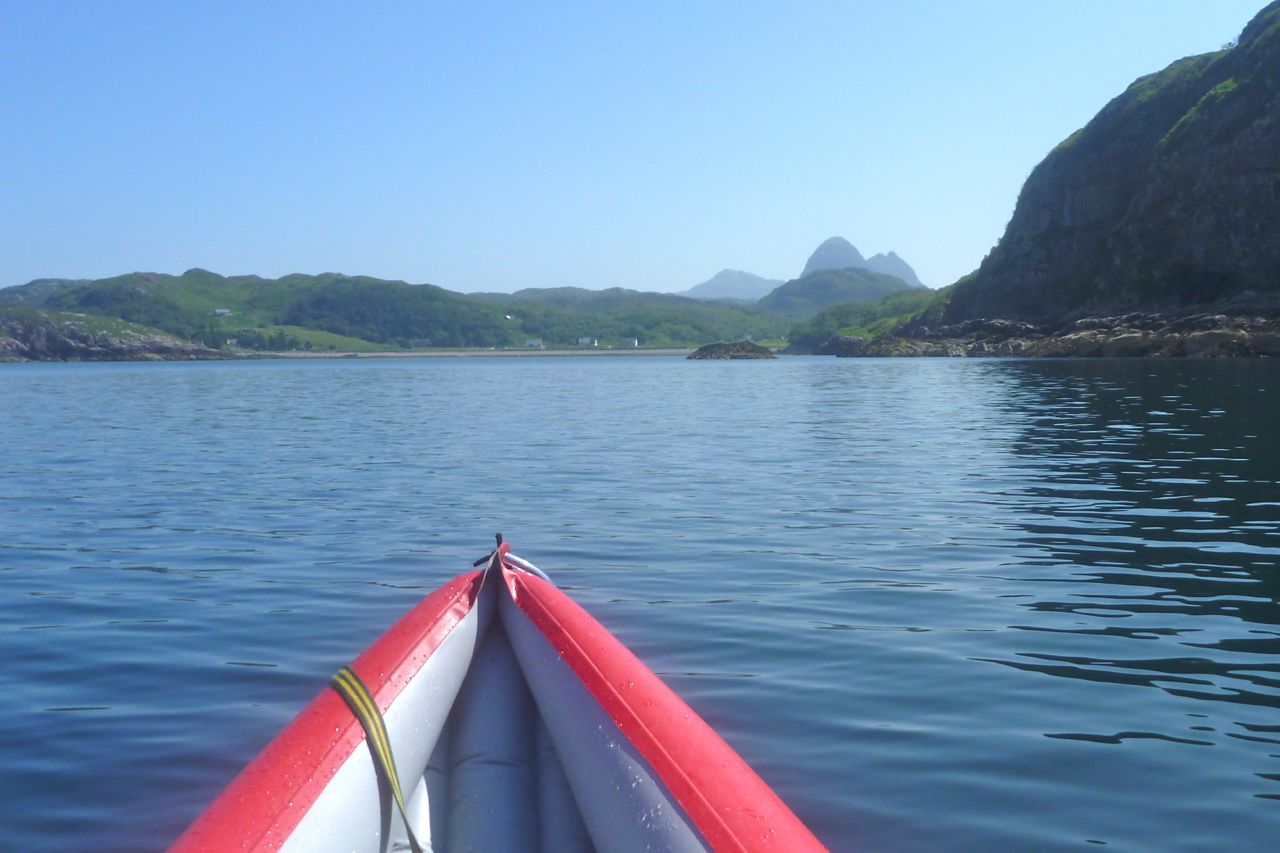
On the way in I got a striking view of Quinaig mountain (on the left) which rises over 800m like the rim of a crater behind Lochinver town. (A couple of days later we walked the three summits of Quinaig – definitely one of the best of the Assynt mountains.) And south of that was the reliable dome of Suilven behind Strathan hamlet, also a great climb as is well known. Past the harbour and marina and the baronial Victorian edifice of the Culag Hotel which had the misfortune to have an ugly fish factory built right in front of it. There are more nice old pics of Lochinver here.
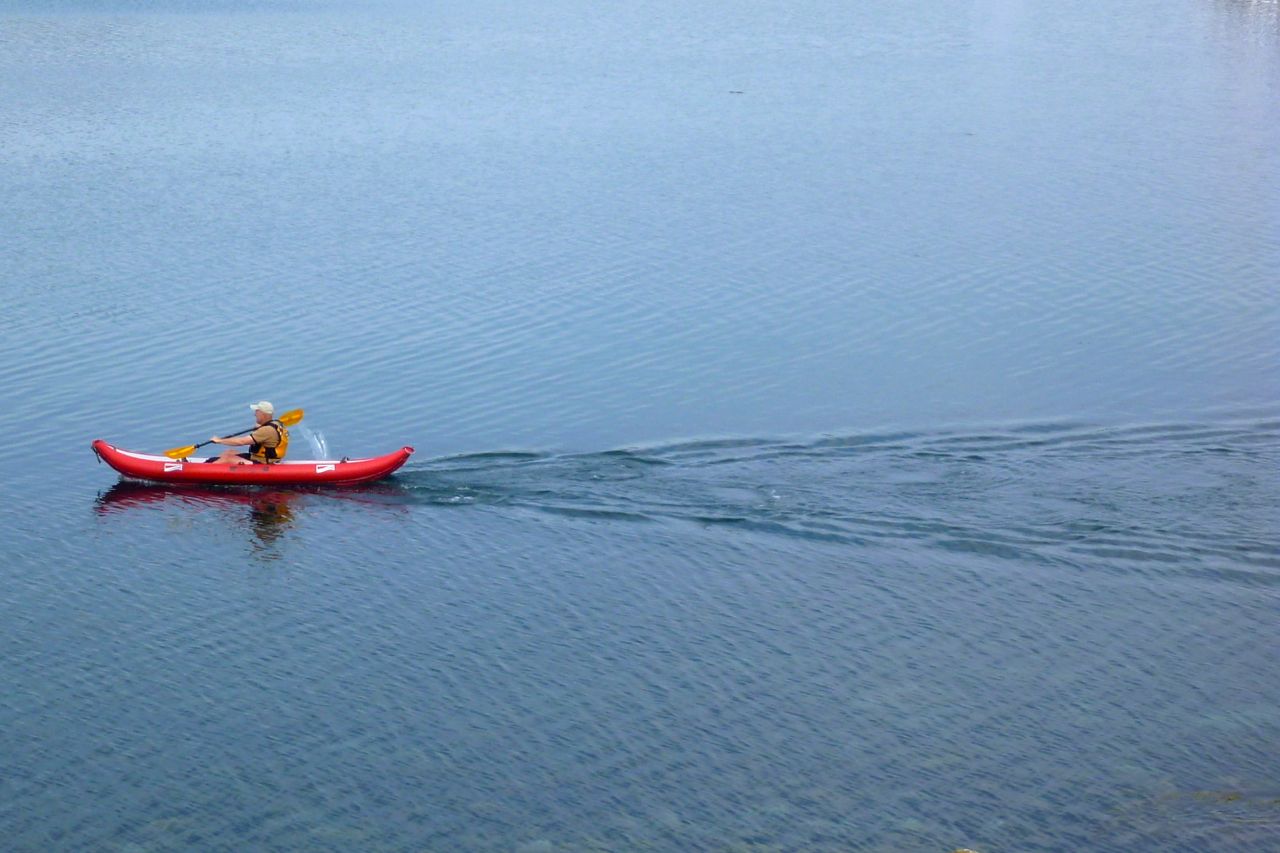
So there we have it. Calm conditions or perhaps a pessimistic estimate meant I got to Lochinver at 2.10, just 4.5 hours from put in. The GPS logged 3.5 paddling hours and a 3.1 mph moving average over 11 miles. Peak speed was an unnoticed 4.6 coming in with the tide into Lochinver. In fact that compares well with the only other long run I’ve done here: Ullapool run, though that was into the wind at times and clocked up 15 miles.
Conditions this time couldn’t have been easier; it’s so often windy up here compared to just 60 miles down the coast in the vicinity of Skye. I felt like I could have paddled any open crossing that day and so Enard Bay proved a bit of an anticlimax. The Amigo didn’t feel especially slow or tiring to paddle just because it’s not a K40, and so now I have a better idea of what the Grabner can manage in a day.
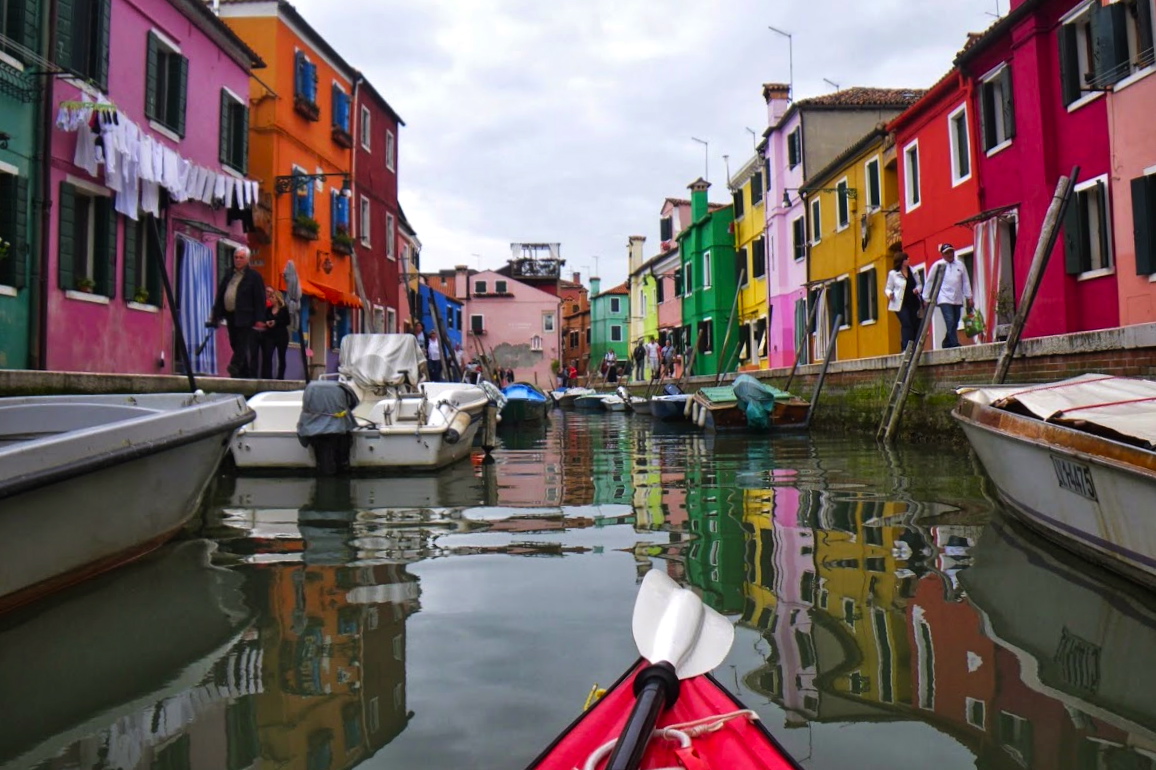
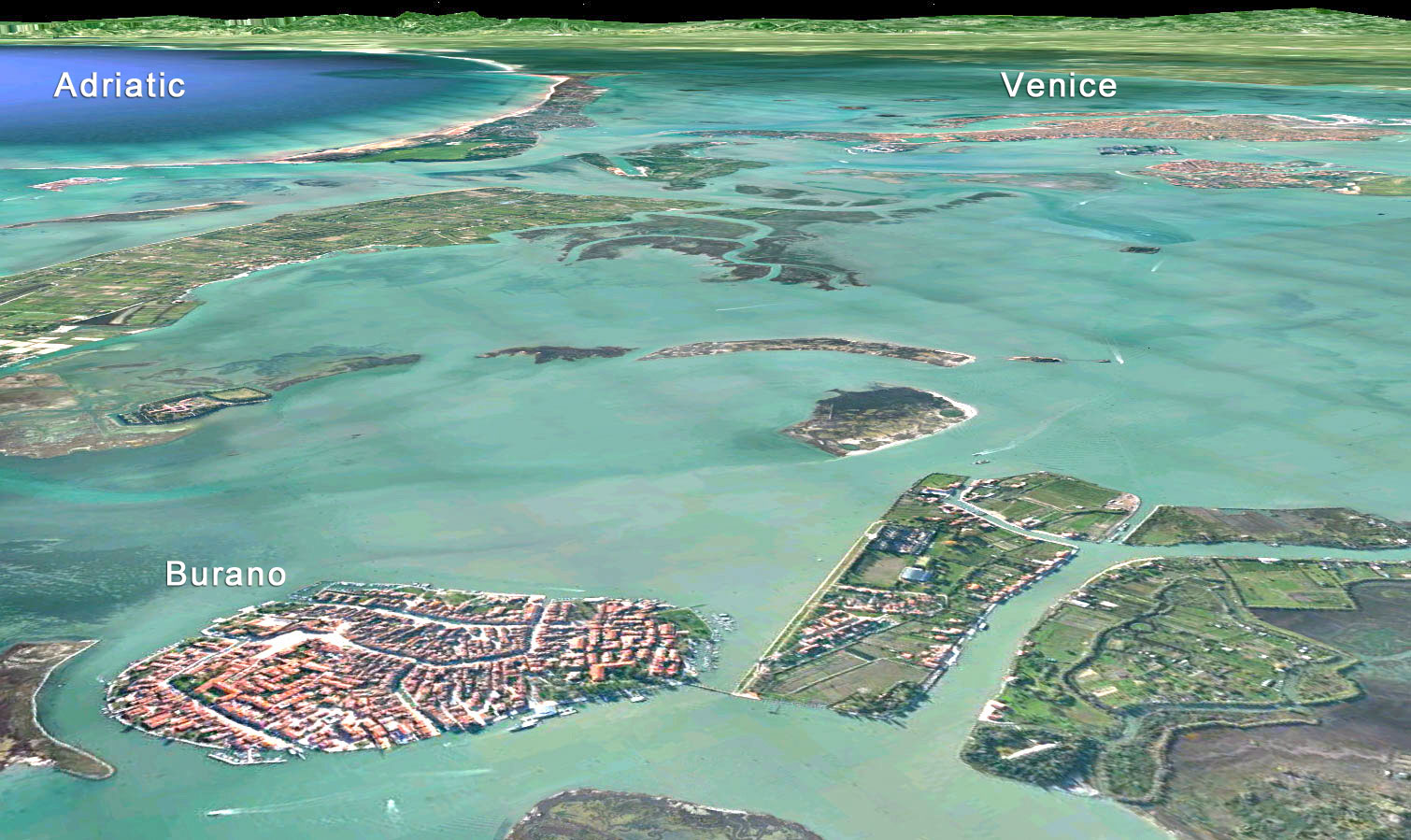
Paddling a Grabner H2 through Burano, a Venice-like collection of islands and canals (right) about 8km northeast of Venice itself.
Wiki says: Burano is also known for its small, brightly painted houses… The colours … follow a specific system originating from the golden age of its development; if someone wishes to paint their home, [they] must send a request to the government, who will respond by making notice of the certain colours permitted for that lot.
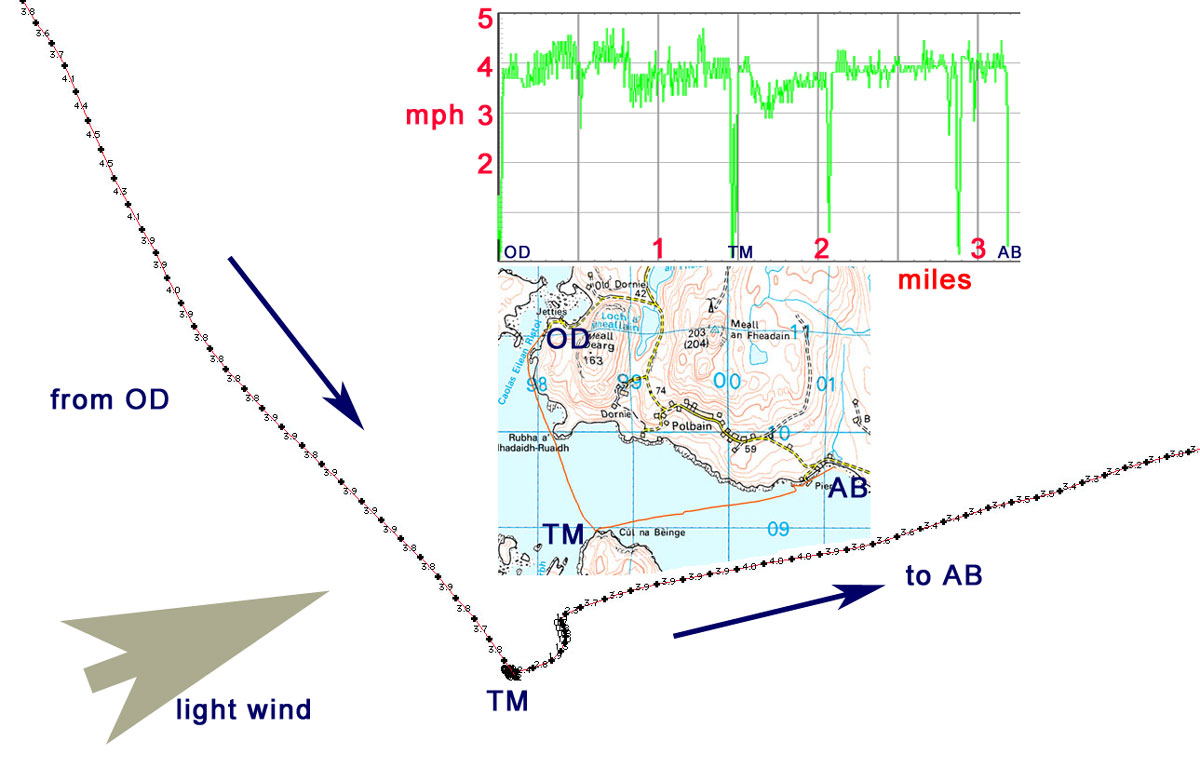
A couple of years ago I did a speed test on my then-new Incept K40 over three and a bit miles from Old Dornie to Badentarbet beach via Tanera Mor island.
I recall setting out flat-out on a cool, calm evening, cruising hard close to 5mph at times, with a burst after a rest up to 5.2, after which my energy levels tailed right off because I was well and truly pooped. I recently decided to replicate that route in similarly calm conditions and see how my new Grabner compared.
Prior to that we were out yesterday in windier and choppier conditions when, with a 10-15mph back wind I averaged about 4mph with a burst up to 5.3. Coming back into the wind we decided to try the Amigo two-up, as it only requires the front backrest moving forward. Towing the Solar together we managed a steady and sustainable 3mph with a burst of 3.8 into the stiff breeze. And on a quick spell downwind we got up to 4.8mph. It’ll be interesting to see what we can manage two-up when not towing a kayak
Though twice the weight of the g’f, I sat in the front and got pretty wet from the chop, but up here found the Amigo’s narrowed beam and lack of annoying finger-snagging seat lugs made paddling easier, even without a footrest to brace off. We seemed to clash paddles less than the last time we did two-up in the Sunny on the Vezere in France. Perhaps there’s more space between the seats in the Amigo even though it’s overall 10cm shorter than a Sunny.
As it happens once back on the beach, a French couple in a motorhome were drying off their Gumotex Solar 410C. They’d also been put off from exploring the Summer Isles by the offshore wind. They set out this morning and I see that the two seats do look quite close (ropey photo at max zoom on the right). I mention this because, as a reminder, I rate my discontinued Grabner Amigo as very similar to Gumo’s Solar 410C (see table below). Main difference is more pressure in my Amigo make it a stiffer and probably faster boat – but at twice the price of the Solar while you can still buy it. Back to the speed comparison test. Today was a calm day with a light wind from the southwest and when I set off the tide just beginning to ebb.
I’m getting accustomed to the thigh straps and the homemade footrest is great. Pulling inwards with the knees to brace off the straps and so transmit more power in the stroke isn’t something I could do for too long, I decided. I think the straps are more useful for last-ditch bracing against tipping in rough seas or rapids. But even then, allied with the footrest they do help connect you as well as you can be in an open-decked IK. Yesterday I’d found the backrest made my back hurt, perhaps because I have those footrests to push off. I’m still not convinced by this rigid backrest arrangement anyway. The cut-down packraft seat is fine (while it lasts) but that bar keeps disengaging from the rubber lugs (since fixed) and I think I’ve already bent it just be leaning too hard while moving about. It won’t be too hard to either get a thicker-gauge backrest bar made or dispense with it altogether and fit something like an Incept blow-up seat using the current lugs (although I see from what I thought here that maybe that’s not the answer). And as mentioned, those forward lugs painfully snag my fingers every once in a while.
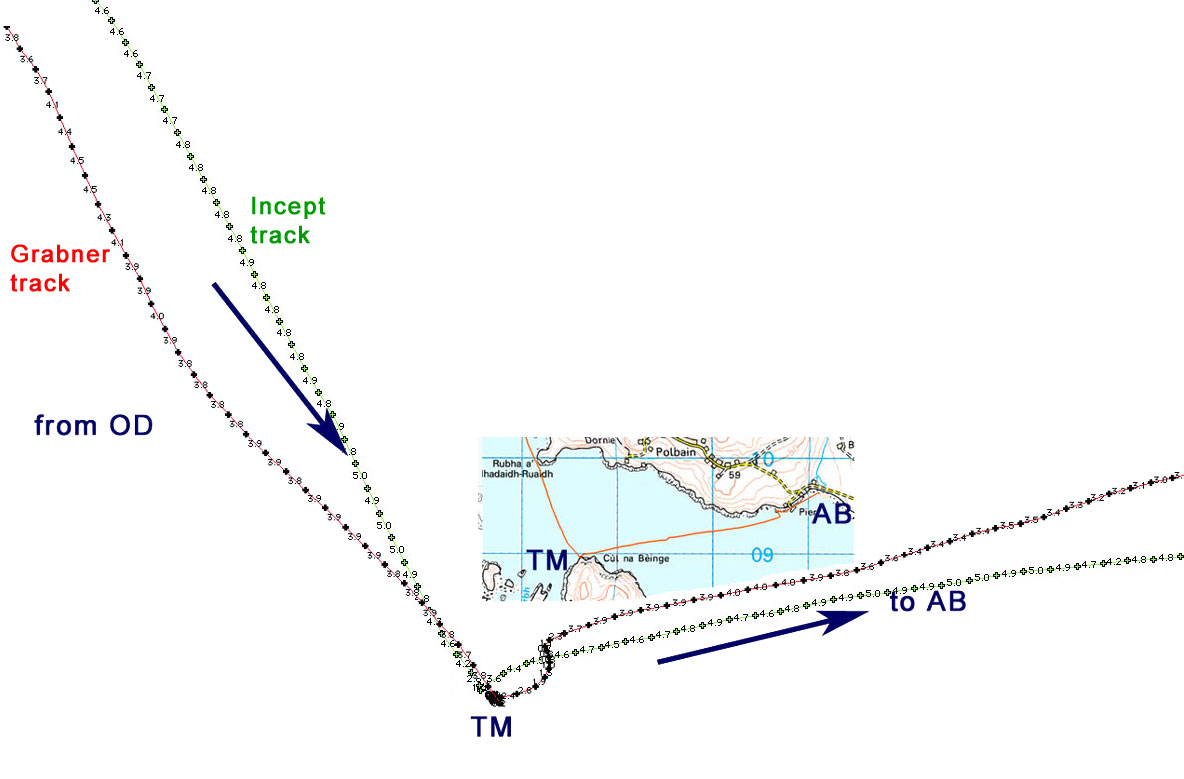
Anyway, with barely a break I belted across to Tanera as fast as I could, leaning on a bit of karrimat taped to the seat back which did the trick. I averaged just under 4mph where the Incept had managed about 4.6. That’s also the top speed I clocked in a flat-out burst in the Grabner just before reaching the island, although on both occasions this sort of effort was not sustainable.
On the second leg back to the beach I had a light wind behind me but as I neared the pier I thought I could feel the pull of the outgoing tide. Unlike in the Incept, my energy and speed didn’t drop off much as I approached the beach and I got across at what felt like an all-day sustainable 3.8, with some spells recorded at up to 4.5mph without trying.
What the heck does it all mean? Well, it’s the not-so-startling revelation that the slimmer and two-foot longer Incept K40 was indeed a faster IK than the Grabner (two tracks overlaid on the left). Overall the Grabner is around 20% slower than the Incept.
At times at sea or on near-still rivers I do feel like I’m pushing the wide-nosed Grabner like a packraft. That’s another benefit of twin-side tubes, I now realise: a sharper bow is formed, as found on Grabner’s Holiday models too. On the right you can see that’s more plough than bow and must add up to a more effort over a long day, limiting compatibility with hard-shells for full-day runs like this.
And look at that wake I recall forming a similar conjecture (picture) about how the Sunny ruffled the water when compared to a hardshell’s sculpted bow. Or indeed look again at the Incept’s moderate wake at the top of the page. But then this is all for flatwater operations. In a swift river like those of the <a class="wp-gallery mceItem" style="color: #000000;" title="Kayaking and packrafting in southern France Massif I’m sure the shorter Amigo will be easier to handle than a K40 and so the compromise stands. It’s just that up here the best paddling is in the sea. Surprisingly I don’t miss the Incept’s rudder, having spent years in skeg-only IKs before getting the Incept.
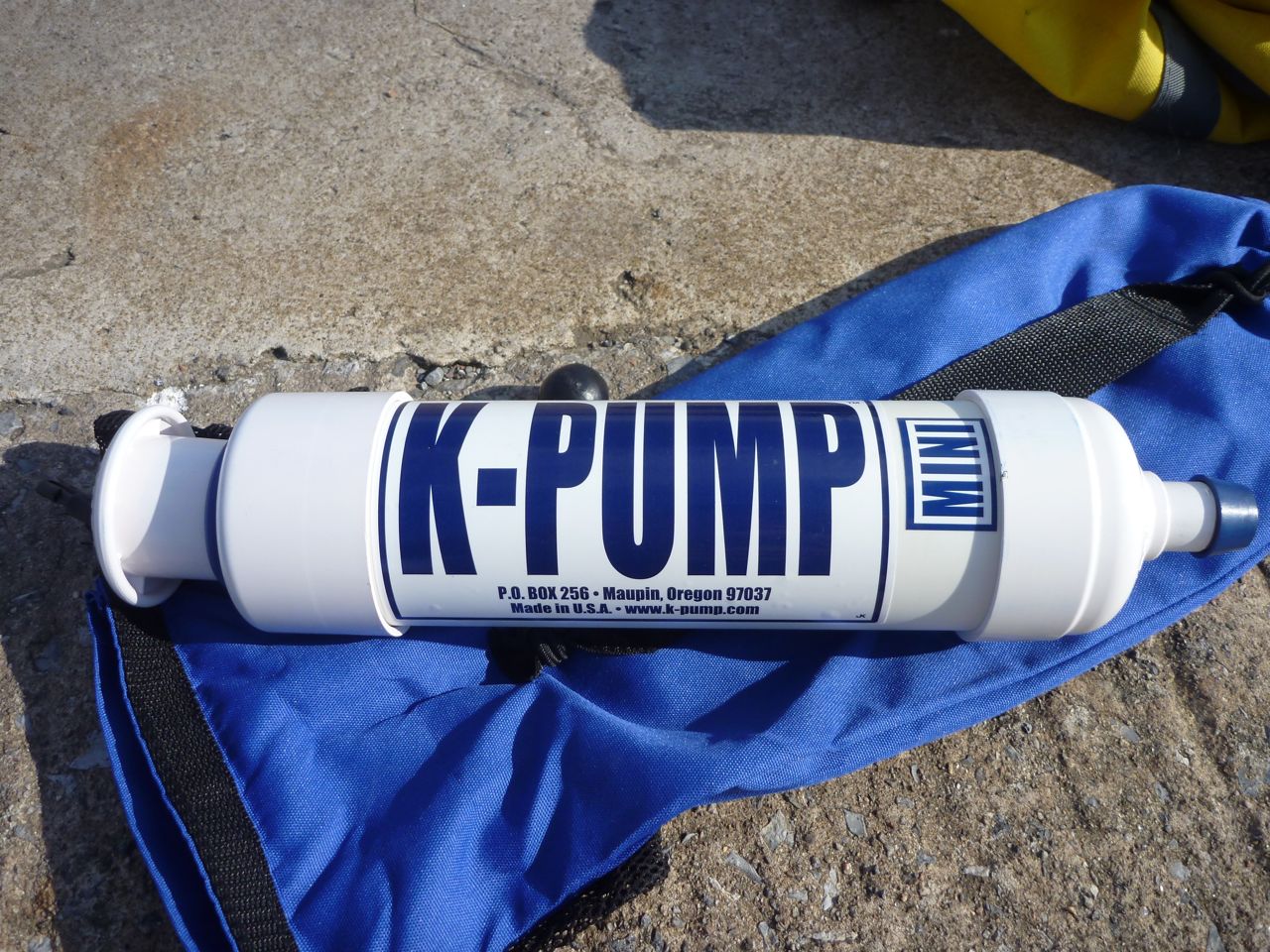
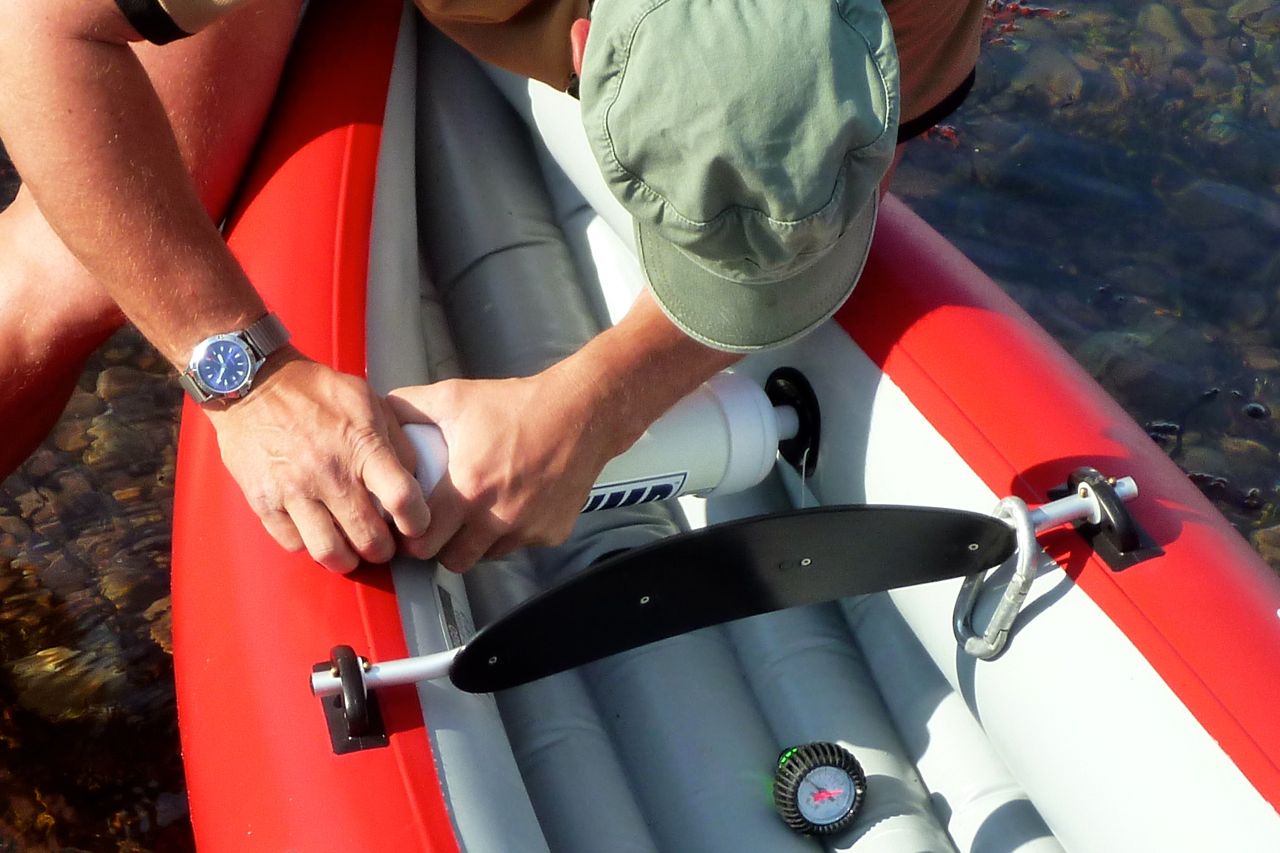
Guess what! I got my Mini K-Pump the other day (left, 600g in the bag; ~$73) and gave it a go, topping up the Amigo at Old Dornie. The fat, 15-inch pump easily banged in the required psi into the floor, but getting to the side chamber valves wasn’t so easy (below). That required the angled nozzle supplied in the kit. Before I got a chance to fit that, the plunger or piston inside the housing got knocked off the shaft. Without a crosshead screwdriver I couldn’t fix that, but luckily I had the barrel pump at hand, so we achieved operational pressures in the end.
A quick reply from K-Pump apologised for the lack of adequate gluing on the plunger. With all the grease around the seal and the plunger / piston, I decided it was less work to fix the plunger to the shaft (right) with a couple of self tappers, rather than glue. Don’t know what I’m on about? Never mind ;-)
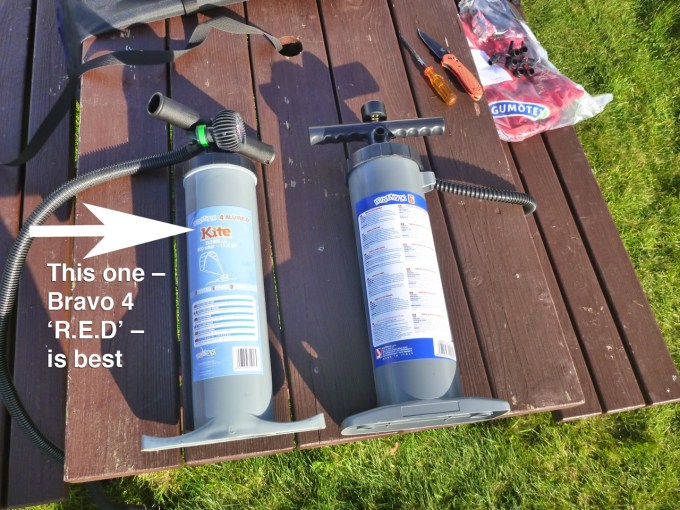
My very cheap Bravo two-way R.E.D ‘kite pump (left) is much faster at effortlessly inflating a rolled up IK out of the bag, but is of course too bulky to take on a plane. With the angle nozzle (right), the K-Pump Mini is a much handier and more compact top-up pump: I estimate it takes less than ten pumps to top up a chamber; about twice as many as the bulky Bravo kite pump. And I’ve since found it can inflate my Gumotex Seawave from flat in about 15 minutes (picture below, in Venice). Years later, it’s still my back-up or top up pump, especially handy on my Seawave which had PRVs all round and so would purge, and also to get bigger packrafts like the Nomad S1 over lung pressure to make them good and taught.
It’s hard to buy a K-Pump in the UK and I’m not sure there is anything similar. A Decathlon 1.4L D/A barrel is not that much bigger, easy to buy and just 15 quid.
Pankanel in Greece has this to say: I would also like to comment on the K-Pump Mini. I was looking for something compact and bought it from an online shop in Poland. When I first saw it, I was disappointed. It looked small for the job. Like a very fat version of my bike pump. But when I used it I wasastonished. Side by side, it inflates the boat as fast as my high-pressure Bravo foot pump or an electric Bravo foot pump. Using an extension I made using a little garden hose, some duct tape, and three of the included adaptors (vinyl tubing, Boston adaptor, universal adaptor), I can now inflate the boat very fast, standing up, or even in the water. It is the best pump I have ever seen. I Imagine the bigger models will do miracles.
Unlike my previous new IKs, out of the bag you don’t get much with a Grabner Amigo. In fact you don’t even get a bag. With Grabner IKs just about everything except the repair kit and air you pump in is an extra which undermines the otherwise striking 14kg weight. To make up for this dearth of equipment, in the catalogue they even list the specification label (right) as among the boat’s standard features! So my Amigo added up to the bare boat with carry loops at each end and two backrest bars. No seat, skeg, pump, lashing points (D-rings). On purchase, I ordered half a dozen D-rings and a pressure gauge. The rest I’ll work out myself. Having learned what’s needed over the years, that suits me fine.
With the high pressures an Amigo runs it’s great to finally have a pressure gauge that’s easy to use (left). There are no pressure release valves (PRVs) to stop an Amigo splitting a seam if left out in the hot sun, so it’ll be a quick way of keeping tabs on the boat’s pressure or ascertain it’s at full charge. I’ve added a marker in pink to easily line up with the Grabner’s rating of 0.3 bar (4.3 psi) – not 4.3 bar as I mistakenly did once (the old eyes are going…).
Fitting a tracking fin
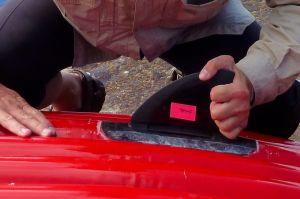
Before the Amigo even got wet I glued on a Gumotex skeg patch (left, £12) and thick plastic Gumo skeg (another £12). All up cheaper and stronger than Grabner’s similar slip-on €60 alloy version. I took a chance using MEK to wipe and one-part Aquasure to glue the Nitrilon patch to the Grabner EPDM hull as I didn’t have proper two-part adhesive to hand. I figured it would work OK as a skeg isn’t under great strain like thigh- or footrest D-rings, for example. Years later, no problems. Apply a thin film of Aquasure to both surfaces; wait half an hour, then press down with all you’ve got.
A skeg is a pain in the shallows or when dragging a heavy-laden boat over the heather; that’s one thing I liked about the Incept’s hinged rudder, but I can’t think how to make an effective hinged skeg except the way Feathercraft do it on their self-bailing Java (it slips up and down through a slot in the self-bailing floor).
Press down hard!
Can just about the fitted when inflated
A slip-in skeg can’t be slipped off a fully pumped up boat, at least one like a high-pressure Amigo, though actually after a couple of months it’s less tight and can be done. Being able to do that is very handy for portages or grass-dragging, though the skeg itself looks pretty tough. Of course, an IK works without a skeg, but on coastal waters they’re a good idea. More on that topic here.
Pump
The Amigo uses more secure bayonet inflation valves which with the right adaptor (see inset below left) don’t pop out at the high pressures (0.3 bar/4.3psi) this boat requires.). Pump hose-end bayonet adaptors are easily bought in the UK from RIB suppliers on ebay. Inset left, the black one is what Grabner sell with a fitted fibre sealing ring and steps in the bayonet to suit different valve depths. The ‘butterfly’ finger tabs make this easy to twist in place, too. The green one uses plastic spacers held in place behind a black rubber washer to get a good seal. You wouldn’t want to lose these push-on seals and it’s hard to twist in place, so for the moment I’d say the Grabner one is better. Write that down, quick!
A now almost extinct yellow-hosed Bravo foot pump that suits some Gumotex can’t manage Grabner pressures, at least not my aged Bravo which hisses from various leaks before you can get a full charge. I’m amazed it’s lasted as long as it has. I got myself a bulky 2-litre barrel pump (above left, £20) rated at over 11psi. As you can imagine, on a low-volume IK this works fast, not least because it pumps on up and down strokes. Like Bravo foot pumps, it also has a second port to suck out ever last dram of air – handy for compact packing at the end of a tour.
The Bravo barrel is bulky so I’ve got a K-PumpMini (right, review here) from i-canoe in Ireland who can import anything from the NRS catalog in the US, and without a huge mark up too (€80 delivered, not sold in the UK). My longer K-Pump 100 worked surprisingly well inflating the Incept; we’ll see how the Mini model performs on the Amigo. If nothing else it will be a handy top-up pump; Grabner cover themselves very comfortably by claiming that anything under a 20% pressure loss over a 24-hour period is not a warranty claim, though I’ve never owned an IK that lost that much air in weeks let alone a day. K-Pumps can’t suck out air like Bravo pumps, but using a loose hose with the bayonet fitting it can be done by lung.
Additional D-rings
Next, I glued on my half-dozen D-rings (left). Front and rear will hold down gear; the other four locate my cut down packraft seat as well as an adjustable footrest tube similar to what I made for the Solar last year. The seat and foot rings will also double up as thigh strap location points. I’ve not always been that successful at gluing on previous boats, so this time did it by the book: roughen with sandpaper, wipe clean with MEK or alcohol, apply glue to both surfaces thinly and wait half an hour, glue again and wait less, then apply and press down hard with the roller.
Doing this I had a feeling the two-part Polymarine 2990 adhesive (right) was more effective than whatever I used doing the same job on the slipperier PVC-U Incept a year or two ago. I suspect Hypalon/Nitrilon is easier to glue; ‘plastic’ PVC-U is more effectively heat welded.
Thigh straps
Over the years I never really got into using the thigh straps on my Incept or Java – perhaps the need for ruddering the Incept made them more tricky to use, or perhaps I’m just an idle paddler. But with the Amigo, I want to have that option to help it shift. In any case, it’s worth persevering with thigh straps as this is one of the main things that separates IKs from hardshell kayaks in terms of boat control in rough conditions and optimal torso-centered paddling efficiency. Straps are not quite as effective as bracing your knees under the top deck of a hardshell, but they’re all you can do with an IK. Otherwise, you’re just sitting in a canoe or on a floating log. I’ve now got fully used to the straps on the Amigo and use them without thinking, just like I feel much more secure with the toe clips on my bike’s pedals.
Footrest
In my opinion, you need some kind of footrest too, if a braced body is to make an efficient paddle sweep – it’s probably more important than thigh braces. Last year I improved this on the old Gumo Solar that’s occasionally used by the g-friend. The Gumotex footrest cushion (same as my old Sunny) was too far away for the 5-foot Mrs to use effectively and is squidgy at best. On the Amigo I was able to use the front thigh strap D-rings to hook up the 4-inch footrest pipe (above left) with an adjustable strap looped through. It works fine.
Seat
At the other end I’ve separated the toilet-like seat base of my old Alpacka Denali packraft from the backrest section. It clips to the rear thigh strap hardware with mini snaplinks (left). This ultralight seat has already been repaired once by re-heat sealing the flat seam and another hard bounce may pop it again. It’s lasted the summer but if that happens I’ll come up with something better; any inflatable pad or IK seat base will do. The Incept seat was pretty good, so was the firm-backed Feathercraft Java seat which didn’t fold under strain. Right now, at about 50 grams, the cut-down Alpacka seat base is about as light as a kayak seat can be.
The hard plastic Grabner backrest was comfortable enough to lean on once I added a bit of karrimat, though it kept coming adrift from the lug holes when the bar pivoted down, usually when manhandling the boat, but occasionally on the water too. At sea it’s quite awkward to refit the bar into the black rubber lugs as the hull sides push apart. The only way I found was to face backwards in the boat, swing the legs out into the water and squeeze them against the hulls to repeg the seat bar.
To keep the bar in place while retaining a tool-free, quick detach element I hammered out the outer brass peg and replaced it with an R clip (above left). But that didn’t last too long – one clip bent and fell out and, as expected with footrests, the alloy bar was bending against the strain. I tried a blue seat strap instead (right), but hooking that to the rubber seatrest lugs looked like it put too much strain and distort them. Ripping those lugs off would be a pain. No way round it but to glue on another two D-rings as I did on the Solar; a 4.5-inch patch has four or five times the glued surface area of the seatbar lugs so ought to take the strain. D-ring prices seem high so I settled on what I knew – chunky Grabner items at €15 each (right). Grabner deliver fast from Austria.
The seat strap was a crude solution so I figured I may as well try a proper, full-height backrest off an SoT. On ebay the ‘heavy-duty‘ item (left) with long adjustment straps and even a back pocket went for £24 – less than the two D-rings which hold it in place. As far as I can tell the rear straps’ only purpose is to hold the backrest upright, but it’s proved very comfortable – like a proper seat and with no inflation required. I’ll keep the original seat bar for less frequent two-up paddling where I don’t have a footrest to put a strain on it. So after a couple of months use I have optimised my Amigo by completing the adaptions listed here, making a comfortable and more practical boat for coast hopping and river touring. The cost has been six D-rings £80; seat £24, glue £15, seat base and straps already had; Gumo skeg and patch £24, and two pumps, gauge and adapters £110.
A sunny day in the south of England saw me back on the water with the Big Kahuna Man after many months off. It was a chance to anoint my new Grabner Amigo’s slick, factory-oiled hull with the Medway’s occluded discharge. If you’re interested, there’s more on why I got myself an Amigo right here.
BK Man and I started out of Tonbridge with a plan to replicate our icy winter run of last year when at times we had to crack our way down the river. Assembling the Amigo for the first time was of course simple once I had the bayonet adaptor fitted to the end of my aged Bravo foot pump, but that pump could barely manage to get the requisite 0.3 bar (4.3psi) the Amigo runs. More about all that malarkey on the mods page.
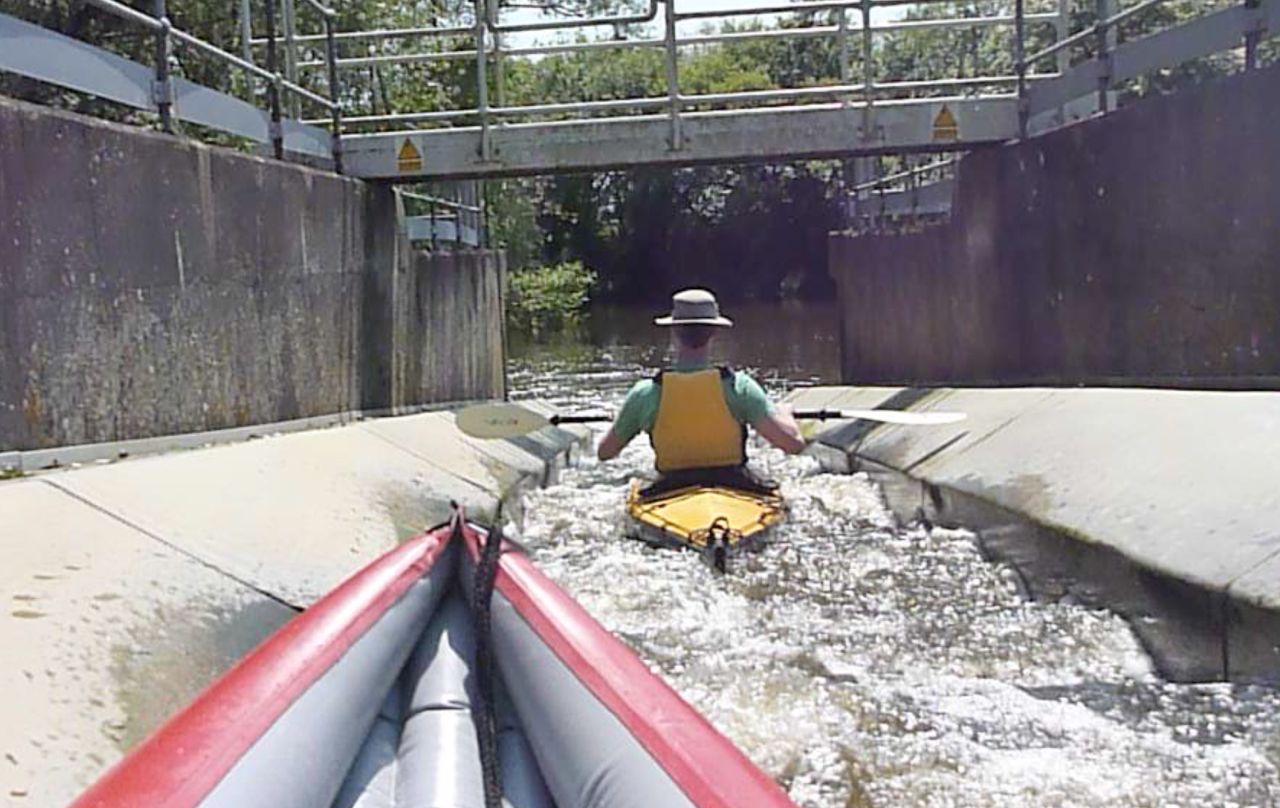
We slipped down the rather tame Tonbridge Town Lock chute (right) where it soon became obvious the Amigo was not going to break any speed records. This may be a false impression as there was a stiff head-breeze, negligible current and my lack of paddling fitness and of course the Amigo’s 3.75m and 80cm width – over half a metre shorter and 11cm or 4.3 inches wider than my old Incept. All that made for hard yakka while the slick Kahuna glided effortlessly by.
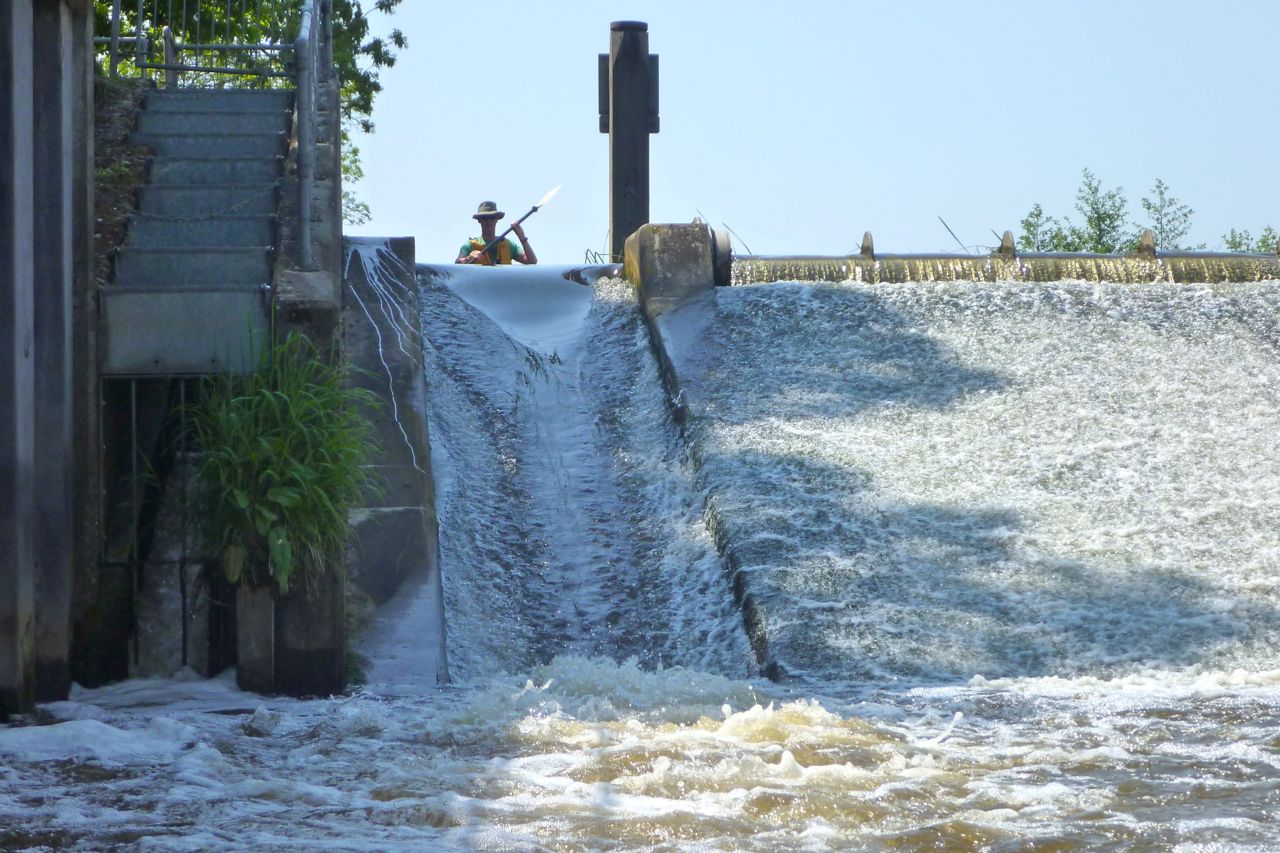
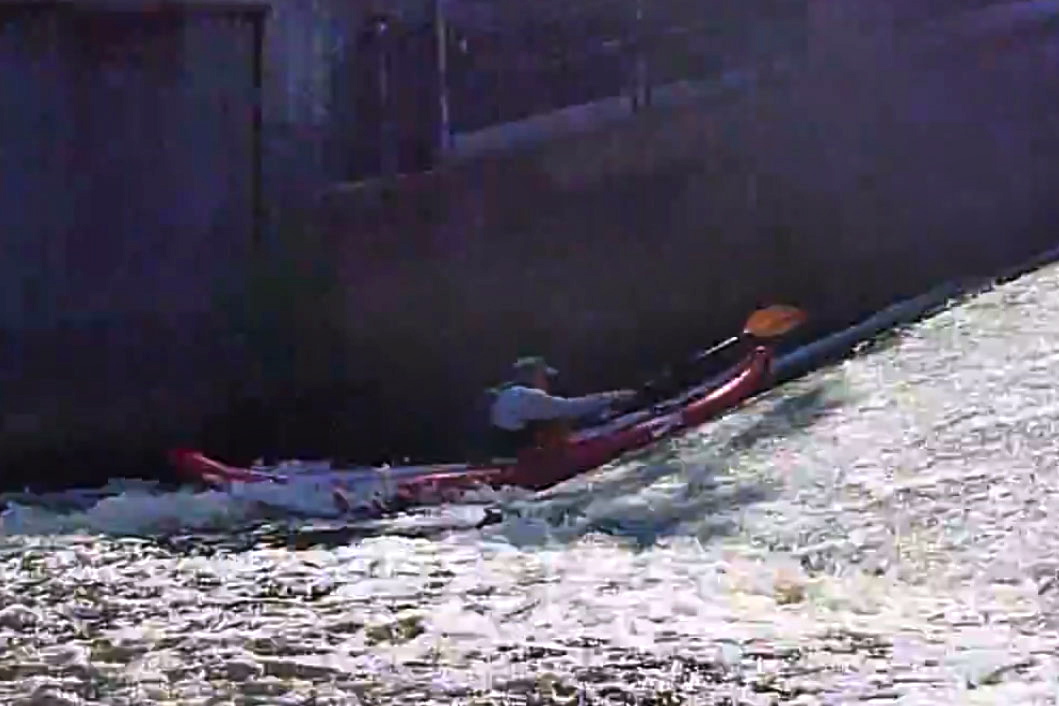
On a positive note the Medway hereabouts now appears to be fully chuted up for canoes – we could have got all the way to Yalding without getting out. As mentioned, some chutes are rather dull affairs where fixed bristles churn up the water and slow a boat down. Others, as we knew well, were steeper and more sporty numbers that you attack at full pelt (left). We like those!
The recently fitted Gumotex skeg tracked flawlessly but still kept the curly ended Amigo turnable. It will be good to try paddling without it; not such a good idea at sea but always handy in shallow rivers where the current should provide the speed you otherwise gain from being able to paddle harder with a skeg.
In between the fun chutes, the simpering Medway crept by. BK Man combed the water as gently as if he was brushing Kate Middleton’s perfumed hair, while I hacked away like the Barber of Seville with my too-large Corryvreckan paddle; very light and stiff it may be but it’s not the blade of choice when unfit. Also, the boat’s secondary seat lugs tended to catch my thumbs, the spare packraft seat was a bit sloppy on the factory oil and I was in dire need of a footrest: all things to refine or fit once relocated up north. Later I just rested on the seat back with no air padding from the Alpacka seat and that was fine and enabled a good back posture, though I do worry about snapping that seat bar in a hard hit or clumsy moment. It did dislodge a couple of times as the boat flexed down steeper chutes. I suppose a stick or even just a strap will make do as a replacement.
You can see from the pic on the right that even with my weight and only .25 bar in the side tubes, the Amigo is as straight as a boiled hardshell and unlike the Sunny of old. In future I’ll pump it up to 0.33 or so to compensate for the cooling once it gets in the water.
By the time we got to the sporty Sluice Weir Chute (lef and right) I was knackered, sore and starving, a torment made worse by the gusting breeze and the succulent aroma of wild garlic emanating from the lush, green river banks. Southern England in early summer really is a great place to be an insect.
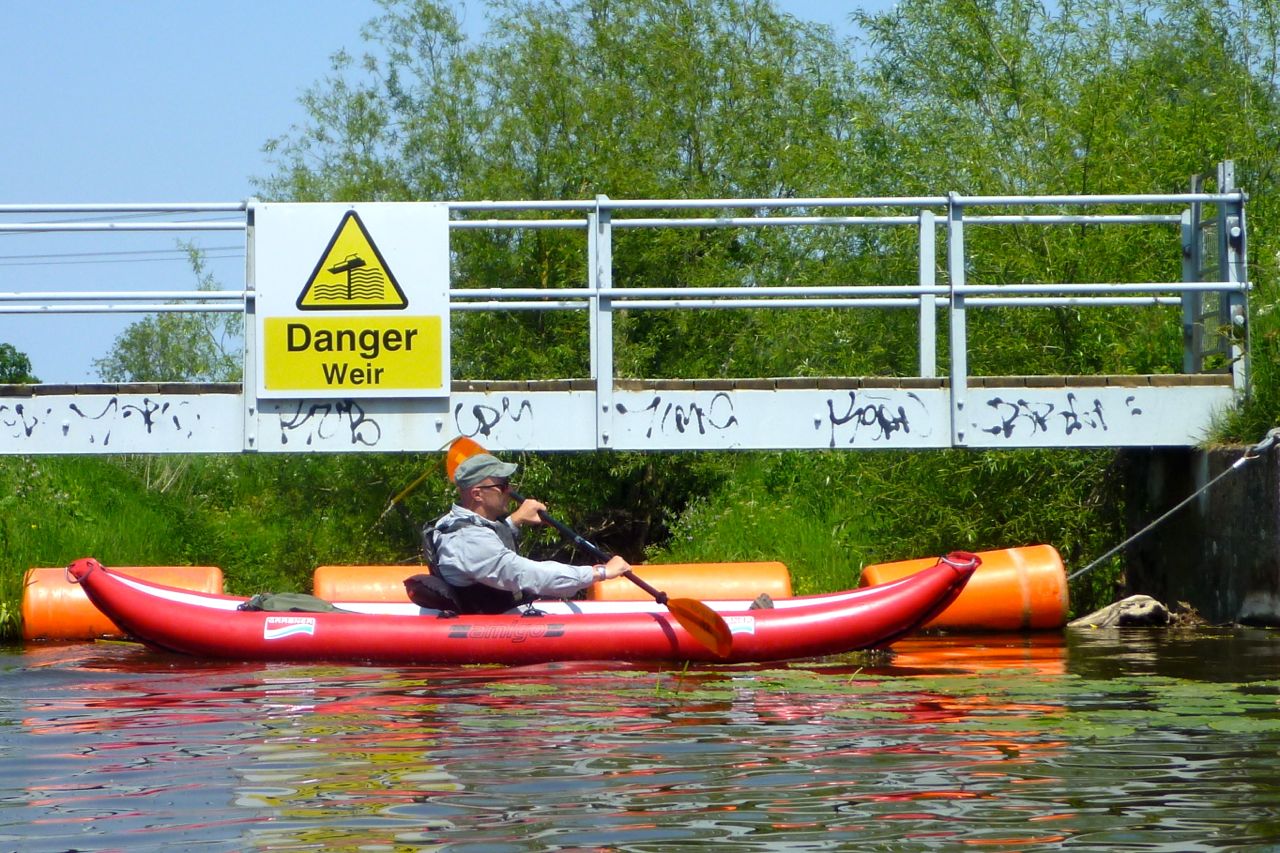
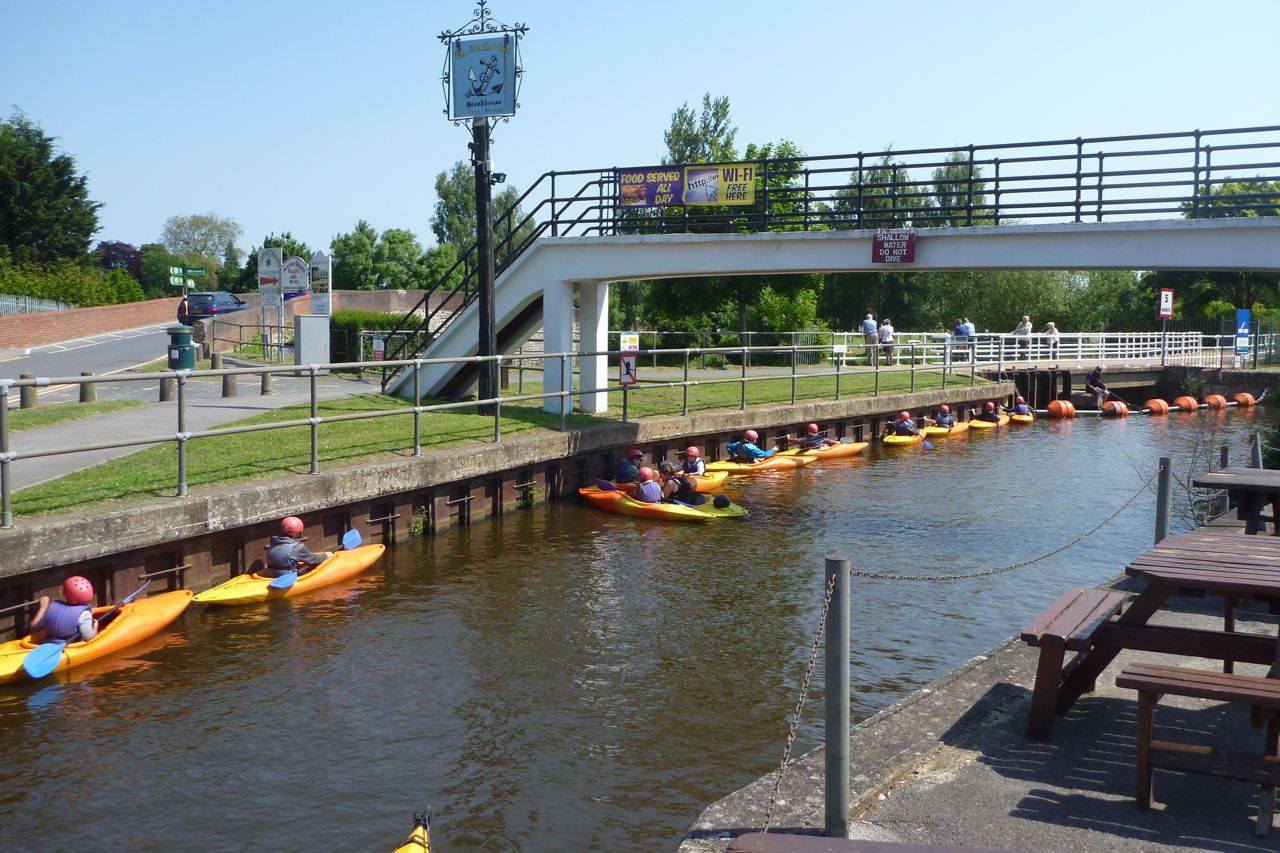
We had high hopes of snaring a good feed at Ye Olde Anchor Inn at Yalding, but it was so poor it wasn’t even worth a picture. I ate as well in primary school back in 1968. What a waste of a great location; someone keel-haul the chef! Next time we’ll revert to the tea room on the other bank. As we approached the Inn we were puzzled by a string of schoolkids in mini kayaks lining up to slip down the flat Yalding weir face. Like some neoprene Pied Piper, their teacher or guide was actually pushing away the orange safety booms so the little mites could slip through and potentially plummet to their deaths. I suppose the river police must allow it. At the low levels we knew the flat slide down the weir face was not so suited to our long boats – the Kahuna’s nose would dig in to the concrete at the base and spin the back around while I’d scrape my skeg all the way down to the sound of melting plastic. Btw, check out this vid of what happens at Yalding when they open the taps. Scary!
Gastronomically unsatisfied, we lowered ourselves back into our boats for the short hop to Hampstead Lock (no chute). Here, in the full spirit of The Pack Boating Way, we dismantled our boats, walked 5 minutes the station and caught the train back to Tonbridge. I can confide that like a Sunny, an Amigo is so easy to dry, just splay it out (right) like a Peruvian hamster entree, give it a wipe, roll it up and off you go.
One thing I can to say about the Grabner – you do appear to get what you pay for. Construction appears to be flawless – far superior to the Incept, better than Gumoes I’ve had and with not a smudge of stray glue or ill-adhered creases, gaps or lumps. Once the set up is optimised it’s an IK that ought to last many, many years. More Amigo action to come up in the Summer Isles in the next couple of months
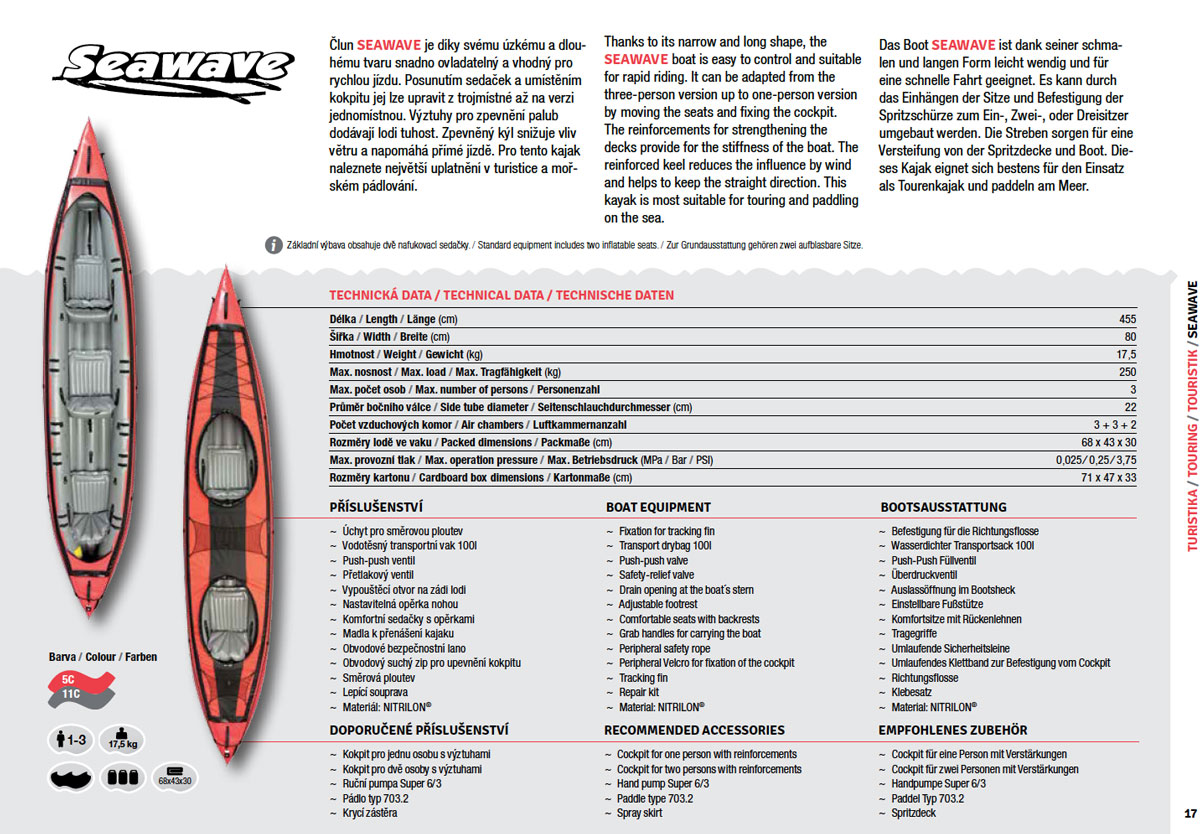
The Seawave was released in 2013 and in 2016 a near-identical model came out with a rudder option. The Seawave can be used as a single, double or triple, and is sold in Euroland for around€1625 or £1425 in the UK. They used to be a bargain. Not any more. In 2023 the Seashine version came out – a Seawave with a drop stitch floor (like the Thaya and Rush); slightly heavier, wider and longer and a lot more expensive.
My stats for my Seawave are 4.5m x 78cm wide and 17kg plus a claimed payload of 250kg which sounds plausible. Significantly, the Seawave’s pressure is rated at 0.25 bar (3.6psi) all round, midway between the Gumotex IK norm of 0.2 and Grabner’s 0.3 bar. Some of Gumotex’s orange series whitewater boats run 0.25 and their IKs were never that shoddy. Having said that, the PRV in the floor of the Seawave has the same ordinary rating you’ll find in a Twist or a Palava or probably any other Gumotex IK (more here) but the adjacent sticker claims 0.25 bar max. It’s the side tubes that now take 0.25 bar, not 0.2. What they now call Nitrilon is not like the stiff old hypalon-like Nitrilon of my early Gumboats. Increasing hull pressure is one way of getting a more rigid and therefore faster IK, but it’s the integrity of the ‘I-beam’ floor that’s the usual limitation. The Seawave has a pressure-release valve in the floor but not on the side tubes, and I read these pressures are said to be on the conservative side. You can’t over-inflate the floor but these Gumboats can handle more in the side tubes providing you watch it when out of the water in the heat.
The Seawave is long for an IK, but with just a skeg (optional, but there’s a rudder now), you wonder if this could be hard work to turn into the wind. However, in France kayaks destined for sea use (beyond a certain distance from the shore) must be homologated or approved in some way, and the Seawave has passed this test.
The great thing with the velcro deck (for one or two) is that it can be removed; on my Incept I paddled like this approximately 99.9% of the time, with the deck rolled to one side. Even at the slightly higher pressures, I have to say at one point in the video I noticed the Seawave bending with the swell. My Sunny used to do this, taking on water over the low sides, but with a deck that ought not be less of a problem, even if you imagine there’ll be some seepage through the velcro in heavy conditions or white water.
Flexing is a problem with any long inflatable and even my short and high-pressure Grabner (left) flexedin certain conditions. Manufacturers get round it with metal frames (Feathercraft, Advanced Elements), twin side tubes (some Grabners, Gumo Seakers, Incept) stiff fabric (Incept) or just high pressures like Grabner, but that demands very good construction. Drop-stich panels are the new way of doing it now.
There are more impressions as well as some nice pictures from an actual owner, Norman, right here (translated from French). He ran a 410C for a few years and talks of pumping his Seawave right up to 0.35 (5psi) bar which makes for good speed (6kph average he claims). That is 40% above the recommendation so let’s hope the seams on the Seawave can take it, cap’n.
It looks like grey, Halkey-like valves in the back, not the old-style black ones that Gumo used. And I see that Gumotex have again adapted an idea that I had on my Sunny years ago (right), a drain hole at the back. Only theirs features a neat sliding cover. It could all be the normal process of improvement of course, but I recall that after I had some smaller skegs made for my Sunny (and sold to a few others), Gumotex reduced the size of theirs to the current black plastic ones. And then the velcro deck idea. Whatever, it’s gratifying to see ideas I have tried or written about actually making it into production.
Enough of this speculation! Actual impressions on receiving my boat here, followed by half a decade of very enjoyable Seawave paddling.
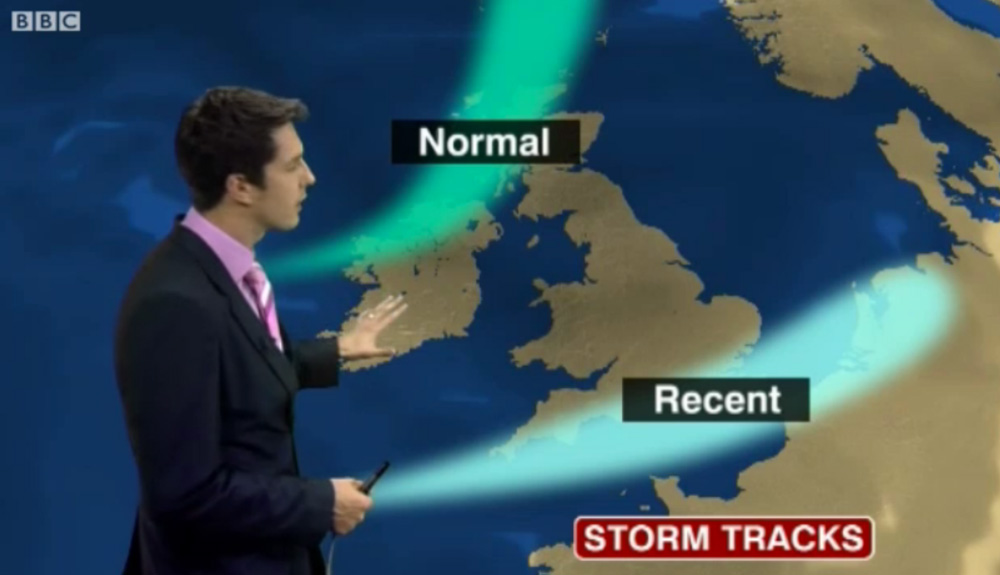
In 2011 I met Gael after he ran out of time and weather to complete the second stage of the Scottish Sea Kayak Trail he started in 2010 in his Grabner H2. According to the guy who wrote the guidebook, the SSKT is a 500-km run through the Inner Hebrides from the Isle of Gigha off the Kintyre peninsula to the Summer Isles, but with no shoreside infrastructure as such, most just follow their nose with the book’s help. In 2012 Gael returned to Skye for another go, now in the ex-demo Incept K40 be picked up from Sea Kayak Oban. In March that year Scotland experienced some very fine weather while England got the converse – a result of a misplaced jet stream (right). And so it was for Gael who managed a comparatively trouble-free run all the way to Ullapool where he rolled up his boat and bussed back to his car on Skye.
Day 1 – Kyleakin to Uags The trip began rather badly. I arrived around midnight in Kyleakin after an interminable drive from Paris with an exhausting final crossing through the Highlands mostly in the rain. I set up my tent quickly on the grass by the hostel’s backyard. Once in my sleeping bag, I fell asleep right away, lulled by the pounding of rain on the canvas and the rustle of leaves in the wind gusts. Early next morning I woke up with my feet feeling cold and wet; during my deep slumber I’d pushed them under the edge of the tent. Fortunately, my sleeping bag fill is synthetic and the nylon shell water repellent enough and with relief I found it was still dry inside. The ground all around was drenched and I could now test the effectiveness of my new Seal Skinz socks. It was still raining, so I donned my foul weather gear right away before proceeding with the usual pre-launch routine (inflate kayak, rig the accessories, sort food and equipment before closing the bags). Like last year I went to Kyle of Lochalsh Police Station to report my departure, then to the Co-op to stock up on McEwans in case I got shipwrecked.
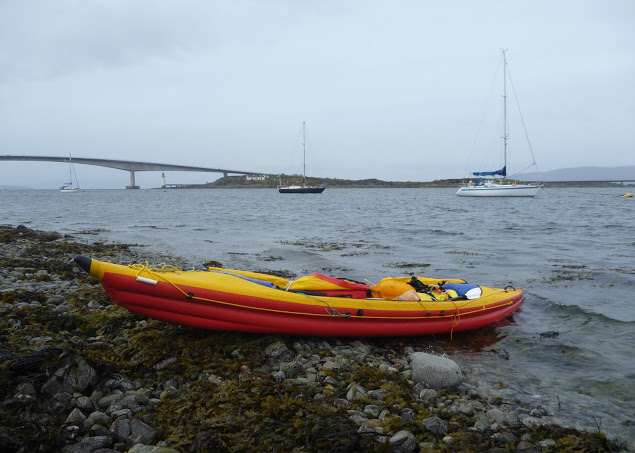
Early in the afternoon, after a quick snack, I launched in Otter Pond by the Skye bridge. A fresh easterly was blowing out of the Loch against the flowing tide, raising the inevitable chop. I crossed the channel towards Kyle, then let myself be blown under the Skye bridge, leaving Eilean Ban to port. I paddled to Erbusaig Bay through the relatively sheltered Black Islands but decided not to proceed directly to Uags under the current crosswinds. Instead, I hugged the coast upwind towards An Dubh Aird from which the crossing would be much shorter. After vain attempts to take a picture of the two little otters which turned around me, I left the lee of An Dubh Aird and rushed towards the south coast of the Applecross peninsula. Two-thirds of the distance into the crossing I bore away and took a direct course to Uags, pushed at speed down the wind blowing along the axis of Loch Carron. Sadly I couldn’t surf the best waves though because the stern was too heavy with the beer. I landed around 6pm in Uags, and moved into the empty bothy.
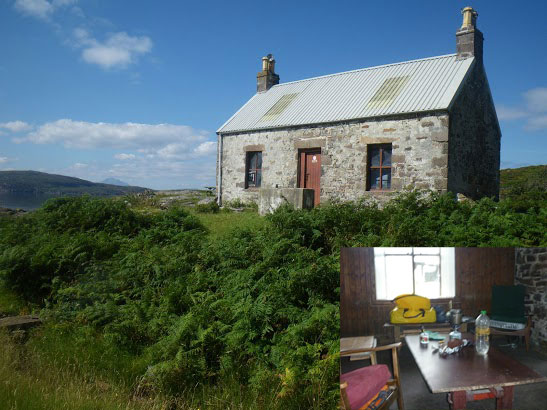
Once installed, I hung my tent and sleeping bag to dry, then I rewarded myself this interesting first step with a hot tea and a thick slice of chocolate cake. Outside rain was still pounding.
Day 2 – Uags to Red Point I woke up at dawn feeling numb as my old foam sleeping pad had been of little comfort on the floorboards. The temperature was 5°C; so much for this jet stream. I went out to stretch my body and surprised a little doe grazing in the meadow below the ruined Uags hamlet. It scampered away before I could fetch my camera (this is a double entrendre called ‘lacking reflex’). But – it had stopped raining, the air was clear and visibility was excellent. The snow-capped peaks of the Cuillins stood out beautifully against the sky (below left) but the chill air from the northeast soon sent me back inside.
Once on the way from Uags an unexpected SE tailwind pushed me gently toward Sgeir Shalash but the breeze then turned NE, as expected. In the protected lee of the shore I paddled on north without difficulty, up to Camusteel, but when I reached the mouth of Applecross Bay, I had to fight against the wind. It funneled unhindered along the valley, whipping up the waters and raising an uncomfortable chop, until I reached some shelter in the lee of Rubha na Guailne. From there the long way north to Loch Torridon seemed a never-ending trudge. The wind had picked up to the point of pushing me hard offshore whenever I got 50 meters from the shore. I kept hugging the coast, despite the uncomfortable chop and the occasional breakers, because the wind was shifting SE, thus pushing me northward. When I eventually passed Rubha na Fearna I found myself facing the wind blowing right out of the Loch.
Loch Torridon greeted me with one of its customary gusts of which I’d had the humiliating experience the year before. I took shelter as soon as I could in a tiny cove hidden behind a natural breakwater. I badly needed a feed. After a snack and some rest, I pushed off to cross the Loch. I paddled a mile inland to gain an upwind margin of safety then I headed north. Wedged into the seat, with my legs holding tight on the thigh straps and squeezing the footrest, I blithely crossed the choppy zone, kept an eye on the most threatening peaking waves and checked off some landmarks in transit which I used to control my leeward drift with the other eye while admiring the spectacular scenery of the mountains towering over Loch Torridon (yes, all at once).
I returned to quiet water in the lee of the north shore, laid the paddle across the boat and started bailing. My open decked Incept kayak had ridden well on the waves but had shipped a fair share of water which was now swashing in the bilge. I pulled ashore in the early evening on a beautiful beach near Red Point.
The ebbing tide had just retreated beyond the tombolo that connects Eilean Tioram islet to the mainland, thus forming a placid lagoon. Some cows and sheep were grazing in the dunes undulating behind the beach. I pitched my tent in a hollow, barely sheltered from the chill NE breeze and crashed out.
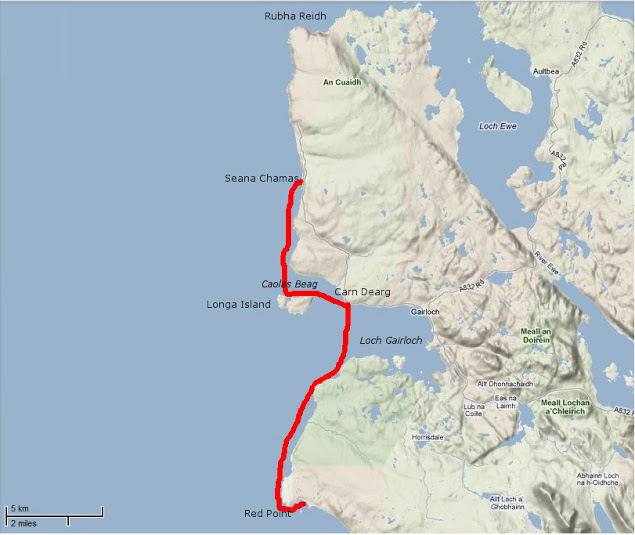
Day 3 – Red Point to Slaggan Bay The night had been cold but the clear morning sky made me hope for a warmer day. When I shoved off I didn’t know that I was about to enjoy one of the most beautiful days of my paddling life. Passing Red Point I noticed with satisfaction there was almost no swell. For once I wouldn’t be shaken by the rebounding waves and could explore the nooks and crannies of this craggy coast.
The sky became overcast and the NE wind picked up as I approached Loch Gairloch. The temperature dropped rapidly and I paddled more vigorously towards Carn Deag in an attempt to stay warm. I made a brief stop on the beach at Big Sand (left) but the chill breeze urged me on. I passed downwind along Longa Island with the hope of discovering a sheltered cove for lunch but found none. I then went on across Caol Beag, passed Rubha Ban and kept paddling north with my stomach gurgling. The beauty of the coast was worth the inconvenience of being cold, numb and hungry; huge sections of sandstone cliffs that had fallen in the sea provided an extraordinary maze of narrow passages that I enjoyed threading through. Erosion had also cut multiple geos and caves also worth exploring (I didn’t know what a geo was before reading the SSKT guidebook). I eventually reached Seana Chamas beach, largely uncovered by the outgoing tide and where I landed and dragged my kayak a few yards on a carpet of seaweed.
The sea was empty except for birds and a view that stretched westward to the Outer Hebrides. The Shiant Islands were clearly visible, standing out like a motionless line of battleships. I finished my lunch just as the tide returned up to my boat. The sky began clearing as I left and when I got past Melvaig all around me glistened under the sun.
After half a mile of boulders the coast turned to sandstone crumbling cliffs again and I could resume prowling in and out of caves and geos under the bright light of this sunny afternoon. Quite suddenly behind another headland appeared – the dreaded Rubha Reidh and its striking white lighthouse. I felt the mid-tide current pick up as it dragged me over to the other side of the promontory. The whitecaps of a faster tide rip were visible out to sea but right under the lighthouse the sea was rippling gently against the reddish rocks. One of the most exposed stages on this route passed without event.
The NE wind that had been blowing since I left Kyleakin had dropped too, but there was still some swell from the north, preventing me from sneaking through the rocky labyrinth that stretched between Rubha Reidh and the beautiful beach of Camas Mor. Beyond Rubha Reid to the east the extraordinary snow-capped skyline of the Wester Ross mountain range rose from the horizon (left). Put in a trance by this sight, I carried on on an eastward course and arrived at Caolas an Fhuraidh. I took stock at the mouth of Loch Ewe before an exposed 4km crossing over to Slaggan Bay. To the SE lay Rubha nan Sasan still with it’s WWII bunkers and gun emplacements. At that time Loch Ewe had been the starting point for many Russia-bound convoys and a haven for Allied shipping. There’s still a NATO base there today. As I paddled to Ploc an t-Slagain I hoped I’d not be rammed by a nuclear submarine entering or leaving Loch Ewe; I’d read reports elsewhere in the Hebrides of these subs rising so fast the resulting wash tipped sea kayaks bow over stern. I reached Slaggan Bay at 7pm finding another perfect landing place, a crescent of fine sand surrounded by empty dunes.
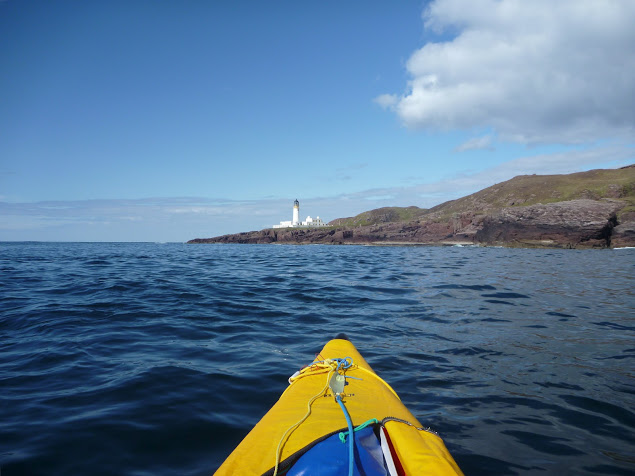
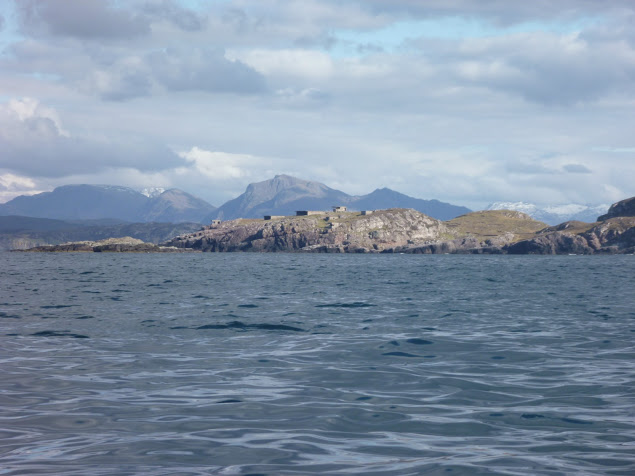
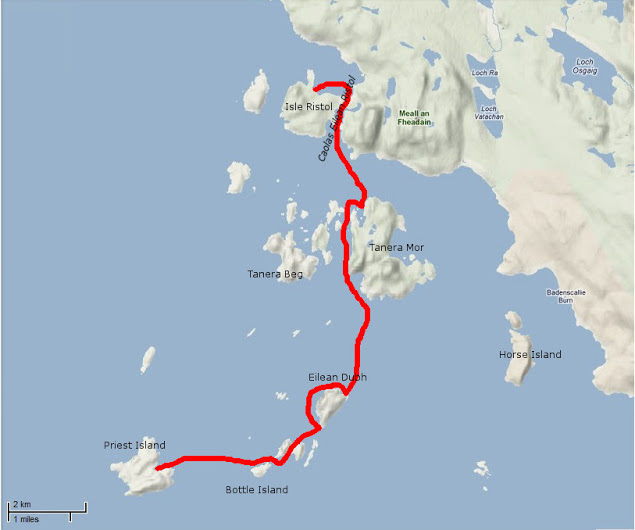
Day 4 – Slaggan Bay to Isle Ristol Under ideal paddling conditions I hugged the coast towards Greenstone Point, the last critical passage of the SSKT. The Point was flat and bare and proved even less dramatic than Rubha Reidh, although its rocky shoreline was wild and beautiful. From Greenstone I paddled on to Rubha Beag. In the distance the conspicuous peak of Ben Mor Coigach was towering over the horizon and to the NW lay a scattering of islets; the long-expected Summer Isles.
I headed towards the closest, Priest Island some 5km away. Halfway through the passage, the wind died off and the sea glassed over. The uncanny cries of the guillemots emphasized the eerie atmosphere; I felt like I was entering an unearthly space. From the SE tip of the Priest Island, I carried on around the west side. It was another paddling paradise with endless features to explore in the good company of seabirds and seals.
Once I completed this circumnavigation I paddled back to a cove called Acairseid Eilean a Chleirich (it’s quite a challenge to try to explain to other people the places I visited) where I pulled ashore onto a tiny uninviting boulder beach (left). As the afternoon progressed I uneventfully hopped through the convenient chain of islets lying between Priest Island and Tanera Mor, the biggest of the Summer Isles. I had intended to land near Althandu as I needed some of the facilities of the Port a Bhaigh campground, mostly their electrical hookups to charge the batteries, freshwater and even a shower, why not? There was also a pub close by.
But as I paddled through Old Dornie harbour I came within sight of the campground and within earshot too. The place looked packed and was definitely too noisy. After four days of solitude with no other sounds than the sea and the birds, I couldn’t stand it. So much for the camera, shower and a beer. I swung my boat south towards the lovely nearby beach of Traigh an t-Sean Bhaile on Ristol. I pitched my tent on thick grass which promised a comfortable night and the chilly cold kept any irksome midges from hatching.
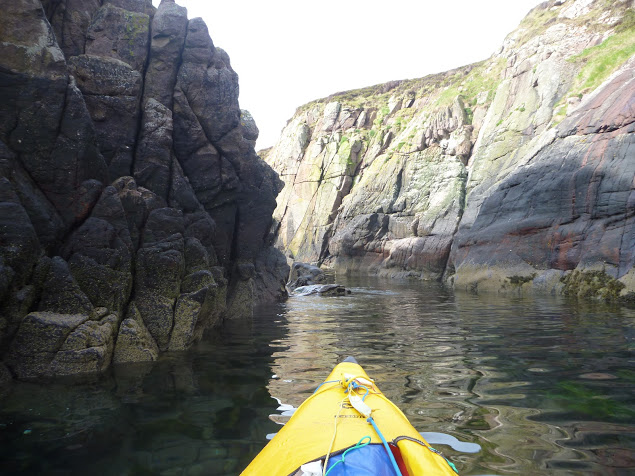
Day 5 – Exploring the Summer Isles I devoted this day to exploring the archipelago as all these islands offer the type of craggy shore most sea paddlers are looking for. The sea conditions were again at their best for squeezing through narrow channels between rocks, under arches or into caves with almost no swell and light winds. I proceeded anti-clockwise around Ristol, paddling along its west coast then circumnavigated Eilean Glas Mullagrach and Glas Leach Mor.
Shags had built their nests in the crevices of the cliffs overlooking the sea. They were not easy to spot as their colour merged with the cliff but their unmistakable angry squawks betrayed their presence above me whenever I got too close. From Glas Leach Mor (the ‘large green stone’ a good description actually) I crossed to Tanera Beag. Here I gave a wide berth to a skerry occupied by a large group of singing seals that I didn’t want to disturb. The haunting sound suited the scenery perfectly.
Tanera Beag is considered the most beautiful of the Summer Isles by the experts. Close to its SW corner is a cave deep enough for a tourist boat to get in and with a very high ceiling after which it’s called Cathedral Cave. Its SE corner is adorned with an elegant arch, which is another place of pilgrimage by all paddlers visiting the isles.
After completing the circumnavigation of Tanera Beag I pulled ashore for an overdue snack and a nap in a pretty little cove where the outgoing tide had left a broad sandy beach. Between Tanera Beag and Mor Eilean Fada I entered a kind of shallow lagoon of clear water. The tide was low and I saw my kayak’s shadow skip along the sandy bottom.
Later I landed in the Anchorage on Tanera Mor, a sheltered bay that opens to the east and filled with salmon pens. There is a floating dock for the tourist boat but the tea shop/post office where I’d intended to indulge in a brew and some piece of cake was closed. Tanera Mor (currently for sale) enjoys an offshore status which allows this tiny post office to issue its own stamps but no brew, no cake and no stamps for me today.
I hopped back in the boat and crossed the Anchorage diagonally and skirted Rubha Dubh, the east corner of the island. Here I entered a narrow cove choked with seaweed and backed with a pebble and boulder beach. High spring tides and gales had filled the depression beyond the beach thus forming a lovely pond, An Lochanach. I pulled ashore soon after two other kayakers. The guy didn’t look very happy to see me and curtly turned down my offer to help them to carry their heavily loaded sea kayaks. So I minded my own business, as I had just been advised to do. His wife came and offered remorsefully to give a hand, but I declined politely.
It had been a hot afternoon and I’d paddled without cag and without a cap for the first time in five days. But cold came back after 7pm and the Franco-Welsh relationships in the cove did not improve. Although our respective pitches were located 300 meters apart, each on one side of the beach, no invitation to share dinner was exchanged. It nice to be alone of course, but I like chatting with other paddlers too. Another time perhaps.
Day 6 – Tanera Mor to Ullapool On a beautiful sunny morning I headed SE towards Loch Broom and Ullapool. Sunny but cold, chilly indeed, so chilly that I had my breakfast in my sleeping bag.
In the meantime, the wind had shifted SE so I slogged against it all the way to Horse Island. I paddled through the tidal gap which divides this island from its northern tip, Meall nan Gabhar. Once through I pulled ashore and found a very convenient pitching spot. I regretted not having carried on to this place yesterday, instead of staying next to unsympathetic paddlers. So seemed to say the half-dozen seals romping about behind me. The sky was promising some fair weather that had been a long time coming. As the breeze didn’t abate I took shelter in the lee of Acheninver. But as soon as I got past Rubha Dubh Ard I fought the headwind again until I reached the base of Ben Mor Coigach.
Then I paddled below the sheer slope of the mountain until I got to what looked like the white sands of Camas Mor beach. Actually, it’s a pebble beach facing Isle Martin and the guidebook said amethysts can be found here, but I didn’t find any. By 2 o’clock clouds covered the sky and some chill air forced me back into my cold-weather gear.
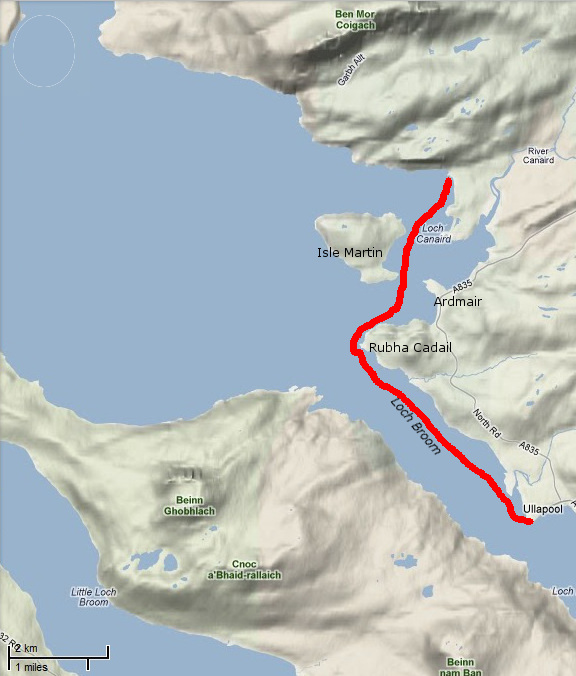
I shoved off shortly after lunch and enjoyed passing the last natural monuments of the Trail. I rounded Rubha Cadail, addressed the last salute to Ben Mor Coigach and entered Loch Broom. The wind unexpectedly veered NW and pushed me gently towards Ullapool.
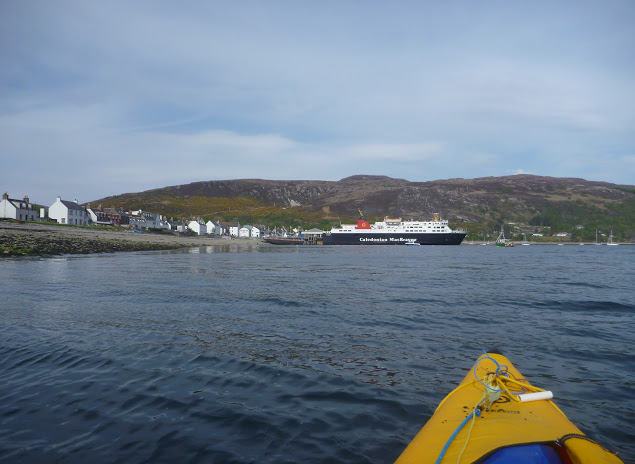
Once ashore I pitched my tent under the stares of some motorcyclists wondering where the hell I’d come from. A leather-clad fellow told me the owner was already gone and would return early next morning to collect the fee. Meanwhile, I washed the Incept to remove the grit scattered in the bilge, wiped it dry, deflated it, rolled it, and pushed it into my huge 160-l Ortlieb Kanurucksack. The K40 doesn’t fold as compactly as my good old hypalon H2 but I was relieved it crammed into the bag. I enjoyed dinner at the water’s edge overlooking at the now placid waters of Loch Broom, glowing in the satisfaction of my achievement. It has taken three years and two different boats, but I’d completed the SSKT in an inflatable sea kayak along with one of Europe’s most striking shorelines. Celebrations continued at the Ferry Boat Inn where I e-mailed friends and family, sipping some good beer, the sound of music replacing the soothing sound of the sea lapping the shore.
Ullapool to Kyleakin The weather was set to improve in the following days and I wondered whether to paddle north and round the Point of Stoer, take the ferry to Stornoway for a glimpse of the Outer Hebrides, or complete the exploration of Raasay and Rona that I’d started the year before. The first two options required maps that I was not sure to find in Ullapool. and I was also missing sailing directions.
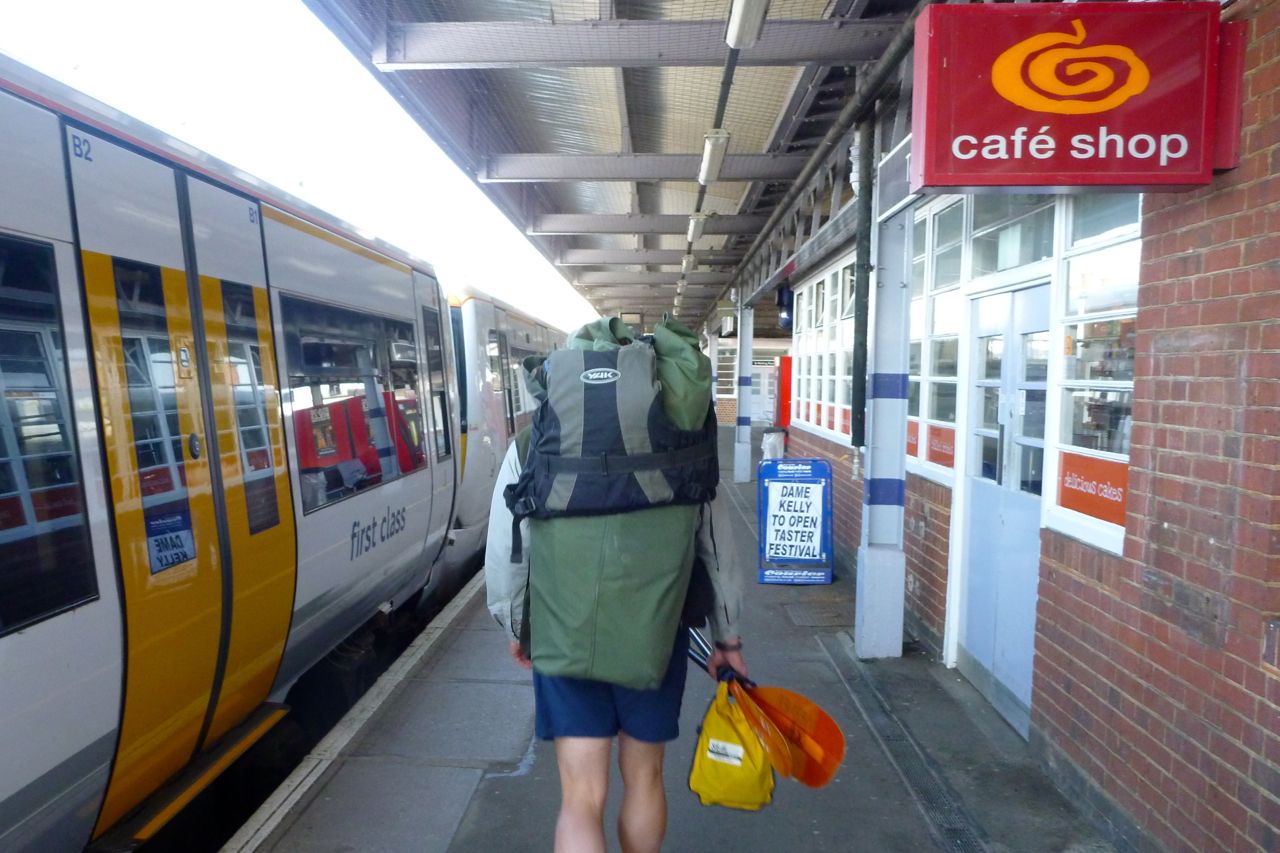
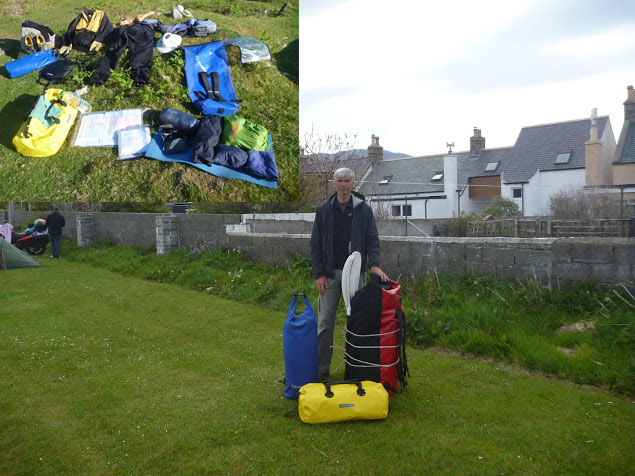
So I packed all my gear in my three-bag travelling arrangement: boat and paddling gear in the 160l Kanurucksack, camping gear and clothes in the 59l XPlorer bag, food, cooking gear, books, maps, tools and all the rest in the 49l Rackpack. The result was portable but heavy and I had a half mile walk to the bus station by the ferry terminal. Luckily the owner came by for the fee and gave me a lift. Soon we were en route to Inverness by bus; an alternative would have been leaving the bus at Garve railway station, halfway to Inverness and hopping on a train to Kyle of Lochalsh.
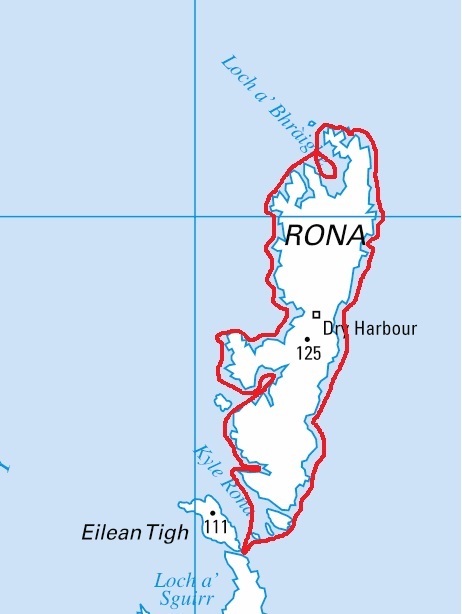
Eventually, I decided to park up in Kyleakin on Skye and undertook a very enjoyable three-day tour around Raasay and Rona. The year before I’d experienced the charms of these islands despite the unsettled weather – this time conditions were ideal. Back at the pier three days later, I was giving the Incept a wash on the slipway when a Land Rover towing a trailer full of sea kayaks turned in. A party of men got out of the truck, unloaded the kayaks and started putting paddling gear on. As they carried the boat to water they came over to say hello and asked about my boat and my trip. They were attending a kayak class beginning this very day. Their first-day program was a shakedown paddle in sheltered waters before a guided multi-day run to Sandaig. The guide joined the conversation and yet again I endured the usual hardsheller’s drivel about IKs. Ten minutes later I watched the student awkwardly clambering in their kayaks; for some of the clumsier it took quite a while. I told them they were lucky modern kayaks had such larger cockpit coamings – but not as big as mine! By the time I got to my car the temperature inside was like an oven, despite the screen I’d fixed over the windshield. My chocolate bars had melted. In northwest Scotland? Whatever next.
Last summer I spent 3 weeks in Sardinia with my wife. We were camped near Santa Maria Navarrese, a quiet seaside resort and a strategic location from which to explore the splendid and relatively untouched Ogliastra region, located on the central eastern coast of the island. There the mountains rise to over 1000m within 20 km of the shore, hence our plan to combine a beach holiday with hiking and paddling activities. Real sportsmen would add climbing and mountain biking as Peter Harold and his Lemon House guests do. Me, I’d rather add enjoying Sardinian food and wine to the program instead.
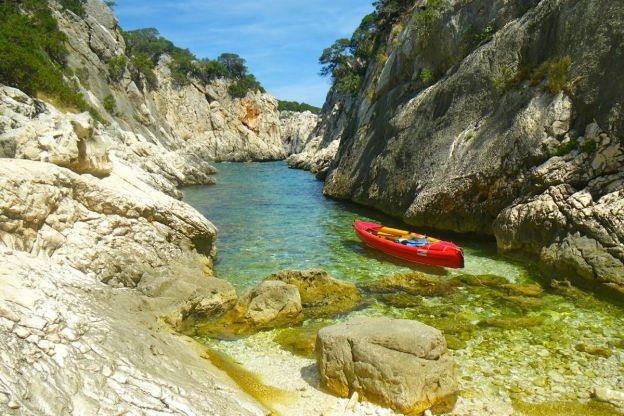
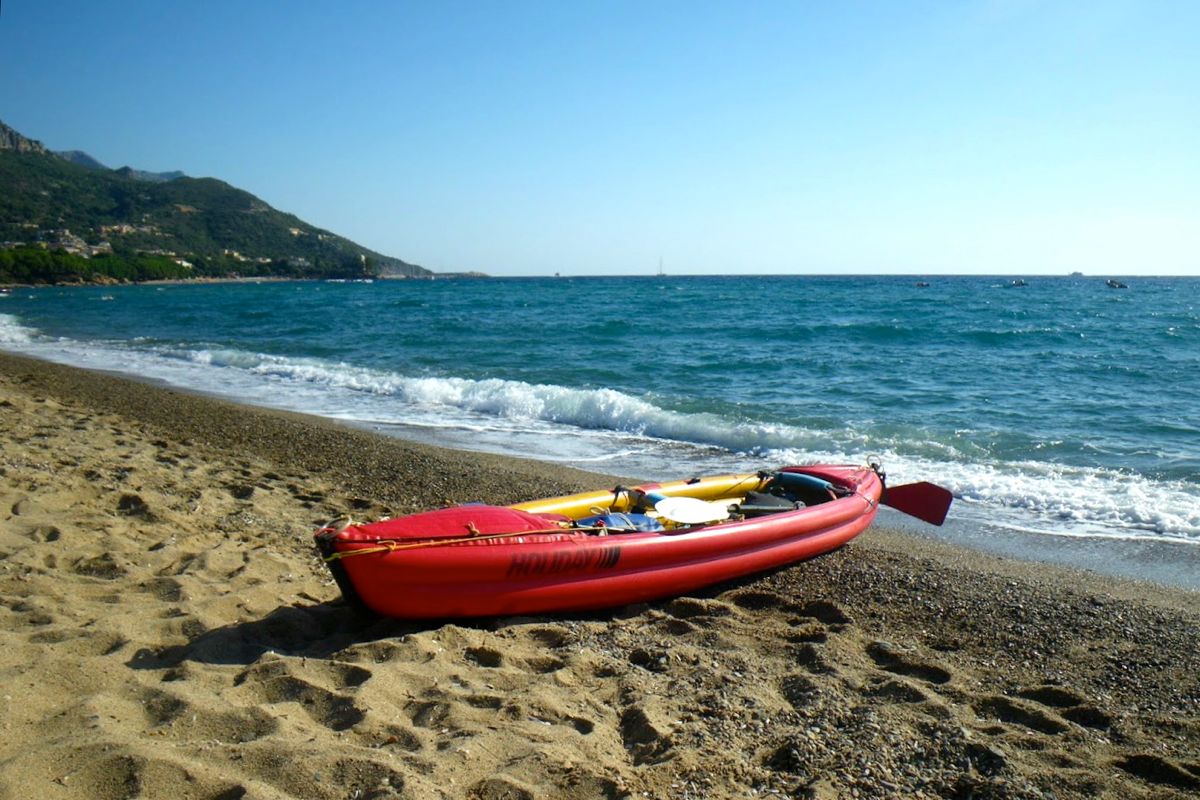
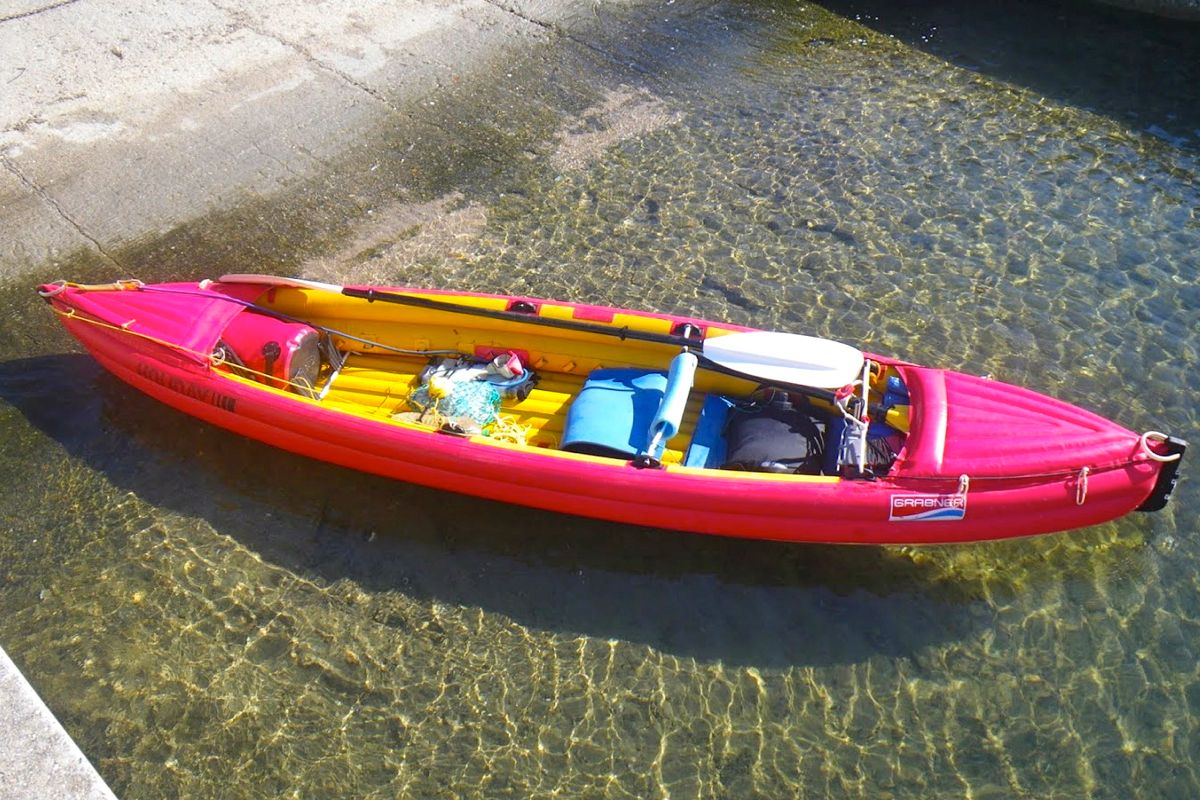
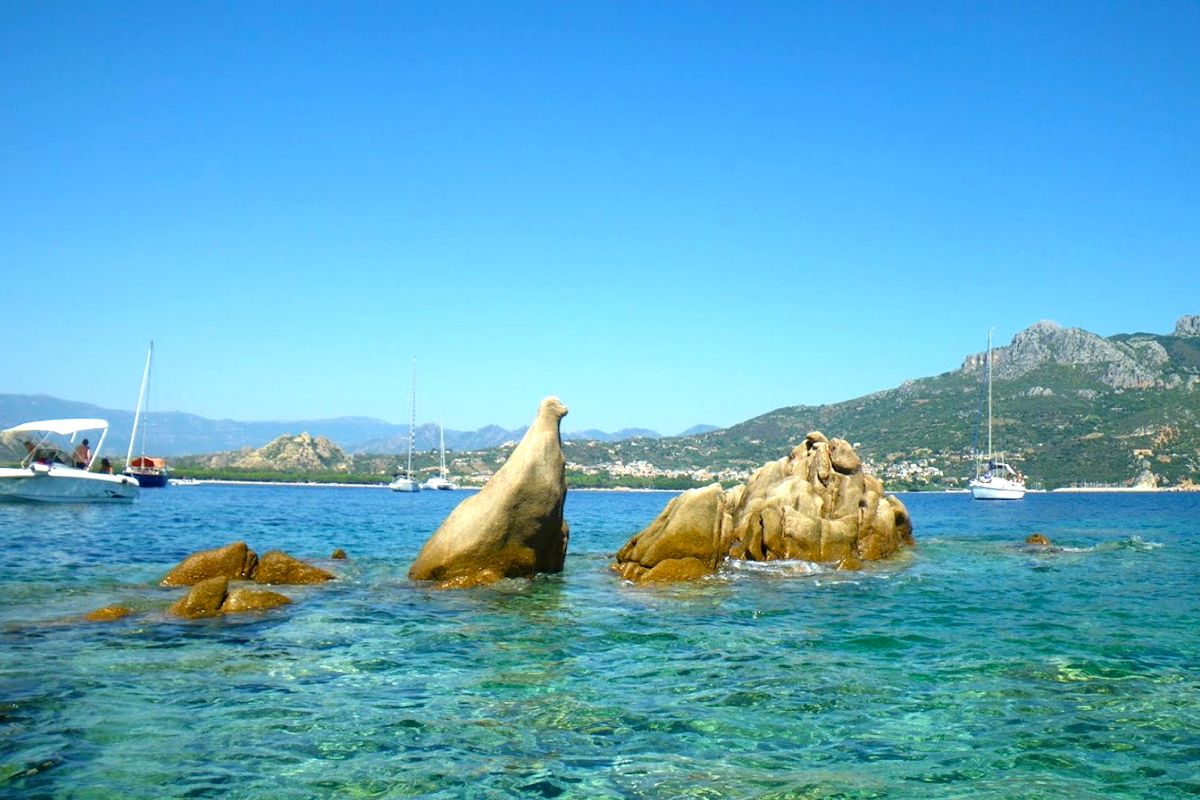
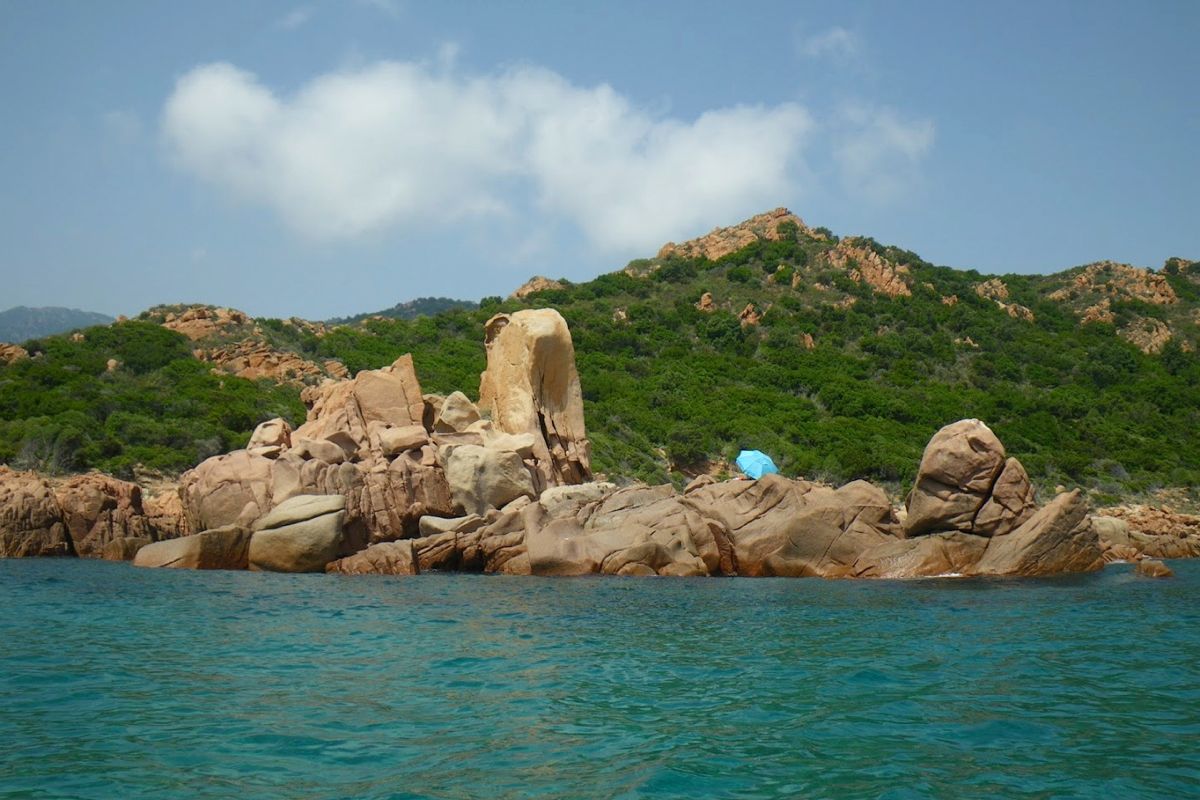
I brought my revived Grabner H2 IK. It took us along the astounding coastline to tiny coves that can be reached only by sea. Such fabulous places are found from 20 minutes to 2 hours of relaxed paddling, stopping en route to have a refreshing swim in turquoise water or to stretch one’s legs on a short walk inland into the fragrant Mediterranean macchia.
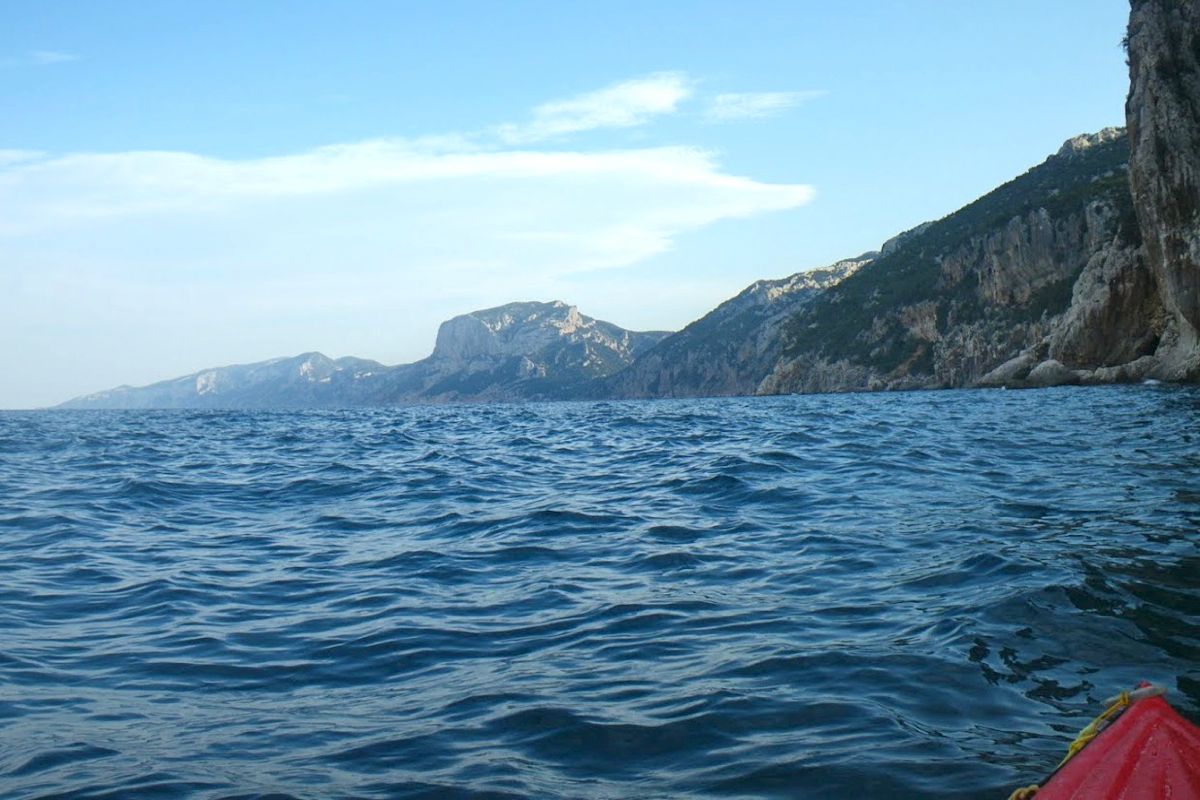
From Santa Maria Navarrese (aka: SMN) the coast up to north is mostly rugged rock wall all the way to Cala Luna, punctuated by caves, coves and superb white sand beaches tucked under towering cliffs. No easy escape routes leave from those beaches; it would take a few hours staggering along deep codulas (gorges) and up steep and craggy paths before reaching the plateau over the coastal ridge. Although rugged and remote, it’s not real wilderness in summer, because this stretch of coast is travelled all day long by dozens of tour boats and hundreds of rental “gommoni” (Zodiac-style, hard-bottom RIBs) sailing from Arbatax, SMN or Cala Gonone (the next resort north of SMN). Should a boater get stranded he could easily hitch a lift back to port. Two beaches; Cala Sisine and Cala Luna have tourist facilities in summer such as bar, restaurant, toilets, with employees staying overnight. Sometimes whole families, stay overnight as well. In Cala Luna the restaurant is well known to help ‘naufraghi‘ (castaways); ill-prepared or unintentional overnighters. Sea traffic starts fading from 5pm with the beaches getting covered in shade, and disappears from 6pm to 8am, as often does the sea breeze too, so late afternoon and early morning are definitely the best paddling times. A paddler or hiker traveling this area offseason would be on his own.
So one morning I left for a 2-day trip to Cala Luna and back along the Ogliastra coast. I launched my loaded Grabner in the shore break beating on the Tancau beach. I jumped awkwardly on board, intending to shove off quickly and not to be dumped back. Unfortunately, my inelegant butt crash-landed right on the backrest. It collapsed under my weight with a sorry crack. I paddled on to the nearby Santa-Maria Navarrese marina, barely controlling my course in the 2-foot chop raised by the F3 Grecale (NE wind), then pulled ashore on the slipway for repair.
I found no immediate solution to fix the broken backrest bar. The middle backrest was intact but it was too long to fit in the stern backrest position. However, it could be fitted between the new brackets recently added by Grabner. These circumstances forced me to test the solo paddling position which requires only one backrest. I shifted the middle backrest and removed the remnants of the stern one. Then there was the footrest problem to solve. The footrest is a 2-part aluminum bar. One part is mostly a tube while the other is a plain bar of a smaller diameter which can slide into the tube, so the total length adjusts automatically to the width of the boat for different positions of the footrest. The bent ends of the footrest are tucked into fittings glued on each side of the cockpit. Because of the bent ends the footrest must be taken apart to connect the rudder pedals on it. The crude aluminum material gets corroded quickly in seawater. To prevent it seizing up, I used to spray WD-40 in the tube. Many years ago I once forgot to take apart the footrest and after a few days, it got seized up for good. And now it was too long to fit in the forward tapered half of the kayak. It would be a no-rudder/loose-footrest trip then.
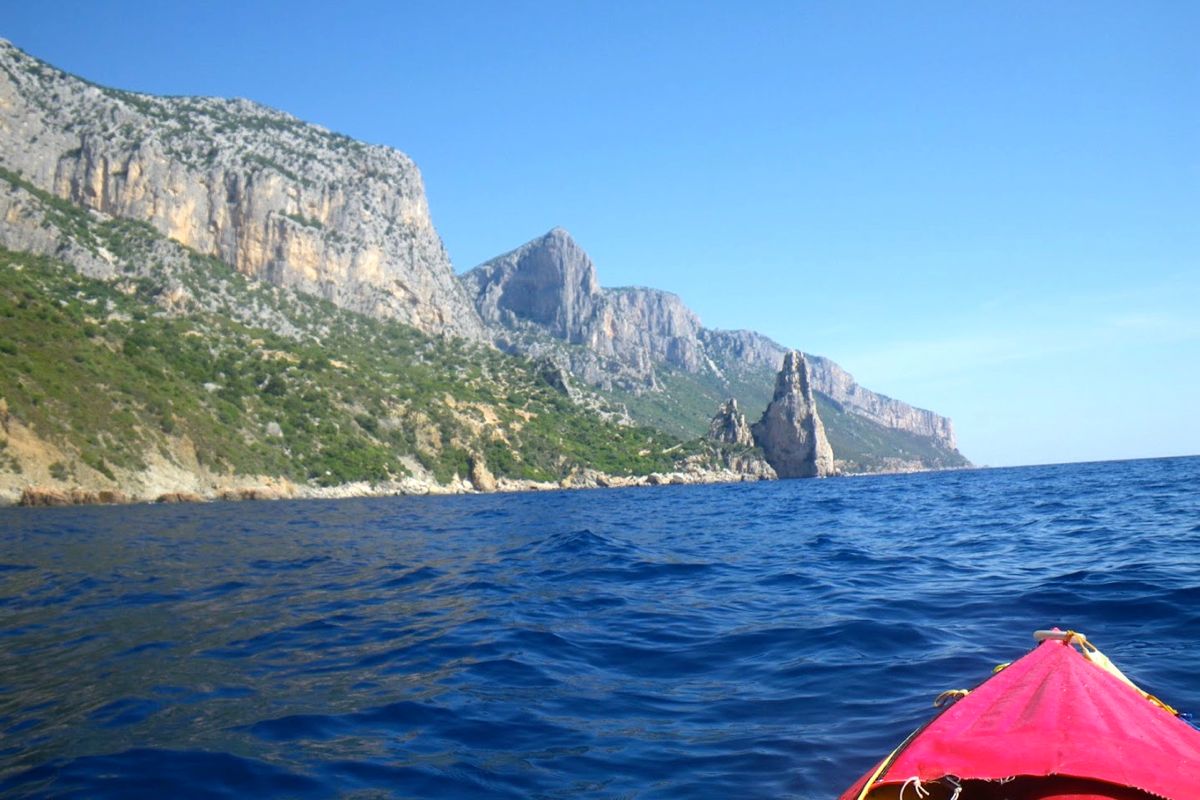
The Grecale abated as I left SMN and headed to Pedra Longa, a conspicuous rock steeple 128m high which stands out of the shoreline. From Pedra Longa I carried on along the boulder beach of Cala Forrola, under the precipitous cliff face of Punta Giradili. In good sea conditions when there is no shore break it’s possible to land safely onto those round smooth boulders. There’s a nice resting spot nearby, with a spring and a large flat slab to lay on for a nap under an overhanging rose-bay tree providing shade from the scorching sun.
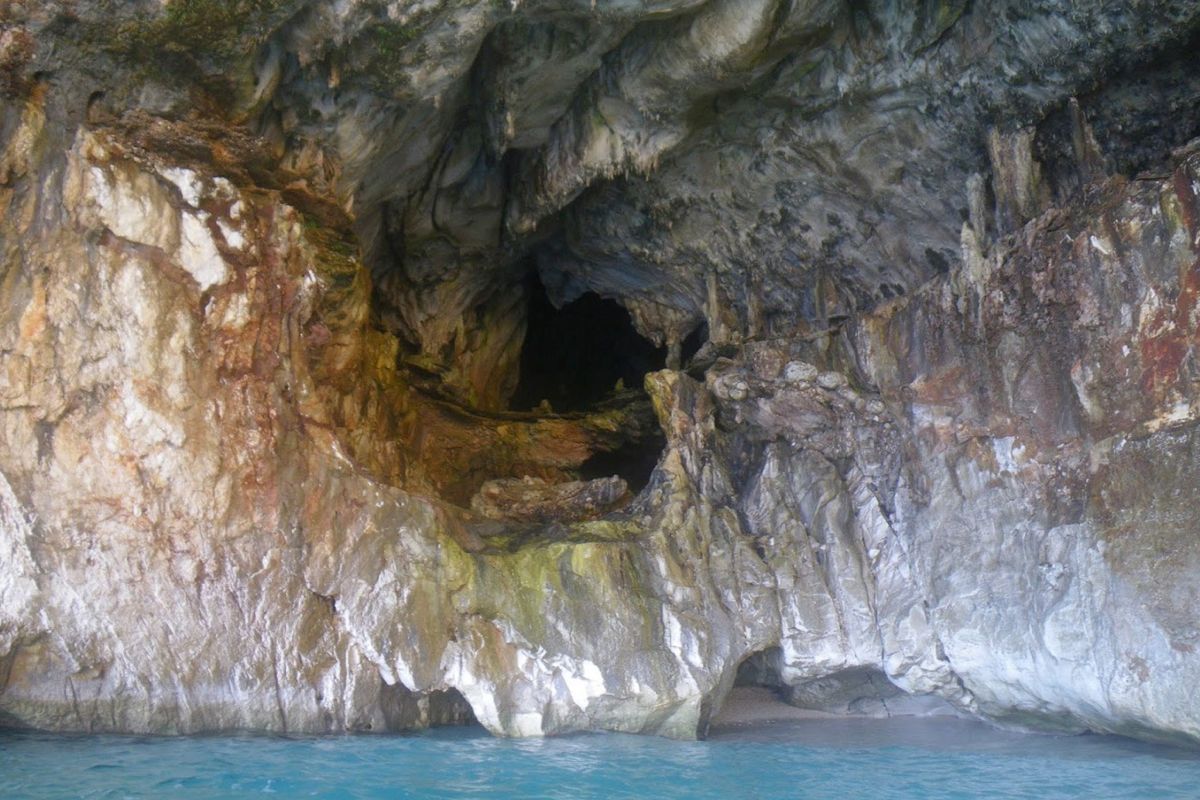
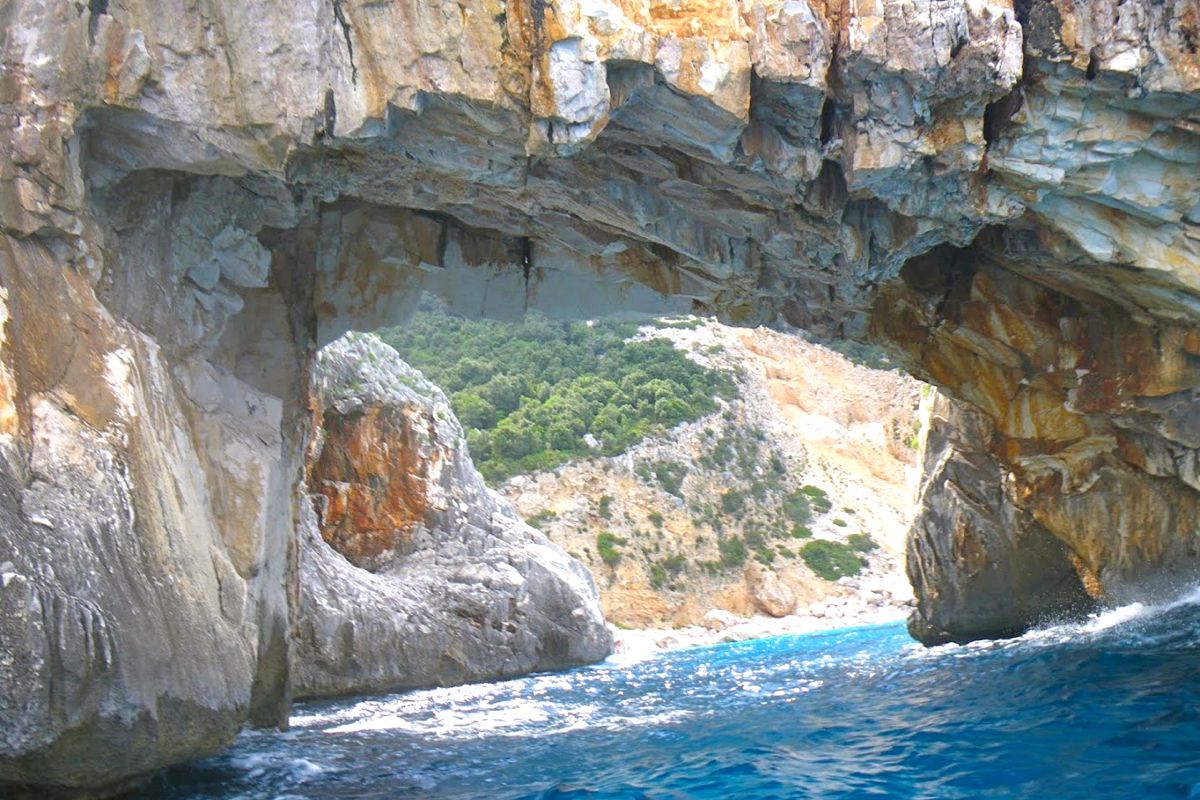
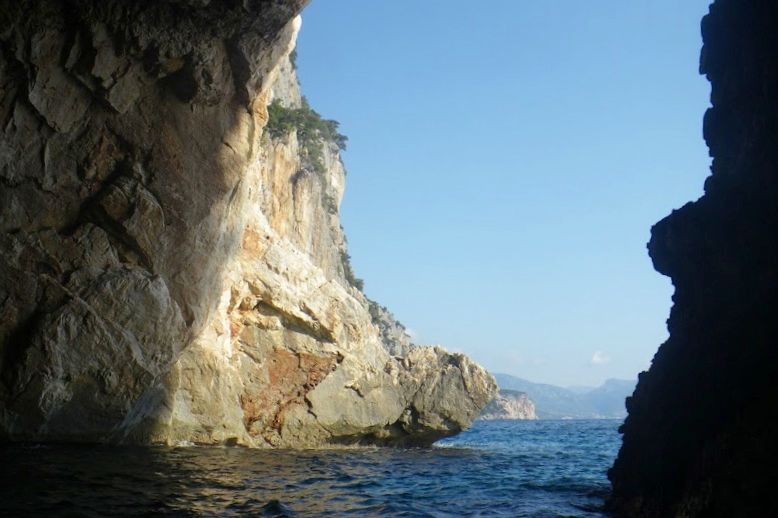
Passed Punta del Pecoraro the coast becomes a vertical wall with nowhere to pull ashore for a significant distance. The only dents in the cliff were the Grotta dei Colombi (cave of the doves) and a sea cave close to the Capo Monte Santu. An opening in the cliff vertical face loomed right under this impressive headland, the entrance of Porto Pedrosu (Grouse Cove). Porto Pedrosu is a fairly narrow inlet, narrowing even further as it goes deeper inland. It ends on a boulder choked beach, 3 metres wide. The gommoni are too large to get there; they stay on anchor near the entrance of this mini fjord and the crews swim ashore. I filled my net anchor with large pebbles, tied it to my bungee leash and put it on the edge of the foredeck. I pushed my boat out to sea with the painter in my hand. I give it a yank when the kayak was at the right distance from shore and the anchor fell. I pulled the boat back a bit and tied the painter around a rock. The bungee holds the mooring lines tight provided the anchor is heavy enough for not tripping on the bottom. I had the place all to myself for a quick lunch and a short siesta.After leaving Porto Pedrosu I visited Porto Quau (Quail Cove), the next inlet, also like a gash in the cliff, without any landing spot as it is walled in on all sides by plumb faces or piles of tumbled large boulders.
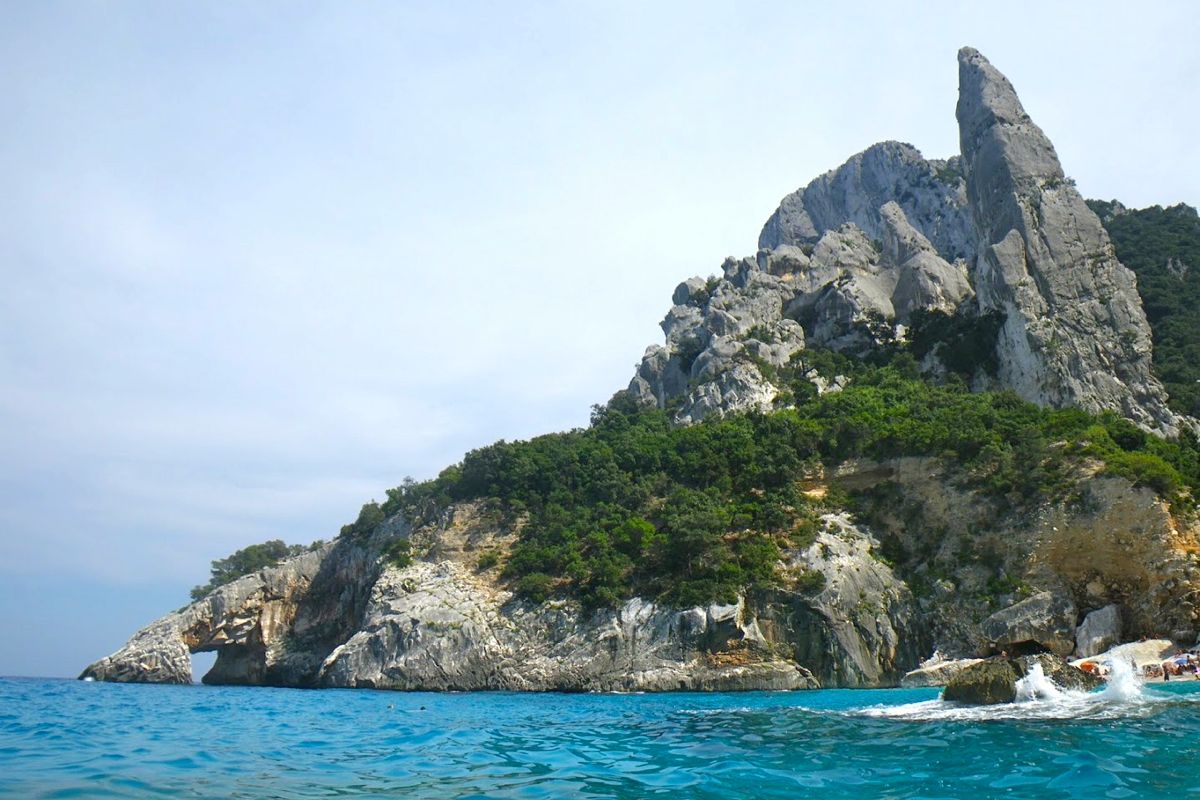
I carried on around the sheer 250-m high Punta Iltiera keeping some distance from the shore to stay away from the uncomfortable rebounding chop. About 3 kilometers later the arch of Cala Goloritze came in sight. I went through the arch, which I had not expected as it usually swarms with swimmers. The otherwise lovely beach was still crowded with sun worshippers. Unlike other beaches further north, this place can be accessed after a relatively short (1h35) and easy (530m descent) walk from the Golgo plateau above. Italian families get there carrying large umbrellas, beach chairs, beach toys, ice chests and picnic supplies to spend the day swimming, tanning, playing, eating and making an incredible din. The return trudge up the slope with the panting and grunting hoards is quite an experience, like being part of a commedia all’italiana movie. Besides the arch, Goloritzé is also famed for its 127-metre long needle rock, the Aguglia, ‘a sought-after destination for free-climbers’ say the guidebooks. From the sea it looks smaller because all the place is dwarfed by the towering mass of 466-m Punta Salinas.
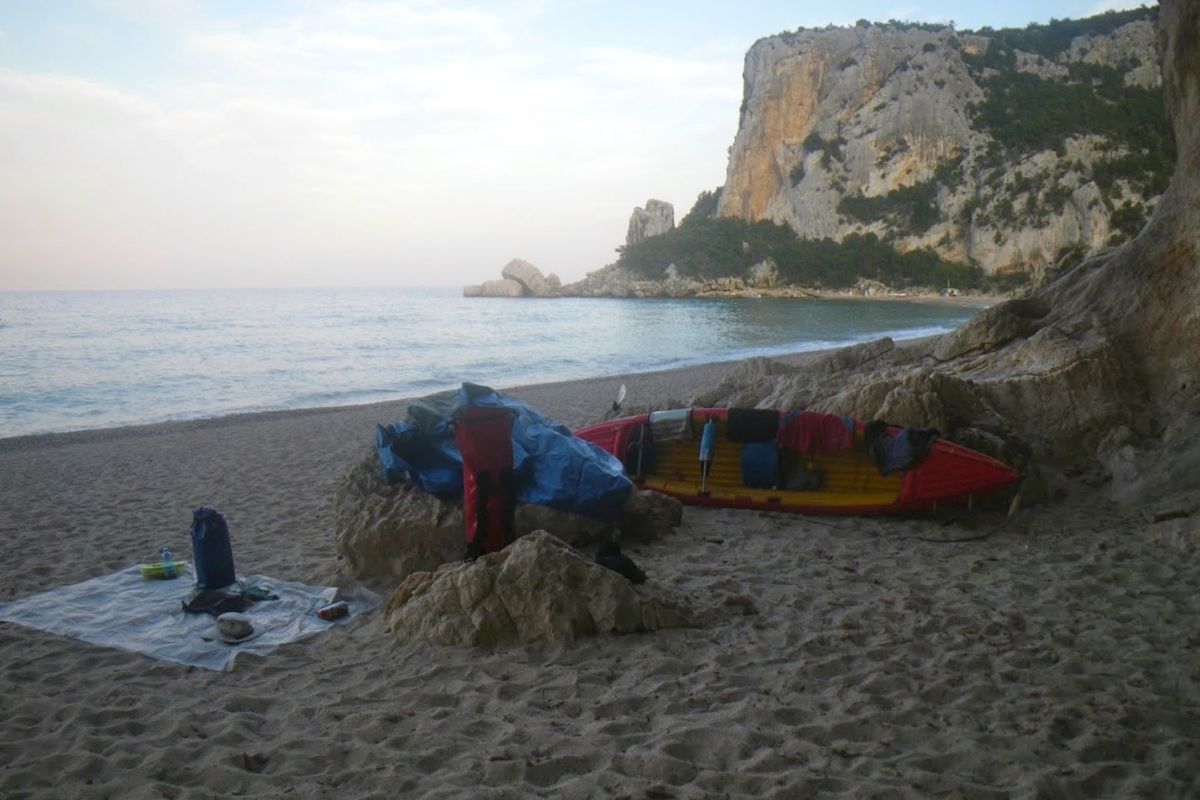
The next renowned and highly advertised place is Cala Mariolu, a postcard-like white sand crystal water beach. It’s not exactly sand but tiny rounded gravel. By 6pm most boats were gone. I had noticed earlier that this time was the rush hour for tourist boats and rental boats as well. I had seen them almost everyday return at full speed to SMN or Arbatax to get there by the 6pm cut-off. I passed Cala Biriola while the last batch of people was being evacuated. Groups of visitors are landed on different beaches and for a limited time in order to avoid too many people cramming the same beach at the same time. I was alone on the sea and Capo Monte Santu looked far behind by then. I reached Cala Luna by 7pm. It wasn’t dark but the sun had disappeared behind the mountains. I pulled ashore in front of the large caves located on the north end of the beach.
The beach edge was very steep with the typical dumping wave breaking right on it. I looked for the smoothest landing place and stood by for a while before paddling in, timing waves sets. I caught the back of a wave but it did not carry me high enough to reach the flatter ground and I landed on the steep slope. The next wave crashed in, half filling the cockpit, as I jumped out of the boat and grabbed the bow handle – easily done with an open IK. I hauled the boat turned bathtub up the slope and carried the gear near the entrance of a cave. Setting camp was quite simple: laying an old space blanket as a groundsheet on the sand. In the very unlikely case of rain coming, I could go inside one of the caves or retreat into the codula and rig my tarp between shrubs. Dinner was instant polenta, pecorino cheese, fruit, all washed down with some Ichnusa beer. The issue with polenta – a bit like couscous – is that it has no taste. Simply adding a generous spoonful of butter, bits of cheese and some spices make it delicious (there might be more sophisticated ways to enhance polenta though). I was a bit tired and I fell asleep shortly after dark under an extraordinary starry sky, sliced now and then by the seasonal shooting stars. Next morning I woke up at dawn and watched the sunrise on the placid waters. The temperature was relatively cool and I stayed in my sleeping bag until 6.30. The obvious upside of outdoors living in warm and dry weather is how little equipment you need. My heaviest pieces of gear were my 10-liter water bag, and a pack of beer. In no time after breakfast I packed up and brought gear and boat to water. Again I launched my kayak at the wrong time. I thought there was a lull between two bigger wave sets, but I was hit by one before I could jump on board and push-off, right in the dumping zone, at the bottom of the beach steep slope. The boat got instantaneously swamped and severely tossed back toward the beach, pinned down by the waves in the impact zone. Most pieces of gear floated in or around, each held close by its respective tether. The H2 was now a heavy piece of jetsam that I struggled to haul on higher ground.
I bailed the water, secured the gear under tighter bungees and shortened tethers and timed the wave sets more accurately. I put to water again, at the right moment this time. ‘Nothing was lost, only a bit of pride’ as said Audrey Sutherland in Paddling North. By 8am I was still alone on the water, save for one or two gommoni heading south. I passed Cala Sisine and Cala Biriola, still empty of visitors. The sea was much calmer than the day before, and I could hug the coast and visit many caves and crags along my way southward. At 10.30 the boat traffic was picking up and I stopped at Cala Mudarolu with a deep cave at the end of this lovely cove. The entrance is barred by a gravel beach. There is water inside, brought by the gales when the sea reaches over the tombolo. Unfortunately, the surface of the pond inside the cave is littered with plastic bottles, soda cans and all sorts of trash. It was 11 and the boat traffic was now in full swing. Fortunately, most boaters hop from one beach to the next, overlooking the rocky shore in between. I passed the beach area of Cala Mariolu where a large fleet of motorboats was moored beyond the line of buoys marking the 300 meters limit from the shore. At noon the traffic stopped: pranzo time is sacred in this heavenly country. over the next 2 hours all I could hear were the gulls and the water lapping the cliffs, instead of roaring gomo engines. I gave up stopping at Cala Goloritze, scared off by the crowd on the beach and in the water. Instead, I paddled on to Porto Pedrosu for a quiet lunch stop in the shadow of some Holm oak. Now it was time to fight the regular SE afternoon breeze around Capo Monte Santu, but the lumpy chop of the day before had turned to a gentle ripple. From half a mile offshore I stared at the stupendous ruggedness of the Supramonte, while paddling my way back to SMN. No polenta tonight, but a hearty 7-course seafood dinner at the Pescheria, a nice restaurant on the shore of the Tortoli lagoon where they even offer to carry you home.













































 Inflatable Kayaks & Packrafts