Category Archives: Gear

Paddles, clothes, buoyancy vests, etc

Packraft to Suilven Mountain

Gear report here

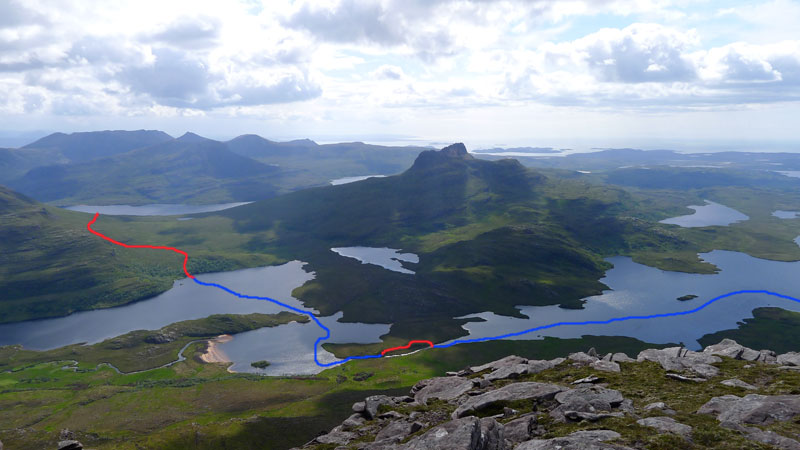
Anyone who’s climbed up the fin-like ridge of Stac Polly will see a wild, lochan- and bog-speckled vista spreading north across the Assynt. Just a couple of miles away are the peaks of Cul Mor and Suilven (main hill, left), relics of a glacier that ground down the land between them as it inched towards what’s now the sea.

lochanss


The OS map shows this area as a Nation Nature Reserve, but it actually lost this designation a few years ago. And although it looks wild – so wild there’s no grazing, nor inhabited dwellings – this 100 square-miles of barely-fenced bog, rock and water is unusually accessible, bordered by quiet roads to the south and west, the A835 to the east, but not much to the north apart from the path passing below the north slope of Suilven. So seeing as this region of Coigach/Assynt has so few packable rivers, these lochans are a great place for short-range packraft exploration following some of the routes suggested on the graphic, right. It’s not just me that thinks so, the local sea kayak outfitter as well as a couple of intrepid canoeists have been coming here over the years. For them the inter-lochan portages require some commitment. But not in a packraft!

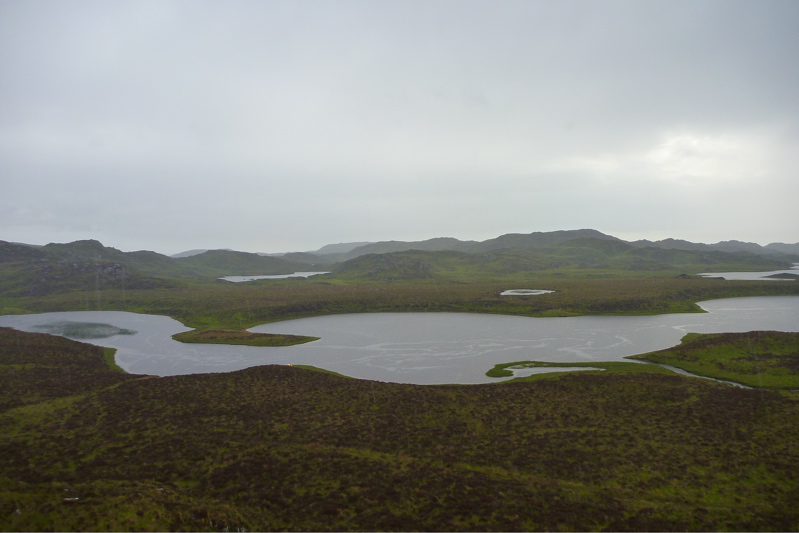
You can make up a route to suit yourself here; climb every mountain, ford every stream, visit every island. I chose a pretty easy overnighter and got dropped off by the road at Linneraineach below Cul Beag. There’s nothing at Linner’ bar a footpath which leads north to Loch an Doire Dhuibh (right viewed from Cul Mor).

My packplan was to paddle across Doire into the small adjacent loch, follow the channel into the main Loch Sionascaig, pay a visit to Eilean Mor, the biggest island hereabouts (and one of hundreds of Eilean Mors – or ‘big island’ in Scotland). From there I’d paddle among smaller isles towards the northeast shore of Sionascaig and walk past the ruin of Shieling over the saddle to the short river that links Fionn Loch to Loch Veyatie. With a paddle over to the south side of Suilven mountain, I’d find a dry spot to camp and take it from there. Suilven is only 731m or 2398 feet high, but it does have a strong draw on the imaginations of hillwalkers in far northwest Scotland, as do many of the Assynt’s peaks.

I think much of it stems from its Ayers Rock- or Matterhorn-like separation from its surroundings; a distinctive mountain shape, like the much more accessible Stac to the south. Add the lochans below and the open sea just a mile or two away, and mountain summits around here add up to something special. The picture right is taken from Ben Mor Coigach (743m) looking north over to Stac, Suilven and the distant peak of Quinaig. That’s another thing – the mountains have nice names around here with, you’d like to think, a touch of the Norse about them. This is after all Sutherland, or ‘the South Land’ in the mind of a Danish bloke in a horned helmet, circa 900AD. If you like hills there’s a panorama of some Sutherland mountains below, taken from the tip of the Coigach peninsula looking northeast.

Back to the boating; this was my first proper run in my Yak and as I pulled smoothly away from the shore of Loch Doire (left) it struck me how cool it is to trek over the hills with a pack of only 10-12 kilos, inflate your mini boat and set out across a body of water with your kit slung over the bow. In fact I’m convinced a frontal load makes packrafts faster as, despite the wind drag, the weight reduces the left-to-right yawing.

Very soon I was surprised to see the GPS reading a steady and sustainable 3mph (4.8kph, 2.6 knots) on the calm, windless loch. “What’ll it do?” I wondered, as you do. About 4.1mph, as you ask, but only for a few seconds, unless there’s a Great White on your tail. I’m sure that was more than I ever registered in my old-shape Llama, and I dare say more than I could average walking along the surrounding terrain which was mostly pathless. When I got back a speed graph (right) extracted from the GPS spelled it out: tramping across the pathless hilly bogs – about 2.3mph; on the water, out of the wind – 3mph; on the water into the wind – 2.4mph but with some effort.
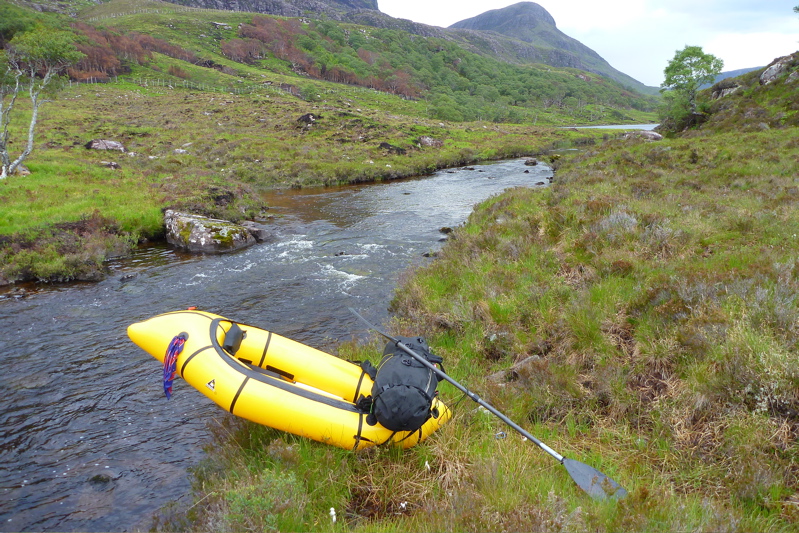
The channel that led west to Loch Sion (below Stac Polly, right) looked promising on the map, but even with the current high water levels following the deluge that was May, it soon got too shallow over the couple of metres drop to the next loch, and with a wince-inducing scrape the Yak hung up on a rock, requiring a short portage (left). That done, moving out onto Loch Sion a breeze was now in my face as I edged along the shore. Past Eilean Dubh I squeezed through another inter-island lead and out into the main loch, heading for Eilean Mor island. Even with the mild buffeting, it struck me how safe I felt alone in my raft; safer than I often feel initially in my Incept kayak at sea in similarly tame conditions. I think not being at sea had much to do with it, with no kind of wave or ill wind that could blow the Alpacka out to the wrong side of Greenland.


Eilean Mor is a natural focal point in Sion loch – what can it be like, an island set deep within in a wilderness? Many paddlers are fascinated by these tiny wooden islands on Scottish lochs, I assume like me, because they think it must be a UNESCO-like example of a hyper-pristine natural habitat beyond the reach of prolonged human intrusion.

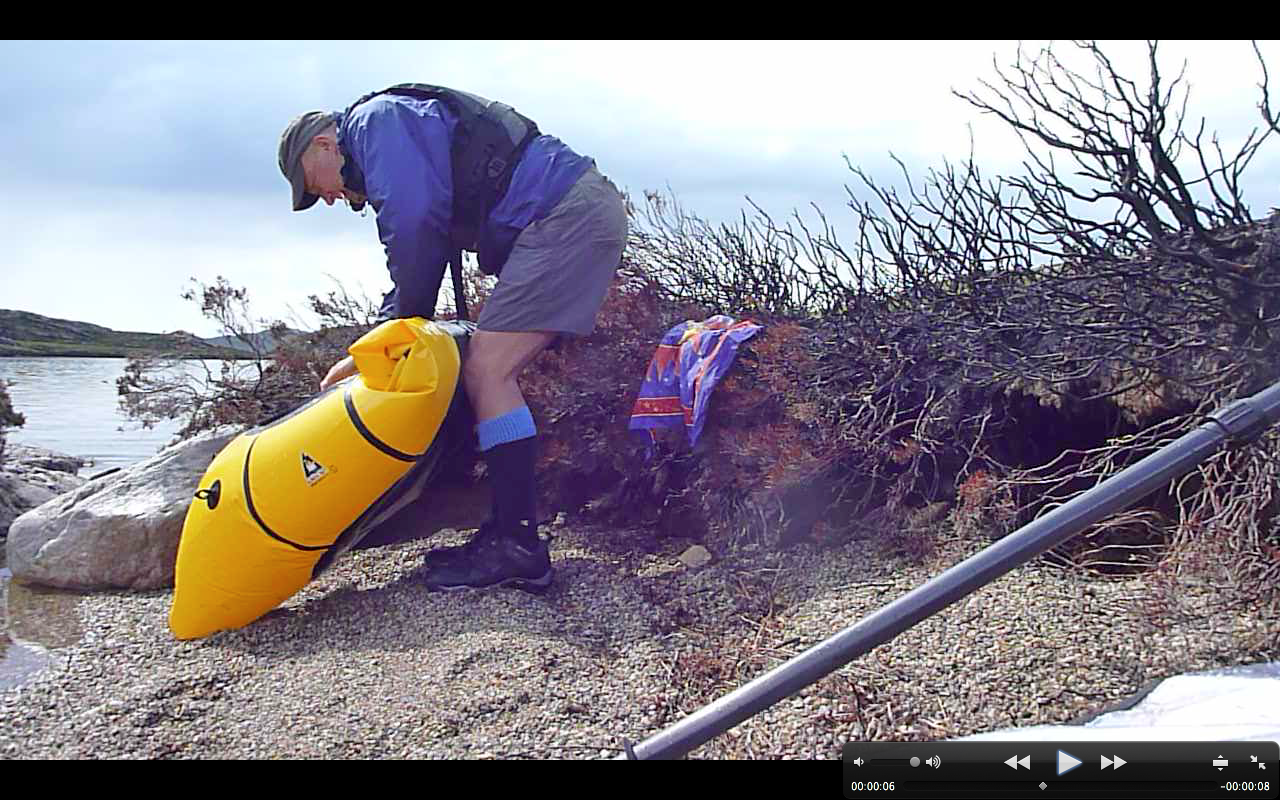
On the southern tip I can tell you there’s certainly a spacious, grassy camping spot (and now, a finely-built cairn), but as I half fell out of my boat and staggered ashore (left), the latest shower passed by as I beat my way inland towards the Eilean’s summit, through a forest choked with ferns, birch, hazel and their fallen, decaying predecessors. As I bushwhacked upwards, an owl not 10 feet to my left flew off noiselessly, and in places the ferns hummed with a flouorescent green glow (above).

At the summit, about 100 feet above the loch I looked over to the entrance to Boat Bay, a mile or so to the west (above left). To the north Suilven was a dark, uninviting rampart while to the south I imagined the walkers who daily take the short trek up Stac Polly (right) looking down on the progress of the little yellow boat far below and thinking, heck that looks fun!

I set off northeast, passing other inviting but unnamed isles (left and right), around Rubha Sionascaig with its alluring isthmus and up to Creag Sionascaig. Arriving at the shore, new shoots of grass poked through the blackened peat, scorched by the bushfires of early May which have been well and truly doused by the series of lashing gales which followed. I rolled up and headed up a creek line towards a saddle, passing a ruined croft which, as in so many remote locales in northwest Scotland, makes you wonder what on earth the people lived off up here?

Squelching over a novel mixture of burned peat crust spongebog mush (left), at the pass I looked down and saw half a dozen tents and a couple of canoes (right, barely visible) pitched at a meander in the river at a point where it was quite probably fordable. I’m sure the water there was running eastwards from Fionn into Loch Veyatie [it doesn’t], but if that’s the case then Fionn Loch is unusual in that it drains both ways, east and also west via the River Kirkaig to Lochinver and the sea. A geographical oddity? who knows [I do now; it isn’t]. I walked directly to Fionn, deployed the Yak and paddled across the channel (left). A short walk out of sight of the campers found a flat shoreline where I pitched beneath the looming mass of Suilven. 
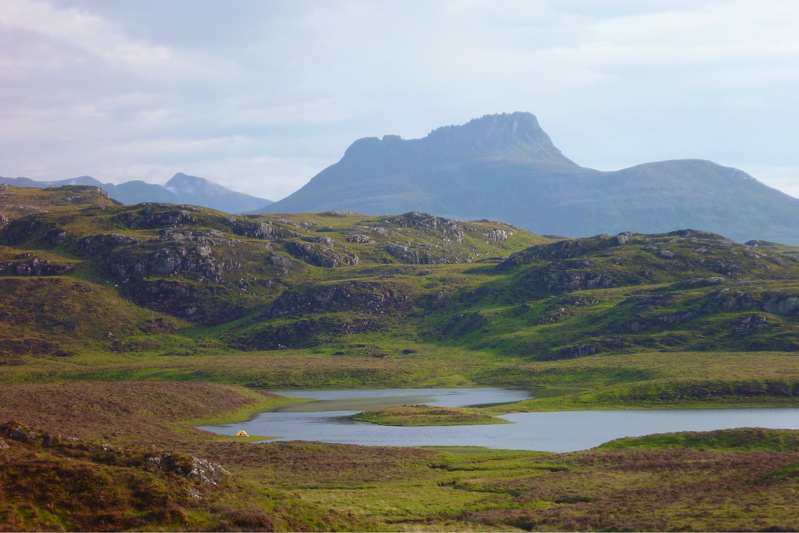
At times I’d wondered whether there even was a path up the south side of Suilven mountain (left) – I’m sure I’d read it somewhere. Then, during a short spell of sunshine a steep path became briefly illuminated; straight up alongside a scree slope, then off at an angle to the saddle-ridge between the two peaks. But now it was raining steadily, I was pretty damp and not in the mood for a hefty slog across contours pressed together up like the teeth of a comb, but I feared once I got in the tent I’d probably slob out. So after a light feed, I set out, packstaff in hand, to locate the path up the hill and once on it, followed it till 8pm. If nothing else, it was a good way to warm up and dry off.
It would be nice to report a stirring vista some 400 metres below the summit of Suilven, but a leaden gloom pressed down on the sodden land. I’d called the Mrs – tomorrow would bring more rain, but the winds would return too first thing in the morning. Back in the tent and soon after sunset, the rain arrived early and lasted most of the night. It was all a bit much for my single-skin tent which, though amazingly light and compact, is not rated as waterproof. The drips soon came through the fabric of the flat roof as I dozed, soaking my legs and chilling me. Half-awake, I lay my cag over the drip zone, after which the night passed well enough and I woke reasonably dry.
The next day was not one for shorts; today I was going to try out my new Kokatat Swift Dry Pants (see Suilven Gear). I’d half a mind to catch the twice-daily bus at 11.15 from the junction (see green graphic, top of the page) and estimated it would take 4 hours to get there, so breakfast at 6am was cereal in warmed up loch water. It wasn’t raining yet which meant it would be shortly, so I packed up quick and scooted back over Fionn Loch, taking a different route back southwest, past Na Tri Lochan to an inlet on Loch Sion (see satellite image bottom of the page). It was a longer land stage, but would put me into a better position to dodge the predicted southwesterlies while paddling back west towards Boat Bay. I’ve been reading a lot of sea kayaking literature lately and the lessons were paying off.

Let me tell you, walking over the pathless mire following a night of rain is merely a necessary means to get to the next bit of fun paddling. My knee-high Seal Skin ‘Wellington socks’ were working fine – last night my feet had been bone dry – but it’s a tiring, rhythmless slog over this crap; any sheep trails are merely conduits for more running water and mud. Again, the star of the Gear Show has to be my packstaff; it makes walking on uneven ground, descents and climbs so much more secure, especially with a load.


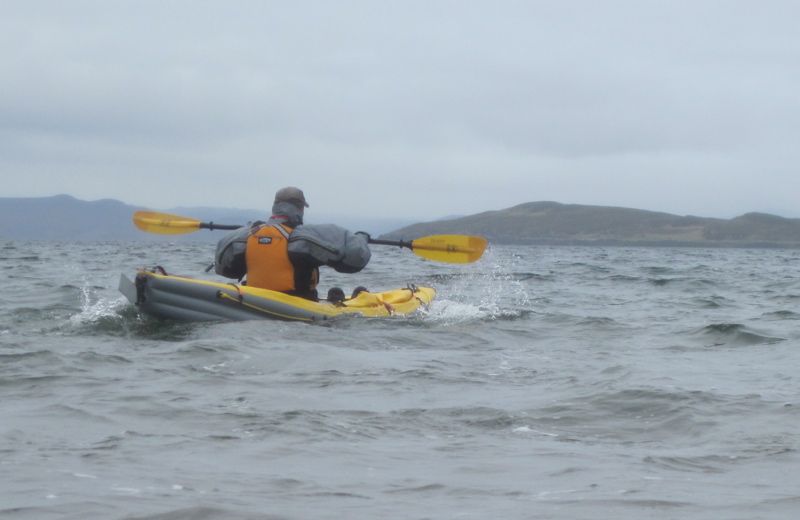
I reached the inlet bang on time which took me by surprise. Was this some un-noted lochan, no it was Sion – I’d not read the inlet’s shape on the map closely enough. Once back on the water, initially my leeward paddling ploy worked well. Then I turned a corner and suddenly the wind was onto me and the bow was bouncing on the waves (left) as I hacked past the shore at barely 1mph. For a while I thought I’d have to give up and take to the shore but again, as sea kayaking lore states, wind is often exacerbated round a point or headland, even on a lochan. Near normal speeds resumed, in fact just a fraction under the still-and-calm 3mph cruising of yesterday, but at a heavy cost to the arms and shoulders. I couldn’t have done this all day but luckily, I didn’t have to so I got stuck in. Again I was surprised how safe I felt out here, alone and ill-dressed and where stopping to fiddle with the cameras pushed me back nearly as fast as I paddled forward.


Finally I entered the mouth of Boat Bay, back onto known ground. The end was in sight. Last September I couldn’t even paddle the Sunny out of this bay in a stiff easterly. Now I dug my way onwards to the tiny beach inlet which was notably smaller than last year. I rolled it all up and hiked up to the nearby road. Within a couple of miles g-friend’s hatchback popped over the hill and I was home and dry for lunchtime – a 15-mile, 24-hour mini packboating adventure completed, with lots more ideas for future exploring of the lochans below Suilven mountain.

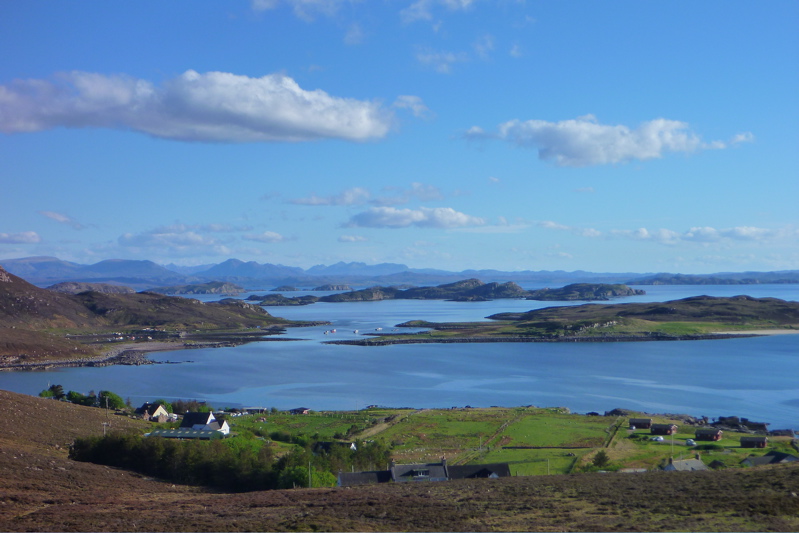
Below: almost the entire route seen from Cul Mor summit, looking southwest and west. Stac and Summer Isles in the distance.
 

Paddles for IKs and packrafts

See also:
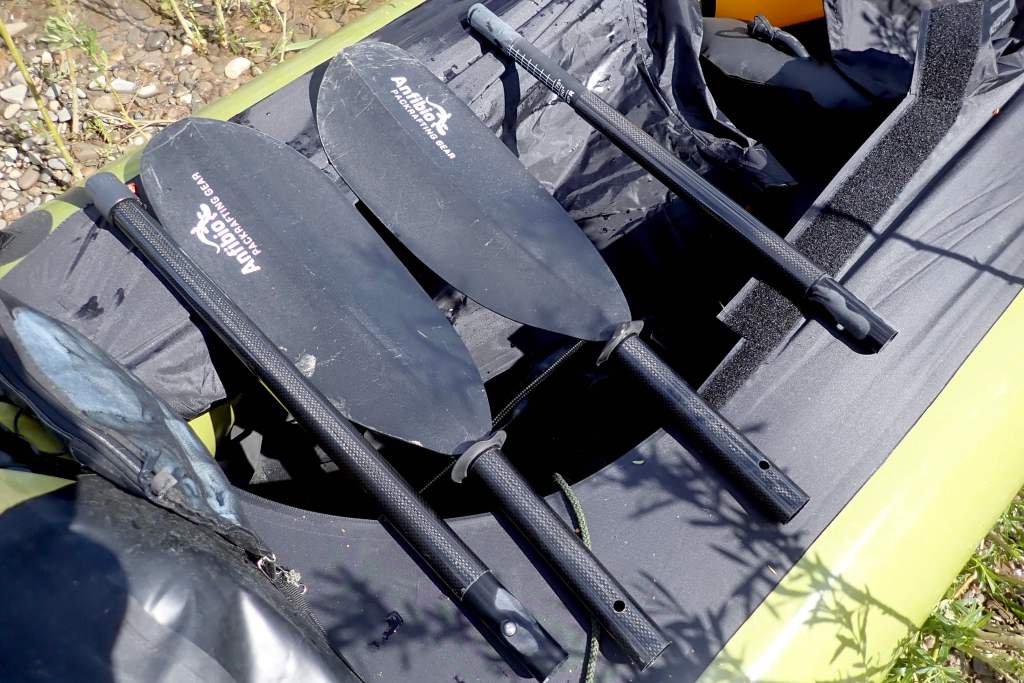
Anfibio Vertex Multi Tour paddle
Anfibio Fly
Wax your paddle blades
MYO Packstaff

pad-abmr
shovelorspade

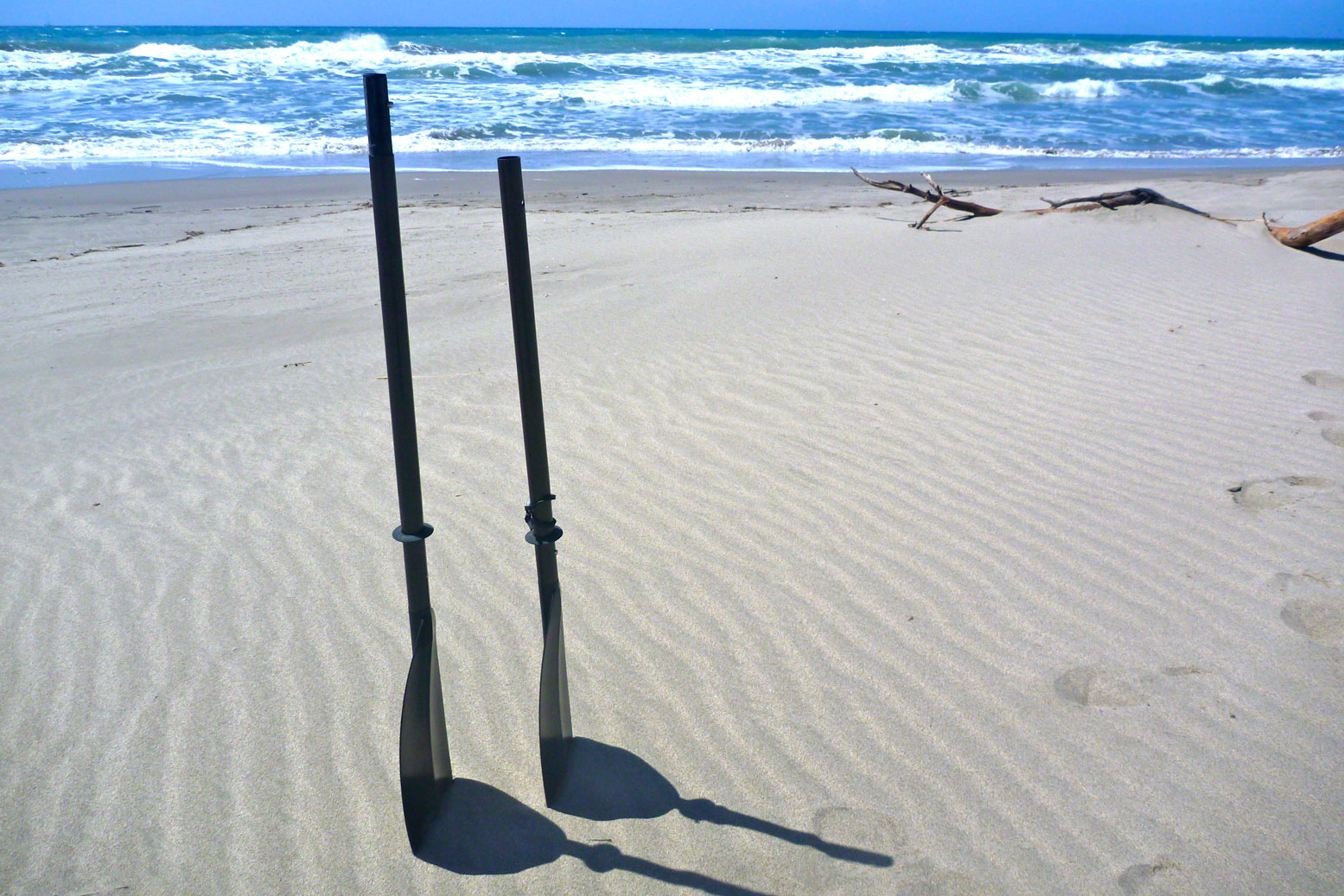
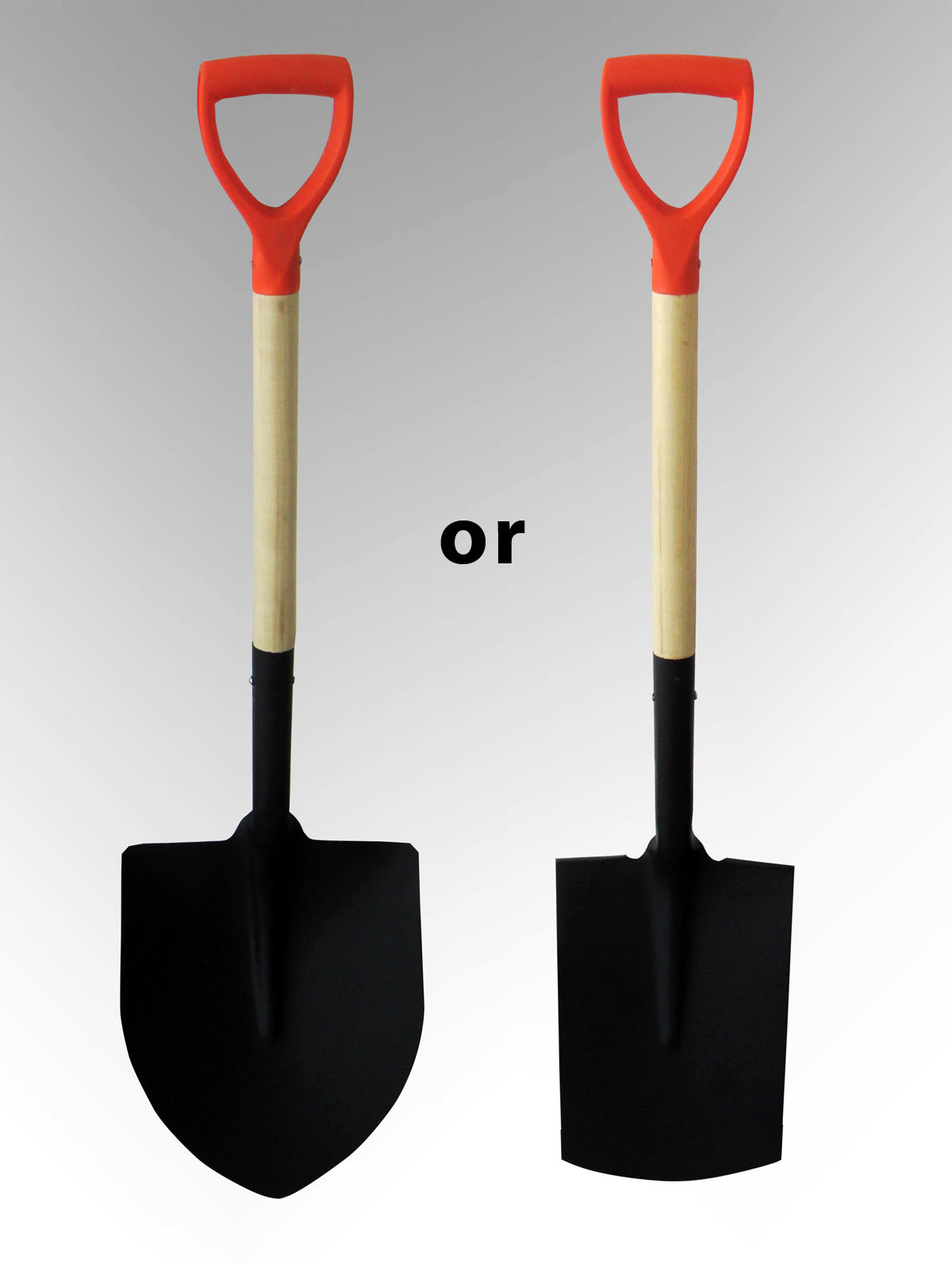
Like most beginners I started my IK-ing with a super cheap 3-piece TNP shovel. Then, after picking up a much better used 2-piece fibreglass Lendal Archipelago which soon seized up, for Shark Bay in 2006 I splashed out on a decent light, rigid, bent-shaft, adjustable offset, low angle 2-piece, 230cm Werner Camano. At £230, it cost more than my first two boats but in all those [17] years I have no regrets. The Camano just works.

highangle
High angling with a low-angle paddle.? All the gear with no idea

To me bent shafts and an indexed, ovalised grip make ergonomic sense for steady, all-day paddles rather than pulling fast moves in rapids. It’s just more compatible with the non-rectilinear human form. I did notice that when I swapped back to the slightly heavier straight Lendal (before it seized) there was noticeably less flex, but over a decade and a half later, the Camano is in great shape and is still my favourite for anything where a compact four-piece is not needed.

The Camano is a low-angle paddle, but I think my style, if you can call it that, is high angle, and in fact I read that high angle is the right way to do it. I find that wide, high-sided and relatively unresponsive IKs and packrafts encourage or require an energetic ‘digging’ style compared to a smooth gliding hardshell.

A paddle for packrafting
The way I see it, even more so than most IKs, a packraft has high and fat sides and you sit low inside. So that ought to mean a long paddle to get over all that plastic and into the water. Paddling with the 220cm, big-faced Aquabound paddle, I didn’t really notice any issues other than some squeaking as I rub the sides occasionally. Longer would not have made much difference.
At around 3kg a packraft is extremely light but it’s not an efficient shape for gliding through water like a swan. However, once on the water with a paddler in it, the total weight is nearly the same as a more glidey IK, so it boils down to the need to propel the hull using a paddle with a large surface area. Some might say a bigger blade will mean more yawing, but I figure you just dig less hard and anyway, with practice, yawing is easily controlled once moving. Providing you have the strength, a bigger face ought to give the speed which packrafts and IKs lack. There are times (mostly at sea or on white water) when speed and power can mean safety.
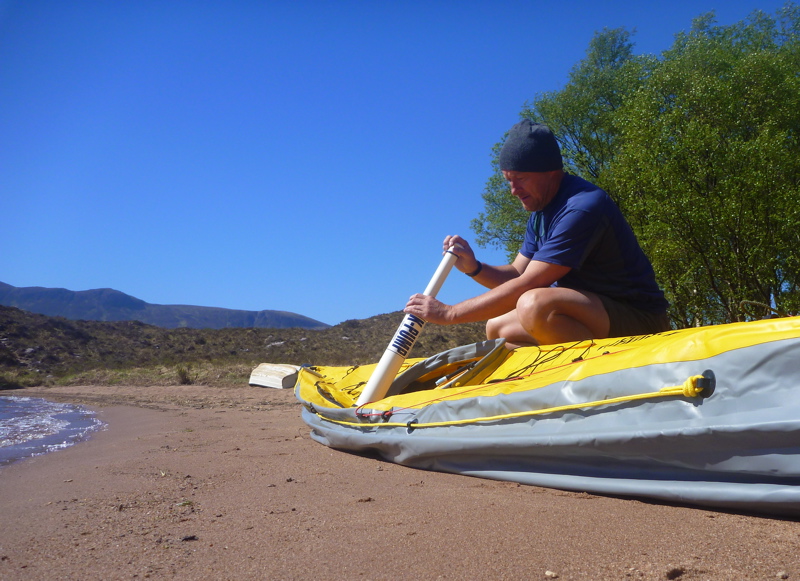
In the US I got myself an Aqua Bound Manta Ray 4-piece high-angle in carbon (above right, 220cm). Weighing under 900g this one feels more flexy than the Camano, but fits right in the bag and so makes a great packrafting or back-up paddle – apaddleinyourpack, so to speak. Mine has the two-position snap button offset which I run at 45°. You can now get an infinite-position Posi-Lok version.
The compact and light Manta Ray (70cm longest section) is ideal on short day trips with public transport and with no load to haul on the water. It was fine for a decade of UK packrafting and makes a great packstaff, too, but it didn’t always come apart easily like the Werners. Dry or wet, don’t leave it
assembled for days or weeks, especially after sea use (that probably goes for all multi-piece paddles).

I used my Manta sea kayaking in Australia as well as packrafting – it was fine for both. For the price this is a great paddle – so good I sold it to my Ozzie mate and bought another right away. I’ve never seen a 4-part Manta for sale in the UK, but in Germany the Anfibio Packrafting Store sells TLC Mantas as well as their own Anfibio Vertex 4P (left).

Or they used to. Now they sell their range of own-brand sticks. I recently padded with a chap with their four-part Wave which weighs 991g and comes with infinite angle and 10cm of length adjustment (210-220cm). I would guess the blade is <650cm2. The longest section is 64cm and all that for €125 is very reasonable.

I also have a straight, fibreglass-blade Werner Corryvrecken (£200 years ago). It’s the biggest paddle Werner do in 210cm+ 2-piece touring paddles: 721cm2 blade area compared to the Camaro’s middle of the road 650cm2. and 677cm2 for the Manta Ray.

At 220cm (same as the Manta Ray) I’ve also gone as short as I dare to get over the fat sides of a packraft.
There’s no indexing on the straight, carbon shaft, just a little ovalisation as on the Aqua Bound. The Corry’s face is a tad bigger than the Manta Ray (left and above) but the whole stick feels much more rigid (it’s 2-piece). It’s 7% lighter than the Manta Ray and 17% lighter than the stiffer Camano – initially you notice this. I compare my Corry and Camano in my Incept sea kayak here.

More weights & measures
According to the kitchen scales the weights of these paddles are:

  • Werner Camano 230, 2-piece – 988g – stiffest
  • Werner Corryvrecken 220, 2-piece – 816g – lightest
  • Aqua Bound Manta Ray 220, 4-piece – 880g – least stiff but cheaper
  • Anfibio Vertex Multi Tour 210-25, 4-piece – 890g – cheapest; multi-use

So now I have a long, comfy low-angle Camano for long, loaded IK or packraft sea trips; a straight, I sold the rigid, light, shorter big-faced Corry, and the Mrs likes the thin-shafted Anfibio Vertex Multi Tour 4-piece.
Incept K40 – speed, straps and storage

Incept K40 Index Page

No doubt about it, the K40 is fast enough for an IK. Last night was a calm but chilly evening, not very inviting so I settled on some effort and endurance rather than relaxed fun, nosing along the coast.
Alone and without my usual dry suit, the initial agoraphobia certainly helped with the digging. But for goodness sake, the sea was barely stirring apart from an eerie swell, so I dared myself a dash over to Tanera Mor (left). It’s only a 25-minute crossing.

The day before a kayaker fell in heading in the other direction back to Old Dornie and ended up being rescued by the coast guard (one press version here with a few small errors). I was told only one of the two kayakers actually fell in and although experienced, couldn’t roll or exit instantly, possibly as a result of cold shock? I presume it was that effort along with, like me, not being ‘dressed for the swim’, that brought on the reported hypothermia and associated helplessness. There were several other kayak rescues reported around Britain last weekend. Certainly up here it was the first sunny and calm couple of days in ages which must have brought paddlers out, even if sea temps haven’t caught up and may never do so.

I kept upright and sustained a sweat-inducing 4mph plus for half an hour, peaking with the aid of some unnoticed surge at just over 5mph (8.5kph or 4.6 knots). I suspect that in similar conditions, a slick fiberglass sea kayak that’s six inches narrower and six inches less high can cruise at around 4–4.5mph all day, and I’m also told that at sea you should bank on an average of 3 knots (3.5mph, 5.5kph) when estimating distances. On the last leg, going east against the ebb and a light breeze didn’t make much difference to my speed. Until I was spent, that is. In the absence of sunny vistas and a warm breeze to linger over, it was a good work out. See also a similar test with my Grabner.
This was my first proper outing with the thigh straps. It wasn’t rough enough to test them, but I’m sure they enabled me to keep the speed up. This is partly due to the fact that, like so many IK seats, the Incept backrest collapses as you lean on it as it’s far from rigid, no matter how much you inflate it. It’s why I got an Aire Cheetah seat for my Sunny years ago, and why, along with its mushy footrest, the g-friend can’t get the most out of her Solar (top left; I fixed it later). When you lean back on an inflatable seat – even attached to the hull tops (the highest point) – it still just folds down from the arch of the lower back. This leaning from the middle-lower back rather than pushing from the lower back/hips is partly to do with a lack of solid footrests in the Incept and Solar (before mods). All this squishy inflation certainly creates comfort but is also the biggest performance drawback compared to hardshells – even if you do read of SinK Sit in Kayak hardshellers complaining of numb limbs until they find their ideal boat/set up. One reason a sea kayak can manage to be just 22 inches wide is that you can jam yourself into it – hip, thighs/knees and feet – so it fits and responds on the move like a running shoe, not a woolly slipper – a nifty analogy for SinKs vs IKs.
Without a solid seat or footrests, the thigh straps on the Incept do their best to replicate a hardshell’s underdeck thigh pads, enabling me to sit upright because the backrest as it is can’t provide that support. If that means more strain on my abdominal muscles, bring it on!
As I mention elsewhere, with the deck zipped up there’s normal back support off the coaming that’s still mushy enough not to make you sore as it would do on a SinK. Open deck, one solution would be to incorporate some rigid sticks or a board into the backrest to stop it scrunching down – like a Cheetah in fact. At one point on the Sunny, before I got the Aire seat I had a board jammed in behind me to help push off the box I used as a footrest. And so I conclude: seatback with the top down, not so good no matter how you adjust it; thigh straps good any day of the week.

One thing you lack in open deck mode on a K40 or any open IK is flat space for any sort of secure storage or fitting points.  It’s the same story on a packraft. Trying to emulate a professional, I went out with my new large SealLine ziplock map case which lay at my feet. Gael turned me on to these. Unlike some walking map cases that I’ve seen over the years, it’s clear on both sides and best of all is big enough to give you a whole day of map on view if you fold the map right, so avoiding unnecessary fiddly openings on the water or in the rain. Online walkers’ reviews seemed to rate the Ortlieb roll-top equivalent, and claimed the Seal Line will split at the ziplock, but even if it’s simpler, I can’t see roll-top anything being as bomb-proof on the water as a ziplock, and Gael’s had his still-unyellowed SealLine for years before it developed a tiny hole on his last trip.

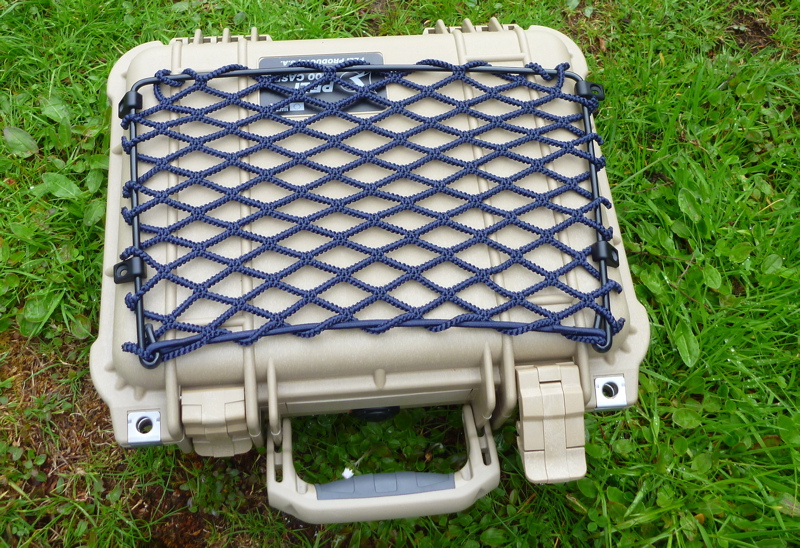
Back to stashing; of course you can attach everything to some point on the boat, Gael managed fine in his H2, but bits of string around your legs doesn’t seem such a good idea unless you’re really organised. I tried paddling with my Peli 1400 box (left, with a lid-net I plan to fix on – bought here) under my knees the other day, but handy though it was, that wasn’t going to work. It would be better fixed behind me. A Peli is easier to open and close quickly and reliably than my yellow Watershed bag (also ziplock closure), but I think it’s shape will make it a much better ‘day hatch’ bag on an open IK and a packraft, even if closing it securely as a hazard looms may take some luck.
Of course in zippy deck mode you have quite a lot of flat space, even if the Incept’s deck stretchies are almost over my feet (the thin shock cord is indeed too flimsy as Gael mentions). But top on there’s enough flat deck space by the hatch at 10- and 2 o’clock to stick a D-ring or velcro. One way I’ve got round this so far is packing it all on the pfd. Certain things belong there sure, but you can end up feeling like some special forces dude, waiting the the signal.

You can attach things to your thigh tops which are within reach and sight. The SealLine map case will clip around a thigh. I’ve tried doing the same with an Aquapac GPS case strapped round the leg; it’s OK and can hook to my drysuit’s relief zip tab to stop it slipping down when walking, but it’s all more junk hanging off you. Compass excepted, a GPS isn’t really a vital gadget in clear conditions. On the sea a legible and accessible map is handier. Still here? Then there’s a good page of improvised deck tech on ukrivers – but of course it’s all oriented towards hardshell SinKs.

MYO kayak disc sailing – Incept K40

Incept K40 Index Page
Main kayak/packraft sailing page
See also this post and links off it

We parked up at Loch Raa where we’d tried umbrella sailing last year without much success. Initially G said we were nuts to go out in this wind, so we sat in the car and ate our butties like a semi-retired couple in a Peak District car park. But by the time I’d finished working out a way to attach my home-made sail to the Incept’s bow, she was already on the other side of the loch.

This was my first time trying out my 0.78m2 sail on a kayak, but I’d recognised the value of sailing in Australia a few years ago with a mate hooked up to a Pacific Action (PA).
Here in the UK I get the feeling sails on sea kayaks are seen as even less sportsmanlike than rudders – just not cricket, but an Incept IK is excused from such protocols. Anyway, in terms of efficiency my home-made jobbie wouldn’t be a patch on a proper PA, but I’m not planning on crossing the Indian Ocean just yet. Made from an old tent and with the ability to twist down to half the deployed size, my rag sail was a good way to experiment with the idea and techniques of sailing. If it came to it, I can buy a PA or Bic anytime.

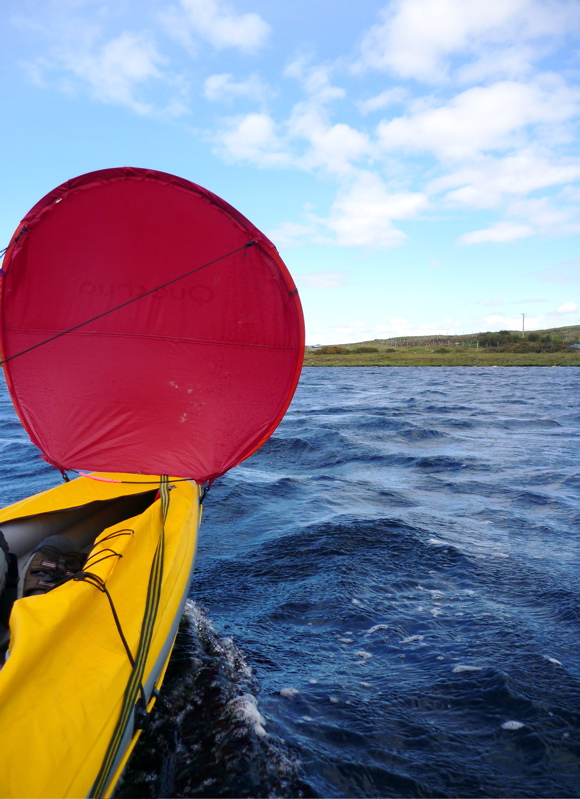
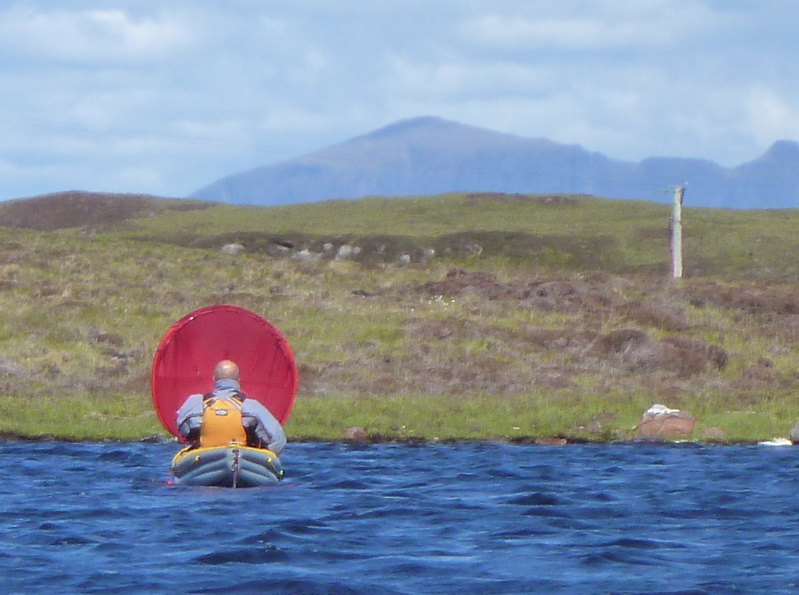
The wind was still batting over Loch Raa (Ardmair recorded a max of 33mph today) so I hacked upwind, flat out at 2-3mph, drifted round and let my rag sail get a fill. Considering the paddling effort it took to get there, I wasn’t exactly ripped out of my seat, but that’s probably a good thing for a first go. I was concerned a side gust might catch me out and pull me over. I took a few downwind runs and found myself cruising at around 3.5mph, topping out at 4.3mph once I neared the downwind shore at the end of the fetch.

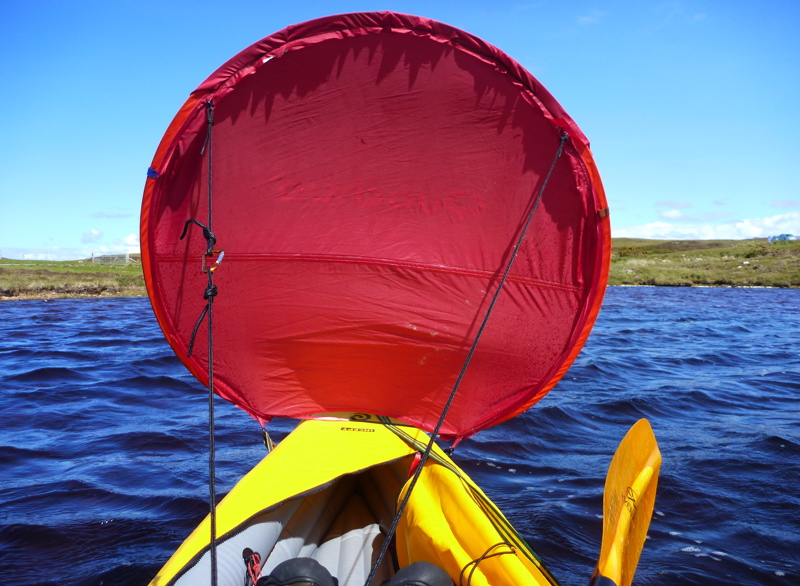
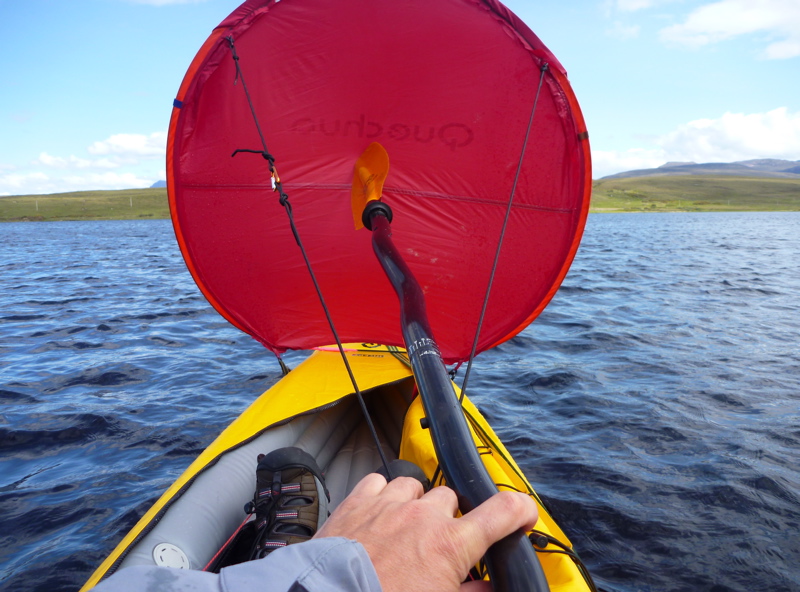
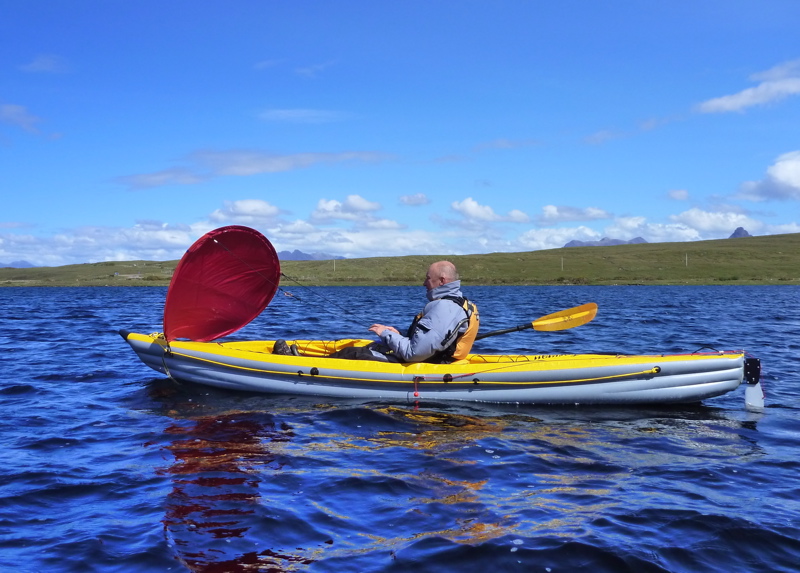
At around 4mph it begins to get fun, with the bow carving through the waves. Stability was great, I never felt out of control and would have like to have gone a bit faster. All I had to do was stash the paddle, hold onto the string and foot the rudder. In lulls I needed to support the sail with my paddle (left), but later found if I let it reach forward it stayed up. Set up for a packraft, my control string was a bit too short with the sail six feet ahead of me.


I did try to steer and travel off wind by twisting the sail and ruddering, but not sure I fully got the hang of that. Doing this takes two hands to pull one string back, but if I rigged a rigid handlebar into the string (a bit like a water skier), that might enable one-handed twisting, plus easier holding at other times. Or perhaps a cinchable attachment to the hull is the way to go, leaving yours hands free to who knows, add a little paddle power.
Thing is, if I hacked into the wind at 2-3mph I could probably have paddled downwind at 4mph. I may try a proper downwind paddle v sail test next time, but as we all know, what downwind paddling gives you in push, you put in as tracking effort to avoid weathercocking, especially without a rudder.

At the wind speed that day, sailing wasn’t so much about going faster as saving effort. Plus it was more fun than I expected to surf along for free, mainly because it didn’t feel at all risky. But this was on a small loch with waves less than a foot high. Half an hour earlier on the sea the chop was a couple of feet; I imagine that would require more concentration and with less possible speed on the rougher surface.

Sailing downwind you don’t get the sensation of the wind in your hair, but the GPS and the splash off the bow tell the story. On one run we rafted up and the sail still pulled us along at over 3mph which was pretty good for two fat boats. As I approached the shore on my last run I lifted the rudder and straight away the back came round, as it seemed to do when I tried sailing in a pack raft. So it seems a rudder or at least a skeg is the key. To steer accurately with a paddle would be pretty tricky, but I may try that one time. Visibility wasn’t really a problem; to get a closer look just tug it back out of the way.

Having thought it all over, I have updated my hypothetical analysis of the £50 Bic Sail (left) on the main packboat sailing page with a couple of pics. For the couple of hours it took me to make my disc sail, I think fifty quid on something that has actually has some kayak-based testing and design put into it is not such bad value.

I also tried out my thigh straps. Problem was one of my messy patches had half unglued so I couldn’t put any force on them. But they fit well, are comfy and easy to adjust, don’t feel like they might trap you, and are a definite improvement for either powering on or boat control in choppy water. The positions marked on the Incepts hull felt just right.

Incept K40: a windy weekend

Incept K40 Index Page

Normally on a decent weekend up here (as pictured left) there’ll be half a dozen vans with their distinctive kayak racks parked down at the beach. This weekend they’d all clearly read the forecast, but keen to get some hours in for an upcoming plan, kayaking chum Jon took a chance on the long drive up.
The good thing with the lie of the land hereabouts is there’s usually somewhere sheltered to go wherever the wind’s coming from. Except perhaps during a northwesterly as predicted for Saturday and which bowls straight up the skirts of the prevailing lochs and valleys.

With it all laid out on my doorstep, Saturday afternoon we put in at sheltered Old Dornie harbour (left) and tried to head out round the adjacent isles, but I lost my nerve at the sight of the oncoming swell and increasing wind. Eager though we were, we reverted to Plan A, turned round as if on a tight rope and settled for a couple of hours solo re-entry practice, something I’d yet to try in my Incept K40.

Being a hardsheller, Jon works on his roll from time to time, but hasn’t quite got it nailed yet. He’s got a good alternative though, re-entry and roll, they call it – getting himself into the semi-submerged kayak on its side and then once in and braced, doing the hip flick and paddle float lift to get himself upright, at which point he pumps out the hatch compartment.

Me, I tried lunging onto the deck from the water, as I would on my former Sunny or my packraft. But the K40 bobs quite high when empty, so I was surprised I managed it, perhaps aided by the added buoyancy of my dry suit.

The problem is, once slumped belly down over the hatch (above), what next? You fall back in, that’s what next, because trying to turn onto your back tips you off long before you get your legs securely down the hatch. Perhaps with a bit more practice and finesse it could be done, but this was pretty calm water so realistically, just as on a hardshell sea kayak, it’s usually too tricky to pull off unaided. I then tried with my new paddle float as an outrigger. Would you believe it, re-entry was much easier and also pulls less water in as the boat remains more upright. Hook a leg over the floating paddle shaft and scuttle aboard. From this position I found it was fairly easy to flip round and drop bum first into the hatch and then stuff the legs in. 

On that day I was carrying my two Watershed dry bags full of camping gear to see how it handled, so they helped reduce the boat’s possible swamped water volume, but even then any deckless IK conveniently self-drains when flipped back over – no awkward, X-rescue hauling over another kayak’s glossy fibreglass deck to drain. Once in the K40, there were only a few inches of water to bilge out, certainly not enough to cause sloshing instability (the true reason why you need to drain a kayak fast following a deepwater re-entry – not because you’ll get your pants wet).
One thing I noticed was a rope knife attached to my pfd got caught on the hatch coaming, and also all this grovelling around over my wet kayak’s deck pulled the bite valve off my new CamelBak/pfd set up which then drained away. That will be £4.99 please. Now I know to reposition one and tuck in the other to avoid any snags.
Spraydeck newsflash! The massively oversize cheapo spray deck I bought and modified (left) still required a lot of scrunching. But having actually used it, my feeling is the K40 sits so high it’s not going to be needed unless it gets cold or I’m heading for river rapids. At other times it’s just more clobber to carry around, wash and dry. Maybe I’ll get to see the value of it as my experience in the Incept extends. On a much lower sea kayak like Jon’s P&H, a deck is pretty essential.

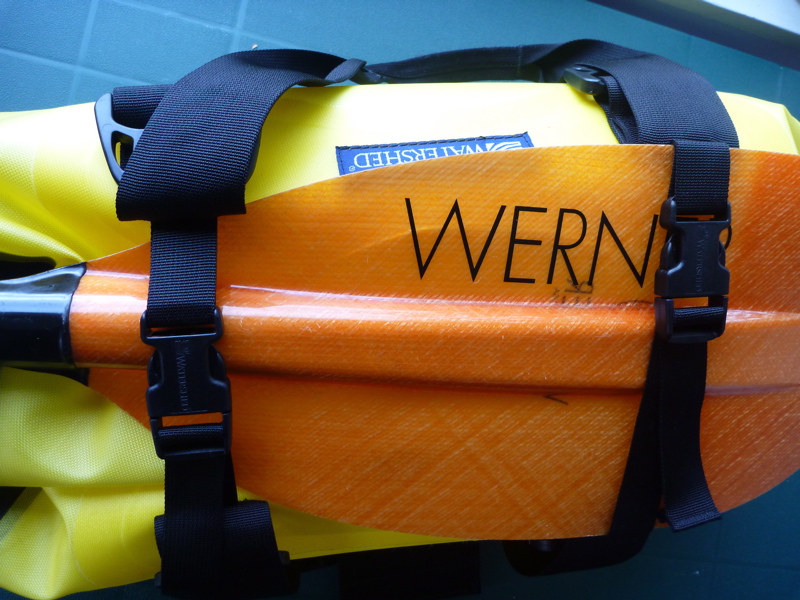
The other way to get back into an Incept from deep water would be to simply unzip the decks and haul yourself on. No paddle float needed, although it occurred to me yet another use of the Watershed bags, particularly the smaller yellow Chattooga, could be as a paddle float (left). Any dry bag will do, but you know the Watershed’s won’t so much as seep a drop like a roll-top will after a few minutes, and the Chattooga even has some clips which can be used to secure a paddle blade.

If not using any type of outrigger float, a bit more water will swill into the K40 as you pull over the side to get back in. Ideally you then want to crawl up through the unzipped hatch hole as you got aboard, ease around and take your seat. But now you have the fairly tricky manoeuvre of trying to zip up the decks, all while hanging onto your paddle and not tipping back in. As I found first time out, without the support of another boat or a float, reaching the fully opened zip pulls on the Tasman is quite an unstable stretch from the seat, even with the grab loops I’ve tied to them. Longer loops might get in the way so some sort of a hook stick is needed if no one is around to do it for you. Regarding the K40’s zippy deck, as long as I wear a dry suit I can see even less need for it at sea in the conditions I’m every likely to go out in. Only on a WW 2 or 3 river would it be handy (with the spray deck) to save the boat swamping and the need to find a bank to drain it.
If you’re paddling undecked, getting in from deep water all so much simpler, just like an SoT, and if not there’s a good section on the informative Kayarchy website illustrating all sorts of deep-water rescues.

Next day we set off to try and actually paddle somewhere, but off the beach it still looked horrible (left and right); 15-20mph winds but now from the SW. We paddled towards the Isles anyway, but after 15 minutes I didn’t like what I’d guess you’d call a boat-stalling ‘short chop’ which would only get worse further out. While hacking away warily, it occurred to me that focussed as you are in such conditions, it takes some effort to think of others or even keep track of them, and should they flip while you’re barely coping yourself, it can all go horribly Pete Tong. After all, no one usually capsizes is calm, wind-free conditions. That’s why we wanted to get some practice time together out here. The plan had been to go as far as camp the previous night, but the miserable weather and a fully fitted house just a mile away nixed that idea.

It wasn’t actually that gnarly, just not much fun and possibly about to get less so. As we did a U-ey I was encouraged to observe my Incept that morning felt less intimidating to turn than Jon’s slinky P&H. Again, no great surprise; his boat is floating stick insect with the turning circle of a stretched limo. The K40 is wide, has a rudder and – now that I’ve seen pics of me in it – the ends sit out of the water even with my weight and a 10-15 kilo load aboard. Is that a lot of ‘rocker’  or a little, I forget, but it turns easily with rudder + paddle strokes, and with the rudder up can spin on its axis with a lot fewer paddle strokes than Jon’s Scorpio. And with fewer edgy moments too. I was getting the feel for the Incept in rougher water.

So we sailed ourselves back to the beach, fighting to steer with the tailwind. Once there we settled for messing about closer to the shore, practising more turns out on the swell or paddling parallel to waves to gauge tippiness, secure in the fact that we were constantly getting blown inshore.

I was open deck that day, but noticed where the Sunny would have flexed and swamped over the rounded sides where I sat, the more rigid and higher-sided K40 stayed mostly dry. I was also conscious that even though they are also more clobber and something to catch your foot on, the thigh straps I’m waiting to glue in would surely help control in rough water. Either that or I see them as the only possible explanation for my lame kayaking skills! With the deck off we also tried paddling the Incept two-up – me sitting in the back facing backwards. That’s a total weight of at least 180kg in our gear, 20kg over what the Tasman is rated for. Jon reported the boat was tippier like this and had it been a serious requirement, I could have laid down to improve stability.
One thing I noticed open deck is that there’s less back support from the low seat – a common problem with IKs using inflatable seats, and one reason I went for a Aire Cheetah seat on my Sunny. Clearly with the deck on the flexible coaming helps as a back rest and by the end of that day I felt the tops of my legs straining a bit in a bid to maintain upright. The problem is there is nothing solid to brace the feet against either, but I imagine this is another benefit of fitting thigh straps.

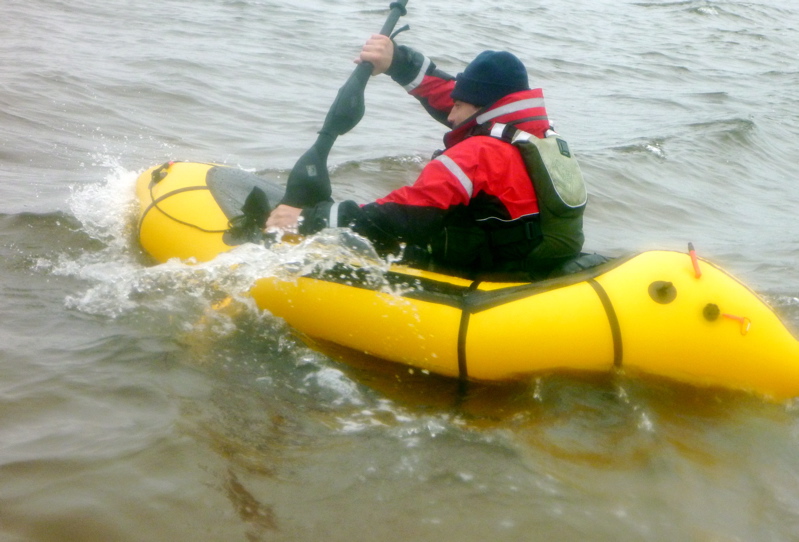
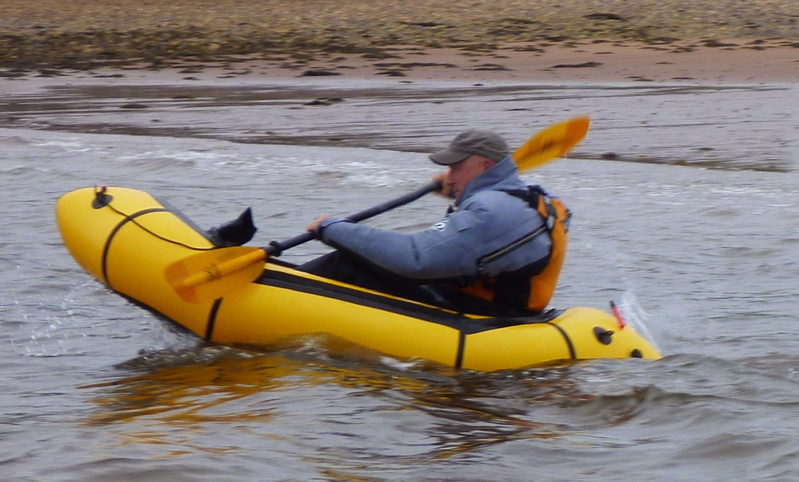
Having mastered many new skills, we had a quick scoot in the packraft (above); fun and very stable in the conditions, but also so slow you’d run out of puff before getting anywhere. The initial instinct in the chop was to try and jump it like a BMX bike; it sure would be fun to try surfing it on bigger waves one time.


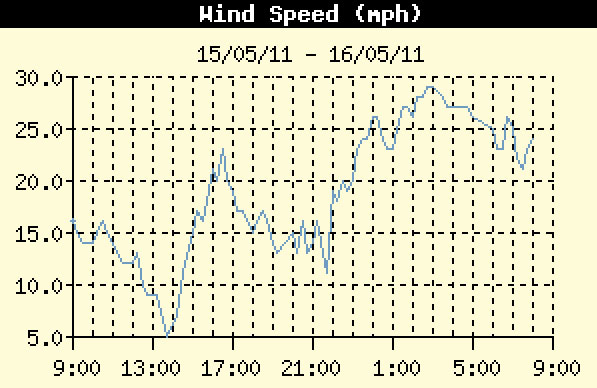
Suddenly a glassy calm befell the bay, just as a private weather station near Ullapool recorded accurately in the graph on the right. Great we thought, let’s make a dash to the Tanera Mor about a mile and a half away, so we can say we got off the mainland – an ‘open water’ crossing! In this way many foolhardy newbs sail off to their doom, I suspect, because little did we know it was just the wind clearing its throat and refilling its lungs before coming back from new direction and harder than ever. But not before we’d managed to cross over and nudge the island’s sandstone cliffs (left) with our bows.


The previous day and that morning I’d been put off in similar- or even easier conditions but now, after a few hours playing around we were more tuned into our boats and even headed back diagonally across the stiff back wind and swell to make it a bit more difficult. Me of course with the aid of my rudder; without it I’d be correcting all over the place and need to stern-rudder, as Jon occasionally did. With backwind ruddering, I noticed it’s not a simple matter of holding the rudder at a certain angle because the tracking continually goes off, presumably as a quartering wave rises and drops behind you. A constant pedalling of the rudder controls was required to keep on the track. Don’t know if that’s normal, but I’d hate to wear out my rudder lines prematurely.
So not a totally wasted weekend. Now we know we can get back into our boats alone one way or another, and can actually handle F4 conditions within sight of the shore, even if next time we go out, initially we may not feel that way. 

Paddling to the Wasp Factory (Incept K40)

Incept K40 Index Page

I’ve been watching a range of weather forecasts in a bid to try and get a feel for things around here. With no hurricanes predicted, last night I went out for a paddle along the shore. Even now it’s light here till 10pm.
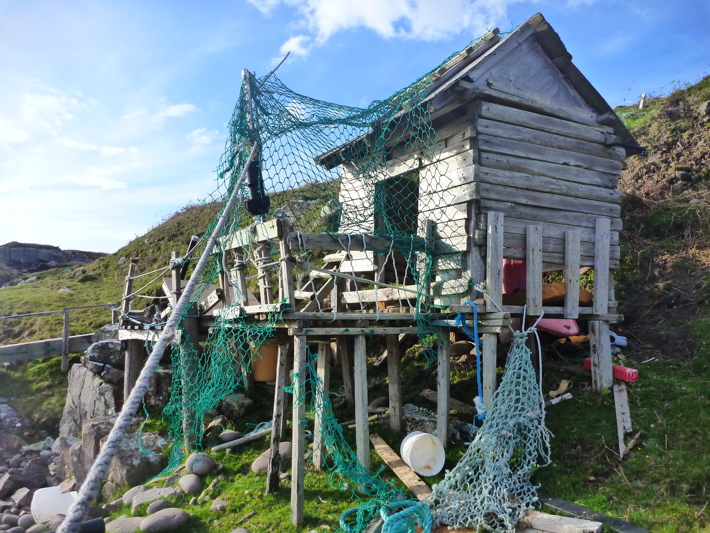
On a quiet beach I came across a strange installation, an abandoned Wasp Factory or maybe just some kids’ flotsam beach house. In some places the masses of washed-up fishing industry junk is depressing in the otherwise unpolluted surroundings, but it’s also part of what makes beach-combing so intriguing. Whose chopped down wellies were they (different sizes, made in Holland)? When was Calmac man’s (Hebridean ferry service) hard hat blown overboard and did he go with it? All messages without a bottle. If nothing else, as Gael observed last year along the SSKT, there’s always plenty of rope, netting and more usefully, firewood to be found on less visited beaches.

P1010356

Eight years later it finally succumbed to the Hebridean gales.

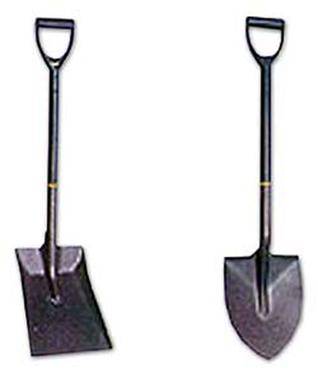
Spade or shovel?
I paddled open deck that evening and along the way attempted to compare my good old, bent-shaft Werner Camano with my newer Corrywrecken (both discussed in more detail here). In short, over a couple of hours I could hardly tell the difference in operational terms except that the Corry initially felts amazingly light and taught after using the Camano, but going back to the Camano doesn’t exactly feel like falling headfirst down a well. Both are great paddles when compared to a spade tied to a shovel with duct tape. Can’t say the bigger Corry made the boat go any faster, but perhaps the lighter pull of the more ergonomically bent, low-angle Camano felt more natural and sustainable. It’s hard to tell if that’s a genuine impression or just a pre-conditioned response to what sea kayak paddle lore suggests. I think in the Incept I’ll stick with the Camano, only because it continues to work so unobtrusively plus I don’t want to mash or lose the newer Corry any sooner than necessary. Despite being named after a famous tidal whirlpool off Jura, I’d say the Corry is a great white water blade, where you want to pull fast pivots and brisk acceleration to navigate complex rapids.

No rudder
I paddled back 2 miles or so with the rudder up under a very light wind and with perhaps a bit of back tide and swell. I’m getting the knack of tracking the K40 a lot quicker than in the Sunny without a skeg – but then I only discovered the Sunny worked skeglessly by mistake after a few weeks. My conclusion in the Incept is that you’re maybe 1kph down on a typical 6.5kph cruise (I had a GPS) because of the correcting finesse and concentration required. Maybe that will subside, but it all takes a little more out of you physically, as your hands are doing the steering/tracking as well as the pulling. Just like in the Sunny, every few minutes you spin offline for no reason you can fathom. So then either you pull hard to bring the front back, or you just spin right out and check out the view behind, then paddle backwards for a bit as if you were planning to turn all along. After a bit of that you lose it anyway, let it swing back around pointing forward and carry on your way.

Incept K40 Tasman inflatable kayak review

Incept K40 Index Page

What’s in the bag?
The other night I tipped out the contents of the blue bag and unrolled the boat from a factory-packed volume which, like a new Alpacka, it’s never likely to regain (see below in red). It all added up to:

Blue roll top dry bag
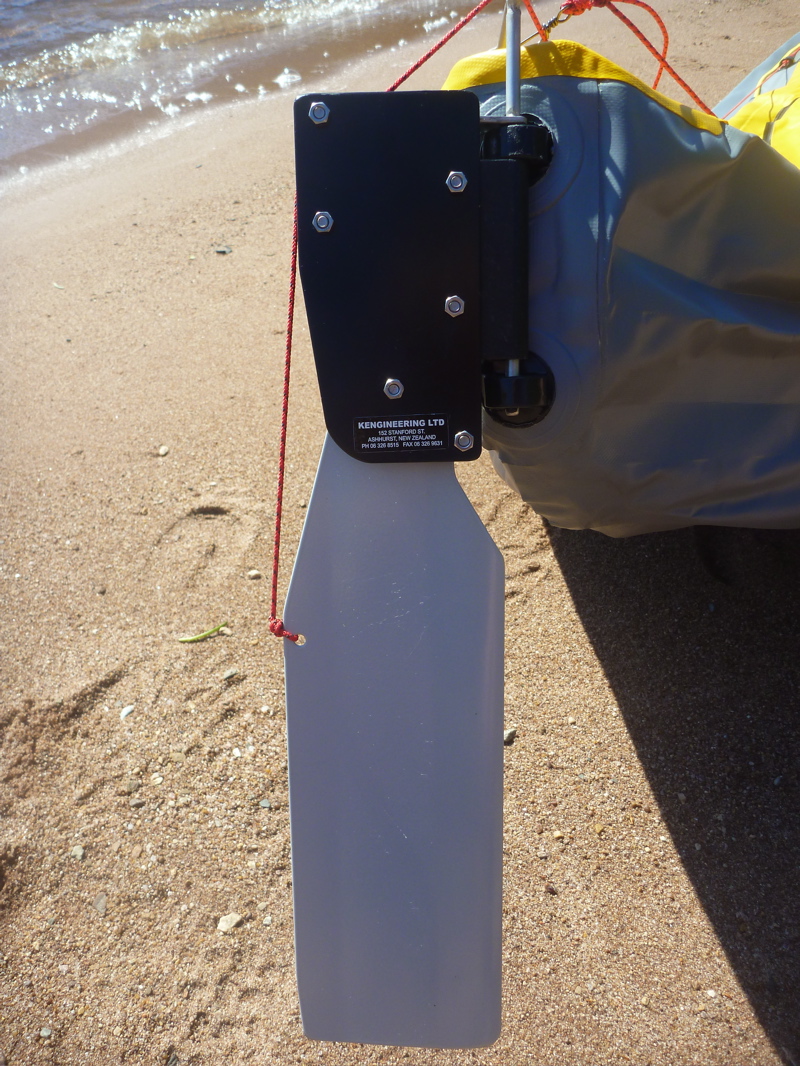
Boat with deck lines and all rudder controls/lines
Rudder assembly
Flexible hatch coaming rod
Inflatable seat
Four GRP battens which slip into the deck to give it form
K-Pump in a bag with adaptors and grease
Boat repair kit (glue, a dozen patches and a valve adaptor, see red)
Basic instructions and an NZ leaflet on safe sea kayaking

Dimensions
According to my atomically calibrated measuring instruments, the boat alone weighs 14.8kg + 2.2kg for rudder, seat, repair kit and pump. It’s 4.3m long, 69cm wide and 45cm wide inside (32.6 lb + 4.8 lb; 14′ 1″; 27″; 18″).
The table from this post compares dimensions on similar IKs. At 17kg the K40 actually feels pretty light and as long as it’s empty, not too windy and the path is easy, I can carry the kayak on my head or the back of my shoulders.

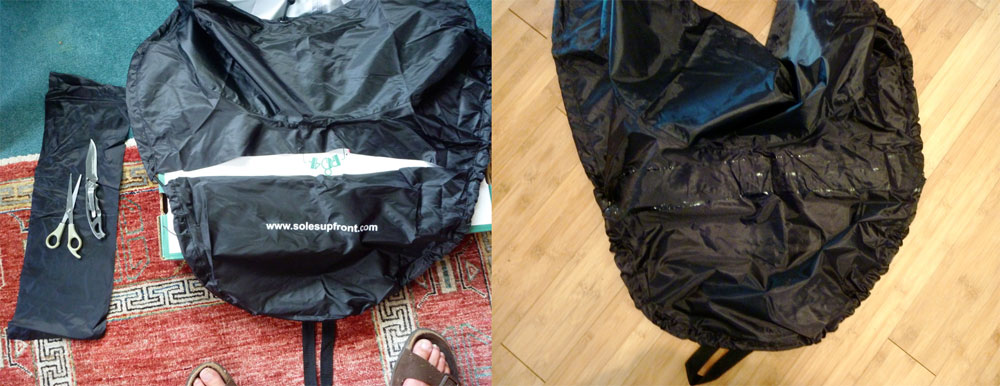
What’s not in the bag – a spray deck. You get the impression that it’s a special shape/item and so ought to be included, but I’m told it’s €103 euros for the one Incept recommend. It’s hard to ascertain exactly what you’re buying from the small image buried on their website, but similar skirts go for around half that price in the UK. I bought a nylon cheapie to be getting on with. It’s actually not badly made for 19 quid, with taped seams and a decent coated material; it’s just way too long, so I had to cut it down.

Aa K40 sits a lot higher than a regular hardshell kayak, so I imagine a skirt would only be necessary when it gets really rough (by which time you probably have other issues) or cold, or you confidently expect to be able to extract yourself from capsizing with one smooth swipe of your blade. It would be nice to master a roll, but I suspect that crawling back into a K40 with decks unzipped is less difficult, especially with a paddle float. More on that here.

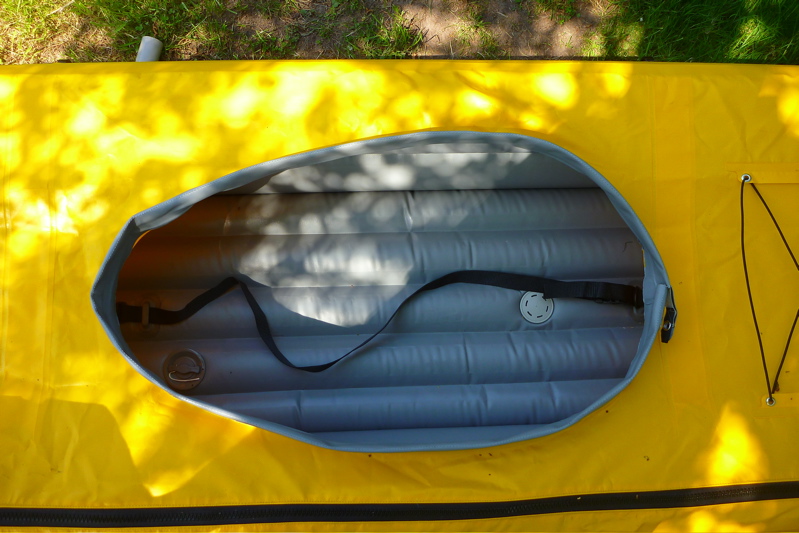
The hatch is 71cm long, 41cm wide and 186cm circumference (28″ x 16″ x 73″), if that helps you select a spray deck. Although it’s statistically small, I’ve sat in worse and as it’s not rigid, even I can pull my legs up to get out while still seated.

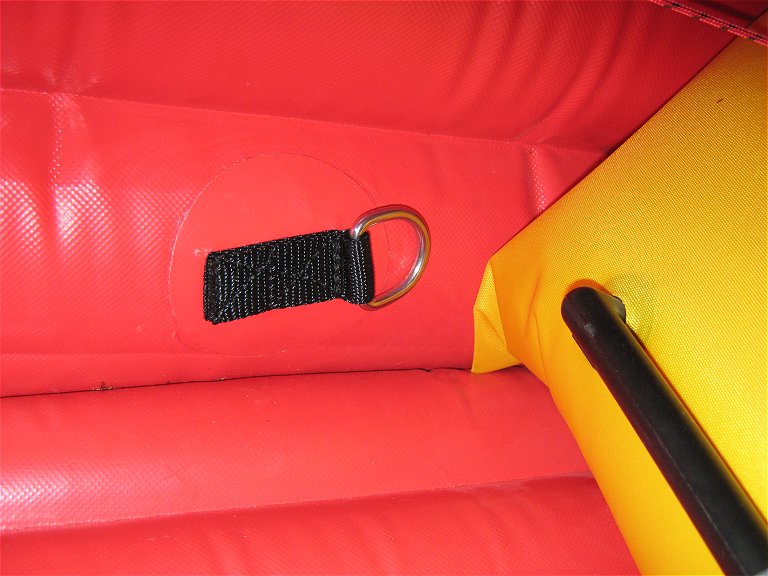
Thigh straps are a €66 option. Fair enough, but my boat has no D-rings (left, Incept’s pic) for the straps, just markings where to fix them. Some boats get patches, some don’t I was informed (probably heat-welded, left).
Otherwise it’s a lot messy work gluing some on (below left), which will either cost you over £50 for four Incept patches sent over from NZ. Or you can spend hours on the internet looking for alternatives. I fretted, thinking I must buy actual Incept ones which are made from the same PVC-urethane material as the hull. As well as clean surfaces and a good roller, on inflatables the adhesive/material combination is critical for a good, permanent seal.

The actual Incept PVC patches cost $NZ12, similar to the UK from places like PolyMarine. Or good old NRS have all sorts of patches here and among other places, they now have an outlet in Ireland (so all import taxes paid (until Brexit happened).

I bought a dozen #2097s (left) which are a bit big at nearly 5″ (120mm) but can be trimmed. NRS said that Aquaseal (aka: Aquasure in Europe) will do the job on PVC-to-PVC as well as anything, but actually one D-ring stuck on with Aquaseal came off three times.
Probably my bad application so eventually I tried the small unbranded tube of Ultraseal 777 which came with the boat’s repair kit. It’s a much thinner and runnier than Aquaseal and smells like classic Bostik, and because it was not ‘filling’ but just adhering, I thought it made a better, more pliant seal and it cured quickly too. I’ll find out for sure how the 777 patches worked in comparison with the Aquaseal.
Unfortunately, though it’s made by Bostik, I couldn’t divine whether 777 has a magical formula that perfectly suits Incepts polyurethane alloy fabric, but in future I’ll clean off with MEK solvent and use Bostik 1782 – the nearest I could guess and found cheap on ebay.
While my back was turned Bostik seem to have diversified into scores of glues from my youth when the classic, pink-tubed all-purpose glue did it all. Now they sell a glue for scores of uses which the cynical consumer can’t help thinking is marketing- rather than function led.

The SeakayakOban test boat I tried had thigh straps – straight, not as comfortable as pre-curved ones I recall having on other IKs.
Pre-curved straps hook better over the knees, so I got a pair for an SoT off amazon for £33 (left). With those brass-plated clippy things they’re heavy, but seeing as they’re so fat they could double up as cushier backpacking straps on a boat-hauling packframe.

One more annoyance: I was expecting to get the Bravo footpump which the shop I bought it from pictured and confirmed by email. I received the better, hard plastic K-Pump after I went out of my way and bought one. This inconsistency with Incept’s info (including images of models with old colour schemes, velcro decks and talk of ’25 D-rings…’ in current brochures) gets frustrating. You get the feeling Incept aren’t focussed on promoting these IKs, as if they’re a sideline to the raft business. But as long as the people on the factory floor with the scissors and heat guns are on the ball, I’m sure I’ll get over it.

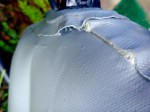
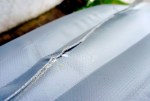
Sadly, quality of construction is also inconsistent. Most of the boat is heat-welded but closer inspection revealed a lifted seam at the glued-on rudder patch (below left). The cavity here was an inch deep and took repeated injections of Aquaseal to fill, but I presume this is a patch glued on the hull, otherwise I’d have a pretty flaccid boat by now.
Nearby, a couple of hull seams had also lifted a mil or two (middle pic). It’s hard to think these would have slipped past any inspection (assuming there is one), so I presume they lifted after that point. These are the only manufacturing flaws I’ve spotted on an otherwise clean job. And to be fair the rudder patch glues around
a curve where two other layers meet, so it’s a difficult join. I’ve laddled the whole area with Aquaseal (last pic) and it’s now sealed for good.

Incepts are made from 1100 dtex Polyester fabric coated in a PVC-urethane blend. It’s notably less thick than an old-style Gumotex. Stiffer is harder to glue into tight forms (as proved above) but makes a faster boat on the water. It’s also more awkward to pack, especially when cold. I can’t see me ever rolling it up as compact as the image at the top of the page (see red text , below). I go on further about IK materials here and once, theboatpeople spoke sagely about Incepts, though it’s unclear if they’ve actually seen one in the raw (never stopped me!).

As the enclosed instructions say, the biggest risk to damaging a PVC craft is when a sharp and stiff corner of a rolled up boat scrapes on concrete or tarmac; it grinds off the coating real quick. I must remember never to do that. It’s unlikely that the PVC-U is as durable as synthetic rubbers like Nitrilon or Grabner’s EPDM, but with care, regular rinsing, squirts of 303 and the odd dab of glue, it should last.
In fact the K40 is the only IK I’ve ever punctured: a tiny thorn tip picked up while pumping up on Loch Moidart. The second owner’s similarly punctured the side while pushing past a thorn three on a river, and again at sea later. Knowing all this in retrospect I would say Incept’s choice of fabric for the K40 may not be durable enough, but the only other owner of an older red and yellow boat has had no flats at all. It’;s possible earlier boats used different fabrics.

Out of the bag I pumped it up for the night and fitted and adjusted the rudder which was dead easy. Next morning all was still pleasingly firm, so off to one of the local lochs. Down on a small beach near a road, again I was surprised how effortlessly the K-Pump inflated the K’s three chambers until the PRVs start hissing at 5 psi or 0.34 bar – as high as any non-DS IK.
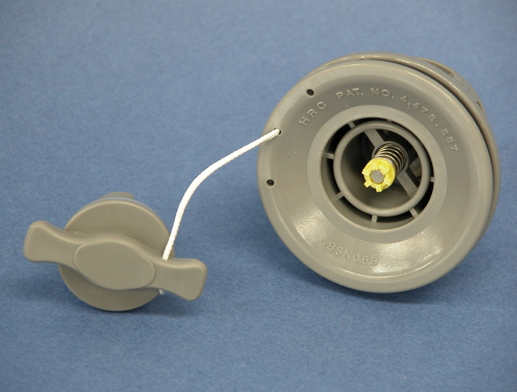
I like the idea that on the water you’re able to top up the pump from inside the cockpit as all the valves are located accessibly by your lap, though over the course of that warm day – leaving it in the sun here, there and on the car’s roof – it wasn’t necessary. And I sure like the fact that the Halkey Roberts’ valve caps (left) twist off easily and back on securely, unlike my old Sunny’s horribly stiff and awkward items which never relented in all years or use.

Packing up a Tasman
As mentioned, the stiff PVC which responds so well on the water makes rolling and packing up a K40 a bit of a challenge, especially if space is important and it’s not warm. After a few weeks of ownership I finally gave it a go. First thing to do is the suck all the air out that you can’t do by just rolling; this is something a K-Pump does not claim to do (despite what you may read), but I’ve only lately discovered a Bravo pump (left) can do once you switch the hose to the other port. With the Halkey valve opened (pressed down) the spring in the Bravo’s bellows sucks stoically until you can hear the PVC creaking. All you have to do then is yank off the push-fit hose and close the valve quick against the boat’s partial vacuum – tricky with fingers; you may need pliers.

The ABS K-Pump is heavier and as bulky as a Bravo footpump, but it’s more robust and for a hand pump is amazingly effortless. The K is the pump to use even if it doesn’t suck, but the boat comes with a bayonet valve adaptor in the spares kit. Pop that on a short length of hose and you have a manual – or oral – sucking tube to compact the K40 for transit. If this is all TMI, just say ;-).

nk4-car

First impressions on the water were a bit shaky compared to the test day a few weeks back when conditions were about the same, if not even calmer. Maybe because I was alone, ill-dressed for the very cold water, and the valley caught the odd gust off the big mountains. Who knows what was up, but I doddered around like a beginner, then parked up on another beach for a walkabout, and on the way back paddled with the deck unrolled which was fun. This convertible deck arrangement is such a great idea. It’s like owning a brolly or a mac: you don’t always want it but sometimes you need it.

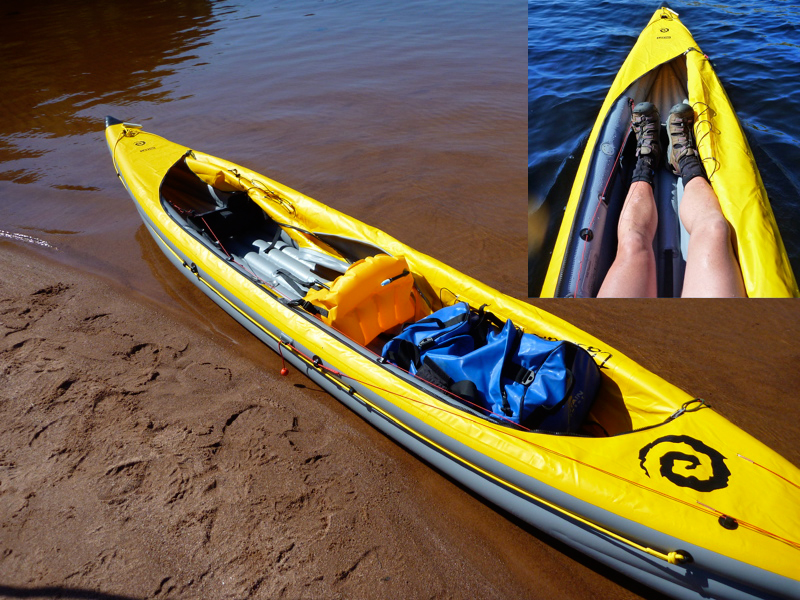
Part of the reason deck-free is possible is that the K uses a removable bendy nylon rod for the hatch rim or coaming (left). Remove the four chunky GRP deck-supporting battens, roll the deck back to the right side and hey presto, the legs can breath, you can get in and out gracefully and maybe even carry a light passenger.
Though thick and strong, the battens don’t seem to have any influence on pushing the boat’s sides out as far as I could tell, it’s more likely a zipped up deck holds the sides in if anything, so inhibiting longitudinal flex of the hull in rough conditions with a heavy paddler.

The rudder mounts easily and looks like a well made unit, though again, I’m no expert. Foot control is off some flaps on an adjustable air bag footrest using string and elastic. Not surprisingly, it’s all a bit mushy, but I don’t think any IK or even any K will have a system as solid as the Amoco Cadiz. It centres naturally and so works fine as a simple straight tracking skeg which is all you want most of the time. For an impression of rudder free paddling, read this.
If you want to slide forward down the boat (perhaps to pull the deck on or have a snooze) you can easily slip your feet under the semi-inflated footrest/rudder pedal air bag. Turning circle on full rudder lock is about 10 metres, same as our Nissan, and I also observed that you can do a 360 in this boat on the spot with 5 back strokes; in other words: less strokes than you’d imagine. Backing up is also easy with the rudder up and the rudder lift line works fine. A rudder of course came into its own to correct tracking when paddling downwind or at 45° to the wind in either direction, though here is where the mushiness was noticeable. A bit more experimentation with the footrest/rudder pedal air bag pressures and seating/footrest positions may tighten things up.
So far the seat is fine and I’ve had no complaints since. It’s light and simple, but made from thick nylon (compared to an Alpacka) with two elbow valves – and it clips out in seconds, just like the modified seat in my old Sunny. But like on my old Alpacka Llama, you sometimes sit on the squashed down backrest when getting in with the deck on, which could be a pain if the situation was choppy or awkward. There is more back support with the deck on I’ve found, as you lean on the back coaming a bit. I’ve also since found even at sea it’s safe and stable to sit sideways on the seat with your feet in the water.

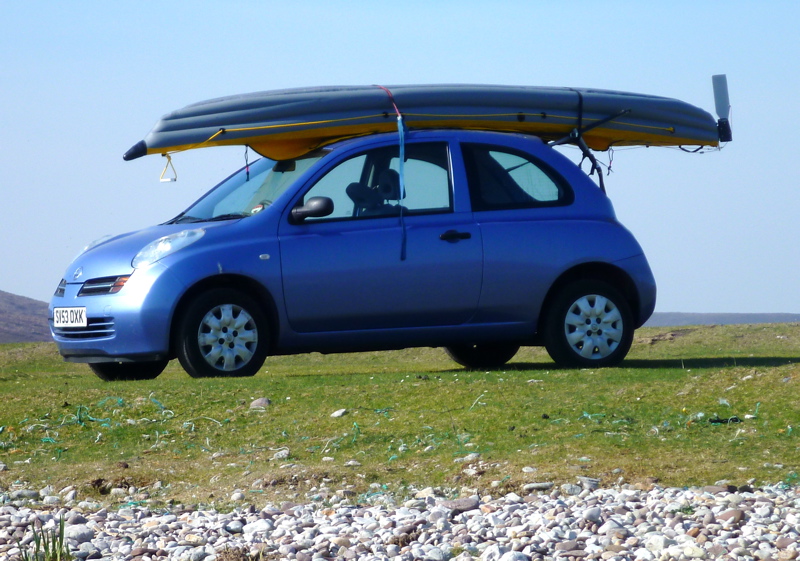
By the time I got back a couple of hours later I was in the mood for more so I strapped the boat onto the car (another great aspect of frameless IKs) and scooted over to the main beach opposite the Summer Isles. That morning there’d been no less than nine cars or vans with kayak racks heading out for the day. Quite right too as it was amazing weather, so much so that the blooming gorse in the hills caught fire. As I came back, the village fire engine dashed past me, trailing cobwebs and heading for the smoke palling over the Assynt to the north.
Out in the bay a pair of late hardshellers were heading out and it seemed a bit less gust prone out in the open water. After dicking about for a bit, I headed across to Tanera Mor island, about two miles across the bay. We look over to Tanera all day from our place, and on many previous occasions in the Sunny I’ve thought about it but never dared. I suspect the relative speed and higher sides of the Incept gave me the edge and the confidence.
In the island’s anchorage, flushed with the success of my monumental traverse from the mainland of Britain, I pulled over by a salmon pen and watched the caged fish flit across the surface, I presume enacting their instinctive upstream spawning surge, but here destined only for the slicer and the smokehouse. On the way back I decided to deck up for no other reason than I could, noting that when fully unzipped, I can just about reach the zip ends fore and aft to pull them closed, as long as I used the fishpen side for stability. Out at sea if it was rough a boat alongside would be needed. I’ve since lengthened the tabs on the zip ends to make them more reachable.
A small island ferry left the nearby jetty at the same time as me, and mid-crossing its parallel wake crept ever closer until at the last minute I panicked a bit and turned into it to be on the safe side. Later, a bigger fishing boat came across my bows leaving a bigger wake which was no bother taken side on. I’ve since found the K40 is fine in side waves that can make a slinky hardshell a little nervous.
No GPS but I timed myself; 25 mins to cover 2 miles which were a bit choppier than on the way out. That’s 7.2kph or 4.5mph or 3.9 knots if you must. Not bad at all and it all rather neatly validates exactly what I ruminated on earlier about getting a better boat for my time up here: dashing alone across what I would classify as ‘open’ water was one of the main reasons I wanted a faster, decked IK. The Incept has delivered on Day 1.

Alpacka Yak 1 (Decked) Main Page

See also:
Packrafting the Fitzroy River (NW Australia; 5 posts)
Alpacka Yak around Suilven mountain
Alpacka Yak to Suilven mountain
Urban Packrafting: the Death Weir Kebab Tunnel
Slackrafting to Clashnessie
Intex Slackraft vs Alpacka
Packrafting in France – Ardeche Gorge
Packrafting in France – Chassezac
Escalante packraft recce
Trying out bikerafting
Packrafting a Force 6 gale
Packrafting the Oscaig river
2011: Llamas get the point

After all that lot I sold my Yak and bought a non-decked, two-colour Yak in a 2013-14 sale

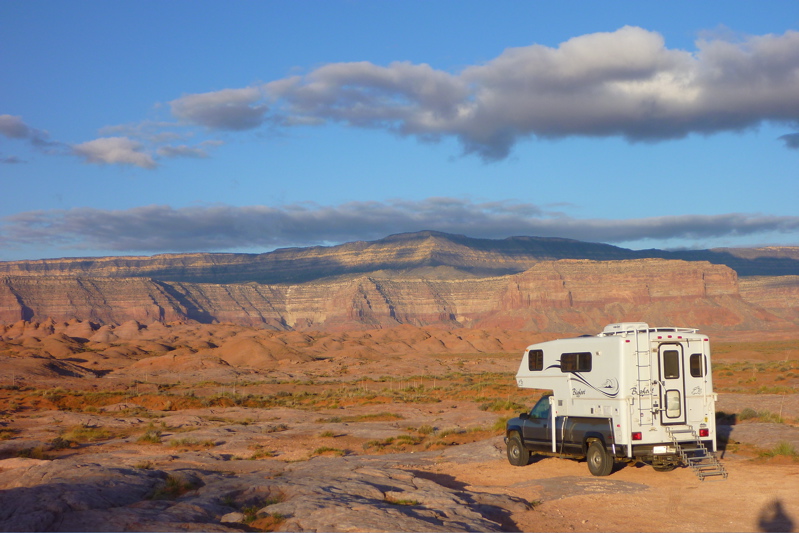
I’d parked the RV at the end of a 55-mile track south of the highway at Hole in the Rock, the top of a gully which drops 500 feet down to Lake Powell and which is bit of a scramble in places. If this was the Australia that I know, the chasm would be plastered with ‘Gorge Risk‘ signs. Looks like the Americans have got over all that, if it ever existed here. What you see – a steep, boulder-chocked gully where you want to take care – is what you get.

Getting down and back up from the lake wore me out for a day, but what was I complaining about? In 1880 Mormon pioneers spent six weeks here lowering two dozen wagons to get across what was then the Colorado river (read right) to get to a new settlement on the far side.
Once on the water I only went for a bit of a splash-about in a flooded arm off the main body of the lake as it was a bit windy and I wasn’t sure what weather lay ahead. By the time I got back to the top it had clouded over and stayed that way till I left the GSENM a few days later.
Changes on the conventional-looking pre-2011 rafts are summarised here: pointy ends, greater length, extended stern, 2-part backrest/seat and a deck that zips right off. I also have a feeling the floor’s made from a chunkier or stiffer fabric and so the extra butt-patch I had specified (left – done for free) may not be so necessary – but it sure feels worthwhile when scraping along a boney Scottish burn.

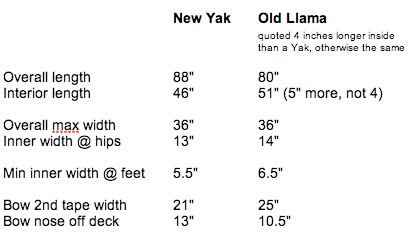
On the water first impression was not so good – oh dear the 4-inch shorter Yak was seemingly narrower at the front than my old Llama and I couldn’t put my feet side by side when pressed against the front (left image on the right) – this wearing size 11 Keen Arroyos (fairly wide). But deflating the backrest from full gave my legs more room and I actually found that both feet placed flat on the floor below the bulge of the side tubes worked fine (right image above right), just not so sure if this is so intuitive for brace control. I checked the front interior width of my Llama against the new Yak and it’s only an inch wider. In the picture left the new Yak and Llama fronts seem near identical in interior front width.


Getting back in the longer Llama, I now see the reason my feet didn’t jam was that I had a few inches gap between the front of my feet and the inner front of the boat where it tapered off. Sat against the back I could never reach the front to brace which is why I got the Yak. Also, the UDB on the new Yak may have constricted my feet a bit that day. Paddling a few days later without the UDB, I can’t say I noticed the foot jam. Got all that?


Other fascinating facts from my comparative measurements (above right) show the new Yak is only 8 inches longer then the Llama, so a new Llama ought only be 12″ longer, not 20 inches as estimated from the Alpacka website’s measurements at the time. The new Yellow Yak is nominally 4 inches shorter inside than an old Llama.

Other than that it feels much like the old Llama. Like they claim, turning/spinning doesn’t seem to be affected by the increase in length, but I’m sure the Yak’s bow yawed less from side to side as I paddled, due I suspect to the extended tail damping the paddle-induced pivoting effect, rather like a rudder or skeg. I did have my part-filled UDB strapped to the front where any weight tends to reduce yawing anyway. It was the first time I used the UDB on the water and have to admit the added guarantee of its girth and buoyancy was reassuring should a Colorado river barracuda make a bite at my Yak. Couldn’t really do any speeding in the conditions – it may be just half a mph faster, but that’s still some 20%.

As anticipated, the new 2-part seat is a real improvement. No more having the backrest flop down as you’re trying to get in quick off a steep bank or into a fast flow with a need to line up or burn. Like on my Llama, I just clipped the seat base onto the hull tabs with a single snaplink each side (inset, left) rather than mess about with the string they supply. Makes taking it out and drying/cleaning the insides easier.

Later on, washed up on the wrong side of the Virgin River Gorge in northwest Arizona, I also found the part-deflated backrest a handy way of portaging the empty boat – a bit like a Sherpa’s headband (left).
So, bottom line, not a huge difference in operation apart from less yawing which was never that bad anyway once you compensated for it. Can’t say I noticed any added buoyancy/better trim with the longer back, but it might be noticeable from the other PoV. The zip-off skirt is a nice idea; one less thing to unroll and dry after. The added snugness I dare say I’ll appreciate in rougher conditions and it sure is nice to have a yellow boat for a change!
There was a discussion on BackpackingLight about the new shape and here Roman D gives his opinion for a harder core of white water utility. More pack-Yak adventures this summer.


Packraft MYO sailing

See also this

First sunny spring day around here so we went out to try out the flip-out disc sail I made over the winter on my Llama and Steve’s Big Kahuna. Wind was forecast at about 8 mph but was gusty – a bloke in a dinghy sailboat said it was up to 15 mph.
Folded and clipped on the packraft, the sail sits out of the way and can be opened and – more importantly – closed easily with a twist, as long as you have a clip of some sort to keep it closed (and that clip is attached to the sail so it does not spring off and sink to the bottom of the lake…).

Initial impressions were disappointing, I did not rip off across the reservoir like a hooked marlin out of a Roadrunner cartoon. But watching the vid back it’s clear the boat did noticably drift downwind across the reservoir with the sail aloft, often at speeds similar to paddling (about 3 mph). Problem with the sail on the Alpacka was the boat soon turned off the wind one way or the other, swinging left and right. The pointier Kahunayak was better, especially once Steve trailed his paddle like a skeg. Didn’t get to try that on the Llama as I was fiddling about with the string trying angle the sail so as to steer the boat into the wind. This worked quite well in correcting the direction as you can see in the vid, but staying in that position was a problem.
Could this be due to ‘wind-spill’ off the flat disc sail which lacks dishing like a WindPaddle? Maybe. It will be interesting to try it on my ruddered Incept IK when it turns up, as well as the new-shape Alpacka which I am picking up next week.
More testing to come this summer up in windier Scotland with my all-new packboating flotilla. Or just enjoy this 2014 video from Finland by JP. More here at leftbound.