Category Archives: Gluing & Repairs

Jurassic Packrafting: Dancing Ledge & Sea Caves

Anfibio TXL Index Page
More Jurassic Coast paddles
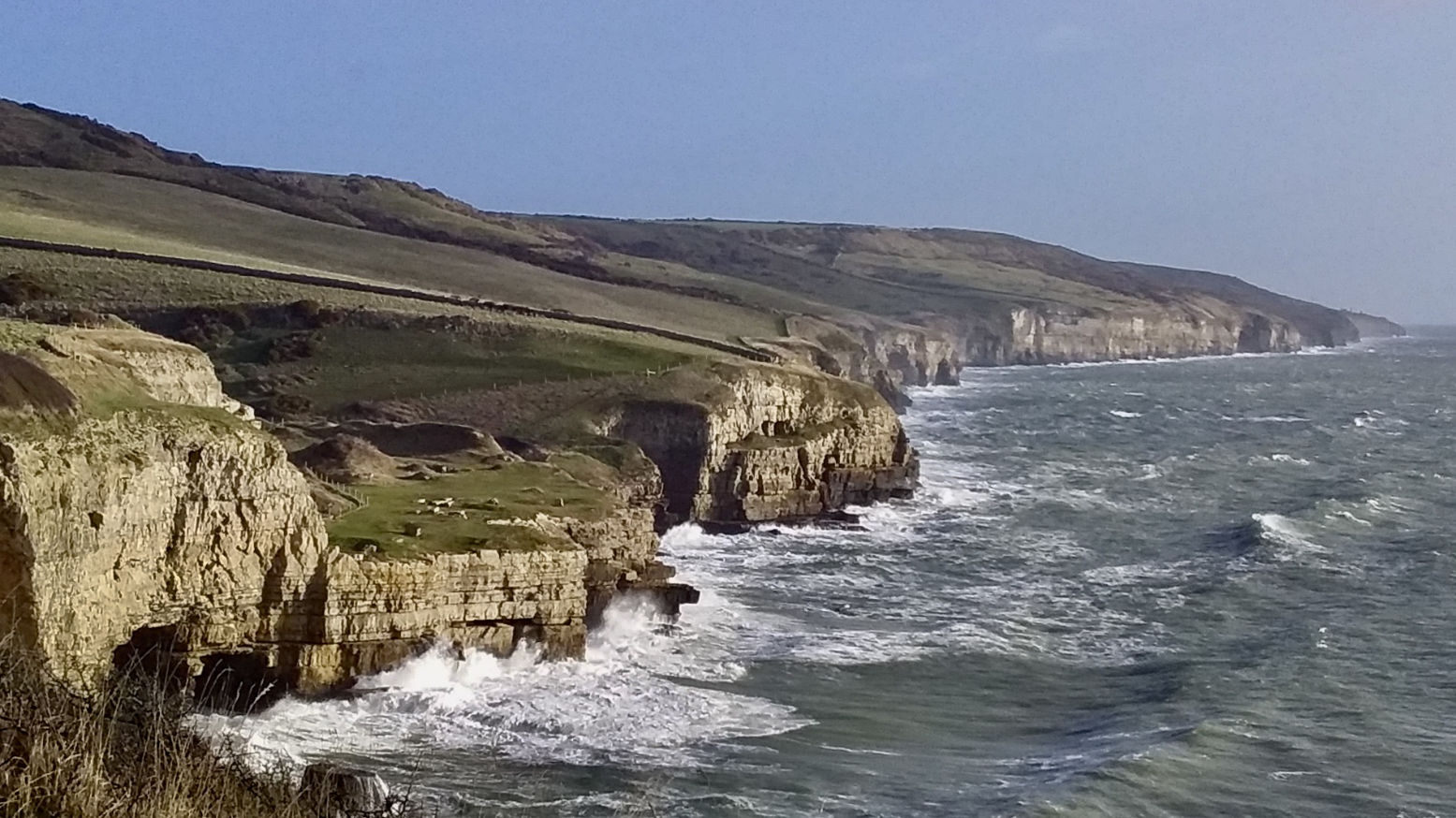
A winter storm sweeps the cliffs of Dancing Ledge

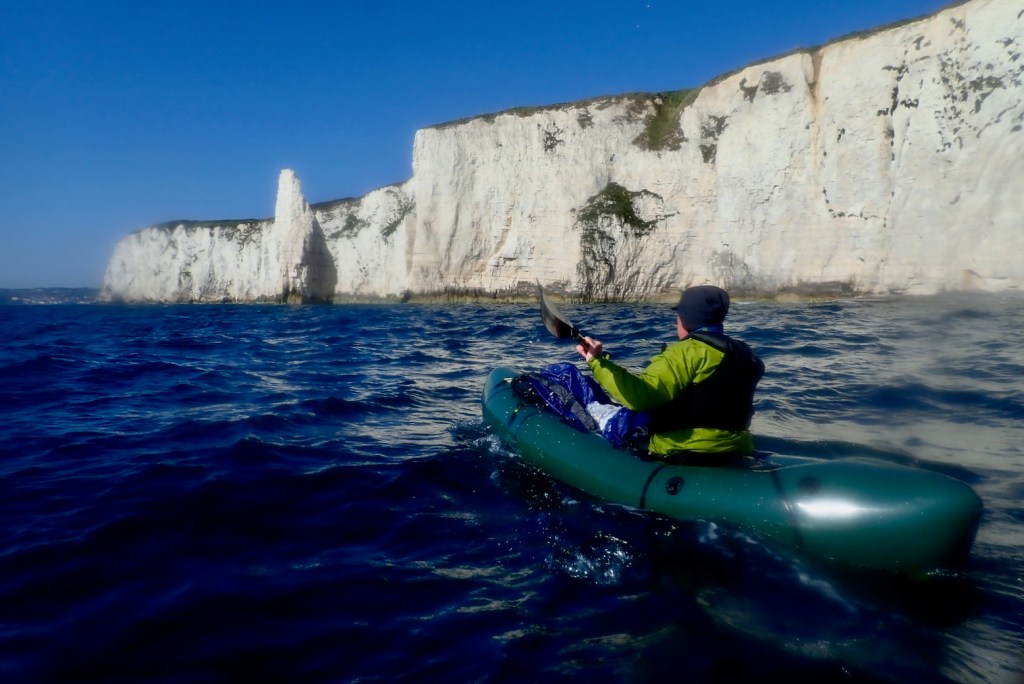
You wait weeks for a calm, sunny day to come along – and then one does. So in my back pocket I had a modest sea excursion planned for the TXL: the cliffs and caves west of Dancing Ledge.
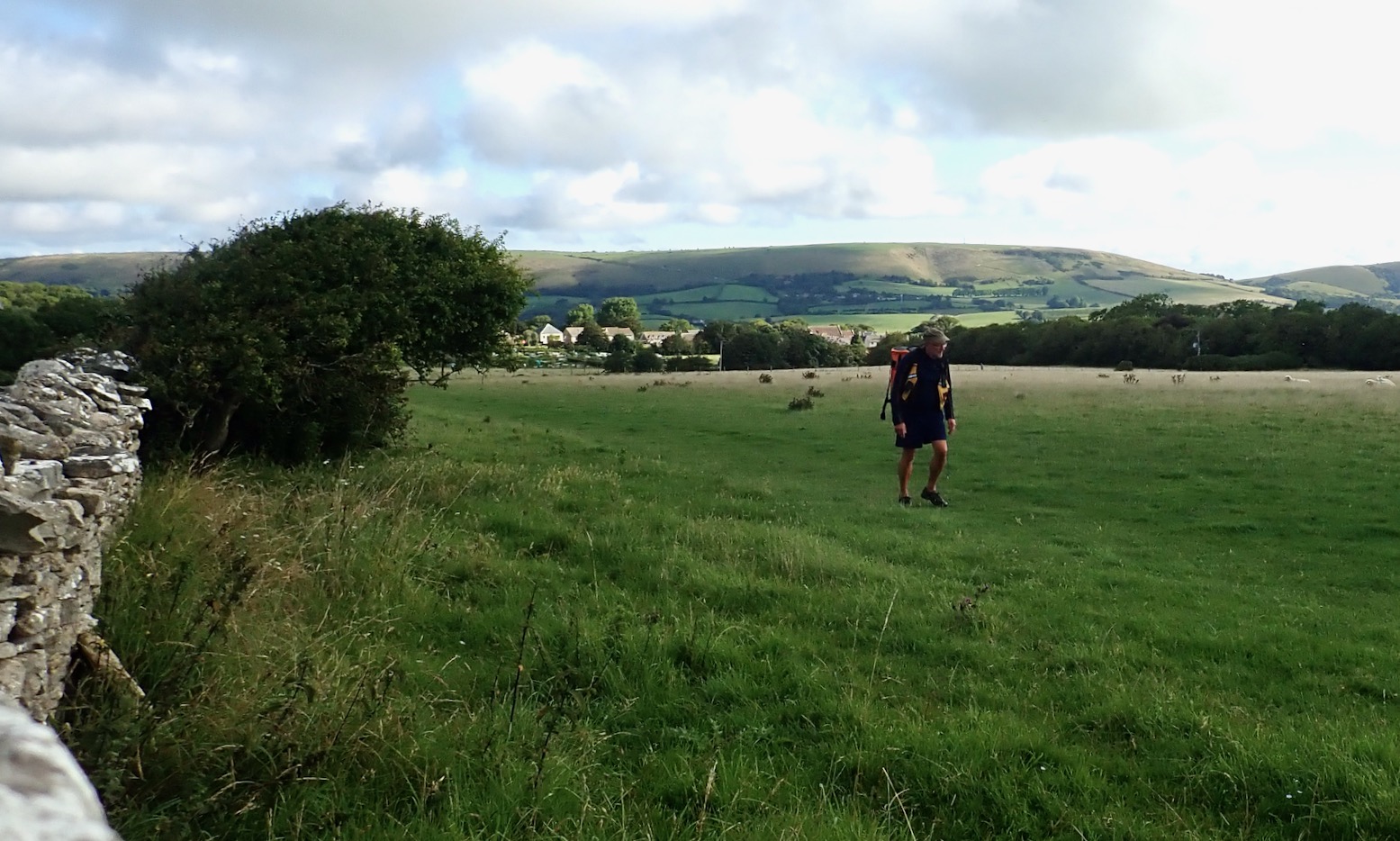
It’s a mile’s walk from Langton Matravers village across the fields to the coast where the downs drop steeply to the former Portland stone quarry. From Swanage, about four miles to the east, Dancing Ledge is the first of the few sea access points along this cliff-bound Jurassic Coast.
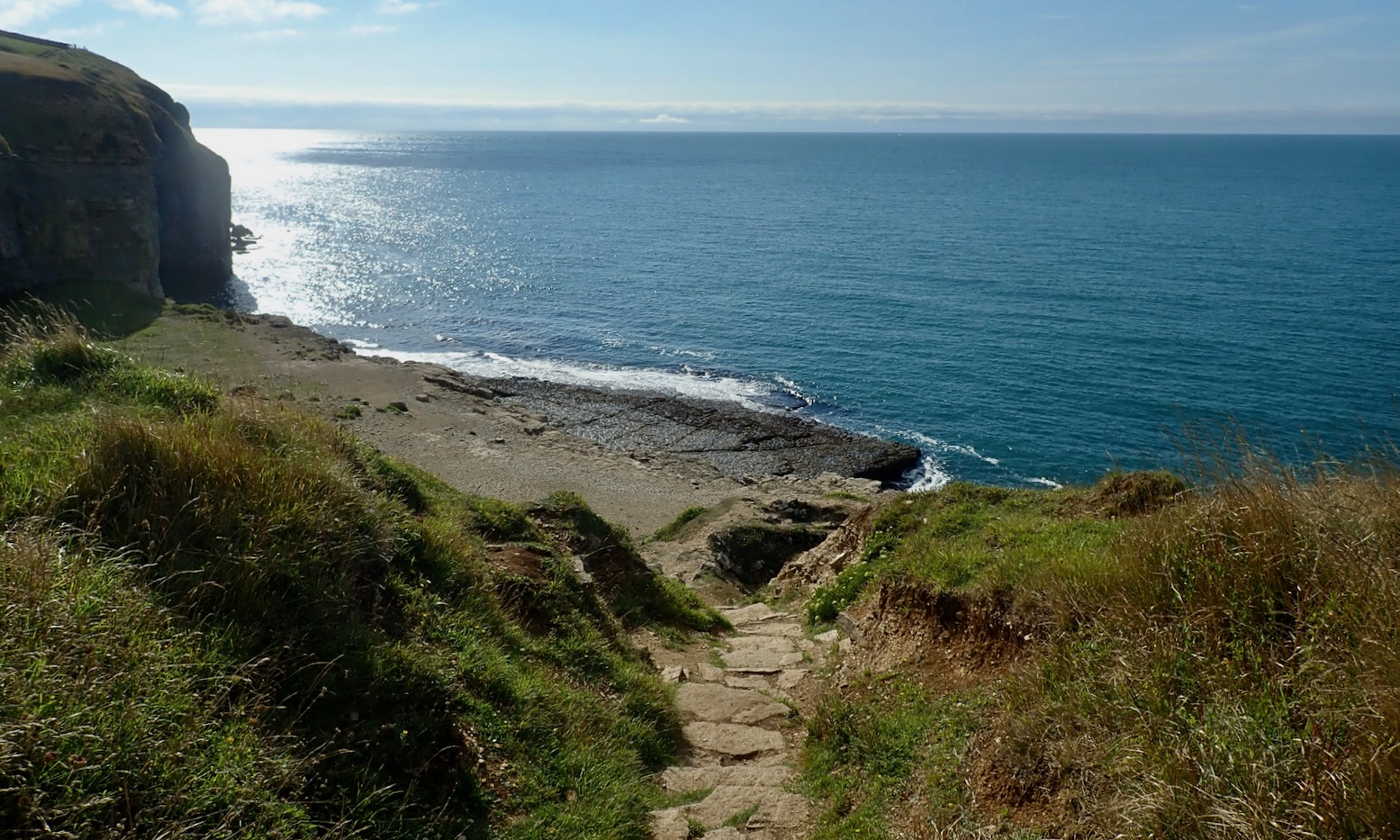
Approach to Dancing Ledge

At low tide the lower, natural ledge is revealed, making getting in and out relatively easy. But to reach it you still have to scramble down a small cliff (below). It was easier to chuck the packraft backpack down before descending after it. Alone, rolled up or inflated, getting this far with an IK would be a struggle. This is why we like packrafts – and sea-going packrafts, so much the better.
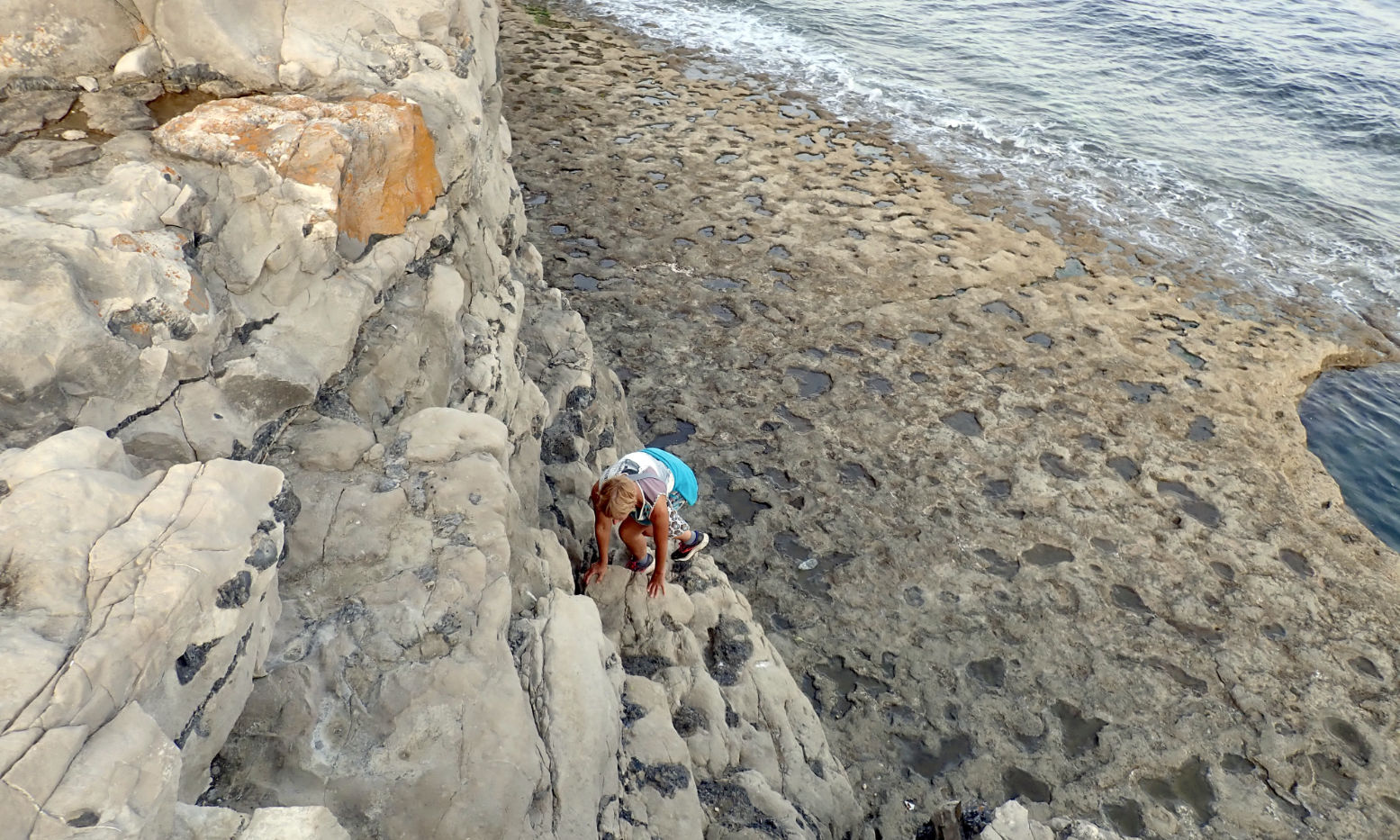

The point where you scramble down overlooks the Bathing Pool (below). It was blasted out of the rock in the late 1800s by the strict headmaster of the local Durnford school in Langton. Pupils then trotted off to the pool each morning for the character-building ritual of ‘strip and swim’, but with a now reduced risk of being swept out to sea.
Decades later, James Bond author Ian Fleming attended the Durnford prep school and endured various torments before moving on to the more benign, towel-flicking environs of Eton. Unsurprisingly his Dorset years left a deep impression and later he named his 007 hero after a prominent Purbeck family, the Bonds of nearby Creech Grange. By 1999, when Bond 007 filmmakers had run out of Fleming’s dozen book titles, they chose ‘Non Sufficit Orbis’ or The World Is Not Enough, starring Pierce Brosnan. It was claimed as 007’s family coat of arms in On Her Majesty’s Secret Service, published in 1963, but was also the real Purbeck Bonds’ 16th-century motto. There’ll be a short exam later.
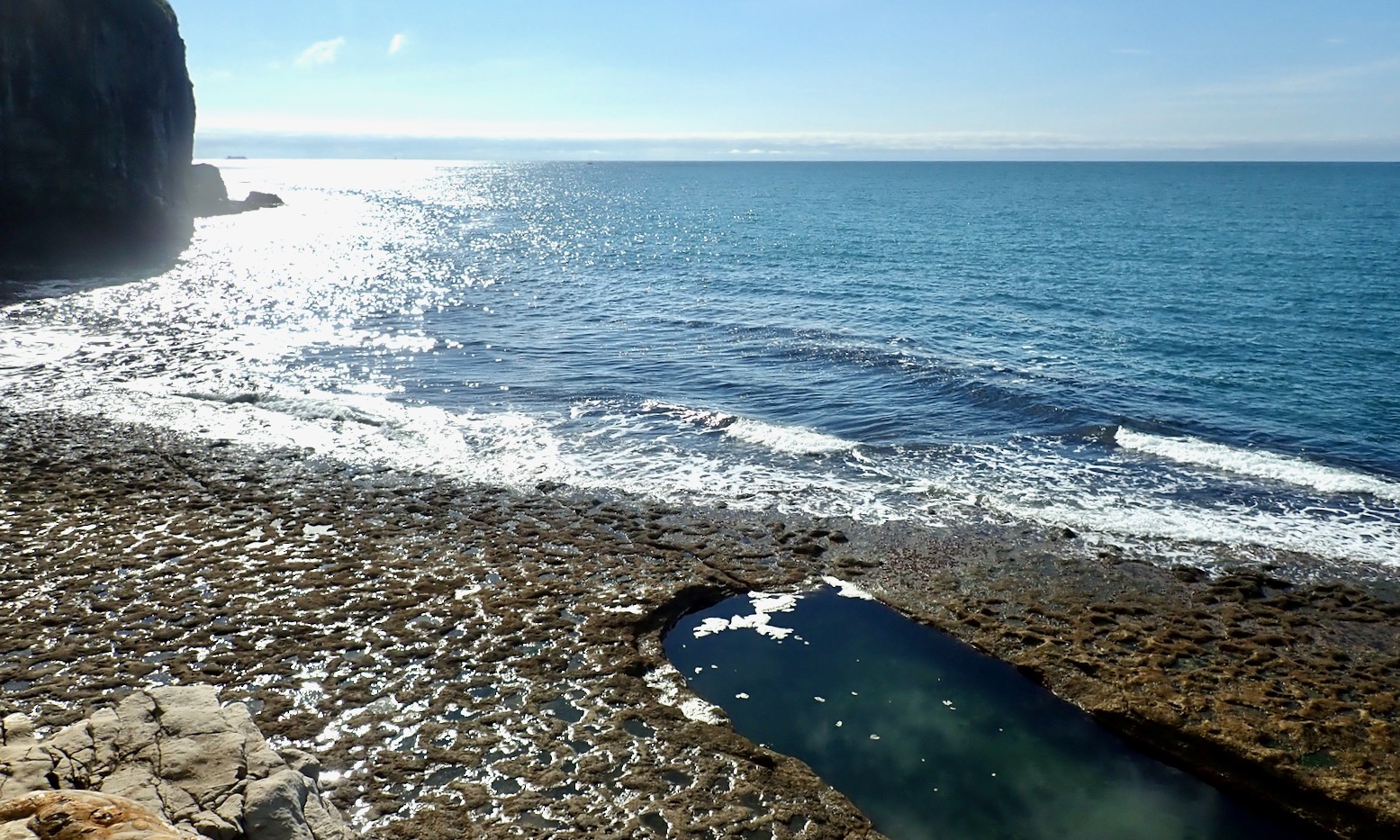
Back by the sea, even with wind speeds forecast at a lowly ‘4mph’ there was no balmy flat calm today, but that’s just the way it probably is with the wide open Atlantic to the west. Portland Bill or even nearby St Adhelm’s Head don’t do much to reduce the oceanic fetch driven by weeks of wind and squalls.
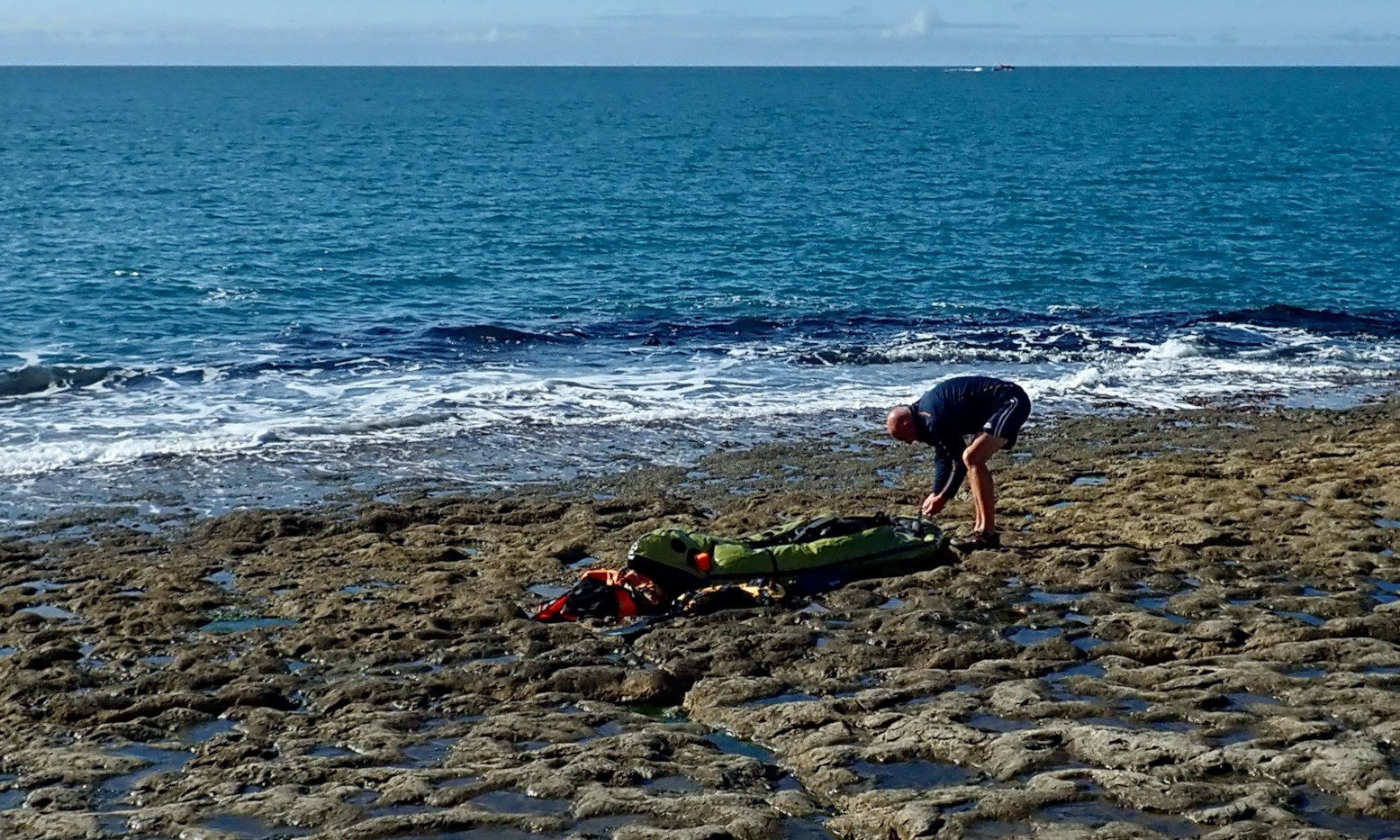
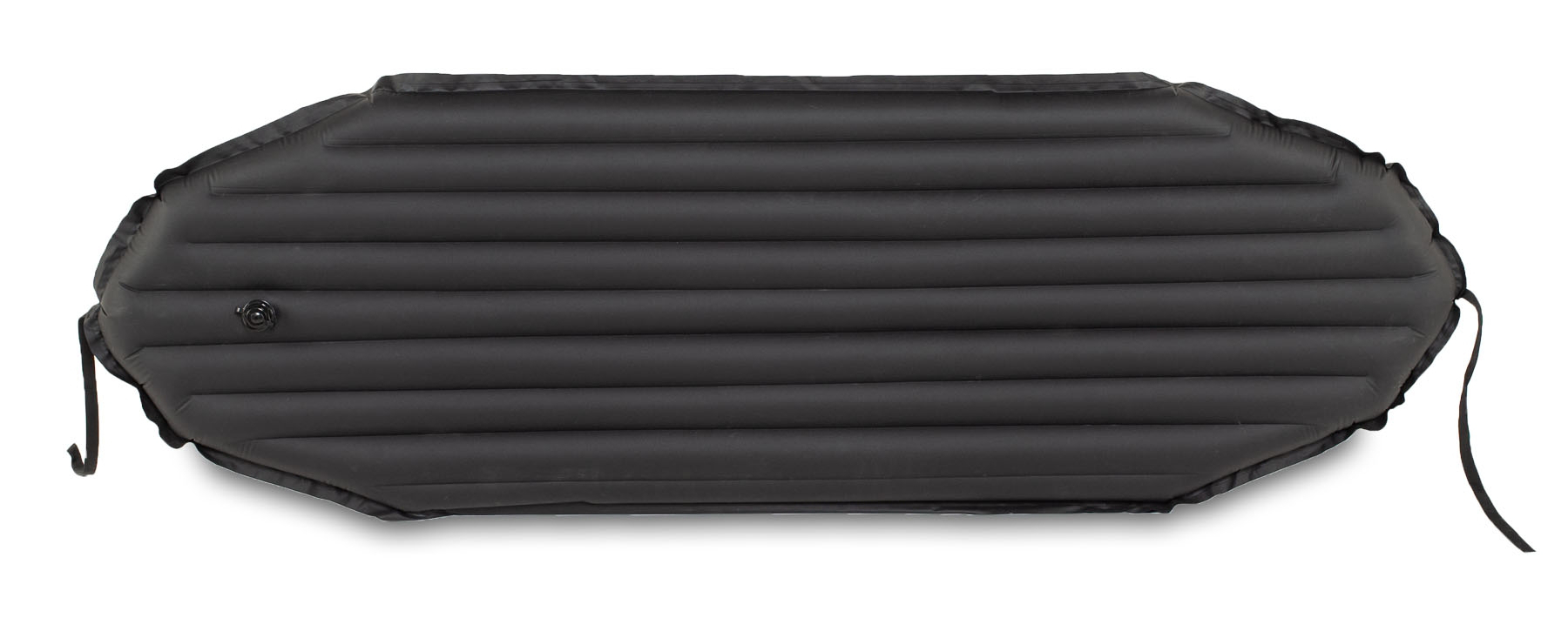
While setting the boat up I find today’s #ForgottenItem was the floor pad (left), which I was wanting to try again, despite being not entirely convinced. Two up, as we did near Skye last year, meant reduced legroom with the mat, but solo with my centrally positioned weight, I still like to think it will limit hull droop and floor sag to improve paddling response. (It does).
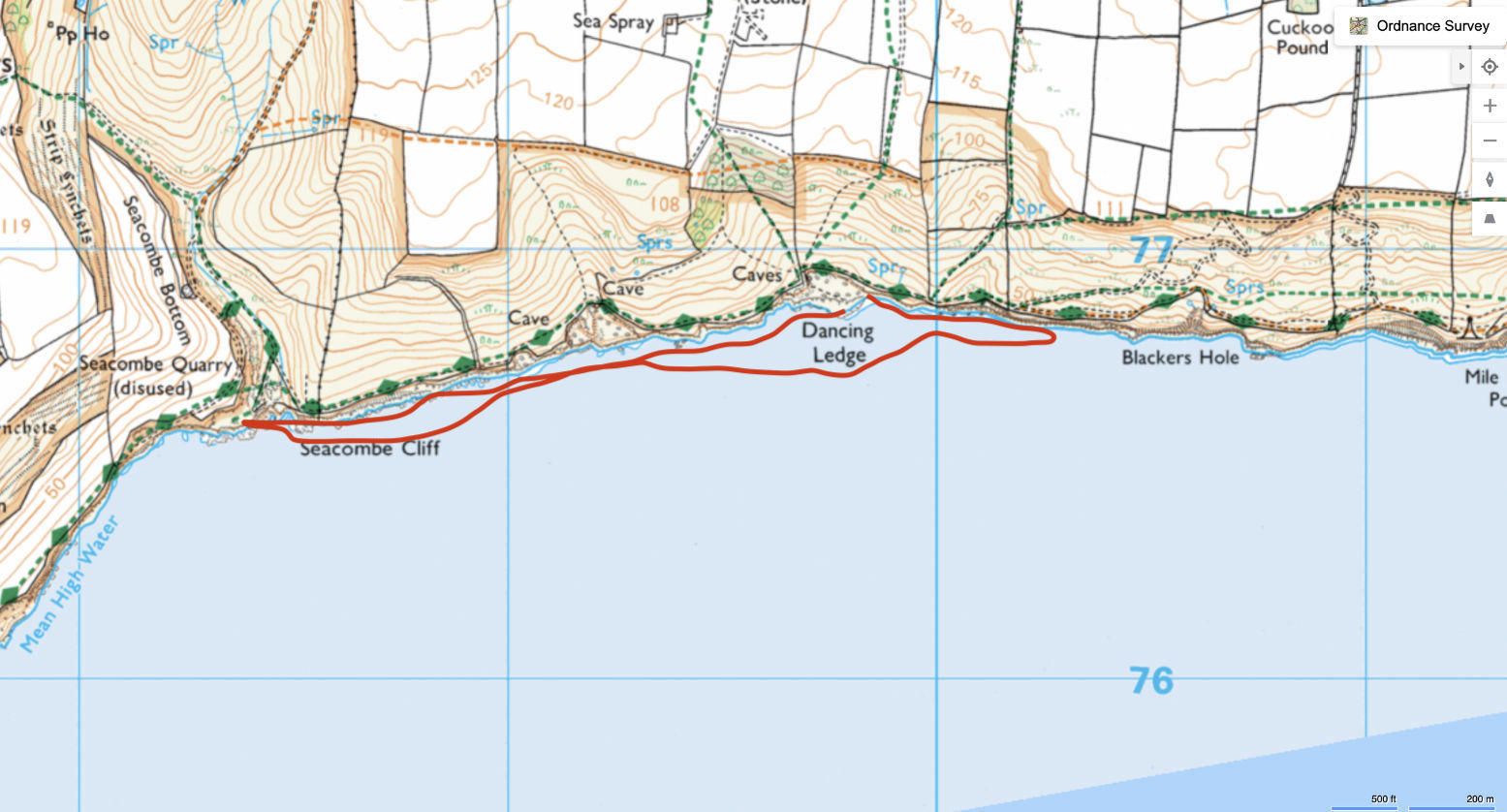
Alone, these exposed sea cliff paddles make me quite nervous, and a regular-sized packraft like my old Alpackas or Rebel would feel even more unnerving. The TXL’s healthy 2.8-metre length reduces that impression with less pitching, but I never fully relaxed today, so was happy it was only a mile to Seacombe inlet at which point I could get out and walk back if I wanted.
Away from Dancing Ledge things calmed down a bit or I just get used to them, but elsewhere I needed to keep an eye seaward as bigger waves rose up.
With my old MRS Nomad S1, I learned that with longer, high-volume packrafts like a TXL, no matter how hard you pump them up with warm, ambient air, after 10 minutes out on cooler water, a crease develops midway along the side tubes as the air in the hull cools and contracts and the boat effectively loses a few fractions of psi. Though beginners might worry they have a slow leak, this is normal with inflatables.
Ashore, I made use of Bond’s Pool of Torment (said to be the next film title) to pre-cool the TXL but knew it wouldn’t really work. Flooding the inflated boat for a few minutes is probably the answer. A little hand pump can only pack in, say, 2 psi at 18°C. Any more air forced in may burst the pump or stress the boat’s seams if done too often. But once part submerged by my weight on 12°C sea water, the hull cools and drops to, say, 1.8psi. It won’t get any lower, but it’s enough to lose its edge and means the boat paddles less efficiently. We can’t be having that!
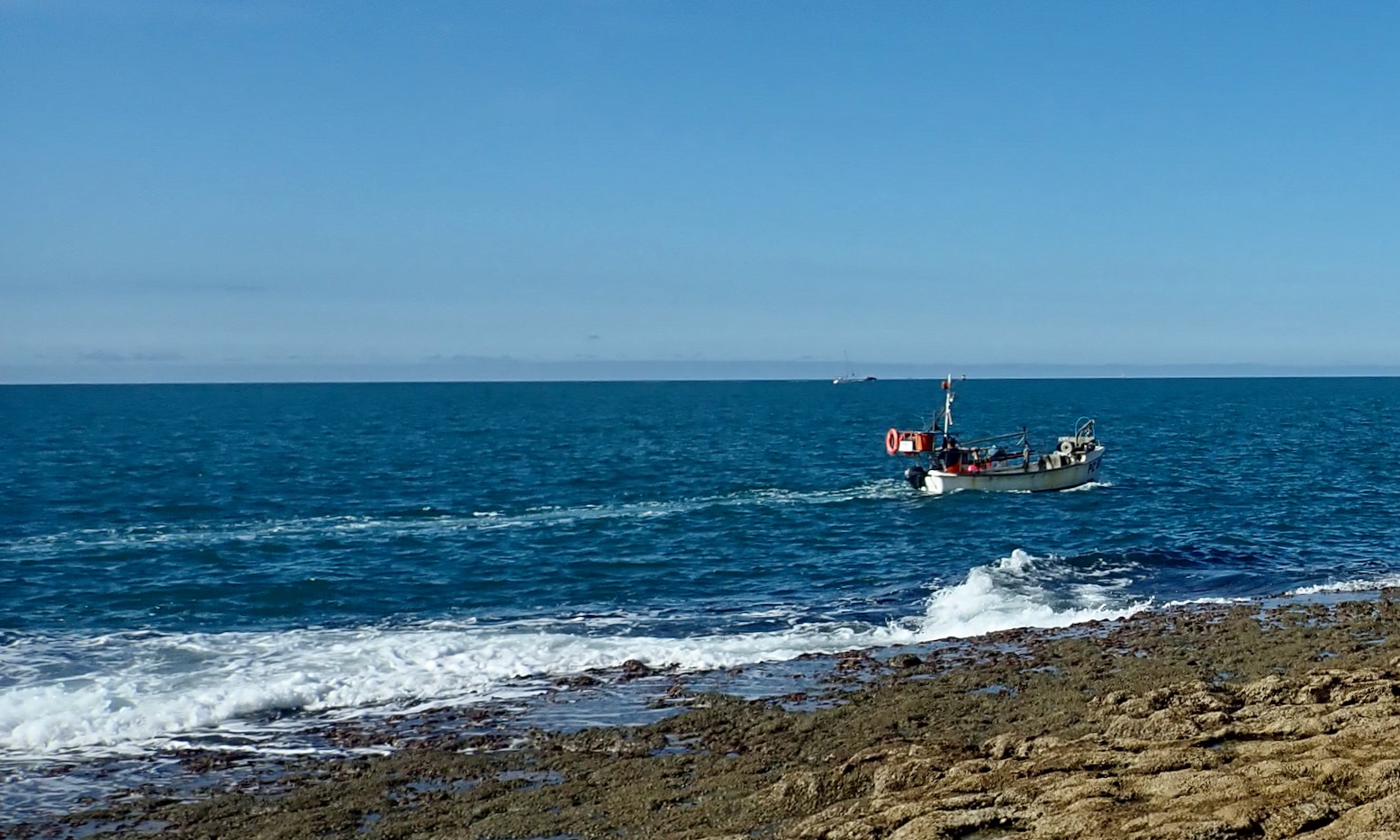
In my heightened state of anxiety at paddling a new, exposed locale, I was pleased to see a lobster boat passing my way (above). Later on I catch up and and meet the Chatty Fisherman. For a while I was worried the tide might turn before I got to drag myself away, but, Purbeck born and bred, he was a local quarryman who used his summer hols to snag a few lobsters and had lots to say about everything, including reduced catches of late.
We used to get hundreds [of lobsters] here before the seas got warmer. Now I barely get a handful.”
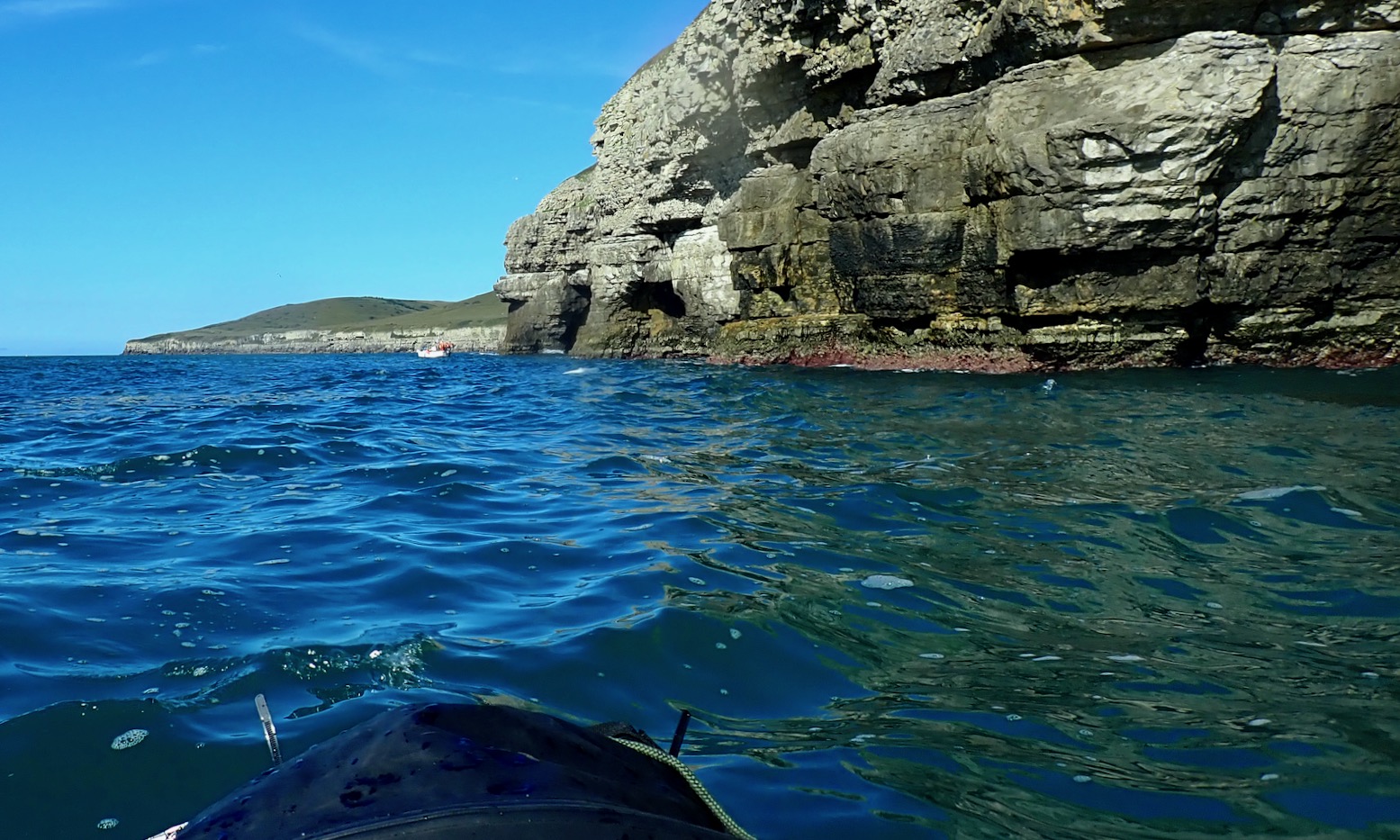
There was no place to hop off and top up the boat, though I could always flip round in the seat and do it on the water. That said, I wonder if longer packrafts like TXLs could benefit from repositioning the inflation valve closer to the central seat, like my old Incept K40 solo IK. The MRS Nomad had the valve on the bow, which was handy. I suppose this might make expelling the air on rolling up more difficult, but we now have mini pumps with suction settings, making valve position less important. With a passenger or another paddler alongside, on-water topping up is less of an issue, but had I thought it through before adding the second skeg patch, I could have glued it at the other end, as the TXL is symmetrical, but then is the bow bag tabs would be at the back. So halfway down one side would be better, Anfibio. Sorry, I did I say something?
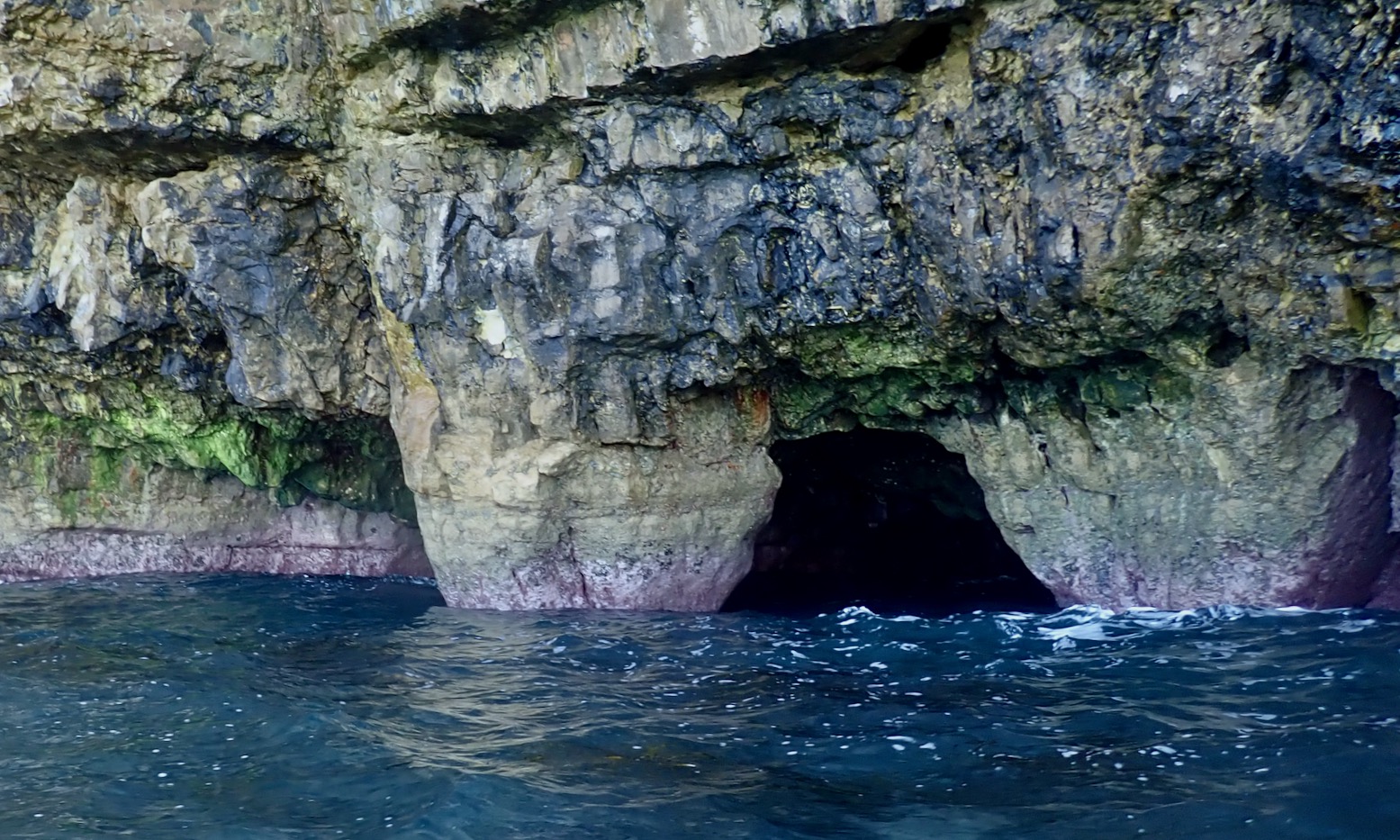
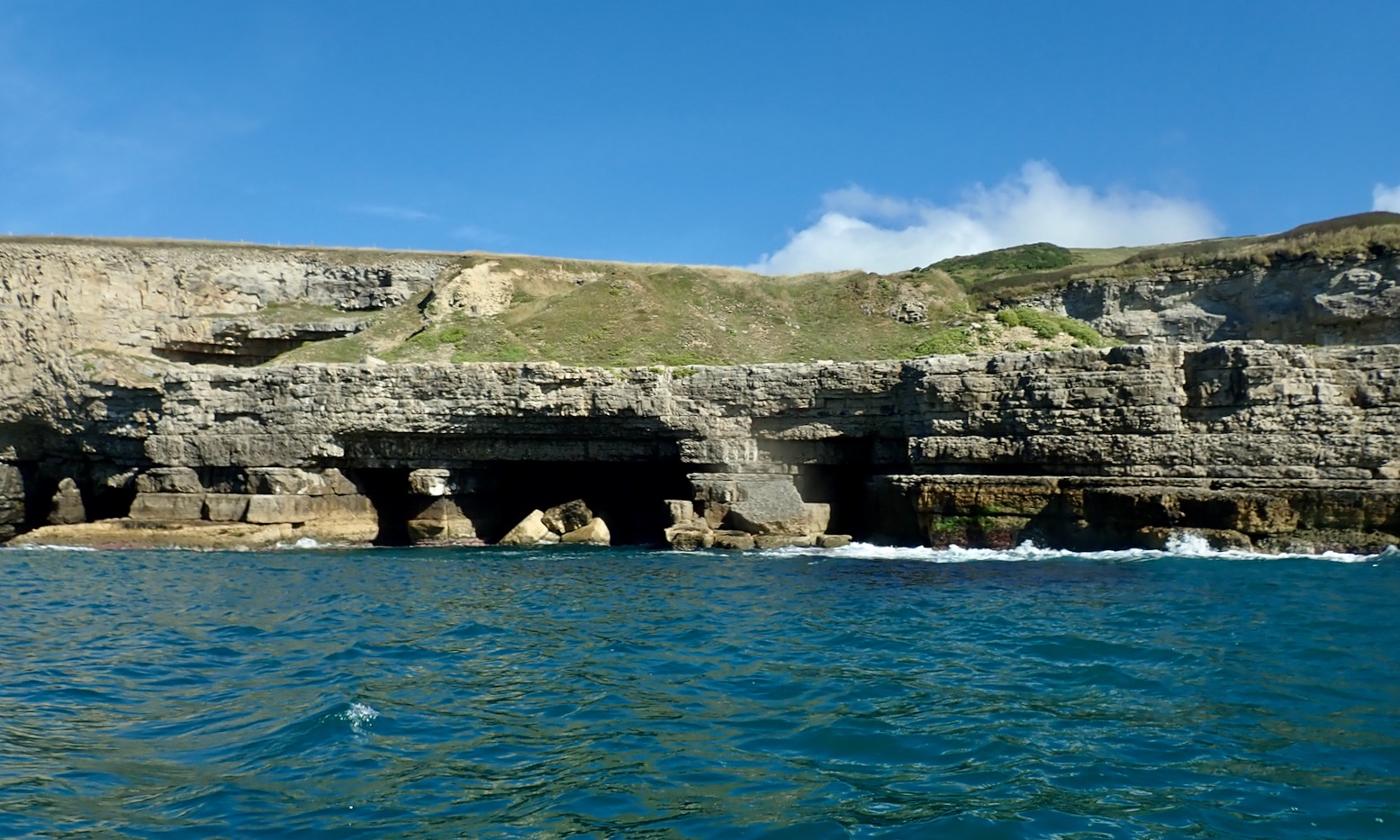
I paddle onward. Most of the caves have too much intermittent swell rolling in to get close, but one twin-mouthed cavern (above) looks like it could be safely threaded in the nippy TXL without me getting lifted by a sneaky swell and knocking myself out on the cave’s roof.
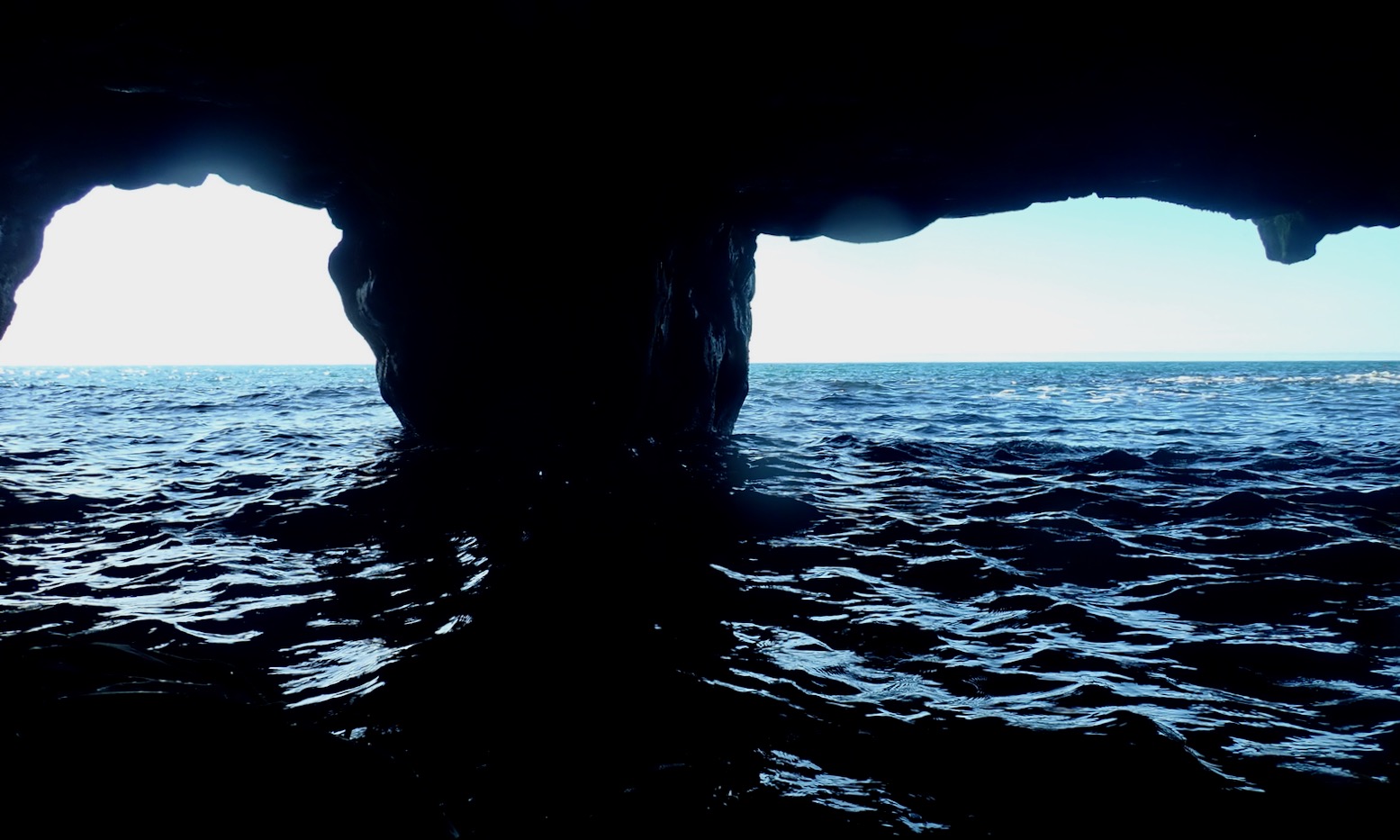
Inside the cave

Further west I see a few people wandering about on the foreshore ledges, announcing the inlet at Seacombe, another old quarry. As I get near, I line myself up to get lifted by a wave and dropped onto a ledge. It ought to be easy but ends up a bit of a bundle. Before I can climb out I get sucked backwards into another wave, which drops onto the boat. But though it looks ungainly, timing isn’t that crucial in a stable packraft that’s easy to hop out of quickly. Lord knows how a sea kayak would manage. Up on the ledge I drain the TXL before flipping it back over and giving it a few jabs of the handpump so it’s pinging firm again.
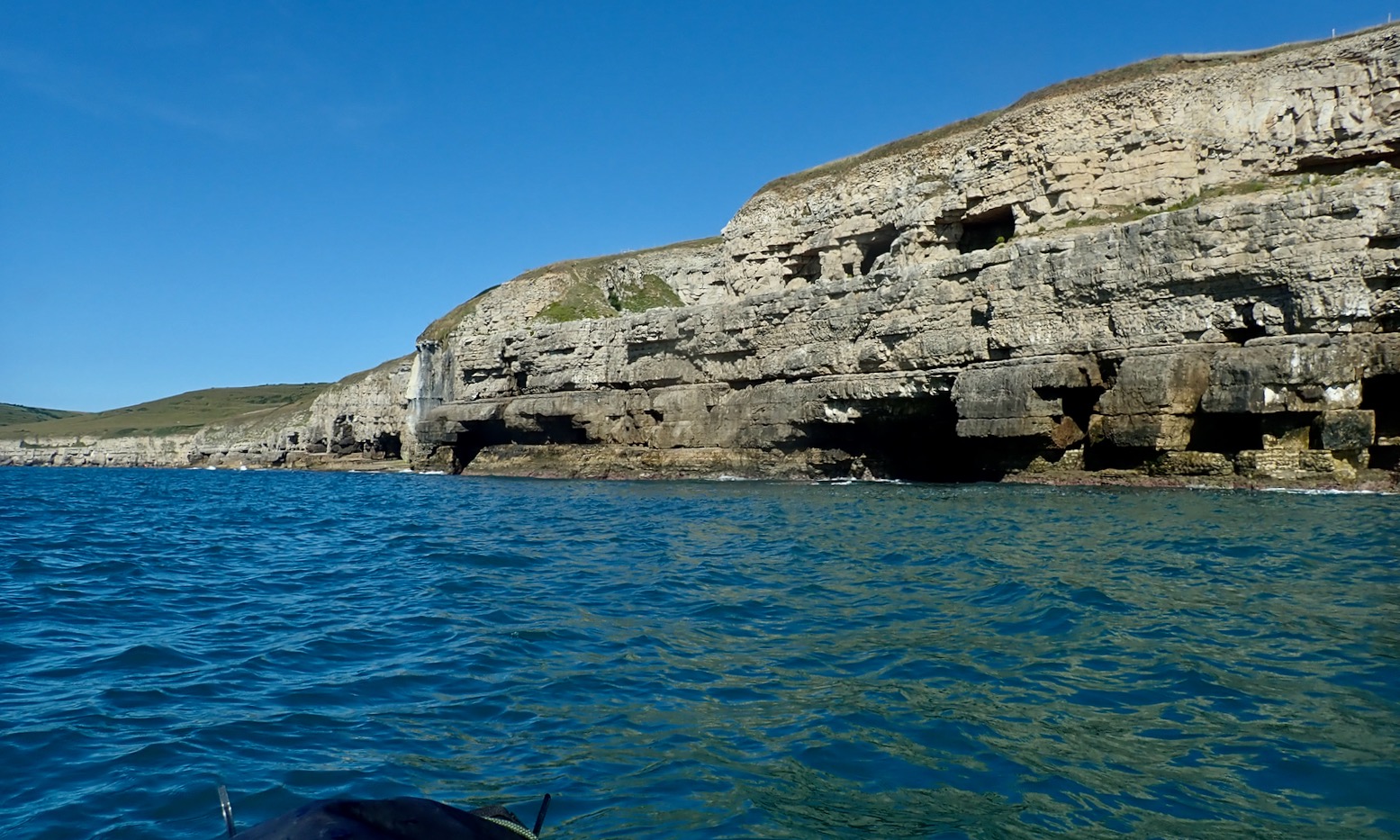
Seacombe cliffs

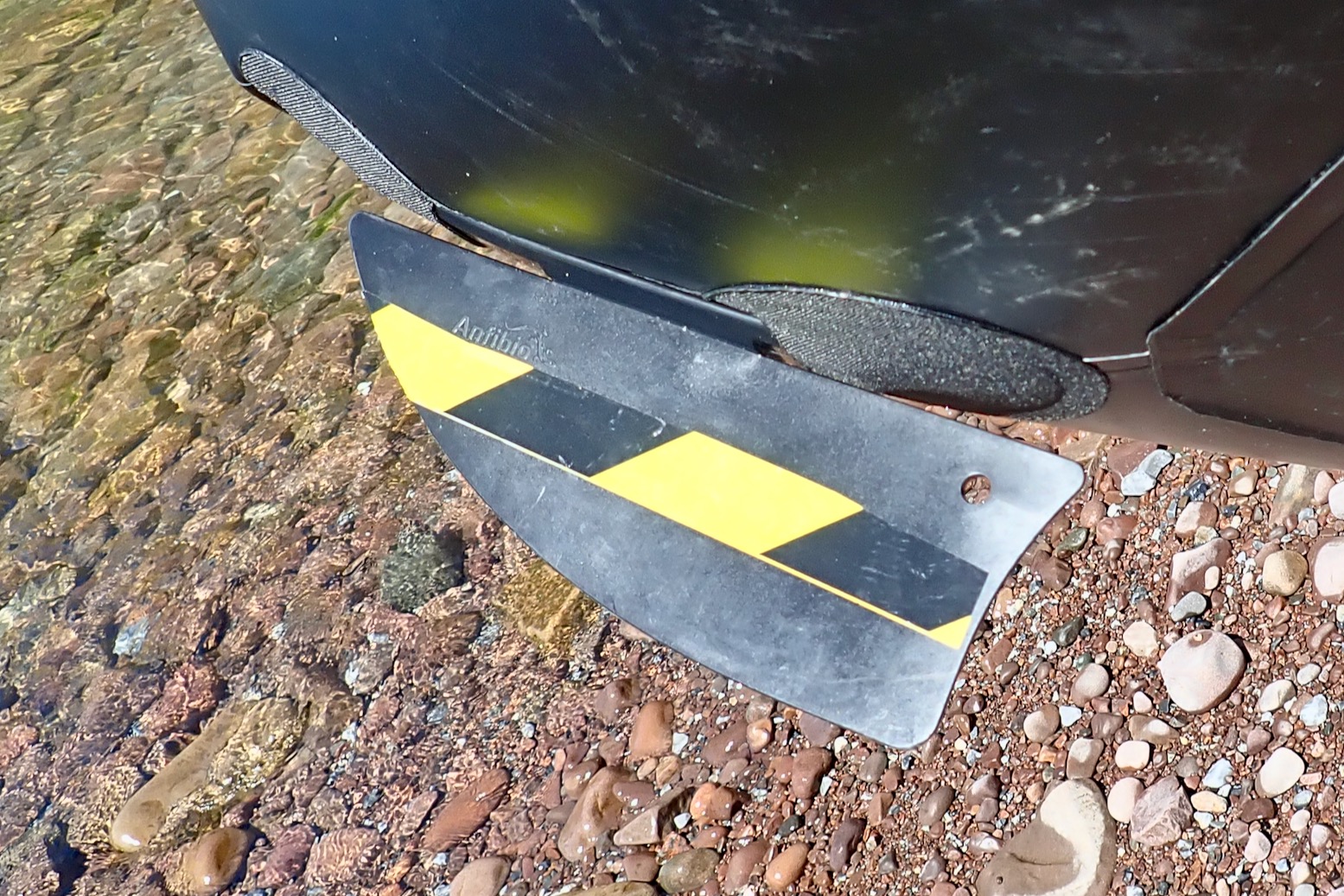
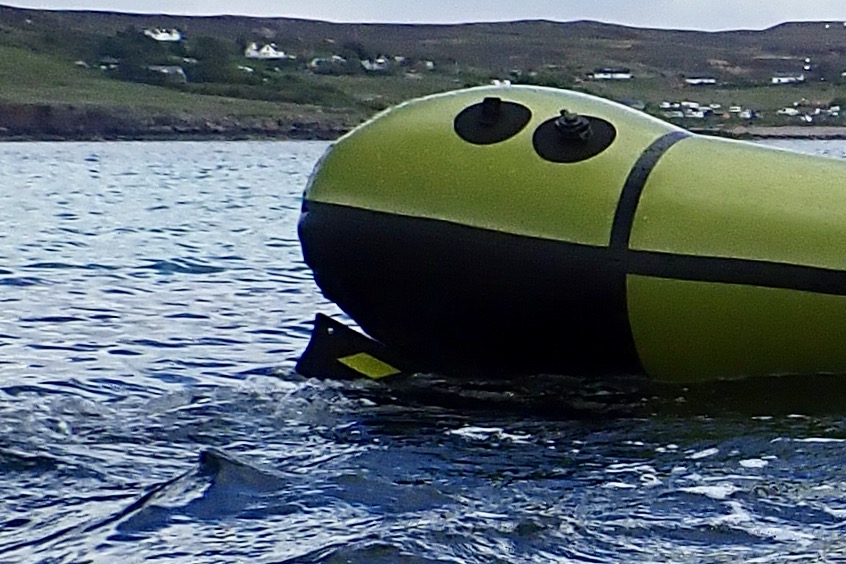
Putting back in, I’m alarmed to see my skeg lying on the rocks. My to-and-fro landing must have dislodged it. (It happened again on my next TXL; this is a fix). It is for moments like these (or, more commonly, distractions while packing up) that I wrapped it in hi-viz yellow and black tape. Had I lost it, the downwind paddle back would have been a bit squirrely, giving me something new to worry about until I realised the cause. Passing the twin-mouth cave I threaded earlier, the tide is already too high to repeat the stunt.
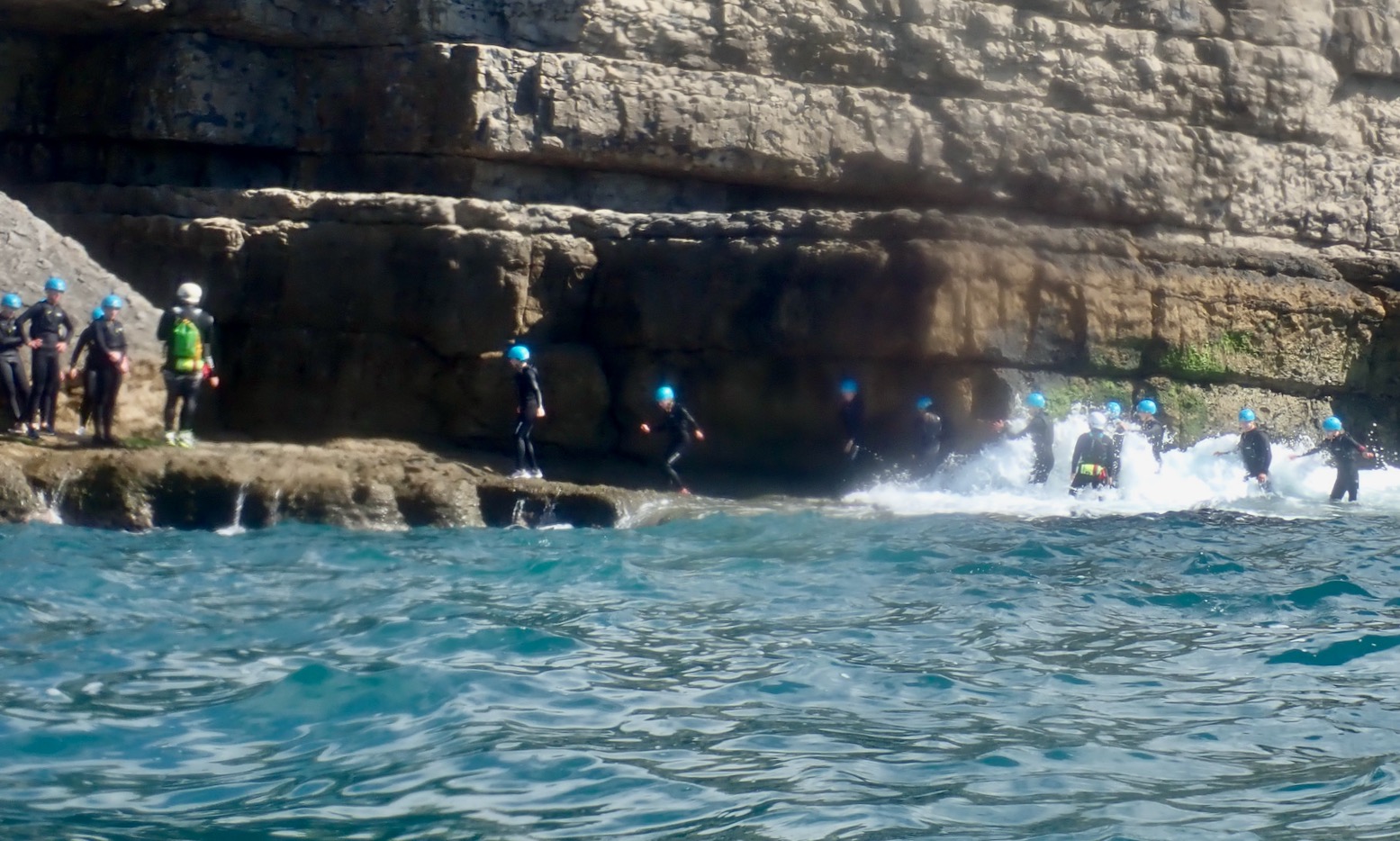
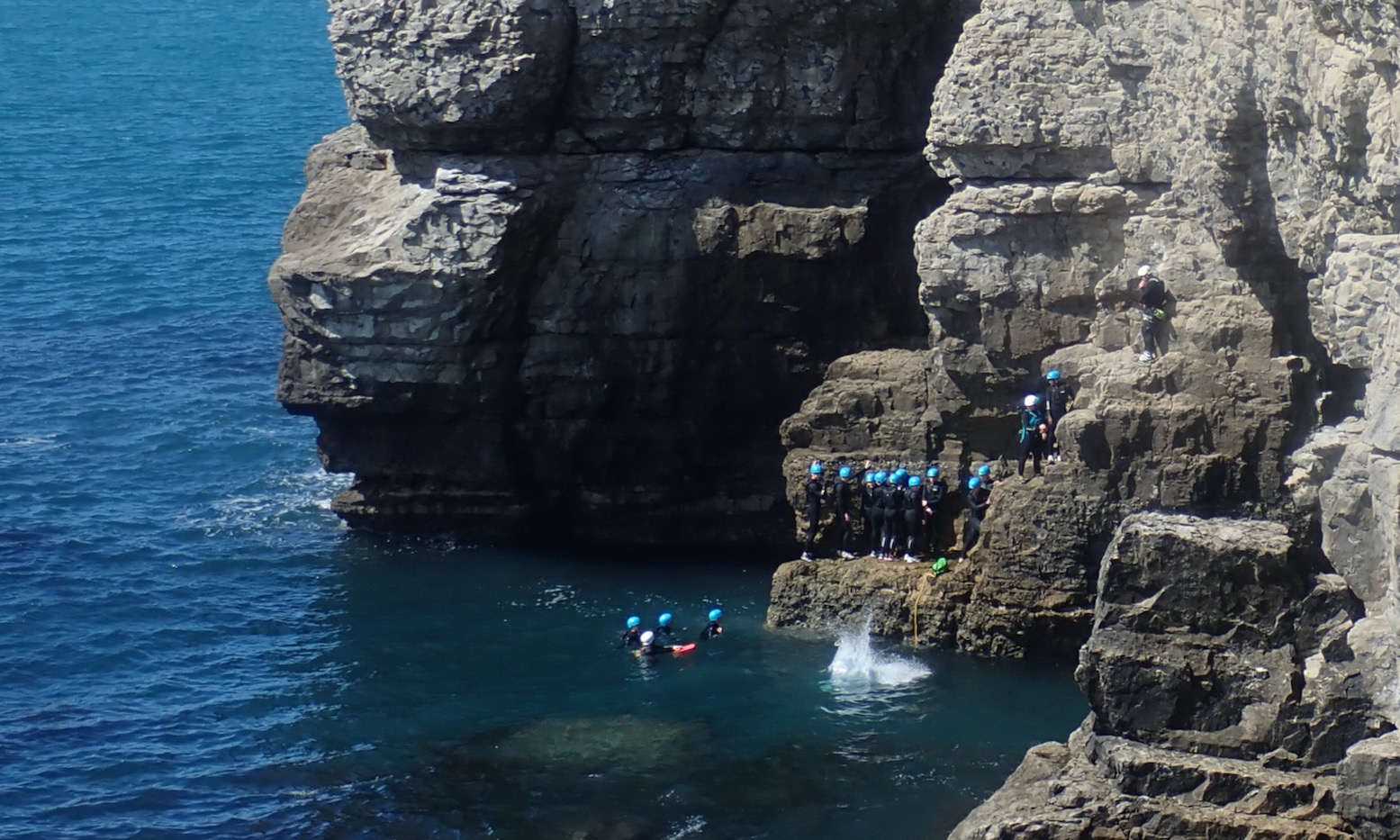
By the time I returned, Dancing Ledge was packed with day-trippers including groups of coasteering wetsuit-clad kids. They inched along the ledges, swam across cave mouths, and then clambered up to a narrow ledge to jump in. The next group was already lined up to follow so it all looked a bit sketchy and congested with just two guides for over a dozen kids (turns out it can be), but I bet they all loved it.
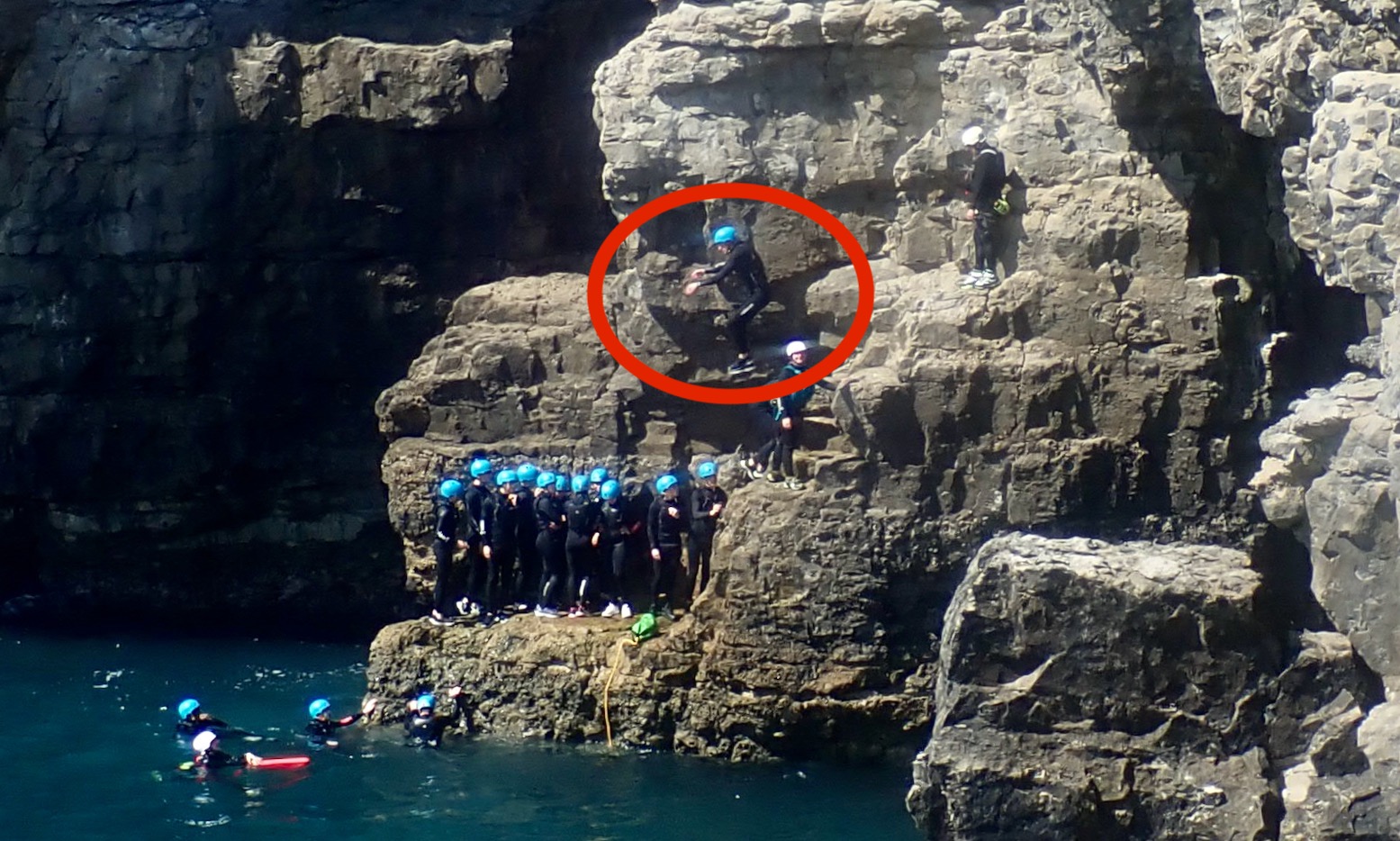
‘Beyonsaaaay! (or whatever kids shout these days).

As had happened so many times, a spell on the water without incident calmed the nerves. So I continue past the Dancing take-out and cast a wistful glance eastwards. It was only 2.5 miles, or an hour or so with the tide and wind and cliffs to the Isle of Purbeck’s southeast corner at Durlston Head, before a more sheltered turn northward to Swanage, another mile away over the Pevrill Ledge, the final hurdle into town. One for the next ‘calm’ day perhaps.
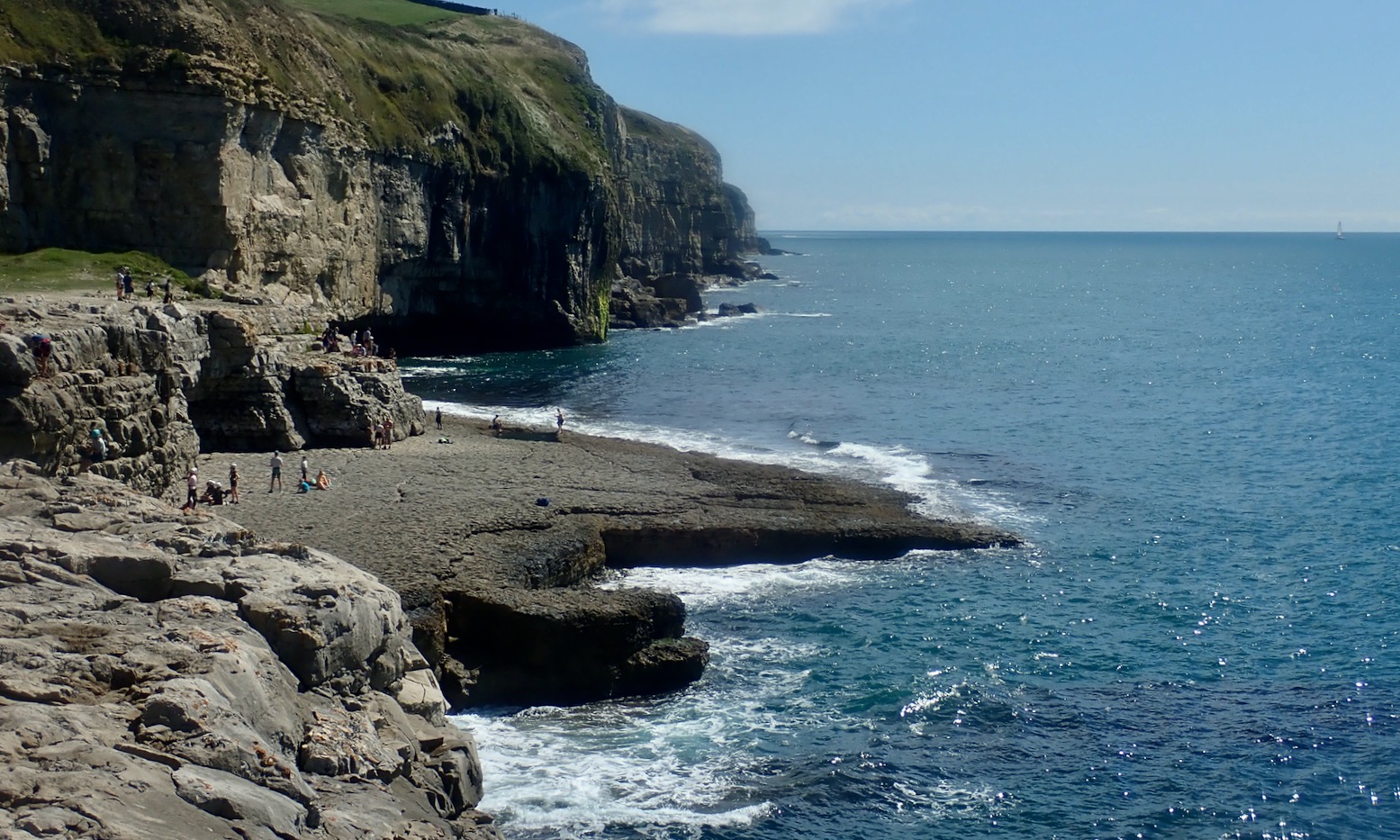
Looking east over Dancing Ledge

Anfibio Plus(+) fabric
Checking out Anfibio’s TXL page later, I see they’re offering the option of the TXL and similar long/double models in chunkier Plus (+’) fabric. It’s only 17% heavier but 80% more tear-resistant, depending on how you measure that, but costs only €70 extra. It looks like it might be similar to floor fabric or comparable with Alpacka’s much more expensive Vectran option.
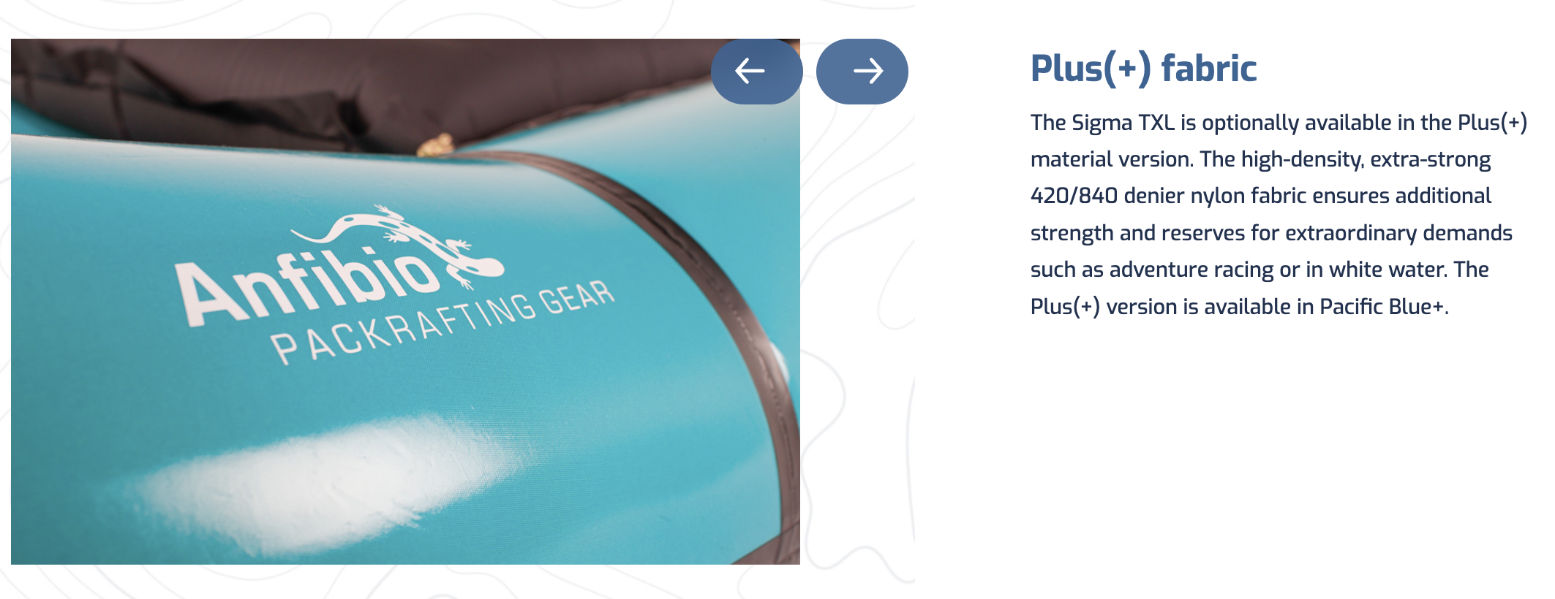
Anfibio don’t fully explain why they’re now offering thicker Plus(+) fabric; has the standard proved a bit less durable? I admit Anfibio do focus a bit too much on the ultra lightweight side of things which, alone in a single-skinned inflatable, is not where my priorities float.
From my experience with stiffer PVC IKs versus more flexible rubber kayaks, I do wonder if a Plus(+) TXL or similar might be more rigid on the water without the need to pack it full of air. It may even exclude the need for the 900-g floor pad (it doesn’t). Along with what I estimate to be a <500g weight penalty, I imagine a Plus(+) TXL will roll up less compactly, but other than that it’s something worth looking into.
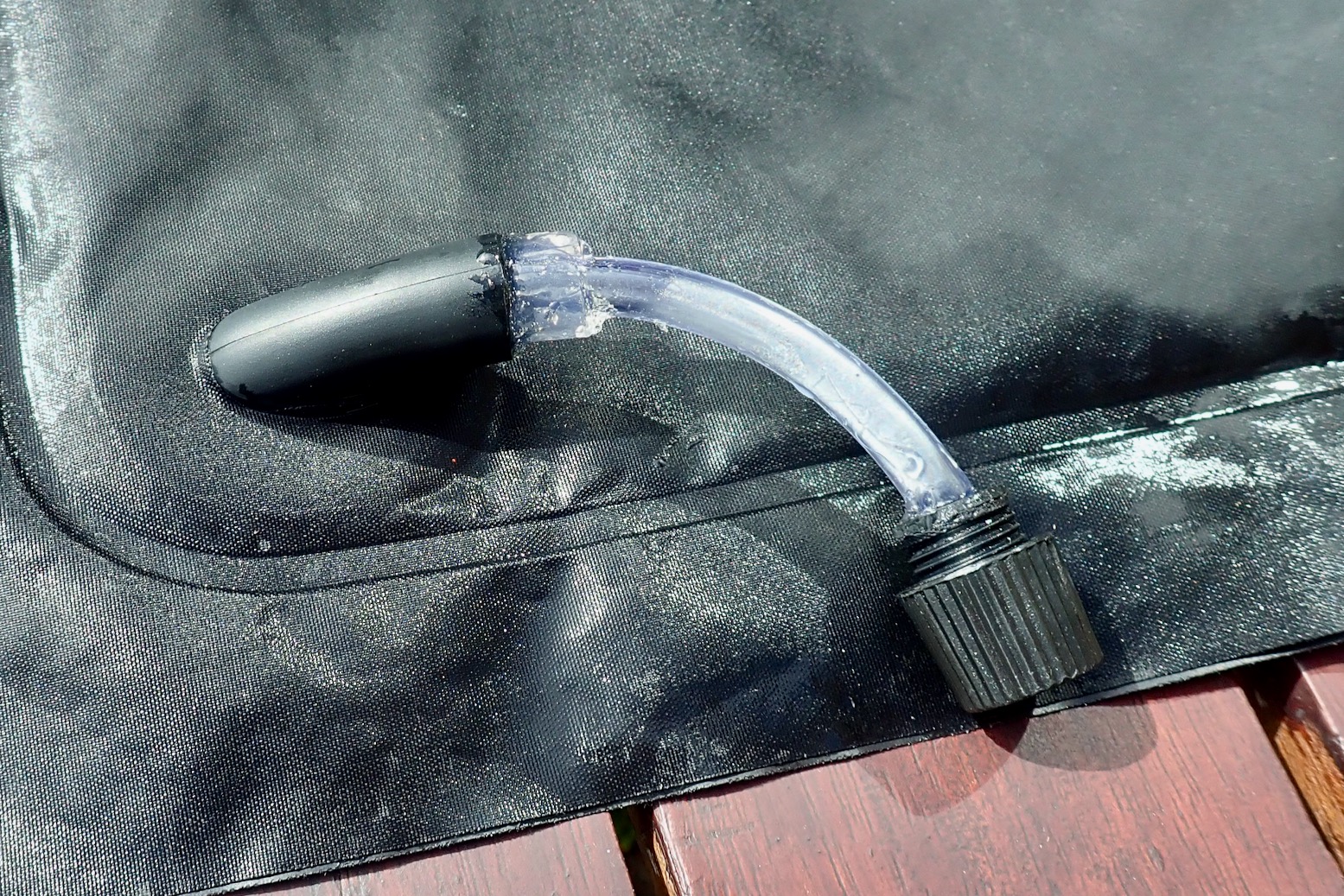
Quick-deflate seat
While I was never a fan of the mushy, twist-lok stem valves on the early Alpackas, I’m not a huge fan of the sprung, one-way inflation valves Anfibio use on their seats and backrests. Great for easy inflation and holding high pressures, but a pain to deflate when packing up; you have to jam a fingernail in the valve and scrunch the seat while it ever so slowly deflates. At least with an old twist-loks you could suck the air out. And anyway, you don’t need full pressure in a seat. Far from it.
There was talk of Anfibio modifying the seat valves for easy deflation but it’s not happened yet. Now the TXL is my sole packboat, I’m minded to set it up well. I failed to find anything other than Boston valves online. They’d work of course and will dump air really fast, but are a bit OTT and would need gluing in properly.
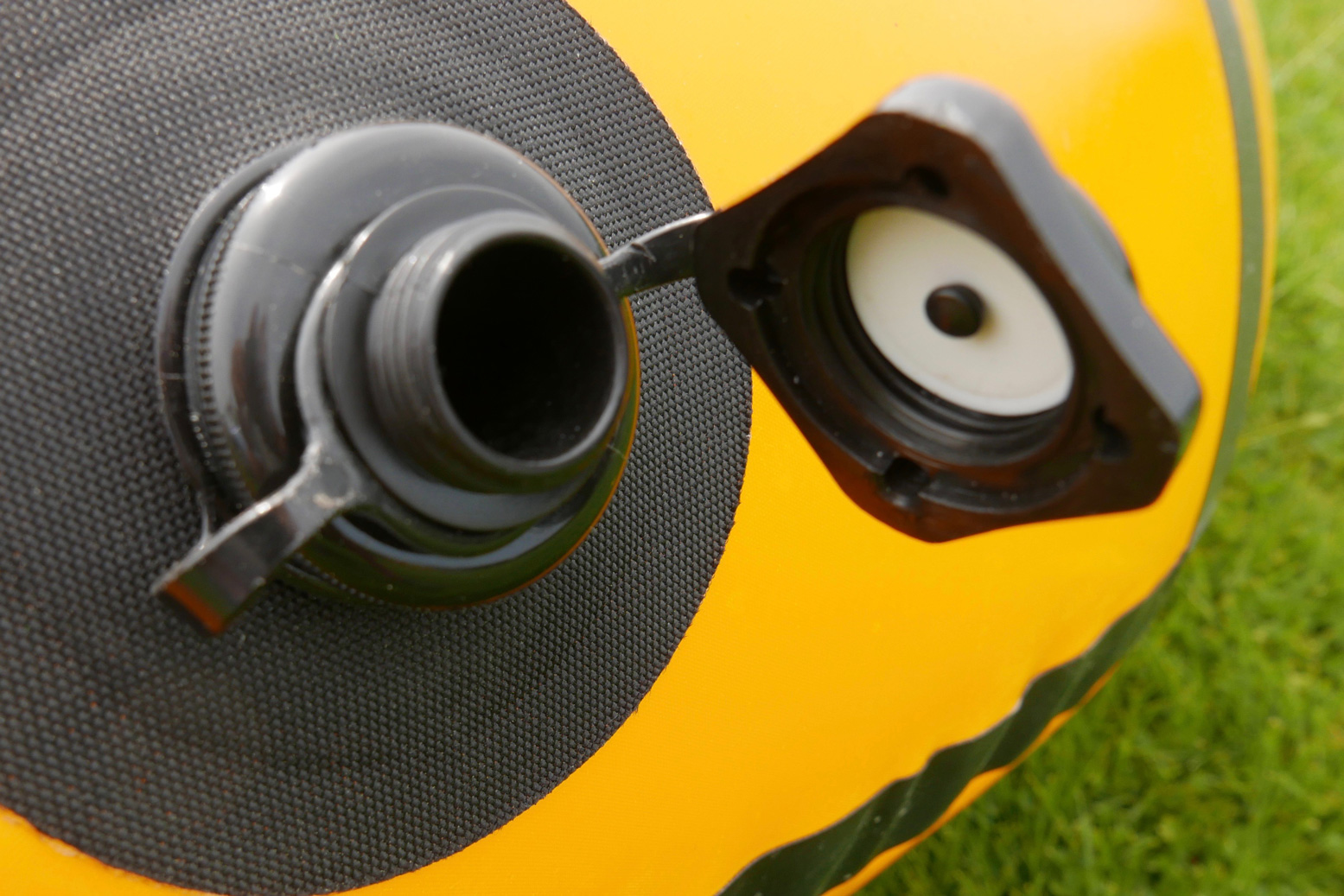
I had a spare dry bag with a neat twist lock valve a bit like Thermarest sleeping pad valves. But marrying it to the chopped off sprung one-way valve in the seat was tricky to do neatly. So I managed to do it not neatly (above left) with a bit of clear tube and lashings of Aquasure. Unfortunately the tube is narrow which slows things down or increases effort; win-lose. For the moment it works; I can unscrew the valve and roll up the huge seat, purging the air as I go. Looking back on this dramatic episode, next time I’ll just cut a hole and glue in a Boston valve (left) which are easily found online for under a tenner.
Sigma TXL: floor-mounted skeg and foam backrest

Sigma TXL Index Page

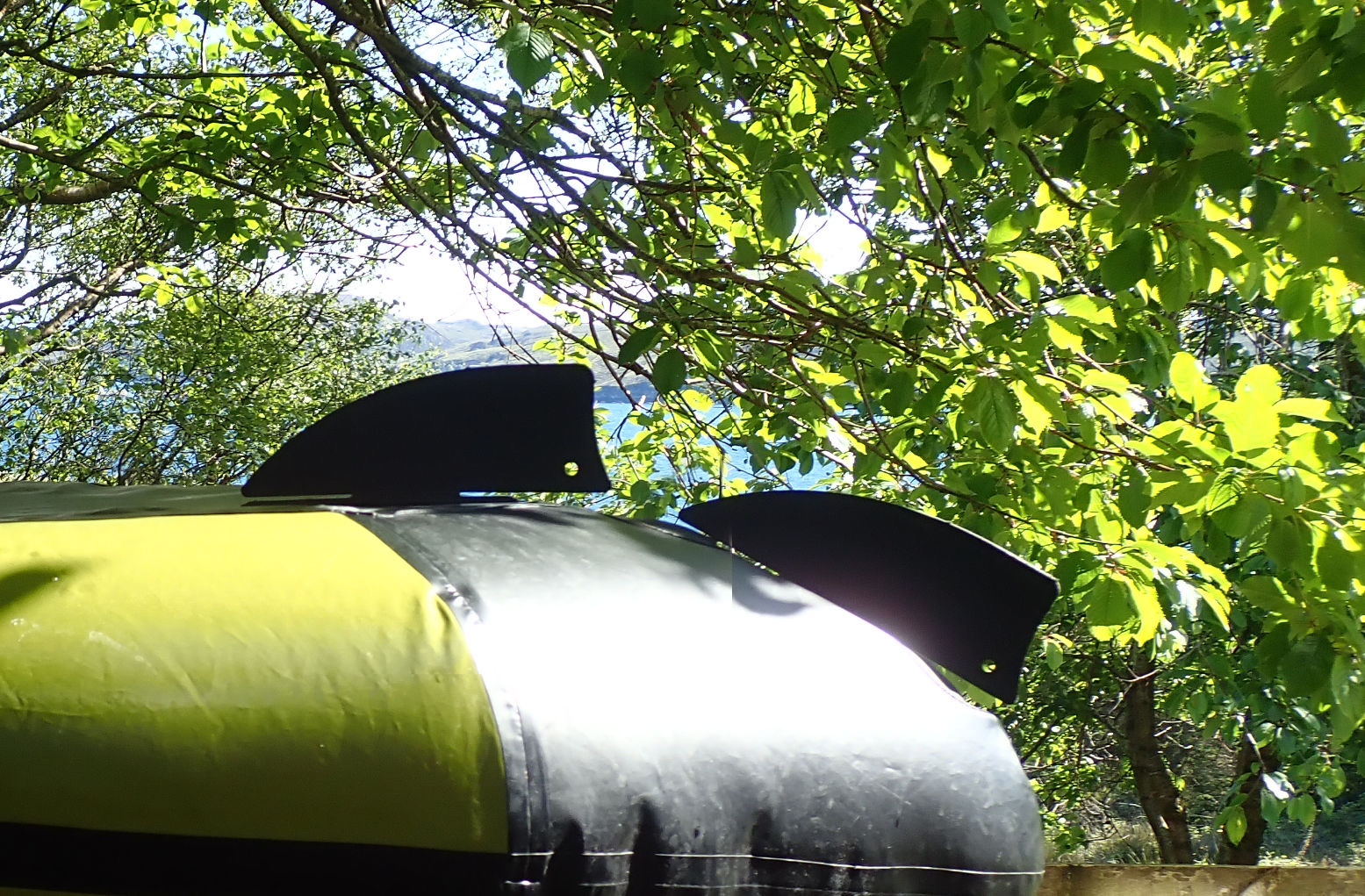
After various trials I decided for sailing the TXL would benefit with a skeg on the floor where it would be fully submerged except momentarily when cresting bigger waves. The standard position angled on the stern (left) sits too high on the buoyant TXL so doesn’t have much effect, though the TXL tracks pretty well on flat water, with or without the air floor, solo or two up. You can mount the skeg back-to-front (right) for more bite, but I hope tracking when sailing will be greatly improved with a fully immersed skeg. When the wind allows, I want the TXL to be a reliable sailer on longer paddles.

Under the floor stays fully submerged, even with the air floor.

I could’ve simply made an extension to the stock skeg, but decided having two positions for the stock skeg would be less bulky. Like on an IK or a SUP board, the long but shallow Anfibio skeg would work well mounted horizontally under the floor (above, left). I’d already tried a skeg under the bow, but that did not work well at all. Waiting for good glue, I’d stuck that front skeg patch on with Aquasure and was surprised how easily it peeled off with less than a minute with the hairdryer.

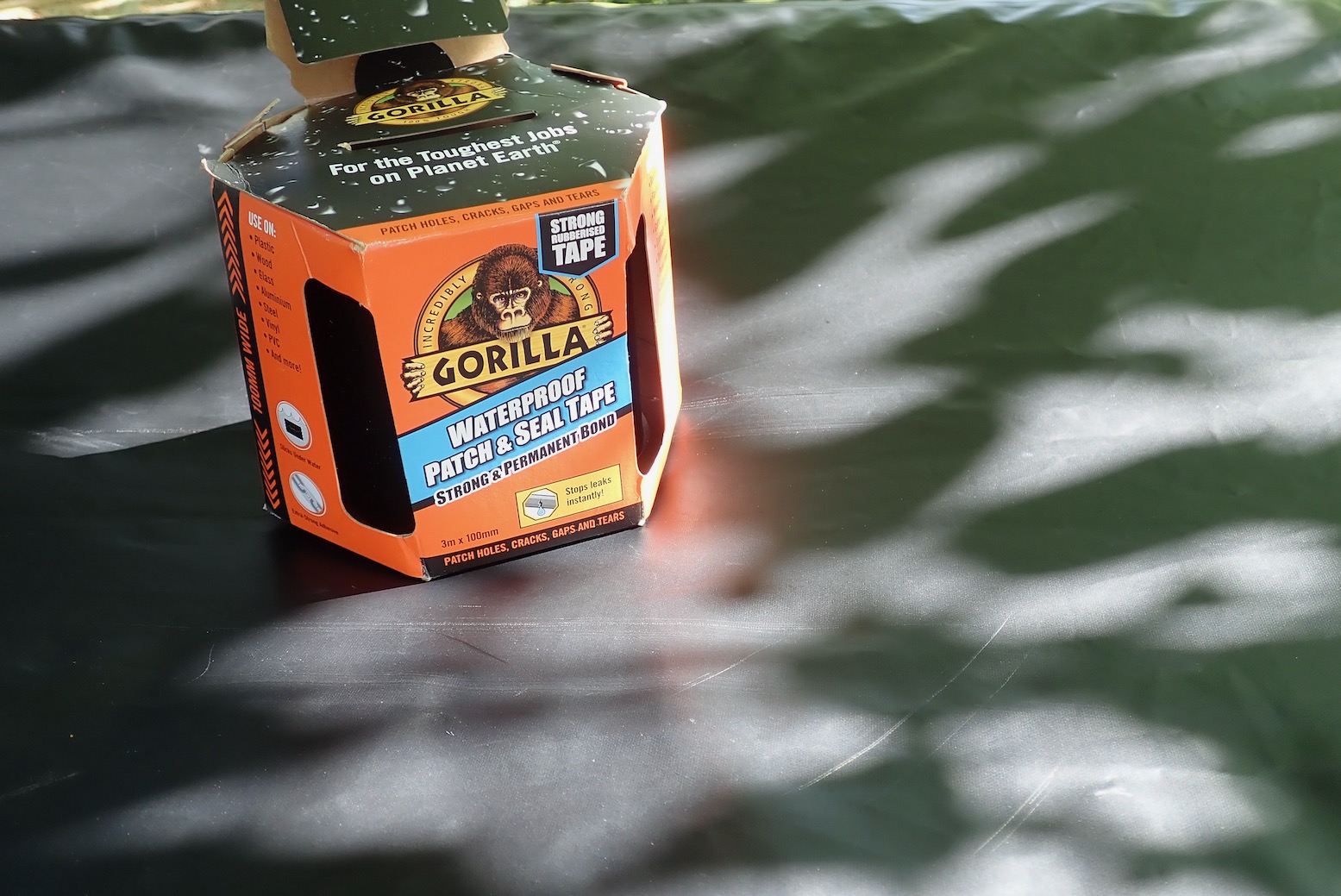
Just as I was about to clean the removed patch and glue it on with Helaplast (recommended by Anfibio), I thought super tacky Gorilla Patch & Seal tape would be even easier, using the spare Anfibio skeg patch as a template. But I decided P&S is just thick ‘rubber’ tape suited to sealing, not supporting a knocked about skeg. In fact regular, string backed Gorilla ‘duct’ tape would have worked (a good way to test the idea), and I’ve found lasts surprisingly well on a packboat. In the end I decided the liberated fabric-backed Anfibio patch would be best.

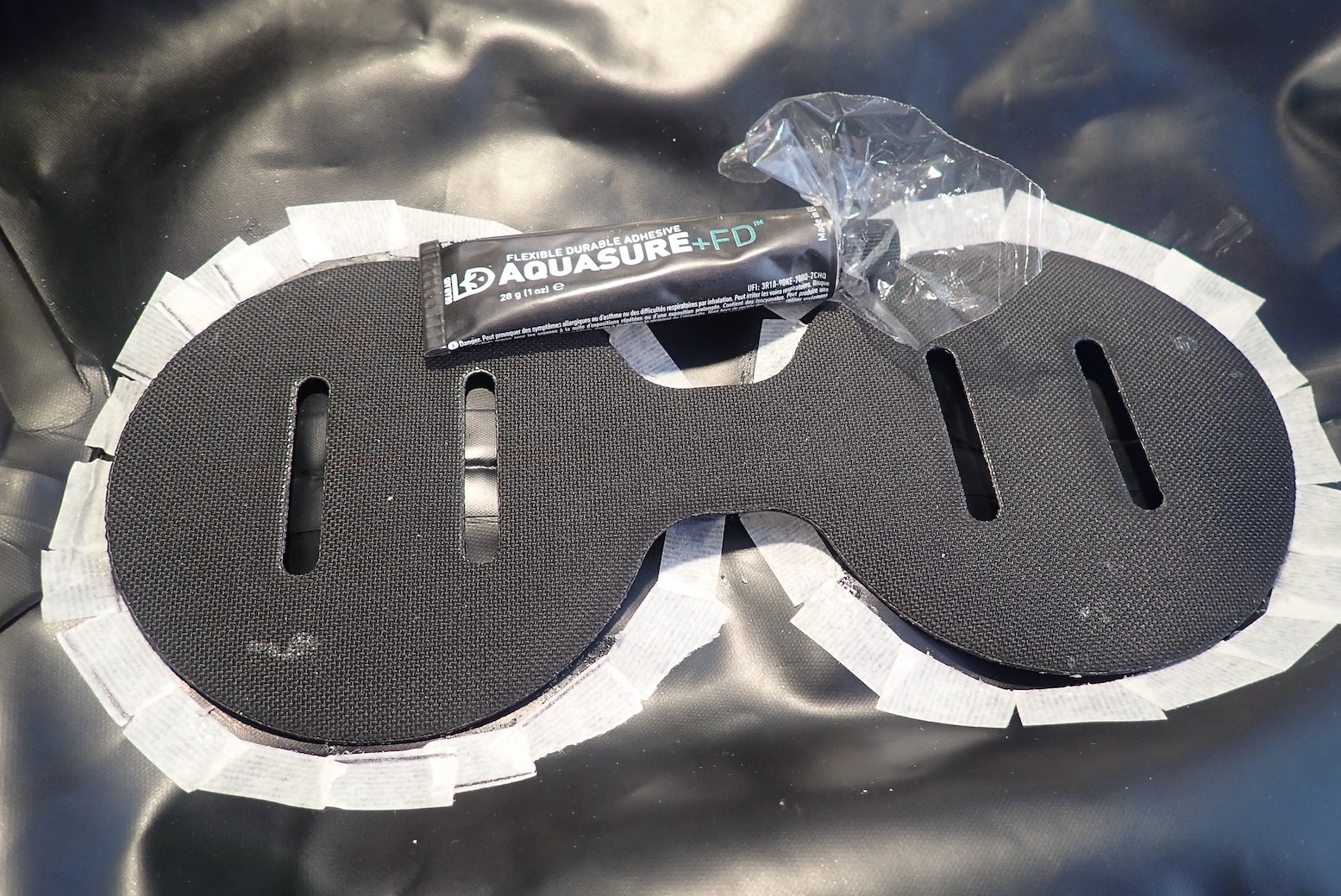
The most important thing is to mount the patch straight along the centre line otherwise you’ll be going round in circles. This is best judged with the boat inflated. After that, it’s the same Helaplast sequence as detailed here. While gluing, I decided to add a couple of tabs low in the front to make the thigh straps hook more effectively over the knees.

The benefit of having two positions for the rear skeg instead of a bigger fin is that you can choose: use the standard position for shallow rivers (if a skeg is even needed) and use the floor mount on open water where wind and waves may push the boat around more, and if you hope to sail in a straight line.


Foam backrest
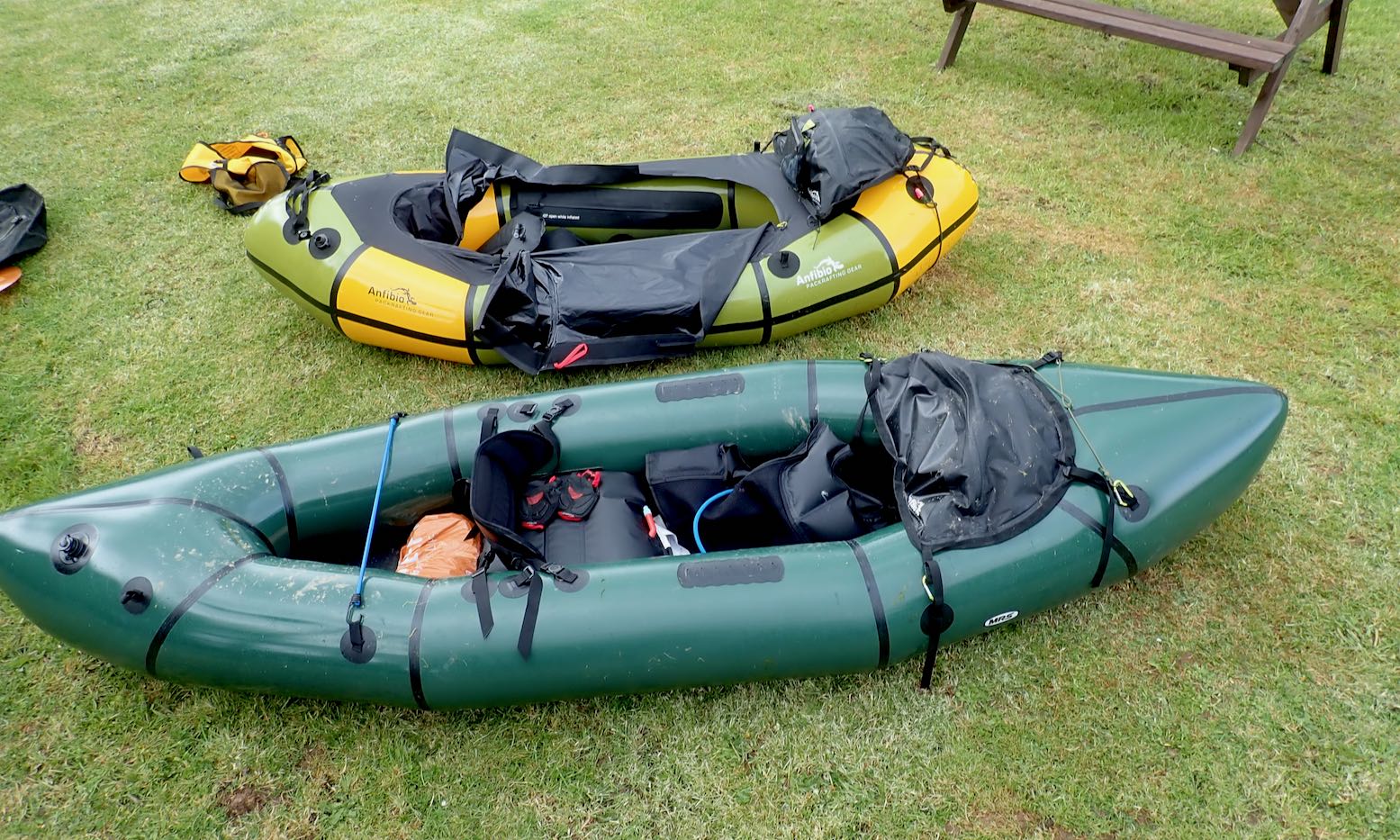
Sat up front, the stock inflatable backrest (below left) does the job, but in a low-pressure boat, the air cushion just adds more mushiness where you want support. As I say in the book or on Seats: sit on air; lean on foam. There is no advantage to inflated backrests other than saving a bit of packed space (might they also be cheaper to produce?). In this way, regular solo packrafts, where you lean on the back of the boat are better. Seated centrally in the TXL, you need a supportive IK-style backrest.

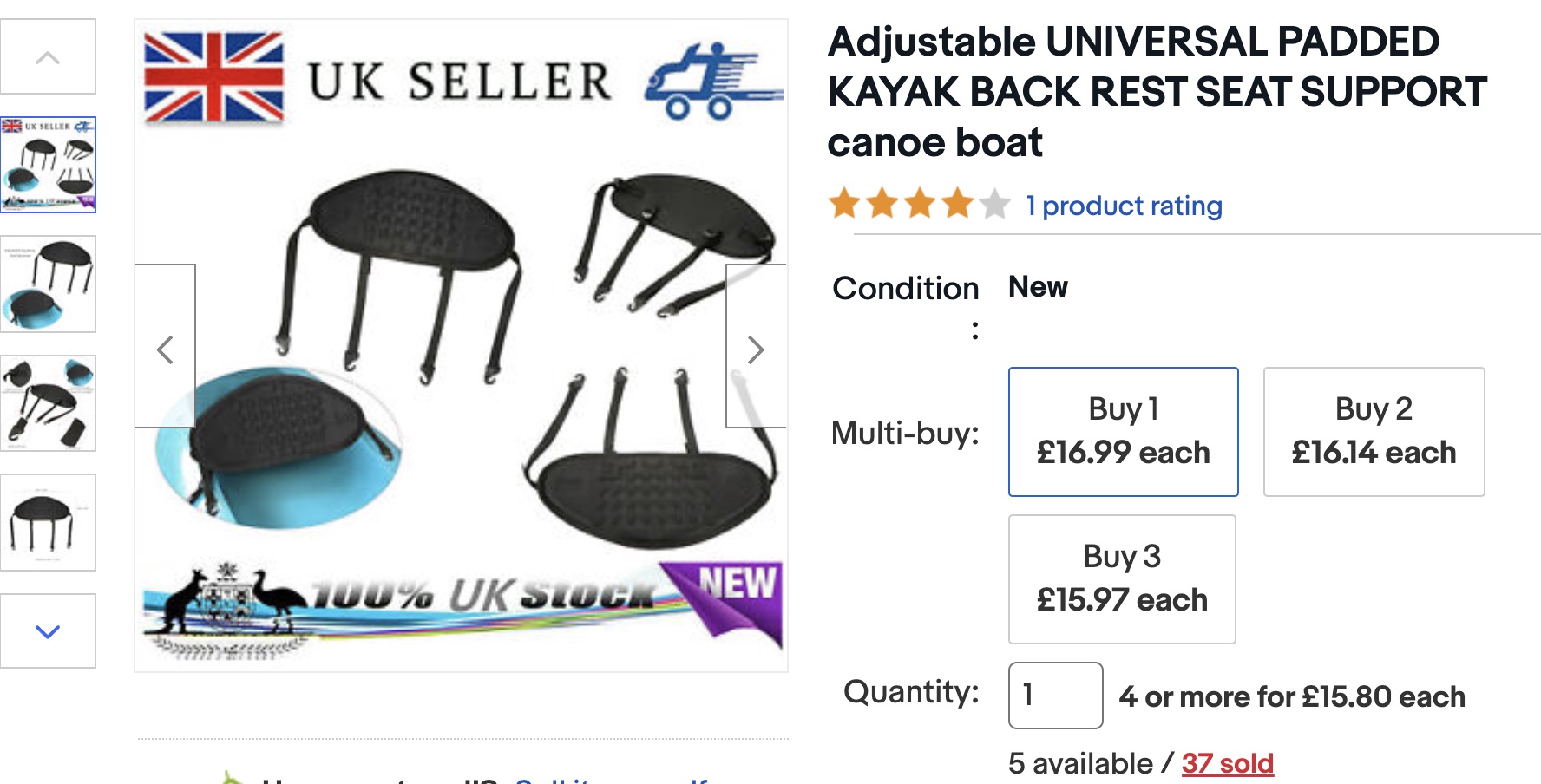
After a few outings I’ve decided to replace it with a spare foam SoT backrest (below), an idea which has worked well on my IKs for years. IK makers too have a blind spot when it comes to front seats. Today’s price for the backrest on ebayUK is 17 quid (left). Once I ditched the heavy ‘brass’ clips which came with mine, it weighs 200g, only 40g more than the Anfibio item (the ebay one shown left uses lighter plastic spring clips).

The foam backrest fits right on the TXL: the long tapes reuse the TXL’s front buckles and, less well, the rear straps come back through the flat tab mounts. A slide ring would work better here. I could have reused the thin, cinchable elastic cord which came with the Anfibio backrest but I suspect it was part of the problem (and thought so on the Anfibio Revo too). Counter-tensioned, non-elastic straps attached to a firm panel add up to better support. Up to a point the thinner foam backrest also makes more room behind it, too. And I won’t miss deflating the stock backrest to save on packed space, neither!

Sigma TXL • bow skeg and knee straps

Sigma TXL main page
Glues and Repairs

Pivoting

Years ago I remember when the value of fitting packraft rear skegs was debated. Then, the now common longer sterns were introduced by Alpacka and positioned the paddler more centrally which greatly reduced excessive bow yawing. The problem was largely solved.
On a packraft you’d think a skeg under the bow would eliminate the yawing endemic to short, wide rafts while compromising turning agility. In fact, I wonder whether a packraft might yaw nearly as much at the back but you never notice. Like one of those Turkish dervishes, you’re actually pivoting from the middle of the paddle shaft, or perhaps a bit behind, at the centre of mass (left).

Rear skegs certainly improve tracking on IKs; you can manage without, but with a skeg you can paddle harder without constant micro-correctioning. On rivers I’ve found solo packrafts paddle fine without a rear skeg; or they’re too short to demonstrate noticeable improvements. There’s a bit of nodding as you move off which soon settles down with some momentum and a steady cadence. Even my symmetrical Rebel 2K (left; stern identical to bow, not extended) paddled fine down the Wye without a skeg. But when getting pushed around by a swell or on sea lochs (especially when sailing) fitting a skeg was worthwhile.
Either way, rear skegs are a thing now with packrafts even if you don’t have to fit them every time. Certainly on my longer TXL I like to think the stock rear skeg aids coastal paddles; though we found a brief stint with no skeg was only slightly noticeable, paddling into the wind in a sheltered loch (no swell). Anyway, I’ve been curious to see what effect a frontal skeg has, so on buying my TXL I ordered a spare skeg and patch which Anfibio also sell separately for €21 + €6.

Goop no good; Aquasure OK; Helaplast better

Gluing on a skeg patch
As stick-ons go, this is not a mission critical job but you want to line it up dead straight which I now see is better done with the boat inflated. I just used the rear seam, hoping it was along the middle line. Anfibio recommend Helaplast which they can’t post outside of Germany, but which you can buy on ebay.uk (from Germany…) for €7 for 50ml.
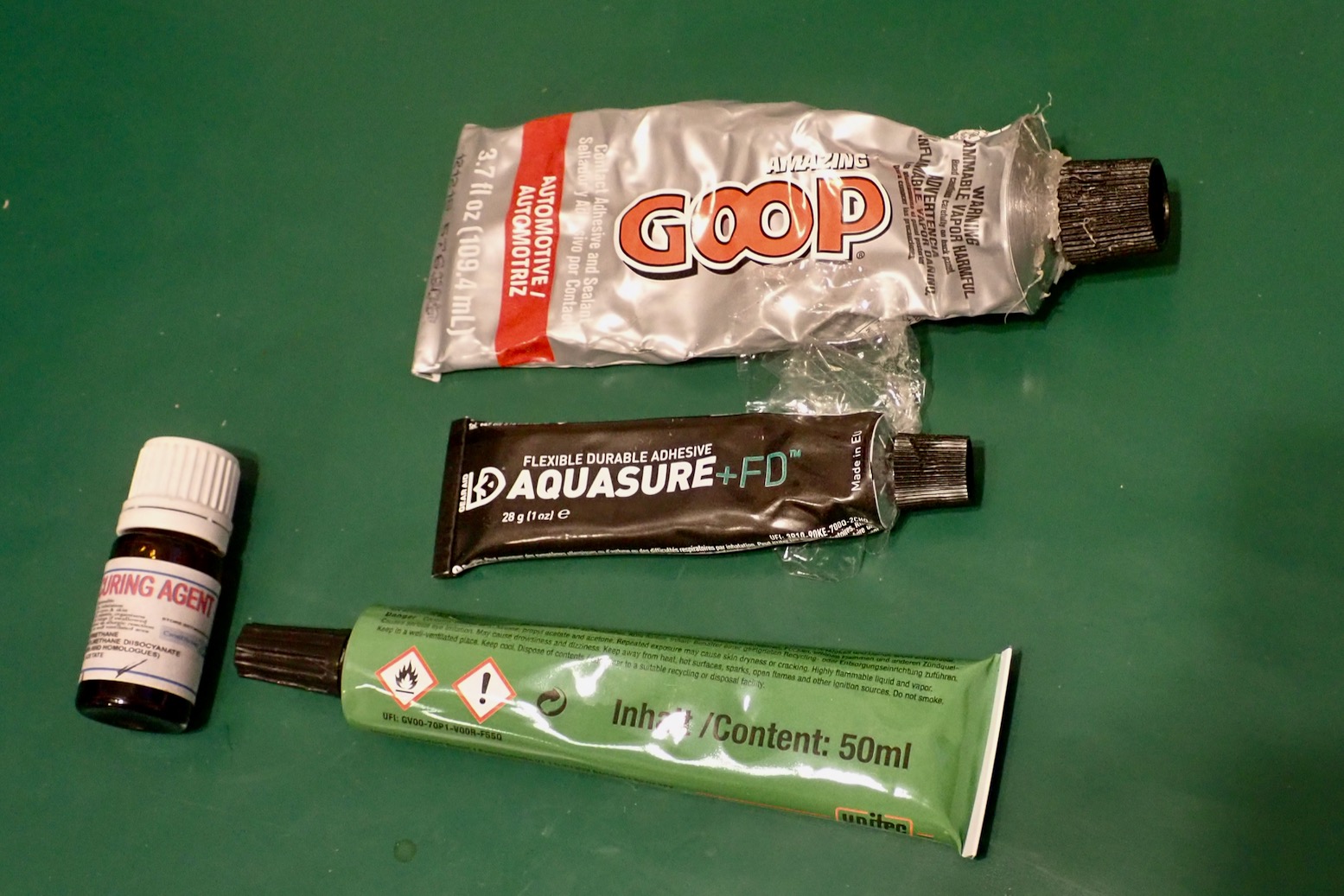
There must be something similar in the UK, but the problem is identifying it against something that provenly works. I had some Goop contact adhesive, but whatever their ‘Automotive’ variant is, it did not stick at all. So I decided to try some Aquasure+FD, leaving it to cure for half an hour before sending in the roller. That seems to have worked.

Using stock TXL mounts sort of works

Knee straps
Part of me likes to think I’ll be using my nippy TXL the way I use my IK: fair weather, open-water sea paddles rarely more than a mile from shore. As this might require sustained periods of paddling I figured some knee straps would help, as they do in my IKs. It’s not so much for hardcore bracing or even rolling, the way they’re used in white water, but just to lock-out the legs so the core is more connected and you get good drive.

Anfibio sent me their latest 5-point thigh straps which I tried and liked on the Revo (left). But to make full use of them would require gluing on up to 8 extra patches (if not ideally the ladder patch; left).

I decided my old Anfibio 3P straps which I’ve used for years in my IK would be OK for my low-tension, flatwater use. They require adding just two pairs of attachment straps. I could have got away with the unused flat patch by the seat, but the direction on tension was off centre and would eventually wear, stretch and maybe break. These small patches are not really designed for such loads and now my Helaplast has arrived, I decided to try it. An old post on the Anfibio blog explains how to use Helaplast:

  • mark off area on hull
  • mix hardener 20:1
  • clean surfaces with solvent
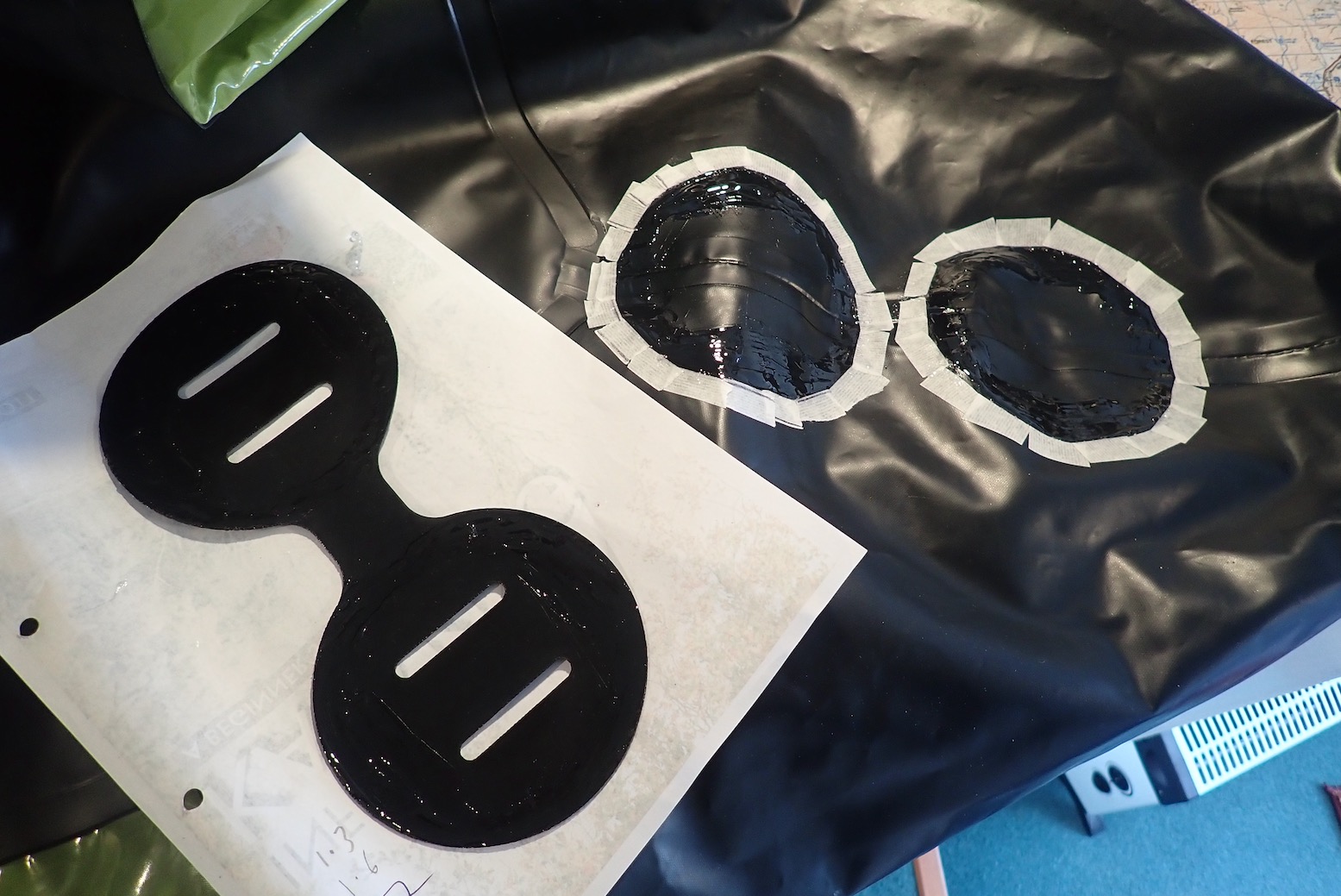
  • apply a thin layer to both surfaces and wait 30 minutes
  • apply another thin layer and wait another 10 minutes
  • Position patch; it won’t adhere properly
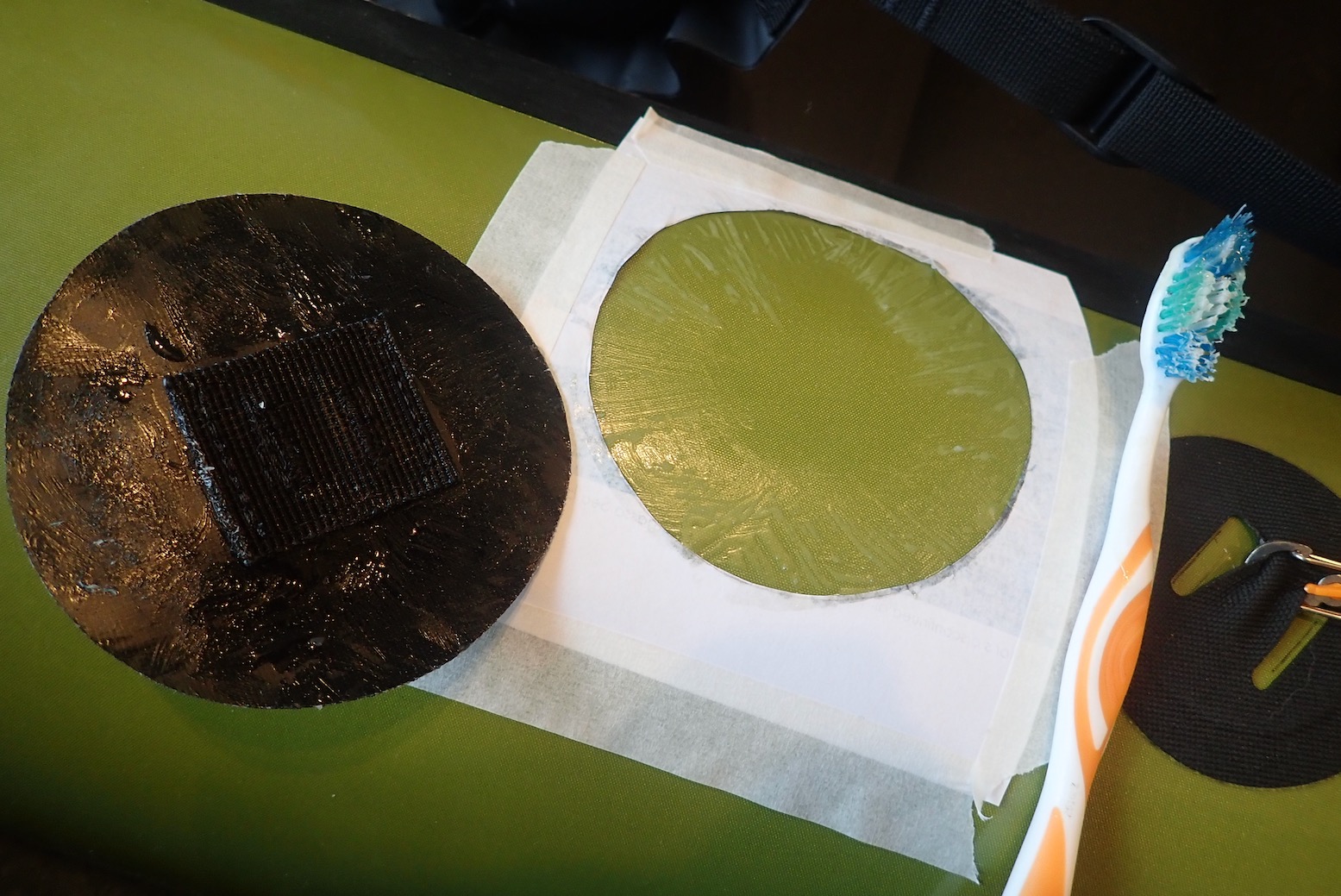
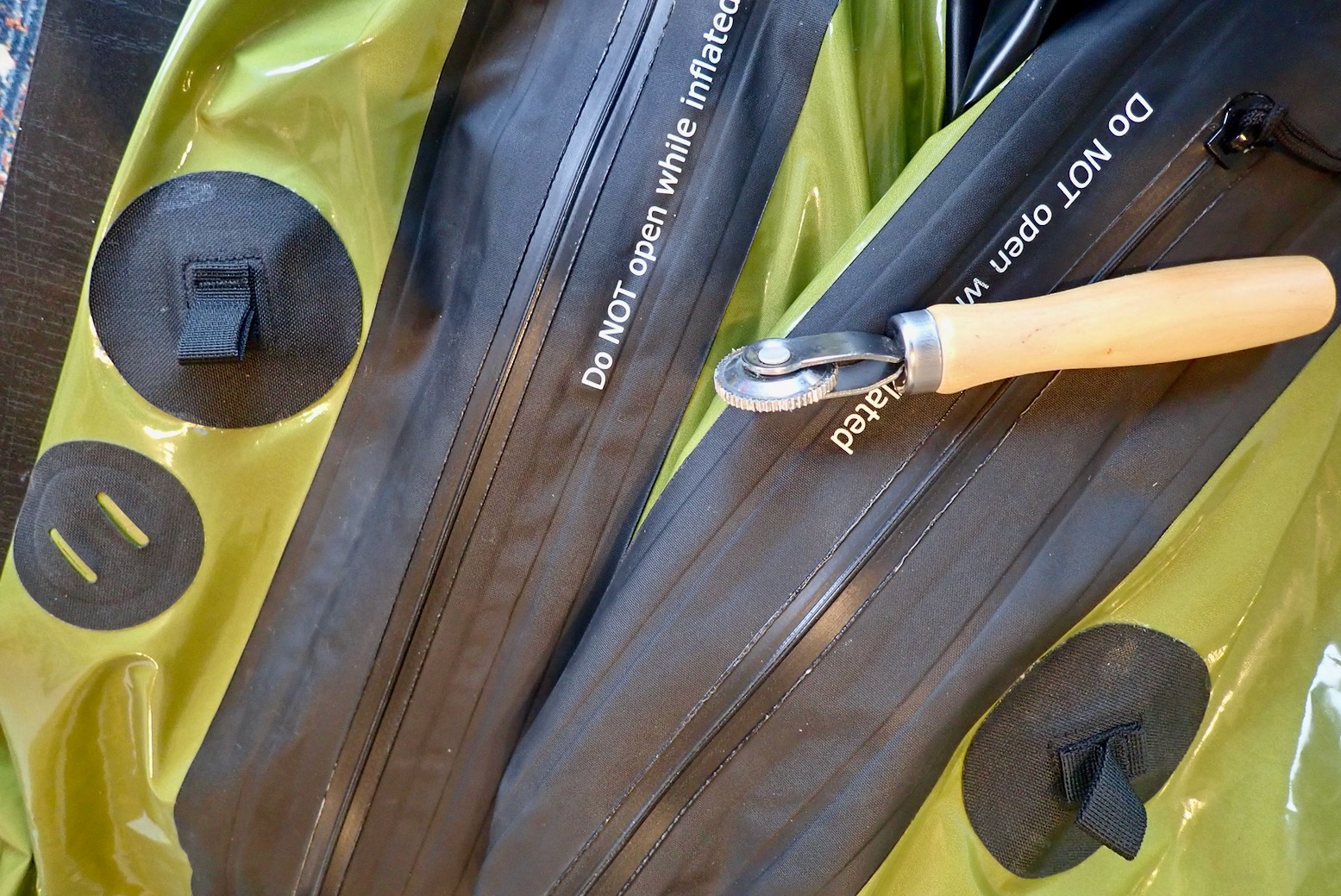
  • Heat with hair dryer to reactivate glue and press down hard with roller. It’s better if the boat is deflated to do this on a hard surface.

The heat reactivation trick was not one I’ve heard of before with glues (except to loosen stuff), but you could see it worked. Where the positioned patch was lamely stuck to the boat, a bit of heat saw it bond down well with some added rolling. You can tell when something looks well glued and this feels like it, though I’m sure glad I didn’t have to do that another six times.

Update
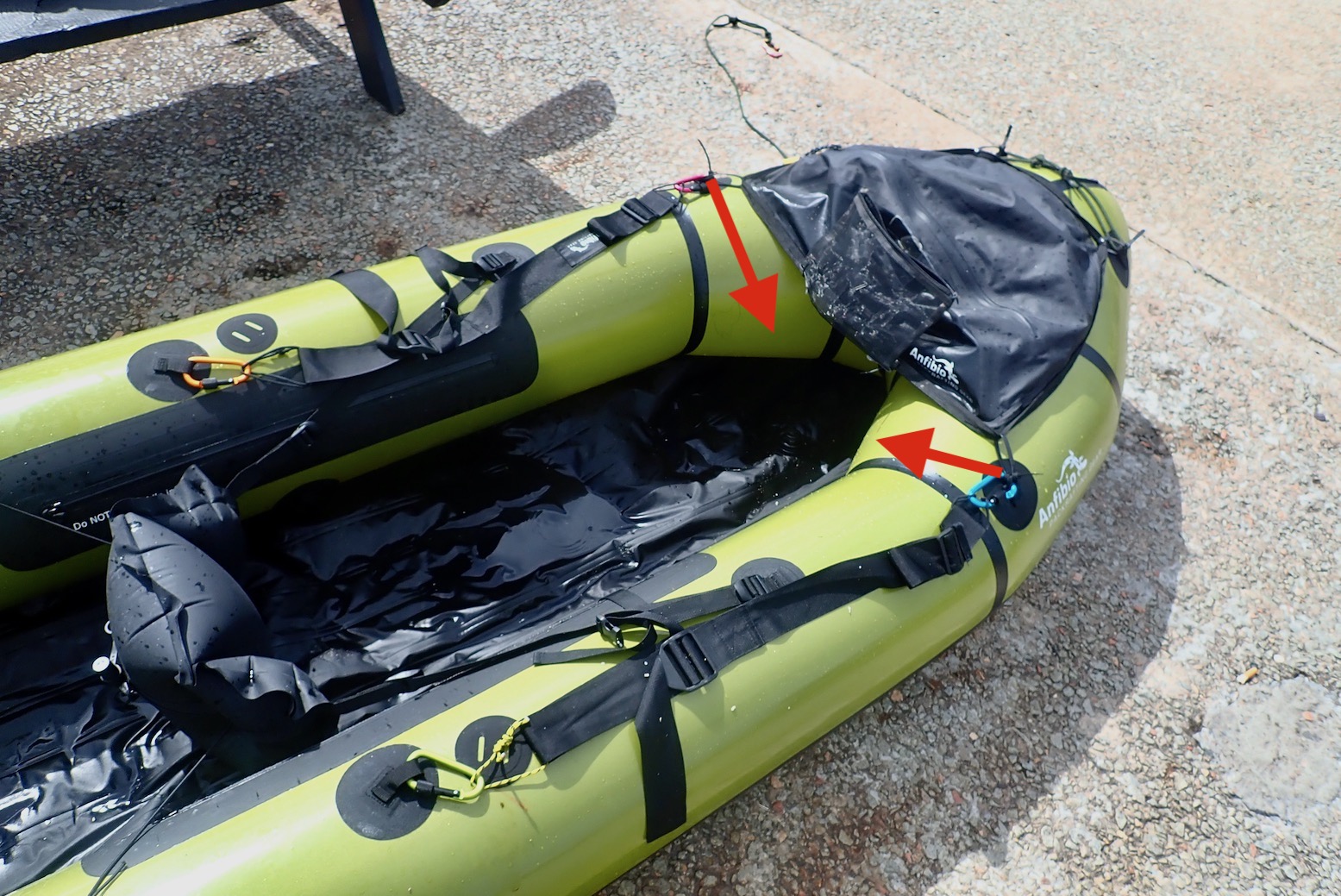
Having paddled about with the straps a bit, they work OK, but the front mounts need to be lower to hook well over the knees without using the cross-link strap to pull each strap inward (not what they were intended for – entrapment hazard!). I did this a few days later. Knee straps also make a good set of handles for moving the boat about like a giant holdall.

Thigh strap attachment points are better off set low at the front.

25% off Fernhurst IK & Packraft guides

Buy my Inflatable Kayaking; A Beginner’s Guide direct from Fernhurst Books at 25% off if you sign up for their newsletter. Click this or the image below. More about the book here. You can also buy it off amazon.uk for about the same cost, depending in their discount and postage fees.

My similar Packrafting Beginners’ Guide is due in May 2022.

Repairing a huge rip in your Inflatable Kayak

As mate was getting out of a current-model full-Nitrilon Twist 2 the part of the boat under a jetty rose up into the sharp end of a bolt securing a mooring ring.

KABOOM!!

.. a two-and-a-half foot rip tore across the top of the hull in both directions with a puff of South Moravian talc. As it’s a largely linear rip in an accessible location, making the repair was fairly straightforward: sew, then patch.

[FYI: I know of two other Twists which have suffered similar long rips: here and here. But not any other Gumotex model].

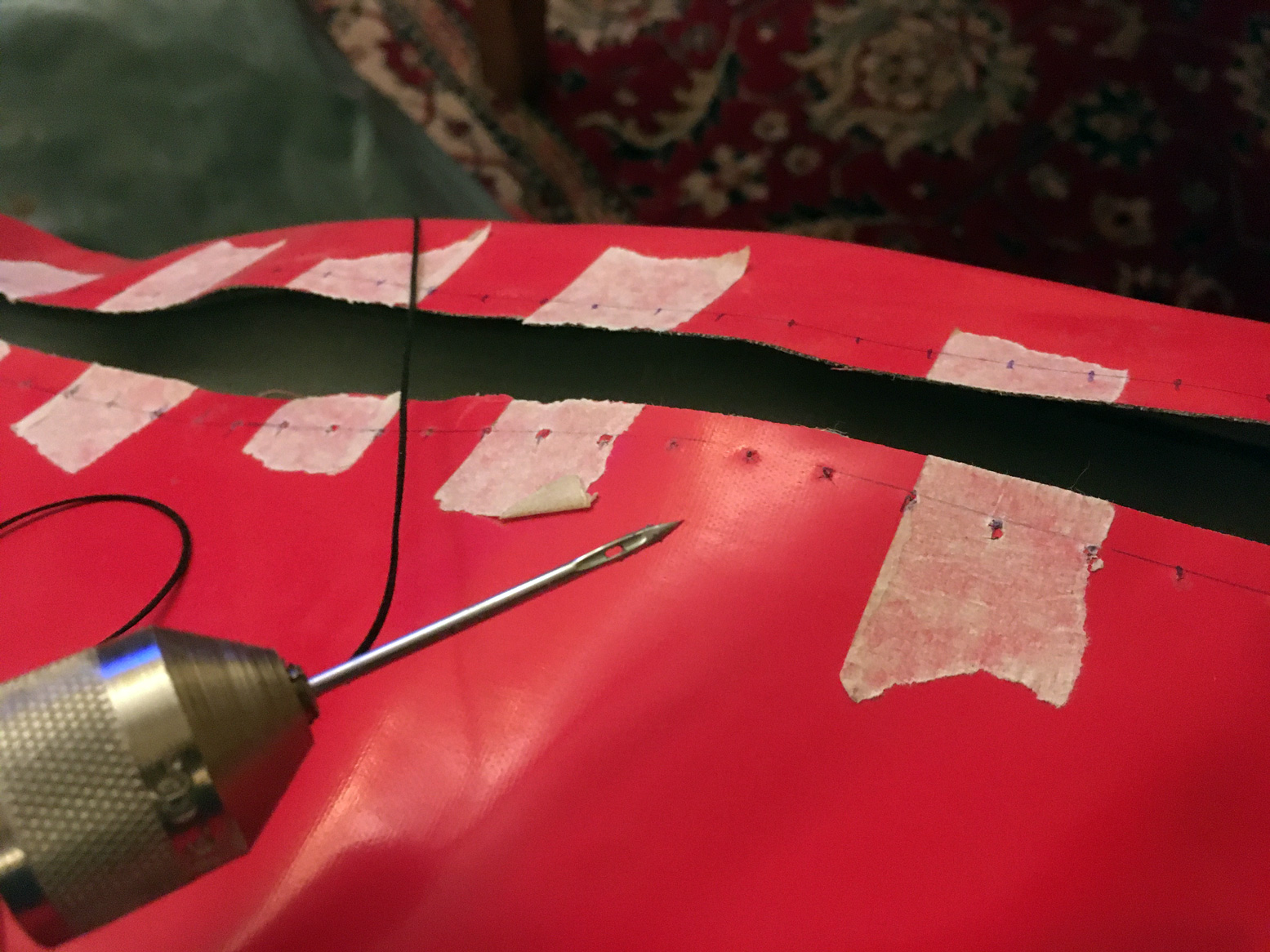
Because the coated core of the red Nitrilon fabric is a woven mat, sewing is an effective way of holding the two sides of the rip together to reduce the tension on the eventual glued-on patch once the boat is inflated. You need an awl spike to pre-poke each hole for the thick polyester thread. This fabric is hard to cut with sharp scissors, let alone thread with a needle.

Rip neatly sewed up with a special cobbler’s reverse herring backflip cross-stitch. One thing that got forgotten was sanding then cleaning the surfaces alongside the rift before sewing began.

Completed repair. This would work on a PVC IK too, but most of them are shell and bladder or drop-stitch. PVC is a bit harder to glue well.

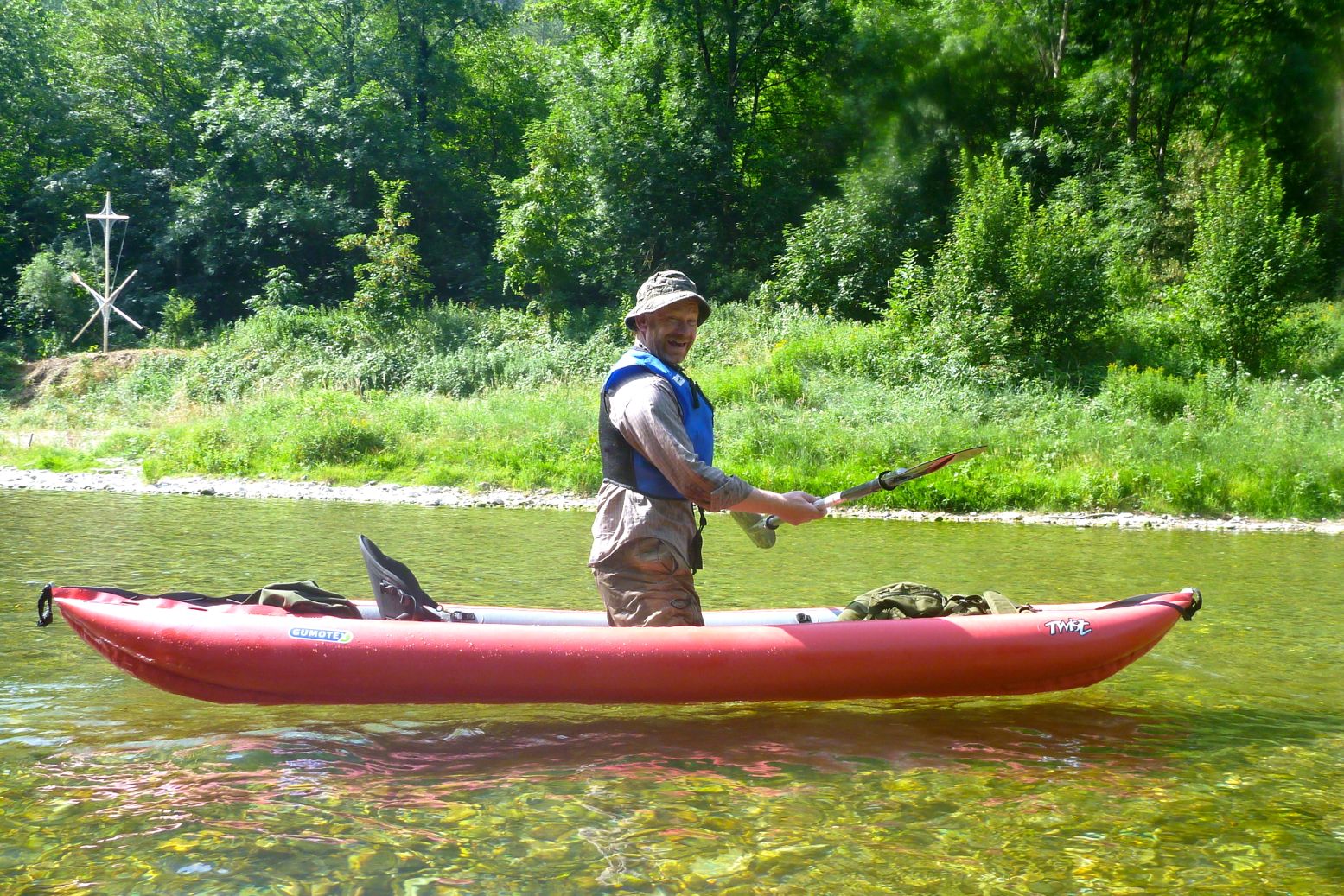
The repaired Twist back on the water.

Make Your Own Hypalon D-rings

See also:
Inflatable kayak glues and repairs
Repairing a Gumotex Seawave
MYO alternative to D-rings

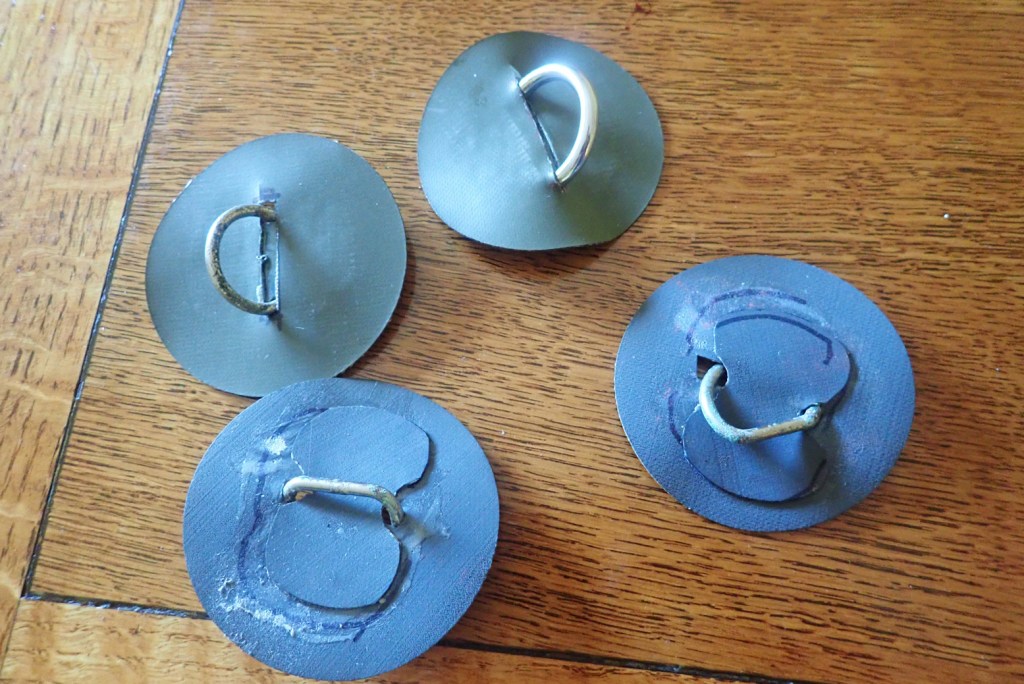
You can get ready made Chinese PVC D-rings dirt cheap on eBay but genuine rubber hypalon D-rings (not plastic PVC claiming to work on hypalon) cost a lot for what they are. Once you factor in the price of two-part glue, it adds up, especially if you have a few to fit.
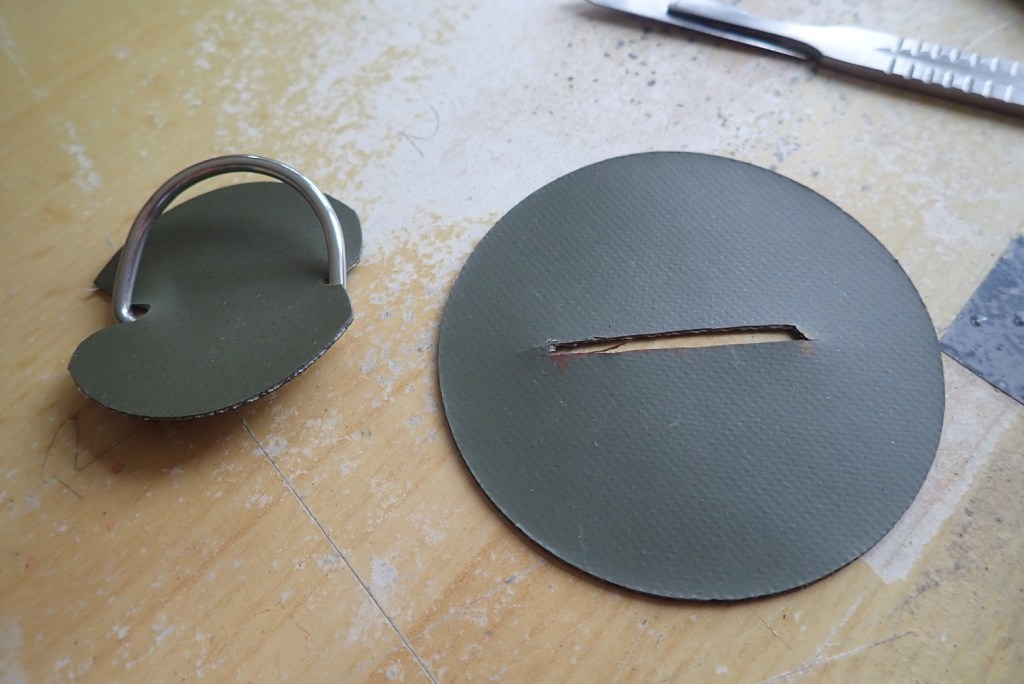
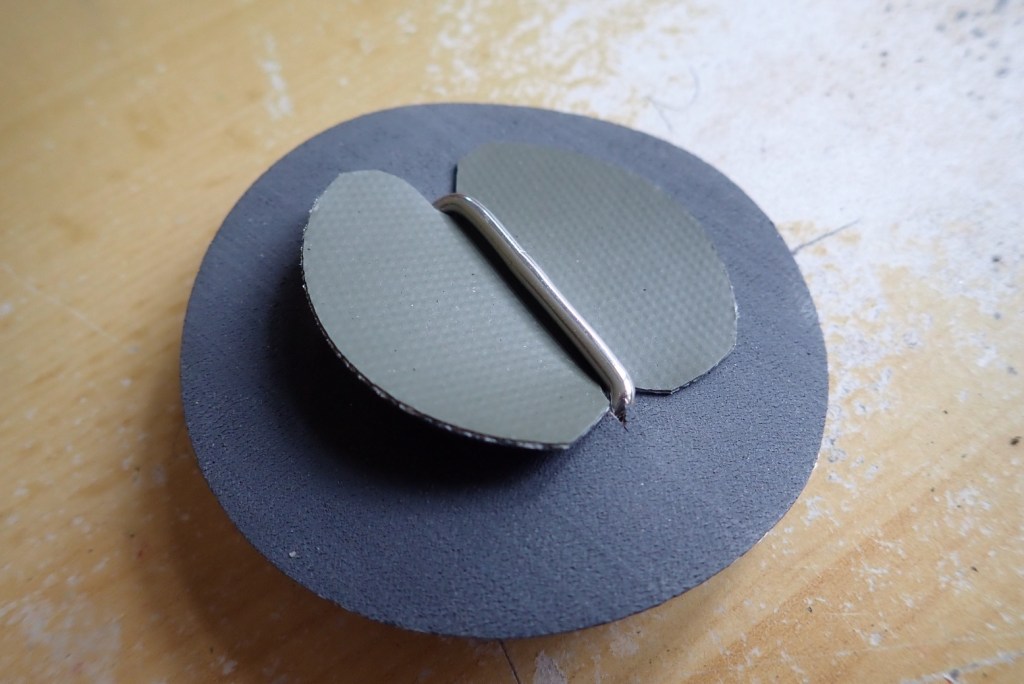
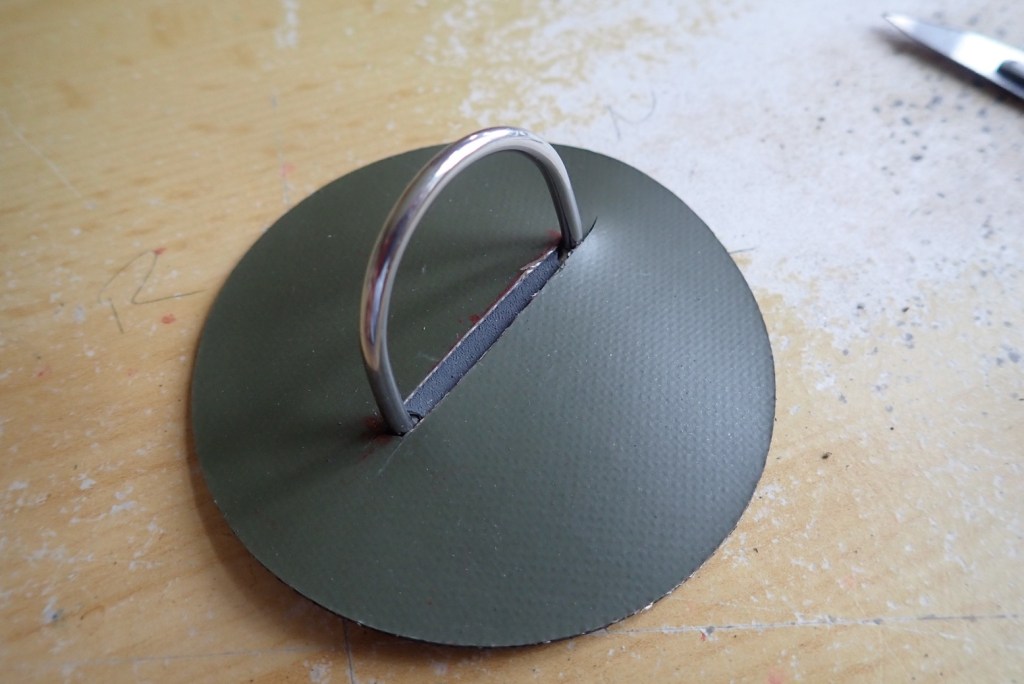
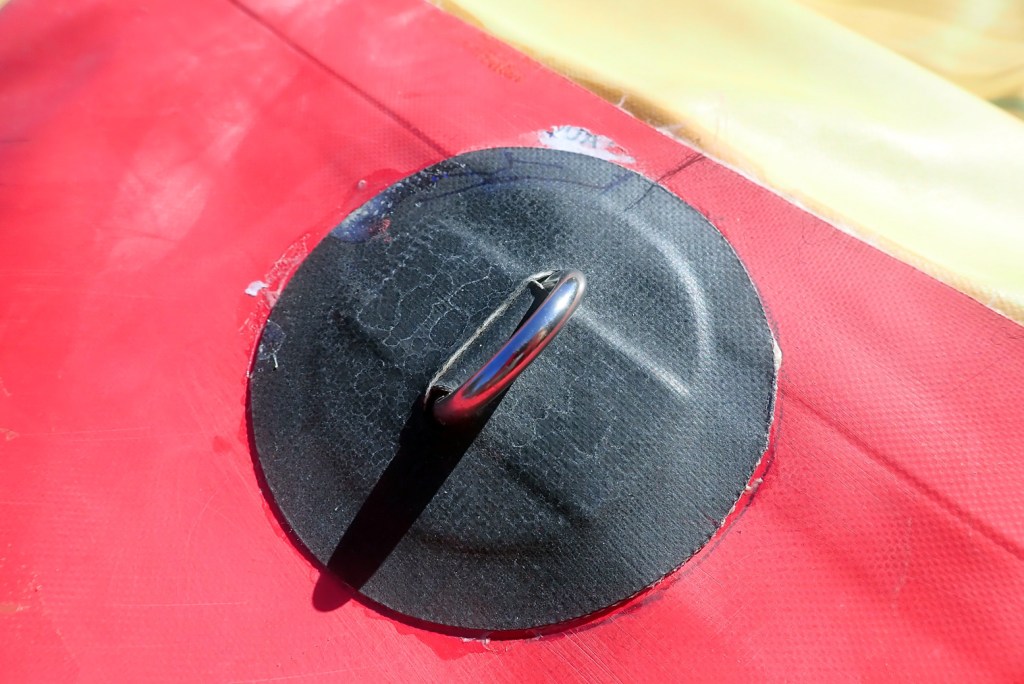
It’s fairly easy to make your own D-rings for your IK to attach gear, thigh straps, footrest mounts and so on.

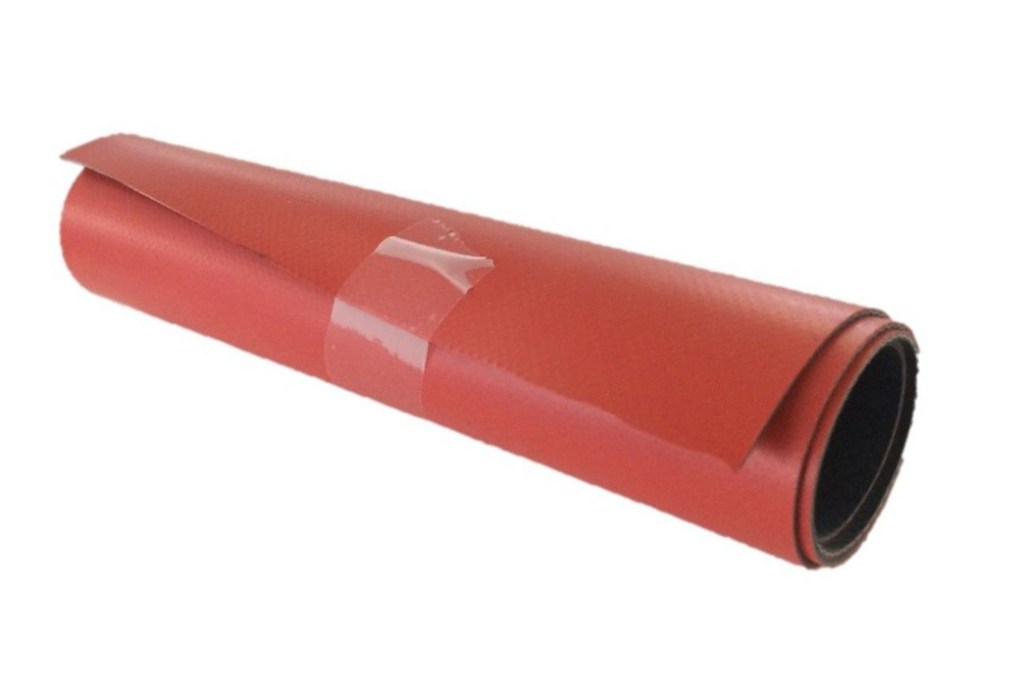
You can buy metal D-rings by the sack-load online, as well as round PVC or Hypalon patches. (‘Hypalon’ is pretty much the same synthetic rubber as Gumotex Nitrilon and Grabner Nordel EDPM). Or buy an off-cut (above right) for much less and cut your own. A D-ring doesn’t have to be round but it’s better if corners are rounded. You will notice how unusually hard it is to cut this stuff with scissors or a blade. The fibre core is tough: needed for zero-elasticity in an IK.

Pictures below show how to make your own D-rings.
Go to this page for how to apply any patch, step-by-step.


Sticking to the Rules
I needed to fit some tube-top D-rings to properly support a second backrest in my Sunny 2020. I found a stray, opened tin of Bostik 2402 two-part in my kit bag, but with an expiry date of 2009. Back then I only owned this original Sunny and looking it up, 2402 turned out to be for rubber boats. Perhaps I bought it more recently but didn’t notice the expiry date. In the tin the glue was still liquid and unseparated, but the little bottle of Bostik D-10 hardener had long since evaporated. Digging around, I also found an opened bottle of PolyMarine hardener. Comparing chemicals showed they both contained Diphenylmethanediisocyanate, one of the few words that’s too long for a Scrabble board.
I mixed the wrong-brand hardener with the 11-year old glue 25: 1 and the bond looked as good as anything.

How to repair a ‘hypalon’ kayak

See also:
Inflatable kayak glues and repairs
Make Your Own D-rings
MYO alternative to D-rings

lm-pumper

Hypalon is a cool-sounding word and although not made anymore, has become a generic term for the similarly durable synthetic rubber-coated fabrics still in production, like Nordel and Nitrilon. Once upon a time all rafts and were made of hypalon, then less expensive Asian PVC came on the scene. More about IK fabrics.

sw-holes

The other day, while lashing the Seawave to a chopped-down trolley, the bag sagged under its own weight and rubbed on the sharp edge of the hard plastic wheels which wore through the pack and then the boat’s hull (left) ;-((

The trolley had worked fine with my UDB drybag in New Zealand (below left), but that was partly because you can fully inflate a UDB via its one-way oral valve, transforming it  from saggy sack to firm travel sausage.

Ironically, just two days before I damaged my Seawave I’d snagged a BNWT Orlieb RS140 (right) on ebay.
I’d been eyeing up this non-rigid wheeler duffle for a while as a versatile Seawave transporter plus a reliable on-water drybag/buoyancy aid.
With a bag like this, an IK or whatever you got can be transported easily across any wheelable terrain, or carried as a holdall or on its backpack straps if you’re strong enough.


With enough practice applying D-rings, let along bike and moto punctures over the decades, I was confident I could do a bomb-proof repair on my Nitrilon Seawave. In a way, I was even a little chuffed that my 5-year old IK was earning its first battle scars. Plus, in my experience rubber-based IKs like Gumotex, NRS and Grabner glue more reliably than PVC boats. Shiny packraft TPU is even easier: you can just tape it, but packrafts are low-psi boats not normally inflated with mechanical pumps. My adapted Seawave side tubes run 4 or 5 psi.

Things you will need

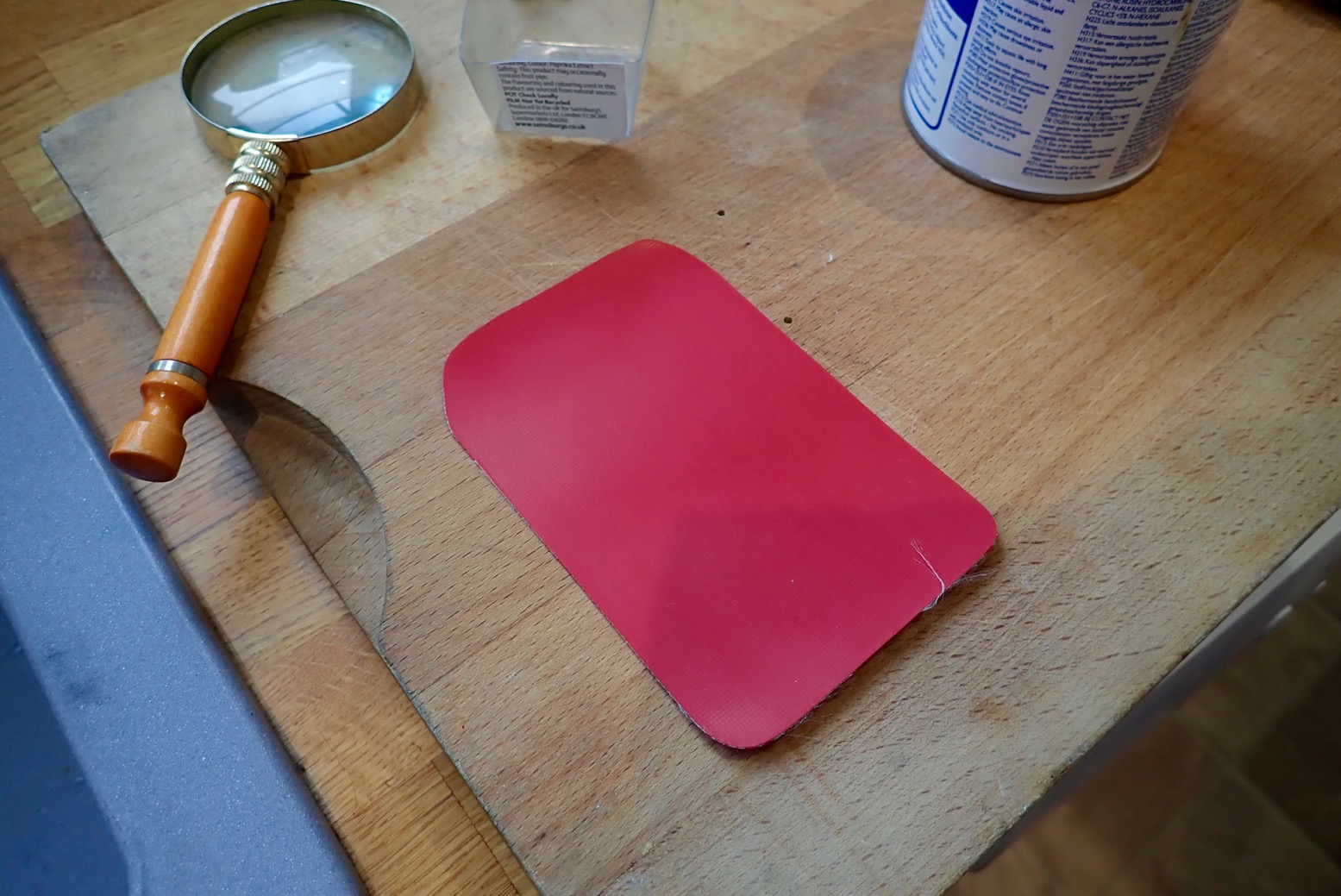
Patch
The right two-part glue (below left)
Solvent (MEK, Toluene) and rag
Sandpaper or abrasive foam sanding block (note: Toluene eats foam plastic sanding blocks)
Masking tape
Small brush or wipe-stick
Tyre repair roller (right)
Well ventilated space to do a good job

STEP 1 • Match up a patch from your collection, ideally identical fabric. For a small hole extend the patch at least an inch.
STEP 2 • Clean the punctured area and patch surface with solvent and wipe dry. This time all I had was brake cleaner spray, but ordered some toluene for next time.
STEP 3 • Sand down the two surfaces and then clean and wipe again with solvent. Avoid touching these cleaned surfaces with your fingers.
Some colour coming off is a good sign you’ve removed any sheen or patina.
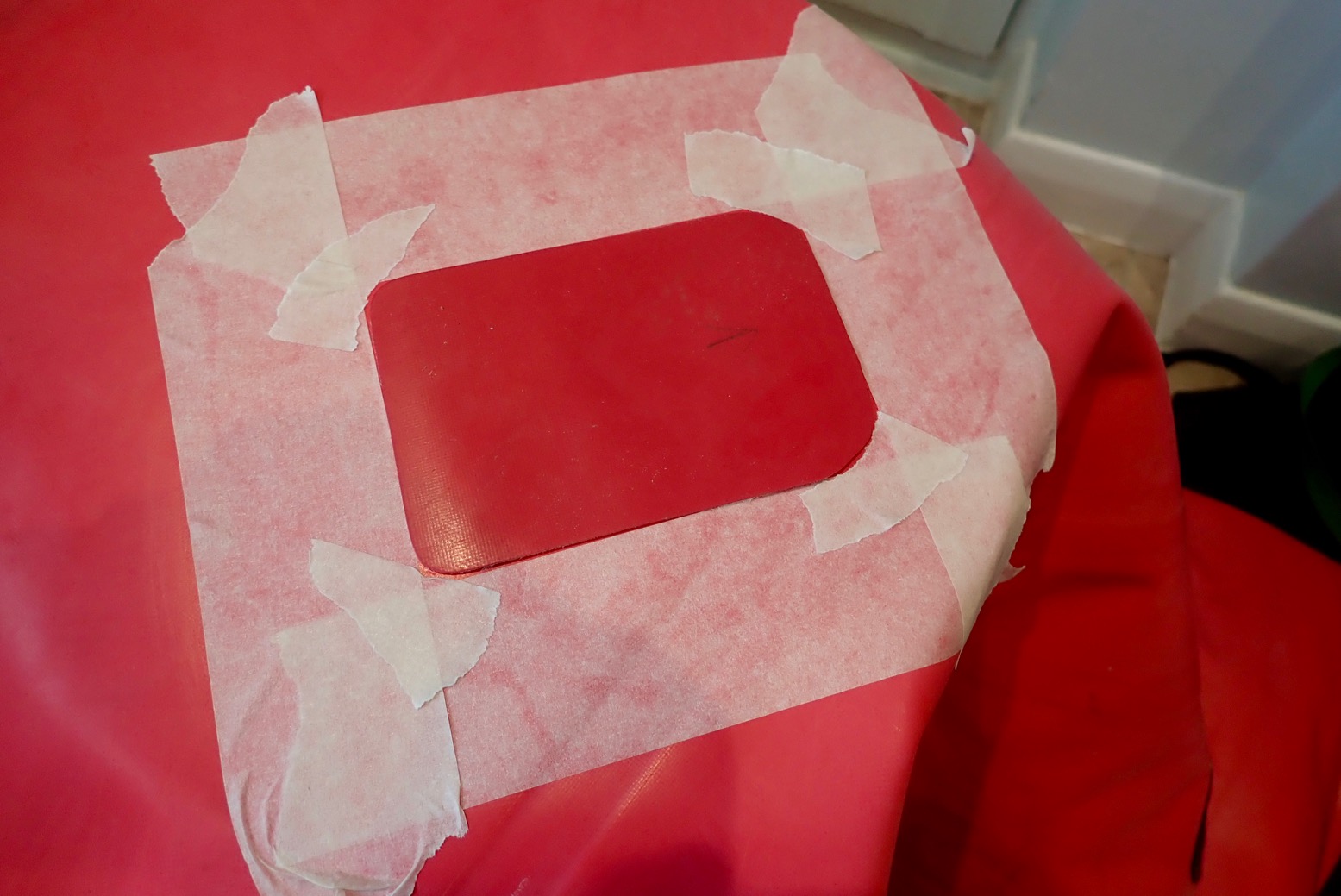
STEP 4 • Position the unglued patch and mask the perimeter with tape to avoid excess residue and to help with positioning. If the patch is not perfectly symmetrical (like above) mark it – but make it bold – I still got it wrong!
STEP 5 • Mix up some two-part Hypalon (Nitrilon; EDPM) glue. It’s rare than one-part glue works as well, but Aquaseal has worked for me, gluing a skeg-patch to a Grabner.
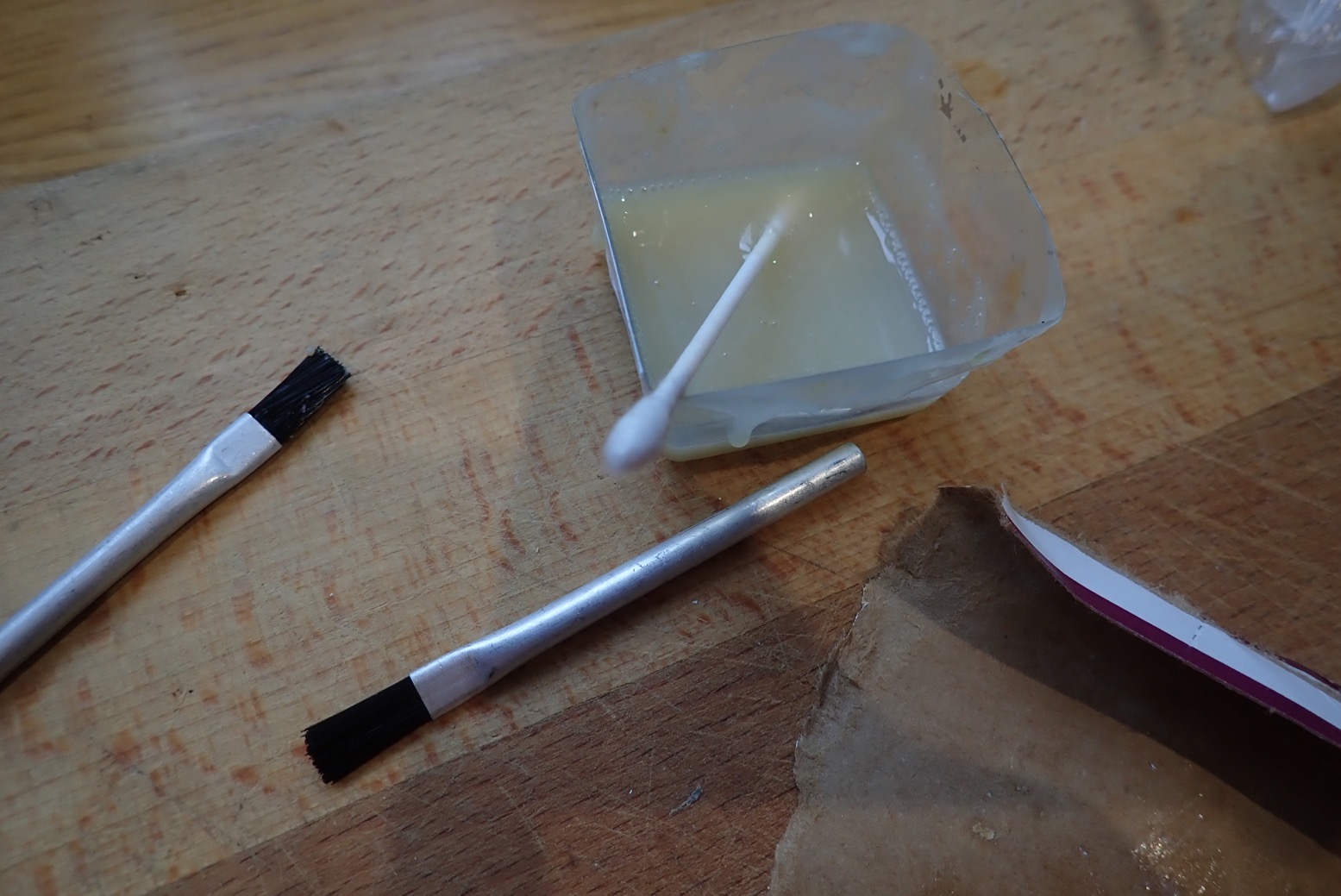
I found some mini brushlettes in my repair kit box – they must have come free with some glue.
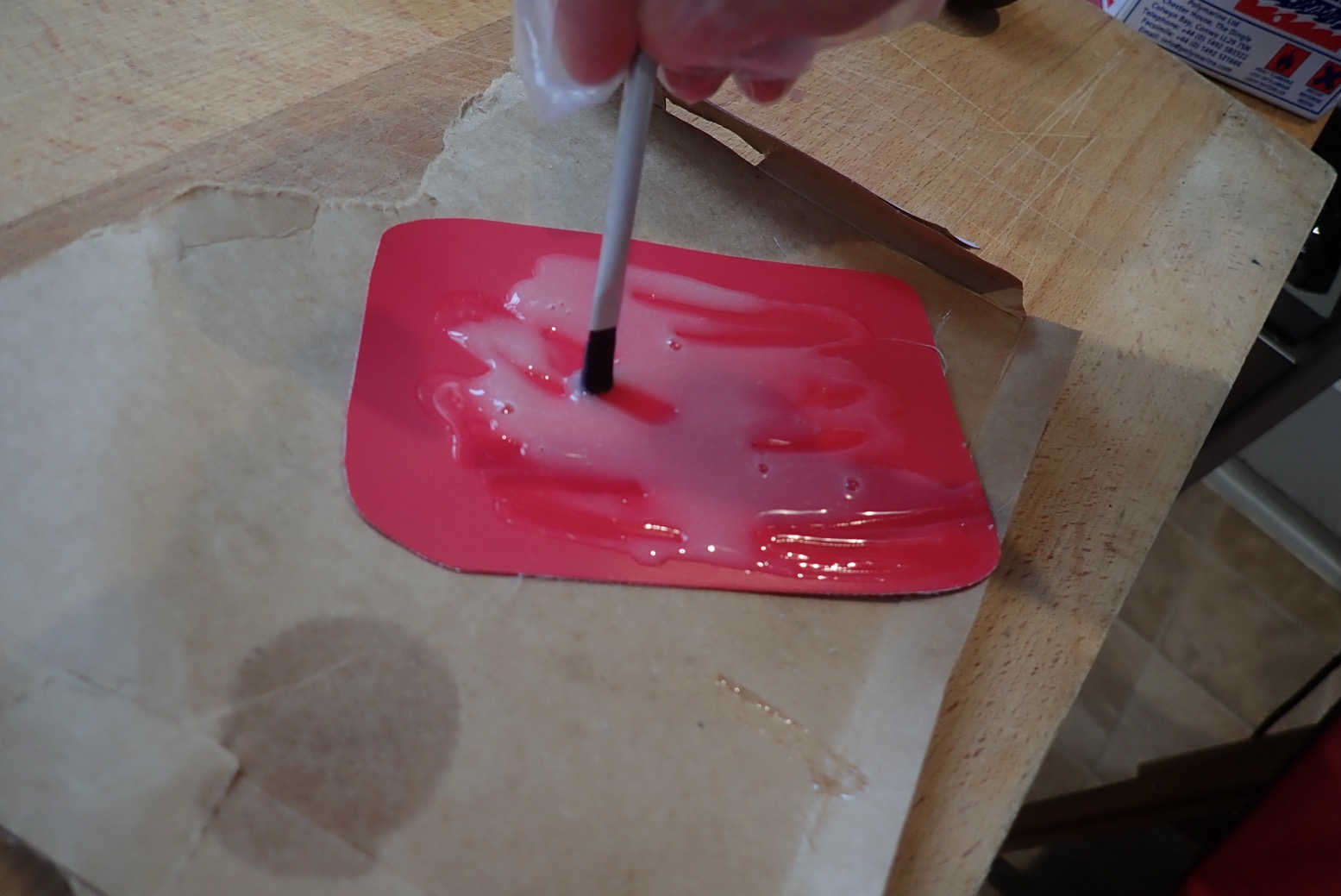
STEP 6 • Brush on the glue thinly to the two surfaces. With Polymarine you then to wait 30 mins for it to cure/dry, then apply another coat and wait till touch dry (5-10 mins). Here’s their full guide: http://www.polymarine.com/advice/hypalon-adhesive-how-to-repair-inflatable-boat-tubes
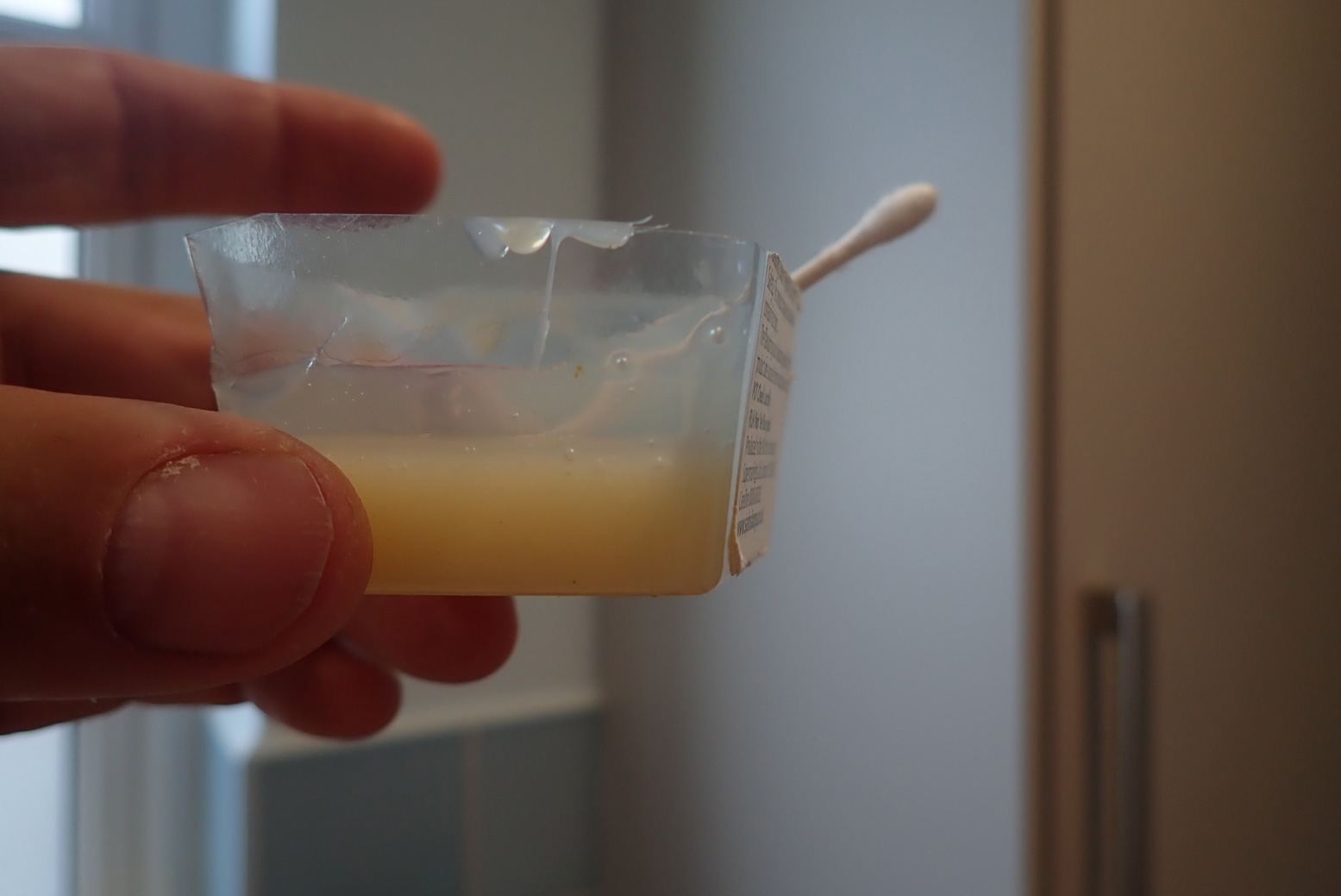
You can see I made typical errors: mixed up too much glue (but better too much than not enough)…
… and applied too much glue on the patch…
… but a just-right thin later on the hull.
STEP 7 • With the deflated boat repair positioned on a firm surface like a hard floor or better still, draped over a wooden stool, carefully lay the glued patch over the damaged area…
… then – STEP 8 • peel off the masking tape and ROLL DOWN HARD moving from one edge to the other and again at 90° and again diagonally with your Baltic pine-handled roller, making sure the edges have stuck down. It won’t hurt to roll again in 20 minutes and again after an hour to make sure the two parts have well and truly bonded till death do them part. And actually, only about 25% of the glue was wasted.
In 12 hours the repair is cured and ought to last the life of the boat. Never do that trolley thing again!

Six Packrafting Essentials

Packrafting Quick Guide
Packboat rescue and survival aids

fx-gear

The basic gear you need for packrafting adventures so you don’t end up as above, or simply just inconvenienced and wet.
For general camping kit (sleeping, eating, washing) you’ll find lists all over the internet and beyond. Mixing paddling with walking, I prefer a 1-kilo down bag, a compact tent, a thick, full-length air mat and a Pocket Rocket-like burner with a big Tatonka or MSR 500ml+ pot/cup and a Gimp stove for back-up
Below, I suggest cheap alternatives in green. A cheap alternative to a proper packraft is of course… a Slackraft but you’ll only every buy one once.

1. A pack for your raft

paragonnrs
nrsparagon01

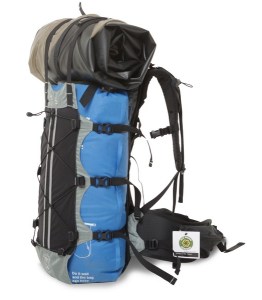
Do you use a regular hiking backpack packed with your boat in or outside, or a purpose-made drybag pack with usually a rudimentary integrated harness, or use a separate packframe harness as pictured?

If you’re a first timer and own a regular hiking backpack, make do with that, but having tried both I prefer a harness. You’re on the water so (unless you can store in the hull, waterproofness trounces all-day carrying comfort. A submersible UDB duffle is tougher, as airtight as a packraft and provides high-volume back-up flotation should you get a flat on open water; exceedingly unlikely but important and reassuring.

For short approach walks like on the Tarn, or the Kimberley, I used my UDB’s basic integrated harness: just sewn-on straps. For Turkey which was mostly walking, I fitted it into NRS pack harness (above left; no longer made) whose load capacity easily exceeds its straps and your back.
In Germany Anfibio Packrafting now sell the more sophisticated US-branded Six Moon Flex Pack (left; new 2021 design), a ‘drybag hauling system’. You can lash anything that fits within the straps, including your rolled-up boat. ULA Epic is another one. In Europe such harnesses seems unknown.
Remember: with any big backpack the key to support and comfort is a stiff board or frame connecting the hip belt and shoulder strap mounts so the weight can be carried low on your hips, not hanging from your burning shoulders.

Cheap alternative: any old rucksack and a tough bin bag.

2. Four-piece paddle

pad-abmr

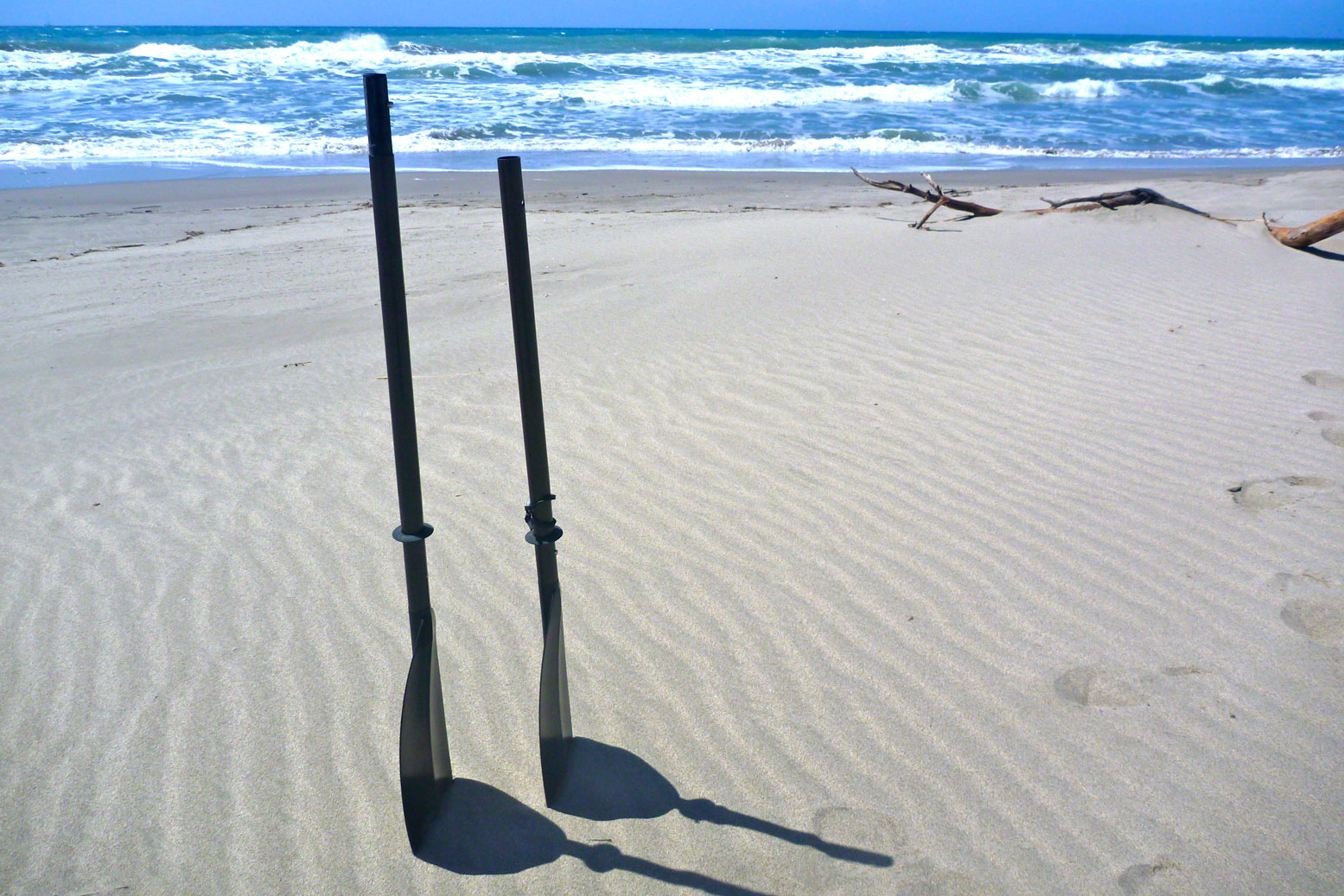
Get a paddle that breaks down into four pieces for easy transportation. A paddle like this may not be as stiff as a good two-piece, but the Aqua Bound Manta Ray left or the Anfibio Wave (right) will still be under a kilo and anyway, you’re in a slow packraft not a razor-thin surf ski. Some four-parters don’t like being left assembled when wet; don’t leave it out of the water more than a day or it may be very hard to separate.

feather

Even cheap alloy-and-plastic ‘shovels’ come with adjustable feathering; an ability to offset the blades. Flat (zero offset) works OK, but most find a bit of offset makes paddling more efficient. I’ve got used to 45° Right (left blade rotated 45° forward) over the years. Whitewaterists prefer 30°. Left handers will go the other way. The Anfibio Wave had infinite feathering and 10cm length adjustment.

Cheap alternative: A TPC 2-piece or similar.

3. PFD (‘personal flotation device’)

bbuey
499_1

A proper foam pfd is bulky in transit but is essential for remote solo paddles or whitewater (as is a helmet and a whole lot more if you’re really going for it).
For flatwater paddles and calm, warm conditions Anfibio’s lightweight inflatable Buoy Boy (left) has twin inflation chambers, rolls down to less than a litre in volume and comes with handy net pockets and a useful crotch strap to stop it riding up when you’re flailing around in the water. At any other time, you’ll barely know you’re wearing it. Note It does not claim to be a CE-rated buoyancy aid.

Cheap alternative: A used foam PFD.

tevafloater

4. Wet shoes
I’m on my second pair of Teva Omniums (left) which are do-it-all wet shoes that are OK for unloaded walking. If trekking the wilderness for days with a full pack over rough terrain, you’re better off with proper lace up trail shoes or boots, but bear in mind that anything with a breathable membrane takes ages to dry once soaked inside out. I use membrane-free desert boots. SealSkin socks are another solution, while they last. More here.

Cheap alternative: Old trainers or Crocs.

5. Day bag or case

P1290855
peli11

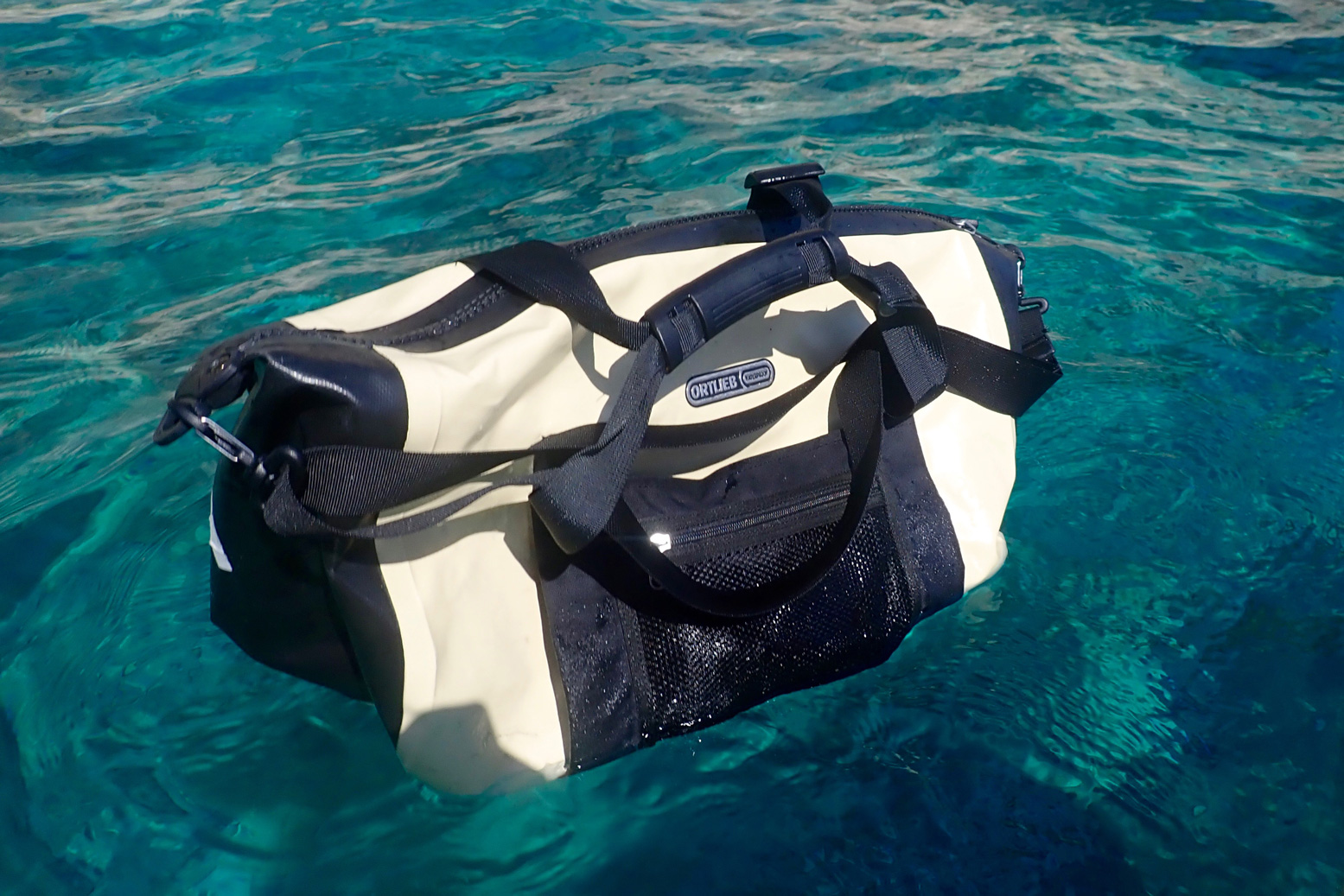
You want something light to carry your valuables when away from the boat in populated areas. Choose a bag or case which fits under your knees without getting in the way. Whatever it is, it will sit in water, get splashed or even submerged, so it needs an airtight seal. If it has handy external storage pouches or pockets, so much the better.

Recently in France I tried an Underwater Kinetics box (22cm x 16 x 8; 540g, above left) used on ebay for under a tenner. It’s about the size of a Peli 1150 but a bit less deep and took my Kindle Fire, camera, wallet and bits. It’s light enough to carry away from the boat and also happens to make a handy camera stand. 
But most of the time I use a 20-L Ortlieb Travel Zip (left) which zips open easily and stores loads. As for a camera? This is what you want.

Cheap alternative: large, clip-seal lunchbox and a plastic bag.

6. Repair kit

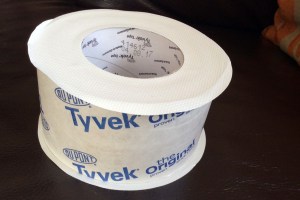
A couple of feet of Tyvec or similar tape and a small tube of Aquaseal is probably all you need for quick repairs. Something I’ve never had to do in all my years of packrafting.

Cheap alternative: Pieces of vinyl tape stuck to you spare repair patches.

Alternative to D-rings for IKs

IKavity

Michael S from BC came up with a good idea for securing stuff, seats or thigh straps to the floor of your IK without resorting to the faff gluing on D-rings – something that takes application and the right glue to do well.
He suggests the cavity formed between the floor and the sides when you pump an IK up can be used to jam in short tubes attached to tape loops. Example left is a Sea Eagle Full D-S, but I know Gumotex and other IKs I’ve owned have a similar space along the sides.

tieseawav

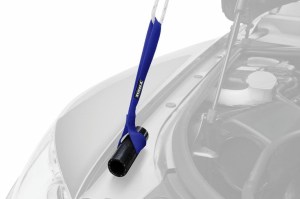
Pictured below are some Sherpak Quick Loop tie-downs which go from $15 a pair on amazon US. You can buy Thule ones for six times as much or search eBay for <Kayak Hood Trunk Tie Down Loops> sent from China for 7 quid. The idea is you shut them under your car’s bonnet, tailgate or doors (right) to help lash on stuff including boats.

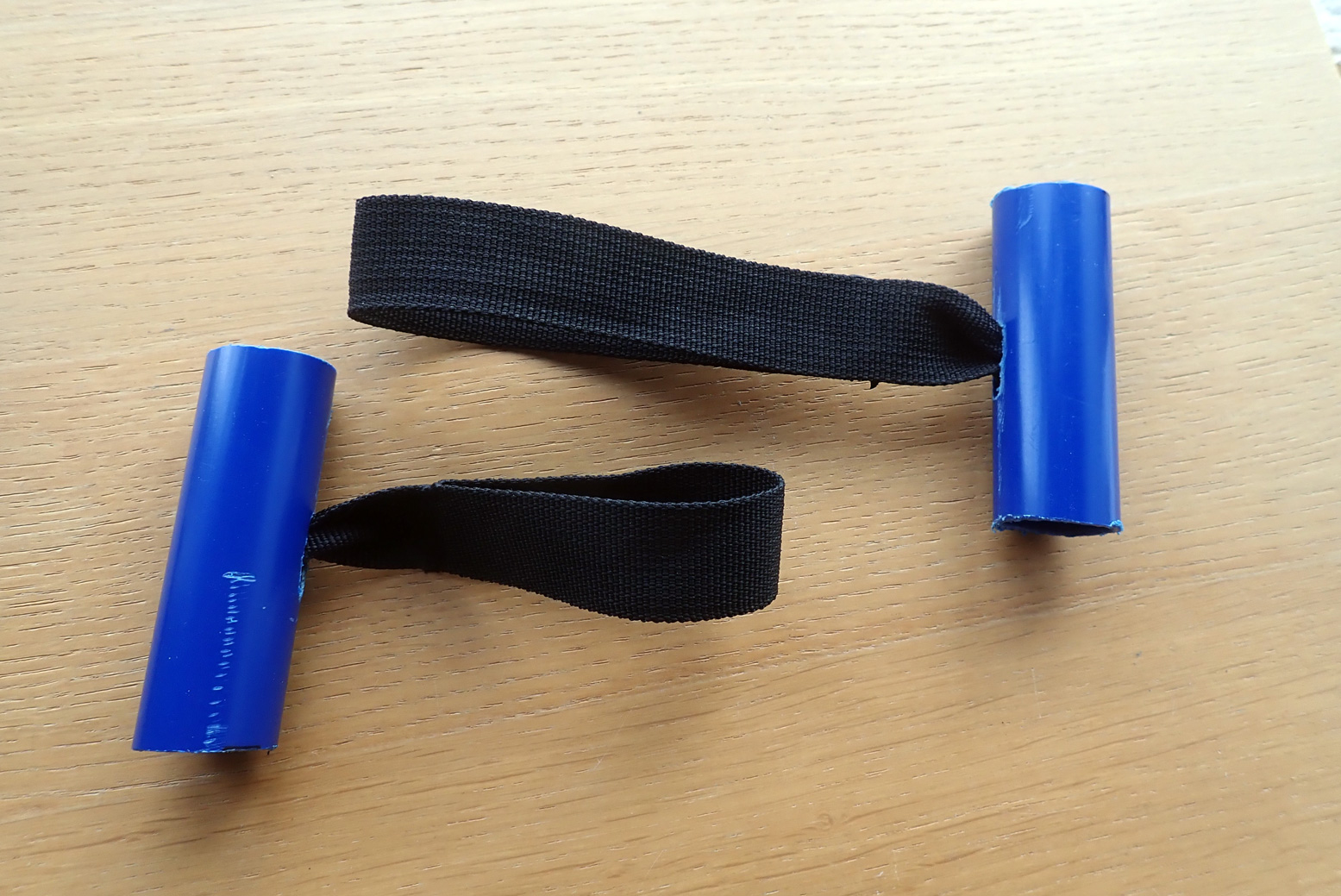
But they could also be lodged in an IK’s floor/side cavities as you pump up, and of course can be positioned anywhere and slid forward or back. It’s possible the 1-inch diameter tubes shown may be too small and pull out, so make your own using larger conduit from a hardware store, or just a shore-side stick and washed-up rope.
Below: I made my own. To be tested. Neato mosquito as my Kiwi mate used to say.