Category Archives: Scotland & Summer Isles

We paddle here a lot

Watershed Bags: Chattooga, Ultimate Ditch Bag, Westwater

‘One Dry Bag to rule them all’
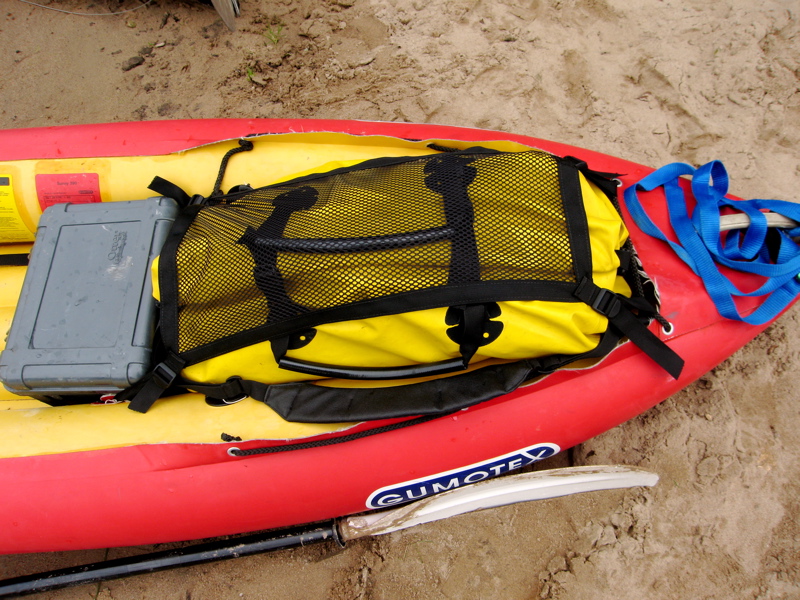
Roll-top dry bags (right) – even the best ones –  aren’t really submersion proof, are they. That’s fine for a SinK with hatches (unless they get flooded), but no so good for an IK, packraft or any open boat on rough water or in crap weather. When I pack for either packrafting or IK I find myself putting roll bags within roll bags to make sure important things stay dry while hoping I don’t flip as I know they’ll not resist a couple of minutes submersion.
A year or two ago I came across Watershed Dry Bags from the US which seal with a big rubber Zip-Lok like seal (see image below) – ZipDry they call it. They’re expensive, but were available in the UK.
In an effort to get one dry bag to you-know-what, I’ve got myself a 30-litre Chattooga ‘day bag’ duffel (below left) and by chance, on eBay an ex-demo Watershed Ultimate Ditch Bag turned up at 20% off (still £130). So that’s actually two bags.
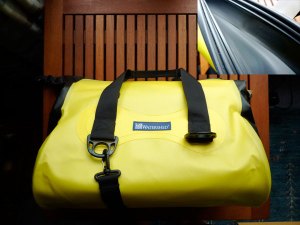
The Chattooga is not quite the rich yellow of the brochures, but a bit translucent which actually makes seeing inside easier when the foam and fleece liner  is not used. That’s another £18, but it may absorb ‘high point’ knocks to the outer skin as well as protect what’s within, though I’ve never used it as it takes up space. The shell plastic is a hard, slippery polyurethane rather than the soft rubbery vinyl of something like a SealLine Baja bag. It’s all RF welded and very solidly built. With the bag top rolled down as it is with a roll bag (not actually necessary) I’ve found this is submersion-proof.  Once in a while a spray of 303 as a moisturiser along the seal grooves helps it seal readily. The bag sits fixed to the mid-floor lashing point in my packraft between my legs for easy on-the-water access, and it fits neatly in the front of my IK and on the back of my bike. I’ve also divined that if things get desperate the Chattooga can work as a paddle float (left). My Chattooga got nicked in 2012 and I’ve since replaced it with another which seems a little thinner and shinier material, but otherwise seals the same. 
I replaced the Chattooga with an Ortlieb Travel Zip.

Ultimate Ditch Bag (more here)

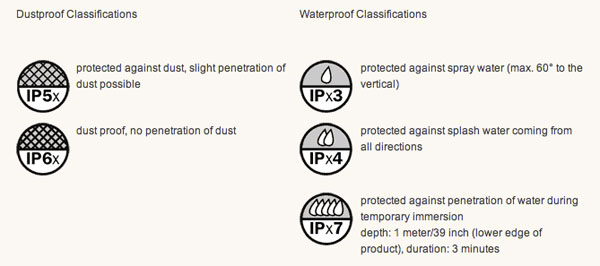
The since superseded Mk 1 Ultimate Ditch Bag (UDB; left) was unique to Watershed; a plain, big 96-litre duffel with basic detachable backpack straps, handy grab handles on each end and accessed by a single tough, dry suit-style waterproof zip, rather than the press-together ZipDry closure as with the rest of the ‘civilian’ Watershed range. My experience with dry suits is that amazingly, these zips actually work long after the material delaminates. Ortlieb have lately brought out similar bags in their usual soft fabric, but using what they call a TIZIP which looks like an ordinary YKK wetsuit zip to me and is only rated to the IPx7 standard (explained in the image right). I spent a couple of hours floating about in my Crewsaver drysuit the other weekend and nothing leaked; the UDB would manage the same while keeping the contents dry, and the fabric is much tougher than Ortlieb’s PVC. You could classify a UDB as ‘IPx∞’.
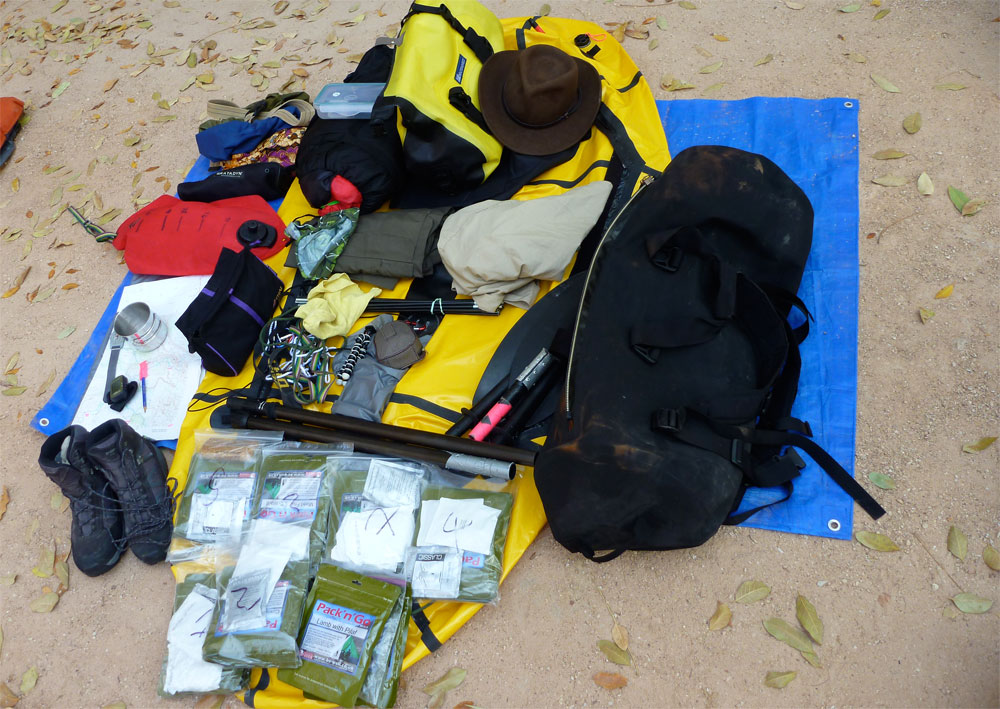
The UDB also has a complex, chunky inflation/purge valve for compression packing once the zip is done up or even to inflate the bag as a buoyancy aid if you’re in really dire straights and your boat loses air. This is reassuring when paddling a relatively flimsy packraft through a school of agitated swordfish or sea porcupines. If the boat goes flat you have a huge buoyancy aid to keep you out of the water and slow down hypothermia. And it can be used empty as an effective float bag inside a hardshell, folder or decked IK hull to limit the bailing required after capsizing or swamping.
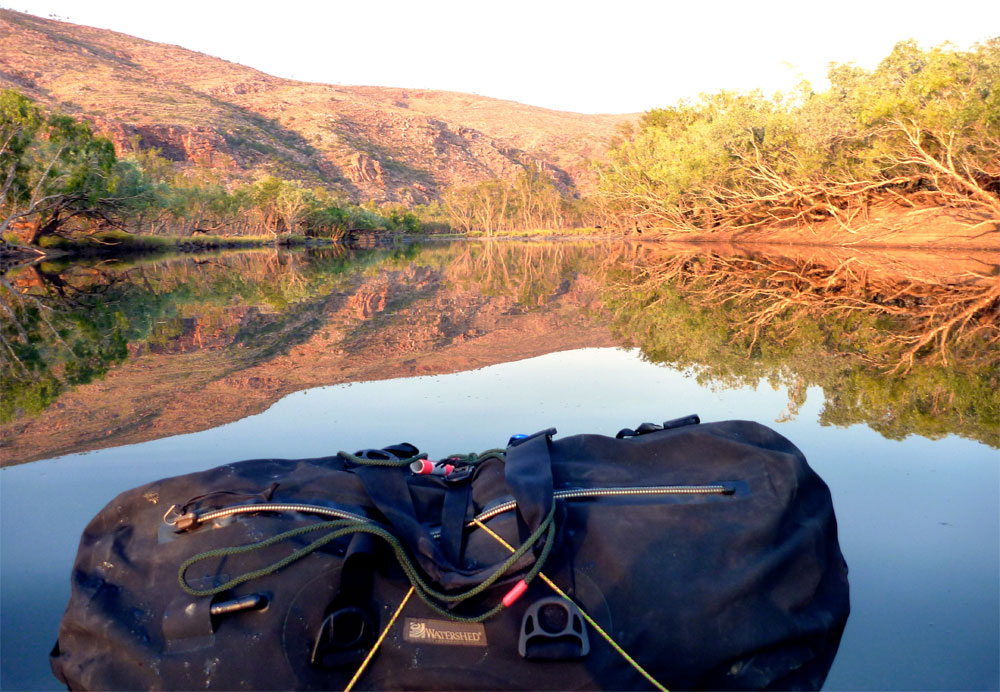
udbb

Apart from my down sleeping bag which might be too much of a risk, I’m now able to simply pack and access things normally in the yellow Chattooga and the UD Bag and so can downsize my collection of dry bags which were gradually taking over the room.
The UDB has proved itself as a functional packrafting backpack for the walking stages – more below, sea kayaking in Australia and remote river packrafting out there too. The good thing is the detachable straps can be modified or replaced with something better, although the UDB lacks any rigidity to carry its weight on a hip belt and as I say below, the shoulder straps’ position is too central. Plus you don’t want to strain those ‘probably-not-for-hiking’ harness fittings and risk tearing them off the bag (although they’re sewn to a patch as left, which is glued to the body, so not much chance of that rupturing the bag – unlike a Gumotex IK bag).

fgw-udb-4

2013: Watershed redesigned the UDB as a smaller, 78-litre duffel now made from their tough, glossy PU-coated fabric, but still with the dry suit zip and purge valve. Or check out their pricier military range of packs, below. IMO while not perfect, harness wise, the original UDB was a better bag. The canvas textured fabric gripped better, didn’t wet out, and the size and shape were just right to slip into a slim kayak or across a packraft’s bow.

Watershed UDB
The 96-litre UDB is big enough to take the raft, a dry suit, paddle blades, tent, sleeping bag and 2 days food

Walking with the UDB
As a backpack the UDB has been surprisingly good at carrying a load in Scotland for up to 3 days (40 miles). Part of the reason for the tolerable comfort was that the UDB’s relatively rough fabric and frameless ‘coal sack’ form grips right across the entire back like weak velcro and so helps spread the load. The chest strap helps greatly too, though I’ve half a mind to try the chunky, wide clip-on thigh straps from my kayak as shoulder straps to get two uses from one thing. It does lack exterior pockets like a conventional rucsac, but that can be got around by having pockets in your jacket or a using a waist bag.

Watershed UDB

Having used the UDB again in Utah and overnight in Scotland, I’ve reconcluded that the shoulder straps are located too much towards the centre of the pack which means that the pack sits too high on your back (see walking pic, top right), making you unstable at times. Loosening the straps to make the pack sit lower but isn’t the same thing as it’ll just be loose. Up to a point you could pack heavy stuff low and anyway, it’s clearly not designed as a full-time pack, but I must say that’s how I’ve used it when packrafting. It’s so convenient to just use it as a waterproof/submersible holdall: chuck stuff in, zip it up and get on the water. Occasionally I run beeswax along the zipper; a bar of soap will do the same and smells nicer. I’ve since got myself a packframe (left) but decided an NRS Paragon pack harness was the best solution to portaging. I used the UDB like this in Turkey.

watershedwestwater

Watershed Westwater
Recently I walked and cycled the Coast to Coast with an ’80’-litre Westwater pack featuring a regular ZipDry seal, thin shoulder straps with chest and an added hip strap. (They now claim it to be 65L) The load was only about 12kg but I found myself unstable in the hills as, with no proper hip belt, the weight was hanging high from the shoulders. On the Lakes stage it was very hot and the back was very sweaty, but it carried OK. Once I got on a bike and the weather broke, the pressure on my butt became exceedingly painful (no surprise there).

The pack is handy in that in dry weather you can simply roll the top over and clip it down, not using the ZipDry seal (as above left) and so easy day access. While sealed up in the wet you know the insides will keep dry. Again, I can see the Westwater working well lashed to a Lastenkraxe packframe with the packraft rolled up beneath it, or in a harness like the NRS Paragon or Flex PR. The only drawback is the slippery texture and shortness doesn’t sit so well on the bow of a packraft  (left) compared to the UDB.

Kayak and Packraft Sails

Page moved here

Feathercraft Java Inflatable Kayak review

In early 2016, Feathecraft dropped the Java/Gemini and Aironaut to stick with folding kayaks.
In 2017 Feathecraft closed for good.

javasection

In 2007 I was already looking to move on from my Sunny to something a bit longer and self-bailing (I thought this was a good idea at the time). The two boats that appealed to me were Aire’s hefty and wide Super Lynx and a Feathercraft Java (since then many new contenders have come on the scene). I decided to treat myself to the more expensive but lighter Java and picked one up from the clued-up FC dealer in Durango.

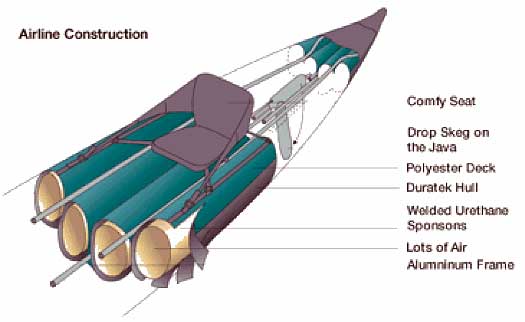
Set up is pretty straightforward: you slot in the alloy keel- and skeg pole and then the side poles, velcro them all in place, attach the seat by too many straps, pump up the four sponsons and off you go. Realistically, 20 minutes is a good assembly time.
It’s a sleek-looking boat for an IK; still today nothing else comes close, but one of the biggest hassles are the cheap inflation valves: basic turn-and-lock elbow valves seemingly off the end of a Thermarest (or indeed an Alpacka packraft where they work fine to top up, not inflate). The thin plastic hose on the hand pump supplied pushes on, but when it’s hot or wet it twists off, or if you pump too hard it blows off and the air leaks out. As it’s an open (not one-way) valve, you have to screw it shut quick. Maddening!
I thought for a while there was some component missing from the pump but no, this was it. I found holding the hose onto the valve with one hand while pumping the two-way pump with the other was an awkward but more effective way of inflating. Even if it’s bigger, give me a foot pump any day. Or regular one-way Halkey valves and a K-Pump.
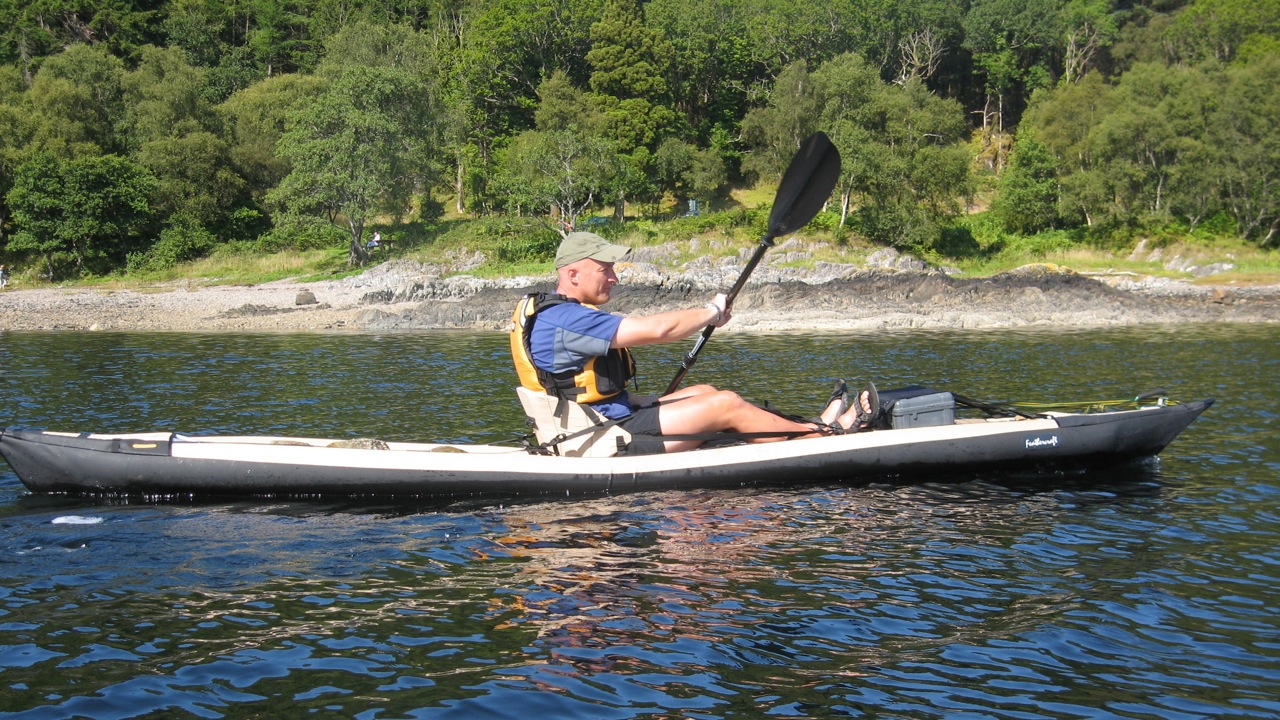
At 28 inches (71cm) wide, it’s just two inches narrower than the Sunny but feels much morem chiefly because you sit high ON it, rather than in it. FC are right in describing the Java as an inflatable sit-on-top. As you can see in the pics, under my 95kg weight, the poles are more there to aid the hull profile than enable longitudinal rigidity. It’s 15 feet 4 inches (4.65m) long but you can’t get much into the last foot-and-a-half at each end; the usual problem with IKs. The thigh straps are a nice touch or an admission that you may need them to keep upright.
I took it out for a scoot across the Vallecito reservoir in Colorado one evening with the two inner (floor) bladders not too firm and was relieved to find it not too tippy. On the way back I struggled with the pump some more to firm up the inner sponsons and found it less stable but still OK, and probably faster. And before I got caught out, I practiced getting back in off the water; as long as I crawled aboard without any sudden movements it could be done in calm flat water. But who ever falls out in calm water?

javahull

The retractable skeg is a great idea that’s only really possible on a self-bailer, but with the middle sponsons firmly pumped up the actuating string which comes up between them gets jammed. It’s best to manually make sure the skeg is fully down before setting off – but this negates the retractable feature.
At least you know that if it snags on the river bed it will just pivot up (but then won’t come down again). A good fix to help the skeg pivot with the string lever would be to have the string passing through a short section of thick garden hose or plastic tube jammed between the sponsons so enabling it to slide freely. The slot through which the skeg passes is also the bailing hole, designed I am told, to suck water out of the boat with a venturi effect as it moves over still water (less effective in a current going with the boat). Can’t say I noticed water rising as I stopped, but it sounds plausible.

Paddling without the skeg was OK on flat water but with it deployed you can power on. The solid footrests, thigh straps and comfy seat (also inflatable) all help here. One problem with the footrests is the angle they sit on: the poles force your knees outwards into the paddle arc. I also wondered how secure they were, screwed down to merely butt against a protruding rivet in the pole. A flat rather than pointy end to the securing screw pin sitting against the 2mm-high rivet might be better and could easily be done. Anyway they never shifted during the easy paddling I did.

The Java has neat cargo nets: easy to use and secure. I’ve since bought a pair for my Sunny. Inflation valve design apart, workmanship is what you’d expect for over $2000 with good attention to detail. The ‘envelope’ or hull doesn’t really need to be sealed in any way as the four sponsons or bladders slot into their respective cases and, with the poles, make this pile of nylon and rubber into the only IK I know that looks close to a proper sea kayak.

Next day in Colorado disaster struck. I left the boat drying on the roof of the car in the forest camp – black hull side up…  and went out very early to Silverton on the steam train. It had been a week of huge storms in the Rockies and camped in the forest I figured it would be OK in the shade and probable afternoon storm. But on the way back, when the bus driver mentioned it was a hot afternoon in Durango I thought “oh dear, I hope it hasn’t…”

It had. The thick black hull rubber had caught the sun nicely as it passed over the clearing and ruptured three of the bladders or sponsons. My lovely new boat, not one day out of the bag was a floppy mess. I yanked out a limp bladders (easily done) and found the rather light, flysheet-like ripstop nylon split, and pinprick holes in the airtight PU coating. That was the end of my Java paddling in CO. (A happy ending. I ordered a full set of sponsons from FC in Vancouver and when they discovered the boat was nearly new they generously offered to supply them free of charge. Good on you FC.)

Back home with new bladders, we went to Scotland and I tried out the re-bladdered Java alongside my old Gumotex Sunny. G-friend’s first impression was that I was too big for it probably due to its SoT stance. She had a point. And also it was too fiddly to set-up for my keep-it-simple prefs. She had a point again, and although it’s amazingly light for what it was, it’s still pretty bulky. In Denver I’d spend hours packing it carefully for the flight back for fear of having the near yard-long hull poles damaged in transit. On my bathroom scales in the blue holdall ready to paddle it weighs 17kg (37.5lbs). The boat’s envelope alone (no seat or tubes) weighs 9kg (19.8lbs). In other words, about the same as my Sunny but two and a half feet longer.

On the lochs the long, thin Java slipped along, with a speed of 10kph (6.2 mph) flashing on the GPS for a second, though 4mph was a more sustainable speed (video above). Let me tell you that is a very good speed for an IK, comparable with the Incept K40 I bought a few years later. (There are more useful speed stats on inlotusland’s blog about a lake near Vancouver in a blue Java.).

The Java kayak didn’t really feel right to me: the old problem of too narrow and me sitting too high for my weight. An experienced hardsheller would probably not have any issues. We went on to a freshwater loch, a little windier by now. I tried to visualise myself in a fairly normal one-metre swell out at sea. The rocks I added for ballast hadn’t really added an impression of stability (as they can do on other tippy IKs) and overall, with the height/width relationship I didn’t feel confident anticipating the less than flat calm conditions I wanted to be able to face.

javabailer

Back at the chalet the biggest hassle of all: the Java takes hours to dry, maybe even days. But dry well it surely must, especially when rinsed after a sea paddle. Sure, I’d read about this in some reviews, but it now dawned on me that the problem was common to all bladder IKs (like all Aires). Water will always get in the hull sleeves/envelopes holding the bladders as well as other crannies, and once there will always take a while to evaporate.
A spin in my basic Gumotex Sunny reminded me what a great boat it was: quick to set up, fast drying and good enough performance. If only it bailed. [2020: I now think self-baling is not essential for a tour boat; i just used my Sunny beyond its abilities].

The Java got itself sold on ebay. Lesson: try before you buy and if it’s not possible (as it wasn’t for me in the UK), be prepared to eat your mistake.

In 2011 I gave my sun-faded Sunny away and got myself an Incept K40 Tasman. The K40 was less fiddly than the Java to set up, though the time taken is about the same, but I still miss the ‘pump and go’ simplicity of the Sunny. That is why I then got myself a Grabner Amigo. But I sold that and got a Seawave, my best IK yet. 

There’s some Java chat on FoldingKayak.org. This guy in BC also had a Java then got a Gumo 410C. Looking at his pictures, I’m struck how ‘perched’ he looks while still being high in the water.

Around the Isles of Ristol (Incept K40)

Incept K40 Index Page

The first stop of the day, for a snack and a bailing session … was on the beautiful little Isle Ristol, where the curve of a petite beach reached out to embrace the approaching kayak in a shingly grin. Here were the rudiments of rest and refreshment in a spirit of abundance without ceremony, from the free-spirited dreams to the always-islands which soften the horizon and bring comfort to the eye. It would have made a wonderful camp, but I had come only ten miles and was good for a few more yet, heading north, away from the sheltered jigsaw pattern of the Summer Isles.

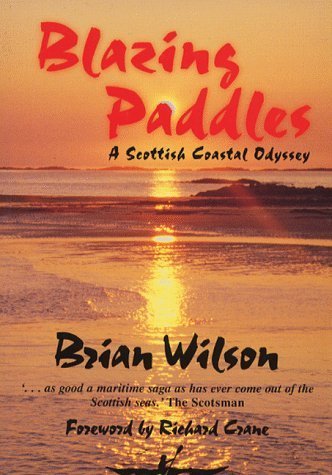
‘Blazing Paddles’ (1988), Brian Wilson

Today was a bad day for sailing. But for everything else, including paddling, it was about as good as it gets up here. The skies were clear, the sea was still and the breeze barely rose above walking pace.

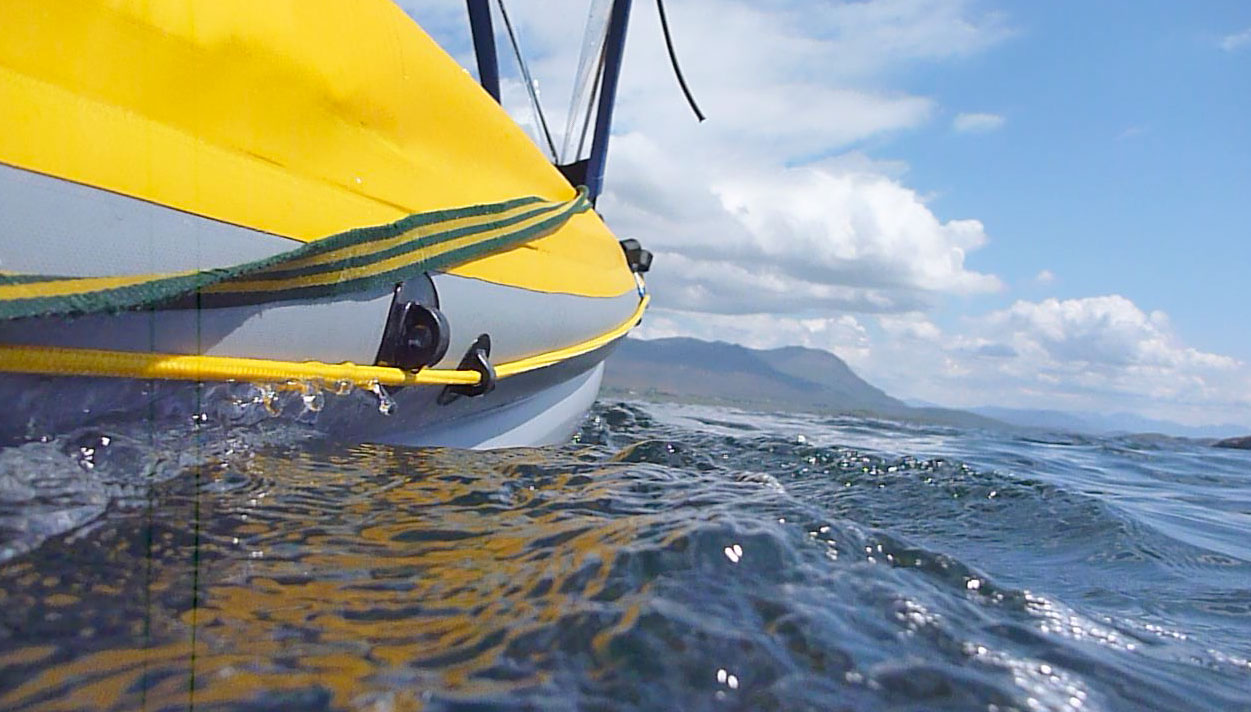
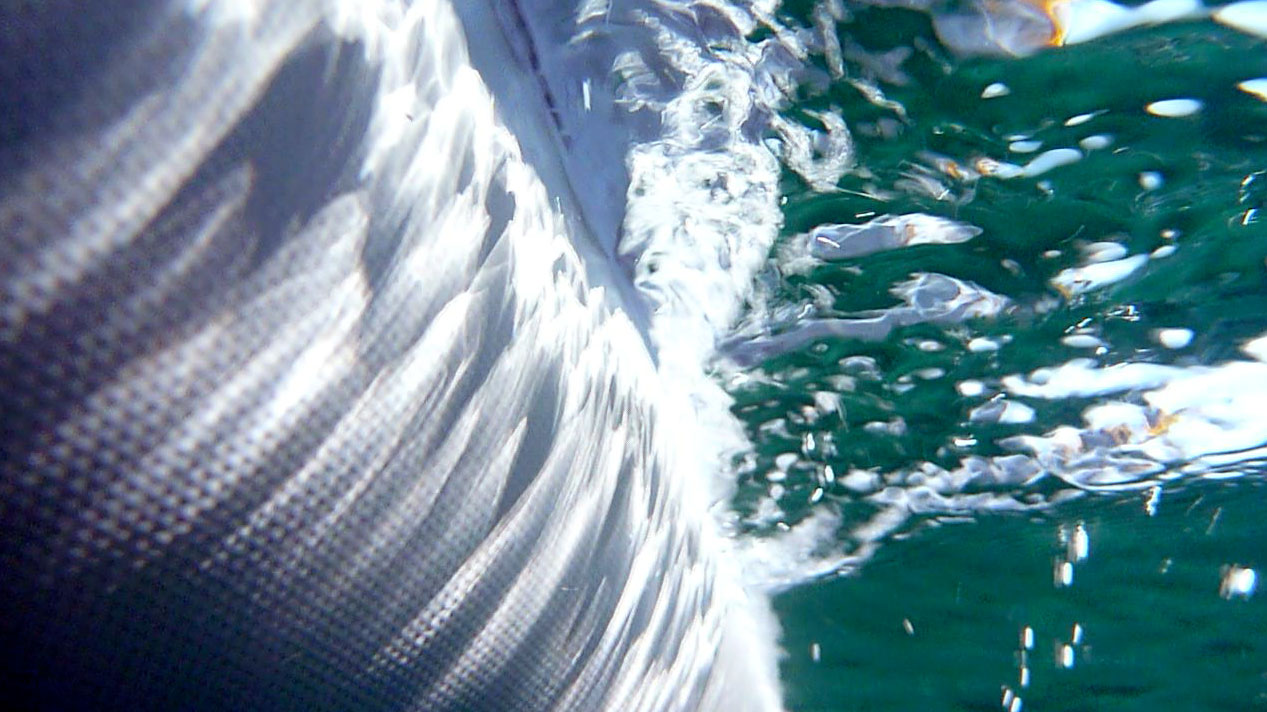
A day earlier I’d paddled off the beach 4km west over to Isle Ristol opposite Old Dornie anchorage. On that occasion, for the first time I actually sensed what must have been a helpful push from the outgoing 2-knot tide which was at its height at the time. Once at the island a lull presaged a change of wind direction and a light headwind rose up. So I popped into a small fissure for a look then sailed slowly back. With no rhythmic splish-spolsh, splish-spolsh, I realised how pleasant it was to be free of paddle noise and amused myself by shooting underwater vid with the rediscovered Go Pro. This ‘hands-free’ PA sail is still a novelty!

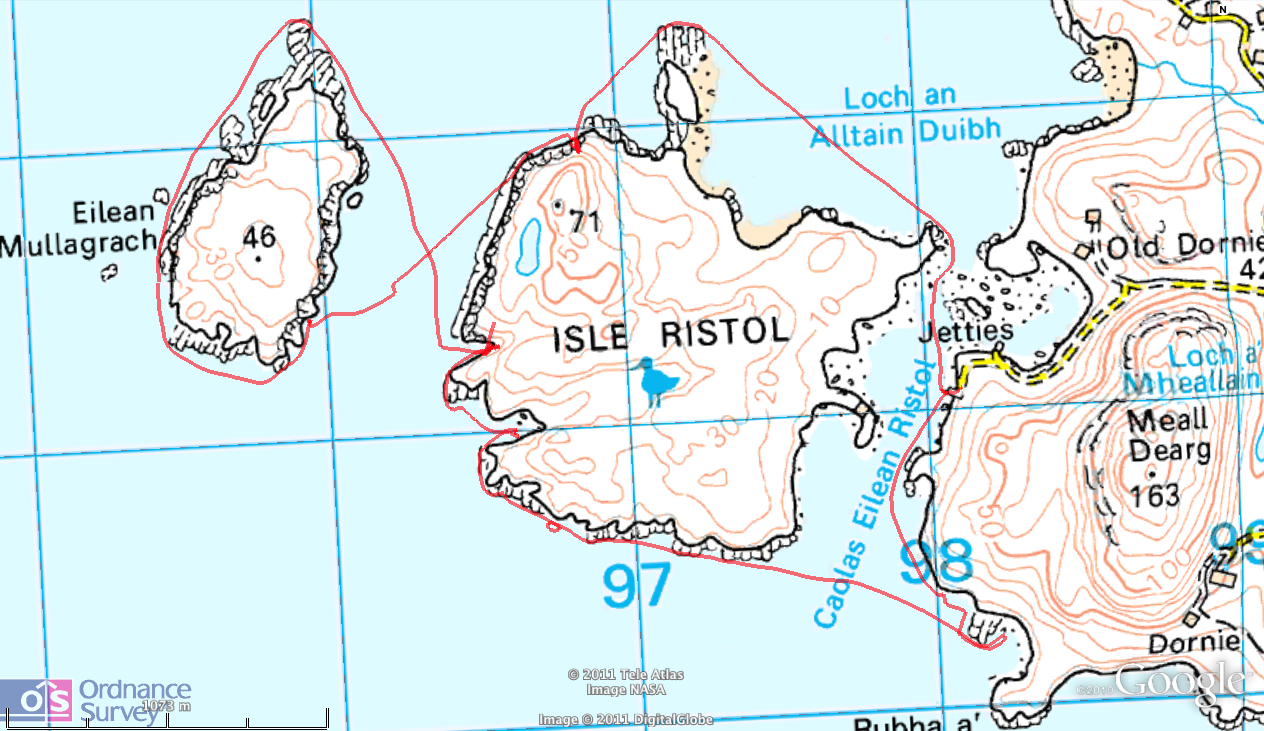
Today was going to require lots of splish and spolsh, but the tranquil conditions encouraged me to try something a little more daring: around Isle Ristol – all 4 or 5kms of it. It may not be Iceland or Tierra del Fuego, but there’s still a sense of accomplishment paddling out to- or right round an island.

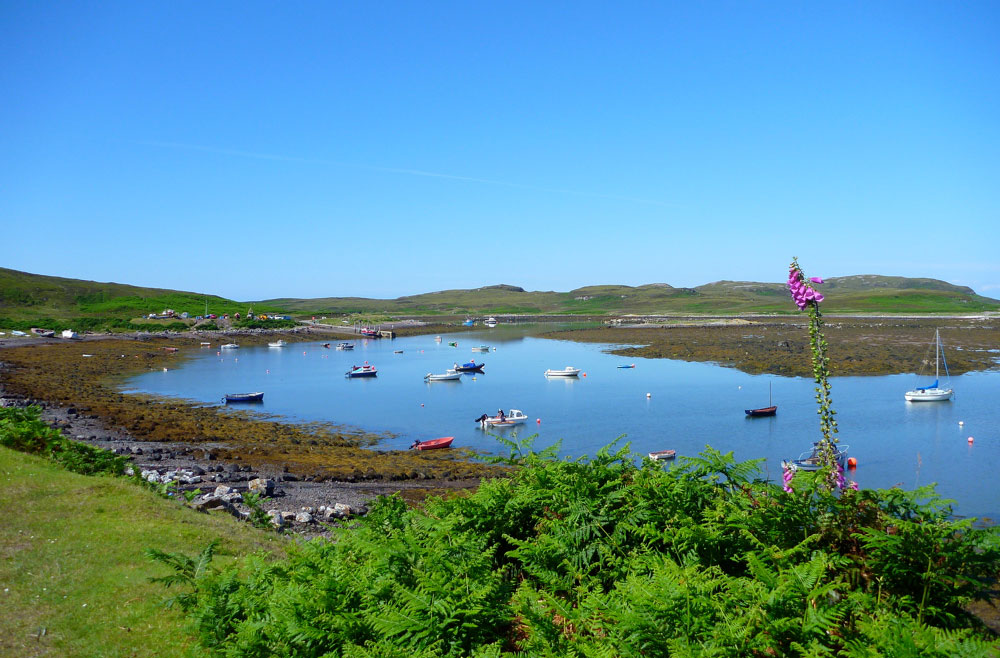
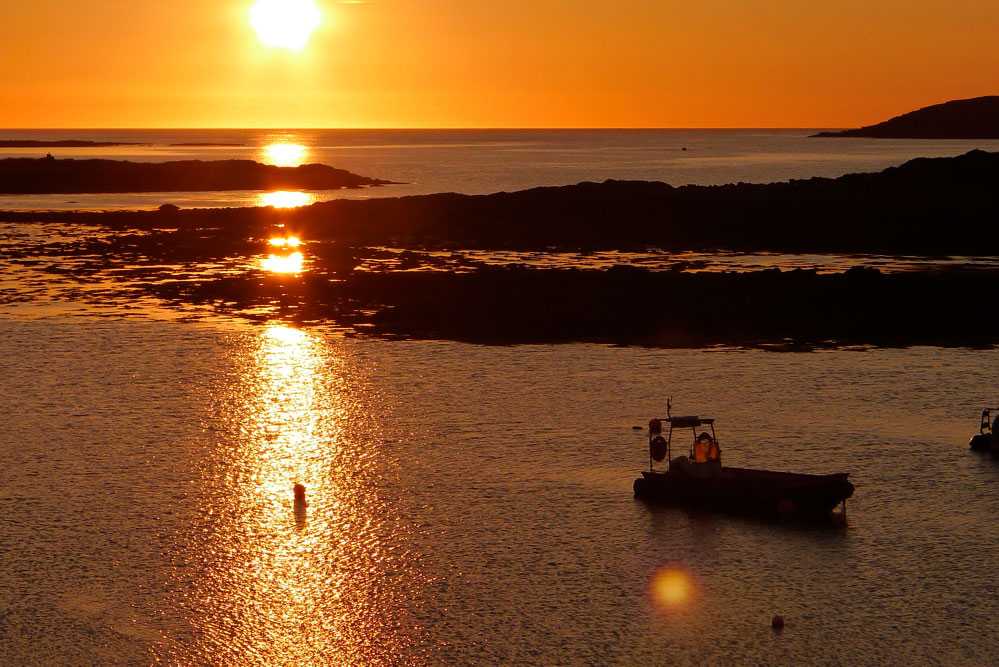
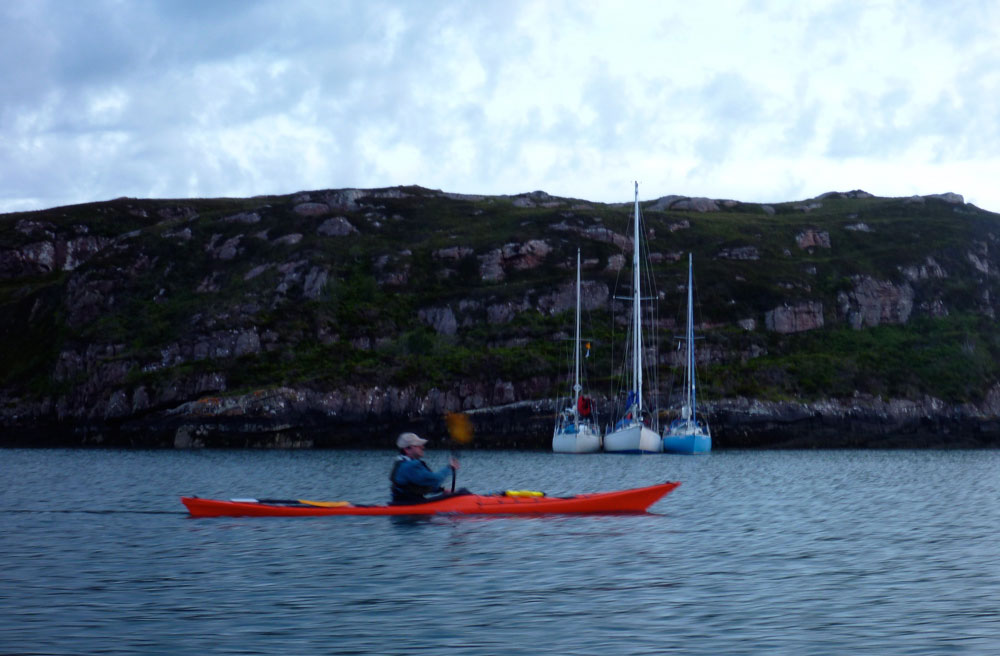
And it’s always fun to paddle out of Old Dornie (left, and bottom of page) as by Scottish standards it’s quite picturesque. A few fishing and rec boats bob around and on a very low tide you can just about wade over to Ristol through the kelp.
I set off at midday; an hour of so before low tide which (by pure coincidence) should have meant negligible currents swirling around between the isles. As it was a warm day and the K40 had been strapped on the car since yesterday, I took the trouble to re-temper the air pressure once on the cool water. The firm kayak responded by gliding swiftly away from the jetty and when I just paddled normally, I was doing just over 4mph.

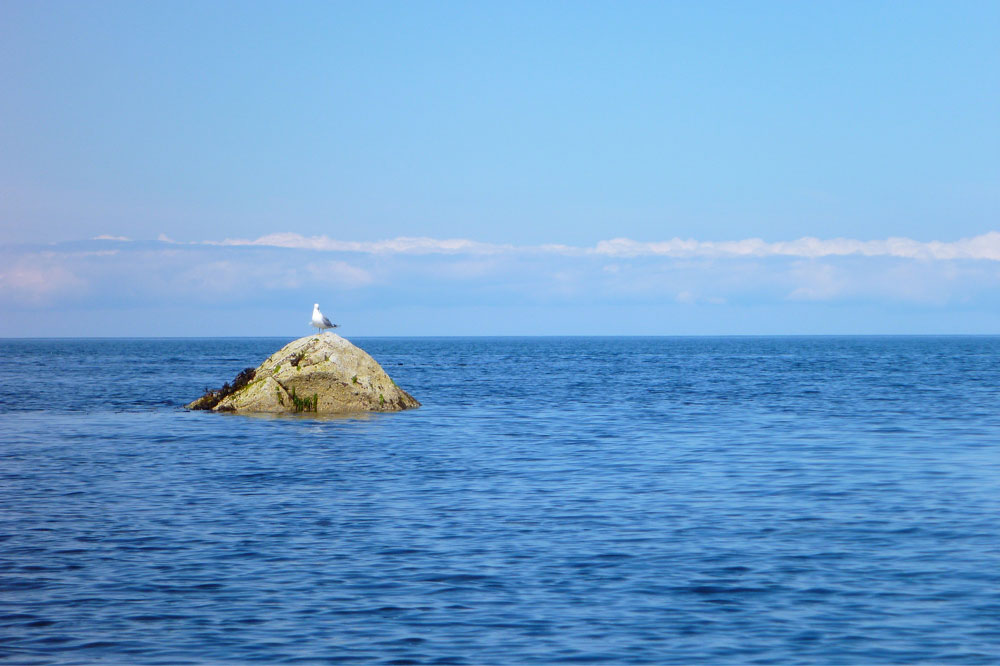
Low tide also meant more land to paddle around and I was forced out around the spur off the north of Ristol by the beach, and out into the unknown. Over the horizon a band of pink clouds lay over the Outer Hebrides as I passed a lone gull (all white seabirds are ‘gulls’ to me) perched on a rock, guarding the way to the open sea. I had a print-out of Ristol on my lap to read each passing inlet if, for some reason I lost my nerve. But beyond the sentinel gull, conditions remained tame.

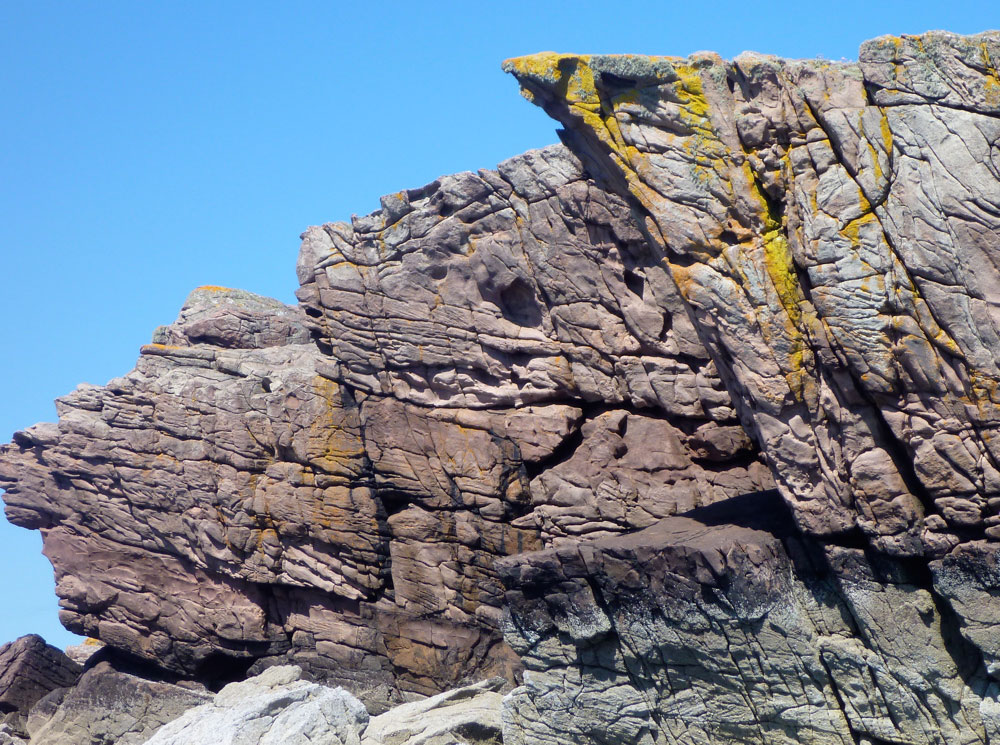
Encouraged, I headed in towards a tumbled cliff and the dark cleft of a sea cave, as wide as my boat is long. New to such probing and aware of the risks, last week while exploring the cliffs along the east side of Achnahaird Bay, I’d dared myself to paddle into a similar cave, catious but intrigued. As here, the over-amplified swell spooked me as it reverberated out from the dank base of the cave, and I was pleased to get out of there quick before some rogue wave came in and pinned me against the ceiling. It didn’t happen so, as with this whole game, you do something scary once and survive unscathed, you get used to it.

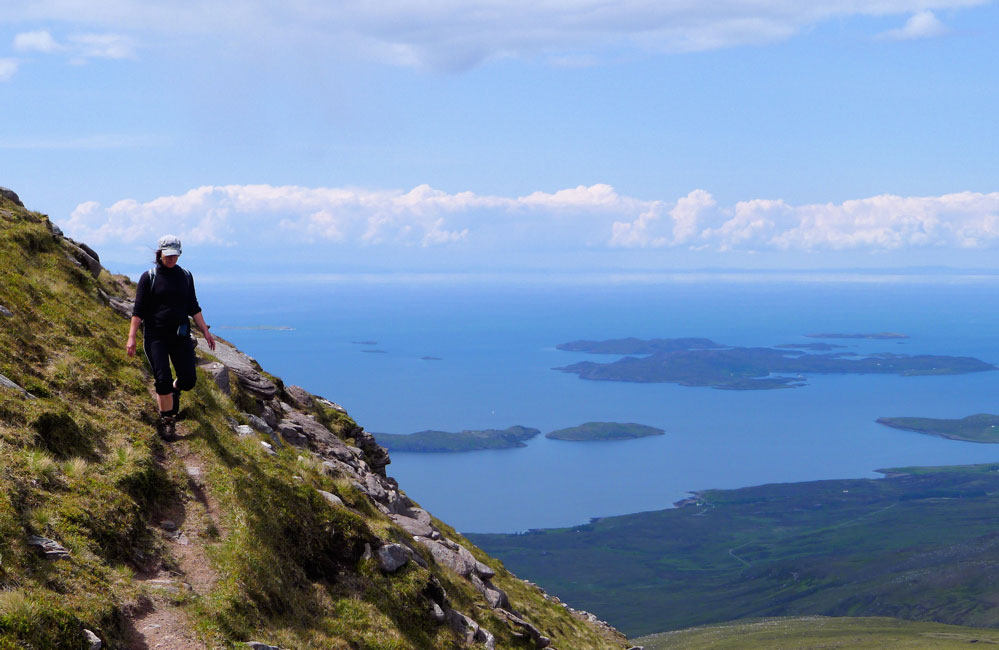
Back in the open and heading further out, I watched for the intimidating swells which never normally reach the lee of the Summer Isles where I usually paddle, but none came. Could it be so easy? I entered the 500-metre passage separating the back of Ristol with Eilean Mullagrach and decided the probability of making it across to that outer isle and back without ending up on the wrong end of an RNLI press release was really quite high. A few weeks ago we’d met some campervaners on Ben Mor Coigach mountain (above left), a great ridge walk that looks down on Loch Broom, Coigach and over to the Assynt. They were also packboaters and mentioned paddling their Advanced Elements double out to Eilean Mullagrach. Crikey, they’re braver than us I thought, as the weather was not so stable back then, but they explained they had a full complement of VHF, flares and all the rest. They’d mentioned an arch and a stack on Eilean Mullagrach which had intrigued me.
I aimed across the passage towards a likely looking inlet of fallen rock, but as I neared it I pulled up, listening and watching the seabirds bobbing about like me, or taking a running paddle back into the air. It was nice to just kick back and relax at will instead of endlessly going somewhere before something bad happens; a common reaction to perceived exposure and anxiety, and not just when a mile offshore!

Fact is I’m morbidly fascinated and scared by the seawhich is partly why I was drawn to those two trans-Atlantic books. I’ve been reading a lot of other sea kayaking literature lately;  back issues of OP magazine recounting unprecedented white-knuckle circumnavigations at record-breaking speeds, and just finished, Brian Wilson’s Blazing Paddles (quoted above). These yarns often sound like war memoirs; compelling and character-building experiences for sure, but not something I aspire to. Viewed from the outside, the UK scene seems to be one of testing yourself. Perhaps the prevalent conditions up here on the northwest coast demand it, because if you can handle it the reward is access to what must be one of the best sea kayaking locales in the world. But though I’m motivated by my own mini-challenges, such as reaching an island you could almost swim to, I’ve had my white-knuckle epics over the years doing other stuff.

At my age the appeal of sea kayaking is sedate touring which is what made Shark Bay such a memorable trip. Coast-hopping on calm, sunny days in warm water; what I’d class as ‘Mediterranean’ rather than Hebridean paddling. Like all the other means of transport I’ve used for more adventurous travels, a kayak is just the latest way of reaching and exploring wild places, rather than pitting myself against wild seas. Today, the edge of the Minch was more Aegean than Atlantic, and the calm conditions encouraged me to slow down and smell the sea breeze, nose around aimlessly or even just drift. For once no pressure to keep alert and moving in case an ill wind or foul tide called for the usual over-reaction.

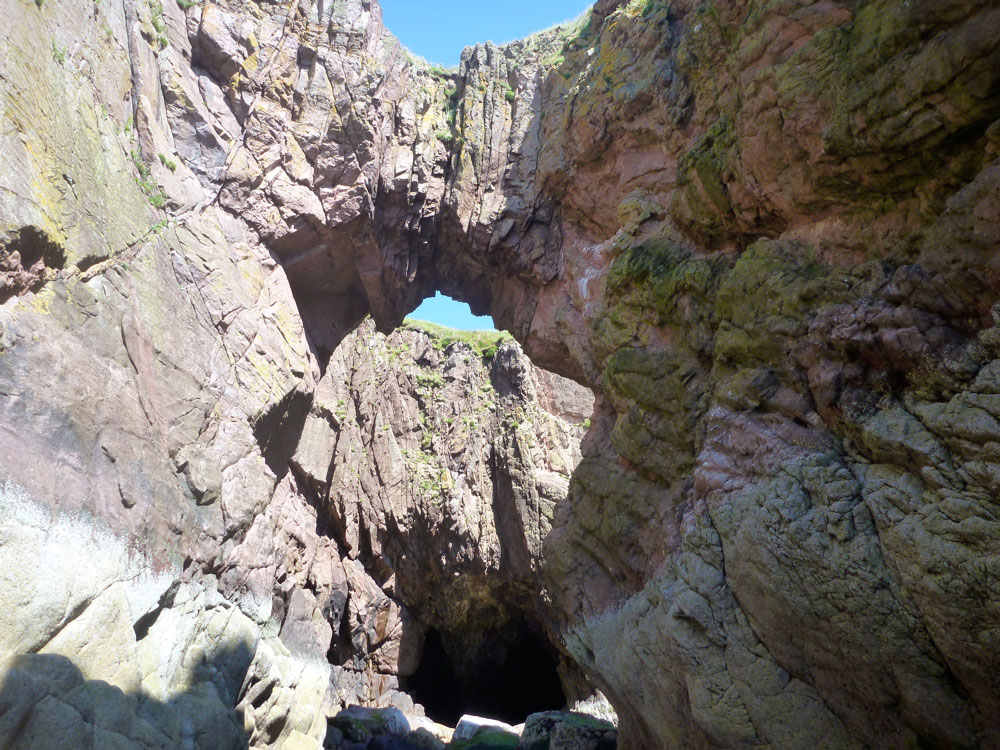
As I turned into the inlet on Eilean Mullagrach, I saw the arch the campers had mentioned unfold before me (left), spanning 40 feet above the shore. At the top of the tide with the sea level 4 metres higher, it would be easy and fun to paddle under it in a low swell.

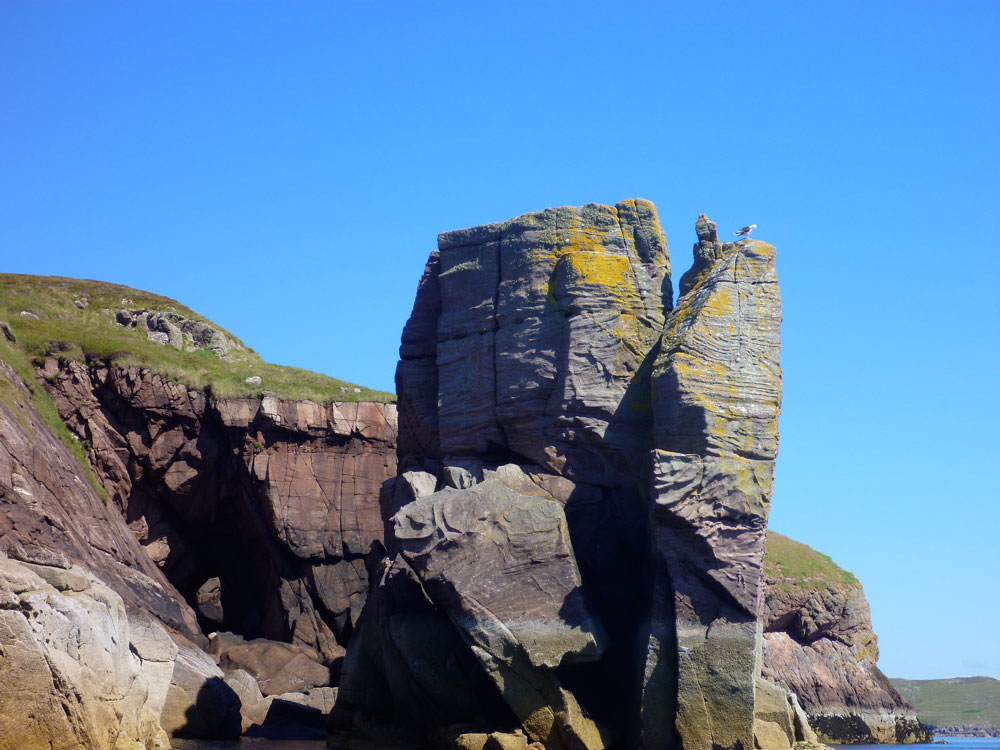
Pleased with my discovery I decided, heck let’s go crazy and carry on around Mullagrach too – or at least push out as far as I dare. I had no map for this island but knew it was about a quarter of the size of Big Ristol – 2 or 3 kms round – a lot less than an hour’s paddling, surely. As I rounded the southeast corner, there too was the stack I’d been told of, with the very same guardian gull on top, watching me like a beaky coastguard.

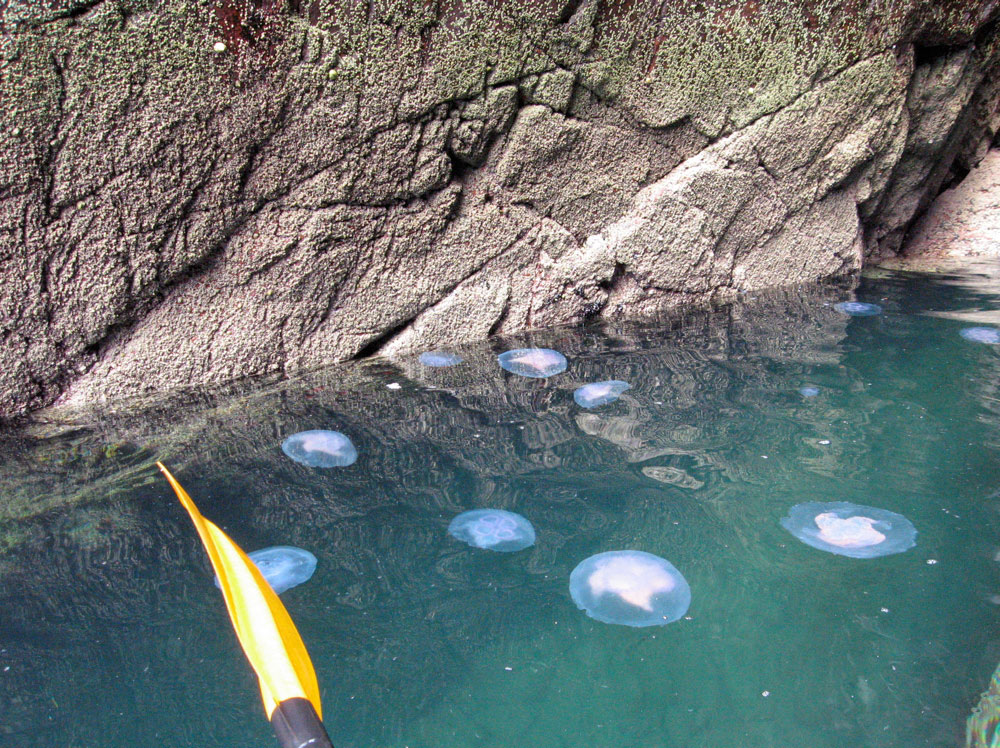
Again, at high water you could probably pass behind this stack; something to try for next time. I moved out west, into the dreaded Minch. With all land behind me, the light was suddenly much brighter, the pale blue sea stretching out to infinity. A light swell was breaking over some flooded skerries where a couple of cormorants looked out to the west as if waiting for something. Small jellyfish drifted past and I remebered how amazed I’d been to first encounter these exotic, dinner-plate sized blobs camping on the beaches of Arran in the mid-70s. Jellyfish? In Scotland? Whatever next – dolphins, harbour porpoises? We saw a pod playing out in the Bay one evening last week. Nice though it was to commune with nature, I was actually rather conscious of my exposure here and so paddled along briskly, keen to catch sight Reiff hamlet at the end of the Coigach peninsula, and the back of Isle Ristol soon after. At one point the swell got a little alarming and the boat squirrelled about, but I steadied my nerves – just keep paddling forward while avoiding the surf and rocks.

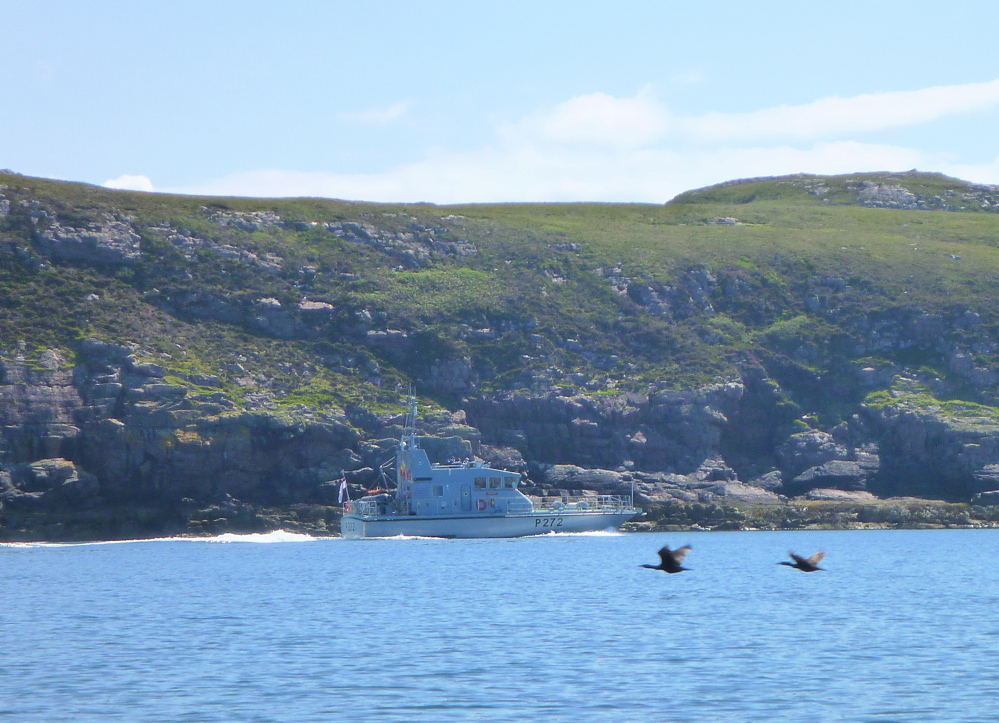
Coming round the north spur of Mullagrach where the low tide had annoyingly prolonged my excursion around another spur, what looked like a navy patrol boat came down from the north. What were they doing up here I wondered, and why were there people dressed as civilians on board? Perhaps it was something to do with the tall ships due into Loch Broom on the weekend, although the probable answer is right here.

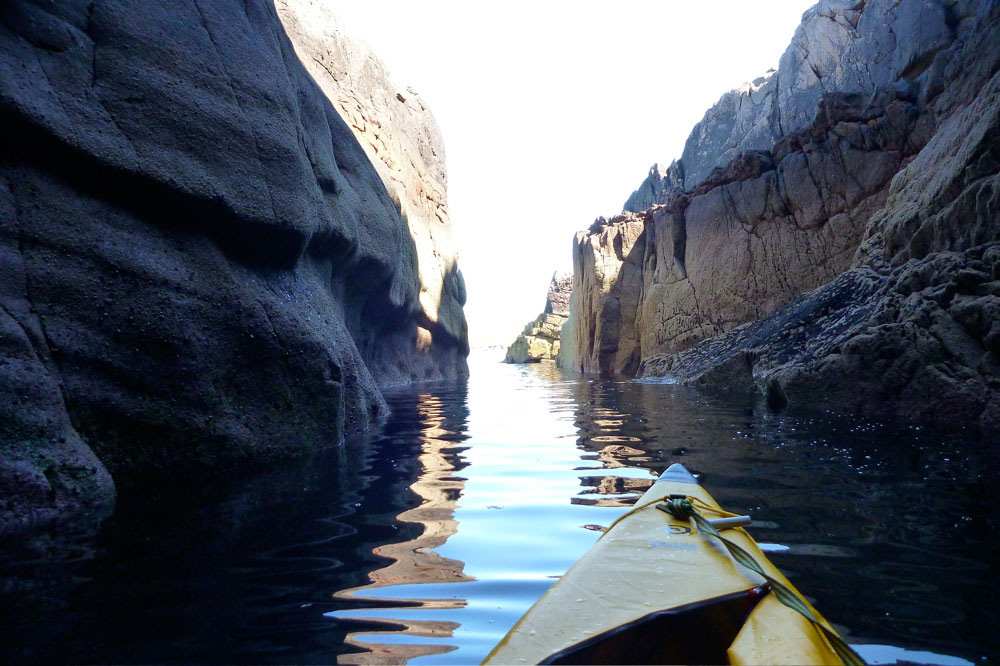
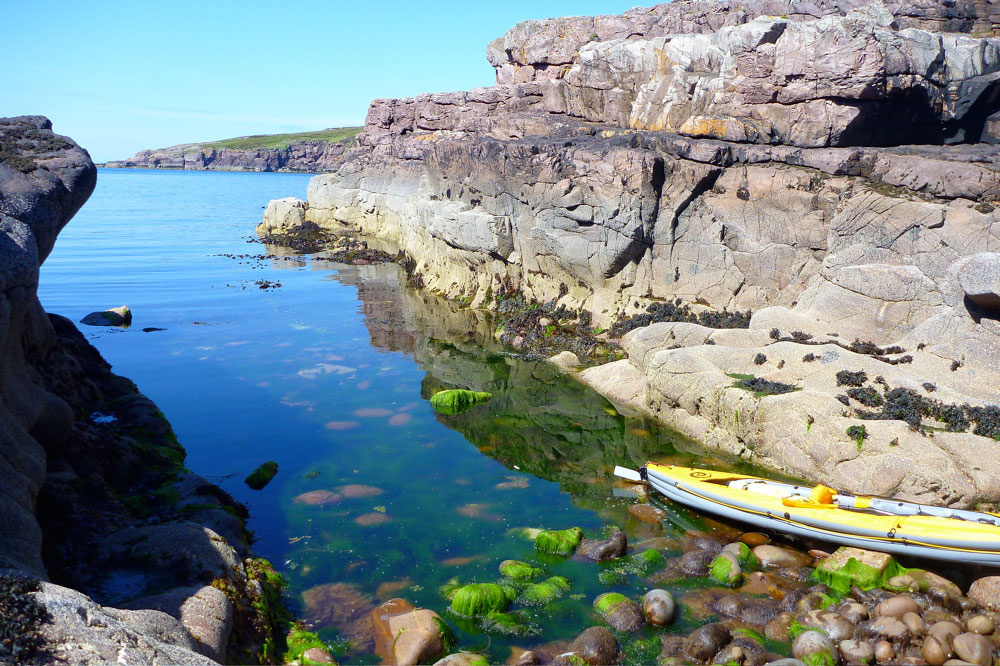
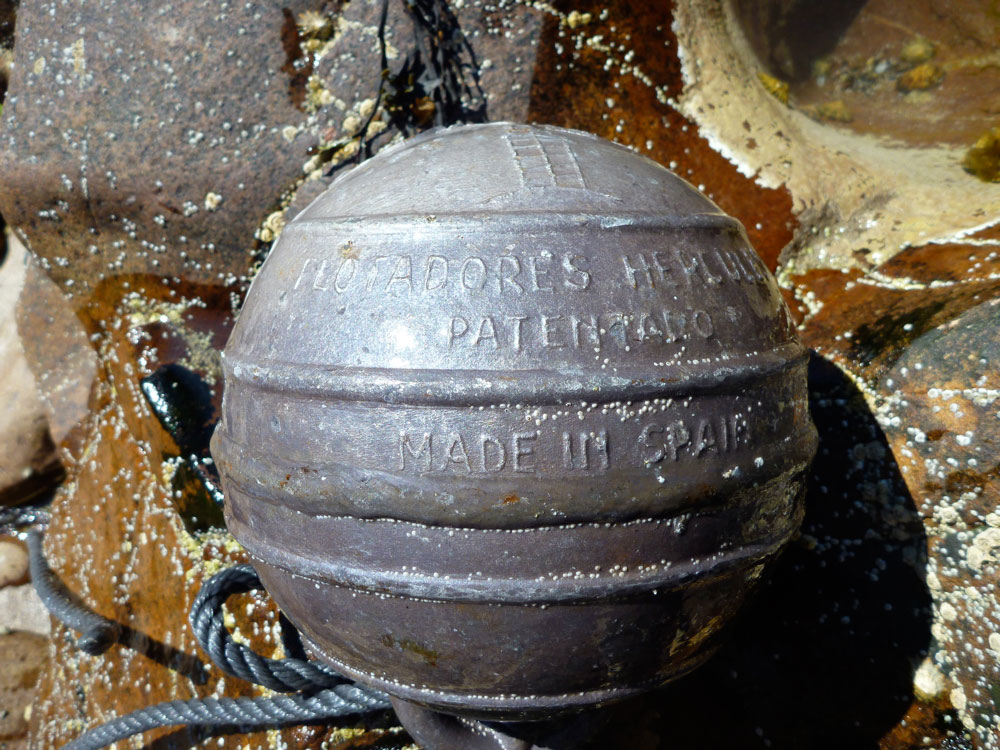
By some geo-tectonic miracle, Isle Ristol turned up just where I’d left it less than an hour ago; with some relief my paddle past the edge of my known world was over. All that remained now was to dawdle back to Old Dornie, dipping in at an inlet or two along the way to see what I could find. At the back of one narrow chasm (left) among all the usual plastic detritus I picked out an odd buoy that looked like it was made of pewter (above left). Most probably it wasn’t a relic from the Mary Rose but merely corroded aluminium, but it struck me looking at it later it could be a circus bomb with a dangling fuse.

With it all at my doorstep and work that can wait, I’ve done some great paddling around the Coigach these past few months, but just as the weather’s settling it’s time to head back south. So, rounding the Isle I decided to head string things out and across to the ‘Wasp Factory’ bay where I’d had a memorable evening paddle when we first got here back in May. Today’s figure-of-eight tour of the Ristols had been a perfect climax to a short summer’s paddling in the Summer Isles. If you wait long enough, these days will come, even in northwest Scotland.

Blazing sunset

V-sailing slowly (Incept K40)

Incept K40 Index Page

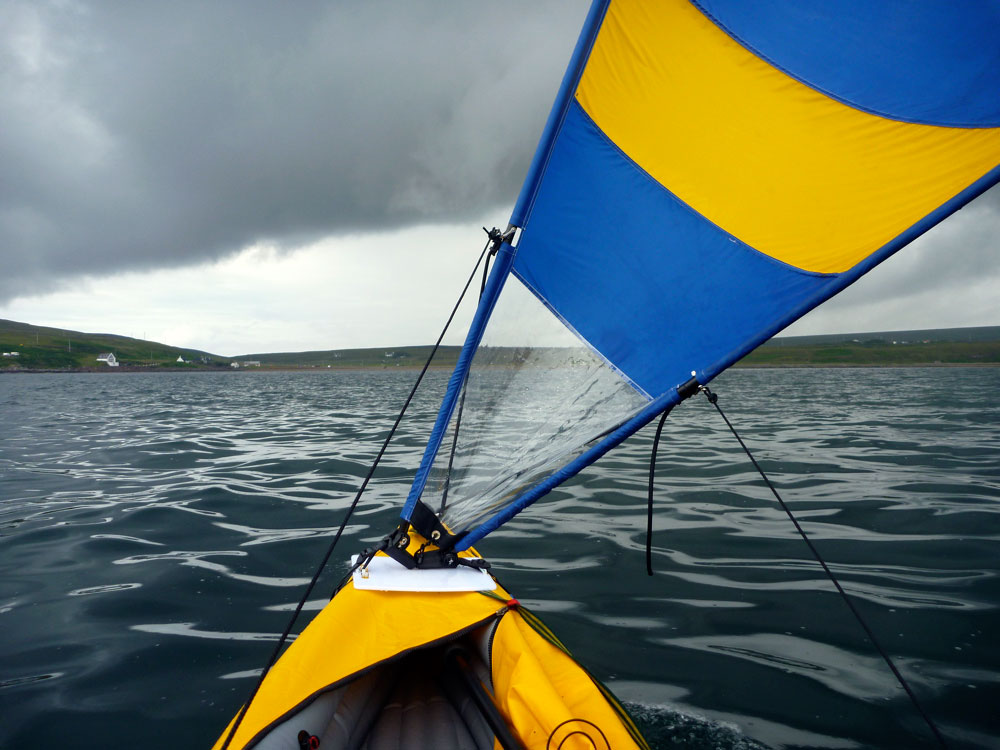
Not much wind today, but with a few refinements to try out it was worth taking the Pacific Action sail out on a regular ride over to the island.
I chose my big-faced Corry paddle and it has to be said it’s quite a strain (the opposite of a Greenland paddle) when you’re a bit out of condition. But then I bought it primarily for the packraft. What felt like a worthwhile breeze heading out to the island was probably more than doubled by the 4mph I was chucking out. Knowing I could afford to be, I was pretty tired once I reached Tanera Mor’s rocky shore. The state of the tide? who knows – coming in I think so it was with the wind, but I really think it makes little difference around here most days.
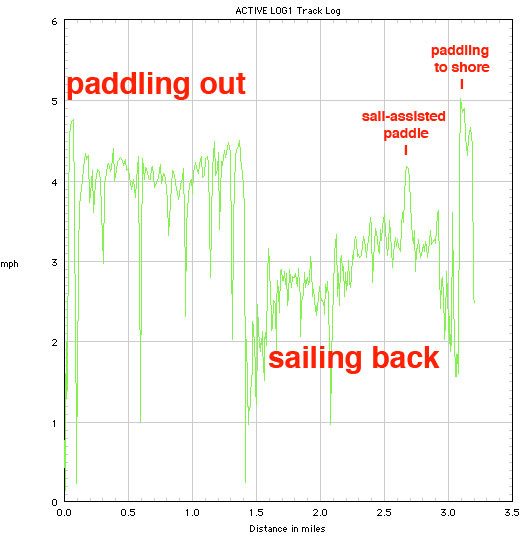
As the graph left and the video below both show, I had a bit of trouble getting it up and never got close paddling speeds while sailing back. But once I did get on the wind, it was a bit of a revelation to find I could pin the sail at a certain stance and, providing the rudder was on the case to, just sit back and enjoy the slow ride. It may have taken me longer to get back, but I could have easily read the Sunday papers, checked my email or just looked around and enjoyed the scenery, had most of it not been suffocated by the clouds of an imminent downpour.


It was also a surprise to learn I was not the prisoner of a given wind angle, but could modify it by up to 180° or maybe even more. At one point back near the beach, from the lapping of the passing waves across my beam it looked like I was paddling a few degrees upwind. Conditions were exceedingly tame but the cord-lock things worked pretty well and their position alongside the cockpit was just fine to slide them up and down.
At one point I tried paddling with the sail which I’d assumed would be rather tricky. Sure, the control cords got in the way a bit, touching my hands as I paddled, but it was possible to paddle lightly and so – as the graph shows – raise the speed with little effort to 4mph. Had I tried paddling harder I think I’d have outrun the sail, but it proves a good point: it need not be either paddle hard into the wind or sit back and sail; you can sail and paddle too if conditions allow- or enable it, gaining a bit more speed and exercise. I may try fixing the shock cord a little further forward to the nose which may help keep the sail up at marginal (low) angles or low wind speeds. I also need to tighten the webbing a little more, so the mast feet touch directly toe-to-toe so that, at the angle they’ve been locked against the masts, they’ll splay the sail out more readily.
The Google Earth screenshot of the GPS track on the right features the long-sought OS layer – useful as GE’s close-up resolution hereabouts is terrible. With it you can depict all the accuracy of a true GPS track over a detailed OS map. It’s a simple kml file found here. Download and open with GE and it’s there to click in the sidebar on the left when/if you choose to view OS maps in GE. Thanks to Gael A. for sending the link.
As things stand today I’m pleased I bought the PA sail; primarily for its simplicity of installation, deployment and possible repairs, its ease of use in the hands of a sailing beginner like me, the compactness when furled, as well as its ability to pulled down fast and attached/removed from the Incept in a minute or two. All that remains to be assessed is the kayak’s stability in rougher and windier conditions. The forecast shows a bit more wind on Tuesday so hopefully, there might be some surf-slicing sail action to grab then.

Packrafting on Inverpolly

Other Sionascaig paddles

A sunny and a warm day, so although I was still feeling a bit groggy following a cold, it was high time to enact a mini-packplan: head out to Inverpolly and string together some of the lochans on the west side.

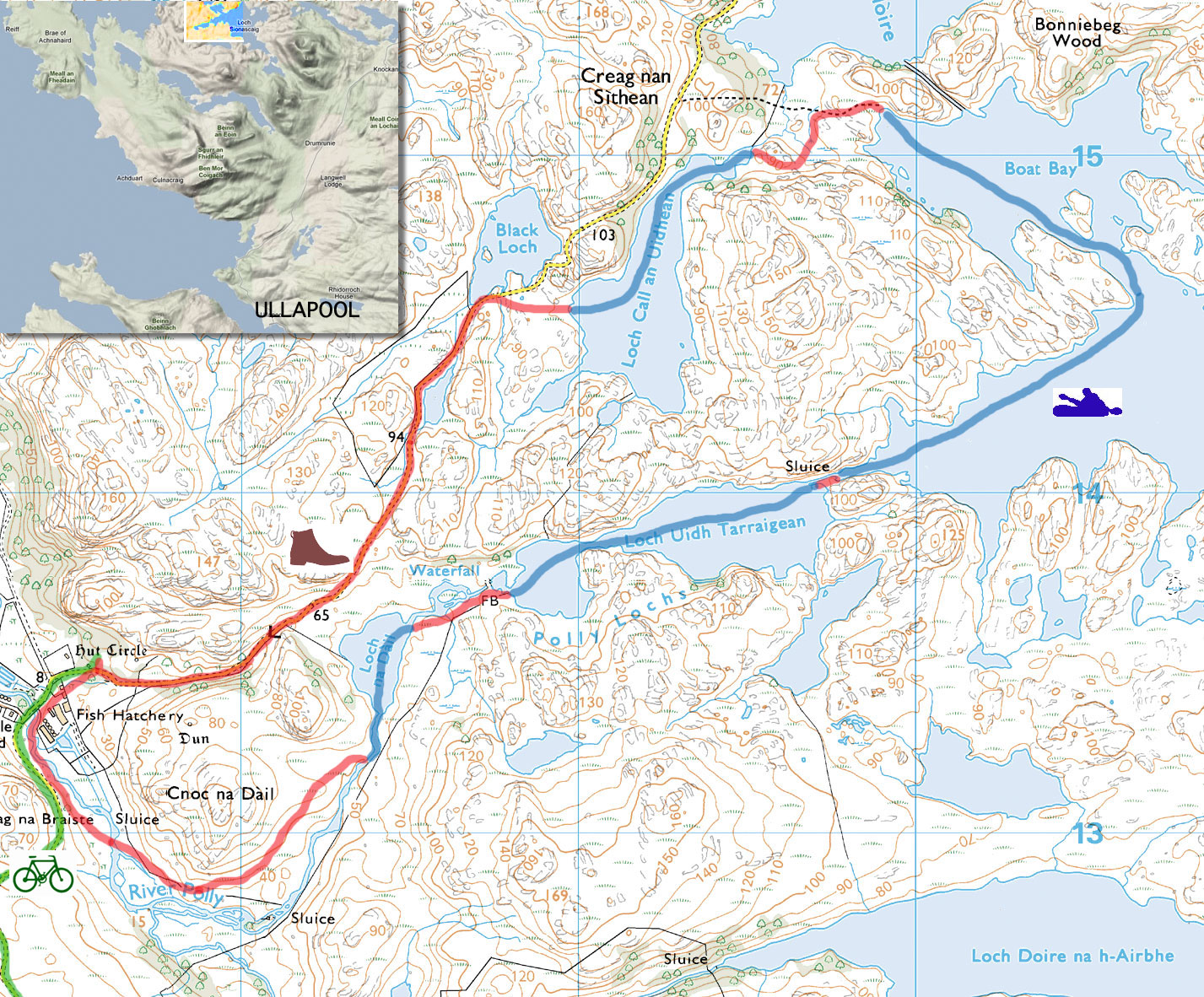
I’d nipped out there a few days earlier to check the lie of the land and try out some used Jungle boots, and although the maps warned of sluices, it all looked doable from the hillsides above.

And judging from the terrain I crossed to get there, it would be a whole lot easier to paddle than to walk. At the end of this paddle my shins were all scrapped bloody by dry heather stalks and other brush. Some sort of plain canvas gaiters are needed to walk across this stuff, even in long trousers. More gear… sigh.

The Mrs had nipped off to Handa Island with the car, but it suited me fine to cycle out to the lochans by the fish farm on the WMR to Lochinver. I stashed the bike behind an old shed in the woods and walked on up the road.

Loch Call‘ where I’d chosen to put in isn’t visible from the WMR which explains why I overshot it a bit, but a splash in the loch to cool down followed by paddling to the north end lined me up for the path down to Boat Bay. It’s one of only two paths I know of to access the lochans. But why were my arms so weak? it was only a cold for goodness sake! I decided to scoff all my sandwiches in the hope it was food I was needing.


Paddling out of Boat Bay the wind was firmly at my back and I sped along at an effortless 3mph+, and noted no ‘weathercocking’ (back end swing-round) as you can get with a kayak without a rudder or skeg. A packraft is a whole different thing of course, with all the weight in the back. If anything, going into the wind sees the lighter front come round if you stop paddling briefly.

That same 10-15mph wind that pushed me along would probably be in my face when I turned the corner into Loch Sionascaig (above) and headed southwest, and sure enough it was, but not enough to spoil my day. The sandwiches were kicking in by now and I shovelled my way towards the first sluice, surrounded by the three mountains of Stac Polly, Cul Mor and of course Suilven, which give this paddling location it’s unique character. How wonderful it is to be out here in the wilds, fanned by a warm breeze and for once not being chocked from all angles in faux-breathable, latex-trimmed wet wear. This could almost be France or Scandinavia in a heatwave.

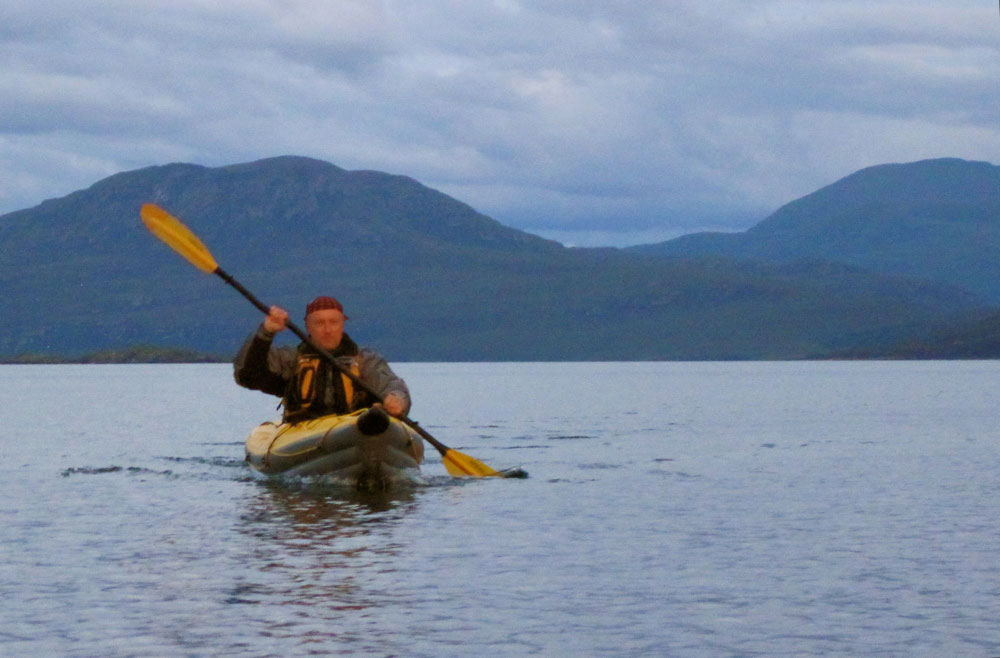
First one, then a couple more fishermen cropped up, standing alone on the banks, dipping their rods and exuding the usual unfriendly vibes. How did they even get there, I wondered? Not looking intrepid enough to have tramped over the hills, they must have paid their dues and been dropped off by the Inverpolly Estate’s boat from Boat Bay. Then a bloke comes round the corner paddling a yellow inflatable bath and threatens to put the wind up their trout.

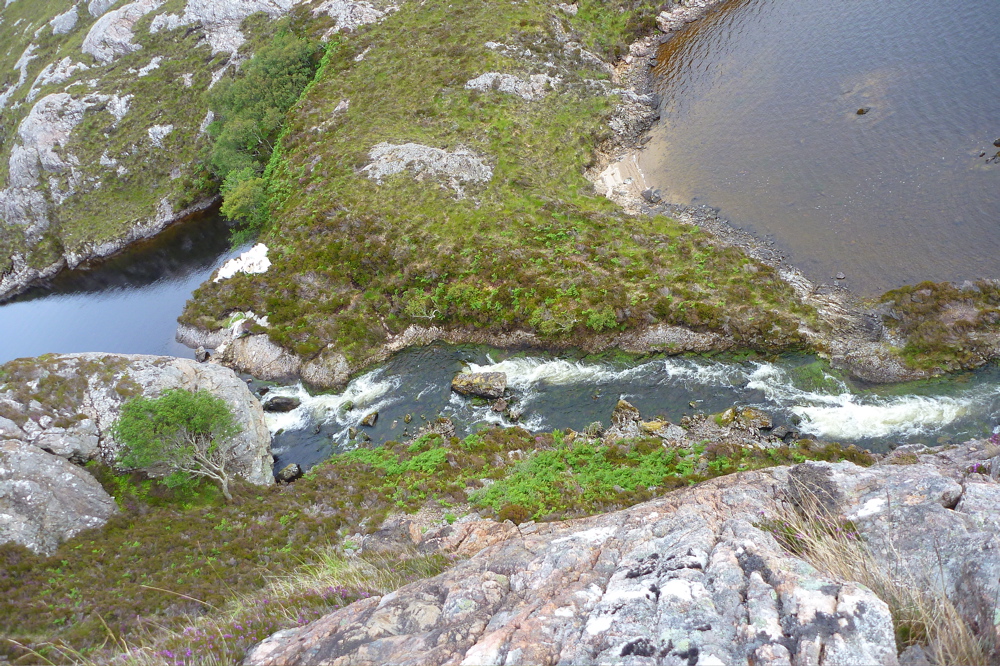
I neared the sluice (above: from above; left, from the south) at the southwest corner of Loch Sionascaig. On my Suilven overnighter a few weeks back, I’d noticed something white hereabouts while on the way back to Boat Bay from the north side of Sionascaig. Turns out they were just big white bags of rocks left over from shoring up the crumbling sluice wall. Most of the water pours though holes in the wall but even then, considering the size of Loch Sionascaig, there’s no danger here of getting sucked into anything nasty at normal levels. Should the wall fail, that could be another matter.

It’s about a 10-metre drop (above) into the steep-sided Loch Uidh which leads to a gap. Here as expected, the wind was funnelling but was counteracted by a slight current running my way. This soon ended at another crumbling sluice that might have been runnable (below).
I came right up and had a good look but decided the raft was too wide to make it down the chute and one-foot drop without me making a mess of myself, and I had to get out soon after. So I walked round and down alongside a series of torrents to the last paddle, Loch Na Dall. This happens to be linked by a short car track to the WMR (not on the map); a good take out if you’re in a canoe.

Although I’ve read of canoeists paddling the slim lochs below Suilven, portaging over to Loch Sionascaig and hoping to follow the Polly all the way to the sea at Polly Bay, what follows from Loch Na Dall isn’t really worth the portage, even if you’ve had a great time up on the main loch. It’s an ankle-twisting haul on a bumpy paddle all the way down to the fish farm, and the one kilometre downstream section after the road bridge at the fish farm (sluices and strainers) to the sea may well raise frowns from the Estate. But perhaps in winter, with the higher water levels you’d need for a clean run, no one’s bothered. Anyway it pays to remember: this is enlightened Scotland where outdoor access is a legal right, though always best combined with common sense. I’ve spent the last couple of months enjoying this freedom up here so it’s worth spelling it out:
The Land Reform (Scotland) Act 2003
You can exercise these rights, provided you do so responsibly, over most land and inland water in Scotland, including mountains, moorland, woods and forests, grassland, margins of fields in which crops are growing, paths and tracks, rivers and lochs, the coast and most parks and open spaces. Access rights can be exercised at any time of the day or night.”

Back to the packrafting. The south end of Na Dall was asprout with grassy reeds which created a briefly exotic paddling sensation. At it’s end the river dropped down into the valley, but there was no tell-tale roaring and the contours on the map suggested it didn’t drop immediately. So after peering from the intake, I dived in with blades churning, only to get hung up on a rock at the first drop. Free from that and on the move, the underside of the plucky Yak whined periodically as it slid over successive obstructions; another high-centred hang up, another clumsy, butt-pivoting, paddle-bashing extraction, gaining nul points for style.
That led to a breather in a pool and then another frothing drop, the camera by now sagged from the jolting. It had turned out to be a couple of minutes of unexpected action, but up ahead there was that ominous noise and I knew it was time to hop out ahead of a series of stony drops (below). I rolled up the Yak and tramped back down to the valley and the bike shed.

Riding back over the hill to Osgaig Loch at a quarter of the speed I came down it earlier that day, there’s a hoot from behind. ‘What!?’ I snapped, eyes stinging with sweat. Another hoot ‘WHAT!?’ Ah, pardon me, it’s the g-friend back from Puffin World while I’m puffing away in two-one, as red as a puffin’s beak and as sweaty as a sauna full of guillemots.

Want a lift, puffinboy? You look a bit hot‘.

I was actually anticipating the freewheeling rush down to Osgaig Loch where I’d had half a mind to try rafting the bike over to the other side. Never tried lashing my bike to the bow of my packraft before – it seems an awkward thing to strap down securely, but others have managed fine so it needs trying out once. Something for another day. We hooked the bike up and drove home.

lochanss

Summer Isles Overnighter (Incept K40)

Incept K40 Index Page

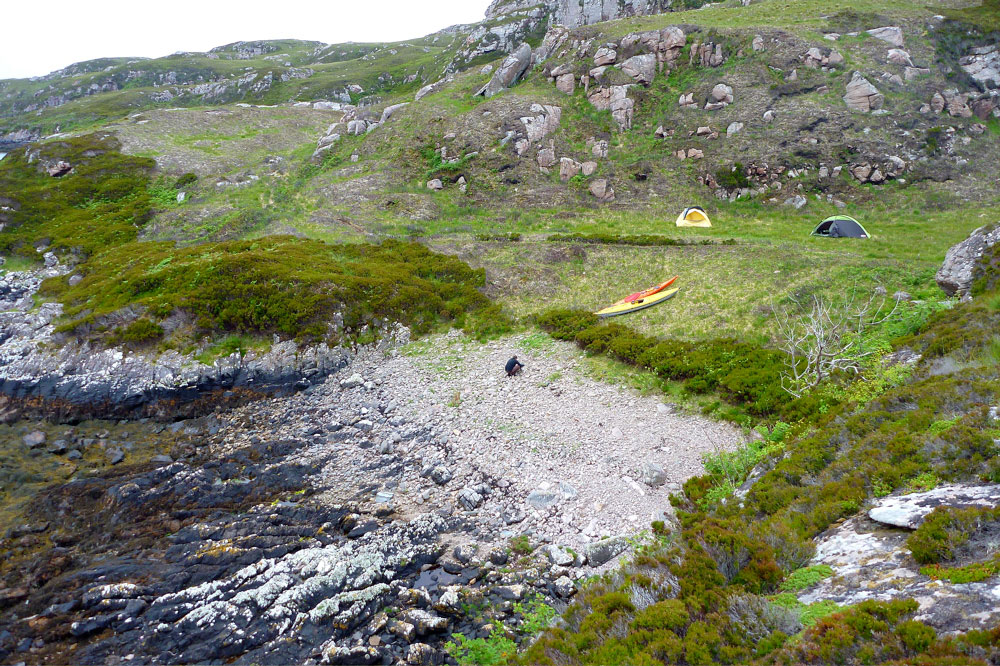
Friday night Jon and I paddled over to the Summer Isles on an exceedingly calm evening. After a bit of dithering looking for a place to camp, we hacked through the seaweed to get onto Tanera Beag about 11pm where we set up for the night.
As predicted, it got windy and flapping tents meant we didn’t get much sleep, although at one point a sudden lull at 3.30am did wake me up with a start. Out over Polbain the red sky was already presaging the dawn, just 80 degrees east from where the sun had set 5 hours earlier.
Heading back later that morning into an F4, it was nice when that part was nearly over. Near the each I hooked around the and tried a bit of disc sailing – it works but I definitely need a bigger sail.  A few days late but I got my midsummer’s mini adventure after all. 

Packraft surfing – Intex vs Alpacka

Sunday morning Jon and I went to try out his new boat, another Intex Sea Hawk, but the one-man version this time which goes on amazon for under 20 quid. For that money a pump is extra, but we managed to fill it up, though maybe not as firm as it could have been. Once inflated it dawned on me rather belatedly that the Sea Kork is indeed a row boat; and it’s not just the rollocks and the rocket launchers – sorry, rod holders – that give it away. It’s the fact that the rounded bow has, like a new Alpacka, a lot more volume – and so buoyancy than its flat stern. This is a boat that you’re supposed to row facing backwards – like a rowing boat. If you sit at the less buoyant back end facing the bow the trim goes to pot, much like it could be on an old-shape Alpacka with heavy person in it. Jon is only 80kg so could get away with it, but with me – in all my gear right on the Kork’s 100kg limit – I felt better kayak-paddling it backwards. Better trim (levelness) means less yawing.

We decided to go over to Achnahaird Beach where, as luck would have it, the surf was kicking off the scale with some rollers up to knee height and kept up by a light offshore breeze. I am joking of course, but a few weeks ago the Achnahaird surf was looking pretty damn good (above) at up to a yard high, so even if today was a nothing special, it can be fun here.

I can’t help laughing whenever I see an Intex in action, but it’s as much in amazement that you get so much boat for 20 quid. Out on the water, the first order of the day was to attack the Sea Hawk with the pointy bow of my yellow Phoenician warship (left). Poor Jon had only been 60 seconds in his brand new boat before I was trying to tip him over, like a log-rolling contest. 

Kayak paddling from a standing start the Yak left the Sea Kork far behind – no great surprise there. Jon then took his TNP apart and tried rowing which ought to be more efficient and so faster. But all he did was a backward zig-zag; maybe that takes some practice – or a rowing boat.

By now we were nearing the surf zone where we spent the next hour having a laugh. Neither of us had ever tried this so the semi-surf was just right; we couldn’t tip our boats over whatever we tried, but if we caught a good one on time we could get a good ride and then head back out to try and ‘wheelie’ off the next one coming at us (left and below).

We swapped boats and confirmed the obvious; the $1000 Alpacka blows a hole in your wallet, but it also blows the Intex inflatable squid off the water. They weigh about the same, but it’s down to the Yak’s shape, lesser width and a snug fit to give you control, as well as no rollocks or fish launchers to bash your hands on as you paddle along.
By the time I got in the Sea Squak the inflatable floor was already limp so I was sitting about six inches lower than my feet, not an ideal paddling stance in a boat that’s a metre-wide. On the way back I tried kneeling, but that soon got uncomfortable. Even then, sunk down and paddling ‘backwards’, stern to front, the Sea Stork still tipped along at 2.5mph without much yawing. So as a packraft the Intex does the job and has got to be one of the best value neo-packrafts around.

I’m told one of the shots on this page was published in the 2012 Alpacka Calendar.

Suilven packraft triathlon

The forecast was good and with time running out, such days cannot be ignored.
Let’s go and do Suilven‘ I said to the Mrs.
Better still, let’s take the bikes and the packraft, park the car at Inverkirkaig, cycle to the trail head, climb up the north side, down the south side, and paddle Fionn Loch into the River Kirkaig for the footpath back to the car to get the bikes.’

What was the last bit again?

It’s a hilly 6-mile ride from Inverkirkaig along the WMR and up to Glencanisp Lodge where the road ends. From that angle Suilven rises like a sperm whale’s head over the gorse and lochans. Maybe it was the sunshine, but Glen Canisp that day looked like something out of a Scottish Tourist Board advert, and was made all the more appreciable by the easy quadbike track we followed east. One time that would be great walk to follow the 14 miles all the way through to Cam Loch and the A835 near Ledmore.

Of course, as ever these days, I was eyeing up the pack-potential of the Abhainn na Clach Airigh river too; actually string of easy lochans and gorges (left), linked with flat or frothy river stages. That too would be a great run, more probably from the Ledmore end, and with a handy bothy at Suileag. Or cook up any combination you like; with boots and a paddle the possibilities here or anywhere in northwest Scotland are infinite.

There comes a point directly north of Suilven’s twin-peak saddle (right) where you have to leave the easy track and head south into the bogs and up. You can’t see a path up the side of Suilven, but it pretty much follows the creek running down from the saddle; an hour and a half’s slog from the quad track that’s as steep as any track can be, without using your arms. And yet, as long as you keep chipping away (left), it’s always quicker and easier than it looks. And it’s quite a thrill to approach the saddle and have the Loch Sionascaig vista erupt before you (below right) as you catch your breath.


G/f decided to rest here while I took on the last 130 metres up to the summit, about 20 minutes away. For some reason a ‘magnificently pointless’ dry stone wall straddles the summit ridge near here. A quick look on the web came up with no convincing reason to its origin, though it does extend downwards enough on each side to stop agile stock either leaving or getting to the summit. And on the actual top there’s certainly enough room to graze a few sheep as well as curiously closely cropped grass. We’d not seen a sheep all day so unless deer make the climb you do wonder what grazed the grass up here? More Suilven summit mysteries.

From anywhere up here we could see the way back; the put-in near last week’s camp and the 2-odd miles along Fionn Loch to the entrance of the River Kirkaig (left). These waters define the border between the counties of Ross & Cromarty and Sutherland. While I was planting the flag, G had been scanning the scene below with binoculars and had spotted the waterfalls on the River Kirkaig we very much did not want to get sucked into.

lochanss


We set off back down the looser south side slope, don’t want to go on but it was another validation of the knee-sparing Packstaffing Way. Without it it’s hard to see how anyone would not stumble or slip a couple of times. Passing the spot I reached last week, strange barking sounds emerged from the heather. A grouse in distress? Turns out G with better eyesight had seen a couple of dashing deer right in front of me.

Down by Fionn Loch I wasn’t convinced two-up in the Yak was going to work or be safe. But we tried fitting in on the bank and in fact it was roomy enough with my legs out over the sides. So we put in and pushed off west across the loch (left) for the river, initially following the shore. Then as it became clear the 3-kilo boat-in-a-bag managed its 160kg (350lb) load fine, I set the engine for full ahead against what I perceived [incorrectly] was a slight current as well as a breeze. Amazingly (or perhaps not) I’ve never seen my packraft track so well with the near-perfect trim.

About 40 minutes later the entry point to the river loomed, with a mild rushing sound caused by the race of water flowing off the loch. We were a little edgy, knowing a deadly waterfall lay not far ahead. We let ourselves get swept in and as soon as I entered the river the boat handled differently, like a kayak in a backwind. It was the current of course wafting us onward. I went as far as I dared and stopped paddling for a moment – a louder rumbling of white water became evident. Two up, sluggish and with no BAs, we didn’t risk it and headed for the bankside footpath.

Rolling up and looking back, it seemed hard to believe we come up and over ‘Pillar Mountain’ as the Vikings had named the prominent maritime landmark of Suilven. By taking to the water we’d saved a bit of time over the path and rested the legs for the last hour’s trek back to the car and a short drive back to Glen Canisp Lodge to collect the bikes. All up, a great day out; 7 miles cycling, 2 paddling and a dozen on foot. And the Yak had proved itself as able handle the two of us for similar flat water transits.


Packrafting the River Kirkaig
The minor waterfall (left) we took out before might be rideable by the likes of Roman Dial and his intrepid chums, but the thundering 100-foot Falls of Kirkaig (see map, above left) would only appeal to gonzo hairboaters high on Red Bull and Go Pros. From there though, the river far below the track seemed packable to the brave, certainly at a point where the path drops down right alongside and the river where it broadens out, just under a mile or so from the road bridge. All grade II or less; even I could manage much of it. Beyond the bridge, it’s just half a mile to the sea at Loch Kirkaig, which would be satisfying to pull off, but even at the relatively high levels (now dropping), it gets pretty shallow in places and would not be a clean run. But don’t take my word for it. I read the river is listed in the SCA whitewater guide.