Category Archives: Gumotex IKs

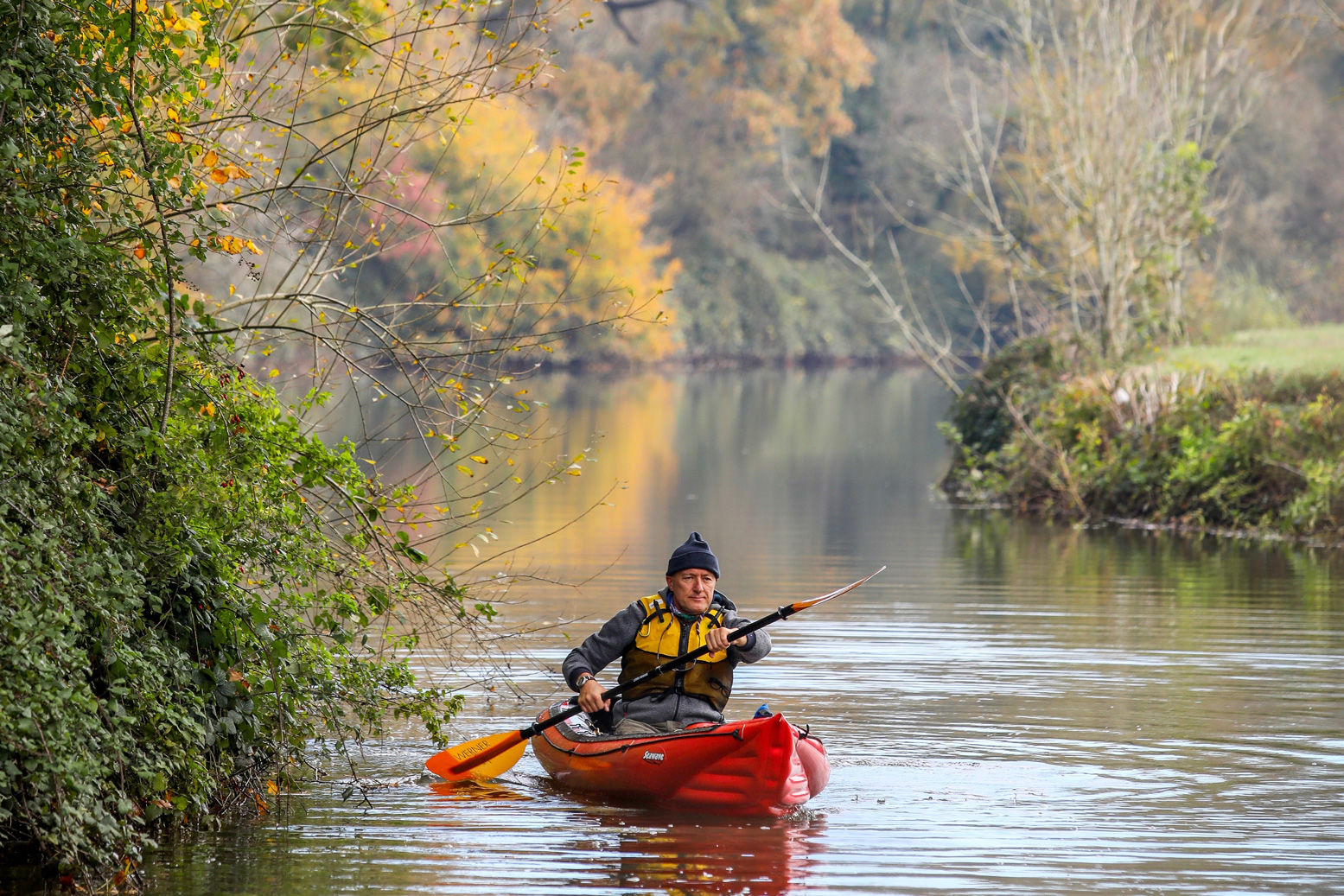
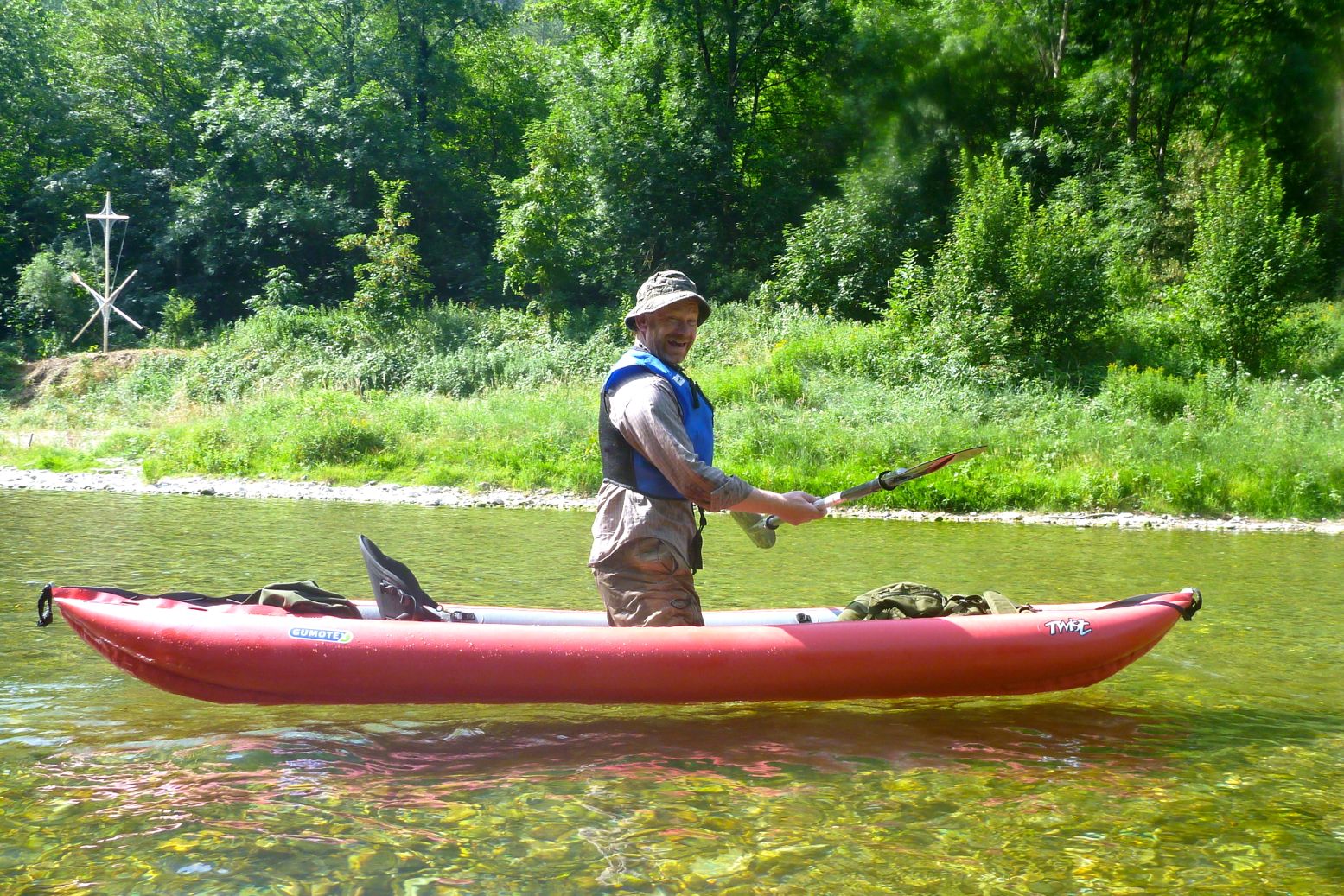
I’ve had several Gumotex IKs

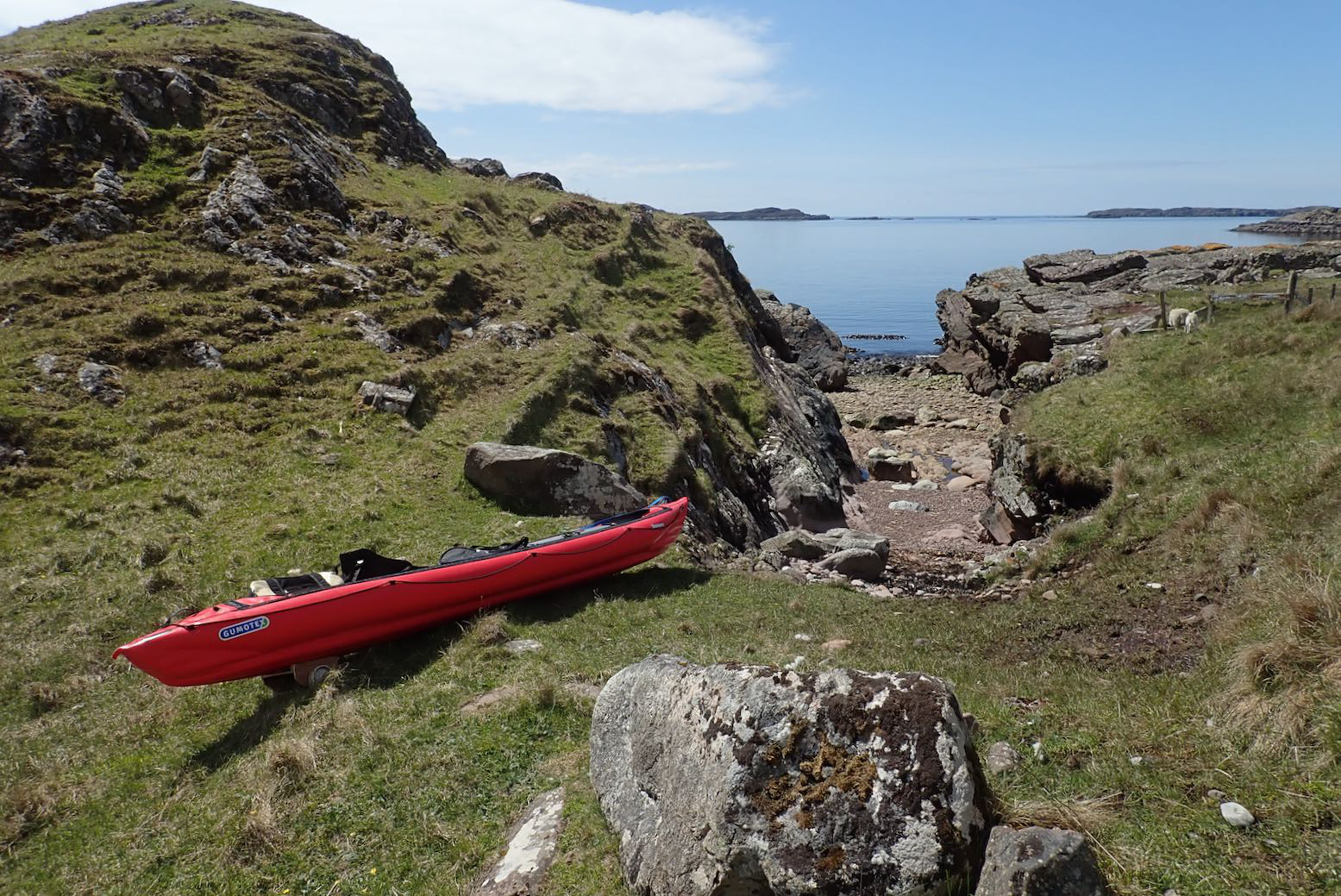
Landfall on Eilean Mullagrach

Seawave Index Page
Summer Isles Kayaking Guide
Other Summer Isles paddles
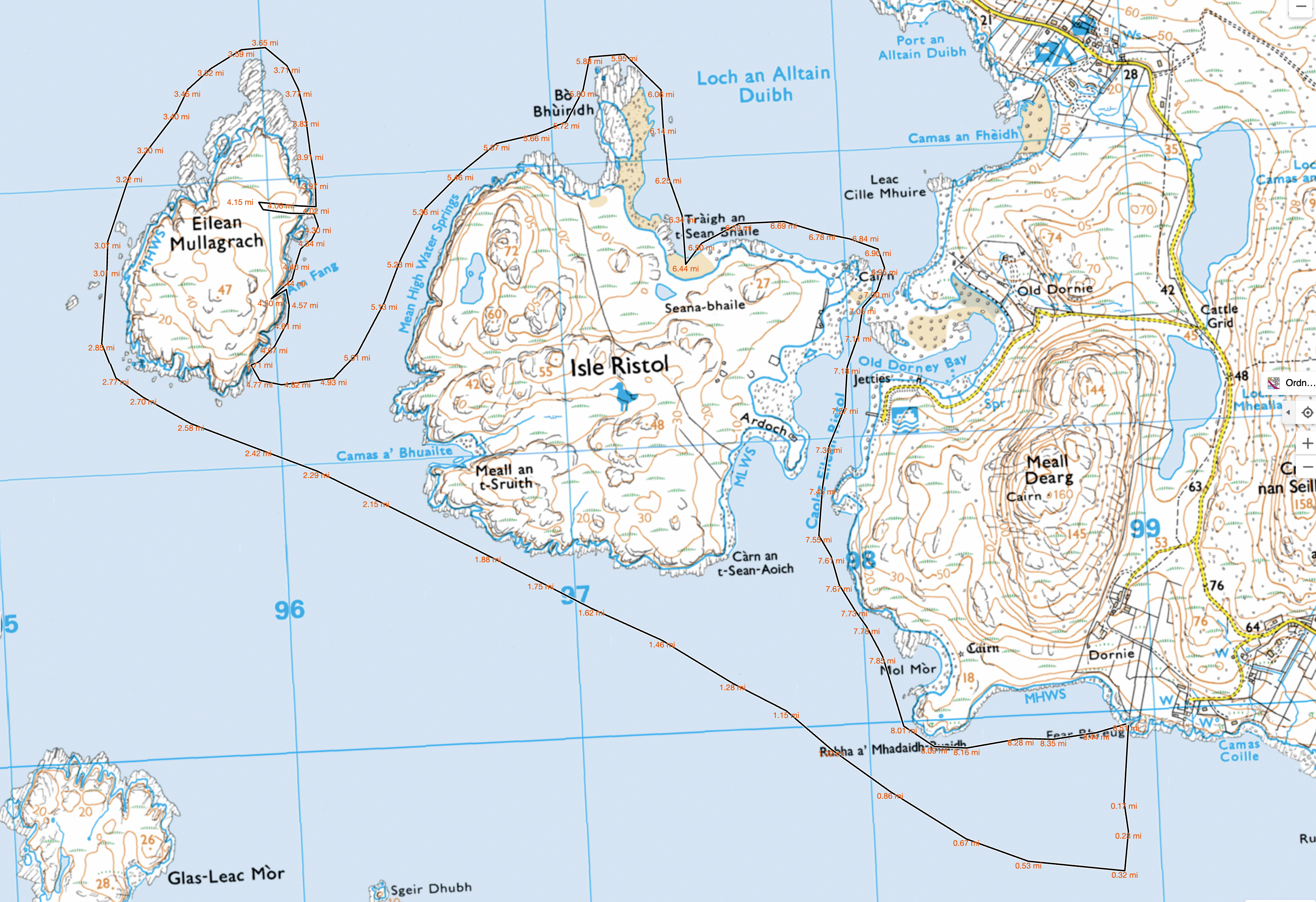
After a fortnight of chilly north winds and a diminishing woodpile, today was one of those rare days in the Summer Isles (far northwest Scotland) where you could paddle pretty much where you liked in an IK.
It was also a chance for me to try out my new skeg-wheel trolley which Jon, who was staying down the road, had made for me.
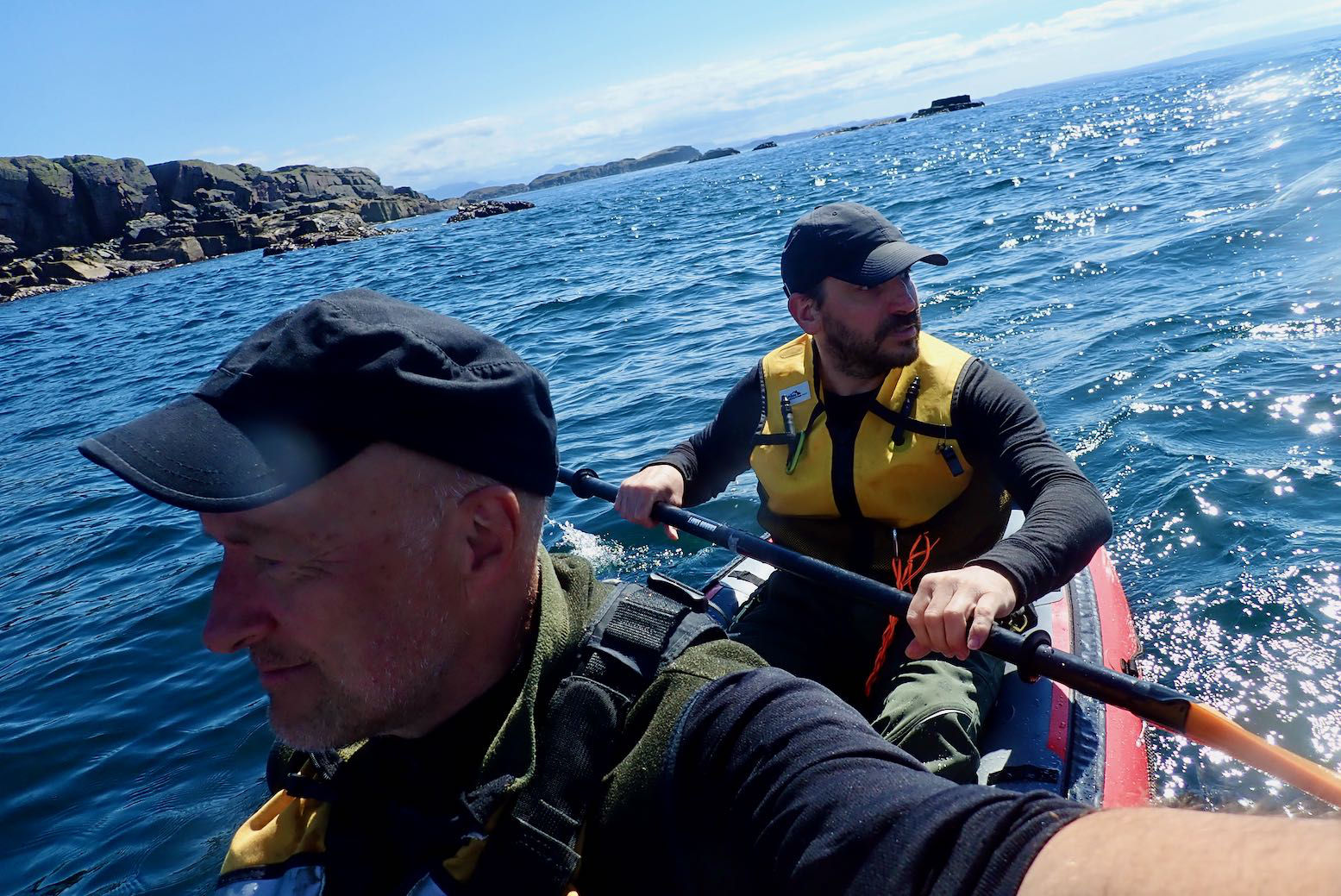
With no boat of his own this time, we set off in mine to see what we might see.
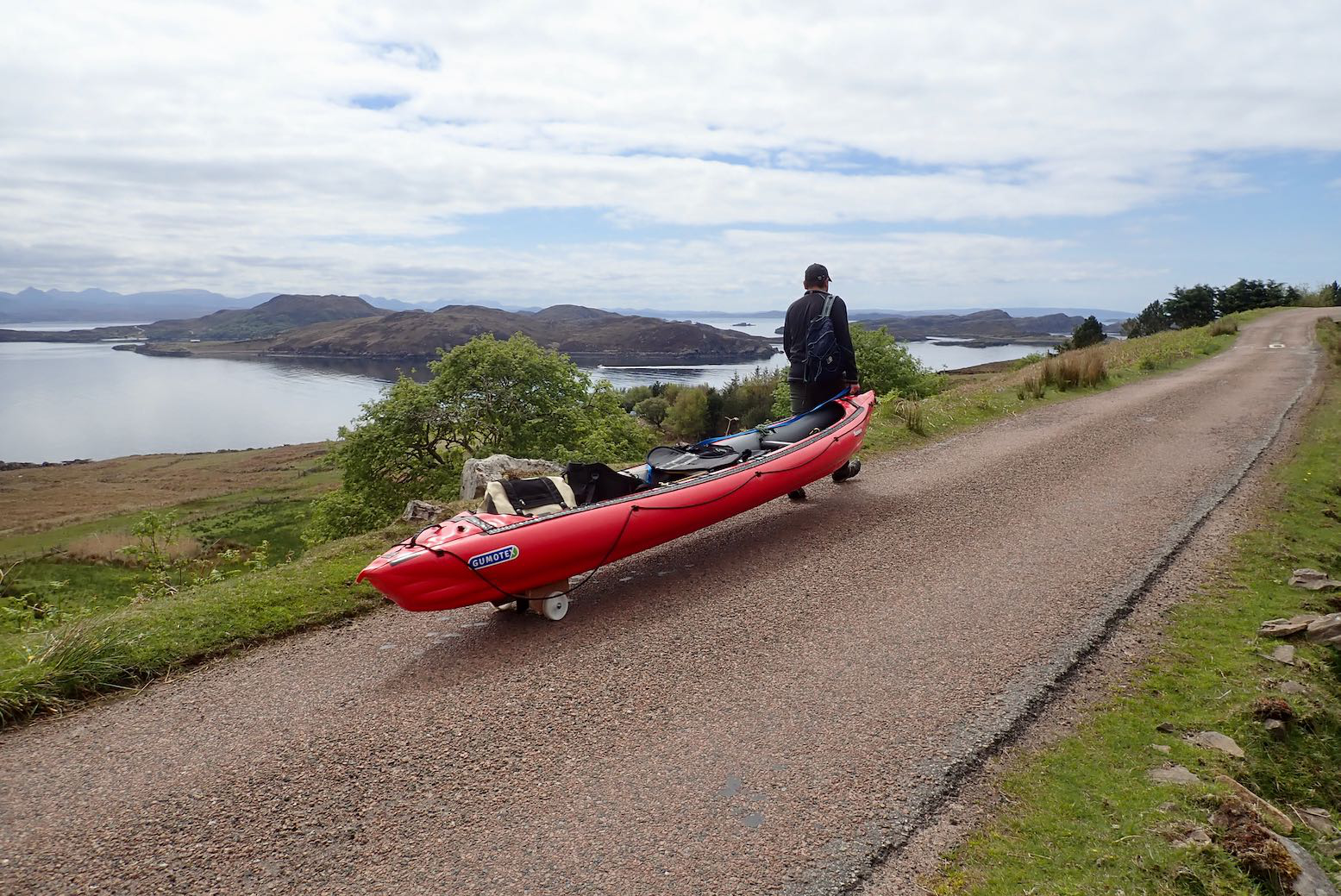
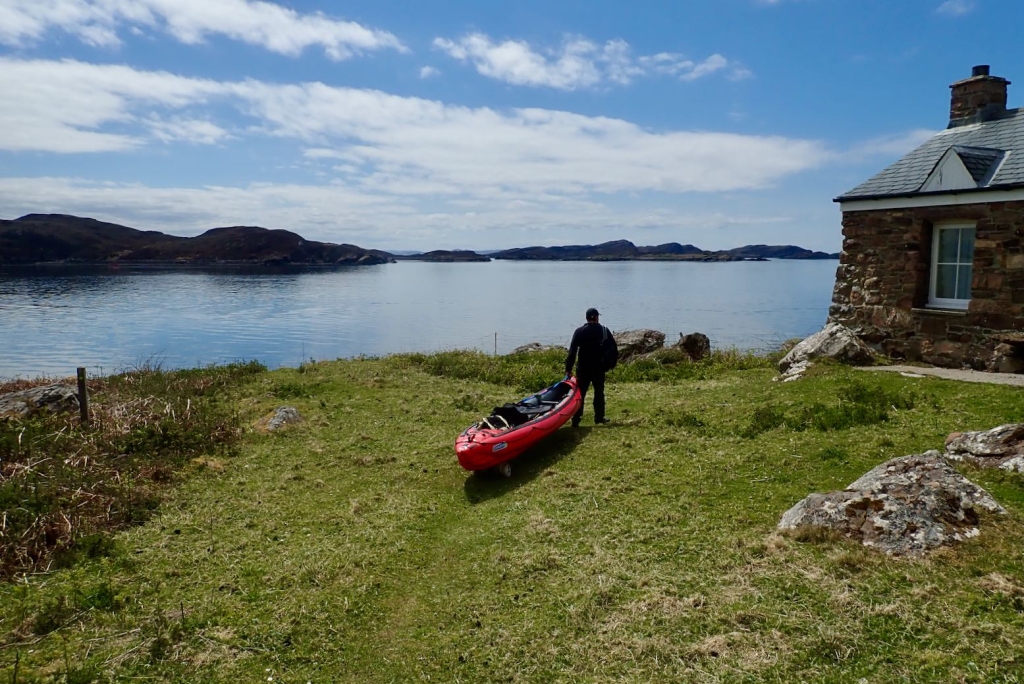
We rolled down the road to the Fox Point, the nearest and least effortful shore access from where I’m staying.
Apart from the clatter of the solid wheels, the set up worked perfectly: stable and smooth.
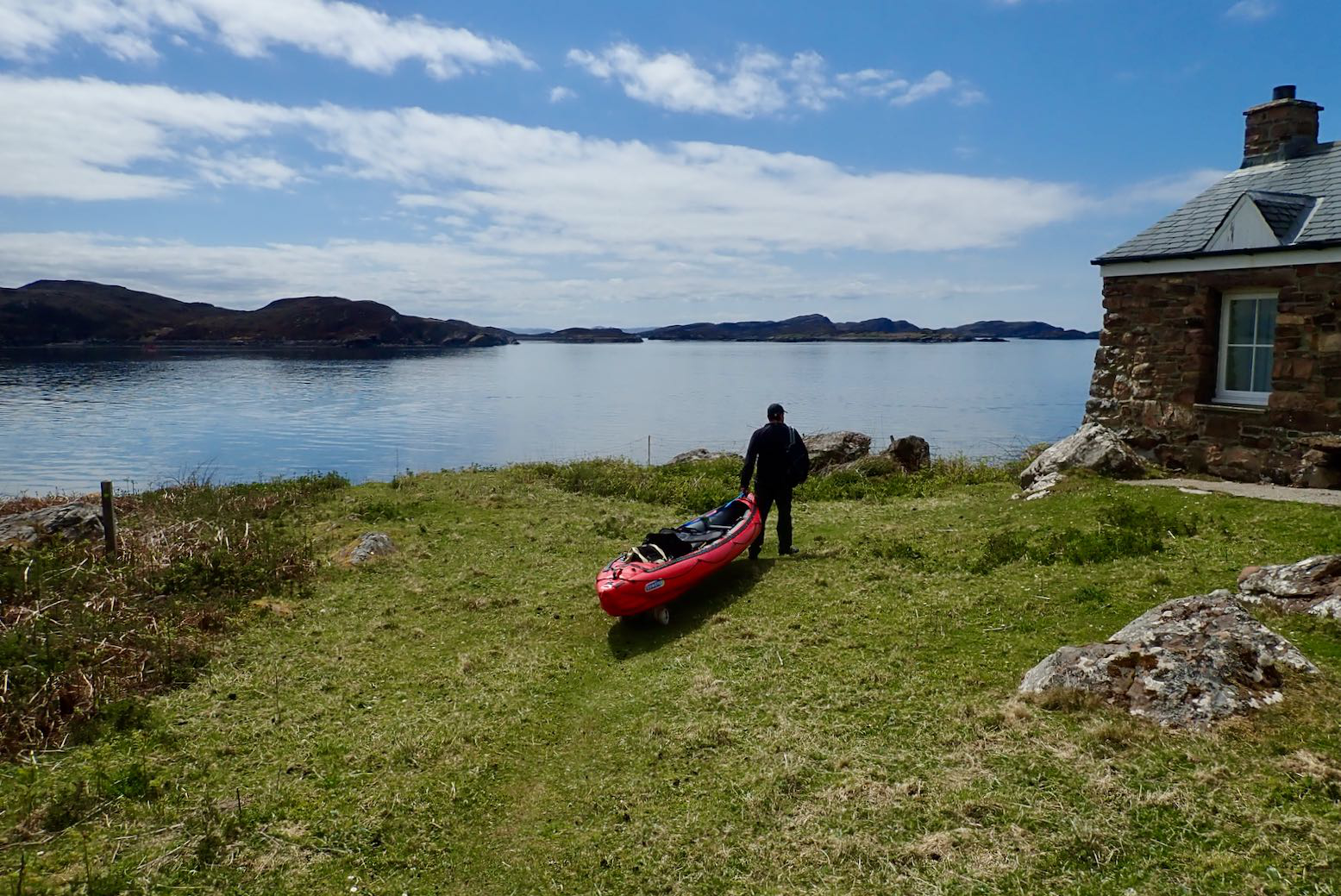
The spring tide had bottomed out so we looked for the least ankle-twisting put-in.
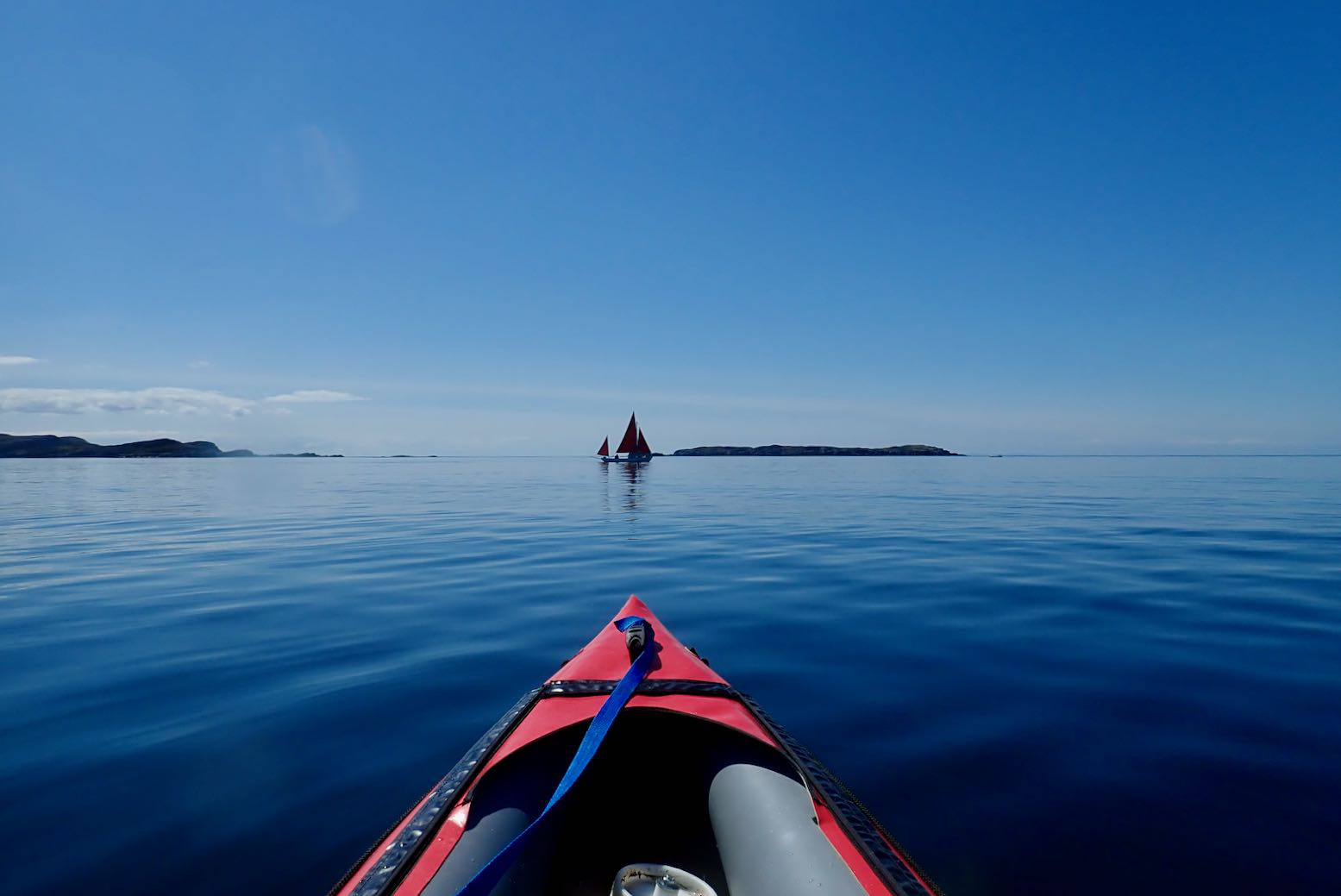
We have no plan so head towards the Ristol Islands across a glassy sea.
With the calm, we take on the outside shore of Eilean Mullagrach; here the refracting northern after-swell makes it a bit choppier with some alarming waves breaking over reefs.
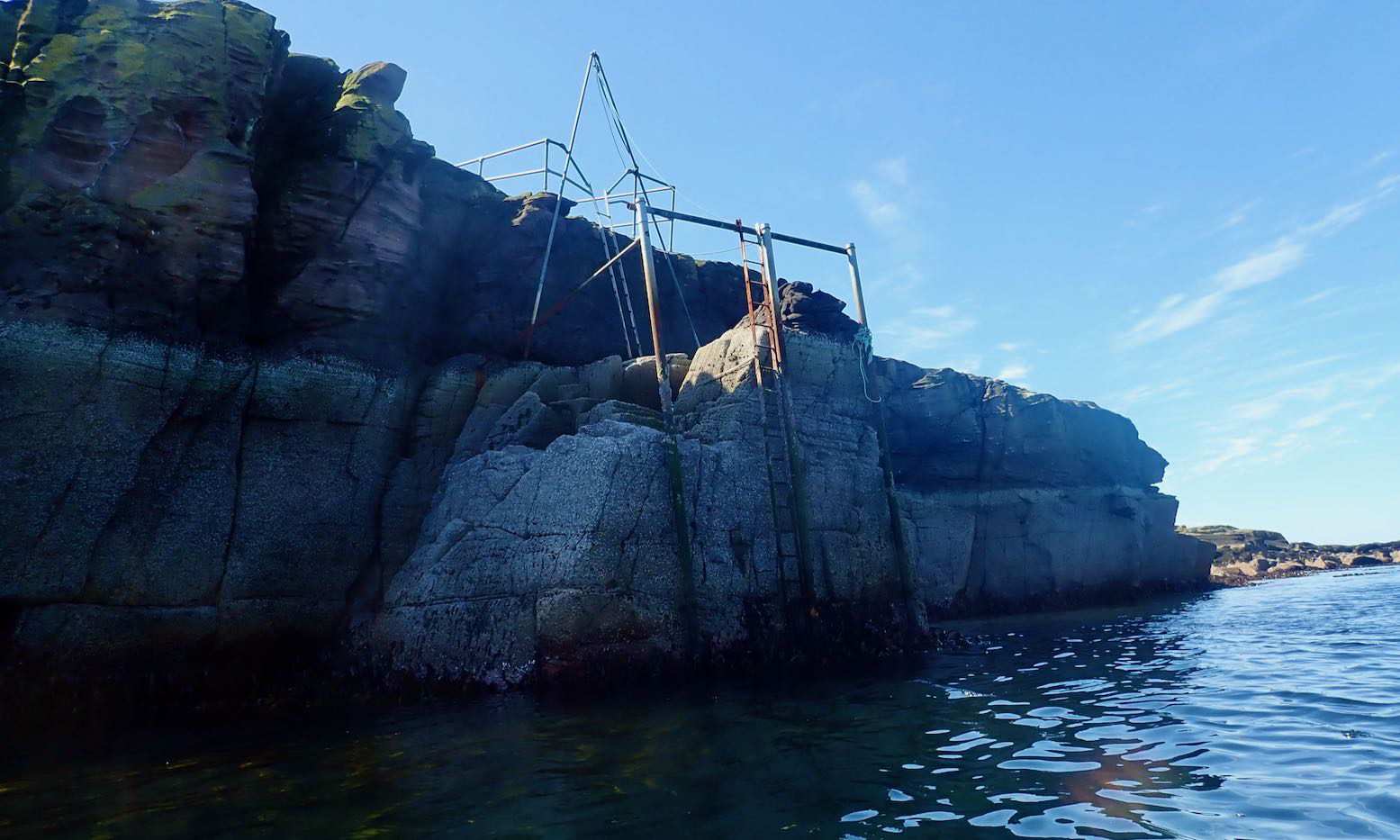
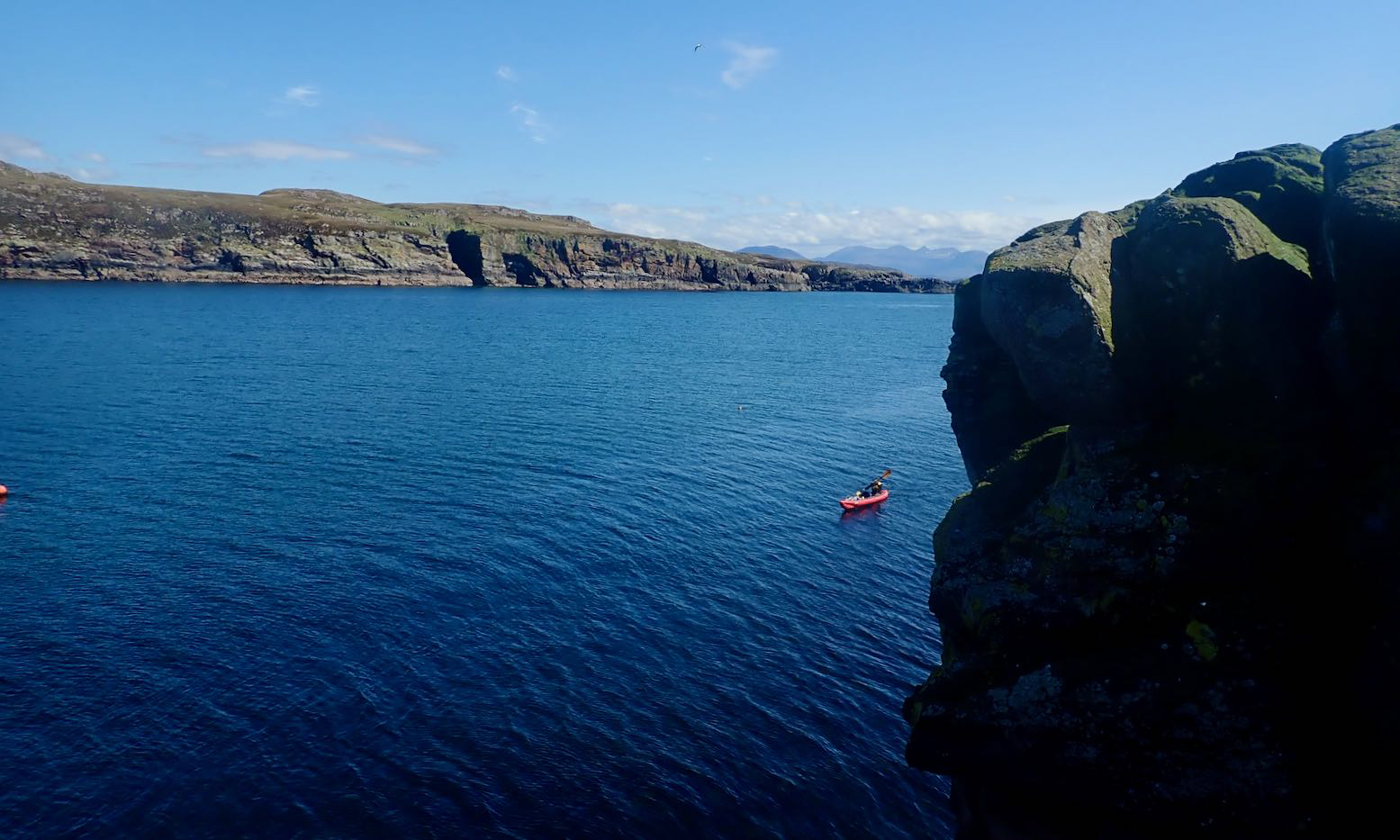
Unless you’re a gannet, this is the only way to get onto Mullagrach, a gantry at the northeast tip.
Usually alone, I’ve never done it, but with Jon to tend the boat, I climb up.
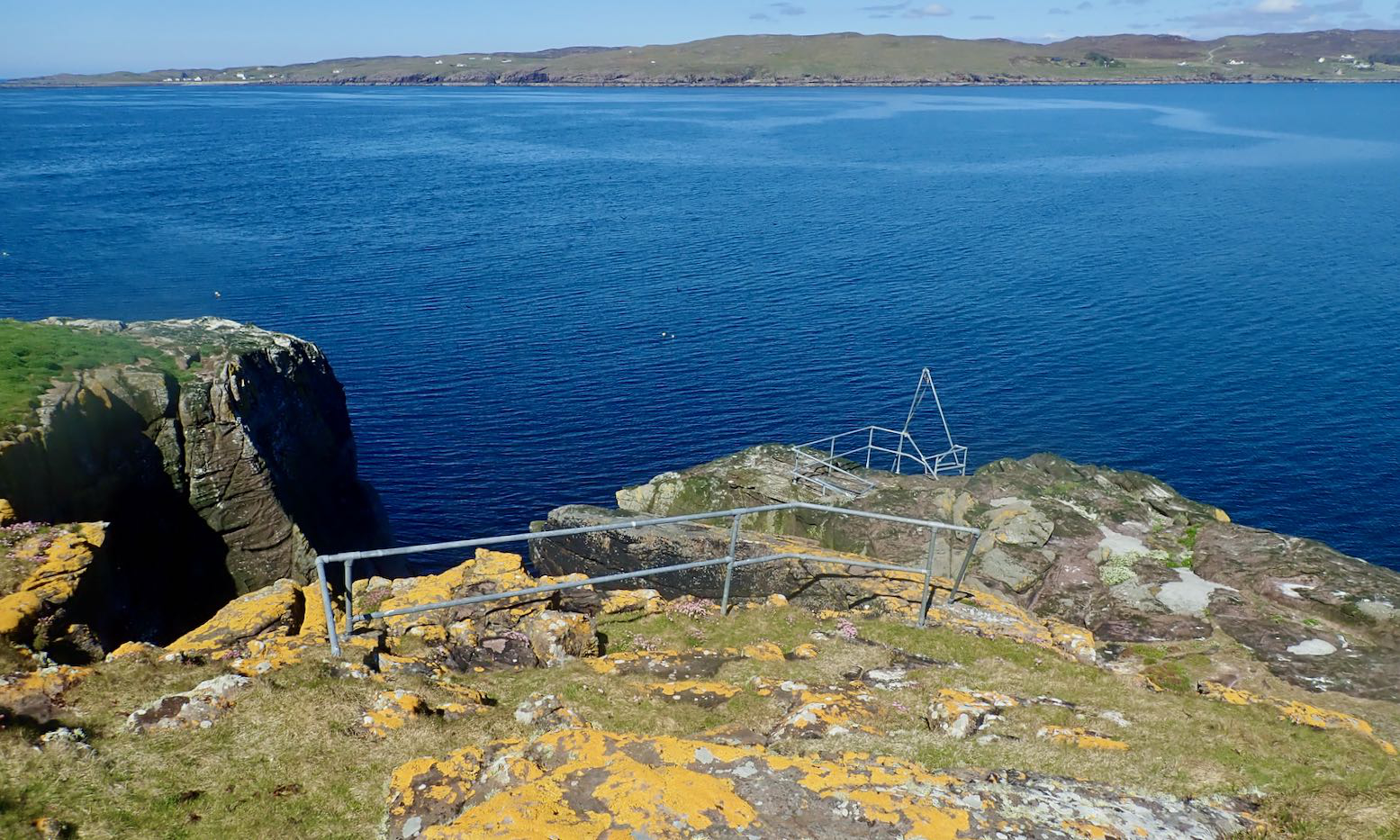
With access so difficult, Eilean Mullagrach was never occupied or crofted. I think it’s now owned by a bird protection enterprise. Perhaps they built this guardrail and cut the steps. There’s what looks like a hut at the island’s south end, just past the (not very) high point.
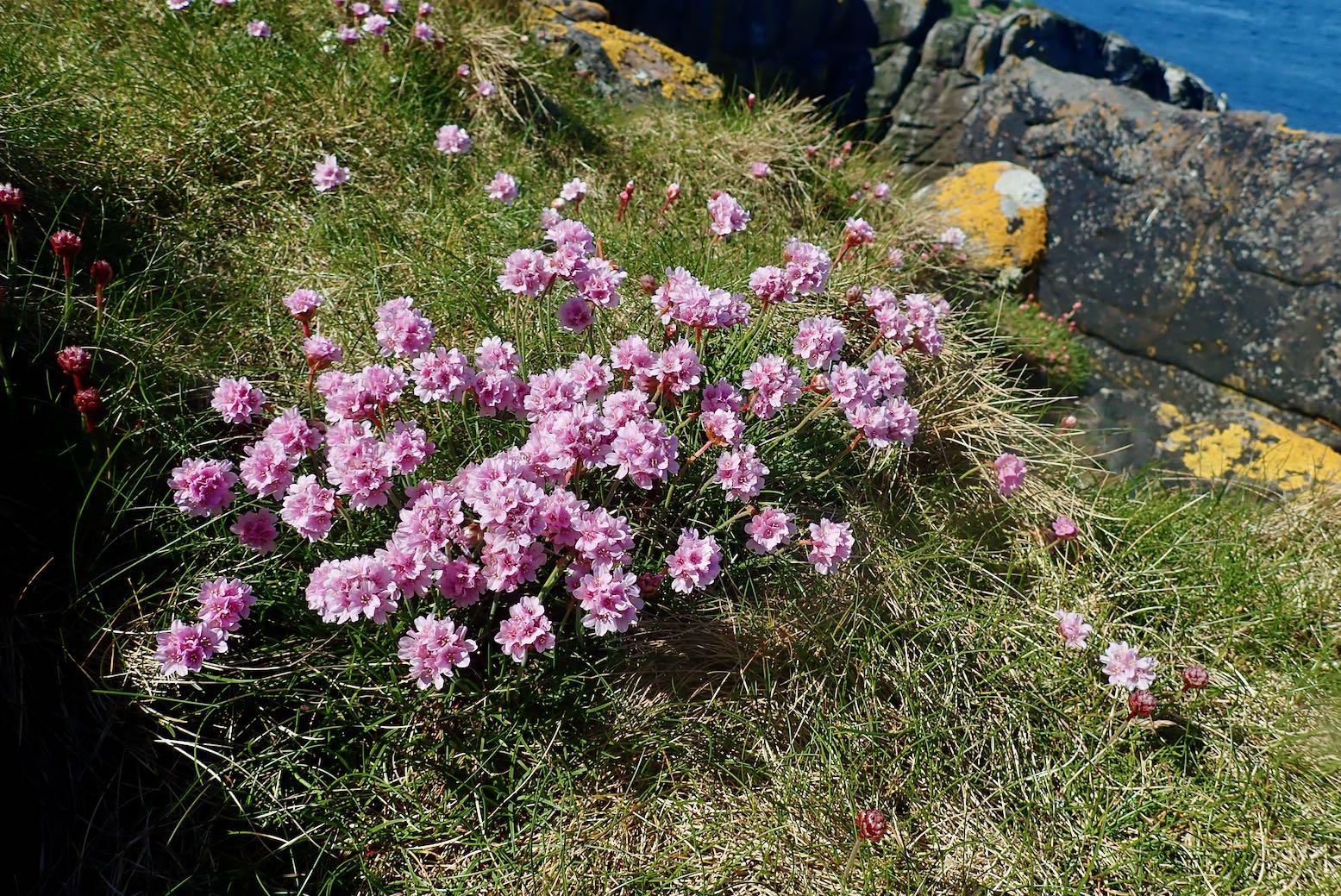
Nice to see sea pink and yellow lichen again. The former mostly found on the sheep-free islands and skerries.
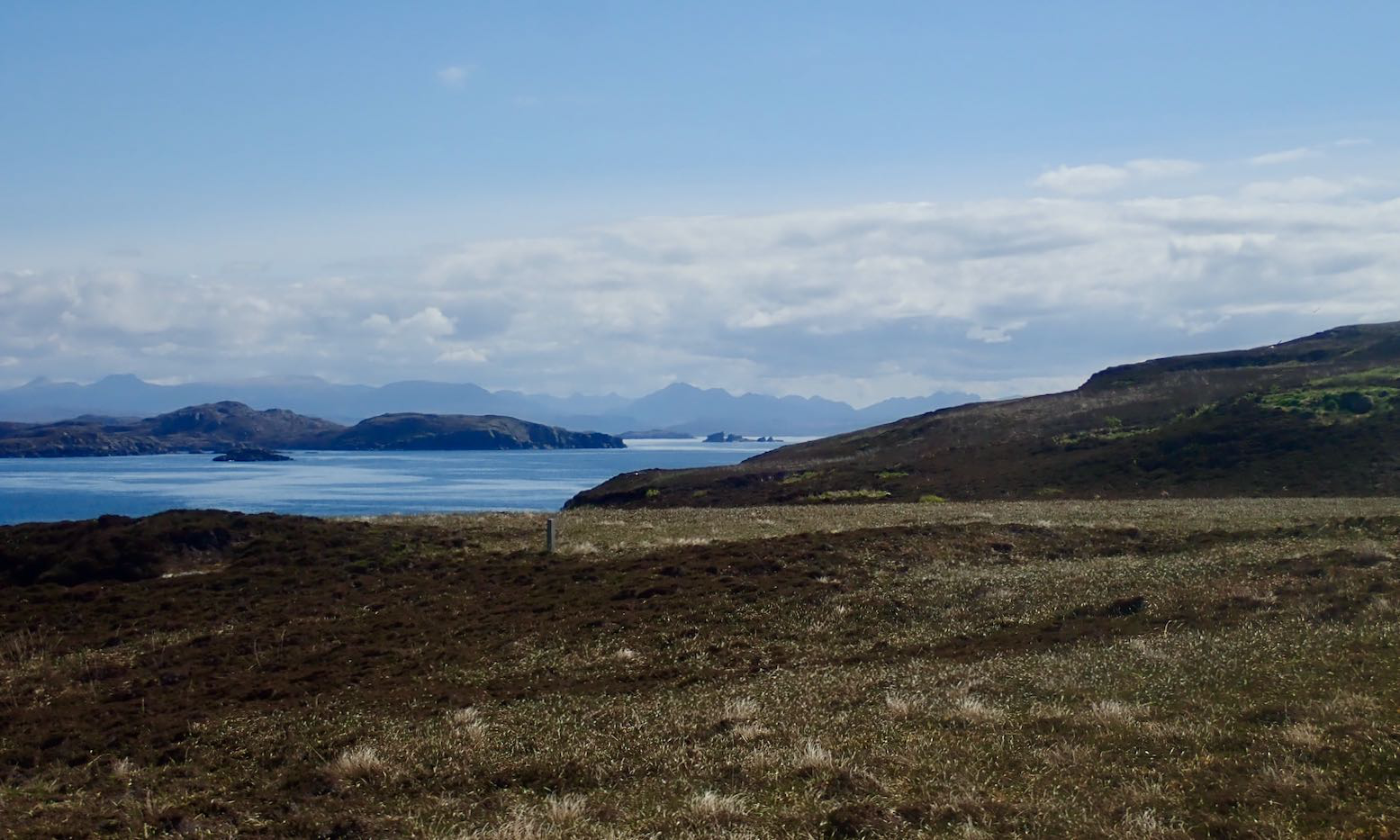
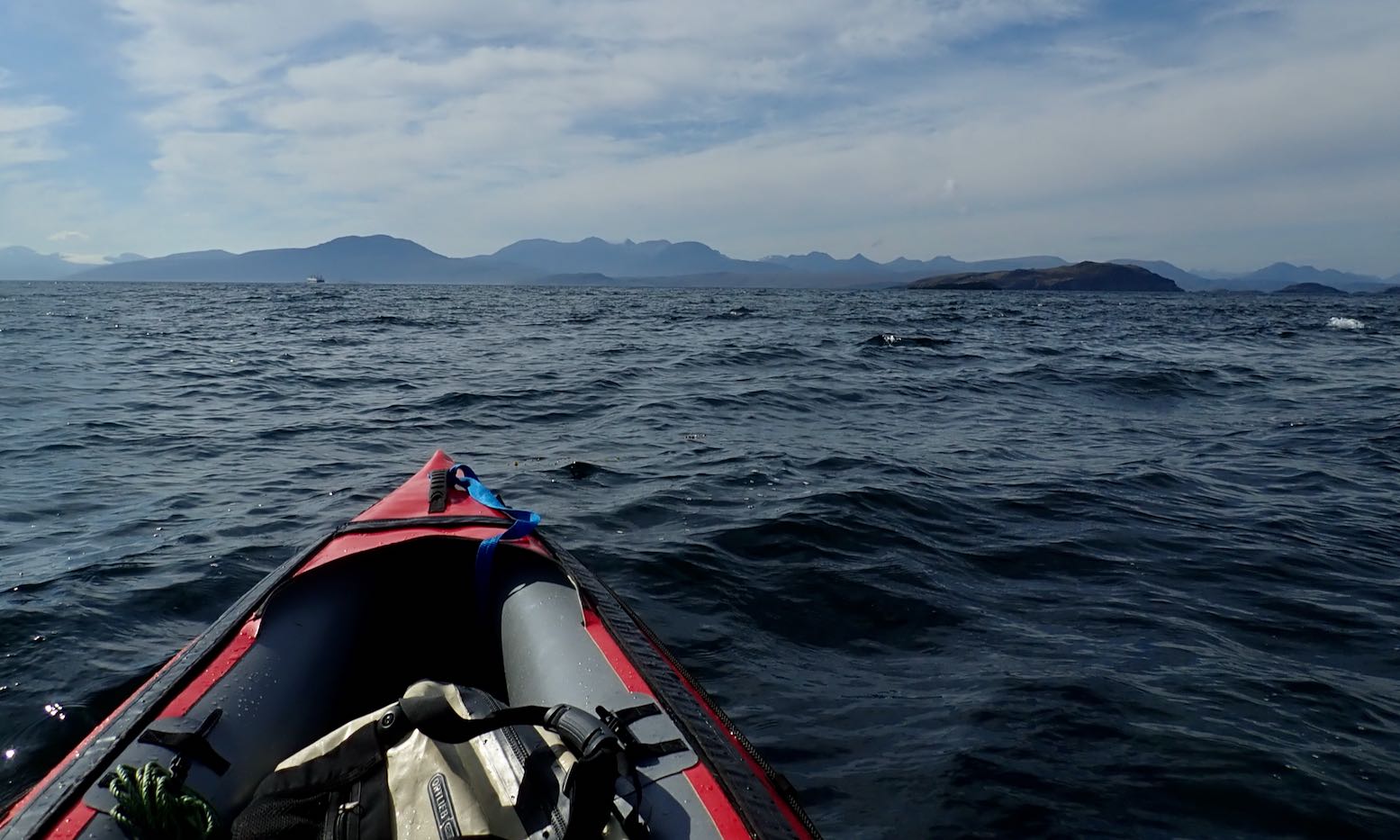
View south over the Summers to the Fisherfield mountains.
The channel with Ristol behind. Better get back; the taxi’s meter is running.
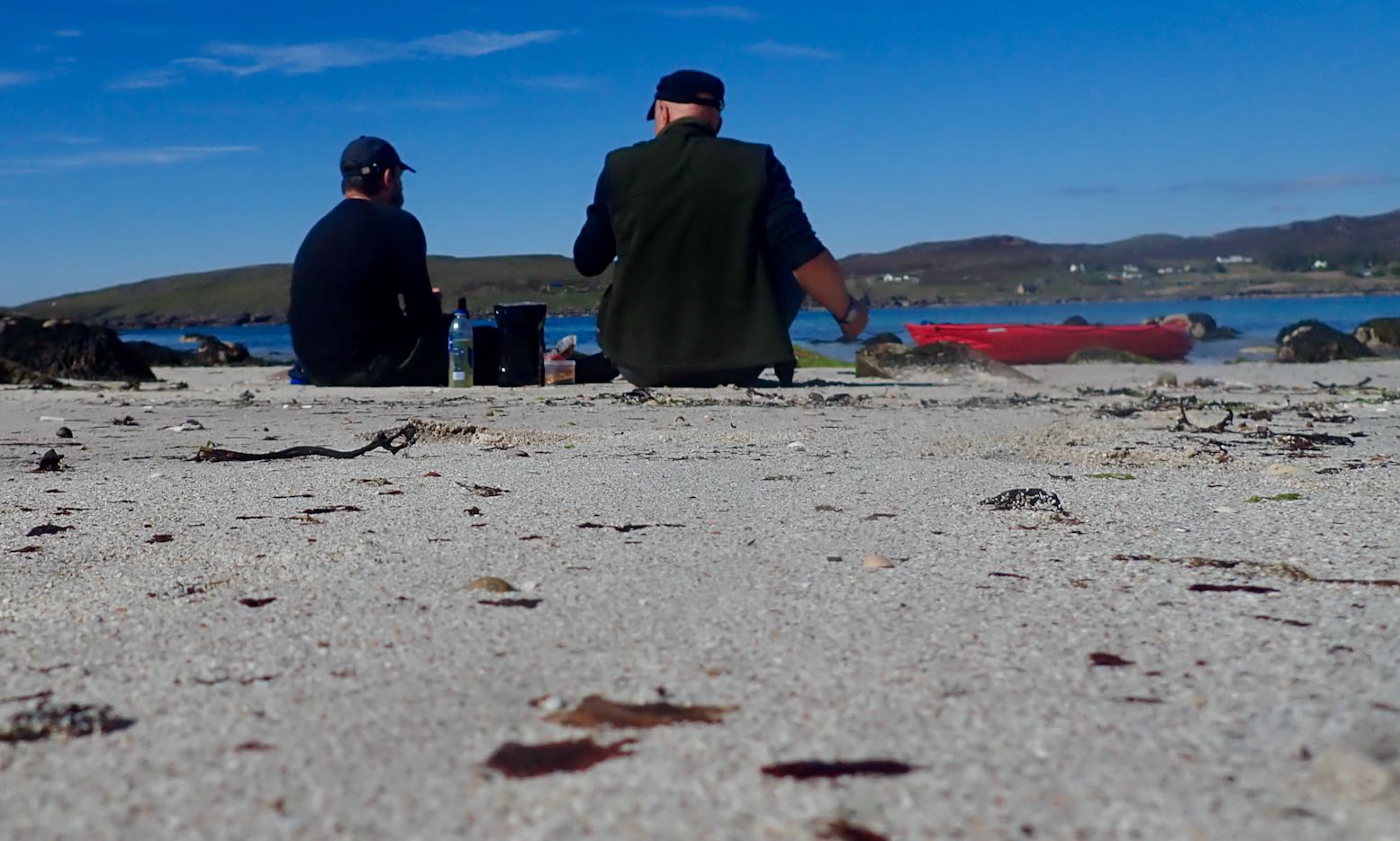
We scoot back north out of the channel and take a break on Ristol beach before cutting through Old Dornie harbour back to False Man inlet.
I leave my kayak overnight with a plan to come back for more tomorrow.
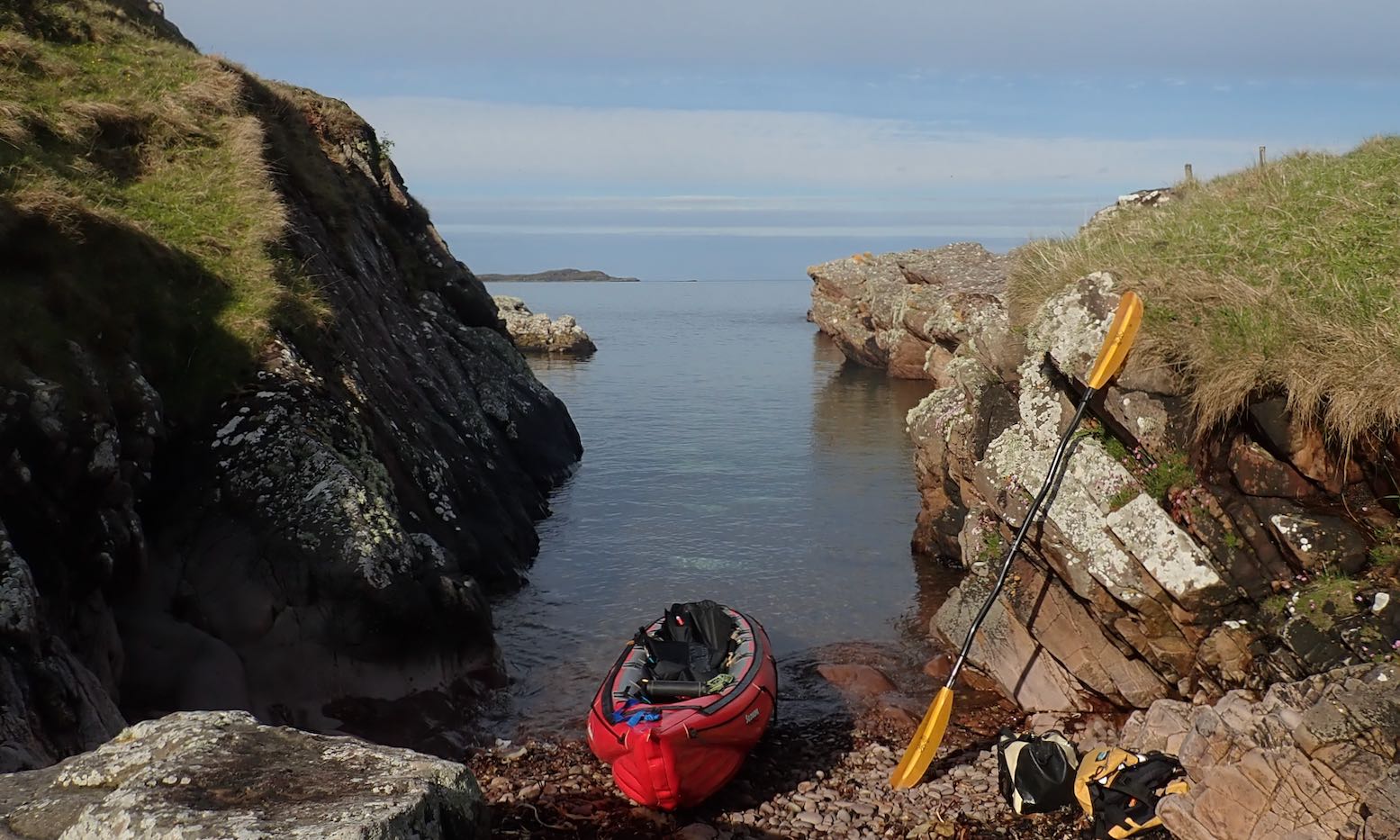
Next morning I’m relieved to see my Seawave hasn’t floated off into the Minch.
I top up and decide to head round the outside of Tanera Beg for starters.
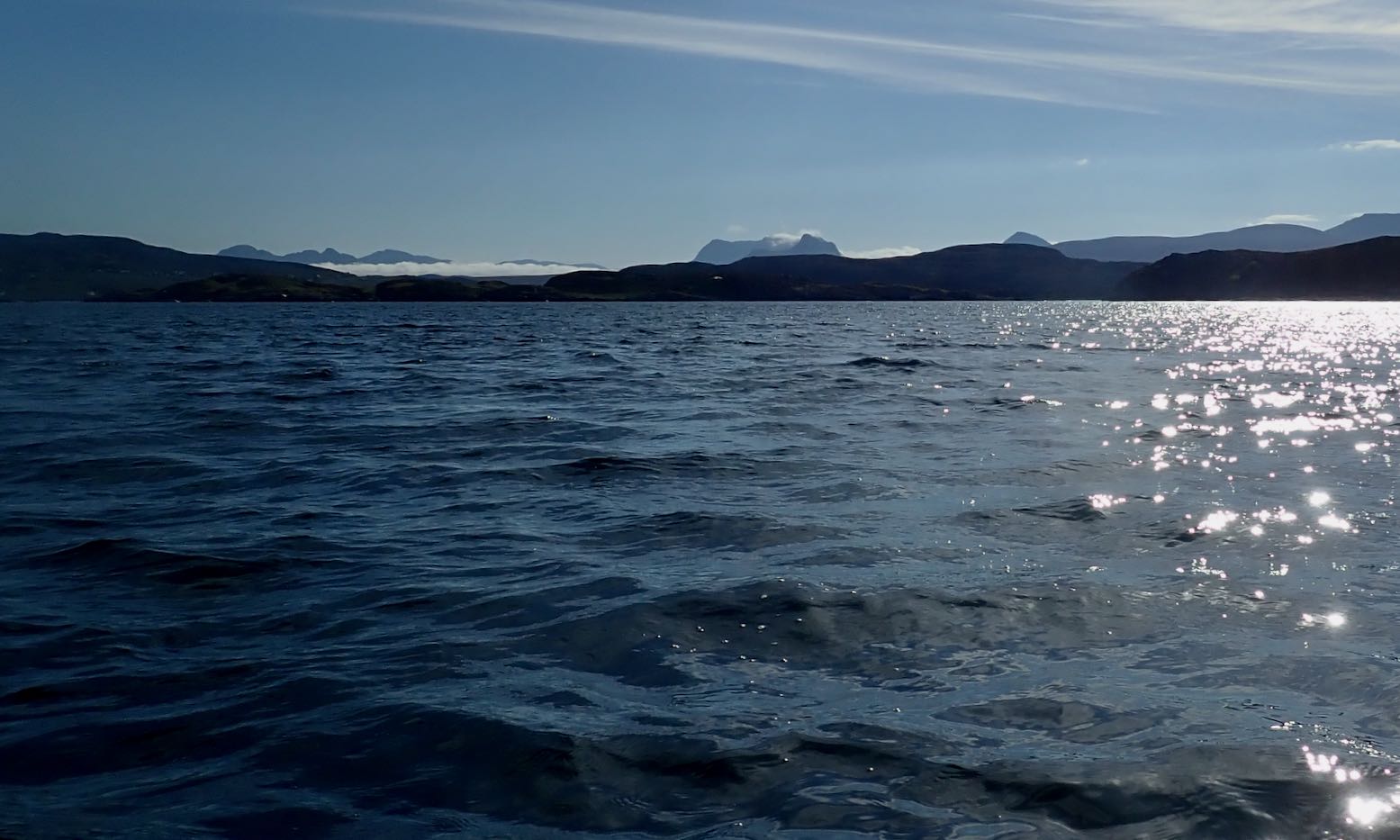
All is calmish as I cross Badentarbet Bay, but as I near T. Beg an unforecast southeasterly kicks up and keeps on kicking.
The west side of Tanera Beg would be too exposed, so I divert into the Tanera Channel, using the lee of the smaller eileans.
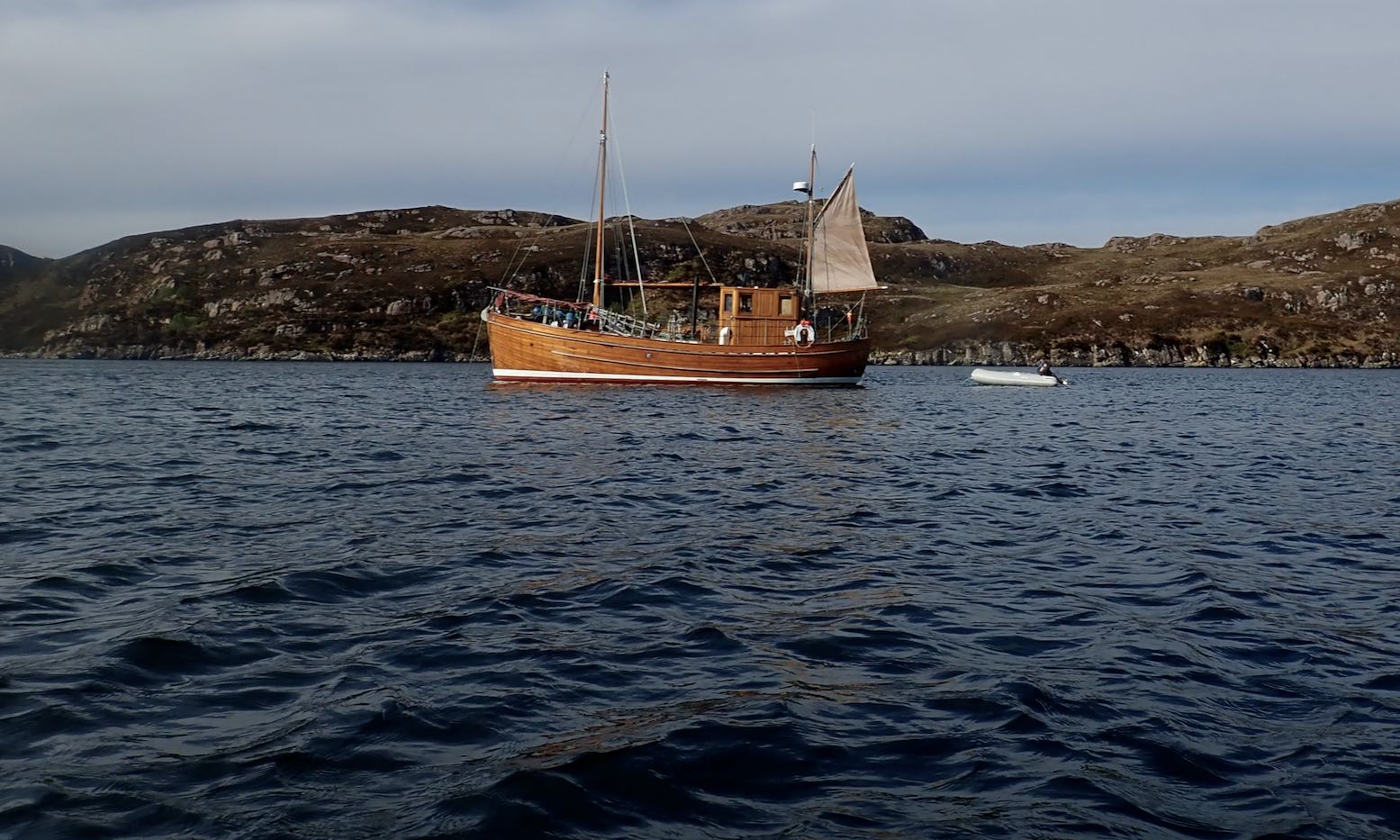
Nice looking wooden trawler.
I’m hoping to at least visit the arch at the southeast end of T. Beg.
It’s only 500m away but it’s quite lively and gusty now so I don’t risk it.
Instead, I turn east to get into the lee of Tanera Mor, and take a diversion through the usually cut off pool of Acairseid Driseach (these Gaelic words just roll off the tongue).
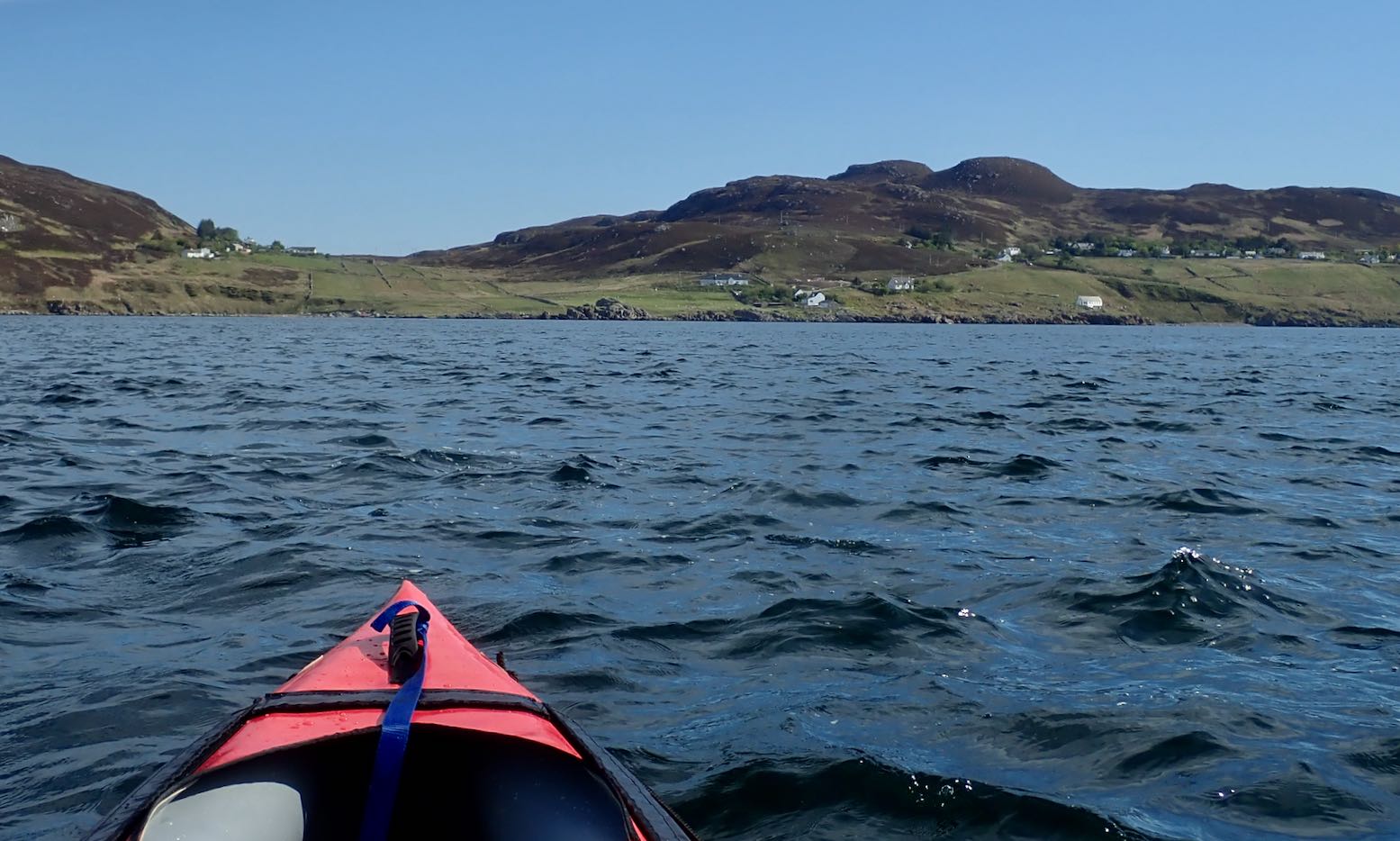
A bit disappointed, I head back to slot harbour but the wind seems less bad or may have passed.
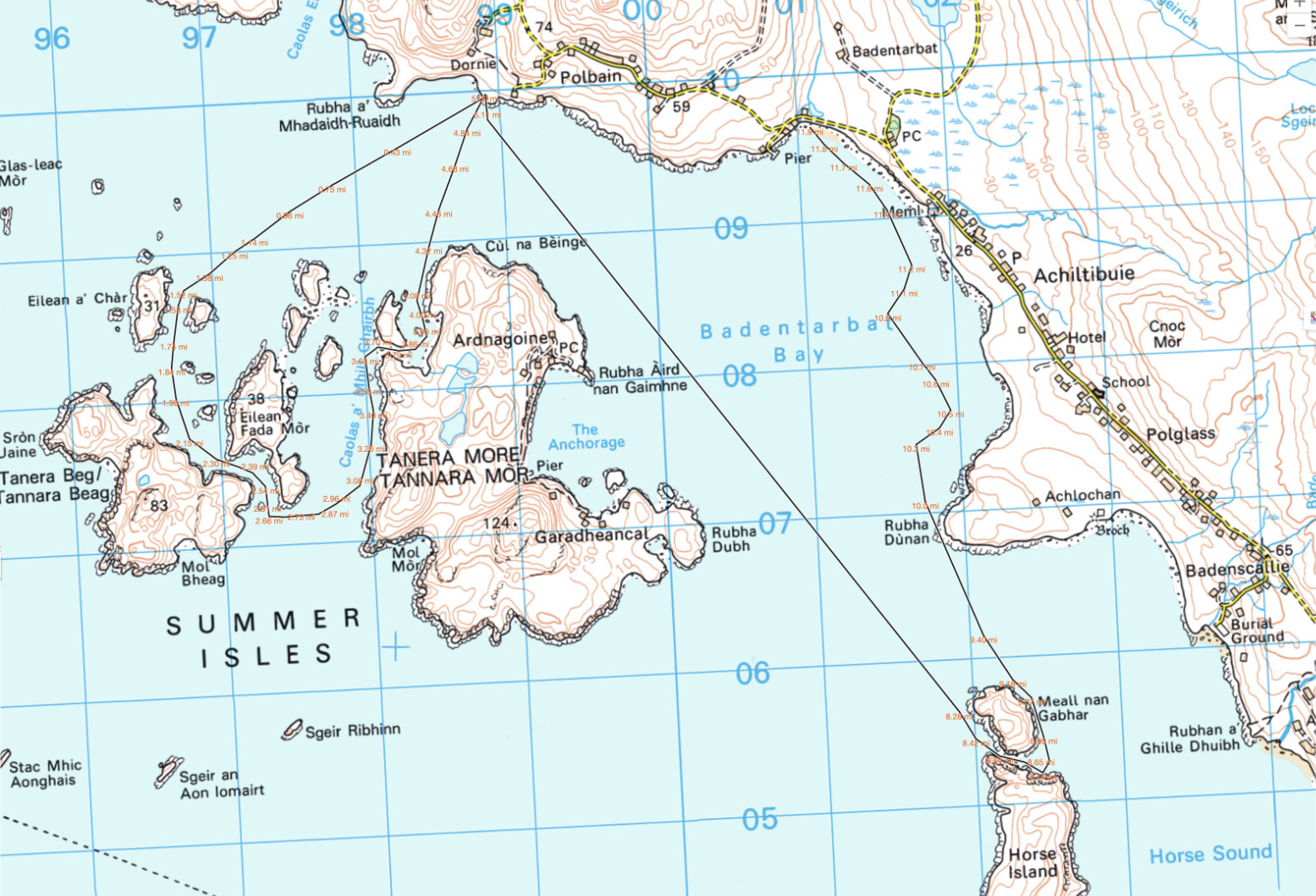
So I collect my trolley and strike out for Horse & Goat Island.
I estimate it’s about 2 miles across Badentarbet Bay. The wind drops and even becomes a NW tail breeze.
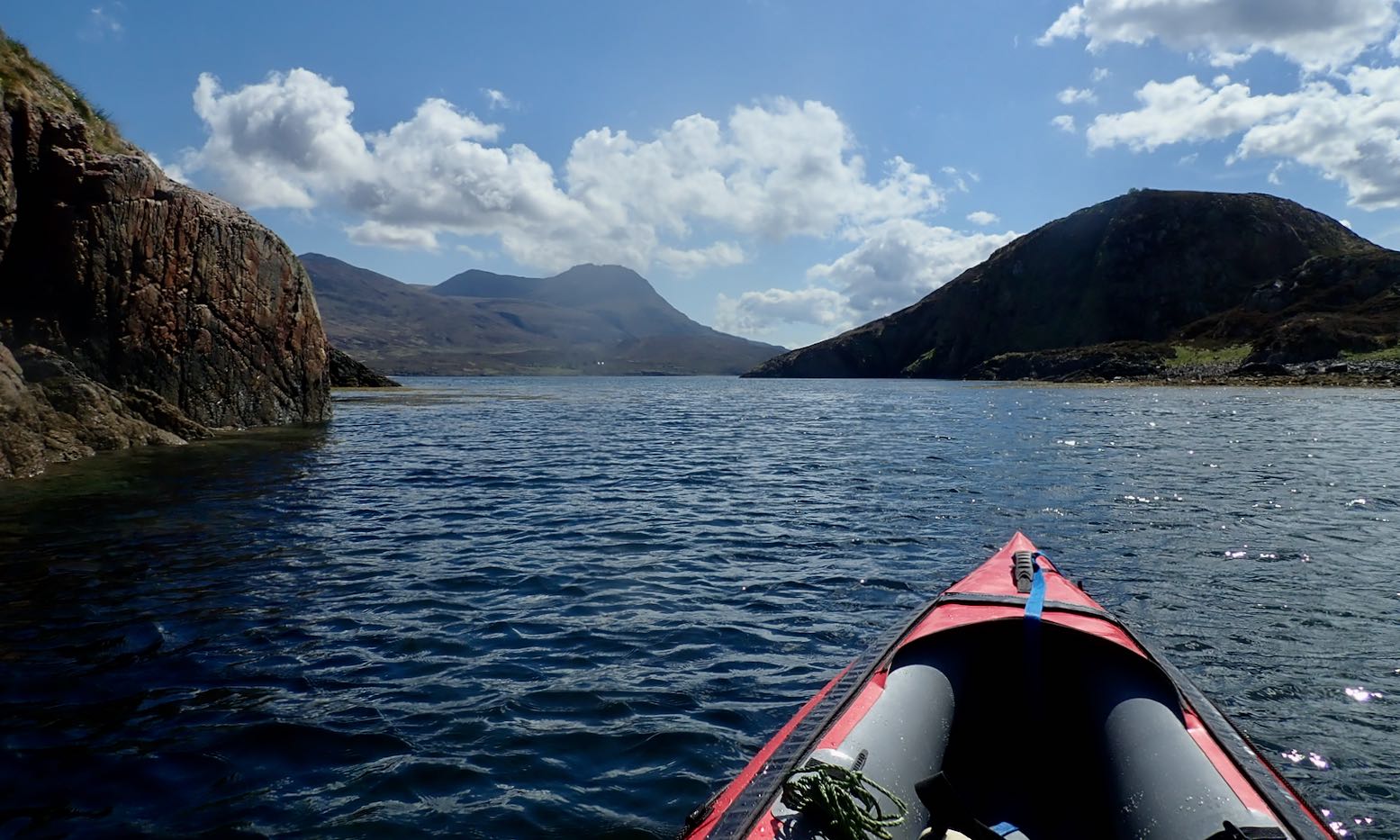
It’s actually more like 3.5 miles to the tidal channel between Horse & Goat.
By now the spring tide is at full flow against me and I wonder if the two islands have joined up yet.
I needn’t have worried; the NW breeze is stronger than any tidal current and there’s at least a foot of clearance.
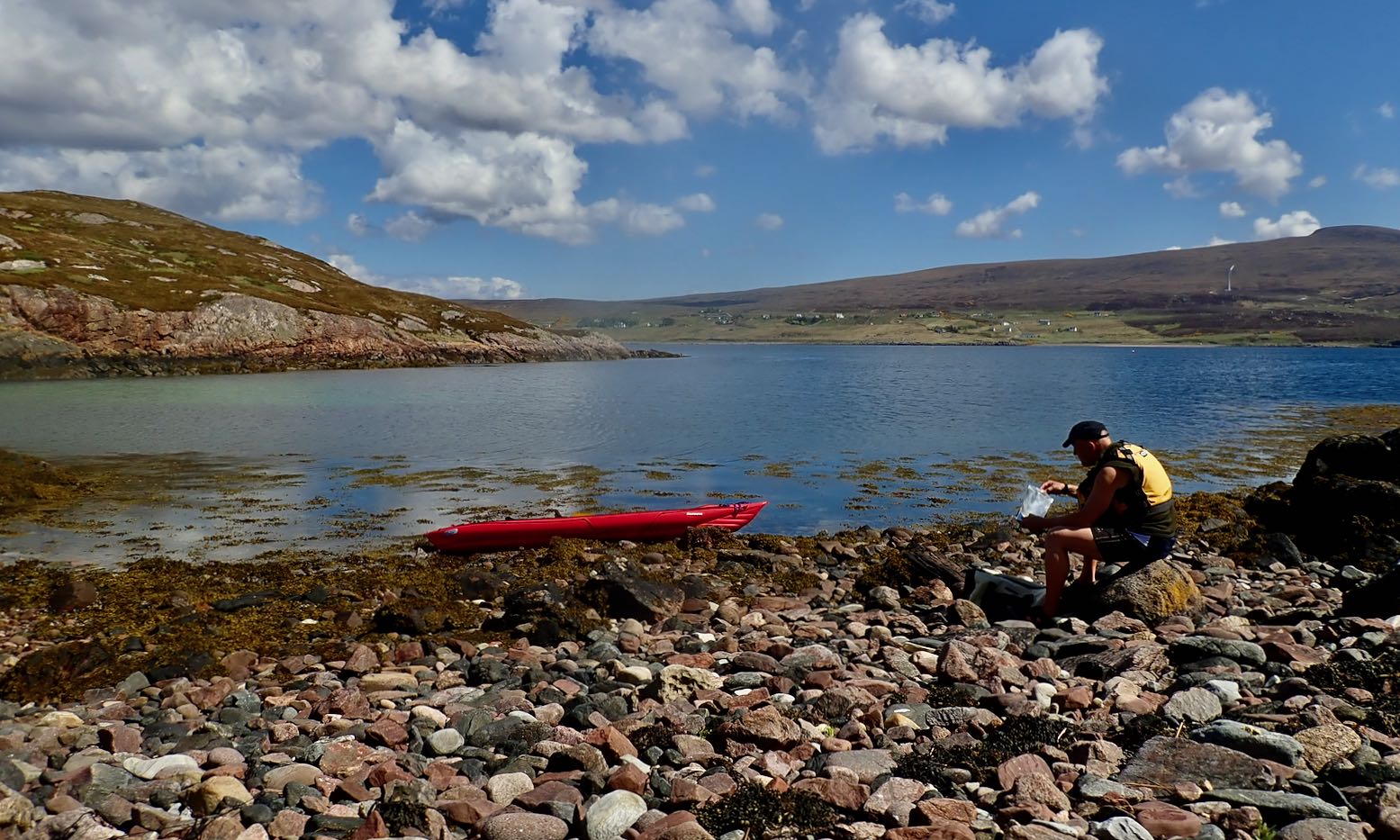
I pull over for a snack and a drink. Last time I was here was with my failed Semperit project. What a nice boat that could have been.
I knew from here it would be a 2-mile into the wind hack to Badentarbet beach.
Or even more annoyingly, a three-quarter headwind. It’s less than 10mph, but despite pushing hard with my left arm, the boat kept getting pushed right. Where is my rudder now?! I should have picked up some rocks to weight the bow at Horse Island to see if that trick works. Next time I’ll carry a waterbag to do the same; it’s something I’ve read of but never tried.
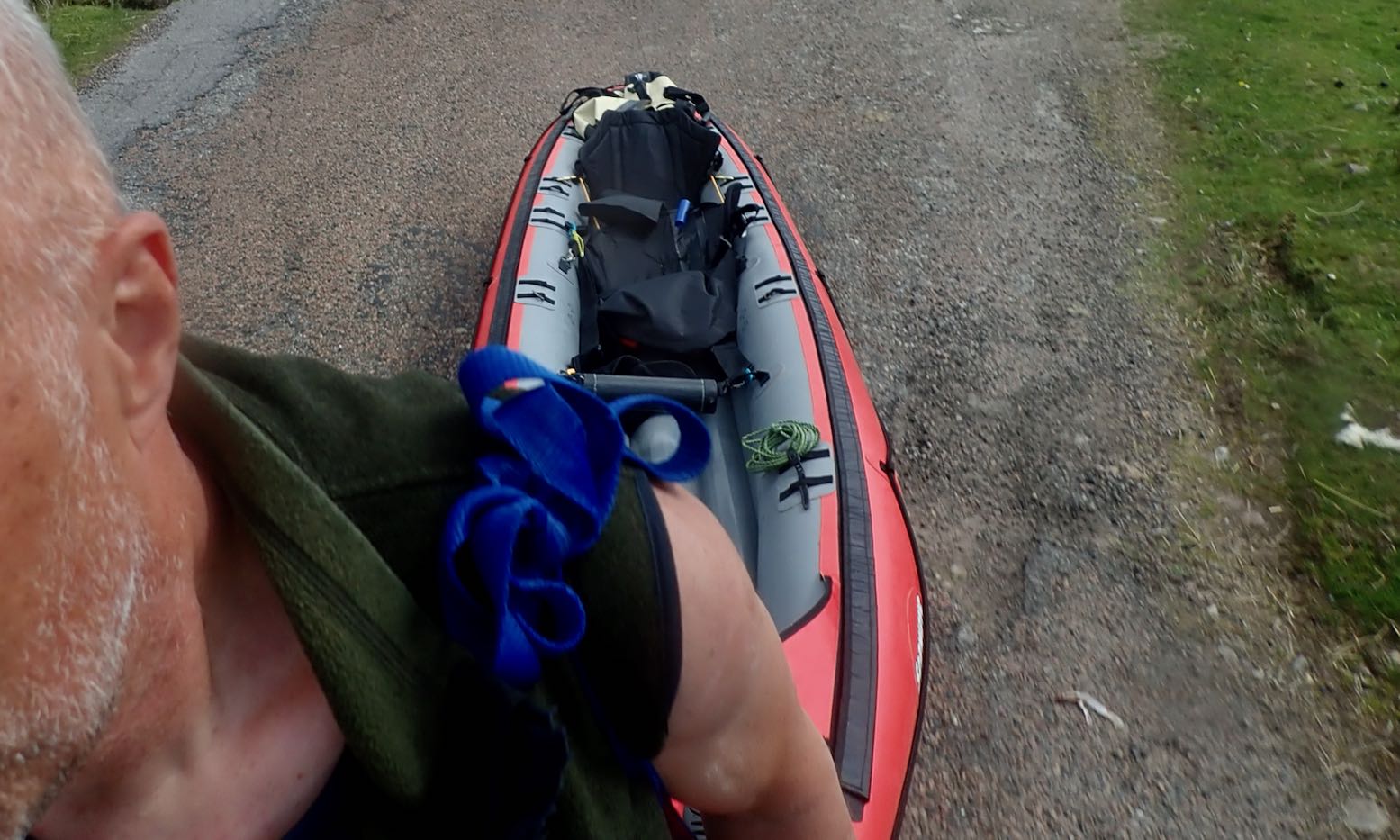
From Badentarbet Beach it’s a stiff climb – 1st gear pushbike – back up the road to Polbain, but on the road the skeg-wheel trolley again makes for easy, hands free towing with the boat hanging from my shoulder via a knotted mooring line. I can walk at normal speed with loads less effort (and time) than carrying the deflated IK.
Having a trolley like this makes the IK nearly as versatile as a packraft: a boat you can start here, end there and easily transport back across the difference.

So ends another great 12-mile day out in the Summer Isles whose configuration enables numerous ways to spin out a trip as pirates, winds and stamina allow, and all without getting too far out.
Gumotex Slip-On Skeg Roller (kayak trolley)

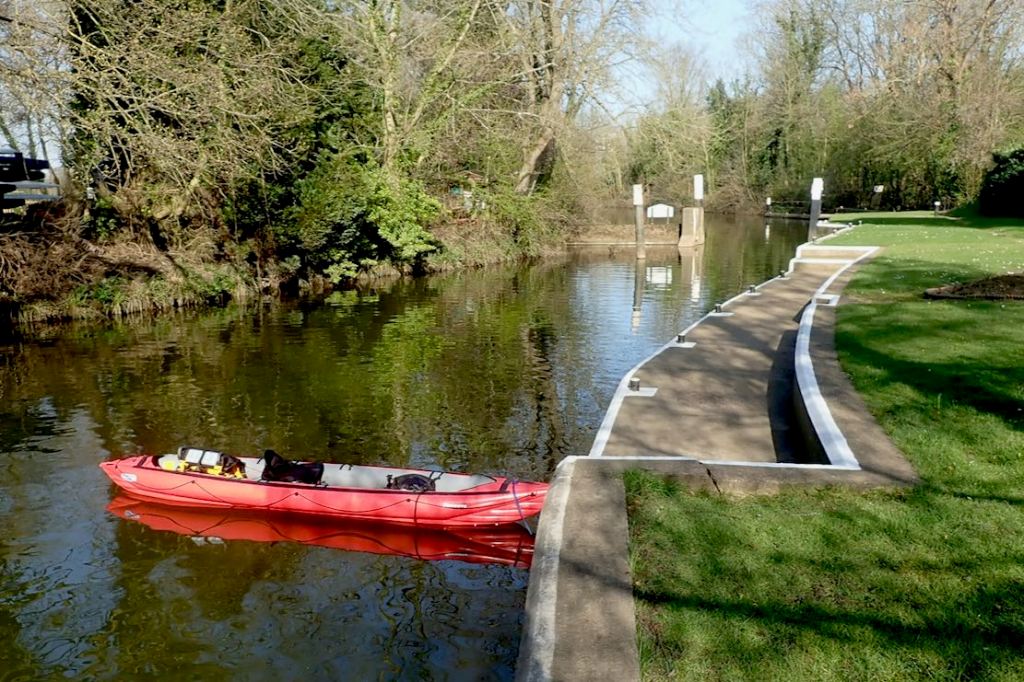
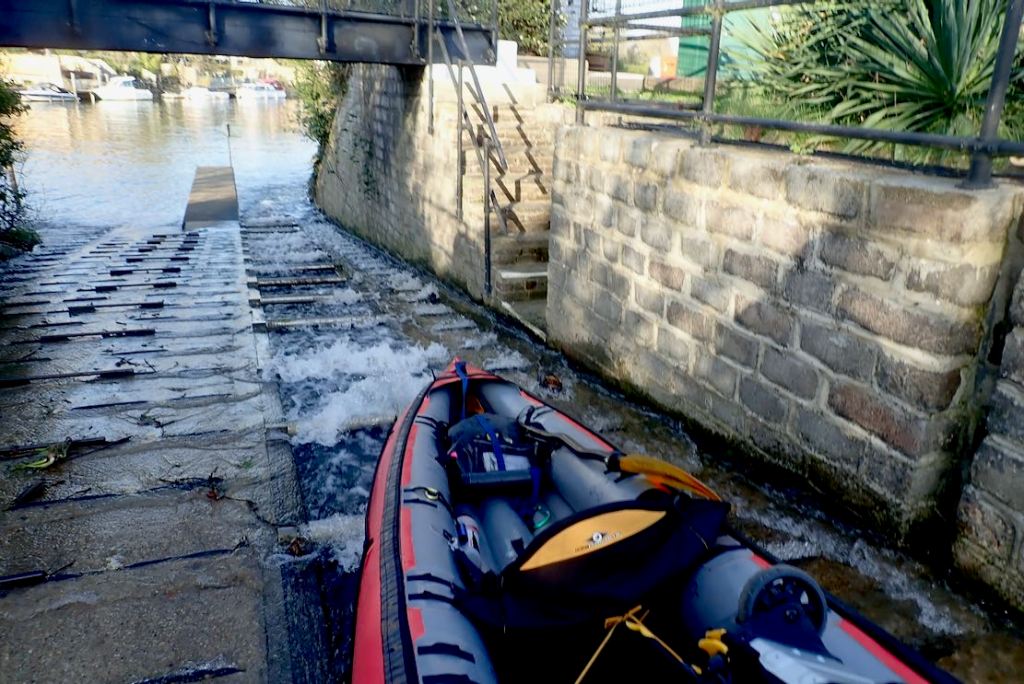
The effort of portaging the dozen locks of the River Wey the other month wore me out. On some portages you can drag the boat along harmlessly on lush grass. Others involved narrow gates, or crossing busy or narrow road bridges. It all got quite effortful, especially towards the end as my energy faded like a dying salmon.

I quickly worked out what was needed: a simple and easily deployed alternative to the typical strap-on canoe trolley, like the 60 quid Decathlon example (left) with identical examples on eBay for nearly half that price. A closer look at some images shows them to be needlessly high (unstable) and the clip-out joints don’t look that sturdy in the long run, though the tyres are nice and fat and clearance is great. With these trolleys I think the V of the alloy frame would sit better in line with the hull, not across it (with bends in the tubes). But crossways simplifies the wheel axle set up. My idea was to use the IK’s own weight with the skeg to locate and fix a trolley in place. Quick to use; no strapping needed.

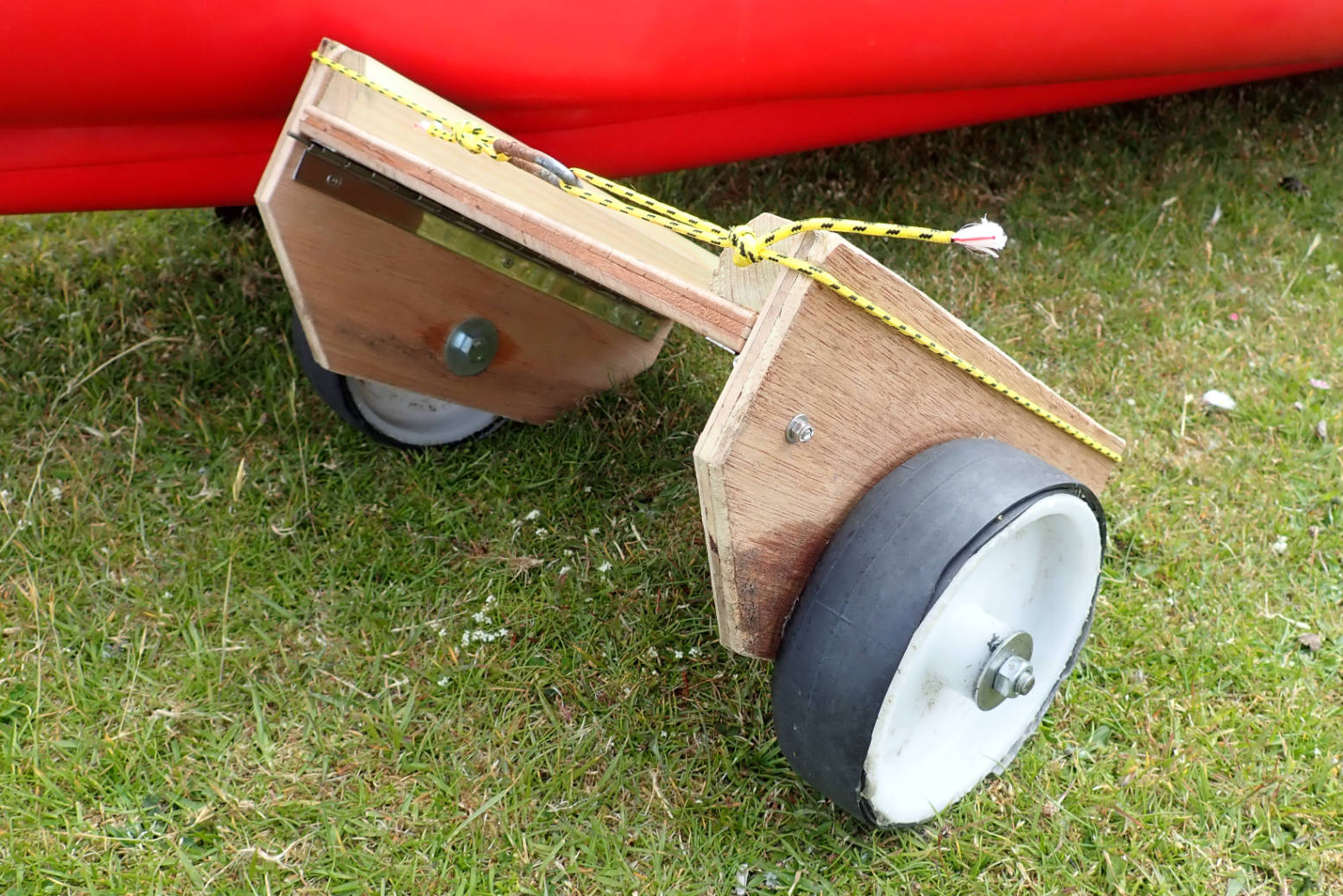
With workspace-and-tools mate Jon, we came up with a stable two-wheel folding platform with a drop-in skeg slot and hinged wheels which folded out to both roll and support the hull either side of the skeg. To portage, lower the boat’s skeg into the platform’s slot, pick up at the bow and roll it away.

On getting the trolley, the too-high sides were easily sawn down by an inch, and another inch got sawn off the bottom to improve ground clearance, as in the graphic. We hadn’t pinned down a way of stopping the hinged wheel plates folding inwards on the move. The trolley actually worked OK on smooth surfaces without any hinge lock, but eventually a bump would knock one side in. Until a neater idea springs to mind, the easiest way for me was stringing a loop of stretch-free Dyneema cord round the top to keep the wheel plates from folding in.

At 1.7kg it’s not that light, but as a prototype it was dead easy to make and the thing needs to be durable. Something similar out of alloy tubing (like the Decathlon trolley above) might be half the weight, but is less easy to fabricate in the front garden.

After a few miles…
By chance, I was left car-less during a few days of great weather. In either direction it’s less than a mile and a 50-metre drop along a quiet road to the seashore: an ideal trolley testing scenario. What extra weight there is sits best over the wheels, and at the bow I tie a shoulder loop into the mooring line, leaving me hands-free to check my messages. Coming uphill for a mile from the beach, I could walk at normal speed with much less effort (and time) than carrying the deflated IK.
It seems the width and height proportions are pretty good for stability, and the cord works well enough to keep the hinged sides up. A couple of times over rough stony ground the cord came off and the trolley folded up, or on steeper side slopes it just fell over. So maybe another 10-15cm of width would be good, but without much added height. And there must be a simple latch or lock idea for securing the sides.

The solid plastic wheels (£12.50 for two pairs) make a racket or hard surfaces and will transfer shocks and eventual wear to the wheel mounts. Some near-identical rubber wheels cost about the same and ought to feel less harsh. But first, I may waste some time wrapping some spare motorbike inner tube around my current wheels.

Having a trolley makes an IK nearly as versatile as a packraft: a boat you can start here, end there and easily transport back across the difference.

All Quiet on the Waterfront; Kayaking through London

See also
Kayaking Richmond to Greenwich

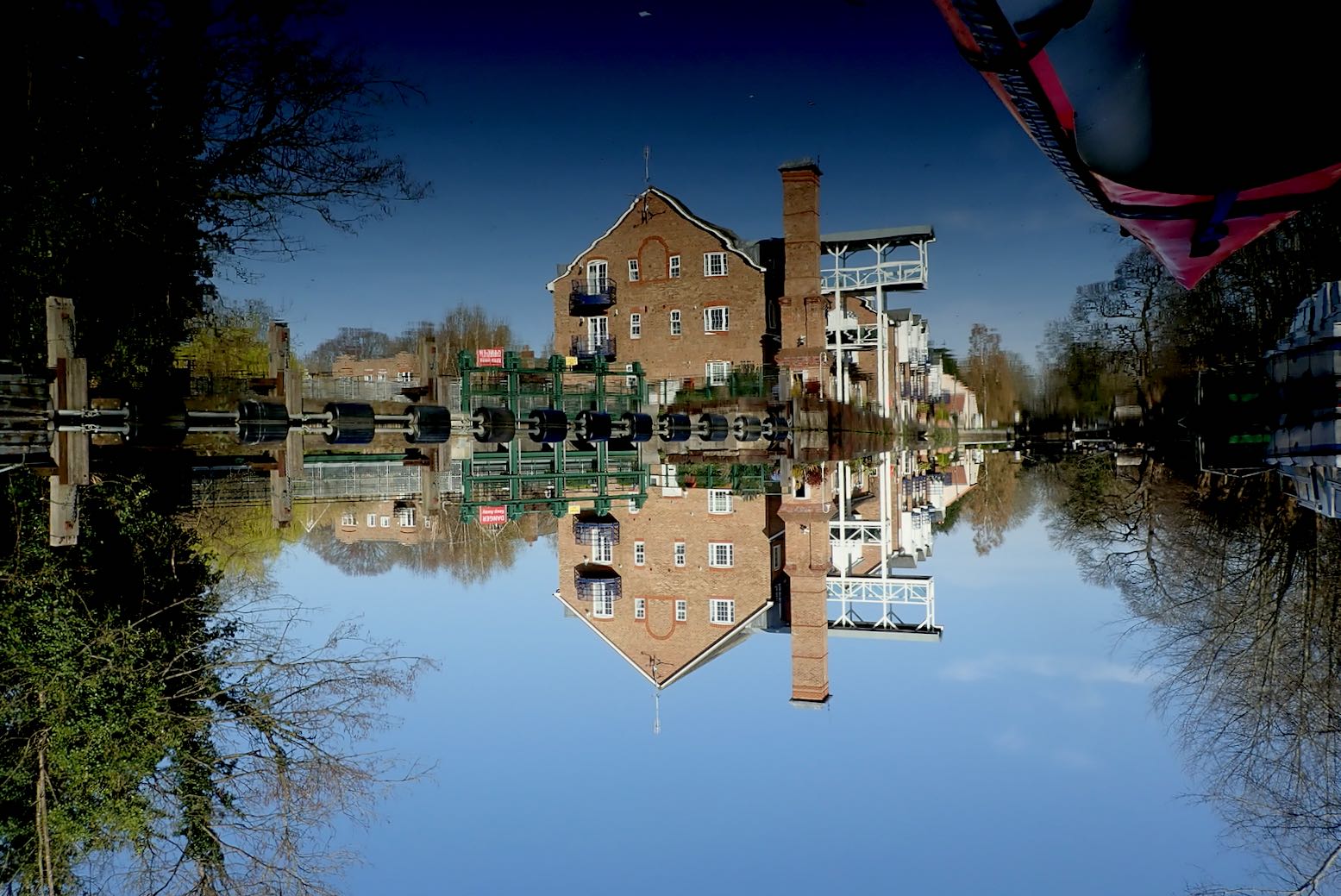
Notice anything suspect about this image?

Right now [April 2021] it’s a great time to kayak the Thames through London. It’s only April but due to you-know-what the Westminster tourist barge scene is dormant, making that brief but lively stage a bit less fretful. Down at water level we paddlers may be hyper vigilant, but can the bloke doing a U-turn in his heaving tourist catamaran while doing a commentary see us fending off the standing waves and refracted wakes?
As a barge-tourist in a Union Jack bowler hat asked me last time;
Is this allowed?
Yes it is chum, but a kayak on this part of the Thames is still an incongruous sight. The congestion and the standing waves pushed up by some bridges at certain times can feel a bit like skateboarding in a gale on Runway 3 at Heathrow.

Downloading the PLA’s mammoth 130-page Tideway Code is enough to put anyone off, but I do believe this edition (dated October 2020) is less anti IK than a previous version I read. At the time I recall seeking clarification from the PLA’s media person and got an arsey corporate riposte. Has the Lockdown IK consumer surge turned the tide on the PLA’s prejudice? It’s the old problem of misconflating a clueless beginner in £49.95 Aldi bin bag with an alert and well-equipped paddler in a decent high-pressure hybrid.
I say: pick your tide, keep right and be observant. For me the biggest peril was dodging the horizontal scythes of the Putney rowers who seem to go up and down across the whole width of the river as they please. They do need a lot of space.

Mortlake to Mayflower (Rotherhithe)
This 21-km (13-mile) stretch lined up well with 10-minute walks from stations at either end.
By Rotherhithe the excitement, such as it is, is over. And skipping the five miles from Richmond gives an easy three hours on the river; a nice early morning or afternoon paddle with good light for great photos or views of the Thames’ bankside icons.
It’s dawn and a Sunday, so it takes two buses and a train to get to Mortlake
Yadda, yadda…
Spacious put-in at Bulls Alley off Mortlake High Street, complete with benches
7.15am. All is calm
A bit of early morning rumpy-pumpy
Head buoy
Genteel Georgian waterfront around Chiswick
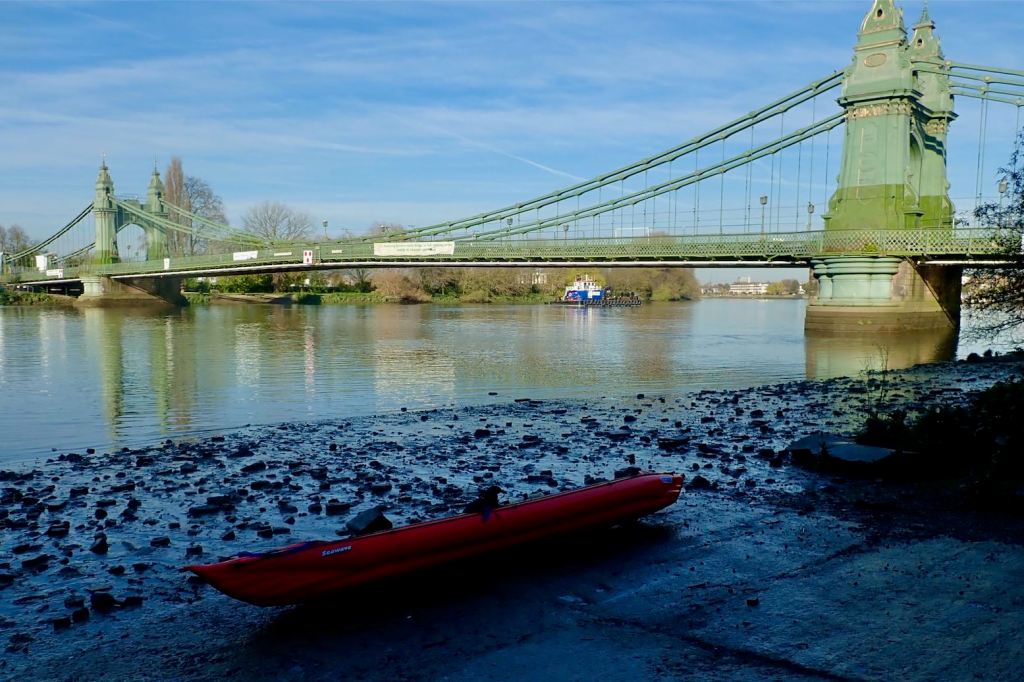
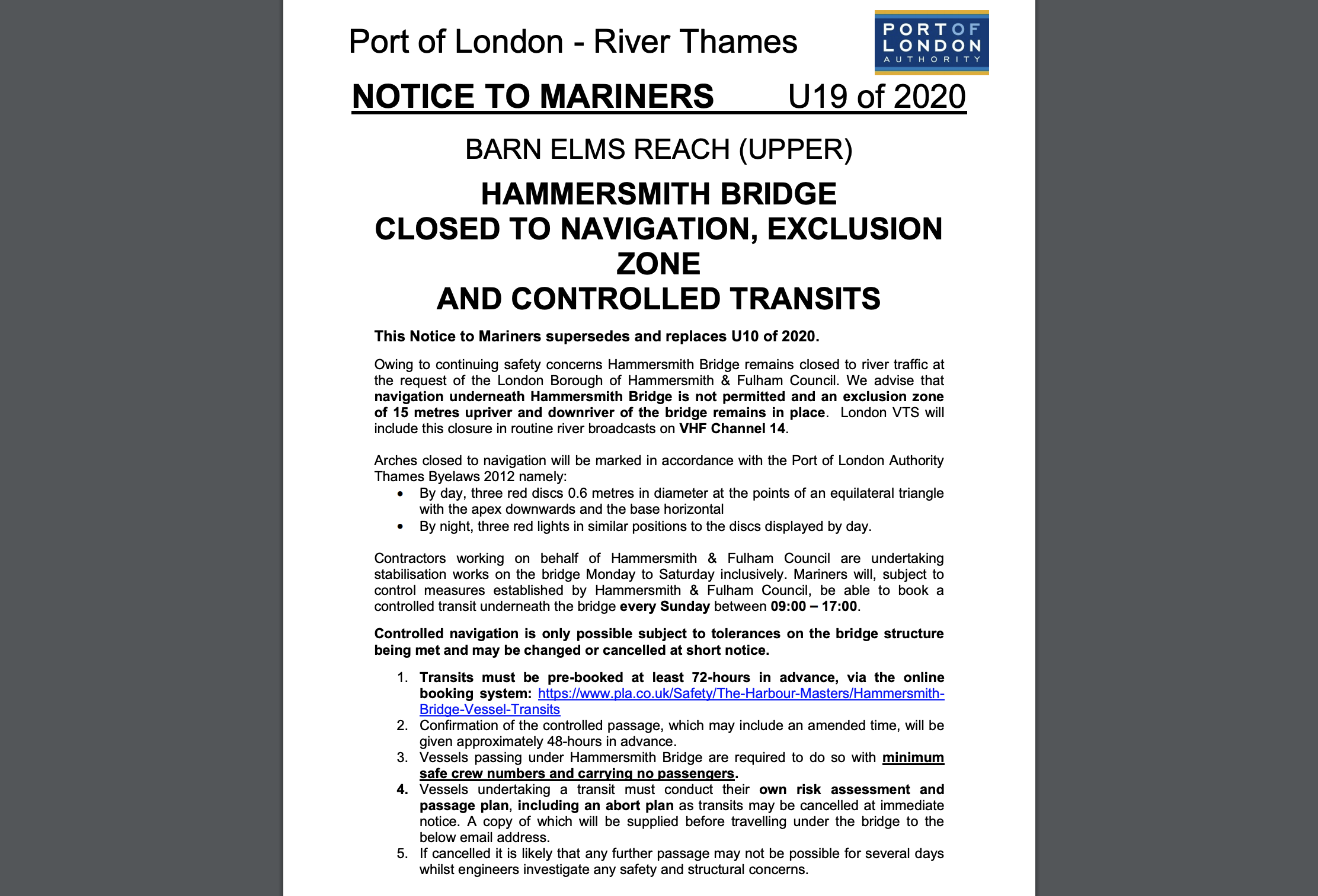
Arseache! Hammersmith Bridge is Falling Down and closed to navigation.
Ie: you can’t paddle under it in case it collapses on your head.
But on the north bank there’s a handy jetty and this slipway (above) on the downriver side is a 5-minute carry
The Hammersmith’s brittle, ageing cast iron dates from 1887 and is suffering from micro-fractures.
All together now: “Build it up with iron bars, iron bars, iron bars.
Build it up with iron bars, my fair lady
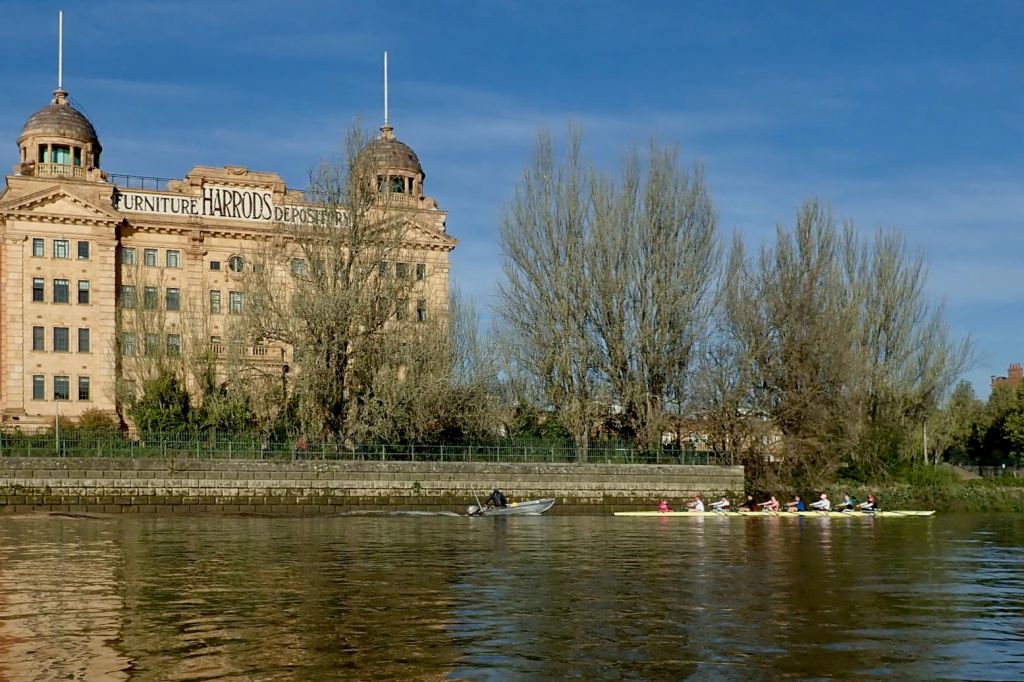
Once a Harrods warehouse, how expensive flats
9am. Putney rowers getting their oars on.
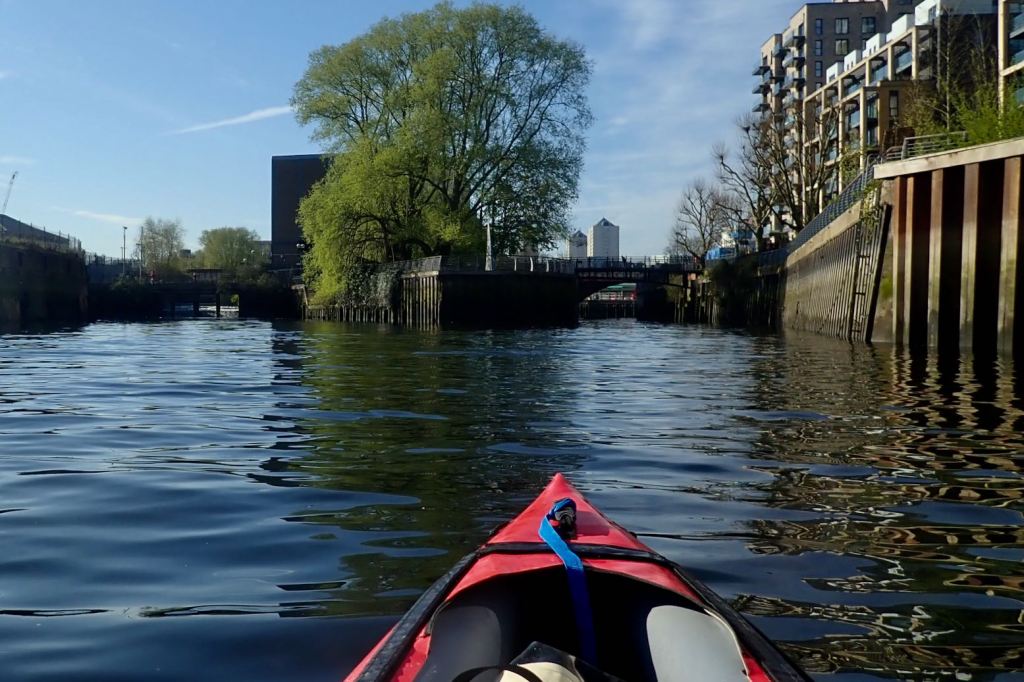
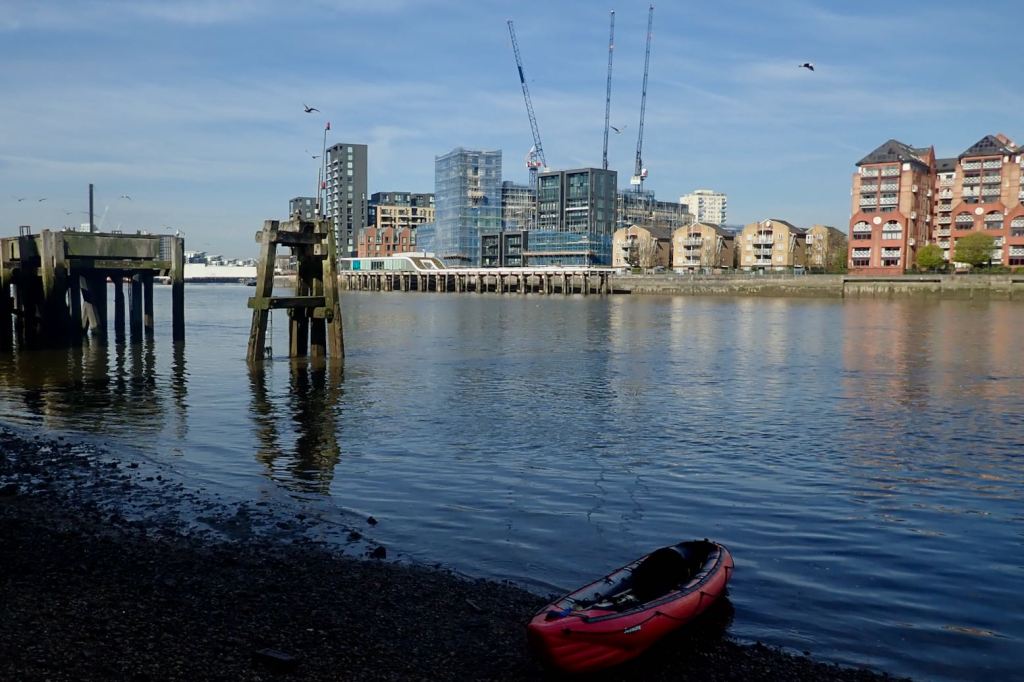
At Wandsworth I nip up Bell Lane Creek where the Wandle comes in.
Big weir drop to the left, and a bit further up on the right, another weir drop at all but HW.
See: Wandle: An Urban Packrafting Nightmare
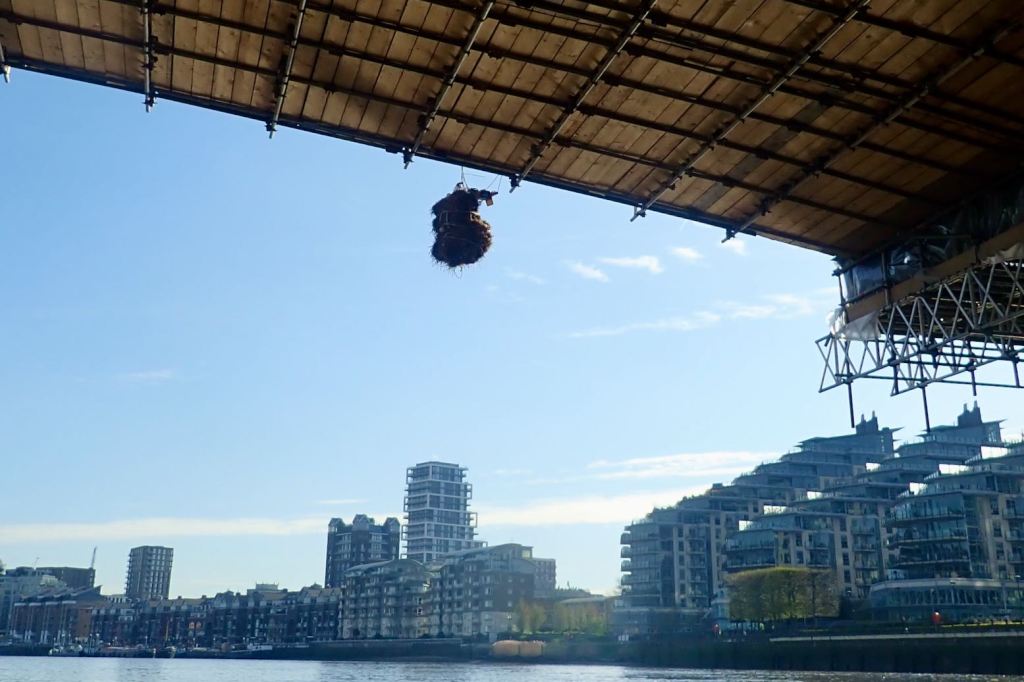
Hanging hay bale? WTJoF? Explanation in the PLA Tideway Code
No arcane signage here up Wandle creek
It’s chilly. Nature’s call cannot go unanswered
River racers. My money’s on the Yellows
Holy Mother of all Parliaments. The latest scandal? The ‘chumocracy’ of lobbying (there have been a whole load more since
It gets a bit choppier just after Westminster Bridge as the current backs up
London Eye still looks as amazing as ever. I wonder if they grease the axle and tension the spokes once in a while
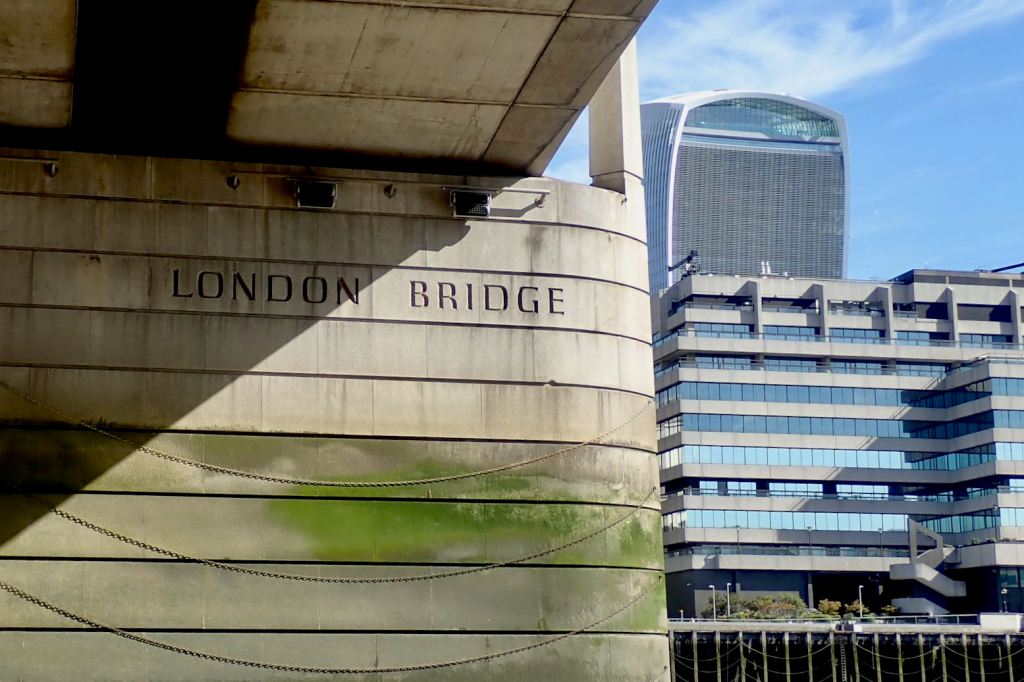
Rectilinear skyscrapers are just so last century
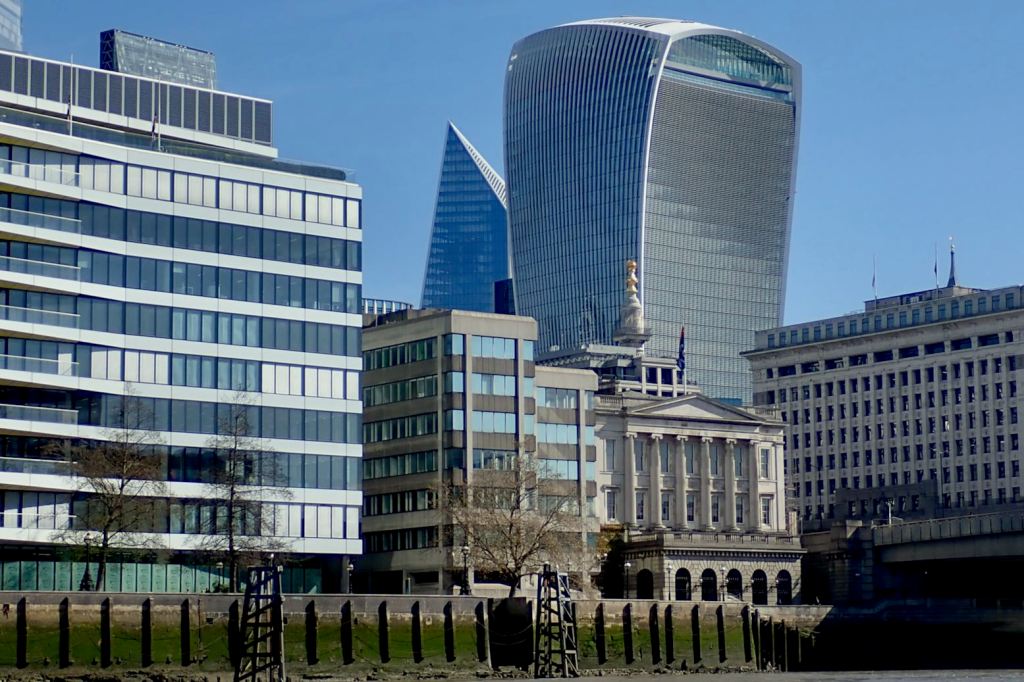
A few years back sunlight reflected off the ‘Walkie Talkie’s’ concave face (20 Fenchurch St) and melted a car in the street below
Not falling down any time soon, but small standing waves soon after can make you think
By the HMS Belfast it settles down again. On a neap tide at least.
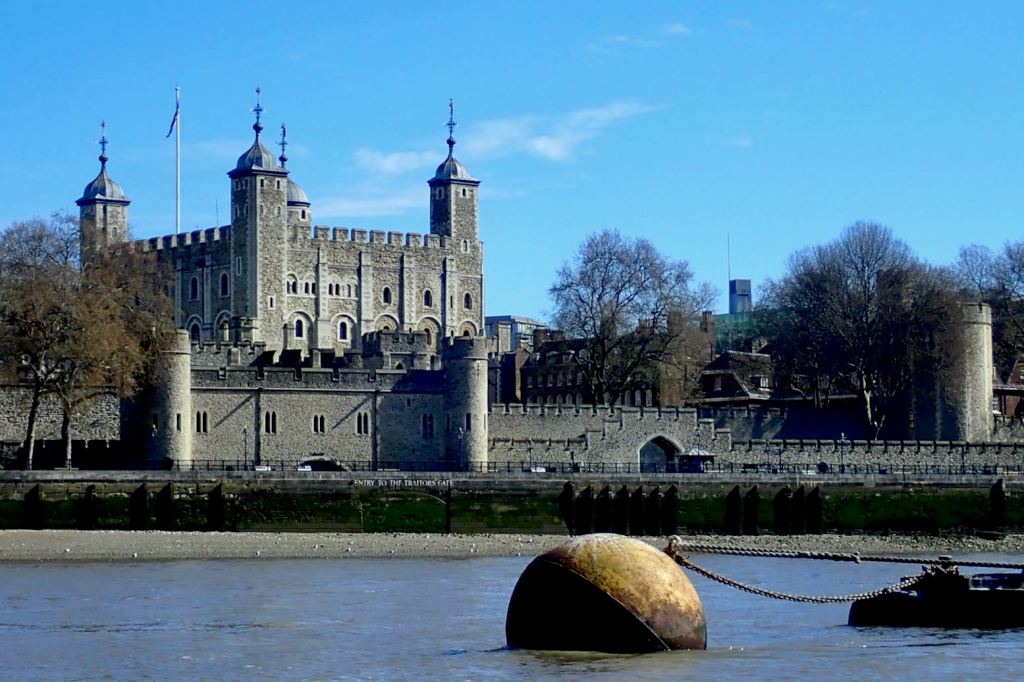
‘Send him to the Tower!’
This is what Hammersmith needs
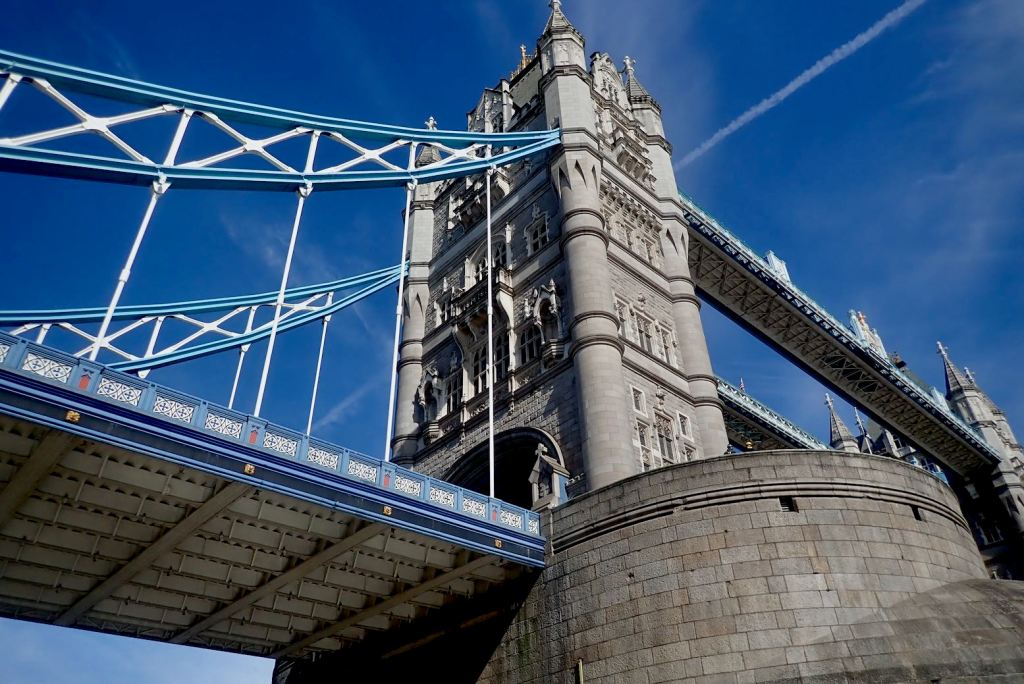
After Tower Bridge the river widens out and the powered craft can gun it
A mile downriver, the Mayflower’s looking a bit shabby. Don’t people go to pubs any more?
In 1620 the famous ship embarked from here for the New World
Tourists RIBs slalom up and and down the Pool of London like giant jet-skis
My modified seatback worked great. Just what was needed
Go west young man. And never come back!
From the beach it’s a 10-minute walk to Canada Water station.
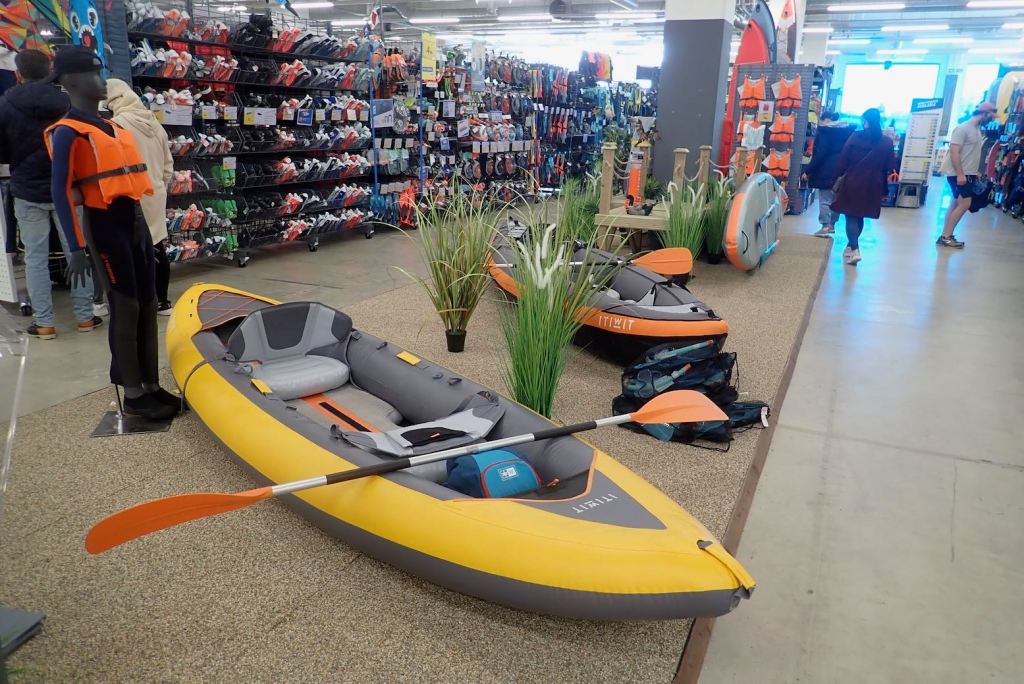
I pop into Decathlon nearby to admire some Itiwits; quite possibly Britain’s most popular IK


The Long Wey Down: kayaking Guildford to Hampton:

Seawave Index Page
Regents Canal (London)
Avon & Kennet canal (Bradford on Avon)

One of England’s first navigations, dating back to 1653. That’s probably why this historic canal feels quite natural and river-like, apart from the virtual lack of current.

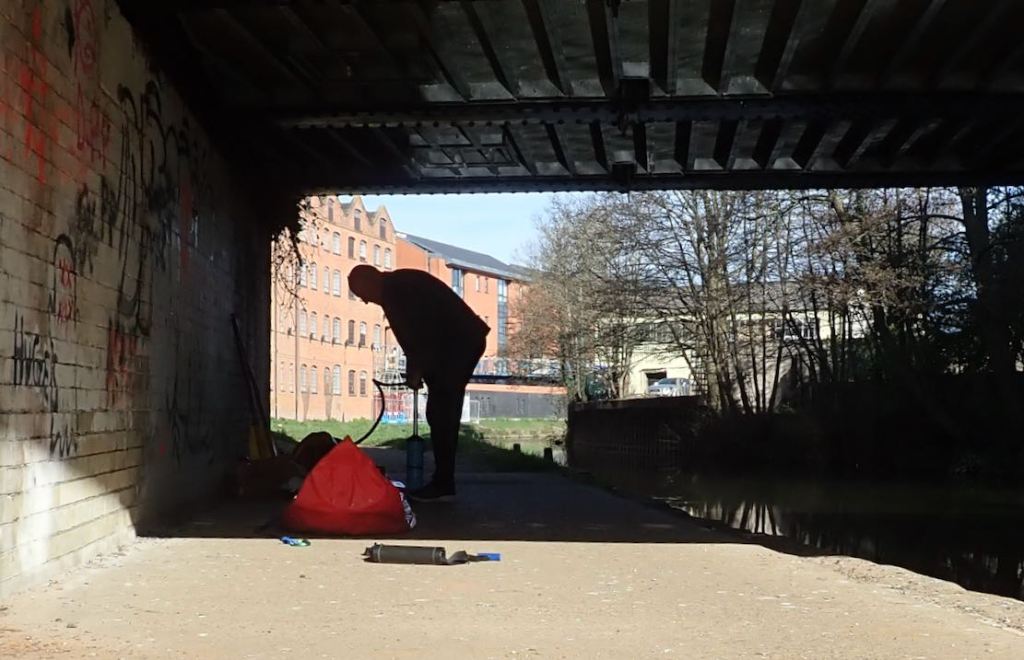
All hands to the barrel pump! The day will be long, sunny and warm. High time to tick off ideas matured over the winter months of Lockdown.
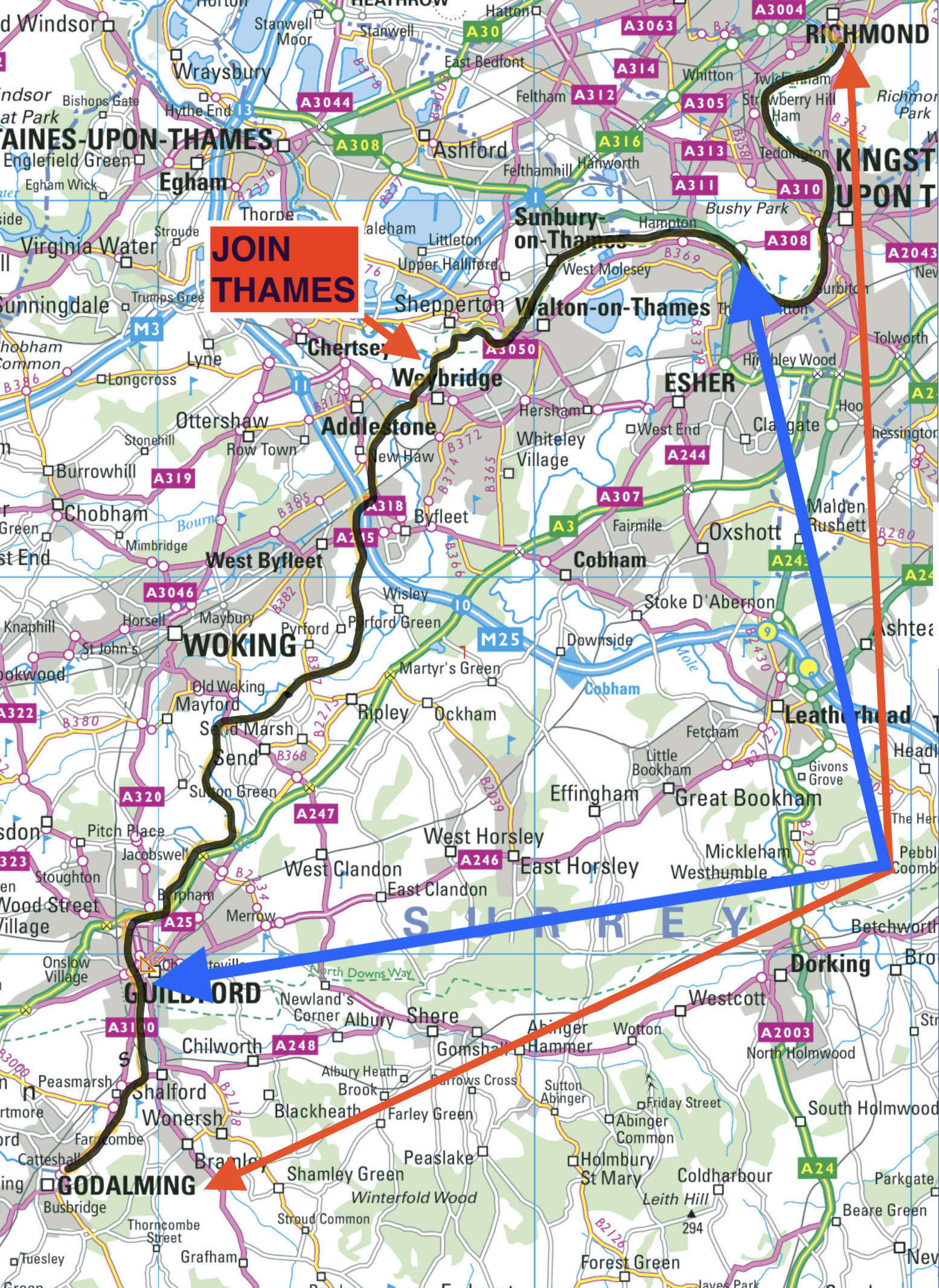
First on the list: the River Wey from Godalming to Weybridge in Surrey. Or should I say, the historic canal called the Wey Navigation which is paralleled in places by the old river. It’s one of England’s oldest navigations (commercial inland waterways) which once connected the Thames with the Navy base in Portsmouth. At the time a safe way of transporting stuff, including munitions produced near Godalming, without risking encounters with Napoleonic marauders in the Channel.
For years I’ve been unsure whether the Wey was a dreary canal with more locks than the Tower of London, or a grubby, semi-urban river with weirs and other obstructions. Turns out it’s a bit of both but better than expected. All I had to do was RTFM!

Compared to the similarly popular Medway, which I’ve done loads of times in IKs and packrafts, summer and winter, the Wey Nav feels less agricultural, more scenic and has an interesting history if you slow down enough to look. But it lacks the Medway’s unique canoe passes which scoot you down the side of each lock (right), avoiding up to three laborious carry-rounds per mile.
Parts of the original river survive in places to either side of the canal, which is what caused me confusion. I now realise the Navigation (managed by the National Trust) gets priority in terms of water levels and maintenance. As a result the occasionally nearby River Wey might be shallow or chocked up with fallen trees or rubbish. But you can combine both to make loops like this.

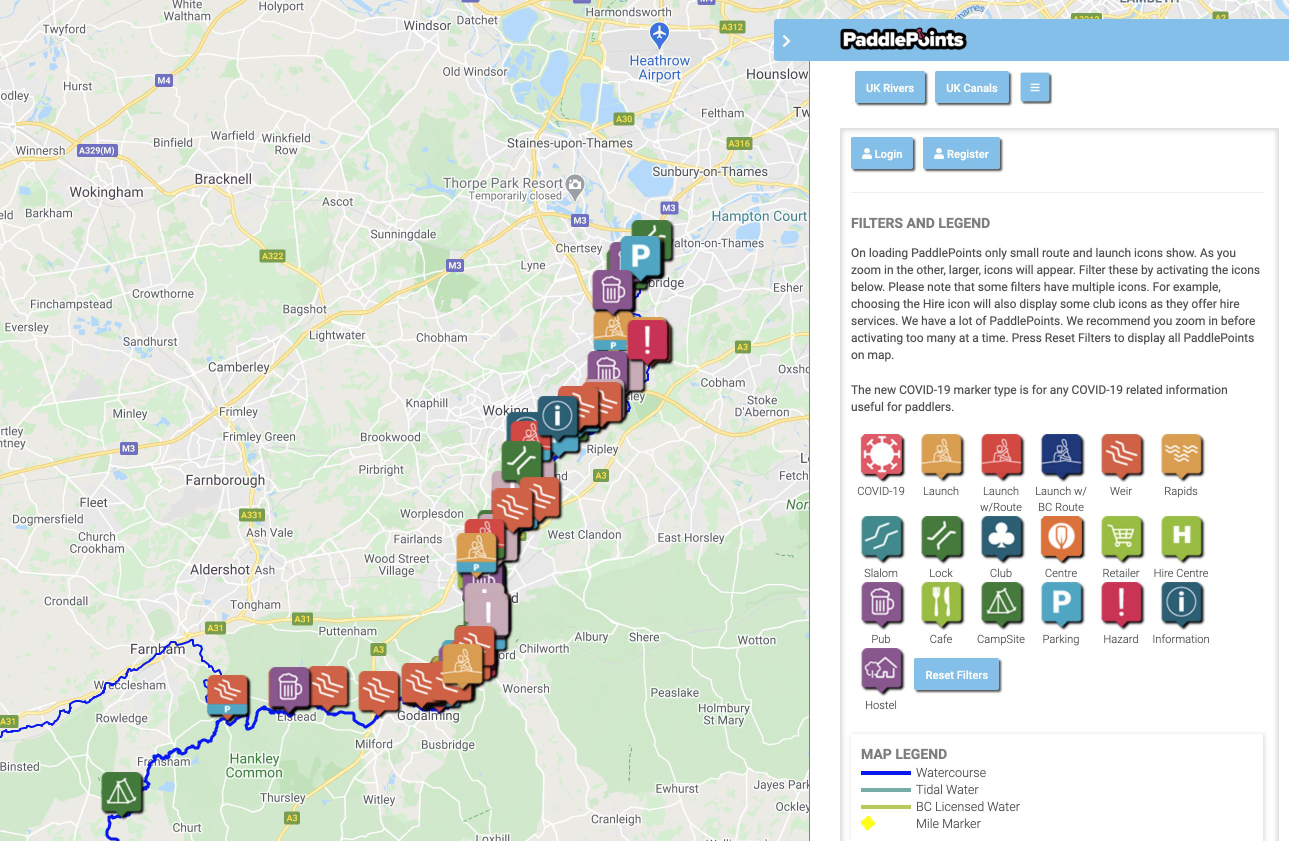
Because of the Wey’s multiple channels and numerous weirs and locks, I tried British Canoeing’s PaddlePoints website, a comprehensive database of paddleable river map routes with handy icons (above) for put-ins, parking, hazards like fallen trees, feral teenagers (I’m not joking) and so on. You can reset to delete extraneous icons (‘Covid-19’ ?); I just wanted to clearly locate the locks and weirs and river’s branches, though on the day ‘Navigation [this way]’ signs at junctions were clear. Closer scrutiny of the map shows that in places the blue line guides you along the old, choked-up river, not the Nav, and not all weirs (an important feature to know about) are shown as icons, even when they’re clearly evident on the Sat view underlay. And so the Map view (as above) can give a misleading impression of which way to go. As you’ll see below, at one point the blue line even guides you over a weir. Common sense prevails of course, but you can imagine some beginner clutching their PaddlePoints app on Map view getting sucked into a weir. I realise now this content is user-generated like OSM or Google Maps, and so errors, inconsistencies and lack of moderation are inevitable. As such, you can report icon-points, but it’s unclear if the route (blue/green line) can be corrected by users. If nothing else, PaddlePoints helps identify which rivers you’re allowed to paddle in England and Wales, and what the rules there might be.

I fancied a full dawn-to-dusk recce: as much as I could fit in from Godalming (where most paddlers start) before my tank ran dry. I might even reach Richmond on the Thames, a section I enjoyed last December in the Arrowstream. That is actually quite a haul: 20 Weymiles plus another 15 on the Thames, including no less than 17 lock portages on the two rivers. But the great thing about ending a paddle in an urban area is I could air down when I got worn out and rail home.
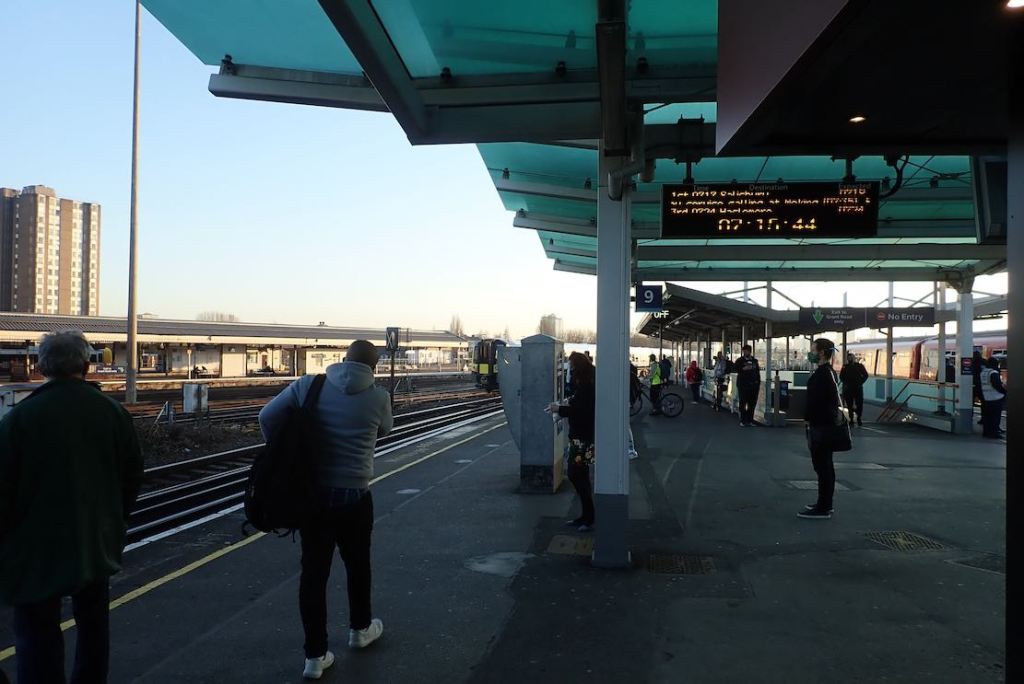
Thirty-five miles? Dream on, bro! I’ve only paddled two days since September so was far from paddle fit. Then again, the pre-dawn brain wasn’t on top form either: I set off in the right general direction, but on the wrong train.

Oh! Mister Porter, what shall I do?
I want to go to Godalming
And they’re taking me on to Hoo [k],
Send me back to Woking as quickly as you can,
Oh! Mister Porter, what a silly boy I am!

After backtracking, I decided to catch up with myself at Guildford, 5 miles downstream of Godalming and missing out 4 of the Wey’s 14 locks. I dare say I’d appreciate that later.

Clapham at 7am. It’s all a bit of a blur.
In Guildford I slip onto a closed towpath and enjoy a quiet set-up without the usual ‘Oh Mr Porter, is that one of those inflatable canoes? I’m thinking of getting one…’
Just around here I realised I’d left my Garmin out in the sun to catch a signal… Should have gone to Starbucks.
I’m trying out some old runners as water shoes instead of my usual Teva Omniums.
Do they really believe this or is it just juvenile baiting?
Alternative use for a big slackraft.
At Bowers Lock I spot my first Intex of the day, a 100-quid of K2 Explorer on its maiden voyage with daughter and dad.
Under an old bridge a real K1 belts past with barely any wake. Looks like fun but what happens when she stops? Same as the bike on the left, I suspect.
As canals go, not so bad.
Triggs Lock. With a little work this side sluice could be a fun canoe chute (lens finger shows scale).
All they need to do is get rid of the guillotine and add a galvanised chute at the end.  
How about it, National Trust? It would be like turning Downton Abbey into a Discount Carpet Warehouse!
Soon after lunch at Papercourt Lock I pass two chappies also heading for Weybridge in something called a Sea-Doo.
Flip yer paddle round, mate, you look like an amateur!
Not another lock, TFFT! Just some general-purpose gates to hold back Viking raiding parties.
At this scenic and willowy point the canal runs right alongside the M25 London orbital motorway.
The tyre noise is like Niagara Falls.
Mile 12 at Basingstoke canal junction. By some civil engineering synchronicity the M25, Wey Nav, Basingstoke Canal and a railway mainline all cross or meet at this point. In its way it demonstrates the history of post-medieval commercial transport: rivers > canals > railways > highways and airplanes. That’s my MA thesis, right there!
At New Haw Lock I need water but the lawn-mowing lock keeper says there’s no tap for a couple of miles.
It’s an awkward portage over a narrow road bridge too. Luckily, this chap helps me out. Thanks, chum!
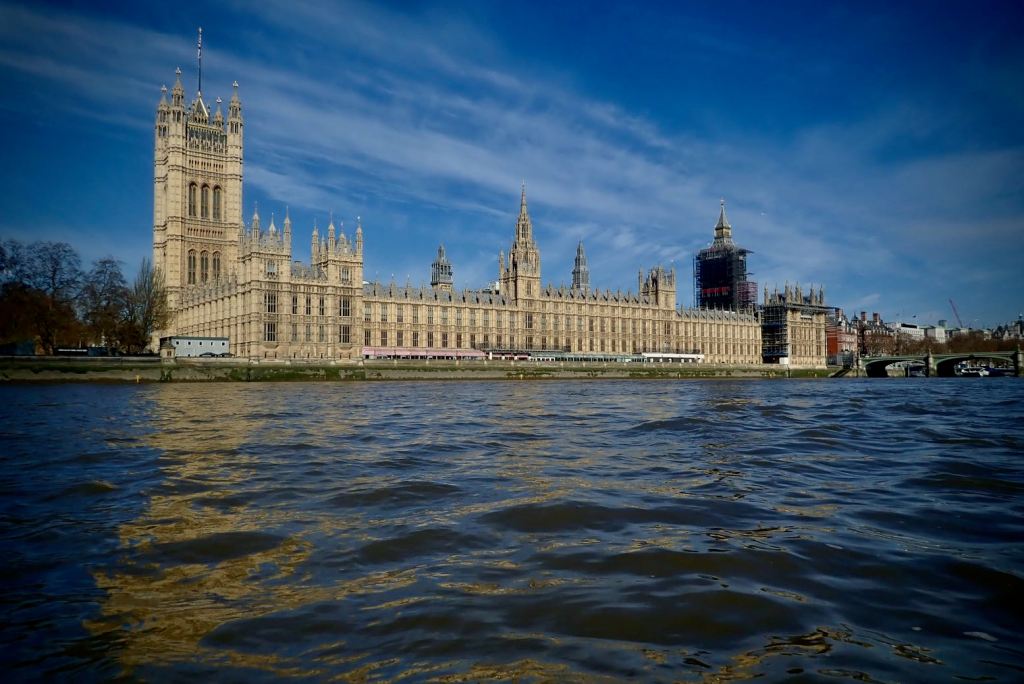
Coxes Lock with a doable weir to the side. I may try it next time and risk censure from the NT.
Well, according to BC’s PaddlePoints website, that’s the way to go!
Weybridge Town Lock. Another awkward portage over a road bridge on the left.
In places the Weybridge backwaters look like an Everglades retirement village.
As I approach the Thames Lock at Weybridge things get wobbly and I have an out-of-boat experience.
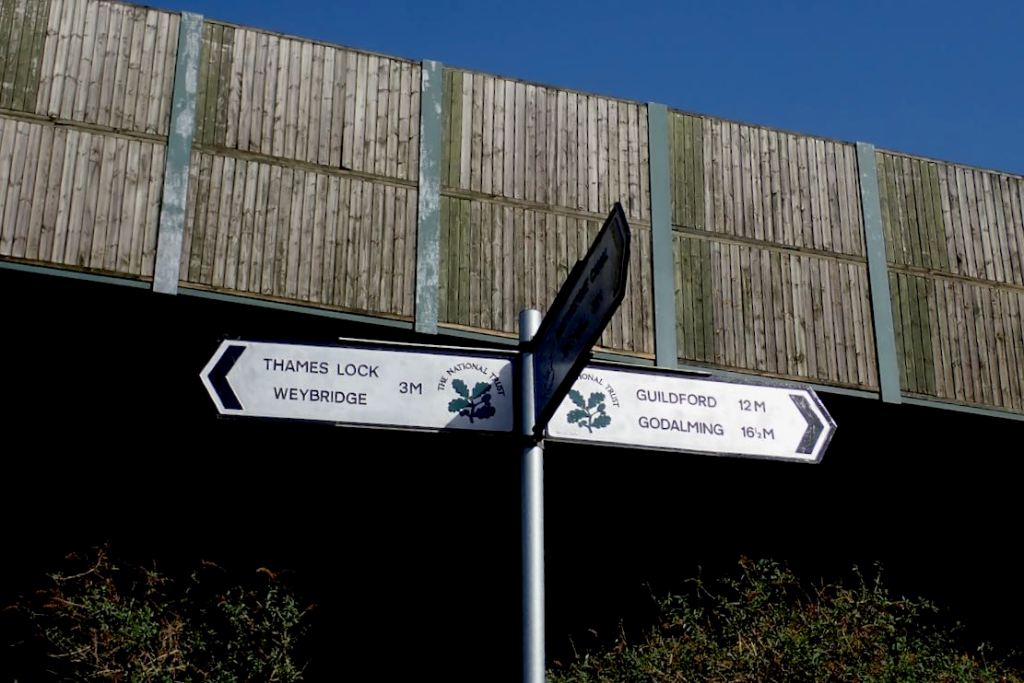
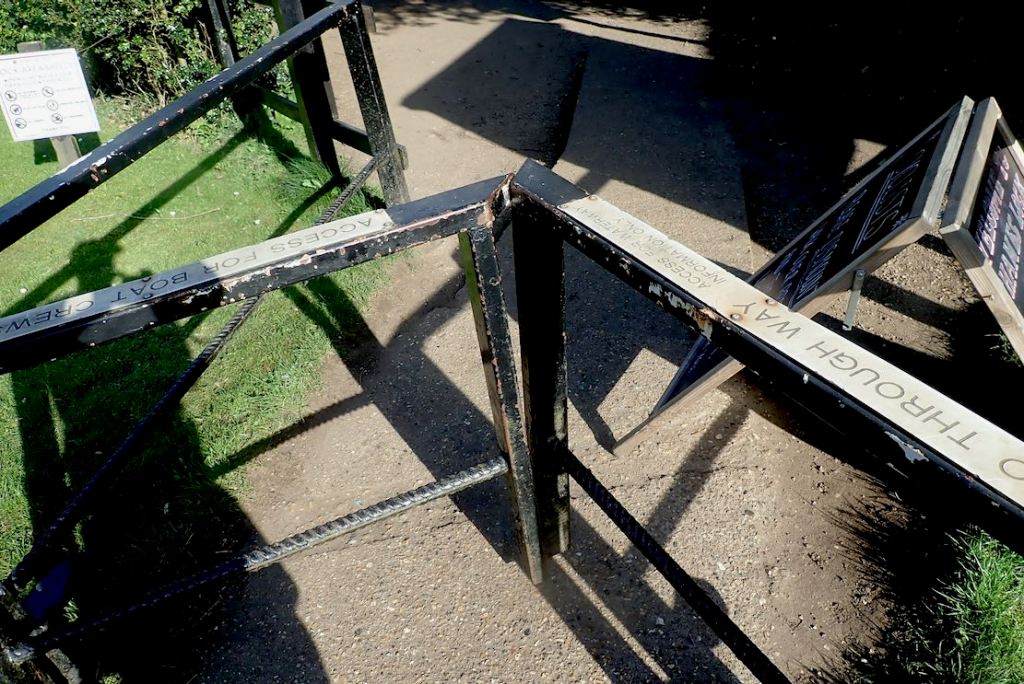
Amusingly lock-themed gates close the footpath so us portageurs can pass.
Finally at Thames level, hallelujah. And there’s a tap set into the jetty too. I drink like a camel then me and the boat have ourselves a wash.
Over six hours from Guildford, but even with a drink and food to spare, I don’t have another three hours in me to reach Richmond. Maybe I can do two hours to Kinsgton.
Now on the Thames, I become a great admirer of roller portages.
The game’s up at Hampton Court Bridge if I’m to have enough energy to roll up the boat. The station is right there.
It’s a warm evening on the Thames and they’re all out in boats and the riverside parks. The [Covid] Rule of Six? Do me a favour!
The skiffs collect bird poo while two lads fire up their Intex Challengers. I’ve seen more Intex IKs today than anything else.
Why? Because they cost from under 100 quid, float just like a Seawave but track like a barrel.
And he may be saying to himself: ‘My god, what have I done?’
Dusk back at Clapham Jct. All up, only 21 miles. I blame ten portages, no resting and my nifty but 3-kilo Ortlieb roller duffle.
With too much food, it all made the boat just a bit too heavy to carry easily. Where the lock-side grass was lush I dragged the boat, but I have a better idea.

Just before the GPS packed up at Basingstoke canal junction, I was averaging 5.5kph on the move. Pretty good with no current to speak of. On the livelier Thames I estimate I was moving at up to 10kph before I withered. Same as in the FDS Shipwreck in December.
My tall BIC backrest (below left) initially felt great then collapsed on itself. Usual story: needs a stiffer insert.
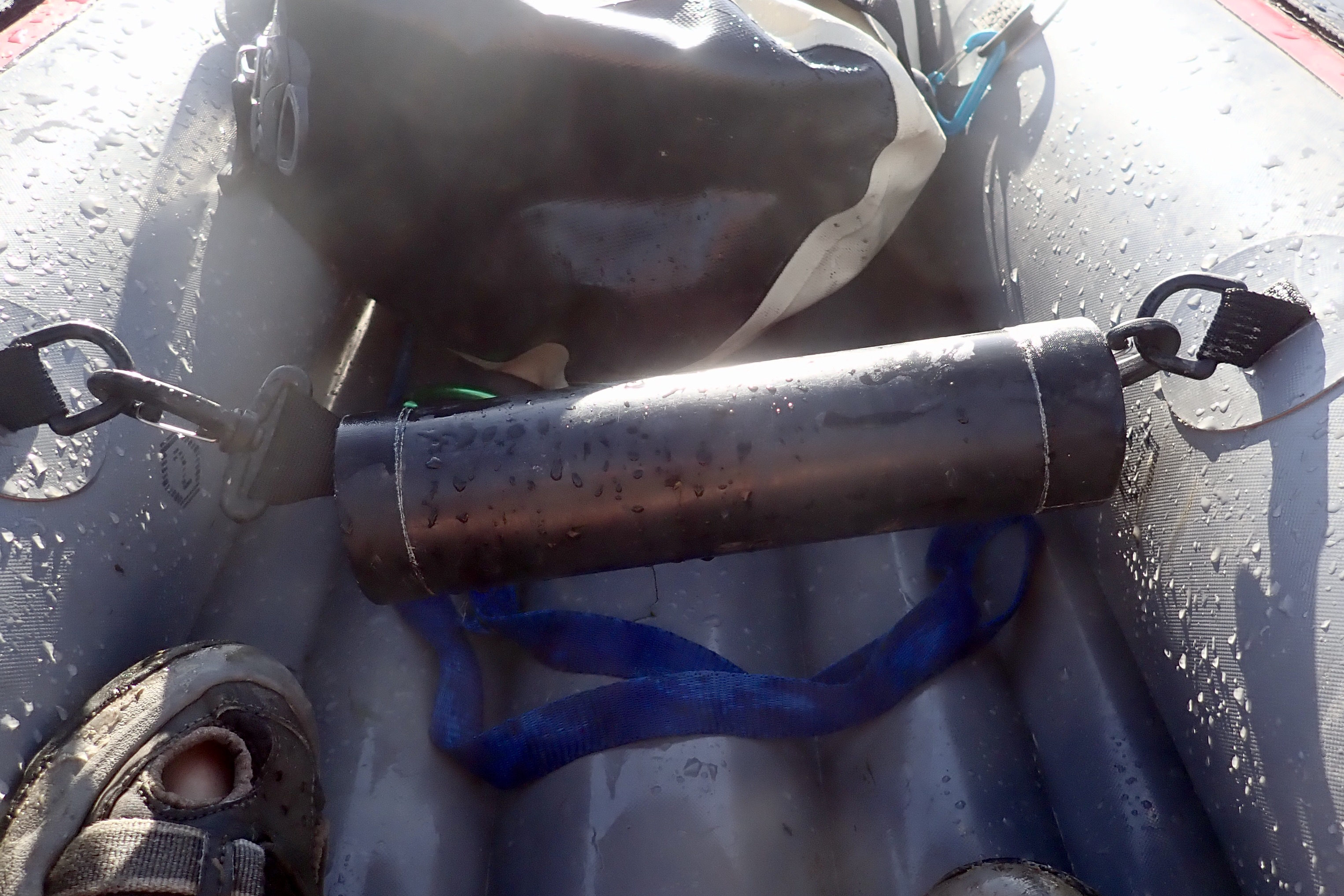
I was trying out my new footrest tube attachment points which worked great. Only when one heat-welded strap broke near Addlestone was I reminded how essential footrests are to comfort, efficiency and stamina. I jury-rigged something up between two D-rings which have been staring in the face all this time.

My 2021 Wey Survey of UK Paddling Trends 

  • Hardshell canoes: 1
  • Hardshell kayaks: 1 (+ 2 K1 racers)
  • Hardshell SoT: 1
  • Vinyl IKs (cheapies): 5
  • PVC (bladder) IKs 3
  • iSUPs: 10+  (mostly women on iSuPs, too)
  • PFDs worn, almost none then again, mine’s more of a handy waistcoat)
  • FDS spotted: none (interesting as readers here are mad for that page)

25% off Fernhurst IK & Packraft guides

Buy my Inflatable Kayaking; A Beginner’s Guide direct from Fernhurst Books at 25% off if you sign up for their newsletter. Click this or the image below. More about the book here. You can also buy it off amazon.uk for about the same cost, depending in their discount and postage fees.

My similar Packrafting Beginners’ Guide is due in May 2022.

Seawave 2: fitting a footrest tube

Seawave Index Page

Owning several Gumotex IKs with the rubbish footrest pillow (left), I came up with my footrest tube idea years ago. It’s since been copied (or maybe just implemented) by many manufacturers.
In a kayak, a footrest isn’t something you rest your tired feet on while watching Netflix. They’re something you lightly brace against to stop you sliding down in the seat and to improve your connection with the boat. To that end it wants to be solid like a pipe, not mushy like a pillow.

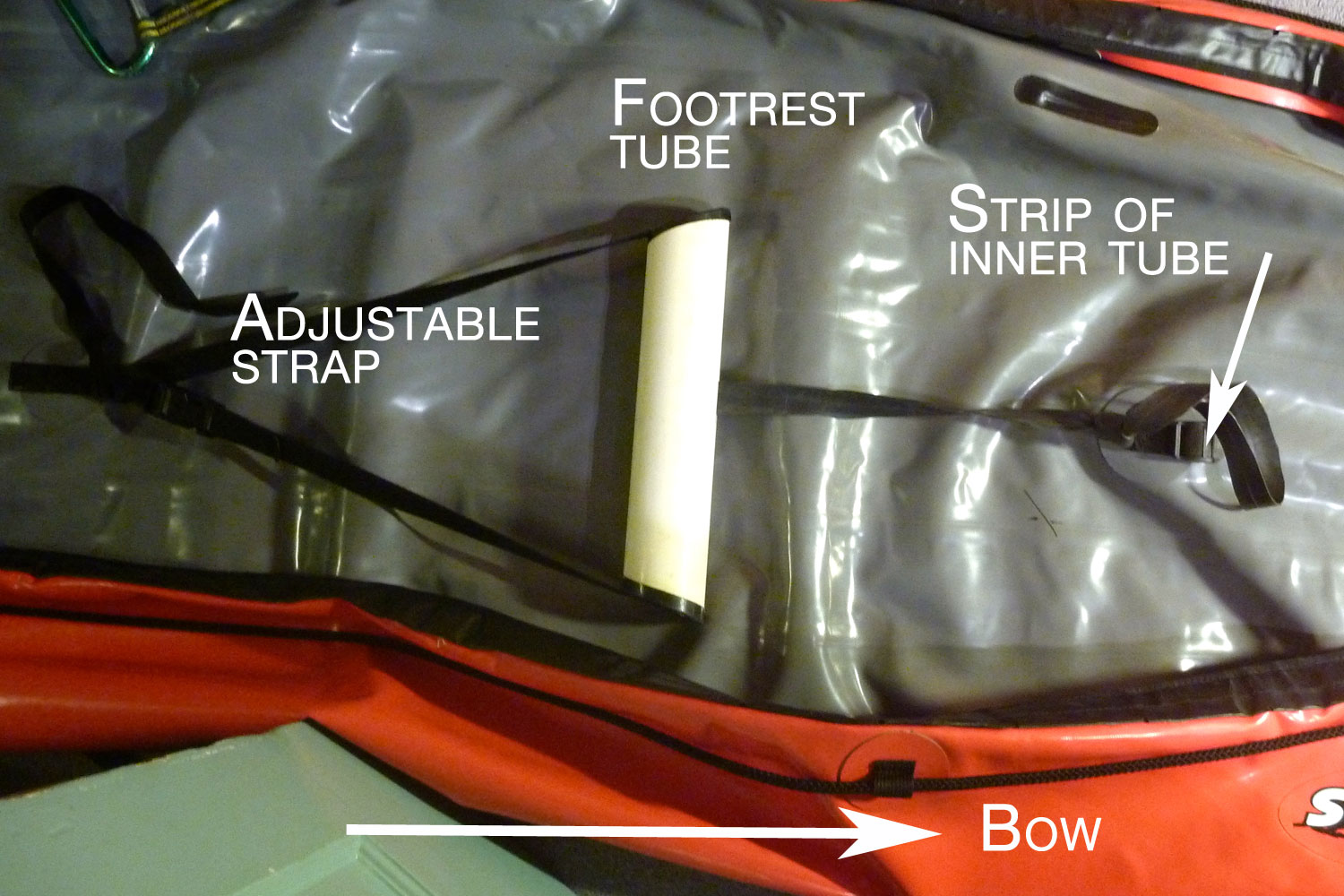
I was never really that happy with my original Seawave’s drainpipe arrangement (below): an adjustable strap running forward from the seat and a counter-tensioning elastic pulling from the bow to keep the tube in position. Too many straps, with entrapment and aesthetic issues.

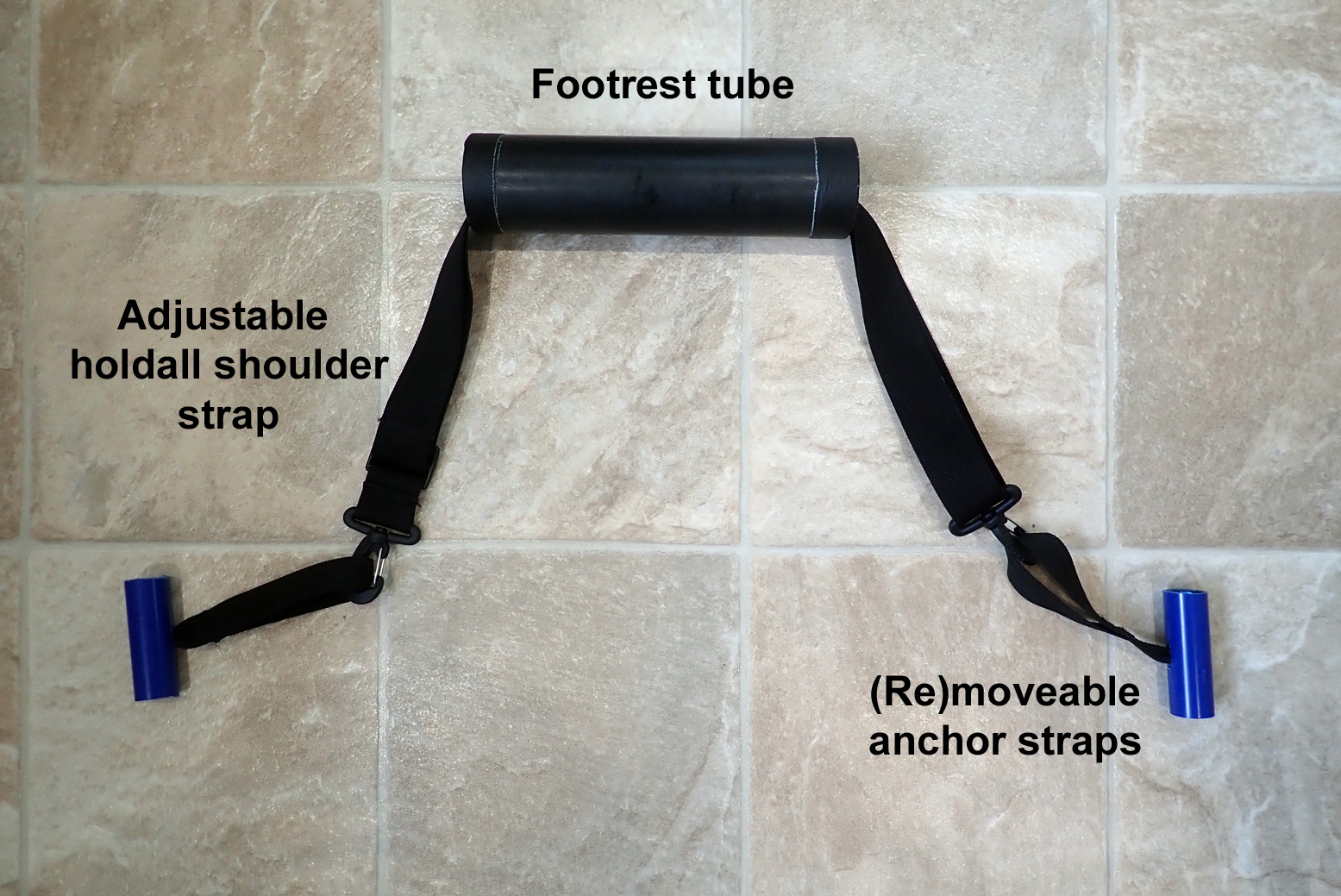
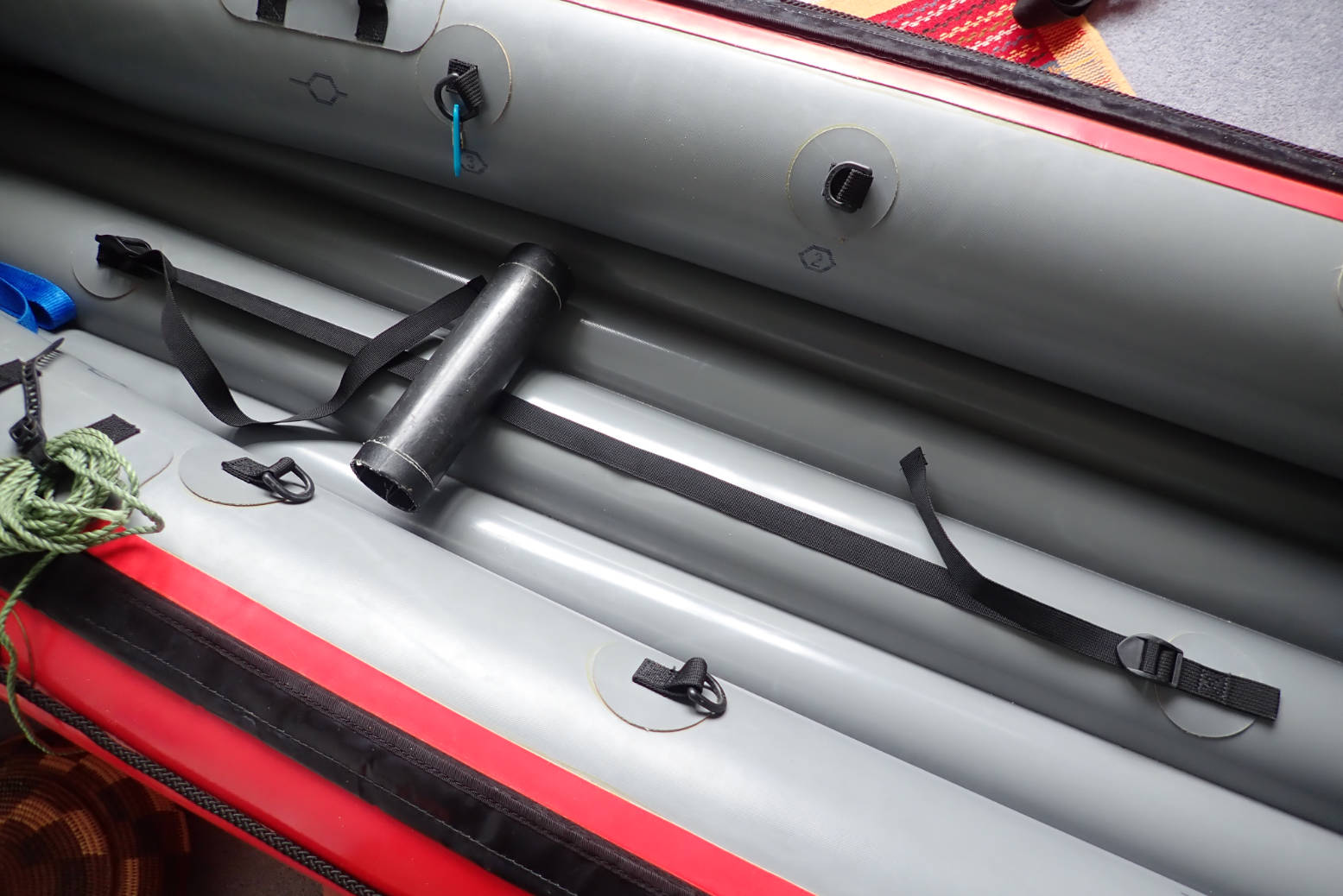
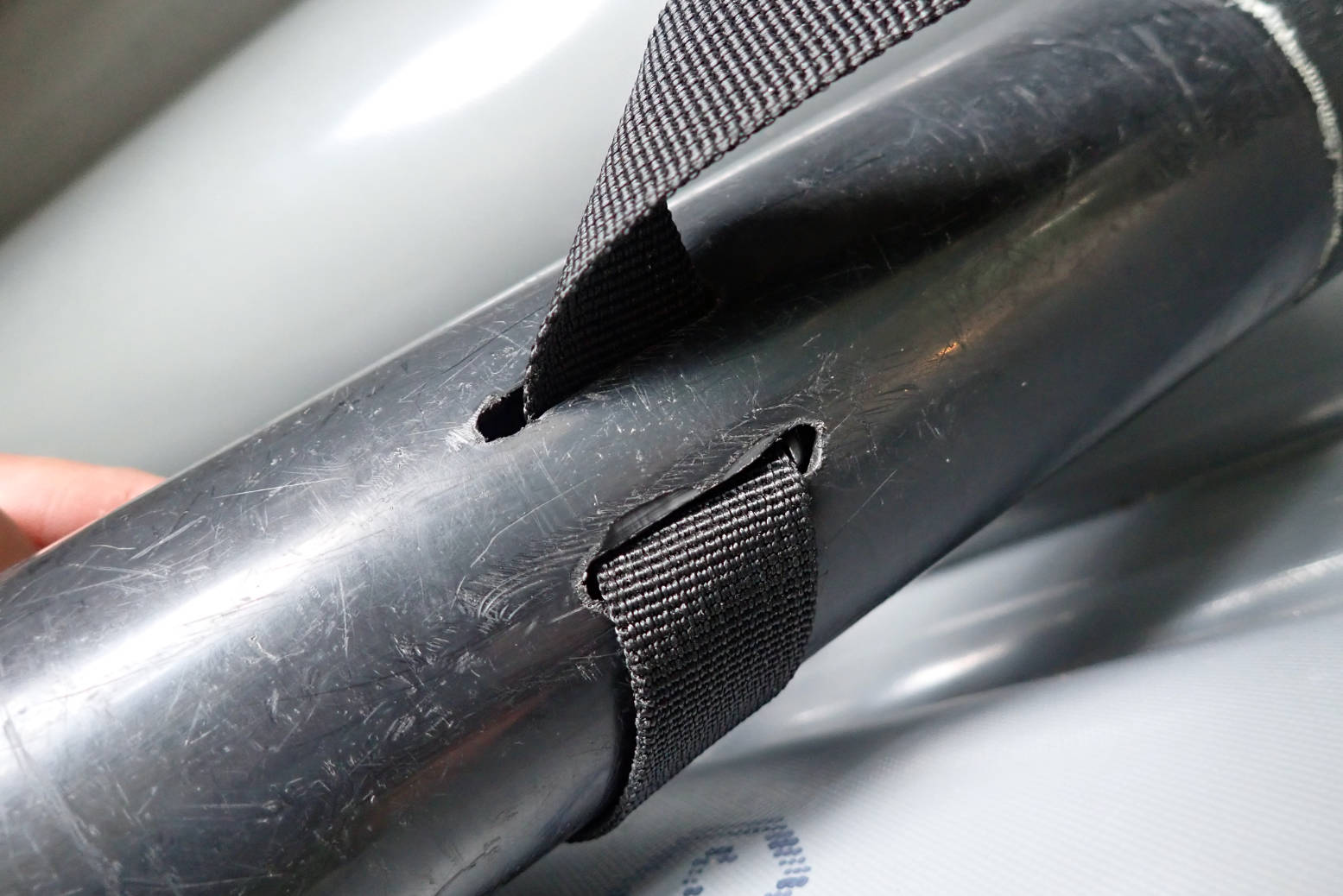
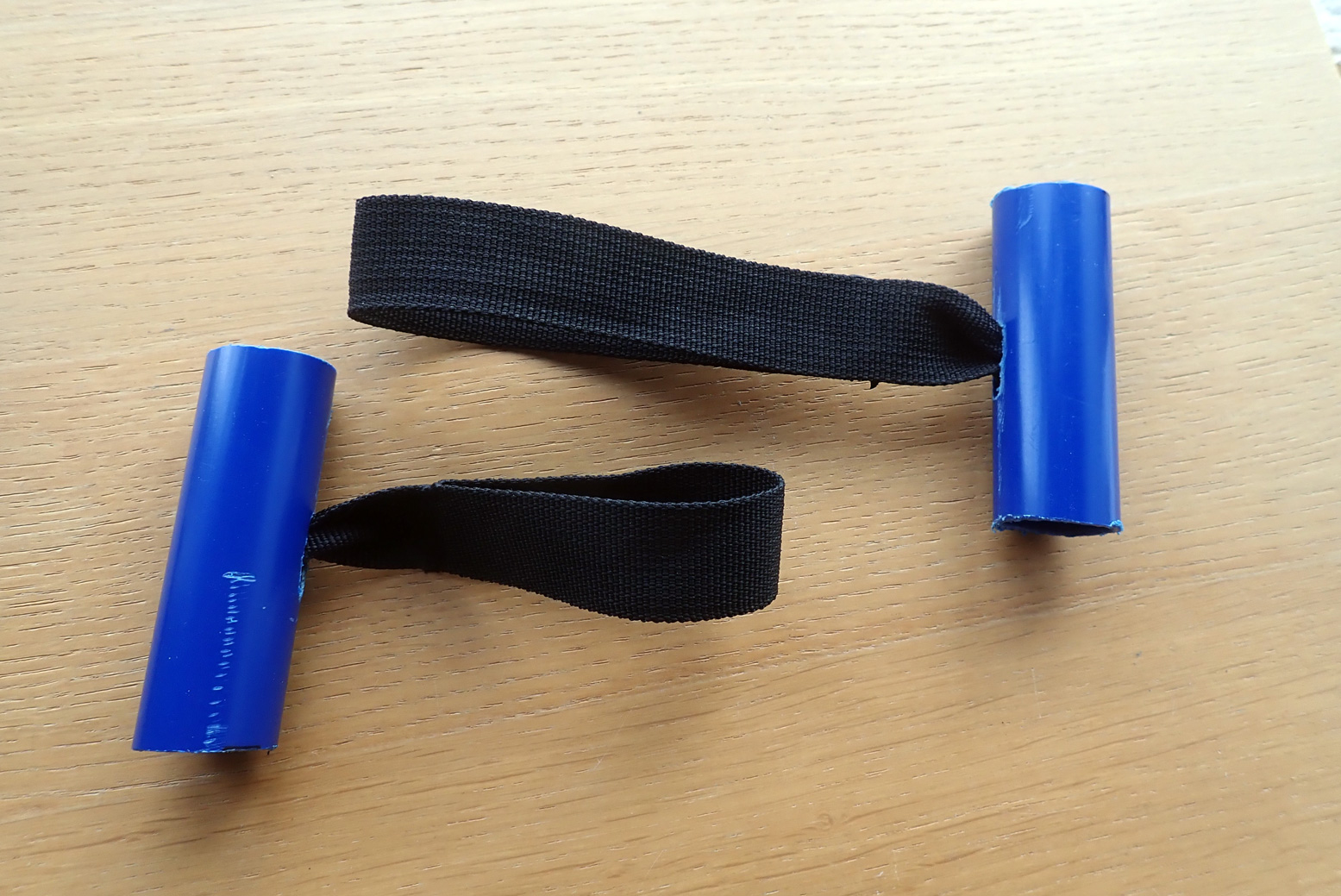
Then I remembered a clever idea someone passed on to me: straps threaded through a small piece of plastic pipe. You can buy them ready-made to jam into car doors to lash stuff down. As was suggested, these anchor straps could also jam into the cavity/channel (left) you find on most tubed and even FD-S IKs with removable floors, where the floor meets the sides to make repositionable/removable lashing points. Also, they are dead easy to make.

As footrest tube strap anchor points they work especially well because the tension on the strap is sideways (towards the bow) for better jamming, and they can be slid forward along the channel when paddling two-up and beyond the adjustability of the strap. And best of all, no tedious 2-part D-ring gluing required.

I got to try out the new system on the Wey and it worked great. The location is solid, so much so that one lazily heat-welded strap broke and I learned fast how essential a footrest is. In bodging something up to get me home, I noticed in fact that the D-rings you can see on the right, below, are more or less in the right position (for me) as long as the footrest tube strap is nearly taught. All the better: it’s one less thing to do on set up.

Then, while rigging up a rudder which worked off a pivoting footrest, a bit like bicycle handlebars work for steering, I realised the two existing tensioning or ‘ladder’ buckles fixed on the boat’s floor can be used to thread a strap, with the footrest locked off midway. The footrest needs to be fixed in position along the strap in, most simply by knotting the tape inside the tube, behind the slots. This makes a very quick and neat way to swivel the tube front or back them paddling double or switching paddlers.
It’s possible the need to balance the tension on the centrally pivoting foot tube with your feet may not work so well when not steering a rudder.

Seawave 2: what’s the damage?

Seawave main page

Though not totally convinced by the boat just because it was new, I planned to buy a Gumotex Rush 2 in the early summer of 2020. I sold my old Seawave easily, but by the time I dithered over coughing up a grand, UK lockdown discounts had ended. Soon availability of Rushs dried right up, along with so many other IKs in 2020, which also saw prices shoot up.

Eventually it transpired the Rush wouldn’t be back before 2021 (was there some flaw with the new design?). Needing a boat for the book cover, with help from a Czech chum, I bought a second-grade Seawave direct from Gumotex, saving 15% on the CZ price (Gumo won’t sell these specials outside CZ). This was just before the price went up to nearly €1300. As predicted, Gumotex prices have risen across the board; the Rush 2 is now nearly €2000 and demand has not surprisingly collapsed.

Defects … are only of a visual nature (abrasions, patches, larger amounts of glue, stamp imprint, etc.) and do not affect the driving characteristics and life of the boat.

Rather unnervingly, the exact nature of each boat’s damage is not specified or identified by Gumotex. It’s the luck of the draw. On unpacking the new boat it took me a while to locate a barely visible patch on the side (left). It may not even be a hole (hard to believe how that could happen in the factory), more likely a scratch or a nick down to the scrim.

Anyway, I’m happy with my Seawave, one boat I don’t mind owning again until something better comes along. The only difference I can see between my old one are grommet/ports for the rudder kit on the stern deck. The factory fresh fabric also feels oddly tacky, like TPU, something I’m sure will go away.

The seats and footrests are the same old over-weight rubbish. Gumotex aren’t making any innovations here. Just as with my first Seawave, before the boat got wet the seats went onto eBay for fifty quid, bringing the price down a bit. I refitted my proven packraft seatbase/SoT backrest idea. More on seats here.

One useless footrest cushion got chopped down into spare Nitrilon patches and oral valves. For a non-critical low-psi item, inside it looks amazingly well made. I plan to re-fit my footrest drainpipe system, and have a great new idea about how to fit and adjust it. More about that soon.

I took the chance to re-measure the Seawave. Yes, it really is just 30” / 76cm wide and yet looks huge in the corridor – the only place in our flat it can be inflated.
And it weighs 19kg with everything in the supplied bag, Ditch the seats (965g x 2) and footrests (411g for both), add a single SoT/packraft seat and a mooring line, and the 4.5m Seawave is a genuine 16kg on the water. Pretty darn good for a 4.5-m boat.
And it’s compact too. Now I’ve learned how to vacuum-shrink a boat (you need a bayonet nozzle with valve-opening pin) and have added an oral valve to shrink down my Ortleib RS140 roller bag too (above right), the boat takes up less room than ever.

An interesting thing was pointed out to me about the Seawave and other tubed Gumboats: they are effectively made from just two big sheets of Nitrilon (plus deck pieces): the red outer/lower and the grey inner/upper (above). They touch at the edges of the floor and join in a flat seam on top of the sidetubes. Simplicity, I like that.

Repairing a huge rip in your Inflatable Kayak

As mate was getting out of a current-model full-Nitrilon Twist 2 the part of the boat under a jetty rose up into the sharp end of a bolt securing a mooring ring.

KABOOM!!

.. a two-and-a-half foot rip tore across the top of the hull in both directions with a puff of South Moravian talc. As it’s a largely linear rip in an accessible location, making the repair was fairly straightforward: sew, then patch.

[FYI: I know of two other Twists which have suffered similar long rips: here and here. But not any other Gumotex model].

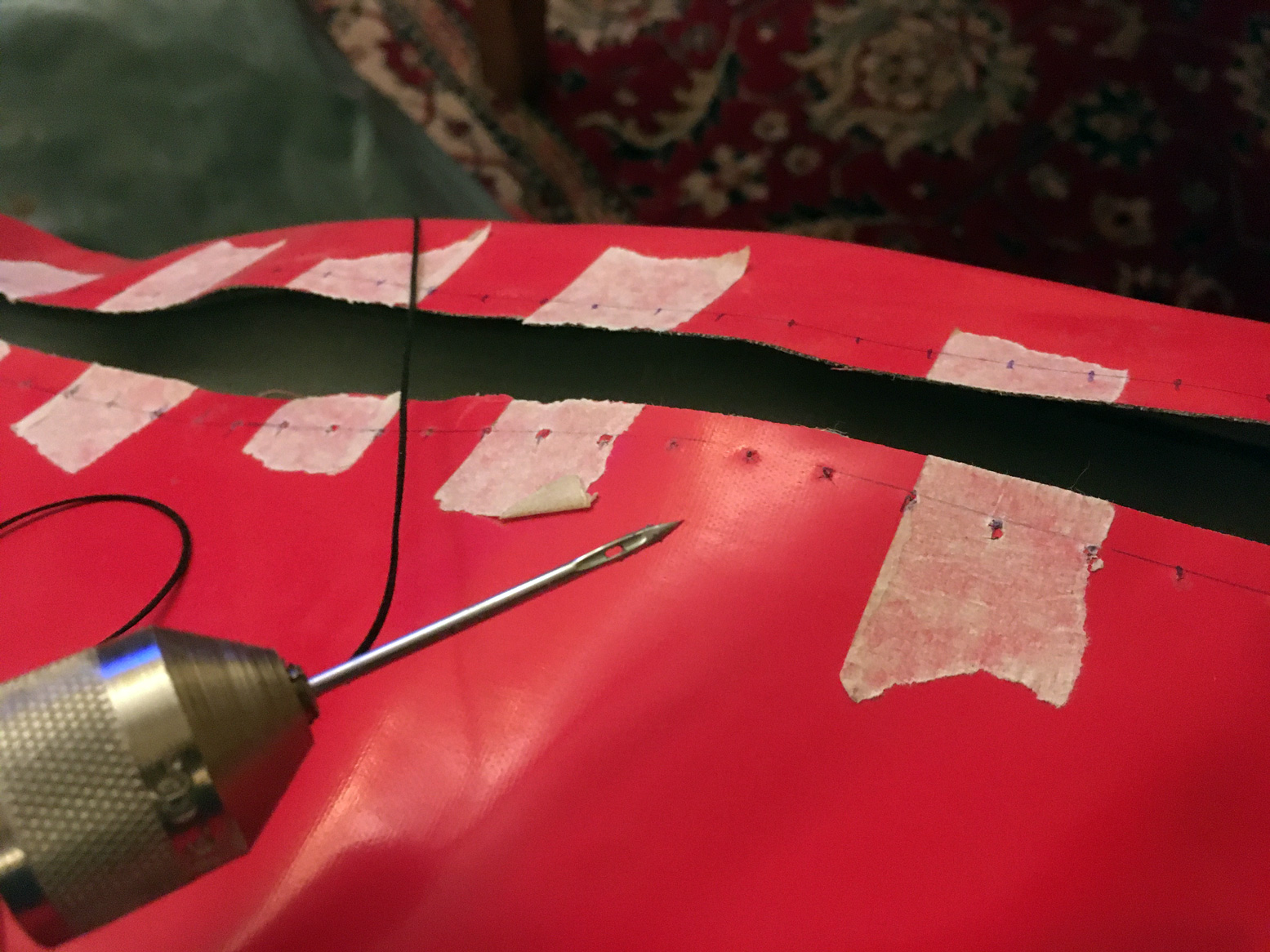
Because the coated core of the red Nitrilon fabric is a woven mat, sewing is an effective way of holding the two sides of the rip together to reduce the tension on the eventual glued-on patch once the boat is inflated. You need an awl spike to pre-poke each hole for the thick polyester thread. This fabric is hard to cut with sharp scissors, let alone thread with a needle.

Rip neatly sewed up with a special cobbler’s reverse herring backflip cross-stitch. One thing that got forgotten was sanding then cleaning the surfaces alongside the rift before sewing began.

Completed repair. This would work on a PVC IK too, but most of them are shell and bladder or drop-stitch. PVC is a bit harder to glue well.

The repaired Twist back on the water.

IK&P video of the Week: Gumotex do the Loire

I’ve often thought of doing a really long river in France, but once you get out of the hills I get the feeling they can drag on a bit, even if it is France.
It didn’t stop these two guys; 5 weeks from Goudet near Le Puy (near the Allier) to St Nazaire bridge just under Brittany. First couple of days they had to wrestle some pretty gnarly rapids in their 4.1-metre IKs. Never mind ‘dress for the swim’ – ‘pack for the capsize’ too!
Interestingly, one suffered a flat on the Framura’s relatively pointed back corner, presumably from all that rock scraping. I’m amazed those rudders survived, too.
Even with its fixed deck, sometimes I fancy a Framura. At just 75cm wide, it was the new Seaker but half the weight. But then I see how they flex, being long but only regular 2.9psi Gumboats, not 3.6psi like the Seawave. It’s quite a difference. And those are twin-tube sides, so jacking up the psi there, then fitting PRVs, as I did to my Seawave, would not be such a good idea (the I-beam in the side tube could rupture).