Category Archives: Travel Reports

Travelling with packboats

Cape Wrath Trail ~ paddling the Assynt

I am slowly working my way through a western variant of the Cape Wrath Trail, a hardcore, unofficial Long-distance path that runs some 200 miles between Fort William and Cape Wrath. More about the CWT here.

cwtasymap

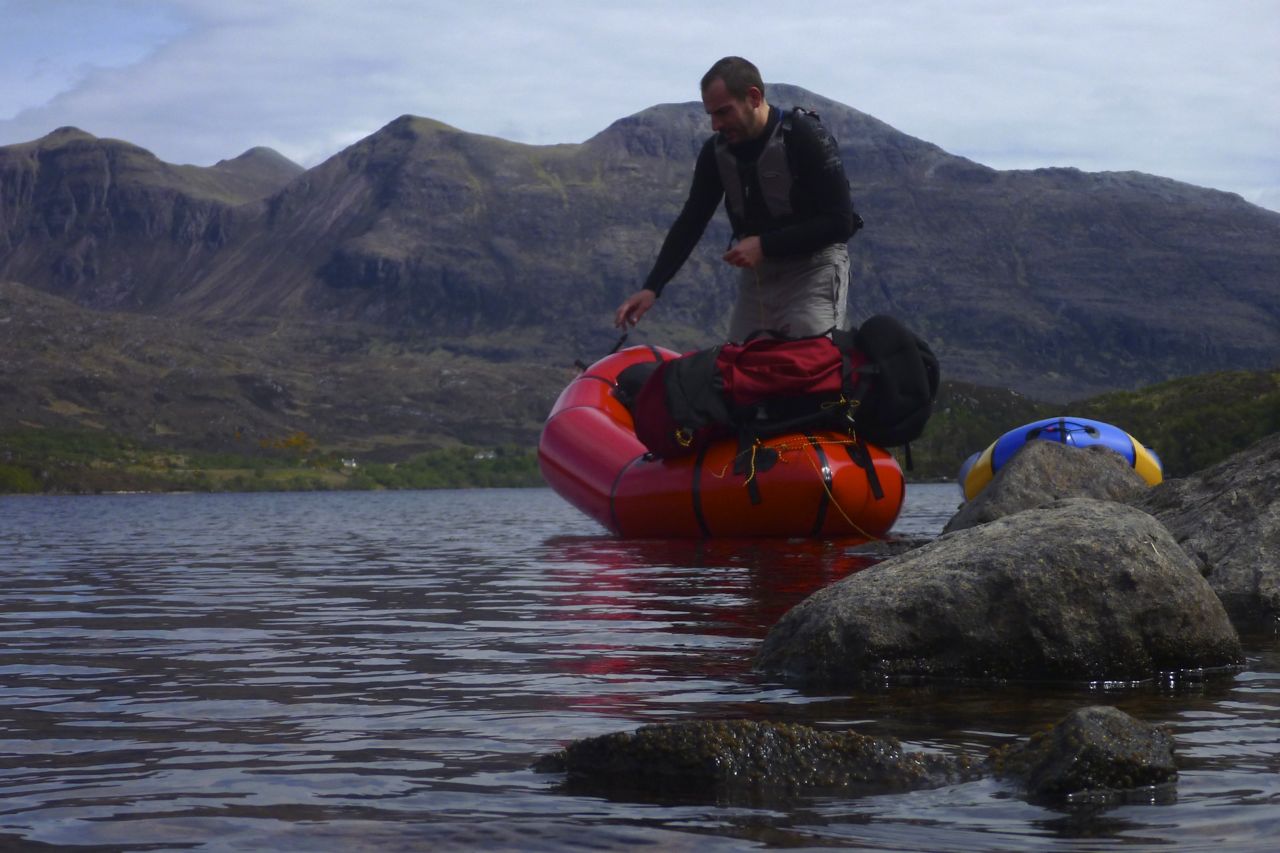
After scraping through the first part of the variant from Dundonnell in December 2013, I returned with paddlechum Jon to complete the remainder from Stac Polly mountain to Kylesku bridge where the regular route comes in from the east at Kylestrome. Following several humiliating episodes orchestrated by me in slackrafts, Jon finally saw the light and bought himself a red Alpacka Alpaca (the next size down from my Yak).

cwtsul02

After kayaking around the Slate Islands near Oban I rode up to Achiltibuie on my very overloaded bike and met Jon at Di’s croft in Altandhu. We fixed up her electric bike, extended the goat shed then next day left a car at Stac car park (above) for our two-day paddle-walk to Kylesku. But things had already got off to a bad start: Jon had done his knee in on the previous day’s Etape Caledonia cycle race.

cwtsul07

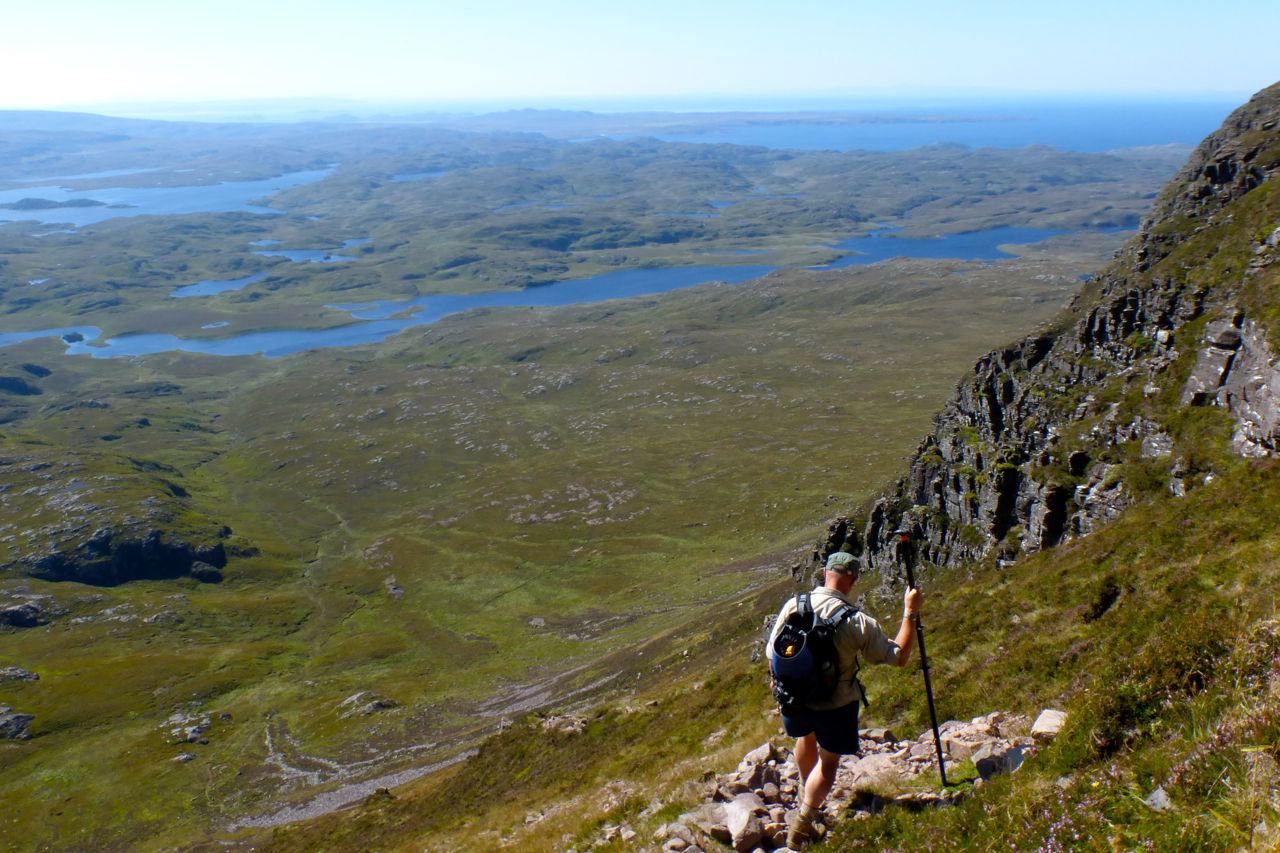
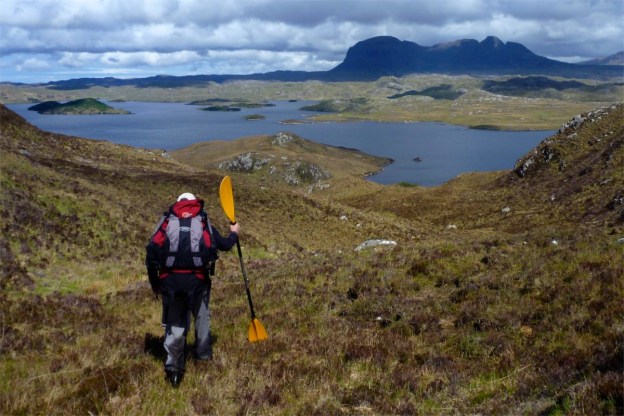
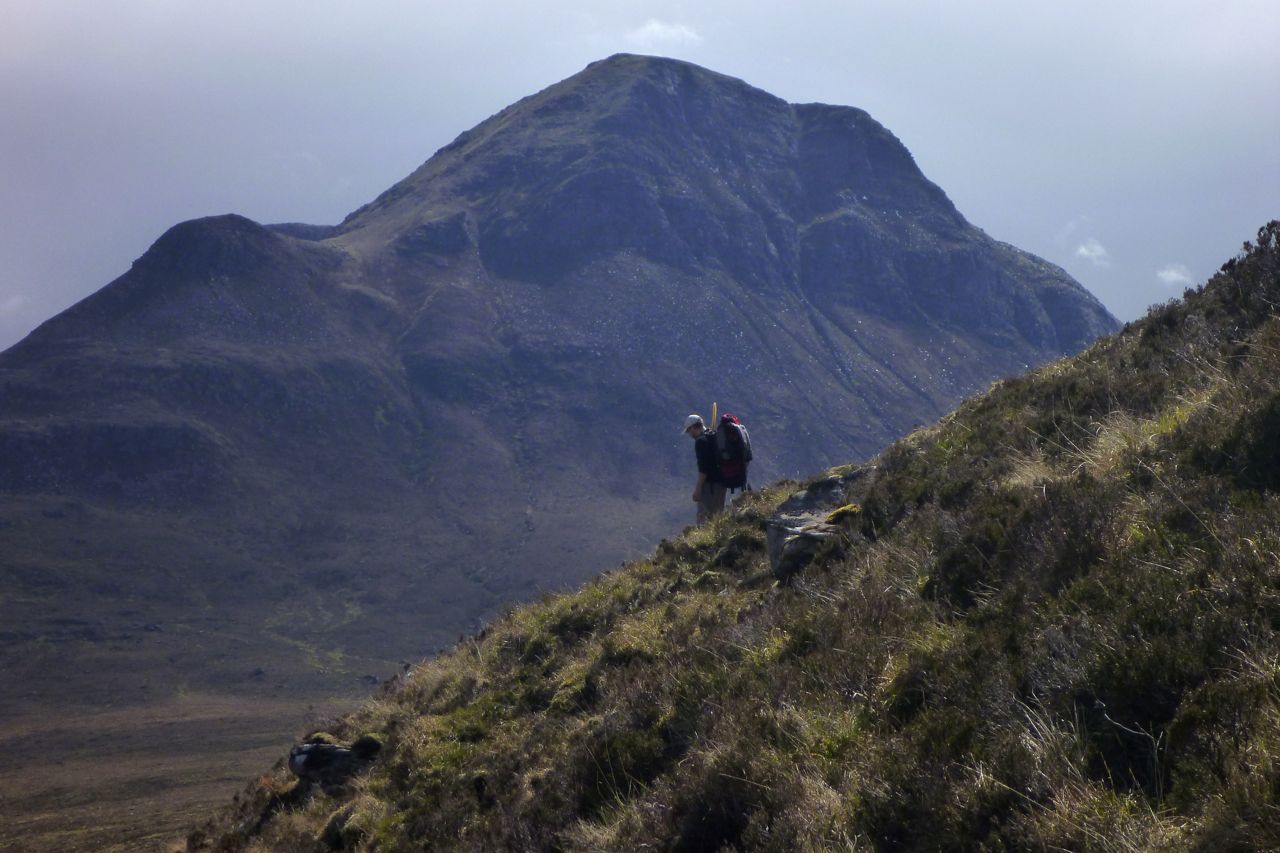
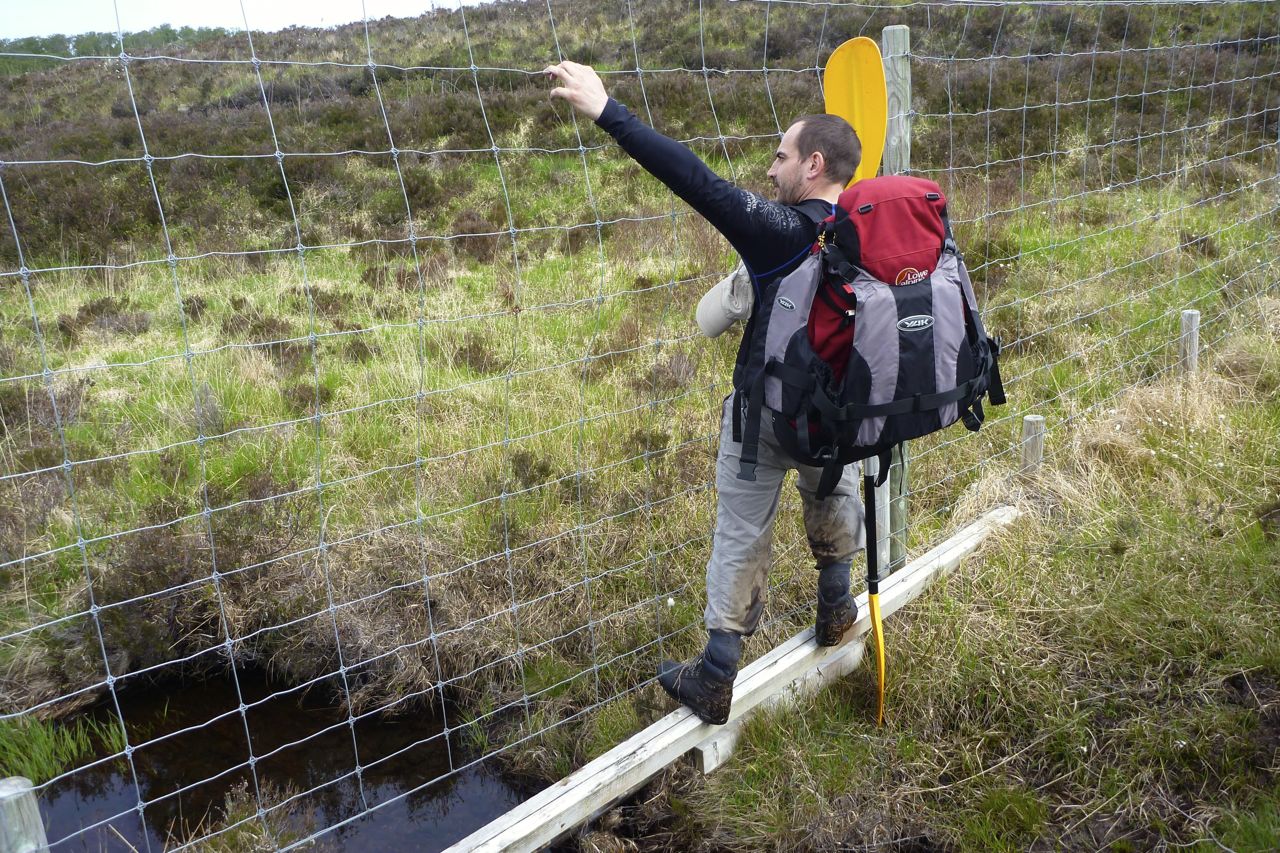
As a result progress was slow up the steep path onto Stac mountain and even slower once we left the path down the north side (above) for the trudge towards Sion’ loch. By this time Jon had recognised the value of using his hefty TNP paddle as a packstaff.

cwtsul08

As the slope levelled off, ahead of us a deer fence cut through the scrub; we followed it until a stout corner post provided an easy hop to the other side. We were now heading directly for a bay with a small island to put in, but that was further than it looked, down small cliffs before dropping through an enchanting light birch woodland which the deer fence may have helped preserve.

cwtsul10

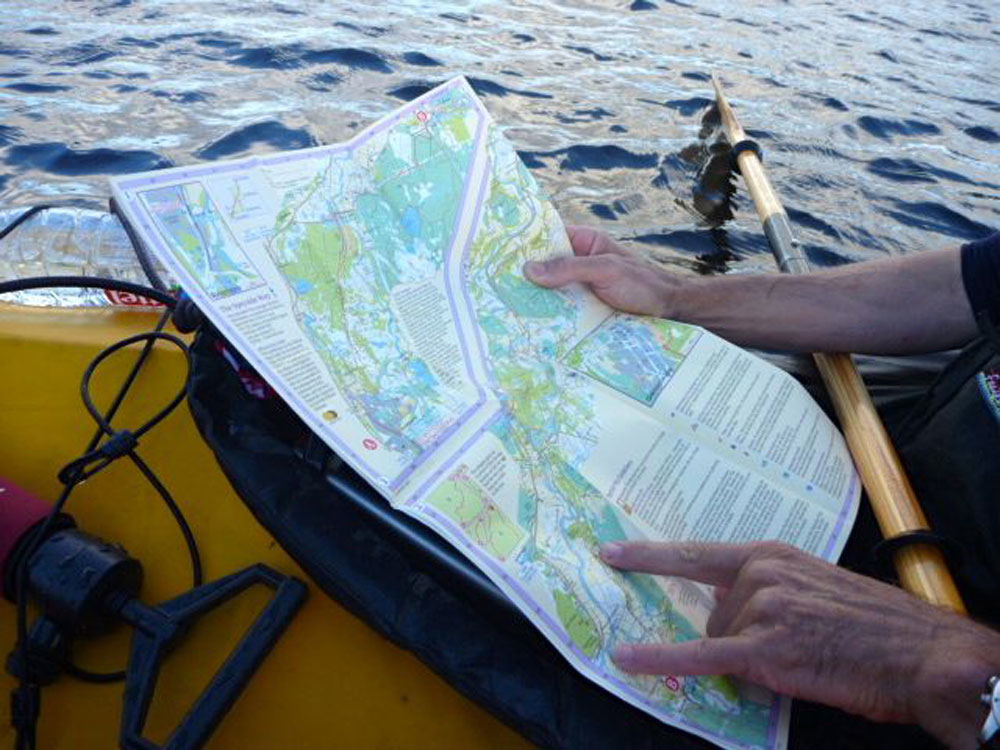
While it was nice to come across the lost pocket of woodland, walking or boating, next time I think I’d take the Linneraineach path which starts a mile or so east of Stac. It leads all the way to the wadeable stream running into the loch (on the edge of the map, above) and is probably quicker and less effort. A walker would certainly be better off going that way instead of rising halfway up Stac and then down again, as we did.
As it was, we were lucky that a recent dry spell had left a spongy crust on top of the saturated post-winter mire. On a few occasions that crust sheared away from the soggy underlay and sent me flying. Either way, this was packstaff terrain par excellence. Have I mentioned packstaffs yet?

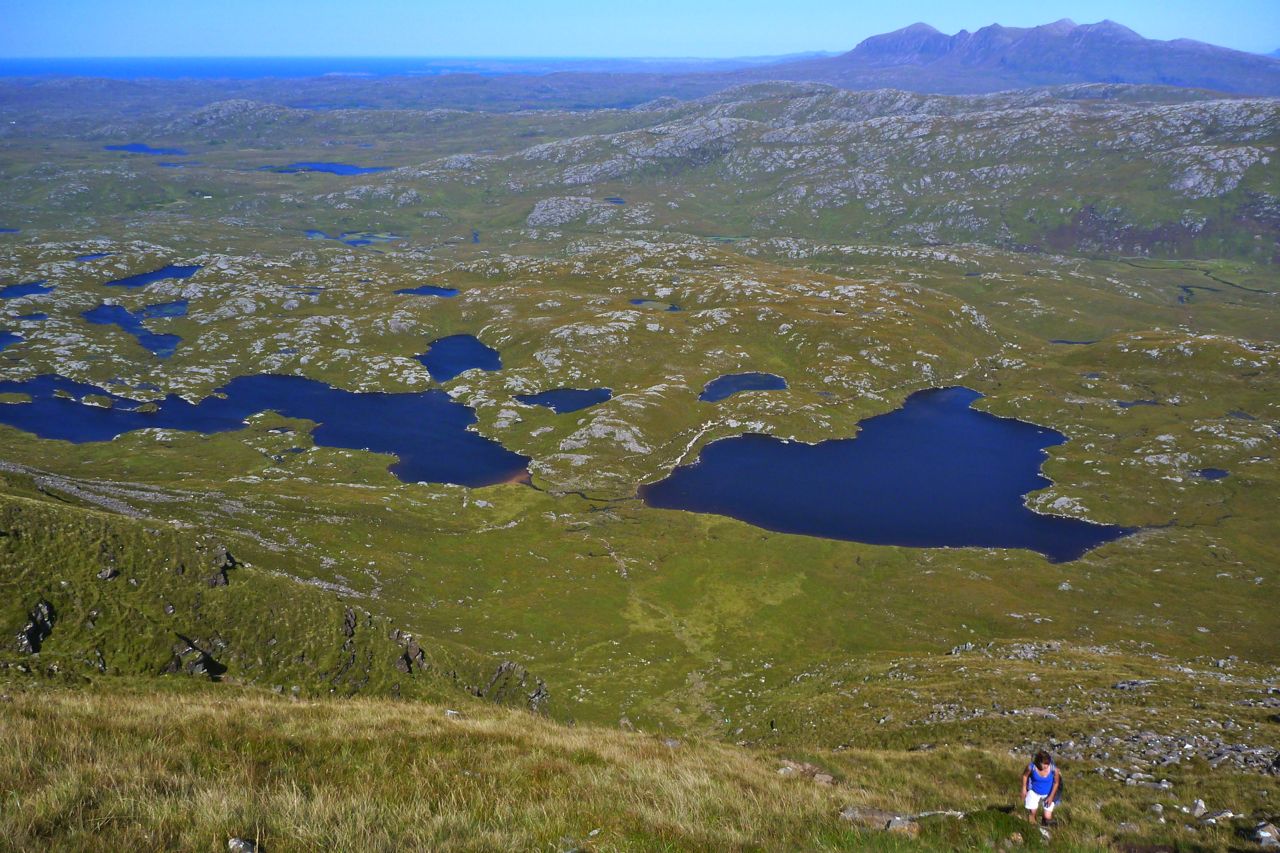
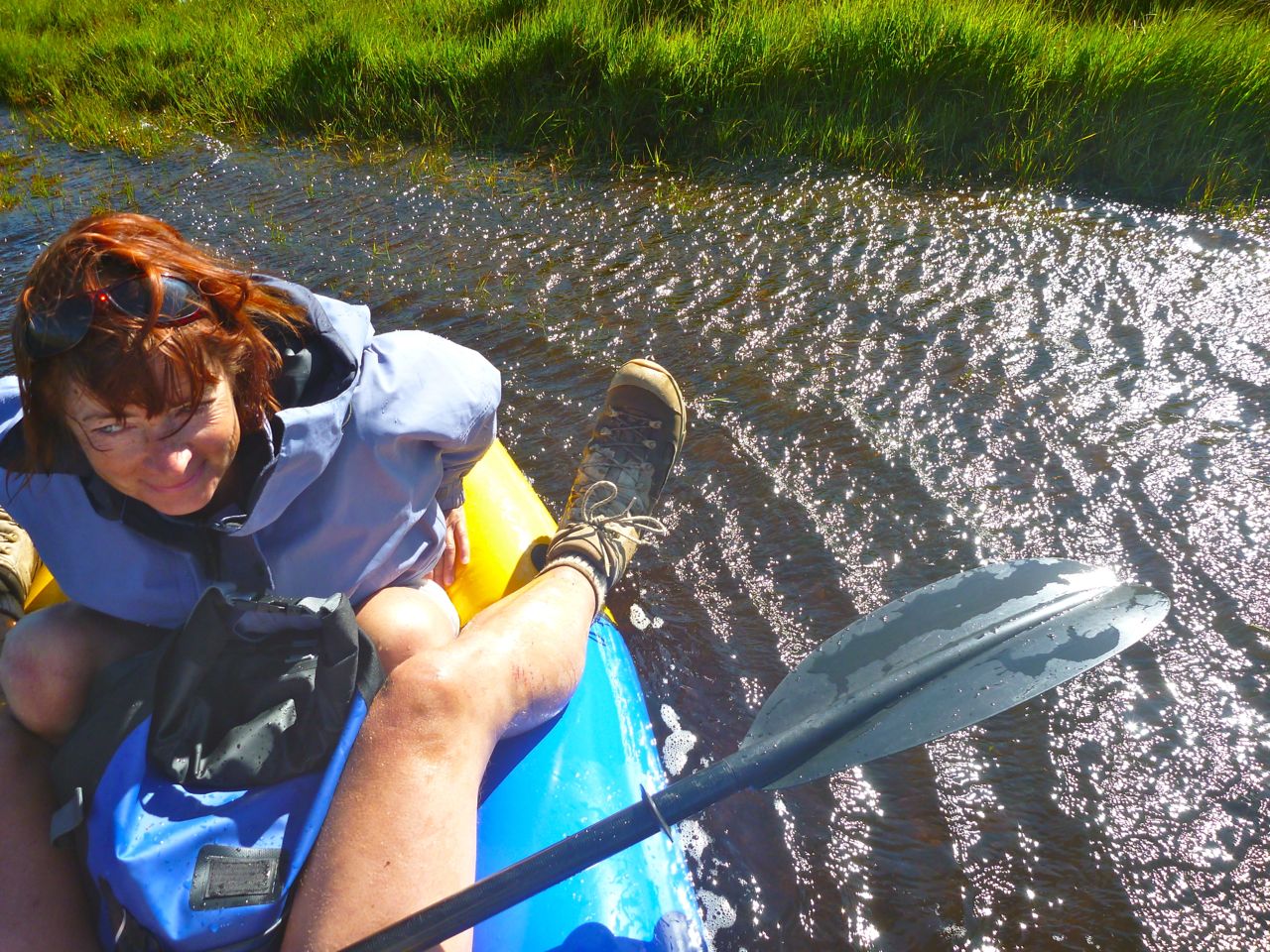
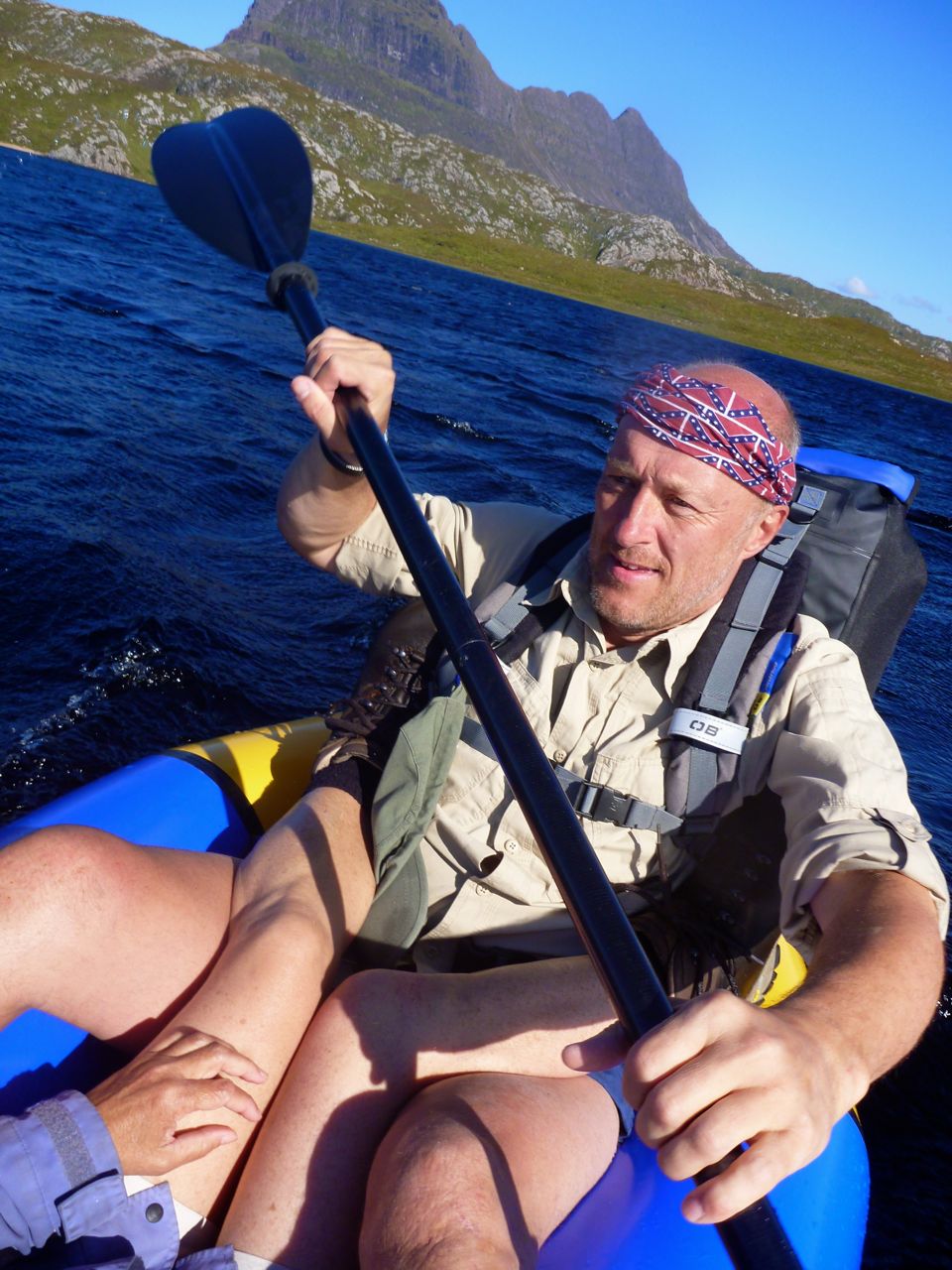
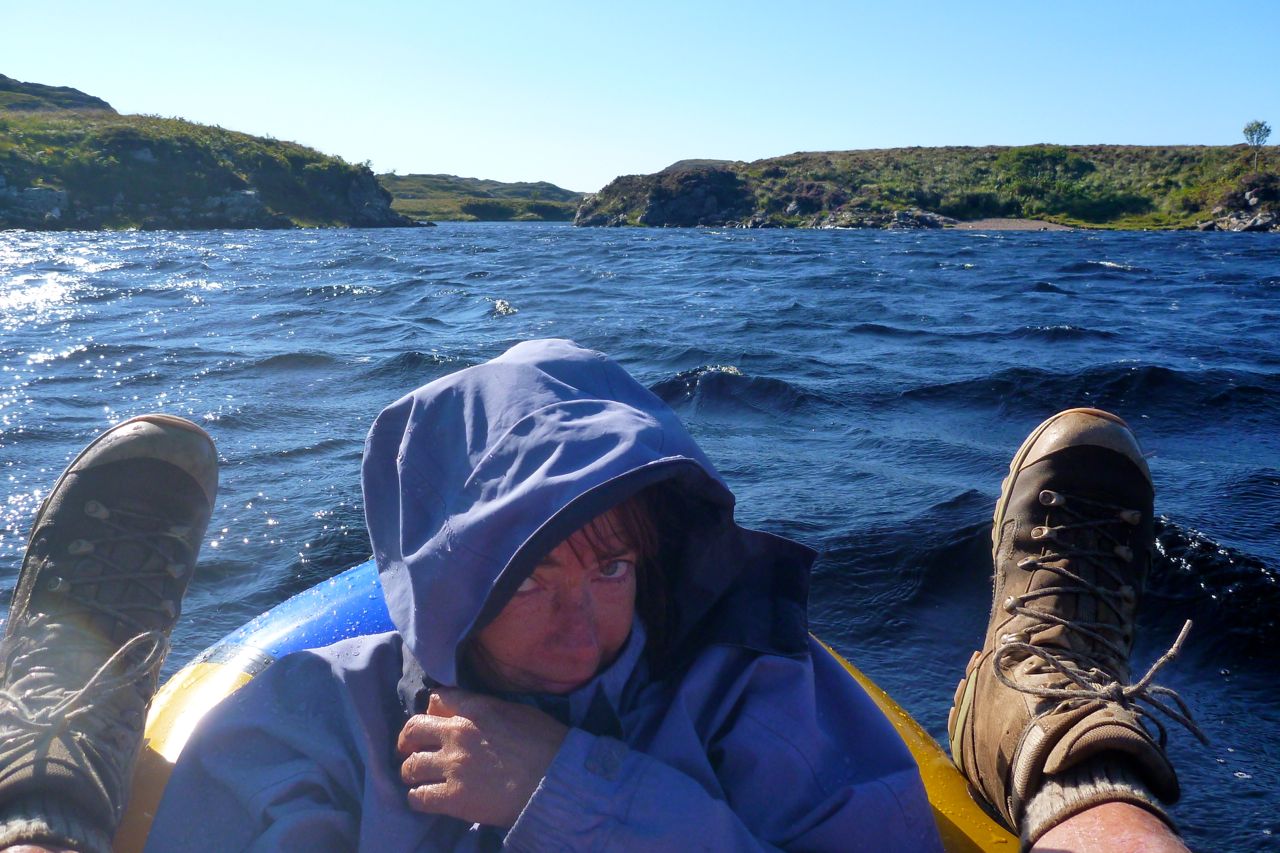
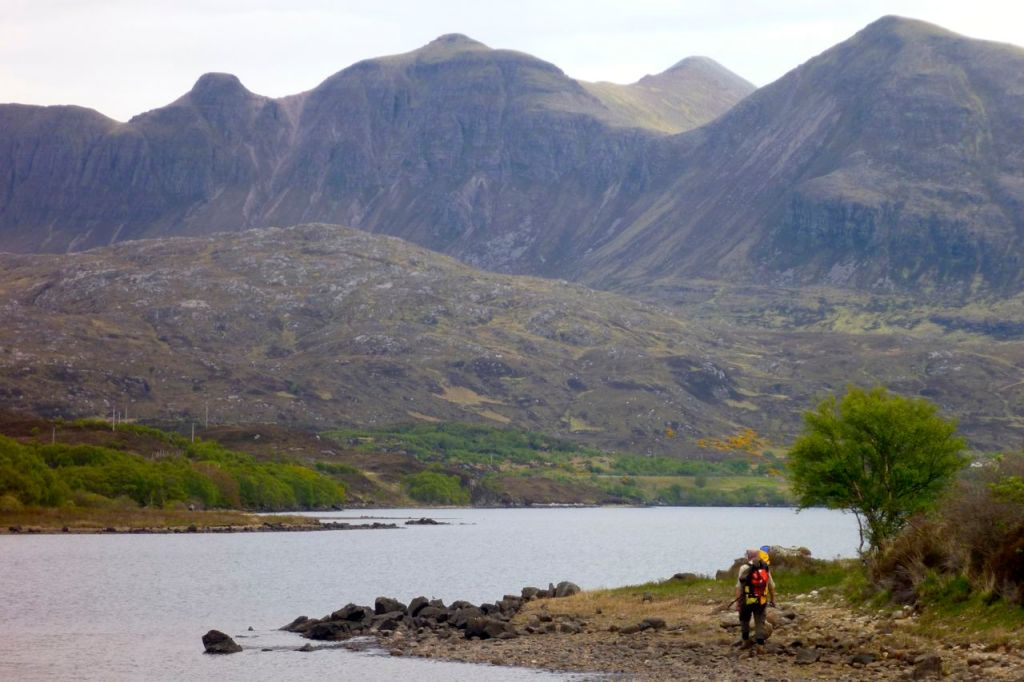
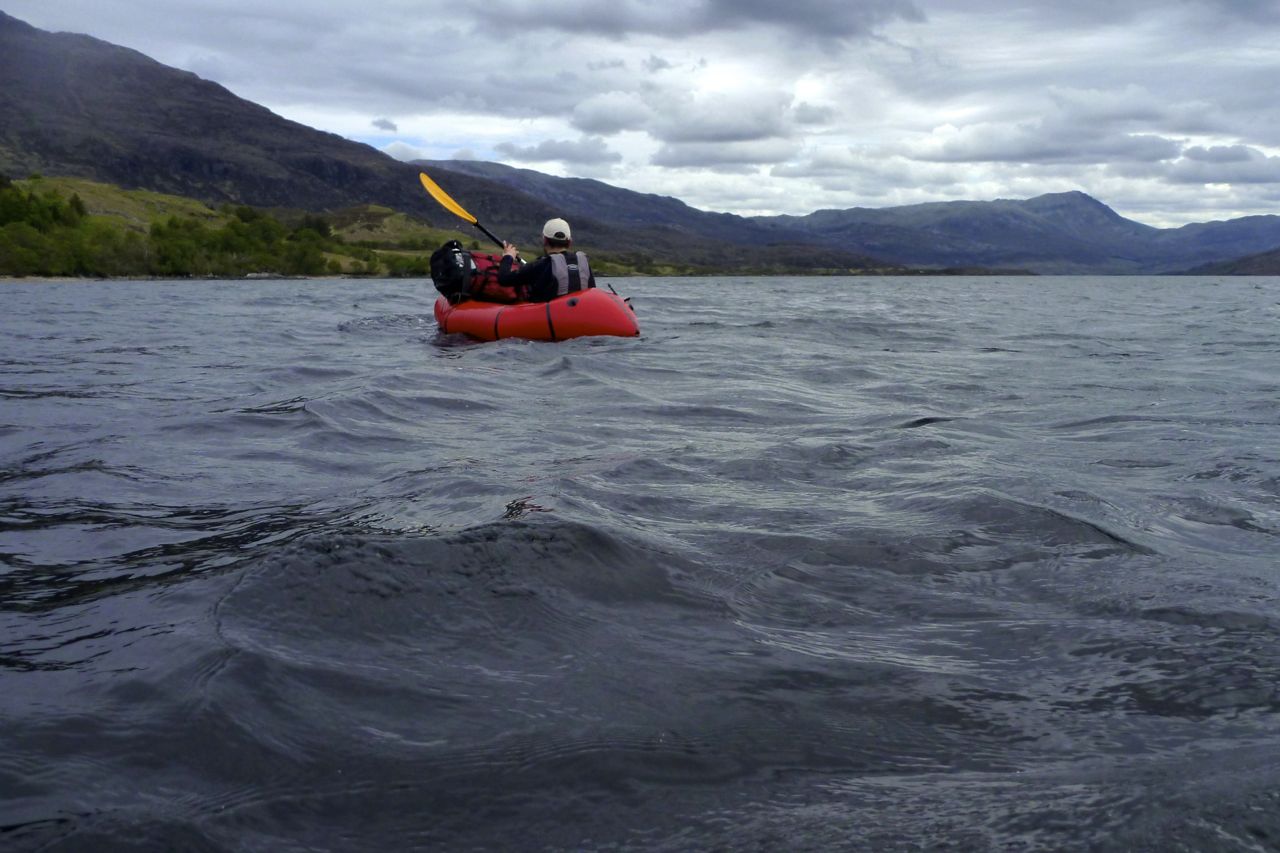
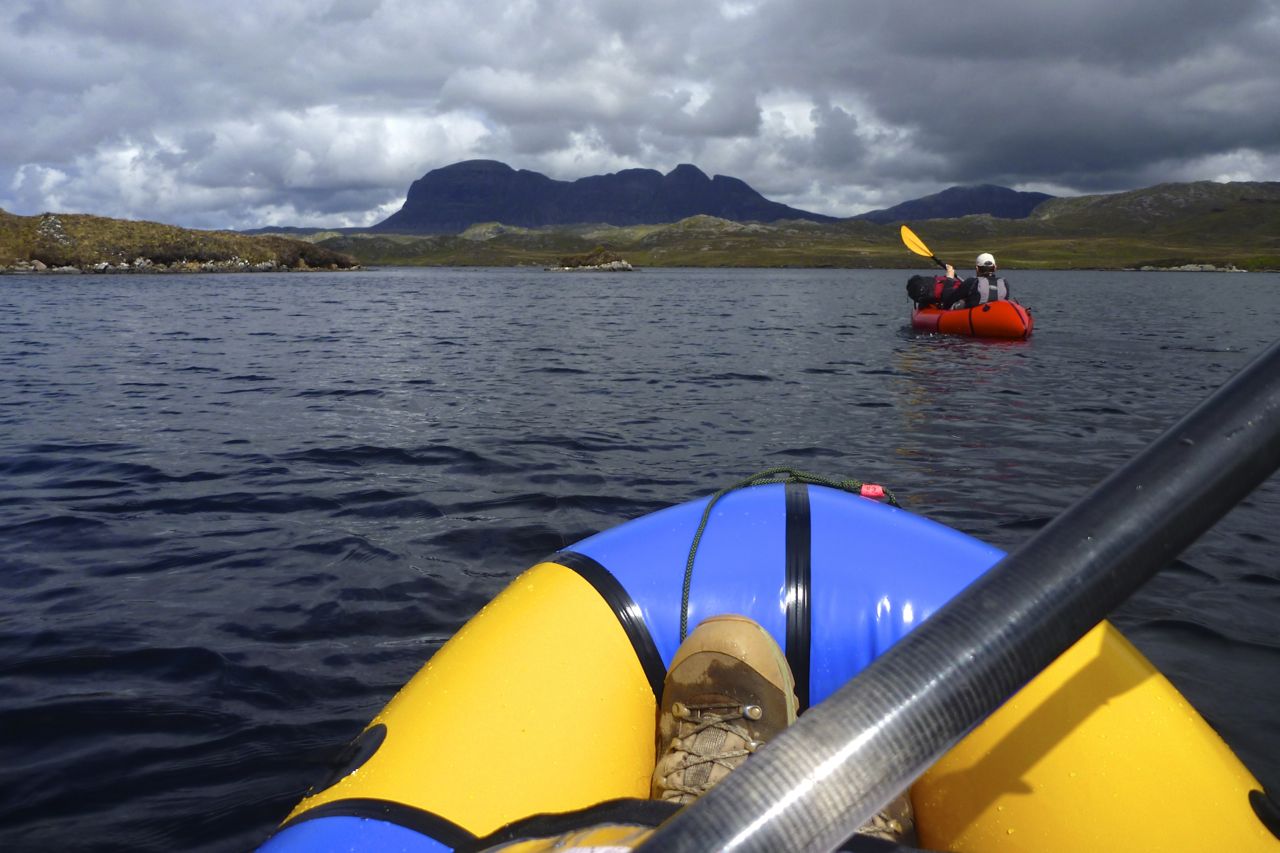
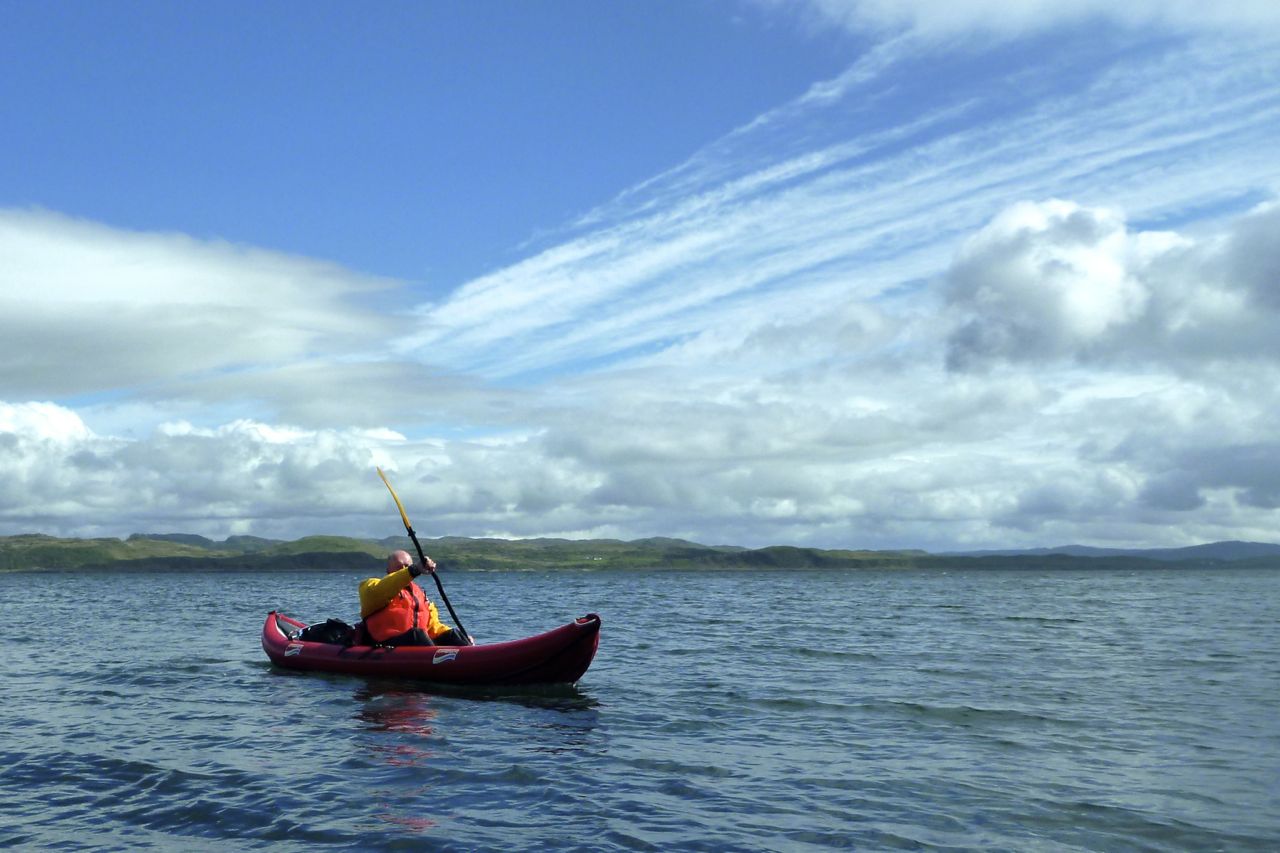
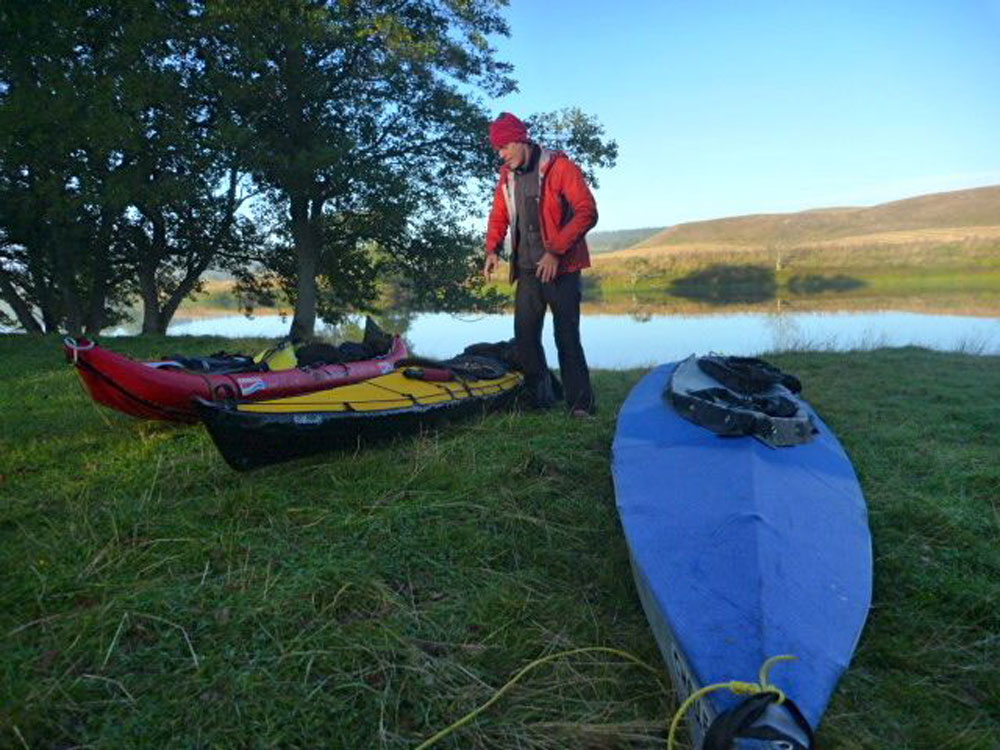
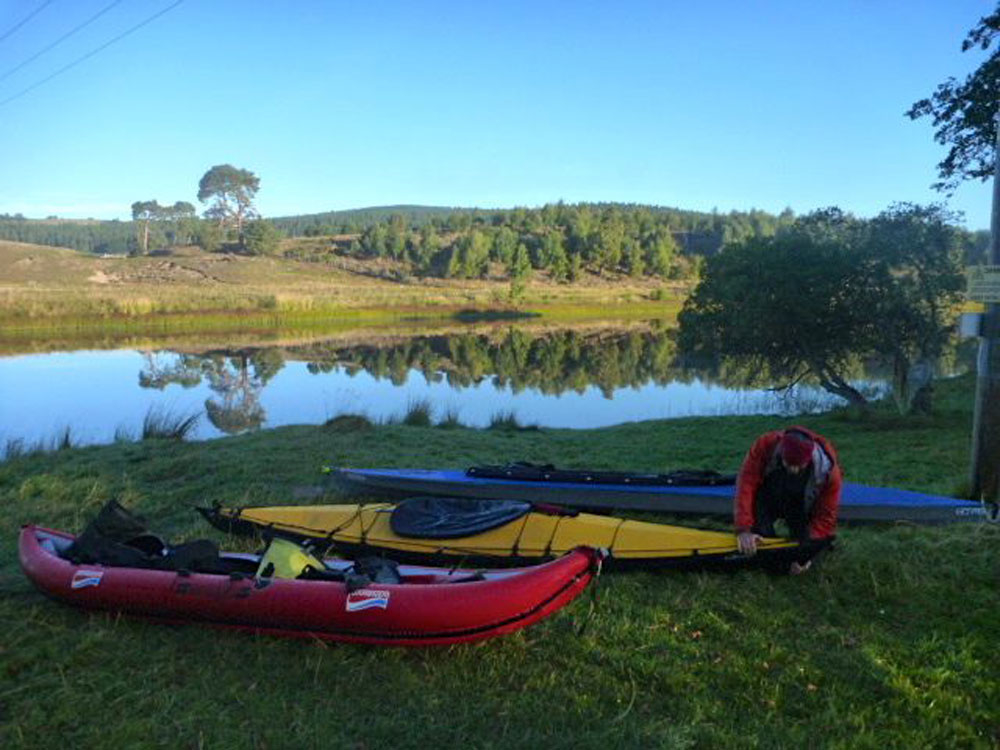
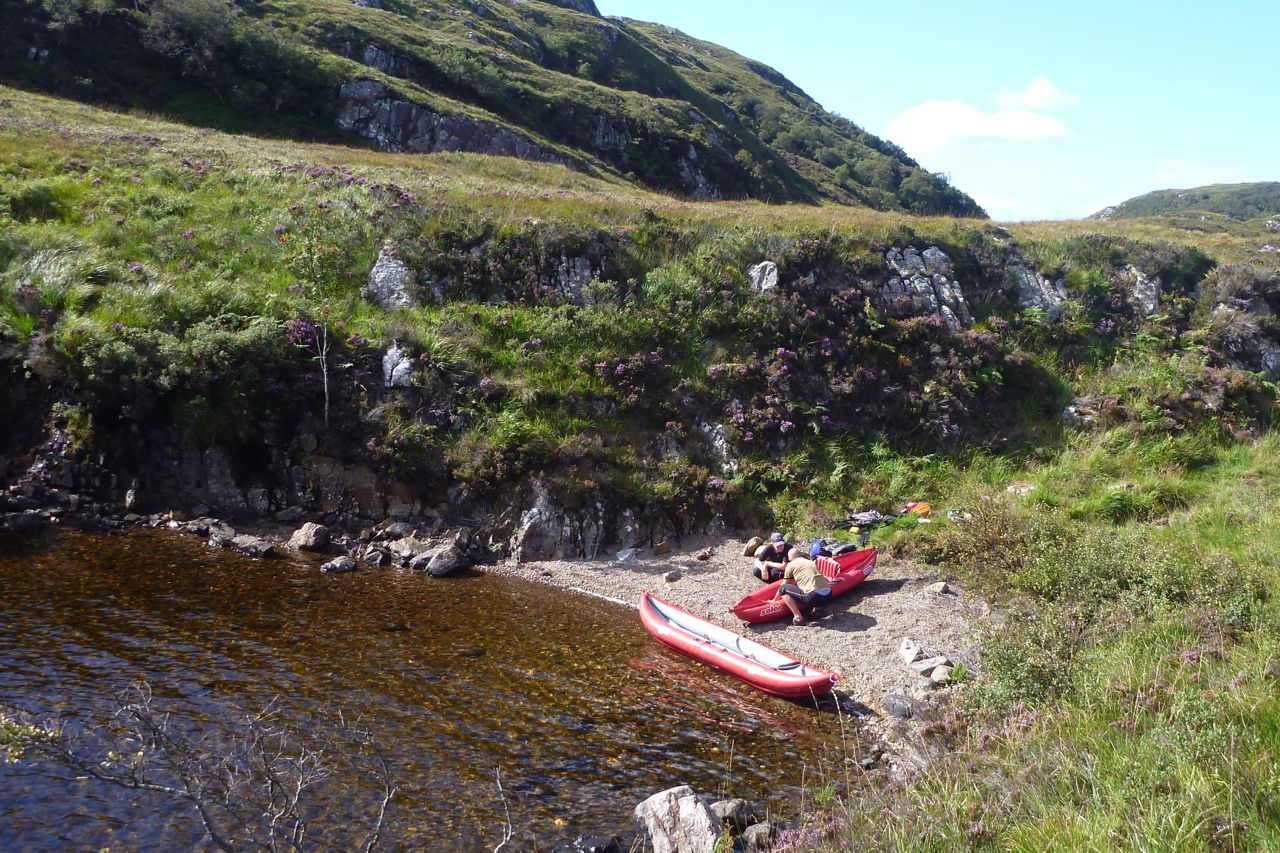
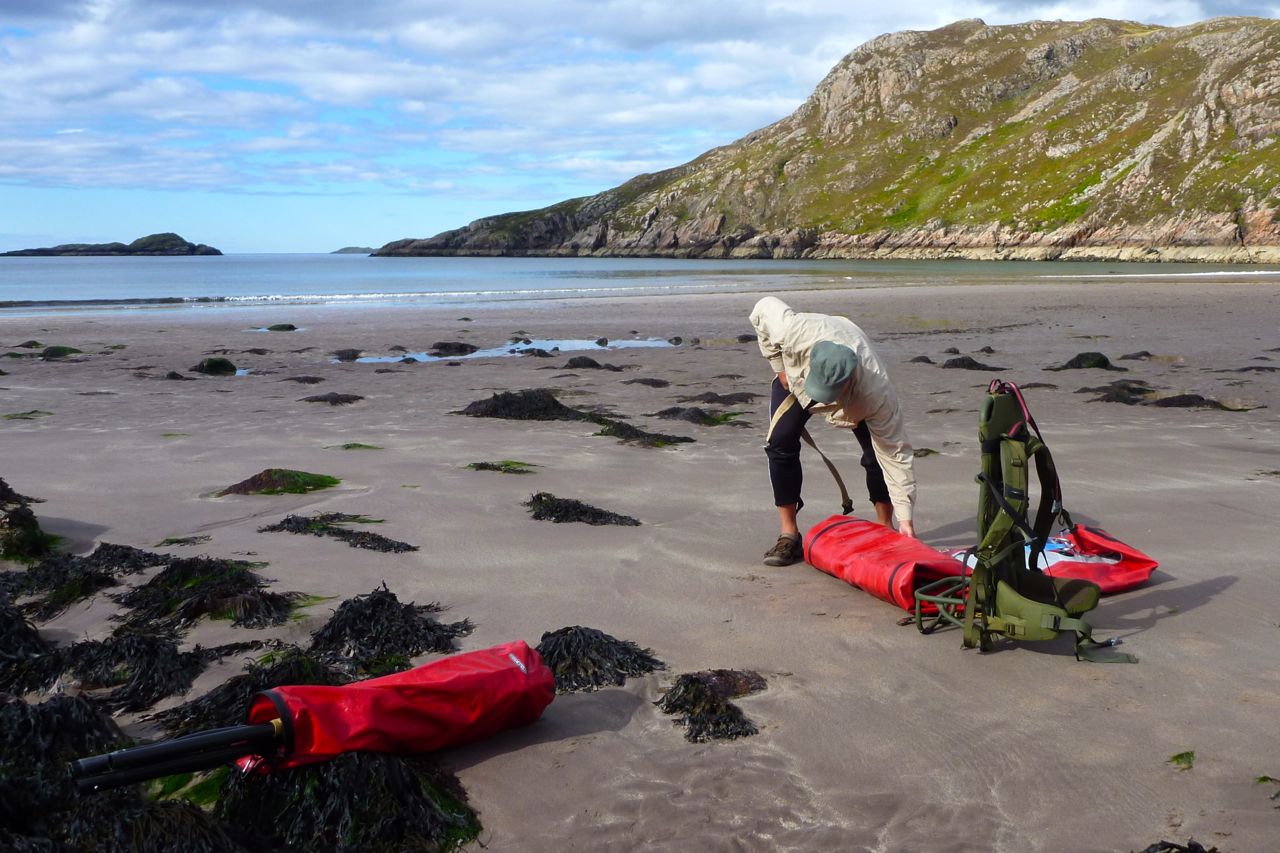
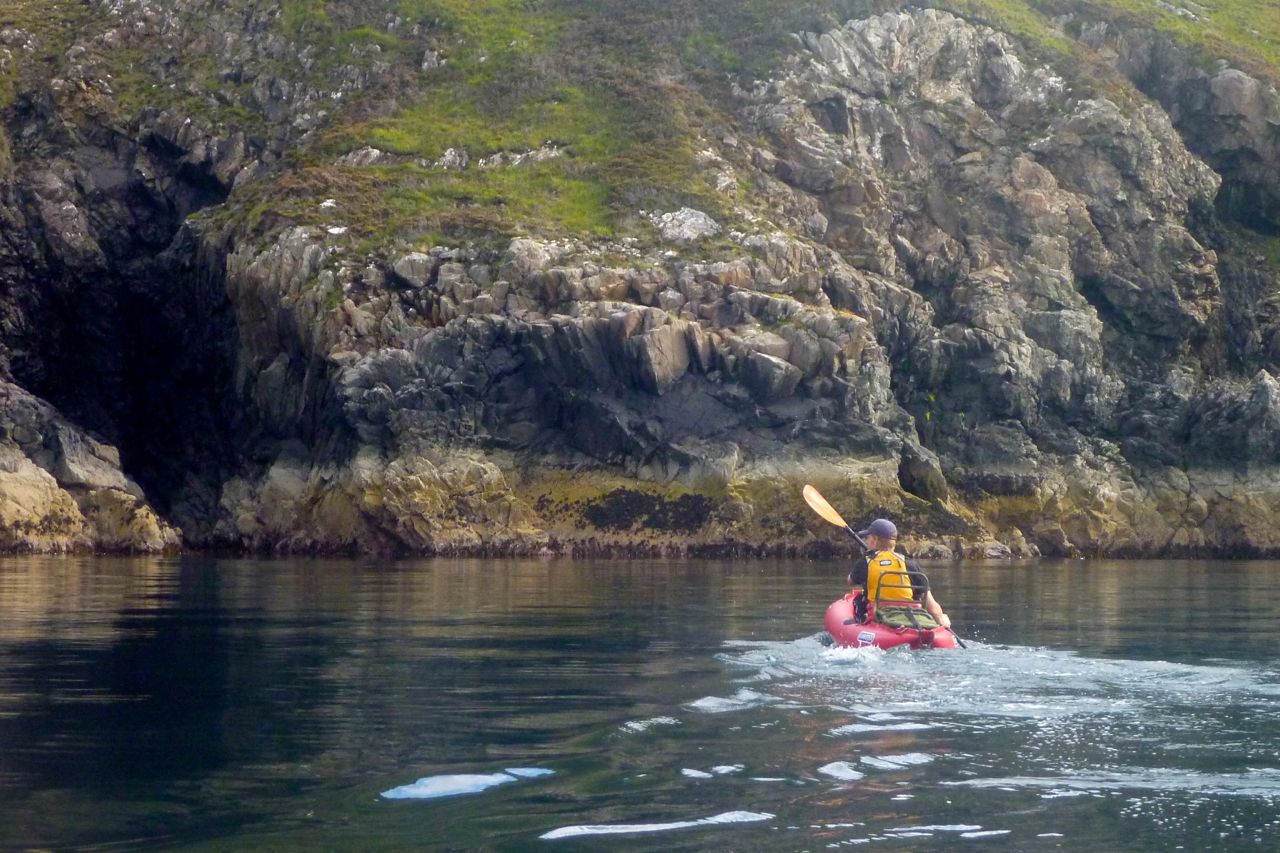
On the small beach at ‘Island Bay’ we pumped up our supple new Alpackas and paddled out north across the loch towards Suilven mountain, passing between small islets and landing an hour later for lunch near ‘Shielding’ on the map. Initially the northwest breeze put us at the fetchy end of the loch and we took on the odd splash. But even with a wet bum, from any vantage point you care to choose, with its ring of peaks, the primeval Inverpolly basin (below) has got to be one of northwest Scotland’s most dramatic landscapes.

cwtsul06
cwtsul14

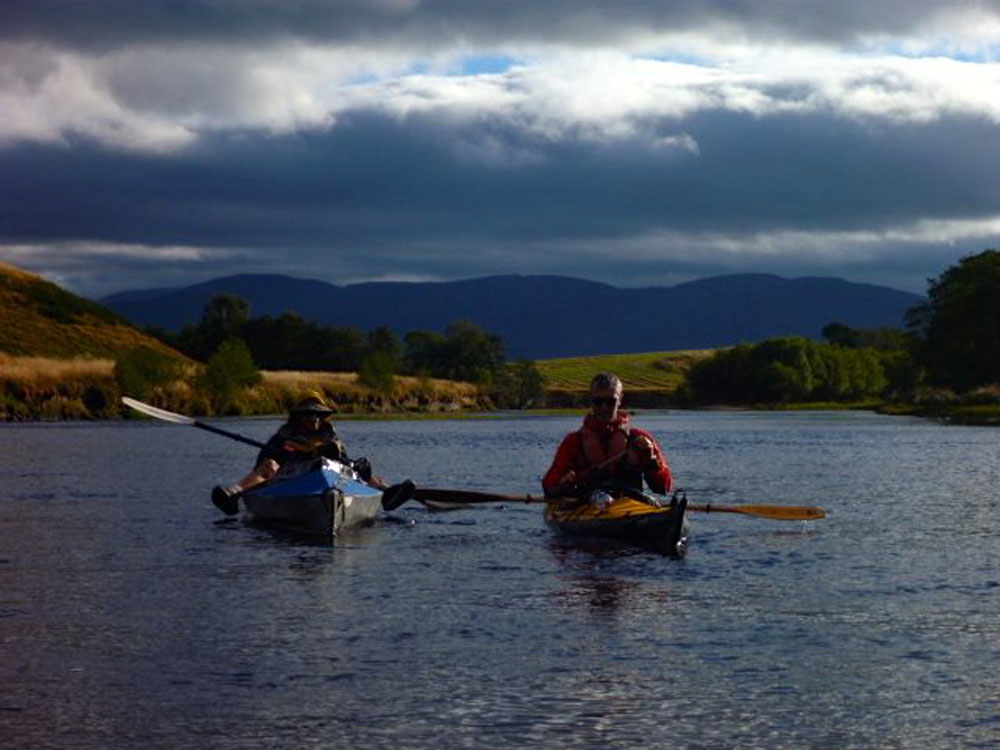
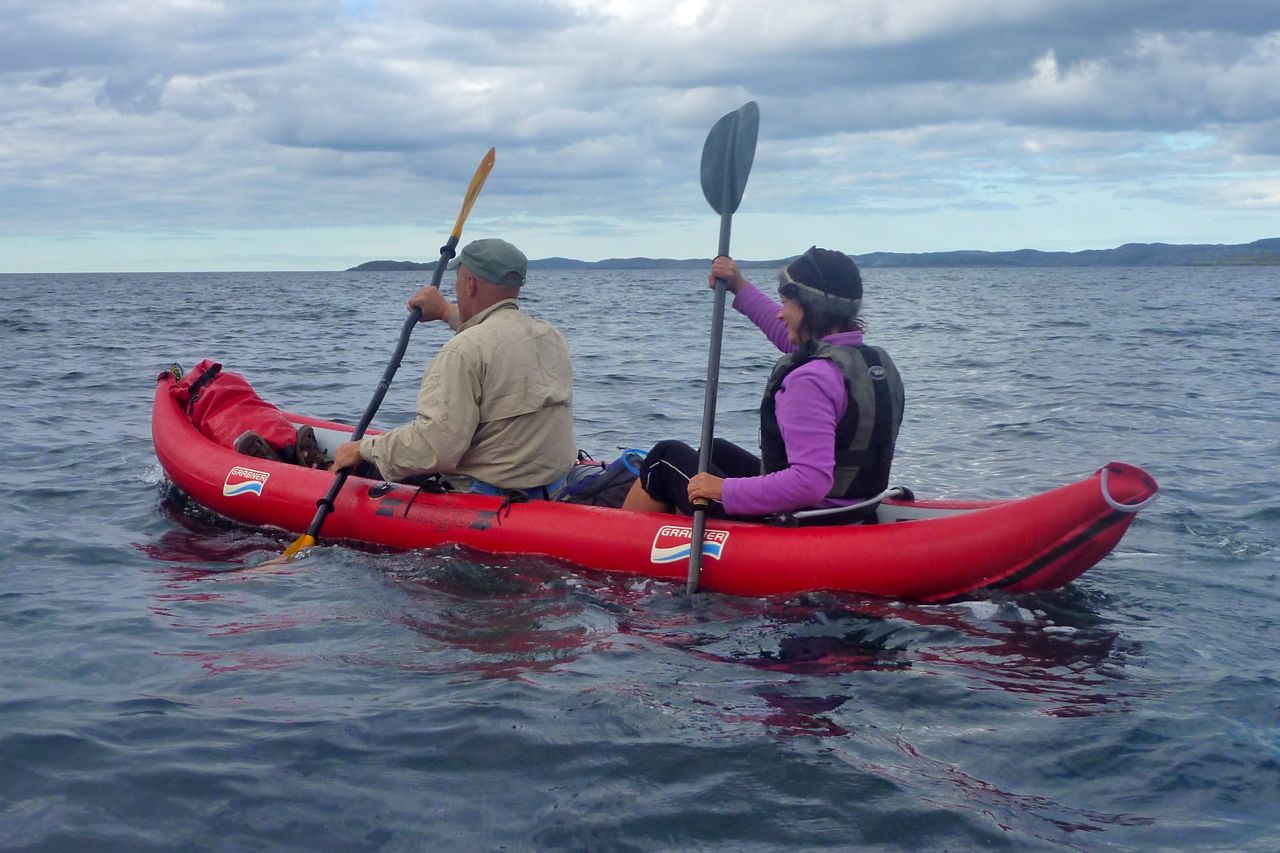
Over lunch I measured up Jon’s red Alpaca against my Yak but could hardly see a difference (it’s 3 inches shorter inside and out). But Jon was having trouble getting a full draw of the paddle with his bag across the bow (mine was below my knees). It’s possible these newer Alpackas have more of a wave-riding upturn at the bow which makes any bow-mounted bag slide backwards. That, plus a need to adapt to a gentler but more frequent ‘packrafting cadence’ saw Jon’s red Alpaca lag behind my Yak. Later we swapped paddles which made a small difference – we should have swapped boats too to see if man or boat was the culprit. My 2014 Yak has the slightly longer stern, but paddles much like my old one.

From Shielding we walked over the pass to Fionn Loch directly below the south wall of Suilven. As before, some canoeists were camped by the Uidh Fhearna  river crossing (a deep wade for a walker; right), practising their moves and barely noticed us slipping into the water from a reedy lagoon. Once on the north side we found an oddly deep channel which led inland for a hundred metres saving some tussock and bog walking.

cwtsul15

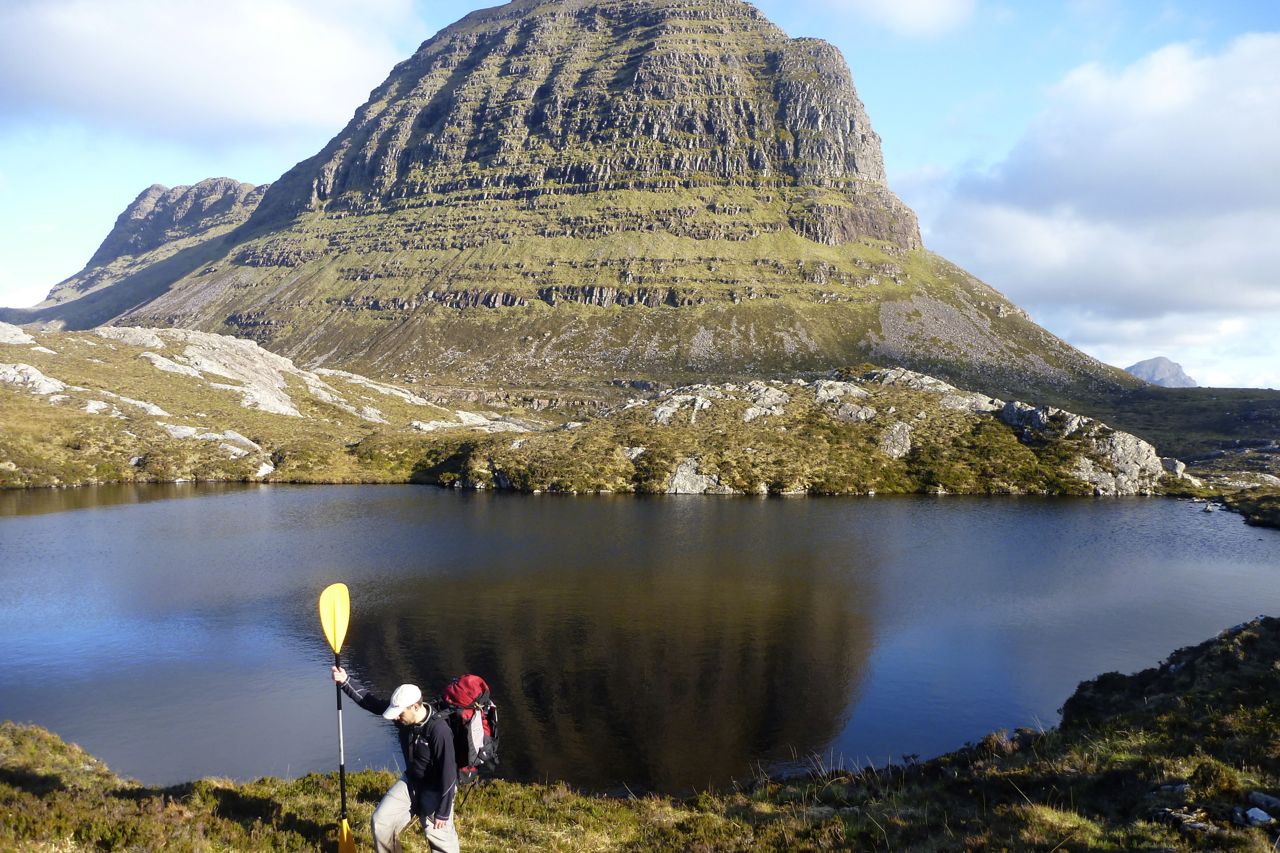
Rolling the boats up, I tried to persuade Jon that the seemingly vertical clamber up Suilven’s south face would be excellent knee therapy, but he wasn’t  buying it. He had ten weeks to get into shape for a four-day trans-Pyrenean ride and didn’t want to risk it. So we set off north below the western prow of what the Norsemen called ‘the Pillar’ (below).

cwtsul25

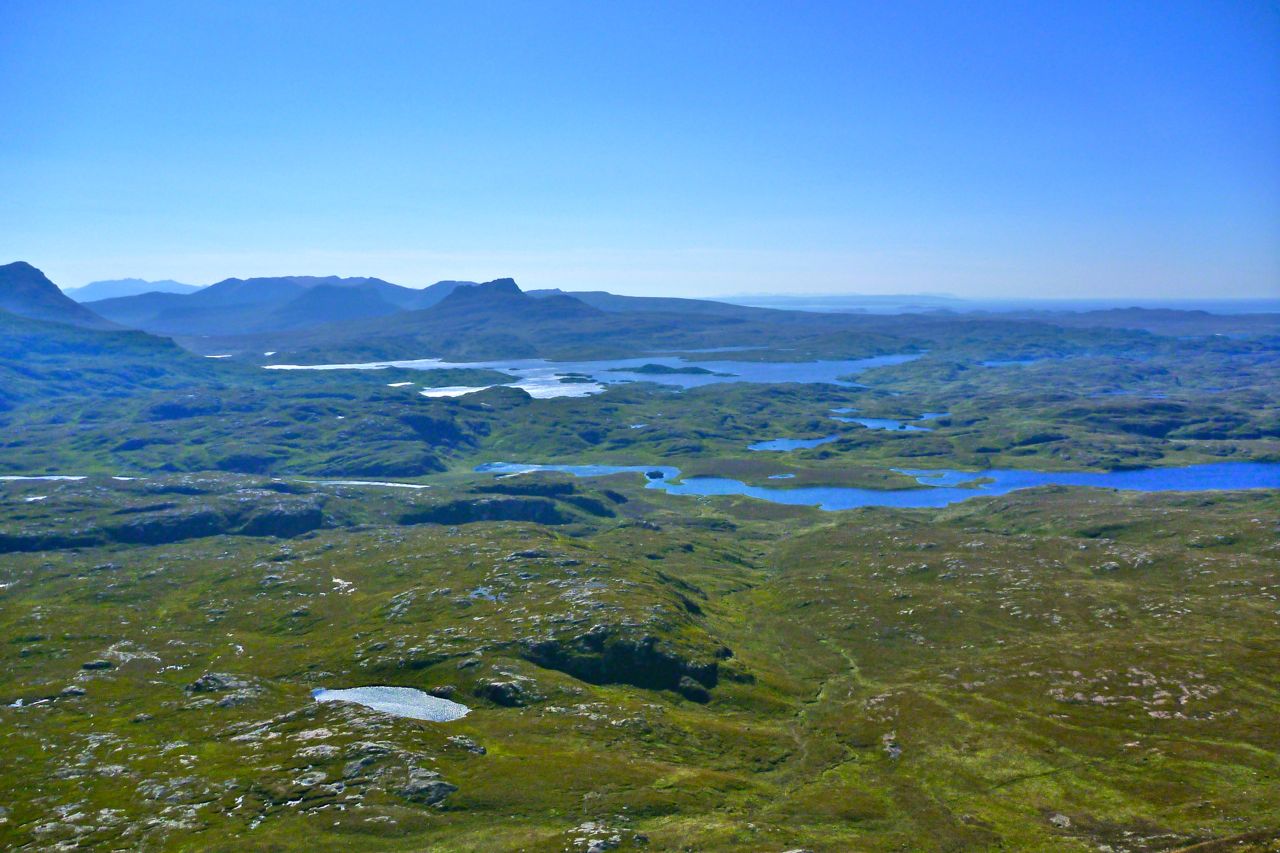
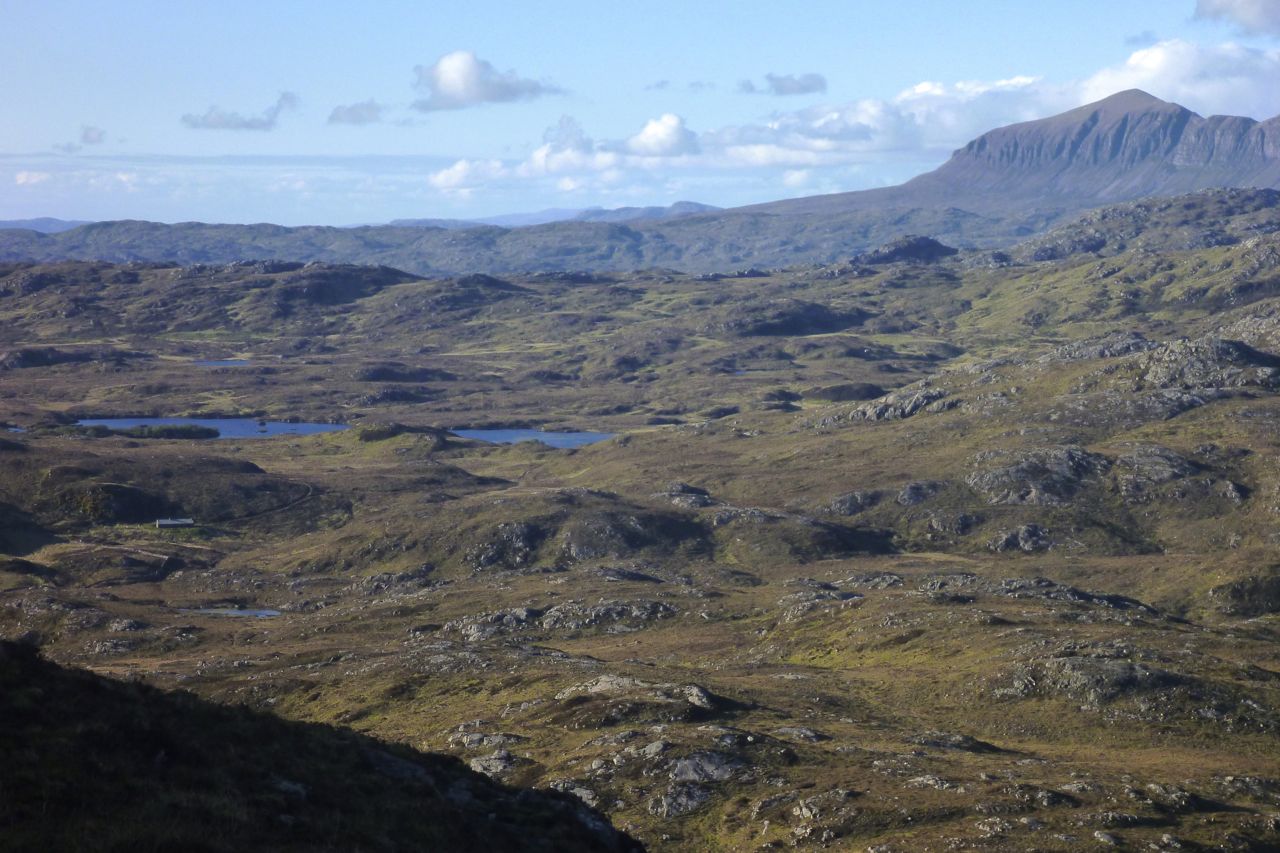
The 50k map doesn’t show a series of gradually ascending ups and downs over ridges running parallel to the mountain. With Jon’s paddle-supported hobbling it took an hour and a half to get to the high point where a view of our next challenge – Quinag (below) – revealed itself across a string of lochans.

Soon we caught a view of Suileag bothy far below but the terrain got gnarlier still, winding around lochans, small passes and down steep slopes. Somewhere here Jon chose to follow an indirect low route to spare his knee and somehow managed to sneak past me while I scanned from a high point for half an hour, trying to track him down. He was behind me all the time, kettle on and yellow paddle resting by the bothy’s doorway as a marker. I needlessly paddled over Loch an Alltain Duibh, assuming the river gully just upstream would be too awkward to cross. In fact Jon had found it an easy ankle wade.

In hindsight I’d say the path climbing up and down the saddle of Suilven to pick up the jeep track west to the bothy wouldn’t have been much slower than our route around the mountain’s western prow, let alone the added appeal of taking a quick detour from the saddle to Suilven’s western summit. Since we did this, the path on the north side of the mountain has been improved.

cwtsul27

Suileag bothy is one of the tidiest I’ve seen, clean and basic with a fireplace and water from a nearby burn.
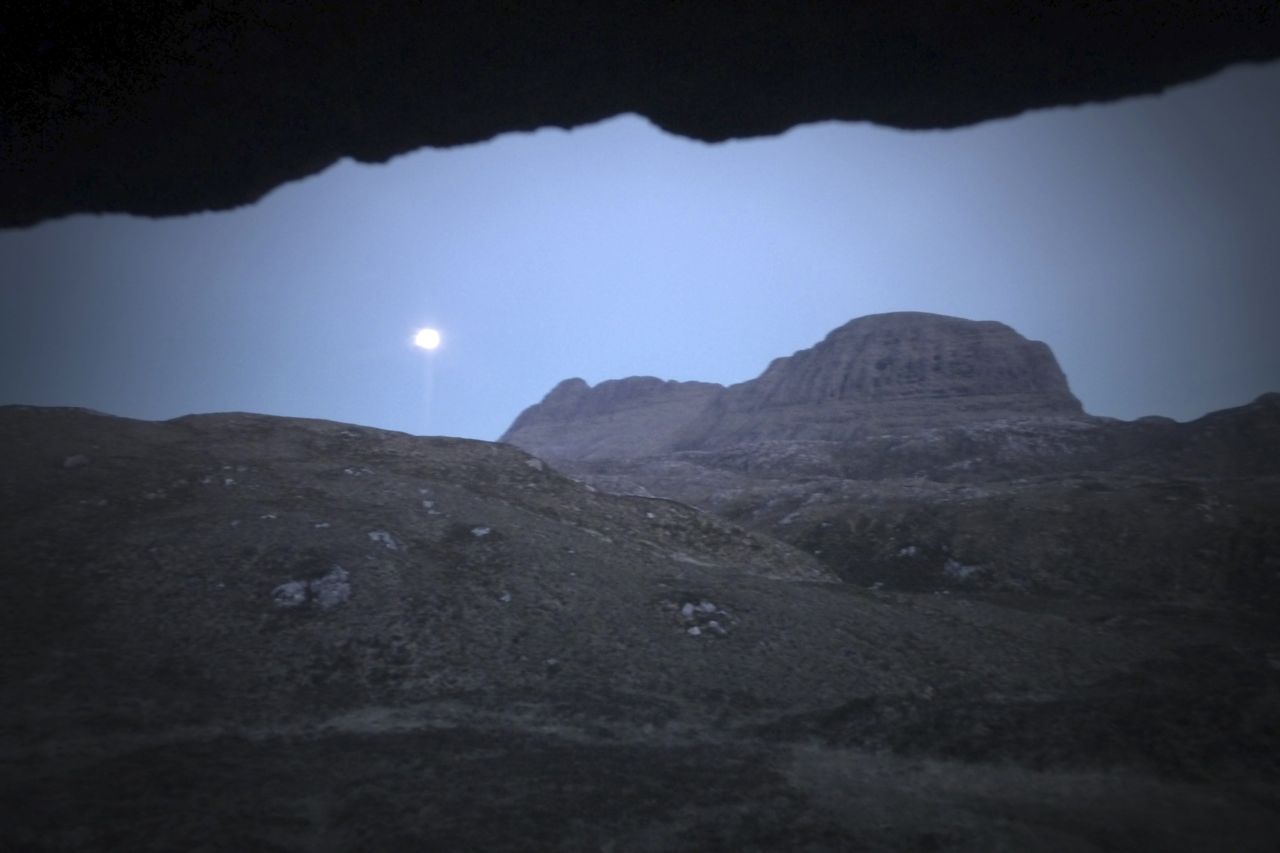
It’s so much more agreeable to barge into any bothy and spread out like a normal person, than crawl around a tent like an invertebrate.

Next morning we followed the path north over a pass for two or three miles to the footbridge over the River Inver to Little Assynt; all up much quicker going. At the footbridge we carried on west then north, over another deer fence and ankle twisting tussocks to a beach beyond the sluice where Loch Assynt drained into the river.

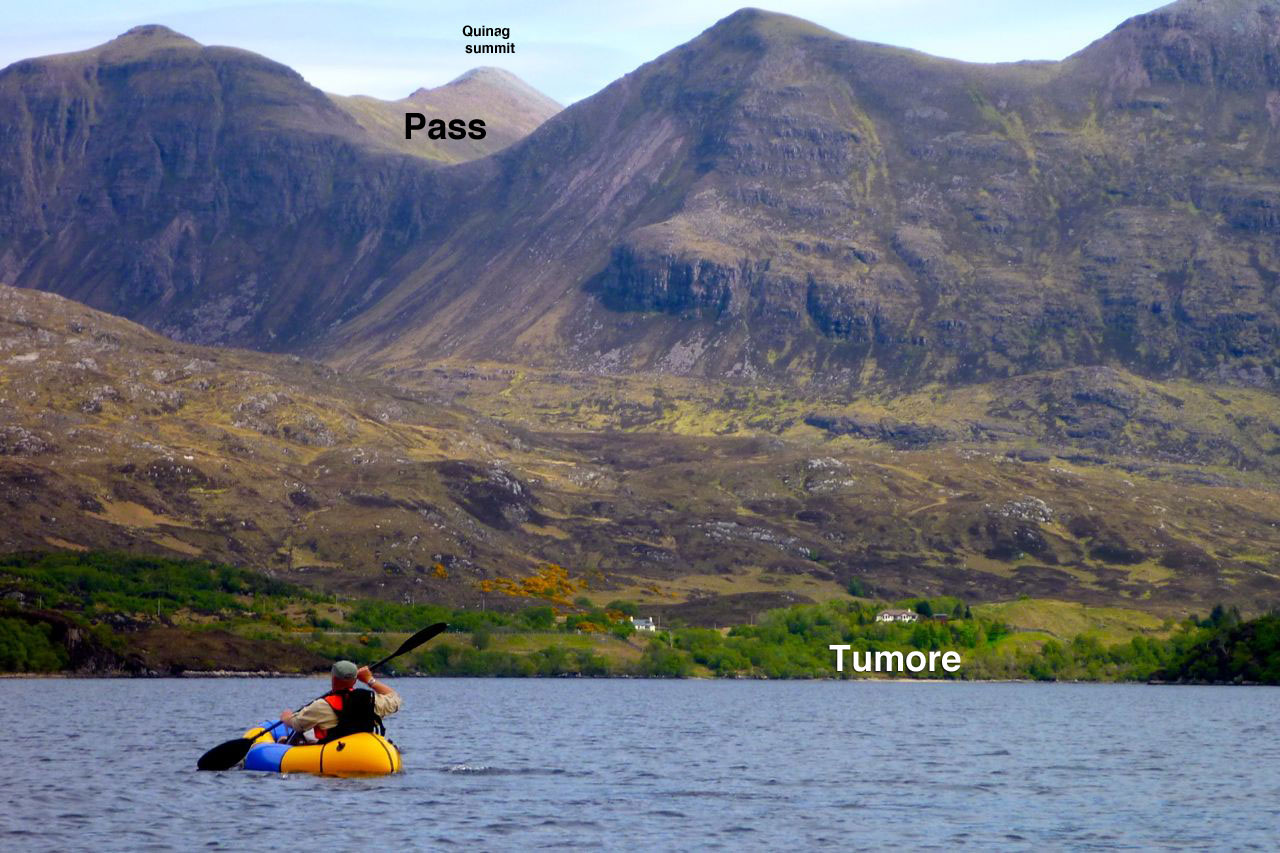
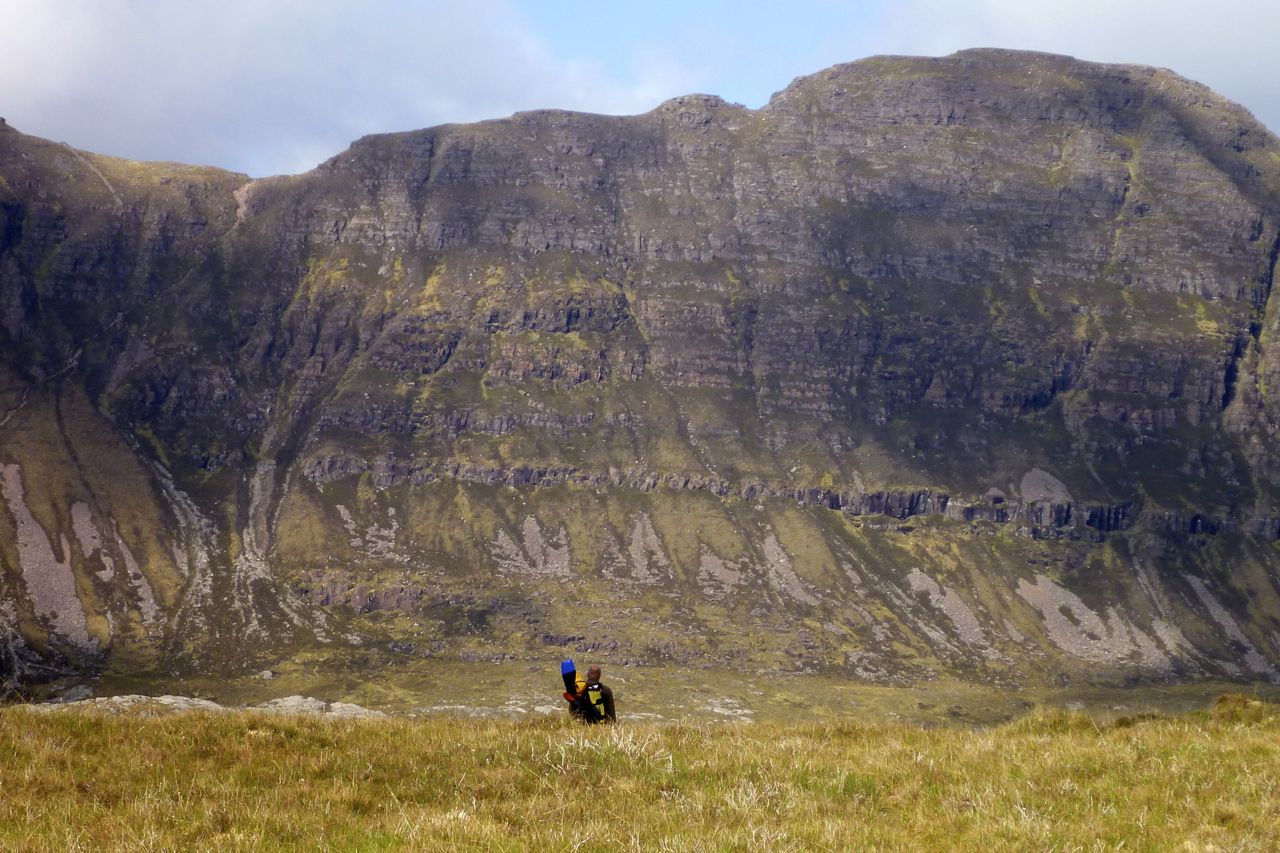
Up ahead loomed the mass of Quinag mountain (above) and Jon and I debated the feasibility of tackling the Bealach a Chornaidh from the pathless west side. Leaving the Drumbeg path, a slope leads a kilometre and some 400m up to either a harmless scree bank or a lethal cliff. It was probably the former but too much for Jon’s gammy knee. We finished off our food under a gale-bent birch below Tumore and, as the wind was with us, decided to paddle Loch Assynt east to the road junction instead. The back way up Quinag pass would have to wait for another time.

cwtsul39

On the water the southwest breeze wafted us helpfully down the loch, though the Alpaca was still notably slower despite my helpful demonstrations on how to paddle. I really ought make one of those instructional dvds, like Jane Fonda. Once ashore all that remained was a seven-mile road walk to Kylesku by which time the forecast wind and rain had caught up with us.

On the road walk I eyed up the terrain northwest of Quinag massif. It looks like the planned orange path shown on the map above would have been another convoluted cross-country struggle, even if it was a more direct line. Leave that to the crows and follow the regular path down from the pass east to the road (unshown on the map but it’s there).
And that was the lesson learned on the land stages of this CWT variant. While there may now be a right to roam across the glens and bens of bonnie Scotland, who in their right mind would want to do that for any longer than necessary? Even wild animals develop paths; it’s less effort and happens to be quicker, even if it’s not a direct route.

cwtsul40

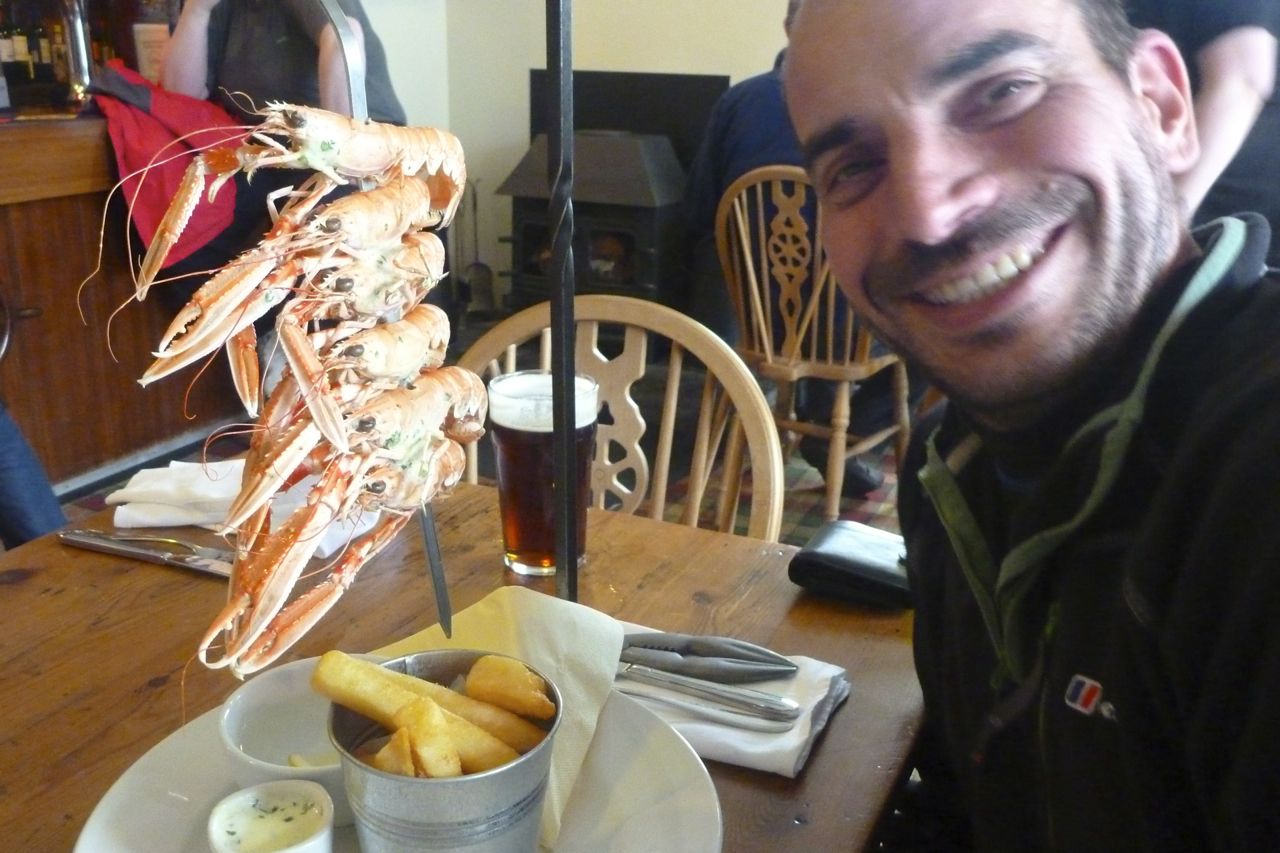
Lured by the promise of a free meal at the hotel, Di drove up right on time and took us the last mile to Kylesku where a TV crew happened to be recording the retirement of the postmistress following no less than 61 years on the job.

So, my summary for this nearly completed CWT Assynt variant? For a boatless walker, once over Loch Broom and in Ullapool, the Postie Path is a dramatic way of getting to Achiltibuie where there’s a hostel, pub and shop. Over the hill it’s a major wade across the Narrows of Loch Lurgainn after which I’d recommend the Linneraineach path between Stac and Cul Beag to the stream before the long cross-country trek to a shorter wade across the Uidh Fhearna river at Fionn Loch. From here take yourself up and down Suilven’s saddle, then from the bothy take the track to Little Assynt footbridge. From here it’s a two-mile road walk to Tumore where you take the Drumbeg path before breaking off up to the Chornaidh pass and down to the road using the path to get you there.
With a boat the Narrows can be paddled, so can Loch Sionasgaig, cutting out a long cross-country yomp. Another quickie over Fionn Loch, up and over or around Suilven and paddle the west end of Loch Assynt to Tumore from anywhere north of the sluice. Job done.

cwt-kyle

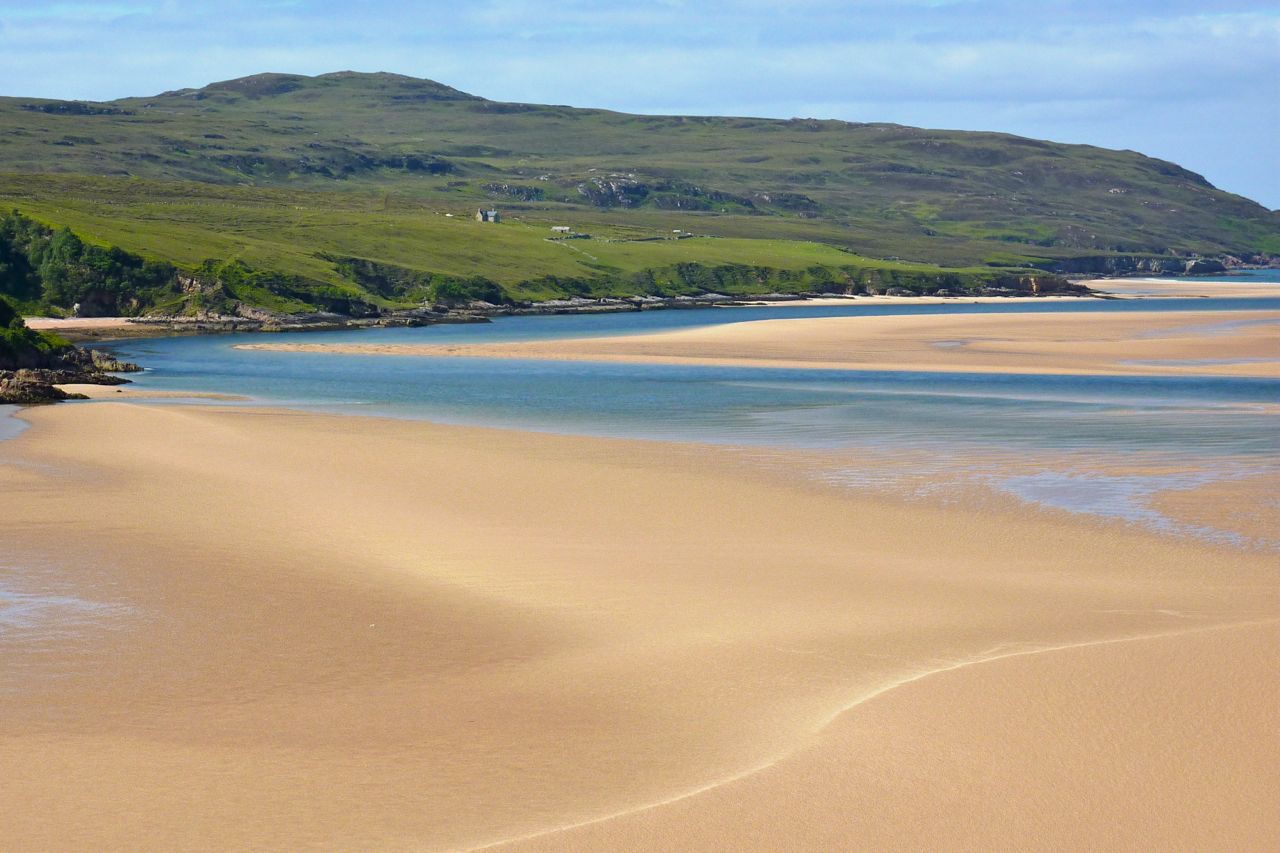
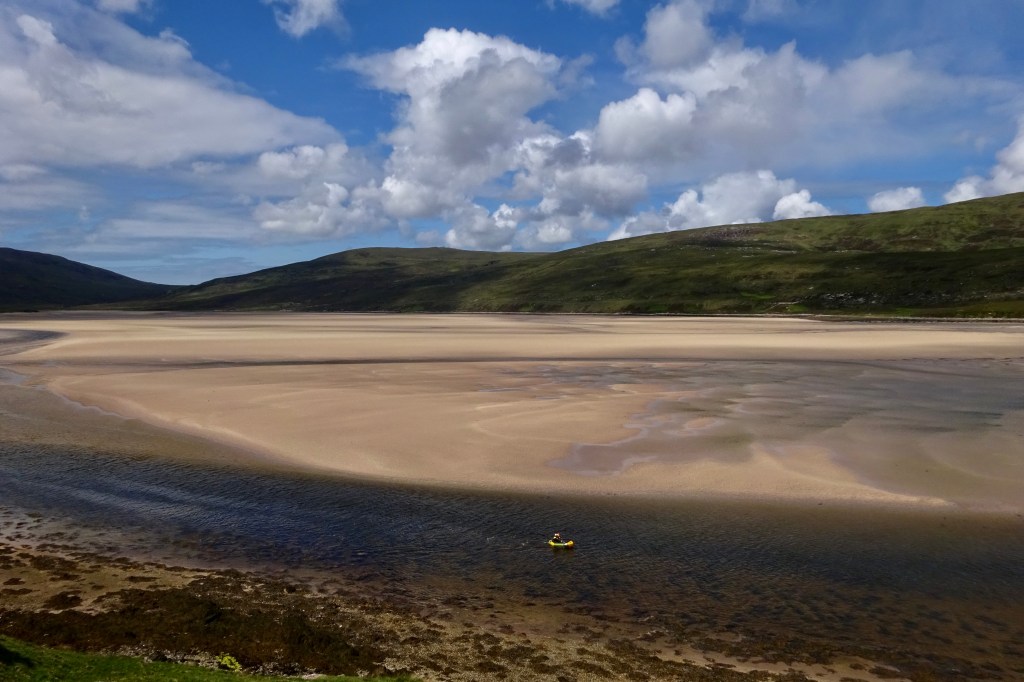
As far as I can tell, there are few other places on the regular CWT path where a packraft is worth carrying (which is probably why the path goes that way and avoids the Assynt). Except of course to get across the Kyle of Durness sea loch after the walk’s finale at Cape Wrath, if the boatman is not around and you don’t fancy the detour to the head of the loch. The image left from a few years ago must be a very low tide, but as you can see it’s potentially just a swim of a few metres. Eight years later I finally got to paddle the Kyle (below).

Crossing the Kyle of Durness; Cape Wrath headland behind

Cape Wrath Trail ~ a Coigach-Assynt variant

CWTML
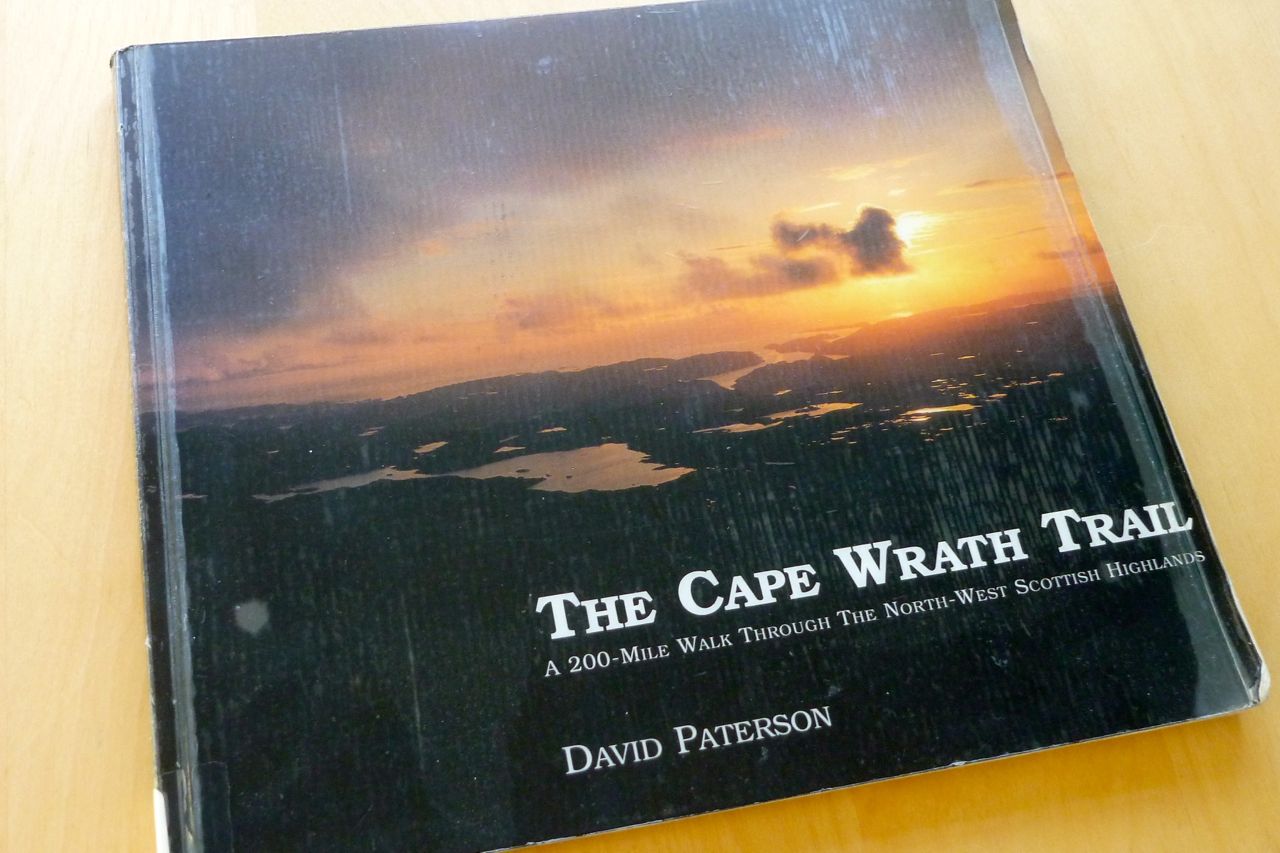
cwtbook

The 200-ish mile Cape Wrath Trail from Fort William to the top of Sutherland was cooked up in the early 1990s by David Paterson, a photographer who’d just come off a job shooting the West Highland Way.
Paterson wondered if you could extend the WHW through the North Western Highlands to the very tip of the British Isles in Sutherland. Over many visits he established a route and in 1996 produced a beautiful book: ‘The Cape Wrath Trail: A New 200-mile Walking Route Through the North-West Scottish Highlands’, creating what he humbly ‘dared to call the Cape Wrath Trail’.
Since then various other routes have evolved between the two points. There’s no set route, far less two helpful waymarks to rub together, but it would not be an exaggeration to describe the CWT as Britain’s toughest long-distance path. Though it’s tracklogged comprehensively on walkhighlands, follows passes and valleys, and tops out at just one 600-m summit, the terrain, weather, scarcity of resupply points or any other services in the North Western Highlands puts the CWT in a class of its own. On occasions,
there is no path at all, but the advent of the 2003 Scottish Land Reform Act opened the moors to all, offering an infinity of options or ‘variants’.

cwt-altna

Originally Paterson’s route passed from Dundonnell through Ullapool, crossing the half-mile of Loch Broom from Altnaharrie on the Scoraig peninsula using a regular ferry. That ferry ceased operating in 2003 and the CWT now reroutes itself miles inland up to the head of Loch Broom and via Oykel Bridge. But as none other than Cameron McNeish suggested in a rather hastily written ‘Foreward’ on a Cape Wrath Trail website:

‘…the route should follow a south to north line as close as possible; it should allow passage through the most scenic areas; it should try and avoid tarmac and paved roads or paths but instead follow existing footpaths and stalkers’ tracks whenever they were useful and it should avoid crossing mountain ranges and major rivers except where necessary.’

In 2013 Cicerone published The Cape Wrath Trail guidebook. They’d published an earlier version as ‘North to the Cape’ in 1999. The 2013 Cicerone author Iain Harper has a website on which he questions and then decides not to include his Coigach-Assynt route option for safety reasons. ‘… Not including an Assynt alternative in the guide was a difficult decision, but on balance I came down on the side of caution, however for the more adventurous walker it should definitely considered…’.

cwtsul09

I’m not an especially adventurous walker and have not done the CWT, but knowing the Coigach-Assynt area, and from the walkhighlands reports I’ve read on the current route, Postman’s Path excepted (see below), the Coigach-Assynt doesn’t seem much more dangerous or remote than many other rather hairy sections on the CWT. And furthermore, our variant stays closer to McNeish’s ‘south to north line [and takes a] passage through the most scenic areas’.
The peaks of the Assynt are like nothing else in the Scottish highlands and it seems to me a shame that the original CWT route had fallen into disuse for want of a half-mile boat ride across Loch Broom.

That boat ride (or using a packraft, of course!) is the key to unlocking this Coigach-Assynt variant and on a pleasant summer’s morning it would be perfectly packraftable paddle from Altnaharrie jetty to Ullapool on the north side of the loch (David H did so in 2012 on his northwestern epic).

cwt-boater

But after the six-mile walk up from the Badralloch turn-off near Dundonnell, arriving at Altnaharrie jetty on a rainy evening in early December 2013 with a spring tide in full ebb against a 20mph wind, paddling towards Ullapool’s harbour lights seemed less of a jolly jaunt. To cut a long story short, we ‘d contacted the harbour master to see if he could help out with a lift. At least one other CWT walker has done this. He arranged for the night shift to come over and pick us up. [It’s worth noting the former Altnaharrie Inn gourmand’s restaurant alongside the small jetty in now a private residence].

cwtwh406

After a cozy night and a lavish brekkie in Ullapool’s Ceilidh Inn, Robin and I set off set off for the 12-mile walk to Culnacraig via the notorious Postman’s Path. We didn’t quite make it and as it involves no actual paddling, you can read about it on Walkhighlands.
In 2021 round-Britain coastal walker Quintin Lake recalled the path:
I thought I’d seen it all by now, but the postman’s “path” to Culnacraig passes over some of the steepest ground I’ve yet encountered. If there weren’t a path to lure me onwards, I’d have turned back.

cwtwh5-24

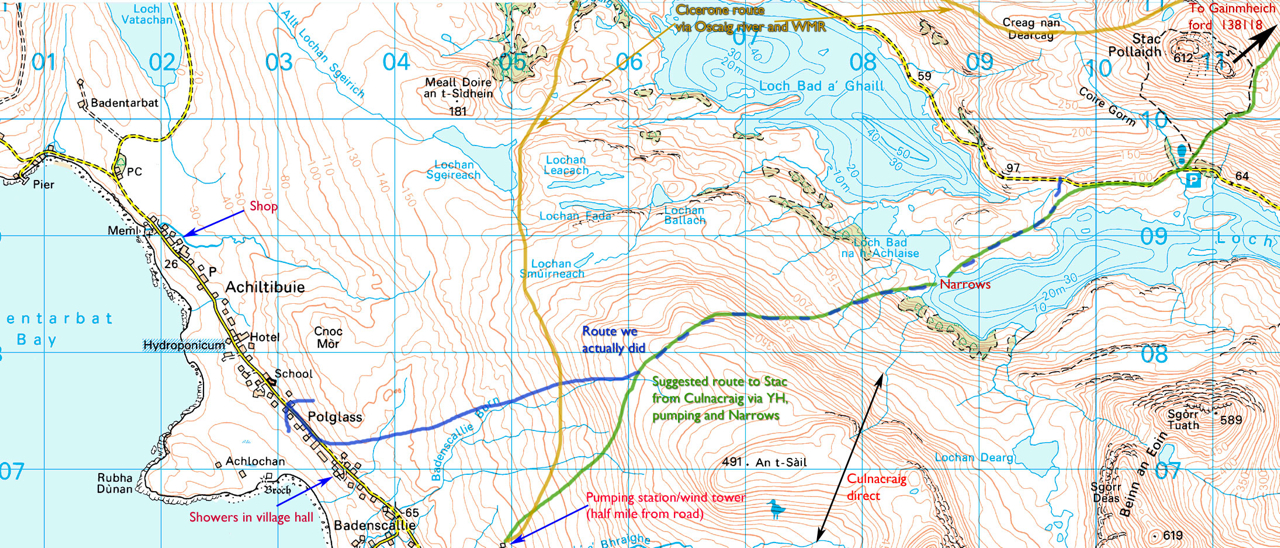
From the vicinity of Culnacraig our suggested variant takes a more direct line than the Cicerone suggestion shown in yellow (above). It crosses over to the narrows at Loch Lurgainn which are just about wadeable to a boatless walker with a stout stick, but which we paddled during a break in the December storms. You can read about that here.

cwtsul11

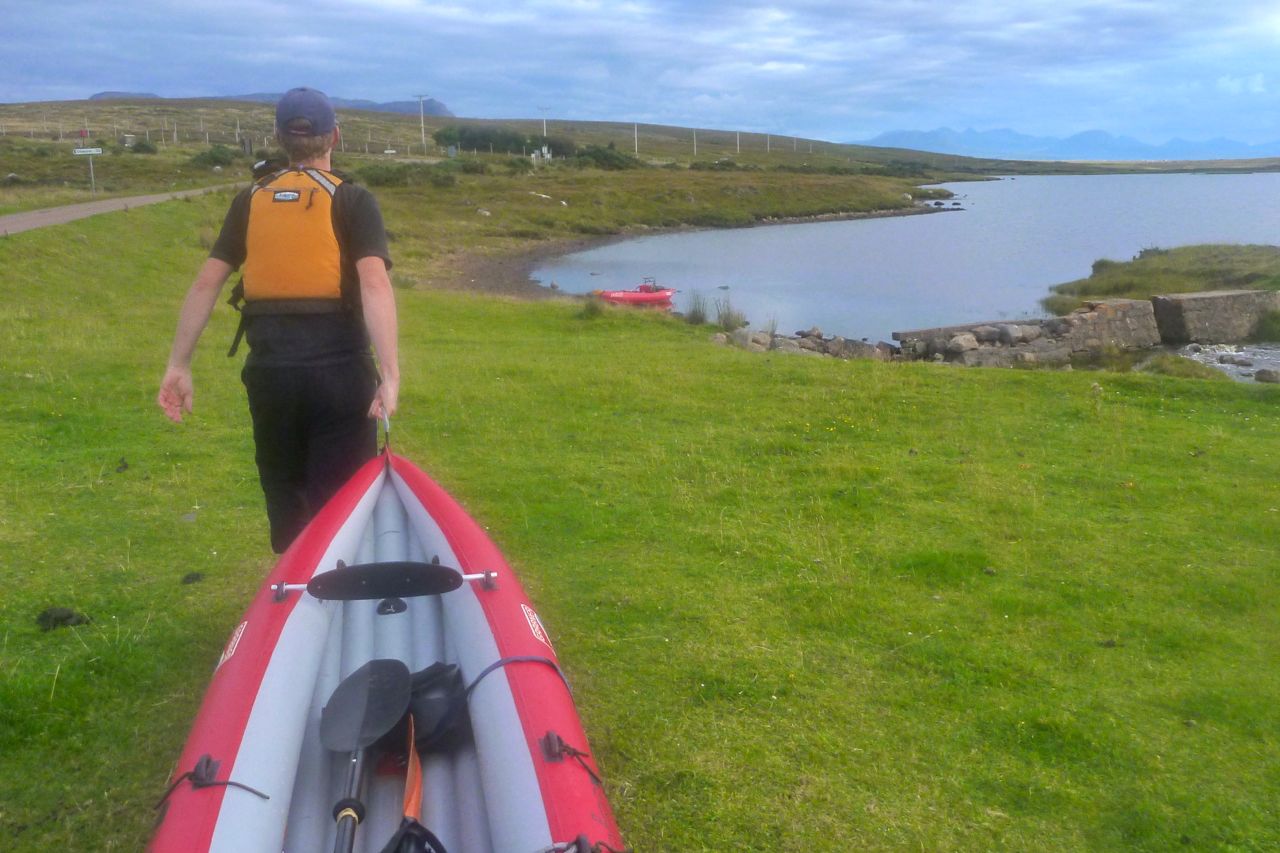
A few months later Jon and I returned to Achiltibuie with our new Alpackas to pick up the variant from the foot of Stac and follow it through to Kylesku where it rejoins the regular CWT for the last lap to Cape Wrath. It can all be walked or waded but our route was streamlined by taking three paddles (right) and a shallow wade. 
You can read about that here.

Grey Dogs and dog water; kayaking the Slate Islands

Deadly whirlpools await

Fellow IKer Gael proposed we meet up during his May visit to the Hebrides; his chance to get a closer look at places he’d passed on the SSKT. Once he’d done his own thing on Mull I suggested Coll and Tiree as a satisfying and remote offshore destination. Those two outer Inner Hebs may claim to be the sunniest places in the UK and looked interesting in Google sat, with many sandy coves. But it also became apparent that all that sunshine required unusually strong winds to blow away the clouds. Whatever’s blowing in the Inner isles on a given day, on Coll and Tiree you can bank on double. Sea Kayak Oban admitted that they’d only managed to run two tours there in six years.

slatemap


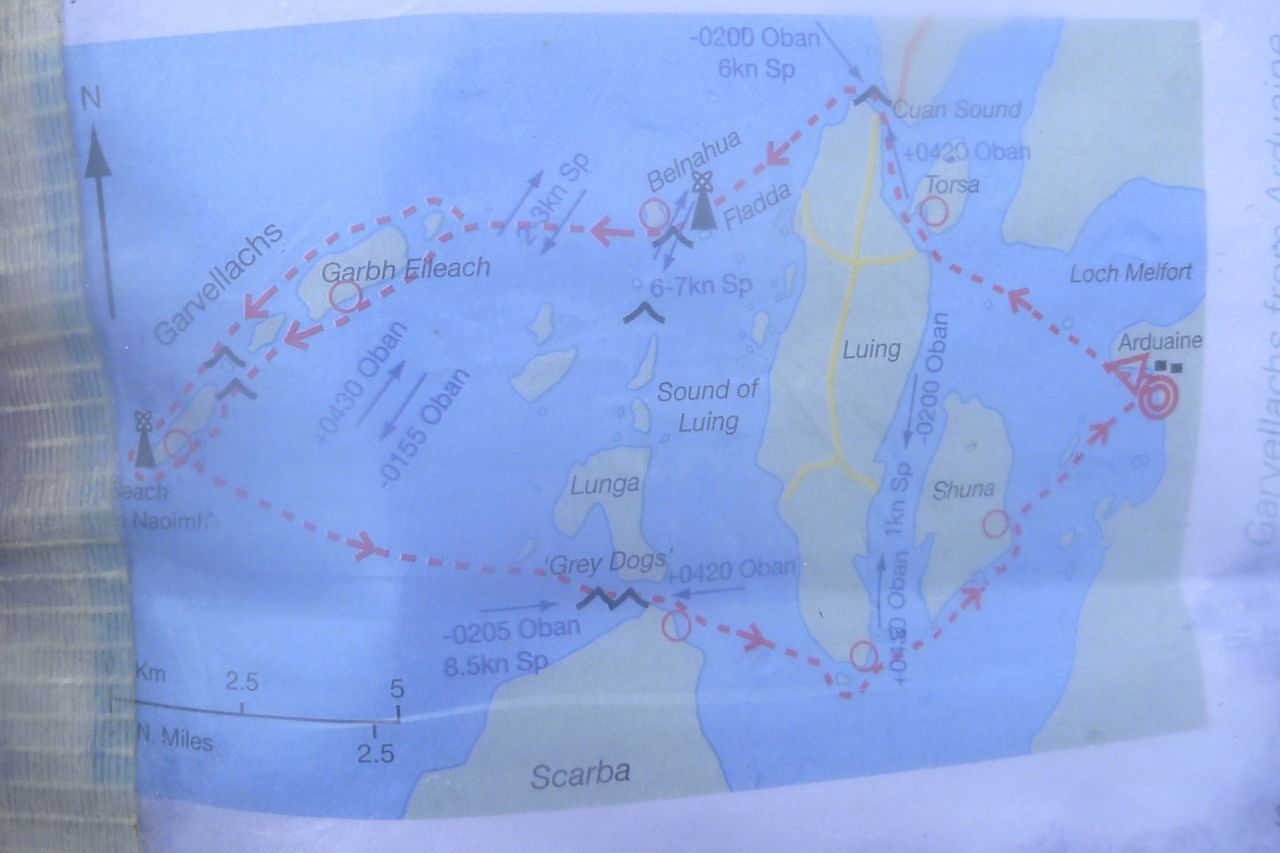
When we met up in Oban, Gael had already made contingency calculations, multiplying several locations by the state of the tide and then dividing the result by the 5-day forecast and subtracting our IKs’ average speed in knots. According to his complex computations, a three-day run out of Arduanie around the Slates would work out best for us.

Oban; a ray of hope

After a brilliant seafeed at EE Usk on the waterfront (left), we squeezed my moto into Oban Backpackers’ storeroom and set off to Arduanie where a sleet shower pelted us while we loaded the boats. The rest of today was actually going to be OK weather, a bit windy. Tomorrow less bad but Friday might be a tent bound zip-in according to the forecast, so our Kindles were charged up.

Over the sea to Shuna

I was snuggly wrapped in my new, lightweight Anfibio drysuit as we set off for a late lunch on Shuna’s east shore before curving around into the wind to cross to Luing. From here we worked our way down to its southern tip then made a dash to Scarba, eyeing up the sinister and all too near Gulf of Corryvrecken which gave me the heebie-jeebies.

Gael had been told of a camp spot overlooking another tidal phenomenon, the Grey Dogs, and once pitched up on the moderately dry platform, we walked over to survey the Dogs where a metre-high standing wave rose up and collapsed every few seconds. Even though we were in neap tides it did this continuously all evening; only at 6am did I see the waters briefly still.

Rainbound on Scarba

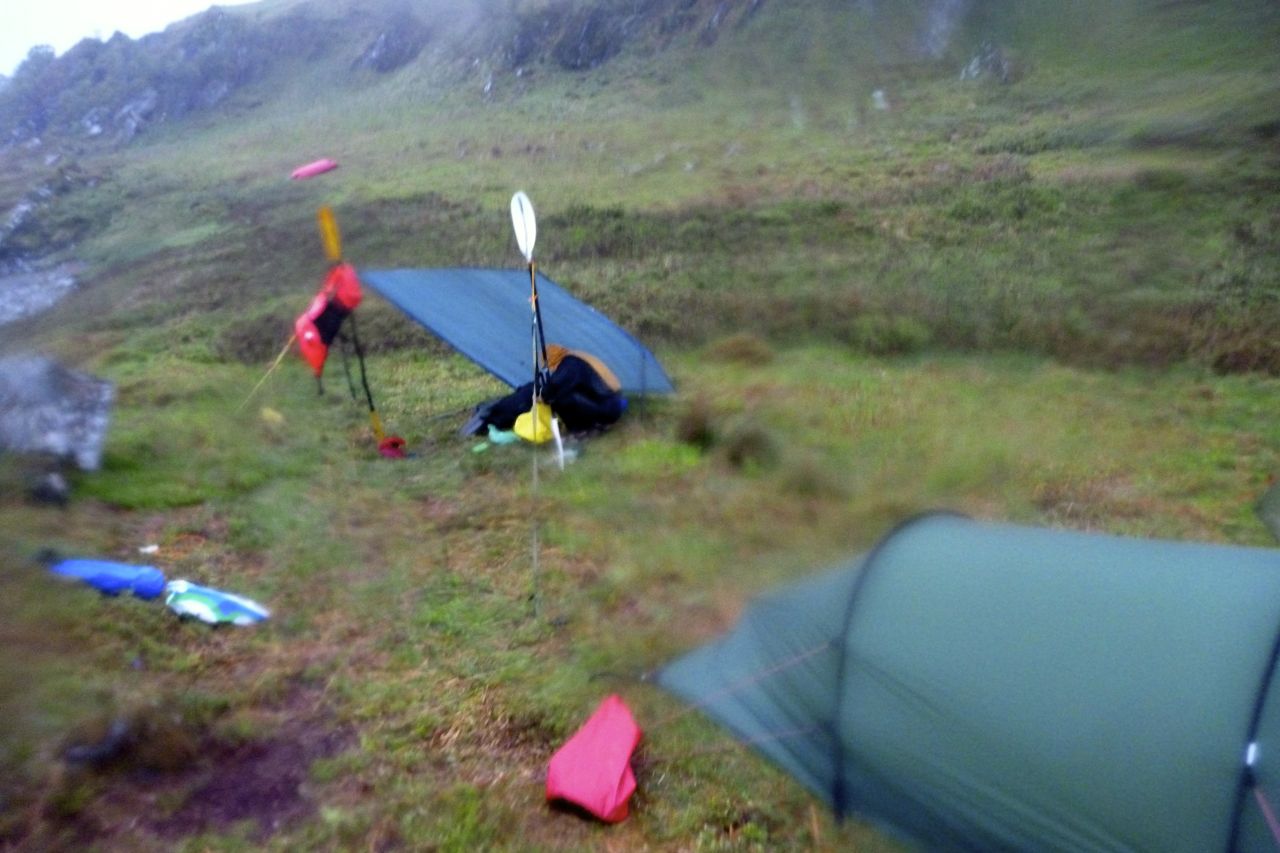
That night the rain closed in and pelted down. We huddled under a tarp – a good last-minute decision to take that – then made the delicate acrobatic contortions to get out of our gear and into our tents without spreading the wet.

Early next morning the Dogs dozed under clear skies, but by the time we were on the water they’d risen again from their submarine lairs and water rushed along the channel’s shores like a river. Even Google sat snatched its picture with the Dogs in spate. In fact, during neaps, either side of the breaking waves looked flattish water, but who knew how a boat would react in there so I assumed we’d head directly north. But when Gael turned his K40 purposefully into the Dogs’ maw I gulped and bleated, ‘We’re not going in there are we?’ Too late, the current had caught me and the ride was on.

Turbid dogs

What looked like flat water between the boiling shore and the midstream surf zone was actually a rolling swell a metre or two high but easily manageable in an IK. Gael rode into the middle for a play – the picture left shows the turbid water between us – and soon we were flushed out into the Firth of Lorn on Lunga’s west shore where the sea state was more placid. What that place must be like to paddle in spring tides doesn’t bear thinking about, but obviously some lap it up (below). There’s probably less risk than tackling the same sort of white water on a river.

Strictly speaking, Scarba isn’t part of the Slate Islands to the north, but this whole area is well known to boaters for its convoluted tides and associated races. For a paddler, the water pushing up and pulling past the isles and channels creates all sorts of complexities in route planning, something which Gael grasped far better than me.

Fladda

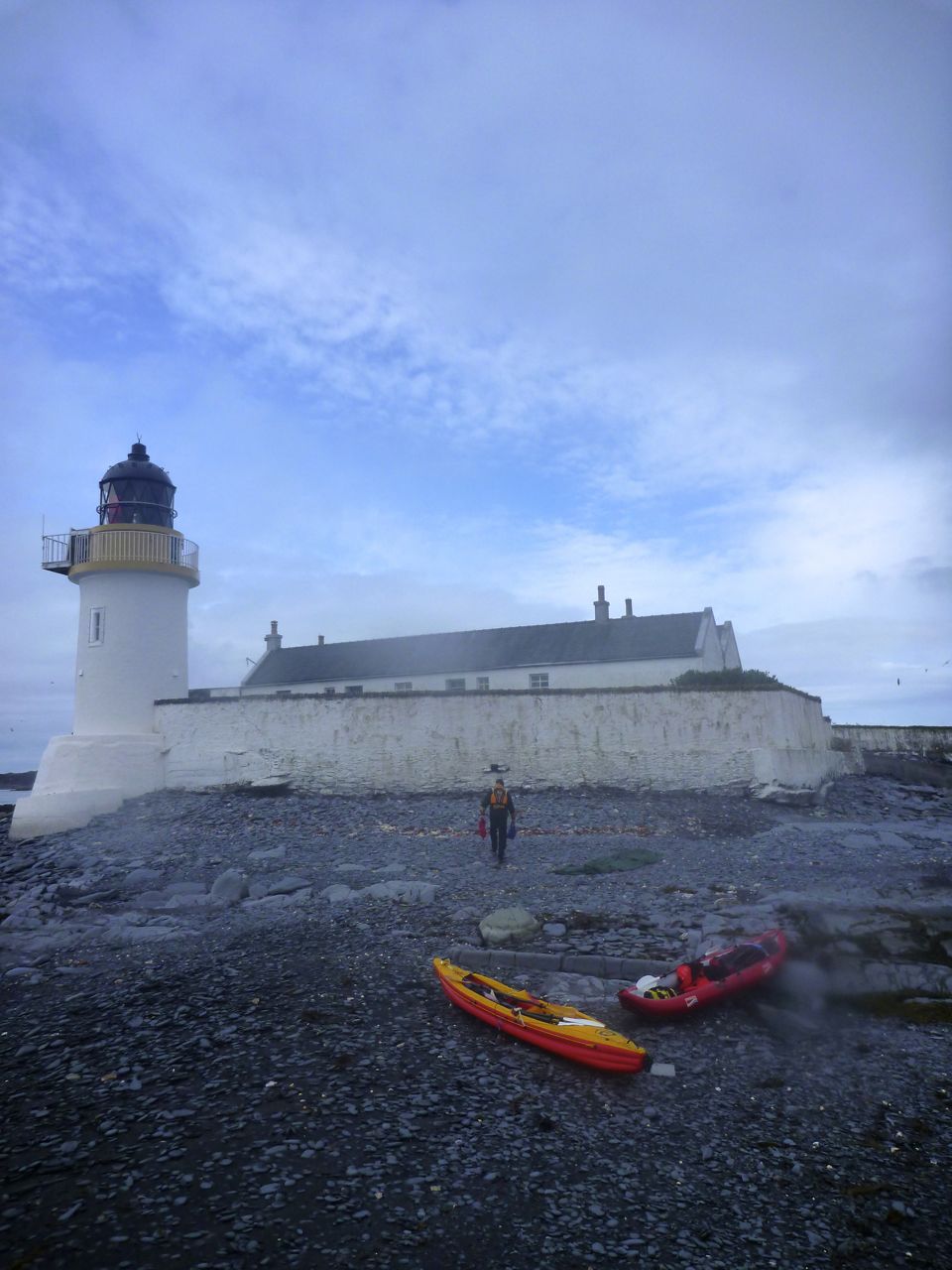
As we approached the lighthouse at Fladda he pointed out a cross-current where he advised we pieleffe. What was ‘pieleffe’, some kind of French nautical term? No: ‘paddle like fuck’. Oh, OK then. Now safely on Fladda’s slatey beach we took a tea break, me still a little frazzled after running [alongside] the Grey Dogs [in neaps] and not being torn limb from limb by clashing whirlpools.

Fladda had a big walled garden and similarly well-protected longhouse attached to the lighthouse. On the adjacent island of Belnahua the 19th-century ruins of quarrymen’s lodgings survived. Apparently, there was another island somewhere here which they’d excavated well below sea level until there was only a rim left. Then came a great storm and washed it all away.

Cullipool slate quay

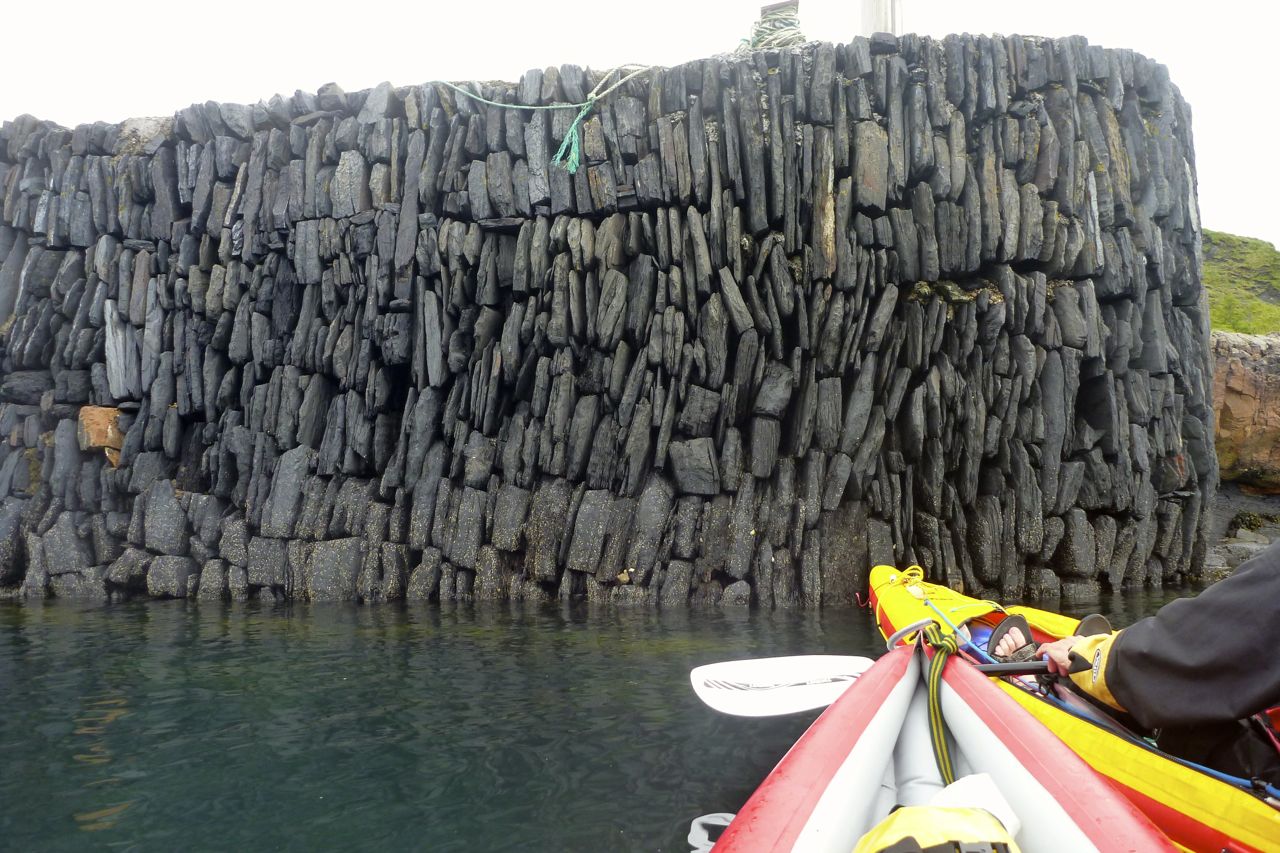
We headed with the brisk tide over to Cullipool harbour on Lunga; the unusual jetty is built of vertically set drystone slates, not something I’ve seen before. From here it was up to the Cuan Sound as the sun began to creep out. Once inside we hit dogwater so that the proposed lunch at the pub by the bridge became overruled by our appetites. A grassy shore on Seil island did just as well and provided space to dry out the tent.

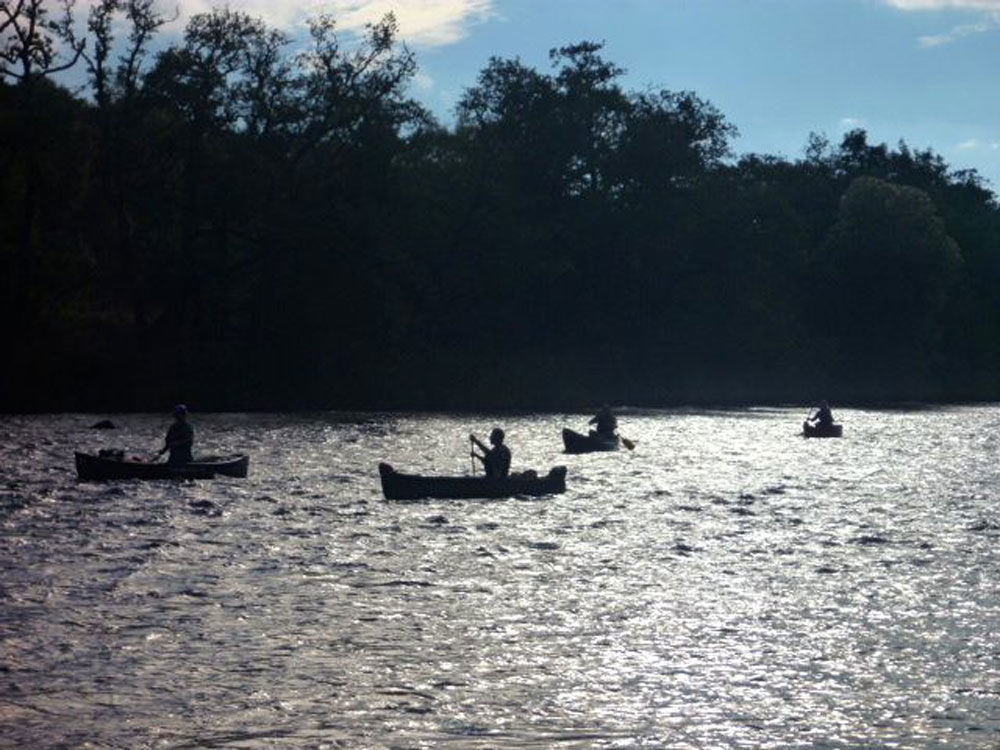
The channel narrowed and became lined with expensive-looking holiday homes which rather tainted our exposure, and as we neared the bridge we passed the only other paddlers we saw, a couple in a canoe letting the tide wash them south. At Telford’s late 18th-century [Clachan] Bridge over the Atlantic we swapped boats. While I shot ahead in the K40, against the current Gael’s impression of my Amigo wasn’t so amicable. Compared to my Grabner, his Incept is a good 20% faster (or less effort, if you like). A lot of the time on this trip Gael was coasting while I felt like I paddled non stop which may have explained my fatigue. I dozed off at lunch and slept like a log overnight, no matter what fits the tent was having. Near the top of Seil we pulled past some sailboats to the back of an inlet and pitched the tents with taut guys in preparation for Windy Friday.

slates-28
brucey

In fact, that day dawned fair; a cold front from the northwest brought in lovely clear air in which the Incept seemed to glow. Gael suggested we edge out to the outside of Seil to see if the sea was manageable to Easdale. We probed outward and while I’d not have gone on alone, by the time we were committed it was only two miles to Easdale. There were no actual whitecaps, just large waves that didn’t even swamp my boat but required momentum to maintain direction. A plastic coffin would have been in its element here, slicing the waves like Bruce Lee attacking a jelly.

Turning into Easdale port was a welcome relief but it had only taken me two nights out to find people annoying and the place suffering from what I perceived as tourism fatigue. Coaches pulled in and disgorged passengers who milled about for a few minutes then moved on. The so-called village shop looked like nothing more than a stockpile of porcelain and lace trinkets; I couldn’t wait to move on. What must locals think when their village becomes colonised like this? Make hay I suppose.

Lunch on Torsa

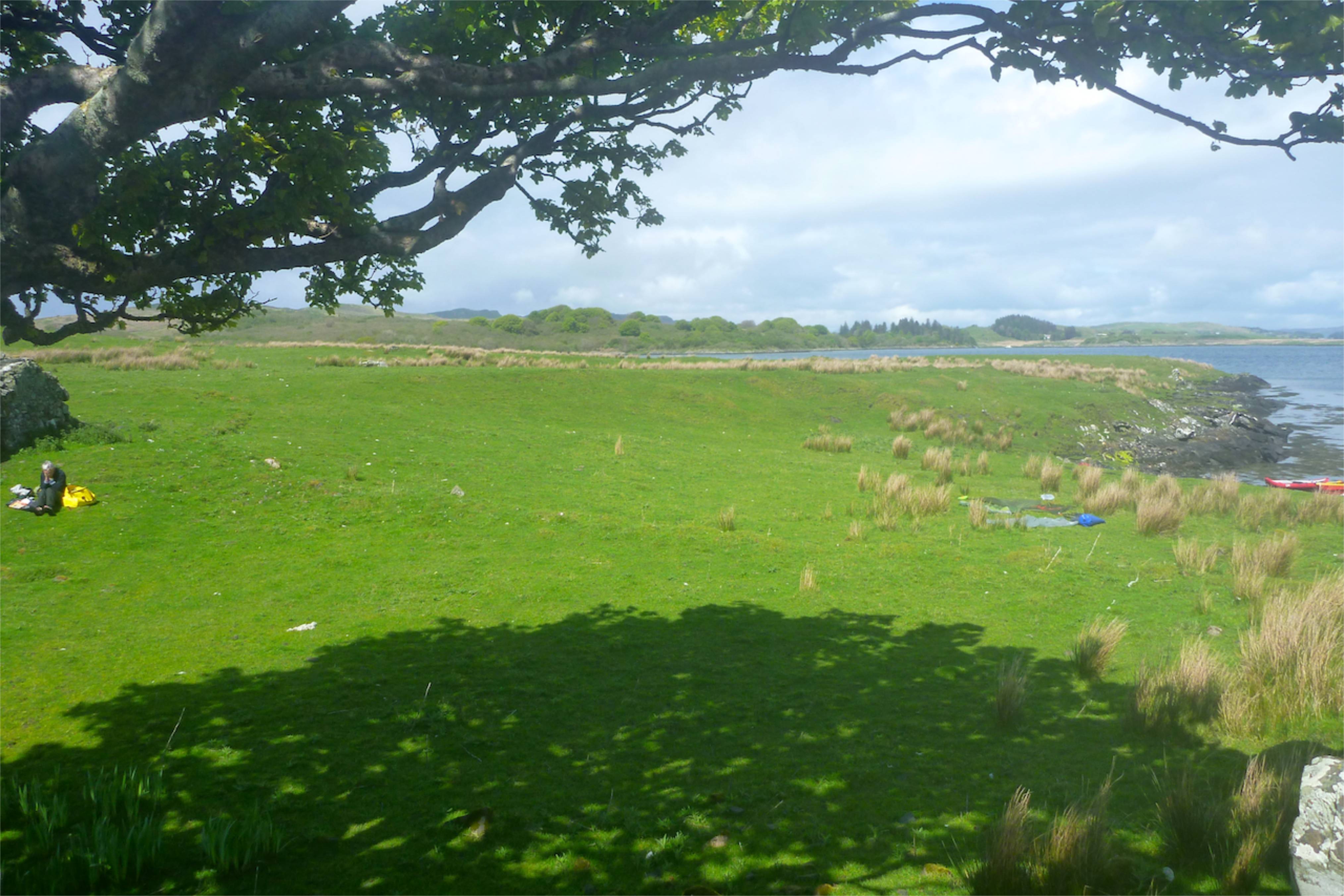
We decided to head back to the car, across the bay’s side waves, back through Cuan Sound then more dogwater and a grassy extended lunch by the big tree on Torsa island. Then it was back out into the sideslap across the mouth of Loch Melfort to Arduanie.

After some 33 miles of island hoping I’d caught enough sun to turn my head into a beetroot and we’d tackled a variety of easy sea conditions. It had been fun exploring the more commonly visited locales of Hebridean sea kayaking, all accessible and escapable, notwithstanding the complex tides. And a chance to do so with someone who grasped the concept of ‘3D’ sea kayak navigation was an added bonus, like a free course. Plenty more to see down here. Back at the jetty we lashed the boats to the roof and headed south to the Mull of Kintyre.


Kayaking Gigha Island

gighamap

With a day to spare after our two-night run around the Slate Islands, Gael suggested we head down to Gigha off the Mull of Kintyre. I’ve always wanted to visit this Scottish appendage and for Gael, Gigha had a special resonance as the starting point of the Scottish Sea Kayak Trail which he completed two years ago. Quite an achievement alone in an IK.

gig02

First of all though, I was ravenous for food on a plate not mush in a bag. We pulled into a cafe in the pretty port of Tarbert for some 1980s decor and food to match (right), then marched over to the Co-Op to see what was going cheap. Whatever I’d been eating on the Slates, it hadn’t been enough

gig04

We camped opposite the island, then once the wind abated next morning, carried the boats onto the ferry. Once underway I came over all lethargic on account of the Slate paddle (or perhaps the gluttonous Tarbert episode). It wasn’t helped by pushing a headwind up to Gigha’s northern point on our anticlockwise lap.

Finally we turned downwind, portaged the sandy isthmus at Eilean Garbh and moved on to the next sandy beach for a long lunch break and what had become my customary doze. Out on the northwest horizon pale blue humps marked the Paps of Jura. I read this short book partly about Jura recently (no so satisfying); among the Inner Hebrides Jura seems to have a certain allure.

gig12

Whether it was a pumped up seat, a good rest or the benefits of three days’ sea kayaking, I got belatedly reacquainted with my paddling mojo. I sat up straight, drew like a pro and soared across the waves like a surf ski, while Gael dabbled along the shore. The ocean side of this narrow island was a bit wilder, but for me lacked the features and interest of the far northwestern coast. Or maybe is was pre-doomed by the stigma of being too far south to be exotic.
gig07

We covered the 5.5 miles to Gigha’s southern tip in an hour thirty; a good pace for a pair of bloats. Back on the sandier mainland side we dipped about looking for a secluded wild camp but there were too many properties or not enough space. And with little wind now, the boathouse campground looked less inviting than a 3-mile scoot back to the mainland.

gig15

We set off, giving the day’s last ferry a wide berth by aiming for a big green buoy about halfway across. Once there and still feeling on form, I decided to PLF to the mainland jetty just to see if I could. Halfway there, with steam pouring from my drysuit’s vents and the tide pulling us south, Gael passed in the Incept without too much effort. I hammered away regardless as the jetty crept closer and touched down in 48 minutes, a minute after Gael. A good, end-of-tour burn up to clear out the cylinders.
It was good to see some other islands and with easy access and escape routes, Gigha would make a great first circumnavigation for a beginner. But as always, the wilder isles to the north and west hold more intrigue.

gig16

Assynt picture on BBC Scotland

stores
bbcwinds

A photo I shot exactly a week ago as we walked over the Coigach peninsula having paddled Loch Lurgainn narrows. We’e heading towards Achiltibuie for a cup of tea (right). Notice how Robin’s hair melds magically with the mid-winter bracken. Must be a form of archaic Celtic camouflage carried through the genes.
From the far back left coming forward and right, the amazing mountains of the Assynt: Quinaig (‘Kun-yak’); Suilven of course with Stac behind Robin and Cul Mor on the far right. All great climbs. It was the weather the day before (left) forced a change of plans. Full story with more pics evolving here.

BBC Scotland gallery link

bbcc

Kayaking the Spey – 2013

Sadly my pics area bit ropey; camera was set on 640px…

spey1307

We last did the Spey from Aviemore to the sea in 2007 when I still had the Sunny. This time round Michael was in Steve’s old, 19-foot Pouch double, Steve was in his Feathercraft Big Kahuna and  I was in the Grabner. Levels were low again, if nor lower, it was the last week in the fishing season but at least the weather was looking good.

spey1314

The first day is just 12 miles and not so interesting, with the best views behind you. With the hour-long assembly of the Pouch completed and the van stashed at Spey Bay, we set off about lunchtime.
Strong backwinds made my skeg-less Amigo hard to handle and I found myself expending a lot of energy trying to stop the back end coming round. Or perhaps I was yet to learn the knack with the Amigo, having paddled it on the sea with a skeg all summer. After a few hours we arrived at the Boat of Balliefurth bankside camp field and paid our three quid. Dinner was a freeze dried mash up from stuff I’d had lying around for months, made easier to prepare and eat with Steve’s half-hoop Eureka annex tarp.

spey1304


Next morning was another sunny, late-September day and we were relived to pass the point where one of the Kleppers got disemboweled last time by a submerged, mid-river fence post. On this occasion the boat-killing spike was visible a few inches out of the water.
We’d thought about doing the river a week later, when the fishing season was over, but timing put us here now, with the fisherfolk getting their last casts in before closedown. The tension between rod and paddle is an old story in England, but up here is exacerbated by the fact that the tweed and wader-clad anglers are paying – who knows? – hundreds of pounds a day for the privilege of fishing the famous Spey. With that cost comes the use of the many ‘day huts’ we saw on the finely manicured banks, as well as optional instruction from a ghilie. And then three kayaks blunder right through the spot where you’re prize salmon is lurking, like it’s a right of way or something.
We did our best to paddle round the back of the many anglers – some ignored us, some grumbled and a few lone ones appreciated it or were able to wave or indicate where they’d prefer you go. Struggling behind one bunch wading in the shallows, Steve got pushed across the current and flipped harmlessly while they just smirked and carried on casting.

spey1324


Once free myself, I shot off downstream chasing what some said was Steve’s paddle, but within a mile another fisherman said he’d not seen it float past. I walked back wondering how we’d get out of this one, but soon came across Pouch and Kahunaman paddling along. Seems the paddle had got submerged right by the boat, so all was well bar a lost pair of shades. Luckily that morning Steve had fitted his FC ‘sea sock’ – a body bag attached to the cockpit rim which stops the whole boat getting flooded if it flips. It was about that time so once back at my boat we spread out for an early lunch, letting out dew-soaked tents dry as some canoers from last night’s camp passed by.

spey1309


Aberlour was our destination that evening. We’d managed it last time, even with the ripped Klepper, but it seemed we were even further behind today. As we paddled on, the shallows and rapids piled up and the folding boats were getting a bashing, while I took on a couple of inches of water bouncing through the wave trains. Occasionally, if we misjudged the route we had to wade (left).
The famous and actually straightforward Washing Machine rapid was only running a half-load that day, but nevertheless succeeded in giving the inside of my Grabner a full rinse which took a few minutes to pump out. More white-water followed, and still I have to say the Grabner didn’t seem to handle well, requiring vigorous paddle yanking to avoid rocks or get in the right spot. Even in the pools, it still took some concentration to track straight before pulling back repetitive bow draws or momentum-losing stern rudders to keep the nose downriver. I’m sure the very similar shaped Sunny wasn’t so bad.

spey1323


Barely a mile went by without passing a fisherman. One grumbled that we should whistle as we came through, but that seemed like it would raise more antagonism, though passing them on the opposite bank may have been right on their target area. Trout were jumping for sure, but we never saw anyone actually catch anything. I’m not sure fly fishing is about that.
After a while riding the bouncy wave trains lost its shine in the face of the after-pumping required, though the swamping was certainly less bad than the Sunny which was best drained by pulling over and standing the boat on end. The canoers we were leapfrogging were getting knocked about and hung up in some rapids too. Shallow rapid followed shallow rapid while we had the feeling that the ghilies, aware of where boats were late in the day, patrolled the banks to make sure we wouldn’t camp on their land.

spey1327


The easy white water had kept us occupied so that round dusk the old Victorian foot bridge of Aderlour came into view. We camped on the bank right there, a long day of around 26 miles in about hours. The great thing with camping by the bridge is that toilets, the Mash Tun pub and a Co-op are all just a few minutes walk away.

spey1326


Restocked next morning and off by 9am, it was a 20-miler to the North Sea, during which time the riverside scenery got a little more interesting, the rapids kept you guessing and so did the fishermen. With no other dramas the breakers of Spey Bay rocked up at around 4pm but, just like last time, no one had the energy to go out and mount the surf.

spey1320


The old wooden-framed Pouch slipped through unscathed yet again and 70-year old Michael had handled the ungainly barge very well, helped by a rudder. The decks of Steve’s lower Kahuna were often swamped in the rapids but towards the end the Feathercraft sustained a bent alloy member (only $30) plus a small rip in the hull. The Amigo was of course immune to the knocks and easy to hop out of, but I’m again wondering about fitting an articulated skeg high on the stern. A bit like a fixed rudder that pivots up harmlessly as it scraps the river bed, and with a retractable and locking line (again, like a rudder) to pull it up out of the way when you don’t want the back pushed round in a sweeping current. I have an idea and it would be easy to fit.

spey1312


It’s fun to paddle the 60-odd miles from Aviemore to the sea, but next time on the Spey I’d miss out day one, hope for higher water levels and do it out of the fishing season. It would also be fun to do the sporty  Day 2 in the packraft with a skirt.
They say the Spey is one of the best canoe paddles in the UK but that just shows how few good, long rivers there are here and why sea kayaking, or short-range hair boating are much more popular.
The stony shore of Spey Bay is a bleak place the paddle, but the van was intact and there was a welcome cafe for a sit-down snack before piling the van up to the roof with our packboats and heading south.

speymap

Loch & Sea: kayaking to Achnahaird

mixteosmap

My grand plans to try out my new packframe on a trek from Loch Maree back to the Summers got radically downsized to a day out from Inverpolly. Down at Boat Bay we pumped up the IKs and set off along a route I’d packrafted a couple of years ago.

mix10

Surrounded by the singular Assynt peaks, Sionasgaig loch is an amazing place to splash about in a paddle boat, but at kayak speeds that stage was over rather too quickly. Just as well though, as I was trying the Amigo without a skeg, and two-up it wasn’t working. Into the wind was possible with one paddling, but out on Sion with a side wind, even with one in control the lighter back kept swinging off the wind.
We put a bag in the back, but at the Sluice Portage (above) we had to commandeer the skeg off Craig in the Solar who up to that point was loving his day out on the lochs. I assured him the Solar was manageable without a skeg as long as he applied appropriate levels of paddling finesse. This low level, almost sub-conscious correction to the tracking is something that’s difficult to achieve when two people are paddling one boat. It’s a shame that a skeg is such a vital accoutrement.

We’d all want them for the Enard Bay sea stage, so at the end of Loch Uidh Tarraigean, g-friend nipped back a couple of miles to the car where the forgotten skeg hopefully lay under a seat. By the time Craig and I had portaged over to little Loch na Dail, crossed it and walked up to the road, the car arrived with the errant skeg.

After lunch we rolled the boats up, coasted down to the fish hatchery on the River Polly and set off down the track towards Inverpolly Lodge and Polly Bay beyond. We’d crept up here on our bikes a few months back, to check out ‘Loch Sal’ bay north of the lodge. There’s boat ramp and fish pens there, which was good to know when I passed a while later on my Enard Bay paddle to Lochinver.
First time there and Polly Bay glittered invitingly at low water. On with in the skegs, in with the air and out we go into the flat calm. While exploring a bay round the corner, Craig managed to spot an otter gnawing over its lunch at the back of a chasm.

We worked our way around the coastline fringed with kelp exposed by the very low tide. Further along, winkle pickers were at work at Garvie Point, but then cloud rolled in on an annoying north wind; that is why you want skegs at sea. The little Solar bobbed about on the waves, but Craig seemed to be managing fine. We edged round Camas a Bhothain bay – no seals at play today – and slipped through the reef into Achnahaird Bay.

holdingpattern

It was now quite chilly and my proposal to form a holding pattern for three hours until the spring tide filled the bay was roundly vetoed. When Achnahaird Bay fills right up on spring tides, you can paddle up the Loch Raa outlet stream almost to the road junction car park, for the short portage to Raa. As it was, there was enough flow to tow the boats all the way up. We’d left a bike here so the Mrs cycled back over the hill to get the car, while Craig and I paddled across Loch Raa and then to the north side of Loch Vatachen. I did this bit without the skeg and was reassured to find that one up the Amigo tracked at least as well as the Sunny did in the same state. Perhaps it’s all down to more centred weight and the aforementioned correcting finesse. I’ll be on the River Spey in a couple of weeks where it’s good to know a skeg won’t be needed (it was).

On the north side of Loch Vatachen we aired down for the short but arduous slog up the hillside to the peat track that leads back to Polbain, a more direct route than following the road. Maybe it’s down to late summer growth, but the grassy tussocks and toe-dragging shrubbery made for an exceedingly tiresome, one-mph haul. Each step required lifting to knee height, and crossing the boggy stream course midway ingested one of Craig’s cherished flip-flops. Struggling a bit with his kayak in a shoulder bag, I was amazed it had managed to stay with him that far. My well-used Teva Omniums clung better to my feet if not the ground, and the heavily loaded packframe sat securely on my back, but I wouldn’t want to spend all day doing this.
By the time we reached the peat track where locals periodically  excavate their allocations, the sun was setting over the Assynt peaks to the northeast. From here it was a short downhill walk to the village and, after some 12 miles, attending to all the food that was fit to eat.

mix36

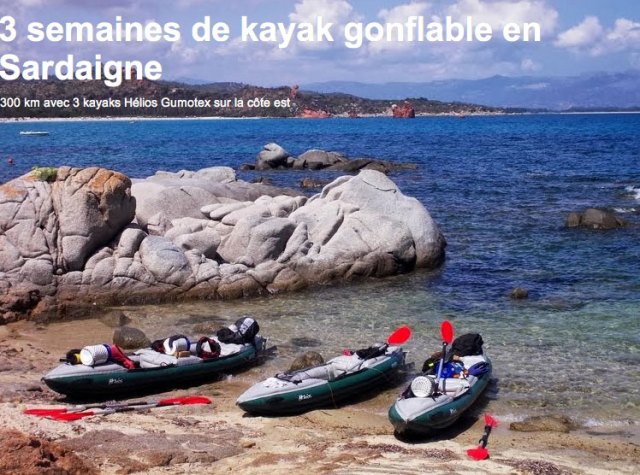
Gumotex Helios in Sardinia

pushhelio

Great report of a three-week paddle along the northeast coast of Sardinia in three Gumotex Helios IKs.
Simply enjoy the photos or read a Google translation if you can’t read the French and another IK&P Sardinia report here.

heliosen

Kayaking towards Bird Island (Summer isles)

Another visit to Carn

sgeir-island

Stuck out in outer Loch Broom, the little hoof-print shaped island of Carn nan Sgeir (above) lies midway between Horse Island and the Scoraig peninsula on the southern mainland. Some call it Bird Island and four times a day the CalMac ferry passes close by, sometimes to the north, sometimes to the south. Nearly a mile-and-a-half from land, I figured getting to Carn would be a good simulation of a more exposed run out to Priest Island (marked below). Plus on the sat image it looked like an unusual place, separated at all but the highest tides by a single, shingle isthmus.

sguirpan

I came across this Summer Isles sea kayaking report by some intrepid members of the Braintree Canoe Club. In a week out of Ardmair they managed to do what’s taken me years, and that included two days windbound below Ben Mor mountain and an overnight on Carn nan Sgeir where, from their gallery, it looks like they saw a great sunset. And here another more recent report from the area with pics and maps: Gruinard Bay (Mellon, below) up past Stoer and Handa Island.

cng-1

Mid-August but sometimes it feels like autumn has already arrived up here. Compared to a few weeks ago the light is thinner and there’s a chill in the air. Jon turned up, not having used his orange Scorpio LV since our outings here last year. On the day the weather wasn’t great so we set off from Badenscallie Beach opposite Horse Island for a splash about. Dark clouds pressed down on the steely swell and a westerly F4 made for a bouncy ride (above) until we got into the lee of Horse. The tide was up so we headed for the flooded gap between Horse and Meall nan Gabhar just to assure ourselves we didn’t want to go through it and out into the open.

cng-7

Instead, we tracked down the lee side of Horse to the southern point where we again pushed out into the winds. At times the front third of Jon’s long LV was launching off the crests, but considering he’d not paddled it for ages, he was managing fine. Perhaps these plastic coffins can be mastered after all? From any direction the Amigo handled it all too, with a brief squirt from Jon’s handy bilge pump by way of a rest.

cng-6

We mucked around alongside the surf breaking over the skerry of Iolla Mor and eyed up Carn nan Sgeir, some 2km away. We could make a run and probably make it, or we could play it safe. With the forecast set to worsen, we settled for a loop round Iolla, scattering some seals, then dithered again over making a break for Carn. Discretion prevailed again, so instead we landed on Horse Island and hacked through the chest-high bracken to the 60-metre summit cairn. As the disturbed birds wheeled over our heads, we looked over to isolated horseshoe of  Carn and the thick clouds swathing the Torridons beyond.

cng-5

A couple of days later all looked calm out the window towards Tanera, but that was because the hill behind us was sheltering the northwest wind. I didn’t notice that until leaving Badenscallie, and very soon the Grabner felt oddly squirrelly, pivoting left on each crest. Approaching Iolla Mor again and now in the lee of Horse, things flattened off but I knew once past that point the 4-5 mile fetch building up from Badentarbet Bay might get a bit much. And so it did, pushing the boat around as it started to white cap. By the time a wave flopped over the side I’d scaled down my plans to tap Carn with the paddle and shoot back. I pressed on for a bit with that in mind but the seas seemed to be rising and it could be a nerve-wracking hour getting back. Less than ten minutes from the Carn, I turned around and scurried back to Badenscallie.

carnmap

A period of calm, that’s what I needed to enjoy a relaxed paddled and look around Carn, rather than making it into a hurried dare. That afternoon came, but it didn’t stop me paddling out from Badenscallie at full steam, knowing that in a couple of hours it may all change. In the rush I’d forgotten map, GPS and watch, but I knew the way and with the clock in the camera I timed the 3 miles to the north tip of Carn nan Sgeir at just over 40 minutes. By that point sweat was wringing in my eyes, but the way the Amigo tracked in such unusually flat conditions was quite an eye opener.

cngg-02

As I neared the shore of Carn, numerous seals slipped into the water and  soon no less than forty of them were bobbing all around, eyeing me up. I’ve never seen so many seals up here. They followed me like a fleet of U-boats as I paddled around to the stony isthmus, and were still watching as I walked  from the boat.

cngg-04

Getting to Carn’s high point took three minutes but doing so set off the dozing midges. As I reached the pole and rag marking the summit, the ferry was coming in from Stornaway, today passing south of the island. Midges made further exploration a misery, so I took a quick look at the grassier and less infested north isle then headed back to Badenscallie at a more relaxed pace.
By now the wind had dropped right off and I stopped a few times to enjoy the silence, broken only by the splash of a seal or a distant guillemot flapping off the water. I couldn’t get over it, there seemed something uncanny about how well the boat was tracking, perhaps I’d not yet paddled in such a calm. As a test I closed my eyes and paddled on for a minute; two times out of three I remained bang on target for the beach – the other time I was off at 90 degrees. As I neared the beach a light north breeze started up, just as predicted, and in a couple of hours the sun would emerge below the cloud ceiling’s western edge to make for another sunny evening.

As I’d found a few weeks ago when I paddled to Lochinver, and then around Rubha Coigach, when it’s calm up here you feel you can almost walk across the water to anywhere you like.

cngg-07