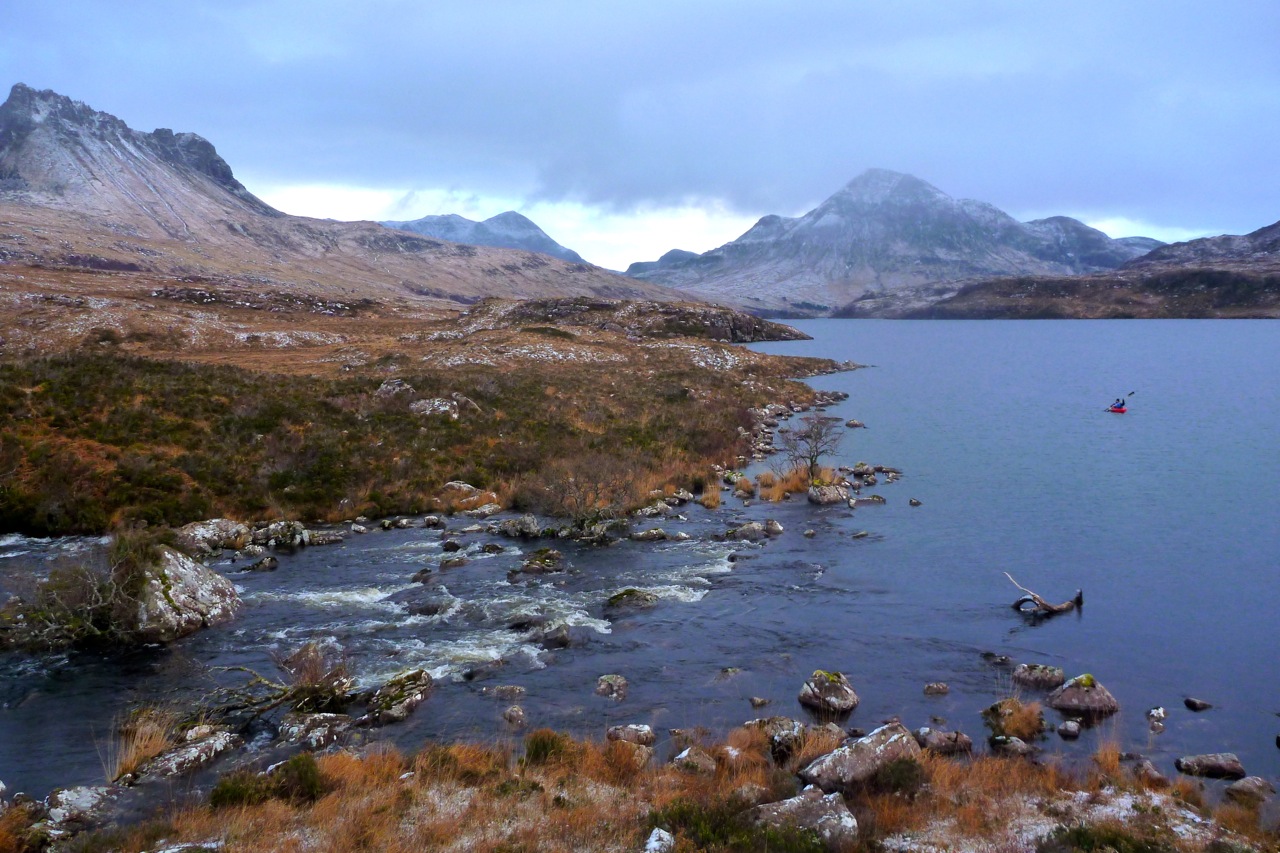
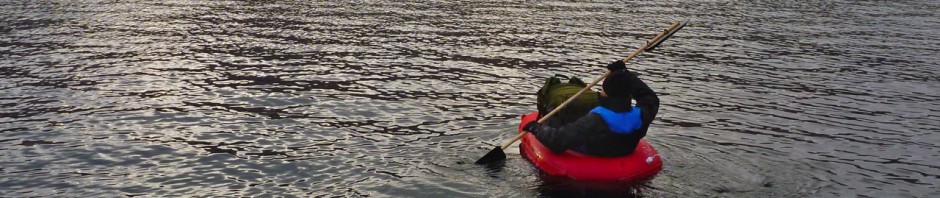
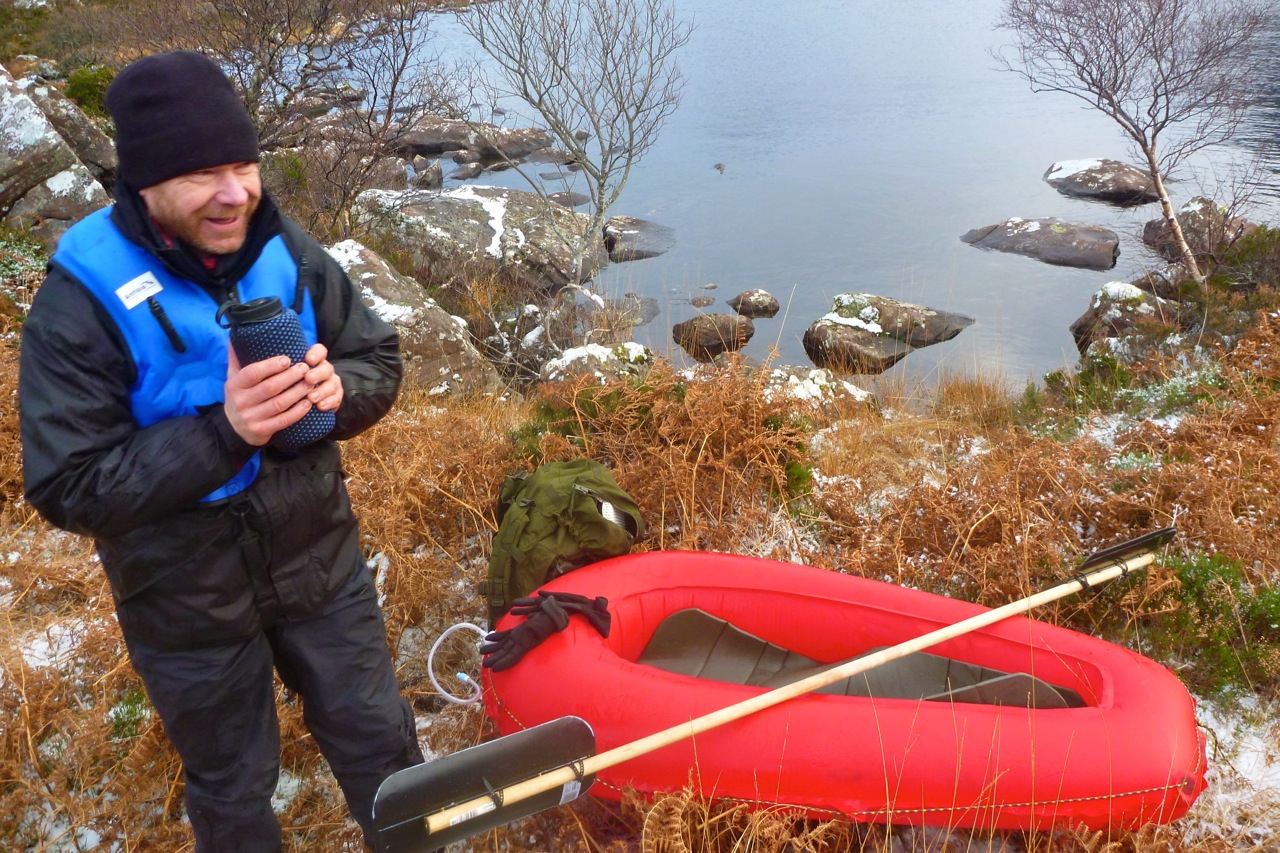
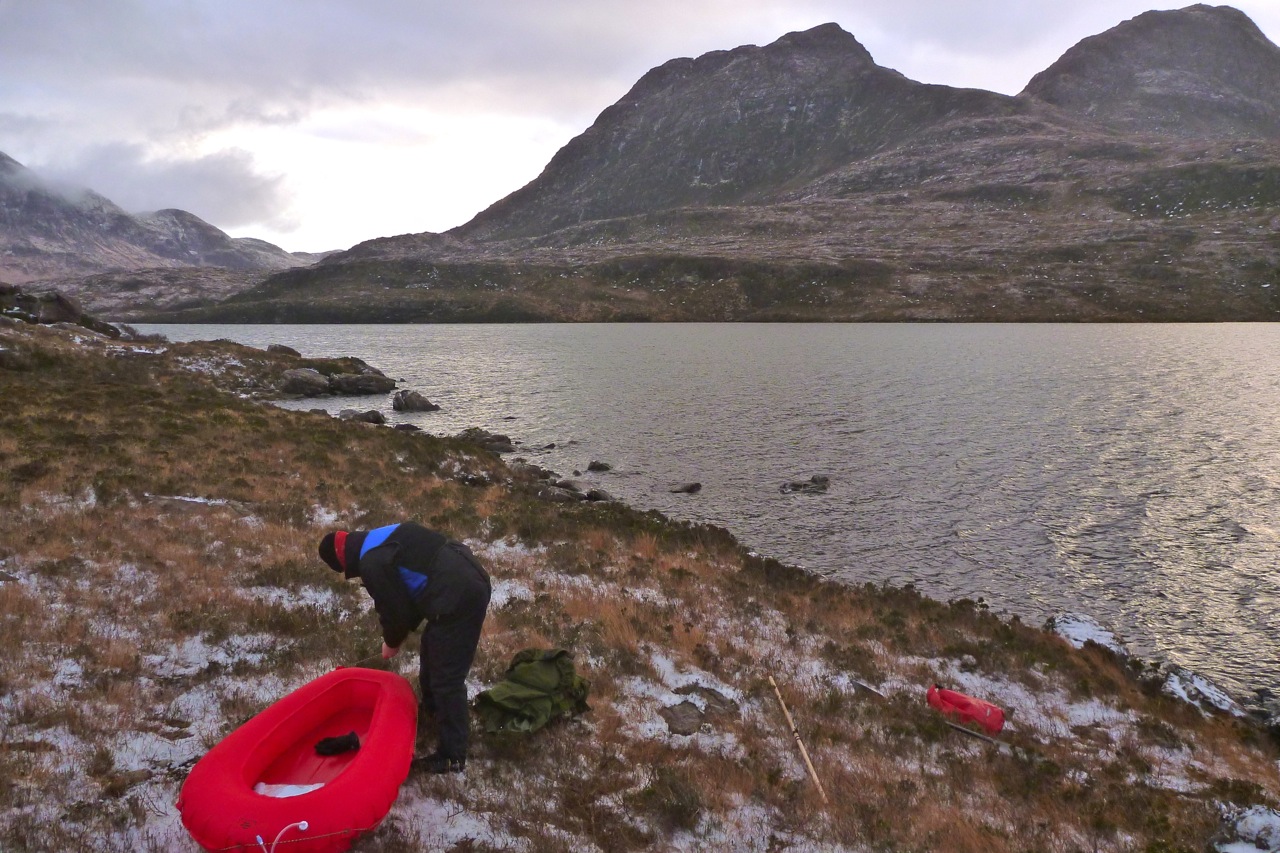
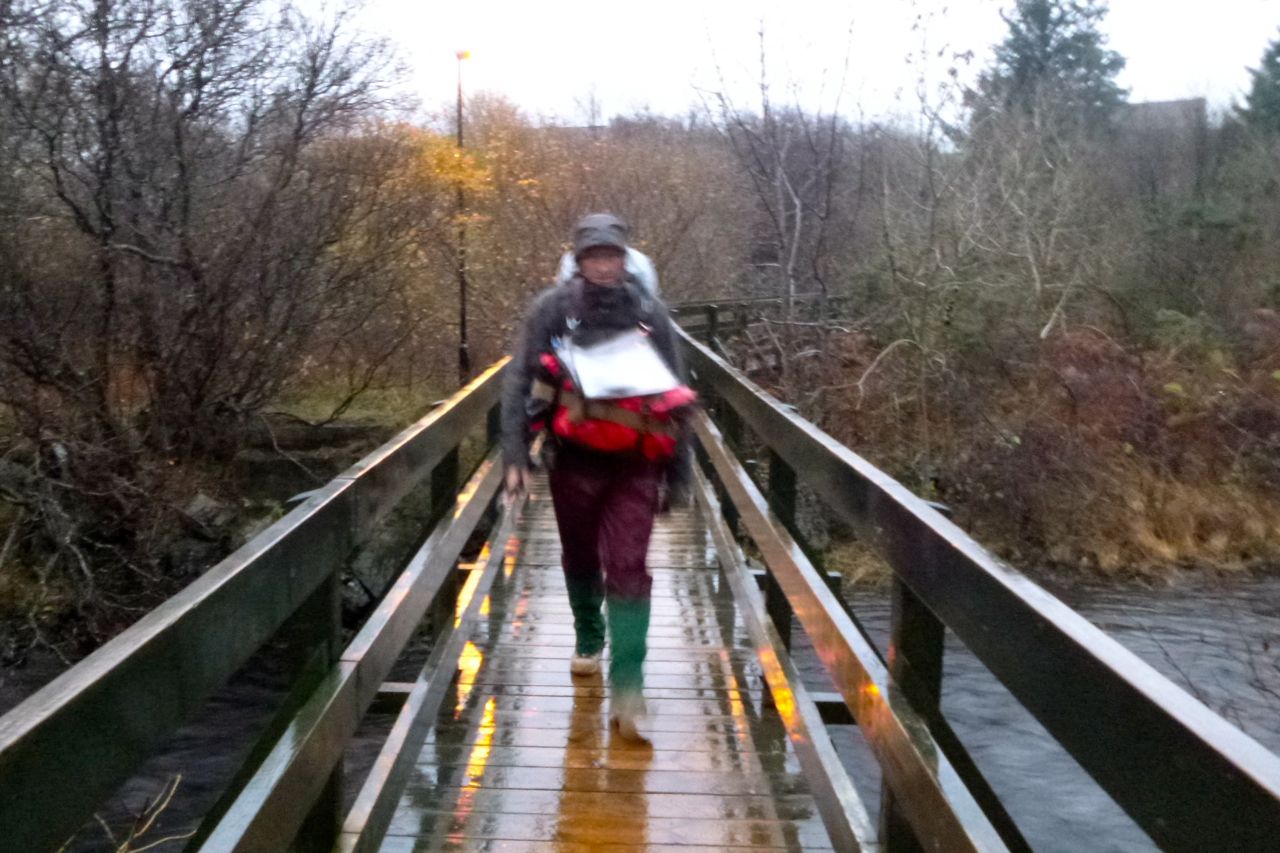
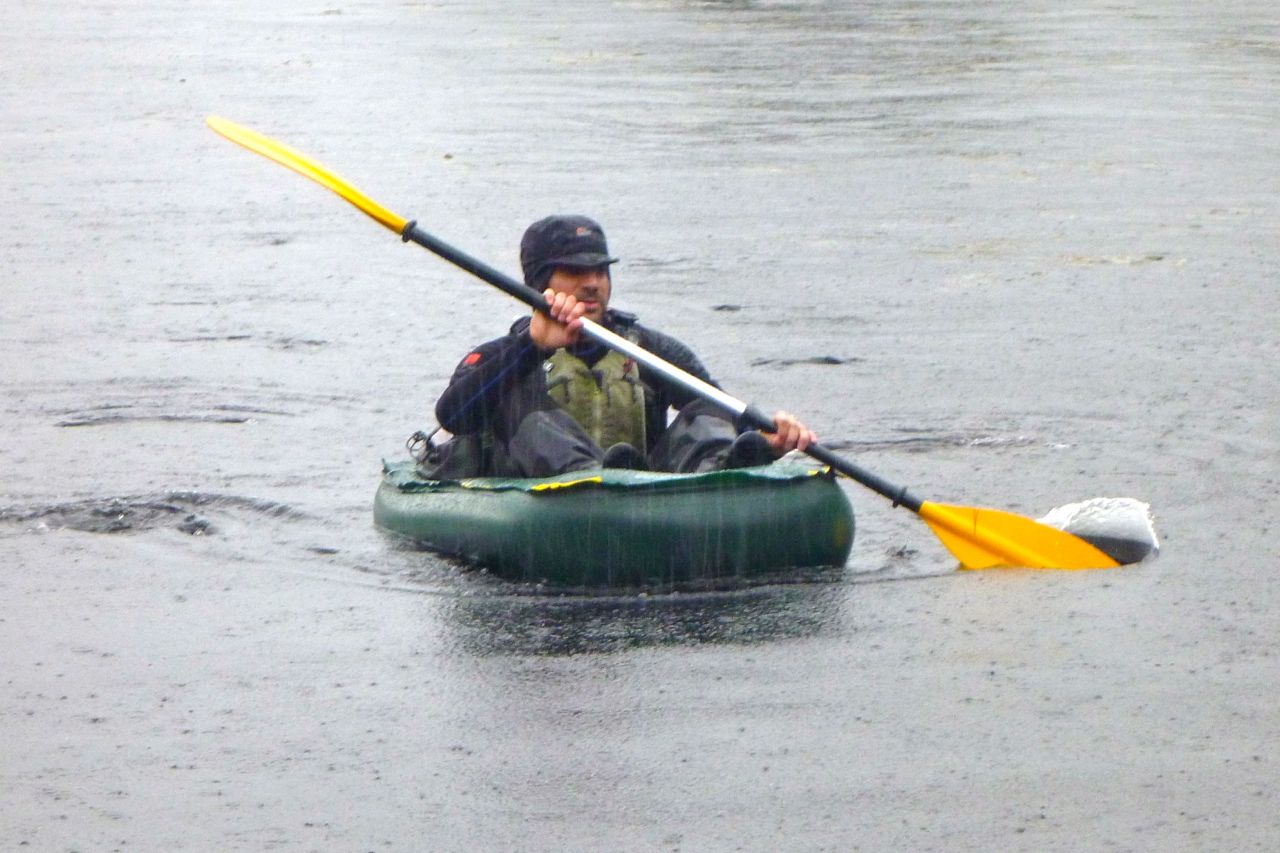
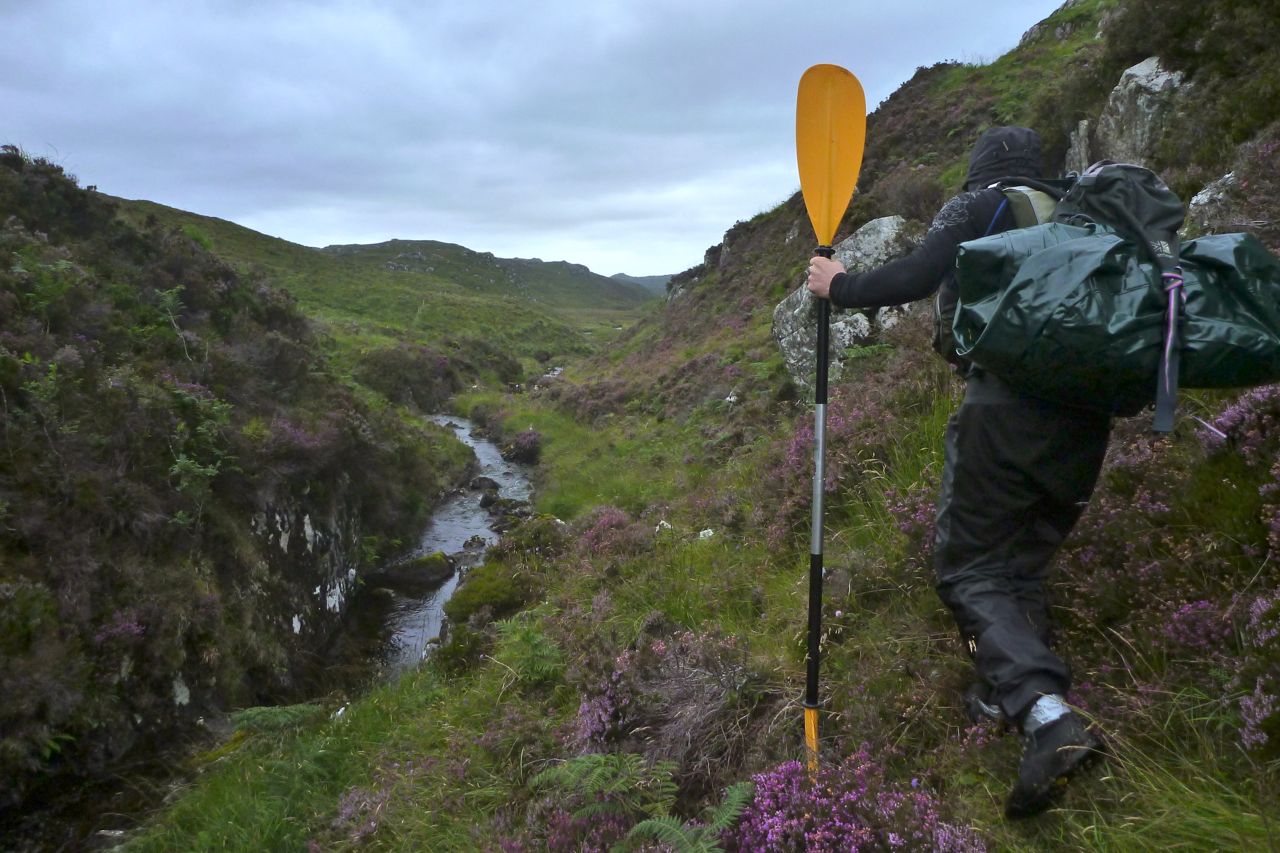
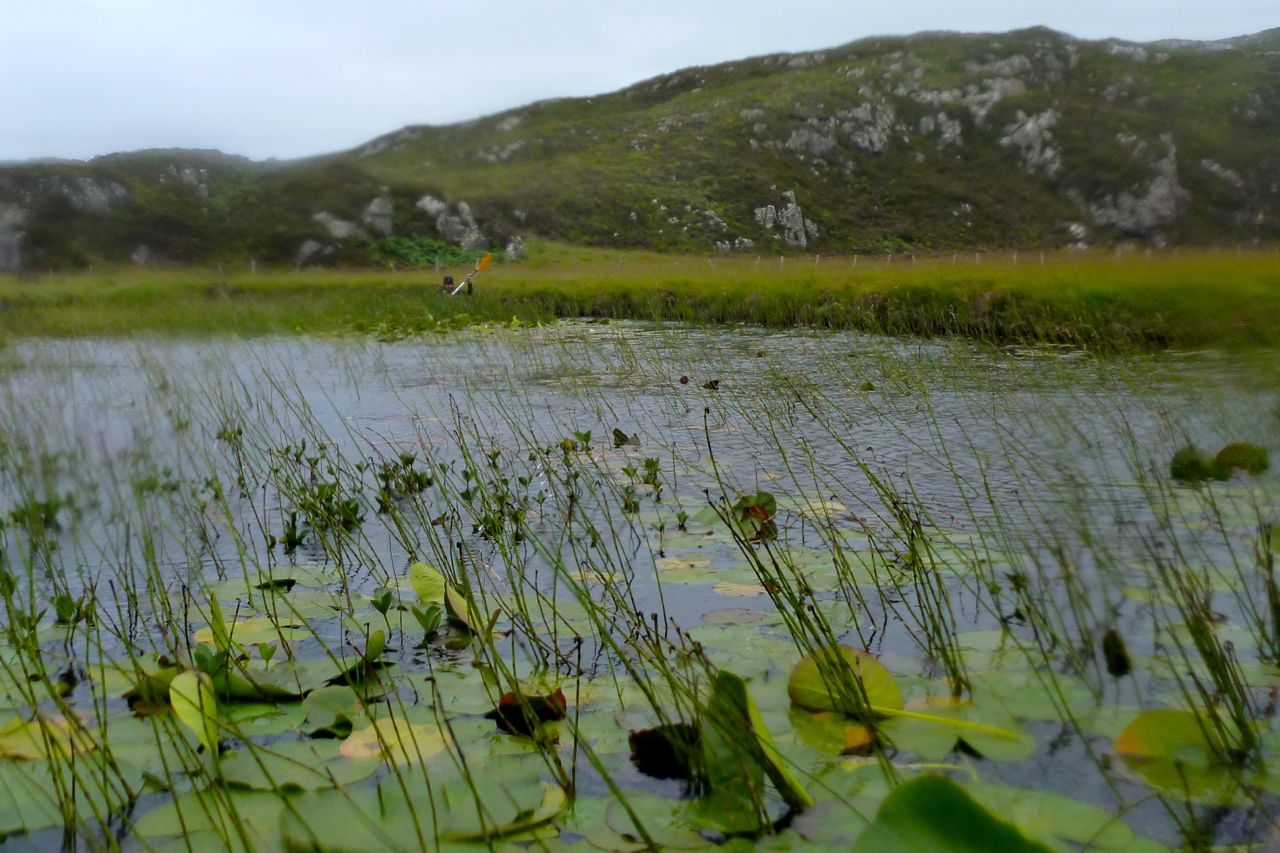
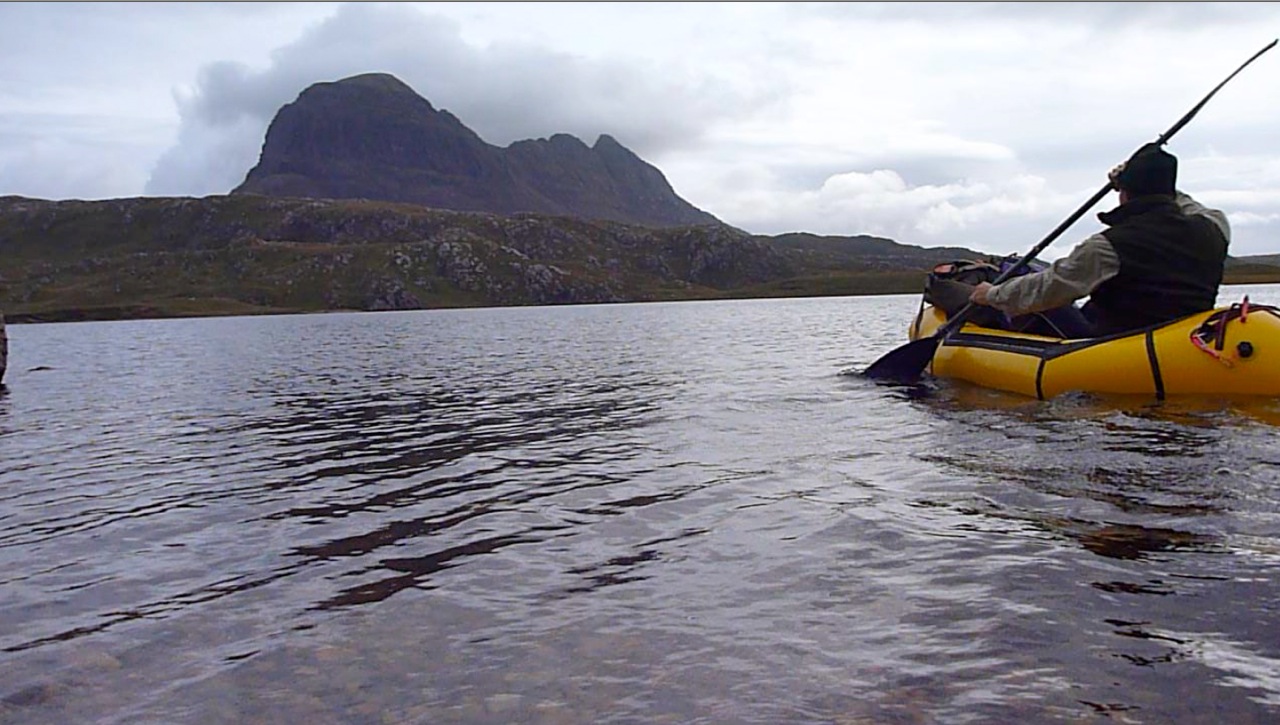
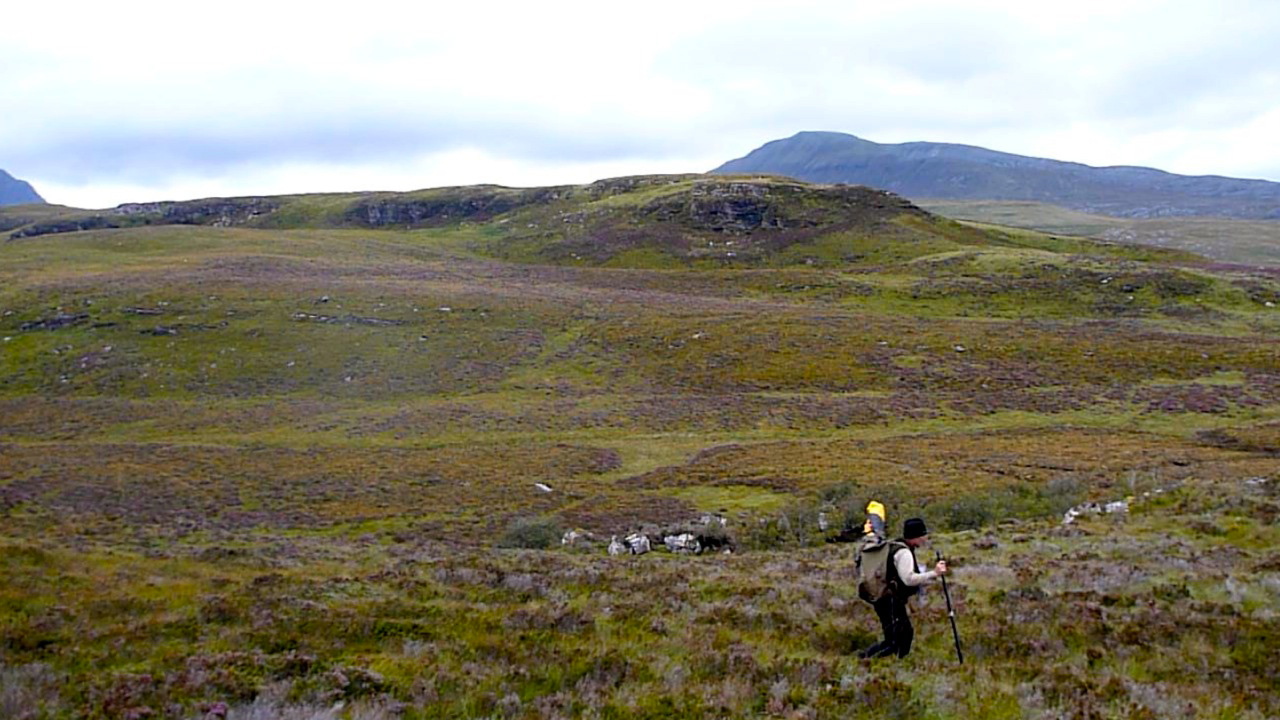
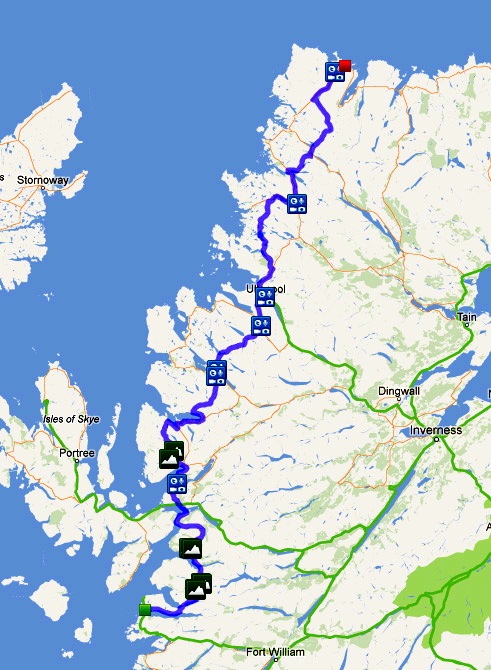
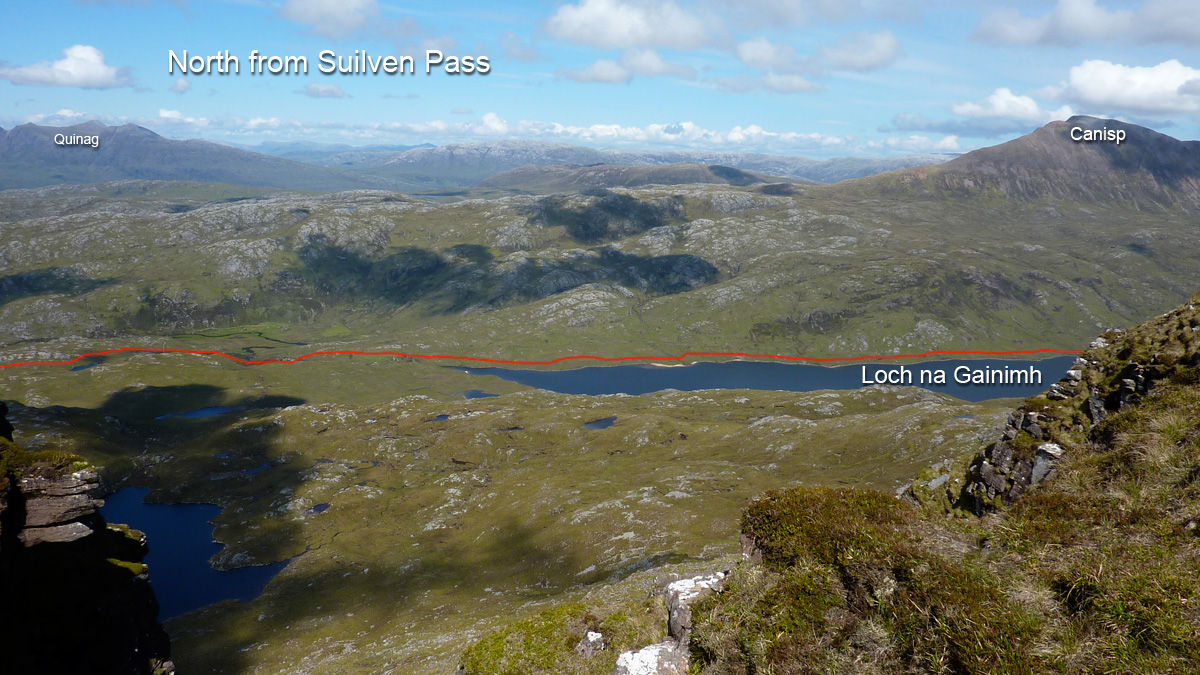
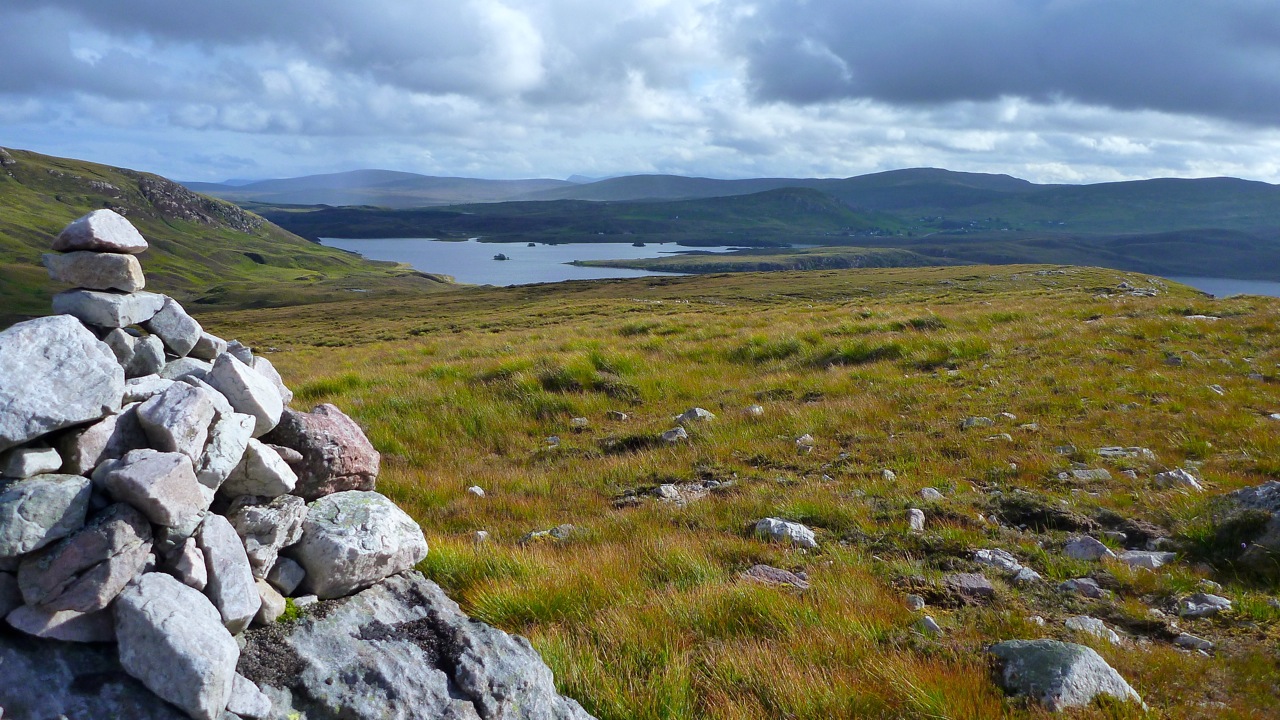
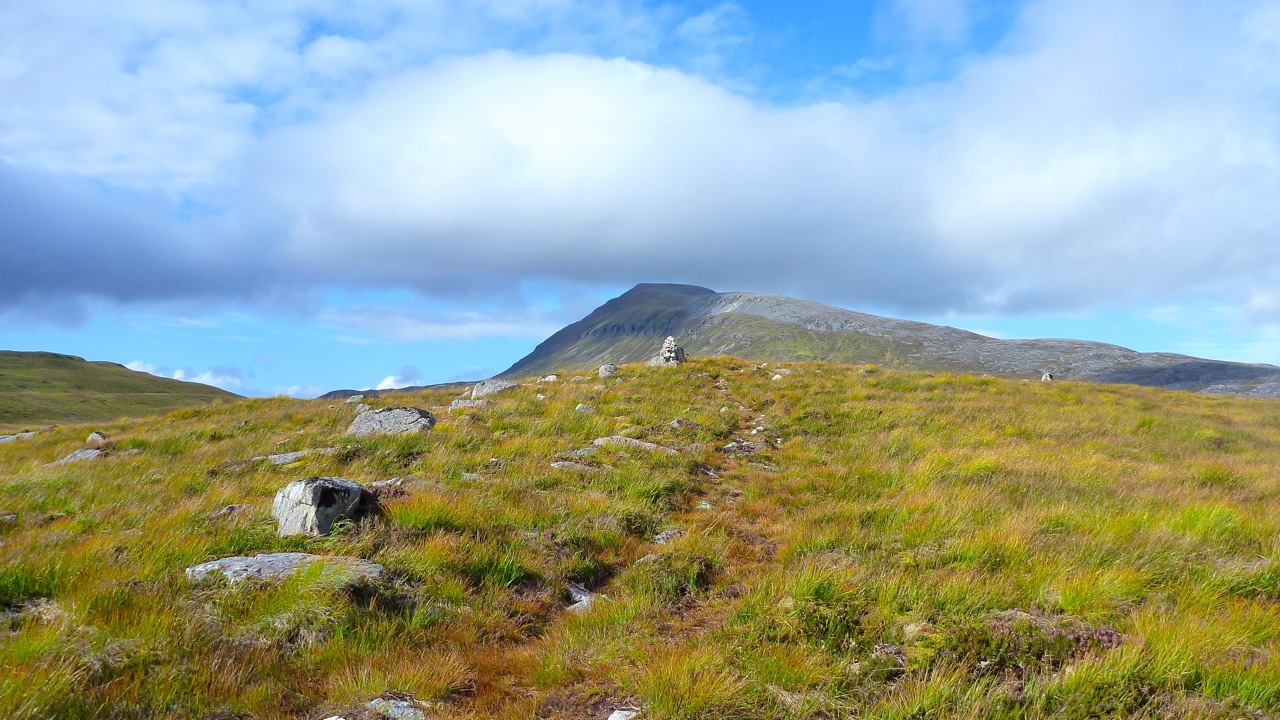
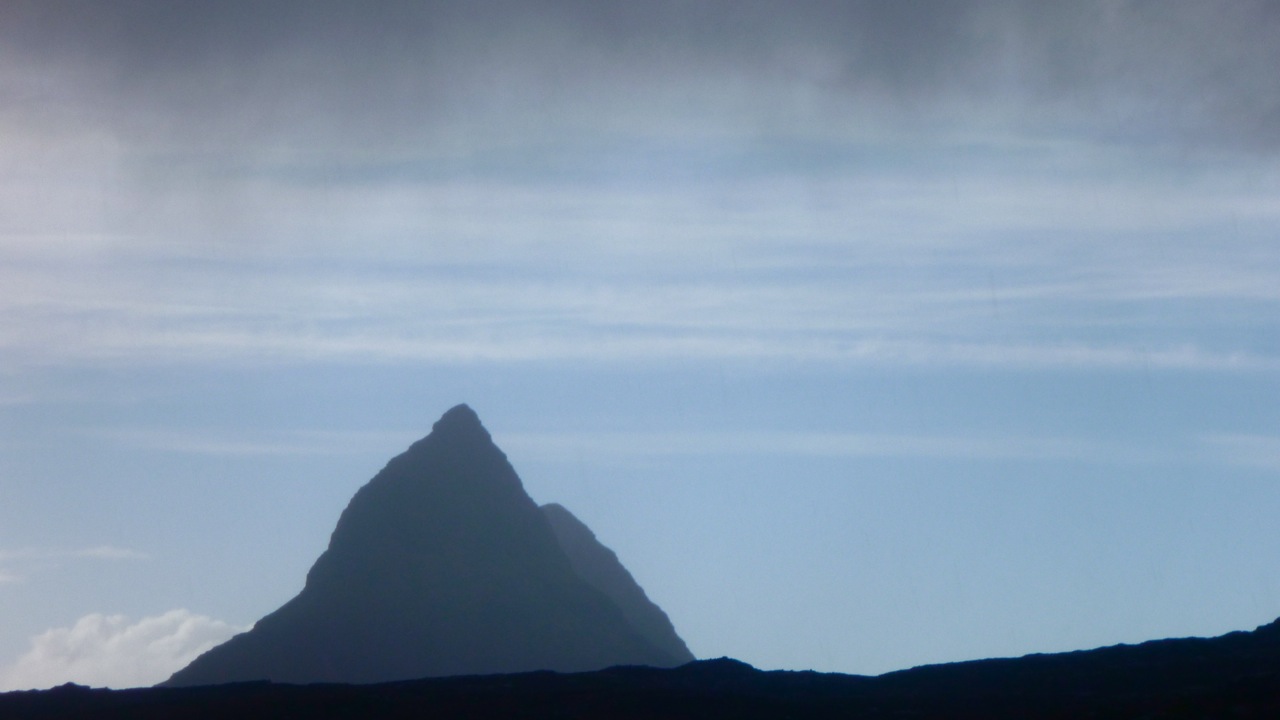
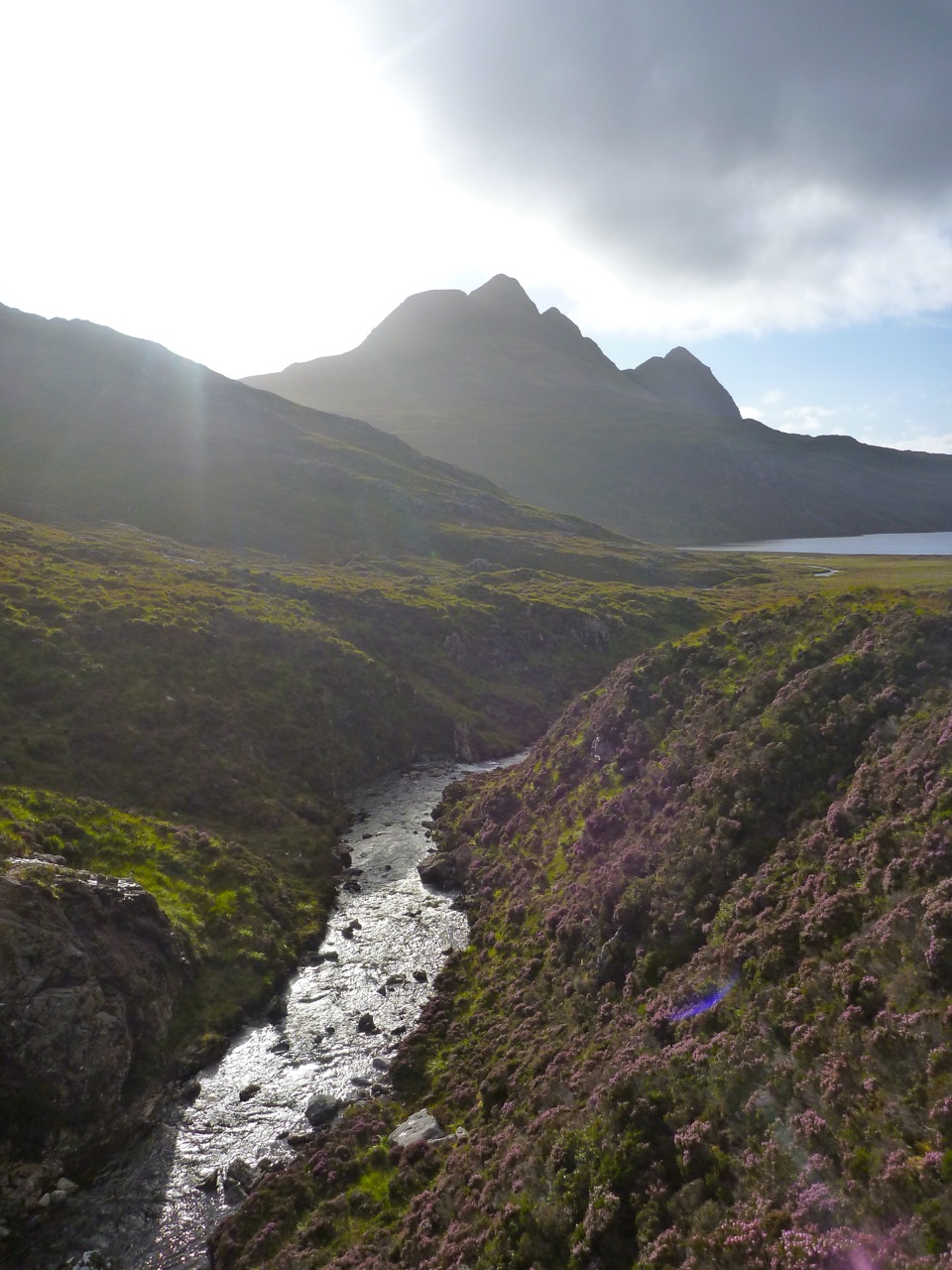
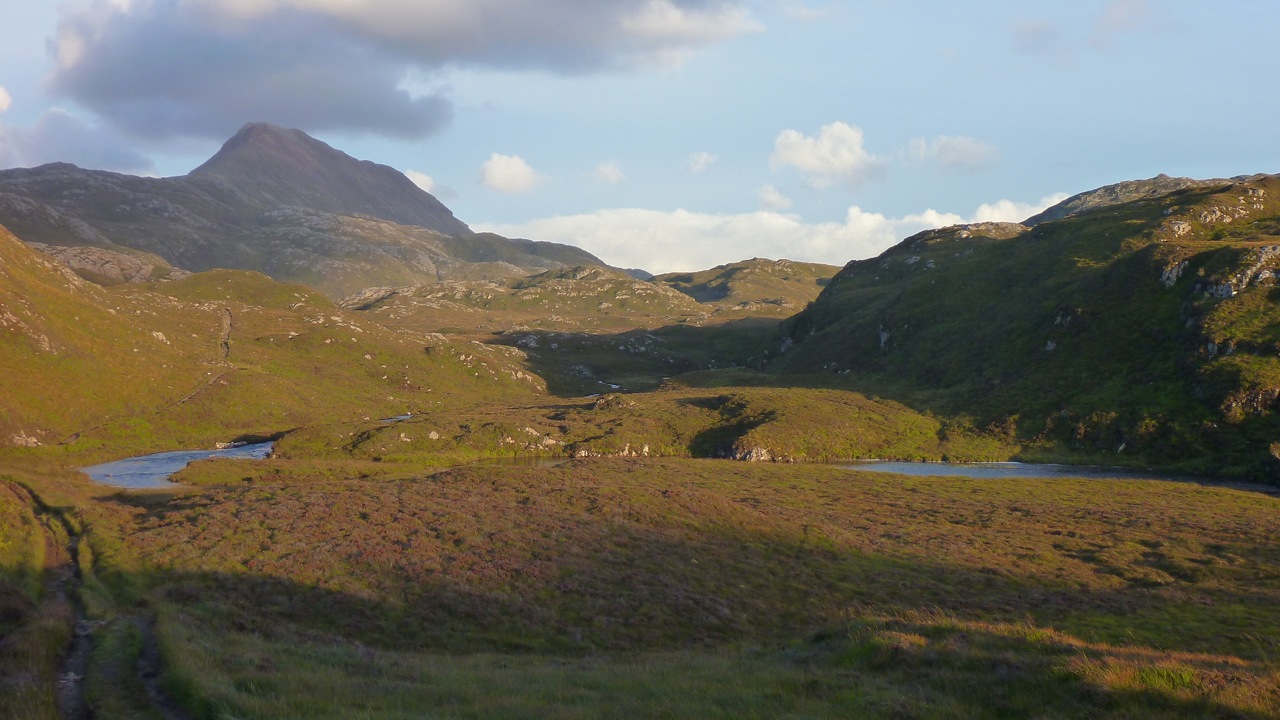
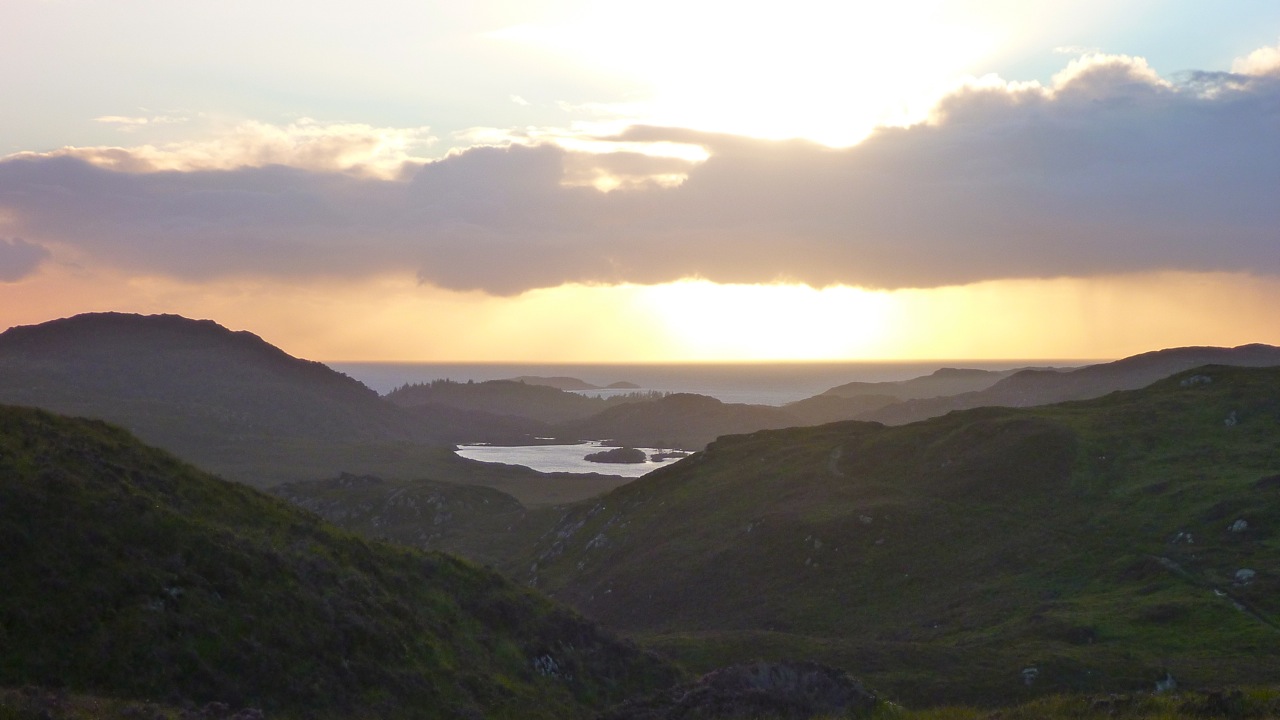
A photo I shot exactly a week ago as we walked over the Coigach peninsula having paddled Loch Lurgainn narrows. We’e heading towards Achiltibuie for a cup of tea (right). Notice how Robin’s hair melds magically with the mid-winter bracken. Must be a form of archaic Celtic camouflage carried through the genes. From the far back left coming forward and right, the amazing mountains of the Assynt: Quinaig (‘Kun-yak’); Suilven of course with Stac behind Robin and Cul Mor on the far right. All great climbs. It was the weather the day before (left) forced a change of plans. Full story with more pics evolving here.
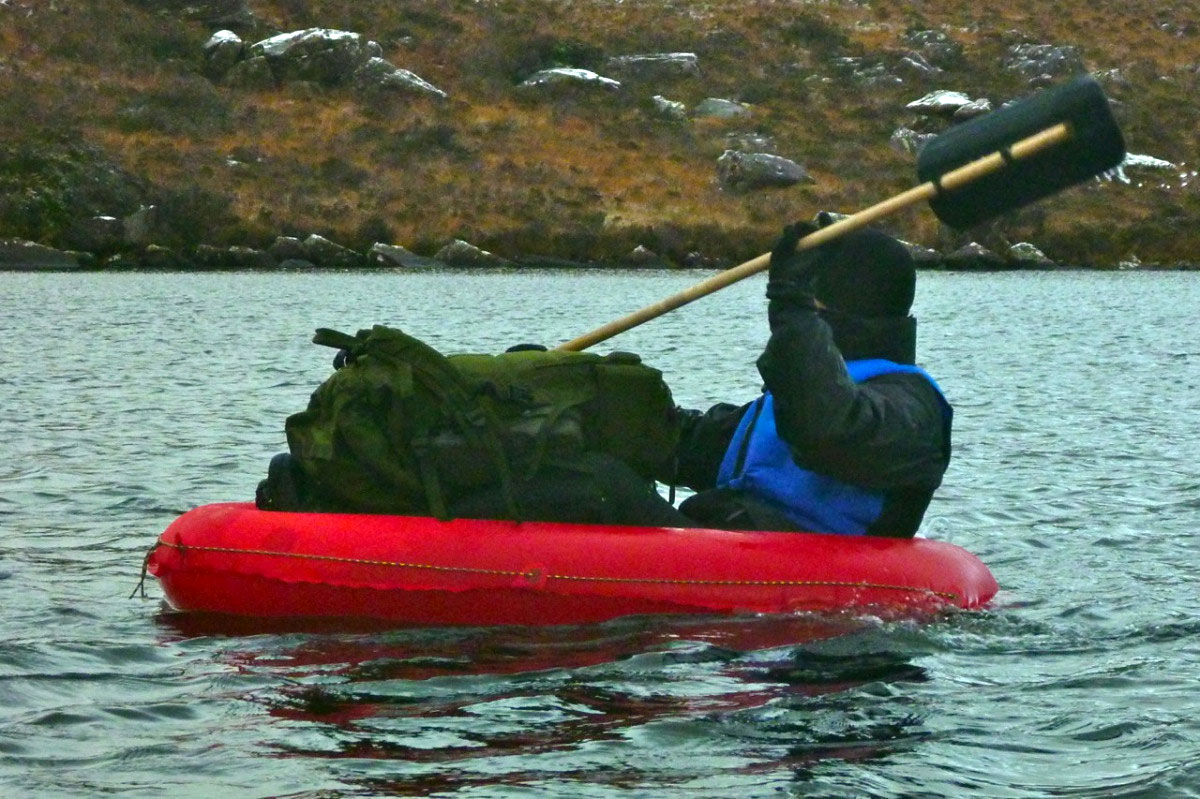
At a verified 670g (23.6oz) including an added grab line, Supai Adventure Gear’sFlatwater Canyon II ($300) must be among the world’s lightest and most compact boats. Before a winter storm blew our plan off the map, the trip we’d lined up in northwest Scotland was ideal for the Flatwater: short crossings saving lengthy overland detours or risky deep wading, but no extended or exposed paddling.
Fabrication Examining the deflated raft, it became clear it was composed of just four pieces of flat material: the top and bottom ‘rings’ which define the hull shape, an inner hull wall joining the top to bottom, and the floor fixed under the completed ring. You could almost make one yourself.
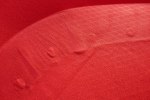
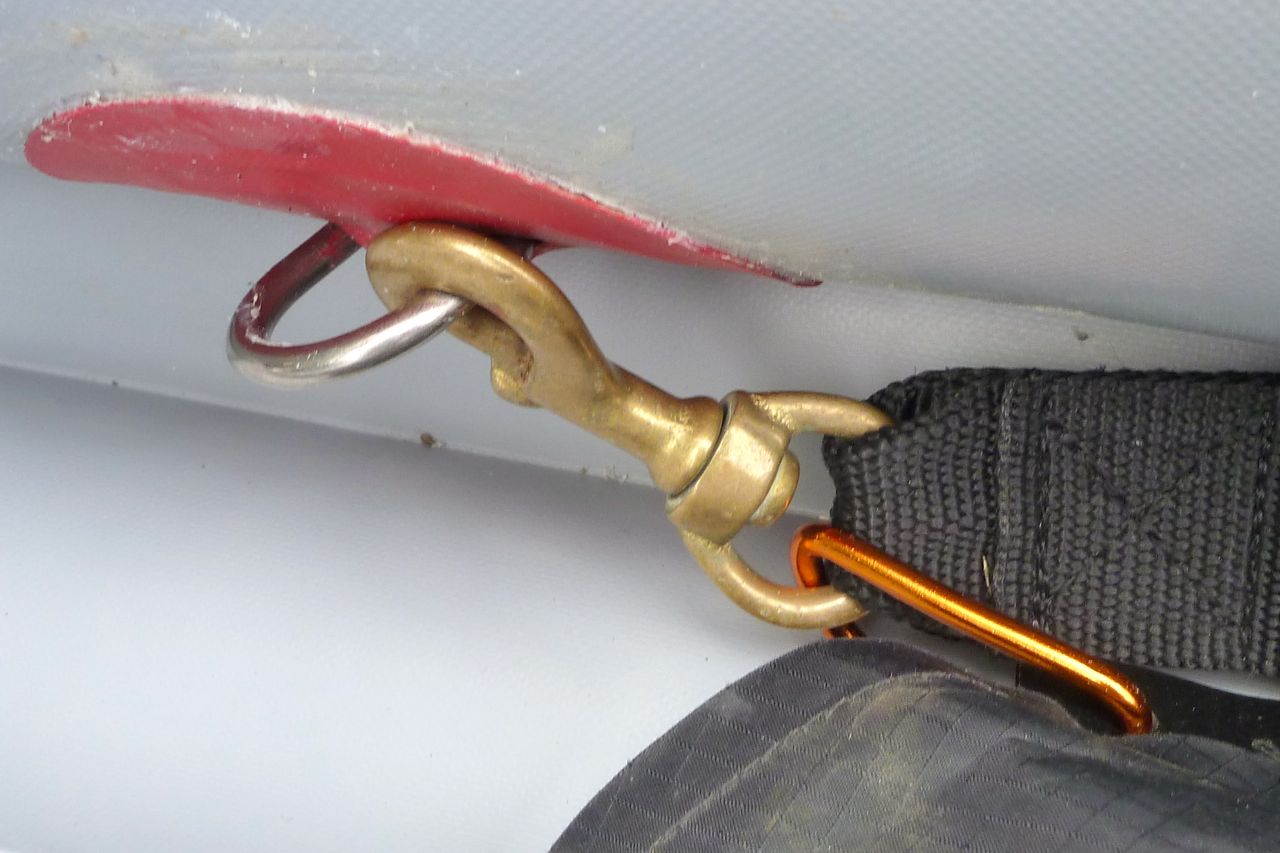
No fabricdetails on SAG’s website, but the Packraft Store states: ’75 denier polyester with single, innerside urethane coating’. This whole denier thing can be a bit misleading, the raft fabric looks and feels similar in thickness to my MSR Dromlite water bags (right) made from 200 denier, PU-coated Cordura (nylon?), but the Flatwater polyester has what looks like a reassuring ripstop weave (visible below left). And as we know from our studies in IK hull fabrics, polyester stretches less than nylon and so is more suited to inflatable boat applications than compact water storage. Where the seams overlap on the outside edge they’ve included seven reinforced tabs (above left) to use as attachment points (a weak point on my non-ripstop Dromlites, even with an eyelet). The floor is made of the same weight fabric and shows what look like ‘spot welds’ along the inch-wide seam (middle).
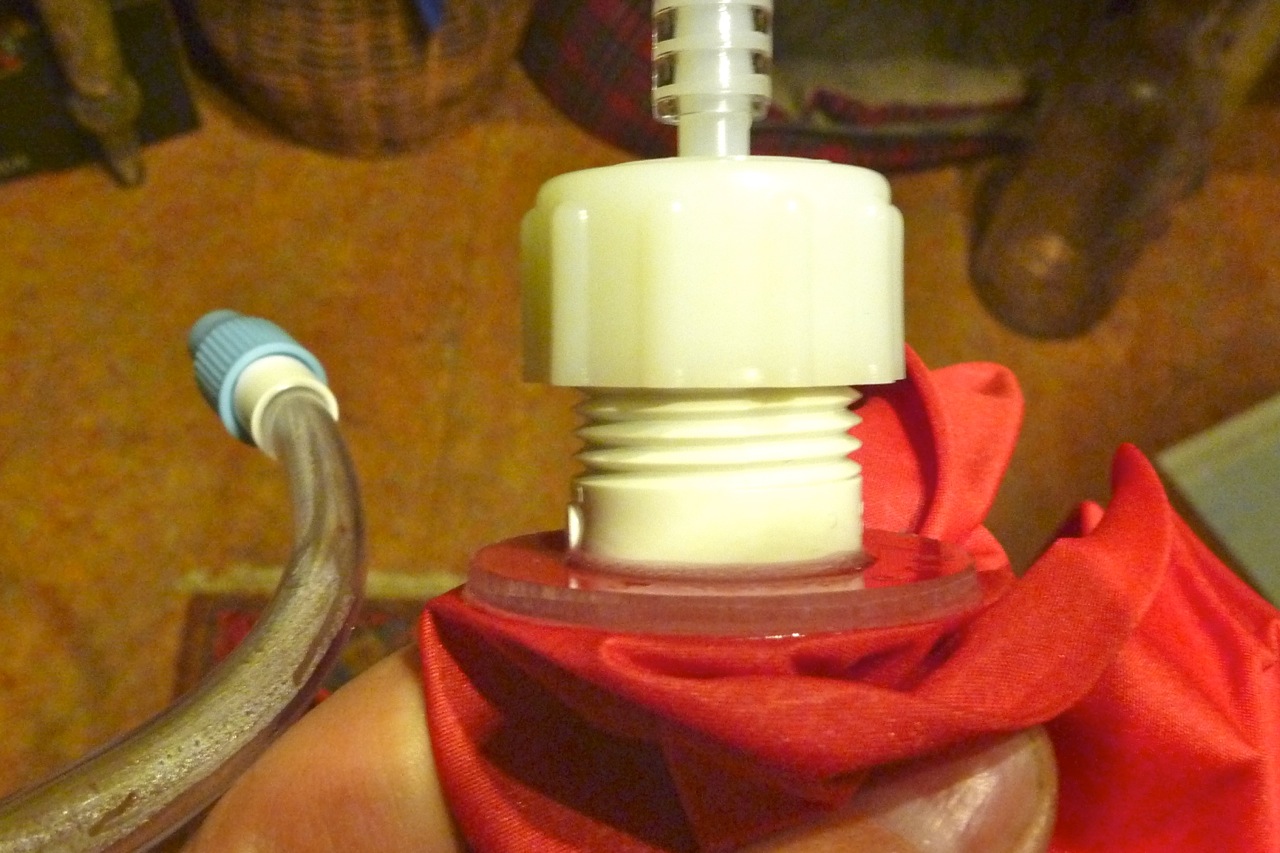
That’s it, apart from a big threaded inflation port onto which screws a white cap fitted with a 18-inch hose topped with a blue twist-lock valve (left). You blow the boat up by mouth (took me about 45 breaths) then top up to operating pressure with the twist lock, like on an Alpacka. But unlike a pre-Boston Alpacka, the long hose means you’re able to further top-up from the water where inflatable boats initially sag as they cool. Plus you could potentially manage a slow leak the same way.
The hull form tapers and narrows towards the bow to resemble a blunt wedge, similar to old Sevylor Trail Boat (right). Like all packrafts and even slackrafts, the added buoyancy (tube diameter) in the stern counteracts the mass of the paddler’s weight. There’s no seat and a new boat comes with a repair kit with full repair instructions on the SAG website.
Some of my measurements (checked several times and now confirmed by the Packrafting Store) vary greatly from those still posted on the SAG website many years later in 2020 and which had their Canyon over 10% bigger, inside and out. Even if they’re factoring in ‘paddler squidge’ making more room inside by pushing on the hull, that won’t make the boat seven inches longer.
As for buoyancy, SAG originally quoted ‘250lb’ (now a more realistic 200lb or 90kg). Robin briefly paddled the raft with his pack which we thought added up to about 100kg. That felt like the limit once a light breeze came up the valley, and required gentle paddling to avoid too much cyclic bobbing and possible swamping.
With the weight; the Store states 633g, SAG quote 24oz (680g). As mentioned, with a grab line and traces of dirt, our boat comes in at 670g on the IK&P calibrated kitchen scales (left). I won’t quibble over 40 grams; to be able to paddle across a loch in a boat weighing less than my trousers is quite something.
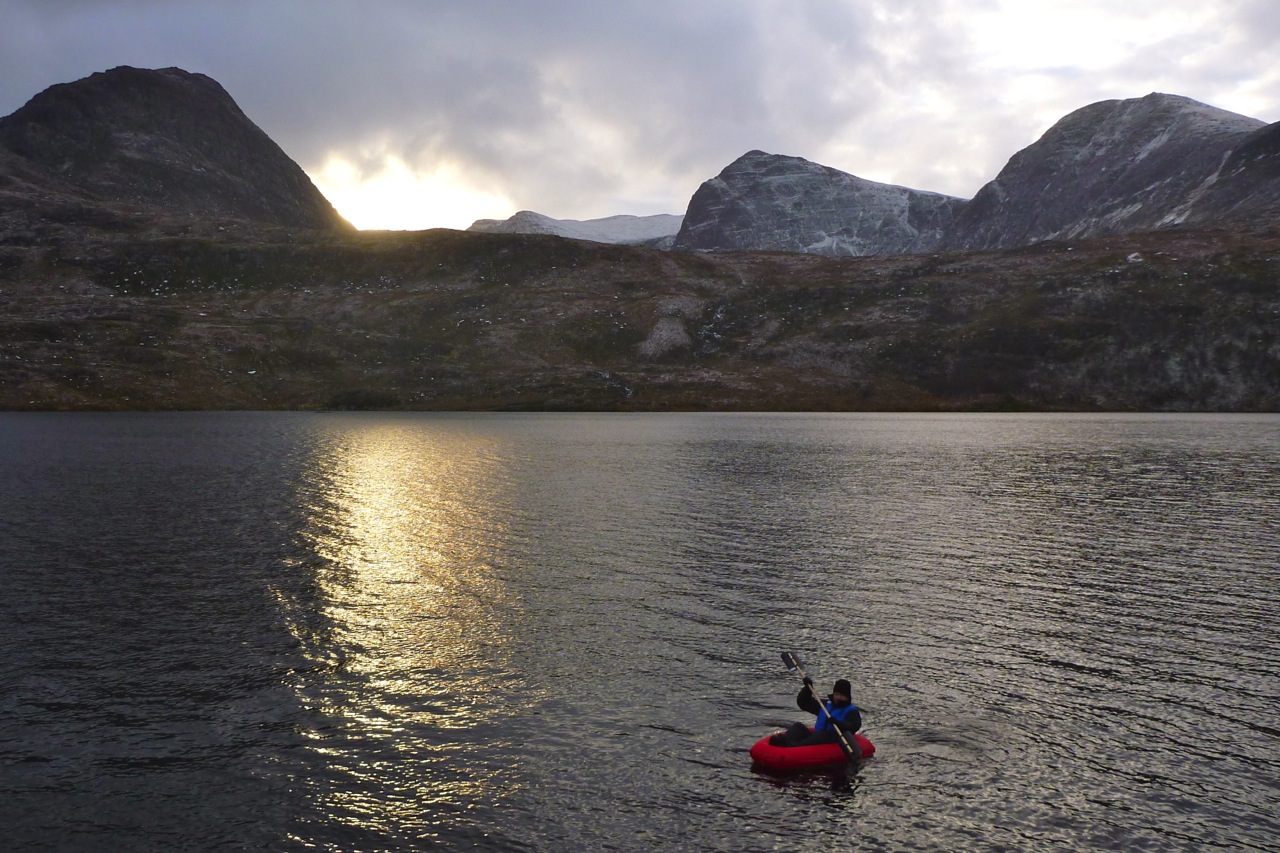
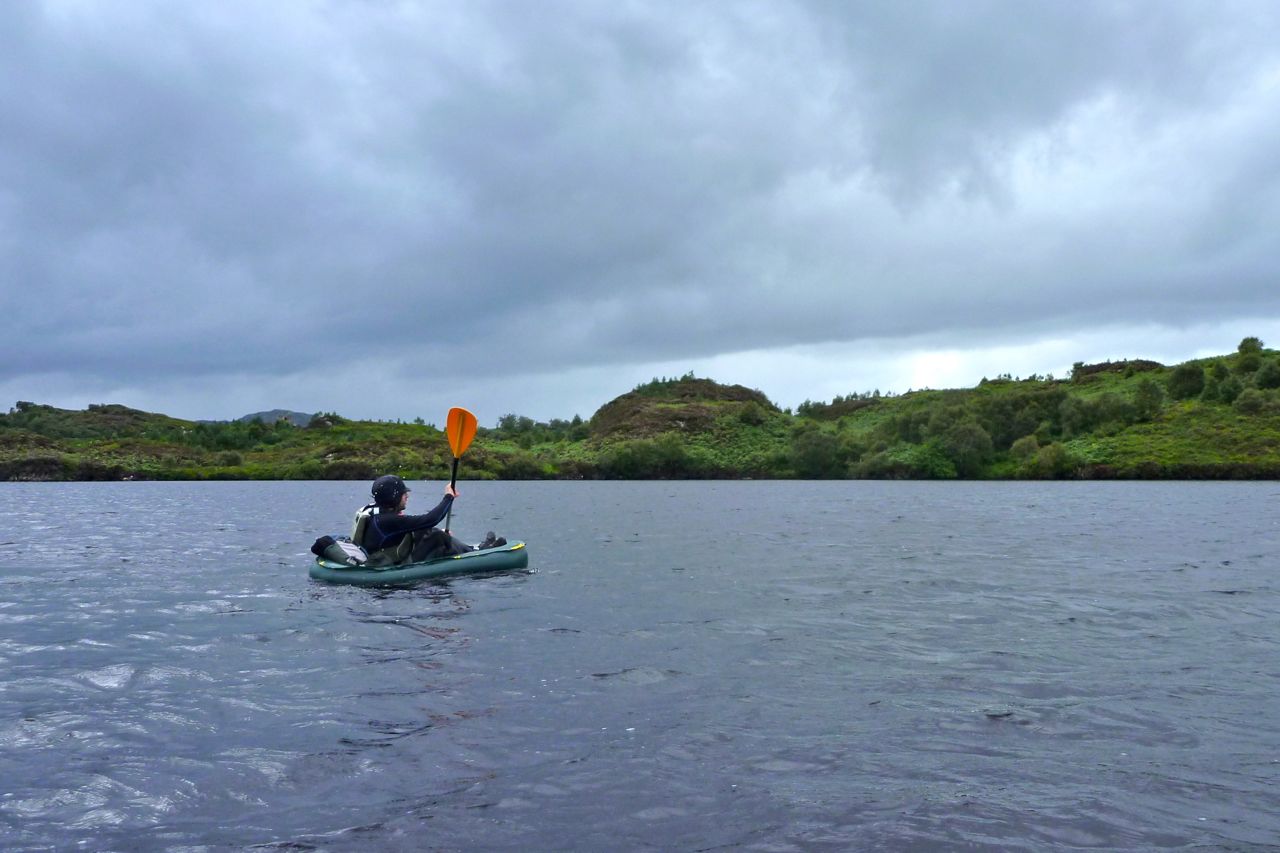
On the water The air was calm but temperatures were close to freezing as we set off to cross the eastern narrows on Loch Lurgainn below Stac Pollaidh mountain. We’d originally planned to come over in the other direction from the Culnacraig shore, but the storm which went on to wreak havoc across Britain nixed that plan (story here). So today we were just taking a 10-mile day trip with a short paddle, from Stac car park southwest back to Altandu.
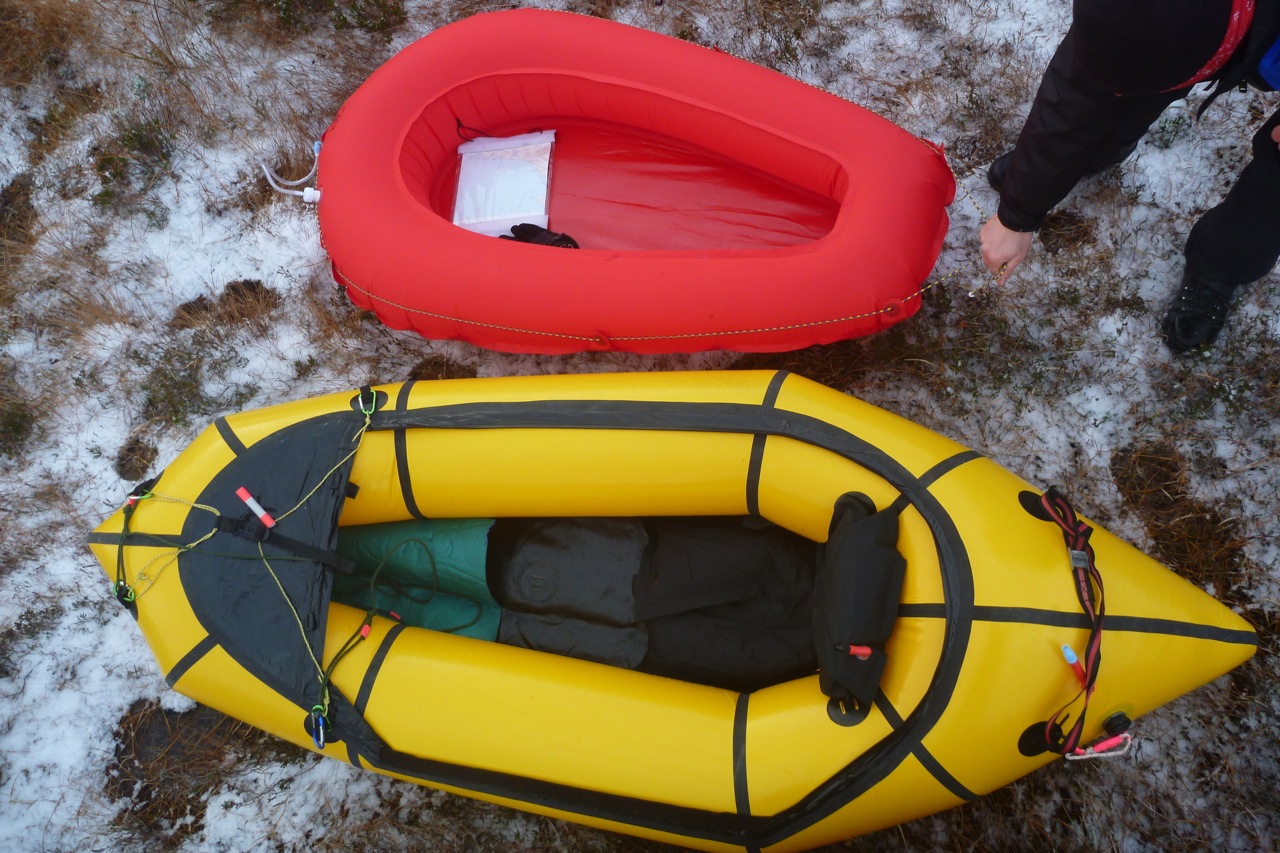
I tried to get directly over the two boats to get an equal perspective but I still think this shot makes the Supai appear a little smaller than it really is. I make the Yak ~42% longer.
‘Fragile and small’ had been Robin’s first impressions after Sven from the Packraft Store in Germany sent us the raft to evaluate. Robin had recently upgraded to a couple of Gumotex Twist IKs so may not have been impressed by the Supai’s thin fabric. I had more faith in that, but as for the size, I too anticipated that SAG had cut it a bit fine with the Flatwater II, even if it lived up to their motto: ‘where every ounce counts’.
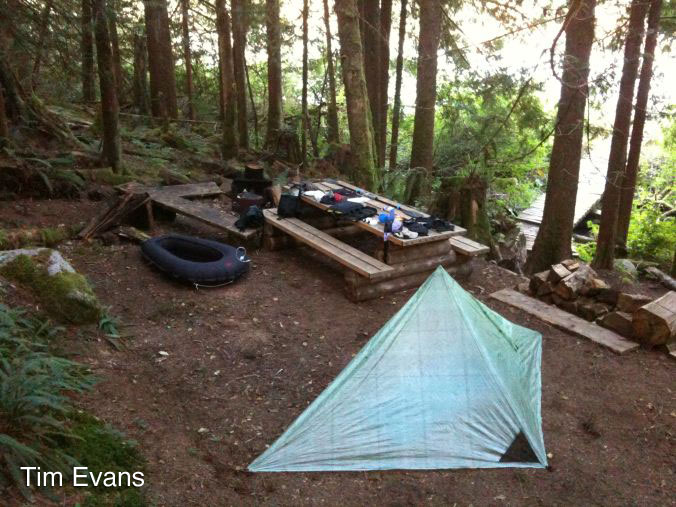
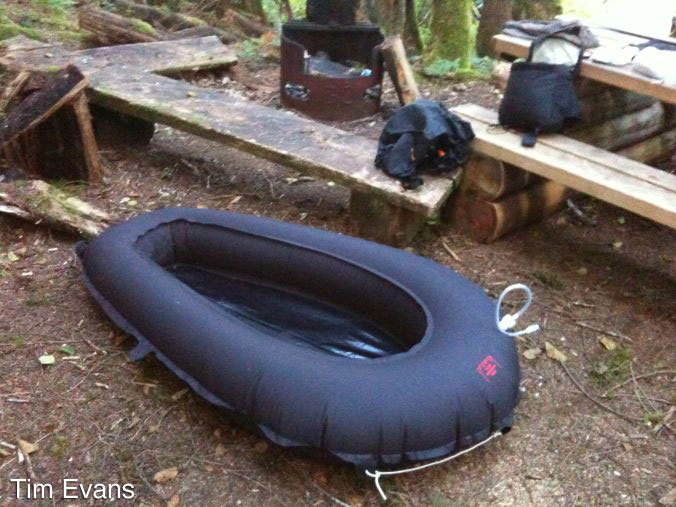
Down on the loch shore, even with a helpful breeze to fill my Yak’s bag, inflation time for both boats was actually the same, although by the end of it Robin was staggering around a bit. As Tim Evans found on his trip, other inflator bags can be adapted to avoid passing out.
Now, laid alongside my Alpacka Yak (same width but 66cm or over two feet longer), to me the Flatwater’s proportions rather too closely resembled a slackraft I skinned from a Sevylor pool toy a year or two back. I knew that with my weight of about 100kg in gear, I’d be pushing this boat’s limit. Without a drysuit I didn’t want to risk it.
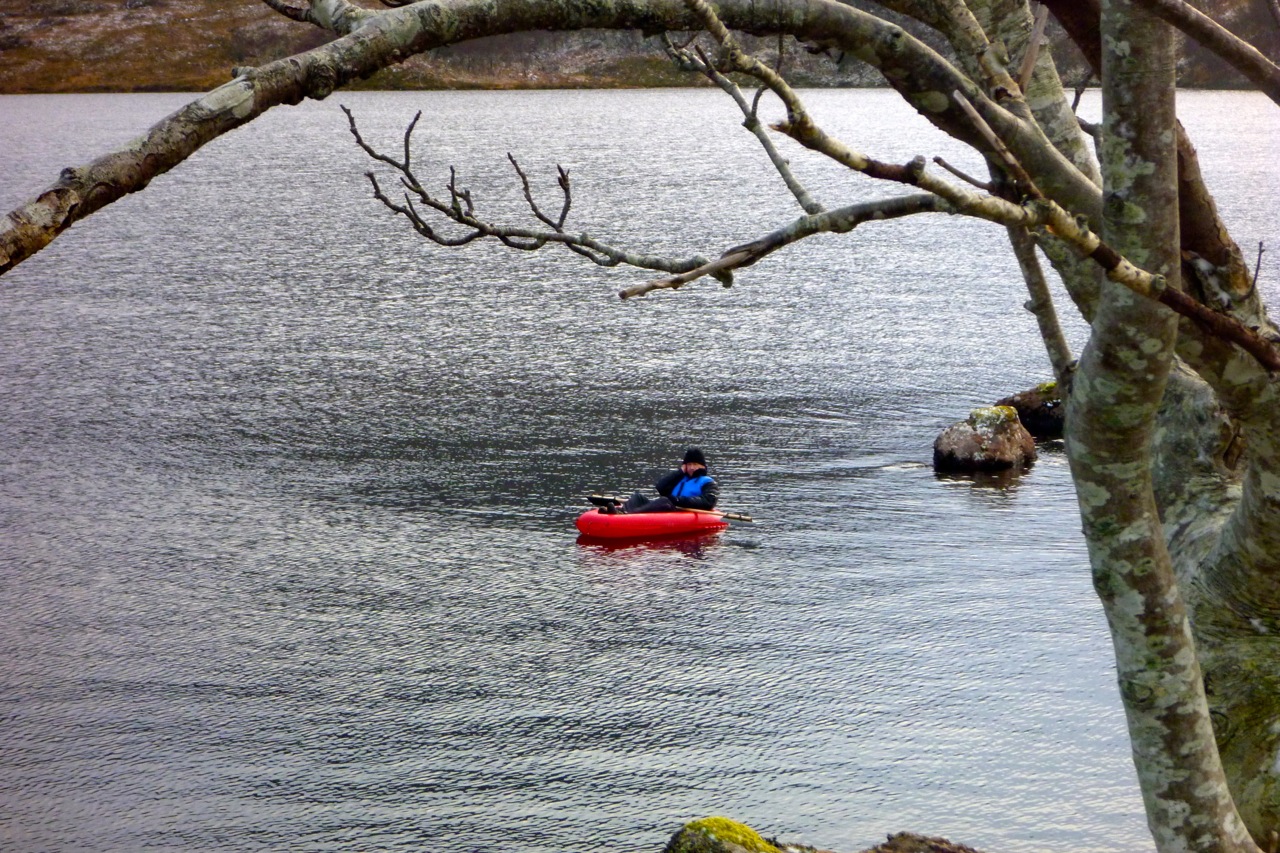
It took some prodding to get packrafting newb Robin (80kg + clothes) in the Supai and I’m not sure I blame him. A sudden move could see the stern dip down and douse the butt. After fitting his closed cell mat to keep warm and protect the thin floor, he set off for a quick spin and soon realised there wasn’t so much to worry about. Paddling gingerly with his home-made paddle (a broom stick, two sawn-down buckets and zip ties) he did a few loops while learning to control the annoying yawing you get with short packrafts and slackrafts, as well as managing the less welcome bobbing which might amplify into a back-end pour over. Yawing keeps the speed down which may be just as well. Start paddling too fast and the bow will rise with a corresponding drop at the stern when slowing down, again risking a pour over in wavy conditions.
Having established he wasn’t going to sink with all hands, I lowered Robin’s 10-kg pack onto his legs then hopped into my Yak. The pack’s added frontal weight should minimise the Supai’s yawing – at least that’s the effect on my Yak. But it’s well known that first time in a new packraft, especially a short one like the Flatwater, paddling efficiently is an acquired knack. Our extra chilly scenario (not helped by his experimental B&Q paddle) meant that Robin couldn’t really relax or bomb around in the Supai. (I tried his B&Q but soon sent it back as it brought in unwanted splash all over my boat). A gust rolled up the valley, rippling the loch’s surface, adding further to the feeling of anxiety in the Supai. From my PoV it looked like the stern was more than half sunk at times – and half sunk on a round tube makes pour-overs all the easier. I skimmed over to the other side and got out to get some long shots and was reminded yet again what a great boat my Yak is. No worries about getting in clumsily, sudden winds or carrying Robin’s pack. Sat here a day earlier when a gale was ripping through at an average of 35mph and gusting to twice that, it may have been a different story, but my long-bodied, yaw-suppressing, high-sided, tough hulled Yak inspires confidence, even without the spray skirt.
The price you pay is weight and bulk. Ready to paddle, at 3.1kg with seats, heel pad, pack attach and lead,plus other straps and some mini krabs, my boat is 4.5 times heavier than the Supai as tested, and even more bulky when you add in the blow bag, skirt and repair kit: the red bag shown right.
Robin slowly waddled over to the south edge of the loch and got out with care before pulling the plug and rolling it up. As on any inflatable, the floor is vulnerable and we discussed ways of getting round this. One problem is the Supai’s floor glues to the hull ring above the lowest points in the hull tubes which means the undersides of the hull are actually lower than the floor (until you sit in it on the water). Using a thicker floor panel won’t eliminate all possible wear. Robin is a versatile home-fabricator (as his B&Q paddle proves) and we decided the least invasive way of protecting the entire underside – hull and floor – would be to string a sheet of whatever you like from the peripheral half-inch hull seam (the seven reinforced tabs not being quite enough to do the job). No messy, irreversible, crease-inducing gluing required, just a line of holes along the seam plus a drawstring. Pre-emptive protection is something I’ve done to my Alpackas’ ballistic nylon floor and although it won’t look too neat, a floor sheet would enhance the less robust Supai’s undercarriage, despite a weight penalty.
Our conclusion He may have got used to it over time, but the Supai felt too skimpy for 80-kilo Robin. Ill-dressed on the day and over-fed in general, I didn’t even try to get in. Build quality is great and the fabric I could live with; it’s much better than slackraft PVC and the extra care needed in handling is well worth the weight saving over an Alpacka. Factoring in experience, company (support), weather conditions and operator weight, the Supai felt right on the limit. Initially you’re reluctant to paddle normally for fear of swamping which could turn exponential. Alongside a Yak it’s a pretty slow too, although I don’t think that’s a flaw. My Yak is slower than my IK which in turn is slower than … As long as it makes progress, a boat is as fast as it is.
Alpacka’s Scout might be a fairer comparison with the Flatwater II. According to Alpacka stats it weighs 1450g, is 4.5cm narrower, 2cm shorter inside and 26cm longer overall, while costing at least $200 more in the US. That still puts the Supai well in the ballpark on weight and cost.Anfibio’s Alpha XC is another which I’ve actually tried. Although it looks to have been designed for the canyon lands of southwest USA, for the lighter paddler the Supai could a great packraft for less predictable Scottish conditions involving short, flatwater crossings. The negligible weight really opens out the options and means you don’t have to get too fanatical about the rest of your gear which can translate into greater comfort.
I knew this even before I saw the boat, but what I’d love to see is a Flatwater XXL more closely matching my Yak’s (or my) size. I’d happily trade the extra 8cm of width the Supai has at the hips for fatter and higher tubes all round, plus another 10cm added to interior length. It’s hard to think that would add up to much more than a kilo overall, but would reward the portlier or overnight-equipped paddler with a more versatile boat able to deal with dodgier conditions. Let’s hope this is part of Supai’s game plan. * SAG later released the Matkat. Not exactly what I was thinking but we tried that too.
Photos also by Tim Evans who writes:
I got interested in packable boats as I love both walking and being on the water. My first major trip was in an Alpacka Yak from Whistler to Vancouver. I hiked for 2 days, paddled the Cheakamus River for a day (with some easy whitewater), then paddled 24 miles of ocean inlet back to Vancouver. This trip was only possible because of the packraft. Then I bought a Supai and did 35km through a lake system north of Vancouver that included a number of portages. I saw a pair with a canoe which they pushed on a trolley through the portages with 200lbs of gear. It took them hours to go a few km. I did the 4-day trip with 16lbs of gear including food, just to see if it could be done (it can). I could have jogged through the portages with my little boat tucked under my arm. The Supai was a light as it gets, but SLOW for any sort of distance.
It’s understandable to worry that something like an inflatable boat is a bit of a liability when out in the middle of a deep lake, hairing down some white-water or when far out to sea. This is especially pertinent if your only experience is a beach toy made of a thin and stretchy PVC film.
I’ve owned over a dozen inflatable boats and have only had one tiny thorn pinprick in the Incept, age-related fabric perforation on an ancient Semperit and a hole worn through careless transportation in my Seawave.
Once on the actual water it’s hard to think of anything actually puncturing my full Nitrilon Gumotex IKs or the old Grabner. What more often happens is some kind of accidental wear or rubbing when not paddling or during transportation, like the trolley wheels which wore a hole in my Seawave, or the windy tree branch which rubbed (but did not puncture) my Grabner (left). I also snagged my packraft’suninflated floor on submerged concrete once, then added protection to the outside and padding on the inside to stop that happening again.
I’ve also travelled with cheap slackrafts that have got ruined within minutes and punctured every other day. You do get what you pay for. So when it comes to glue I’ve learned that preparation and application are vital to getting a good repair: rough it up; wipe it down with solvent, apply the right glue to both surfaces, wait, then slap on the patch and press down hard with roller to achieve a long-lasting bond. More below.
Is your boat plastic or rubber? As explained here, broadly speaking IKs are made of either rubber- or PVC-coated fabrics. Rubber-based Hypalon, EDPM or Nitrilon is much less used now and most with the tubeless construction method. On a boat like this, rough up the surface, clean with solvent (see below), apply the right glue and a same-material patch, all which needs to be done well as the patch is vulnerable on the outside. Or, you can just dab some Aquaseal directly onto a small hole in the hull to protect it from wear, as shown above left (not an actual puncture).
One-part glues I’ve succeeded in gluing on non-critical D-rings onto Gumotex Nitrilon and Grabner EDPM (Grabner), as well as PVC to Nitrilon using single-part Aquasure urethane sealant/adhesive (‘Aquaseal‘ in North America). Allowing Aquasure or similar to half-cure in air for 30 minutes, then sticking together and letting it ‘seal’ to itself is a way of bonding anything – even non-compatible rubber-based Nitrilon to PVC, as I did here. SeamGrip is a runnier version of Aquasure to get into cracks and seams. Though I’ve not tried it yet, British-made Stormsure is the same thing. Apply a thin film of Aquasure to both surfaces; wait half an hour, then bond with all you’ve got.
In the UK you can buy Aqausure in 28g tubes from £6, or 250g for around £24. Unless you have a lot to glue/seal jobs, be wary of saving money with the big, 250-g tube. Give it a chance and it’ll split and harden before you get to use it all, even if it’s effectively over half price. Alternatively, I’m told a good tip is to store it in the freezer once opened.
The other one-part glue I used on my PU/PVC Incept IK, Slackrafts and used recently on an old hypalon Semperit is Bostik 1782, not least because it once went real cheap on ebay.
I can’t say it worked that well on my Incept; two-part adhesive is always better. Even on the slackraft the Bostik softened and shrivelled the thin PVC. But on non-critical applications (D-rings and none-huge tears), 1782 seems to work well on hypalons (rubber is always easier to glue than plastic PVC) and at £10 for 100ml was good value. Plus it’s a nitrile rubber/resin-based solution and I’ve found won’t go off and harden in the tube like Aquaseal often does. It’s my favourite, do-it-all, one-part glue.
For years Gumotex supplied rubbish Chemopren Universal gluing in their repair kits. It looked like the brown rubber solution you’d use on a bicycle inner tube. I tried to use it on my Gumotex Sunny years ago and found it was crap. Back then it may have been me, but I tried to use Chemopren again recently on my hypalon Semperit and it wouldn’t even adhere to a roughed up, MEK’d surface! To be fair, it might have been many years old, but so are my other glues.
The glue that came with my second Seawave in 2020 was a small tube of Elastick (left). It looks like a generic polyurethane do-it-all glue, like Aquasure. It will probably remain unused with the boat until it turns solid. I’d sooner rely on Nirtile-based 1782 or Aquasure for field repairs. Tbe problem with these urethane glues is once you open them or the alloy casing cracks they dry up and harden.
Two-part glue
For important jobs use much stronger two-part adhesives suited to actually assembling air boats as well as making more permanent fittings and bomb-proof repairs. At about £15 posted for a 250-mil tin, PolyMarine 2990 Hypalon adhesive is much cheaper per ml than Aquaseal or Bostik 1782. In the UK Ribstore and Ribright sell similar stuff, and Bostik 2402 is the same but prices vary wildly. Just make sure you buy for Hypalon or PVC. I’ve used it to glue D-rings onto my Grabner (more here), floor patches to my Alpacka, latex socks to my dry trousers and patches as well as repairs to my Nitrilon Seawave and Sunny. It sticks like shit to a s***el.
The trick is to measure out the correct quantity. Above: the small bowl about half full of glue and hardener – about 10cc or 2 tablespoons? – was enough to fit two 80mm D-rings. Each surface: the back of the Ds and the hull, need two applications half an hour apart.
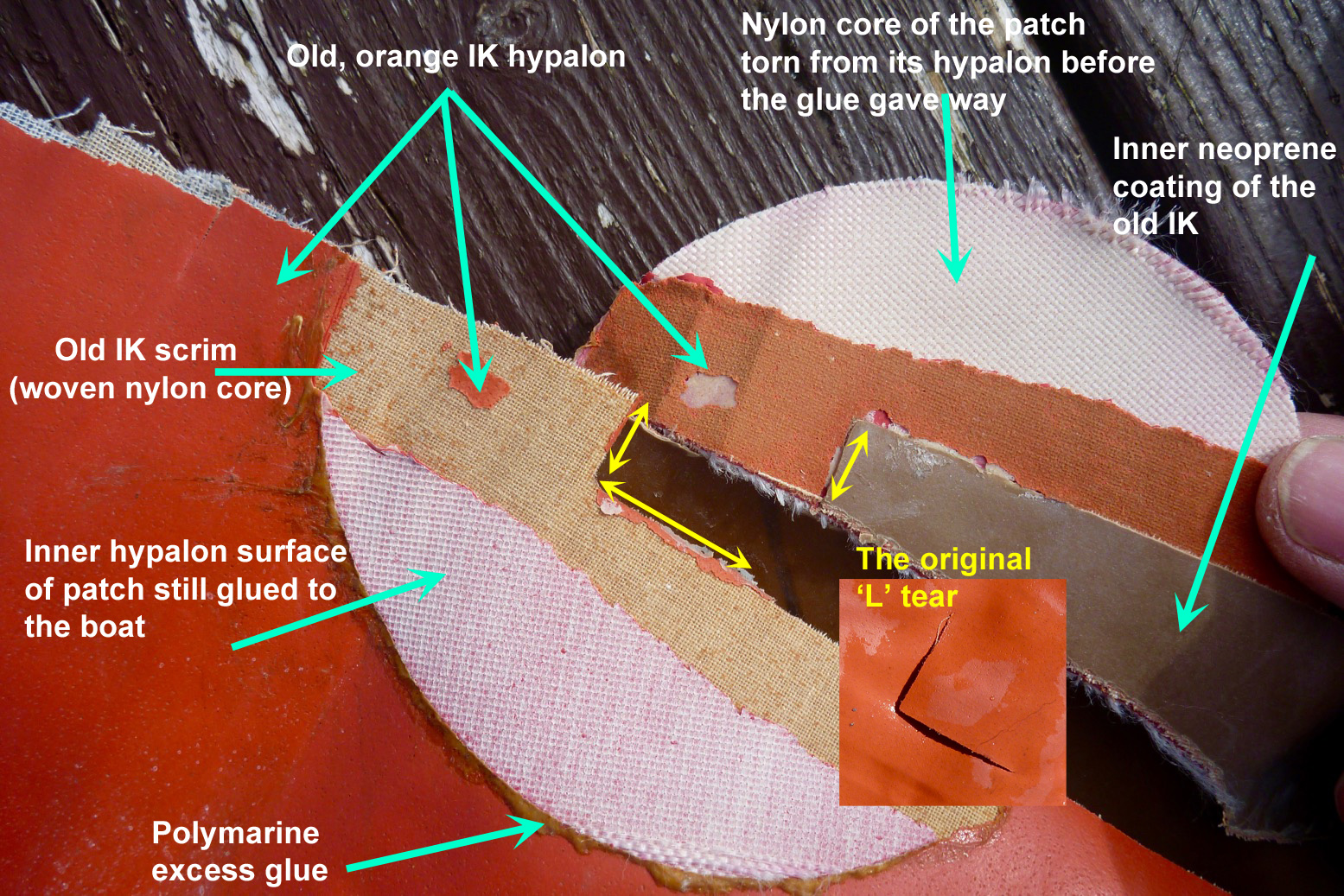
In 2017 when I dismembered an old IK, I was easily able to pull off recent patches glued on with Bostik by hand. But I could only pull off Polymarined patches with a pair of Knipex hydraulic trench pliers and even then, the patch coating pulled away from it’s core (lighter exposed weave below) or the patch remained stuck to the boat and instead pulled off the dead’s boat’s hypalon coating revealing the fabric’s yellowed core or scrim. The two recently glued surfaces could not be separated. They say the mixing of the two components causes a chemical ‘vulcanisation’ and molecular cross-linking which creates a very strong bond. Mixing and applying two-part is a pain, but it works.
Get a good roller
Single or two-part, once you apply your patch, roll it very hard with something like the classic Baltic-pine handled Sealey TST15 stitch roller (left) aka: tyre repair roller used for innertube and tyre repairs. The knurled metal wheel set in a solid handle applies much greater pressure than a wide plastic roller I used to use, and they’re only about a fiver on eBay. Buy one now so you’re ready.
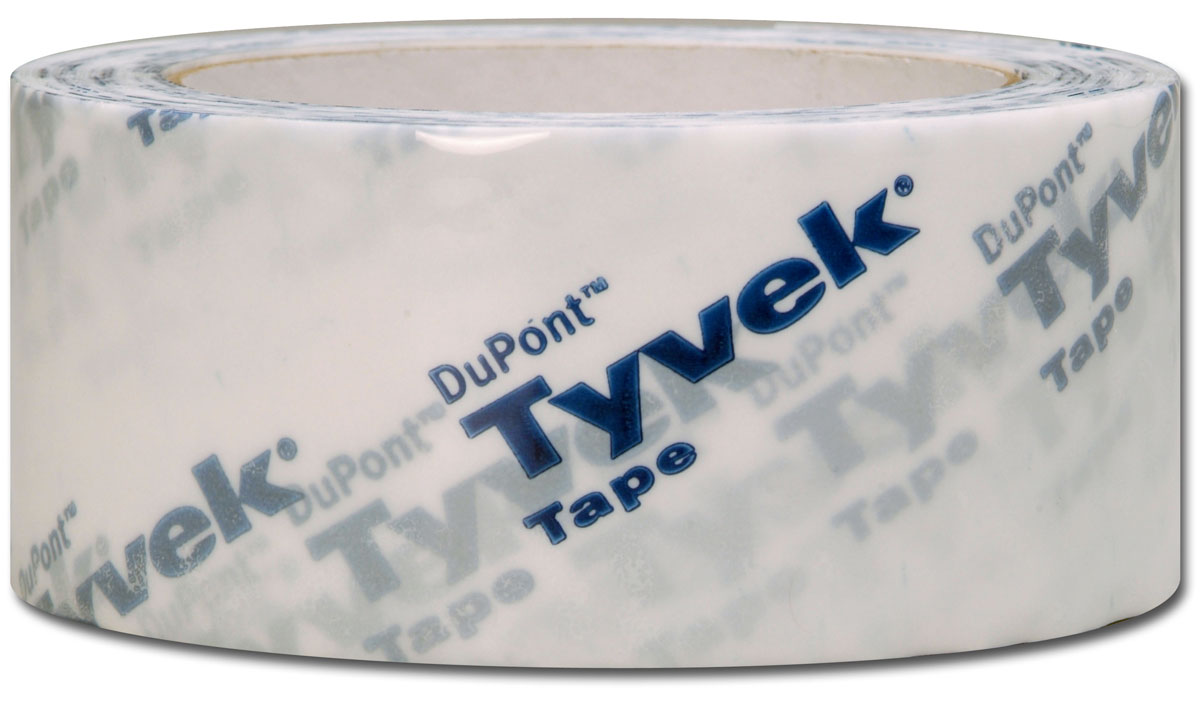
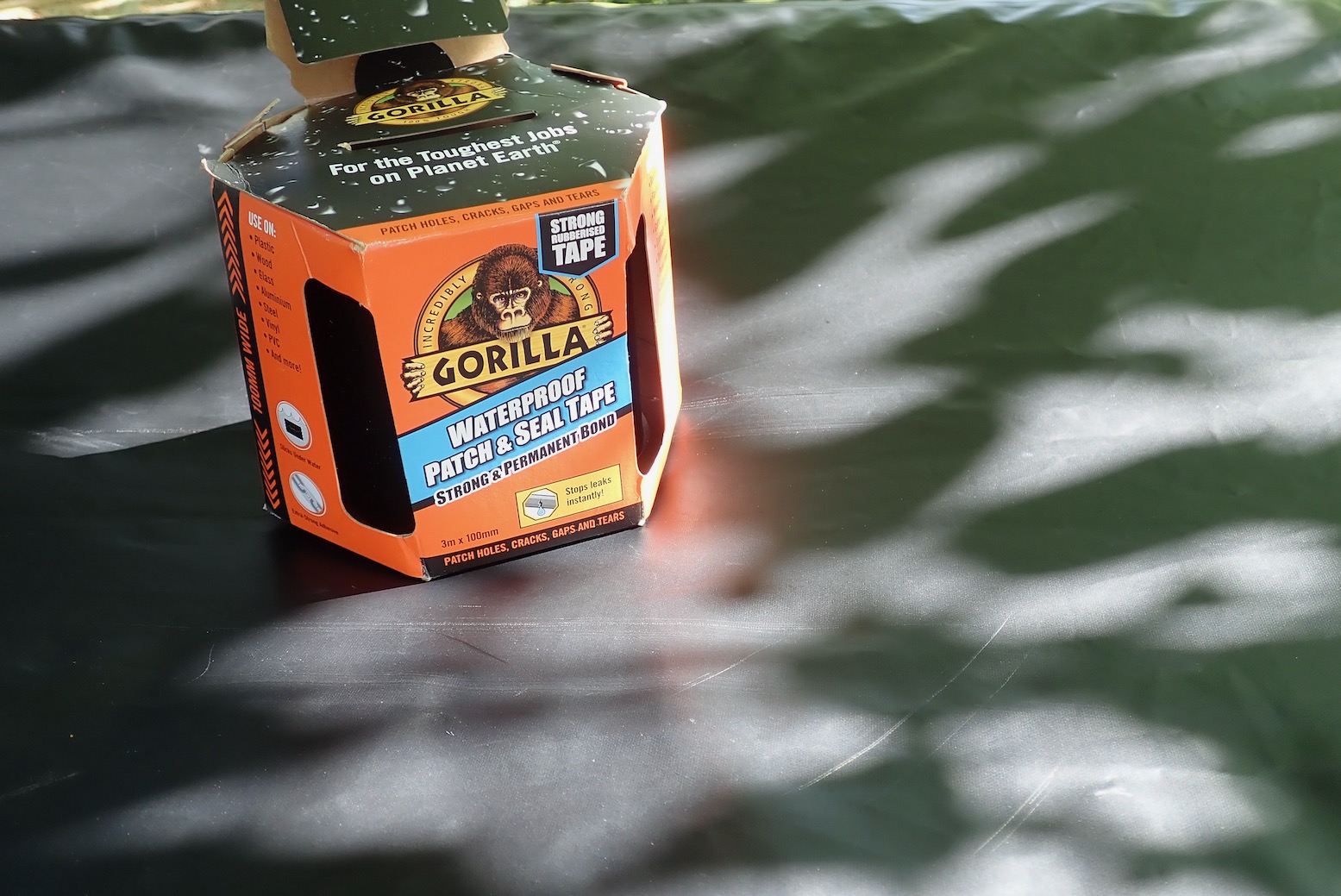
Bladder boat and packraft repairs With smooth-skinned packrafts use two-inch wide Tyvec tape produced by DuPont. Just peel off the back and apply a section to pricks or small tears once the surface has been cleaned and dried. No need for roughing up, but a quick wipe with solvent won’t do any harm. Larger tears can be sewn then taped. Tyvec will work on urethane IK bladders or use ultra tacky Gorilla Patch & Go tape for deep floor scratches and cuts. It will remain impermeable even once immersed.
Helaplast to stick things onGorilla P&G for repairs
Aire-style bladder boat repairs are actually easy. According to Aire’s youtube vid, you unzip the hull shell, slap on a bit of Tyvec on the split, tape up the inner side of the hull shell gash to keep out grit, reflate and off you go. You can glue up in the usual way later, if necessary. I had the feeling that on my Feathercraft Java the urethane-coated sponsons made of thin ripstop nylon fabric (like tent flysheet material) couldn’t have been securely repaired with tape. In fact, it would be difficult to bond anything well to the slippery nylon fabric compared to smooth urethane plastic or hypalon-like surfaces, but perhaps once inflated the seal would have been fine.
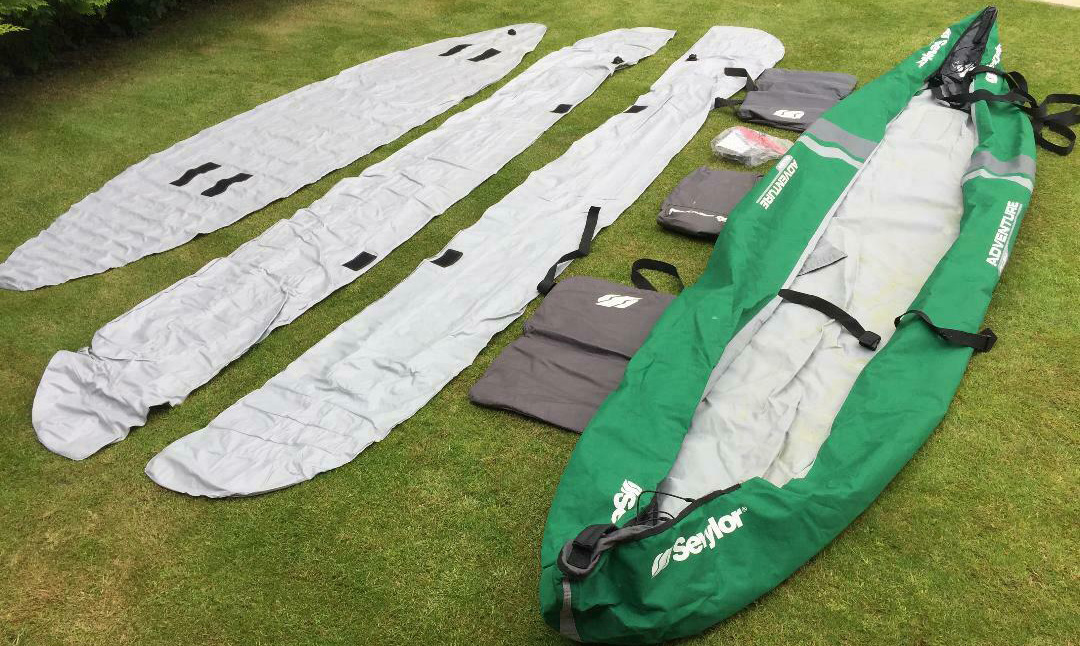
On this Sevylor it was the green envelope which ripped a metre long on the second outing! The owned may have over-inflated on a hot day – it only runs 1-1.5psi. The envelope is just a nylon fabric shell so would be an easily sewn repair. Usually it’s the inserted bladders which go. They can be patched.
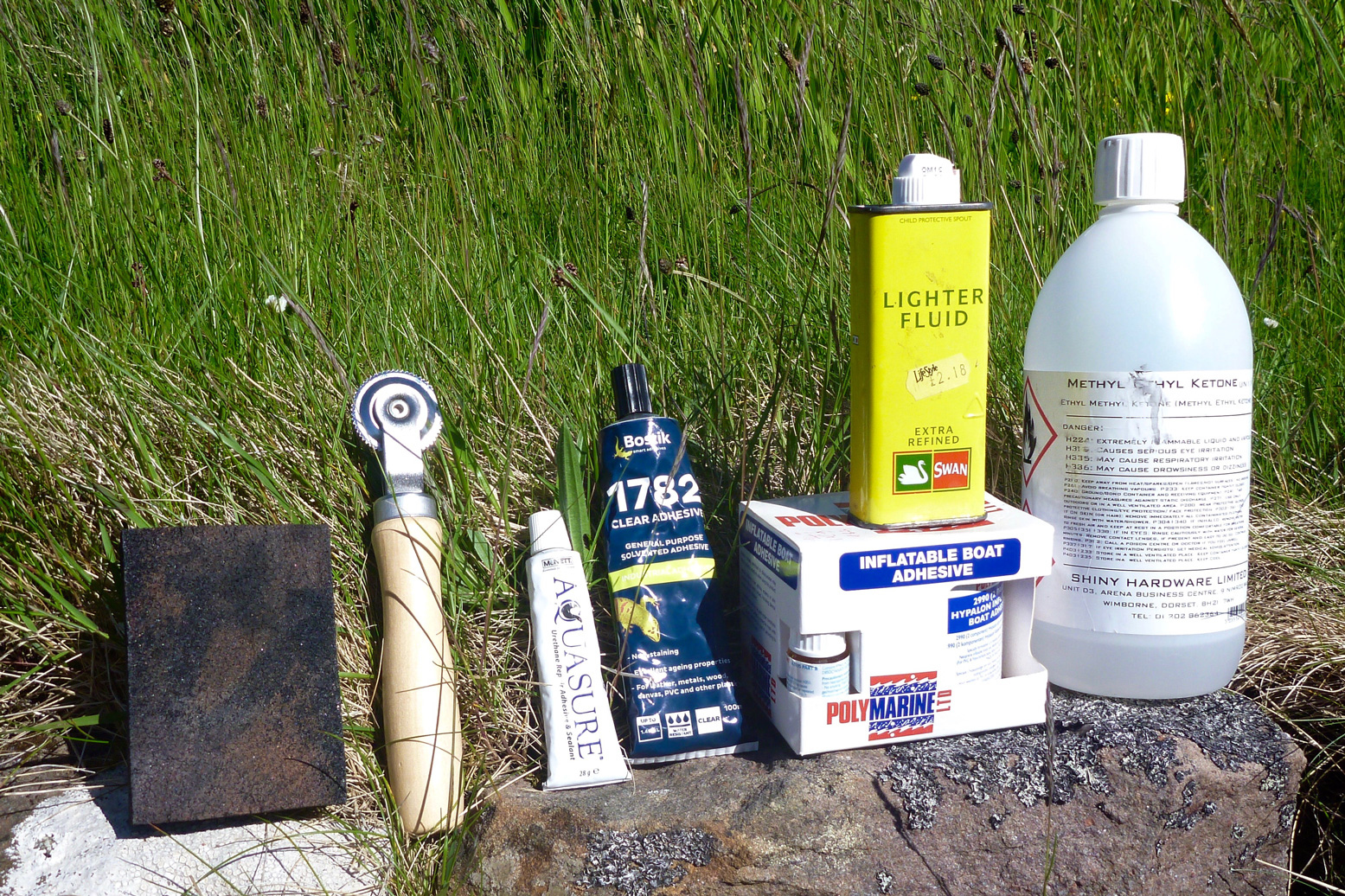
Once you’ve done your roughing up (sandpaper or a foam abrasive sanding block, left) you need to clean off the residue as well as any oil or grease present. Anything will do in a pinch; alcohol and spirits, after-shave or nail polish remover (acetone), lighter fluid, white gas or petrol of course, but not oilier diesel, aviation fuel or Nivea for Men. Bleaching agents aren’t the same thing. In the end just use water to remove the dusty, post-roughing residue, and on a cold day it can help to warm up the damaged surface to cure the glue more quickly.
Tri Nitro Toluene (TNT)
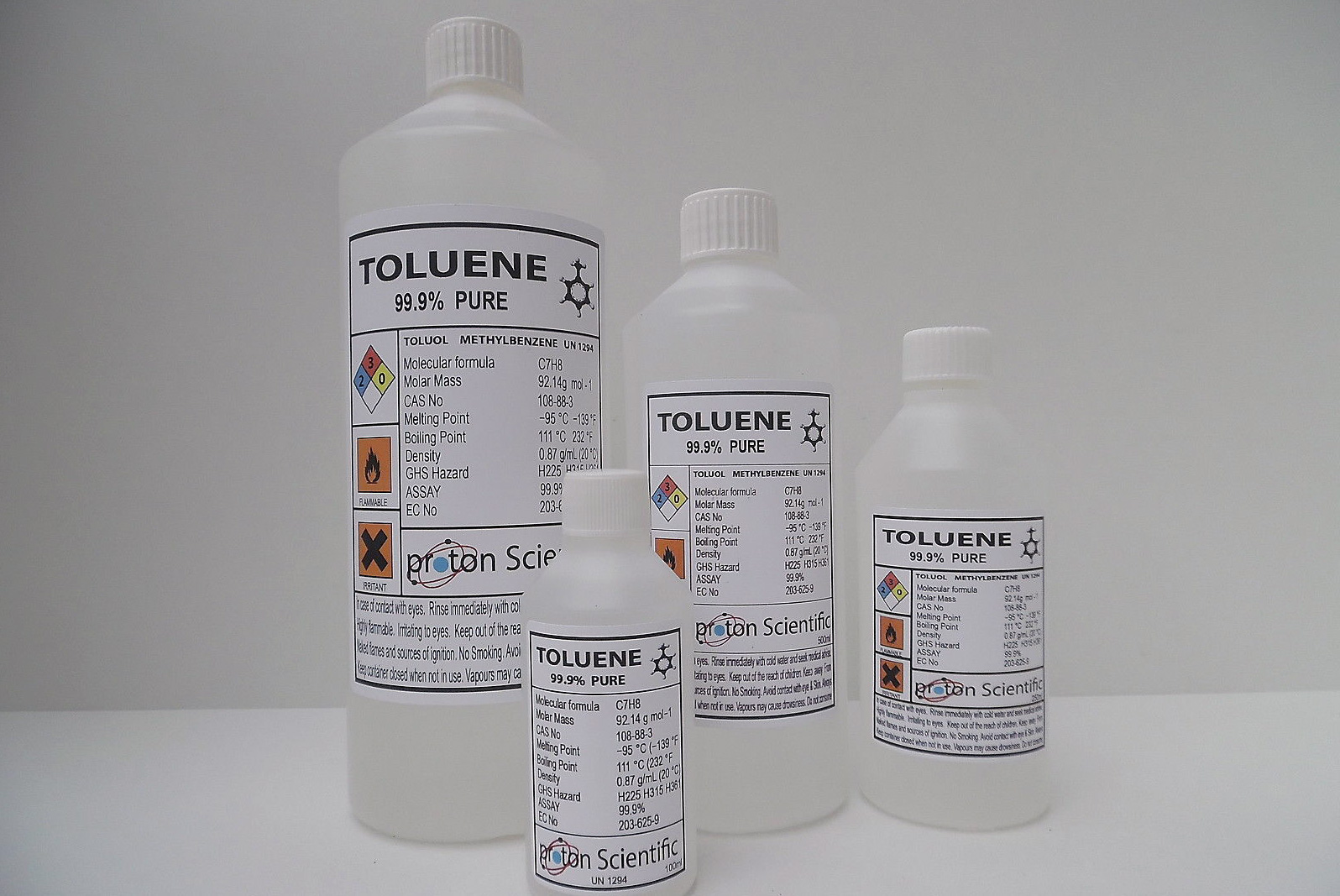
For a travel repair kit a tin of lighter fluid (same as white gas) or nail polish remover (acetone) are easy to buy and handy to pack. Back at home I’ve found MEK (Methyl Ethyl Ketone) is inexpensive at £9/ltr and hideously effective. Acetone is even cheaper and perhaps less extreme – all we’re really talking about is cleaning off any grease and the dust after sanding. They say MEK is for PVC boats rather than Hypalon, but on a thin plastic slackraft the PVC will shrivel up before your eyes once MEK’d. Even on rubber-based coatings use MEK or similar toluene sparingly. Expect some colour to come away on the cloth and the coating to soften at bit: good for adhesion. Note the NRS video above specifically recommends toluene (the second ‘T’ in ‘TNT’ explosive, fyi) for hypalon. On ebay uk it’s the same £9/ltr but they won’t post this stuff around the USA.
Huge tears and bear bites
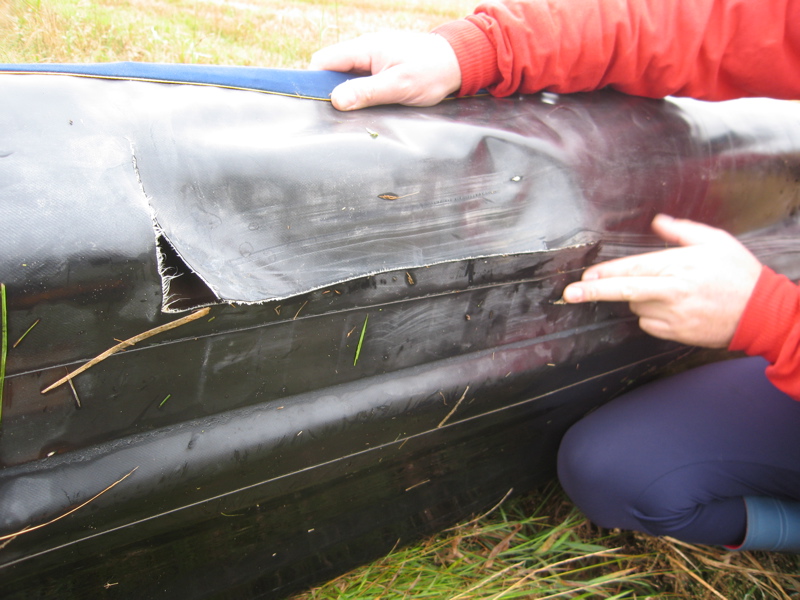
If you have a huge gash, as in the folding Klepper’s hull below, sewing is the only way to contain the tear when applied to an IK. Then apply a huge patch with adhesive, as normal. The boat below caught a cut-down metal fence stake buried in a shallow river bed and was actually sent back to Klepper for professional repair. It’s tempting to think an IK’s pressurised hull would have skimmed over the stake rather than snagged it. The smaller 1-inch L-tear on the left was glued with a 5-inch patch but the 30-year-old IK proved to be totalled.
This huge tear…was carefully sewn up..and patched. Good as new.This old Klepper caught a metal stake buried in a riverbed. Rrrrrrrip. Even then, sewing up the tear and a big enough patch, that would be an easy repair
I thought I liked the idea of packframes for pack boating – a rigid rucksack harness and frame without the bag element. The boat, paddles plus dry bags are all lashed to a frame, alongside a drybag.
In the US one time I saw some packframes at a hunting outfitters in Flagstaff (left) that were much better than anything I’ve seen in the UK and going from just $80.They had hinged L-sections to support loads, and looked like an ideal carrier for the UDB and boats. As it stands, my UDB is still my preferred haul bag for overnight pack boating activities. Good analysis, history and list of packframes
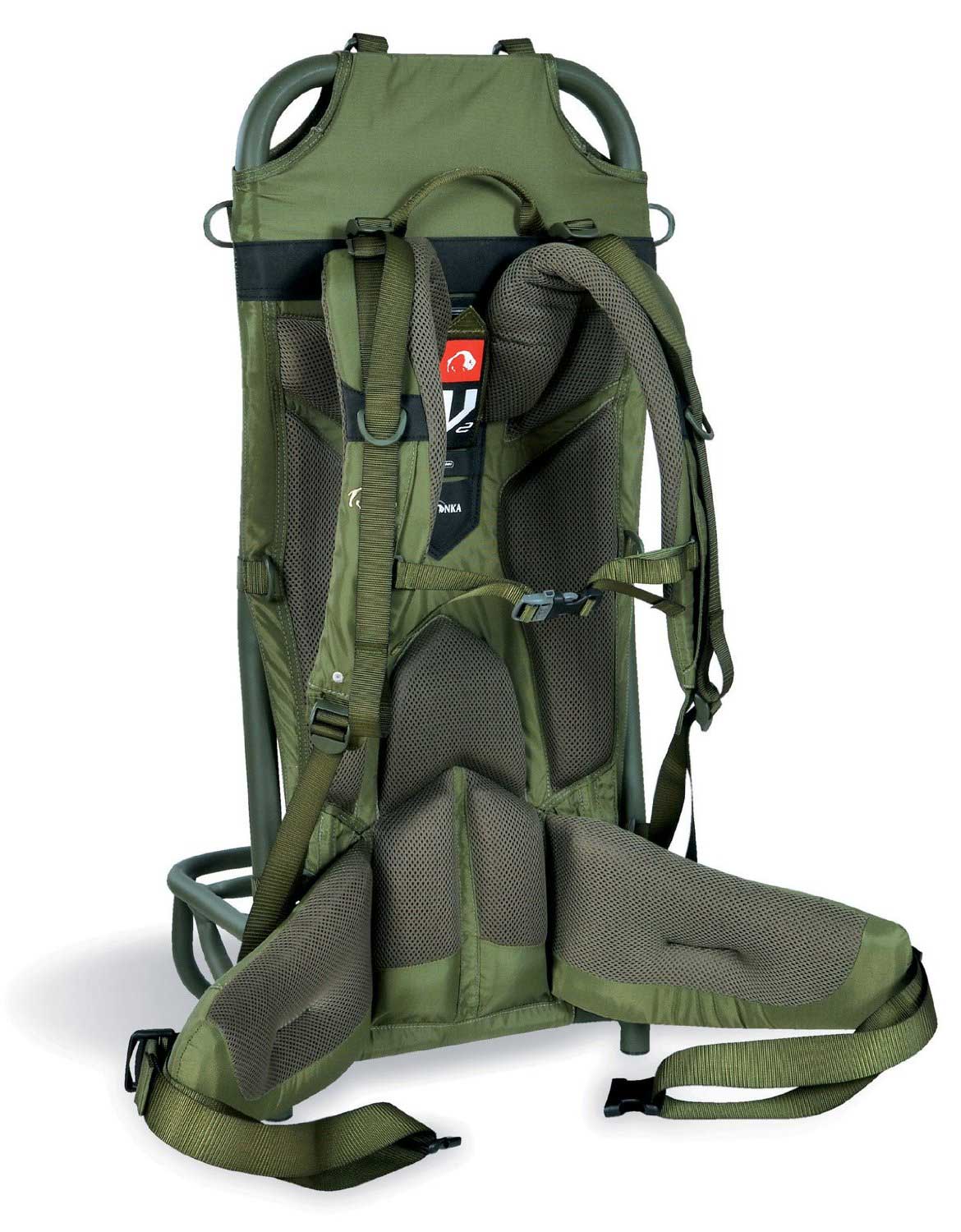
Tatonka Lastenkraxe review Lastenkraxe? A Nordic nutcracker? An uncredited evil troll out of Harry Potter? Tatonka is a German company who produce some crafty and functional stuff, such as their pot/cup. A little research reveals that Lasten + kraxeadds up to ‘load bearer’ + ‘rucksack. Vorsprung durch kraknik.
The Lax differs from the hinged hunters’ frames by having a well triangulated, rigid platform. A bit over the top for load bearing perhaps and it certainly won’t slip under the bed so easily. But besides being rated at an eye-watering 50kg, the platform provides the unexpected benefit of standing up straight when placed on flat ground and being a ready-made camp seat.
It weighs 2.7kg but feels lighter for the amount of alloy in there. And like all modern packs, you can adjust the harness to suit your back length, as well as do the usual micro-adjusting to the chunky hip belt and shoulder straps and the all important, non-elasticated, sternum strap. The Lax will obviously work fine for packraft expeditioning, plus kayak day trips where a trolley can’t be used, but I wanted to see if carrying my Amigo IK was a viable option for camping too. The Amigo weighs about 15kg ready to go, and as you can see, takes up much of the packframe when strapped on vertically. Horizontally would make more space above, but having walked about five miles on road, track as well as very rough hillside, treating the Amigo like a packraft will be a tall order.
I recall the Terra backpack on my first packrafting trip in 2010 weighed 18kg with a few days’ food and a drysuit. The Amigo is at least 12kg heavier than a packraft so that’s 30 kilos. I was walking around with about 20kg which felt like plenty. As said, the Lax is rated at up to 50kg which is hard to believe; the stitching alone would be under immense strain.
Realistically, camping with the kayak would work best where there was more water between short and fairly easy walks (few bogs and steep inclines – so not really Scotland then). Of course, having a kayak as opposed to a packraft makes lone coastal paddling and sea loch crossings less intimidating.
Comfort is as good as can be expected with a 20-kg load, but I think it’s safe to say a rigid frame is less compliant than a modern frameless backpack like my Berghaus C71 (2.6kg). On one stage the lower frame was digging into my hips through the hip belt, although on the next walk I must have adjusted it better and it was fine over terrain that at times was barely walkable. I wasn’t using a packstaff this time, but off-piste that would be a great help.
Early days yet, but quality of construction seems good. I like the lift handle and generous padding. One thing I’d like to see on any harness like this is a pocket or two on the padded hip belt, or even just a bit of tucking mesh. The platform construction looks solid and as well as being a pack stand, with a some cushioning would also make a solid camp seat when unloaded. This is a much discussed and under-rated item, and one on which you could even lean back on, just like you weren’t supposed to do in school. The solidity of this structure also opens up the possibility of adding that nirvana of urban packboat portaging: trolley wheels. More about that if I get round to it. Rrp in Germany for the Tatonka Lastenkraxe is €170. My green one cost £95 off amazon. Black ones were another 20 quid.
In my packframe investigations I discovered that in the Tatra mountains of eastern Europe there’s a local ‘iron man’ sport of ‘Nosicsky’ (‘portaging’): carrying massive loads on wooden L-packframes. Perhaps it was once a way of resupplying mountain refuges when the mules were on strike. As you can see, over 200kg was a record one time, but it proves that L-frames were the original do-it-all packframe, long before modern backpacks found frameless alternatives that kept the weight closer to your back.
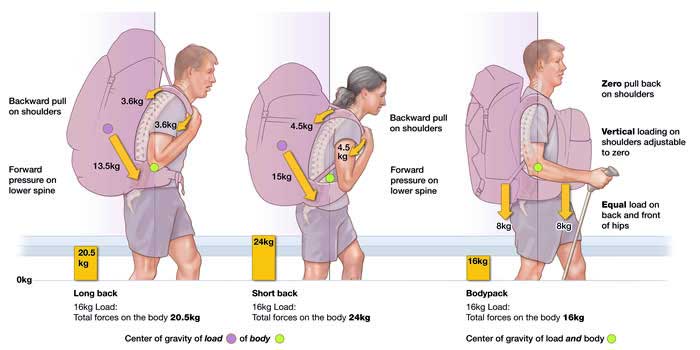
I also came across the Kiwi Aarn website which showcases a frontal load ‘FlowMo Bodypack’ to help improve you posture and balance weight distribution. They’ve designed two pockets for the front straps to carry dense but compact items (like water) while still being able to see where to put your feet. Sounds like a good idea but many of us, like Jeff on the left in the Kimberley (with my old Terra 65), have come up with a similar solution intuitively, when needing to carry a day pack as well as a backpack. Still, it’s an idea worth considering when you have a 15-kilo boat on your back.
Since I wrote this I did try a similar idea on our CWT recce, well at least carrying the packraft on my chest. It did feel good on regular ground: better posture, less stooping – but on gnarly terrain the bulk got in the way of the ground at my feet which got dangerous in the places we were walking. To be fair, Aarn acknowledge this limitation.
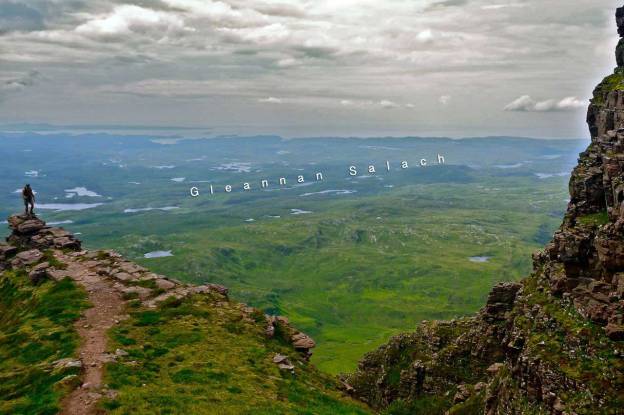
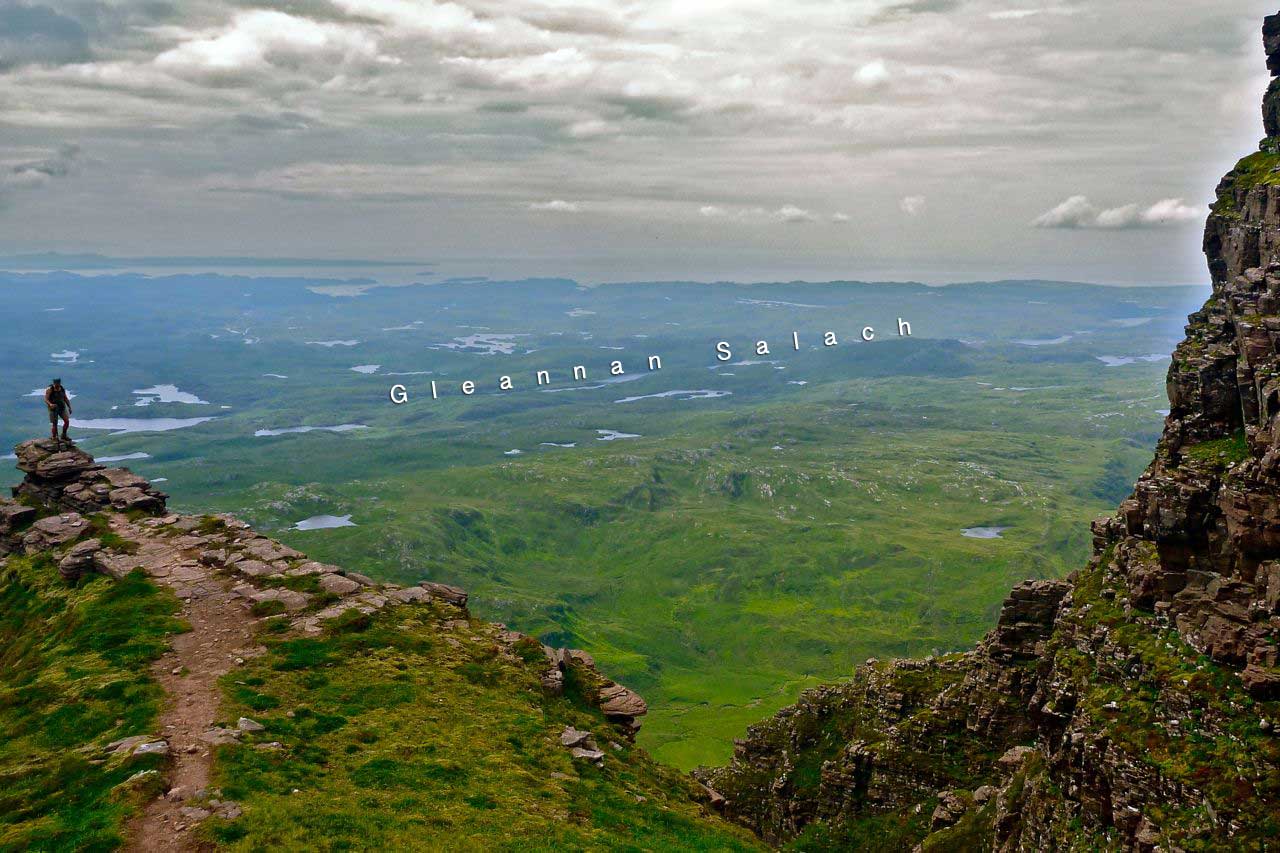
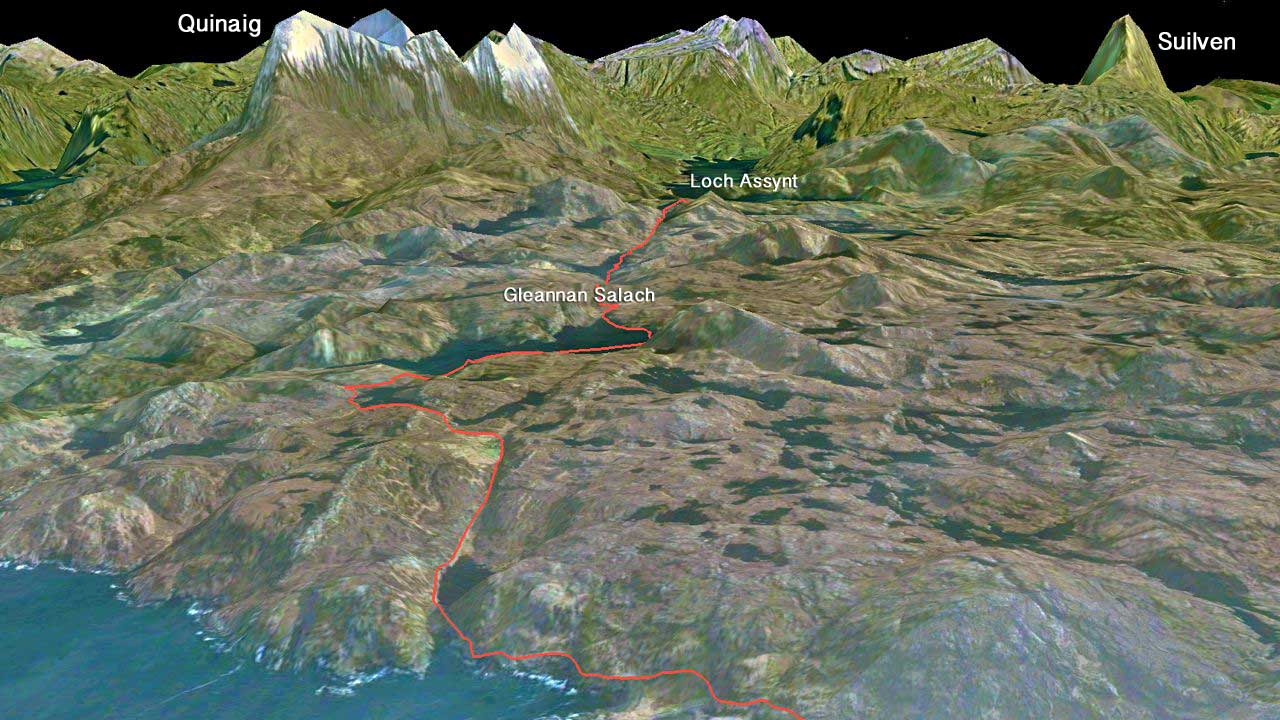
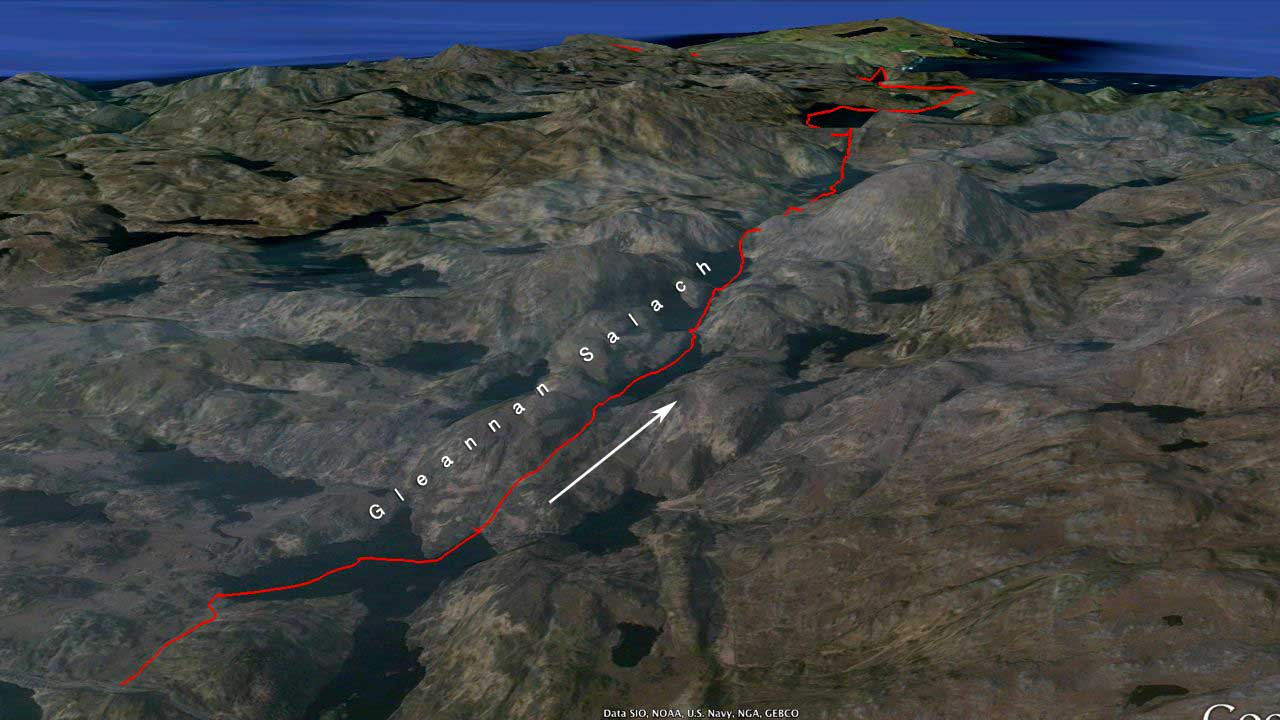
As we left one car near Stoer, out to sea a stampede of white horses were galloping in towards the Bay of Clachtoll. It looked like a late 90s Guinness commercial out there. We didn’t want to be kayaking in that, no sirree. So instead Jon and I swapped craft and set out to follow a string of lochs which filled a fault line marked on the maps as ‘Gleannan Salach‘ (above). It ran west from Loch Assynt to the sea, across a lochan-speckled headland tipped by the Point of Stoer. To the south Enard Bay (which I kayaked a few weeks ago) to the north Eddrachillis Bay; all ringed by the cute Drumbeg road. I’d clocked this as a viable packrafting ‘line’ some time ago and today was the day.
It was only about seven miles, road to road. But from the look of the map and knowing the terrain around here, I expected the walking stages to be sodden, gruelling bogs or chest-high fernfests. We’d found as much on Horse Island the previous day. Jon was debuting his skinned dinghy (more on that idea here), last seen here during a bitterly fought offshore jousting tournament we’d held off Achnahaird Bay a year or two ago. I’d cut my own slackraft down a while back but found with my weight, the freeboard was a limited and the slightest wave would swamp it. Luckily that was all the excuse I needed to be allowed to use my proper packraft.
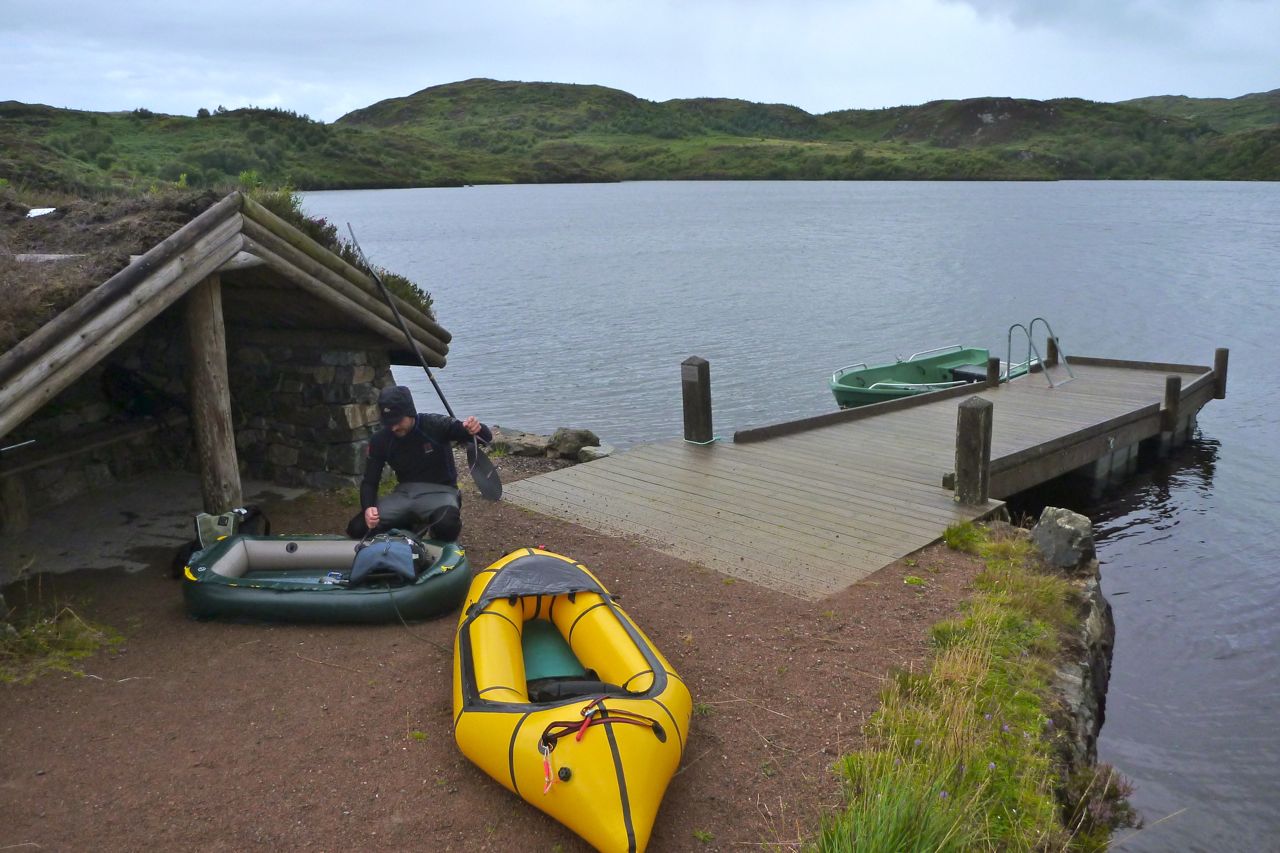
It was going to be a day of blustery winds and heavy showers so appropriately dressed, we parked up at the Leitir Easaidh end near Loch Assynt and put in at a shelter by a boat ramp. On inflation, Jon’s slackie looked ridiculously small, an impression that worsened once he actually got on it. And on the water the situation deteriorated still further; that thing pulled half the speed of the ‘packa, yawing left and right like some demented dashboard ornament in need of a good slap.
A relative novice to slacking, it’s possible Jon was paddling as if he was in his 17-foot sea kayak which has a length/width ratio of over 8:1. On his slackie it was less than 2:1. Long, powerful strokes merely flip the bow left to right, as I found when I first tried my original Alpacka Llama. It takes a bit of a knack to limit yawing, although the newer ‘fastback’ tailed Alpackas like my yellow Yak, greatly minimised that. Previous slacking expeditions in France and the Kimberley has been with unskinned, full-width slackboats which attained some two thirds of an Alpacka’s peak velocity, once you’ve divided the surface tension by Ω x π. It brought up the troubling possibility: was removing the outer hull to gain slimness at a slight loss of buoyancy not as efficacious as previously thought?
Jon’s in there somewhere, collecting ticks
By the time we got to the far end of Loch Leitir Easaidh we’d already been rained on and blown about twice. Faced with a steep climb through knotted woodland and thick bracken, we rolled ’em up and go stuck in. Soon we were at the pass which overlooked the next lochan and by the time we were back at the pumps that one mile had taken an hour.
We estimated the rest of the crossing would probably be at the same slug-like pace, so to get home before Christmas, I towed the slackraft. Jon paddled too of course, the tow line constraining his rampant yawing as we clung to the leeward south shore. Alone on windless flat water, my packraft can sit on 3 mph. Out of the wind our packboat convoy managed about two which was good enough. At the far end a short portage dropped us a few feet down to Loch Three, and at the end of that one a deer fence stretched across the small weir before Lochan a Ghleannein Shalaich, loch #4.
At this point the map showed the flow funnelled into a narrow gorge which could mean an awkward climb to get round. We’d decided if it took ages to get to the gorge we’d turn back, but lined up we were averaging a little over our target 1 mph so the mission rolled on. Better still, an easily walkable route ran alongside the stream through the gorge (above), then opened out to an agreeably grassy basin that didn’t involve thrashing through chest-high bracken or sinking into unset peat. Unusually, walking here proved to be faster than paddling.
That stage gained us some time, but back on the water we took a few steps back. The southwesterly gale sweeping across Loch na Loinne must have been accelerating round Cnoc an Dubharlainn, at 223-metres, the highest hill in the ‘Salach’. A couple of islands provided inadequate protection from 35-mph sidewinds which hammered down on the rafts. We both dug hard on the right and barely the left across the exposed bays, managing between 1.5- and 2 mph, though it sure didn’t feel like it. The shortest rest saw us skitting across the choppy waters to the northeast bank.
Out of the wind it’s another world. By a wooded cliff we glided past the controted, banded Lewisian gneiss that makes up the bedrock of this waterlogged region. Said to be three billion years old, the Salach badlands has had its capping of oxblood coloured Torridon sandstone scrapped away, right down to the raw bones of the primeval gneiss. At the far end they’d built up a rubble and mat barrage which diverted the outflow through a pipe. Purpose unclear, but after the effort of getting here, I suggested we unline for the next little loch before one more portage brought us to Loch Poll, the last and biggest loch.
Untethered, the Alpacka Yak skimmed across the lochan like a spun stone. Jon was not so far behind and we both squeezed under a fence and along a channel before we ground out on mossy boulders and took to the banks. The whole traverse seems to follow an ancient wall and a newer fence, and as the winds strengthened we popped through a lonely gate and over a pass clinging to our inflated boats. Down on the far side, again we managed to paddle a meandering, reedy stream until a small waterfall barred access to Poll. Raining, blowing and cold, it was a good time to cram in the last of our squashed snacks for the final haul.
Slackerman, where you gonna run to? And a haul it was. The winds and rain intensified to the point where we decided, that even at our glacial pace, better to take a longer route around Poll’s southern edge. Flat against the wind at times, from the look of the passing shore, our lined-up flotilla crept along at barely a mile an hour. In fact a ’10’ marked on the OS map has obscured a couple of handy islands that would have made crossing Loch Poll’s 300-metre wide ‘neck’ not so exposed, though that route may have put us against the biggest fetch and rebounding winds.
We curved round the loch’s southern shore to gain a brief spell of backwind and then with more hacking, arrived at the take-out bay at 7pm, six hours out of Leitir Easaidh. It was a ten-minute walk to the road and the car, somewhere within a mile. Half an hour later, where was the car? Not in Strathcoy, not in Imirfada. Had we turned the right way off the Salach? At Clashnessie Bay I was forced into that ultimate humiliation: looking at the map. Oh dear. I got Clachtoll near Stoer mixed up with Clashnessie, also near Stoer; I had assumed the Gàidhlig Buidheann-stiùiridh doi Teanga (Gaelic Language Directorate) had changed the name. Another three miles march it was then, into a headwind so strong we couldn’t hear each other talking. Ardmair near Ullapool recorded 48 mph around that time.
So, has the cut-down slack rafting myth been finally punctured with a blunt wooden spoon? I knew they were slow but Jon’s boat seemed worse. Still, my Amigo IK is the same alongside Jon’s Scorpio sea kayak – not as fast – so you’re as fast as you are. I still think for a hill trekker carrying a slackraft that’s no slower than a Supai, lighter than my Alpacka and a fraction of the price, still enables water-inclusive routes across the well-suited northwestern highlands. Longer crossings may take a while but you paddle. That’s what you do. Splish follows splosh follows splish follows splosh. Good things come to those who wait.
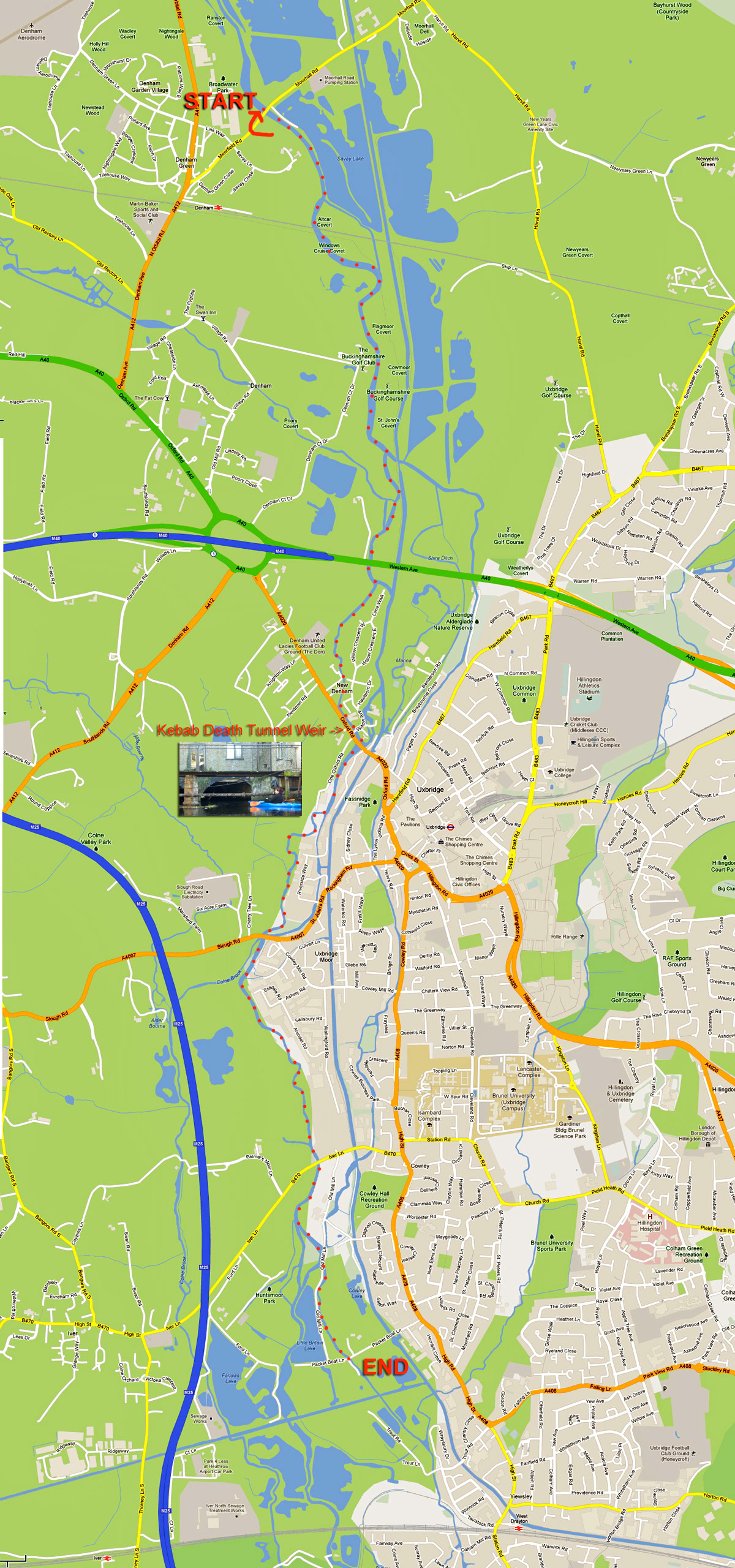
The other day a friend relatively new to yaking invited me and a mate to paddle a river near her home. The Colne runs between the edge of Greater London and the M25 motorway just a stone’s throw from Heathrow airport.
Looking at a map (far below) and more so at a sat image, it’s hard to distinguish the actual course of the Colne among the many waterways, reservoirs, overgrowths and the Grand Union canal which all fill this part of west London’s perimeter, but Lois had already recce’d a route which included half a dozen fun weirs and other challenges along the way – all up a run of around six miles. Chief among these tests was what must surely be an urban paddler’s nightmare; a weir drop inside a low tunnel that passed under a kebab shop and which we dubbed TheKebab Death Tunnel Weir (the word order is interchangeable). The thought of being spun in a dank, sunless hydraulic or jammed against a rusting grate as clammy kebab fat dripped onto your forehead from cracks in the overhead brickwork was surely the makings of a deleted scene from David Lynch’s Eraserhead.
All that was far from our thoughts as we bundled over a bridge parapet and inflated Lois’ Sunny IK which Robin was borrowing. Lois was using her newish hardshell Dagger and I was in my Yak packraft. Lois quite rightly rationalised her controversial IK betrayal by explaining that as she lived on a canal she just wanted a boat to hop into anytime (her Gumos having sprung slow leaks). I can relate to that though I wouldn’t go as far as actually buying a plastic coffin. We swooshed off under the bridge and downstream on a lovely autumn’s day, along what transpired to actually be a proper river with a kosher current, far from my expectations of a concrete lined culvert awash with urban detritus and pestilent scum. We passed under a huge arc of brickwork supporting the westbound mainline railway and soon sidled up alongside the Grand Union canal. Not that we could see it. Even the OS map gets quite confusing, marking rivers or other waterways passing across lakes and wetland reserves. But once on the river the way ahead was usually obvious.
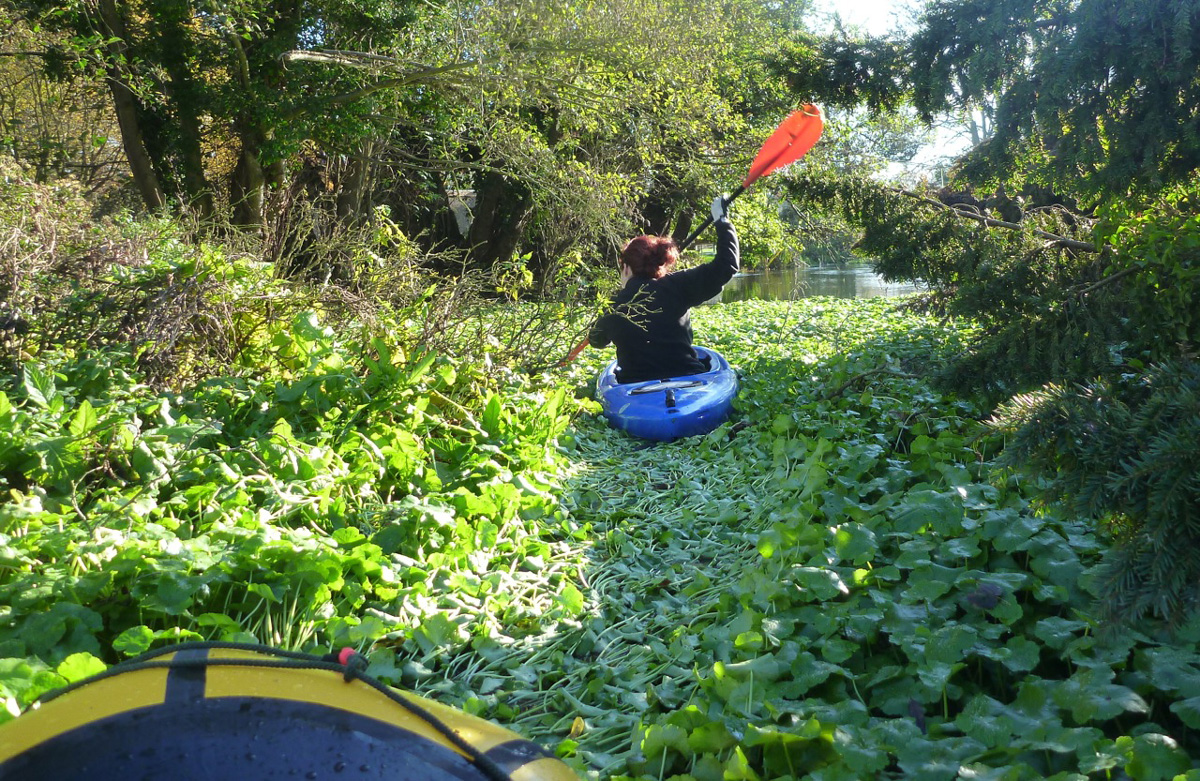
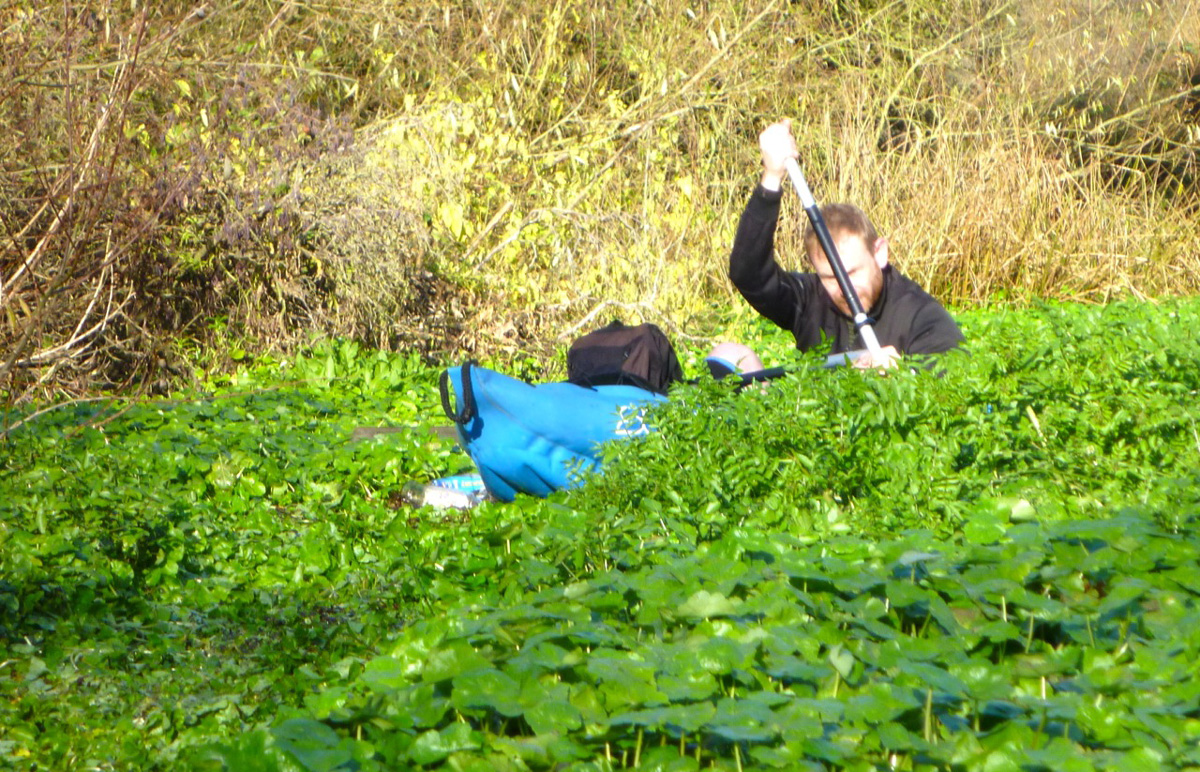
At one point what looked like thick mat of giant watercress carpeted the river bank to bank (actually pennywort, a very troublesome weed I am informed). Up ahead Lois’ Dagger ploughed into the vegetation (left) which amazingly proved to be paddleable, although with my wide, flat-hulled ‘packa I found reaching out and tugging on the floating wortrug worked best.
Soon we came to our first weir, a drop of a foot or so but where we did the right thing and hopped out to check we weren’t tipping over onto some gnarly boat spike. All clear so Lois slid over effortlessly into some shallows, then Robin beached himself inelegantly on the rim in the possibly under-inflated Solar. Knowing this, I sped the Yak up to warp speed and scrapped over with a splash.
More riverine bliss ensued with barely a crisp packet to sully our glide. Delicate foot bridges led to cosy cottages. Another double weir looked deadly from above but recce’d from below was no drama. No having yet recognised the benefits of spray skirts, Lois’ Dagger was taking a cockpitful on some of these weir drops. The Solar too scooped up some swill, but this was the first occasion where I zipped on the Alpacka’s spray skirt – mostly to keep my legs warm but also proving it did what it was supposed to.
Up ahead, another clot of creswort choked the channel, but this had got thick enough to catch some crap so we hauled out stinky twigs and other rancid mush before hacking our way in. The rigid hardshell was best; my Alpacka (above) while broad was at least light, while the Gumboat put up a fight and Robin split his paddle all the better to dig his way through (right). Another weir with a drop of a couple of feet gave Lois a fresh rinse as we neared the outer London suburb of Uxbridge.
Bankside trees gave way to razor-topped railings protecting the back end of industrial units and things turned decidedly less serene as we neared the gaping twin maws of the Death Tunnel. It burrowed under a parade of shops, the pride of which was unquestionably the broad, handsome frontage of the Burger Kebab Galaxy restaurant.
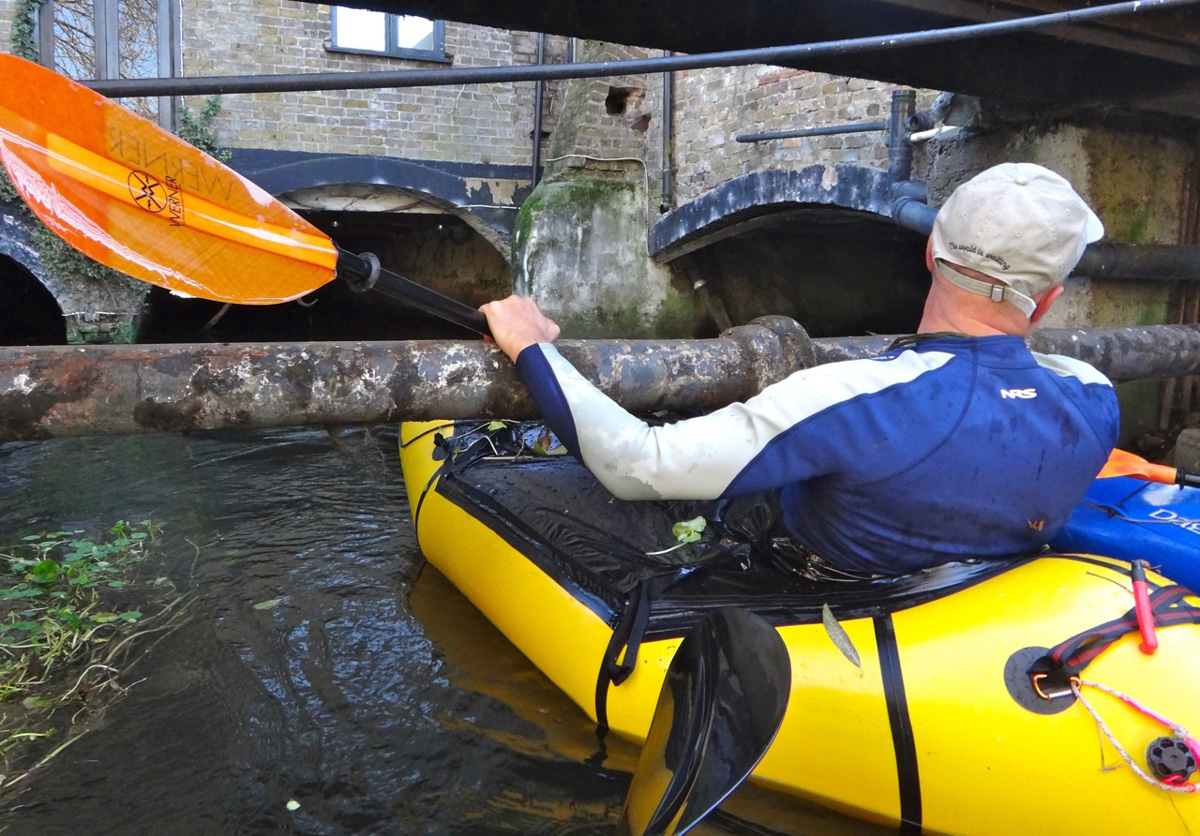
Two limbo-low bridges lead to an even lower rusty sewer pipe spanning the canal, and up ahead two arches reached into the watery gloom like a farmer’s rubber glove and where the rank stench of congealed doner fat choked the air. A chink of light marked the far end of the 70-foot tunnel (left) where the roof – strung with electrical piping, rotting rafters and mummified bats – pressed down to just a couple of feet right over the edge of the drop. Lois said last time the water was higher and they couldn’t even see the end, but they’d edged in anyway, slid over and survived.
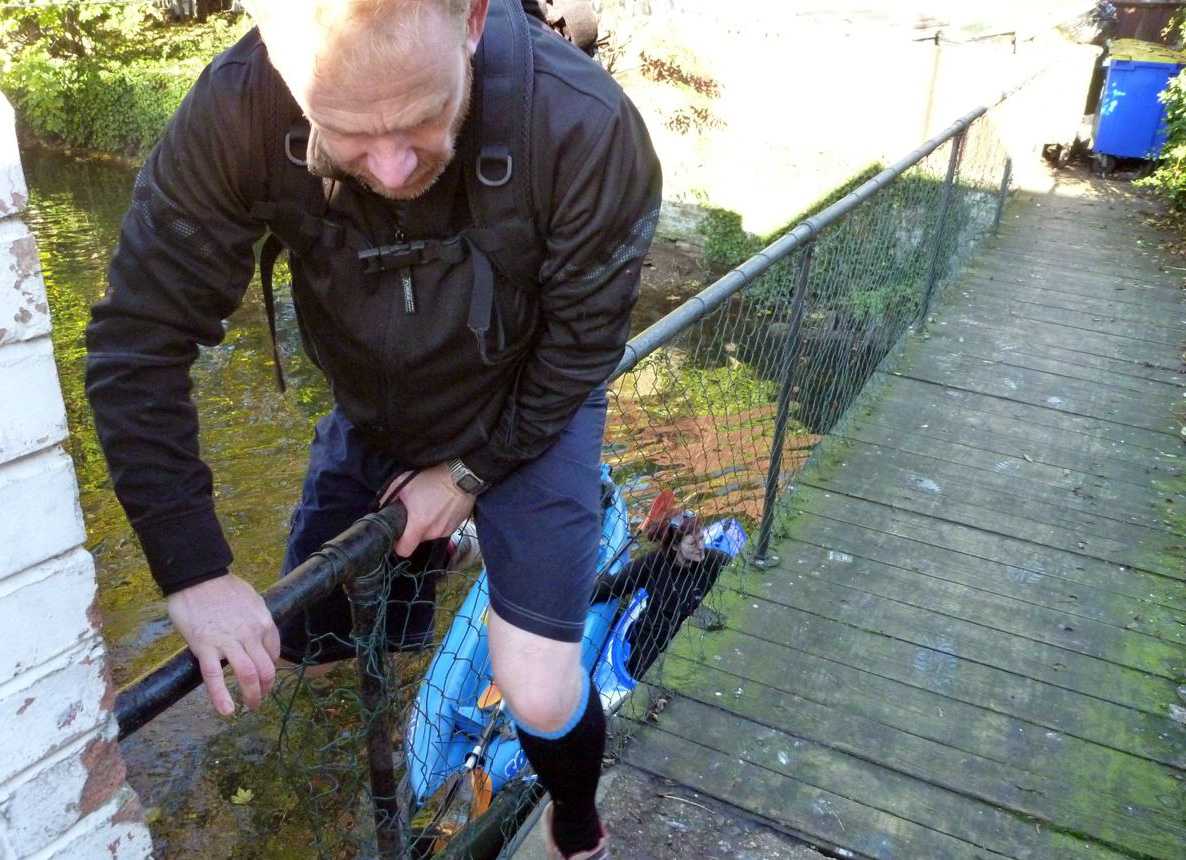
Even then, you never know when a burned-out scooter or half a tree might be poised to spoil your weir and anyway, Lois was sure this weir was higher than anything we’d done so far. So Robin and I clambered up onto the footbridge (left), walked round the far side and waded up into the tunnel as far as we could against the current. With the help of my camera’s flash I was able to get far enough in to see that the three-foot weir was actually a narrow 45° slide of about 3 feet, not a straight drop. Much less risky.
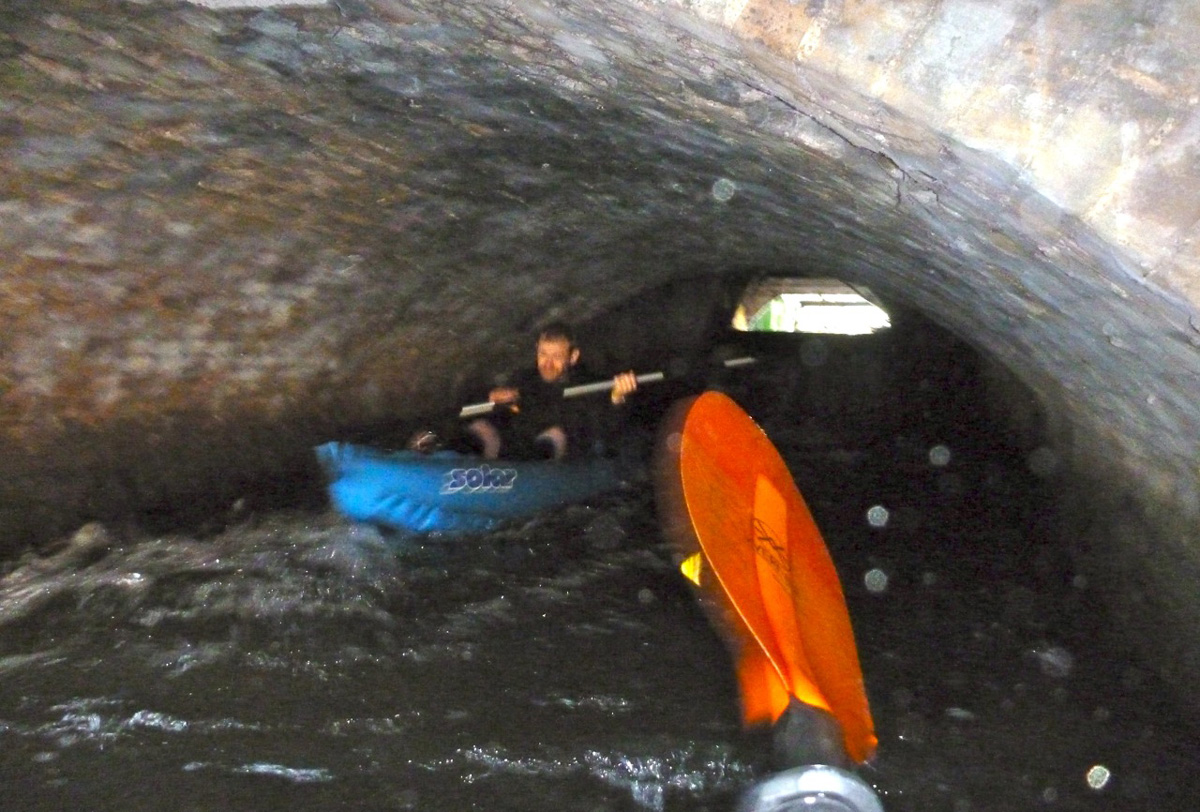
Now reassured that I wouldn’t be pitched out of the packraft to smack, face-first into to a span of festering, greasy brickwork, back at the boat I squeezed myself under the sewer pipe (right) and let the speeding current draw me in, making sure to keep well away from a broad side tunnel which led off to the right and didn’t look like it had a happy ending. I didn’t want to end up being squeezed out of someone’s kitchen tap like rubber-boned Janus Stark. In the main tunnel, the roof bore down and I stowed the paddle as I tipped down the chute, getting shoved against the right wall as I ran out towards the light like a near-death experience.
Lois came down next (faintly visible above left) and also got pushed right at the base of the chute and semi capsized.
Kebab Death Horror!
Her paddle floated down towards me but before I could grab it the eddy caught it and floated it back up towards the chute. Meanwhile, soggy arsed Lois hopped out and dragged her waterlogged Dagger into the piercing daylight. Robin came down next (left), got pushed over but kept it together. It seems the tunnel weir had set up a long, thin anti-clockwise circulant or eddy which came upstream and looped back down just below the chute and explained why we’d all got pushed into the right wall as we came off the slide.
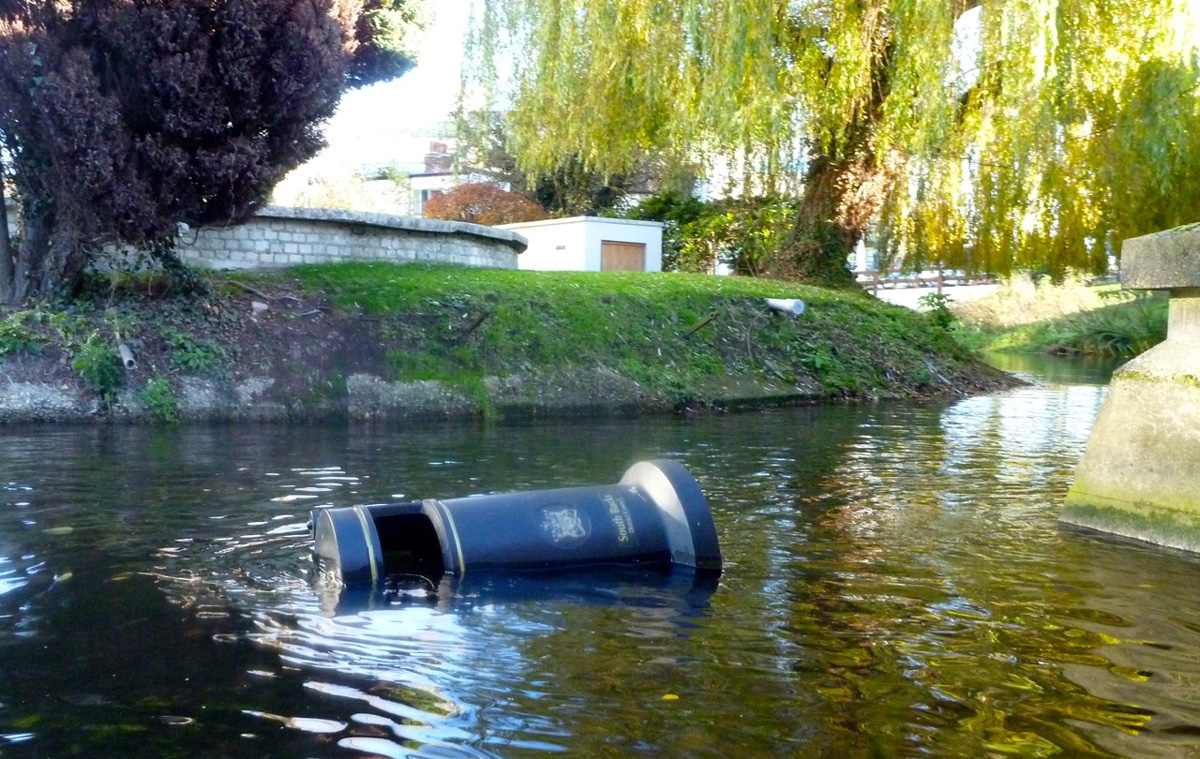
But we’d survived the KWDT and soon cruised past a striking municipal bronze statue depicting a trio of naked nymphs grappling over a giant Christmas pudding (left), a scene plucked from the otherwise unexceptional Lost Chronicles of Uxenbride discovered not far from Kebab Galaxy in 1892. And here at last! A plucky South Bucks District Council dustbin uprooted from it’s roadside vigil and flung into the Colne by some beer-crazed revellers high on nitrous oxide. Now that’s what you call urban packboating! There was more to come. What is a paddle in merry England without getting a bollocking from a vexed bankside angler. We’d seen a few upstream who’d mostly ignored us (I don’t waste greetings on anglers anymore), but as Robin and I rounded a bend following another weirlette, some grumpy git wearing rubber up to his neck let us know his feelings, concluding with: ‘You coming back?’ (demonstrating his lack of understanding about how kayaks and rivers interact). ‘No sirree‘ ‘Good!’
His mate just down the way was more civil and explained ‘there’s no navigation on this beat, it’s in the agreement…’ pointing to a sign, rather ineffectively positioned downstream that merely said Private Fishing or some such. I didn’t know the paddling status of the Colne and maybe Lois didn’t either, but a quick Google later on showed up threads on the SotP and ukrivers that indeed suggested the Colne hereabouts had been leased by a bankside golf club to Uxbridge Anglers Club, and their £80 membership fee helped entitle them to exclude paddlers on parts of the Colne. What about the Magna Carta and all that? Which parts are off-limits is hard to determine unless there is a blanket paddling ban.
We certainly saw no ‘ No Canoeing’ signs so it all left a sour taste for a while, but that’s the way paddling is in England thanks to Edward the 1st’s short-sighted bequest to his loyal noblemen (or so the story goes).
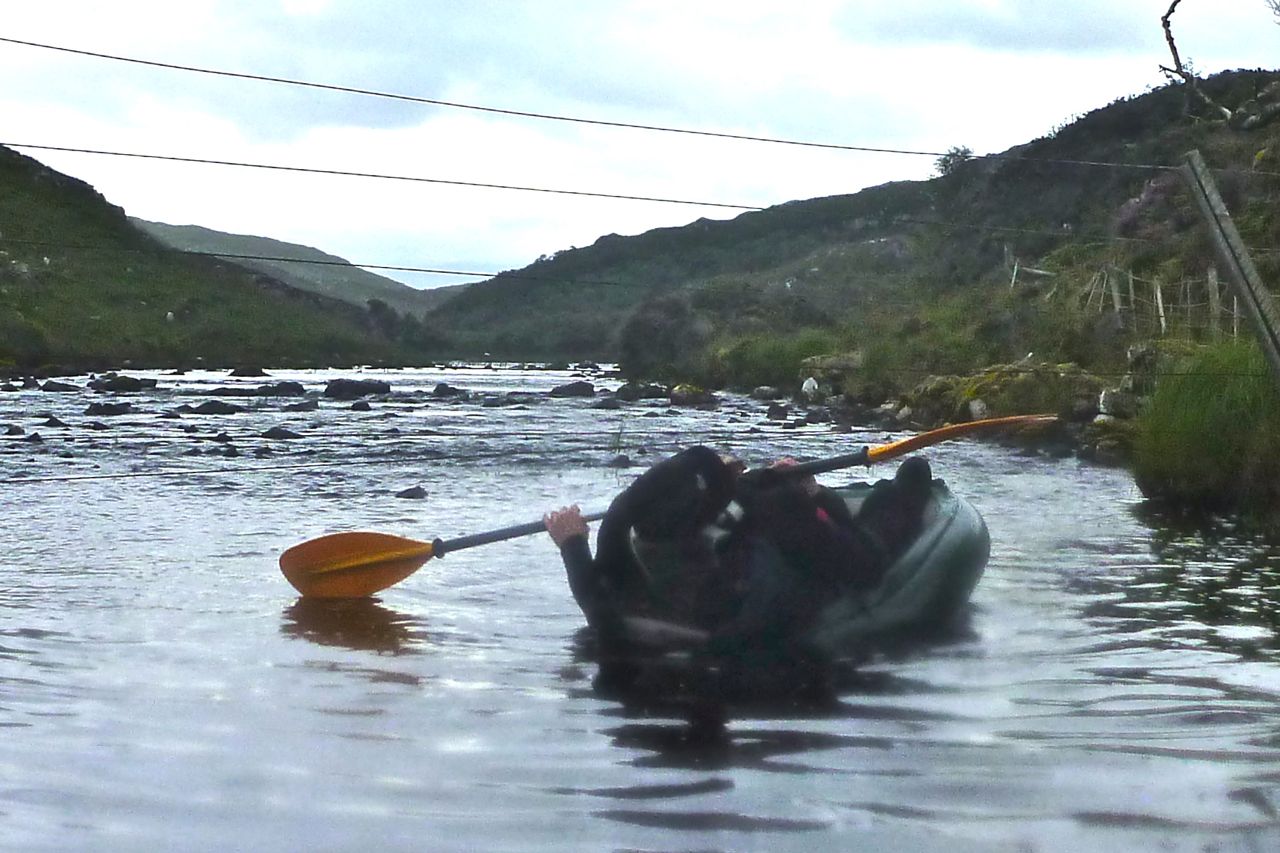
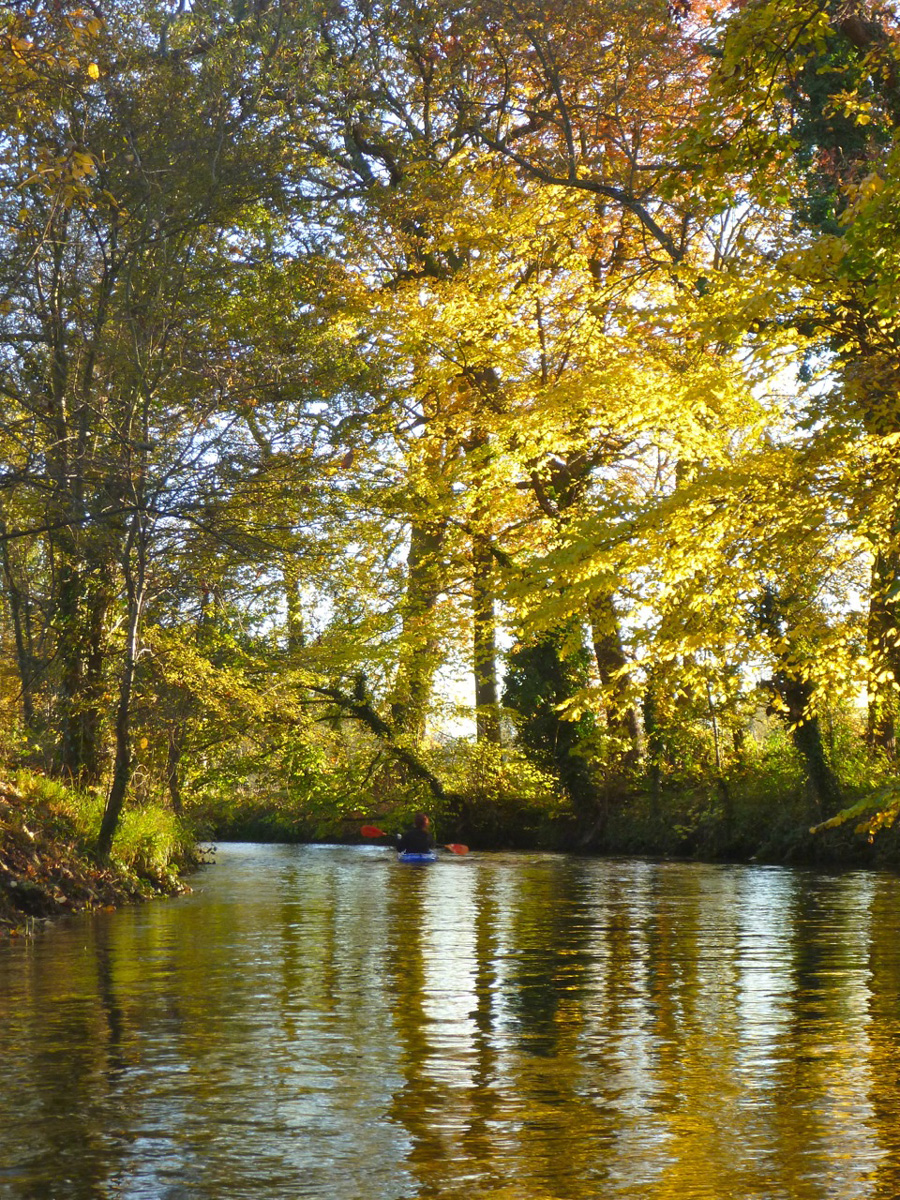
The last mile or two down to Packet Boat Lane passed without rancour as the late autumn sun seeped through the falling leaves. The current was speeding along by now and negotiating a squeeze around a fallen tree and some brambles, Robin managed to low side the unskeged Gumotex at exactly the point where Lois had tipped in on a previous occasion. Luckily he was also in shorts and hopped back in the Solar. Somewhere here there was a blockage of fallen trees and flotsam which we couldn’t paddle through and so made our only short portage. ‘Take out, rrrrrrriver left!’ yelled Lois, scarring the crows into the flight path of several 747s lowering their landing gear. Incredibly, Packet Boat Lane (near Iver) is actually a drivable ford across the Colne, rated at no less than five stars by the peer-reviewed wetroads.co.uk.
Once back at Lois’ cosy houseboat Robin couldn’t resist nipping back and having a crack at the car-swallowing ford on his well-travelled trail bike. I stood in the middle with water halfway up my thighs and filmed the action, thinking, ‘rather you than me, mate – it’s a long push back to Crawley’. Sure enough, before he got even halfway his Yamaha spluttered to a stop and we pushed it back like a couple of spotty teenagers trying out their first stolen bike. Back on the barge the throbbing woodburner and a hot bowl of soup soon thawed our chilled limbs as we tried to analyse what the heck was wrong with Robin’s moto, other than acknowledging an engine can’t run on water like a kayak can. We left Robin to it, I rolled up my Alpacka and rode back home across London. Thanks to Lois P for organising a great day out.
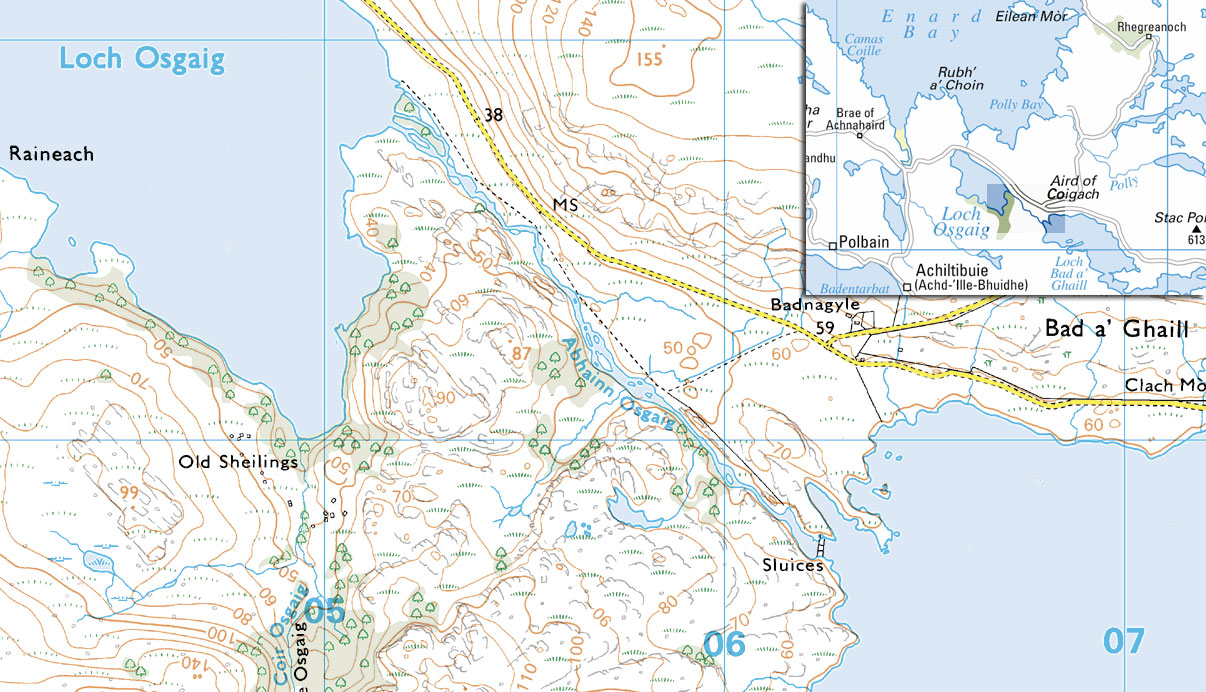
Don’t get excited, we’re talking a few hundred metres of Class 1.1, but that’s as good as it gets around here. We’ve had a lot of rain in the last week, enough to make the only paddleable river – the short Osgaig – worth a poke with a paddle. I was here with the Yak last year at slightly lower levels, so this time was expecting a smoother run in the Solar (now with an improved seat-foot set up), followed immediately by a comparison run in the Alpacka Yak.
Gumotex Solar IK The good thing with the Solar is it’s old, worth next to nothing but tough, so can be dragged like a hardshell with the Yak in the back. I considered jury rigging some thigh straps; it could be done now through the new footrest pipe and around the seat mounts, but looking at the river as I drove up, it wasn’t really worth it. Thigh straps are what makes any deckless boat – air-filled or hard-shelled – much more controllable when things get choppy. Even WW packrafters insist straps are the way to go.
With the skeg off, it’s easy to seal launch off a grassy bank and into the scrum just below the waterfall which looks a bit complicated so was no less inviting this year. As I spilled over the first little step I tried surfing like people do. But the Solar wasn’t especially dynamic or there wasn’t a strong enough recirculation going on to make it feel interesting. So I swung round and set off. Even at full flow, the Osgaig is a shallow, bony river better suited to an injection-molded TNP ‘spaddle’, not 220 quid’s worth of carbon-light Werner Corry which was picking up new scrapes as I jabbed at the water to keep the boat on line. It was really quite effortful with the Solar, at 3m or nearly 10 feet it’s perhaps a bit long for this sort of thing. I hit the one or two rapids full face, kicking up a satisfying splash and remembering that ‘bring it on’ exhilaration when trying an IK and white watering for the very first time on the Salmon River in Idaho all those years ago.
The river branched near the Loch; left looked all froth but too shallow so I swung right but again scrapped and shoved from one bar to the next. I was hoping to make it all the way to Loch Osgaig but up ahead I saw the tree strainer I recalled from last year so, stuck on another rock and by now steaming out of the ears in my heavy drysuit, I stepped out and walked back upriver.
Alpacka Yak Packraft A few minutes later I hopped into the snug Yak, spun round and slipped over the first drop. Spinning back, I tried to surf as I’d just done in the Sunny but it wasn’t happening. I guess the Yak is just too wide, light and too much drag to fight the flow. Off I went downstream, trying to avoid getting snagged while lining up to take the peak of what waves there were. Jammed in the yellow tub, sat lower and with higher sides, it felt much more responsive than the longer Solar and so was less effort to ride. Perhaps part of it was that a good line is less vital; most of the rapids I could have taken backwards and that added up to more fun. So there it is: a tight-fitting packraft is more fun on easy white water than a 3-metre IK. When I got snagged towards the end, I just stepped out, threw the boat ashore, and staggered out over the slimy boulders.
I’ve already done a couple of great packrafting excursions around the charismatic mass of Suilven mountain (left, viewed from the east). Last year we did a ‘triathlon’ loop up one side and down the other using bikes, feet and two-up in the Yak; and before that I did an overnighter from Loch Sion to have a look around. That second link has an intro to the region you may like to read.
So you’d think I’d know the local pack-potential well, but looking yet again at the map, I clocked an interesting if lengthy day out, packrafting around Suilven. I could walk east out of Inverkirkaig past the Falls to Fionn Loch, then paddle several miles of continuous water south of the mountain to cross a headland and then another short loch. From there I’d turn back passing a couple more lochs to Lochinver back on the coast. That was around 23 miles, plus another 3 or 4 back to the motorbike at Inverkirkaig. An eleven hour day for sure so unusually, I packed a torch.
The day of least bad weather arrived (today’s grim weather, right): overcast and 12°C with winds building up to 25mph bringing showers and afternoon sunshine. It would have to do; the rest of the week was forecast as much worse and at least I’d have backwinds paddling out.
Should they become hard to handle I knew I could hop ashore – that’s the great thing about packrating. But I also knew that cross country hereabouts is usually a gnarly combination of boot-sucking mires, moss-clad boulders and ankle-snapping tussocks of clump grass. Unless you’re a ground slug or sport a rack of antlers, when off piste in the trackless wilds of the far northwest, you’re often better off in a boat.
Nine 15 and I was out of Inverkirkaig with two fat sandwiches, two bananas and a cup. The thickly wooded valley with it’s not quite paddle-worthy river rose up to the 60-foot Falls of Kirkaig, but with filming and whatnot, it wasn’t till 11am that I paddled onto Fionn Loch (left) under a ceiling of thick cloud on the verge of incontinence. The rounded west prow of Suilven loomed above, trailing its cone-like tail like the giant goldfish in the Singing Ringing Tree.
I was reversing the section we paddled last year on the triathlon, and at a narrow point passed some small standing waves indicating a current flowing back to the river. Hmm, strange I thought. Approaching the mile-long narrows which maps call Uidh Fhearna, it was a stage which I’d somehow got into my head flowed eastinto Loch Veyatie, based partly on this picture I took last year. Turning south round a reedy bend and fighting what I thought was just the headwind, I took another turn and, like some astonished Victorian explorer, found the water flowing west, right at me. Of course it does. At the other end Loch Veyatie, Cam Loch drops through a series of waterfalls, and if Fionn here did the same, where did Veyatie drain – down some tectonic plug hole? There would be no Fellowship of the Royal Geographical Society for me this year.
Even with a backwind, there was no paddling up this Uidh (left), though I’ve read of hardcore canoeists poling it. So I unplugged the Yak and set off along the north bank to the far end where the Uidh opened out onto Loch Veyatie and lost its current. With no free ride to help outrun the afternoon’s predicted winds, my schedule slipped away. As the OS map shows initially, there’s a path as far as a stream a mile away. Who knows why, maybe that’s where folk fish, but of course the path itself becomes a mini river. I should have worn my long Seal Skin socks today, the short ones were already sodden but they still kept my feet warm. After fording the river I decided to continue cross country until it became too hard. That took less than 20 minutes by which time I’d already stumbled twice and, while negotiating one steep bank, actually feel a few feet into the loch! Luckily, no damage done so just up ahead I set my sites on a beach to deploy the raft. It was now 1pm and with that walk covered at around 1.5mph and getting slower; better to get on the water. But first, for amusement purposes I filmed myself from unrolling the Yak to paddling away. It took 8 minutes, something that you’ll see below is made a little less boring to watch by speeding up fifteen times.
An exposed hour’s paddle down Loch Veyatie ensued. I turned out of the cove into the wind, hurrying for the south shore to get into the southwesterly’s lee until the next narrow point where I’d cross back to the windier north side to line up for my take-out. As I passed across the mouth of the sand-spit inlet of Loch a Mhadail, gusts blasted out fetching up some whitecaps. It’s all in the mind of course, but I really don’t enjoy bobbing about alone, mid-loch and out of sight on a chilly September’s day without a drysuit or PFD. One good thing with the Animas backpack I was using for the first time was that like my UDB, it doubled as a reliable float bag. Although there was virtually nothing in it bar my lunch and a cag, that was the reason I sealed it full of air.
The overhead gloom and rising wind was eating up a lot of nervous energy, but that wind was also pushing me along at what turned out to be 3mph, more than double what I’d have managed staggering along the shore, and more direct too. Another reassuring surprise was spotting the buildings at Elphin on the A837 at the head of the Loch. I’d forgotten how close I’d be getting to the other end. Paddling with the wind past the south shore, cascades ran off Cul Mor and scraggy patches of original woodland clung to the foreshore. I counted them off on the map as markers to my take-out, and with a dash over to the north side, that came up just as it looked on Google Earth last night. What a great WYSIWYG navigation aid GE is. Let Google harvest all my dreary browsing data to throw back at me as targeted ads. It’s a price worth paying for their sat mapping services.
It was only when I crawled out of the boat and stood still that I realised how strong the wind really was, roaring over the hills and bating down the grass. Even though it was less than a mile’s walk to the other side of Creagan Mor headland, there was no chance of leaving the Yak inflated. Instinctively I headed for higher ground, scattering some deer far ahead, but my route soon led to a cliff so I dropped back into the bog and tussock valley that brought me to Cam Loch’s shore. Here I felt I could relax sufficiently to eat something. My cup was MIA, out on the loch somewhere, so I scooped up a drink by hand.
One more loch to cross; easily done no matter how windy it’s become. Somewhere on the north side the map promised a path that led 12 miles back to Lochinver. All I had to do was slot myself onto it and ride it out for as long as it took. Whitecaps rolled passed me as I neared the north shore of Loch Cam, but what had had an edge of dread on Veyatie just an hour or two ago was becoming familiar and a bit of a laugh as the promised sun stuck its nose out for a sniff at the day. After airing down I soon hooked up with the stony trail, but found I was wavering a little, probably through not eating or drinking enough. It was now 3pm; six hours on the go but I’d only actually walked some 4 miles up to that point, so the legs had plenty left in them and there was drinking water running down the paths.
On occasions I’ve harboured thoughts of cycling this path from Lochinver to the A road, but from the state of it at this end I’d not get 10 feet. It followed a hard, white rim of exposed stony rubble that’s visible on a sat image, but I suppose was better than the mush to either side. Light grey and crystalline, I’ve since read it’s Lewisian gneiss or quartzite which gives the appearance of snow to some of the Assynt’s mountains like Canisp or Foinaven (see long image below). This whole region is marked with monoliths, the most striking of course being the remnant sandstone outliers like Stac or Suilven which resisted their brush with the glacier’s claw as it passed through, exposing the ancient base of lighter coloured gneiss.
I’ve kept missing the interesting ranger-led talks at Knockan Crag, just south of Elphin, he site of the Moine Thrust which literally turned geology on its head a century ago.