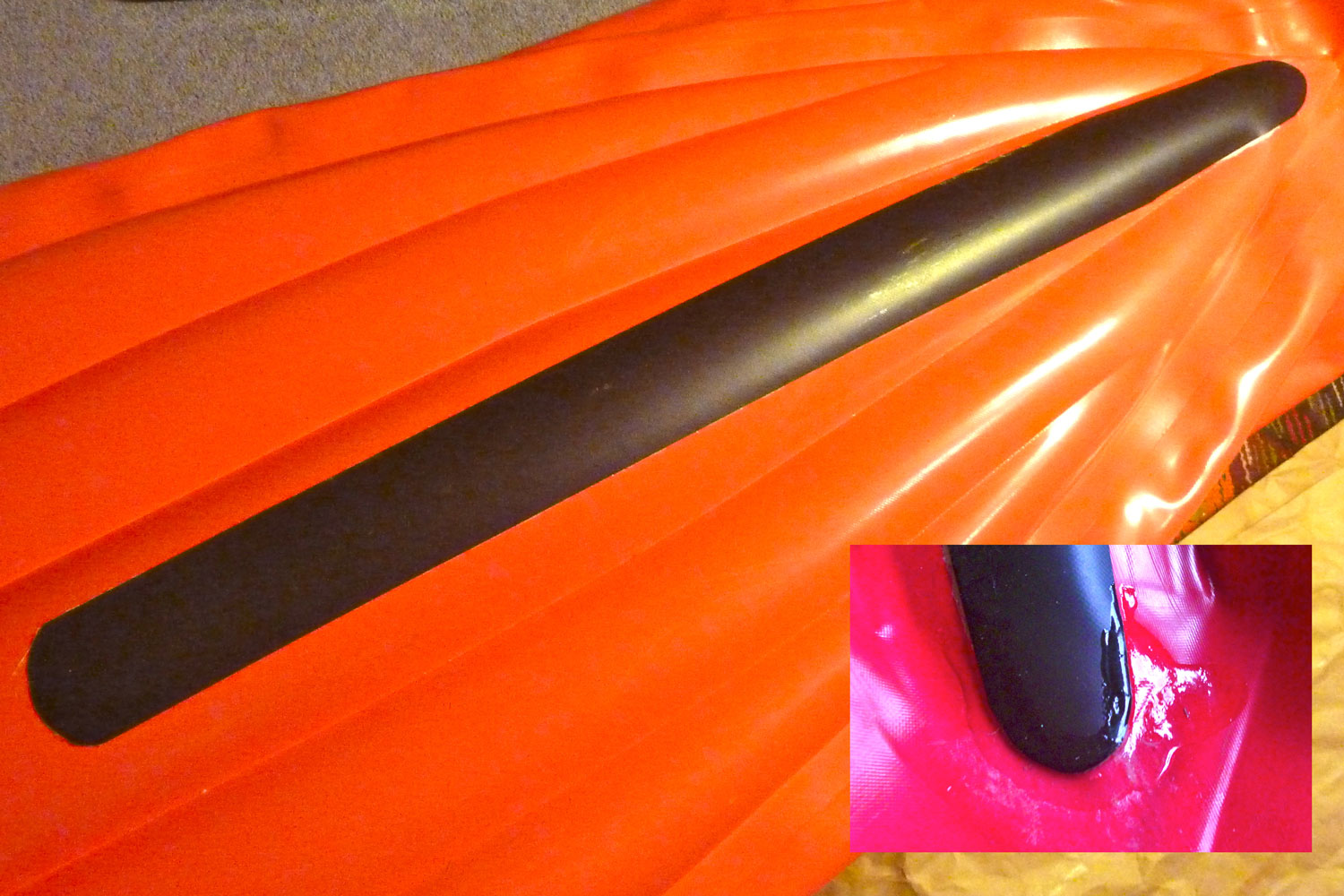
Grappling to get the boat out of the muddy Medway river at Yalding one time put a light scrape on the hull. It reminded me that, along with fitting PRVs to the sidetubes, another winter job was to fit a protective strake under the bow where most scraping occurs. Better to get the protection in early while the boat is newish.
A 70 x 15cm Hypalon off-cut (close enough to Nitrilon) was 14 quid on ebay and once trimmed left enough for another strake or two. I had some Polymarine two-part adhesive (below) and glued the strip to the boat’s curved form with the floor inflated, even if that meant working the roller to press it all together was less effective. I then slathered some Seam Seal around the nose of the strake to protect it from unpeeling (less runny Aquaseal would have been better but a Seam Seal tube was open. More on glues here).
2021 Update A strake is a good idea but actually got hardly worn, so on Seawave 2 I just stuck on some Gorilla tape, maybe two layers, in the same place. Easily renewed/removed.
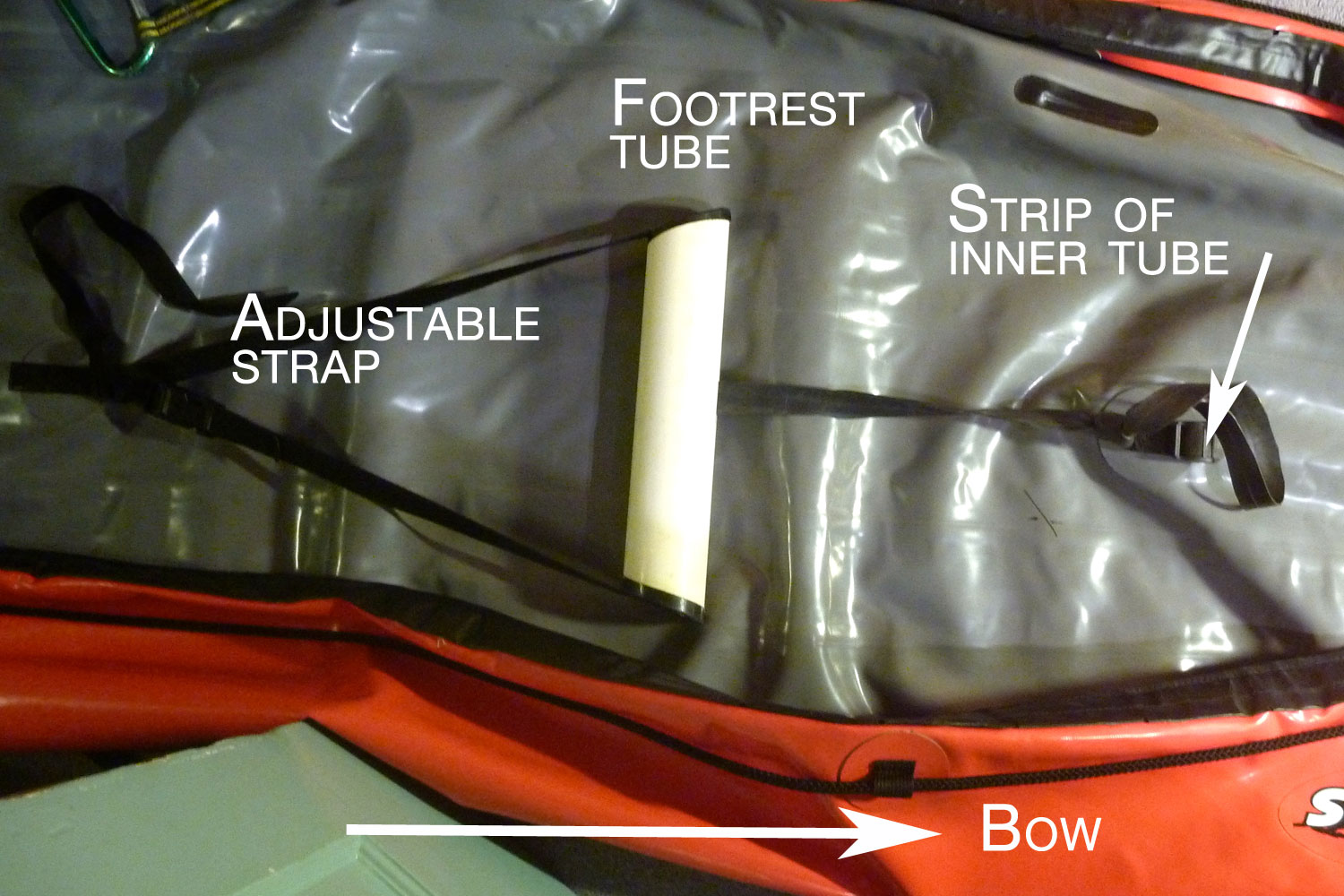
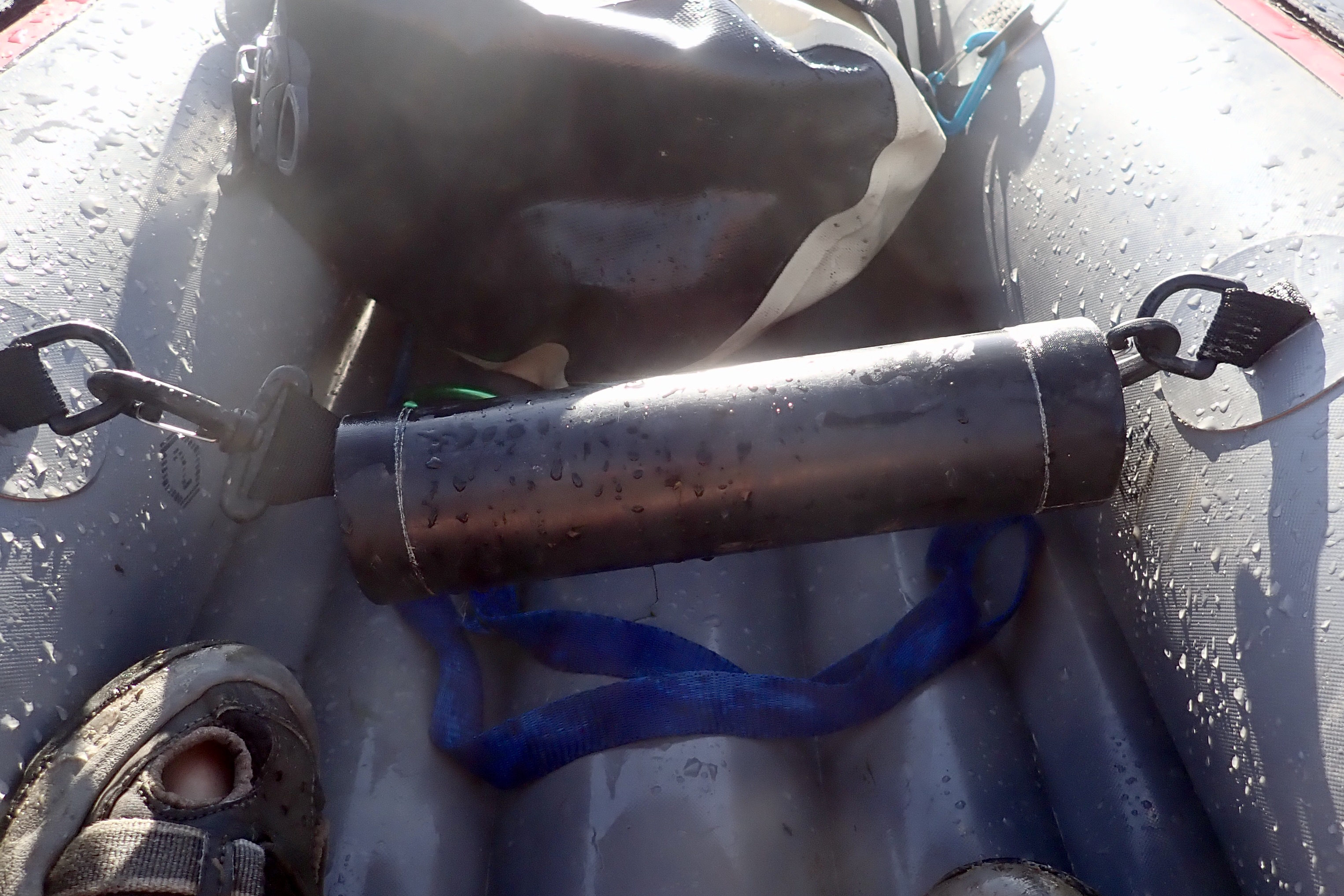
While the boat was filling the hallway and causing a hazard to domestic navigation I also bodged up a better system for the all-important footrest. A bit of inner tube now counter-tensions the footrest from the bow to keep it in position. It means the thing is now fully adjustable across a wide range of positions, can easily be fine-tuned from the water, removes in seconds for boat cleaning/drying and needed no extra fittings glued to the boat. Once great thing about the Seawave is the multitude of attachment points on the floor and sides.
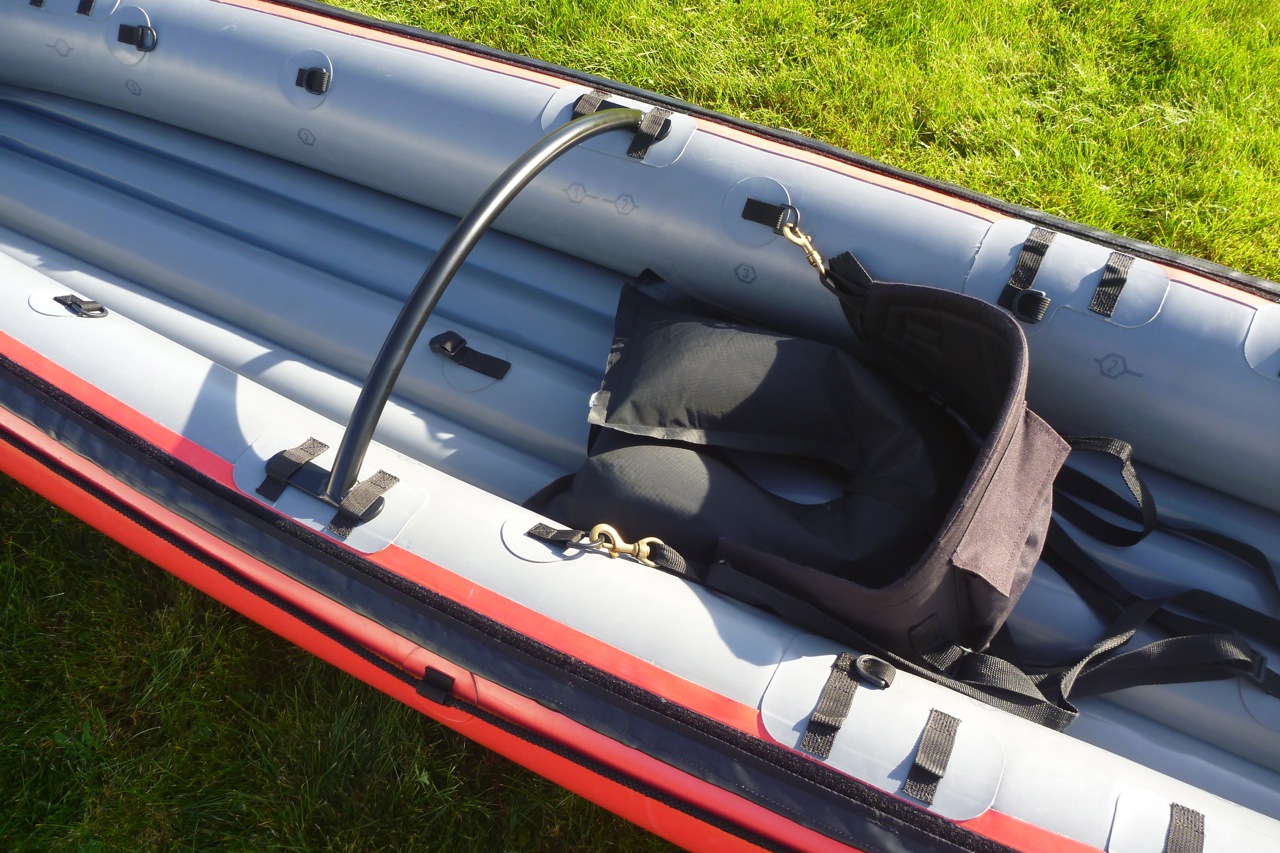
While on the river my aged Mk1 Alpacka U-seat base went flat, split right in the U. This seat is part of a lighter and comfier system I brought over from my Amigo – an improvement on the one-piece Seawave seats. It’s currently unfixed to the boat and the thin nylon must have ripped while yanking it into position on the river after getting back in. Again, I’m trying to avoid gluing extra D-rings to the hull – they’d limit seat base adjustment options anyway.
Better then to attach the seat base to the base of the backrest with a couple of zip ties. The whole backrest/seat base can then slide forward and back off the backrest side straps and it all unclips from the boat in less than 3.7 seconds. I glued up the punctured U-seat but it won’t last, so I’ve ordered MkII Alpacka seats (left) from Packrafting Store: €70 delivered for a pair. From Alpacka US the seats cost $25 but their auto-calculated international postage is nuts, let alone tax and VAT issues. These seats have the U filled in like a webbed foot: stronger and less floppy for just ~12g extra weight.
Seawave 2 seats and thigh straps
2021 Update. I’m using the same system on Seawave 2; a non-U packraft seatbase and a used backrest off a Bic SoT with a piece of stiff plastic board slotted inside.
Heavy
Better
I’ve also ditched my old my SoT thigh straps (left). Nicely padded and effective though they were, the brass spring connectors and padding made them feel heavy and bulky at ~720g.
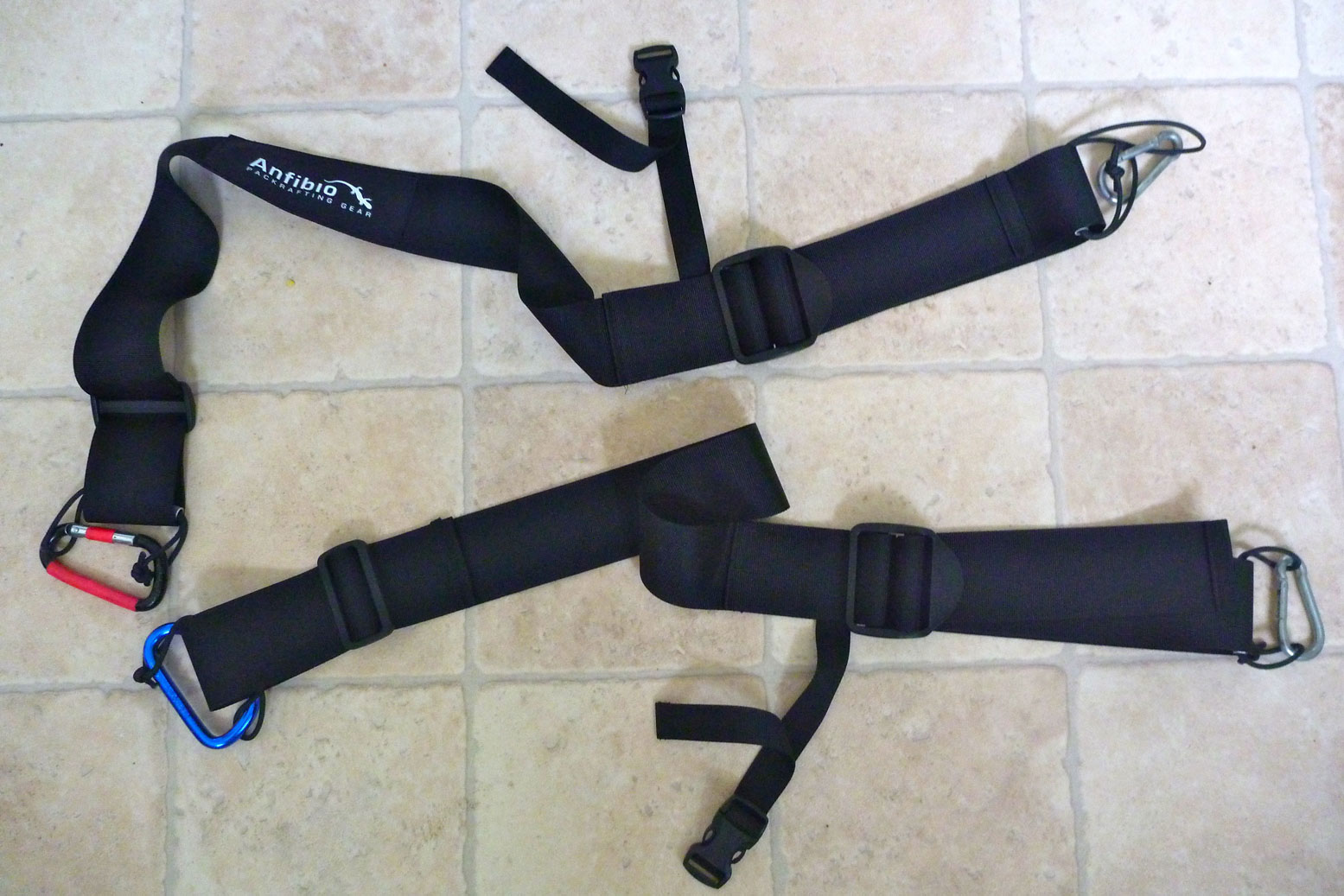
Instead I got some non-padded Anfibio packrafting straps (they’re different now). With my biners they come in at 270g. The delta-straps dangling off the sides are a clever idea, designed to give a more direct pull when rolling a packraft for example. Can’t see myself doing that in any of my boats. Whether you’re rolling or just paddling, in rough water the more direct connection with the boat the better. I’m a big fan of these light but effective straps now. No need for paddling.
Clipped together is actually the wrong way – entrapment hazard!
My Gumotex Seawave was a well spec’d IK for my sort of coast-hopping and occasional touring, especially as it was factory rated to run at a higher-than-usual 0.25bar or 3.6psi (Gumo normal is 0.2). That means greater rigidity which adds up to less longitudinal sag caused by paddler weight (who, me?!) . And of course a better g l i d e. My previous Amigo and Incept both ran an even higher 0.3 bar, and it’s said that this Gumotex can also be pushed to that sort of pressure on the side tubes without risking damage. Factory hull pressures are set on the conservative side to limit warranty claims.
Like all the Gumboats I’ve owned, the more vulnerable I-beam floor chamber has a factory-fitted PRV set at 0.25bar/3.6psi (confirmed below). PRVs are important here as if an IK gets hot (typically out of the water on a sunny day) internal air pressure can increase to the point where seams might rupture. If separation happens to an internal I-beam in the floor it will balloon up and becomes irrepairable. I would not meddle with the factory-set PRV on an I-beam floor. As we all now know, the answer to I-beam floor limitations is drop-stitch technology – effectively zillions on ‘I-beams’ spreading the load over the entire area which enables much higher pressures.
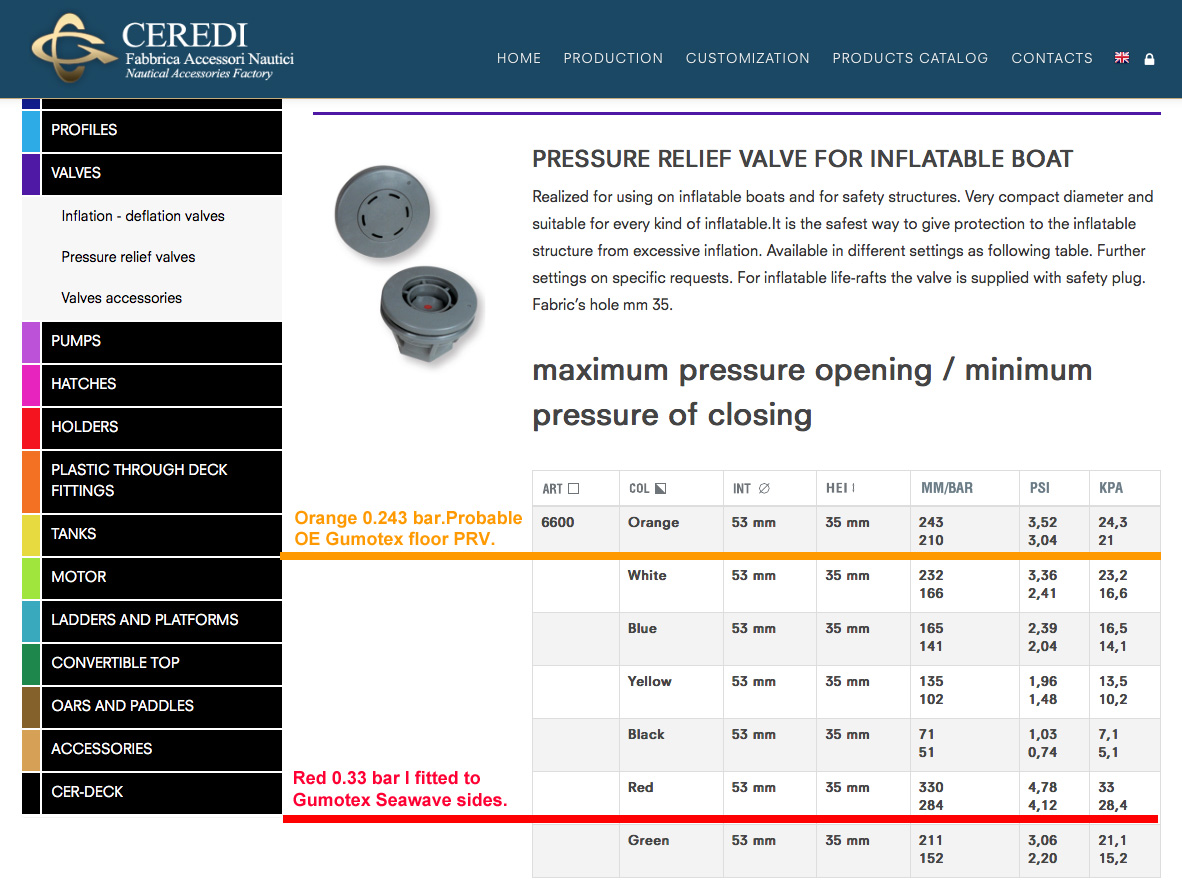
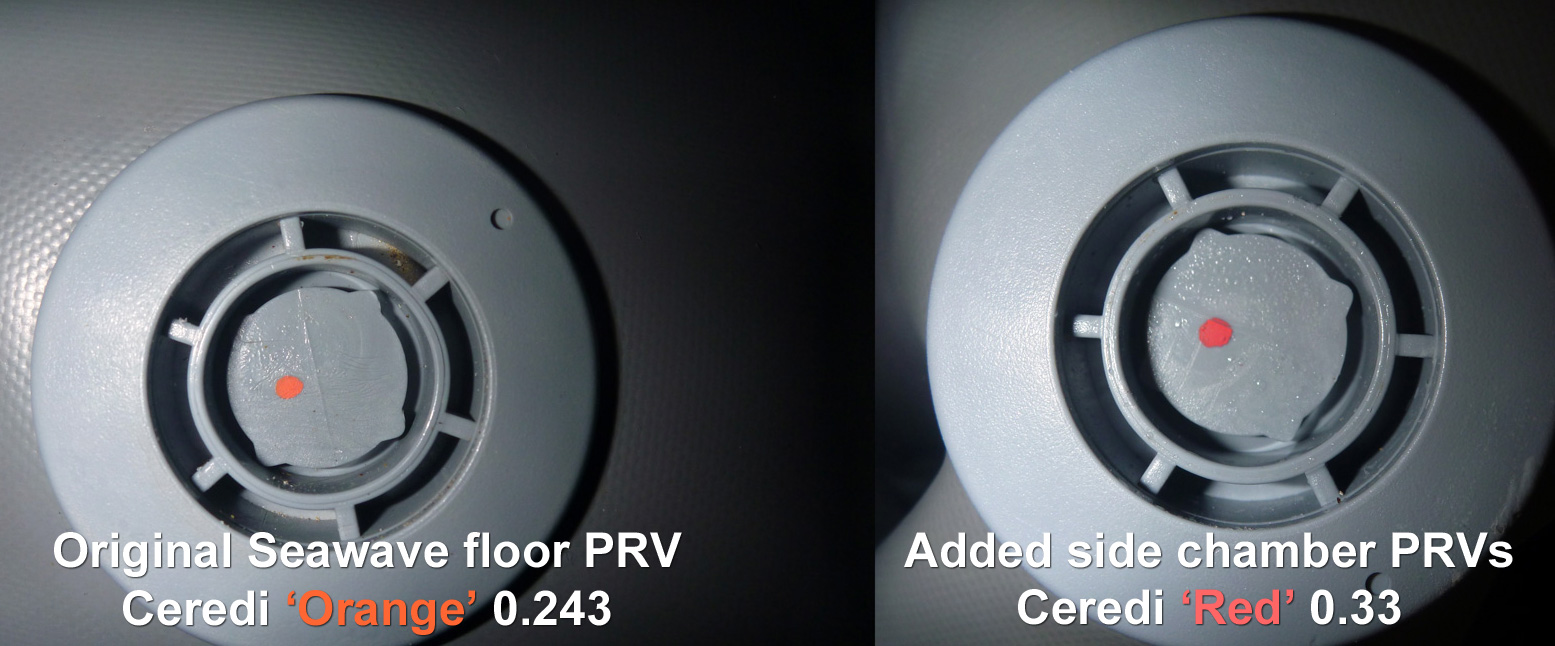
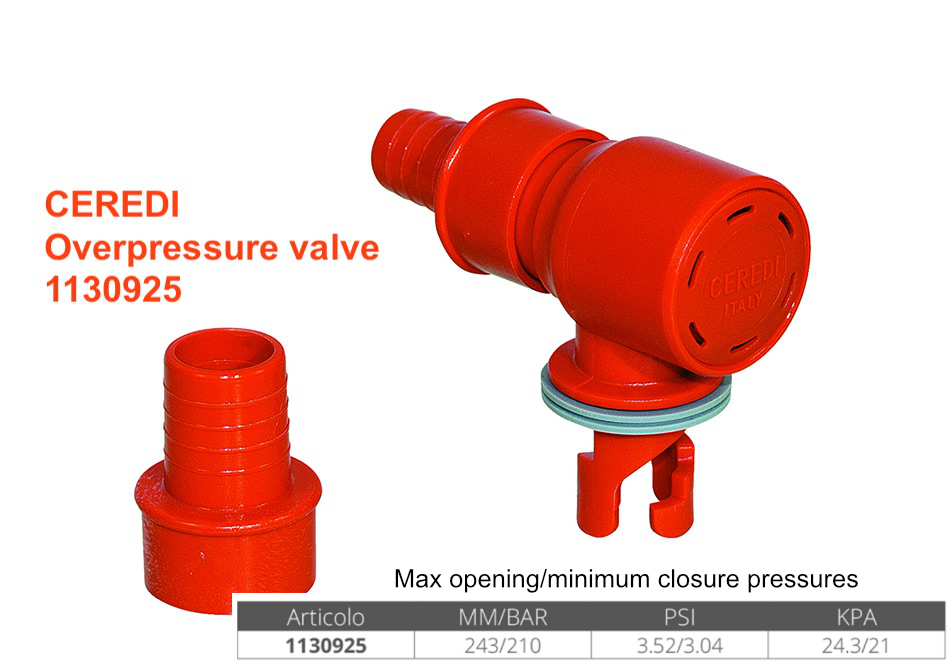
In a discussion with a French Gumtexer, he suggested that Gumotex use the same orange dot 0.243 PRVs in all their boats, irrespective of the stated official rating which is either ‘0.2’ like most – or ‘0.25’ on the Seawave. He sent me a photo of his 2016 Palava floor PRV (left) – orangey-pink, same as my Seawave and classified by Ceredi as 0.243. Officially the Palava is a ‘normal pressure’ 0.2 bar canoe. Upshot? Your Gumboat’s floor may be rated at higher pressure than you think or is officially stated. You’d assume then that the tubed sides can easily handle at least as much pressure. Then again, in the table below, Ceredi state the orange PRV will open between 0.21 and 0.243 so perhaps 0.21 it is and we all just need to calm down a bit.
PRVs use springs set to purge air before pressures reach structure-damaging levels. Then again, my Amigo had no PRVs at all so you assume Grabner were confident their floor construction was solid enough to handle occasional neglect. But I’ve been caught out before and always try to ensure a boat remains in the cooling water when moored up on hot days – even getting up to splash the sides as they tighten up like a drum.
Like most IKs with single side tubes, my Seawave had no PRVs as the tubular profile can handle higher pressures better than the flat, ‘lilo’ floor. However, if you’re planning to run the side tubes over-pressure as I am suggesting, that could be risky. The answer: fit PRVs in the side tubes – just like my old twin side tube Incept. That way you can safely leave you IK out of the water in the tropics, go and hike up a volcano (which might be described as ‘the planet’s PRVs’) knowing that all three chambers will harmlessly purge any excess pressure. Sure, when it all cools again back in the water the boat may be saggy, but better a quick top up with your K-Pump than pulling bits of shredded Nitrilon out of the palm trees. Ideally I was looking for a PRV set at a reasonable 33.33% over the factory figure of 0.25 bar – i.e.: something around 0.33 bar or 4.8psi.
I admit that the colours look pretty closebut it’s pinky-orange for the OE floor and red for my 0.33s
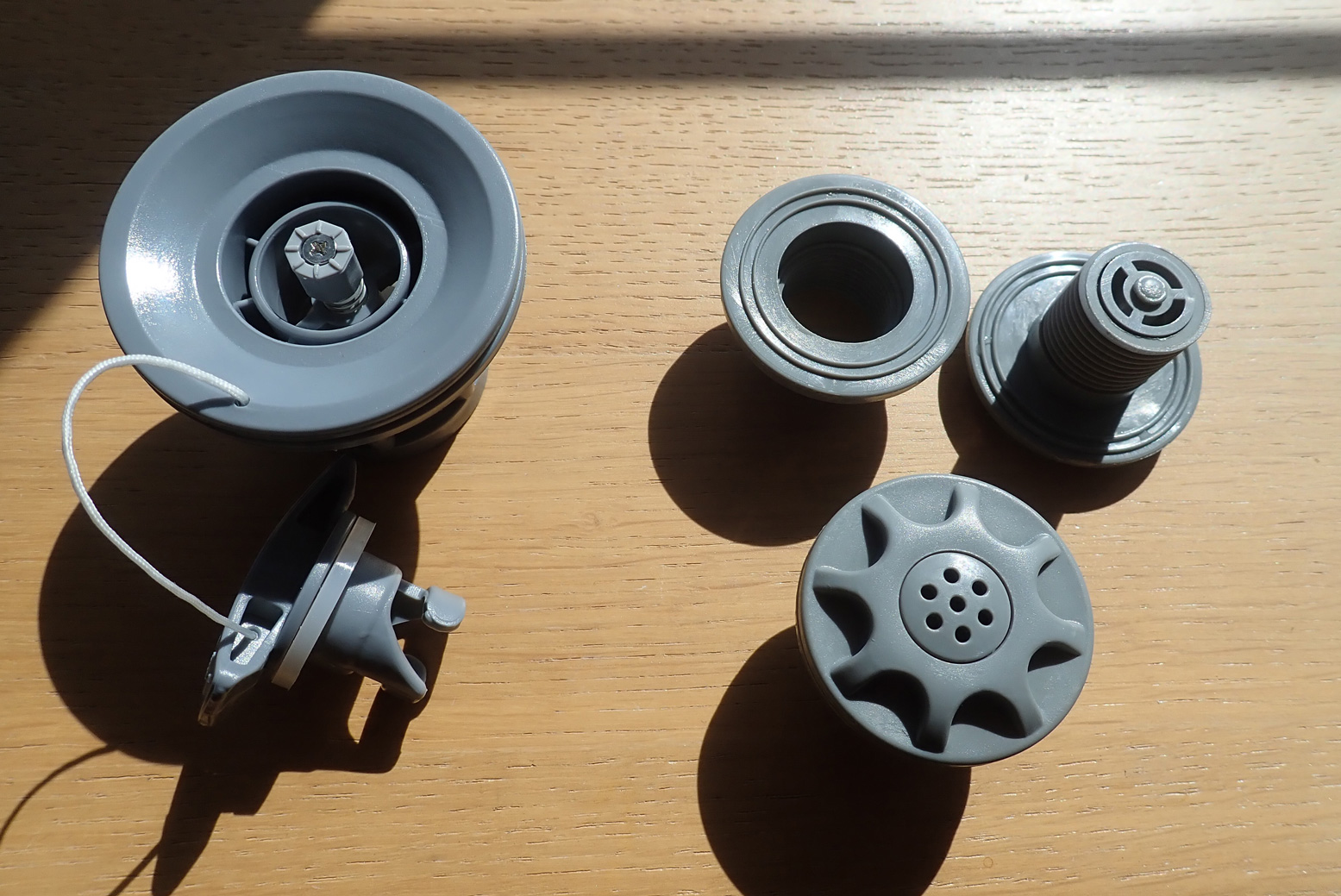
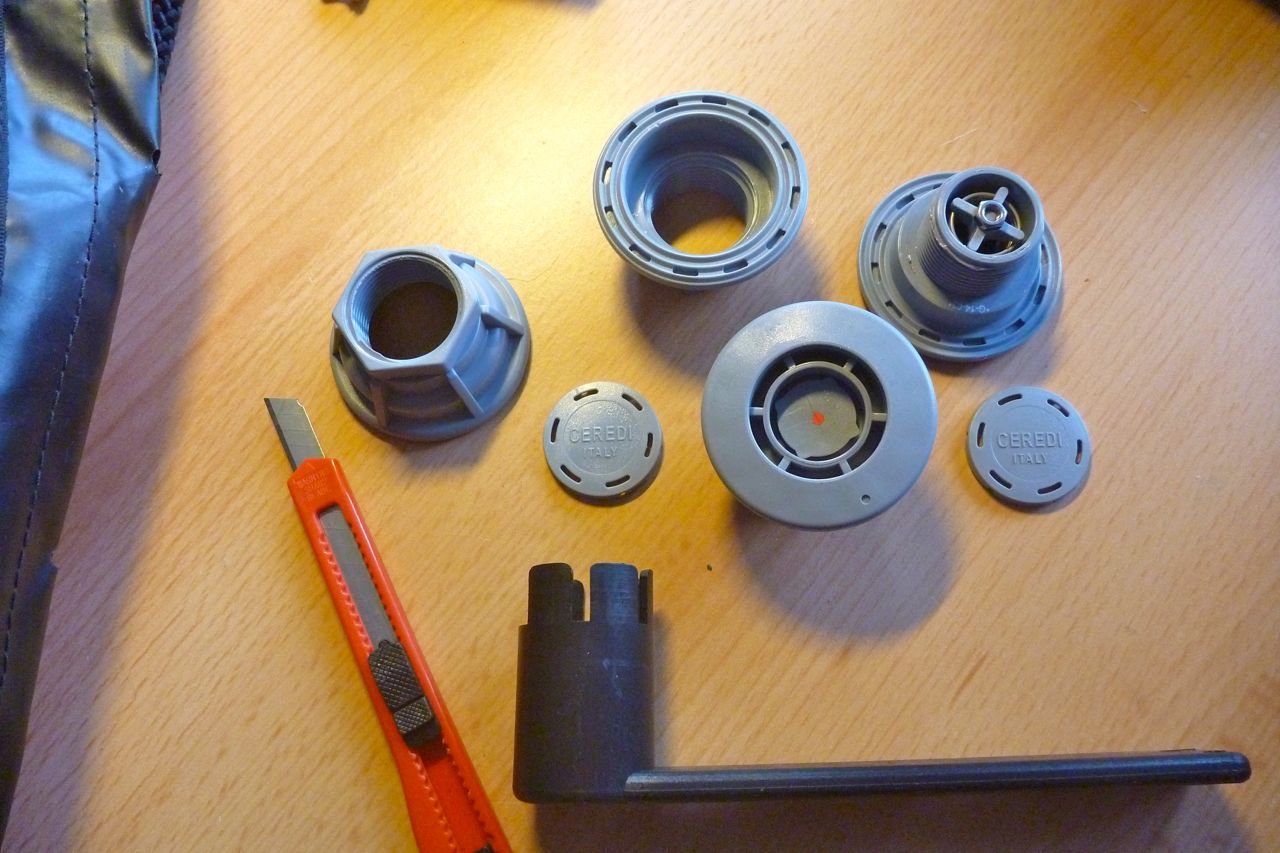
Well-known IK valve-makers Leafield and Halkey didn’t make anything matching my needs (or don’t sell to individuals). The Seawave’s valves are stamped ‘Ceredi Italy’ and once I managed to track them down online, I saw the same Ceredi 6600 PRV series came in options including Red 4.78 psi / 0.33 bar, (above right). In the UK they were a special order via IBS and cost £42 a pair + post.
Ceredi prices too steep for you? On eBay I bought unbranded ‘4psi‘ PRVs from China now £8 a shot and delivered in less than 2 weeks. Note these are smaller than your Ceredi and require only a 25mm hole. The back nut will easily fit through the inflation valve hole, once you remove that. I pressure-tested the valves I received and they stood up to the claim: More here. Search eBay: ‘Air Safety Release Valve Kayak’.
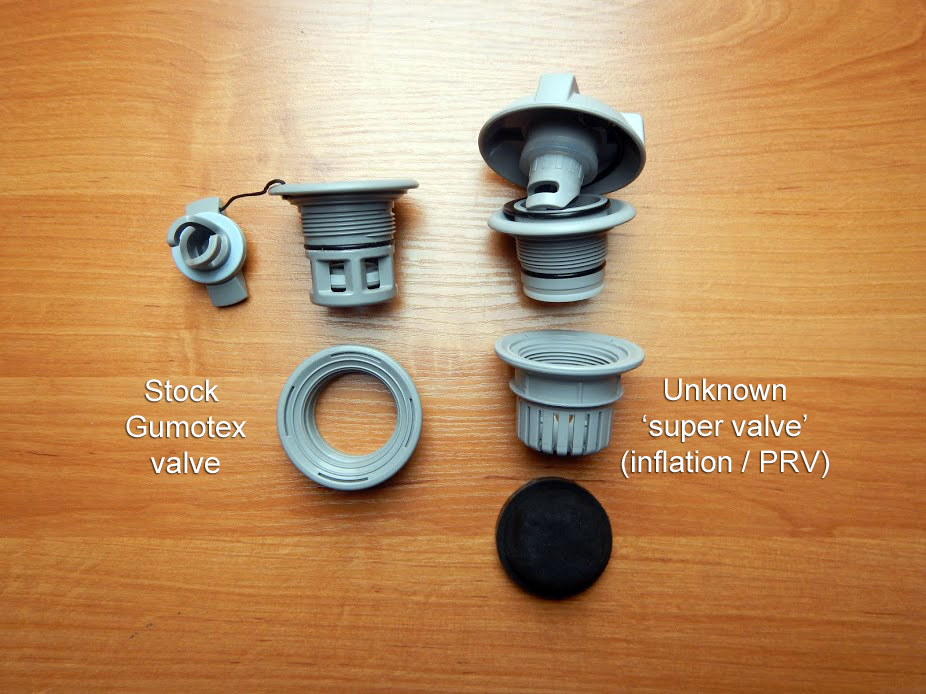
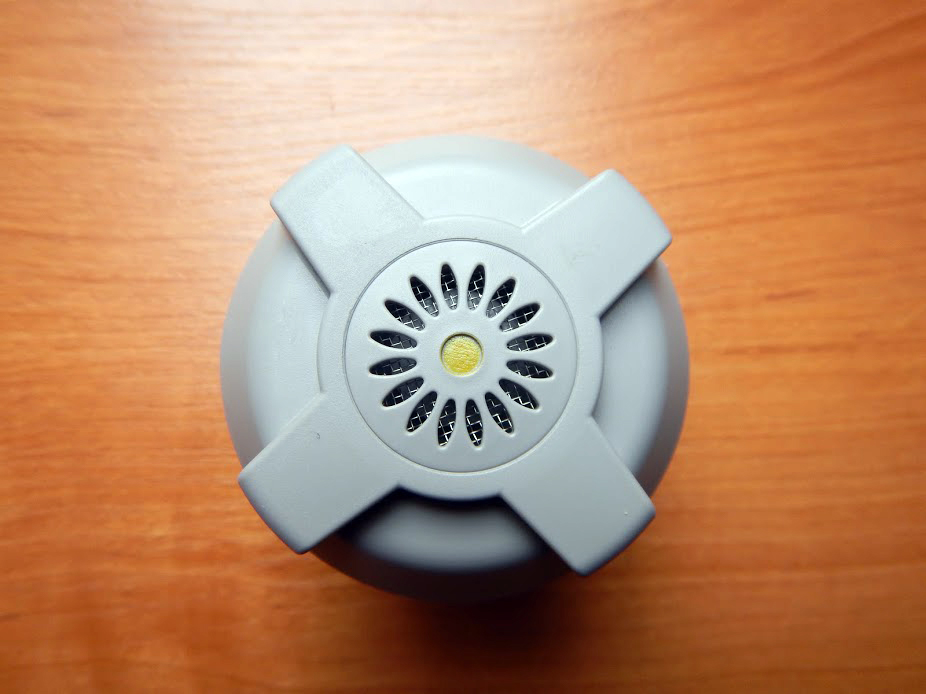
As you can read from Adam’s comment below, there is – or more probably was – a super valve which combined both inflation and pressure-release duties which means you simply replace the stock inflation-only valve. No need for extra holes to be cut. His link no longer works but I tracked it down to here; the Bravo Super Valve – that’s Bravo as in the Italian branded Chinese-made pumps we all know and love. But there is no mention of a super valve on their valve page anymore, nor in their catalog.
Fitting the Ceredi red dot PRVs
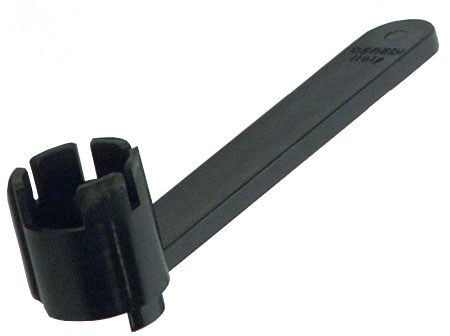
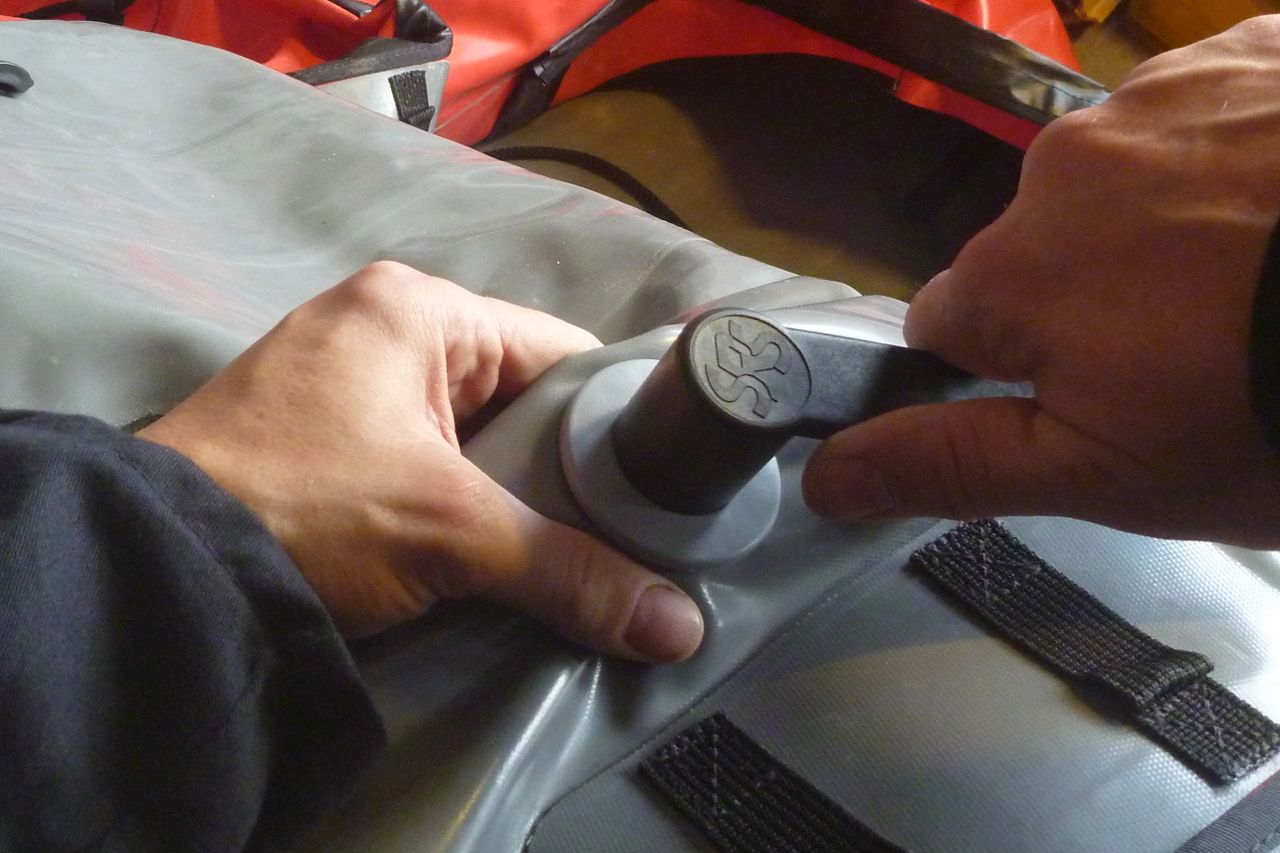
Tools and time needed • Gumotex push-push valve removing tool (fits Ceredi PRVs also). Right; £12 on ebay • Narrow-bladed knife or scalpel • Water pump/lock channel pliers • 30-60 mins
Short version • First, remove the side chamber’s inflation valve with the tool. They can be extremely stiff. If you can’t undo it, maybe think twice before going ahead. Or try silicon spray grease of 303 protectorate to lube
• Choose your spot, mark and then cut a 37mm hole in each side chamber. The Ceredi-suggested 35mm was not enough.Or fit the smaller, unbranded mini PRV (~25mm hole); see above. • Squeeze the PRV’s threaded back collar through the bigger inflation-valve hole, shuffle it over to the new PRV hole and loosely screw on the external part of the PRV by hand • Reassemble the inflation valve and tighten both valves with the tool • Fit push-on caps to the PRVs • Pump up and check for leaks. Maybe retighten some valves with the tool
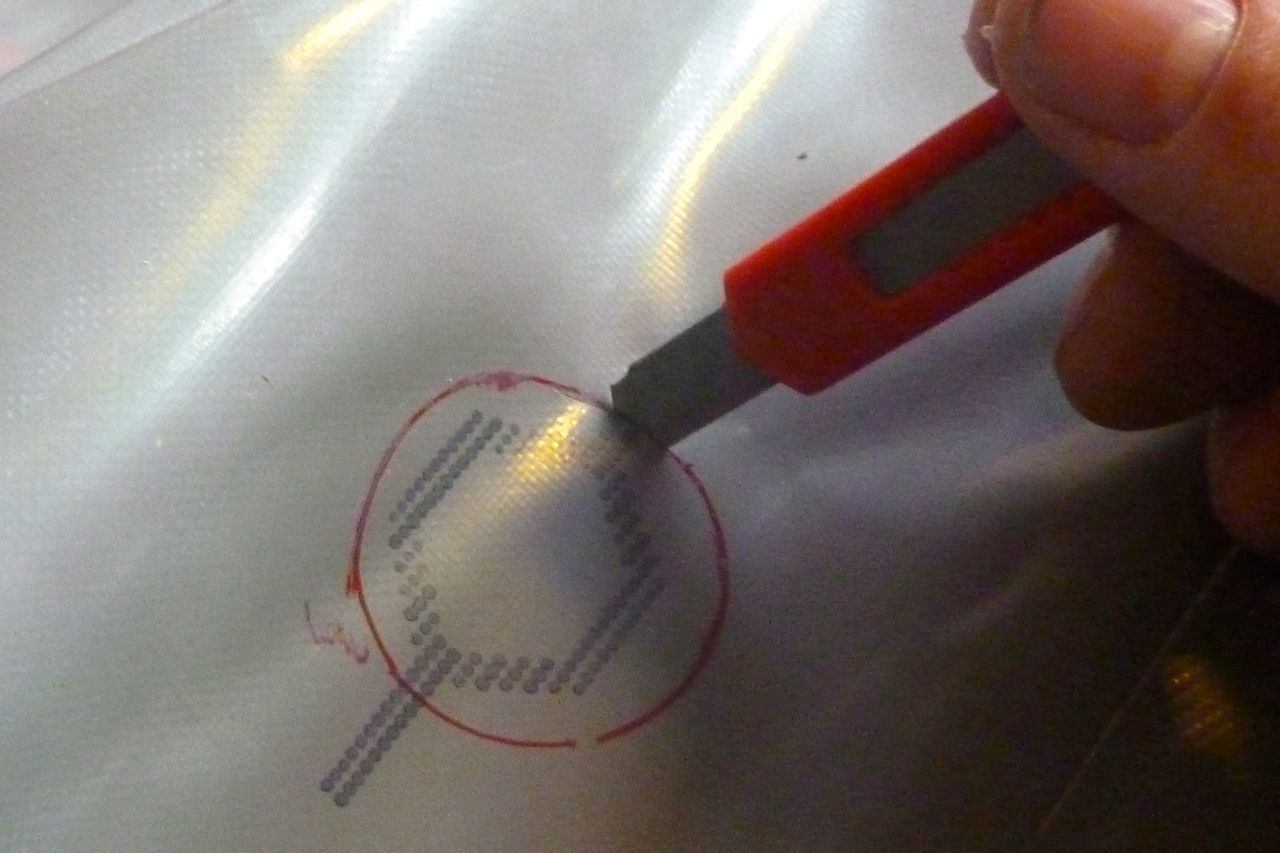
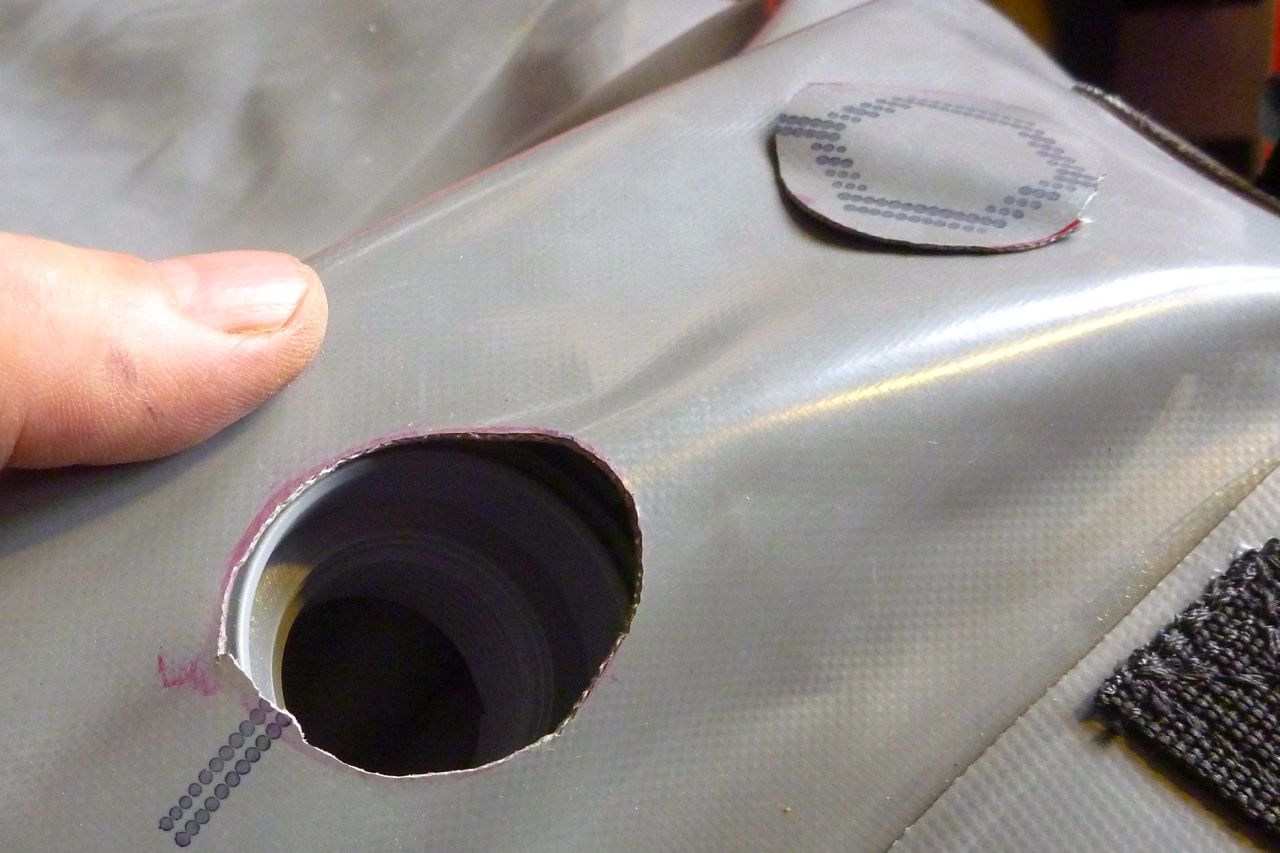
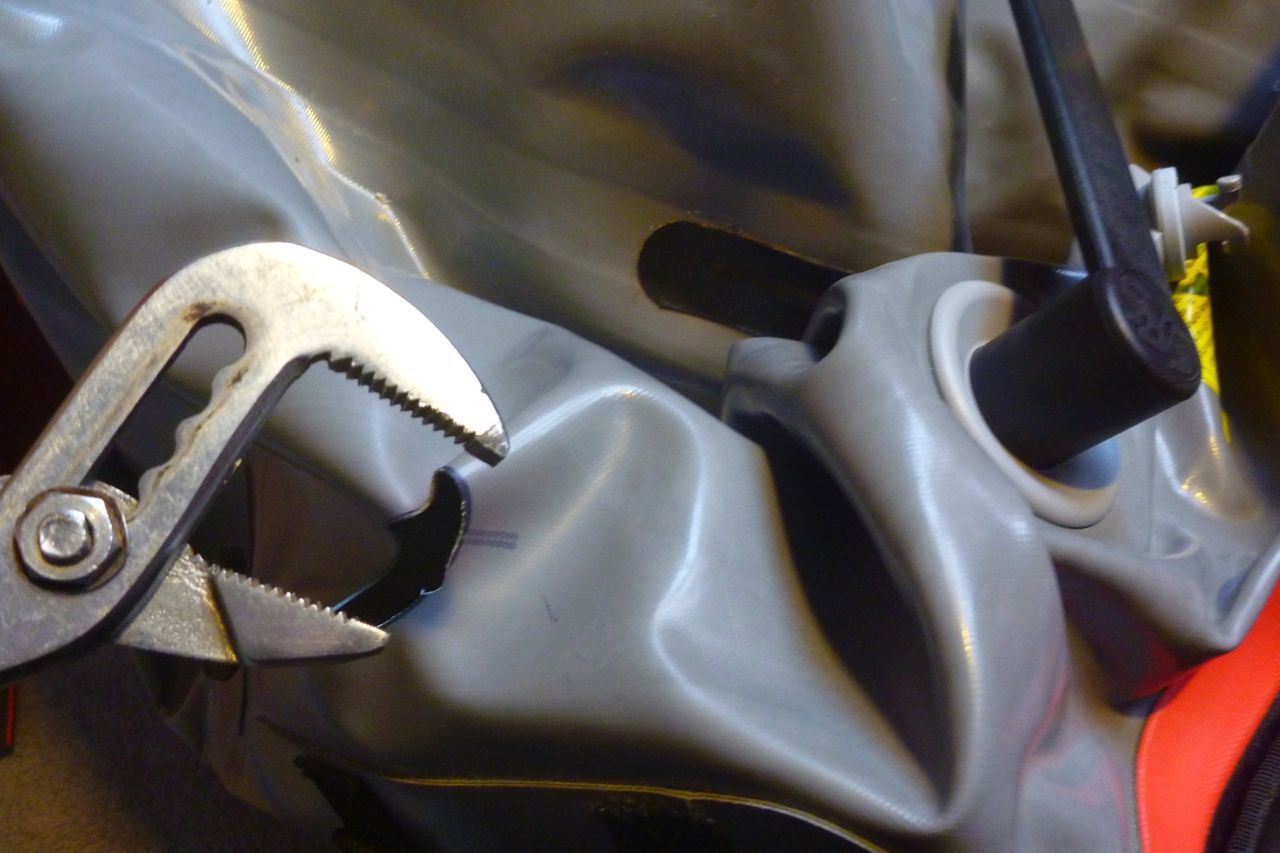
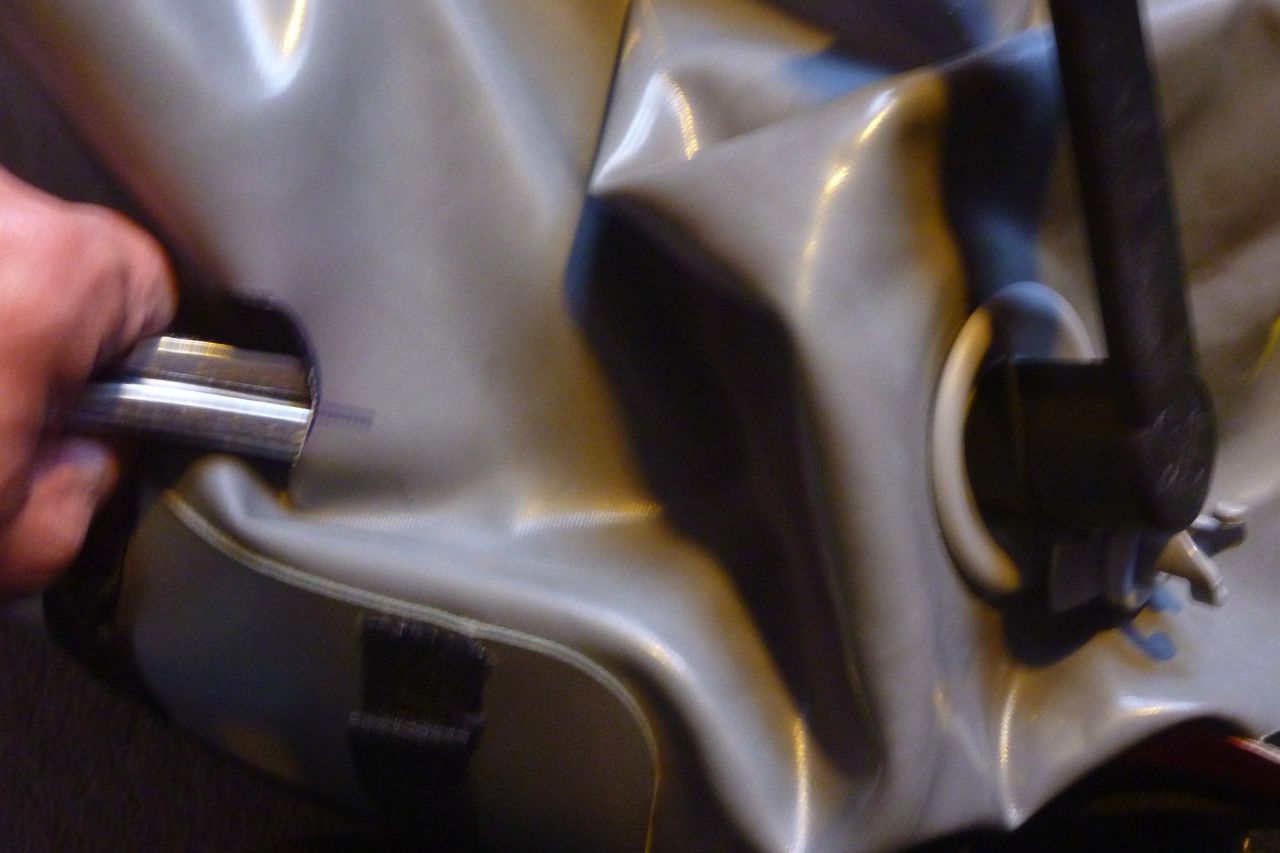
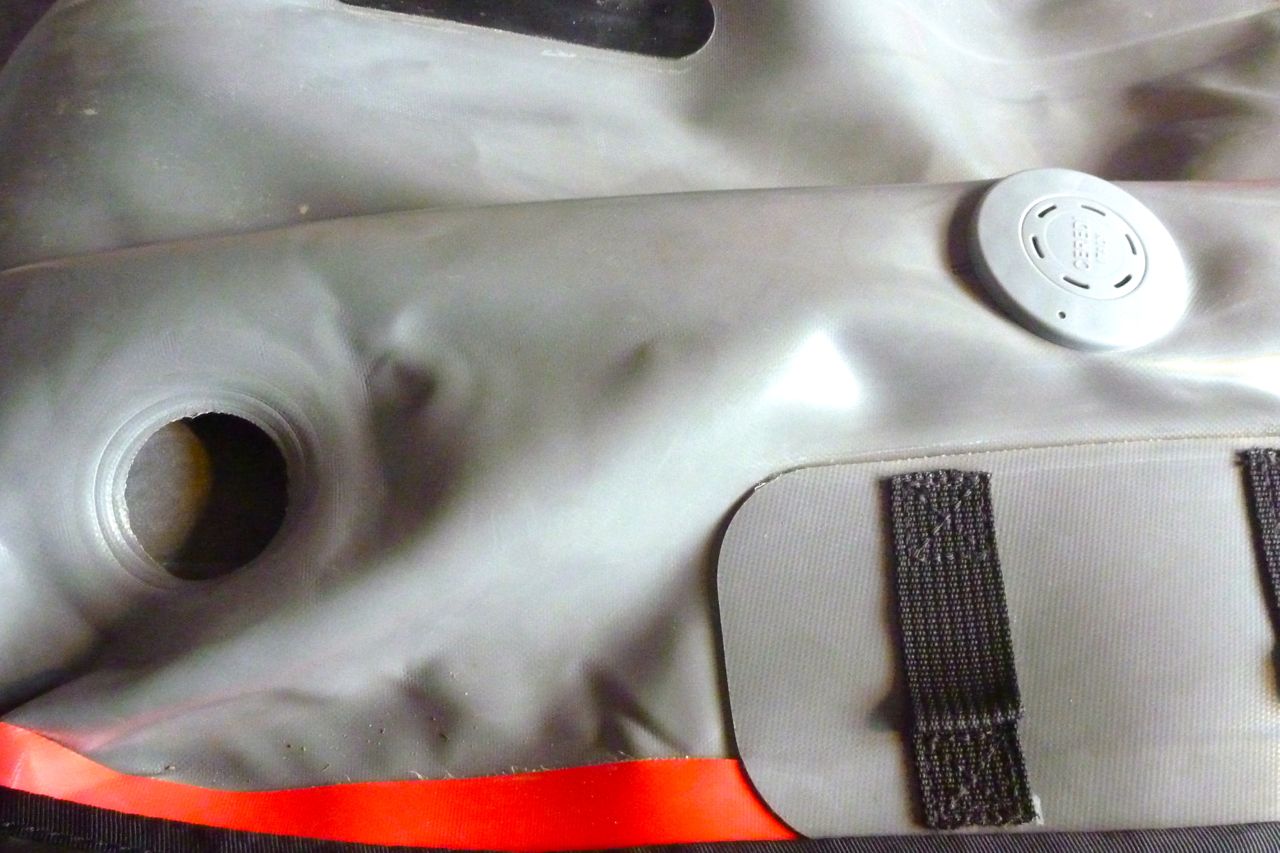
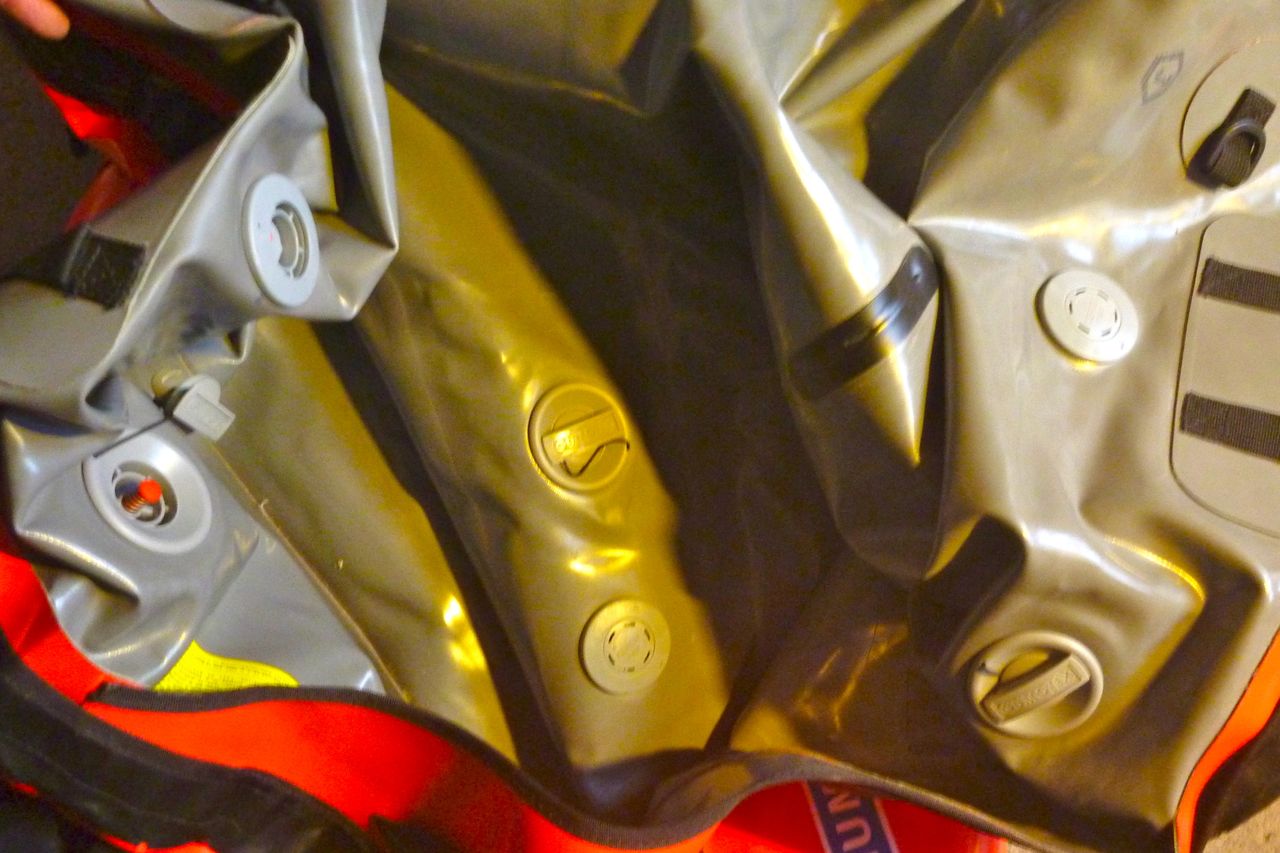
Long version I chose to fit the PRVs close to the inflation valves and at about the same level. There are mysterious markings on the inside of the Seawave to aid symmetrical positioning (Pic 2, below). I used a narrow-bladed knife and of course took care to gather up the hull skin so I wouldn’t inadvertently puncture the other side of the side tube. I assumed the 35mm hole would be big enough to take the back nut. When it wasn’t I was a bit flummoxed. Now I had a gaping hole in my boat, but no way of getting the back of the PRV inside the boat without performing a Caesarian on my Seawave. Luckily two brain cells dropped into my Hadron Collider and it occurred to me that once removed, the nearby main inflation valve’s hole might be bigger. And it was – just. One stock push-push valve was extremely hard to undo. I wondered if it had been glued in or that the plastic valve removal tool would snap (you can buy a metal one for loads more). When the other side undid with less effort I knew it had to be possible.
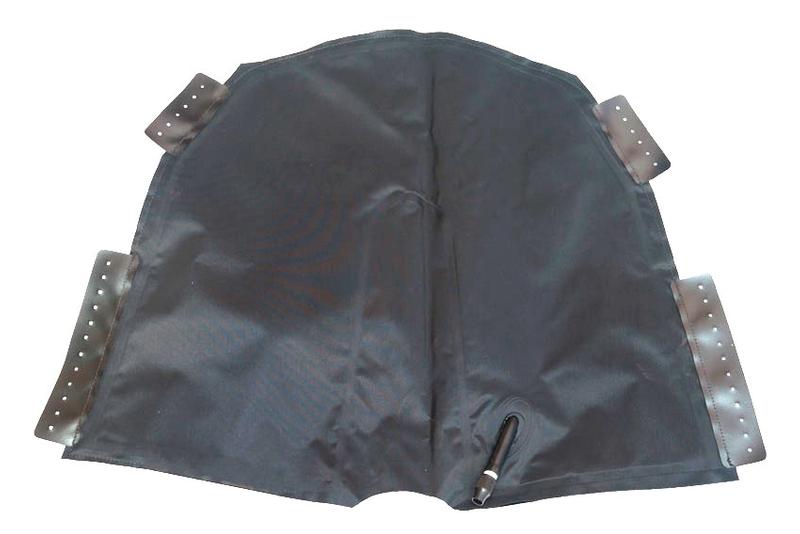
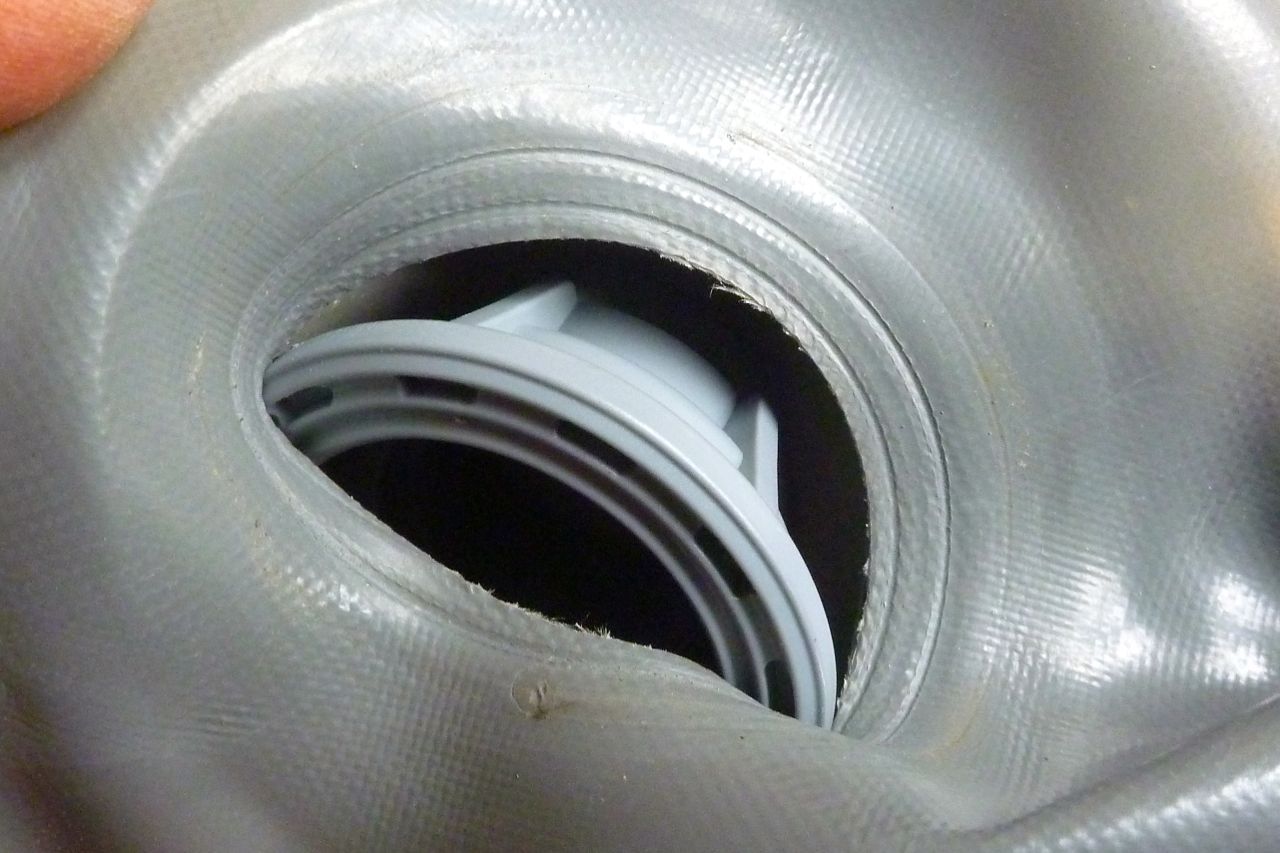
Another problem is that the internal collar or nut is only 10cm deep (pic 4, below) and so was hard to grab through the hull fabric. Until I realised this, I was grabbing the inside part of the outer valve body which screws through the collar from the outside. Trying to ‘unscrew’ the valve body from itself is like trying to pull you head off – eventually the valve tool would break. Another ‘Higgs boson’ moment came over me and I realised that by chance the two valve holes were close enough for me to get some water-pump pliers in there, grab the back collar and finish the job (pic 6, below). After that, no more problems. One thing I noticed while doing all this was the unseen protective patch on the inside of the hull opposite the inflation valves to limit wear and rubbing between valve body and hull when the boat’s delated. Nice touch, Gumotex ;-)
I did all the valves up as hard as possible with tool and hand, and in four more years had no problems. On a hot day in the sun I can hear the high-pressure side PRVs hissing away. The gallery below shows the job in chronological order.
The bits you need. Note the adjustment nut, top right. Didn’t spot that originally.Incision, but the right-sized 37-mm hole is too small to pass through the ’35mm’ PRV back collar37mm hole is better, but still not wide enough to pass through the inside ‘retaining nut’ of PRV assemblyYou need to remove themain inflation valve (it’s hard to grab the inside part by hand). Then the PRV back nut just squeezes through main valve hole and can be shuffled along towards the new holeHolding the PRV back nut in place to tighten is hard by hand. So pass pliers through the main valve hole…… to clamp onto the back of the PRV assembly. This is why it helps to cut the PRV hole close to the main valvePRV done. Now replace main valveClamp them all upPRVs as far as the eye can seeSmall leaks after reassembly test: retighten all valves
Now it’ll be good know that should I doze off as the tide ebbs away, I won’t be rudely woken by an exploding boat. Another side benefit of doing this is that you’ll never need to use a manometer (pressure gauge) again. You simply pump up all three chambers until they hiss and you know they are at full operating pressure.
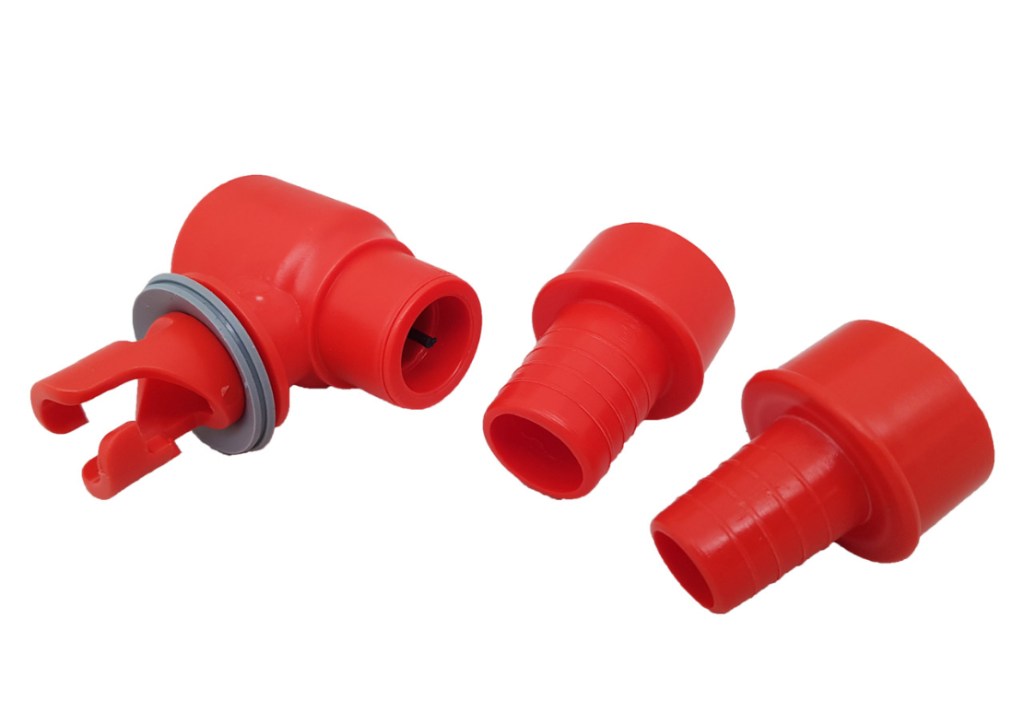
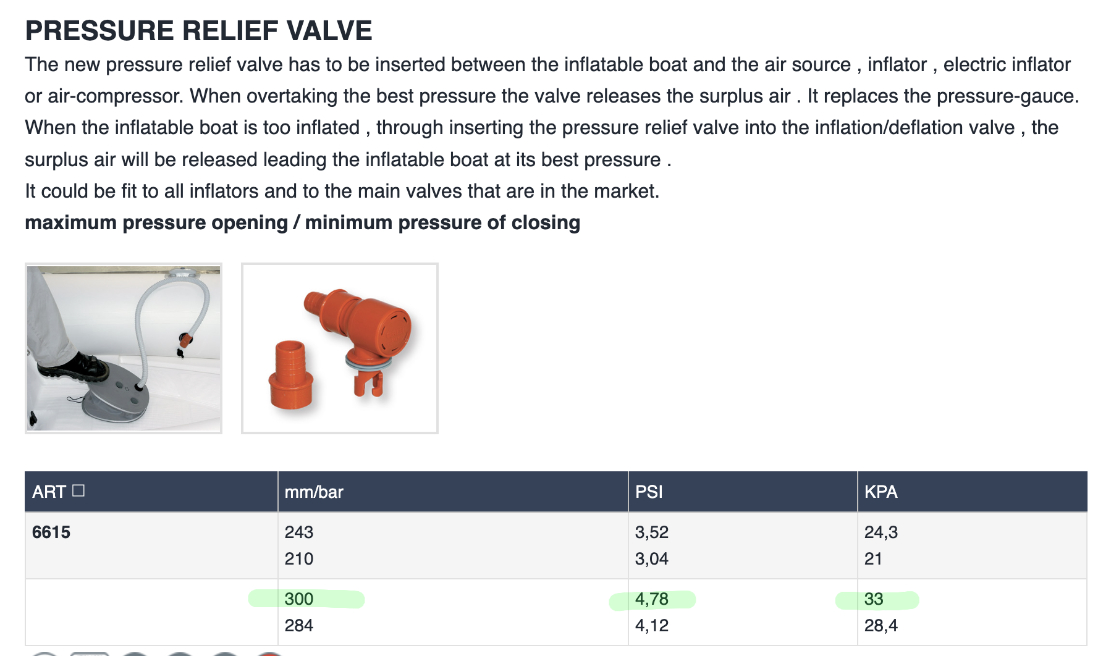
PRV inflation adapter hack In the comments below you’ll see Nikola suggesting the idea of using PRV adapters (below) on the side tubes. Normally you’d fit one to the end of your pump hose to fill up a boat to their pre-defined purging pressure without needing to refer to a manometer. It’s a handy gadget.
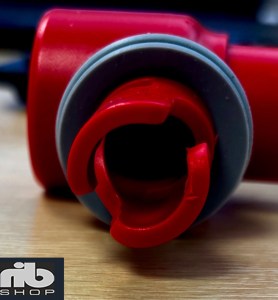
No valve opening peg
However, this would not work as a dynamic PRV fitted to a boat. Before attaching the PRV to you valve, you’d first need to block off the open end where the pump hose attaches. That’s easy enough. But to get a ‘live’ reading of the actual hull pressure (like a manometer) the 6615 must have a central peg/screw (picture) to open the boat’s valve it as you bayonet it on. The image left shows that a 6615 doesn’t have such a peg. Used as intended for pump inflation, there would be no need for it. So the hack won’t work because the boat’s valve must be open, and as soon as you do that the air rushes out as you try and clamp on the PRV adapter. The only way to make a 6615 work as an on board PRV would be to have some sort of one way valve on the inlet; not something that could be easily and reliably bodged. It’s worth remembering you don’t want some flaky PRV playing up midwater and dumping a side tube’s air. Better to cut proper PRVs into the hull as described above.
However these adaptors are very useful for inflation and the 6615 Ceredi nozzles come in two ratings and cost just £12 in the UK. The lower rated one is the same pressure as a Seawave: 0.25 bar/3.5 psi. You could also use this one to over-inflate a 0.2 bar factory-rated boat, like a Gumotex Twist by 25%. The ‘300’ version (in green above) is less easily found and rated at 0.3bar/4.75psi, the same as the red-dot in-hull PRVs I fitted to my Seawave. If you can’t track the 6615s down, try the similar black Grabner inflation relief valve which is also rated at 0.3 bar, but, like everything Grabner, is double the price of the Ceredis.
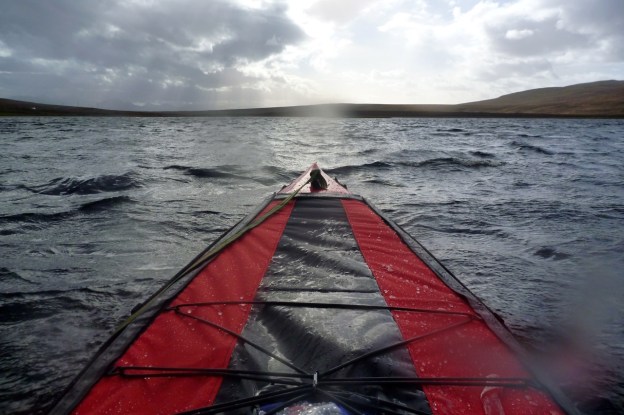
The new boat had to get christened in what they call a ‘fresh breeze’. It was only going to get windier over the next few days. Either that or it would stay rolled up till the new year. I went to freshwater Loch Ra round the back where I took my packraft for a ‘gale test‘ one time. It’s a safe place for this sort of thing. My new wind gauge – a tenner on ebay – was reading a moderate 15 mph, but it felt like more. I do wonder about the accuracy of that thing. Turns out Ardmair near Ullapool was registering a solid 25 with a spike up to 35 around the time I was out. So let’s call it at least 20 mph – not really IK weather.
I pumped the sides up to about 0.33 bar (4.8psi) and jury-rigged a quick footrest stirrup, but under the deck it was hard to line up quickly when you’re getting in while being blown around. I have a better idea to counter-tension it into position from the other end with an elastic (left). That, or copy the Amigo set up with D-rings – less straps cluttering up the floor that way.
Used to hoping effortlessly into open boats and setting off whatever the conditions, the need to negotiate the deck made getting in all the more awkward – though a grounding skeg is also a factor. With an onshore wind, I figured out a nose-to-the-shore angle but had the paddle blown out of my hands just as I was slotted in. I retrieved it and tried again using those nifty deck elastics for the stick, then backed up and swung into the wind.
As expected progress was slow until I found a rhythm, and then just very effortful – like hauling a head hose uphill. The Seawave’s more rounded hull means it’s a little more tippy than the mattress-flat Amigo, but in a good way. I never thought I’d write that line, but a little rolling means side waves need not push you over if you counter brace, though I can’t say the Amigo riding side waves flat like a raft was ever a problem. If it didn’t tilt with the waves water would pour over the sides. With the Seawave’s deck, lateral sea waves need not deck the Seawave.
Before I got too far out I checked to see I felt in control across the wind. It was blowing so hard I only needed to paddle on one side to go straight, but no stability worries. Then downwind with no untoward weathercocking either, all things considered. Further out on the small loch the fetch flattened a bit but another side-to-the-wind run saw the long boat extremely hard to bring back into the wind. A rudder would be handy, or maybe more aggressive leaning or my weight further back. It felt like my position was a bit too far forward to lever the bow round while the wind pushed on me and the sides. Not sure if that makes actual hydrodynamic sense, but without knowing the Seawave’s normal seat position, there’s certainly room to move my seat back in the cockpit a few inches to see if it makes a difference: more ‘rudder effect’ with a rearward paddler. This animated gif on the right shows the seat about 4 inches further back. Of course these were conditions where you’d expect a long, unloaded, over-buoyant IK to handle like a drifting log.
Upwind it felt like I was crawling along but I got to an island faster than expected, got beached then carefully inched around it. As I knew well, a backwind may be less effort but can be as hard if you can’t keep the back of the boat from coming round – a common flaw with wind-prone IKs. But the Seawave tracked pretty well, right on- and then just off the wind, with only the occasional double pull on one side to level up. I did a bit more crosswind practice but by now I was pooped and even needed to drink out of the loch. Any hope of more tests without the skeg, without deck, at factory pressures and so on would all have to wait.
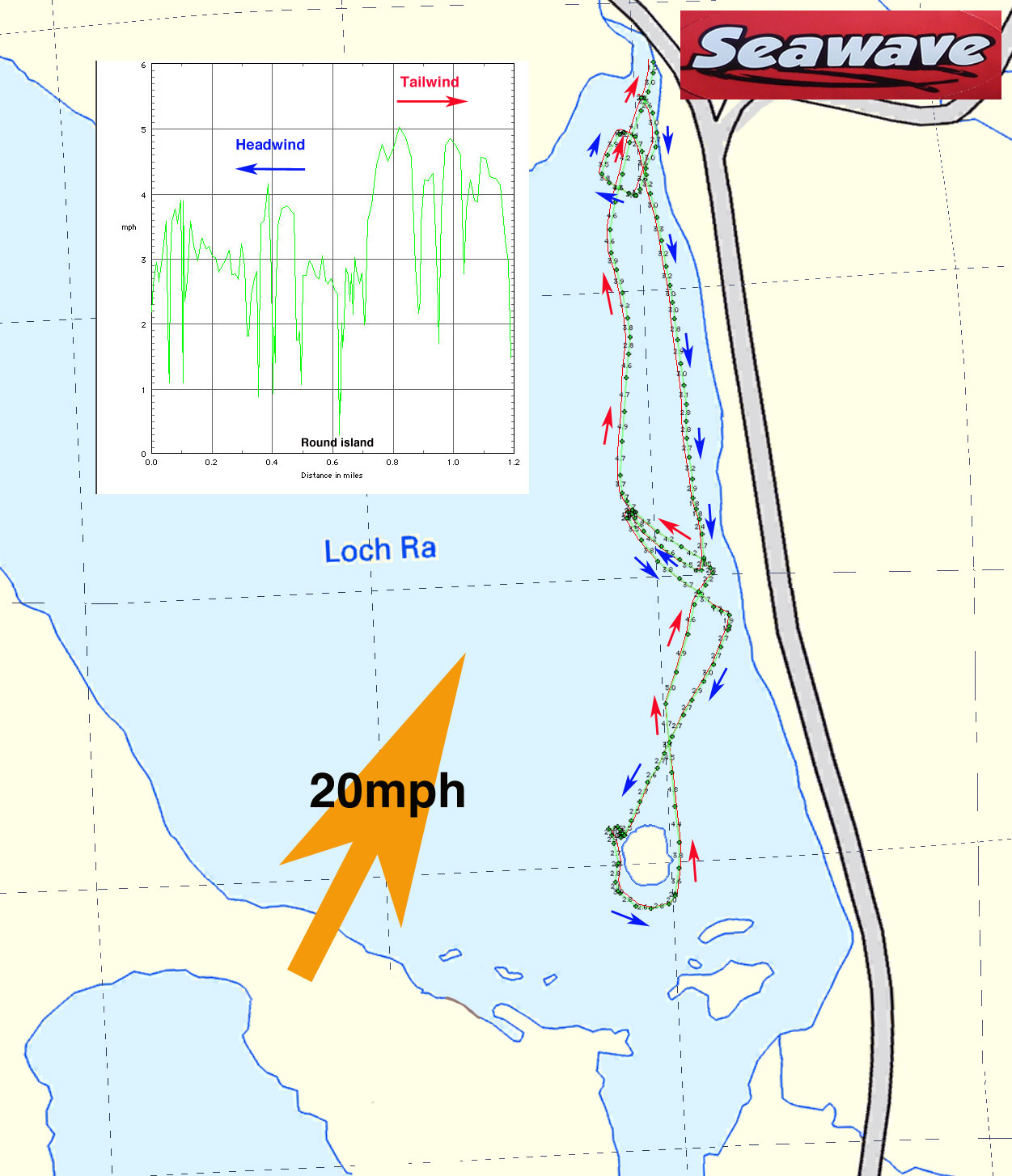
Back home the GPS showed up some surprises. Into the wind I was hacking at a surprising 3mph, across it at 4 and downwind at up to 5mph. All much more than it felt. I’m pretty sure the Incept would have managed the same – and it was less effort than in the Amigo.
As the seasons change and the days shrink, the weather seems to flip from one extreme to the other. A few nights ago it was howling from the east at over 60mph and began to sound a little scary in our exposed cottage. We’ve had 60 a few weeks ago but from the prevailing southwest. I have a theory that a less usual easterly gale is noisier because it blows against the wind-bent vegetation. I got up at 5am to check things out and found the bike blown over, even though it was hard against a wall. The kayak – that was gone, but being red I knew it would be easy enough to find in the daylight. Turns out it was nestling in a ditch not far away.
I’ve pondered on similar sound theories about high water on a spring tide. Assuming it’s not all drowned by the wind and waves, there’s a certain rushing and gurgling sound I’m not sure I’ve heard at other times. Again, I could only explain it by weathering: the higher and so less smoothed down parts of the rocky seashore are responding noisily to their fortnightly lapping. Sadly, a recent communiqué from Stockholm informs me that neither theory will be shortlisted for a Nobel Prize.
There’s also been talk of a blood moon lately. Not a theory but an astronomically accredited rosy-orange glow brought on by the fuzzy edge of the earth’s shadow. Though the recent one wasn’t visible in the UK as it was earlier this year, with the current calm conditions I figured a moonlight paddle would make a novel experience. On the beach about 8pm, the moon was just rising over Suilven to the northeast. An hour before high water, geometrically, the idea of the moon ‘pulling’ the water in towards it made perfect sense. And blow me down if it didn’t have an orangey hue (not caught by my camera), though I realise that’s just because it was rising.
Out on the water in the dark I thought it might be unnerving – part of this idea was a bit of a dare. But if anything it was all rather magical. For once the boat remained perfect still as I tried to take some pictures and just as the thought – ‘I wonder if there’s any phosphorescence [sic]’ – passed through my head, the bow and paddle blades revealed a light twinkling in their wake that definitely wasn’t reflected moonlight. Taking a picture was impossible, though later I did notice it didn’t require agitating the water to see luminescent entities darting about. In fact the correct word is bioluminescence. Is it an ordinary phenomenon up here? Do tides, moon, season and temperatures have any influence? Who knows.
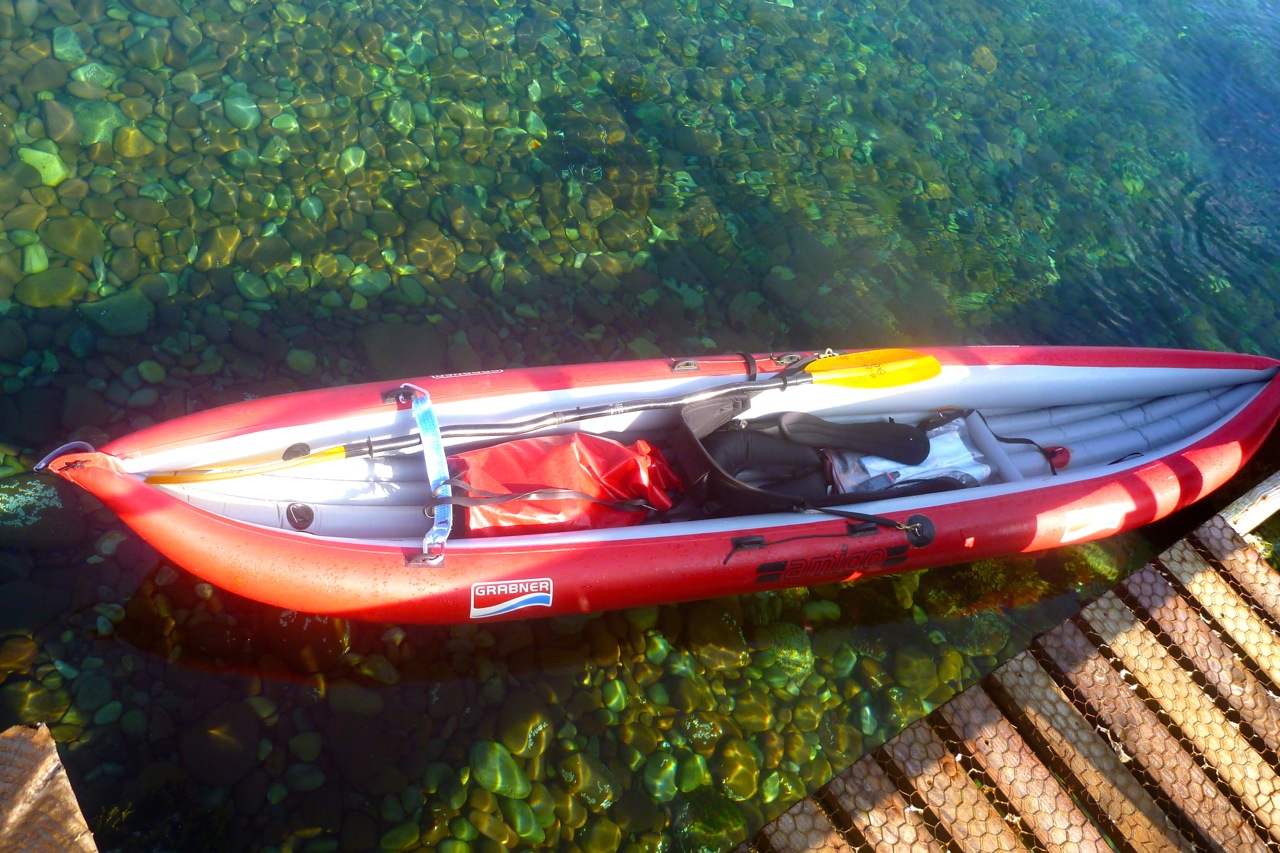
The low moon reflecting on Badentarbet Bay reminded me of a bogus tourist event they have in Broome, northwestern Australia. A low tides the moon rising over the mudflats of Roebuck Bay creates a very similar stepped effect, all the excuse they need to add it to their packed events calendar and run a New Age-y beach market. It’s bogus because it not unique to Broome or anywhere, and in my guidebook writing days out there, my bullshit antennae had to remain tuned to a high pitch. Broome is a lovely spot and has many genuinely unique attractions, but you’ll see the same lunar effect 600km down the road in Port Hedland. And anyone who knows the difference between PH and Broome will understand why PH don’t crow about their staircase too much. As the tide topped out I was really rather cozy, wrapped up in my Anfibio drysuit and Gul fleece onesie – floating but not drifting between the moon and the stars and whatever was glittering below. This might be one of my last paddles in the Grabner and a new boat is on its way. I hope get a chance to take it for a spin before we migrate back south
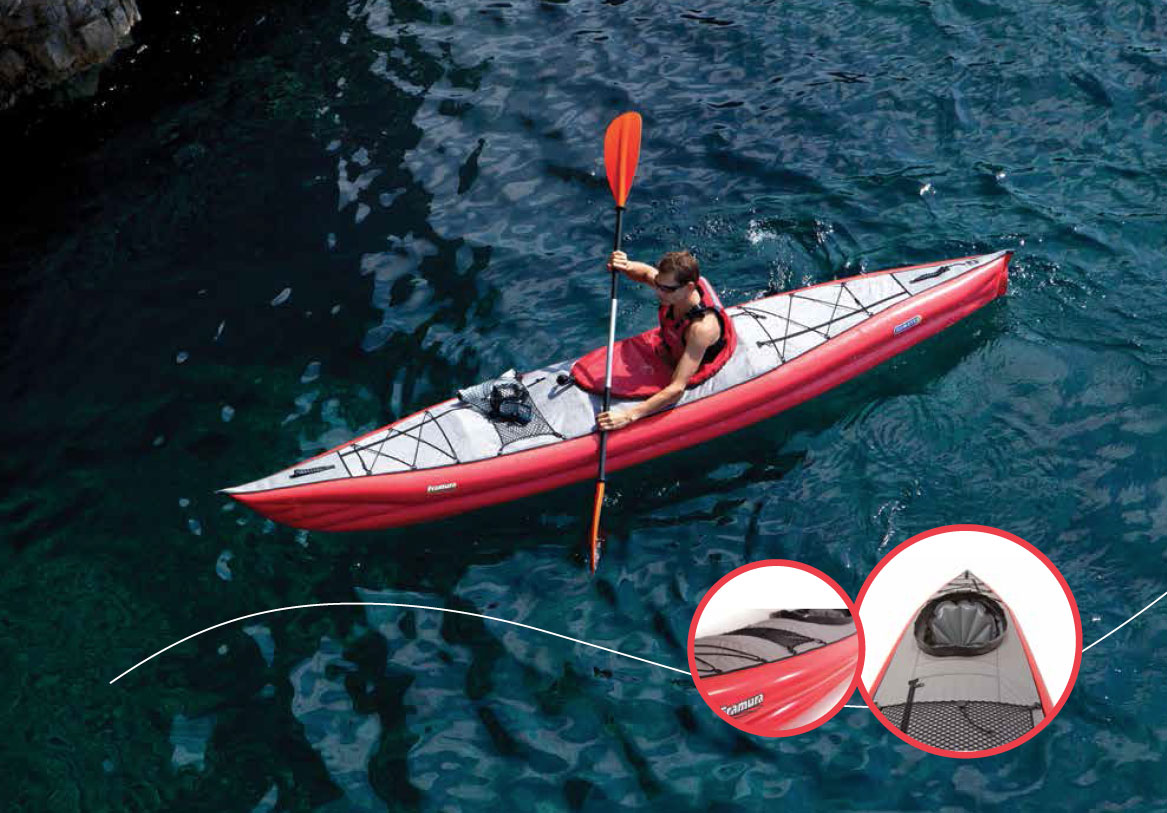
Even with the Rush models for 2020, Gumotex still claim their Framura IK is their fastest boat. For coastal ‘yaking the numbers certainly look great: 16kg + 4.1m x 75cm wide That’s 29.5″ and about as wide as you’d want to be in a proper IK. I see that in France it’s homologated for use as a kosher ‘Cat C, 10km from shore’ sea kayak while in North America it’s sold as a Swing EX.
Oi! Not sure I’d be dragging my IK over the sand like that.
From the bow shape it looks like it’s based on the slightly shorter but much wider Swing 2 – or the longer but also wider and higher pressure Seawave. That lightweight deck is fixed and has Swing-like struts to keep it up and shed water. Access is by straight zips or down the hatch. Like the Swings, they leak until the Swings were upgraded in 2025 along with the new Aurion, a hybrid Framura.
As for pressures, the Framura runs a disappointing 0.2 bar/2.9psi, not the 0.25 bar of the Seawave. But I read that Gumo-recommended max pressures are on the conservative side: the side tubes can be run up to 50% higher with great improvements in rigidity, and the floor runs an 0.2 bar PRV so can’t be over-pressured). I also read somewhere they got 12kph out of a Framura while testing at sea. The best I ever got out of my Java or Incept was a short burst of 10kph, so that is fast.
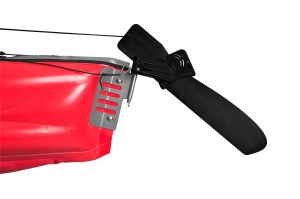
In 2016 they introduced a rudder kit (left) for the Framura/EX. I made one for my Seawave but in the end, could not be bothered with it on day paddles. On multi-day runs where you get the weather you’re given, a rudder may be a good idea.
Slim, not like an otherwise similar Swing
I like the look of the 4.1-metre-long Framura but I liked my Seawave more. Framura, by the way, is a nice spot on the Italian Riviera, not far from Portofino. Not, as I thought, a hint that the new boat uses a frame(ura) to maintain rigidity. That rarely works with IKs, in my experience. You do wonder if the new hybrid Rush 2 supercedes the 2015 Framura.More Framura in this video. See also this.
I’m not convinced the 0.2 bar Framura is that much faster than a longer, stiffer Seawave. And I also suspect it has not been such a sales success either. Perhaps claiming the former has something to do with the latter.
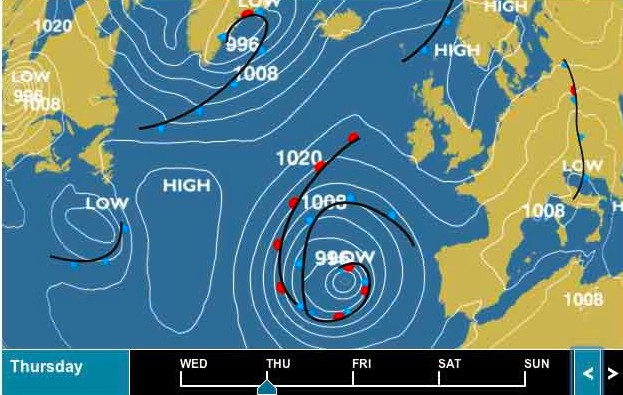
With the heather turning purple, mushrooms all over the lawn and a chill in the air, I thought it was all over for this season. But this week we’ve had a reprieve. Sat between isobars so far apart they’re in different time zones, today the Summer Isles are getting one final spell of calm, summery conditions. It could be my one and only chance to tick off the last of the Summer Isles.
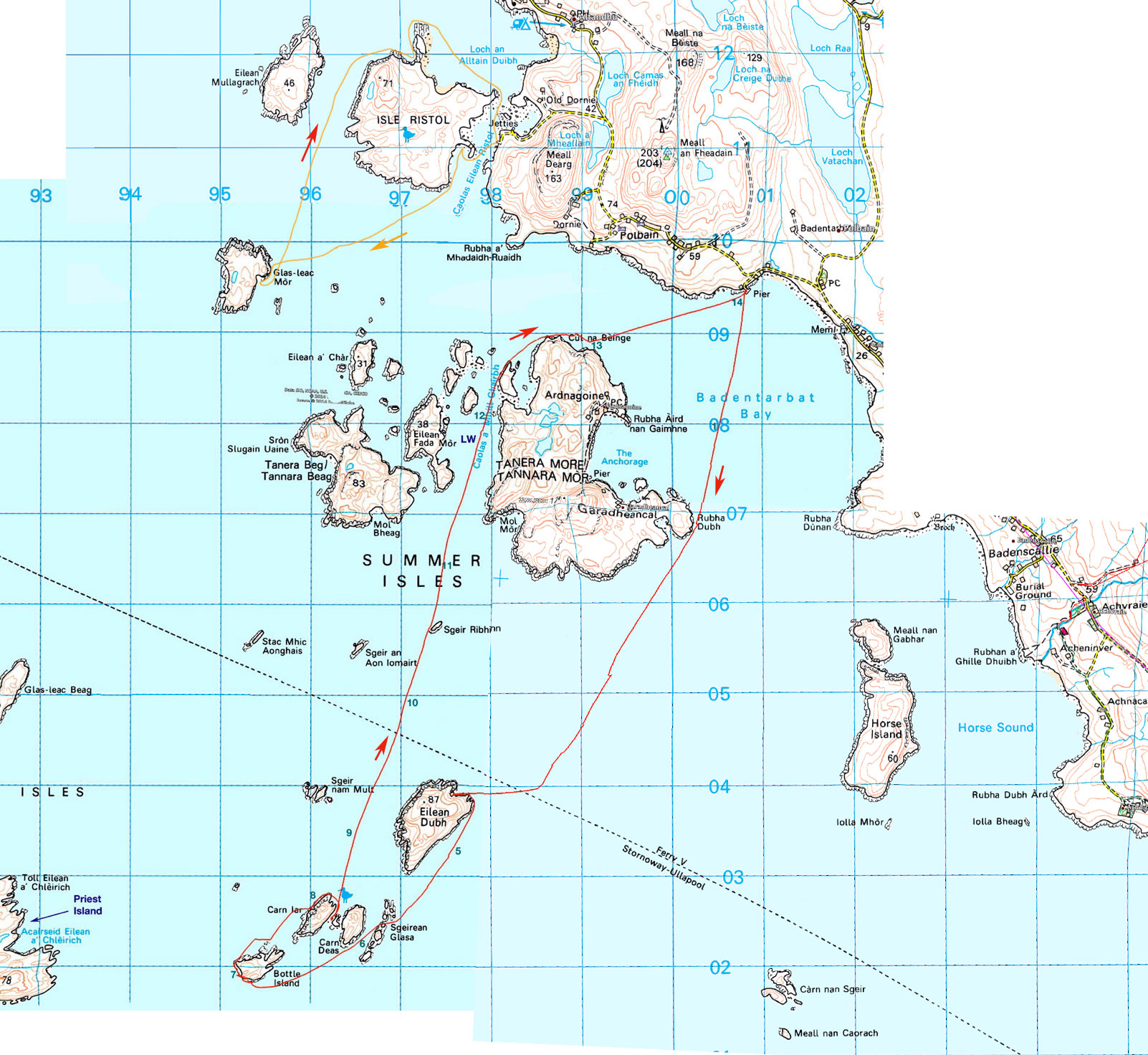
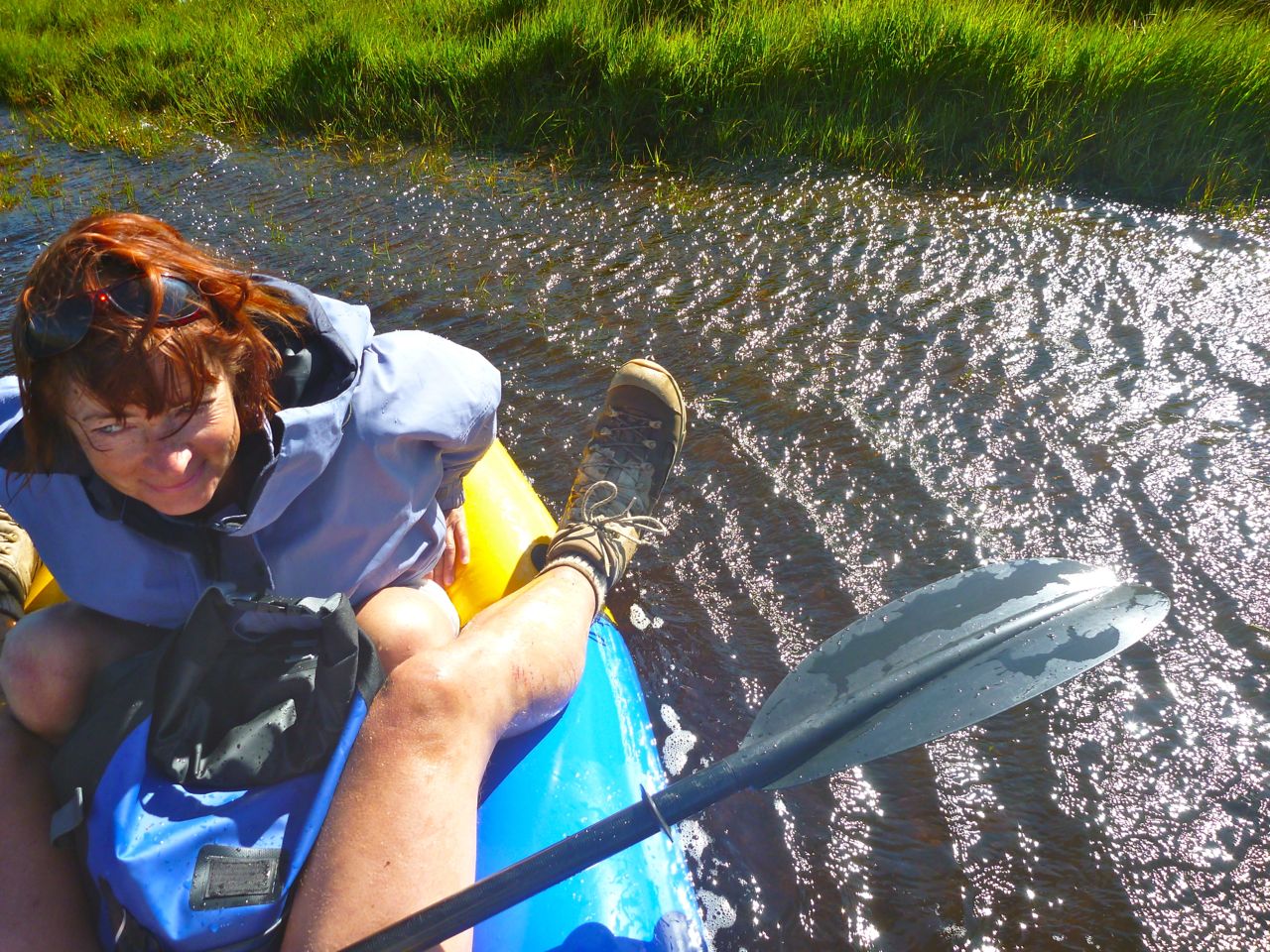
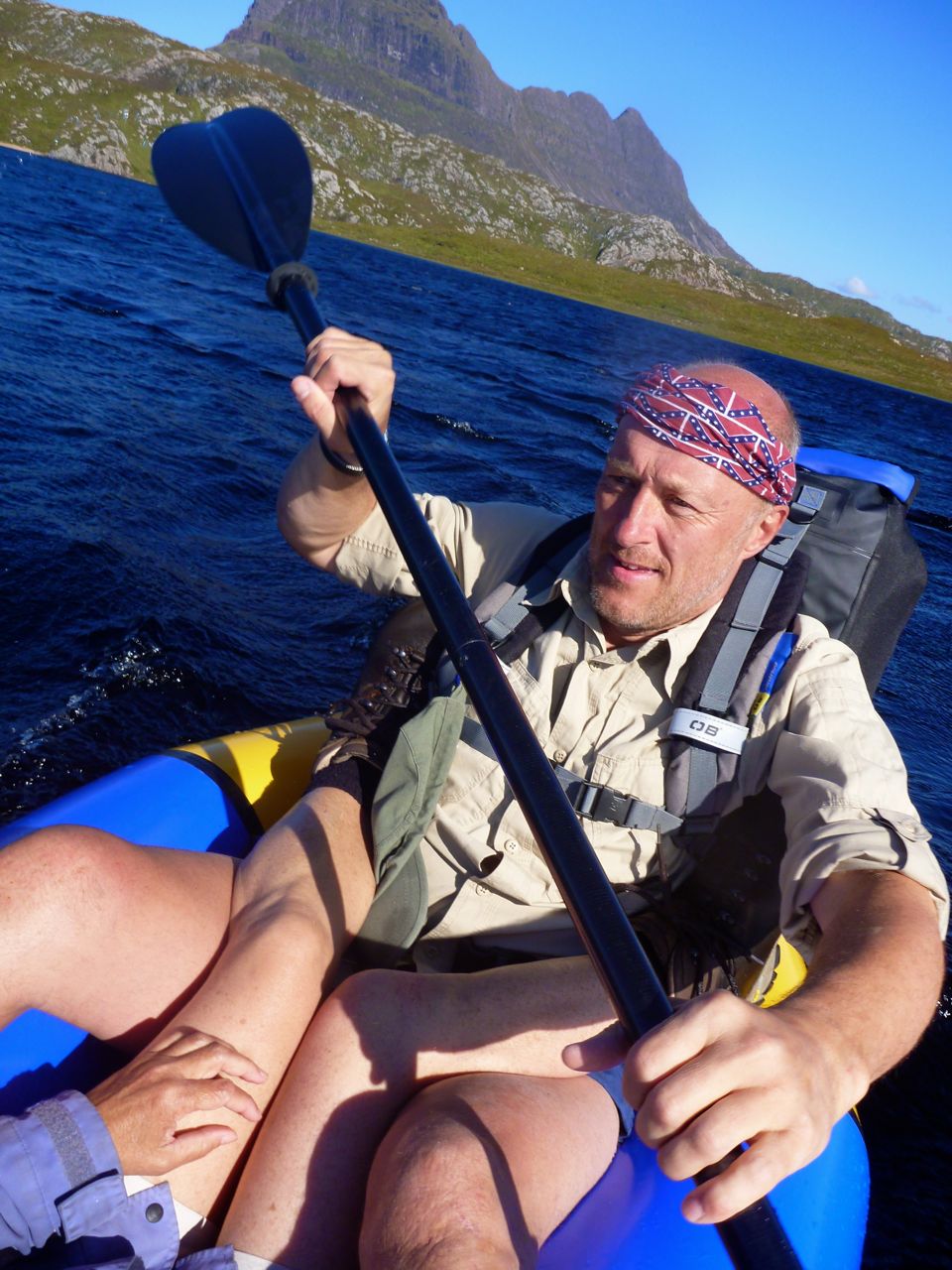
Yesterday we nipped out from Old Dornie to Glas-Leac Mor (map left), another as-yet unvisited isle less than two miles out. Paddling 2-up took a bit of ‘readjustment’ and isn’t half as comfortable for me as my fuly-braced DIY solo set-up. But following a short cruise alongside Glas Mor, we were fully synched for the long way back between Ristol and Eilean Mullagrach.
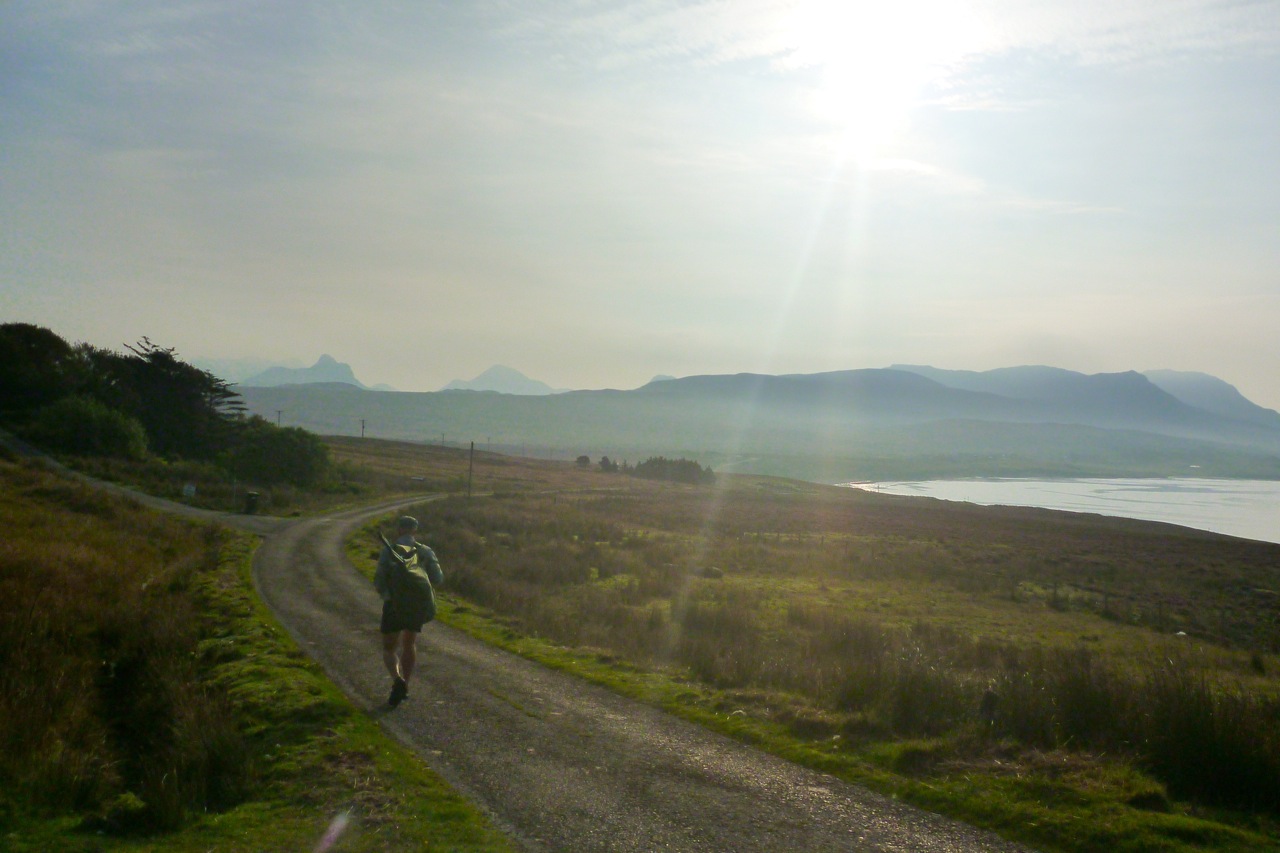
Local internet chatter talked of helicopters dropping equipment to build a dwelling on Eilean Mullagrach, which we could see on the south side. Apparently professional castaway and Lego brand ambassador, Ben Fogle, tried to buy Mullagrach ten years ago, but bid too low, perhaps to the owner who’s developing to now. (Had he bought it, he could have named the 46-metre-high summit ‘Ben Fogle’). With no easy sea access that I’ve seen, you do wonder how they’re going to get to that house. As we paddled through the sound, a little dolphin popped up, huffing and puffing, and some colourful kayaks were taking a guided tour around the isles. The following day’s forecast was for similarly light winds, so I dropped the kayak off at Badentarbat jetty and next morning walked down with my gear.
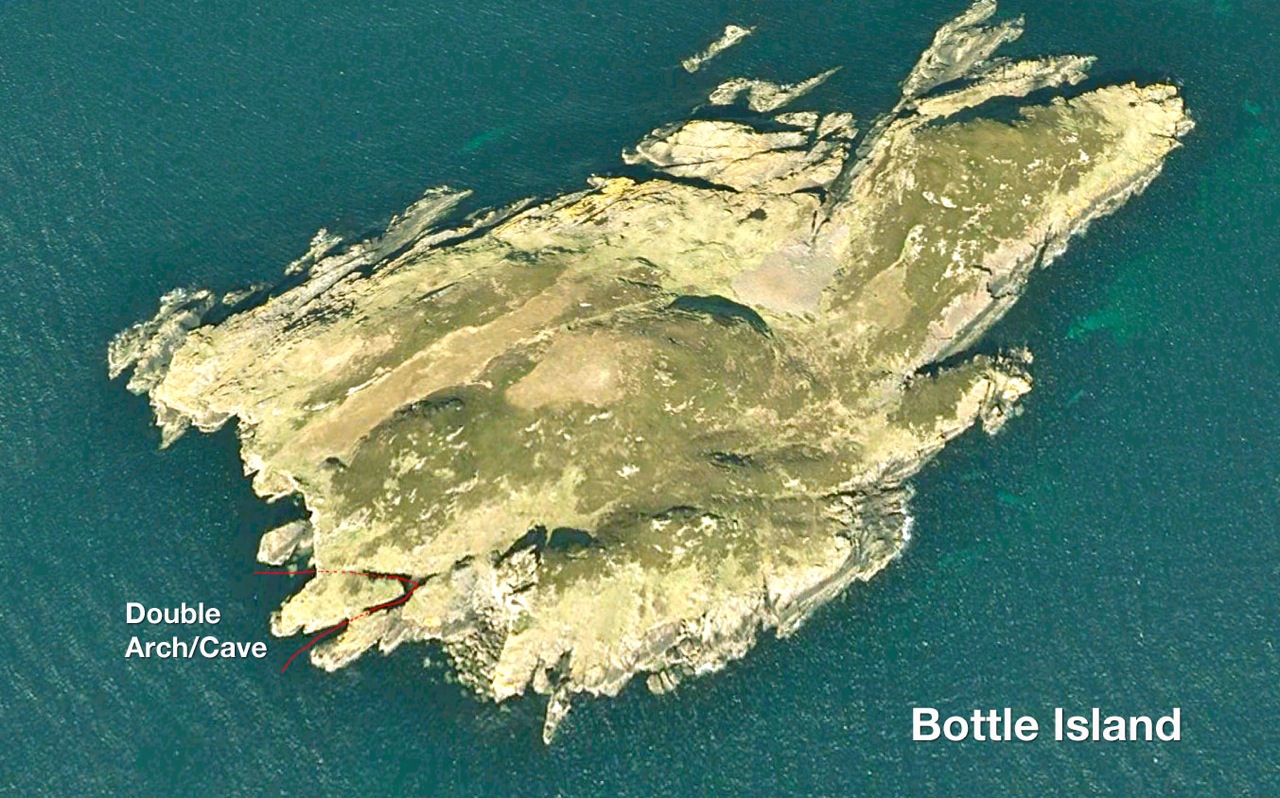
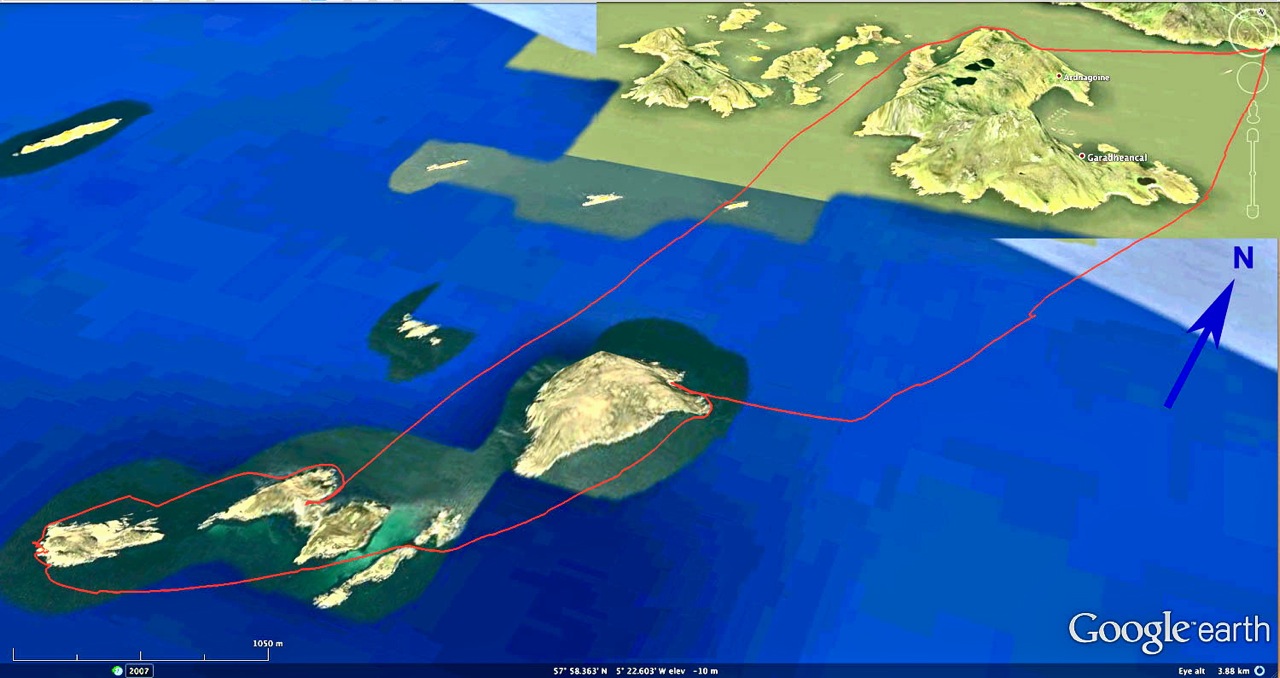
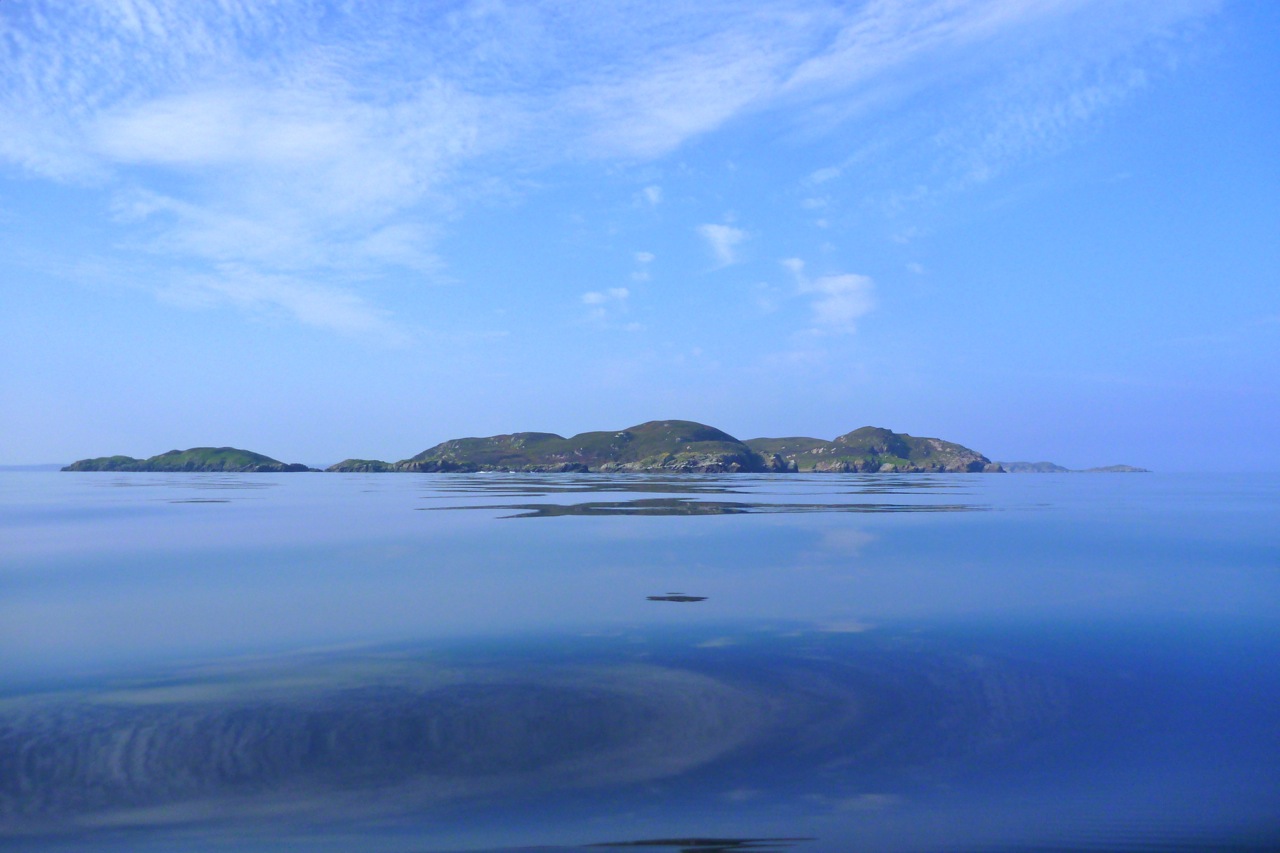
You don’t need a flat calm to visit the inner Summer Isles: the Taneras, ‘Ristols’ and Horse Island. But alone in an IK the outer Summers can feel like a bit of a reach. Priest Island is the most distant and adds up to an 18-mile tour via all the other outer isles, even though you need never be more than a mile or so from an island or inaccessible skerry of some sort. I settled on Bottle Island at the end of a cluster of isles and a 14-mile round trip from Badentarbat jetty. That’s about the same as our run to Ullapool a couple of years ago, but more open water than coastal hop.
The winds would be barely a factor until the afternoon, but a spring tide was at its 5.5-metre peak. I asked tidemaster Gael whether there was anything to consider on my route: he advised the books and charts didn’t list any dodgy currents. I was expecting a bit of flow through channels or around points at peak ebb around 11am, but could always find another way round.
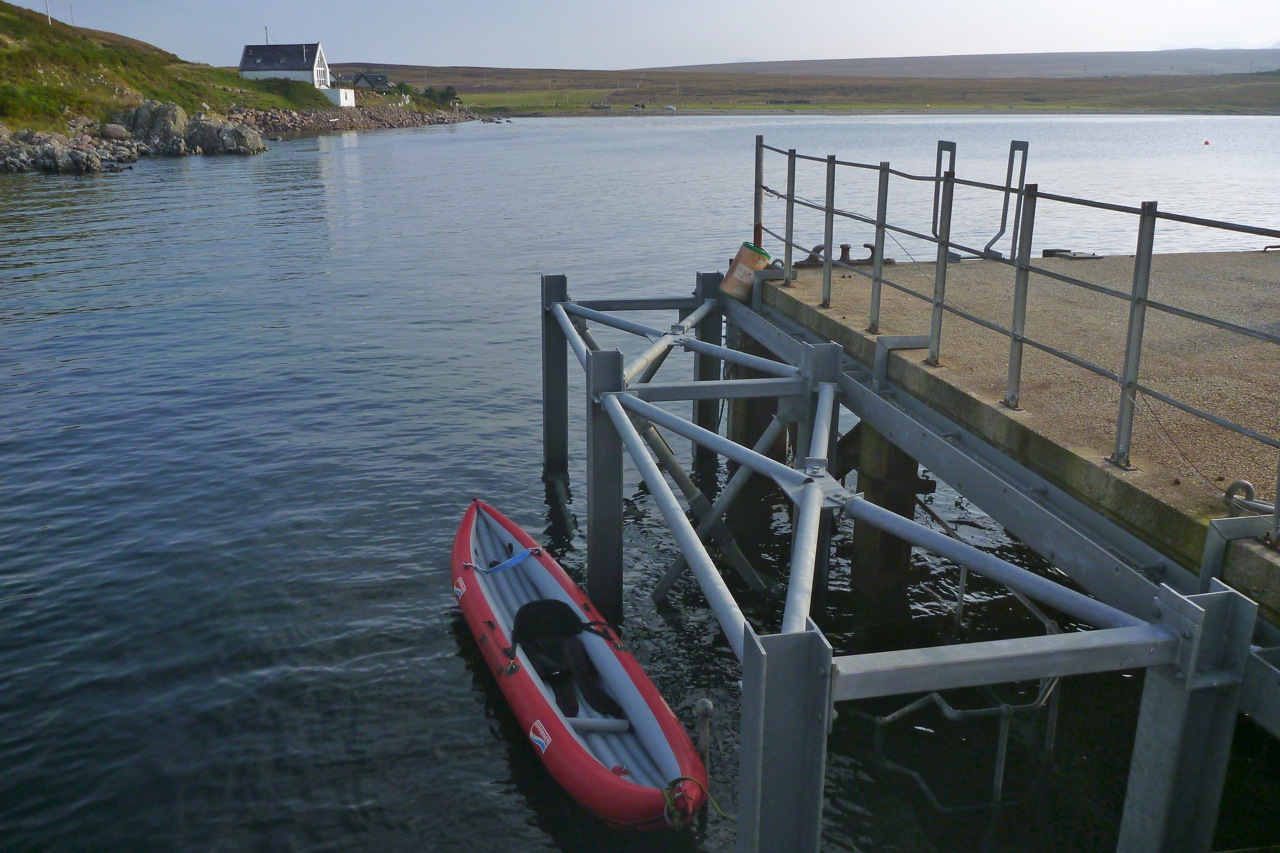
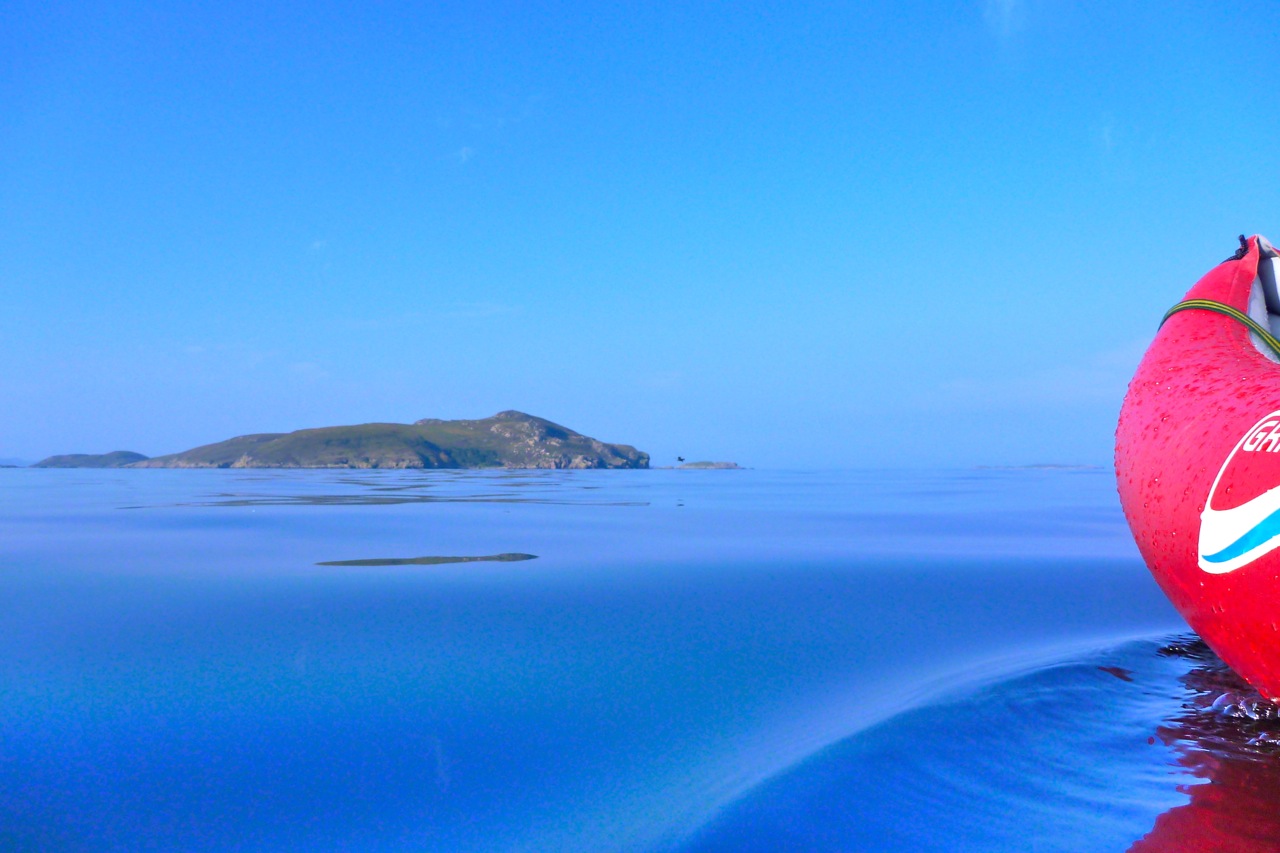
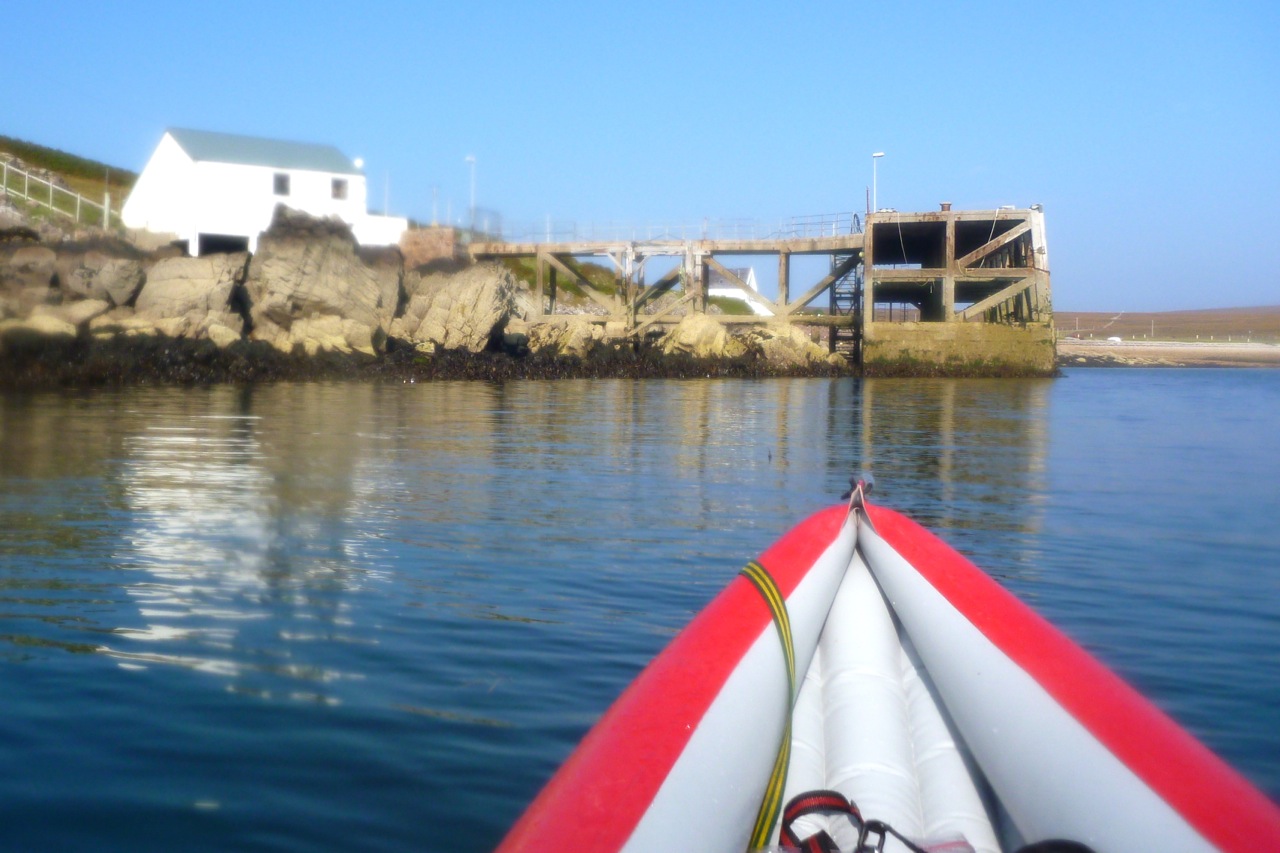
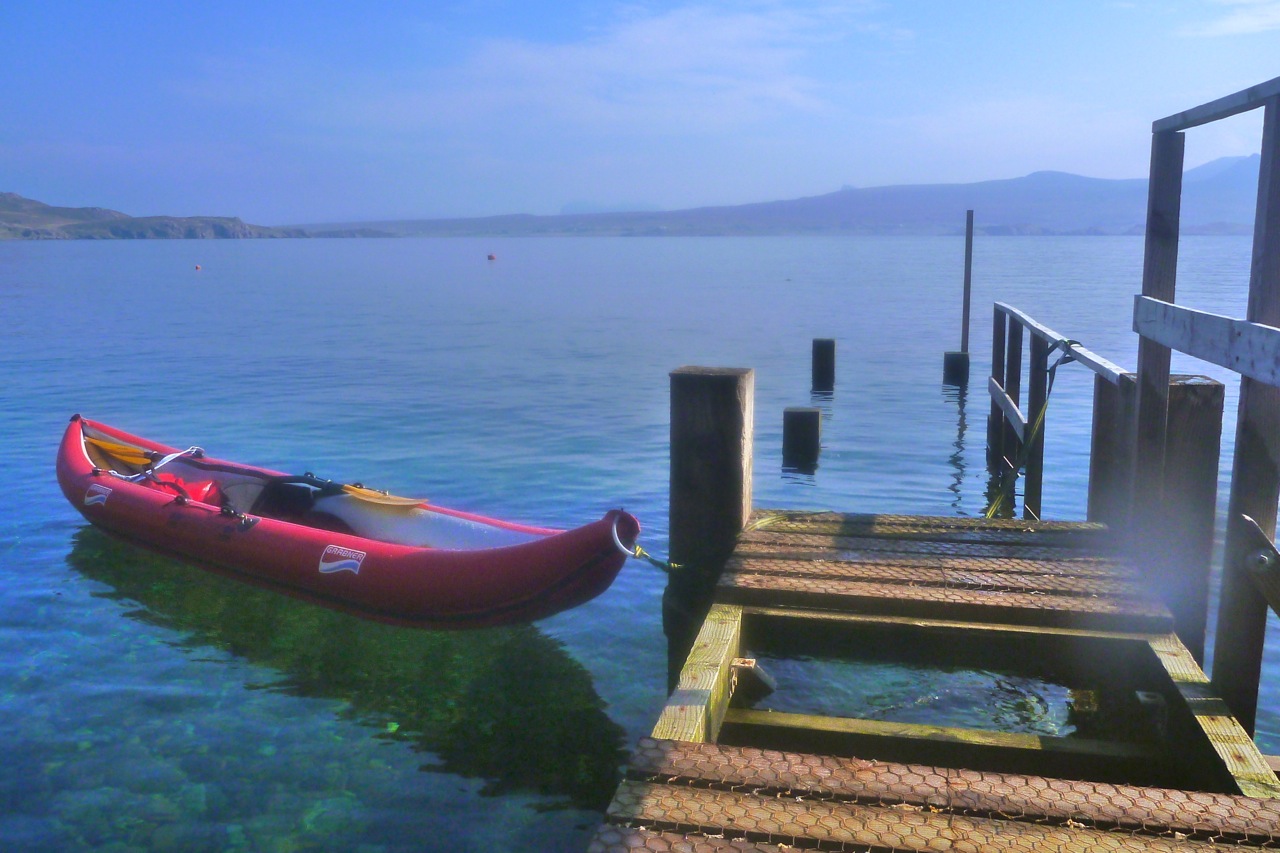
The pier at Badentarbet is condemned and blocked off with a barrier, but locals clamber round for a spot of fishing. I dropped the boat over the barrier, carried it down the steps to the water (right) and was on my way at 9.30, an hour after very high tide. Forty minutes later, I turned the east corner of Tanera Mor (still for sale, btw. Currently under £2m), rubbed the sweat from my eyes and clocked Eilean Dubh, nearly 2.5 miles ahead. Coming round Tanera put me back in a cooling breeze and the boat slid silently across the water as if on rails. To the southeast was Horse Island and Carn nan Sgeir, a remote skerry I visited last year and now floating on the glassy surface like a jellyfish with gout.
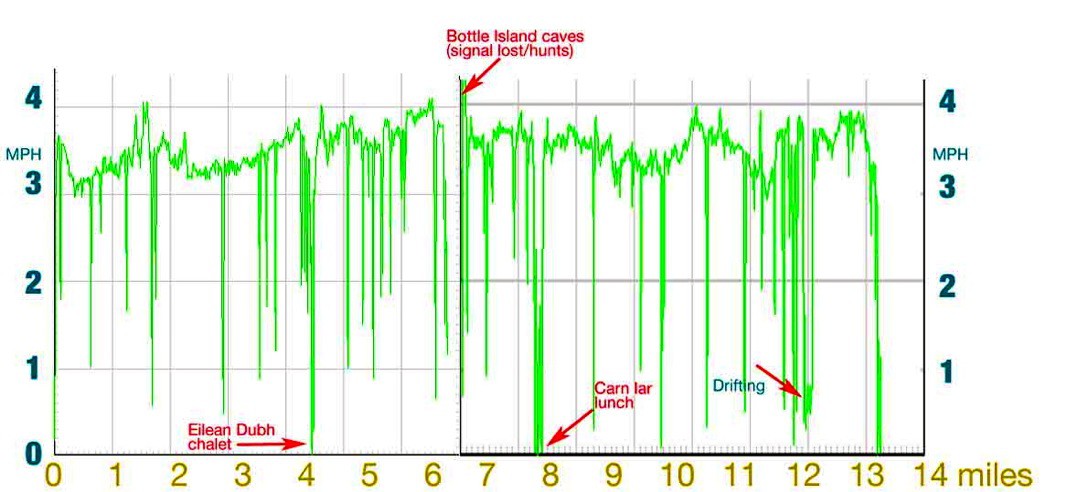
An hour before peak flow, at one point I was convinced I was being pulled west on the outgoing tide. I stopped to try and read any drift on the GPS, but couldn’t determine a direction. Turned out later I was drifting at 1mph east or inland with the breeze. So much for the impression of deadly currents. It was a lesson for the day: what you feel is happening (drift, current, ‘wind-in-the-face’ velocity) doesn’t always match the unassailable facts of the GPS. But alone on an all-day run it’s important to know what’s going on: is it ‘me’ or is it due to the conditions – so you can judge how much you have left in the tank.
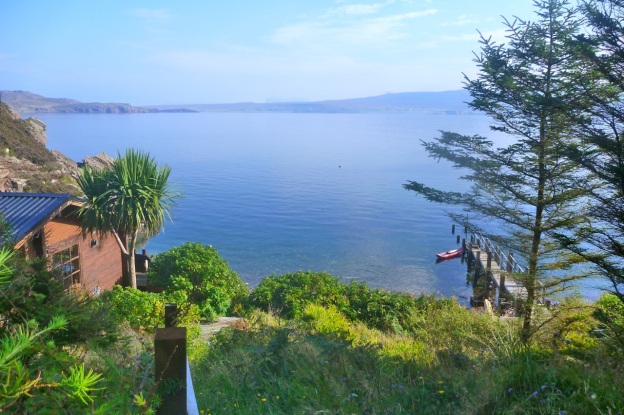
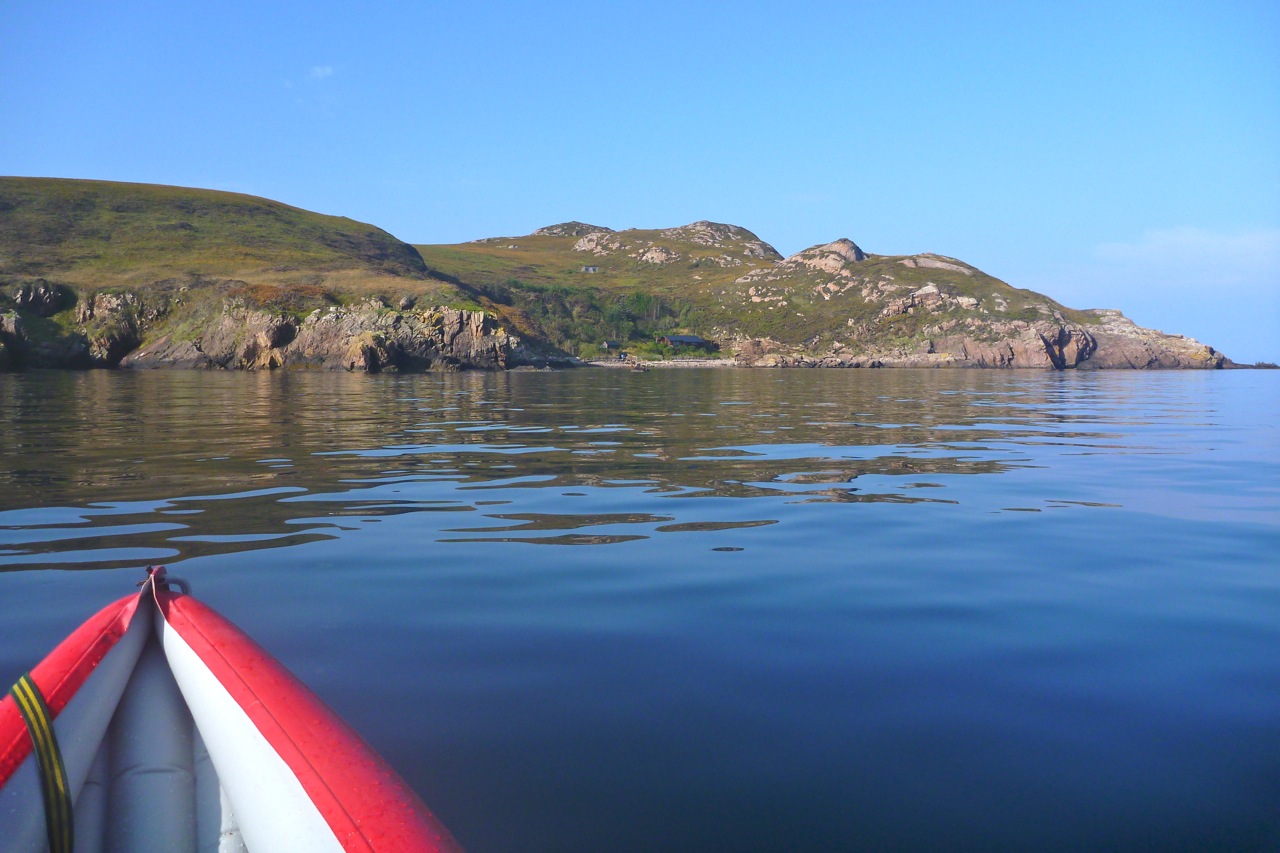
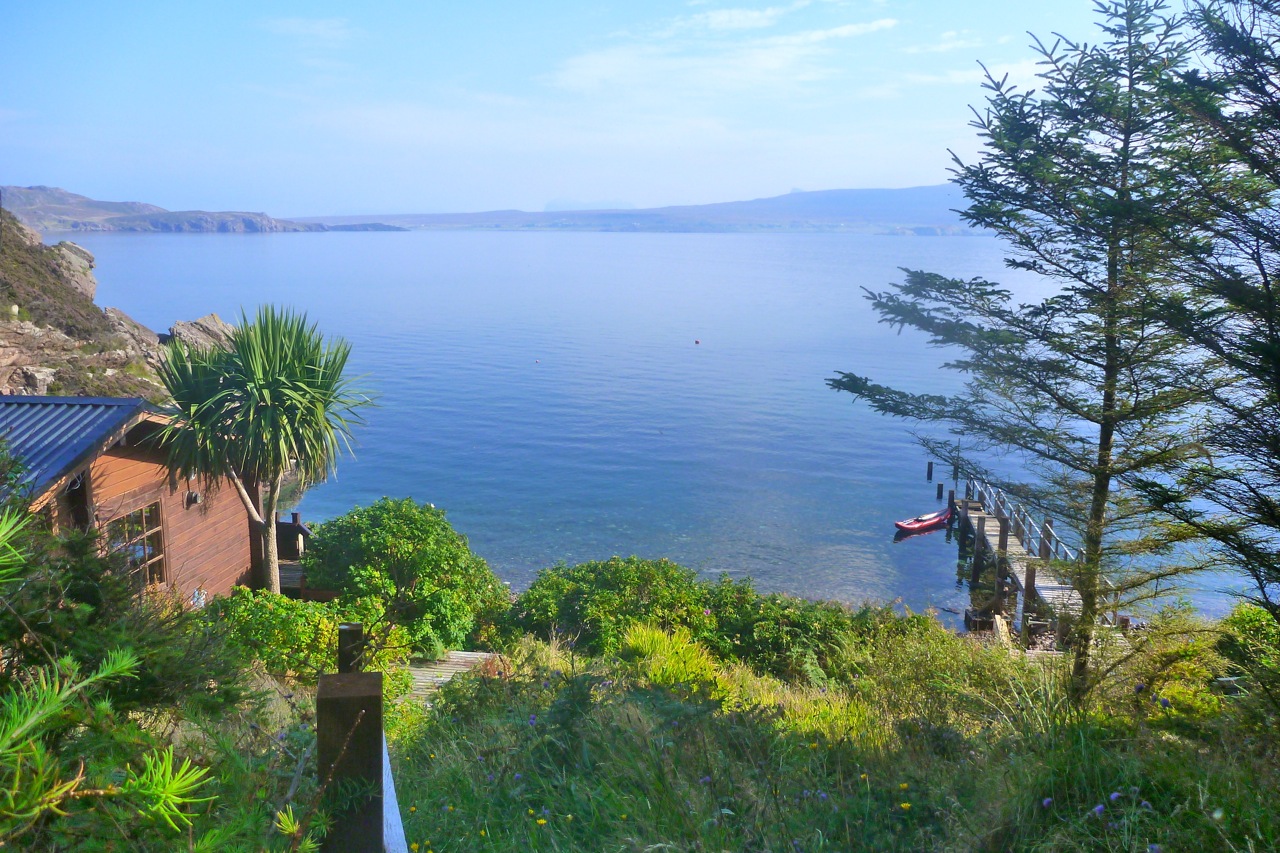
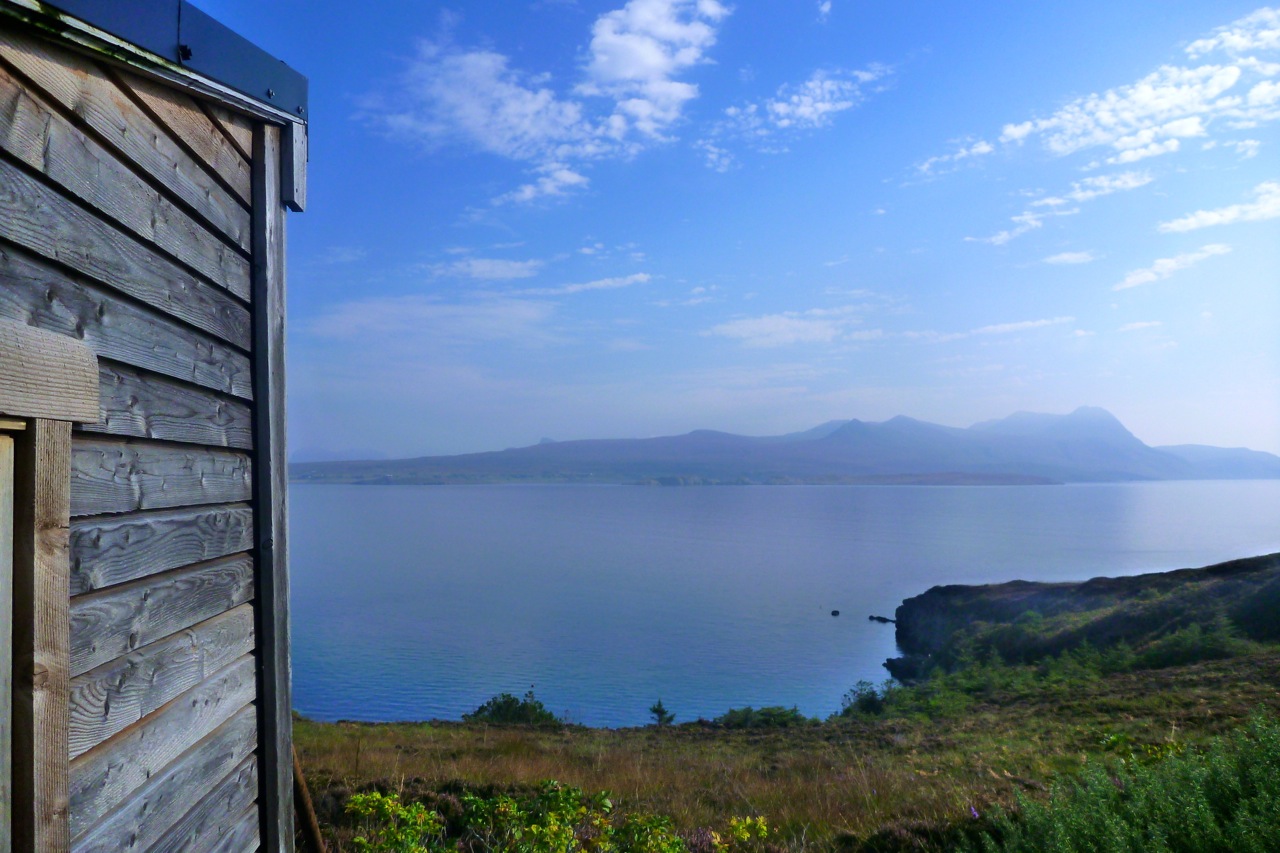
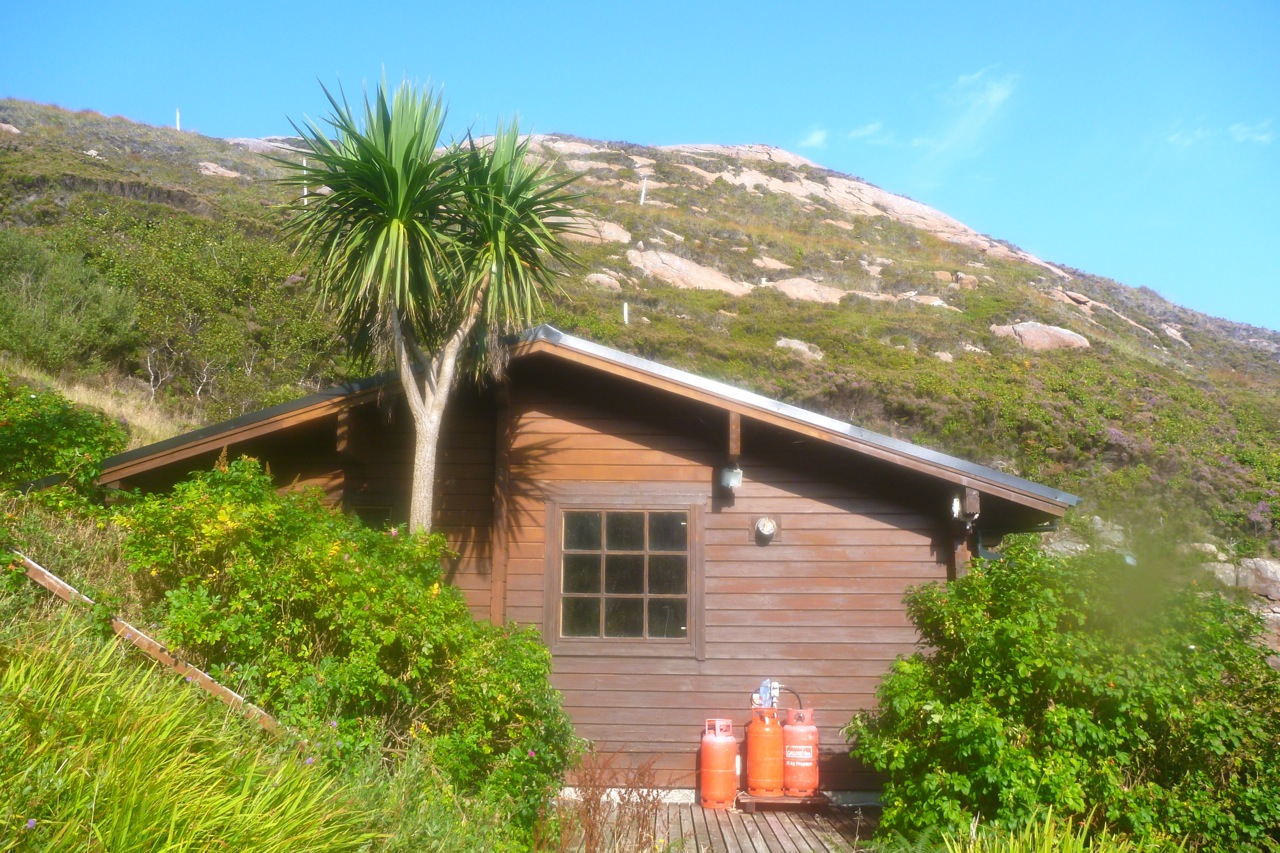
As I neared Eilean Dubh I saw what looked like a chalet in a tiny north-facing bay. A couple of years ago I’d heard about a house in an outer Summer somewhere but couldn’t find it on Google. This must be it (left). With no boat moored at the jetty, I diverting for a closer look. It was certainly the protected setting to build a dwelling: small stony beach for access; sheltered northeast aspect and a burn trickling down for water. Once ashore, the chalet reeked of lovely warm creosote and there was even a palm tree among the firs and other trees. Up the hill in the heather was little shed /painting studio. It didn’t look like anyone had been here for months.
Back on the water and coming round onto the east side of Eilean Dubh, I expected to be paddling against the ebb spilling southwestwards round either end of the island. And that’s how it felt, though again the GPS showed I was doing a normal speed or even faster, briefly hitting 4mph. It’s all in the mind. But when I came through a gap into the channel between Sgeirean Glasa and Carn Deas, I was definitely fighting against something, so moved away for the shores. Just as I did so a Tornado ripped past low overhead, close enough to see the undercarriage.
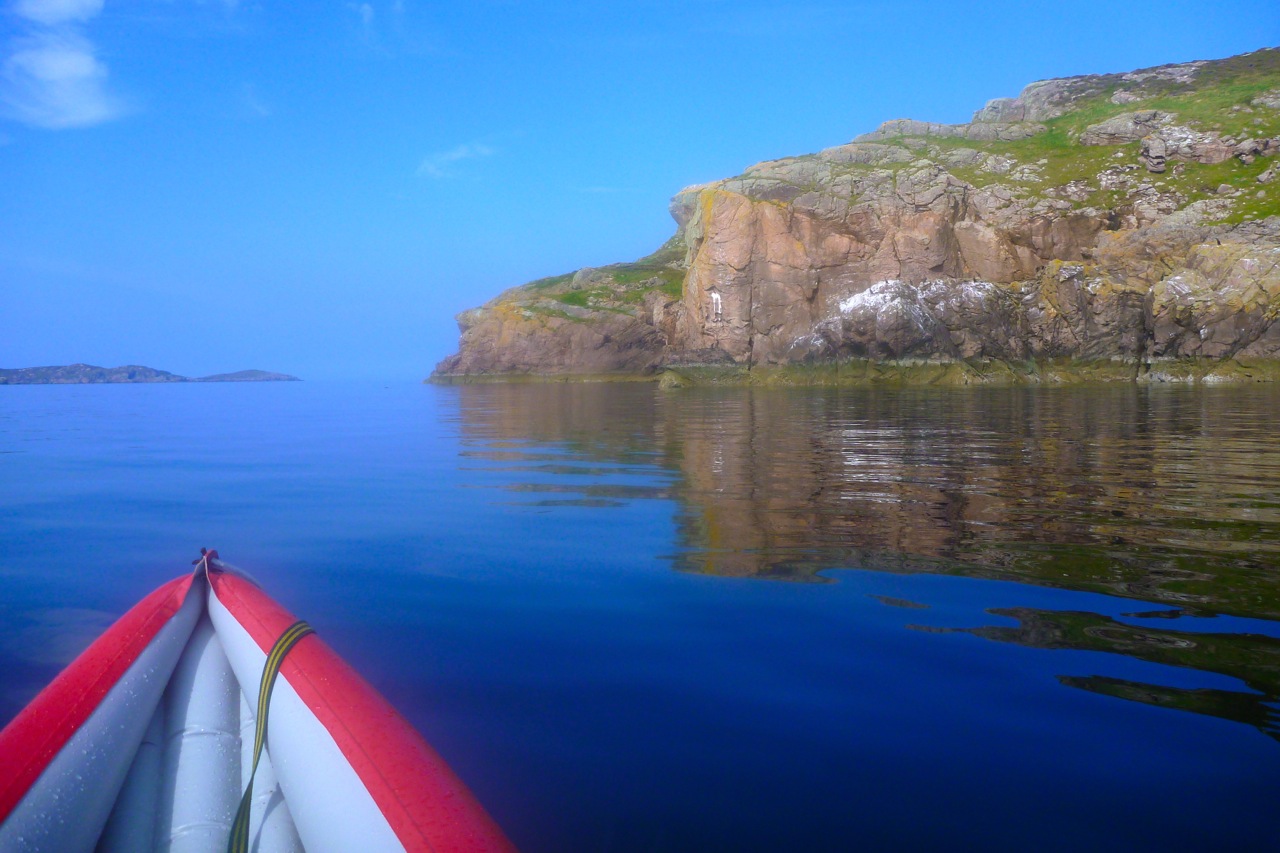
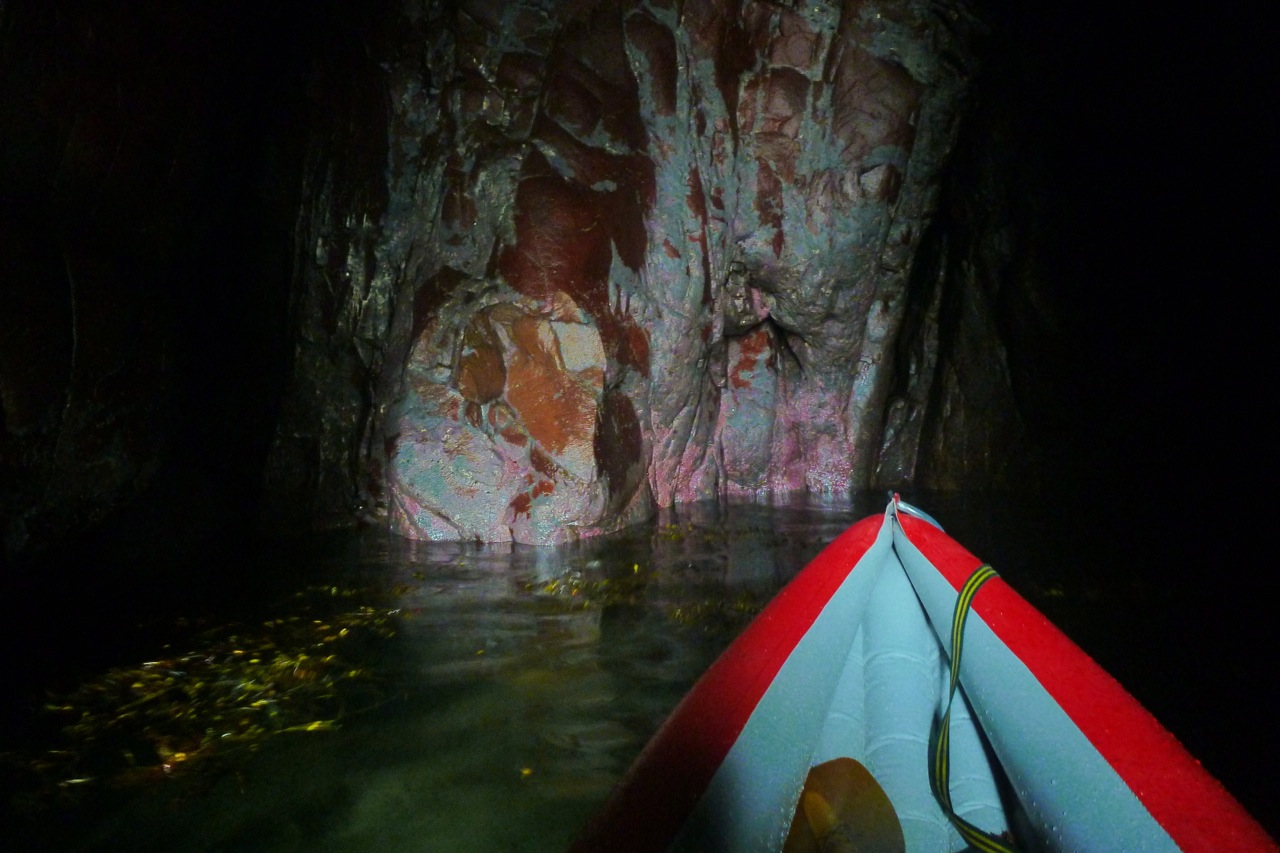
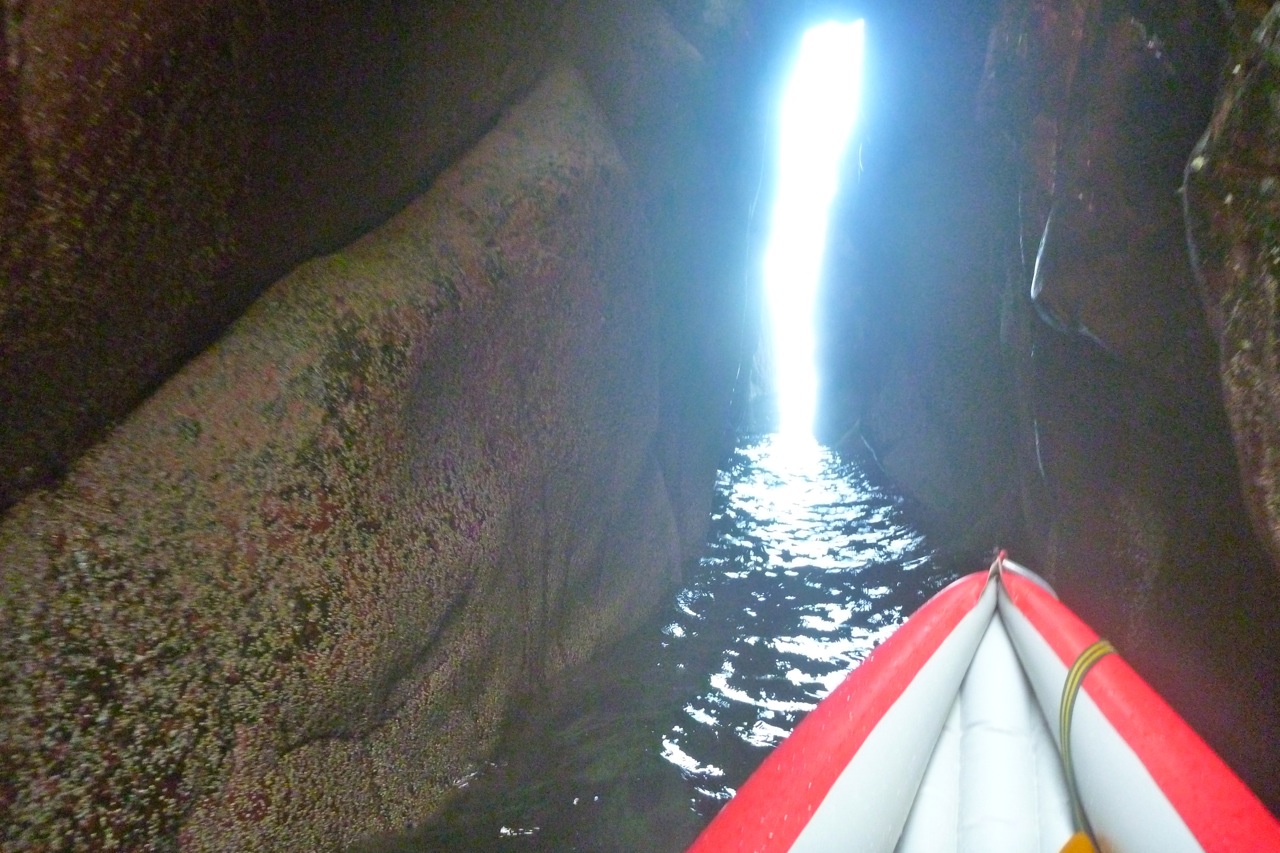
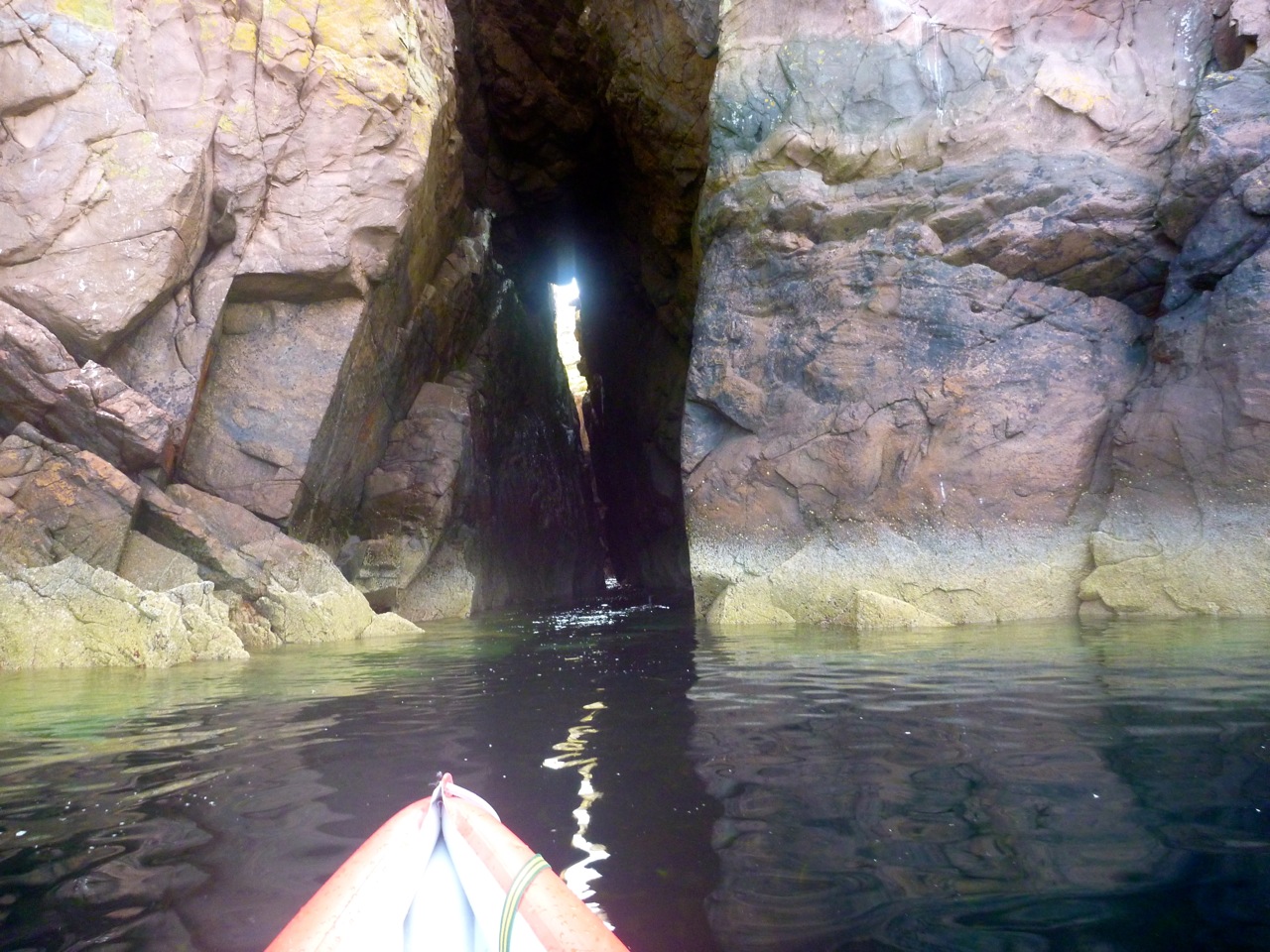
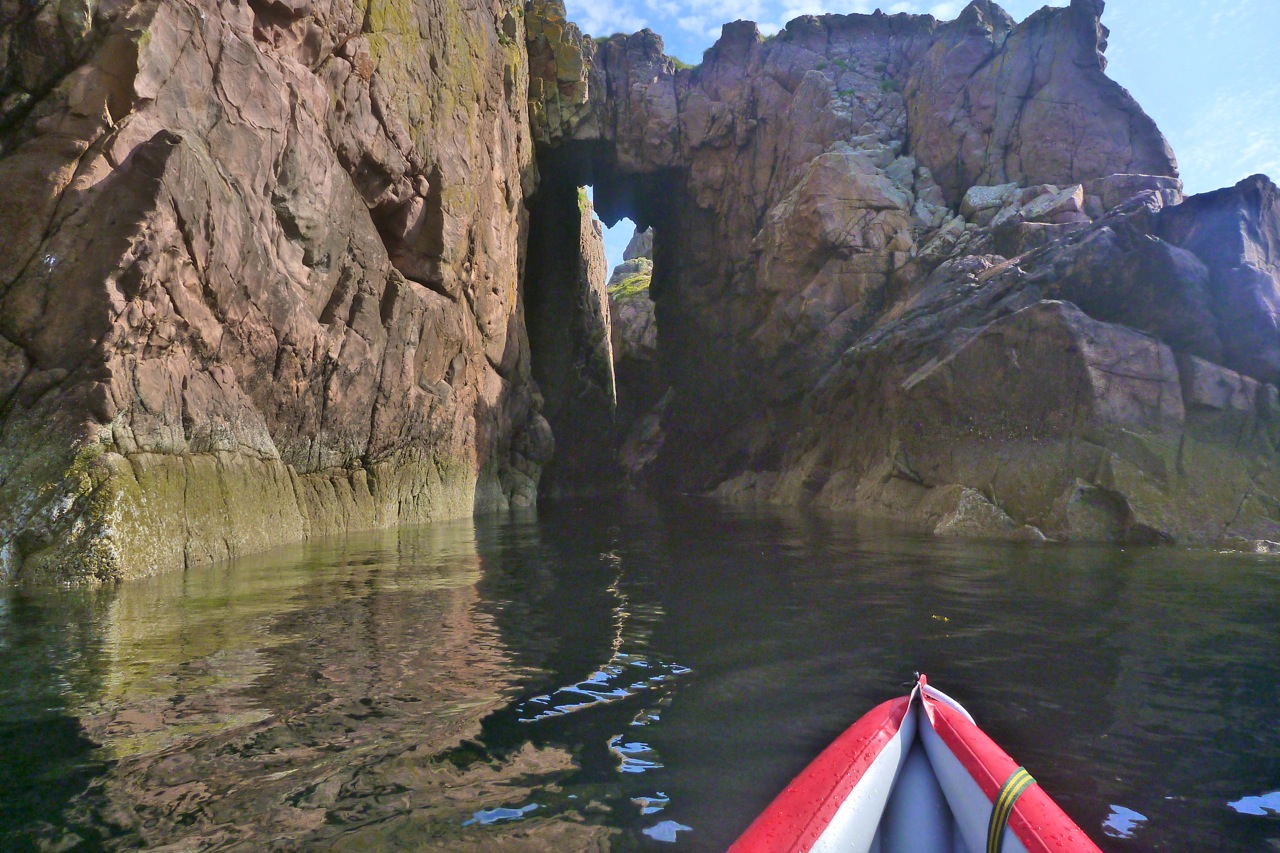
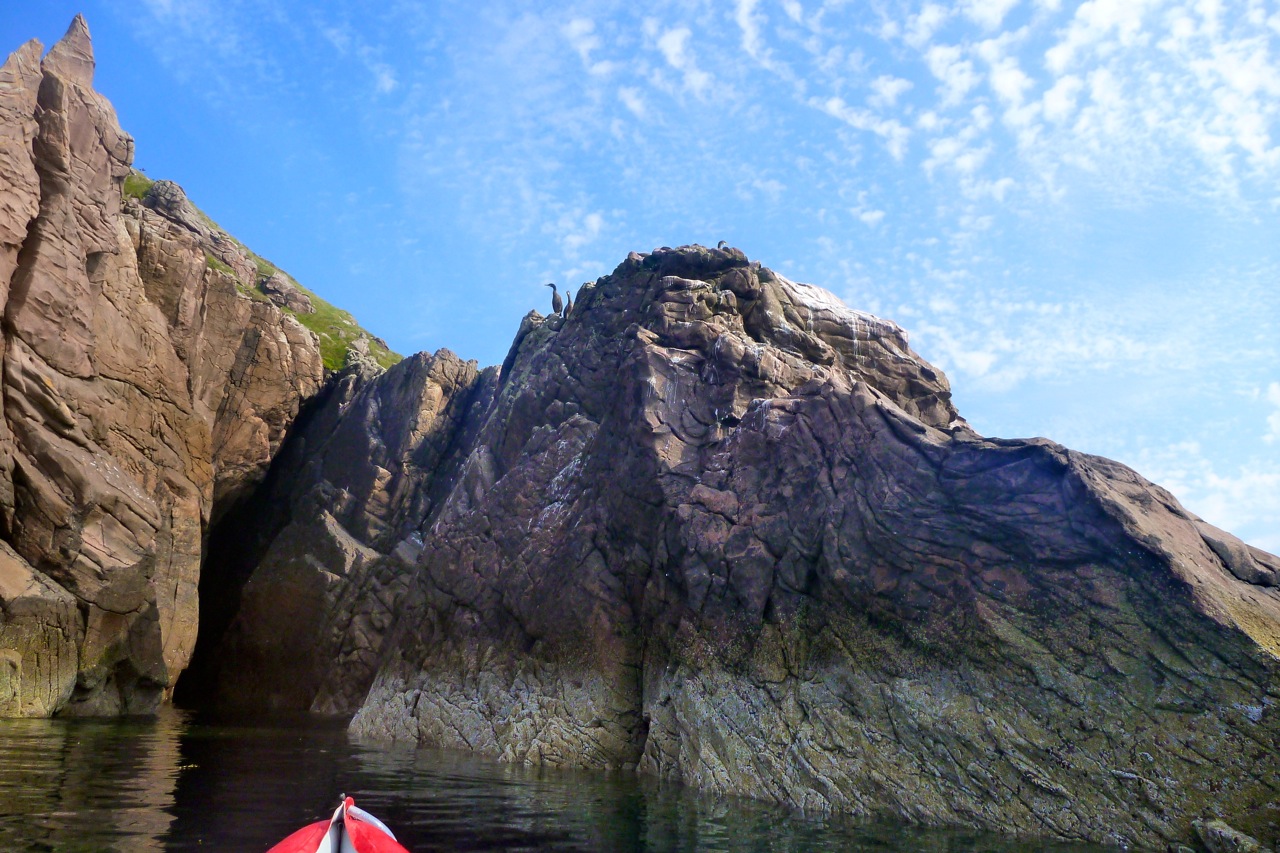
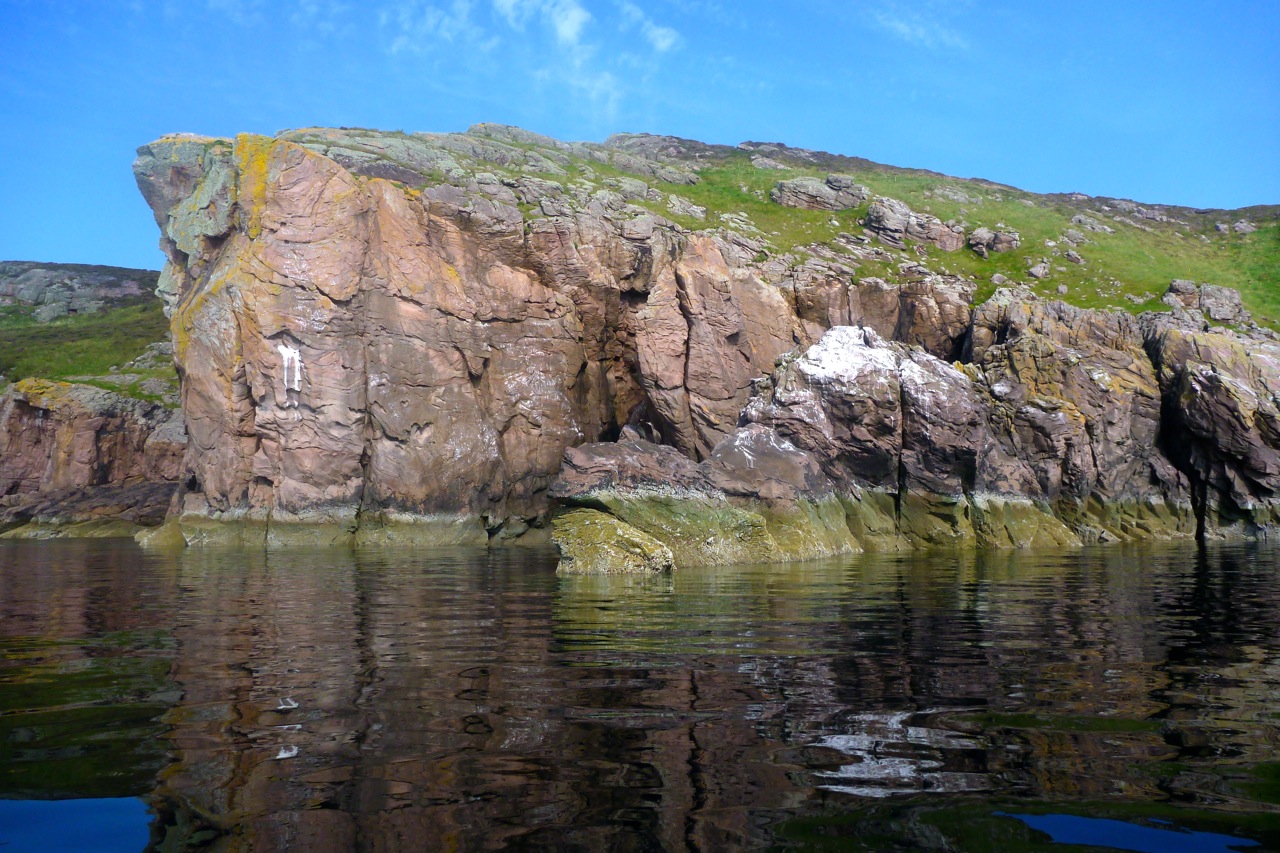
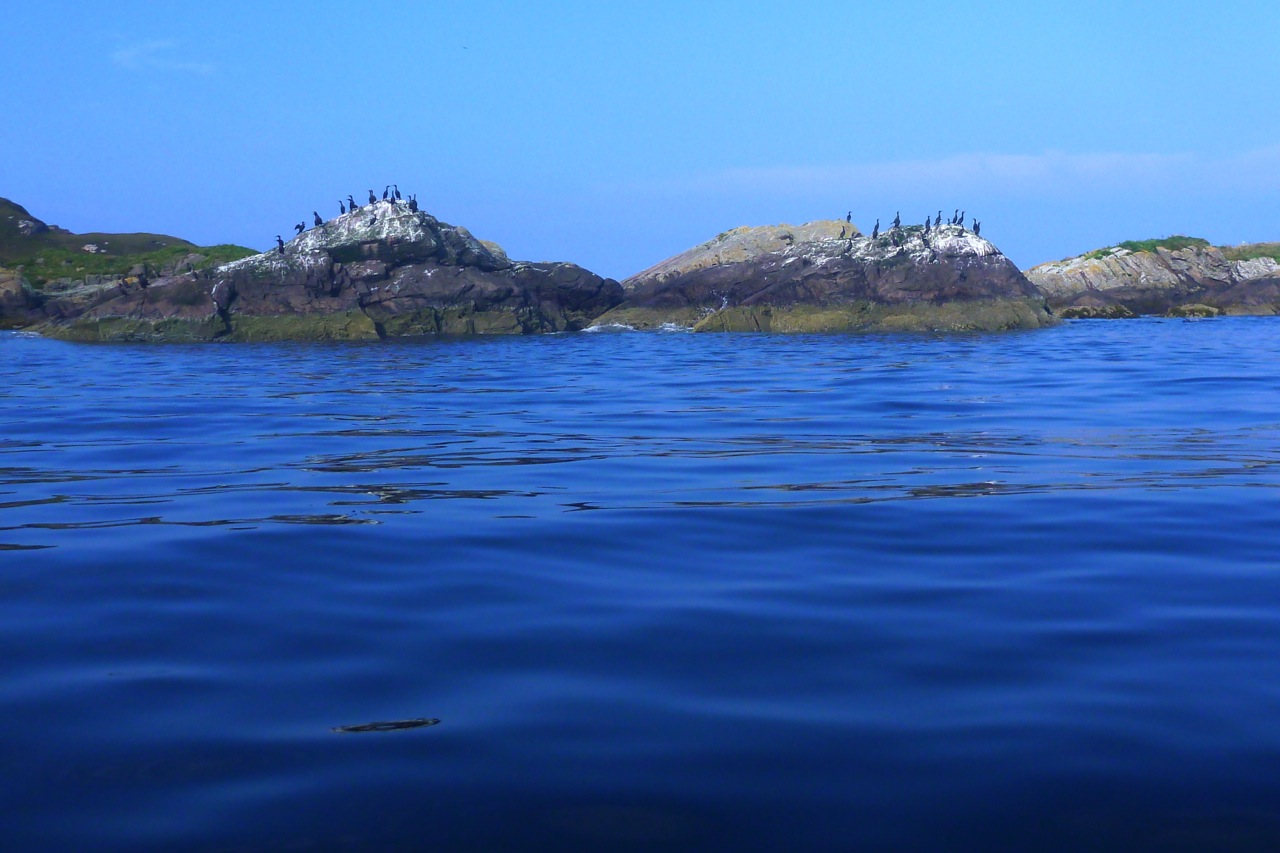
Up ahead, Bottle Island was now only a kilometre away. So far so good: I got there in two hours from the pier after deducting 25 mins nosing around on Eilean Dubh: 3.5mph cruising average. Here I nosed about some more, this time deep into a slotted geo on the south side of the island, where plinky-plonk drips and splashes echoed in the cleft. On the back of the cave the minerals in the Torridon sandstone looked like a gaudy, modern art mural (right) – or maybe petrified viscera.
There was just enough room to turn around in there when an incoming swell revealed another way out. In a corner was a chasm under another arch with an even narrower tunnel leading back out to sea (right). I inched in to see if it was wide enough and safe, then stowed the paddle and pushed through off the walls back out into the open. A double arch sea cave – who would have known!
Two clicks to the west Priest Island looked far enough away to stay that way for now. It’s nice to leave something for next time (aka: ‘hold back to give an impression of calculated caution’).
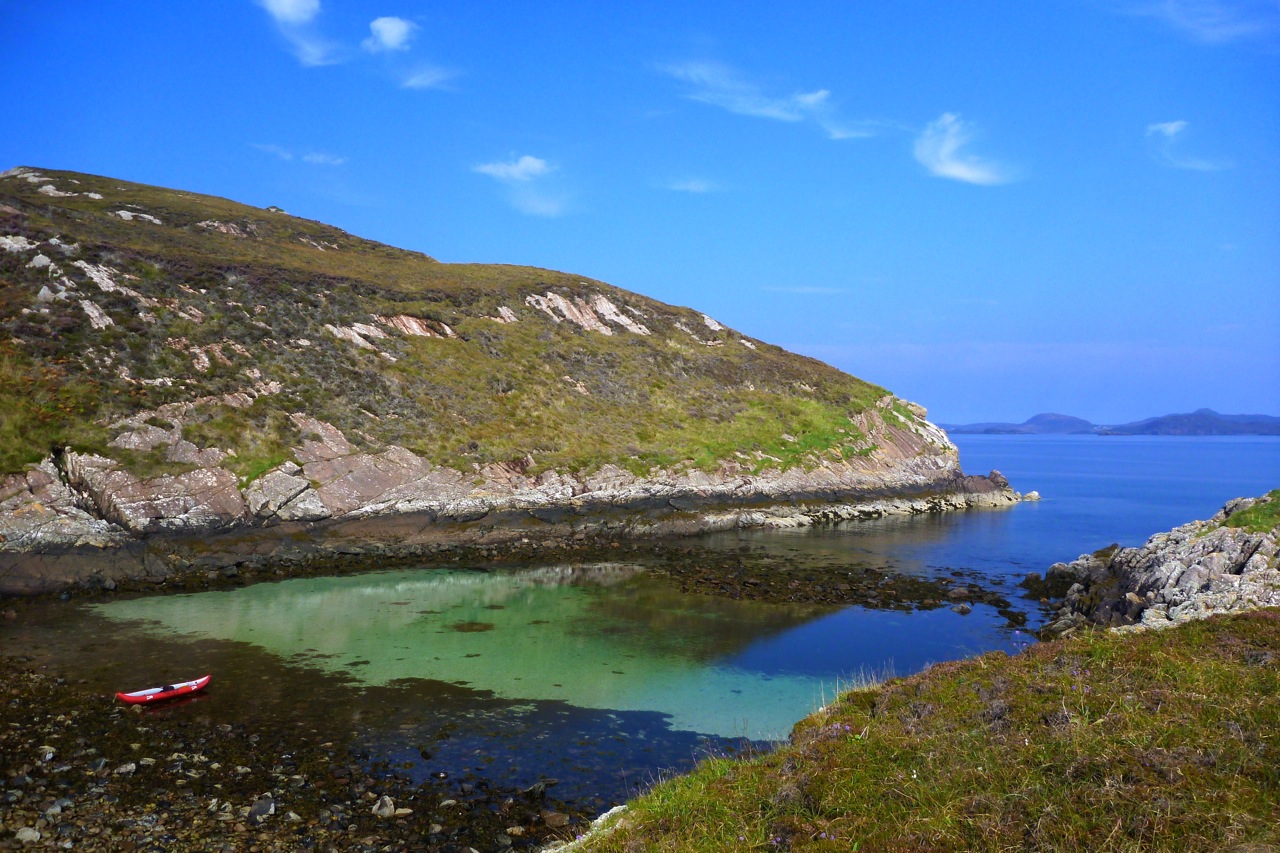
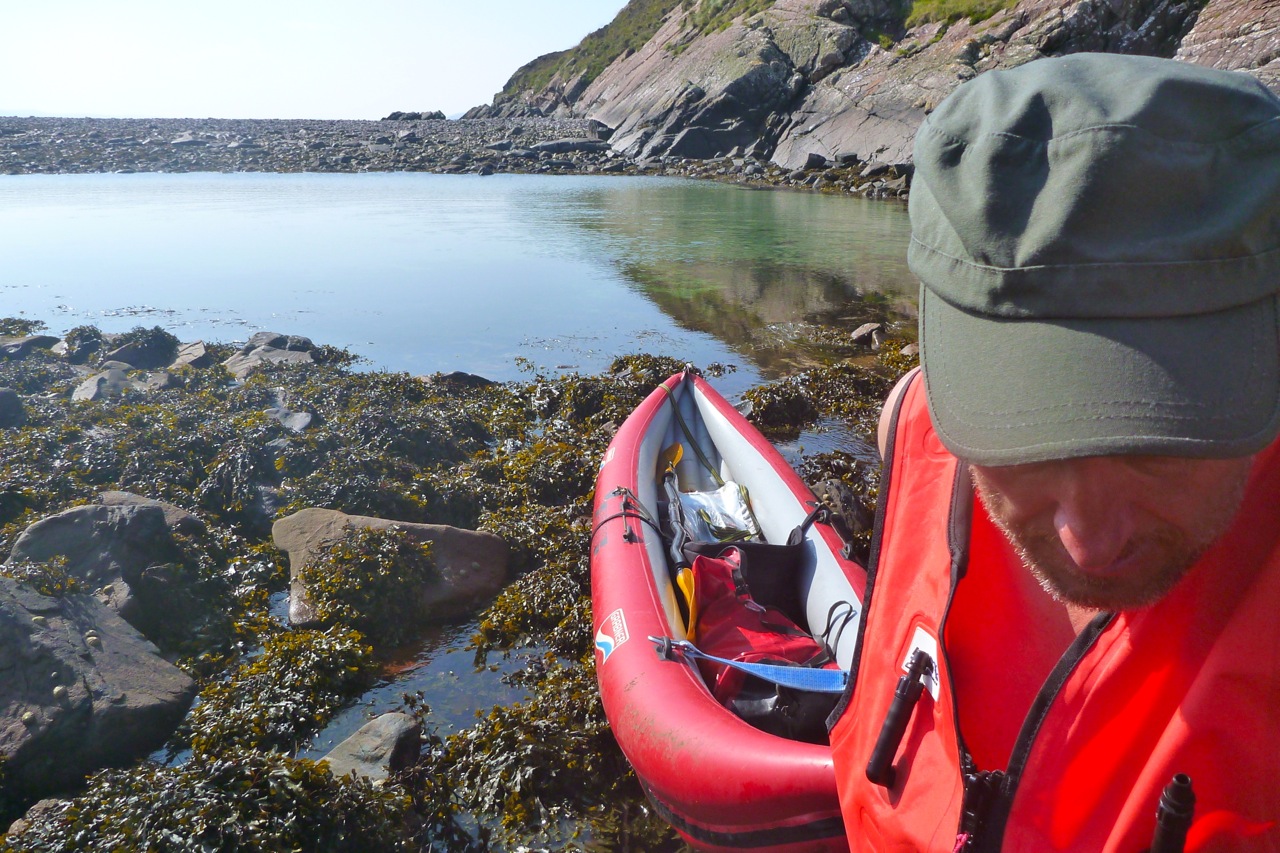
So I turned back north and on the way tried and cut east between Bottle and Carn Iar to get to Carn’s beach for lunch. I didn’t want to eat in the boat if I could help it. But the flow between the islands felt too strong and I didn’t want to burn up energy I might need later. Instead, I got to the north side of that stony isthmus beach that links Carn Iar to Carn Deas, very similar to the ones on Carn nan Sgeir or Horse Island. To get onto it I just about scraped over a rock and seaweed bar into a sandy pool (left), knowing I wouldn’t get back out without a portage. But I wanted to get out of the boat, walk around a bit then have a sit-down.
Up on the grass and heather I ate and drank just about everything I had while down below a gang of seals quietly observed. As I’ve noticed before, these sheep-free islands have verdant and varied vegetation all of their own. I took a doze on a lovely machair sofa, then packed up and waded across the pool to tackle the ankle-breaking portage back out to the sea which has dropped half a metre in the meantime.
Now for the long haul back: 3 miles out in the open to Tanera Sound. I should have dozed in that machair sofa a bit longer: the big feed has taken out my energy and I found myself counting the strokes towards Sgeir Ribhinn skerry, pushing into a light northwest breeze that rippled the surface. After the glassy morning conditions, even waves a few inches high give a noticeable resistance, and for a moment I wondered if the east side of Tanera Mor might be easier. But the speeds later showed I was doing as well as ever at around 3.5 mph – it’s more likely I was unfit for all-day paddling, not having done any since we got here. Again, it makes me think that a speedo (or legible GPS readout) is a good idea as you can verify you’re going better than you feel, despite the impressions of currents and wind. It’s not like moving on land.
Alone out here, too far to swim to even the nearest skerry, you can’t help thinking ‘what if’. What if I somehow caught a stinging jellyfish with the paddle and it landed slap in my face? But the most likely ‘what if’ isn’t that or a sustained swordfish attack, but getting separated from your boat. That’s easily done when thrown out of an IK in an F5, but on a day like today it’s hard to come up with a plausible disaster scenario that would raise the slightest bit of interest in Hollywood. That’s why I ventured right out to Bottle Island.
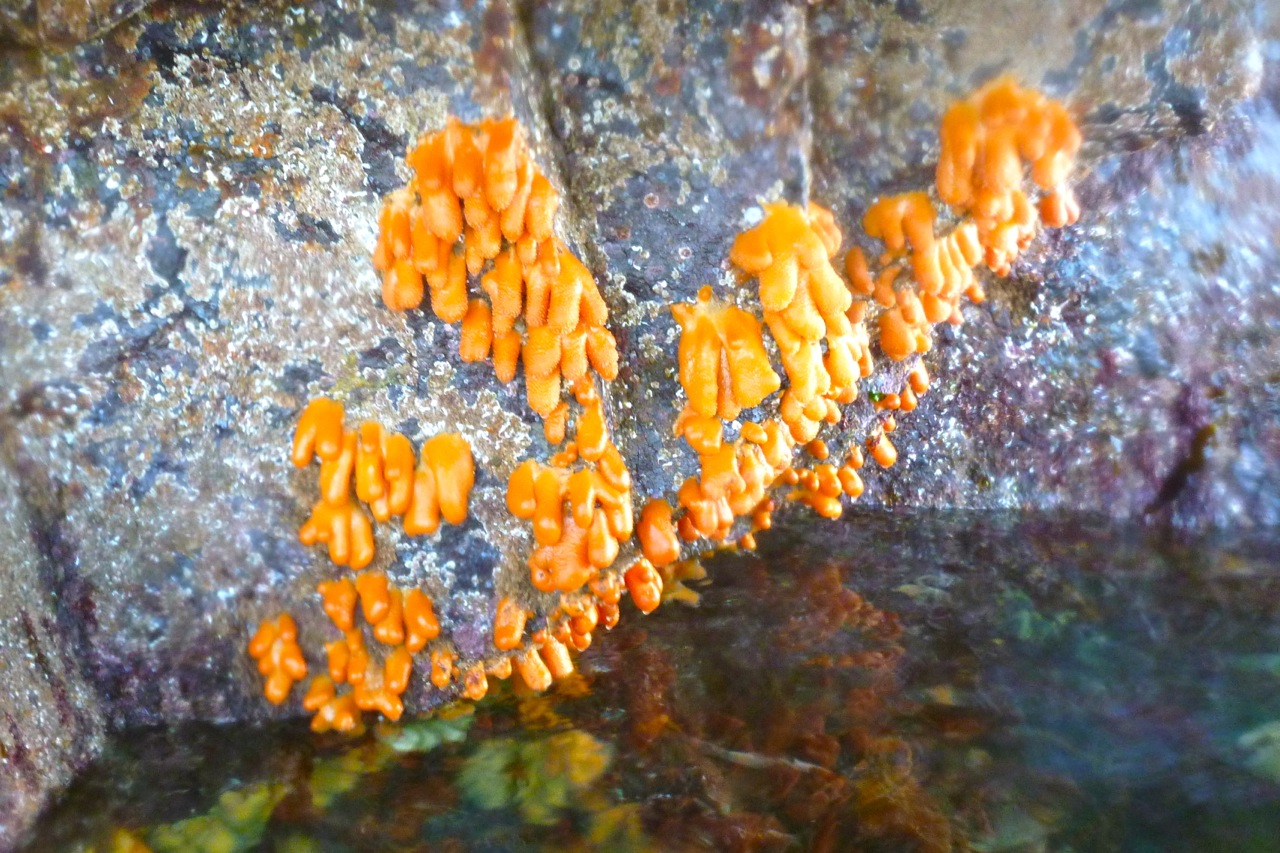
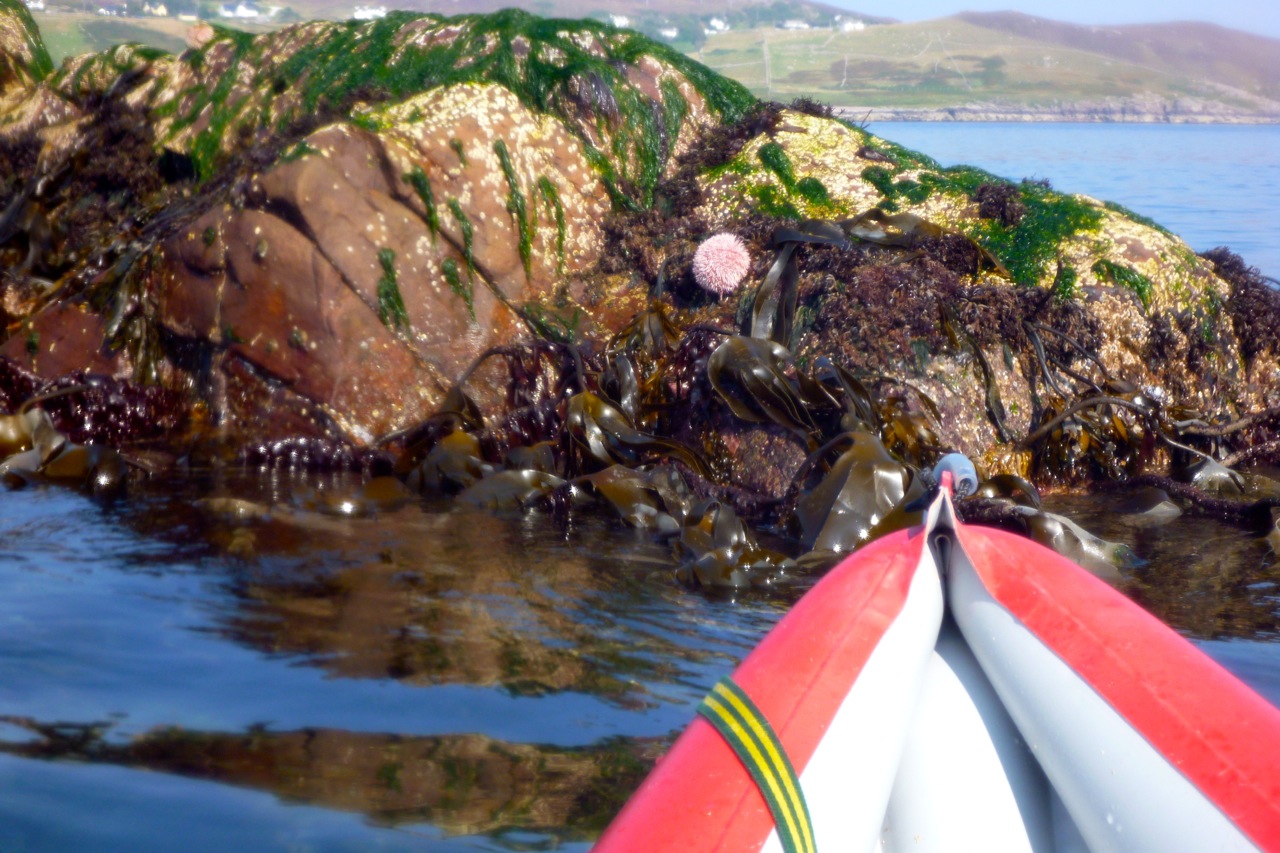
By Low Water I was right in the middle of Tanera Sound. You see new things when the tide is very low: some pendulous orange sponges tucked under an exposed overhang. And on a tidal skerry visible from our window, a prickly urchin of some kind. Don’t want to ram that with my IK.
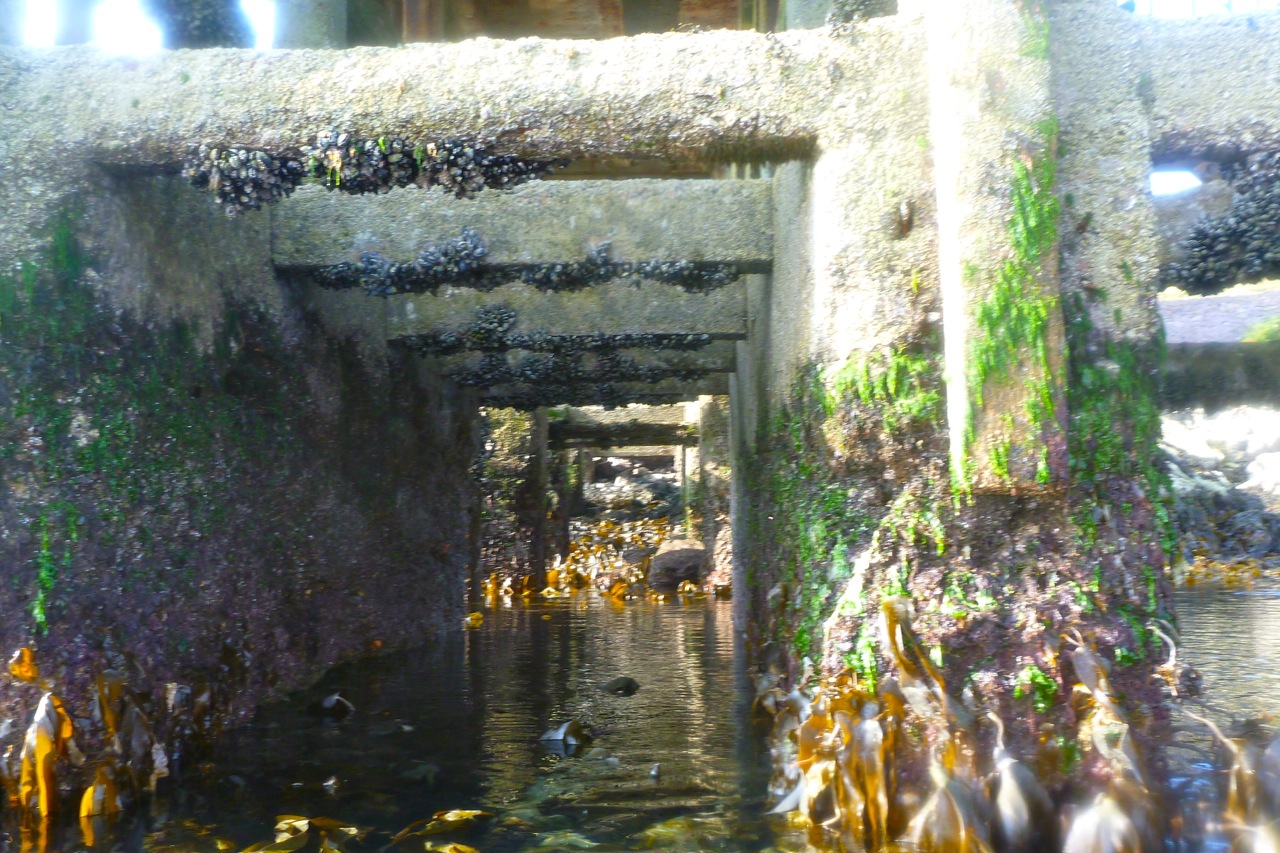
I can see our isolated house on the headland and with only a mile to go, I lie back and drift with the incoming tide drift for a bit. Then it’s back to the pier where the sea is at least 3 metres lower than it was this morning, exposing lower beams encrusted with mussels.
Fourteen miles and 5.5 hours; moving average (not always cruising): 3mph. On a long trip like this I have to say I miss the old Incept’s effortless glide (compare this Incept speed graph with the one below – or read this comparison post). I miss the speed not because the Incept was a bit faster, but because you definitely feel the effort required to push the wider and half-metre shorter Amigo along. The Amigo is even shorter (though much more rigid) than my old Sunny: the shortest IK on my IK comparison table.
All things being equal, that extra bit of speed can enable you to go further or get back quicker. But let’s face it, it’s always a compromise: there are days for fast boats and days for fun boats. I’m here and still breathing. My Amigo is an easy boat to live with – and a lot better than pushing a bathtub around on a trolley.
Not much time for paddling at the moment, but with a staggering three days of cloud-free skies while the south had its traditional wet bank holiday, we had to down tools and go and do something. How about another walk over Suilven and paddle back – was last time three years ago already? The motorbike was left at Inverkirkaig, so this time it was just a paddle-and-boot ‘biathlon’.
With the car parked near Glencanisp Lodge, it’s about a 2-hour walk along the estate track to the turn-off leading up to Suilven saddle. On the way we pass Suileag bothy where Jon and I overnighted in May, tackling an Assynt variant on the Cape Wrath Trail.
It’s only a mile and a quarter from the estate track to the saddle, but with the 430-metre rise, it takes up to an hour. The washed-out last few feet onto the 600-metre-high saddle are on all fours. Above at the back, Quinaig, one of the best of the Assynt mountain walks. No packraft required.
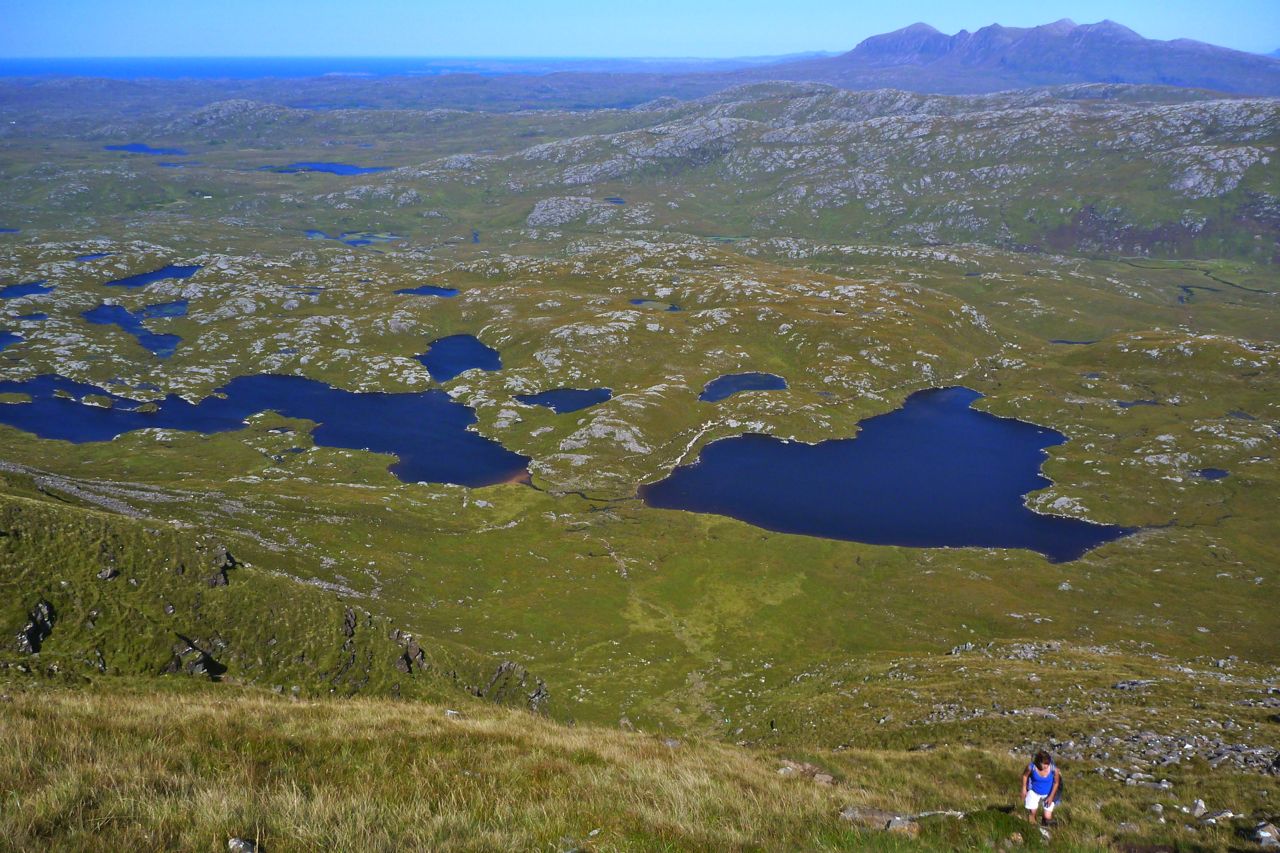
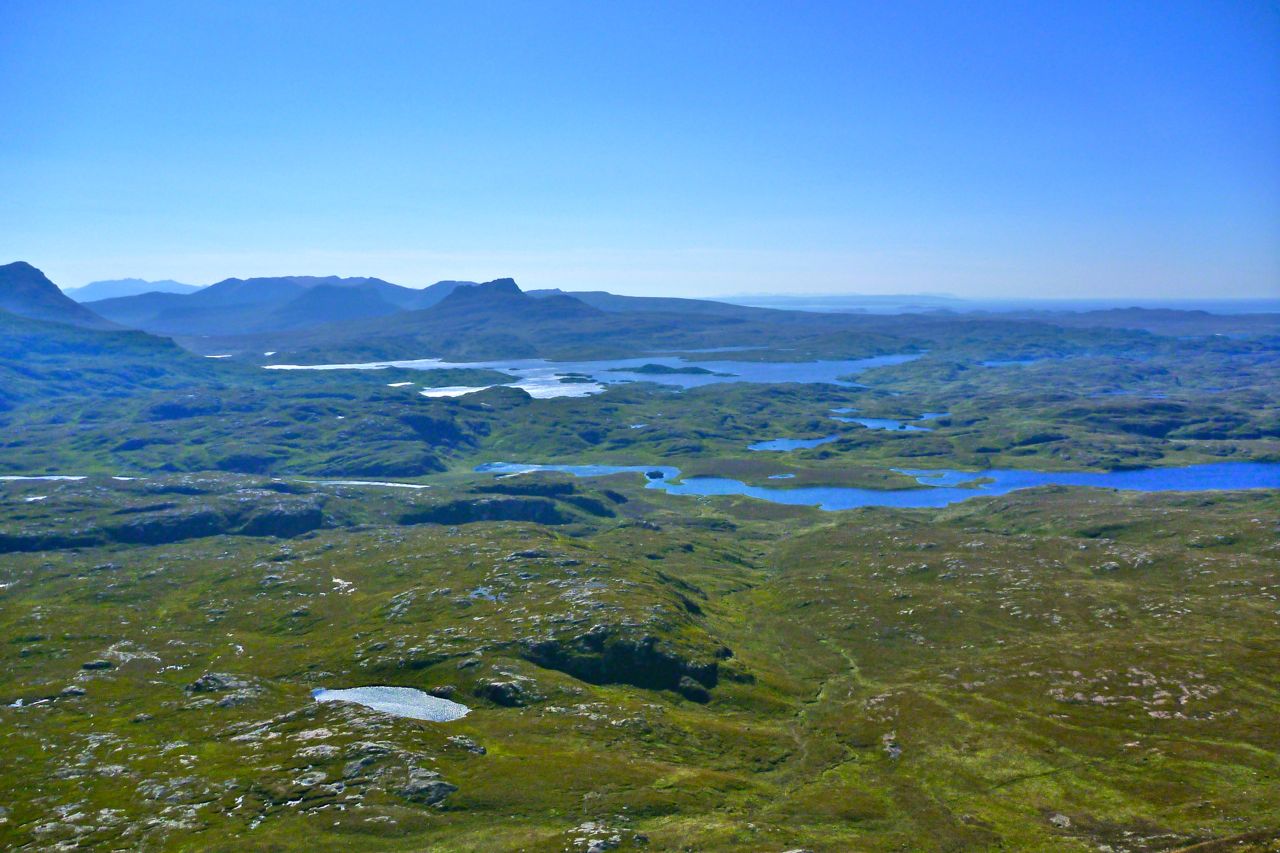
At the breezy saddle it’s quite busy – well, ten people or so – so we decide to lounge around and not visit the 731-m summit, nice grassy spot though it is. Far down below on Fionn Loch, we think we can see three canoes heading upstream towards the canoe camp alongside the rapids (more or less the middle of the picture, above). But they’re moving so slowly, for while I thought I was mistaken. Soon we’d realise why they were creeping along at about one foot a second.
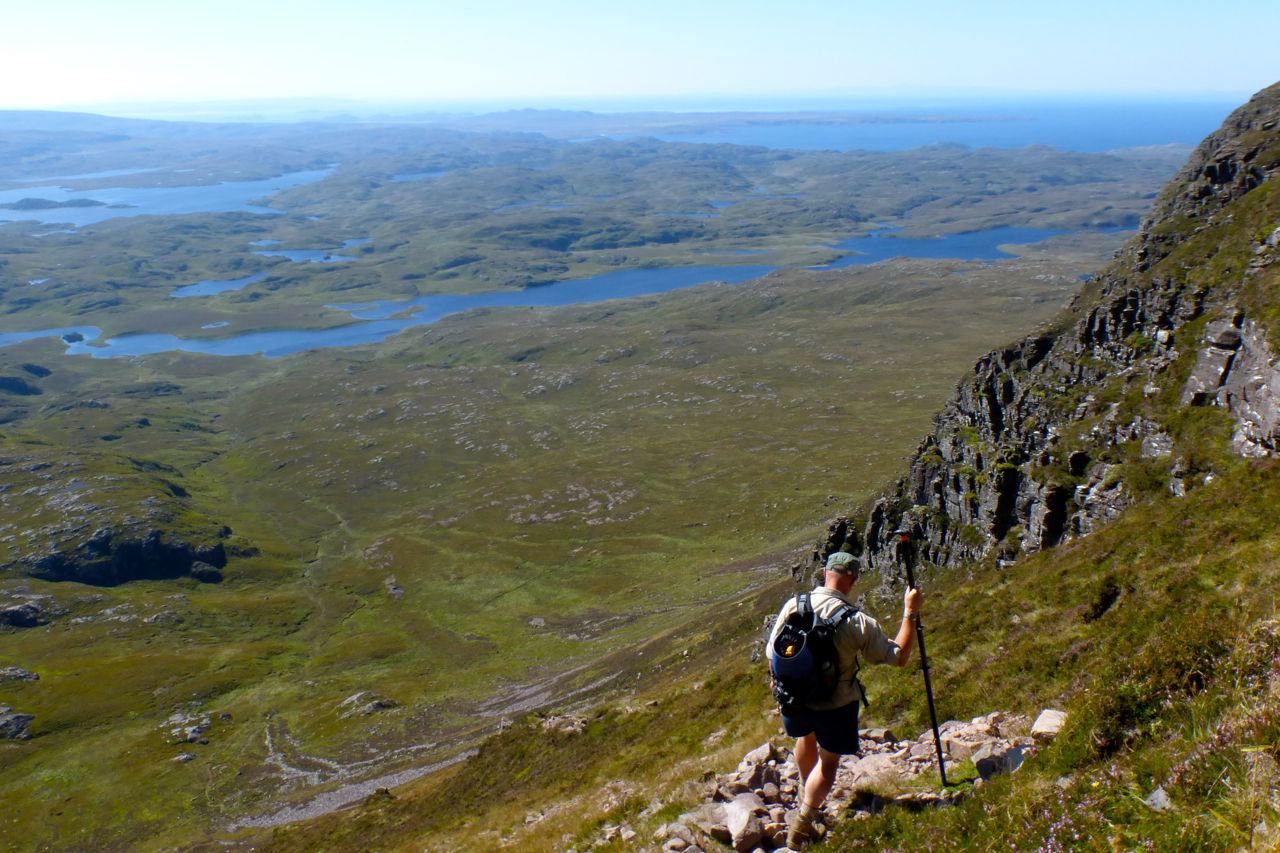
We set off down the exceedingly steep south side of the mountain.
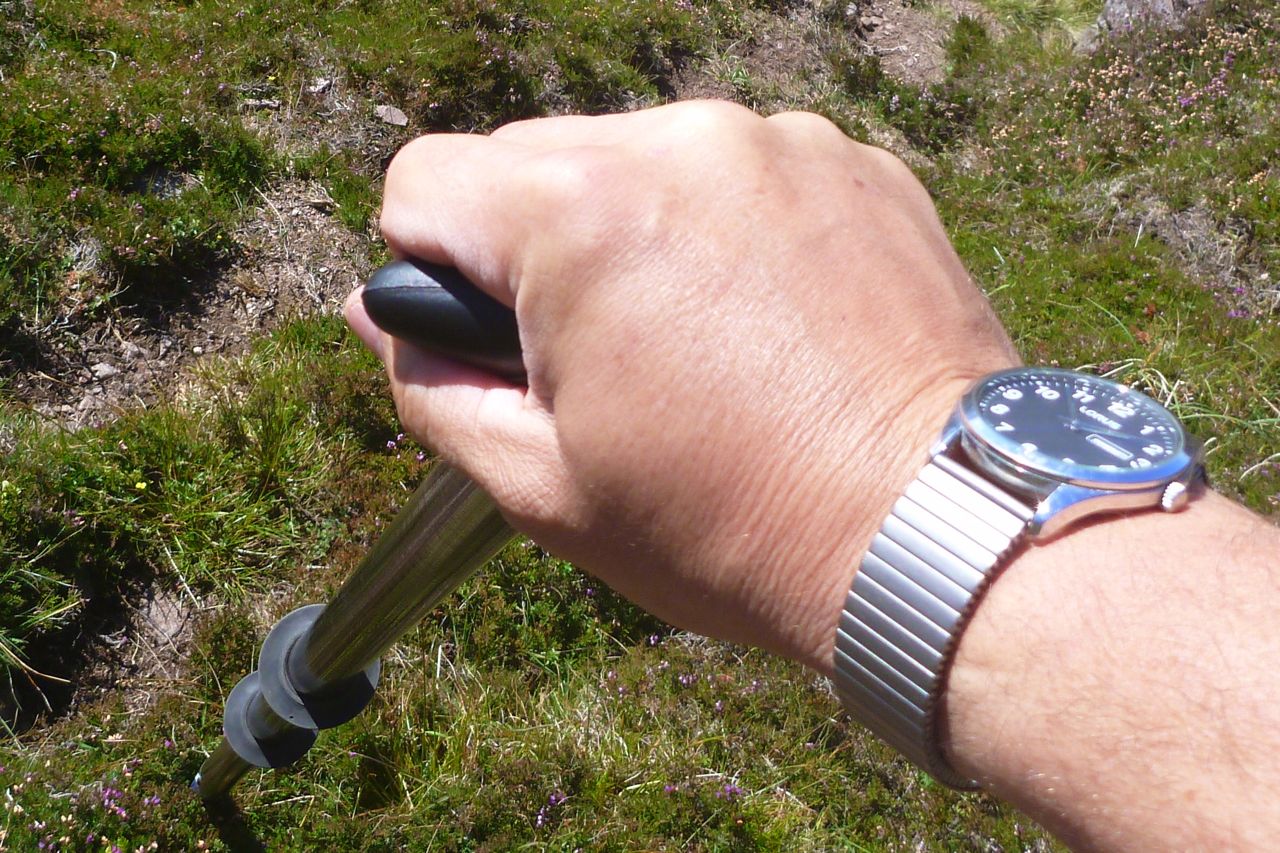
Here I get my first chance to appreciate the canoe-handle T-piece I’ve added to the end of my packstaff. It makes a much better support when inching down steep slopes, and the long packstaff can reach down a foot below your boots. Anyone would think I was going on about packstaffs again.
Coming off Suilven, the gradient begins to ease. By Fionn lochside a strong easterly is blowing and the packraft fills up almost by itself, even if the boat is on the verge of taking off. This looks a lot more than the 15-mph forecast. The wind will blow us downstream, but it looks rather gnarly out there, and we’re only at the ‘top’ of the fetch. It’s about a mile and a half along the loch to the river inlet and will get choppier downwind.
Visiting baboons might enjoy a view of my butt patch – glued on with Bostik 1782 and (appropriately) lined with gorilla-tape. Even though the 2014 Alpackas have a bit more back-end buoyancy (as we were about to find to our cost), for the weightier and lazier paddler, a butt patch offers useful protection in the shallows.
Did I say it’s very windy? And to make matters worse I’m rather careless about the weight distribution, forgetting how we did it last time in much calmer conditions. With the packs in the middle of the boat and the Mrs’ legs tucked in, instead of reaching back, the bow was noticeably low.
Once out midstream, the bow started swamping in the chop which was a little alarming. The restful 1.5-mile downwind paddle to the river inlet is abandoned. I tell the Mrs to lean towards me, and I paddle across-wind for the other bank. The odd wave splashes over the side.
We could have tried again with the packs on my back, but were a bit unnerved. As it is, two-up the boat was a little hard to handle in the wind, and we have no pfds. So the Mrs takes to the bank – a long detour around a lagoon – while I tip out the boat then allow the wind to whip me along the loch, pulling over to wait once every few minutes.
I’m not sure I want to engage with the wind funnel at the ‘narrows’ of Fionn Loch, as by now the whitecaps and chop are getting it on. Plus I’ve lost track of the Mrs. So I pull over and stagger over the bogs to see where she is.
Reunited, we’re effectively on the south side of the Kirkaig river, so are still going to have to paddle across to get to the north side for the regular path back to the car park. I recall the river entrance nearby is in another bay which will be out of the easterly fetch. With better thought out trim, that crossing should be less risky.
I know from previous experience that trying to carry an inflated packraft even five minutes to the bay in this sort of wind will be like trying to wrestling a pterodactyl. So out with the plug and under my arm it goes. That’s the great thing with packrafts: they’re as easy to paddle in as they are to walk with, though there’s probably a more elegant way of saying that.
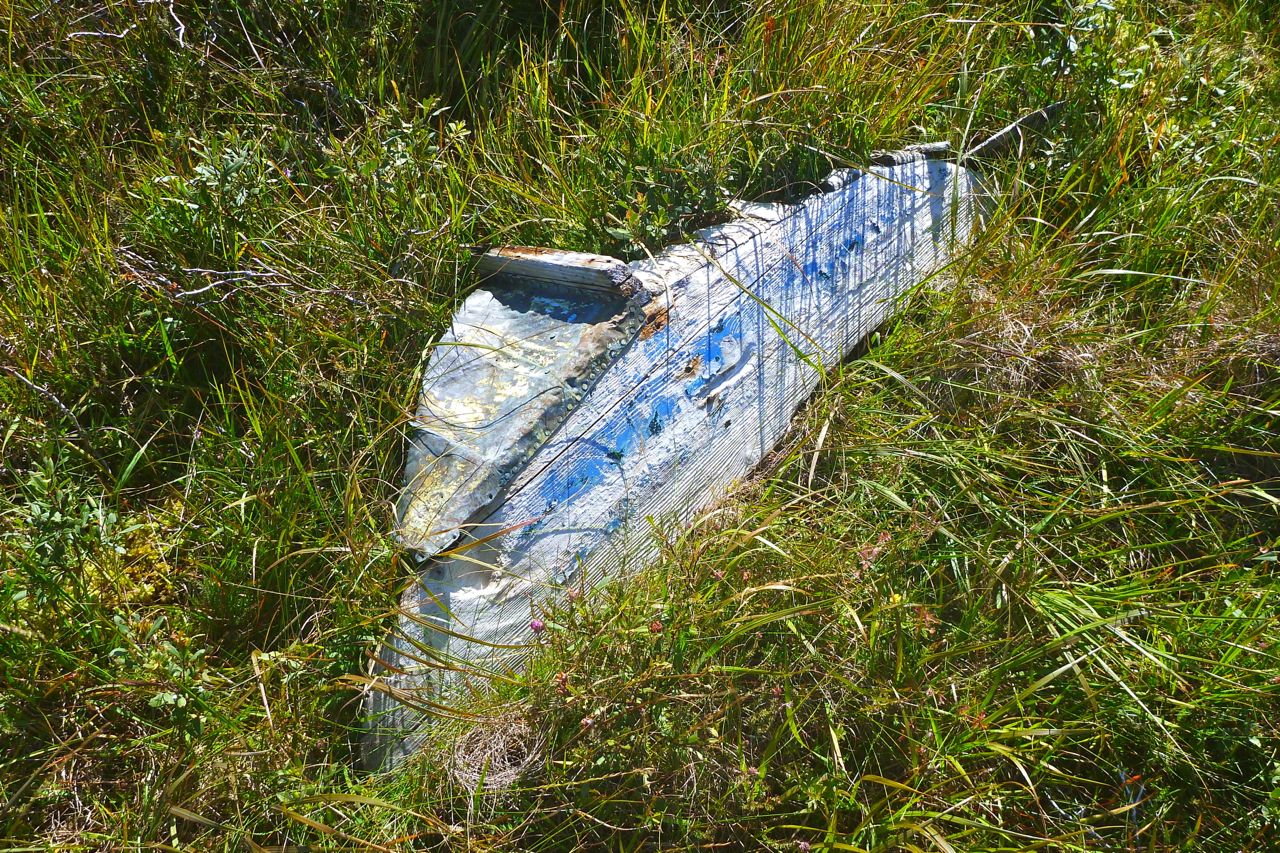
This rotting transom is all that remains of the last boat that came this way.
Another quick air up…
…and we set off across the small bay…
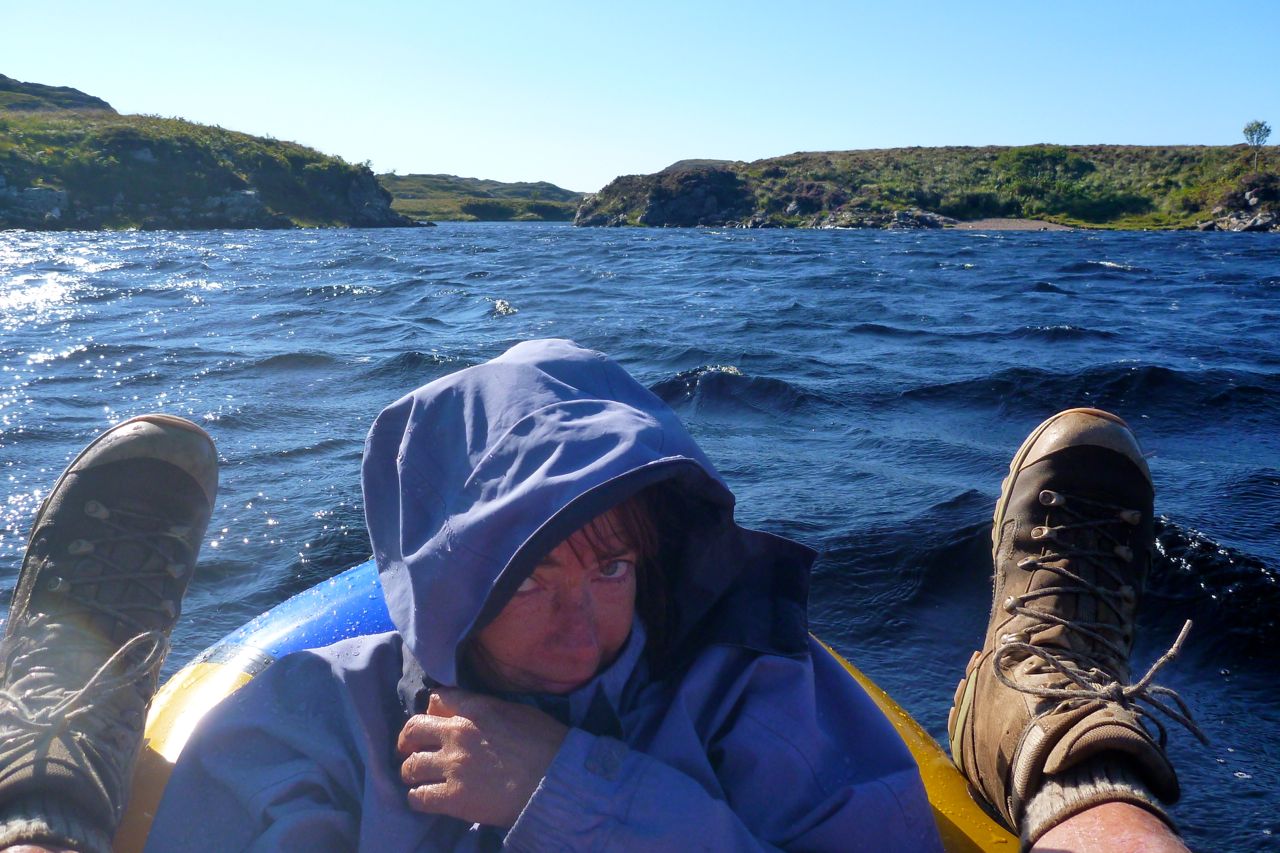
…for a small beach by the river entrance (above my right boot). Two up with the wind, I don’t want to get involved with the swift current flowing through the inlet towards bone-crunching waterfalls.
Back ashore I roll up the Yakpacka…
…and we set off for the 3.5-mile walk back to the bike at Inverkirkaig. And even here on the path the wind nearly knocks we over a couple of times. It was only an 11.5-mile day (10 for me on foot + 1.5 paddle), but by the time we get back to the bike we are pooped. Luckily, this year we have a lovely house to go back to.
As we’re normally way up north for the British summer, I’ve forgotten how great a sunny 26-° southern English day feels. It’s been years. If it was France it’d be normal, but in the UK it’s not which adds to the magic. A perfect day then to bang out a Medway run from Tonbridge to Yalding in my newish Alpacka Yak. Even the wind was up for it, with a stiff, 15mph breeze forecast from the southwest.
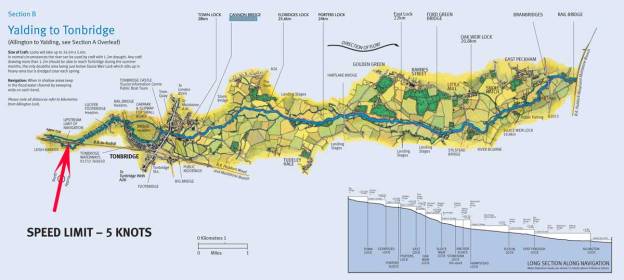
With shoes, shirt and pfd in the wet bag, I slid down the chute off Tonbridge’s Town Lock, sat up straight and set sail. Overhead the wind was lifting the leaves, exposing their lighter underside, and with the river course (below) oriented right on it, I suspected this was going to be a good run. Eldridge Lock chute rolled up in under 20 minutes and that felt like at least a mile (1.3). And with no shoes or pfd the Yak felt roomy so I pushed the backrest low to get nicely jammed in. Paddle at eye level, a full draw from the feet, and I crack on.
Porters Lock already? OK then. How far is it to Yalding, anyway? Twelve something; couldn’t remember if it was kms or miles (13km), but I knew when we did it last June in my new IK that I was pooped well before the end. After Porters I pass some canoe-ers crouched on the floor of their boat, battling upstream. There’s no current but they’re sure fighting the wind. Further down the river, a couple with a camo-pattern IK are lunching by one of the locks. With the trees in full summer bloom and yellow lilies at the banks, in places the pea-soup Medway could pass for a backwater in Kakadu, with salties lurking in the shallows, eyeing up wading jabirus.
Sluice Weir Lock
Much sooner than expected it’s the big slide down Sluice Weir Lock (above) which I knew was near the end. The short Yak surfs over the frothing base a lot better than a nose-burying kayak. I took no water on any of the chutes and the backwind even helped keep the paddle splash off me. After a quick visit to water the bushes, I top off the seat and hull. Holy moly, now the firmed up Yak is skimming along like a surf ski under the big-bladed Corry paddle. This last section was a l o n g haul last time, but I power on and there is, the Anchor Inn at Yalding. Don’t want to eat there again, so I finish off my water and check the watch. Two hours twenty. That seems fast; it was an all-dayer last time.
It’s another 5-10 minutes scoot down to the take-out at Hampstead Lock and a short walk to the station where it costs over a fiver to ride three stops back to Tonbridge. When I get home I Google Map the river distance: 7.5 miles or about 12 clicks to the Anchor. In two twenty that’s a pretty surprising 3.4mph or nearly 3 knots. I’d be pleased with that in my 14-foot IK, but in dumpy packraft? Not bad at all.